



Abstract
Background
In increasingly dynamic and innovation-driven healthcare environments, fostering intrapreneurship among employes is critical for organizational resilience and progress. While proactive personality traits are known to support such innovative behaviors, the broader organizational climate—particularly the presence of organizational cynicism—may significantly constrain this effect. Research exploring this interaction remains limited, especially in healthcare settings.
Objective
This study aims to examine whether organizational cynicism moderates the relationship between proactive personality traits and intrapreneurial behavior among healthcare professionals working in public hospitals.
Methods
A cross-sectional survey was conducted with 330 healthcare workers from public hospitals in Niğde, Turkey, between July and December 2021. Data were collected using validated instruments measuring proactive personality, organizational cynicism, and intrapreneurship. Statistical analyses included descriptive statistics, Pearson correlations, regression analysis, structural equation modeling (SEM), and Hayes’ PROCESS macro (Model 1) for moderation testing with 10,000 bootstrap samples.
Results
Findings revealed a significant positive association between proactive personality and intrapreneurship (r = .422, p < .01), and a significant negative correlation between proactive personality and organizational cynicism (r = −.430, p < .01). Regression analysis confirmed the positive impact of proactive personality on intrapreneurial behavior (β = 0.044, p < .001). The moderation analysis showed that organizational cynicism significantly weakens this positive relationship (β = −0.062, p < .05).
Conclusions
These results highlight the critical interplay between individual traits and organizational culture. While proactive personality enhances intrapreneurship, high levels of cynicism undermine this effect. Reducing organizational cynicism and fostering trust-based environments may amplify the benefits of proactive traits in healthcare institutions.
Keywords
Introduction
In today's competitive business environment, organizations rely on employes with distinctive qualities who can quickly adapt to changing conditions in order to succeed. Bolino et al. (2010) emphasize that employes’ characteristics play a critical role in enabling organizations to achieve a competitive advantage. In this context, proactive personality, organizational cynicism, and intrapreneurship have emerged as key constructs for understanding how employes contribute to positive organizational outcomes and sustainable competitive advantage. 1
As organizations continually pursue innovation and development, proactive personality traits and intrapreneurship have attracted increasing attention. Proactive individuals are those who lead change, seize opportunities, and generate innovative solutions, while intrapreneurship refers to the creation and implementation of new ideas, products, or processes within an organization. 2 Parker et al. (2010) define proactive personality as the tendency of individuals to take initiative in solving problems and capitalizing on opportunities. 3 Employes with proactive personalities can introduce novel ideas, enhance business processes, and develop innovative solutions, thereby strengthening an organization's capacity to adapt to dynamic market conditions and sustain competitive advantage.
Proactive personality traits—including being active, enterprising, open to innovation, and responsible—enable individuals to identify opportunities in their environment and foster the emergence of new ideas.4,5 These traits support intrapreneurial behaviors by encouraging employes to develop their own projects, take calculated risks, and engage in innovative initiatives. 6 Organizations benefit from such employes, as they can cultivate an intrapreneurial culture, improve organizational performance, and reinforce competitive advantage.7–9 Consequently, promoting proactive personality traits and recognizing employes who exhibit these behaviors can maximize intrapreneurial potential and enhance organizational success in dynamic business contexts. 3
However, organizational cynicism can undermine these positive effects. It is characterized by employes’ distrust and negative attitudes toward the organization. 10 According to James, individuals exhibiting organizational cynicism lose confidence in organizational goals and consistently adopt a critical stance at work, which can reduce motivation, decrease job satisfaction, and contribute to a negative work environment. Prior studies indicate that organizational cynicism adversely affects intrapreneurship and job performance across various professions. For example, Uzun (2018) reported a negative relationship between organizational cynicism and teachers’ intrapreneurial behavior and job performance 11 ; similarly, Akdemir et al. (2016) and Kahya (2013) observed negative effects among university staff and academics,12,13 and Bacaksız et al. (2018) documented this pattern among nurses. 14 These findings suggest that organizational cynicism can act as a barrier to employes’ entrepreneurial tendencies and organizational contributions.
In light of this, the present study examines the impact of proactive personality traits on intrapreneurship and investigates the moderating role of organizational cynicism in this relationship. Understanding how organizational cynicism influences the link between proactive personality and intrapreneurship can help organizations develop effective strategies for managing innovation and change.
This study addresses a gap in the literature, as no prior research has simultaneously examined proactive personality traits, intrapreneurship performance, and organizational cynicism in healthcare settings. Based on the literature, it is hypothesized that proactive personality traits positively influence intrapreneurship, that organizational cynicism negatively affects intrapreneurship, and that organizational cynicism moderates the relationship between proactive personality traits and intrapreneurship. Accordingly, the hypotheses are:
Methods
Procedure
This study employed a descriptive-correlational, cross-sectional survey design to examine the relationships among proactive personality, organizational cynicism, and intrapreneurship. The study was conducted and reported following the Strengthening the Reporting of Observational Studies in Epidemiology (STROBE) guidelines to ensure methodological transparency and rigor.
Data were collected between July 1 and December 31, 2021, using a mixed-mode approach that included both face-to-face interviews and online surveys to maximize accessibility and response rates. Given the demanding schedules and workload of healthcare professionals, an online survey was offered as a practical alternative. The survey instruments were digitized using Google Forms and distributed via email and WhatsApp. Respondents were instructed to complete the questionnaire at their convenience. For face-to-face participants, data collection was conducted in private settings to minimize external pressure and ensure confidentiality.
Participants were assured that each survey would be completed individually, reducing potential response bias. On average, survey completion required approximately 10 min. This dual-mode data collection strategy enabled broader reach while accommodating the working conditions of healthcare professionals, thereby enhancing the robustness and inclusivity of the sample.
Population and sample
The target population comprised 2027 healthcare workers employed in public hospitals in Nigde province, Turkey, including 792 midwives/nurses, 467 other healthcare professionals, and 768 administrative staff. Due to the challenges associated with accessing the entire population, the required sample size was calculated as 324 individuals using PASS 11 (NCSS Statistical Software, Kaysville, UT, USA), assuming an effect size of 0.30, a margin of error of 5%, and a statistical power of 0.80.
The study sample was selected through stratified random sampling based on service category and staff numbers within each hospital. A total of 330 healthcare workers voluntarily participated, including 130 midwives/nurses, 80 other healthcare personnel, and 120 administrative staff. Participants were fully informed about the study, and only those who provided consent were included, with each individual completing a single response.
Inclusion criteria required participants to have at least one year of work experience at their current institution and not hold a leadership position. Exclusion criteria included holding a leadership role or providing incomplete or inconsistent survey responses.
Instruments
Data were collected using the Socio-demographic Characteristics Form, the Proactive Personality Scale (PPS), the Organizational Cynicism Scale (OCS), and the Intrapreneurship Scale (IS).
Sociodemographic characteristics form
This form included questions about participants’ descriptive characteristics, such as gender, age, education level, marital status, department of employment, total work experience, and duration of employment at the current workplace.
Proactive personality scale (PPS)
The PPS, developed by Bateman and Crant (1993), assesses individuals’ proactive personality tendencies. The original scale consists of 17 items on a 7-point Likert scale, although several abbreviated versions have also been developed, including:10-item form15–17
6-item form 18
5-item form 19
4-item form 20
In this study, the Turkish adaptation by Claes et al. (2005), as adapted by Akın and Özcan, was employed. This version consists of a single dimension with 10 items. Previous studies reported Cronbach's alpha (α) values of 0.83 and 0.86, indicating high reliability. Responses are rated on a 7-point Likert scale ranging from ‘strongly disagree (1)’ to ‘strongly agree (7)’. 21
Organizational cynicism scale (OCS)
The OCS, originally developed by Brandes et al. (1999) and adapted into Turkish by Erdost et al., comprises 13 items across three dimensions: cognitive (5 items), affective (4 items), and behavioral (4 items).22,23 Cronbach's alpha (α) values in prior studies ranged from 0.83 to 0.91. The scale uses a 5-point Likert format, with responses ranging from ‘strongly disagree (1)’ to ‘strongly agree (5)’.
Intrapreneurship scale (IS)
Developed in Turkish by Naktiyok (2004), the IS demonstrates high reliability in previous research. It consists of four dimensions: innovativeness, autonomy, risk-taking, and proactiveness. The scale contains 21 items rated on a 5-point Likert scale, from ‘strongly disagree (1)’ to ‘strongly agree (5)’. 24
Data analysis
The collected data were analyzed using IBM SPSS Statistics 25, AMOS 24, and the PROCESS Macro (Model 1) developed by Hayes (2018). Descriptive statistics were first calculated to summarize participants’ sociodemographic characteristics and the central tendencies of key study variables. Subsequently, Pearson correlation coefficients were computed to examine the bivariate relationships among proactive personality, organizational cynicism, and intrapreneurship.
To test the direct effects hypothesized in H1 and H2, simple linear regression analyses were conducted to assess the predictive influence of proactive personality and organizational cynicism on intrapreneurial behavior. For H3, which proposed a moderating role of organizational cynicism, moderation analysis was performed using the PROCESS Macro (Model 1). This analysis employed bootstrapping with 10,000 samples and a 95% confidence interval to evaluate the interaction effect of proactive personality and organizational cynicism on intrapreneurship.
All statistical tests were conducted using a significance threshold of p < 0.05. Model validity and the significance of interaction terms were examined to determine the presence of moderation.
Validity and reliability analysis
The reliability of the measurement instruments was assessed using Cronbach's alpha (α) coefficients, which were 0.84 for the Proactive Personality Scale (PPS), 0.91 for the Organizational Cynicism Scale (OCS), and 0.91 for the Intrapreneurship Scale (IS), indicating high internal consistency for all three scales.
Construct validity was evaluated using a two-stage approach, incorporating both Exploratory Factor Analysis (EFA) and Confirmatory Factor Analysis (CFA). Prior to EFA, data suitability was assessed using the Kaiser-Meyer-Olkin (KMO) measure and Bartlett's Test of Sphericity (BTS). KMO values exceeded 0.81 for all scales, indicating adequate sampling adequacy, while BTS results were statistically significant, confirming the appropriateness of the data for factor analysis.
EFA results demonstrated that the factor structures of the scales were consistent with those of the original versions. The total variance explained by the factors was 41% for PPS, 73% for OCS, and 61% for IS, exceeding the commonly accepted threshold of 40% for both unidimensional and multidimensional constructs. 25 These benchmarks support the structural validity of the adapted scales. 26
Overall, these analyses indicate that all three scales exhibit satisfactory construct validity and internal reliability, consistent with both their original formats and their Turkish adaptations. Summary statistics supporting these findings are presented in Table 1.
Validity and reliability of measurement tools (n = 330).
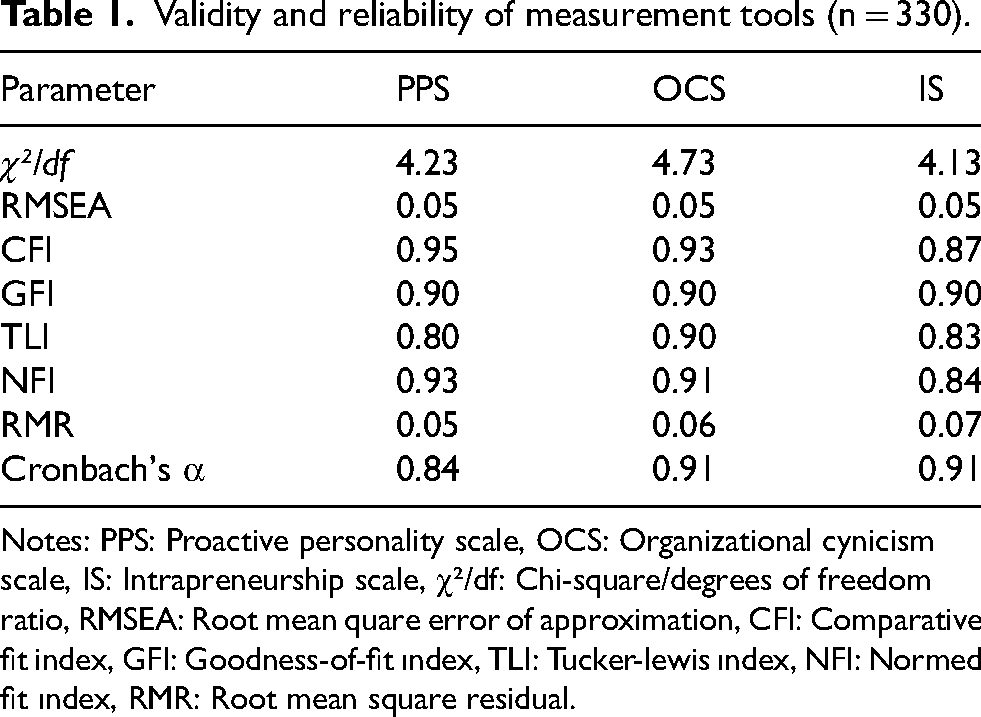
Notes: PPS: Proactive personality scale, OCS: Organizational cynicism scale, IS: Intrapreneurship scale, χ²/df: Chi-square/degrees of freedom ratio, RMSEA: Root mean quare error of approximation, CFI: Comparative fit index, GFI: Goodness-of-fit ındex, TLI: Tucker-lewis ındex, NFI: Normed fit ındex, RMR: Root mean square residual.
Ethical standards
All ethical standards were strictly followed throughout the study, which was conducted in accordance with COPE guidelines. Ethical approval was obtained from the Kayseri University Scientific Research and Publication Ethics Committee on March 26, 2021 (Approval No. 2021–25). Additionally, institutional permission was granted by the Ministry of Health (Permit No. T11.59.12, dated June 13, 2021) to conduct the research in the relevant healthcare settings.
Results
Sociodemographic characteristics of healthcare workers
A total of 330 healthcare workers participated in the study. As shown in Table 2, 53.6% of participants were female, and 58.8% were married. The majority (75.1%) held a university degree or higher. The participants’ average age was 35.17 years (SD = 10.53), their mean total work experience was 10.73 years (SD = 10.08), and the average duration of employment at their current institution was 7.96 years (SD = 8.77). These descriptive statistics indicate that the sample primarily consists of educated, mid-career professionals, providing a relevant context for examining their proactive behaviors and organizational attitudes within the healthcare sector.
Sociodemographic characteristics of participants (n = 330).
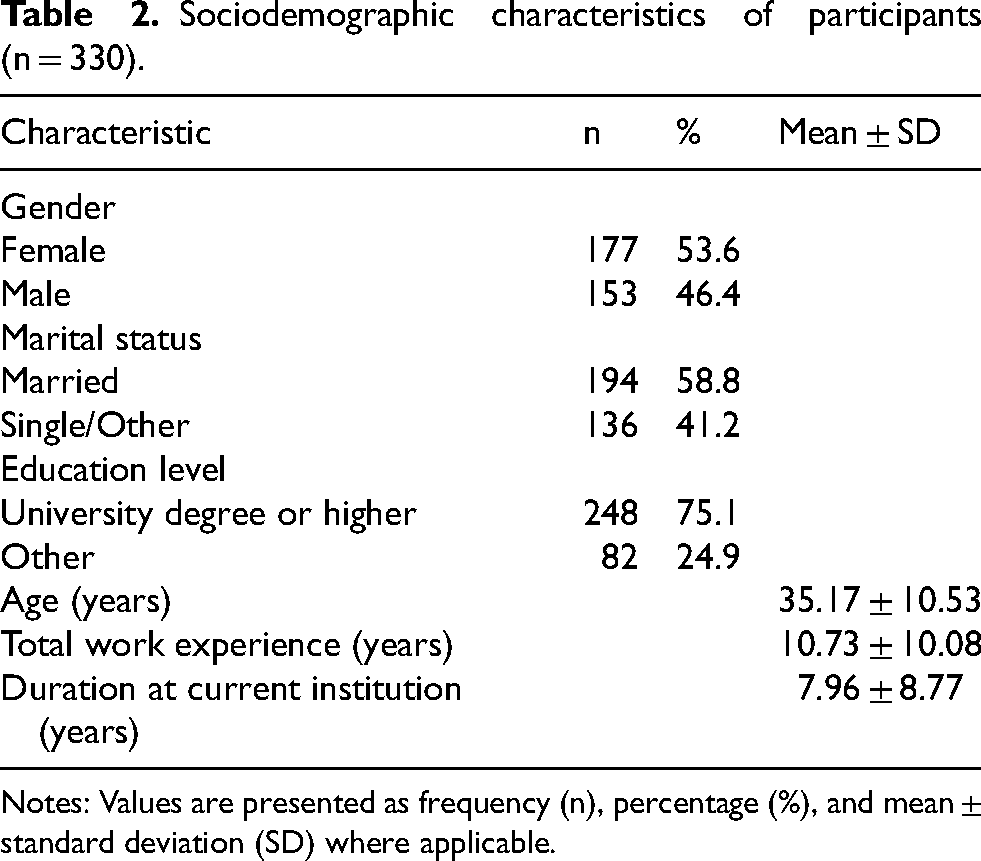
Notes: Values are presented as frequency (n), percentage (%), and mean ± standard deviation (SD) where applicable.
Descriptive statistics and correlations
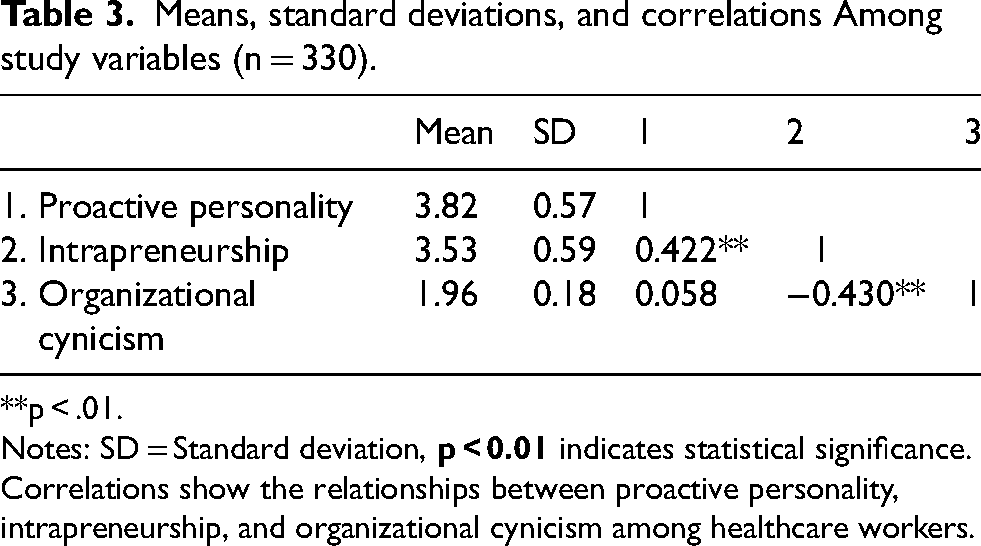
Table 3 presents the means, standard deviations, and correlation coefficients among the study variables (PPS, IS, and OCS). The mean scores were 3.82 ± 0.57 for PPS, 3.53 ± 0.59 for IS, and 1.96 ± 0.18 for OCS. Correlation analysis revealed a positive and significant relationship between PPS and IS (r = 0.422, p < 0.01). Conversely, a negative and significant relationship was found between IS and OCS (r = −0.430, p < 0.01), indicating that higher levels of organizational cynicism are associated with lower intrapreneurial behavior.
Means, standard deviations, and correlations Among study variables (n = 330).
**p
Notes: SD = Standard deviation,
Regression analysis
Simple linear regression analyses were conducted to test H1 and H2. The results indicated that PPS positively predicted IS (β = 0.044, t = 8.438, p < 0.001), while OCS negatively predicted IS (β = −0.010, t = −3.364, p = 0.001). As shown in Table 4, PPS accounted for 17.8% of the variance in IS (R² = 0.178), whereas OCS explained 3.3% of the variance (R² = 0.033).
Regression analysis of study variables (n = 330).
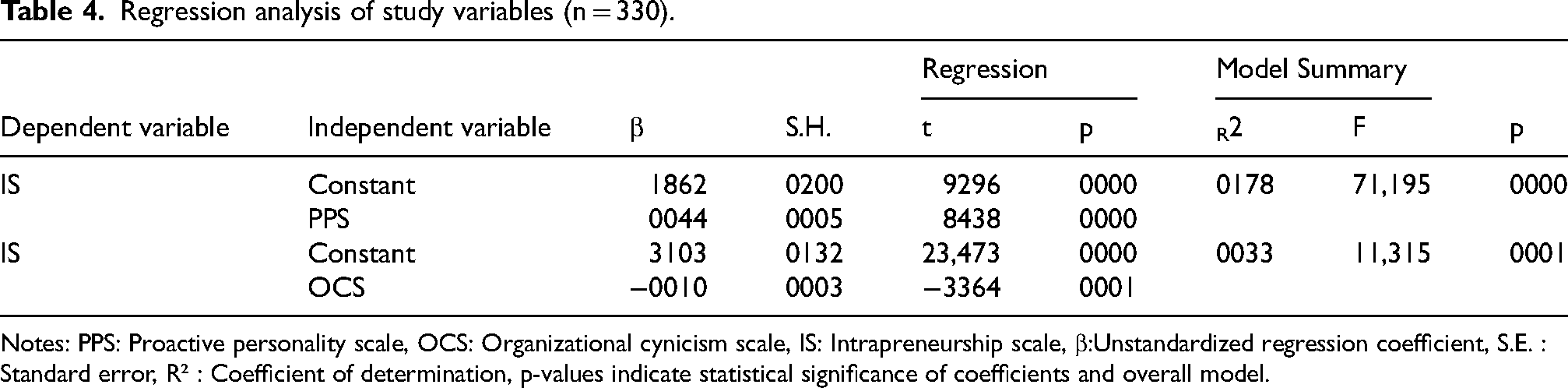
Notes: PPS: Proactive personality scale, OCS: Organizational cynicism scale, IS: Intrapreneurship scale, β:Unstandardized regression coefficient, S.E. : Standard error, R² : Coefficient of determination, p-values indicate statistical significance of coefficients and overall model.
These findings can be summarized as follows:
Both hypotheses were supported by the analysis.
Moderator analysis
To test the hypothesized moderating effect of Organizational Cynicism (OCS) on the relationship between Proactive Personality (PPS) and Intrapreneurship (IS), a moderation analysis was performed using Hayes’ PROCESS macro (Model 1) in SPSS. 27 The analysis employed bias-corrected bootstrapping with 10,000 resamples, and results were interpreted at the 95% confidence interval. The interaction between PPS and OCS was statistically significant (β = −0.062, p < 0.05), indicating that organizational cynicism weakens the positive relationship between proactive personality and intrapreneurship. Accordingly, Hypothesis 3 (H3) was supported.
These findings suggest that the positive effects of proactive personality traits on intrapreneurial behavior are attenuated in the presence of higher organizational cynicism. This interaction effect is illustrated in Figure 1, which depicts predicted intrapreneurial levels at low and high levels of organizational cynicism across varying degrees of proactive personality. The structural relationships among the study variables, along with the tested hypotheses and observed effects, are further detailed in Figure 2.
Black line: The effect of proactive personality on intrapreneurship in case of low organizational cynicism. Gray dashed line: It shows that this effect weakens at high organizational cynicism.
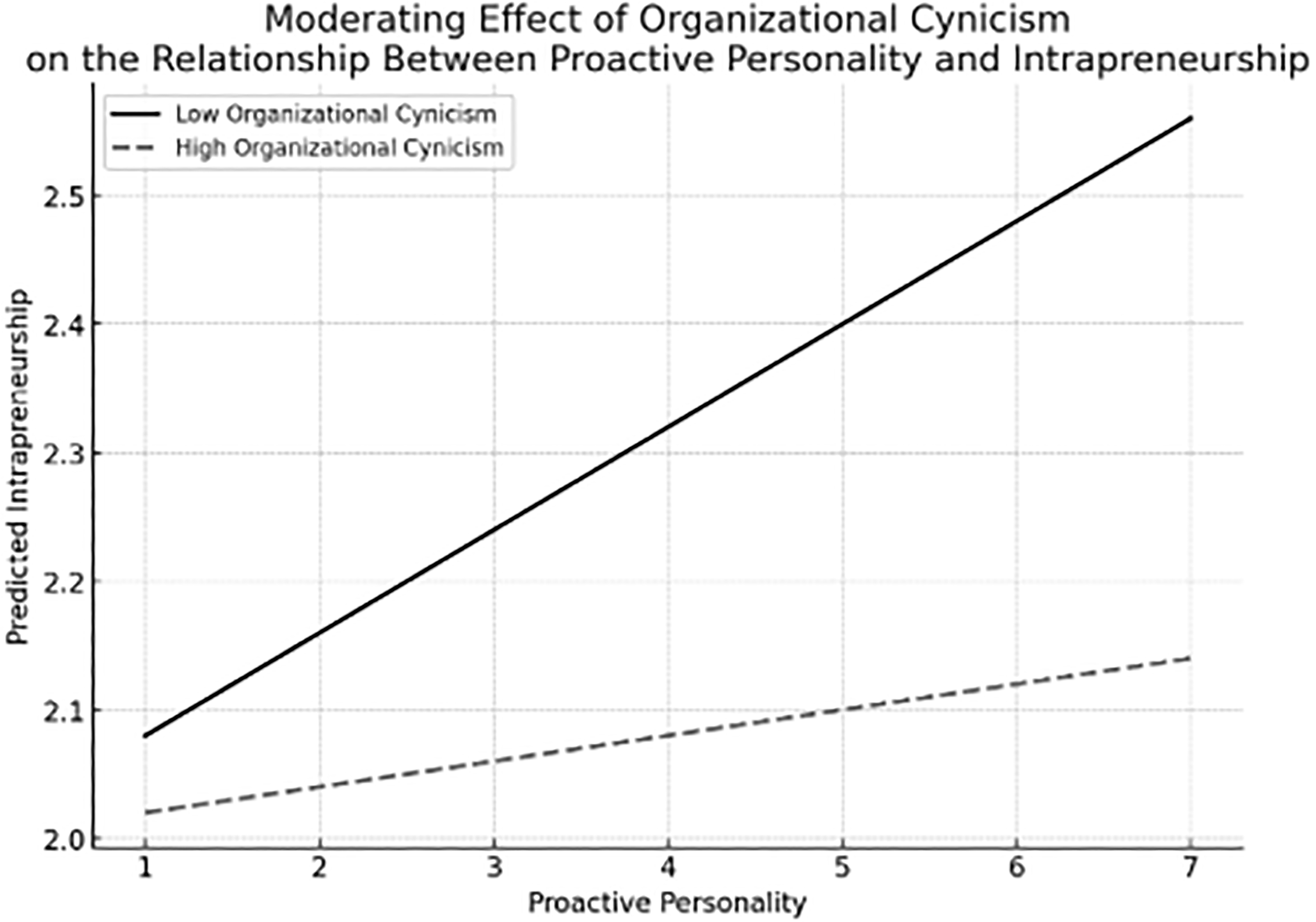
Impact chart. Note: The black solid line represents the estimated effect of proactive personality on intrapreneurship when organizational cynicism is low. The gray dashed line represents the attenuated slope of this relationship when organizational cynicism is high, indicating the moderating effect.
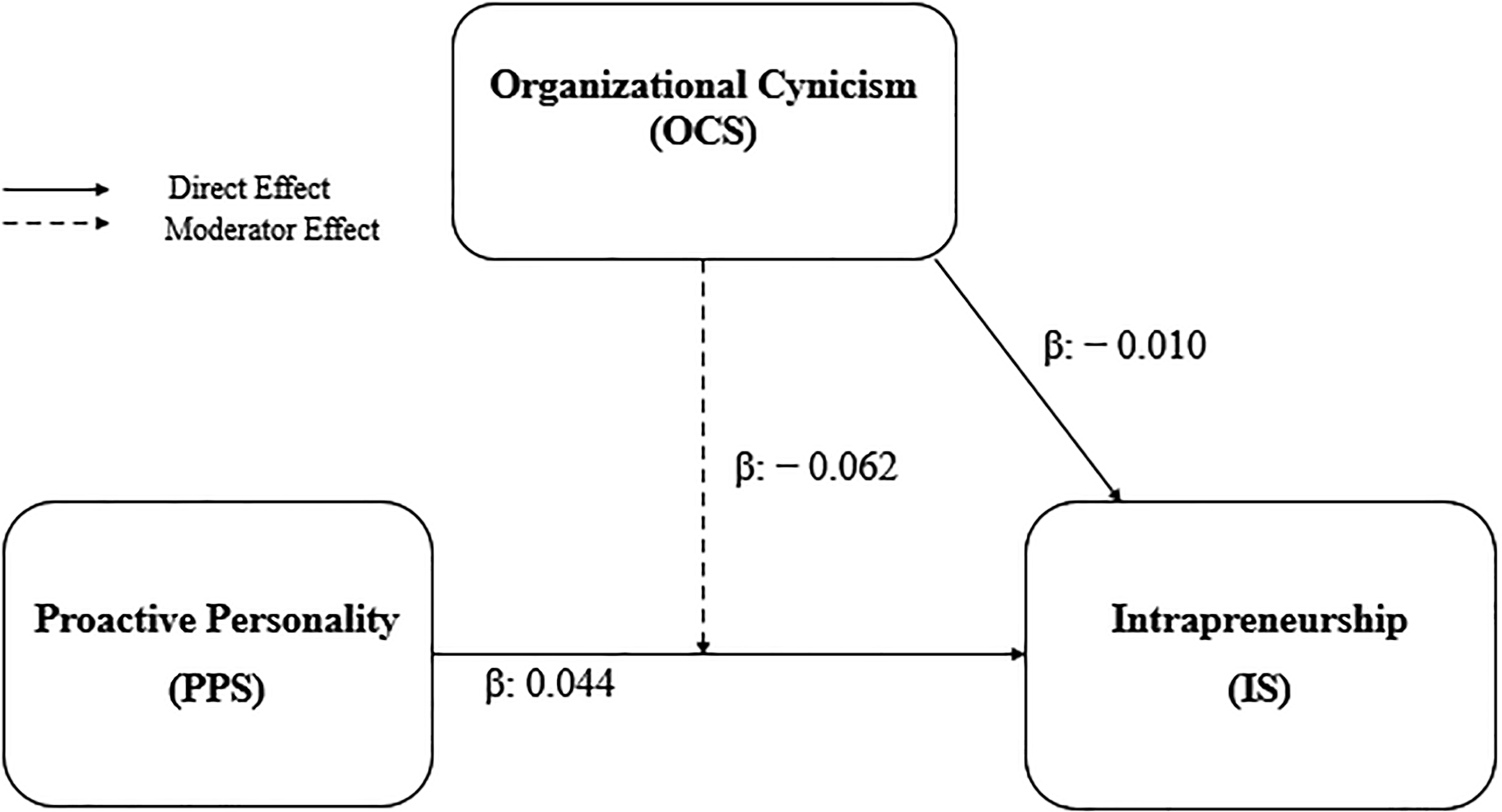
Research model.
Discussion
This study examined the impact of proactive personality traits on intrapreneurship among healthcare workers and explored the moderating role of organizational cynicism. The findings indicate that individuals with proactive personality traits demonstrate higher intrapreneurial behaviors, while organizational cynicism negatively affects this relationship. By integrating proactive personality, intrapreneurship, and organizational cynicism, this study addresses a gap in the literature and highlights the importance of fostering proactive behaviors and reducing cynicism to enhance organizational innovation and competitiveness.
The regression analysis confirmed a positive association between proactive personality traits and intrapreneurship, consistent with previous studies that link proactive personality with entrepreneurial inclination and intention.28,29 Similar results have also been observed in organizational settings, such as Yıldız's (2017) study in the white goods sector, which demonstrated that proactive individuals contribute more to intrapreneurship. 30
Conversely, the negative role of organizational cynicism on intrapreneurship aligns with earlier findings showing that cynicism undermines both innovative behaviors and overall job performance.11,12 Cynical employes are less motivated to initiate or sustain innovative activities, which limits organizational adaptability and competitiveness.
From a practical perspective, these findings emphasize the need for healthcare institutions to design strategies that cultivate proactive behaviors while minimizing cynicism. Encouraging initiative-taking, fostering trust in management, and reducing organizational indifference can increase employe motivation and commitment. In turn, this strengthens intrapreneurship, enhances organizational innovation, and contributes to long-term competitiveness.
Intrapreneurship holds particular value in healthcare organizations, where innovation and adaptability are essential to addressing complex challenges such as patient safety, service quality, and cost efficiency. Intrapreneurial behaviors, including process improvements, development of innovative practices, and integration of new technologies, directly contribute to better clinical outcomes and organizational effectiveness. Recent studies emphasize that intrapreneurship not only enhances service quality and patient satisfaction but also increases organizational resilience in the face of growing demands and limited resources.31–33 By fostering an intrapreneurial culture, healthcare institutions can strengthen employe motivation, encourage continuous improvement, and maintain competitiveness in an increasingly dynamic environment.
Conclusion
This study provides empirical evidence that proactive personality traits significantly enhance intrapreneurial behavior among healthcare professionals. However, the presence of organizational cynicism was found to negatively moderate this relationship, attenuating the otherwise positive effects of proactive dispositions. These findings highlight the importance for healthcare institutions to adopt a dual approach: fostering proactive work behaviors while actively addressing and mitigating sources of organizational cynicism.
To sustain innovation and competitiveness in the healthcare sector, managers should implement strategic interventions aimed at reducing cynicism, such as promoting transparent communication, recognizing employe contributions, and involving staff in decision-making processes. Concurrently, training and development programs that reinforce proactive attitudes represent a crucial investment in long-term organizational adaptability and performance.
Building on these insights, future research could expand the scope by examining the impact of proactive personality on broader outcomes such as job performance, creativity, and organizational innovation across diverse sectors. Additionally, further investigation into the antecedents and consequences of organizational cynicism—including its effects on motivation, engagement, and organizational culture—would provide valuable contributions to both academic literature and managerial practice.
Study limitations
This study has several limitations that should be acknowledged. First, the cross-sectional design restricts causal inferences between proactive personality traits, intrapreneurship, and organizational cynicism. Employes who are already cynical toward their organizations may underreport their proactive tendencies, which could bias the results. A prospective longitudinal design, particularly one that measures proactive personality traits prior to employment, would allow for a clearer understanding of how organizational cynicism develops and moderates intrapreneurship over time.
Another important consideration is the value of intrapreneurship in the healthcare sector. Intrapreneurial behaviors—such as initiating innovative practices, improving processes, and enhancing service quality—are especially critical in healthcare due to the sector's complexity, high demand for innovation, and direct impact on patient outcomes. Promoting intrapreneurship can therefore contribute not only to organizational performance but also to overall healthcare quality and patient satisfaction.
Finally, the sample primarily consisted of educated, mid-career healthcare professionals. On one hand, this demographic represents a valuable group for intrapreneurship research, as individuals at this career stage often possess the expertise and autonomy to implement innovative ideas. On the other hand, it may limit the generalizability of the findings to other groups, such as early-career employes or those with less formal education. Future studies could benefit from examining more diverse samples to better capture the broader dynamics of proactive personality and intrapreneurship.
Footnotes
Acknowledgments
The authors declare that they have received no funding or support for this study.
Authors' note
This article is derived from Emre KARASU's doctoral thesis prepared under the supervision of Professor Demet ÜNALAN in the Department of Health Management at Kayseri University.
Ethical considerations
Before the research, Ethics Committee Approval dated 26.03.2021 and numbered 2021–25 was received from Kayseri University Scientific Research and Publication Ethics Committee. In addition, necessary permissions were obtained from the Ministry of Health to conduct the research in relevant areas.
Consent to participate
Informed consent was obtained from all participants.
Author contrıbutıons
Study design: EK, DÜ; data collection: EK; data analysis: EK; study supervision: DÜ; manuscript writing: EK; critical revisions for important intellectualcontent: DÜ, EK
Funding
The authors received no financial support for the research, authorship, and/or publication of this article.
Declaration of conflicting interests
The authors declared no potential conflicts of interest with respect to the research, authorship, and/or publication of this article.
Data availability statement
The data that support the findings of this study are available from the corresponding author upon reasonable request.