



Abstract
Using narrative inquiry to analyze the Fair Fight website, this article illuminates how localized lived experience becomes an important tool to fight electoral injustice. The author provides an assemblage of narratives from disenfranchised voters to argue that although election technologies and processes (e.g., address systems, voter registration, absentee or mail-in ballots, voter queues), poll workers, and officials may seem neutral or apolitical, they can potentially be tools of disenfranchisement.
Jacqueline, Jamie, Melanie, Rascheicka, Ora, and Chris were denied access to vote in Georgia. Jacqueline could not vote because her residential address was unverifiable; Jamie was not able to vote because she had been “scrubbed” from the voter registration roll; Melanie and Rasheicka were unable to cast their ballot because after waiting in a long queue, they were asked to go to a different polling center; Ora was disenfranchised because after mailing her ballot, she was informed that her document had insufficient oath information; and after mailing his ballot, Chris was told he had already voted using his previous address (Why We Fight, n.d.). These stories reveal voter disenfranchisement strategies used in Georgia to deny voters the right to participate in the democratic process. The lived experience of these voters helps to clarify our understanding of electoral injustice and teach us, as professional communicators, that
technical documents can be used to reveal and dismantle systemic electoral injustice. technical documents and procedures shaping the electoral process in America are not neutral or apolitical; they can be used as conduits to perpetrate electoral injustice. localized narrative experience is quintessential to the fight against electoral injustice.
In this article, I use narrative inquiry to analyze the Fair Fight website (https://fairfight.com) in order to illuminate how localized lived experiences become important in fighting electoral injustice. My analysis focuses on how the website intentionally tapped into the narratives of disenfranchised voters to expose underlying social, political, institutional, and cultural practices that subtly work to infringe on the rights of voters or render voters powerless, exhausted, confused, and voiceless. As academics and professionals in technical and professional communication (TPC), a field that has embraced social justice, we can learn from Fair Fight localized and practical activist strategies situated in lived experiences. The Fair Fight website is the prime medium of organizational communication that Fair Fight uses to distribute information, raise awareness, and educate the public. By examining this website as an example of TPC, we can see in practice what it means to provide social justice advocacy from the bottom up. The Fair Fight website is a technological space that demonstrates how to use lived experiences to reveal systemic injustice and institutional structures that maintain this injustice.
My goal for this analysis is to reveal attempts made by Stacey Abrams, a Black woman, and her grassroots organization to recognize, reveal, reject, and replace (Walton et al., 2019) electoral oppression. I intentionally state the racial identity of Abrams for a reason: Technical communication has garnered interest in identifying the ways Black women are contributing to epistemological and practical knowledge about activism and empowerment in our field (Harper, 2021; Jones & Williams, 2022; Moore et al., 2021). Electoral advocacy groups are a good site to study social justice activism because they work on behalf of marginalized and disempowered groups. These grassroot organizations meet with, listen to, and observe the lived experiences of people at the margins every day, so they understand what it means to be marginalized, especially through disenfranchisement.
Without a doubt, technical communicators have suggested strategies that we can use in our advocacy roles, but I argue that such strategies tend to be more theoretical or abstract than practical. For instance, the Office of Equity at Utah State University designed implicit bias training materials based on Walton et al.'s (2019) 4R heuristics to train the deans and their leadership teams from eight colleges in the university. Feedback from the participants, however, revealed that the heuristics alone cannot support the work of social justice (Moore et al., 2021, p. 9). Reflecting on the feedback presented to them by the Office of Equity, Moore et al. (2021) admitted that “in order to make the heuristic really useful, it needed to be situated within contexts of use and lived experiences of redressing inequities” (p. 9). In other words, it is difficult to apply the 4Rs in localized situations if they are not grounded in practical, real-world examples. But theories can sometimes be too abstract and far removed from our experience to be able to address real-world problems. We in TPC need to ground our abstract thoughts (theory) in localized real-world experiences. This way, when someone sees injustice, they know exactly what they are looking at or experiencing. As a field, we must be humble enough to learn how to devise localized and practical activist strategy from organizations that engage with vulnerable populations in their day-to-day activities.
Fair Fight is one example that demonstrates how we can use narratives to uncover electoral injustice. In its advocacy work, the organization is fighting back against Jim Crow 2.0, electoral laws and processes aimed at disenfranchising voters, especially voters from marginalized populations in Georgia and across the country. It also fights for the expansion of Medicaid to support millions of vulnerable populations and relieve over 20 million people of medical debt. These advocacy roles challenge technical communicators to use their “privilege and skills as nimble, flexible, liminal, rhetorical, and ethical technical communicators” to “intervene in global and local technical communication problems at the macro and micro levels in the face of asymmetrical power relations and limited agency—and teach current and future practitioners to do the same” (Haas & Eble, 2018, p. 5).
In the following sections, I introduce Fair Fight, analyze research in TPC that examines election technologies, introduce the narrative inquiry approach I use to analyze the Fair Fight website, and discuss my findings, which show how electoral injustice is both a human rights issue and a concern for TPC scholars interested in social justice. Finally, I point out implications of the study for TPC scholarship and emphasize the relevance of narrative study as a powerful tool for unearthing unjust practices.
About Fair Fight
Fair Fight is a grassroots organization based in Georgia that aims to dismantle electoral injustice through activism. In other words, the organization promotes fair, free, and incontrovertible elections; encourages people to participate in the electoral system; and organizes educational programs to sensitize citizens about their voting rights. In response to what she perceived to be “gross mismanagement of the 2018 election by the [Georgian] Secretary of State's Office,” Stacey Abrams launched this organization “to ensure every American has a voice in our election system through programs such as Fair Fight 2020, an initiative to fund and train voter protection teams in 20 battleground states” (About Stacey Abrams, n.d.). This core belief in electoral integrity is captured on the Fair Fight website with metaphors used to describe the organization. For example, metaphors such as “we promote fair elections,” “educate voters about elections,” “bring awareness to the public,” “fight back against Jim Crow 2.0” are used. These metaphors aim to create an ethos of trust and credibility.
Fair Fight, as an organization, believes in collective efforts to expose, mitigate, and reverse voter suppression. Its emphasis on collective efforts highlights the need to create some form of coalition and allyship to be able to expose various forms of injustice because the work of electoral injustice is complex and subtle. Further, the “work of social justice cannot be limited to individual action or perspectives because the oppressions it targets are structural: historical-but-dynamic and built into the fabric of societies” (Walton et al., 2019, p. 50). The work of Fair Fight, then, “brings awareness to the public on election reform, advocates for election reform at all levels, and engages in other voter education programs and communications” (About Fair Fight Action, n.d., n.p.). Although Fair Fight advocates for progressive issues, such as Medicaid and medical debt relief, it chiefly galvanizes action on election-related issues.
Fair Fight categorizes its activities under three broad headings: litigation, legislation, and advocacy. In addition to advocating for progressive and electoral issues, Fair Fight has initiated litigation, filing a civil rights lawsuit in court against the Georgia Secretary of State's Office and Georgia Board of Elections, claiming that there was gross mismanagement of the 2018 election that discouraged and disenfranchised voters. It has also challenged in court the suppressive tactics of True the Vote, a Texas-based organization, alleging that it uses different strategies to intimidate and prevent Georgians from going out to vote. And regarding legislation, Fair Fight has fought against a 2019 legislation that, under the guise of election reforms, put the interest of venders before voters.
Election Technology, Human Rights, and TPC
TPC scholarship has had conversations about attempts to disenfranchise some voters or treat some votes as illegitimate and fraudulent. Scholars have discussed how biometric technology (Dorpenyo, 2019), Facebook (Sano-Franchini, 2018), voter tests and voter registration (Jones & Williams, 2018), gerrymandering of electoral maps (Sanchez, 2018), and voter education guides (Whitney, 2013) are deployed to disenfranchise voters. Along those lines, Dorpenyo and Agboka (2018) have argued that conversations “about technologies and their deployment or use in elections raise important usability and social justice questions for both designers and users of such technologies, especially in unenfranchised cultural sites” (p. 350). Sánchez (2018) discussed gerrymandering as a tool of electoral injustice, and Jones and Williams (2018) revealed how voter tests and voter registration can be used as tools to disenfranchise Black voters, highlighting another social justice component in the study of election technologies. Together, these scholars have demonstrated that we need to examine how any technology or artifact can be used as a political weapon to discriminate or marginalize. There is no neutral technology; every technology can be used to benefit some and disenfranchise others (Banks, 2006; Benjamin, 2019; Braun, 2014; Eubanks, 2018; Haas, 2012; Noble, 2018).
For example, even though many people use Facebook for entertainment, to obtain information, to keep in contact with friends and family, or to engage in political activism, this technology and its interface can also be used to serve harmful ends (Sano-Franchini, 2018). Bridgewater (2018) interrogated the interstices between business logics, election technology, and democracy. Analyzing the “About” section of three websites of election technology companies (Dominion Voting, Smartmatic, and Election Systems and Software), he identified that the majority of the discourse surrounding these election technologies focused on creating ethos by “appealing to business profitability and the impartiality of technology to promote democratic institutions” (p. 422).
Technical communicators have taken on human rights concerns, and electoral advocacy is a fight for human rights (Dura et al., 2013; Walton, 2016). The Universal Declaration on Human Rights establishes that the right to vote is a fundamental human right and defines it as follows:
Everyone has the right to take part in the government of his country, directly or through freely chosen representations. The will of the people shall be the basis of the authority of government; this will shall be expressed in periodic and genuine elections which shall be by universal and equal suffrage and shall be held by secret vote or equivalent free voting procedures. (United Nations, 1948, n.p.)
Sadly, in America, voting has been treated as a privilege—White privilege, to be precise. Disenfranchisement of Black communities and minority voters is woven into the fabric of American politics and elections. Over the centuries, there have been strategies to disenfranchise, limit, and target votes from minority populations. Some of these strategies aimed at Black people and brown voters include literacy tests, understanding clauses, poll taxes, White primaries, voter ID laws, gerrymandering, intimidation, grandfather clauses, and purged voting rolls (Alexander, 2020; Anderson, 2018; Daniels, 2020; Jones & Williams, 2018). And as recently as the presidential elections of November 3, 2020, President Donald Trump and his Republican allies contested votes from predominantly Black communities in Pennsylvania, Georgia, Wisconsin, and Michigan. So what institutional structures, we might ask, enabled Trump and his allies to label votes from Black communities illegal or criminal?
As Walton (2016), inspired by human-centered design scholar Buchanan (2001), reminded us, TPC should prioritize people; that is, we should embrace “human dignity and human rights as the first principle of communication” (p. 404). This readiness to address human and civil rights issues was highlighted by Sapp et al. (2013) when they revealed that “professional communication is a critical component of human rights work, particularly in governmental, intergovernmental, nongovernmental, and civil society organizations” (p. 5). They condemned the extent to which the field's constant affinity with business and industry (breeding grounds for colonialism) still weighs heavily on our scholarship, teaching, and practice, thereby discouraging us from discussing human rights issues.
Indicating how technical communicators are positioned to explicitly address human rights, inequality, racism, systemic injustice, and the disenfranchisement perpetrated during elections, these scholars have called on us to examine “how and why design of texts, communication [emphasis added] and technologies can be, have been, and are used” (Jones & Williams, 2018, p. 373) to disenfranchise, discriminate, marginalize, and silence vulnerable people. Ultimately, conversations about human rights and the vulnerable nature of election technologies provide just a slice of how technical communicators are responding to the social justice turn.
Method: Revealing Electoral Injustice Through Narrative Inquiry
Narrative inquiry is a methodology for studying or understanding the lived experiences of humans through stories. This lived experience is situated in three dimensions or “commonplaces”: temporal, social, and spatial. The temporal commonplace reminds researchers that the experiences or events being studied have a past, present, and a future of people, places, things, and events (Clandinin, 2016, p. 29). The social commonplace points to personal and social conditions. It reminds us that the lived experiences of people are shaped, in part, by personal conditions as much as social, cultural, institutional, familial, and linguistic narratives. And the spatial commonplace helps us to understand how lived experiences are connected to “the specific concrete, physical, and topological boundaries of place or sequences of places where the inquiry and events take place” (Clandinin, 2016, p. 41). When we reflect on these three dimensions of narrative inquiry, we have a powerful tool for recognizing and revealing the various forms of injustice that surround us. Also, in the narratives told, we can examine the various ways technical documents become the medium through which voters are silenced or disenfranchised.
Narrative inquiry is not new to the field of TPC. In recent years, Jones has used narrative inquiry to examine how human-centered designers, in their effort to promote social justice and inclusion in design (2016a), can use narratives to identify the various ways that design silences users and to highlight how Black business entrepreneurs overcome oppressive structures to become successful (2017). Baniya (2022) also used a combination of narrative inquiry and social network analysis to examine how disaster areas become a site where local and global communities assemble to support those who have been afflicted by disasters, such as the earthquake in Nepal and the hurricane in Puerto Rico in 2015 and 2017, respectively.
The three dimensions of narrative inquiry (temporal, social, and spatial) help us to recognize and reveal the nature of electoral injustice so that others know when they are experiencing it. The temporal dimension helps us to think about disenfranchisement as having a past, present, and future: for example, the past use of literacy tests and understanding clauses, the present ID laws, and the future legislation that will be drafted to impact and shape elections. The temporal dimension, then, enables us to think about the history of elections or voting as a site of struggle. The social dimension helps us to think about the cultural and institutional conditions that prevent people from getting access to the ballot. And the spatial dimension helps us to identify specific places where voter disenfranchisement is prevalent.
For this study, I focus on the Why We Fight (n.d.) page of the Fair Fight website. This webpage is designed to emphasize Fair Fight's commitment to recognize, reveal, reject, and replace electoral injustice. It uses narratives from six characters—Jacqueline, Chris, Jamie, Rasheicka, Ora, and Melanie—to expose electoral injustice in five broad areas: voter registration, absentee voting, unethical poll workers, voter location, and voter counting. Characters play important roles in narratives because they are “inextricably connected to the narrative and [are an] important consideration for whether the audience can identify with not only the character, but also with the story that is being told” (Jones & Walton, 2018, p. 245). These six characters who share their stories on the Why We Fight (n.d.) webpage do so to initiate change or reveal systemic disenfranchisement, and we can identify with their stories when we hear them. Together, they show how voter suppression strategies are slowly and insidiously burning down democratic principles (Anderson, 2018, p. 27).
In my analysis of the Why We Fight webpage, I ask the following questions:
What were the stories and experiences of the six characters? How does Fair Fight, led by Stacey Abrams, use narratives to reveal electoral injustice and advance the principles of electoral justice? How might the strategies used contribute to our disciplinary understanding of advocating for the marginalized and disenfranchised? In what spaces, places, and contexts can we identify TPC practices?
To answer these questions, I analyze the lived experiences of six characters through the three dimensions of temporality, sociality, and space. Their stories about their own disenfranchisement sum up the mission of Fair Fight: to “promote fair elections around the country, encourage voter participation in elections, and educate voters about elections and their voting rights” (About Fair Fight Action, n.d., n.p.).
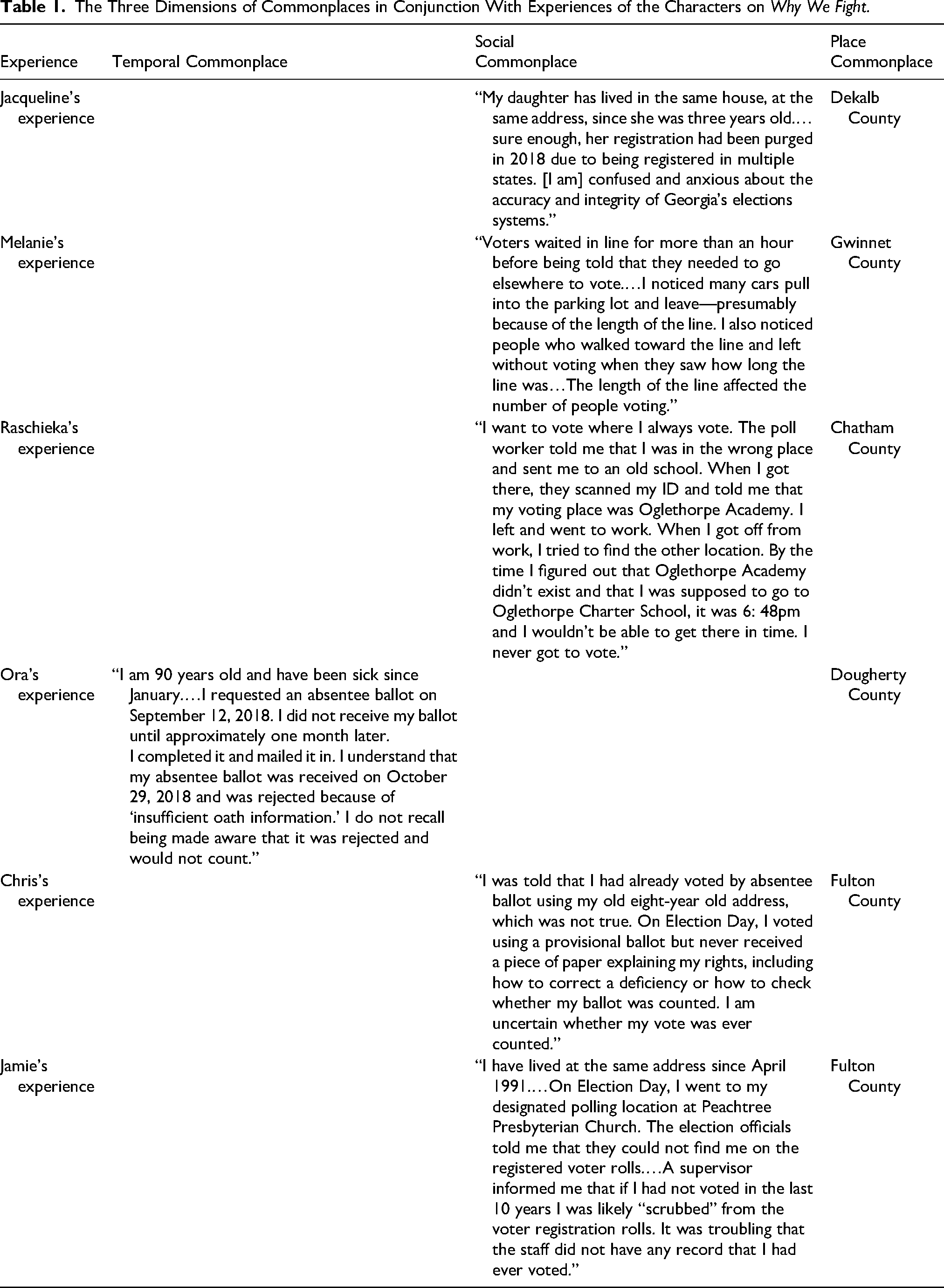
Table 1 provides experiences from the narratives of the six characters. I grouped the experiences according to their temporal, social, or spatial commonplace. Although the narratives are grouped under a specific narrative dimension, they could also fall under other categories. In other words, an experience that falls under the temporal dimension could also fall under the social dimension. As Clandinin and Connelly (2004) have told us, these dimensions are interconnected and intersectional.
The Three Dimensions of Commonplaces in Conjunction With Experiences of the Characters on Why We Fight.
Findings: Electoral Injustice Rooted in Temporal, Social, and Spatial Dimensions
My analysis revealed that the stories or lived experiences of disenfranchised voters can highlight real-world injustices. In other words, the lived experiences of voters that are portrayed on the Fair Fight website are rich, localized narratives such as Moore et al. (2021) described. By sharing these accounts from disenfranchised individuals who have experienced varied forms of electoral injustice, Fair Fight meets the first two criteria for dismantling injustice in the 4Rs heuristics that Walton et al. (2019) recommended: recognize and reveal. That is, Fair Fight is dismantling injustice by providing localized narratives from some voters in Georgia about the injustice they experienced. The six individuals provide “rich stories of human experience that reveal oppression in localized, and therefore very recognizable, ways” (Moore et al., 2021, p. 9).
Electoral Injustice is Manifested Through Social Structures and Election Technologies
The social dimension points to how people's lived experiences are shaped by personal conditions as much as social, cultural, institutional, familial, and linguistic narratives. I argue that electoral documents and practices, such as voter registration, long queues, ballot access, voter deception tactics, and vote count, can be deployed as strategies to disenfranchise voters, especially voters living in communities predominantly populated by Black, Indigenous, and other people of color (Jones & Williams, 2018; Sanchez, 2022). In fact, Fair Fight states that these new strategies of disenfranchisement are a reinvention of Jim Crow era politics and need to be resisted.
Sanchez (2022), for instance, uncovered how the Postmaster General Louis Dejoy's decision to remove the U.S. Postal Service (USPS) mail-sorting machines prior to the 2020 general elections exemplifies how decisions about electoral technologies, framed around neoliberal discourses of austerity, privatization, and deregulation impacted people of minority groups. He noticed that “in every region, more than half of the locations that will lose sorting machines have large percentages of minority populations.” Although Dejoy argued that the decision was neutral and would propel the USPS to be effective, efficient, and productive, beneath the veil appeared to be a move to slowly disenfranchise some people. This move by Dejoy and the various disenfranchisement stories told by Jacqueline, Melanie, Rasheicka, Ora, and Chris reemphasize Haas’s (2012) claim that “technologies,” such as voter registration and ballot access, “are not neutral or objective—nor are the ways in which we use them” (p. 288). I will now discuss how the various narratives by these six characters reveal the ways that institutional structures and election technologies become tools of disenfranchisement.
Jacqueline and the Address System. Jacqueline's story about her daughter reminds us that the address system can be exploited to disenfranchise voters: My daughter has lived in the same house, at the same address, since she was three years old…sure enough, her registration had been purged in 2018 due to being registered in multiple states. [I am] confused and anxious about the accuracy and integrity of Georgia's elections systems. (Why We Fight, n.d., n.p.) I have lived at the same address since April 1991.…On Election Day, I went to my designated polling location at Peachtree Presbyterian Church. The election officials told me that they could not find me on the registered voter rolls.…A supervisor informed me that if I had not voted in the last 10 years I was likely “scrubbed” from the voter registration rolls. It was troubling that the staff did not have any record that I had ever voted. (Why We Fight, n.d., n.p.).
Jamie's experience with voter registration reminds me of Katz's (1992) caution that technical communication, if not approached ethically, can reduce or erase human beings. Thus, care should be taken when we are designing public documents because any wrong move can unjustly erase or delegitimize people. In this regard, voter registration can become a regulatory document (Williams, 2010) that is used to suppress voters or create barriers that frustrate or disenfranchise them, and to voters such as Jamie, it can evoke distrust. Further, Jamie's experience exposes the broader concern that Jones (2016b) raised about oppressive structures: “Oppression is structural…its causes are embedded in unquestioned norms, habits, and symbols, in the assumptions underlying institutional rules and the collective consequences of following those rules” (p. 348). To change the oppressive structure of voter registration, then, we need to question the processes that must be followed before someone can be “scrubbed” from the voter registration. Did election officials make any attempt to contact Jamie? Did they give Jamie the opportunity to prove that she has lived at the address for a long time? Jamie's experience is not new. There are historical antecedents to the use of voter registration purge as a tool of discrimination (Anderson, 2018; Daniels, 2020; Jones & Williams, 2018).
Melanie and Long Queues at Polling Centers. Melanie's experience suggests that long lines at voting locations can lead to voter suppression: Voters waited in line for more than an hour before being told that they needed to go elsewhere to vote.…I noticed many cars pull into the parking lot and leave—presumably because of the length of the line. I also noticed people who walked toward the line and left without voting when they saw how long the line was.…The length of the line affected the number of people voting. (Why We Fight, n.d., n.p.)
Although long queues for voting seem to indicate that people are participating in the democratic process, such long queues can become a tool of disenfranchisement for people who do not have the stamina to stand in line for a long time. And in some areas, the weather may be off-putting. More so, long lines discourage people from voting, reduce people's confidence in the process, and place undue economic cost on counties and states (Stewart & Ansolabehere, 2015). Melanie reinforces the idea that long queues discourage people from voting when she describes seeing “cars pull into the parking lot and leave” and people walk away from the line without voting. A survey report on the 2012 elections (Stewart, 2015) indicated that about 500,000 people failed to vote because of polling-station problems, including long queues.
As Abrams et al. (2020) explained, the phenomenon of long queues is akin to the poll-tax system of the Jim Crow era because when one stands in a queue for a long time, that person is “losing pay,” and if that person is a shift worker, “that can be up to half a day's pay” (p. 26). Identifying a relationship between racism and long queues at polling stations in the 2012 elections, Stewart (2015) indicated that “minority voters waited longer to vote than white voters. White voters waited an average of 12 minutes to vote in 2012, compared to 24 minutes for African American voters and 19 minutes for Hispanic voters” (p. 7). This statement implies that if you are voting in a Black community, the likelihood that you will stand in a long queue is high, which reinforces the argument I will make about the intersectionality between race, space, and electoral injustice and the urgent need to research this relationship.
Rasheicka and Unethical Poll Workers. Poll workers are quintessential to the democratic process. Their roles are visible for everyone to see. They help count ballots, open and close voting centers, operate voting machines, and check voter identification. Hall et al. (2007) called poll workers “street-level bureaucrats who powerfully affect the experience that voters have on election day” (p. 647). Their interaction with voters can shape the perception and confidence of voters on election day. If poll workers do not set up voting machines on time, the voting center's opening time is delayed. And if poll workers cannot properly handle the voting machines, voters may experience confusion and unnecessary delays at the voting center. Rasheicka describes how poll workers can be used to disenfranchise people by sabotaging voters’ experience: I went to vote where I always vote. The poll worker told me that I was in the wrong place and sent me to an old school. When I got there, they scanned my ID and told me that my voting place was Oglethorpe Academy. I left and went to work. When I got off from work, I tried to find the other location. By the time I figured out that Oglethorpe Academy didn’t exist and that I was supposed to go to Oglethorpe Charter School, it was 6:48pm and I wouldn’t be able to get there in time. I never go to vote. (Why We Fight, n.d., n.p.)
The history of elections in America shows how poll workers have been used to enforce disenfranchisement laws such as literacy tests and poll taxes (Hall et al., 2009; Keyssar, 2000). In Rasheicka's case, poll workers appeared to use their power to misinform and frustrate voters. Redirecting a voter to a location that does not exist is disingenuous and shows us that we need to be wary of unethical poll workers and expose them. The actions of the poll worker who misdirected Rasheicka lacked ethos or credibility. Because poll workers assume positions of power during elections, we must interrogate the role that they play in disenfranchising voters. Doing so may inform how poll workers are trained to administer elections. A lot of conversations in TPC about elections revolve around technologies such as ballots, redistricting maps, Facebook user interfaces, and literacy tests, but little attention is paid to the role of poll workers and election officials. As a field that prides itself on being user centered or human centered, TPC must examine the human elements of election technology. If poll workers are to be interrogated, then, we need to expand the notion of technology to include humans. But in election contexts, we have focused more on the hardware and software.
Ora and Chris and Confusion Over Absentee Mail-In Ballots. The absentee-ballot system has always been a bone of contention, and in 2020, the absentee mail-in ballot system became more contentious when Postmaster General Louis Dejoy decided to remove sorting machines from specific locations in the United States. Sanchez (2022) likened this move to eliminate mail-sorting machines prior to the 2020 general elections to “larger systemic moves that aim to damage democratic participation incrementally” (p. 177). Sanchez even referenced how first-class mail, which is supposed to be fast and prioritized, was moving slowly. Ora's case indicates how nefarious attempts to disenfranchise voters through the absentee-ballot system are clothed in legal jargons or legalese: I am 90 years old and have been sick since January.…I requested an absentee ballot on September 12, 2018. I did not receive my ballot until approximately one month later. I completed it and mailed it in. I understand that my absentee ballot was received on October 29, 2018 and was rejected because of “insufficient oath information.” I do not recall being made aware that it was rejected and would not count. (Why We Fight, n.d., n.p.)
Chris was told he had already voted with an old address: I was told that I had already voted by absentee ballot using my old eight-year-old address, which was not true. On Election Day, I voted using a provisional ballot but never received a piece of paper explaining my rights, including how to correct a deficiency or how to check whether my ballot was counted. I am uncertain whether my vote was ever counted. (Why We Fight, n.d., n.p.)
The experiences narrated by Jamie, Ora, Chris, Rasheicka, Jacqueline, and Melanie collectively reveal the localized institutional and systemic flaws in Georgia's electoral system. More concerning, they reveal how electoral injustice is sometimes “invisible and therefore seems inarguable” (Walton et al., 2019, p. 115) and that institutions that manage these electoral processes may not be neutral and may exploit the system's loopholes in order to disenfranchise voters. The narratives also reveal how such institutional genres mediate human activities. Hence, by exploiting the loopholes in the system, institutions can render some voters powerless, voiceless, and silenced. Readers can easily recognize the sense of hopelessness, disappointment, and despair in the voices of the narrators. Jacqueline from Dekalb county tells us “[I am] confused and anxious about the accuracy and integrity of Georgia's elections systems” (Why We Fight, n.p., n.d.). Such confusion can potentially cause voters to doubt the integrity of an election. Therefore, as rhetors and technical communicators interested in dismantling injustice everywhere, we need to work relentlessly to expose practices in our system that may seem neutral, objective, efficient, or acultural but instead perpetrate systemic injustice.
The integrity of an electoral process is held high when the public is confident that the processes are free, fair, and incontrovertible. People who perceive that the electoral system is corrupt or that the handlers of elections are corrupt or incompetent are less likely to vote. Thus, TPC needs to critically interrogate electoral practices to recognize and reveal the ways these tools and processes have been and are still being used to disenfranchise voters. We should also not ignore that the postal system can be a medium of disenfranchisement that can be manipulated to enact slow civic violence (Sanchez, 2022). Particular attention should be paid, then, to how we vote through the mail.
Our electoral practices are supposed to be objective ones that allow every American of voting age to vote without fear or favor, but the narratives presented by Jacqueline, Melanie, Rasheicka, Ora, and Chris cast doubt on the process, showing us that these practices can be exploited to a nebulous end. Electoral documents and processes may appear neutral at face value, but a close examination of them reveals the exclusionary tendencies that these processes embody. Therefore, although election processes (e.g., address systems, voter registrations, absentee or mail-in ballots, and voter queues), poll workers, and election officials may seem neutral or apolitical, they can potentially be tools of disenfranchisement. And historically, these technologies have been used to disenfranchise certain voters (Anderson, 2018; Daniels, 2020; Jones & Williams, 2018).
Electoral Injustice is Grounded in a Place or Space
The electoral injustice experiences shared by Jacqueline, Ora, Jamie, Chris, Melanie, and Rashiecka are grounded in specific, situational, and localized spaces or places: Dekalb County, Dougherty County, Fulton County, Gwinnet County, and Chatham County, respectively. These counties are in Georgia. Geographically, Georgia is located on the southeastern coast of the United States. Its capital is Atlanta. Georgia is bordered by Florida to the south, Alabama to the west, South Carolina to the east, and Tennessee and North Carolina to the north. Historically, Georgia and its southern state neighbors that seceded from the union in the 19th century experienced slavery and Black voter disenfranchisement, and more important, they were the site for the enactment of Jim Crow laws.
The Jim Crow era, which lasted from 1877 into the 1960s, is a dark moment in American history when Black people were vehemently pursued, punished, intimidated, incarcerated, and disenfranchised. During this period, a racial caste system was enacted in which Black people were treated as second-class citizens. Jim Crow laws made sure Black people could not vote or get meaningful employment, housing, or an education, and they were denied access to food stamps, social welfare, and health care. This period also saw a rise in the incarceration of Black people (Alexander, 2020; Anderson, 2018; Daniels, 2020). Consider, for instance, the Mississippi plan that was passed by the state in 1890. This plan empowered White supremacists to put together “paramilitary groups called ‘rifle clubs’ that showed up at Republican rallies and violently attacked Black voters. On election day, they intimidated Black voters by whipping those who attempted to vote and even shooting them” (Abrams et al., 2020, p. 3).
Georgia has been systematic and relentless in its quest to deny Black people the right to vote. Even when the 14th and 15th Amendments were ratified to guarantee equal rights of citizenship and voting to former slaves, Georgia and some former Confederate states made sure Black people did not get the chance to vote because Confederate state actors failed to believe that Black people were free and equal to White people. These state actors relentlessly initiated disenfranchising procedures such as literacy and understanding tests, which forced Black voters to read and understand confusing legal terms; poll taxes; intimidation; felony laws; obscure registration processes; residency requirements; redistricting; grandfather clauses; and appointment schemes in order to terrorize and threaten Black voters (McDonald, 2003, p. 3). Confederate soldiers in the south founded the Klu Klux Klan in 1868 to further intimidate and oppress Black people.
The oppressive electoral practices of Georgia, in particular, compelled Congress to enact different reconstruction acts that placed the state under military supervision. The Second and Third Reconstruction Acts enacted in March and July 1867, respectively, made it possible for Black voters in Georgia to register under military supervision (McDonald, 2003, p. 18). Then nearly a century later, against the backdrop of several new voter intimidation and Jim Crow laws targeting Black people in the south, the Voting Rights Act (VRA) of 1965, a right that Black people had technically won immediately after the Civil War, was enacted. The VRA guaranteed Black people in the south the right to vote.
Singh et al. (2021) reported that in response to the unprecedented number of votes cast in the 2020 elections, “at least 19 states enacted 33 laws that make it harder for Americans to vote” (n.p.). Georgia is one of such states that has enacted laws to limit people from voting. The American Civil Liberties Union (ACLU of Georgia, 2023) reported that after the 2020 elections, the Georgia State House of Representatives and Senate passed an antivoter rights law that “attacks absentee voting, criminalizes Georgians who give a drink of water to their neighbors, allows the State to takeover county elections, and retaliates against the elected Secretary of State by replacing him with a State Board of Elections Chair chosen by the legislature—rather than the voters” (n.p.). This law was signed by the governor, Brian Kemp.
In 2013, the U.S. Supreme Court eviscerated sections 4 and 5 of the 1965 VRA in Shelby County v. Holder (Brennan Center for Justice, 2018, n.p.). Sections 4 and 5 of the VRA required any jurisdiction that has had a history of denying people the right to vote based on race to submit a proposal for changes in electoral law to the Department of Justice or a federal district court in Washington, DC, before such changes are effected. This mandate would ensure that such changes would not deny minority voters the right to vote. The Supreme Court, however, ruled that this mandate was unconstitutional because it depended on an old formula (for more on the history of voter disenfranchisement in the south, see Anderson, 2018; Daniels, 2020; McDonald, 2003).
I have shared the location and a brief history of Georgia not only to provide a context for this analysis but, more important, because place-based information is relevant to narrative inquiry. In narrative inquiry, the dimension of place or space helps us to understand how lived experiences are connected to “the specific concrete, physical, and topological boundaries of place or sequences of places where the inquiry and events take place” (Clandinin, 2016, p. 41). Technical communicators have always been interested in and championed the need to interrogate places and their intersections with social injustice (Agboka, 2013; Haas, 2012, Hurley, 2018) mostly because of the belief that space is a product and producer of social relations that are imbricated in cultural, rhetorical, and political practices (Hurley, 2018, p. 94). Thus, space or place can be culturally or socially designed to produce injustice and be a target of discriminatory practices. We must recognize, then, as Haas (2012) argued, that “even in the most progressive spaces and places, the colonial rhetorical detritus of racism and ethnocentrism remains” (p. 287) and that if we fail to reveal and dismantle it, it will shape who we are and what the future will be.
Against this backdrop of pervasive injustice in American society, I consulted the U.S. Census Bureau quickfacts: Georgia (n.d.) to analyze the racial composition of the various counties or specific geographical locations of the narrators in this study. This analysis shows that Blacks or African Americans occupied either the largest or the second-largest percentage of the populations in each of the counties: 44.5% in Fulton County, 54.8% in Dekalb county, 71% in Dougherty County, 41.2% in Chatham County, and 29.8% in Gwinnet County. Although racism pervades every aspect of American society, some geographic locations or communities where most of the inhabitants are Black, indigenous, or people of color (BIPOC) are more likely to experience racism and injustice. Therefore, it is not surprising that the six voters who narrated their stories live in predominantly Black communities in Georgia.
Counties in Georgia were especially affected when the USPS removed mail-sorting machines a few months before the 2020 general elections. Sanchez (2022) stated the extent to which the removal affected communities in Georgia with a predominantly BIPOC population: The USPS Equipment Reduction document lists 8 DBCS machines for removal from Atlanta (61.7% BIPOC) . . . looking at the numbers more closely, we can note that “North Metro GA,” located in Duluth, GA is slated to lose another 8 DBCS machines. While Duluth, GA is located 24 miles northeast of Atlanta's central business district, its USPS distribution center services areas that are still predominantly racially diverse. For example, Duluth, GA (population: 30, 556) is 66.1% BIPOC and is located in Gwinett County (population: 915,000), which is itself 65.6% BIPOC. (p. 11)
Hurley (2018) reminded us that an orientation to space and place helps us to understand “how the spaces and places we inhabit always already produce—and are produced by—social, cultural, ideological, and rhetorical meanings” (p. 98). Space, place, and location help us to focus on where, how, and why electoral injustice happens. In this case, as Table 1 indicates, where electoral injustice is happening in counties such as Dekalb and Fulton in Georgia, and how electoral injustice is happening is, as I have discussed, through voter registration, ballot access, voter deception, and vote count. But why does electoral injustice happen? Indisputably, these genres used during elections are technical communication products—they communicate and embody complex information and knowledge about procedures that shape the electoral process. To answer this question, we need to interrogate the intent behind discriminatory practices. The history of elections in Georgia indicates that one such intent is racial prejudice or the quest to maintain White power and privilege. While technical communicators have examined where electoral discrimination happens (Jones & Williams, 2018; Sanchez, 2018; Sano-Franchini, 2018; Whitney, 2013) and how (Dorpenyo, 2019), little attention has been paid to why electoral disenfranchisement happens. This area is ripe for exploration.
Implications of the Study: Localized Lived Experience Reveals Injustice
Stories of localized electoral injustice must be told and retold because hearing these stories from multiple voices helps us understand that the electoral space can be a site of oppression. It also helps us renew calls to dismantle electoral injustice and encourage other silenced voices to join the fight. The stories shared here reveal that unjust practices or policies dehumanize, disempower, and silence affected individuals. This sense of being dehumanized, disempowered, or silenced is evident in the stories from Jacqueline, Melania, Ora, Rasheicka, Jamie, and Chris. Although their experiences are different, they are connected in a similar way—that is, these individuals are seen as the problem, so they must be prevented from voting. What the storytellers reveal is that when we accept that systems are neutral and that the technical documents that shape the system are objective, apolitical, acultural, and color-blind, we tend to blame the people who are affected. In other words, rather than blaming the system and its structures for enabling injustice or disenfranchisement, we blame the people who suffer injustice and accuse them of not following instructions or prevent them from accessing the space where they can enact agency. I will now share three implications of my study and offer strategies we can use to contribute to our disciplinary understanding of advocating for the marginalized and the disenfranchised.
Implication 1: Narratives Help Us to Recognize That Systemic Injustice Causes People to Feel Marginalized and Powerless
The stories I have presented here suggest that unjust practices tend to confuse their victims, causing them to feel marginalized and powerless. These unjust practices are institutional and cultural procedures, regulations, technologies, laws, and policies that produce or sustain actions that make individuals, or a group of people, feel like second-class citizens. Institutional or social practices or policies that leave people feeling confused are probably unjust practices. After unsuccessfully attempting to vote, Jacqueline is left “confused and anxious about the accuracy and integrity of Georgia's elections systems” (Why We Fight, n.d., n.p.). Jamie is confused to hear that polling officials could not find her name in the registered voter roll. More concerning, she is informed that her name has probably been erased from the register. Melanie was confused that polling officials made them wait in a queue for an hour before telling them that they had to go to a different polling station to vote; Rasheicka was confused when she went to her usual polling station to vote and was told that she was at the wrong place. She went to the new polling station that she was directed to go to only to be told that it too was the wrong place and was redirected again. And Ora was confused when she was informed that her absentee ballot lacked “sufficient oath information.” As a result, her vote was rejected—a decision that was not communicated to her. Such confusing signals from polling officers, voter registration procedures, and absentee-ballot regulations dehumanize, disempower, and silence these voters, rendering them helpless and excluded from meaningfully participating in the electoral system. The stories also provide a lens for recognizing the intersectionality of electoral injustice. Instances of electoral injustice overlap. We see an overlap between Chris's experience and Ora's experience and between Rasheicka's experience and Melanie's experience.
Implication 2: We Need to Share Narratives to Reveal Injustice
Revealing injustice requires being vocal about an unjust practice. Silence is not an option. In fact, to be silent about an unjust practice is to be complicit in the injustice. Thus, we need to share our experiences of injustice with others. Sometimes, sharing our experiences means exposing our vulnerabilities, but that is okay. Being vulnerable is part of our existence as humans. Although sharing their stories could have made them targets of attack by people who seek to maintain the system of injustice, the six voters were ready and willing to share their stories of injustice with Fair Fight. So, by allowing Fair Fight to use their stories on its website, they are showing us the extent to which they wanted to reveal the injustice they had encountered and, in turn, encouraging others to come forward to share their experiences as well. Further, revealing incidents of injustice helps others to recognize when they encounter similar incidents. Social injustice is complex, so it is difficult for one person to go against a system of injustice. Doing so requires coalition building, that is, “taking collective action against oppression in ways that preserve and account for difference while consciously, intentionally centralizing marginalized perspectives” (Walton et al., 2019, p. 21). I believe that the disenfranchised voters revealed their stories to Fair Fight because they wanted to build a coalition—to take collective action to dismantle electoral injustice and save others from going through similar forms of disenfranchisement.
We do not even have to be the ones experiencing injustice. We just need to share experiences of people who have suffered from an unjust practice. The #SayHerName movement is one example of sharing stories of the disenfranchised or those who have witnessed injustice. Activists in this movement bring awareness of Black women who have been unjustly victimized by the police, saying the names of these women either at the beginning or end of their presentations. We learn from such activities that saying brings awareness and action. As professional communicators working in a field whose hallmark is writing or language use, we can choose to write about injustice. But to be able to share other people's stories, we need to care about or show empathy toward their experiences.
Implication 3: Narrative Inquiry Is a Powerful Tool for Recognizing and Revealing Injustice
These narratives shared by victims of disenfranchisement expose unjust practices in America's electoral system and the complicity of technical documents in perpetrating electoral injustice. I have investigated how one election-advocacy organization, Fair Fight, employs narratives to debug the messy and complex electoral system and the ways that technical genres such as voter registrations, mail-in ballots, and address systems can be exploited to disenfranchise voters. In other words, through narratives shared by voters, we can reflect on how voting technologies impact the abilities of some people to participate in the electoral process. Such narratives are relevant in understanding the work of those involved in social justice and election-advocacy organizations.
Fair Fight, an advocacy group founded by a Black woman, Stacey Abrams, uses narrative inquiry to shed light on electoral injustice in Georgia, skillfully focusing on the localized, lived experience of disenfranchised voters. By allowing them to tell their own stories, Fair Fight is magnifying the voices of these voters who have suffered injustice. Georgia's case is a micro space for us to interrogate macro forms of electoral injustice in the United States.
The field of TPC is beginning to address more explicitly the human rights violations, inequality, racism, systemic injustice, and disenfranchisement perpetrated during elections. This study shows that social injustice is rooted in the localized lived experience of people, and we can confront such forms of injustice when we focus on people who have experienced them and, I will add, those who uphold the systems of injustice. Technical communicators have explored the various ways that technical communication is complicit in racism and systemic injustice. Jones and Williams (2018), for example, showed how Black voters in the deep south designed documents to resist electoral documents that aim to discriminate against black voters. My study has indicated that lived experience is key to understanding what it means to recognize and reveal injustice.
This study is another example that shows how an activist organization headed by a Black woman, Stacey Abrams, recognizes and reveals electoral injustice by using narratives and written communication on its Fair Fight website. The website itself is a form of technical communication that conveys messages to lay audiences. If technical communicators want to actively advocate for the marginalized and unlock the chains of injustice, they need to collaborate with such grassroot activist organizations. Such collaboration should not be hard to accomplish because community engagement is a major aspect of TPC scholarship and practice (Bowdon, 2004; Gonzales, 2022; Walton & Hopton, 2018).
Conclusion
Fair Fight's activism is relevant to TPC because the genre they use in its activist agenda, its website, is an example of how we can use written communication to reveal and dismantle unjust practices. TPC involves a system of practices that maintain, create, and order technical knowledge in organizations, institutions, societies, and communities. The documents involved in electoral practices, such as voter registration forms, mail-in-ballots, and residential address lists, are part of these order-creating practices—they relay information and maintain order in the electoral process—but the narratives featured on the Fair Fight website show us that technical documents can become tools of disenfranchisement even though they are mostly presented as neutral, clear, efficient, effective, accurate, and objective forms of communication. Technical documents can be confusing, however, so the bigger challenge for technical communicators “is to know how to respond if asked to write, design, or distribute information used to facilitate oppression and discrimination” (Jones & Williams, 2018, p. 384). I believe that we can best respond by critically questioning the neutrality of the technical documents that shape electoral processes. We should question not only the documents we use or read but also those we design ourselves. In essence, we need to acknowledge that the documents we design are not color-blind, benign, objective, neutral, or apolitical; they are shaped by the ideologies and cultural influences of the designer. Thus, we should be aware of our implicit biases when we are tasked to design technical documents.
The narratives reveal that electoral injustice can be quiet, bloodless, hidden, and subtle, and in most cases, technical communication becomes the quiet and hidden accomplice of suppression. Injustice can happen through a technical communication breakdown, that is, through errors in voter registration, mail-in-ballots, residential addresses, and so on. As technical communicators, we can step in to help solve some of these technical communication breakdowns. Most of the issues identified by the six narrators in this study are design errors, and we are good designers of technical communication. We can respond in a just way by putting our theories in practice.
The Center for Civic Design (n.d.) is using technical communication principles such as plain language, usability testing, design thinking, and accessibility to write, design, or distribute electoral information that is inclusive, just, and accessible: “The Civic Design team brings expertise in UX—user research and usability testing, plain language, accessibility, expertise in designing forms, web, applications, and services—to the challenges of making it easy for everyone to vote” (n.p.). That statement indicates how technical communicators are better positioned to apply our theories to empower voters, especially multiply marginalized voters. The Center for Civic Design provides guidance on how to design usable ballots, write instructions that voters will understand, test ballots for usability, choose how to communicate with voters, design-voter education booklets and flyers, design election department websites, guide voters through the polling place, create accessible online information, create forms that help voters take action, design a voter guide to an election, plan language access, and design vote-at-home envelopes and materials. Its areas of expertise indicate that technical communicators have a role to play in making the electoral process more accessible and just to voters. Its suggested guidelines are principles we teach our students and publish about in scholarly journals and books. The Center for Civic Design, then, show us that our theories can help us design inclusive documents that empower rather than disenfranchise.
But in designing such documents, we must be intentional about recognizing, revealing, replacing, and rejecting systemic injustice. Fair Fight was intentional about the stories it chose, about providing the geographic location of the voters, and about not hiding the names of those who have suffered from electoral injustice. We need to do the same. We can be intentional about reclaiming the agency of marginalized voters when we listen to, respect, and center the lived experiences of individuals or groups who have experienced discrimination or electoral disenfranchisement. This study has provided a new trajectory for scholars to study:
poll workers and election officials and their role in disenfranchising voters the address system as an object of discrimination the mail-in ballot system and how its design potentially disenfranchises voters the voter registration system long queues at polling stations
The electoral space in America and several other countries across the globe is a site for injustice, disenfranchisement, intimidation, dehumanization, and discrimination. As a field that has embraced social justice, TPC must give space to narratives that reveal the various ways that election technologies such as voter registration and mail-in-ballot systems can be deployed to maintain, produce, or reproduce electoral injustice. Narratives can reveal clues about unjust practices in the electoral system and the complicity of technical documents in perpetrating this injustice.
Footnotes
Acknowledgments
The author would like to say a big thank you to Natasha Jones for taking her time to review my initial draft. He is also grateful to the editor and the reviewers for their thoughtful engagement with my manuscript. The feedback the author received from reviewers was thorough and helpful.
Declaration of Conflicting Interests
The author declared no potential conflicts of interest with respect to the research, authorship, and/or publication of this article.
Funding
The author received no financial support for the research, authorship, and/or publication of this article.
