




Abstract
There is a widespread concern that some aspects of digital media use may be detrimental to mental health. Digital media such as social media, video games, and artificial intelligence profoundly influence the daily lives of young people through practices embedded in global and particular digital cultures. Because digital technologies and their uptake are actively evolving in ways that cannot be fully anticipated, research must “take the long view” to develop robust theories that stand the test of time. The philosophical approach of critical realism, developed by Roy Bhaskar and others in the 1970s–1990s, provides helpful parameters for studying complex phenomena such as the relationship between digital cultures and mental health. Critical realism sees science as a social process that aims to uncover the generative structures of reality, with the understanding that causal mechanisms exist at multiple levels of inquiry, from the material to the social. Drawing from the work of Bhaskar and other critical realists, this article outlines three methodological guiding principles for the study of digital culture and mental health: (1) focusing on the causal effects of digital media, located in individual practices, technologies, sociocultural structures, or elsewhere; (2) combining methods (qualitative and quantitative) and disciplines; and (3) actively engaging with the social dimension of research. Research on digital media and mental health has the capacity to illuminate causal mechanisms and their possibilities for human emancipation, even when these mechanisms are not fully actualized or directly observed.
Introduction
There is a widespread but controversial view that the contemporary digital culture is detrimental to our well-being. The potential harms of excessive screen time, problematic social media use, and gaming disorder have become the objects of growing attention in the mental health sciences (Christakis and Hale 2025), with some authors contending that digital media increase the burden of depression, anxiety, and self-harm among youth (Haidt, 2024; Twenge, 2020). It has been objected, however, that the use of digital media is not intrinsically harmful, that its impacts on mental health depend on other factors, and that digital media can also provide benefits (Hamilton et al., 2023; Nesi et al., 2018; Odgers, 2024).
Understanding the impacts of digital media is crucial for families, practitioners, and policymakers to appropriately intervene in the promotion of youth mental health. Institutions have responded with a range of policies, such as the U.S. Surgeon General Advisory on social media and youth mental health (Office of the Surgeon General, 2023), the ban on social media under 16 years old in Australia (Conroy, 2024), and the one-hour daily limit on video gaming for children in China (Soo, 2023). But there is a concern that restricting access to digital media may disproportionately harm those who rely the most on technology for social connection, information, and other psychological needs (Bacaj et al., 2025). And though clinicians can play an important role in promoting healthy digital practices in youth, many feel insufficiently trained to do so (Aref-Adib et al., 2020; Million et al., 2025). Research is therefore crucial to orient practice and policymaking toward the well-being of youth—not only in response to the current digital media landscape but also in anticipation of emerging technologies.
Researchers hoping to “take the long view,” beyond technological panic or naive optimism, face important challenges. Within any given population, there are likely multiple impacts of digital media that co-exist, from the positive to the negative (Beyens et al., 2020): for example, an individual can simultaneously derive meaningful relationships from their involvement in video games yet also struggle with controlling their gaming hours (King et al., 2025). How can research disentangle this heterogeneity of effects, in a way that effectively supports clinical practice and policymaking? To complicate the matter further, with the rapid evolution of digital media, the knowledge generated in one period may seem inapplicable in the next (Orben, 2020). One need only consider the leap from Facebook and chatbots in the 2010s to TikTok and large language models in the 2020s. How can our conclusions about the effects of digital media stand the test of time, if these technologies are constantly evolving? Faced with evolving and heterogeneous technological possibilities, scientists must find some grounds for clarifying the impacts of digital media on mental health amidst sociohistorical contingencies.
These methodological challenges reflect fundamental ontological and epistemological questions: respectively, what is the nature of digital media effects on mental health and how can research uncover facts about them? Despite growing attention to the improvement of theories and methods for the study of digital media effects (e.g., Hall, 2020; Mansfield et al., 2025; Odgers & Jensen, 2020; Orben, 2020; Subrahmanyam & Michikyan, 2022), the ontological and epistemological assumptions that prevail in the field remain largely unexamined. A closer consideration of ontology and epistemology may reveal methodological blind spots and help explore what better research ought to look like. In this article, I argue that the study of digital culture and mental health can progress by drawing on critical realism, a philosophical position that combines ontological realism and epistemological relativism. The first two sections provide an overview of current methodological approaches in the field and an introduction to the philosophy of critical realism. I then outline three guiding principles for research informed by critical realism: (1) investigating the causal effects of digital culture and practices; (2) combining methods for causal inference; and (3) actively engaging with the social dimension of research.
Methodological Approaches to the Study of Digital Media and Mental Health
Current methodologies for studying digital media and mental health (or well-being) include a range of approaches. Following a common heuristic, I categorize these methodologies as quantitative, qualitative, or mixed, recognizing however that such classification is imperfect (Paulus & Wise 2019). As a preamble to discussing critical realism, it is helpful to first consider some of the characteristics and applications of these methodologies.
Quantitative methodologies are common in the study of digital media use and mental health. Surveys, in particular, have been extensively used over the past decades to examine how various indices of digital media activities and behaviors are associated with mental health outcomes (Odgers & Jensen, 2020; Subrahmanyam & Michikyan, 2022; Tang et al., 2021). Experimental designs, ambulatory data collection (such as smartphone-based sensing), and interviewer-rated assessments have also been used to generate quantitative data on the human effects of digital media (Bodenstein et al., 2023; Lemahieu et al., 2025; Wichstrøm et al., 2019). The use of digital media is most often indexed as “screen time,” that is, the amount of time spent on screen-based media such as smartphones, video games, and social media—an approach guided by the idea that an excess of screen time is at the expense of time spent learning, socializing, exercising, and sleeping (Przybylski & Weinstein, 2017; Vidal et al., 2024). Another substantial branch of quantitative research has focused on addictive uses of digital media, with various definitions generally entailing a pattern of usage that is difficult to control, has negative consequences on well-being or functioning, and persists despite negative consequences on the person (Cataldo et al., 2022; Király et al., 2022).
Critics have pointed out that measures of screen time and addiction are far from capturing the breadth of what people are up to on digital media (Aarseth et al., 2017; Ferrari & Schick, 2020; Kaye et al., 2020). To address this, the field has seen the development of theories and frameworks to understand the contents, motivations, and experiences related to digital media, as well as the psychological and social contexts that influence digital media practices and their impacts on mental health (Christakis & Hale, 2025). However, these newer approaches have yet to be fully implemented, and it has been argued that contemporary quantitative research continues to suffer from inadequately defined theories, constructs, and measures (Ballou et al., 2025; Mansfield et al., 2025; Orben et al., 2024). Importantly, quantitative research in the mental health sciences primarily focuses on individual behaviors. Less attention is paid to the meaning that people ascribe to their digital media practices and the broader sociocultural factors in which these practices are embedded.
In contrast, qualitative methodologies for the study of digital culture cover a large epistemological territory. While much of it is not framed as mental health research, key themes that are relevant for human well-being, such as identity, community, learning, and agency, are important threads throughout. Ethnography investigates digital media practices and beliefs in their sociocultural contexts, using data from fieldwork, interviews, and close readings of texts both online and offline (Hine, 2015; Horst & Miller, 2012). The contribution of ethnographic research is essential to understand how digital media are imbricated in the daily lives of people and participate in the formation of new sociocultural structures, shaping how people think about themselves, how and with whom they form social ties, and what brings them stress or resilience (Hine, 2015; Postill, 2024). Phenomenological research draws on in-depth interviews to capture the nuances and structures of participants’ lived experiences, including experiences of time, space, embodiment, and human relations (Dowling, 2007). Phenomenological research is uniquely positioned to understand experiences related to digital technologies, shedding light, for example, on how youth experience constant availability online (Childs & Holland, 2024), cyberbullying (Chan et al., 2020), and gaming in the context of chronic illness (Peat et al., 2023). Other qualitative methodologies include the grounded theory approach, which has been used to generate theories about digital media and mental health (Galea et al., 2025), and case studies to investigate particular “cases,” such as the inner workings of digital interventions for mental health (Chan & Holosko, 2017). Finally, qualitative and quantitative data are often combined in mixed-method research (Subrahmanyam & Michikyan, 2022), for example, by using themes from qualitative interviews to develop quantitative measures of social media experiences (Finserås et al., 2025), or by using big data extracted from the internet to inform ethnography (Hine, 2015).
These methodologies all provide important insights on digital media and mental health, and their complementarity rests on distinct assumptions, strengths, and limitations. Quantitative methodologies generally follow the positivist perspective that there exists an objective reality, and that scientific knowledge about reality is constituted through observable facts and measurement (Crotty, 1998; Young & Ryan, 2020). Positivist research is animated by an interest in causal mechanisms and prediction, such as how digital media impacts (causes changes in) mental health—an inquiry that tends to focus on individual behavior. In contrast, qualitative methodologies are more often grounded in a constructionist (or subjectivist) ontology, according to which what we consider real is inseparable from human meaning-making (Crotty, 1998; Gergen, 2015). From the constructionist perspective, the goal of research is not to examine observable facts about digital media effects but rather to understand experiences, meanings, practices, and sociocultural structures involved in and shaped by the use of digital media. Recognizing that scientists are part of the social structures they seek to study, many qualitative methodologies promote a critical exploration of the social dimension of science, pondering, for example, how the researcher’s positioning shapes their interactions with a stigmatized online community (Barratt & Maddox, 2016) or how human values underpin scientific optimism for technology in autism (Alper, 2023).
Although quantitative and qualitative data are often combined in mixed methodologies, their roots are in positivist and constructionist perspectives with distinct ontological and epistemological assumptions. How these assumptions play out is often unacknowledged, despite their bearings on research questions, methods, the interpretation of findings, and knowledge translation. The next sections draw on the philosophy of critical realism to delve deeper into ontological and epistemological considerations related to digital media and mental health, as well as to propose methodological principles for the field.
Critical Realism
The conceptual body of work on critical realism was developed by the philosopher Roy Bhaskar in the 1970s–1990s, enriched by Archer, Collier, Sayer, Lawson, and others (Archer et al., 1998; Bhaskar, 2008), and subsequently applied to qualitative research (Fletcher, 2017; Fryer, 2022; Maxwell, 2012), psychology (Botha, 2025; Pilgrim, 2020; Willis, 2023), health research (Alderson, 2021; Mantell et al., 2025), and the study of digital technologies (Volkoff & Strong, 2013). Bhaskar began his development of critical realism in response to the two prevailing theoretical perspectives of his day, positivism and constructionism. Across positivism and constructionism, he argued that there was an epistemic fallacy: the reduction of ontology (what is real) to epistemology (what constitutes scientific knowledge) (Bhaskar, 2008, 2014). From the positivist perspective, scientific knowledge about reality is produced through objective and measurable observation. Bhaskar noted that the positivist emphasis on observation does not adequately account for the role of hidden causal mechanisms that govern natural and social phenomena. The positivist emphasis on objectivity does not account for aspects of reality that cannot be separated from human subjectivity, such as human experiences, discourse, and social structures. The constructionist perspective, in contrast, is that knowledge is constituted by human meaning. Accordingly, the constructionist perspective does not admit a reality independent of human experiences, discourses, and social structures. Bhaskar concluded that both the positivist and constructivist perspectives are committing an epistemic fallacy by treating reality as equivalent to our understanding of it. This error prevents researchers from grasping the complex structures of reality that are not reducible to empirical events or social phenomena. With his critical realist philosophy, Bhaskar aimed to address this problem and bridge the seemingly irreconcilable positivist and constructionist perspectives. He proposed three tenets that became the foundation of critical realism: ontological realism, epistemological relativism, and judgmental rationality.
Ontological realism is the view that reality exists independently of our knowledge and perception. For critical realists, reality is stratified into three nested domains: the empirical, the actual, and the real (Bhaskar, 2008). The empirical contains all events that are perceived. The actual contains all events, perceived or not. The real contains all causal powers and structures, actualized or not. Following this ontological system, critical realism defines science as the search for causal powers and structures in the domain of the real, a process driven by the dialectic between theories and empirical observation. To illustrate, we can consider the following example: a team of researchers aims to understand the effects of social media on mental health through qualitative interviews with youth (Figure 1). One of the resulting qualitative themes is that participants experience social media as promoting social comparisons, which are felt to be detrimental to self-esteem and well-being. Based on these accounts obtained empirically, the researchers infer events, such as youth’s use of social media and changes in self-esteem, even though the researchers did not directly observe these actualizations. Finally, the researchers identify potential real causal mechanisms by drawing from prior theories and their findings; they argue that social media metrics and visual contents promote social comparisons and that negative social comparisons lower self-esteem (Meier & Johnson, 2022; Nesi et al., 2018). Importantly, the researchers of this fictional example note that the proposed causal mechanisms may not always actualize for everyone: some forms of social media use will not activate social comparisons, and some youth will not be affected by social comparisons. As this example illustrates, the stratified ontology of critical realism recognizes that our data are generated by events (observed or not) and causal mechanisms (which are not always actualized), all elements of reality implicated in the scientific process. The Stratified Ontology of Critical Realism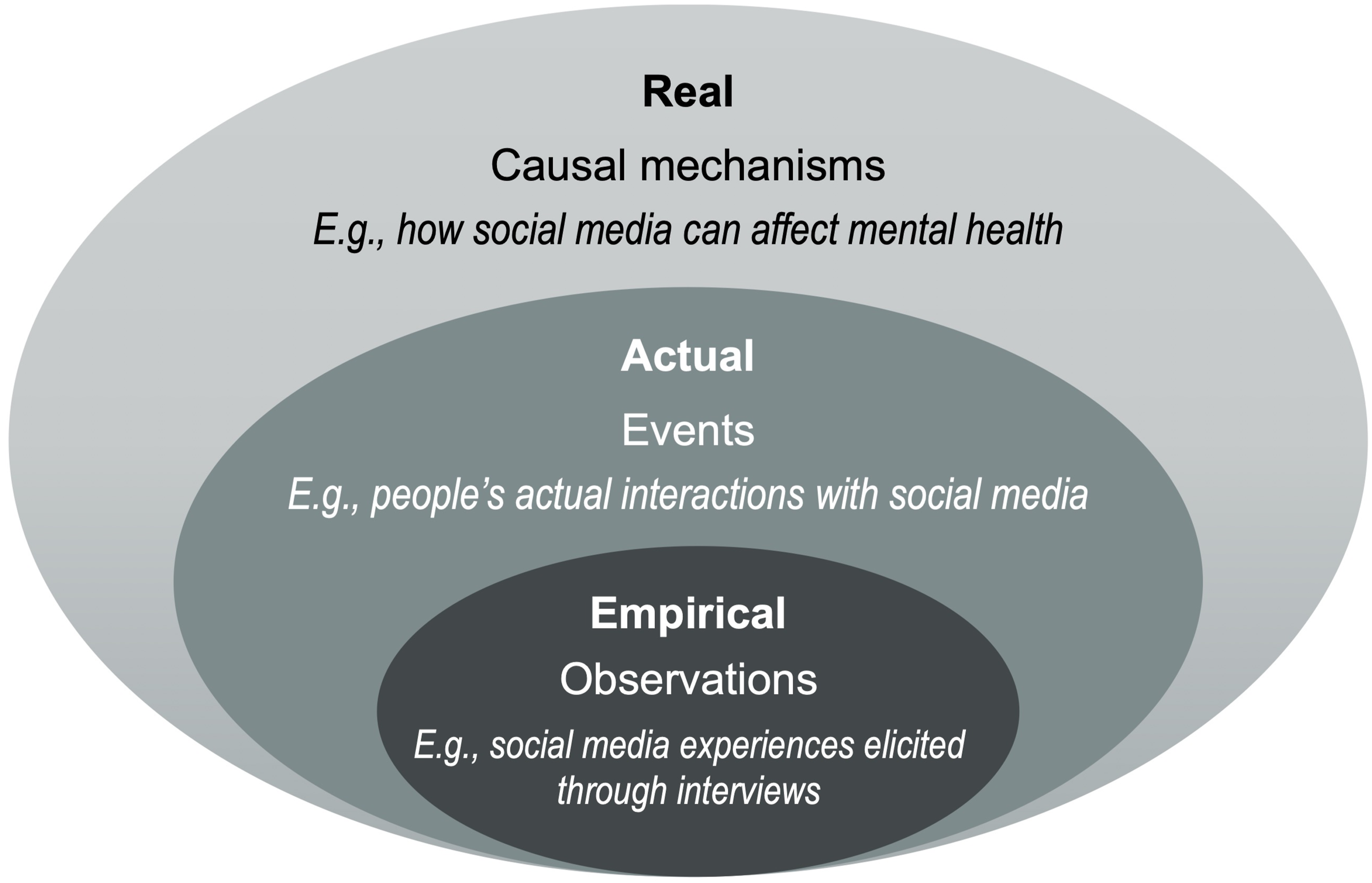
Critical realism further asserts epistemological relativism, that is, that science cannot produce absolute truths about reality. Scientific knowledge is relative because it is always contingent on the prior theories, sociomaterial conditions, and values available to researchers, which orient the questions that are asked, the methods used to answer them, and the conclusions that are drawn (Bhaskar, 2008). Scientific knowledge is also fallible because it studies causal powers and structures that are enmeshed in near-infinite webs of interacting factors (“open systems”), whose totality can never be fully accounted for in research (Bhaskar, 2014; Botha, 2025). This relativism does not mean that “anything goes” or that all theories should be treated equally. Critical realism advocates for judgmental rationality, a cautious and reasoned adjudication between competing claims about reality (Isaksen, 2024; Willis, 2023). Although critical realism is not monolithic, the combination of ontological realism, epistemological relativism, and judgmental rationality remains a shared foundation among critical realists (Isaksen, 2024; Willis, 2023).
The Causal Effects of Digital Culture and Practices
The philosophy of critical realism provides an elaborate theoretical perspective on causality, critically building on the positivist conception that causality is revealed by perfect conjunctions of events. Perfect conjunctions of events occur when, under controlled conditions, A is systematically followed by B. Bhaskar noted that in the real world, conjunctions of events are never truly “perfect”: there can always be third factors that affect A and B or that prevent the causal mechanisms linking A and B from being actualized (Bhaskar, 2008). For example, the effect of social media use (A) on negative social comparisons (B) might be blocked by a third factor, such as an individual’s high self-esteem, or a lack of visual contents on social media. In theory, perfect conjunctions of events can only be observed under fully controlled conditions, which Bhaskar called a “closed system,” meaning that no external factor can influence A, B, or the causal mechanisms linking them. Laboratory experiments attempt to create closed systems by controlling all environmental conditions. However, the problem, argued Bhaskar, is that no system is ever fully closed: the world is such that all phenomena are potentially interrelated in some way, across multiple levels of organization: natural and social phenomena influence each other, as do human agency and social structures (Bhaskar, 2014). The result is that science always operates in “open systems,” where conjunctions of events are imperfect and only actualized some of time. Inferring causality therefore requires that researchers attend to the material, human, and social conditions that are required for causal mechanisms to be actualized into events.
Despite the complexity of identifying causality in open systems, a methodology informed by critical realism would be focused on identifying the causal effects of digital media on mental health. By foregrounding causality as an ontological research question, critical realism helps remedy the muddy position of causal inference in contemporary mental health research (Willis, 2023). In quantitative studies, causal aims are implicit in theoretical frameworks, research questions, and the statistical adjustment for potential confounders (Grosz et al., 2020). In qualitative research, though the research aims are generally framed as understanding experiences and meanings, causal relationships are implied in the links drawn between situations, experiences, and meaning-making (Maxwell, 2012). But because quantitative and qualitative studies are inevitably prone to biases, there is a common sentiment that explicit references to causality are exaggerated or unsubstantiated. In contrast, in a critical realist methodology, causality is explicitly acknowledged as part of the research questions, and as such it openly guides the generation, analysis, and interpretation of the data (Fletcher, 2017; Moore & Kelly, 2024). The benefit of this explicit engagement with causality is that it provides a clear standpoint from which to judge the limitations of the study and appraise alternative interpretations of the data.
In addition to its clear engagement with causality, the ontological system of critical realism has more specific implications for the study of digital media effects. Critical realism recognizes that causal mechanisms are real, independently of whether or not they are actualized and observed. As a result, the causal criterion ascribes reality not only to the material world but also non-material structures, such as virtual reality, sociocultural conditions, and semiotic processes, which are all real by virtue of their capacity to bring change in the world. Such a view of reality invites researchers to reconsider the materialist assumption that virtual phenomena are less “real” than their physical counterparts, as in the dichotomy between virtual and “real” friendships (Chalmers, 2022). Recognizing the complexity of causal systems, critical realism also rejects reductionistic–deterministic views of mental health problems as fully attributable to either neurobiology or sociocultural conditions (Botha, 2025). From the biological to the social, the causal mechanisms of mental health reside at multiple levels of inquiry.
Likewise, the causal effects of digital media can be found at multiple levels (Liebherr et al., 2025; Postill, 2024). Typically, we think of digital media effects as located in the interaction of one or many individuals with a digital device (e.g., a pleasurable gaming session, cyberbullying, or online social comparisons). But even without direct interaction with the technology, digital media may affect us through the media practices of others, such as in the frustration of conversing with someone who is distracted by their phone (Vanden & Mariek, 2020). The effects of digital media also extend to broader sociocultural mechanisms, for instance, in the social norms of adolescence that expect youths to perform certain practices online (Weinstein & James, 2022).
Sociocultural conditions are crucial for understanding how digital media influence mental health, yet they are rarely addressed in mental health research, where neurobiological and psychological phenomena are the dominant levels of inquiry (Gómez-Carrillo et al., 2023). A methodology informed by critical realism recognizes the possibility that some of the causal powers of digital media are best described not in terms of individual behaviors but at the broader level of digital culture(s). Digital culture here takes a double meaning: it first refers to what might be called the “global” digital culture, namely, the dominant and pervasive ways in which digital technologies shape the organization of societies, modes of communication, informational habitus, and beliefs about the world (Thumim, 2012). Among adolescents, for example, the global digital culture is locally actualized in the expectations of peers to be available on social media and to possess a smartphone (Weinstein & James, 2022). In its second sense, digital culture refers to the subcultures that mobilize digital media to develop and disseminate particular systems of shared beliefs, identities, values, and customs (Paquin et al., 2024). Examples of these digital cultures include esport, geek, influencer, conspiracy, and fan subcultures. Both global and localized digital culture(s) are emergent and evolving structures through which digital media can influence mental health, but they are all too often omitted from research frameworks concerned with the explanation of individual behaviors.
Combining Methods for Causal Inference
No single method or discipline is capable of grasping causal mechanisms at all levels of inquiry (Danermark, 2019). As a flexible foundation to study causality across methods and disciplines, critical realism deploys the concepts of demi-regularities, abduction, and retroduction. Demi-regularities are partial repetitions of events (Lawson, 1997, p. 204). They are contrasted with perfect conjunctions of events, where A is always followed by B. Critical realism rejects the search for perfect conjunctions due to the complexity of open systems, instead aiming for the identification of demi-regularities (Bhaskar, 2014). Demi-regularities are imperfect repetitions that can be observed in quantitative data (e.g., as revealed by statistical associations) or in qualitative data (e.g., themes in interview transcripts).
Abduction and retroduction are forms of causal inference based on empirical data. Because empirical observations provide an incomplete window into the open systems from which they are generated, researchers must look beyond empirical data to grasp the causal mechanisms at play (Willis, 2023). In critical realism, the process of “going beyond the data” starts with abduction, which means re-describing the data using theory (Danermark et al., 2002; Fletcher, 2017). This redescription is followed by the work of retroduction, which consists of retrospectively identifying the causal mechanisms that generated the data. Retroduction draws from demi-regularities in the data, theory, and thought operations (e.g., counterfactual models) (Danermark et al., 2002, p. 80).
Abduction and retroduction can be applied in both quantitative and qualitative studies. In the first instance, let us consider a statistical association between time spent on social media and well-being, whereby adolescents who spend more time on social media report poorer well-being on average (Charmaraman et al., 2025). The association does not provide much information, in itself, on the causal mechanisms at play: does social media use decrease well-being, and if so, why? Does poorer well-being motivate the use for social media? Is there a third factor that confounds the association? The data can be redescribed using theories of social media effects (abduction): for instance, the identified association might support early theories that social media promotes negative social comparisons (Meier & Johnson, 2022). Therefore, we could suggest that youths’ social comparisons, emerging from the interaction between youths, social media, and contemporary culture, are the mechanism that generated the statistical association between social media use with lower well-being (retroduction). However, there are multiple alternative interpretations that can be made based on other theories, and there is not sufficient information in the “text” of the quantitative data to favor one interpretation over another. In a subsequent study, we might therefore examine the role of social comparisons more directly by indexing the frequency or degree of participants’ social comparisons on social media, which can then be examined as a statistical correlate of well-being. However, on its own, this research approach will not be able to rule out the possibility of co-existing or even counteracting mechanisms (e.g., high self-esteem and obtaining social support online that improves well-being). This uncertainty brings us to the role of qualitative methods, which might help us identify other potential causal powers of social media.
Indeed, a key feature of the critical realist methodology is to recognize that qualitative research can support causal inference (Sayer, 2000). The approach is similar to that of quantitative research: the researchers look for demi-regularities in the data, redescribe the data using theory, and devise an explanatory model of the causal mechanisms that could have generated the data. To continue the above example, a qualitative study could examine how social media influences youth mental health through individual interviews with youths. Various strategies can help identify potential mechanisms, such as narrative storytelling (“Tell me about a time where social media was particularly beneficial/harmful to your mental health.”) and more general questions (“In what ways does social media shape the mental health of people your age?”). In the first instance (narrative storytelling), the interviews will generate diverse personal accounts of social media experiences, across which the researchers will look for demi-regularities to identify potential causal mechanisms. In the second instance (the general question), the researchers let the participants initiate the retroduction—that is, participants are prompted to infer potential causal mechanisms based on their own experience and knowledge, and their accounts are subsequently analyzed by the researchers. Whatever the data generation strategy, the qualitative results will reveal demi-regularities that can help support, revise, or reject theories on social media influences. The choice of method depends on the research questions, the levels of inquiry, and theory. Ultimately, given the multiple levels of inquiry that are a priori required for understanding the phenomena of interest, some amount of interdisciplinary work will be necessary (Danermark, 2019).
Research as a Social Process
The previous two sections pleaded for research on digital media that combines multiple levels of inquiry and methods. However, on its own, observing the complexity of digital media effects does not do much to help researchers orient their work—and in a world of limited resources for research, the orientation is everything. Researchers get their orientation in part from theories and prior knowledge, but also from the social dimension of science. This social dimension is a key area of inquiry in critical realism.
Critical realist research rejects the assumption that science is detached from history and can be value-free. Research is always conducted from somewhere, even though the “somewhere” is often unacknowledged and unquestioned—particularly in the mainstream mental health sciences (Aftab, 2024). The questions asked, the theories drawn from, the methods used, the resources available, the interpretations made, the values implied: these all are aspects of research that are influenced by the historical, material, cultural, and psychological position of researchers. The contingent parameters of science, which underlie Bhaskar’s defense of epistemological relativism, are not merely obstacles but are what makes research possible in the first place (Bhaskar, 2008, 2014). However, critical realism mandates researchers to critically examine and reflect on the social parameters of their work.
Research on digital media is no exception, and it is laden, like other areas of mental health research, with values and cultural–political orientations. The conceptualization of gaming disorder provides an illustrative example of this social dimension of science. Gaming disorder refers to a pattern of video gaming that is difficult to control, prioritized at the detriment of other activities (e.g., work or school), and continued despite negative consequences (WHO, 2024). The recognition of gaming disorder has been a source of substantial debates in the scientific community, notably over whether the diagnostic label might help better support people who need help around their gaming habits vs. stigmatize those who are simply passionate about games (Aarseth et al., 2017). Like other behavioral addictions, the criteria of gaming disorder make two important assumptions: (1) the object of the addiction is a non-productive activity, susceptible of interfering with productive activities (usually understood as occupational activities); and (2) the threshold between health and illness is indexed, in part, by the loss of self-control. As critical histories of the Western world have shown (Chapman, 2023; Rose, 1996), there is nothing a-historical or value-free about the import of productivity and self-control in the mental health sciences: to the contrary, those notions are very much intertwined in political, economic, and cultural histories. This does not mean that one ought to reject gaming disorder or any mental health label solely on the grounds that they are situated in history. Again, operating from a particular position is a necessary condition for science to be possible (and I do agree that the concept of gaming disorder helps capture psychosocial–biological realities). But the example serves to illustrate the social dimension of research on digital media and mental health.
How should we conduct research on digital media, then, given these social parameters? In response to the inevitable role of values in the production of scientific knowledge, Bhaskar’s critical realism espouses an explicit commitment to human emancipation (Bhaskar & Collier, 1998). Scientific research can pursue human emancipation by revealing sources of injustice, oppression, and suffering and by proposing and testing interventions that aim to alleviate them. As a range of critical social theories have established, attention to injustice and oppression means interrogating and problematizing the structures of power that create and reproduce forms of inequalities, such as those associated with sex, gender, race, class, disability, madness, and neurodivergence (Crotty, 1998; Kincheloe & McLaren, 2023). In the case of gaming disorder, emancipatory research might ask: who benefits from the institutional recognition of this diagnosis, and who is harmed by it? Whose voices and knowledges dominate the study of gaming disorder, and which ones are left out? A critical realist, animated by their interest in causality at multiple levels of reality, would further ask: what causal structures are prioritized in the study of gaming disorder (e.g., behavior and neurobiology) and which ones are omitted (e.g., culture and commercial practices)? Of note, some of these questions have been addressed in research on gamers’ insights into the phenomenology of disordered gaming (Carras et al., 2017), the motivations for gaming among disabled players (Hygen et al., 2024), and the hegemonic ideals of masculinity that undercut problematic gaming (Gelūnas, 2023).
Finally, a critical realist informed methodology calls for reflexivity. Critical realist investigators must continuously examine and reflect on the influence of their own position in the research process. This positionality can manifest itself at every step, from the selection of theories and methods to the levels of inquiry that are foregrounded (e.g., biological, psychological, and social), the participant–researcher relationship, and the nature of the interpretations made. Critical realists recognize that they are, as human agents, part of the social systems in which their objects of research are situated (Bhaskar, 2014). The discourses of scientists about digital media are capable of shaping how research participants and the general population think about their own digital practices, producing changes in the very digital culture that is the scientists’ object of study. The effects of digital media on mental health are moving targets, not only because of technological developments but also because of the potential reciprocal effects between scientific and popular discourses, digital practices, and mental health (Hacking, 2004; Kempton, 2022). Through active efforts of reflexivity, researchers may better understand how the entanglement of culture and practices influences their work and how the researchers in turn influence their objects of research. Participatory methods and other inclusive practices in science can support reflexivity by expanding the range of voices capable of revealing one’s omissions and errors (Harding, 1991).
Conclusion
Application of Critical Realism to the Study of Digital Culture and Mental Health
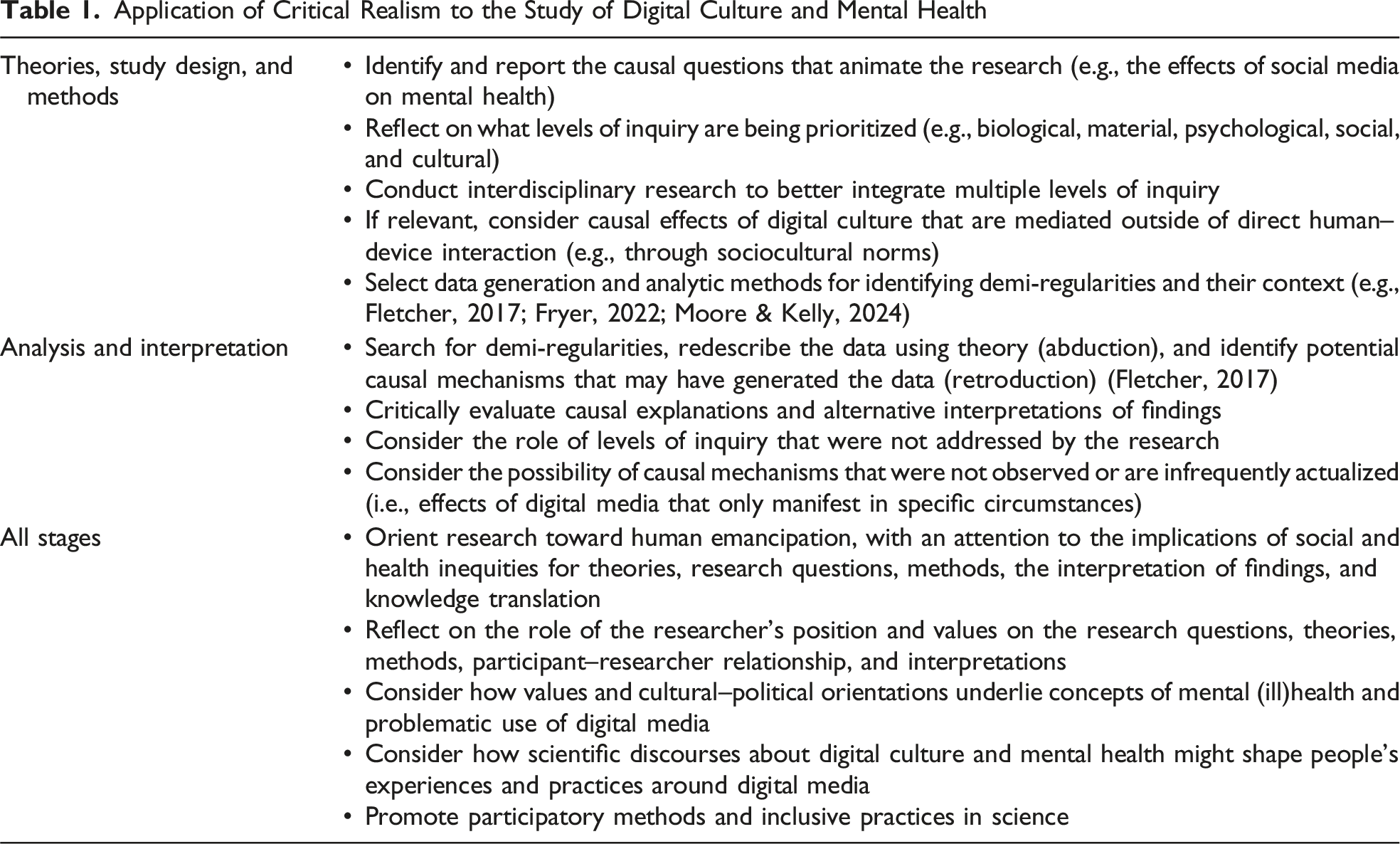
But given that causal mechanisms exist at multiple levels of inquiry, what should orient the attention of the researcher? If critical realism does not prescribe much direction or epistemic criteria for science, it does however commit researchers to the pursuit of human emancipation. This axiological commitment, combined with the constant work of reflexivity, provides the ultimate direction of research programs on digital media effects and mental health. As researchers plan, conduct, and complete their studies, they should ask and ponder how their research could contribute to human emancipation, what blind spots they may have, and what they can do to steer the ship in a better direction. Through its ontology of causal powers, critical axiology, and reflexivity, critical realism provides researchers with rich devices for taking the long view on the knowledge they generate. In a world of ubiquitous and everchanging digital cultures, critical realist principles may help translate knowledge into interventions and policies that contribute to the promotion of human flourishing.
Footnotes
Acknowledgments
The author thanks Elizabeth Anne Kinsella and Monica Molinaro at McGill University for their valuable input and feedback on earlier versions of the paper.

Ethical Considerations
This article did not require an ethical board approval because it did not involve research participants.
Funding
The author disclosed receipt of the following financial support for the research, authorship, and/or publication of this article: This work was funded by the Fonds de recherche du Québec and Ministère de la santé et des services sociaux (MR1-344191).
Declaration of Conflicting Interests
The author declared no potential conflicts of interest with respect to the research, authorship, and/or publication of this article.