



Abstract
The extant literature has scant detail about everyday spiritual practices that aid Indigenous young people. This paper systematically explores Indigenous Spirituality, health, and well-being through Elder-governed yarns conducted via Zoom with 44 Aboriginal Elders, Healers, and Senior and Junior people involved in health and well-being of the Victorian Aboriginal community. These yarns were analyzed through an innovative, constructivist, multi-perspectival discursive grounded theory method. Key findings are that Spirituality is crucial for health and well-being, leading to a clear mind and at-peace “center” in a person. Aboriginal spiritual practices reflect the unique characteristics and essential rhythms of Country. Spiritual development is incremental and increases the obligations and responsibilities a person has to community and Country and leads to increased caring for Country. This paper provides rich detail about practical spiritual techniques to aid Indigenous young people and their kinship networks. It has the potential to shape future policy.
Introduction
Indigenous Spiritual practices have been developed, practiced, and passed on to younger people in Australia for millennia. Spirituality has always been central to Aboriginal and Torres Strait Islander ways of knowing, being, doing, and axiology, and, in turn, to health and well-being. But it is relatively recently that the Western health discourse has recognized the importance of Spirituality for Indigenous people. National policy documents since the 1990s have increasingly described Australian Aboriginal and Torres Strait Islander mental health and well-being as holistic and underpinned by physical, cognitive, emotional, spiritual, social, environmental, and cultural domains (Australian Institute of Health and Welfare [AIHW] & National Indigenous Australians Agency [NIAA], 2020; PM&C [Department of Prime Minister and Cabinet], 2017; Swan & Raphael, 1995). Moreover, they now recognize that human health and well-being is affected by the health of Country, the Ancestral homelands to which Aboriginal and Torres Strait Islander people have profound social and spiritual ties. However, despite agreement about the importance of Indigenous Spirituality for health and well-being globally, the extant literature has scant detail about practical spiritual practices that aid Aboriginal and Torres Strait Islander young people and their kinship networks. There is also little research outlining the form or content of programs designed to strengthen Indigenous Spirituality. These questions are particularly pertinent for Indigenous people living in the south-east of Australia, where colonization has arguably had the most longstanding and deleterious impact (Sherwood, 2013). But they are also questions that are relevant to other places subject to cultural dispossession and dislocation.
Drawing on research yarns conducted with 44 Indigenous people from around the south-eastern Australian state of Victoria, this paper explores the following questions: How do Indigenous people create and sustain Spirituality for themselves in the contemporary moment? Connection to Community, Country, and Culture are known to be central, but what does this require or look like in practice? Are some connections more important than others? How do they share their Spiritual practices with the younger generation? And how might those wishing to strengthen Indigenous Spirituality for themselves or others (through the development of targeted programs, for instance) draw on this knowledge? The paper finds that Spirituality is crucial for health and well-being, and it manifests in a large number of ways and may involve every facet of individual and community life. Indigenous Spiritual practices can be shared with younger people and are cultivated through repetitive practice. They reflect the unique characteristics and essential rhythms of Country and lead to a clear mind and at-peace spiritual center in a person, so the Spiritual energy of Country may readily flow through them. Spiritual development is incremental and increases the obligations and responsibilities a person has to community and Country and leads to increased caring for Country. Finally, Indigenous Spiritual practices could augment Western health management but are best run separately or nested alongside.
Indigenous Spirituality and Health
Research with Aboriginal and Torres Strait Islander communities in Australia has found that Spirituality influences the formation of personhood at a fundamental level and is inextricably linked to mental health and well-being (Wilson, 1999). Spirituality conveys meaning and purpose through deeply intuitive and pervasive internal conscious and unconscious connections with the material and non-material world (Eckersley, 2007). While Aboriginal and Torres Strait Islander spiritual practices are varied and particular to people and place, most share a belief that Creator Spirits formed and continue to form all the material and non-material elements of Country from a prior state of formlessness, finding resting places on earth and/or in the sky (Grieves, 2009). That is, Stories re-told in Ceremony in the same way at particular places and seasons in Country not only record the Creator Spirits’ actions but also support their ongoing generative practices that keep people and Country healthy (Stockton, 1995). “The Dreaming” is the common translation into English language that denotes this process of primordial origination of all aspects of Country, “seeing” and “experiencing” the eternal during sleep, and the ongoing creative processes of regeneration (Stockton, 1995). Law, ethics, morals, and values emerge through these acts of creation, and all are interconnected in a relational web. In contrast to Western settler colonial thought, there is consequently no past, present, or future tense in Indigenous epistemologies, nor are there demarcations between the secular and sacred, material and intangible, or subject and object (Rose, 1992). While settler-colonization disrupted the maintenance of Indigenous cultural practices, many of these creation Stories continue to be recalled overtly in contemporary society through place-names and animals but also covertly by Aboriginal and Torres Strait Islander people who have continued to maintain their cultural practices quietly despite the many years of repression.
Traditional healers’ work is similarly integrated across spiritual, physical, social, and cultural domains. Elkin (1994) provides a detailed overview of Indigenous traditional healers, their comprehensive training and practices. A thorough description is beyond the scope of this paper, but briefly, they use a variety of healing techniques including song, massage, bush medicines, smoking and water ceremonies often depending on the particular place, time, and ailment they are healing, and local cultural traditions. Ngangkaris from the central desert region of Australia, for example, use a variety of sacred objects (wood, australites, quartz, etc.) that they claim can be moved into or out of the person’s body at will (NPY Women’s Council Aboriginal Corporation, 2013). Their healing powers invariably run in families and are often passed down from grandparents to grandchildren. Country is crucial for their healing powers. Healers can only do their work after connecting first with each Country’s Ancestors and Spirits through the soles of their feet, the palms of their hands, their bodily spiritual center in their abdomen, and the middle of their forehead. Healers are often peripatetic, following cultural obligation to and responsibility for community and Country. While traditions across Australia differ in their detail, they share a belief that Country and Spirits are central to their powers.
The international Indigenous literature provides a strikingly similar account of Indigenous Spirituality and mental health and well-being, connections to community and homelands, the activity of Creator Spirits, and traditional healing practices (see Canadian First Nations peoples—Freeman & Lee, 2007; American Indian peoples—Gone et al., 2020; Kenyan Bantu peoples—Mukaria, 2021; Western Siberian Khanty peoples—Tolley, 2021). As for Australia’s Indigenous peoples, Spirituality has a number of key components for each individual and community mediated through their Ancestral places: Story, language, law, kinship, history, and ceremony including song, dance, music, and art that convey the sacred (Myers, 2002; Salmon et al., 2019). Commonly, human beings and animals, plants, landforms, waterways, etc. may have shared spiritual origins reflected in the actions of the Creator Spirits as part of how everything is in relationship to everything else. This Totemism is an intrinsic part of Story and how Country functions (Grieves, 2009; Rose, 1992; Stockton, 1995). Men’s and women’s Spirituality, law, and ceremony exist separately but in a symmetrical and complimentary way (Rose, 1992). Spirituality is also developmental and incremental in the knowledge and practice of Story, law, and ceremony: initiation rites ensure that young people embark on a spiritual journey from “egocentricism” to a gradually deeper understanding of how all aspects of Country are related (Tacey, 1997/1998).
According to Gee et al. (2014), Spirituality (including Ancestors and Spirits underpinning Country) is one of the seven domains needing to be addressed for the individual and communal health and well-being of Aboriginal and Torres Strait Islander peoples. The others include connection of self to (1) body, (2) mind and emotions, (3) family and kinship networks, (4) community, (5) Country, and (6) culture. Further, enculturation (the degree of an Indigenous person’s integration within culture) and cultural spiritual orientation (the extent of their personal engagement in cultural spiritual practices rather than adhering to more distant general community spiritual beliefs) are important for ongoing health and well-being at an individual and communal level (Fleming & Ledogar, 2008). The “Strong Spirit Strong Mind” model for Indigenous health and well-being, based on Joseph “Nipper” Roe’s Ngarlu cultural healing practice, links health with the Ngarlu (inner spirit, located in the abdomen) being at peace and free from constraints (Casey, 2014). Furthermore, Wariya Ngarlu collective healing practices involve the group becoming of one mind, one emotion, and one spirit in their respective abdomens so remaining communally healthy (Casey, 2014). Common across Australia is a belief that the abdomen is the site of a person’s spiritual center. It is termed Liyan for the West Kimberley tribes and Morrom for the Victorian Kulin tribes. Ungunmerr (1988) describes a practical technique of the Daly River tribal groups for remaining healthy and well, termed Dadirri. It is a wordless meditation involving intense focus on different aspects of the environment, such as water flowing in a river or wind whistling through trees. In the quiet stillness and awareness that follows, the practitioner becomes increasingly aware of their inner Spirit communing with the Spiritual reality within the element of the environment on which they are focused.
Indigenous health and well-being in other parts of the world, including Canada, the United States, and Western Siberia, are similarly linked to Spiritual practices that are emplaced in Country. Gone et al. (2020) reveal Native American Healers view spiritual practices as necessary for accessing sacred powers that give rise to life, health, and ongoing well-being and that some Healers need to be on their traditional lands for these spiritual practices to be efficacious. Consequently, American Indian reservation life is viewed as more conducive to spiritual healing than an urban setting. Importantly, Native American Healers have an obligation and responsibility to their communities and their homelands to access these sacred powers for the benefit of both. Likewise in Canada, spiritual practices for health and well-being are enacted and emplaced locally for them to be effective. The Khanty shamans of Western Siberia similarly have local healing songs with specific rhythms, melodies, and language relevant for the particular place (Tolley, 2021). Spiritual healing practices are integral to the recently explicated notion of survivance (Wilbur & Gone, 2023)—a portmanteau of survival and resistance. Indigenous communities internationally, Wilbur and Gone argue, have remained healthy and thriving despite the historical trauma of colonization. As resilience is to trauma, they pithily note, so survivance is to historical trauma (Wilbur & Gone, 2023). Freeman and Lee (2007) also outline that while Spiritual practices are necessarily particular to a locale, different tribal communities with health and well-being issues in common may forge national links at an organizational level.
Western Evidence-Based Mental Health Care
Western evidence-based mental health management, by contrast, arises from a strikingly different epistemology, ontology, and axiology. Rather than an intersubjective, relational, and communal Indigenous base, Western mental health is largely founded on objectification of mental phenomena through particular clinical and research practices. These include observation of symptomatic emotional states and behaviors (Jaspers, 1913); operationalization of phenomena through determining their psychometric properties; collection and analysis of nomothetic group data to characterize particular mental disorders; and conducting randomized controlled trials of carefully defined psychosocial and/or medication management strategies (American Psychiatric Association, 2013). Biological phenomena and medication treatments are more readily operationalized and investigated so the evidence base for these phenomena has grown exponentially since the “decade of the brain” in the 1990s (Goldstein, 1994).
The resulting “acculturative stress” caused by the epistemological, ontological, and axiological clash has worsened Indigenous peoples’ mental health and well-being and intensified Indigenous historical trauma (Reser, 1991). Waldram (2004) has termed this a community “soul wound” that has led to anxiety, depression, alienation, and marginalization of Indigenous peoples. Hunt et al. (2008) have emphasized the “intercultural post-colonial frame” that bedevils Indigenous governance systems, and Mahood (2012) has described the characteristics of the spirit-sapping revolving door of non-Indigenous health professionals who relentlessly rotate through remote Indigenous communities. In response, some Indigenous communities have used their Spirituality in ceremony to resist colonization (Poroch et al., 2009) and counter ongoing traumatic events (Stout & Kipling, 2003). Many hundreds of Indigenous communities in Australia have taken proactive steps to develop strengths-based approaches to aid their young people and their kinship networks: McKendrick et al. (2014) provide a concise overview of them. Yet, despite steady ongoing calls for Indigenous Spirituality to be incorporated into mental health service delivery for approximately 30 years (AIHW & NIAA, 2020; Dudgeon et al., 2017; Suggit, 2008; Swan & Raphael, 1995), there is little evidence of substantive change.
Methods
The overarching methodology for this study was a hybrid of grounded theory with Community Participatory Action Research (CPAR). It comprises two parts: the first a community needs assessment that informed the developed of the second: an Elder-governed culture-centered adjuvant therapy for young people with treatment non-responsive mental illness. Community participated in all levels of the research from governance, leadership, research assistance, and participants. A small number of non-Indigenous researchers (one of the co-leads, author JM, a research officer and research assistant) are also part of the team.
Establishing Indigenous Leadership Following Cultural Protocols
A Board of Elders and Senior People oversaw the study from its inception. Elders provide ongoing core and central guidance for Indigenous communities in Australia (Busija et al., 2020; Flicker et al., 2015) as they do internationally (Kennedy et al., 2022): Indeed, governance by Elders is a protocol for how Indigenous communities work. An Indigenous child and adolescent psychiatrist (author AV) co-led the project consulting with an Aboriginal Health Liaison Unit within a major pediatric hospital in an Australian capital city. An advisory group of experienced Indigenous health professionals added specific guidance on navigating Western health care systems while maintaining cultural authenticity. The project was approved by the Royal Children’s Hospital Human Ethics Committee (2019.207/56941). The quality of the research design scores 14/14 on the Aboriginal and Torres Strait Islander quality appraisal tool (Harfield et al., 2020).
Sampling and Recruitment of Community Members
Participant Characteristics for the 44 Community Needs Assessment Yarns.
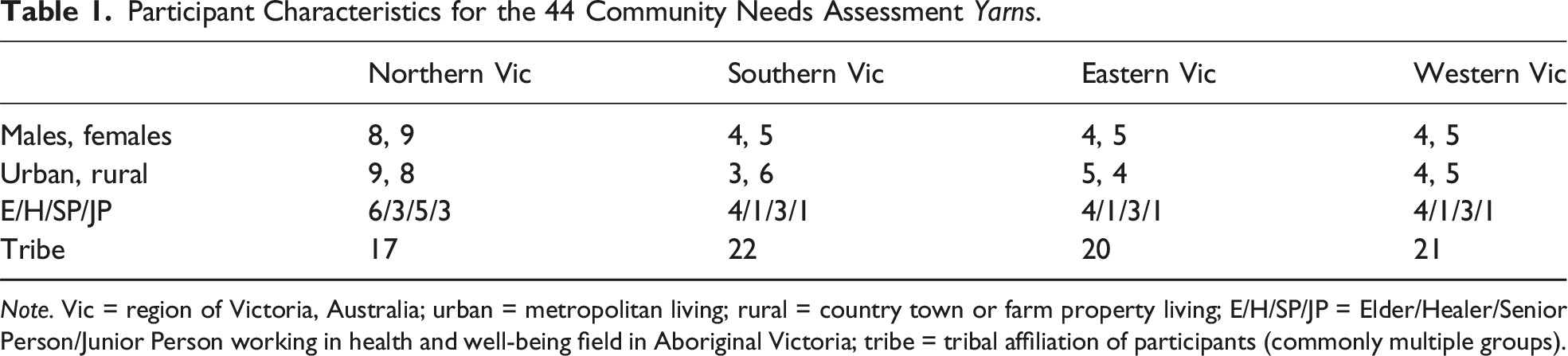
Note. Vic = region of Victoria, Australia; urban = metropolitan living; rural = country town or farm property living; E/H/SP/JP = Elder/Healer/Senior Person/Junior Person working in health and well-being field in Aboriginal Victoria; tribe = tribal affiliation of participants (commonly multiple groups).
Yarning with Community Through COVID-19
Given the implicit Western biases in most research methods (Bainbridge et al., 2013; McGaw & Vance, 2023), grounded theory analysis was done by a multi-perspectival team. Grounded theory typically begins with open questions, rather than a hypothesis or theory, focuses on social actions and processes, and uses an inductive process to generate themes arising from the participants’ data (Glaser, 1992). Given Indigenous health and well-being is emplaced in a matrix of relationships—geographic, Ancestral, Totemic, and human—that are inter-generationally transmitted through community and Country connection and belonging via “Storying”—yarning was used for the Community consultation instead of semi-structured interviews. Yarning is an Indigenous method of making sense of lived experiences with another (Geia et al., 2013). It is a dynamic, specific, and fluid style of conversation through which knowledge is holistically exchanged (Kennedy et al., 2022; Shay, 2021). In a yarn, intimate views and sensitive information can arise as knowledge is shared in a two-way intersubjective process that enriches all who are involved. To manage cultural safety, a respected member of the local Indigenous community facilitated the yarns (Innes, 2009; Merriam et al., 2001). Their reciprocal connections, defined by obligations and responsibilities of kinship, enabled the yarning process (Dew et al., 2019).
Due to community lockdowns during the COVID-19 pandemic, the yarns were convened one-on-one in “Zoom.” Although we initially planned to run Indigenous yarning group sessions with the participants across Victoria, the switch to Zoom had its strengths. The “Zoom-yarns” facilitated quiet voices to be heard as extroverted personalities could not take center stage; they were deeply reflective and for some participants was a source of comfort amid lengthy periods of social isolation. Zoom enabled easy recording and subsequent transcription. The yarns were lengthy—45–60 min or 8–10 pages of transcribed conversation on average. Where Elders were unable to manage the unfamiliar technology of Zoom, phone conversations were recorded instead. Four open-ended questions scaffolded the yarns: What does Culture mean for you and your mob? What Cultural practices aid and/or maintain health and well-being for you and your mob? Who best governs Cultural practices in your mob? Any practical issues for Cultural practices to be put into place at the hospital? An overview of the themes from the study has been reported elsewhere (Vance et al., 2024a). Spirituality was a strong theme, emerging in some way in the yarns with most participants, hence the exclusive focus on it in this article.
Analyzing the Community Yarns
Analysis was informed by constructivist, grounded theory, which demands reflexivity in the analyst (Charmaz, 2006; Glaser, 1992). As social, cultural, educational, and disciplinary differences can shape perceptions, a team of four analysts independently read the yarn transcripts and/or watched the video footage and completed initial coding. This multi-perspectival approach was developed to make blind spots that arose from the intrinsic interests and disciplinary training of each coder apparent. Each had unique social, cultural, and disciplinary perspectives: two had Aboriginal heritage and two were non-Indigenous; one had secondary education to year 11, one had an undergraduate degree, and two had doctorates; those with tertiary training were variously skilled in mental health (psychiatry), social sciences (anthropology), and the spatial disciplines (architecture and cultural geography). One of the coders was a participant-researcher who conducted the Zoom-yarns. All the perspectives of the yarns were valued.
The separate stages of grounded theory analysis typically comprise initial coding, then focused categorical coding, and the formulation of gerunds which lead to theoretical coding (Charmaz, 2006; Glaser, 1992). In this project, coding was done independently to begin. The analysts also wrote self-reflexive memos to track responses and thoughts and record, question, and define assumptions (Cooper & Burnett, 2006). The team then met over four sessions via Zoom sharing what they had “discovered” through each yarn. At times, the members were united in what they believed had emerged from the data, but at times dissonant perspectives emerged instead. All these multiple perspectives were included in the yarns analysis. The coders eschewed consensus as a simple reinforcement of a dominant discourse, congruent with Mouffe’s (1999) injunction to “struggle” with difference in her “agonistic pluralism” treatise. While there was strong agreement about the key themes, each member of the team had emphasized different themes during the coding phase: arguably because they resonated most strongly with their own experiences and interests. The anthropologist, for example, had been drawn to discussions that sought to explain the meaning of “culture”; the Indigenous research assistant who had previously worked as an Aboriginal Health Liaison Officer had been particularly interested in the barriers and blockages to health recounted by the participants; the architect and cultural geographer had been interested in the practical discussions about the health giving benefits of “doing” cultural practices—art, music, dance etc.—and passing them on; and the Indigenous psychiatrist (author AV) was particularly drawn to discussions about the intangible experiences, sensations, and beliefs that underpin culture. A fuller description of the methods is available in other papers (McGaw & Vance, 2023; Vance et al., 2024a, 2024b).
Findings
The team all agreed during discussion that Spirituality had been a key theme of many of the yarns. A simple word search of the transcripts offered a confirmatory objective measure: “Spirit/Spiritual/Spirituality” was mentioned 175 times, second only to Country—noted 208 times as the most frequent noun used when community members talked about Culture and healing. Five participants spoke at some length and with considerable eloquence and detail about how they practice Spirituality. Although few in number, they were diverse, including men and women, younger people and Elders, Stolen Generations, and ones who had grown up immersed in Indigenous culture throughout their lives. We have chosen to focus on these yarns because of the richness and insights they provide. We include long excerpts so their voices are clear.
These yarns revealed that Spirituality is built on faith in a force or entity that is intangible, unseen, and unobserved. Participants described it as a multi-sensory, whole of body experience that piqued at particular times. They perceived Spirit manifesting through a variety of entities within Country including the stars, landforms, waterways, plants, animals, insects, clouds, and wind. Individuals described spiritual encounters through every part of life, both sacred and mundane, as if they actually lived moment to moment spiritually. But Spirituality was also described in terms of a network of family relationships, community (clan and tribe) relationships, and relationship with Country. As one participant explained: For me it’s very much about Spirit. I’m really closely connected to Spirit every day—every part of my life is about a connection to Spirit. I hear Spirit, see Spirit, talk to Spirit, Spirit is everywhere for me. Living culturally, that Spirit connection can come in so many different ways. It can be the relationship with birds, the way the wind blows, it can be clouds, it can be Spirit trees, it can be all sorts of things, it can be Spirit itself. I get my cultural strength and connection from my relationship with Spirit. But also my relationship with my Elders and my family and that connection to my Ancestral Country. (Participant 28)
Spiritual practices were deemed to be crucial for clearing one’s mind and healing one’s body. They were often described as rhythmic, repetitive, calming, and bringing peace. Indeed, practicing being quiet, listening deeply through surrounding day-to-day noise and the initial stages of noisy silence, was believed to be critical for hearing the echoes of the Ancestors and Spirits of Country. One participant described a practice of staring at their reflection and/or Totem until they begin to see their own Ancestral Spirits. They believe they will go back to their Spirit places in Country when they pass. Ceremony, especially a smoking ceremony and speaking in traditional languages, was said to enable Spiritual experiences for both individuals and communities. The body was also noted to be the vehicle for an individual’s Ancestral Spirits: I think it’s affirming of being Aboriginal … and the sense of pride and strength you get and that believing that you are connected to Ancestors, Spirits and Country and having full faith … It’s there but you can’t see it, and when you do it you can’t explain the feeling you get because it’s a whole of body experience. For me, it clears my mind, it steadily connects you. It connects you with old ways that are thousands and thousands of years old slowly. How can that not be healing? It connects you with what has been taken and I think there is power in that. There is power in saying we are reclaiming you as you learn more and more. I think that is another added strength … [Our practices are] rhythmic, calming, repetitive so it’s calming, it’s healing, and all our practices do that. If you think about dance and song it’s quite soothing. But when it’s done in your language on your Country it adds extra layers to it .… (Participant 3) I started singing in our language. That is the vehicle that carries the Spirit of our people. This body is the vehicle that carries my 80,000-year-old Spirit that will eventually go to that place of the Spirit’s dreaming. Our people’s Spirits still walk with us. I can enter this space between the real, the physical and that Spirit place there [gestures up and down]. It’s not a thought process, it’s our true Dreaming. I’m trying to balance my cultural identity all the time in two worlds—blackfella and whitefella. We get messages every day from the Old People. A leaf might hover in front of you, and that’s a message from those Old People. Spirit is around us every single day. And I want to immerse myself in the practice. Our Elders and Ancestors want us to go back to Country. You can go out on Country and hear nothing because there is so much noise in silence too. If you listen intently you will hear them Old People in the echoes in the bush. The reality is if you stare long enough in the mirror at yourself and truly believe, you will see your Ancestry. Spirits that are you. Don’t just look at yourself as a physical manifestation of your mother and father, look beyond and you see your Ancestors. Knowledge is held, not in the intellect, but in my spirit. The Totems that make us are who we are too. Possum just stares straight through you and you think that is one of my family members staring me down. (Participant 32)
Participants explained that Spiritual growth demands hard work and total immersion in regular Spiritual practices. It is developmental and incremental. As one grows in inner strength, one experiences ever greater Spiritual protection. The depth of knowing and capacity for caring in community and for Country are markers of Spiritual development. They are also an indication of the intimacy of relationship with Ancestors and Spirits of Country. Two participants explained: Culture to me means and is being amongst the trees, caring for each other, being close to land, knowing Spirit, Spirit knowing me, my connection to birds and all animals, even those horses and pigs and all them come here. So yeah, it goes deeper than just land for me. Spirit and land, so these are separate things, but everything is a living thing. They acknowledge you as well as you acknowledge them if you can see the signs. And you have to work hard at it. That’s what Spirit means to me, culture. (Participant 34) So culture is something that I hold spiritually within myself as part of my identity as an Aboriginal person. So that Spirituality connects me to Country, and gives me a strong sense of belonging and connection to customs, languages, roles, functions, every part of our living from when we are born to when we pass, because elements of Ceremony are part of that process. That slowly builds up your cultural integrity. (Participant 43)
The Ancestors and Spirits of Country are ever-present, revealed through natural phenomena like the wind. They were described as attending to people, communicating with them constantly, and calling people to Country. One participant described a process of Ancestral Spirits actively enabling them to learn their lost language and delighting in their growing knowledge and capacity. Rewarded for the effort and attention of deep listening, the participant felt the Spirits’ presence through the dynamic energy of Country: That’s how I learned my language—phonetically as though I was reading English after I got a book and worked on it hard. I sat quietly and did that deep listening and I listened to the Old People … and over time then it was as if my [many times] great, great grandparents were sitting up there. It was a freaky thing became I’m sure they were in attendance. I’m sure they heard their [many times] great, great grandson sing in that language. Those languages would have been sitting dormant and cared for by non-Aboriginal people in a cabinet. I got my cousin to smoke me before and that evening massive windstorms came through, it came from the west, and for non-Aboriginal people that was just a wind, but for me, for everyone using those dormant languages, it was all those Ancestors from around the country coming to hear and it was the most poignant and amazing experience of my life. (Participant 32)
Discussion
Indigenous Spirituality’s importance for health, revealed in these yarns, is consistent with the extant international literature (AIHW & NIAA, 2020; Gone et al., 2020). Like other international Indigenous traditions, Spirituality operates within and between individuals, family, community, and Country (Swan & Raphael, 1995), is pervasive and deeply intuitive (Eckersley, 2007), is crucial for ongoing health and well-being (Poroch et al., 2009), and must be expressed in particular ways, at particular times, and in particular places to be effective (Stockton, 1995; Tolley, 2021). Developing ways to enable young Indigenous people who are disconnected from their community and/or their Country or living in out-of-home care with non-Indigenous carers to engage in Spiritual practices is therefore an important aspect of being healthy (Vance et al., 2023). Connecting up young people with their community and/or Country can be arduous and fraught with difficulty, so fostering opportunities for encountering and learning from other Indigenous people who explore their Spirituality in the Country where they find themselves can form the basis of a young person’s deepening exploration of Spiritual practices.
Our participants offered rich description of their own Spiritual practices in the yarns, such as the ways Spirit manifests in the natural world, involves all the physical senses, and imbues every aspect of daily life. These practices are consistent with some of the literature on Indigenous Spirituality (Freeman & Lee, 2007; Salmon et al., 2019), including the crucial role of “place” (Tolley, 2021); the importance of being free of the tenses of time (Rose, 1992); the importance of Totems (Grieves, 2009); and being at peace and free of constraints (Casey, 2014). But they are also different from other Spiritual practices, both Indigenous and theistic. Whereas these participants describe spirit in the natural world—in birds, animals, Totems, and trees; in the dynamic elements of wind and smoke; and in the practices of speaking traditional language, singing in Country—experienced in the everyday, mundane, and small moments of life, other religious practices use ceremonial practices to connect with the Spirit world, for example, the Native American Indian ceremonial practice of petitioning a supernatural being for aid (Gone et al., 2020) or a Christian church-based Eucharistic ceremony (Grieves, 2009). Perhaps because our participants’ Spirituality is integrated holistically into a way of being in the world rather than confined to religious expression or belief, it is perceived to be a critical aspect of health and well-being.
The yarns offered instructive lessons for developing a Spiritual practice. Participants advise becoming quiet and listening deeply through surrounding day-to-day noise until silence is found. It is not until one moves deeper than this initial noisy silence into an inner quiet, they say, that one enters a space and place where Ancestors and Spirits of Country can be heard and experienced. One enabling practice described is quiet and persistent staring at one’s reflection or at Totems. Through this process, one participant sensed his own Ancestral Spirits appear, revealing shared Spiritual origins. For one of our participants, Indigenous Spiritual practices are rhythmic, are repetitive, and reflect the unique characteristics and essential rhythms of the Country where they are practiced. They lead to a clear mind, peace, and calm across the whole person, group, or Place in Country and aid bodily healing. As with other spiritual and religious traditions, particular ceremony and language enhances and strengthens Spiritual practices and makes them more intimate and immediate. According to our participants, this reflects the underlying Spiritual–physical nature of reality where names convey the Stories of Places’ creation (Stockton, 1995).
Spiritual development and growth in the yarns are described as incremental (Tacey, 1997/1998). With successive stages of initiation, and with practice, deeper truths and knowledge are understood, experienced, and internalized (Brady, 1994; Elkin, 1994). Obligations to, and responsibility for, community and Country are a necessary corollary of the process of initiation (Gone et al., 2020). The degree of enculturation and cultural spiritual orientation are linked with ongoing health and well-being (Fleming & Ledogar, 2008). For example, Dadirri meditation practices are associated with enhanced protection of health and well-being and increased Spiritual growth (Ungunmerr, 1988). Moreover, Spiritual development is central for survivance given historical trauma (Wilbur & Gone, 2023), healing the “soul wound” of colonization (Waldram, 2004), and managing acculturative stress (Reser, 1991) along with the endless pragmatic problems of governance between Western and Indigenous worlds (Hunt et al., 2008). Yet, again the yarns provide important detail: hard work is essential for Spiritual growth and development along with total immersion in Spiritual practices. Through such sustained and deep commitment, increased personal strength and protection arise against the fragmenting effects of colonization and traumatic events (Vance, McGaw, O’Meara, et al., 2024). Tireless effort and discipline are demanded to “keep at it” over time with an openness to learn from Spiritual practices. Importantly, a clear mind, peaceful mind, and self-control at individual and interpersonal levels characterize Spiritual growth and development.
In addition, caring for community and Country marks Spiritual growth and development along with ever deeper knowing of Ancestors and Spirits of Country and relationship with them. Practitioners become aware they are all around, communicating with them constantly, and drawing them deeper into an experience and knowledge of Country’s essence—how everything is connected to everything else and works. Through practice, they become ever more skilled at balancing the connections between the Spiritual and physical worlds.
The yarns occasionally mentioned specific male and female Cultural Spiritual practices. This differs from the known strict gender demarcation practiced in tribal groups in the Australian Central and Western desert regions, the Northern Territory, and the Kimberley regions (Elkin, 1994; Rose, 1992). It is not surprising given the rapidity and ferocity of colonization in South-East Australia with the attendant destruction of cultural tribal systems and practices. Many of the distinctions between tribal groups were lost through the suppression of culture and co-location of tribal groups in missions and reserves in the colonial period. The surviving Victorian Indigenous community operated as one mob until the 1990s in order to survive (Sherwood, 2013). Traditional Healers (terms include Ngangkaris and Mabans) were rarely discussed specifically in the yarns for they no longer exist in South-East Australia since the cultural destruction that occurred through colonization. Ngangkaris from the NPY Women’s Council travel down from Mparntwe (Alice Springs) to Victoria to provide healing to young people and their kinship networks. Since Mabo vs Qld (1991) which gave rise to Native Title law, there has been a renaissance of Indigenous culture in Victoria, and cultural practices, like language, art, and other customs particular to different tribal groups, are being reclaimed.
Given the importance and centrality of Indigenous Spiritual practices for ongoing health and well-being in the community needs assessment, developing a method for providing Elder-governed Indigenous Spiritual practices in addition to Western evidence-based mental health would seem to be important. Yet, how it is done in practice without Western health management and practices crowding out, colonizing, syncretizing, or hybridizing Indigenous spaces, places, and practices requires ongoing research (Asamoah et al., 2023; Marsh et al., 2015; Wolfe, 1994). The second stage of this research project is piloting an adjuvant Elder-governed Indigenous health and well-being program in natural environments (Eckermann et al., 2010) for young people receiving standard Western mental health care in a mainstream hospital. The study is almost complete, and preliminary results are promising. So much so that authors (AV and JW) have profoundly changed their individual practices of psychiatry and psychology from just providing Western mental health management alone to placing Indigenous Spirituality and Culture at the center of the therapy experience: All Indigenous young people and their kinship networks are now offered a Culture-centered therapy that is inclusive of Indigenous Spirituality alongside Western mental health care (see Vance, McGaw, O’Rorke, et al., 2024 for a description).
Conclusion
This study provides rich detail about Indigenous Spirituality practiced by members of the Aboriginal and Torres Strait Islander community in Victoria to aid Aboriginal and Torres Strait Islander young people and their kinship networks. There are ample data from the community yarns to enrich the form and content of programs designed to strengthen Indigenous Spirituality. Indigenous people create, deepen, and sustain Spirituality for themselves in the contemporary moment in a variety of ways. Connection to community, Country, and culture remain central for Indigenous Spiritual practices. Some connections are more important than others at particular places and times and in particular ceremonies. And there are clear techniques and instructions to aid those wishing to strengthen Indigenous Spirituality for themselves or others (through the development of targeted programs, for instance). The data from this study are relevant for Indigenous people living in the south-east of Australia, where colonization has arguably had the most longstanding and deleterious impact (Sherwood, 2013). But these data are also pertinent for all places subject to cultural dispossession and dislocation. A key future policy direction supported by these data is running Elder-governed Indigenous Spiritual practices separately but nested alongside Western management.
Footnotes
Author Contributions
A.V., J.M., J.W., and S.E. conceived and developed the research protocol. A.V. and J.M. wrote the first draft with constructive revisions provided by A.V., J.M., J.W., and S.E. All authors contributed to composing the final manuscript and are accountable for all aspects of the work.
Declaration of Conflicting Interests
The author(s) declared no potential conflicts of interest with respect to the research, authorship, and/or publication of this article.
Funding
The author(s) disclosed receipt of the following financial support for the research, authorship, and/or publication of this article: This project is supported by the Australian Government Medical Research Future Fund (MRFF) as part of the Million Minds Mental Health Research Mission (MRF1179461). The funder has no role in the study design; collection, management, analysis, and interpretation of data; writing of the report; and the decision to submit the report for publication.
Ethical Statement

Data Availability Statement
All Indigenous data are under the control of our governing Victorian Traditional Custodian Elder’s Board. Reasonable requests made to the corresponding author will be presented to the Elder’s Board, and if approved data will be made available.