




Abstract
Transition to adult life can be a challenging time for disabled youth and their families. This article describes the collaborative creation of Transitions Theatre, a research-based reader’s theatre activity based on narrative interviews with eight disabled youth (aged 17–22) and seven parents. Analysis of these interviews generated two opposing yet interrelated themes. On one hand, youth and families felt lost in transition facing multiple gaps in healthcare, financial support, education, and opportunities for social participation after having “aged out” of the pediatric system. On the other hand, they started cripping “normal” adulthood to envision more inclusive futures wherein disabilities are understood as integral to society. These two themes were transformed into two reader’s theatre scripts, one featuring a youth, the other featuring a parent. Seven youth and four parents (six of them were original interview participants) then participated in a Transitions Theatre workshop to read the scripts together and discuss the authenticity and relatability of the scripts. Participant feedback suggested that the reader’s theatre method was effective in sharing findings with research participants and stimulating a critical dialogue on how to (re)imagine transition to adulthood. We discuss the importance of implementing inclusive design strategies to make reader’s theatre accessible to participants with diverse abilities and preferences.
Keywords
Introduction
Transition to adult life can be a challenging time for young people who move into new roles, responsibilities, and routines. The process can be even more daunting to disabled youth 1 and their families who need to navigate through several transitional pathways that are not typically well established for them. In pediatric rehabilitation, the focus on transition support originally grew out of concerns with service gaps between pediatric and adult care. Mounting research and anecdotal evidence suggested that youth and their families who had enjoyed holistic, multidisciplinary pediatric services suddenly find themselves at the edge of a service “cliff” once they reach the age of majority (e.g., Gauthier-Boudreault et al., 2018; Gur et al., 2020). Some youth and families reportedly felt as if “being pushed off a cliff” or “falling into the abyss” (Joly, 2015) and were left unprepared to navigate adult healthcare systems.
Over the past few decades, the focus of service provision has been widening from clinical transition to psychosocial support for young people transitioning into diverse social roles including employment, postsecondary education, and independent living. With the increased attention to family-centered service and real-life oriented interventions (King, Imms, et al., 2017; King, Williams, & Hahn Goldberg, 2017), there is a growing recognition among practitioners that the design and provision of personalized and context-specific support are invaluable for young clients and their families to move through life’s major transitions (Doren et al., 2013).
However, as a handful of critical scholars suggest (Gibson et al., 2014; Hamdani et al., 2015), rehabilitation literature remains silent on what “successful” transition to adulthood truly means to disabled youth and their families. The existing literature builds predominantly on a normative notion of “successful” adulthood marked by financial independence, educational achievement, career success, and formation of intimate relationships and new families. These images are socially determined but not necessarily reflective of the diverse realities of growing up and living with disabilities. Beneath transition-related service lies a normative assumption that all young people, regardless of their social locations, dis/abilities, cultural backgrounds, and identities, must move toward “successful” adulthood. Within this well-intentioned discourse, certain groups of youth such as those with disabilities are simply “lagging behind” peers in the general population. These youth are seen “at-risk” of failing to meet convention with respect to education, employment, and independent living (e.g., Hanley-Maxwell & Izzo, 2012); thus, needing guidance by a host of professional interventions. On one hand, portraying disabled youth as moving toward the same adulthood as their non-disabled peers can contribute to de-stigmatizing negative stereotypes of dependency and unproductiveness historically imposed onto people with disabilities. On the other hand, representing disabled youth as striving to be a “good” or “successful” adult “just like anybody else” can leave unquestioned the ableist assumption that reinforces the perceived normalcy of non-disabled bodies (Cherney, 2011). Indeed, the image of “successful” adulthood may be imposed more decisively on disabled youth—and importantly on their families—as they feel the pressure to work harder than their non-disabled peers to “prove themselves” (Slater, 2013).
The discourse of “successful” adulthood also silences the voices of family members who play an integral role in their child’s life. Studies on parents of disabled youth tend to cast parents in a negative light by framing parental vigilance, concern with an unknown future, and mistrust of healthcare providers as obstacles to youth’s successful transition to adulthood (Heery et al., 2015). Some professionals believe that parental involvement in their adolescent child’s healthcare may pose a barrier to transition readiness (Clarizia et al., 2009). Through this discursive lens, what families hope for their child and themselves and how they envision their futures vis-à-vis the “successful” adulthood are of less priority. Further, the discourse of normative adulthood leaves little room for youth with significant cognitive impairments or progressive conditions who are likely to require constant support after turning the age of majority (Gibson et al., 2014; Hamdani et al., 2015). These individuals might be further marginalized by transition-related policies and services designed based on the discourse of “normal” adulthood.
In an effort to disrupt an unreflective pursuit of normative adulthood and explore alternative ways to see post-transition life in a new light, this qualitative exploratory study employed an arts-informed method of reader’s theatre. Reader’s theatre is an interactive story-telling activity in which learners read assigned lines out loud and engage in a facilitated discussion to collaboratively learn about the subject matter (Pardue, 2004). As a subgenre under research-based theatre (Saldaña, 2016), reader’s theatre has garnered interest among health researchers who wish to elicit tacit and implicit knowledge and to disseminate research findings beyond scholarly circles. Reader’s theatre has been widely implemented in health education to facilitate a deep conversation on challenging topics such as patients’ experiences of interacting with service providers (Langlois et al., 2017; Pardue, 2004), end-of-life care (Shapiro & Cho, 2011), and patients' experiences with returning to work after injury (Kek et al, 2021). Furthermore, Rosenbaum et al. (2005) contend that creating reader’s theatre scripts from qualitative data could embrace the personal nature of patient narratives in a way that is substantively different from traditional qualitative analysis. They chose the reader’s theatre method to help clinicians immerse into personal and emotional dimensions of patient experiences, instead of responding technically with diagnoses and therapeutic interventions. Their reader’s theatre piece offered learners an opportunity to vicariously experience what it is like to be a patient.
With the growing popularity of arts-informed methods in health research, researchers started developing reader’s theatre scripts based on qualitative research data such as interviews, focus groups, and field notes (e.g., Kek et al., 2021; Langlois et al., 2017). However, few published articles describe how research participants were involved in the script development after initial data collection. Unlike theatre-based action research in which participants engage deeply in the process of play-creation through iterative physicalizing and improvisation (e.g., Perry, 2018), existing reader’s theatre studies are largely silent on whether research participants, whose stories inspired the studies in the first place, had an opportunity to be part of the decision-making process of what was included/excluded from the theatre scripts. Also, little is known about whether participants were invited to assess the validity and authenticity of theatre scripts before researchers shared them with external audiences.
To address this gap in knowledge, this paper describes the process in which we created Transitions Theatre, a participatory reader’s theatre, with disabled youth and their parents. Our intent was to integrate participants’ voices into the process of knowledge creation and mobilization and communicate research findings with diverse stakeholders (i.e., disabled youth and their parents, healthcare practitioners, community service providers, and healthcare students) through an accessible, relatable, and engaging method. In what follows, we first describe narrative interviews with disabled youth and their parents about their experience transitioning to adulthood. Using the themes generated from the interviews, we developed two reader’s theatre scripts and facilitated a Transitions Theatre workshop with the interview participants and youth and parents of similar demographic backgrounds. This paper concludes by discussing some key learnings from the participatory process and how inclusive design strategies can benefit qualitative health research.
The Initial Narrative Interviews
This study took place at a Canadian pediatric rehabilitation hospital as part of an organizational strategy to improve support for young clients and families transitioning from pediatric to adult care. Prior to study recruitment, this study received ethics approval from Holland Bloorview Kids Rehabilitation Hospital Research Ethics Board (file number: 18-778). Two occupational therapists specializing in transition to adulthood services assisted with recruitment by contacting clients 17–22 years old in their past and present caseloads and asking permission for researchers to send a study information letter. Youth were eligible if they were aged 17–22 years at the time of recruitment and able to communicate in English verbally or by using an Alternative Communication (AAC) device. Parents of young clients aged 17–22 years were also recruited.
Eight youth (mean age 18.2 years old) and seven parents (all were biological parents of at least one youth with disabilities) participated in a narrative interview. Of 15 participants, there were two youth–parent dyads. Although participation of youth–parent dyads was welcomed to obtain a holistic understanding of how the family had experienced transition to adulthood, it was not required that both youth and a parent from the same household take part in the study together. All participants provided written informed consent prior to enrollment in the study.
The lead author conducted all interviews. Nine interviews were completed by phone and six interviews were completed in person per participants’ preference. Following Riessman’s (2008) method of narrative interview, each interview was guided by one open-ended question: “Tell me your experience transitioning into adult life (for youth)” or “Tell me your experience supporting your child transitioning into adult life (for parents).” The lead author attentively listened to participants with minimal interruption, and only when necessary, prompted participants to give further descriptions by asking: “What happened?” “Who was involved?” or “What did you do?” In each narrative interview, the focus was placed on how participants made sense of, or felt not being able to make sense of, their experiences moving to adulthood. The interviewer intentionally avoided providing an interpretation of the term “transition” so that each participant could define the term at their own discretion. The interviews lasted between 30 and 76 min (average 47 min). All interviews were audio-recorded and transcribed verbatim by a professional transcriptionist. The lead author took detailed notes immediately after each narrative interview to document key points and her reflections on participants’ stories and how stories were narrated.
Analytic Procedure
Arthur Frank’s (2010) notion of narrative habitus guided our analysis in exploring discursive contexts of personal narratives. Frank (2010) encourages researchers/listeners to ascertain discursive resources and cultural repertoires people draw on when telling their stories. This “inner library,” argues Frank, illuminates how people’s stories are both shaped by social structures and being creative and agentic. The method of structural narrative analysis (Riessman, 2008) was also employed to identify different storylines constructed by participants. In narrative analysis, the focus is placed on the structure of narration (how it is told), including a central plot, characters, and chronological events of participants’ stories. Drawing on Riessman (2008) and previous narrative research in the field of disability studies (Smith & Sparkes, 2008), two authors independently read all 15 interview transcripts at least three times and identified the narrative structures and thematic patterns across the data. Both researchers took detailed memos while immersing themselves in the transcripts and shared their memos to generate key themes after the second round of independent reading. Relevant participant quotes for each theme were selected. Discrepancies in the interpretations were solved by discussion between the two researchers until consensus was achieved.
We aimed to identify different voices of each narrative (subjective positions), the layering of voices, and potential dialogues between them. After closely examining each story, we analyzed major “threads” or shared themes running across individual narratives, as well as elements that differentiate some stories from the others. As stories were collected both from youth and parents, we pondered on how stories emerging from these two groups may overlap and differ. This thematic focus enabled us to closely explore the content of narration (what is told) and how content and the act of storytelling work together to accomplish participants’ communicative intent.
Emergent Themes
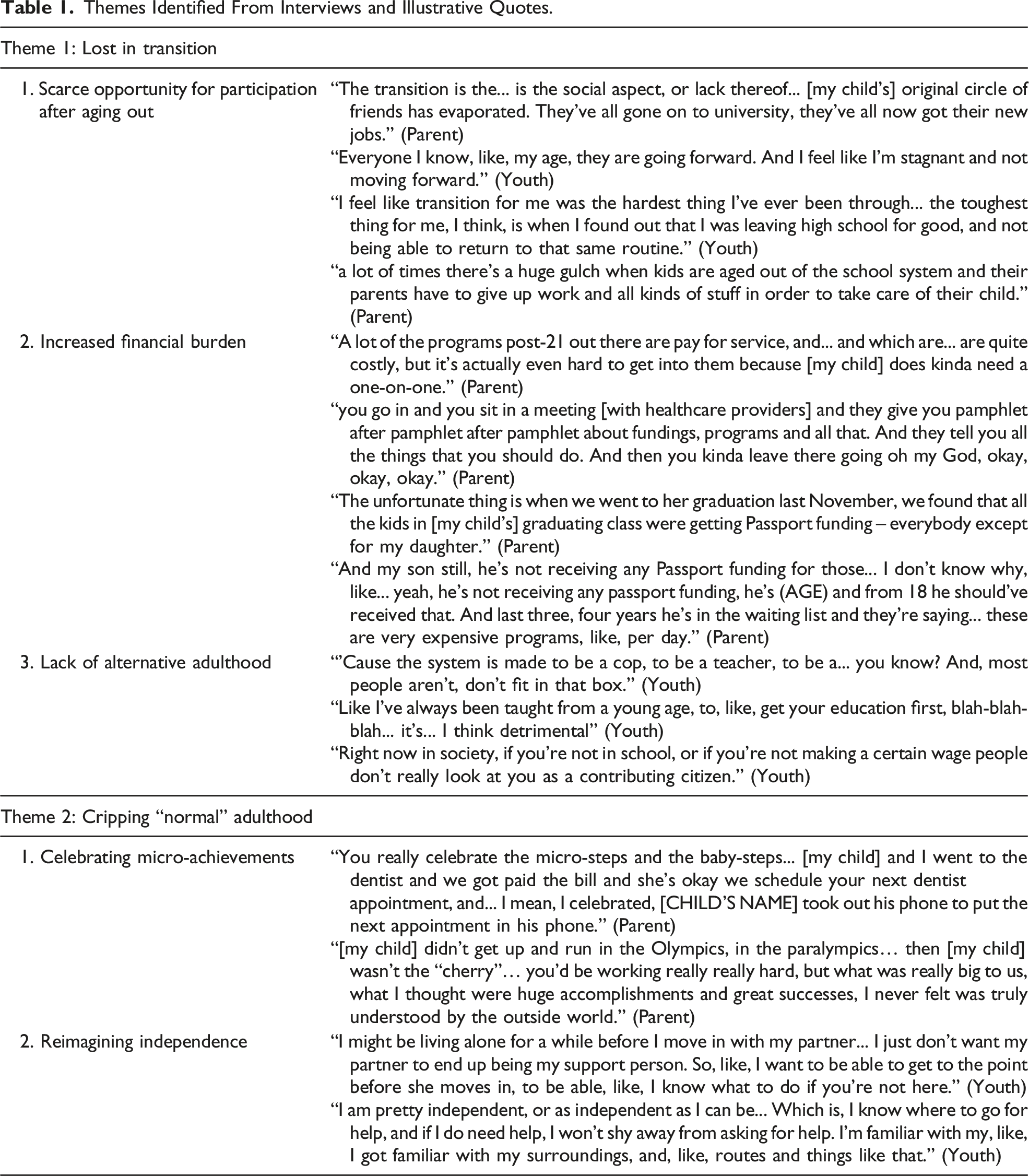
Theme 1: Lost in Transition
In the province of Ontario where this study took place, public secondary/high school education (usually grades 7–12) is free for residents. Students with special needs are entitled to attend school up to 21 years old depending on their educational needs. However, after graduating high school, disabled youth—especially those who do not transition to postsecondary education or formal employment—have a paucity of opportunities for social participation. Both youth and parent narratives reflected the challenge they faced due to the
There was a shared concern among parents around
Many youth participants described a perceived distance between them and “normal” adulthood marked by financial and residential independence. Their narrative commonly addressed the
Theme 2: Cripping “Normal” Adulthood
While many interviewees experienced hardship throughout their transition to adult life, some started reimagining a vision of adulthood that would better fit their lived reality. One tactic shared both by parents and youth was
There was also a shared disagreement with the “super cripple” stereotype, a discourse that glorifies disabled persons who “overcome” their disabilities and who have successfully integrated into a society. One parent criticized healthcare institutions for “cherry picking” patients’ stories for their fundraising campaigns and noted that their family’s measure of success would not align with the dominant framework: “[my child] didn’t get up and run in the Olympics, in the Paralympics… then [my child] wasn’t the cherry… you’d be working really really hard, but what was really big to us, what I thought were huge accomplishments and great successes, I never felt was truly understood by the outside world.”
Some participants argued against the ableist rhetoric of normalcy that shapes growing up with a disability as a “non-success story.” Instead, they called for more inclusive futures in which disabilities are understood as valuable and integral to society. Participating parents commonly believed that their children can “contribute, in a fulfilling and useful manner, and have a fulfilling and rewarding life,” regardless of the conventional definition of “successful adulthood.”
Relatedly, in acknowledging the disabling impact of a vison of a normative adulthood, some participants started “I just don’t want my partner to end up being my support person… I want to be able to get to the point before we live together, to be able to know what I can and can’t do if [the partner] is not here.”
In this context, knowing one’s limits is considered a way of caring for and being with significant others. Learning how to instruct people in their life when help is needed (e.g., attendant care person, roommates, and colleagues) was also seen as an important step toward interdependence. One youth noted that she is “pretty independent, or as independent as I can be” because she “won’t shy away from asking for help.” Other youth resonated with this view and stated that making decisions for themselves and being accountable to these decisions are more significant than being financially independent or living alone. They hoped for a society in which people are “recognized for their humanity” rather than their productivity or perceived contribution to society.
Translating Narrative Themes into Reader’s Theatre Scripts
After completing the analysis, the lead author shared the abovementioned two themes, analytic memos, and de-identified interview scripts with an artist-researcher and professional playwright. The two discussed the structure of the scripts and potential characters and collaboratively drafted a few scripts representing the experiences of youth and families. According to Saldaña (2016), there are four potential approaches to research-based playwriting. Some writers take a verbatim approach to preserve the precise language of interviewees, while others employ an adaptation approach by selecting portions of raw data and rearranging texts into “a more aesthetically shaped” product (p. 17). Yet, other writers may opt to write an original dramatic composition inspired by raw interview transcripts. Some even devise composite characters to represent collective themes and stories across data. Among the four approaches, we employed the adaptation method by using direct extracts from interview transcripts as much as possible, while rearranging texts to communicate the two themes effectively.
We elected to develop scripts in the form of a monologue, rather than a dialogue between two or more characters. Teman and Saldaña (2019) argue that a research-based monologue can render “a three-dimensional account of a character” (p. 467) by representing the character’s personality, value systems, emotions, and experiences of being human in a condensed format. By choosing a monologic form while not creating a concrete character, we transformed voices of several interviewees into one that speaks about the intricate and multifaceted nature of transitioning to adulthood. The literary device of monologue was helpful in preserving the authenticity of participant voices while representing the two narrative themes as opposing yet intricately interwoven.
After drafting a few scripts, we ended up writing two scripts, each consisting of 10 short lines: one featuring a disabled youth speaking about their transition to postsecondary education (Appendix A), and the other portraying a parent of a disabled son looking back after their son turned 21 years old (Appendix B). Although the two scripts represented different perspectives, we strived to ensure that both scripts incorporated the two narrative themes and subthemes identified in the analysis. The reader’s theatre activity was named Transitions Theatre.
Transitions Theatre Workshop with Disabled Youth and Families
All interview participants (n = 15) were invited to take part in the Transitions Theatre workshop to read and discuss the two scripts. The lead author and a speech language pathologist with extensive experience running a medical reader’s theatre at universities co-facilitated the workshop. New participants who met the same eligibility criteria as the narrative interview (i.e., disabled youth aged 17–22 years or parents disabled youth aged 17–22) were also invited to join the reader’s theatre and provide additional insight into the scripts.
A total of 11 participants (7 youth and 4 parents) took part in the Transitions Theatre to collaboratively read the two scripts and discuss the initial study findings. Of 11 participants, six were original interview participants (3 youth and 3 parents) and five were new participants (4 youth and 1 parent). The Transitions Theatre lasted about 2 hours with a 15-min break in between. Participants were enrolled in one of two groups and performed the monologues together by taking turns reading aloud the lines assigned from the scripts. To accommodate participants with diverse physical, cognitive, and communication abilities, we incorporated several inclusive strategies in the workshop design in consultation with an occupational therapist. The theatre scripts were prepared in different formats and font sizes (i.e., each line printed on a single page). Hand-free page holders were prepared for placing scripts on a wheelchair tray. An Augmented and AAC device was programmed with the scripts in advance for participants who preferred to use the device. One participant used the AAC device to take part in the reading activity.
After reading each script, group facilitators asked participants 1) whether they felt the script authentically represented their experience of transitioning into adult life; 2) whether they found the script informative for future theatre participants (e.g., disabled youth and their families); 3) what surprised them; and 4) what changes, if any, they would like to make to the scripts. The first and the second authors took detailed field notes during the facilitated discussion. At the end of the workshop, participants were asked to share their feedback on the Transitions Theatre. Instead of a conventional feedback survey, we prepared several formats so that participants could freely express their thoughts and feelings using images, colors, and words. Some participants collaborated to create a reflective drawing together, while others instructed a facilitator to document their feedback on a piece of paper.
Theatre Participant Feedback
Original interview participants and new participants to the theatre commonly found the Transitions Theatre engaging and felt they could strongly relate to the scripts. Some participants noted that the scripts not only recognized and validated their experiences but also helped further “build vocabulary about transition” to describe their experiences and made them realize “there is still hope.” Moreover, both youth and family members found it valuable to learn each other’s viewpoints through the scripts. Some youth commented that they were surprised to learn “more about the parent perspectives such as fears about not having a plan for the children,” as they did not have a chance to hear what their parents thought when they transitioned to adulthood.
One parent who participated with two youth (aged 19 and 17) mentioned that Transitions Theatre catalyzed a conversation among their families about their preferred futures. “It is very effective. I felt lots of the things my son couldn’t share with me, but he shared at transitions theatre workshop. That will help me to understand my son – what he is planning and what he is thinking about the future.”
A few participants suggested minor edits to the scripts to enhance readability. Others encouraged the researchers to develop additional scripts featuring diverse youth (e.g., youth with neurodiversity and youth with complex care needs) and a variety of transition experiences and settings (e.g., transition to paid/voluntary employment and transition from hospital to community care). Following the Transitions Theatre workshop, we revised the two scripts and developed an interprofessional education (IPE) workshop for pre- and postlicensure healthcare providers. From October 2020 to August 2021, a team of three academic/clinical educators and three lived experience educators (one young healthcare provider with disability and two parents of disabled youth) facilitated four workshops with a total of 67 students and clinicians from 11 health disciplines. Details of the workshop design and learner feedback were reported elsewhere (Seko et al., 2022).
Discussion
This project intended to create a research-based reader’s theatre with disabled youth and their families based on their narratives of transition to adulthood. In the initial interviews, participants shared diverse realities of growing up with disabilities and their unique views about their futures. Although the transitional processes were experienced differently by different participants, their narratives commonly suggested that the concept of “transition to adulthood” encompasses ambiguities, contradictions, and the society’s implicit expectation to put disabled youth into a ready-made box of “normal” adulthood. Their narratives revealed a disheartening tendency that many disabled youth and families felt lost in transition just as those who were interviewed two decades ago (Stewart et al., 2002). The abrupt decline in opportunities for social participation and financial supports after “aging out” of the system posed serious challenges to families who strived to maintain continuity of experience for their children. Youth who followed a mainstream pathway such as postsecondary education similarly faced challenges in navigating the ableist system. Despite mounting research and policy recommendations over the past two decades (Kingsnorth et al., 2021; Lilly et al., 2019), the transition to adulthood still felt rough and alienating for disabled youth and families in Ontario, Canada.
At the same time, participant narratives indicated a potential of cripping futures apart from the dominant framework. Youth and parents described how they would celebrate micro-achievements in their daily life, rather than yearning for or lamenting about what normative society deems a “successful” future. Their approach resonates with what Szafran and Magdalena Wasielewska (2020) called “tailored success” for disabled children that emphasizes personalized accomplishments adequate to one’s talents and potential. Through this lens, success can have many faces. What may be an ordinary activity for some can give these participants a sense of happiness, pride, and self-fulfillment. Similarly, some youth proactively reframed independence as knowing their limitations and interdependence with others. Against the modernist assumption of independence where individuals are expected to perform all the tasks of adulthood alone, these narratives entail a seed of “crip futurity” (Kafer, 2013), a collective evocation of alternative, more inclusive futures. The two opposing yet intertwined narrative themes vividly reflect Kafer’s (2013) contestation that “how one understands disability in the present determines how one imagines disability in the future” (p.2).
Building on these two themes, Transitions Theatre was developed to foster a dialogical space in which diverse stakeholders can reflect on their experiences and critically consider what shapes transition to adulthood. By using the reader’s theatre method, we aimed to illuminate what the transition looks like to disabled youth and their families, what meanings they ascribe to their adulthood, and how their preferred futures may adhere to or resist normative assumptions about “successful” adult life. We found the reader’s theatre method effective in sharing research findings with participants. Naidu and Prose (2018) argue that “returning study findings to communities” is not simply a validity checking practice, but it is an accountability practice driven by an ethnical imperative of community-based research. In our research, the method helped to foster an opportunity where research participants could evaluate the authenticity and relatability of the scripts and benefit from research outcomes. The feedback from the theatre participants suggests that we were successful in authentically portraying their experiences and helping them understand the multiple aspects of transition that they had not thought about previously. We were pleased to learn that the reading activity and subsequent discussion sparked a conversation within a family about their preferred futures.
Admittedly, the script development was a selective process. Participant narratives of the past were selectively constructed from among an array of personally meaningful memories. Then we, the researchers, chose words of the interview participants that we believed accurately represented their voices. Only selected segments from narrative interviews were adapted into the two self-standing monologues that amplify some voices while omitting others. As Teman and Saldaña (2019) remind us, all arts-informed research methods have their own aesthetic shape. The modality of reader’s theatre merges participants’ voices with researchers’ creativity and aesthetic tastes, which obscures where data ends and where theatre begins.
Nonetheless, given our research goal to document and represent the stark realities of transition to adulthood, the power of reader’s theatre to foster critical awareness and afford different ways of knowing made it an optimal platform for knowledge creation and mobilization. In addition to the IPE workshop we developed (Seko et al., 2022), we expect healthcare professionals and educators might consider using Transitions Theatre to engage disabled adolescents and families in dialogue about their forthcoming transitions to adult life. This knowledge may not only encourage youth and families to envision adulthood in a new light but also help healthcare providers discover new opportunities for transition support and push the envelope to their clients’ advantage.
One important lesson was that it is essential to design research activity to be as inclusive and engaging as possible. We intentionally designed Transitions Theatre to let all participants read at least one assigned line of the scripts out loud, as we believed performing a monologue together would make theatre participants experience an in-depth connection with the scripts and other participants. In doing so, we implemented several inclusive design strategies in the Theatre workshop so that participants with diverse abilities and preferences could join the reading activity and discussion. The planning process was eye-opening, in that it made us realize the ableist assumptions inherent to the seemingly participatory method we drew on. For example, it became evident to us that the conventional feedback form we originally designed would not meet participants’ needs and preferences. Rather than accommodating their needs by retrofitting existing methodologies, we composed alternative feedback forms for participants to choose from. Our experience illuminates the importance of reconsidering and restructuring the “compulsory able-bodiedness and able-mindedness” (Kafer, 2013, p.16) that shapes qualitative research. Instead, situating disability at the center of a research project like Transitions Theatre can bring to light the historically contingent power relations between the researcher and the researched. As Price and Kerschbaum (2016) assert, “when disability is assumed to be an important part” of a research project, rather than an external condition that needs to be accommodated or compensated for, the “normative framework [of research] is both exposed and challenged” (p. 20).
Conclusion
As transition to adulthood support for disabled youth has extended from clinical transfer to broader life transitions, the question as to what constitutes “successful” transition is gaining much more significance and complexity. This study aimed to create an authentic reader’s theatre activity to mobilize research findings through an interactive arts-informed method of reader’s theatre. Although evidence suggests that research-based reader’s theatre can be effective in mobilizing research findings and educating audiences (Langlois et al., 2017; Rosenbaum et al., 2005), the process of creating a reader’s theatre has not widely involved research participants. We described the process in which themes generated from narrative interviews were transformed into two reader’s theatre scripts and then performed by disabled youth and parents in a Transitions Theatre workshop. We found the reader’s theatre method to be a powerful and engaging platform for collaborative research with disabled youth and families. However, to maximize the potential of this method requires an inclusive design approach to involve participants with diverse abilities and preferences. In line with advocates of crip methodology (Hickman & Serlin, 2019; Price & Kerschbaum, 2016), we believe it important to undo the traditionally assumed ways of knowing and situate experiences of being disabled at the center of qualitative research with disabled youth and their families. Inclusive design methods have much to offer qualitative health research and contribute to disrupting the normative discourse around transition to adulthood.
Footnotes
Acknowledgments
Our sincere thanks go to the study participants who generously shared their time and stories with us. We thank Dr. Julia Gray, artist researcher and professional playwright, who contributed her expertise in playwriting to the development of the Transitions Theatre scripts. Ms. Vibhuti Jethava, speech language pathologist, also provided invaluable support in facilitating the Transitions Theatre. We also appreciate Ms. Laura Thompson and Dr. Laura Bowman for their help with study recruitment.
Declaration of Conflicting Interests
The author(s) declared no potential conflicts of interest with respect to the research, authorship, and/or publication of this article.
Funding
The author(s) disclosed receipt of the following financial support for the research, authorship, and/or publication of this article: This study was funded by the Holland Bloorview Kids Rehabilitation Hospital Foundation Transitions Strategy. Gillian King was supported by the Canada Research Chair in Optimal Care for Children with Disabilities (Tier 1), funded by the Canadian Institutes of Health Research. This chair is supported by matching funds from the Kimel Family Opportunities Fund through the Holland Bloorview Kids Rehabilitation Hospital Foundation.
