



Abstract
In response to decades-long exclusionary practices, academic institutions are now recruiting early career researchers (ECRs) from systemically marginalized populations who specialize in equity-related research. As a result, these ECRs are likely to conduct research within their communities on topics that have personal relevance—insider research. Methodological training for insider research places an emphasis on methods, such as reflexivity, to ensure rigor; however, the emotional and psychological impacts of these research methods on the researcher are seldom discussed. Therefore, I use analytic autoethnography to illustrate the embodied impacts of conducting insider research using an example of personal relevance and argue that methodological practices require an embodied reflexivity that centers the researcher and the impacts the research has on them. This paradoxically rewarding and taxing work necessitates changes in methodological training and practice, institutional support, and an openness to innovation when calling for equity, diversity, and inclusion in the academy.
As memories began to fill my mind, reminding me of the details from my own experiences that I had forgotten, I realized just how well I know this topic. Had I forgotten? Or had I just pushed these memories to the corners of my mind? I awoke at 4:00 am, parched, while my mind recalled lines of interview data that resonated with my own experiences. Stories of trauma that consumed hours of carefully conceptualized research had begun leaching into my dreams.
Introduction
Many qualitative researchers arrive at a study due to their personal connection and investment in the subject under investigation (Greene, 2014). With its origins in anthropology, insider research is a term that describes inquiries where the researcher is also a “member” of the community or culture that is being studied (Beals et al., 2020; Greene, 2014). Insider research is a well-debated concept among qualitative researchers; as a response, academe has enacted methodological strategies to ensure rigor and trustworthiness of the research (e.g., reflexivity), while also focusing on the impact of the researcher’s positionality in relation to the research (Rossiter, 2007; Shaw, 2016). This article is not concerned with debates of rigor and trustworthiness, degree of insider status, or the benefits and drawbacks of insider positionality, though these are important conversations to have (Chavez, 2008; Hayfield & Huxley, 2015). This article builds upon a small literature concerned with the psychological and emotional impact of qualitative methodologies that are suited to insider research, particularly among systematically excluded and oppressed scholars (Campbell, 2017; Ross, 2017). Through a deliberate centering of the researcher, I aim to acknowledge and highlight the emotional and psychological impact that conducting insider qualitative research can have on the researcher. This conversation is particularly centered on early career researchers (ECRs) given their unique positioning in the current sociopolitical academic climate.
An Illustrative Example
I arrive at this discussion as a queer, white settler, cisgender man who grew up in conservative settings that led me to experience so-called “conversion therapy” (Kinitz, 2020). Conversion therapy is a set of practices that presumes lesbian, gay, bisexual, transgender (trans), and queer (LGBTQ+) identities and/or attraction is abnormal and attempts to suppress or “change” LGBTQ+ people’s sexual orientation, gender identity, and/or gender expression (Kinitz et al., 2021; Mallory et al., 2018). Not only have I experienced conversion therapy as an adolescent and young adult, but the continued existence of conversion therapy threatens my and other LGBTQ+ people’s safety. I am now affiliated with a program of research on conversion therapy practices in Canada. In other words, I research a topic that delegitimizes and seeks to assimilate LGBTQ+ lives. I am also completing a PhD at a top-tier university where I experience the academy’s promotion of productivity and outputs above all, particularly within health sciences where biomedical conservativism devalues critical qualitative scholarship (Webster et al., 2019). I write about my experience to challenge neoliberal notions of productivity and rigor over health and wellbeing. Moreover, I write this piece to illuminate the paradoxical injustice driven by academic institutions and equity-based initiatives to include systematically excluded researchers that became apparent to me through my use of reflexivity.
I received graduate-level training in critical schools of social work and public health that taught me to tackle problems and research that are political, to ground my work in social justice, and to center the margins (Eakin, et al., 1996). My privilege of being a white, cisgender (cis) man makes it more possible for me to pursue research motivated by the injustices I have experienced in my own life. In my position, I have access to robust academic, financial, and social supports that lead to opportunities and the capacity to invest time and energy in projects that will enhance my career. My privileges provide a safety net to write articles such as this. I discursively construct myself as simultaneously a privileged and a marginalized researcher to be thoughtful in how I approach research and engage in the ongoing negotiation of self in relation to the academy (Johnston & Sanscartier, 2019). There are many topics in LGBTQ+ research to which my identity as a queer, cis, middle-class, white man does not grant me insider status. However, upon working on projects involving conversion therapy, where the primary focus of the research resulted in participants whose experiences mirrored my own, I found myself as a “total insider” (Chavez, 2008).
I engaged in research to explore and understand conversion therapy in Canada throughout my doctoral studies with a team of health science researchers. Extrapolating from the definition provided above, one can imagine the negative consequences of conversion therapy; it instills shame, isolates people from family and community, and is destructive to people’s mental health and wellbeing, often resulting in suicidality (Goodyear et al., 2022). The specific project that I draw from is a qualitative study of people’s experience of conversion therapy in Canada that collected data through in-depth interviews. I was a research assistant (RA) on the project who was identified by a mentor as someone with experience of the phenomenon we were studying. Though never having spoken about my experiences before—except to convey my interest in the project and a brief mention that this work “hits home”—I was invited to engage in the planning and implementation of the project. This work required and prompted me to engage in a variety of research practices: facilitating a community-based workshop where people shared their stories of trauma, co-authoring emotionally charged research and policy briefs to the government, sharing my personal life stories publicly to advocate for social change, and interviewing people about their stories that mirrored my own. I contributed as a participant in my own research project and provided my story and research findings to the media. My activist/academic writing was cited, informing debates in Canada’s House of Commons and The Senate where conversion therapy was subsequently added to the Criminal Code. This work led to legal action and regularly hearing homophobic rhetoric while attending public forums on the conversion therapy Bill. These deeply personal experiences with the research process culminated in what I would quickly experience as “stomach-churning analysis” and interpretation of people’s trauma for academic consumption.
Background
Insider research has the potential to reduce the risks associated with research on participants and communities, strengthening research ethics and outputs (Hayfield & Huxley, 2015). It situates researchers with lived/living experience in a particular context onto the research team as to guide the research process in insightful ways that outsiders might be unattuned to. Those without experiences of systemic oppression have conducted research on marginalized or “diverse” groups for decades (Lewis, 1973; Simonds & Christopher, 2013). Some researchers have done, and continue to do, indisputable damage in the name of good science, often without ties to communities that their research careers are built upon (Lett, 2021). Lett (2021) prompts us to consider our positionality, relationship to those we research, and not just “what the research is, but also how it is conducted, and who benefits from it” (p.1). An example of this that impacts my life is research on the topic of conversion therapy conducted by those outside LGBTQ+ communities. For decades, those in positions of power from non-LGBTQ+ communities conducted research that provided a basis for pro-conversion therapy efforts despite growing evidence of the deleterious social and health impacts of these practices (Salway et al., 2020). Engagement of LGBTQ+ communities in this research has led to robust, community-driven programs of research that have real policy implications with potential to improve the lives of the populations at the center of the research (Ending conversion therapy, 2020).
Social upheaval and political movements have changed the world, and the academy is changing with it. More involvement of systematically excluded and oppressed groups throughout the research process has become essential. Increasing mandates for inclusion of underrepresented groups is commonplace among funders (e.g., Social Science and Humanities Research Council in Canada; Canadian Institute for Health Research), institutional review boards (e.g., Tri-Council Policy Statement: Ethical Conduct for Research Involving Humans), and community advocacy movements (e.g., “Nothing About Us Without Us”; The Denver Principles).
Simultaneously, students in qualitatively driven health science graduate programs, such as nursing, social work, or public health, often arrive with lived/living experience that reflect the topics they aim to investigate. Prospective students are expected to align themselves with the mission, vision, and values statements of their intended graduate programs, including calls on applicants to engage in research focused on “disenfranchised groups” (York University, 2021), or to focus on the social-structural conditions that underly inequity (University of Toronto, 2021). Postdoctoral and assistant professor positions for equity-seeking groups, specifically Black scholars, have proliferated (Hamilton, 2021; Makanda, 2020). Graduate programs and university faculties have also made commitments to targeted recruitment of students and ECRs of systematically excluded groups in academia: Black, Indigenous, and LGBTQ+, among others (Flaherty, 2020; Universities Canada, 2017). With this increase of systematically excluded groups in the academy, calls for community-driven research, and mission statements claiming to explore issues of social justice among “disenfranchised” groups, there is likely to be an increase in underrepresented graduate students and ECRs conducting insider research.
The academy stands to benefit greatly from the labor of marginalized ECRs who engage in research that they are personally connected to. The inclusion of systemically marginalized researchers, whether as ECRs, peer-researchers, or RAs, will lead to increased funding, meeting ethics requirements, and easier community engagement for research processes (e.g., recruitment). However, studies have illuminated that Black, Indigenous, and LGBTQ+ scholars’ research is often undervalued and under resourced compared to their more privileged colleagues, and that these scholars are seen as less legitimate and work in environments that trivialize the effects of, and promote, oppressive work environments (Beagan et al., 2021; Blumenfeld et al., 2016; Mohamed & Beagan, 2019). Further, the epistemological positions that many in these groups situate themselves within, and in particular Indigenous epistemologies, may be at odds with what is considered desirable research practices and knowledge by neoliberal universities (Martin, 2012). Western knowledge production might learn from Indigenous perspectives that teach relationality as priority over research outputs (Kovach, 2017). A neoliberal institution that values productivity over wellness, financial restraint over adequate resources, and defines success as an individual responsibility is antithetical to the work of systemically marginalized researchers who engage in personal-political research. Their work requires historically underacknowledged resources, such as dedicated time and financial support for the emotional and psychological burden engaging in this work can produce (Mohamed & Beagan, 2019). Despite recruitment of scholars to engage in research that demands additional resources, neoliberal ideology undergirding academia will undoubtably lead to exploitation and continue to exclude those without access to privilege and supports, particularly in disciplines such as health sciences where critiques of scientism are often pushed aside.
The Burden of Insider Research
Researching “sensitive topics,” and the challenges that accompany such work, has been discussed for decades (Lee & Renzetti, 1990). The emotional burden of qualitative research specifically has been widely discussed (Dickson-Swift et al., 2007) with entire journal issues dedicated to the topic (Granek, 2017). However, apart from autoethnography where researchers are naturally insiders and concerned with their stories of adversity, marginalization, and painful experiences (Bochner, 2012; Ellis, 1999), the emotional and psychological burden of insider qualitative research has been minimally explored. One exemplar exception addressing this dearth is the work of Ross (2017) who studied the mental health of sexual minority women and reported on the positive and challenging emotions that resulted from engaging with participants who shared similar life stories to her. She explains that one participant’s experience was so similar that tragedies in the participant’s life became imaginable in her own, causing troubling dreams and tears when reviewing transcripts. Ross (2017) calls for further exploration of emotions in insider qualitative research.
There is a lack of attention to the impacts of insider research and how ECRs might prepare for and be supported throughout the research process. Early career researchers conducting qualitative social science research from interpretivist, constructivist, critical, or emancipatory paradigms engage in more than the conventional, intellectual exercise of writing seemingly emotionless and value neutral truths in an academic journal (Kim, 2015). See for example, recent calls to employ Indigenous epistemologies to alter the way we approach research and ask questions (Kovach, 2017; Martin, 2012). Moreover, being an insider in research that draws on these paradigms demands empathy, vulnerability, emotion, passion, and personal sacrifice on the behalf of the researcher (Ross, 2017). Early career researchers, particularly those from systemically marginalized groups, have particularly taxing experiences carrying out their research and require acknowledgement of these experiences and adequate supports as they produce research (Doll et al., 2020; Griffin et al., 2018). Literature is needed on what it means for these groups to engage in research with “their brothers and sisters who are often living painful realities” (Chapman et al., 2018, p. 1).
Drawing on Reflexivity
I have been trained in graduate schools that center critical social theory and direct my attention to inequities and taken-for-granted assumptions in the arenas in which I work. I have completed formal advanced qualitative methodological training that has prompted me to consider insider status, who and how I am as a researcher, and why this matters. Through my experiences and review of graduate curricula, I have observed that qualitative graduate research courses frequently embed assignments and activities to prompt reflexive practices that interrogate researcher positionality. Reflexive practices promote critical reflection of the researcher to consider how their positionality impacts each aspect of the research process. For example, the foundational methodological course for the Centre for Critical Qualitative Health Research (CQ, 2021), an international leader in qualitative methodologies and where I received my training, begins with a first assignment titled “who am I as a researcher.” Students are prompted to “consider biographical, professional/disciplinary and conceptual/theoretical orientations that shape their positionality as a researcher and how this contributes to the formation of the research question and the study methodology and design” (CQ, 2022). In this assignment, I wrote about my onto-epistemological position in a critical social paradigm, noting that I approach research with the goal of social transformation, and understand reality to be shaped by power relations.
Accounting for the role of the researcher and their positionality is imperative to quality research; however, just as each aspect of knowledge generation is concerned with researcher subjectivity (Code, 1993), so too does the knowledge generating process impact the researcher (Dickson-Swift et al., 2007). What happens when conducting research intrudes into our personal experiences and everyday lives? What happens when the voice of the researcher is one of the voices from the margins? Those of us engaged with insider qualitative research conduct work that can personally impact our lives, our families, and our communities. Our politically situated research can quickly become personal. I conduct the research I do and entered into social-justice training as a direct consequence of my experiences of oppression. Through this work, I aim to document the emotional and psychological implications of such research on someone with intimately personal (and traumatic) experiences with the subject matter they research.
Methodology
Theory
I hope to illustrate how my experiences, and others’ conducting insider research among marginalized groups, might be conceptualized through critical theory (Eakin et al., 1996) and a theoretical lens of epistemic exploitation (Berenstain, 2016). Epistemic exploitation has been employed by women of color activists and is a form of epistemic oppression that “…occurs when privileged persons compel marginalized persons to produce an education or explanation about the nature of the oppression they face” (Berenstain, 2016, p. 570). Berenstain (2016) continues that epistemic exploitation reenforces structural oppression through “…unrecognized, uncompensated, emotionally taxing, coerced epistemic labor” (p. 570). I draw on the concept of epistemic exploitation to theorize and make meaning of my experiences.
Analytic Autoethnography
In line with analytic autoethnographic methods, I retrospectively reflected upon my experiences as a complete member researcher and wrote about and reflexively analyzed my experiences and positionality to communicate the richness of experience and meaning that extends traditional social science reports (Anderson, 2006; Bochner, 2012). I present stories of personal phenomena that might become familiar for those engaging with this article who are both outsiders and insiders to the experiences I present (Ellis et al., 2011). This autoethnography is a form of “reflective practice” as defined by the University of Toronto’s research ethics board and is exempt from ethics approval. The study this autoethnography discusses was approved by Simon Fraser University and Universite de Montreal. However, ethical research practice goes beyond institutional ethics boards and should include my own sustainability. Throughout the reflexive and analytical processes, I planned intentional walks to ground myself and debriefs with a friend to sustain myself through this emotional, introspective work.
Creative Analytic Practices
To illustrate my embodied experiences conducting research from an insider perspective, I draw on Creative Analytic Practices (CAPs). Using CAPs, I write texts that draw on the imagination and narrative practices that capture the reader’s attention and blend creativity, writing, and analysis (Richardson, 2003). Richardson (2003) encourages qualitative scholars to use writing as method each day, in relation to our personal lives and our research, evoking scholars to use CAPs in their memo-writing, field notes, personal notes, and all forms of writing. CAPs use creative writing to expand on our conventional research practices. Richardson (2003) encourages us to “…expand [our] writing vocabulary, habits of thought, and attentiveness to [our] senses, and as a bulwark against the censorious voice of science” (p. 381). Through CAPs, I articulate my reflexive embodied account presented below as a fragmented story that illustrates my experiences throughout the research process.
Embodiment
Within the autoethnographic process and development of the written account, I draw on embodiment to highlight how our bodies can help us to understand ourselves, remember events from our past, and provide insights unavailable to cognition (Sparkes, 1996). I use embodiment to illuminate the emotional, embodied labor of insider research by presenting methodological reflections as an embodied researcher.
Memos and Analytic Reflexivity
Throughout the research process, I used memo-writing as a method for analytic reflexivity and to document my thoughts and reactions to the research. Eakin & Gladstone (2020) prompt qualitative researchers to employ reflexivity at all stages of research, using reflexivity as an analytic method for insight into the phenomenon under investigation. I wrote reflexive memos following interviews and throughout analysis. Some memos were pages long filled with reflections on interview content, ideas for analysis, and my reactions to both content and my emerging analysis. I wrote about my role as a researcher and how I thought participants responded to me based on our relationship and the amount of self-disclosure I used in interviews. I later reflexively reviewed memos written throughout the research process, looking for clues to how what I wrote signaled embodied responses to my experiences as an RA. In this process, I highlighted texts that included or referenced what I perceived as embodied descriptions, elements of emotion, and socially situated experiences. As reflexive memos were often scattered and disorganized in their focus, recording thoughts about earlier and later processes and experiences as they became salient for me in these documents, I reorganized the highlighted texts into a temporal arch that resembled research processes in a more linear fashion (i.e., research planning, data generation, and analysis). This allowed for analysis of how I was responding to the research as it progressed in an embodied way. Through a lens of epistemic exploitation, I then wrote reflections following my reflexive review specifically about what I recalled of the experiences and my embodied responses to them. Employing “everything is data” (Eakin & Gladstone, 2020, p. 6), I used all the material I produced as data for the vignettes below. It was not until writing reflections following the analytic memos and reflexive review of these data that I engaged with CAPs, which I then used, along with embodied descriptions, to construct the vignettes I turn to next and illustrate the phycological and emotional impact of my experiences as an insider researcher.
Results: A Stomach in Knots
Insider Status Confronted
The first engagement in this work began as a volunteer, prior to my RA formally starting. I was to attend a community-based workshop that brought together various stakeholders, including LGBTQ+ and allied researchers, policy representatives, people who experienced conversion therapy, and others. I was there as a volunteer graduate researcher to assist in facilitating the day and note-writing for a forthcoming report. I’m pretty stoic, and a rational thinker. My family goes as far to describe me as cold at times, but I assure you, I am not. I stood—stoically—in the mirrored elevator as it rose to the conference room floor. I felt my stomach churn and my mind begin to race. “Stoic…that’s a joke,” I thought. I’ve never spoken about my experiences in conversion therapy. I never really gave it much thought before. The elevator dings, and the doors opened to the conference room where I was to help host a day-long workshop on conversion therapy. On the agenda: to hear perspectives of those whose lives have had devastating harms resulting from these practices, and to develop a research agenda for how to support this population – a population of which I was a part. As we engaged in the ice breaker around a large, open circle, the churning in my stomach intensified. “Thanks so much for sharing. I’m humbled to be here and learn from everyone. My name’s David and I’m a researcher from the University of Toronto.” I explained to the group of 35 people, most of them strangers. “I also have experience…” I trailed off, not sure of what—or rather, how much—to share. I’m sure my pivot towards discretion left many put off or confused about what experience I was referring to. I flew across the country for this workshop under the pretense that I had dealt with my feelings. Logically, I did not feel any overwhelming emotions. I felt confident that I had dealt with my own trauma, and I was sure that I wanted to be part of this work. For the first time, my churning gut, with its own embodied wisdom, was telling me something different. The salty smell of my sweat was beginning to fill the air. My historic experiences of trauma were swelling. I was meant to be on the outside of the circle, but I found myself in the middle. Maybe my past was not so fully digested after all…
I realized through this first experience that I was grappling with what made me an insider as well as an outsider. I was there as an academic-in-training with expectations of being able to stand back from it all; I was to be an outsider who was supposed to have dealt with my experiences that made me an insider. I was drawn to the educational programs I attended for my masters and doctoral studies because of their commitments to marginalized groups and valuing of diversity among their student populations. I recall explicitly discussing what made me an insider to the communities I wished to work and conduct research with in my applications. However, my motivations for supporting my communities and aims of higher education obscured the reality of what this work might entail. Reflecting on this opportunity, I did not consider the option to not take the (soon-to-be) paid position that would surely lead to publications. This work fulfilled my goals of supporting community and advancing my career. I did not consider or seek out the supports I might need to continue doing this work, but nevertheless, I continued.
Data Collection as an Insider
Now employed formally as an RA, I was to conduct the first interview of the project. Though comfortable with my interviewing skills, I was excited and nervous about the places this newly minted interview guide would lead us, and how I or the participant might steer us in unknown directions.
My first interview was moments away. I could feel a steady build of adrenaline as it neared. I stood, legs bouncing, in the large lobby of my school awaiting the first interview participant, not knowing what they would look like or how this was going to go. Dozens of students came in and out, all on a mission of some sort. Then in walked a man, looking unsure of himself or where to go. “Hi, are you looking for David?” I greeted him. We walked up to my supervisor’s locked office where I took out the audio recorders, engaged in some small talk, and began listening to his story. He laughed, cried, sweat through his shirt, just as I too laughed, and cried, and sweat through my shirt. His story was a mirror; he put words to experiences that I was never able to. He spoke of concepts I was able to provide language to, letting him know I understood all too well, without sharing much at all. Two hours later, I walked him through the hallways, down the elevator, and wished him well. I felt that we had connected. I was worried about him and how he might continue in his journey of healing. I went back to my cubicle in my sweaty, likely a little musty, shirt with a stir of emotions frantically rushing throughout my body as my heart raced. I uploaded the audio recording, wrote an analytic memo, and promptly switched to working on a different project without much thought.
I was nervous for my first participant interview and expected nerves to dissipate as interviews went on. However, I found myself becoming sweatier with each passing one. At one point, I began integrating a walk following each interview, before switching to the next task. This helped in the moment, but it did not make subsequent interviews any easier. I was not expecting to be thinking about participants in the same ways that I did as a social worker with clients. Not only was I thinking about participants, I found myself comparing their experiences to my own and being faced with processing my experiences of conversion therapy for the first time. It was something I never thought about while I was living it, but hearing participants put words to my experiences made confronting my past unavoidable.
When the Personal-Research Venn Diagram Merges
Interviewing friends was not something I expected coming into the project, but it was something I realized was likely to occur as I quickly recognized people from my personal life at the initial community event. I have been connected to groups of people who are likely to have experienced conversion therapy in my personal life. Though we had never explicitly made this connection of a shared experience, I was made starkly aware of how many people in my social networks had similar experiences to myself. Recruitment was slow, so a few weeks later I reached out to my own networks—yes, there are networks of us—to bolster participation. This resulted in my second participant being a friend. I felt strange requesting such vulnerable details of a friend’s trauma for the purpose of research. I sat, listening to his story, wanting to interject with anecdotes about shared upbringings, family values, reminisce about the time he was my camp counsellor and how we both ended up as adults with shared stories. But my role wasn’t to be a friend. Being a supportive and active listener, sure, but I would never probe for such detail as a friend.
I found myself interviewing my camp counsellor from when I was seven years old—we bonded over events of my childhood—his youth—prior to and following the formal interview. I found myself questioning the sustainability of continuing research that permeates my personal life so significantly. I never considered that my work in the protected ivory tower with “disenfranchised groups” would mean recruiting and interviewing friends.
Injustice From Attempts to Produce Justice
Following the first couple interviews, the COVID-19 pandemic lockdown measures took effect and interviews moved online. The interviews were becoming more and more challenging, and I was quickly becoming overwhelmed. I felt alone and isolated in my small apartment with minimal social outlets. Anxious sweats and an elevated heart rate throbbing in my ears preceded every interview. My showers took longer as I would zone out and reflect on the words of participants, brought back only by the hyperarousal and a sense of alertness. Waking up to emails from participants wanting to connect more and engage in reciprocal storytelling left me skipping meals, my stomach barricaded from letting in the past. I could taste the acidic indigestion. I began to dread the idea of scheduling my next interview. My monthly therapy sessions quickly became insufficient. The $500 of my school-provided paramedical benefits and my annual income below the poverty line didn’t allow for increased formal supports – I felt stuck.
Despite having a supportive and deeply caring research team, I continued to encounter embodied reactions to interviews; I would think about participants throughout my days, and sometimes just wanted to cry when working on analysis and dissemination of results. I continued with the project, seeing it through to fruition, drawing on the professional and personal resources I had access to. As a graduate student, my limited extended health benefits were inadequate to access mental health supports. I needed to change my approach to one of care, compassion, and intentionality to continue analysis and dissemination. However, my resources were too scarce to adequately manage the emotional and mental burden of data collection, analysis, and writing up of participants’ traumatic stories. How is it that academic research institutions are seeking equity, diversity, and inclusion by bringing insiders into research arenas without supportive infrastructure? Are research institutions providing adequate remuneration for the experience and emotional burden of being an insider from an underrepresented group? I occupy an abundance of privilege and was still without adequate resources. What does justice in academic research institutions look like in attempts to promote equity? These questions began to take shape as I reflected on my experience.
In the illustrative example above, I approached the interviews and transcripts analytically like I would any other research activity. I did as I was trained and supported to do: collect information, think about it rationally, and produce findings. I was not trained or encouraged to engage with the emotions of the research. However, I quickly learned that I was not going to be able to get through this research by relying on my rationality and intellectualizing the work. When I worked clinically as a social worker in child and adolescent mental health, my mentor would tell me to “listen to [my] gut.” I liked to base my assessments and treatment plans on the facts, as I was taught to break things down, set a plan, and execute, but she was right. Our lives are informed by many things beyond “facts” and rationality—it is more complicated than that. Our gut, or more aptly our limbic system, is more attuned to our feelings than our rational-thinking minds. It was time I listened to the churning of my stomach—the indigestion that was my past.
Discussion
Through analytic reflexivity (Eakin & Gladstone, 2020), I was able to better understand and articulate the emotional and psychological impact of conducting research with those whose experiences resemble my own. I was able to conceptualize the unintended consequences of recent equity efforts by institutions to include marginalized researchers as, unintentionally, efforts leading to injustice and a form of epistemic exploitation. As someone from a systemically marginalized population, I was drawn to research/educational programs with social justice aims and encouraged to engage research with personal relevance. However, the additional emotional and psychological labor of insider research as an oppressed person without adequate institutional resources and support was unexpected. Through engaging in reflexive analysis, I was able to see how I was impacted by this research practice, which was in itself also a laborious undertaking. Consequently, I argue that we employ reflexivity beyond rigor, producing research questions and design, or data analysis; we need to equally include the impact—emotional and psychological labor—on, and care for, the person conducting the research, particularly when the researcher and research are connected to communities that experience systemic oppression.
To consider the researcher as separate and disembodied from the research is misaligned with interpretivist, constructivist, or transformative paradigms that are dominant in qualitative research (Sharma et al., 2009). This autoethnography demonstrates that within every qualitative inquiry is an embodied researcher who is impacted by the research and the sociocultural contexts of which they are involved (Sharma et al., 2009). The experiences of distress I describe are common across a variety of research methods, including those without direct connection to the topics they study (Woodby et al., 2011); however, there is need to advance scholarship to understand the unique impacts and supports required for insider research among systemically marginalized groups given calls for increased diversity in the academy and insiders in research.
Through this analysis, I provide further evidence of epistemic exploitation in academic institutions as theorized by Berenstein (2016). The increase in “diversity work” in academic institutions might serve to further exclude marginalized researchers (Ahmed, 2012) through the exploitation of the emotional and psychological labor and knowledge of systematically excluded ECRs (Berenstain, 2016). Through a lens of epistemic exploitation, those in positions of privilege (e.g., granting agencies and principal investigators) must critically question how power structures are reproduced through the inclusion of insider researchers (e.g., peer researchers, ECRs) throughout research processes intended to advance inclusive and community-responsive research. As illustrated through the autoethnographic account, the social and political agendas of academic institutions produce epistemic oppression (Dotson, 2014) by devaluing and providing inadequate resources for the unique and valuable knowledge of marginalized insider-researchers, despite outward-facing invitations to bring subjugated knowledges into privileged spaces.
Foundational qualitative research texts often address the emotional burden of research on the researcher; however, researchers from oppressed groups, and increased for those with less privilege (e.g., students and peer-researchers), must often engage in additional work with less resources (e.g., financial security, implicit trust from colleagues). This includes engaging in reflexivity itself as someone who is being required to become acutely self-aware of their experiences resulting from marginalization. Experiences of graduate students and ECRs who are total insiders, people like me who share experiences and identities with the marginalized communities of whom they engage, are missing from qualitative training. We are expected to have dealt with the experiences that indeed make us insiders and trained to step into, rather than back from, the phenomenon we are studying. However, we are not taught how to do this safely. As demonstrated in this article, my training did not prepare me to anticipate experiences of my past that were less “digested” than I had once thought. I realized that despite positioning myself as an outsider, due to expectations about my role as a researcher with advanced training, I was nevertheless very much an insider, which was consequential for me as an ECR.
Experiencing secondary distress (inclusive of psychological, cognitive, or physical distress) is common among qualitative researchers, and in particular ECRs who commonly have inadequate supports in place (Orr et al., 2021). Secondary distress includes secondary trauma that can occur when listening to traumatic stories from participants (van der Merwe & Hunt, 2019). However, insider researchers with experiences of marginalization and/or trauma may encounter additional burdens and possibly even retraumatization. Johnston (2019) discusses how engaging in this work can be triggering and force a researcher to confront and process trauma, particularly as a reflexive qualitative researcher who is required to engage in critical self-reflection regarding their impact on the research. We occupy multiple positions in research, and there is need to consider what positions matter, in what contexts they matter, and how these roles have the potential to impact the emotional and psychological labor of insider qualitative researchers (Orr et al., 2021). The subsequent discussion centers around methodological implications for how we might think about reflexivity and positionality, particularly in the context of systematically excluded ECRs who already navigate additional sites of labor in the academy.
Reflexivity and Embodiment for Sustainability
Ample literature has discussed and critiqued how qualitative researchers employ the notion of reflexivity, from superficial statements to self-indulgence and largely as a tool to provide more trustworthy and ethical research (providing resolve to the researcher for their representation of others in the process; Finlay, 2002, 2017; Hall & Callery, 2001; Jacobson & Mustafa, 2019; Pillow, 2003). Others promote reflexivity the way I have employed it in my analysis and interpretation, as an analytic practice, to better understand the phenomenon being studied (Braun & Clarke, 2019; Eakin & Gladstone, 2020). My approach to reflexivity is aligned with the work of Pillow (2003) who has emphasized practicing “uncomfortable reflexivity”—where my reflexive analysis illuminated significant consequences for insiders—taking reflexivity beyond solely rigor, resolve, ethics, or analysis and interpretation. However, conversations on reflexivity and positionality often involve implicit assumptions that the researcher is part of a/the dominant group, without considering the risks given the positionality of systemically marginalized researchers. I do not contest core definitions of reflexivity as “thoughtful, conscious self-awareness” (Finlay, 2002, p.532) or its potential value for scientific analysis or rigor. However, I suggest that current uses of reflexivity ignore the embodied researcher and their safety. Two components of reflexivity require further attention. First, the critical self-awareness gleaned from reflexive processes is a particularly laborious act for those with histories of trauma and/or marginalization. Second, by engaging in reflexive processes, an ECR, and particularly those from systematically excluded groups, might gain awareness of how their research could impact them and the potential supports needed to engage in insider research. I wish to add to Finlay’s (2002) five points of what reflexivity as “a valuable tool” can do (p. 532): Reflexivity can and should be used as a methodological tool for understanding and addressing the impacts of research, and particularly insider research, on the researcher.
Ensuring safety and care for a diversifying academy needs to move to the forefront of qualitative methodological training and practice. Methodological training might consider more emphasis on topics related to the emotional labor of qualitative research (e.g., Campbell, 2017; Dickson-Swift et al., 2007; Ross, 2017), normalizing this labor as part of the research process that requires both time and resources to manage. It is troubling that through years of graduate research courses and assistantships, the emotional burden and health impacts of research methods many of us embark upon are rarely meaningfully addressed. Feminist approaches draw our attention to how the sexist system of academia devalues emotional and caring work (Hesse-Biber, 2011). Reflexivity can be used to interrogate how the doing of qualitative methods might impact the insider researcher and the possible supports required given the unique positionality of the researcher towards the research. This is important for all ECRs and might be particularly fruitful to illuminate epistemic exploitation and the inequitable labor that systematically excluded ECRs are expected to do without additional resources.
Embodiment, autoethnography, and writing might attune us to a focus on the researcher’s embodied self and safety. Our bodies are always present in the research process, whether we make note of it or not. We might learn from our bodies to discover and understand what our bodies tell us (Löyttyniemi, 2005). Qualitative methodologies, through institutions, funders, mentors, professors of qualitative methodologies, and others, need to be accountable to the impact the qualitative inquiry has on the researcher’s body, particularly the bodies of ECRs who are not afforded the same privileges as their senior counterparts. Autoethnography is one methodology that teaches us how to ensure researcher resilience when our work often requires immense vulnerability, emotion, and introspection (Winkler, 2018). Insider researchers, whether as peer researchers, RAs, or ECRs, are required, at some level, to open themselves up to further vulnerability through disclosure of personal experiences for public consumption, as is done in autoethnographic research (Winkler, 2018). Autoethnographic work prompts insider researchers to be concerned with safeguarding the ECR who is engaging in deeply personal work (Tullis, 2014). A practical method to safeguarding the ECR is engaging in embodied and reflexive forms of writing and reflection (Benoot & Bilsen, 2016; Six, 2020). These individual-level interventions of analysis, writing, and reflection can be invaluable, as they were to my process of thinking about and managing the emotional burden of my doctoral RA. However, they required confronting difficult emotions and ample processing time. Using reflexivity as a method that centers an embodied knowing (Dreyfus, 1996) might increase awareness of what supports might be necessary to aid in the sustainability of insider ECRs.
Recognizing the Labor of Systematically Excluded Researchers
In a highly productive graduate program, I experienced pressures to press on in times where I should have processed emotions, as illustrated above. Though critical qualitative methods embrace the body and emotion in research, scientific epistemology, dominant in health sciences, silences our work that takes up subjectivity for fear of not producing rigorous research (Lee, 1995; Webster et al., 2019). Marginalized researchers must engage in the invisible labor of managing the embodied impacts of their research to be seen as legitimate academics due to academic pressures that advance white, ableist, heteronormative, and other structurally oppressive norms with neoliberal ideals (Cech & Waidzunas, 2021; Cheng, 2016; Mohamed & Beagan, 2019).
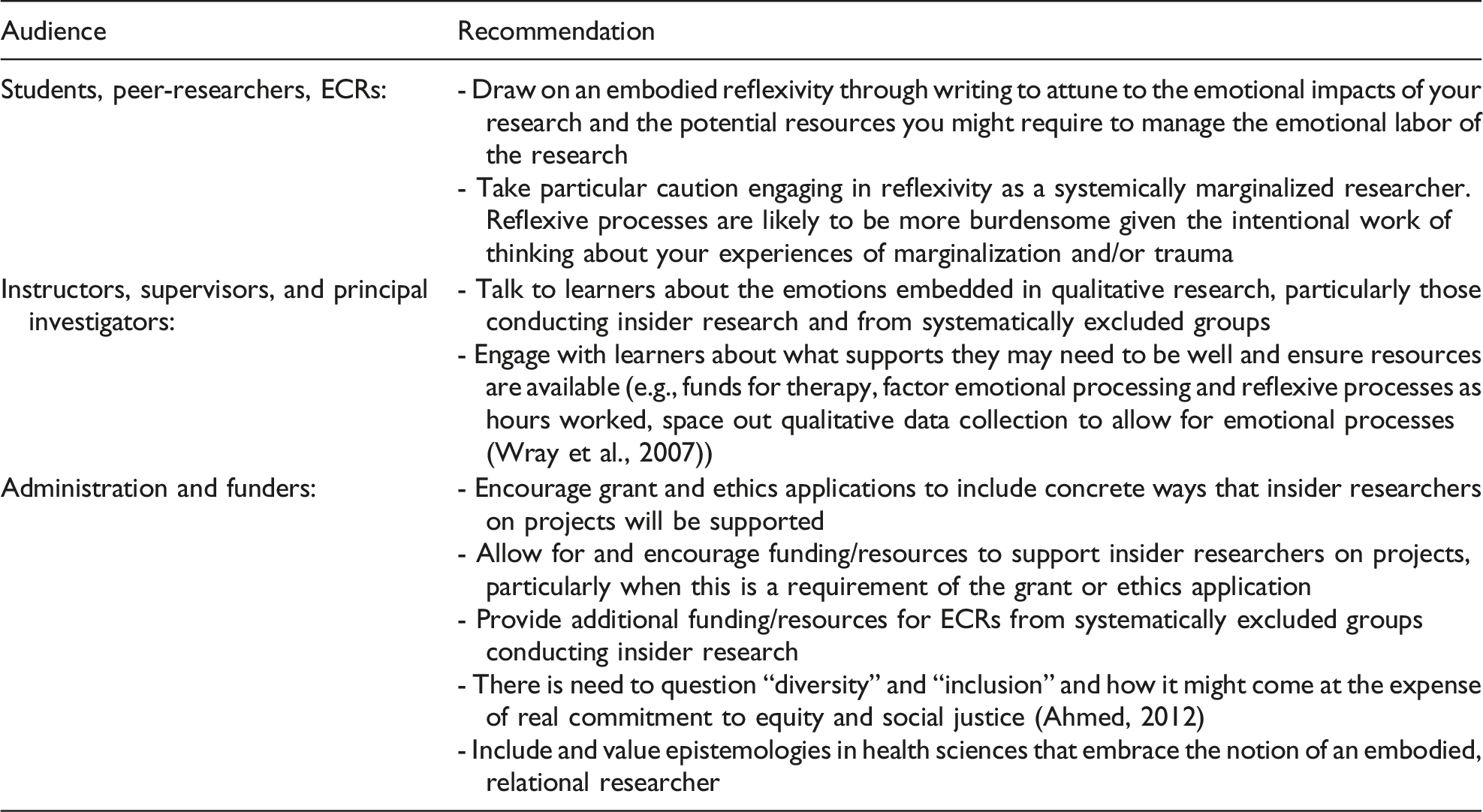
Next Steps
To advance socially just qualitative health research, research that the academy benefits from, the academy needs to acknowledge the potential for harm and provide supports for scholars engaging in this emotionally challenging work (Dickson-Swift et al., 2007).
Conclusion
An embodied reflexivity has aided me in the awareness of the impact of this scholarship and what supports might be needed. I consider insider research to be some of the most life-giving work that I have engaged in. Like many others who enter into critical or constructivist qualitative research, I have the opportunity to conduct research that is not only meaningful to me but that has the potential to benefit communities of which I am a part. This single project fostered my personal growth by providing words to articulate my own experiences; it provided a platform to identify years of unlearning that was needed for myself to grow that have previously been silenced. The power of insider qualitative research motivates me to continue in academia.
I advocate for us to embrace the challenges of embarking on research that engages shared suffering (Frank, 2006) while simultaneously calling for a qualitative methodological ethic that recognizes the emotional and psychological labor of systemically marginalized ECRs who are engaged in insider research. It is unethical to call for equity, diversity, and inclusion in the academy; to focus on inequities and “disenfranchised groups”; and to call for the inclusion of systemically marginalized groups in research, without acknowledging the unique experiences of this work, providing material resources, and addressing the performance measures that espouse structurally oppressive norms.
Footnotes
Acknowledgement
The author would like to sincerely thank Drs. Brenda Gladstone and Lori E. Ross for their mentorship and feedback on previous drafts of this article and teaching the author (me) much of what has been written about. Gratitude also goes out to Daniel Harris, Alan Santinele Martino, Alex Wells, and Kristie Serota who supported the author through generous feedback earlier in the writing process. Lastly, thank you to the anonymous reviewers for providing thoughtful insights and critique of this article.”
Declaration of Conflicting Interests
The author declared no potential conflicts of interest with respect to the research, authorship, and/or publication of this article.
Funding
The author(s) disclosed receipt of the following financial support for the research, authorship, and/or publication of this article: The author was supported by an S. Leonard Syme Research Training Fellowship in Work and Health through the Institute of Work and Health, Toronto, Canada.
