




Abstract
Purpose
This study aimed to develop and validate a measurement scale for assessing resilience among immigrant youth.
Methods
We adopted a mixed-method approach, conducting interviews with 26 immigrant youth and testing these items in a quantitative study of 215 immigrant youth from Windsor-Essex, Canada.
Results
The EFA using Principal Axis Factoring yielded five factors, accounting for 50% of the total variance. The internal reliability for the total scale was 0.92. As expected, the newly developed Resilience Scale for Immigrant Youth (RSIY) and all five subscales were significantly and positively related to another measure of resilience, CYRM, ranging from r = .37 to r = .55, p < .00. The RSIY scale differentiated youth based on their emotional and behavioral difficulties level, providing evidence for its convergent validity.
Discussion
The initial psychometric evidence indicates that the scale demonstrates good internal consistency, well-supported factor structure, and evidence of construct and predictive validity.
Immigrant and refugee youth comprise a significant proportion of the foreign-born population in Canada. In 2021, immigrant youth (aged 15–24) represented approximately 19.1% (1.59 million) of the total immigrant population in Canada (8.36 million) (Statistics Canada, 2021a). Newcomer youth, who arrived between 2016 and 2021, comprised 11.7% (approximately 155,890 individuals). Migration and displacement are traumatic experiences for many, especially newcomer youth, as they transition to adulthood. Immigrant youth face both developmental and acculturative challenges, often in the context of anti-immigrant prejudice and discrimination (Motti-Stefanidi, 2023; Motti-Stefanadi & Masten, 2017; Suárez-Orozco et al., 2018).
Adolescence and early adulthood are times of significant biological and social change. During these periods, stressors can have substantial and lasting effects on developmental outcomes (Doane et al., 2023). For many newcomer youths, these developmental challenges are further exacerbated by premigration exposures to political instability, war, economic hardships, family separation, and social marginalization. Upon migration, they must navigate language barriers, cultural dissonance, discrimination, economic struggles, and academic setbacks (Guruge & Butt, 2015; Kirmayer et al., 2011). These compounded adversities increase their susceptibility to adverse outcomes such as poor mental health and academic performance, hampering their social functioning and social integration (Beiser & Hou, 2016; Guo et al., 2019; Woodgate & Busolo, 2018). Given these challenges and concomitant inimical outcomes, studying resilience is crucial to understanding how immigrant youth adapt and thrive despite these hardships. We define newcomer youth as those aged 13–24, born outside of Canada to parents neither of whom was a Canadian citizen, and who are immigrants (permanent residents) or refugees who have been in Canada for less than 8 years.
Resilience remains a complicated concept (Ku et al., 2025
There are very limited scales to measure resilience in adolescents. Resilience measures developed for use in other adult populations are usually administered among adolescents and young adults (Ballard et al., 2024). Three specific scales developed for adolescents and young adult populations are the Child and Youth Resilience Measure Revised (CYRM-R), Resiliency Scales for Children and Adolescents (RSCA; Prince-Embury, 2008), and Resilience Scale for Adolescents (READ; Hjemdal et al., 2006) and are not without limitations. The CYRM-R assesses the limited socioecological resources available and accessible to youth. A recent meta-analysis (Renbarger et al., 2020) challenges the cross-cultural relevance of the CYRM and cautions against its use to assess resilience factors in young people. Although the RSCA's strength lies in its ability to provide a Vulnerability Index and a Resource Index, it is lengthy (64 items) and primarily focuses on individual characteristics, such as Sense of Mastery, Sense of Relatedness, and Emotional Reactivity. The READ developed among the Norwegian adolescent population measures individual and external resources. However, its social resources dimension is limited to perceived access to external support from friends and relatives. Given these limitations, Windle et al. (2011) concluded that there is no gold standard in their review of 15 resilience measures in adults and adolescents.
The overall objective of this study was to develop and validate a psychometrically sound and culturally relevant resilience scale for immigrant youth (RSIY), following the systematic framework for scale development outlined by Boateng et al. (2018). This three-phase approach included: (1) Item generation through a combination of deductive and inductive approaches involving a comprehensive literature review and in-depth interviews with immigrant youth; (2) content validation and item refinement via cognitive interviews and expert reviews; and (3) psychometric evaluation through exploratory factor analysis and construct validity assessment. This process ensured that the resulting scale was both theoretically grounded and empirically robust.
Validation
The newly developed RSIY was validated using the unitary validity framework, which regards validity as a single construct supported by multiple strands of evidence: Test content, response process, internal structure and validity based on relationships with related variables (Bandalos, 2018; Borsboom et al., 2004; Standards, 2014). First, evidence related to test content, that is, how well the items reflect the construct of interest, was established through a structured process that included reviewing existing literature, consulting service providers, and incorporating expert feedback. Second, evidence tied to response processes, which evaluates whether participants interpret and respond to items as intended, was gathered through cognitive interviews with youth participants. Third, the internal structure of the scale, that is, how well item groupings correspond to the underlying theoretical dimensions, was examined using exploratory factor analysis. Consistent with the socio-ecological theory of resilience, we hypothesize that the RSIY will have a multidimensional structure with items loading onto multiple distinct but related factors, representing the personal, family, school, peer, and community domains. Fourth, to establish validity based on relationships with other variables, we calculated correlations with comparable resilience measures and conducted group comparisons using scores from the Strengths and Difficulties Questionnaire (SDQ). We hypothesize that immigrant youth classified in the clinical range of the SDQ would report significantly lower resilience scores compared to those in the borderline and normal categories. While direct assessment of testing consequences was not undertaken at this stage, the instrument was designed to support informed decision-making in services and policy for immigrant youth. Taken together, these steps reflect a rigorous and context-sensitive approach to scale validation.
Phase 1: Item Generation and Refinement
Defining the Concept of Resilience and Literature Review
Various definitions of resilience exist. While early resilience research focused on individual attributes, more recent work emphasizes the dynamic interaction of individual protective factors and the broader social systems. We will use Ungar's et al. (2008) social ecology of resilience. In the context of exposure to significant adversity, resilience is both the capacity of individuals to navigate their way to the psychological, social, cultural, and physical resources that sustain their wellbeing, and their capacity individually and collectively to negotiate for these resources to be provided in culturally meaningful ways” (p.225).
Literature Review
Informed by the social-ecological perspective on resilience (Ungar et al., 2013), we identified relevant domains and items related to youth's internal and ecological resources. In doing so, we paid attention to the individual assets and resources available to newcomer youth within their social-ecological environment, including family, friends, school, community, and societal values, and how they navigate and negotiate for these shared resources through relationships with others.
Internal Resources
Resilience as an individual trait has been studied extensively (Bottrell, 2009; Carlson et al., 2012; Jefferies et al., 2022; Smith et al., 2008). In a meta-synthesis of 21 resilience scales, Wadi et al. (2020) found four themes mostly related to internal resources or the capacity of individuals. These are control, resourcefulness, growth, and involvement. Immigrant and refugee youth additionally rely on positive mindset to stay strong and have faith in oneself when things are hard (Smith et al., 2023), living in the present with hope for the future (Yalim & Chapple, 2023); taking an active role in the adjustment process (Smith et al., 2023); learning the English language (Salam et al., 2022; Smith et al., 2023); academic success (Khan & Khanlou, 2021), strengths, flexibility, and a strong mindset to adapt to new environments (Gyan et al., 2023), and confidence when confronting transition challenges (Okeke-Ihejirika et al., 2020). In summary, for immigrant youth, internal resources are linked to acculturative tasks, such as learning English, seeking help, and being willing to learn about Canada and its people, in addition to general psychological resources.
Ecological Resources
Resources within the social-ecological context include support from family and friends, school/teachers, and community, including support from settlement organizations. Social support from family and friends was reported to be the central resource for youth resilience in a multi-country study involving data from 14 countries (Höltge et al., 2021). Family connectedness, parental involvement in school, supervision of children, and communication were essential resources that led to resilience among Latino immigrant youth in the United States (Cardoso & Thompson, 2010). Kiramba et al. (2022) highlighted that building friendships with other minority groups at schools, families’ support and expectations about their schoolwork, and parental encouragement were important resilience factors for African immigrant youth in the United States. Support from peers who shared similar migration experiences, and a similar cultural background was important for Syrian refugee youth resettled in Canada in their belonging to the school environment (Salam et al., 2022). Positive school environments, such as the availability of English support resources and support from teachers, providing opportunities for newcomer youth to connect with Canadian peers, are critical resources for newcomer youth to adapt to host countries (Salam et al., 2022; Selimos & Daniel, 2017). Immigrant respondents in the Brodsky et al. (2022) study reported that openness in the receiving community and access to shared resources, such as relationships with people and organizations that provided tangible and intangible support, were critical to their adjustment to a new context. Accessing support and resources from newcomer-serving organizations was helpful in overcoming barriers related to adjustment (Smith et al., 2023). Unlike general youth, immigrant youth draw heavily on cultural continuity and settlement-specific supports to navigate systemic barriers.
Study 1 Method
Research Design
Sample and Qualitative Interview Procedures
We employed purposive sampling to conduct semistructured, in-depth interviews via Zoom with 26 newcomer immigrant and refugee youths from May to August 2021, during the COVID-19 pandemic. Participants were recruited from one of the settlement agencies providing services to newcomer youth in Windsor-Essex.
Study Participants
Participants were youth aged 13–21, consisting of an equal number of males and females. Most of them were from Syria (n = 20) and spoke Arabic at home. Most of them (n = 21) attended some schooling before coming to Canada. Their stay in Canada ranged from 8 to 60 months (Median = 33 months).
Interview Guide
Guided by the socio-ecological theory of resilience and literature review, the interview guide explored: (a) Challenges youth face in adjusting to Canada, including navigating Canadian culture while maintaining their own, experiences of being treated differently due to their immigration background, and acculturation-related conflicts with parents; (b) strategies for handling these challenges, including their strengths, hopes, dreams, and pride in their cultural identity; (c) sources of family support and the role of parents or other family members in helping youth achieve their goals; (d) family narratives and cultural or religious messages; (e) school experiences, including support from peers and teachers; and (f) access to community resources and supports. To contextualize youth experiences and foster a trusting environment, we also included questions about their pre-emigration experiences. For example, participants were asked, “What was the most challenging aspect of leaving your home country?” and “What most surprised you upon arriving in Canada?” Participants were encouraged to reflect on their adjustment journey and the internal strengths and external supports that enabled them to navigate adversity and sustain well-being in the host country. The interview guide was translated into Arabic, the second-most-spoken language in Windsor-Essex, ON. The University Research Ethics Board (University of Windsor) approved the research protocol on January 21, 2020.
Qualitative Data Analysis
The three researchers in this article and a graduate research assistant read all the anonymized transcripts and developed a coding manual with codes (22) and sub-codes (130). A conceptual definition of each code was written. Once all the transcripts were read and coded, all four researchers met several times to discuss each theme and subthemes. Members of the research team reviewed and finalized the themes and subthemes by adding new codes, recoding, and deleting overlapping codes. Both inductive and deductive approaches informed our data analysis plan. The initial approach to coding was deductive, informed by theoretical perspectives and empirical literature related to the concept of resilience. As we became more immersed in the data, the inductive method guided our analysis, paying attention to intersectional aspects of newcomer youth's experiences. This encompassed their evolving understanding of their heritage in the context of the host environment and their engagement with networks and resources in Canada and transnationally.
Researchers’ Background
The data analysis is guided by our own immigrant experience and Western academic training. We thus work from the lens of diasporic living in the West, as all of us are racialized migrants ourselves. The experiences of immigrant youth resonate with our experiences of integrating into our new homes and coping with the changes. Our social justice-oriented, anticolonial perspective framed our desire to mitigate the difficulties and marginalization faced by newcomers and the global inequalities that compel people from the global South to leave their homes and migrate to other countries. Except for the second author, we all identify as cis- women and work in Canada. The second author is based in Singapore. All the authors are in disciplines where we undertake research to advance community well-being, either through social work practice or/and feminist praxis. Our contradictory insider/outsider status creates opportunities for reflection when we question our work, our relationship with our participants and our research products and outcomes. The interviews maintained our empathy while the quantitative work allowed us to develop a healthy distance. To ensure our research was transparent and rigorous, we met regularly to manage our emotional investment and maintain academic integrity. The first and second authors’ strengths are in quantitative research, and they led the analysis in this paper. The third author mainly focuses on feminist qualitative work in contributing to the conceptualization of youth resilience in this project. The fourth author helped steer the mixed-methods aspect of the research and contributed to how we theorized postcolonial immigrant experience.
Study 1 Results
We identified two overall themes: Individual and Internal Capacity involves (a) individual capacities such as language competency and confidence; (b) a realistic assessment of one's capacity to what is available around to them; (c) the capacity to mobilize themselves and others around them as well as the resources that are available and taking action to meet the goals of one's development and wellbeing; (d) the capacity to deal with change such as flexibility and openness to diversity. Participants also emphasized the importance of maintaining their cultural roots and connection to the physical environment, as well as faith in religion or a higher power. This theme aligns with Ungar's et al. (2008) concept of individuals’ ability to navigate psychological and social resources when experiencing adversity.
The second theme, Ecological and Contextual Resources, involves subthemes such as societal values (values adopted by the individual—or the extent to which they hold values that are consistent, complement, or envisioned of society, such as multiculturalism, equality, freedom, and safety), community support, resources available in the neighborhood and school, the support they receive from teachers and peers, formal community organizations, and ethnic immigrant communities, family support (having the support of the family and a private space where help and nurturance occur), and the physical environment (having access to nature and spaces for collective activities, solitude, and safety). Family support was mentioned as a very strong and important cultural norm to overcome challenges and keep the family strong. Peer relationships, both local and long-distance, also played a critical role in providing encouragement, practical help with language learning, and emotional connection. Community organizations and schools were essential in facilitating integration and providing resources. Settlement agencies offered language support, homework assistance, and opportunities to build connections. This theme emphasizes the importance of accessing ecological and contextual resources that newcomer youth can identify, negotiate, utilize, and navigate to promote their well-being.
The identified themes were consistent with the socio-ecological framework and aligned with existing literature. They comprised a mix of general resilience indicators, such as individual coping and family support, and immigration-related resilience indicators, including cultural adaptation and support from formal community organizations and ethnic immigrant communities. In developing the scale items, we identified shared protective factors and resources relevant to both immigrant and nonimmigrant youth, as well as those uniquely tied to immigration-related resilience.
Phase 2: Item Development and Refinement of the Resilience Scale for Immigrant Youth
Informed by Ungar's social ecology of resilience, literature review, and qualitative themes, 78 items were developed that reflect the individual child's resilience and the other systems, such as family, peer groups, school, and community. The words of the research participants guided the construction of the items (see Table 1). The items were worded to reflect the youth's perception of support and services available in their ecological environment and their ability to take action to access these resources to deal with adversity in relationships with others. This phase of the scale development involved providing evidence for content validity and establishing response process validity. Content validity refers to the extent to which the items on a scale adequately represent the construct or domain it is intended to measure. Construct underrepresentation and construct-irrelevant variance are threats associated with evidence based on content (Bandalos, 2018). Construct underrepresentation arises when the scale content is defined too narrowly, omitting key dimensions of the intended construct. Construct-irrelevant variance occurs when scale scores are affected by factors unrelated to the construct the scale is intended to measure.
Illustration of Translation from Sample Quotes to Item Development of the Resilience Scale for Immigrant Youth (RSIY).
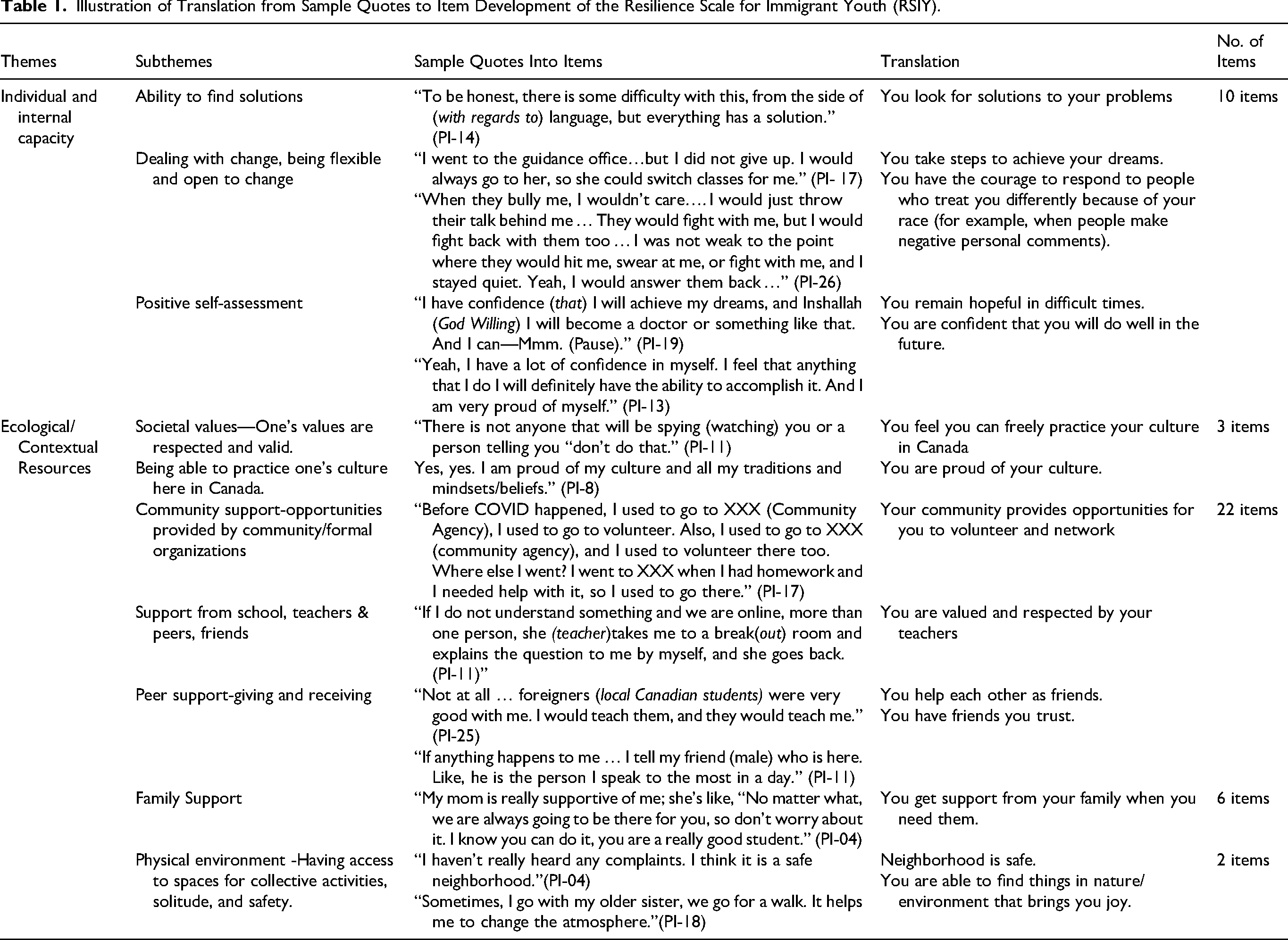
To establish content validity and address construct underrepresentation, we conducted expert reviews by first inviting service providers to review the scale items to assess their relevance, comprehensiveness, and cultural appropriateness and to ensure the items were phrased in a way that made sense to newcomer youth. Thirty-six service providers from various organizations across the region affiliated with the Windsor-Essex Local Immigration Partnership attended the event. Instructions were provided to indicate whether the items could be accepted, rejected, or modified. The service providers either approved the items or recommended modifications. Items that were redundant, overly repetitive, or considered too complex for immigrant youth (e.g., “I know what skills and abilities I have to make choices in my life”) were excluded. We also asked service providers to submit recommendations for improvements. Suggested improvements included items about family being repetitive, replacing mother/father with parent/guardian, adding items related to access to technology, and defining “distress,” and “diversity.” A few service providers questioned the inclusion of prayer and spiritual practice items, stating that if participants do not pray or believe in God, they may feel uncomfortable about it. We integrated their feedback and revised the scale items (we deleted 25 items) before seeking expert opinions. Items were deleted if they were too similar. For example: “My family guides me to deal with life challenges/problems”; “I can ask guidance/support from my parents/guardians to deal with the problems”; “my family protects me when I have challenges.” Poor item quality and lack of clarity were other reasons for item deletion (e.g., “I improve myself to reach my goals”; “My accent is not a barrier in getting resources”; “Social activities (going for a walk, exercise, listening to music, drawing) help me to find solutions to my problems.” Further, items related to parents/guardians supporting children with school-related issues and family discussions about social discrimination and racial bias were deleted due to concerns about contextual relevance, as the youth's ability to meaningfully respond to these items depended on newcomer immigrant and refugee families’ familiarity with Canadian culture.
Four members of the expert panel, three social work professors, and a psychology professor with expertise in youth work, resilience, and well-being, evaluated the final 53 items. We asked the panel members to evaluate each item and provide their feedback on the relevance of each item to the content domain using a 4-point rating scale, 1—highly relevant, 2—quite relevant/needs rewording, 3—somewhat relevant, 4— not relevant. The expert panel was asked to provide suggestions for rewording and/or adding new items not covered in this scale. The expert panel rated the items as “highly relevant,” with ratings ranging from 64% to 84%. Items that were deemed “not relevant” by at least two panel members were subsequently removed (4 items). The expert researchers cautioned us against using the word “diversity.” One researcher recommended that the term “diversity” may have different meanings for migrant youth, so defining it would be helpful. We revised the original item, “Diversity helps me adapt to the community,” to “Having people from the same cultural/racial group helps me adjust to the community.” Once we finalized the scale items, we asked an Indigenous doctoral student to review the items to ensure cultural relevance. Their suggestion was to add additional items that reflect Indigenous worldviews on resilience, as a connection to land and people (Kirmayer et al., 2011).
Cognitive Interviews
Cognitive interviews were used to gather evidence for response process validity and to identify sources of construct-irrelevant variance, particularly related to language comprehension
Phase 3: Scale Administration and Evaluation
Study 2 Method
Research Design Overview
This was a cross-sectional study. We used convenience sampling to collect data from a sample of 215 newcomer immigrant and refugee youth. Youths were eligible to participate if they were between the ages of 13 and 24 and had been living in Windsor-Essex for at least six months but no more than eight years. Windsor-Essex is a unique deindustrializing border zone, where 23.3% of the population is comprised of newcomers (Statistics Canada, 2021b). It is an important immigration site in Ontario, with newcomers from Iraq, Syria, and India bringing diverse languages, religions, and cultures to the region. However, the economic downturn and declining auto industry have created an ambivalent climate toward immigrants and refugees (George et al., 2017). This has further complicated how immigrant youth experience belonging and develop the capacities and resilience needed to navigate the life cycle challenges of adolescence and young adulthood. Participants were recruited from settlement agencies that provide services to newcomer youth in Windsor-Essex. Community agencies invited researchers to attend their youth programs. The researchers informed potential respondents about the study's purpose, the voluntary nature of participation, the consent process, and potential risks and benefits. They were invited to complete a paper survey or provide their contact details for Zoom interviews. A few participants were recruited through snowball sampling. To recruit potential participants, we matched the language and culture of the research assistant with the study participants. As a token of appreciation, respondents received a gift certificate valued at $25. All research materials, including the consent forms, were available in Arabic or English. Translation was conducted by Multi-Languages Corporation in partnership with Access Alliance Language Services. Two professional translators, both affiliated with the Association of Translators and Interpreters of Ontario, conducted the translation and back-translation of the survey and consent documents. One translator translated the survey into Arabic, and a second independent translator back-translated the Arabic version into English.
Additional Measures
In addition to the newly developed resilience items, we included theoretically relevant variables to provide construct and criterion validity of this newly developed scale. Measures selected are based on the evidence of good psychometric properties in migrant and refugee families: CYRM (Libenberg et al., 2013; Cronbach's Alpha in this study was 0.89); WHO-5 Well-being Index (World Health Organization, 2024; Cronbach’ Alpha = 0.84); Emotional and behavioral development was measured by the SDQ (Goodman, 1997; Cronbach's Alpha = 0.70). We used the Canadian SDQ cut-points derived from Canadian Health Measures Survey (CHMS) (Turner et al., 2023). To establish discriminant validity, we used Perceived Stress Scale (PSS; Cohen et al., 1983; Cronbach's Alpha = 0.41), an 11-point Generalized Trust Scale (Lundmark et al., 2016), “In your opinion, to what extent is it generally possible to trust people?”. The 11 points represent a continuum from “people cannot be generally trusted” (0) to most people can be trusted (10) and the physical activity variable (Merlo et al., 2020): “During the past 7 days, on how many days were you physically active for a total of at least 60 min per day?” Respondents were asked to select one option between 0 and 7 days.
Participants
The participants’ ages ranged from 13 to 24, with the mean age being 16.73 (SD = 2.60). Approximately 46% (99 participants) identified as a man/boy, and 54% (117 participants) identified as a woman/girl. None of the participants selected other gender categories. More than half of the participants identified as Arab (53.7%) and Black (25.0%). Many participants, 67.9% (146 participants), reported coming to Canada as refugees. While 26.5% of participants have lived in Canada for one year or less, 40.5% for 2–5 years, and 24.2% for more than five years. Regarding education, 86.6% (187 participants) of the youth participants reported attending school before coming to Canada, and currently, most of them are in high school, grades 9–12 (76.4%).
Data Analysis Plan
Before conducting the structural analysis, we examined the response distributions of the individual items (Clark & Watson, 1995). Item pair correlations were calculated to rule out redundant items (r > .90). Ceiling effects were identified if items had >50% on extreme responses. Items were considered skewed if they were out of range ±2 (Hair et al., 2022). A Principal Axis Factoring (PAF) with Promax rotation was first conducted to examine the underlying structure of the newly developed scale. PAF was considered because it focuses on extracting the underlying common variance shared by items rather than the total variance (Burton & Mazerolle, 2011), which is appropriate for testing latent structures of newly developed scales. Kaiser-Meyer-Olkin (KMO) measure value >0.80 indicates that the sample is more likely to yield reliable factor solutions. A significant Bartlett's sphericity value test indicates enough inter-correlations among items for factor analysis. Eigenvalue > 1 rule (EV > 1; Kaiser, 1960) and Minimum Average Partial (MAP; Velicer, 1976) test were considered to determine the number of factors to be extracted. EV > 1 has been criticized for over-factoring and under-factoring, which may represent random noise rather than true latent structures (Henson & Roberts, 2006). Therefore, the final decision on the number of factors was guided by the MAP analysis, which minimizes average squared partial correlations to more accurately identify the optimal number of factors, while also aligning with the theoretical framework. Factors are retained if there are 3 or more items (Henson & Roberts, 2006) and factor loadings surpassing 0.32 (Tabachnick & Fidell, 2001). Pearson's correlation was calculated to identify the correlation among factors. Cronbach's alpha was calculated for the entire scale and sub-scales. Approximately 2% of items were missing at random, based on Little's Missing Completely at Random test, Chi-Square = 433.194, p = .090; therefore, mean imputation was performed.
Study 2: Results
Evidence Regarding Internal Structure
Examination of initial inter-item correlation pairs revealed moderate correlations, with none exceeding > .90. Therefore, there was no evidence for item redundancies. Five items exhibited ceiling effects with extreme responses exceeding 50% and were removed. The Skewness test indicated all but two items to have an acceptable cut-off score, so we removed them. Eight items were excluded before the factor analysis, so the total number of items included in the factor analysis was 35.
Factor Analysis
KMO value of 0.89 and Bartlett's Test of Sphericity (chi-square = 2477.88, df 325, p < .001) indicate that the sample is adequate for factor analysis. PAF using the EV > 1 rule indicated that eight distinct factors should be retained. The eight-factor solution derived from the EV > 1 rule in PAF exhibited problematic cross-loadings, insufficient loadings, and factors that were theoretically meaningless or weak (with fewer than two items). In contrast, Velicer's MAP test yielded a more parsimonious five-factor structure, consistent with the theory. The factor solution was constrained to five factors, and the analysis was subsequently re-run. Based on criteria such as factor loadings (<0.32), and problematic cross-loadings (<0.15 from the item's highest factor loading; Worthington & Whittaker, 2006), nine items were removed iteratively (one by one) to achieve a clearer and interpretable factor structure.
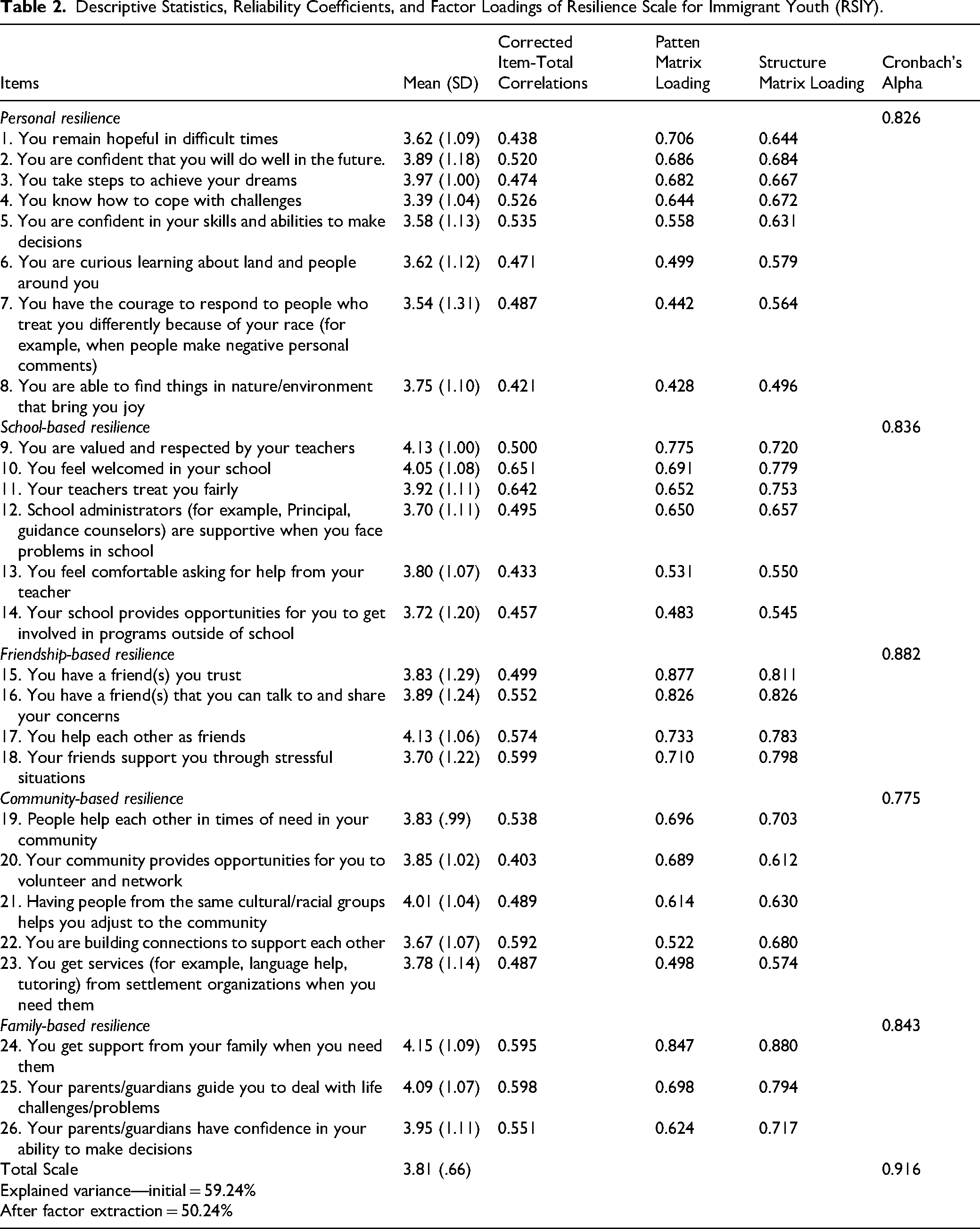
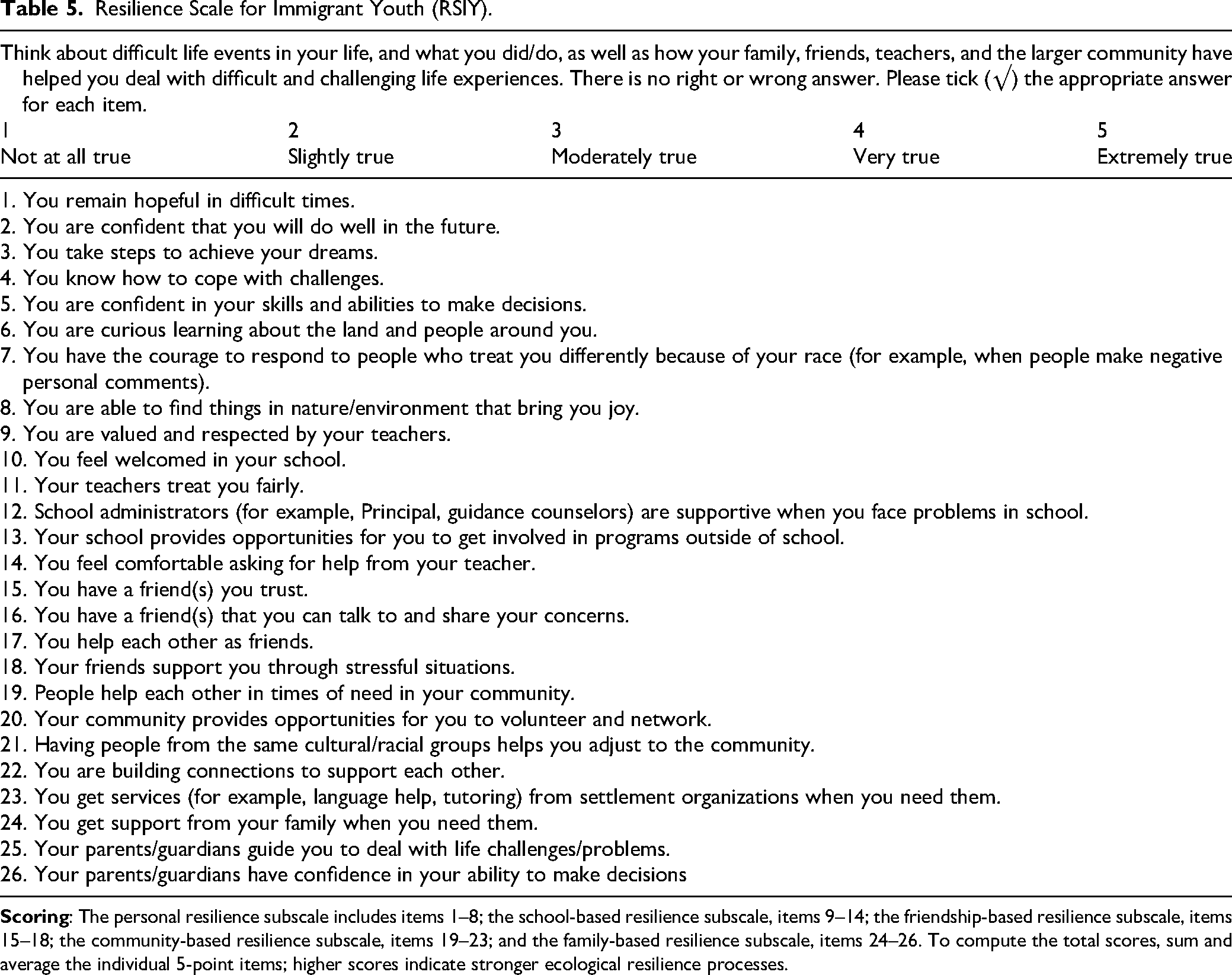
The EFA using PAF extracted five factors that explained 50% of the total variance (Table 2). In the final model, the communalities of the items ranged between 0.27 and 0.78 indicating that each item shares a moderate to high proportion of variance with the extracted factors, suggesting that the model adequately captures the shared variance. Factor 1 (Personal Resilience), with eight items, captures adaptability, goal-directed behavior, optimism, and connection to the environment. Items such as “take steps to achieve your dreams,” “you are confident that you will do well in the future,” “you remain hopeful in difficult times,” and “cope with challenges” load strongly (ranging from 0.558 to 0.706) on this factor. Factor 2 (School-based Resilience) clusters six items related to perceived school support, such as teacher-student relationships, institutional support, fairness, and sense of belonging. Items like “you feel welcomed in your school” and “you are valued and respected by your teachers” load prominently on this factor (loadings ranging from 0.691 to 0.775). This indicates that perceptions of support and fairness within the school environment are distinct aspects of resilience. Factor 3 (Friendship-based Resilience), consisting of four items, assesses the role of friendship in emotional well-being and coping with challenges. Items such as “You have a friend/friends you trust,” “You have a friend(s) that you can talk to,” and “you help each other as friends,” show very high loadings (0.733 to 0.877), emphasizing the importance of close peer connections. Factor 4 (Community-based Resilience), with five items, assesses communal support, cultural belonging, and access to resources for youth's ability to adapt and thrive, with items like “people help each other in times of need in your community,” and “community provides opportunities for you to volunteer and network” exhibiting strong loadings (0.689 to 0.696). This factor underscores the role of broader social networks and community services in fostering resilience. Finally, factor 5 comprises three items relating to family support. High loadings (0.698 to 0.843) for items addressing family support and guidance highlight the unique contribution of the family unit to an individual's resilience. Overall, the results demonstrate that resilience is a multidimensional construct, encompassing both personal attributes and support from family, school, friends, and the community. Intercorrelations between the factors were moderate (r = 0.39 to 0.55, p < .001). The total scale and factor scores were computed by summing and averaging the individual 5-point items, with higher scores indicating higher resilience.
Descriptive Statistics, Reliability Coefficients, and Factor Loadings of Resilience Scale for Immigrant Youth (RSIY).
Evidence Regarding Internal Consistency Reliability
The corrected item correlations ranged from .40 to .65. The lowest correlation was between personal resilience and friendship-based resilience (r = .39) and the largest was between friendship-based resilience and community-based resilience factors (r = .55). The internal reliability for the scale was .92. The reliability of the domains are as follows: Personal resilience (Cronbach's alpha = 0.83), school-based resilience, (Cronbach's alpha = 0.84), friendship-based resilience (Cronbach's alpha = 0.88), community-based resilience (Cronbach's alpha = 0.77) and family-based resilience (Cronbach's alpha = 0.84). The mean for the total scale was 3.81 and for personal resilience, M = 3.65), school-based resilience, M = 3.87, friendship-based resilience, M = 3.86, community-based resilience, M = 3.82, and family-based resilience, M = 4.04.
Evidence Regarding Relations to Other Variables
As expected, the RSIY and all five domains were significantly and positively related to another measure of resilience, CYRM, ranging from r = .37 to r = .55, p < .001, providing evidence for concurrent validity (Table 3). The strongest correlation was between the total RSIY scale score and CYRM, r = .62, p = <.001. Known-groups validity was assessed by examining differences in total RSIY scale score across SDQ categories. A one-way ANOVA revealed significant differences in total resilience scores across SDQ-defined mental health categories: Normal, borderline, and clinical, F(2, 212) = 26.94, p < .001. Youth categorized in the normal range reported the highest resilience (M = 4.10, SD = 0.54), followed by the borderline group (M = 3.80, SD = 0.49), and the clinical group (M = 3.42, SD = 0.71), indicating a decline in perceived resilience with increasing emotional and behavioral difficulties. Post hoc comparisons using Tukey's HSD confirmed statistically significant mean differences between all groups. These results underscore the ability of the newly developed RSIY scale to differentiate youth by their psychosocial adjustment level and provide evidence for its convergent validity. As expected, RSIY was significantly and negatively associated with PSS, r = −.36, p < .001, providing evidence for discriminant validity. As expected, RSIY demonstrated low correlations with the general trust measure (r = .21, p = .002) and the physical activity variable (r = .21, p = .002), indicating unrelated constructs. As expected, gender was not significantly related to the total scale, t(213) = 0.20, p = .84, indicating that the RSIY is suitable for measuring resilience across genders.
The Correlation Between the Total Scale, Subscales, and Validation Scales.
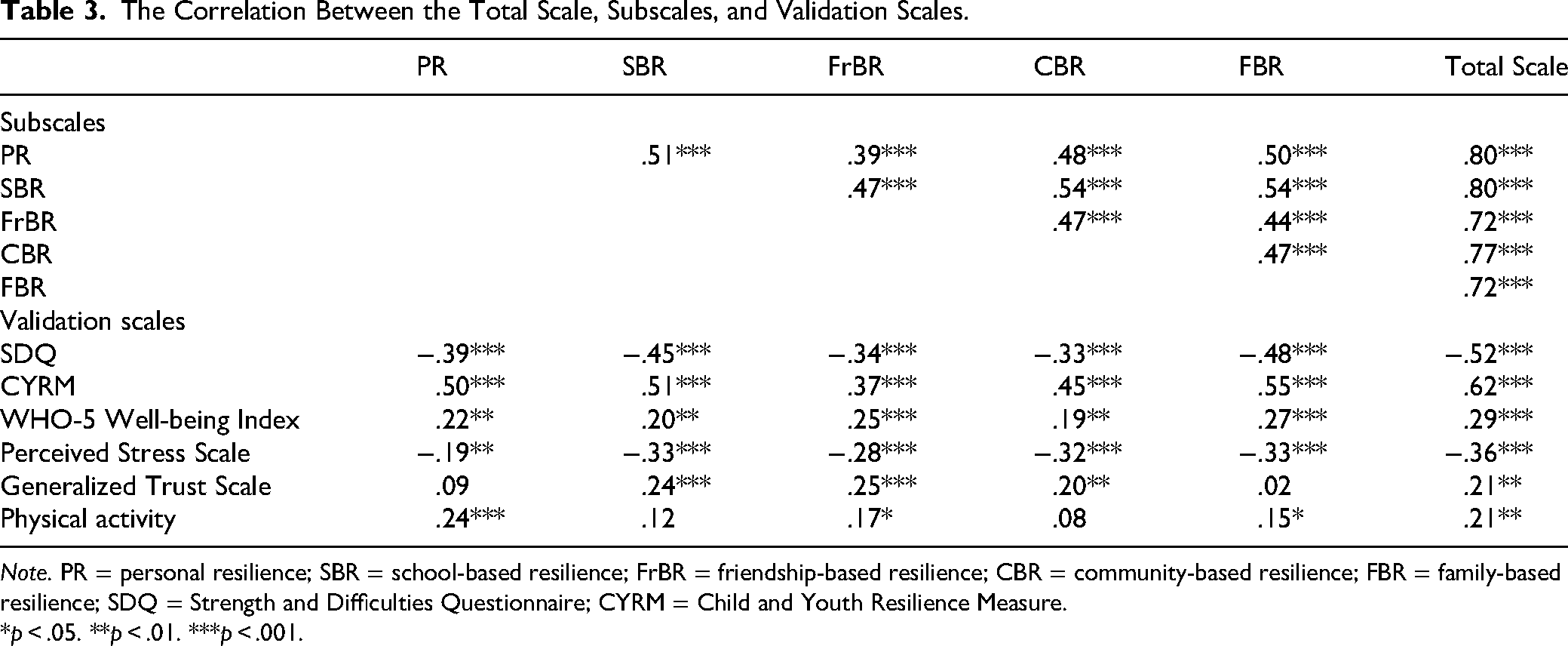
Note. PR = personal resilience; SBR = school-based resilience; FrBR = friendship-based resilience; CBR = community-based resilience; FBR = family-based resilience; SDQ = Strength and Difficulties Questionnaire; CYRM = Child and Youth Resilience Measure.
*p < .05. **p < .01. ***p < .001.
A multiple linear regression analysis was conducted to examine the contributions of specific resilience domains to the overall and subscale scores of the SDQ, after controlling for age, gender, and years of living in Canada. Among the five subscales, personal resilience was significantly related to prosocial behavior (β = 0.34, p < .001, 95% CI [0.480, 1.18]), and lower peer difficulties (β = −0.17, p = .023, 95% CI [−0.76, −0.06]). School-based resilience contributed negatively to the overall SDQ scores (β = −0.18, p = .027, 95% CI [−2.45, −0.15]) and conduct difficulties (β = −0.25, p = .005, 95% CI [−0.91, −0.16]). As expected, friendship-based resilience was significantly and negatively related to peer difficulties (β = −0.27, p < .001, 95% CI [−0.74, −0.20]). Community-based resilience was significantly related to lower conduct difficulties (β = −0.18, p = .046
Discussion and Applications to Practice
The present study aimed to develop and validate a measurement scale for assessing resilience among immigrant youth. Consistent with the socio-ecological framework of resilience, the unitary validity framework employed in this study provided evidence for a five-dimensional RSIY scale. Through assessing diverse protective mechanisms operating at multiple domains, the RSIY contributes to the fourth wave of defining resilience as involving a multi-dynamic process of adaptation to adversities (Masten's, 2021; Ungar et al., 2013; Wadi et al., 2020; Windle et al., 2011). The primary strength of the unitary validity is its emphasis on collecting multiple forms of evidence, ranging from content relevance to statistical structure and external correlations, within a single coherent validity model. Importantly, it provided the flexibility to integrate both qualitative insights and quantitative analysis, which played an important role in capturing the culturally embedded nature of resilience in the lives of immigrant youth.
The RSIY scale advances the conceptualization of resilience among immigrant youth by integrating general and immigration-specific factors within a socio-ecological framework (Ungar et al., 2008). This approach avoids a binary treatment of general versus immigrant-specific resilience and instead recognizes their intersectionality as critical to understanding how immigrant youth mobilize support and navigate adversity. In doing so, the scale offers theoretical and practical relevance for culturally informed assessment and intervention.
The RSIY shares a common socio-ecological focus with READ and the CYRM
Summary Table Comparing the RSIY with Existing Youth Resilience Measures (CYRM-R, READ, and RSCA).
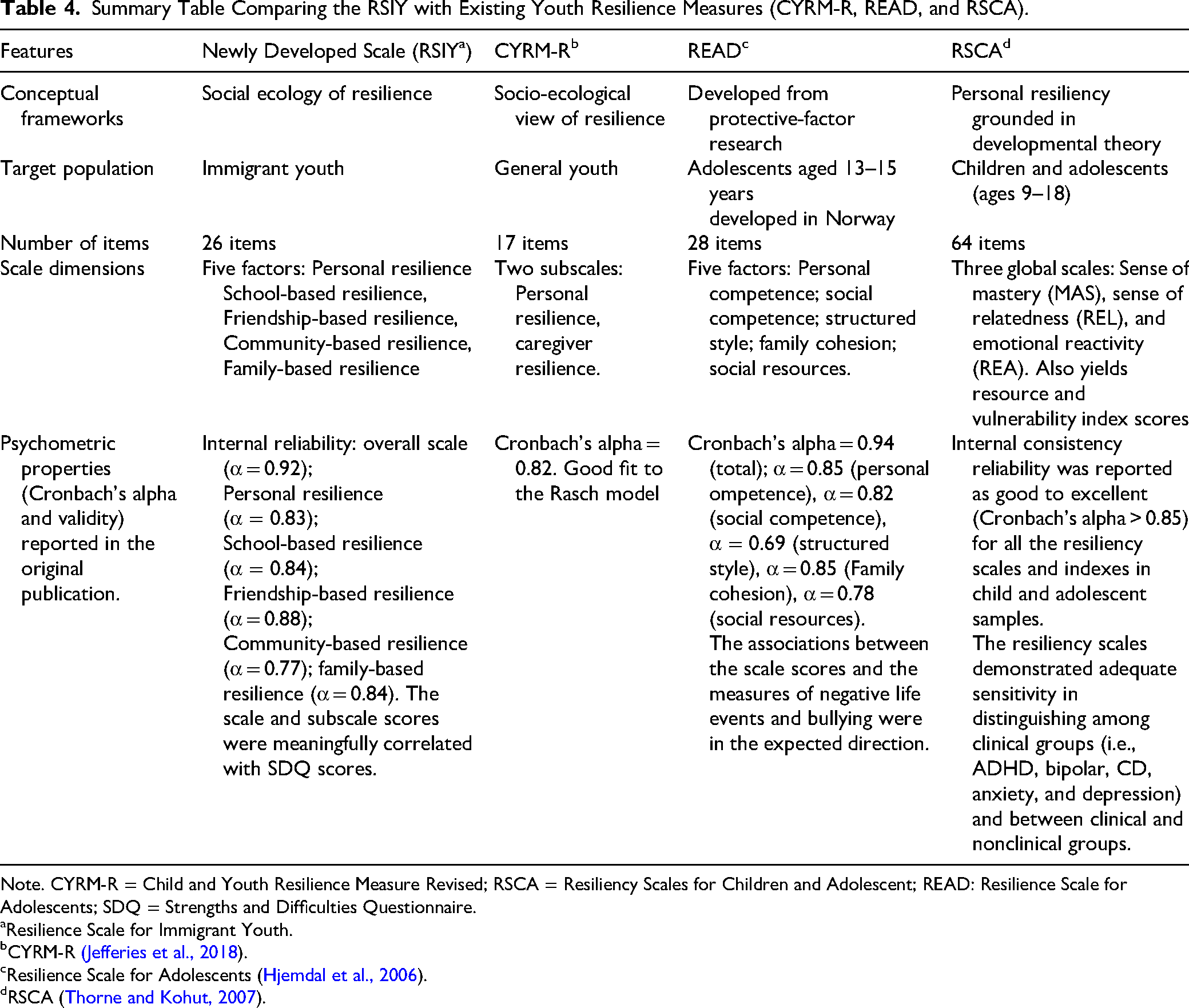
Note. CYRM-R = Child and Youth Resilience Measure Revised; RSCA = Resiliency Scales for Children and Adolescent; READ: Resilience Scale for Adolescents; SDQ = Strengths and Difficulties Questionnaire.
Resilience Scale for Immigrant Youth.
CYRM-R (Jefferies et al., 2018).
Resilience Scale for Adolescents (Hjemdal et al., 2006).
RSCA (Thorne and Kohut, 2007).
There are limitations to the study. First, the small sample size and nonrandom sampling limit generalizability. Given the geographical context of Windsor-Essex and the predominance of Arab participants in this study, a shared cultural context may have influenced how participants interpreted and endorsed the resilience items
Although the newly developed RSIY for immigrant refugee youth is a promising tool for assessing resilience, further investigation is needed to enhance its validity, applicability, and impact. Future research should test the scale's psychometric properties across diverse cultural and linguistic contexts to ensure it accurately captures the unique resilience mechanisms of different adolescent and youth immigrant populations. Furthermore, longitudinal studies are needed to examine resilience development over time and its impact on mental health and social integration. Investigating intersectionality, including variations in resilience by gender identity, socio-economic status, and levels of risk exposure, can lead to more tailored support strategies. Finally, integrating physiological assessment methods could enhance the scale's predictive power and practical utility. Addressing these research gaps will improve the RSIY's role in fostering resilience and long-term well-being among immigrant refugee youth.
Conclusion
The main reason for conducting this study was the lack of a validated scale to measure resilience of immigrant and refugee youth. Given that newcomer youth have unique immigration and developmental experiences, and existing scales do not adequately consider immigration experiences, we sought to develop a scale to measure the resilience of immigrant and refugee youth (See Table 5 for the English and Arabic versions of the scale). The initial psychometric evaluation of the newly developed resilience scale among immigrant youth demonstrates promising reliability and validity.
Resilience Scale for Immigrant Youth (RSIY).
Supplemental Material
sj-docx-1-rsw-10.1177_10497315261427308 - Supplemental material for Development and Validation of the Resilience Scale for Immigrant Youth
Supplemental material, sj-docx-1-rsw-10.1177_10497315261427308 for Development and Validation of the Resilience Scale for Immigrant Youth by Jayashree Mohanty, Srinivasan Chokkanathan, Jane Ku, and Wansoo Park in Research on Social Work Practice
Footnotes
Acknowledgement
The authors thank research assistants, Amaar El Hajj and Monica Romero, for assisting with data collection. Special thanks to Dr. Riham Al-Saadi for her assistance with recruitment and community engagement. We want to thank the settlement agencies that supported this research. We extend our sincere thanks to all the young newcomers who participated in this research.

Funding
The authors disclosed receipt of the following financial support for the research, authorship, and/or publication of this article: This project was supported by the Social Sciences and Humanities Research Council [SSHRC Insight Development Grant # 430-2019-00536].
Declaration of Conflicting Interests
The authors declared no potential conflicts of interest with respect to the research, authorship, and/or publication of this article.
Supplemental Material
Supplemental material for this article is available online.