




Abstract
Keywords
The Flourishing Scale (FS) (Diener et al., 2010) was developed as a reliable and valid instrument to assess psychological flourishing rooted in positive psychology. Its unidimensional structure and robust psychometric properties make it essential to understanding well-being. The scale's original purpose aligns with the theoretical basis of flourishing as a holistic state of well-being, integrating emotional, psychological, and social dimensions (Esch et al., 2013; Hone et al., 2014; Silva & Caetano, 2013). Flourishing embodies intrinsic worth, moving beyond outcomes to include purpose, personal growth, and meaningful social connections (Diener et al., 2010).
Recently, flourishing has become a central point of emphasis in positive psychology research (Amiri & El karfa, 2023; Hefferon et al., 2017; Lomas, 2016; Schotanus-Dijkstra et al., 2016a). Human flourishing is an all-encompassing state of well-being universally valued across cultures, emphasizing intrinsic worth rather than a means to an end. It involves positive feelings and effective life functioning, synonymous with terms like well-being and thriving. Expressed as the concept of “flourishing,” it embodies the good life, blending emotional well-being with effective functioning. Expanding beyond simple conditions and results, it encompasses mental and physical well-being, joy, contentment with life, significance, purpose, religious and moral principles, personal character, integrity, and meaningful social connections.
Flourishing signifies social-psychological prosperity, contributing to an overall sense of fulfillment and purpose in life (Diener et al., 2010; Huppert & So, 2013; Las Heras et al., 2023; Lee & Mayor, 2023; Waugh, 2023). It represents a state where all aspects of an individual's life thrive (Chen et al., 2022). Research consistently demonstrates that flourishing, characterized by heightened emotional, psychological, and social well-being, is associated with positive mental health and health-promoting behaviors (Catalino & Fredrickson, 2011; Howell, 2009; Keyes, 2014; Schotanus-Dijkstra et al., 2016a). Individuals in a flourishing state exhibit positive emotional responses, increased mindfulness, and adaptive cognitive and behavioral factors (Catalino & Fredrickson, 2011; Howell, 2009). They are often marked by elevated conscientiousness, extraversion, reduced neuroticism, and contextual factors such as social support and favorable life events (Schotanus-Dijkstra et al., 2016a). Those experiencing flourishing prioritize accessibility understanding, and display solidarity, empathy, joy, love, and respect (Savage & Wong, 2023).
Long-term investigations emphasize the protective function of flourishing against negative mental health outcomes (Burns et al., 2022). It is a uniquely personal experience influenced by diverse internal and external factors. For instance, athletes prioritize internal attributes and life fulfillment, while older adults find demographic factors such as gender, employment, and education more influential (Ashfield et al., 2012; Momtaz et al., 2016). Flourishing correlates positively with self-love and prosocial behavior, while stress, social support, and coping strategies shape flourishing conditions (Chen et al., 2022; Rahe & Jansen, 2023).
Examining its components through theoretical frameworks and empirical data is essential to understanding flourishing comprehensively. The FS (Diener et al., 2010) and its unidimensional structure and strong psychometric properties (Esch et al., 2013; Hone et al., 2014; Silva & Caetano, 2013) make it a significant predictor of overall health.
It is crucial to acknowledge the impact of individuals’ backgrounds on their flourishing experiences (Yudha & Urbayatun, 2020). These studies collectively highlight the personalized nature of flourishing, challenging the idea of a one-size-fits-all approach. Research consistently indicates that the state of flourishing exhibits variations based on country and context. Religion emerges as a crucial factor contributing to human flourishing (Makridis, 2020). Many elements that promote flourishing, such as age, education, healthcare, workforce involvement, crime rates, income levels, youth joblessness, and voting patterns, have been recognized, and these factors demonstrate differences depending on the location (Clark et al., 2019). Moreover, urban areas demonstrate elevated levels of flourishing, surpassing scores observed in rural areas (Otgon et al., 2023). Furthermore, the significance of cultural distinctions in well-being was underscored, revealing a four-fold difference in flourishing rates among European countries (Huppert & So, 2013). The unique cultural aspect was also emphasized; the flourishing network differed uniquely in every country (Höltge et al., 2023).
Examining its components using theoretical frameworks and experimental data to illuminate this concept is essential to gaining a deeper insight into flourishing. The FS is pivotal for evaluating this notion (Diener et al., 2010). This scale, developed by Diener et al. (2010), proves to be a reliable and valid instrument for assessing psychological flourishing, featuring a unidimensional structure and robust psychometric properties (Esch et al., 2013; Hone et al., 2014; Silva & Caetano, 2013). It exhibits shared measurement factors with various other scales assessing positive mental health. It is a significant predictor of overall health (Rump, 2015) and an invaluable tool for researchers exploring flourishing as a multidimensional construct. The scale's shared measurement factors with other positive mental health assessments further enhance its utility across various populations.
It is important to consider the impact of individuals’ backgrounds on their experiences of flourishing (Yudha & Urbayatun, 2020). Flourishing is not a universal experience; it varies significantly based on the country, context, and other demographic factors. For instance, religion has been identified as a key factor contributing to flourishing (Makridis, 2020), and other elements, such as age, education, healthcare, workforce participation, crime rates, income levels, youth unemployment, and voting patterns, also show considerable regional variation (Clark et al., 2019). Research consistently shows that urban areas report higher levels of flourishing than rural areas (Otgon et al., 2023), highlighting the role of contextual factors in shaping well-being. Furthermore, cultural differences play a significant role, as flourishing rates differ widely across European countries (Huppert & So, 2013), with each nation presenting a unique flourishing network (Höltge et al., 2023).
The FS has been successfully translated and culturally adapted for various regions. In the Middle East, the FS has been successfully translated and culturally adapted for use in various Middle Eastern countries. In Saudi Arabia, the scale has been validated (AL-Dossary, 2021; AL-Dossary & Almohayya, 2024), while in Syria, it has been adapted for adults (Yanardağ et al., 2022). The adaptations in this region have demonstrated sound psychometric properties, suggesting the scale's ability to assess psychological flourishing within the unique cultural contexts of the Middle East.
In Sub-Saharan Africa, the scale has also been validated in diverse Sub-Saharan African contexts. Notably, a South African study (Mostert et al., 2023) demonstrated the scale's validity and reliability in a multicultural setting, with a high α value (0.91). The adaptation in South Africa reinforced the scale's ability to assess flourishing across various demographic groups, confirming its robustness in the region.
In Europe, the FS has seen widespread use across European countries, with validations in Germany (α = 0.87) (Esch et al., 2013), Portugal (α = 0.78–0.83) (Rando et al., 2023; Silva & Caetano, 2013), and France (α = 0.81) (Villieux et al., 2016), among others. European studies have demonstrated the scale's ability to reflect regional differences in flourishing, with significant variability observed between countries (Huppert & So, 2013). For example, flourishing rates were found to differ markedly across European nations, with a four-fold difference in flourishing levels (Höltge et al., 2023). Additionally, the scale has shown good psychometric properties in countries like Spain (α = 0.81–0.82) (De la Fuente et al., 2017) and Greece (α = 0.80) (Kyriazos et al., 2018), further confirming its applicability across European cultures.
In Asia, the FS has been successfully validated in several Asian contexts. In Iran, it has been adapted for use with elderly populations (α = 0.819) (Fassih-Ramandi et al., 2020), while in Malaysia, it has been used with university students (α = 0.91) (Seok et al., 2022). The scale has also been validated in India (α = 0.87–0.90) (Premchandran & Priyadarshi, 2018), showing its relevance across diverse Asian cultures. Furthermore, validation studies in China (α = 0.83) (Duan & Xie, 2019) and its adaptation in other countries highlight its broad cultural applicability in Asia.
In Latin America, the FS has been successfully adapted and validated in countries like Chile, where it demonstrated strong psychometric properties (α = 0.868) (Carmona-Halty et al., 2022), and in Colombia, where a study examined the psychometric properties of the FS among a Colombian sample, showing high reliability with a Cronbach's α of 0.94 (Martín-Carbonell et al., 2021). This highlights the scale's relevance and adaptability to the diverse cultural contexts in Latin America, where flourishing experiences may vary due to different social, economic, and cultural factors.
In North Africa, the FS has been employed in Algeria and Morocco, further expanding its reach. The Arabic version of the scale initially adapted for Egypt (Salama-Younes, 2017), has also shown promising psychometric results in these countries, highlighting its potential to assess flourishing in the Maghreb region. This cross-context application allows for a better understanding of how flourishing manifests in these countries, contributing to the broader discussion of cultural influences on well-being.
This choice is based on the scale's proven applicability and flexibility across diverse cultures, as evidenced in various global contexts, including Germany, Portugal, Iran, Malaysia, France, India, Chile, Greece, Egypt, and others. Through the utilization of the FS in the present study, researchers seek to obtain a comprehensive understanding of well-being. The selection of this scale is driven by its adaptability and resilience across cultures, as highlighted in diverse international settings. In our current study, the question is: What are the psychometric properties of the FS in Algeria and Morocco through confirmatory factor analysis, and what is the scale's invariance with respect to the country variable?
Method
Study Design and Participants
This study employed the FS, administered in paper format, to collect data. The scale was distributed to students enrolled in various disciplines across universities in Algeria and Morocco. Participation was voluntary, with students receiving information regarding the study's purpose and the optional nature of their involvement. Incomplete responses were excluded to ensure data integrity. Conducted within the PRFU research group (Projets de Recherche Formation Universitaire/University Research Training Projects) and identified by the code (I05L03UN020120200002), the study encompassed 758 participants, as detailed in Table 1. Participants had a mean age of 21.86 years (SD = 5.49), ranging from 18 to 64 years. The majority (52.9%) were from Algeria, while 47.1% were from Morocco. The sample predominantly comprised females (74.5%), with males representing 25.5%. Regarding marital status, 91.4% were single, and 8.6% were married. Family economic status was categorized as lower (8.2%), middle (78.4%), or upper (13.5%). Academically, the sample represented diverse stages: first-year undergraduate (20.6%), second year (36.4%), third year (23.4%), Master 1 (6.2%), Master 2 (12.5%), and doctoral students (0.9%).
Sociodemographic Characteristics of the Participants.
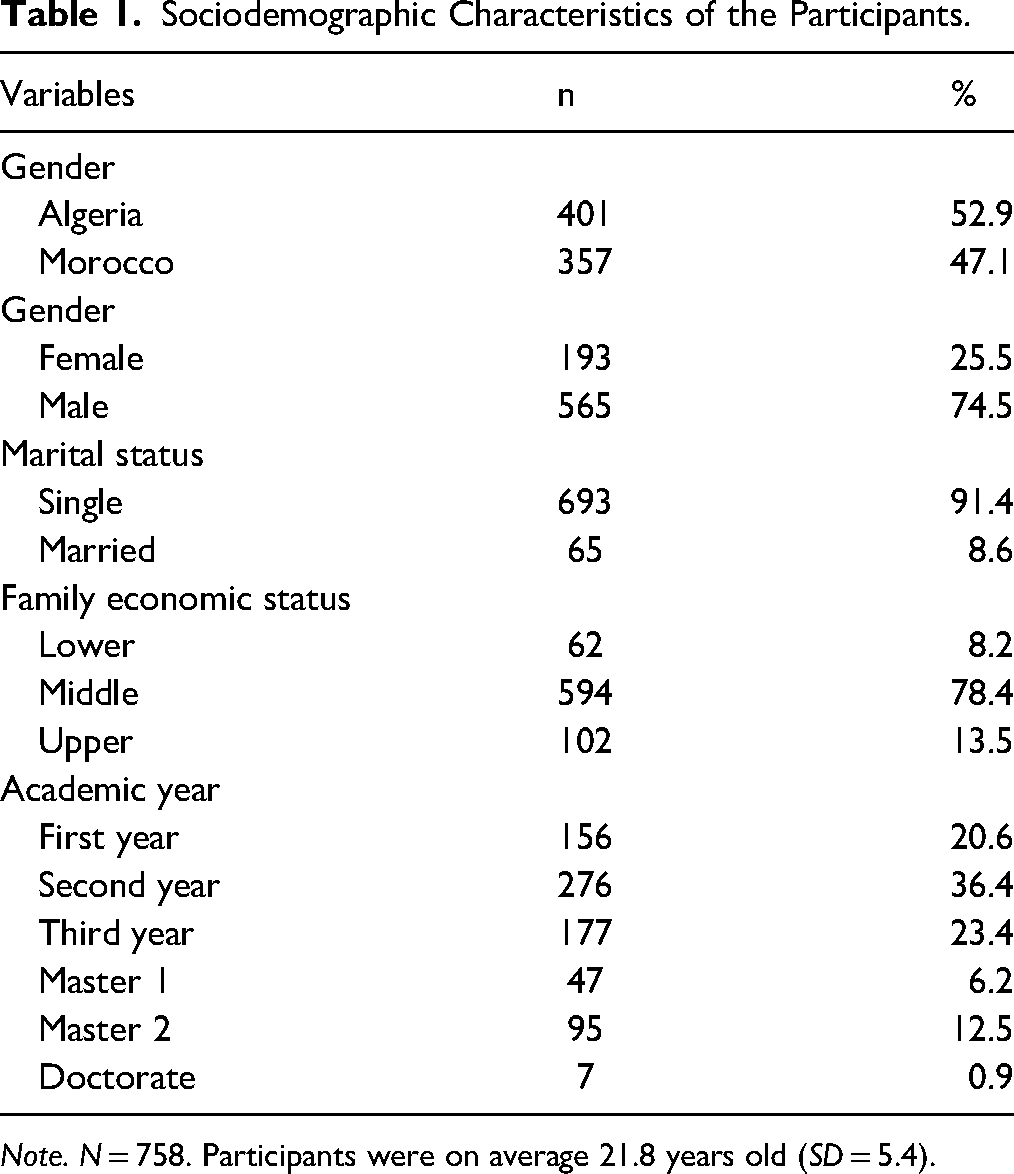
Note. N = 758. Participants were on average 21.8 years old (SD = 5.4).
Instrument
The FS, developed by Diener et al. (2010), is an 8-item instrument assessing various aspects of human functioning, such as positive relationships, competence, and a sense of meaning and purpose in life. It uses a 1–7 scale for responses, yielding scores from 8 to 56. Originally named psychological well-being, it was later renamed for inclusivity. The scale provides valuable feedback for life improvement and encourages self-reflection, particularly for individuals enhancing an already adaptive lifestyle. Psychometric assessment revealed strong reliability (Cronbach's alpha = 0.87) and validity, supported by exploratory and confirmatory factor analyses indicating a unidimensional structure (Diener et al., 2010). In the Arabic context, Salama-Younes (Salama-Younes, 2017) rigorously assessed the Arabic version (PFS), demonstrating robust structural validity and reliability. Study 1 (n = 374) showed strong internal consistency (Cronbach's alpha = 0.82) and EFA supporting a unidimensional structure. Study 2 reinforced temporal stability (r = .62 over 9 weeks). These findings position the Arabic PFS as a reliable instrument for assessing psychological flourishing in Arabic culture.
Data Analysis
SPSS26 was utilized to conduct descriptive statistical analysis. This included calculating the mean, standard deviation, kurtosis, and skewness. Skewness values ideally range between −1 and +1, while kurtosis values are expected to fall between −2 and +2 for accurate interpretation (Sabah et al., 2023a). When using structural equation modeling (SEM), skewness values ranging from −3 to +3 are considered acceptable, and kurtosis values falling within the range of −10 to +10 are regarded as appropriate (Thornberg et al., 2023). Additionally, AMOS 24 was used to perform confirmatory factor analysis, relying on the maximum likelihood method (Sabah et al., 2021). AMOS was employed to conduct confirmatory factor analysis (CFA) using the maximum likelihood estimation (MLE) method. The process involved specifying the hypothesized model in AMOS Graphics, importing the dataset to map variables to their corresponding indicators, estimating parameters including factor loadings and covariances, and evaluating the model fit using goodness-of-fit indices such as χ²/df, TLI, CFI, RMSEA, and SRMR (Abiddine et al., 2024; Sabah et al., 2024a, 2024b). To address nonnormal data, bootstrapping was applied with 2,000 samples, enabling bias-corrected estimates and confidence intervals for robust parameter assessment under nonnormal conditions. The parameter estimates and fit indices validated the hypothesized factor structure, supporting the reliability of the measurement model. The CFA was analyzed using bootstrapped ML with 2,000 bootstrap samples, as AMOS lacks the MLR estimator but offers bootstrapping, which performs better in simulations. This approach addresses the violation of normality by treating the original sample as the population, drawing multiple subsamples with replacement, and allowing for a more accurate assessment of parameter estimates and goodness-of-fit indexes (Byrne, 2001; Fouladi, 1998; Nevitt & Hancock, 1998). Regarding the goodness-of-fit indices, the following were considered: the chi-square value, which should be non-significant for a good fit; χ2/df < 3 for a good fit and < 5 for an acceptable fit; the Tucker-Lewis index (TLI) < 0.90; the standardized root-mean-square residual (SRMR) < 0.08; and the root-mean-square error of approximation (RMSEA) < 0.08 (Sabah et al., 2022; Sabah et al., 2023b; Sürücü et al., 2023).
Results
The Results section presents an analysis of the FS items, including descriptive statistics and CFA, for Algerian and Moroccan samples and the total sample. The descriptive statistics indicate a normal distribution of item scores and significant factor loadings for all items, suggesting a strong relationship between the items and the underlying construct of flourishing. CFA was conducted for each sample, with initial poor model fit improved through modifications, resulting in acceptable levels across key indicators. The total sample also demonstrated good model fit indices after correlating errors of specific items. Additionally, measurement invariance was assessed through multigroup CFA (MG-CFA), revealing that the FS exhibited configural, metric, scalar, and partial strict invariance across Algerian and Moroccan samples, supporting the scale's reliability and validity in capturing the construct of flourishing across these cultural contexts.
1—Preliminary Analysis of the Scale Items
Table 2 presents an analysis of the FS items, including the mean, SD, skewness, and kurtosis for each item within the Algerian and Moroccan samples and the total sample. The item scores exhibited a normal distribution, as evidenced by skewness values ranging from −2.85 to −0.86, all falling within the acceptable limit of ± 3. Similarly, kurtosis values ranged from 0.20 to 10.48, with all values below the threshold of ± 10, further confirming the normality of the data. Regarding mean values, the Algerian sample demonstrated a range of 5.55–6.37, while the Moroccan sample showed means between 5.66 and 6.39. The total sample exhibited mean values spanning from 5.60 to 6.38.
Descriptive Statistics of Items on the Flourishing Scale.
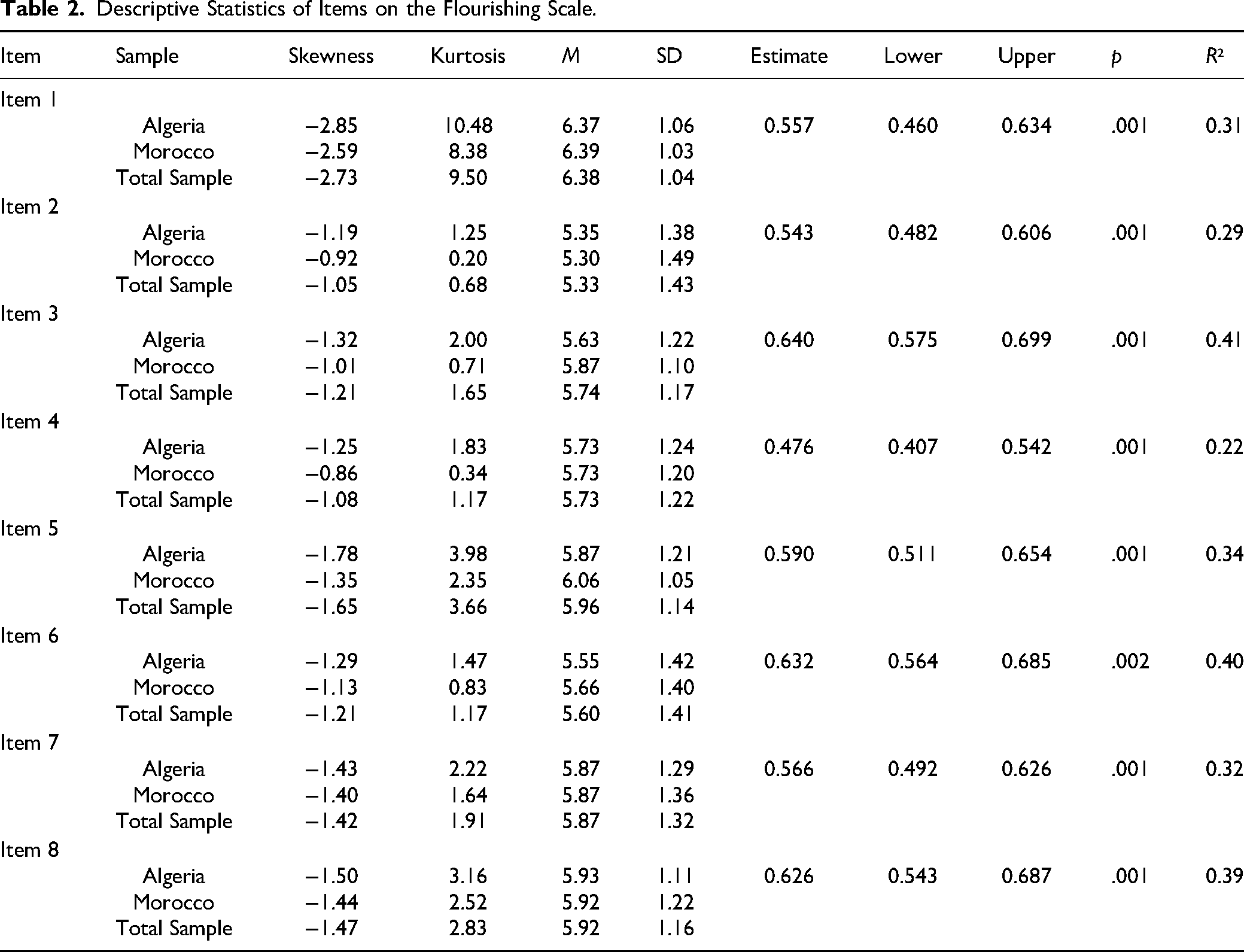
The descriptive statistics for the FS items, based on a bootstrap sample of 2,000, demonstrate significant factor loadings for the entire sample, all with p values < .01. The factor loadings, ranging from 0.476 to 0.640, indicate a strong relationship between the items and the underlying construct of flourishing. Specifically, Item 1 has a loading estimate of .557 (95% CI: 0.460–0.634), Item 2 is 0.543 (95% CI: 0.482–0.606), and Item 3 is 0.640 (95% CI: 0.575–0.699). Similarly, the remaining items show high loadings: Item 4 at 0.476 (95% CI: 0.407–0.542), Item 5 at 0.590 (95% CI: 0.511–0.654), Item 6 at 0.632 (95% CI: 0.564–0.685), Item 7 at 0.566 (95% CI: 0.492–0.626), and Item 8 at 0.626 (95% CI: 0.543–0.687). These narrow confidence intervals highlight the estimates’ precision and underscore the FS's reliability in capturing the intended construct within the Algerian context.
The R² values for the items, ranging from 0.22 to 0.41, reflect the proportion of variance in each item explained by the latent construct. Specifically, the values are as follows: Item 1 (0.31), Item 2 (0.29), Item 3 (0.41), Item 4 (0.22), Item 5 (0.34), Item 6 (0.40), Item 7 (0.32), and Item 8 (0.39). These values suggest medium to high effect sizes, indicating that the items are well-represented by the underlying flourishing construct. The higher R² values (e.g., 0.41 and 0.40) further highlight the strong predictive power for some items, supporting the scale's overall validity and robustness.
The analysis highlights both shared characteristics and subtle distinctions between the Algerian and Moroccan samples. While the FS maintains strong psychometric properties across both groups, slight variations in item distributions reflect potential cultural nuances. Nonetheless, the scale consistently demonstrates reliability and constructs validity, supporting its applicability for cross-cultural comparisons within these contexts.
2—Confirmatory Factor Analysis
The current study conducted a CFA on the FS for three groups: Algeria, Morocco, and the total sample (758 participants), using AMOS 24 software. The analysis employed the maximum likelihood method, bootstrapped with 2,000 samples, as depicted in Figure 1.
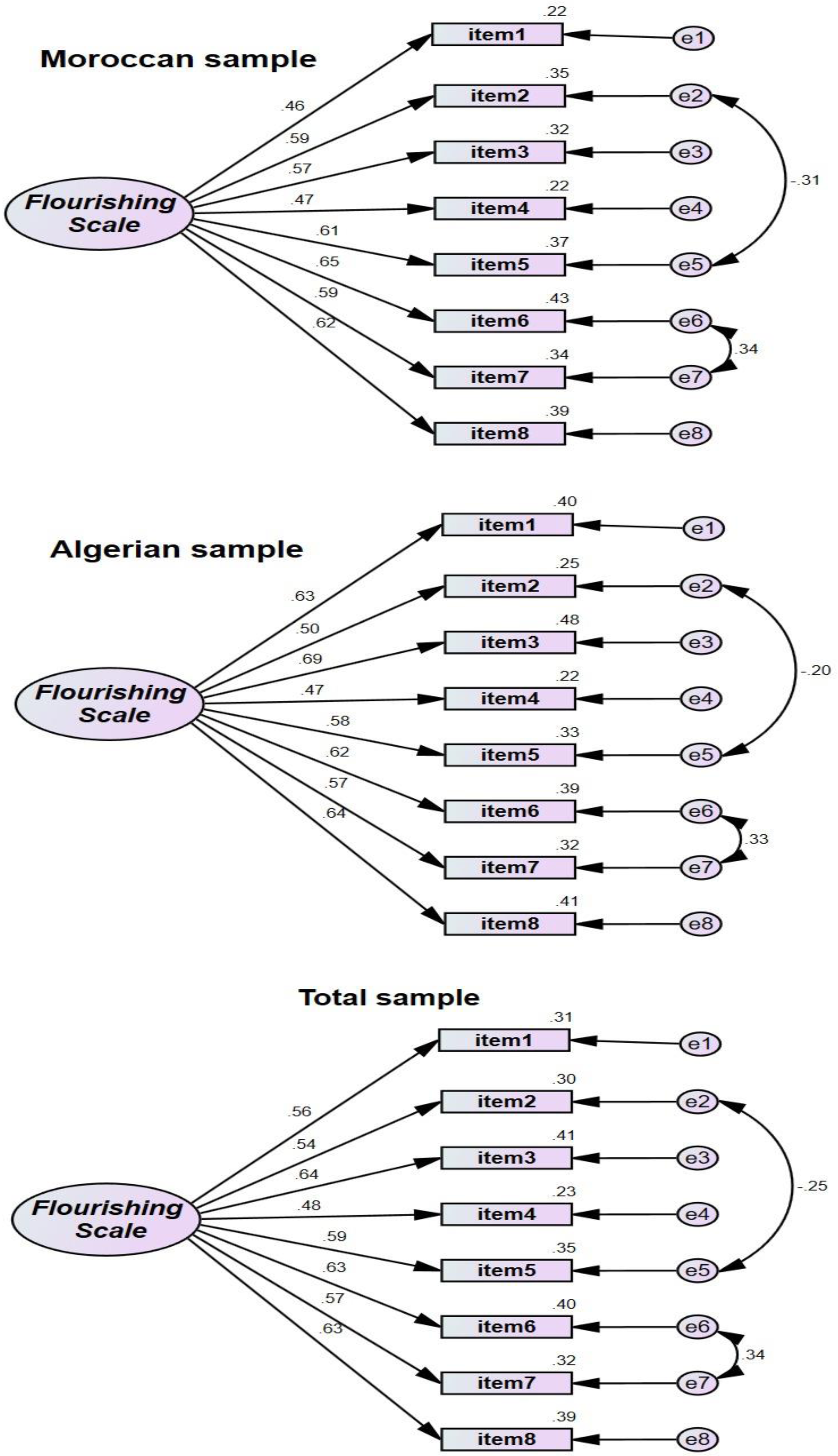
Factor loadings.
Algerian sample: Initially, the Algerian sample displayed poor model fit with CMIN/DF = 5.129, CFI = 0.900, and RMSEA = 0.102, categorized as “Terrible” based on thresholds. The SRMR was 0.0535. Construct reliability (CR) stood at 0.811, and MaxR(H) at 0.825. Following modifications, significant improvements were observed: CMIN/DF decreased to 3.448, CFI increased to 0.946, and RMSEA dropped to 0.078, now classified as “Acceptable.” The SRMR improved to 0.0409. CR remained stable at 0.810, with MaxR(H) slightly decreasing to 0.818. Modifications also allowed the calculation of maximum shared variance (MSV), which was 0.000.
Moroccan sample: Initially, the Moroccan sample exhibited poor model fit with CMIN/DF = 4.790, CFI = 0.887, and RMSEA = 0.103. CMIN/DF was “Acceptable,” but both CFI and RMSEA were “Terrible.” The SRMR was 0.0635, CR was 0.793, and MaxR(H) was 0.819. After modifications, substantial improvements were observed: CMIN/DF decreased to 3.100, CFI increased to 0.944, and RMSEA decreased to 0.077, now categorized as “Acceptable.” The SRMR improved to 0.0490. CR slightly increased to 0.795, while MaxR(H) decreased to 0.802. In both samples, modifications led to significant improvements in model fit, achieving acceptable levels across key indicators (CMIN/DF, CFI, and RMSEA). Reliability measures (CR and MaxR(H)) remained relatively stable across modifications, indicating consistent internal consistency of the FS in these North African contexts.
Total sample: Fit indices were acceptable before modification (CMIN/DF at 8.354, CFI at 0.900, TLI at 0.86, RMSEA at 0.099, and SRMR = 0.0518). After correlating the errors of Items 2 and 5, and Items 6 and 7, the model fit indices became excellent. Item loadings ranged from 0.48 to 0.64. The results of the fit indices indicated a good model fit, with a chi-square value of 81.173 at a significance level of 0.01, a χ²/df ratio of 4.51, a comparative fit index (CFI) of 0.95, and a Tucker-Lewis index (TLI) of 0.93. Additionally, the RMSEA was 0.06, and the SRMR was 0.03, indicating a satisfactory model fit. Regarding the model's reliability, the values were 0.802 for the composite reliability (CR), 0.807 for MaxR(H), and 0.79 for Cronbach's alpha, suggesting an acceptable level of reliability for the model.
3—Measurement Invariance in MG-CFA
To assess measurement invariance between the Algerian and Moroccan samples, MG-CFA was conducted on the entire sample (n = 758) encompassing both countries. Table 3 presents the results of these analyses. Configural invariance was established (χ²/df = 3.274, TLI = 0.915, CFI = 0.945, RMSEA = 0.055, SRMR = 0.0409), indicating that both Algerian and Moroccan samples shared the identical factor structure of the FS. This finding enabled subsequent metric, scalar, and strict invariance testing across these groups. The analysis revealed that metric invariance was supported, with acceptable fit indices (χ²/df = 3.158, TLI = 0.919, CFI = 0.938, RMSEA = 0.053, SRMR = 0.0472), and changes in fit indices within recommended thresholds (ΔCFI = −0.007, ΔRMSEA = −0.002). This indicates that the factor loadings were equivalent across the Algerian and Moroccan samples. Scalar invariance was also supported, showing good model fit (χ²/df = 2.941, TLI = 0.927, CFI = 0.932, RMSEA = 0.051, SRMR = 0.0478), with changes in fit indices (ΔCFI = −0.006, ΔRMSEA = −0.002) within acceptable ranges. This suggests that the intercepts were similar across the groups. Strict invariance was fully supported (χ²/df = 2.761, TLI = 0.934, CFI = 0.927, RMSEA = 0.048, SRMR = 0.0492), confirming that the change in CFI (ΔCFI = −0.005) fully meets the criterion for strict invariance according to Chen (2007). Overall, the FS demonstrated configural, metric, scalar, and partial strict invariance across Algerian and Moroccan samples, supporting the scale's reliability and validity in capturing the construct of flourishing across these cultural contexts.
Model Fit Measures of Multigroup Analysis Models.
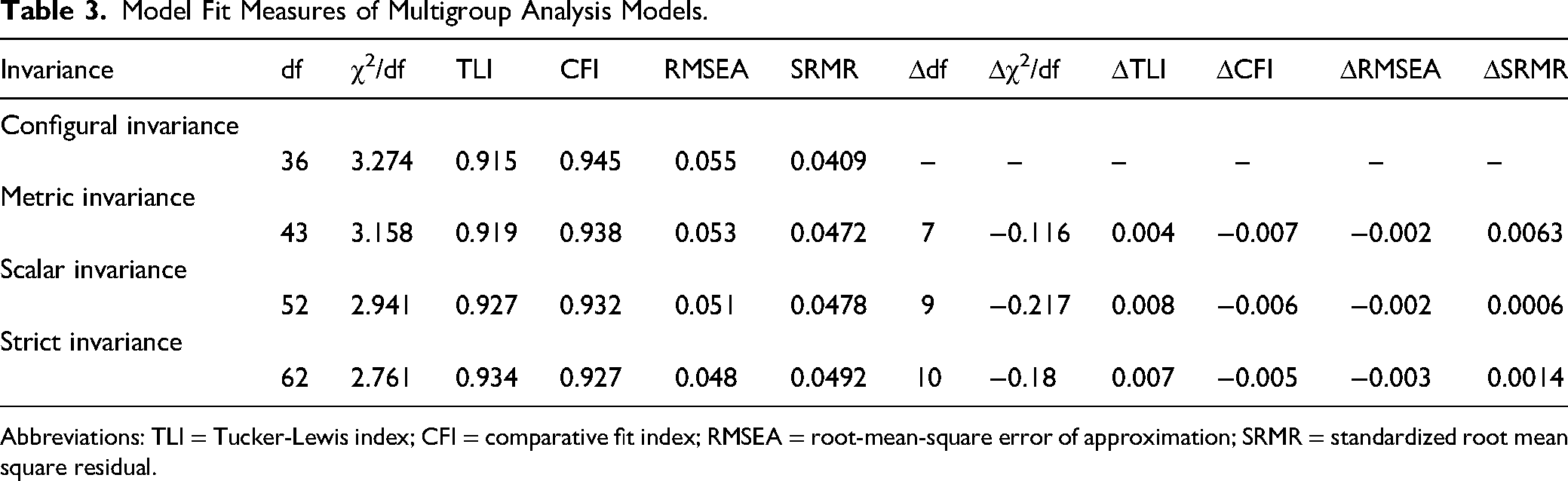
Abbreviations: TLI = Tucker-Lewis index; CFI = comparative fit index; RMSEA = root-mean-square error of approximation; SRMR = standardized root mean square residual.
Discussion and Applications to Practice
The objective of the present research was to investigate the psychometric characteristics of the FS within the contexts of Algeria and Morocco utilizing CFA and measurement invariance. To achieve this, we employed the psychological flourishing measure developed by Diener et al. (2010), demonstrating its validity and reliability across various cultural settings, including the Arab region. We utilized this tool to collect data among a sample of university students in Morocco and Algeria, which was distributed according to the variables of country, gender, family status, income, and university year. Diener et al.'s FS targets positive relationships, competence, meaning, and purpose in life. In addition to the strength of its psychometric properties in a range of foreign cultural contexts, its Arabic version has shown high validity and reliability in the Egyptian, Saudi Arabian, and Syrian environments, making it suitable for assessing Psychological Flourishing in other Arab countries such as Algeria and Morocco.
The results indicated a normal distribution of scores across the scale items. There was also consistency in findings between the Algerian and Moroccan samples. CFA demonstrated acceptable reliability for the FS. Moreover, measurement invariance analysis underscored the scale's reliability and validity for assessing flourishing across diverse cultural contexts, including Algeria and Morocco. This analysis further confirmed the scale's stability and utility in measuring flourishing within Algerian and Moroccan societies.
The psychometric properties attained in the current study align with previous research on the reliability and validity coefficients of the psychological FS structure (Mostert et al., 2023; Premchandran & Priyadarshi, 2018; Rando et al., 2023; Schotanus-Dijkstra et al., 2016b; Seok et al., 2022; Silva & Caetano, 2013; Villieux et al., 2016; Weziak-Bialowolska et al., 2021). It is also evident that the lack of differences between the sample models of Algeria and Morocco enables it to measure psychological flourishing with equal accuracy and confidence among samples from both countries. The added value of the current study's data lies in confirming previous results obtained from Arab samples (AL-Dossary, 2021; AL-Dossary & Almohayya, 2024; Salama-Younes, 2017; Yanardağ et al., 2022). Those findings may open the door to this scale's safe and effective use in estimating psychological flourishing among sample respondents from other Arab countries.
The current data issued from Algerian and Moroccan samples confirm findings from the other Arab states, namely, the Saudi Arabian context (AL-Dossary, 2021; AL-Dossary & Almohayya, 2024), Syrian adults (Yanardağ, Budak, & Özer, 2022), and the Egyptian population by Salama-Younes (Salama-Younes, 2017). On the other hand, the benefit of this scale also lies in its practical extensions, given the importance of the psychological flourishing index in mental health and the prevention of physical diseases, in addition to its correlation with effective work, emotional management, happiness, and other positive life indicators.
For theoretical implications, the current research affirms the validity and reliability of the FS and its applicability across cultures in assessing psychological well-being among diverse population groups in the Arab and global environments. By adopting the Arabic version of the FS and demonstrating its good psychometric properties, this study contributes to the theoretical understanding of flourishing as a universal construct. The confirmation of the one-dimensional structure, good reliability, and validity coefficients aligns with previous research, reinforcing the theoretical basis of the FS as a reliable measure of psychological flourishing in the context of the Arab Maghreb (Algeria and Morocco). Furthermore, the comprehensive verification of the scale's validity and reliability across different linguistic and cultural contexts provides empirical support for the instrument as a culturally valid tool for assessing positive mental health through flourishing.
The practical implications of this study are significant for researchers and practitioners alike. By validating the Arabic version of the FS in the Arab Maghreb and ensuring its reliability and validity among Algerian and Moroccan populations, this research facilitates the accurate measurement of psychological flourishing in these contexts. This has practical implications for mental health professionals, educators in these countries, specifically, and the Arab environment, in general, as it provides them with a validated tool to assess and monitor individuals’ positive mental health. Finally, the findings of this study contribute to promoting evidence-based practices aimed at enhancing psychological well-being and fostering positive mental health in diverse cultural settings.
For workers, the current study provides a significant contribution to social work by offering a validated tool that can be directly applied to assess psychological flourishing. Social workers can utilize the FS to better understand the positive aspects of clients’ lives, such as their sense of meaning, purpose, and emotional well-being. This understanding can guide the development of targeted interventions to enhance clients’ psychological well-being, emotional regulation, and social connectedness. Additionally, the FS enables practitioners to identify individuals at high risk for mental health challenges and tailor interventions to address their specific needs. By incorporating the FS into their practice, social workers can ensure that their interventions are grounded in evidence-based approaches, ultimately fostering better mental health outcomes and improving clients’ overall quality of life. Furthermore, the cultural validation of the FS for use in Algeria and Morocco ensures its relevance and reliability in diverse cultural contexts, making it an essential tool for assessing and promoting positive mental health in these settings.
Limitations and Future Directions
While this study is important and aligns with the theoretical framework, it is crucial to acknowledge several limitations. Firstly, the scope of the study was limited to only two Arab countries in North Africa, Algeria, and Morocco. Although these countries provide valuable insights into the psychometric properties of the FS within the Arab context, the lack of application to other Arab countries limits the generalizability of the findings. Given the diversity in economic, cultural, and conceptual landscapes across Arab states, the assessment of psychological flourishing may vary significantly across regions.
Furthermore, the participant samples in the current study consisted of specific demographic groups, namely university students. This limited representation across age and social groups undermines a comprehensive understanding of psychological flourishing in the context of the Arab Maghreb. Therefore, while the psychometric data obtained from this research and similar studies are valuable, it is important to note the limitation of lacking inclusiveness across diverse demographic sectors. The study's sample was limited to university students, which may not represent the broader population that social workers typically serve, such as individuals from lower socioeconomic backgrounds or those facing mental health challenges. This limits the applicability of the findings to diverse social groups in social work practice.
A key limitation of the current study is that the reliability of the FS was assessed solely through internal consistency, which evaluates item homogeneity but does not address temporal stability. The lack of test–retest reliability limits our ability to confirm the scale's consistency over time.
To address this limitation, future research efforts should expand the scope of adaptation and validation of the psychological flourishing scale to encompass a wide range of Arab samples from diverse socioeconomic backgrounds in the Maghreb region. By doing so, researchers can enhance the validity and applicability of the scale in capturing nuanced differences in psychological well-being across various demographic characteristics among populations in the Arab Maghreb. Future research should also include a more diverse range of participants, particularly those in vulnerable or marginalized communities, to ensure that psychological assessments of flourishing are relevant and useful for social work interventions across different social contexts. Additional reliability measures, such as test-retest reliability, will strengthen the scale's psychometric robustness and broaden its applicability across diverse settings.
Conclusion
This study facilitated the acquisition of quantitative data by distributing the Arabic version of the flourishing scale to students across various disciplines in universities in Algeria and Morocco. Results from the CFA conducted on a total sample of 758 participants indicated a favorable model fit. The reliability of the model was deemed acceptable based on the obtained values. Moreover, MG-CFA revealed no significant differences in measurement invariance between the Algerian and Moroccan sample models. The statistical techniques employed in this study yielded a flourishing scale with commendable psychometric properties.
Supplemental Material
sj-xlsx-1-rsw-10.1177_10497315251315942 - Supplemental material for Psychometric Properties of the Arabic Flourishing Scale
Supplemental material, sj-xlsx-1-rsw-10.1177_10497315251315942 for Psychometric Properties of the Arabic Flourishing Scale by Aiche Sabah, Musheer A. Aljaberi, Mohammed El-Mir, Jamel Hajji and Ahmed Alduais in Research on Social Work Practice
Supplemental Material
sj-xlsx-2-rsw-10.1177_10497315251315942 - Supplemental material for Psychometric Properties of the Arabic Flourishing Scale
Supplemental material, sj-xlsx-2-rsw-10.1177_10497315251315942 for Psychometric Properties of the Arabic Flourishing Scale by Aiche Sabah, Musheer A. Aljaberi, Mohammed El-Mir, Jamel Hajji and Ahmed Alduais in Research on Social Work Practice
Footnotes
Data Availability
The authors will make the raw data supporting this article's findings available upon request.
Declaration of Conflicting Interests
The authors declared no potential conflicts of interest with respect to the research, authorship, and/or publication of this article.
Ethical Approval
All procedures followed the ethical standards of the responsible committee on human subjects (Faculty of Humanities and Social Sciences at the University of Chlef, as well as from the research group PRFU number I05L03UN020120200002 of Chlef, Algeria) and with the Helsinki Declaration of 1975, as revised in 2000 (5).
Funding
The authors received no financial support for the research, authorship, and/or publication of this article.
Informed Consent
Informed consent was obtained from all participants.

Supplemental Material
Supplemental material for this article is available online.
References
Supplementary Material
Please find the following supplemental material available below.
For Open Access articles published under a Creative Commons License, all supplemental material carries the same license as the article it is associated with.
For non-Open Access articles published, all supplemental material carries a non-exclusive license, and permission requests for re-use of supplemental material or any part of supplemental material shall be sent directly to the copyright owner as specified in the copyright notice associated with the article.
