




Abstract
In recent years, there have been worldwide changes in the way social policies and services are designed and delivered at the local level. Principles of co-production, co-design and different models of partnership and collaboration across sectors inform outputs, outcomes and practices. The nature and complexity of the problems and challenges experienced by communities are in continuous evolution. For example, in recent years, community stakeholders increasingly provide authentic knowledge and insight, as well as research relevance and feasibility. The increasing collaboration across sectors helps identify critical public health and social care concerns and, in response design and increasingly implement research projects studying evidence-based interventions (Drahota et al., 2016; Daria et al., 2022). In the current economic, social, and political climate, cross-sector collaboration is encouraged to support social workers in leading and facilitating social changes at community level that can have a lasting impact on peoples’ lives (Lawler & Bilson, 2009).
Social workers and social work researchers increasingly develop partnerships which create a structure of mutual engagement linking the academic context with that of social work practice (Joubert & Hocking, 2015). These collaborations involve various stakeholders, such as academics, practitioners, communities, and service users and focus on reciprocity of lived expertise and knowledge. In social work partnerships involving service users, practitioners and researchers, the impact of such projects can be far-reaching and significantly improve the outcomes of social work (Fook et al., 2011).
Practice Research in the context of social work engages practitioners, researchers, service users, and educators is a negotiated and collaborative process of inquiry. It seeks to contribute directly to knowledge and service improvement through the process of research conducted with practitioners to directly affecting social work outcomes (Joubert & Webber, 2020). In the domains of social and health care, the nexus where research and practice meet provides ample opportunity to increase the potential for fruitful research (Julkunen & Koskinen, 2020). From a practice research perspective, impact is understood as the contribution that the research and practice make to society, the environment and the economy. It embraces the diverse ways in which knowledge and the outputs are produced—which are generated by research and benefit individuals, families and communities. Impact from research might be visible immediately or it can take years to become apparent; and, ideally, the contribution of the research to society, the environment, and/or the economy may have implications for generations to come.
Practice Research Collaboratives (PRCs) is an initiative that developed from the Fifth Conference on Practice Research (2021) to provide a platform for practice researchers to engage actively around specified agendas between the three yearly practice research conferences. Through the aggregated knowledge and experience of the members, the PRC aims to strengthen the agenda on impact and transformative change through studies on collaborative research partnerships and service-user engagement. In this context of active collaborative sharing, the work on complex social work interventions at the community level has become increasingly relevant.
In this article, we draw specifically on three cases in social work practice research involving long-term community and university research partnerships. We note that impact has, in the past, focused excessively on specific measurable research outcomes instead of aiming to bring attention to the transformational aspects of the research process. Impact in practice research should focus on more distant goals and long-term research partnerships that are accomplished over an extended period of time. Considerations particularly relevant within social work research are those addressing social justice, where research transforms negative social conditions and enhances well-being and healthy relationships and positive systemic change in, what are often complex situations (Watts & Hodgson, 2019).
In this article we ask a key question—what are the unique features of the research activities in long-term community and university partnerships in social work that have enabled transformational impact? In each of the cases analyzed there is a description of its unique practice research milieu and the collaborative research processes. We finally assess the impact of the research in relation to systemic changes in the community.
Issues of Impact and Credible Evidence
The importance of using research findings to improve services, policies and practice have been highlighted in the literature. In the early 1990s, the terms “research translation” and “translational research” were coined in response to significant clinical science discoveries and development in the medical field of “best practice.” However, there was little improvement in the provision of health care and in health outcomes (Davidson, 2011; Szilagyi, 2009). Subsequently, the literature around translational research has increased both in volume and complexity in different disciplines over the years. Exponential growth in the literature on successful implementation practices, and processes of embedding science in practice has led to the point where implementation science, improvement science, and knowledge mobilization becoming increasingly popular.
This focus on expressly using research for service improvement soon resulted in a deeper understanding of the complexity of service delivery in many fields such as education, health and social care. Recent reviews by Beehler and Trickett (2017) have indicated that translating research evidence into socially dynamic contexts is challenging. Possibly as a result of this, the U.S. National Implementation Research Network tentatively concluded that results from research studies were not of sufficient quantity and quality to impact human services and, therefore, have not provided the intended benefits to consumers and communities (Fixsen et al., 2009). Moreover, mere exposure to information and new models of practice was considered as insufficient to bring about change (Armstrong & Kendall, 2010).
Increasingly, however, there has been strong advocacy for consideration of how knowledge translation can change not only practice, but systems, and thereby reach the target audiences of policymakers, practitioners and service users. Various stakeholders were encouraged to ensure credible evidence would impact practice in longer-term, transformational ways. In this context, considerable attention is currently directed at both what constitutes credible evidence, and what is meant by transformational systems change.
It is not uncommon for challenges to emerge about the nature of evidence. Different stakeholders will likely have different expectations of the type of evidence needed to support their impact agenda. Amidst “fake news” and contested “big data” findings, the real impact can only be achieved with the production of credible evidence (Fouché & Chubb, 2020). Agreement on the nature of evidence is core to creating impact. A focus on numbers (quantitative data) or stories (qualitative data) is valued differently for different organizations and their funding agencies. The current gold-standard of evidence remains randomized controlled trials, but it is acknowledged that this also has limitations in certain practice contexts (Green, 2014).
Systems change is a growing field of study and practice. McNaney and Bradbury (2016) make it clear that transformational outcomes are dependent on good leadership and good evidence. This highlights the need for partnerships to truly affect systems change. The social work profession is actively exploring ways to make a larger difference to challenges where no single discipline or organization can control the outcomes (challenges such as food poverty, housing deprivation, and youth crime). As Wheatley (2006, p. 139) notes, a system is composed of several parts, but we cannot understand a system by looking at its parts; we need to work with the whole system, even as we work with individual parts. This is also recognized by Grewatsch and colleagues (2021), who have stated that in diagnosing a problem we tend to use reductionism—we look for the one broken part, instead of looking at the picture as a whole.
In strengthening the agenda to ensure research findings have practice impact, demands are increasingly made on researchers in professional disciplines for more engaged research, including community–university partnerships and stakeholder–researcher collaborations. Using credible evidence for transformational impact involves a complex dance of multiple partners with diverse experiences (research experts, practitioners, service users, transformational leaders, and decision makers) agreeing on the best mechanisms to connect with different audiences. This occurs in a complex environment where several political, economic, organizational, and ethical factors are at play.
Political complexities impact power relationships and often determine ownership of the research. In turn, research is impacted by changes to global development agendas, ruling political parties, policy directions, and budget decisions, resulting in organizations shaping practice agendas to meet political and funding opportunities. Research ideas can be configured without necessarily taking transformational goals into consideration (Green, 2014). Asking the right practice-relevant questions in the first instance and implementing the research so findings are co-created to ensure real world relevance and transformational impact can help to simplify some of these complexities. This is more possible when researchers and “users of research” are less distinct groups and where knowledge is shared bi-directionally.
Organizational culture will determine the availability of resources to access information and utilize findings to improve services (Kearney, 2015). A positive culture aimed at systems change will include support from management, community, service users, practitioners, knowledge brokers, and policymakers. Practitioners may, for instance, be hesitant to engage in research, especially when faced with organizational resistance, managerial ambivalence, and insufficient research funds (Moseley & Tierney, 2005). University interest in long-term transformational impact with community partners has yet to be widely reflected at an institutional reward system level. Academics are aware that university interest in community research has yet to be widely reflected in institutional reward systems and tangible support (Moore & Ward, 2010). The requirement that academics engage in community–university research that involve significant practice engagements remains under-recognized (Dodd & Epstein, 2012). Organizations with a culture where curiosity, enquiry and exploration are encouraged and where opportunity, encouragement, time and resources to update knowledge are considered priorities, ensure better environments for research that results in credible evidence and makes a meaningful impact.
Method
The PRCs on impact and influence in social work practice is a digital space for networking, idea exchange, and knowledge promoting creative ways to increase impact and influence practice and policy through long-term partnerships in research. The platform offers online seminars where different studies and cases are presented and discussed. For instance, it has allowed for various knowledge translation models and practice and policy implications in different international contexts to be presented and discussed. Based on these discussions, using a model of collaboratives and aggregated knowledge exchange, it was decided to analyze some cases more closely in order to scrutinize both the processes and the more far-reaching impacts practice research may have. Through this, the group hopes to contribute to developing other models that focus on translating practice research back into practice.
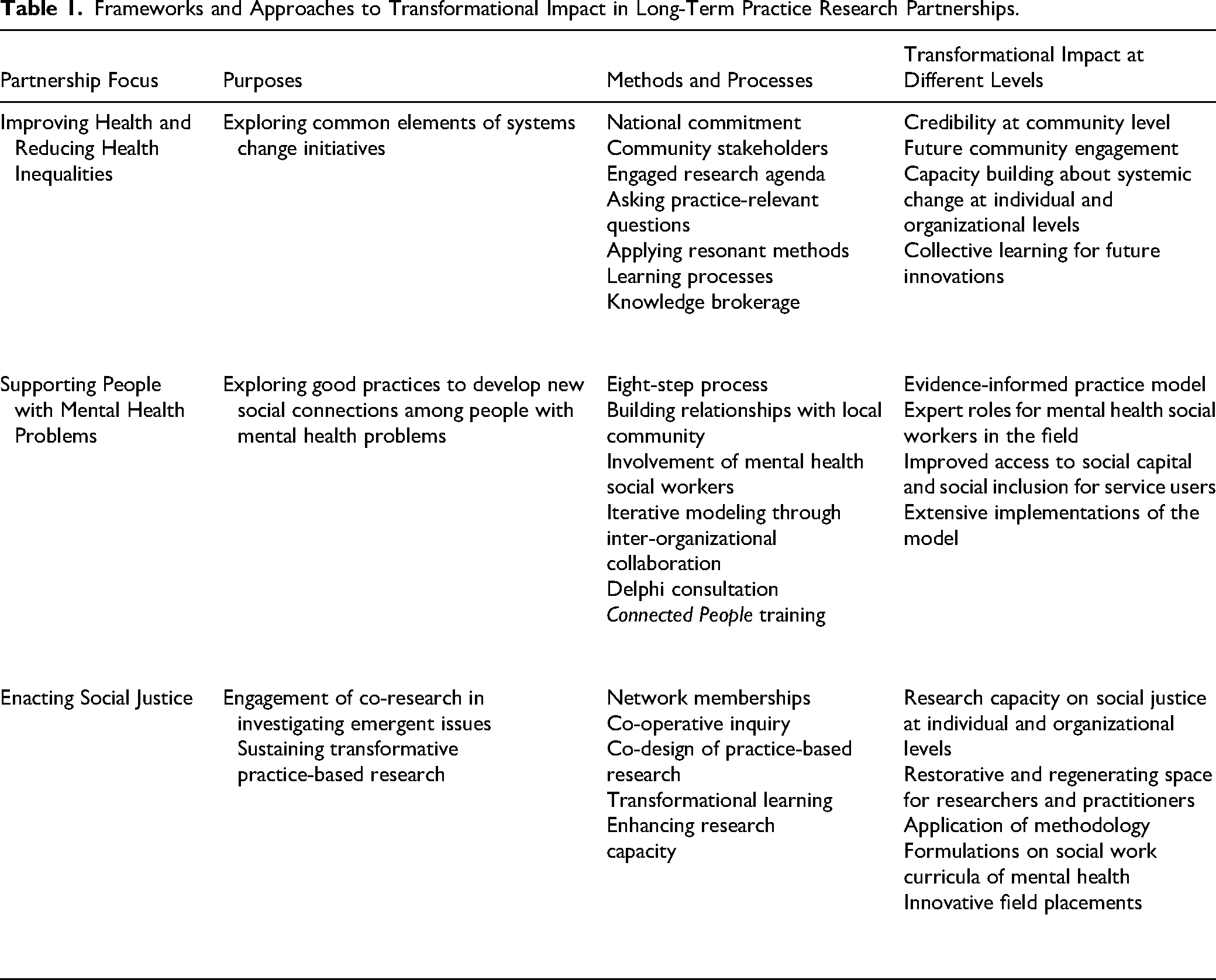
Three cases were chosen to illustrate the complex contexts and how social work research may impact practice in longer-term, transformational ways. We chose to build our analyses on cases that build on long-term practice research partnerships and have aimed for transformational impact within different areas. We aimed through the analysis of the three cases to give a more in-depth exploration addressing the complexity and uniqueness of the contexts and the research processes in practices (Creswell, 2013). The different viewpoints provided gave the opportunity to scrutinize impact on different levels and look for commonalities and divergencies. Based on their long-term research partnerships and studies four researchers (CF, MW, MS, and LW) described: (1) the context of the partnership and the focus of the research collaboration ascribing the conceptual lens/framework on which the partnership is viewed; (2) the activities, methods, and processes applied within the collaboration; and (3) most importantly, the scope of impact within these long-term research relationships from a systemic perspective recognizing changes on different levels and how changes in one aspect may unfold within other levels and aspects of the system. The findings of these cases were then analyzed and discussed within the collaborative platform and the synthesis from the cases was summarized in Table 1. When the cases were compared we used the extant literature and research experiences among the partners in the platform to understand and summarize commonalities and divergencies (Eisenhardt & Graebner, 2007).
Frameworks and Approaches to Transformational Impact in Long-Term Practice Research Partnerships.
The results of these specific projects are not presented in this article, as the focus is on how a practice research partnership informs impact. The questions of resources or economy are also not addressed, although these may have an effect on the longevity of these partnership processes.
Cases of Practice Research Partnerships
Practice Research Partnership for Transformative Change to Improving Health and Reducing Health Inequalities (Aotearoa—New Zealand)
Context and Purposes
One of the underlying principles of the Sustainable Development Goals is that efforts to advance health and well-being are anchored in, and informed by, the community (World Health Organization [WHO] and the United Nations Children's Fund [UNICEF]) (United Nations, 2015; WHO and UNICEF, 2018). The New Zealand Government has a commitment to improving access to primary health care, but the delivery of health policy and services is underpinned by bureaucratic legacies that seldom fit contemporary local landscapes. In New Zealand, such initiatives are still fledgling and require funding, patience, and trust-rich relationships between stakeholders and communities. The goal is to be transformational in the way core services are delivered to communities and to create system-change along the way. It cannot simply be “more of the same” if population outcomes are to improve, and inequities are to reduce. There is increased awareness of the need for an approach which highlights the importance of systems thinking, systemic co-inquiry and social learning (Ison, 2018) moving away from the top-down, hierarchical and instrumental approaches that have been mainstream to date (Innes and Booher, 2018).
It is within this context that a team of researchers across three disciplines (Business, Policy, Social Work) at the University of Auckland, New Zealand, collaborated with a group of community leaders involved in successful initiatives aimed at improving access to primary health care. We defined the purpose of the partnership as exploring common elements of successful transformative systems change initiatives led by these community leaders. We were invited by the leaders of the initiatives to record and reflect on the challenges and successes. The focus was on three paradigm-breaking primary health and well-being initiatives for regions in New Zealand with longstanding healthcare challenges. We collectively agreed that the objective of our partnership was to document collective learning so that future innovations aimed at improving health and reducing health inequalities can benefit from the experiences of others.
Activities, Methods, and Processes
We engaged in a participatory case study design with practitioners and academics as co-experts bringing knowledge, experience and sophisticated skills to the endeavor. The project was undertaken with support from the University and the organizations where partners were employed. The initial challenges were significant ambivalence and insufficient resources in the time-consuming stages of building the partnership. Ethics approval was obtained, with the proviso that naming of the respective initiatives was not permitted We used research methods that were sensitive and resonant with both participants and their communities and regarded as “credible evidence” by all partners, including rapid roundtable dialogue, co-crafting sessions, storytelling, observational site visits, and access to documents, communications, and work-in-progress artifacts. The researchers attended as appropriate (part of) regular meetings of the practice initiatives. Interviews and site visits to the interventions were scheduled before or after each of these meetings. Time and energy were invested to create trust and relationship and we were committed to discussing any ethical, relational or conflictual issues as they arise, making collective decisions on protocol and methodology, and approaching analysis as an invitation to authentic conversation and interpretation. An interesting development early in the project was an agreement to include an intermediary/knowledge broker to ensure we hold to the values, principles and plans we agreed upon.
Assessing Impact
The overarching theme from the findings highlighted that transformative and intersectoral systems change initiatives can only be successful if community leaders and researchers carefully consider several success factors and navigate a minefield of paradoxes. The role, purpose and structure of independent intermediaries in enabling these processes and capabilities were identified as a major contributor to success.
The project had a transformational impact for individuals, communities, organizations, and changes to practice and policy. The findings are co-owned with participants and became a resource for the broader community. Learnings on “critical success factors” were shared with academics through scholarly publications and other national community and grassroots systems change initiatives and representatives from several social, health and community sector organizations, Ministries and local Councils through webinars and workshops. In partnership with stakeholders, we designed a capacity-building program containing a number of online learning modules which weaves stories from the field with content on: navigating partnerships; collaborative and grassroots governance and leadership; policy responsiveness; and influencing systems level change. Significantly, we also developed learning on the role and purpose of intermediaries in complex partnerships. In the context of the current restructuring of the Aotearoa—New Zealand health sector and the impetus on community engagement, we are well positioned to provide expertise on shifting the capability for effective social intervention from government to community with the delivery of this program. Our hope is that future systems change leaders can learn from others’ experience.
This project also enabled strategic community engagement with colleagues across the University and positive engagement with a range of social service leaders, Health Services, and local government leaders. We have gained trust and established credibility with these stakeholders and increased visibility for the University in these communities. Learning from and about complex community stakeholder engagement has influenced the way the researchers work within and across their respective contexts, as well as helping inform others nationally and internationally to consider best practice to navigate partnerships, collaborative and grassroots governance and leadership, policy responsiveness and systems level change. We believe the work we have done so far provides a solid foundation for future community engagement for many researchers at the University. It will also enable us to grow community impact and engagement—particularly, but not exclusively, with community stakeholders.
Practice Research Partnerships for Supporting People With Mental Health Problems (United Kingdom)
Context and Purposes
For many people, the experience of severe and enduring mental health problems is accompanied by social isolation and loneliness (Giacco et al., 2022; Lim et al., 2018). People have, or perceive, less contact with others due to symptoms they experience or associated factors such as internalized stigma (Drapalski et al., 2013), discrimination (Webber et al., 2014) or attachment style (Webber et al., 2011), for example. When experiencing poor mental health, people's social networks shrink (Cullen et al., 2017; Domènech-Abella et al., 2021) and their access to social capital—the resources available to them from within their social networks—also declines (Webber & Huxley, 2007). A consequence of this is that an individual's recovery can be stymied, as social connections are integral to this process (Leamy et al., 2011). However, most people with psychosis (for example) express a desire for increased social contact (Tee et al., 2022), indicating that some support may be required to achieve this.
Social workers are employed in National Health Service (NHS) community mental health teams (CMHTs) in the United Kingdom, or work alongside them in Local Authorities. However, in England and Wales at least, there is no clear or consistent role for mental health social workers, which is largely determined by the needs of their employer or statutory requirements (Tucker et al., 2022). This prevents social workers from taking a lead in developing and implementing social interventions which can address social isolation and loneliness among people experiencing severe and enduring mental health problems. There is also limited evidence for effective social interventions in supporting people with mental health problems to enhance their social connections, which means that psychiatric and psychological interventions are dominant in CMHTs. While there is investment in social prescribing link workers (predominantly in primary care where they have less training and lower professional status than social workers), to support people to connect with community and voluntary sector resources (NHS England, 2019), and a supportive policy environment (National Collaborating Centre for Mental Health, 2019), mental health social workers are seldom involved in this area of practice. Therefore, we undertook a social work-led practice research program to bring researchers and practitioners together to develop and evaluate a practice model that could help mental health social workers provide leadership in this field.
Activities, Methods, and Processes
We undertook three studies with a range of health and social care agencies in England to develop and evaluate a social intervention model, Connecting People. The first was a qualitative study of practice which involved 73 practitioners and 51 people who used services (Webber et al., 2015). Researchers undertook ethnographic fieldwork to explore good practice in supporting people with mental health problems, predominantly psychosis, to develop new social connections. The Connecting People intervention model was developed iteratively in focus groups in the study and refined through a Delphi consultation including those with mental health problems, practitioners, and international social care and social capital experts so that it could be readily in practice (Webber et al., 2016).
Connecting People was piloted in 14 health and social care agencies in the voluntary and statutory sectors in England. An evaluation of its outcomes for 155 people with a learning disability or a mental health problem found that their access to social capital and perceived social inclusion increased when the model was fully implemented (Webber et al., 2019). However, only about a quarter (30/117) of those followed up at 9 months experienced high fidelity. High fidelity to the intervention model—defined as “the extent to which an intervention is delivered without modifying its intended contents, structure, and procedures” (Soydan, 2015, p. 331)—can be challenging to achieve in practice. It requires a full focus on the model, but this appeared to be more difficult to achieve in CMHTs as only one of eight in the study was able to implement it with high fidelity (Webber et al., 2019). A subsequent implementation study aimed to improve our understanding of the conditions required for optimal implementation of Connecting People in CMHTs. We co-developed an implementation pack comprising practice guidance, a training manual, an implementation manual and service user guide with service users and practitioners. This pack was provided to CMHTs in five mental health NHS Trusts and 151 people with mental health problems participated in a pragmatic non-randomized controlled study (Webber et al., 2021). The study found that organizational constraints held back the CMHTs from fully implementing Connecting People. We found that more support than only providing the implementation packs is required to achieve high fidelity. Outcomes for mental health service users were the same in the implementation and control groups as a result of partial implementation. Ethical issues were addressed in each study and reviewed by an ethics committee. One consistent issue which was prominent throughout was asking practitioners to adopt new ways of working while they held heavy caseloads and were often responding to crisis situations. As is common in practice research, pragmatic solutions were sought to ensure Connecting People was implemented with fidelity but not to the detriment of practitioners’ well-being.
Assessing Impact
These practice research studies have enabled us to evaluate the potential outcomes of Connecting People for those using mental health services and the challenges to overcome in order to implement the model with high fidelity. Working with practitioners and agencies, we aimed to provide a role for mental health social workers in this field of practice that aligns to their expertise and value base. The creation of Connecting People has transformed nebulous and low-status practice into an evidence-informed practice model which is now routinely taught to social work students in the United Kingdom. They have provided us with examples of how they have used it to help engage people with new groups and activities in their local communities, having a positive impact on their social connections and access to social capital. Furthermore, articulating social work practice in a model, with guidance for practice, training and implementation, has assisted its replicability with adaptations to Connecting People being made and used in countries as diverse as Sierra Leone, Nepal and United States, with others with plans in place to do the same. The work in Sierra Leone, for example, has informed the development of a framework for the cultural adaptation of social interventions, which articulates how these processes could be undertaken elsewhere (Fendt-Newlin et al., 2020).
In the United Kingdom, though, the transformational and systemic work to fully implement Connecting People is still in its early stages. Producing evidence about the organizational change required to implement a multi-component model which supports people to engage with complex systems has been essential, but the implementation challenges should not be under-estimated. For example, in an English county council, the local authority plans to implement the model in each of its social work teams for adults. One team, for example, has adopted tools from Connecting People into their assessments to prompt mental health practitioners to ask people about their local connections and social networks. In addition, a mental health NHS Trust in a northern city in England is starting to implement the model by taking a bottom-up approach starting with service users and practitioners, though an absence of senior leadership provides a challenge. In a third mental health NHS Trust in a rural English county, there is support from senior leadership for social work practitioner-led initiatives to support people to engage with community and voluntary sector resources.
We will need to return in the future to assess the impact this has had on mental health social work and the ability of practitioners to use social interventions in bureau-medicalised or statutory-focused health and social care systems. However, further opportunities for influencing practice beyond social work are evident in the community and voluntary sector where Connecting People has been embedded in a community-enhanced social prescribing (CESP) model (Morris et al., 2022), which is currently being evaluated. Additionally, the University of York has adapted Connecting People for College Tutors and Mentors to use with new undergraduate and postgraduate students at risk of social isolation. The impact of Connecting People on practice, and the systems which support practice, will take time to be realized. It is envisaged that improved outcomes for people who use these services will follow, along with greater clarity and purpose for social workers and other practitioners using it. Impact has been achieved through collaboration. Practitioners worked with the Connecting People program developers to implement the model in their practice, but collaboration within teams was also essential to decide how best to engage with local community resources and assets. In addition, the CESP model features inter-organizational collaboration as an essential component and initial findings indicate that it works best when different agencies work together to identify, and meet, local well-being needs.
Practice Research Partnership for Enacting Social Justice (Australia, Aotearoa—New Zealand, Canada, and Ireland)
Context and Purposes
Since 2013, colleagues have been forming small academic–community research partnerships and engaging in co-operative inquiries that align with the social work principle of social justice (Duncombe et al., 2020; Hearn et al., 2014; Short et al., 2018; Short et al., 2021; International Federation of Social Workers, 2014; Whitaker et al., 2022b). The International Network of Co-operative Inquiry (INCInq) emerged in 2019 to support these partnerships and the use of Co-operative Inquiry in enabling the co-design and co-production of practice-based research in social work and human services (Whitaker et al., 2022a; International Federation of Social Workers, 2014). The Network seeks to sustain practitioners, educators and researchers engaged in transformative practice-based research. Network membership fosters relationships between community leaders and academics, ensuring research addresses issues of priority to community and practice, capturing innovation as it emerges in practice.
Decisions regarding research topics and data collection are made collectively by research team members. The type of data collected determines the ethical approach for an inquiry Each inquiry abides with the ethical requirements that participating inquirers work under within their countries.
Membership of the Network helps to address the problem of academic isolation, supporting members in advocating for change, introducing innovation and achieving career goals. Members agree to share power by engaging as equal co-researchers in investigating issues emerging across our collective practice. All researchers involved have co-authorship and consensually agree on the publication of findings. Membership has proven popular, influencing members’ research efforts and fostering participatory approaches. The current 37 members include social work students, human service practitioners and managers, and academics from Ireland, England, Canada, Aotearoa—New Zealand, and Australia.
Activities, Methods, and Processes
Co-operative inquiry is a practice-based research method involving cycles of reflection and action, featuring participants as co-researchers, co-inquirers, and co-subjects (Heron & Reason, 2008; Whitaker et al., 2022a). Our experience has shown that it can be used as both a methodology and a method, encouraging the sharing of power, collaboration, and transformational learning of participants (Short, 2018; Short & Healy, 2017).
Co-operative Inquiry methodology has been used for researching into work integrated learning and mental health social work. Social work programs struggle to meet the demand for work-integrated learning places. As INCInq members were involved in field education in Ireland, Aotearoa—New Zealand, Canada, Scotland, and Australia, several co-operative inquiries have identified success features of innovative placements and implemented them (Lomas et al., 2023; Russ et al., 2021; Short et al., 2021; Short et al., 2023). Findings confirm the capacity of research-based placements in preparing students for professional practice and support expanding the range of placements available to students, going some way toward addressing unmet needs.
Revisions to the accreditation standards for Australian social work courses (Australian Association of Social Workers, 2021) repositioned mental health social work curricula, expanding requirements for this core curricula to psychosocial health and well-being; a sub-group of the Network examined the implications of this development (Whitaker et al., 2020; Whitaker et al., 2022b). Responding to a United Nations (2017) call for change, a Canadian/Australian inquiry is investigating features of transformative mental health social work and educational strategies underpinning this practice.
Assessing Impact
Tracking the number of publications in reputable journals and funding success demonstrates INCInq's achievements (Pascoe et al., 2023). However, these markers fail to reveal the equally, perhaps more important, feature of the Network in offering a space where principles of social justice to which the social work profession aspires are upheld and where participants experience the support they need to conduct research and further develop research capacity. Network procedures and the participatory research method hallmarking collaboration and diversity support this. Thus, consideration of impact needs to be a multilayered exercise. This involves incorporating the impact on co-participants, further development of practice-based research methods, transformational professional development, enhancement of social work practice and/or the promotion of social justice.
The Network structure reflects egalitarianism as per key social work principles: social justice, human rights, collective responsibility and respect for diversity, (International Federation of Social Workers, 2014; Pascoe et al., 2023). Drawing on INCInq members’ differences in experiences across countries, cultures and professional settings offers unique and nuanced understandings of research topics and practice. However, there are challenges. While enriching the discussion, navigating differences requires a degree of trust, takes time and can challenge shared vision and goal setting, project processes, outputs and outcomes. This diversity is managed by a commitment to respecting and embracing a spectrum of thinking. Another challenge is finding suitable meeting times due to working across different time zones.
Anecdotally increased Network membership, attendance records, and reported application of the methodology through completed research projects (Duncombe et al., 2020) indicates the Network addresses these challenges effectively and thus continues to meet an important need. It is inspiring new insights and influencing thinking in inquirers’ fields. The research builds knowledge from practice wisdom while the Network processes integrate and enact social work principles. Paradoxically, INCInq counteracts the pressing competitiveness and isolation brought on by broader neoliberal agendas while supporting academics to meet publication requirements needed by these agendas.
Key to the impact of INCInq is the restorative space it offers members. Dr Carmel Halton, an INCInq member, described her experiences participating in the Network as generative and regenerative (Pascoe et al., 2023, p. 5). The Network continues to grow as members respond to requests from others seeking involvement in spaces such as these.
By “generating” knowledge from practice and producing publications, the studies undertaken by the Network support academic members in co-producing practice-based research about topics pertinent to current practice. Students participating in inquiries report being inspired to undertake further research, “generating” future practice-based researchers. As one student, reporting on a rural-focused placement said: “This experience has forged a greater appreciation for the role that research plays in social work, enhanced our ability to communicate effectively and developed our skills in research and strengthened our developing sense of professional identity” (International Network of Co-operative Inquirers, 2022).
Similarly, at a 2022 INCInq strategic planning week, members who are practitioners have noted their appreciation for that their practice wisdom has been acknowledged as well contributed to generating new knowledge through research (Pascoe et al., 2023). Members mentioned experiencing the collaborative, inclusive approach of co-operative inquiry as being “regenerative” (Pascoe et al., 2023, p. 5). The inquiries undertaken provide spaces in which participants can examine current issues that they are grappling with in their practice. Conversations invite reflections from diverse views, broadening perspectives and providing fresh insights. This approach counteracts the inherently competitive, often isolating, traditional approach in academia, student life and, at times, practice. Sharing experiences allows challenges to move away from uniquely personal vantage points. Additionally, at the same 2022 INCInq strategic planning week, members reported acquiring further skills in practice-based research design, data collection and analysis, documentation, publication, and conference presentations (Pascoe et al., 2023).
Results
Despite the broad debate on knowledge translation and using research findings to improve services the complexities of accomplishing desired systemic changes have been given little attention in social work. The three case studies presented in this article illustrate how practice research partnership studies can change not only practice in the field, but also systems, and influence policymakers, practitioners and service users engaged in multifaceted social problems.
Features of Transformational Impact on Social Work Research
The three cases are characterized by a clear focus and target audience. Considering the respective processes and reflections on impact across these cases, there are clearly some commonalities in answering the question about the unique features of enabling social work impact in long-term research activities. Table 1 summarized the common features and divergencies in three cases of long-term practice-based research partnerships. These cases are all involved in research designed to promote transformational impact, but the target group differs. In the first case, the community is the main target, in the second, the service users and in the third, mainly academy. The focus converged thus on three discourses: community, service users, and academy. Although linked, all three show differing approaches underpinning the focus of the research (see discussion by Denvall & Skillmark, 2021).
Moreover, the purpose and motivations of these partnerships vary in relation to conceptual frameworks for the activities and the consideration of what constitutes credible evidence for the different partnerships. They all apply a wide range of models and methods that are both appropriate to practice and relevant to different target audiences and community partners. Nevertheless, the focus on stakeholder relationships, partnerships, and collaboration is common across all three. All the examples facilitate systemic change through their research activities and all created a learning environment and tools to enable the actions to be sustainable and replicated in future in different contexts. While the first case aims for a substantial foundation of community engagement through scrutinizing critical success factors that will inform future success in similar initiatives, the second case aims to strengthen high fidelity in a good practice model for improving future outcomes for service users, while the third case targets the creation of a regenerative space for the academic environment to promote social justice in different working environments. It is possible to identity diverse levels of impact across the cases, as summarized in Table 1, demonstrating the range of benefits for individuals, families, communities and organizations.
From a transformational perspective, these diverse approaches within the cases included in our study are noteworthy. The processes of implementation are not seen as linear, but constantly evolving or declining in systemic manner (Koskinen et al., 2022). A series of “ripple effects” (Beehler, 2016) of multiple impacts are created in these practice-based research processes and can occur at multiple levels and may take place at different stages over time and vary in terms of how unintended or unforeseeable they are. These impacts may, however, be traced within structured initiatives implemented with high fidelity. For example, the Reclaiming Social Work model for working with children and families has been transported from the United Kingdom into many other countries. In Finland, though, it was found to be implemented with high variation in fidelity to its local version (the systemic practice model [SPM]; Isokuortti & Aaltio, 2020). Subsequent development of a program theory for SPM should assist its implementation, as it identified the core components of SPM and the processes involved in its implementation (Aaltio & Isokuortti, 2022). In common with complex interventions in medicine, psychology, or nursing, intervention fidelity in social work is crucial to improving outcomes for people, which can have transformative impacts for individuals and systems alike.
Looking further at the commonalities in the cases the question may arise as to what the prerequisites for the transformational processes consist of. Understanding research impact within practice research contexts in social work the challenges and barriers to impact and translation are described as the importance of understanding the feasibility of complex problems and complex social situations which requires local stakeholders to work together. Included in this partnership is the importance of meaningful communication between partners, transparency and involvement of all actors throughout the process.
In the cases discussed in this article, there was a clear focus, while the strategy and framework and map for how to get from “here to there,” especially when the improvements require significant systemic change was not initially obvious. In all cases there was ab initio an explicit intention and clear framework to map out the trajectory leading to the systemic change from the start. An important element in these case studies is the committed engagement in systems change in long-term partnerships that these cases unravel. Previous studies (Nielsen, 2011) have demonstrated that in long-term learning-oriented alliances stakeholders develop a commitment to the extent that they see the value of the knowledge generated and develop competence in using that knowledge.
Discussion and Application to Practice
The three case studies highlight the elements needed to facilitate systemic change. Germane to our study, Dobbins et al. (2009) emphasize four key elements for those involved in the implementation of knowledge translation strategies. These include: (1) the early engagement with service users, organizations and projects; (2) the development of viable networks as a mechanism to promote interaction and knowledge sharing; (3) allowing time for knowledge “brokerage activity” to take place; and (4) placement of the evidence within the context of the political/practice environment both within and across organizations. All of the cases used in our research have key elements of early engagement with different stakeholders at focus (whether service users, community actors, or academic and practice field stakeholders) as well as investing in building up viable networks and relationships to promote impact on different levels. The practice research processes highlighted elements of careful contextual considerations that was revealed through the multifold of different activities and methods chosen. Adelman and Taylor (2007) stress that there is a need to consider the drivers that motivate researchers and their partners to confront the complexities of, often difficult social change. In this context, we have specifically discussed the framework of research partnerships which have the potential for impact but not touched on the motivation of the researchers and stakeholders to bring about these systemic changes. In this regard, practice research partnerships should take into account the complexity of society and communities without allowing this to act as a barrier—to what is, in fact, a collaborative search for new approaches to manage old issues.
The case study approach grounded in different empirical evidence combined with a literature review may allow for drawing more convincing conclusions (Eisenhardt & Graebner, 2007). Our overall aim, using this approach, is to contribute to wider explorations of practice, research and learning processes, and theoretical evolution in the field of systemic change in social work research. On the whole, it is a question of methods, models, and interventions being communicable to others, to people involved and concerned, if we are aiming for transformational impact.
Footnotes
Declaration of Conflicting Interests
The author(s) declared no potential conflicts of interest with respect to the research, authorship, and/or publication of this article.
Funding
The author(s) received no financial support for the research, authorship, and/or publication of this article.
