




Abstract
This study examined the experiences of immigrant workers in Alberta, Canada, following work-related injuries, with a focus on postinjury reporting and return-to-work challenges. Twenty-seven injured immigrant employees from various industries were interviewed. Using an interpretive analysis approach, the study identified key factors shaping their experiences. Most participants were educationally overqualified for their roles and unfamiliar with high-risk, labor-intensive work environments. Findings revealed significant barriers to accessing information about injury reporting, workers’ compensation, and available benefits. Participants also reported adverse interactions with employers and insurers, inadequate work accommodations, and inappropriate retraining options. Discrimination, language barriers, fear of job loss, and systemic discrimination exacerbated these challenges. The findings highlight an urgent need for policy interventions, including occupational health and safety training for new immigrants, stronger employer accountability, culturally responsive return-to-work planning, and improved communication of workers’ rights. These measures can enhance injury prevention and promote more equitable return-to-work outcomes for immigrant workers.
Keywords
Introduction
As birth rates decline and life expectancy rises, developed countries such as Australia, Canada, and the USA increasingly rely on immigrants to sustain their labor markets and economies. 1 Many nations have recently adopted more selective immigration policies, prioritizing highly educated and skilled workers to meet labor demands. However, despite their educational qualifications, many recent immigrants (especially those in the host country for less than 5 years) struggle to integrate safely into the labor market due to challenges in credential recognition and the underutilization of their education. 1
Canada's immigration system prioritizes educated applicants, favoring those with advanced degrees. 2 As a result, permanent residents tend to be highly educated but often remain underemployed due to challenges in the recognition of their credentials by Canadian accreditation bodies. 2 Many are forced into survival jobs, which are insecure, demanding, and low-paying, with long hours, stressful conditions, and limited collective representation.3–4 Although such jobs span all income levels and demographics, 4 recent immigrants face additional barriers due to their status, including a lack of occupational health and safety (OHS) training.3,5
Evidence indicates that recent immigrants in these roles face higher workplace injury rates and worse work and health outcomes compared to Canadian-born workers.6–12 Educational overqualification further elevates injury risk, as shown in a Canadian study indicating that recently immigrated men with educational qualifications exceeding the requirements for their jobs were significantly more likely to report work-related injuries than immigrant men who had been in Canada for over 5 years and were not educationally overqualified. 13 This renders educationally overqualified recent immigrants especially vulnerable to workplace injuries.
Previous research also highlights broader return-to-work (RTW) challenges for injured immigrant workers. Gravel et al. documented that immigrant workers face greater difficulties than nonimmigrants in accessing medical, legal, and administrative support within compensation systems. 14 Other studies show that immigrant workers experience longer disability durations, more severe injuries, and additional challenges navigating workers’ compensation processes, including delays in accessing disability benefits and rehabilitation services. 8 Research on migrant agricultural workers further underscores these systemic barriers, pointing to limited support for recovery and reintegration. 15
Understanding the increased risk of work injury due to educational overqualification and recent immigrant status is important, but it is equally critical to examine postinjury experiences. Specifically, attention should focus on the support they receive from employers and insurers to facilitate their recovery and return to work. Several studies on nonimmigrant employees show that challenges and delays in obtaining timely support after a work-related injury affect their recovery and RTW outcomes.16–19 Currently, little research addresses the injury and RTW experiences of recent immigrant employees in Canada and the specific support they require.
This study aims to examine the injury and RTW experiences of immigrants. The findings can inform employers, unions, policy-makers, service providers, immigrant advocacy organizations, and researchers about policies and programs that can address this population's challenges following work-related injuries and its associated costs.
Alberta's Service and Support Systems for Injured Workers
This study was conducted in Alberta, Canada, from 2017 to 2022. While most research on the labor market and work experiences of immigrants in Canada has focused on major urban centers, 20 recent settlement patterns indicate a growing number of newcomers relocating to regions beyond traditional gateway cities. 21 Edmonton and Calgary, where the study participants were based, are Alberta's largest cities and key economic hubs, attracting substantial immigrant populations due to their employment opportunities, diverse industries, and established support networks. Like other provinces, Alberta has its own workers’ compensation legislation and Workers’ Compensation Board (WCB). The Alberta Workers’ Compensation Act regulates the financial and medical assistance that injured workers receive. 22 Employers in Alberta contribute to compensating injured workers by paying premiums to the WCB, which collaborates with the Alberta Occupational Health and Safety Department to reduce workplace injuries. 23 Employers can decrease accident rates and minimize premiums by implementing prevention programs, maintaining safe workplaces, and facilitating the safe return of injured workers.
In Alberta, workers injured on the job must report the injuries to their employers. Employers must report injuries that require more than first aid or result in missed work to the WCB within 72 hours. 23 Once an injury claim is approved, the WCB assigns a case manager to ensure timely benefits during recovery and to reduce the financial strain on the injured worker. The case manager develops a plan with clear RTW goals. Employers are expected to return injured workers to their previous roles or to alternative suitable roles. 23 Modified duties or alternative positions must be medically approved, with documentation provided to the insurance case manager. 23 If employers cannot offer modified duties, WCB benefits are provided until injured workers can return to their previous roles or new ones. Options like on-the-job training, skill development, and benefit top-ups can facilitate a gradual RTW. 23 Before April 2021, employers were required to offer modified work to injured employees, but this requirement has since been repealed. 24
Methods
This study aims to address the following research questions: (1) What are the experiences of immigrant employees after reporting a work injury? (2) What challenges do immigrant employees face when they return to work? In this context, RTW refers to the process by which an injured employee safely resumes work, which may involve a graduated RTW plan or job accommodations.
We employed an interpretive qualitative research design, well-suited for exploring individuals’ experiences, beliefs, motivations, and reasoning within a social context.25–26 Data collection involved semi-structured interviews with immigrant workers to understand their experiences. The interview protocol was developed in collaboration with community partners providing employment and settlement services for new immigrants. The protocol included questions and probes addressing the nature and extent of each injury, its impact on the participant's well-being, the employer's response to the reported injury, the participants’ knowledge of available postinjury supports, their experiences accessing these supports, and their experiences returning to work. The University of Calgary, Conjoint Faculties Research Ethics Board (CFREB) approved the study (approval ID: REB16-1675).
Participant Recruitment and Data Collection
A purposive sampling strategy was employed. 26 Eligible participants were immigrants aged 18 or older from racial and linguistic minority backgrounds who had sustained work-related injuries and entered Canada through formal immigration routes. The study included recent immigrants who had moved to Canada within the last 6 years and more established immigrants who had been there for 7‒10 years, allowing for a comprehensive understanding of their labor market experiences and challenges. Eligible participants had experienced a work-related injury. Educational status, occupational status, and whether or not a compensation claim had been filed were not eligibility criteria. All participants were ESL speakers; however, only those who could communicate in English were included, and no interpreters were used. Participants were recruited through various methods, including distributing study flyers to community partners, using snowball sampling, and leveraging the researchers’ networks. Of the 30 immigrant workers who expressed interest, 27 ultimately agreed to participate.
Data were collected between 2018 and 2020. Trained research assistants conducted in-depth, face-to-face, semi-structured interviews using a flexible interview guide to explore participants’ experiences, perceptions, and meanings after sustaining a work-related injury. Each interview lasted approximately 90 min. Since the research team included graduate student researchers with qualitative interviewing training and immigrant backgrounds, interviewers carefully clarified participants’ responses during or immediately after the interviews to minimize potential biases or misinterpretations about their shared immigrant status. 26 To ensure confidentiality, participants were de-identified.
Data Analysis
Data collection and analysis occurred concurrently. Recorded interviews were transcribed verbatim, and data sufficiency was assessed using the principle of saturation, reached when no new theoretical insights or properties emerged from the data. 26 In this study, saturation was achieved after analyzing 20 interviews. However, all 27 participants who agreed to participate were interviewed, and their data were included in the analysis.
A thematic analysis approach—a method for identifying and interpreting patterns of meaning across qualitative data—was used to analyze the interviews. This analysis was informed by constructivist grounded theory principles, which view research participants as equal partners with researchers in constructing knowledge. These principles emphasize developing interpretations grounded in participants’ perspectives. To do this, we generated coding categories directly from the data rather than applying a preexisting framework. We made constant comparisons across participants and their statements to refine conceptual understanding. The research team continually examined how its assumptions, positions, and decisions shaped data interpretation. This approach was used to explore how structural factors and institutional practices shaped participants’ workplace injury experiences and RTW challenges. 27 This approach allowed for a flexible yet systematic process, capturing individual narratives and broader systemic influences. The analysis followed these steps: (1) Transcripts were reviewed, and the research assistants conducted line-by-line coding to identify recurring concepts related to workplace injuries, employer responses, workers’ compensation experiences, and RTW barriers. Coding remained open-ended and iterative, ensuring themes emerged from participants’ lived experiences rather than preexisting theoretical constructs. (2) The research team engaged in ongoing discussions to refine codes, ensuring sensitivity to power dynamics, labor precarity, and institutional constraints. Reflexive memos, analytic notes written by the researchers throughout the study to record emerging interpretations, questions, and reflections on how our perspectives and assumptions might shape the analysis, were used to document insights about how employer attitudes, systemic inefficiencies, and policy gaps influenced participants’ access to support. This process also captured the emotional and psychological toll of workplace injuries, shaping participants’ decisions on injury reporting and RTW pathways. (3) Coded data were organized into interrelated categories, mapping the connections between employer practices, WCB case management, and systemic barriers in injury management. (4) The final themes were synthesized into a conceptual framework that highlighted how broader structural factors, including workplace norms, employer behaviors, and institutional policies, shaped participants’ injury experiences and outcomes. Rather than focusing solely on individual experiences, the analysis uncovered broader structural constraints that shaped access to workers’ compensation, RTW accommodations, and financial support systems. As a result, our approach ensured that the findings were not only grounded in participants’ experiences but also critically engaged with the broader systemic factors that shaped their vulnerabilities. Atlas.ti 7.0 software (ATLAS.ti Scientific Software Development GmbH, Berlin, Germany) was used to facilitate data coding and organization.
The research team ensured the study's validity through several measures. These included writing memos to capture key discussions and emerging issues during interviews, addressing biases related to the team's professional beliefs, immigration status, social location, and theoretical orientation, and maintaining a detailed audit trail of research and analysis procedures. These steps were essential for preserving the integrity and credibility of the research.
Results
Participant Sociodemographic Data
See Table 1 for participant profiles. The majority (22/27) of participants held overseas degrees, with 10 at the graduate level and 12 at the undergraduate level. The sample included internationally qualified tradespeople and professionals, such as lawyers, doctors, nurses, social workers, psychologists, accountants, engineers, business managers, and IT professionals. Only 2 healthcare professionals and 2 tradespeople had secured jobs in their fields. Despite their advanced qualifications, most participants were employed in semi-skilled roles during the interview or before their injury. These roles included cooks, cleaners, sales or shop assistants, cashiers, retail supervisors, construction workers, warehouse workers, and child care assistants, highlighting significant educational over-qualification. One participant held a managerial position unrelated to their technical education. Participants reported taking these jobs primarily to address immediate financial needs, often viewing them as temporary solutions to gain Canadian work experience. Many of these roles involved manual labor (e.g., construction 22%, retail 41%, hospitality 15%), types of work for which participants lacked prior training or experience in their countries of origin. All participants spoke English as a second language.
Sociodemographic Details of Participants.
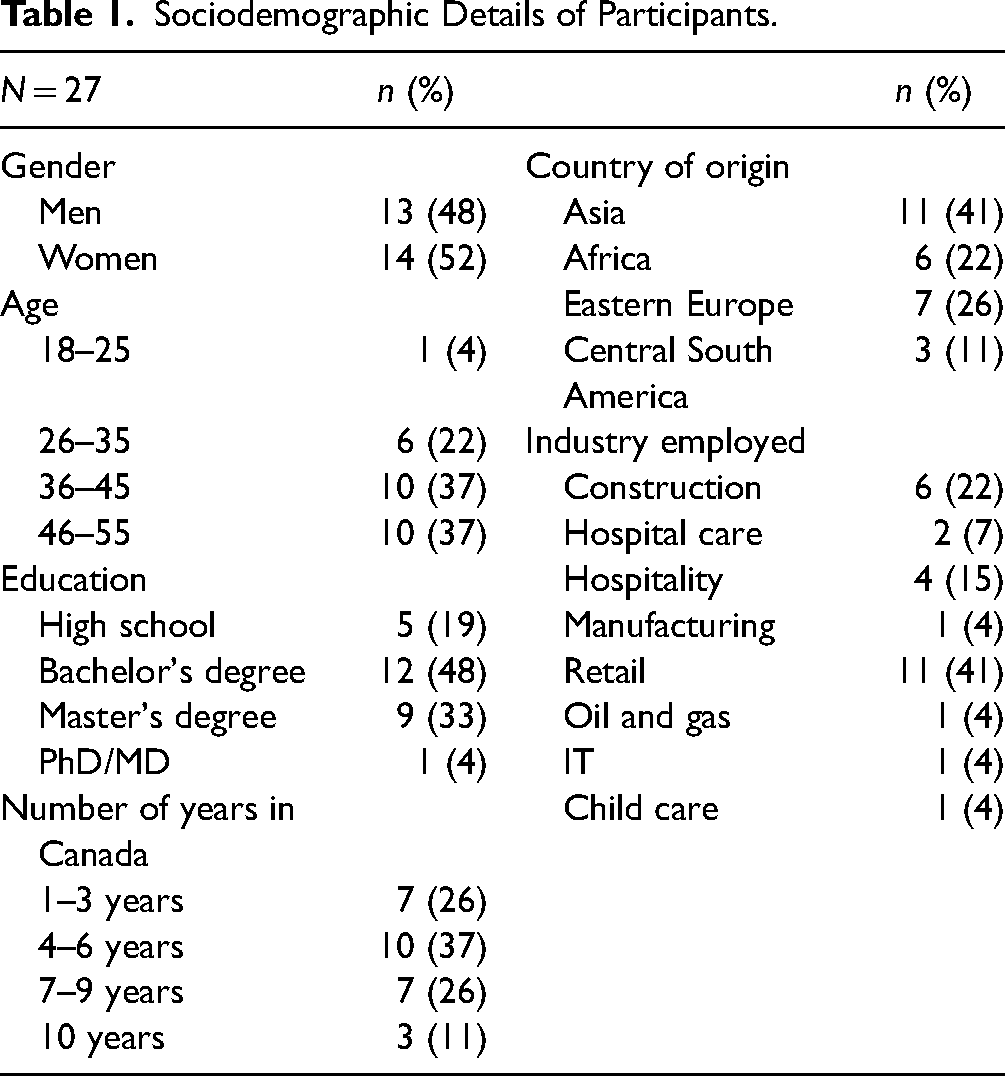
At the time of each interview, 18 out of 27 participants were employed. The majority had reported their injuries to supervisors. Three had chosen not to, citing fear of termination or uncertainty about the severity of their injuries, yet continued working. Sixteen participants received compensation from the WCB. Nearly all participants, except for 3, experienced disabilities that affected work capacity. Some had learned their jobs informally and received little to no formal OHS training. Understanding of OHS varied. Those working in sectors requiring safety certifications demonstrated greater OHS awareness. Participants identified several workplace hazards and structural conditions contributing to their injuries. These included repetitive tasks, work over-load due to staff shortages, lack of personal protective equipment, slippery conditions, hazardous driving environments, skipping breaks, fear of refusing unsafe work, and reluctance to request help. They also described engaging in practices, such as improper lifting when rushing and taking shortcuts to meet targets, which participants understood as responses to production pressures rather than individual errors that caused injury. Awareness of workplace rights was generally limited to injury reporting, and only 6 participants were union members (2 in retail, 1 in construction, 2 in healthcare, and 1 in the IT industry). There was no difference in the frequency with which the 6 union members reported behaviors as responsible for their injuries.
The analysis identified 4 interconnected themes that shaped participants’ experiences with work injuries and RTW challenges (see Figure 1). Themes 1 and 2—limited access to information about injury support and language/communication challenges—created significant the initial stage of reporting workplace injuries. These challenges often led to delays in accessing support, misunderstandings about rights and entitlements, and increased vulnerability in interactions with employers and service providers. Theme 3—the attitudes and reactions of employers and service providers—further shaped participants’ postinjury experiences. Employers’ and WCB providers’ responses influenced whether injured workers felt supported or discouraged from pursuing compensation and recovery resources. Negative or dismissive reactions compounded the difficulties caused by limited information and communication barriers, often leaving participants uncertain about their options and hesitant to assert their rights. These cumulative challenges directly affected Theme 4—poor RTW support. Factors identified from themes 1- 3 made it harder for participants to receive appropriate accommodations, financial assistance, and retraining opportunities. As a result, many faced pressure to return to work before fully recovering, struggled with inadequate support systems, and encountered long-term employment instability. Together, these themes illustrate how systemic barriers at each stage—reporting, seeking support, and returning to work—reinforce one another, creating a cycle of disadvantage for injured immigrant workers.
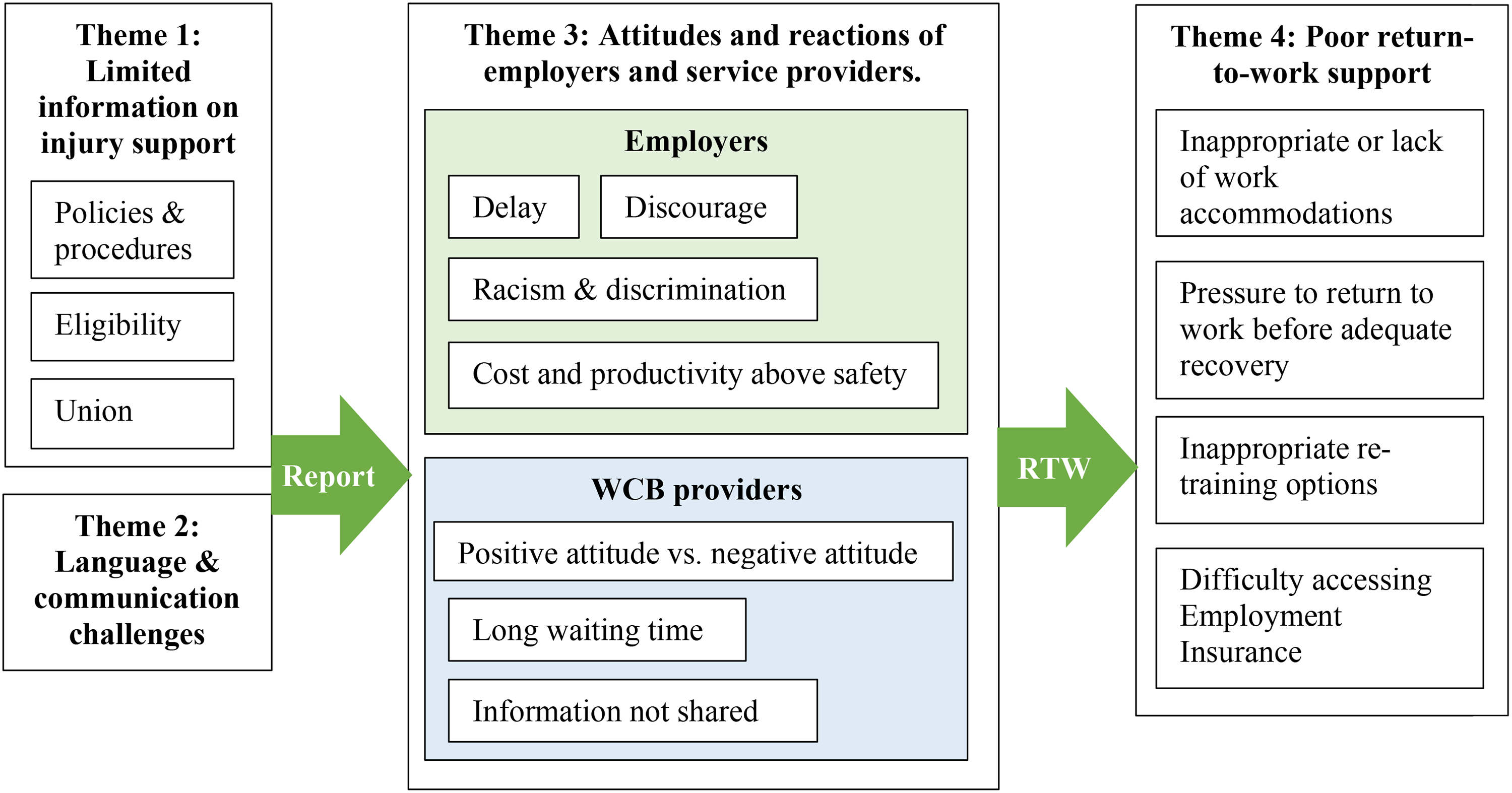
Work injuries and return-to-work experiences.
Theme 1. Limited Information About Injury Support
Lack of Information About Injury Reporting Policies and Procedures
All participants were aware that an injury must be reported to the supervisor. However, most participants were unaware of policies and procedures related to injury reporting and workers’ compensation. At the time of their injuries, many participants did not know that employers were responsible for filing the injury report or that eligibility for financial compensation and paid sick leave depended on submission of a report to the WCB. About 8 participants reported learning about workers’ compensation informally from injured colleagues. While the 6 union members were aware that workers’ compensation coverage existed, they were not fully aware of injury management policies or procedures at the time of injury, and only 3 union members knew that psychological stress resulting from harassment or bullying could be reported. Overall, approximately 80% of participants were unaware that psychological stress constituted a reportable workplace injury. This lack of information about workers’ compensation, combined with employers’ failure to inform workers of their eligibility for paid sick leave and fears of job loss, led some participants to continue working despite being in pain. Nobody told me about how WCB worked. For me, it was complete uncertainty about my future, my health, and my job. I could lose my job. It was why I returned to my job the next day. … I asked coworkers and friends… I want to emphasize the fact that new immigrants do not have enough information about government services. Nobody tells us about the help available. (P5)
Furthermore, in Alberta, employees qualify for sickness or injury leave after 90 days with the same employer.
28
If unpaid leave is provided, they can apply for Employment Insurance (EI) benefits
Theme 2. Language and Communication Challenges
Several participants highlighted language barriers that uniquely shaped their postinjury experiences beyond simple language proficiency. While they could speak and understand English, many struggled with contextual workplace language, making navigating employer expectations and WCB processes difficult. As P1 shared: “Yes, language is definitely a barrier for me. Sometimes I cannot explain properly what I want to say. So other people [employers and WCB providers] to whom I am trying to give a message treat me differently, negatively.” Notably, although WCB provides interpreters, none of the participants used this service, simply because they were unaware it existed. This points to a critical gap in communication about available resources, rather than just a lack of language fluency.
Beyond linguistic challenges, participants struggled with culturally appropriate assertive communication, which affected their interactions with employers, service providers, and healthcare professionals. Some blamed themselves for their perceived inability to communicate effectively, internalizing negative experiences as personal shortcomings rather than systemic issues. These barriers extended beyond workplace navigation to social isolation
Theme 3. Attitudes and Reactions of Employers and Service Providers
The reactions of employers and supervisors to injury reports significantly shaped participants’ experiences and decisions about seeking support. A positive response helped alleviate stress and encouraged recovery, while a negative response heightened distress and discouraged engagement with compensation or RTW processes.
Employers’ Response to Injuries
Of the 27 participants, 3 sustained injuries, but did not report them. Those participants who did report injuries shared that when injuries were visible—such as fractures, deep cuts, or burns—workers were more likely to receive referrals for treatment, assistance with WCB claims, and workplace accommodations. Eight participants, including 2 union members, reported that their supervisors responded with concern and took immediate action when an injury was reported. These participants expressed that their employers actively facilitated WCB applications by helping with forms or providing necessary documentation. Both union members worked for large corporations and successfully returned to work, though neither had approached their unions for support. Of the remaining 16 participants, 11 reported encountering indifference, blame, or even hostility from their supervisors. However, many participants encountered indifference, blame, or even hostility from their supervisors. When injuries were not outwardly visible or were perceived as minor, supervisors often dismissed concerns, displayed frustration, or suggested that participants were exaggerating. This lack of empathy not only reinforced self-doubt but also increased emotional distress, making participants feel they were being accused of malingering. Employers’ response was crucial in shaping workers’ sense of legitimacy and access to postinjury support. Based on participants’ reports, employers’ responses fell into 3 key patterns:
Delays in Reporting to the WCB—Some employers postponed reporting injuries and arranging medical care, often citing uncertainty about severity. P10, for example, waited 3 hours for medical help after a painful shoulder injury. Similarly, P15, a cook, received no support for a severe arm injury and was instead told to leave if she couldn’t continue working. Discouragement from Filing a WCB Claim—Many participants reported feeling pressured not to file a WCB claim. At least 8 participants shared that when they disclosed their injuries, managers attributed them to personal negligence or denied that they were work-related. Although personal negligence is not a valid basis for denying a workers’ compensation claim in Alberta, these workers were unaware of this at the time of reporting. In several accounts, this framing appeared to function as an intimidation tactic intended to deter claim filing. One participant, for example, received first aid and completed an accident report but was subsequently advised not to file a claim. Despite needing time to heal, he was denied leave and feared termination if he challenged his manager. Racism and Discrimination—7 participants reported racist remarks or discriminatory treatment after reporting their injuries. P4, who suffered a severe arm injury while working with hazardous machinery, shared that his supervisor questioned how such accidents happen to “people like him,” implying racial bias. Another participant (a union member) faced harassment by safety officers after reporting his injury but lacked support to file a complaint. Others (including one union member) reported that they risked being labelled as unreliable or unstable if they chose to file mental health claims: You can’t even tell them that you’re going for therapy, or you’re going to a counselor, or you have issues. You can’t do that because then you put a target on yourself. You’re considered unbalanced and unreliable. So, you don’t say these things, you just pretend that you are well. (P22-union member)
These employer responses illustrate how delays, discouragement, and discrimination intersect to create additional barriers for immigrant workers, particularly those with less visible injuries or precarious employment, further limiting their access to support and recovery resources.
Cost and Productivity Above Safety
Participants perceived that employers prioritized productivity and financial concerns over worker safety. Supervisors often focused on the legal and financial implications of injuries rather than employees’ well-being. P15 (a nonunion member) recalled being warned during orientation that management viewed injured workers negatively, emphasizing that workplace injuries cost the organization significant money in WCB payments. Such warnings, combined with rumors that reporting injuries could jeopardize future job prospects, discouraged at least 13 (including 5 union members) participants from disclosing some of their injuries, reinforcing a culture of fear and self-silencing. These experiences illustrate how financial priorities and implicit messaging shape workplace injury management, which deters workers from seeking necessary support.
Attitudes of WCB Service Providers
The WCB was the most common support agency accessed
Many participants experienced negative interactions with WCB case managers, which had a significant psychological toll. Some described a lack of empathy, feeling blamed for their injuries, or being pressured into accepting retraining options under the threat of losing benefits. P1 recalled feeling dismissed as if he was exaggerating his pain, while P5 recounted the distress of being told her WCB support would be discontinued if she rejected a retraining offer. She shared that she was “shocked and angry.” P5 was the only participant who challenged WCB's decision by filing an appeal. This highlights how difficult it was for others to navigate the system.
Participants also struggled with unclear communication when claims were denied or payments stopped. Seeking explanations often proved futile, leaving them uncertain about financial stability and RTW options. Many had to deal with multiple WCB service providers, leading to confusion and additional stress. Payment delays were another major concern. Benefits often arrived late or in unpredictable installments, forcing participants to follow up repeatedly. These financial disruptions intensified anxiety about job security and family support, adding another layer of vulnerability to their injury recovery.
Theme 4. Poor RTW Support
Eighty percent of the injured participants who filed workers’ compensation claims experienced difficulty returning to work. While some successfully resumed full-time positions, others, including 3 union members, continued working despite lingering disabilities, choosing not to disclose their limitations for fear of job loss. Several participants who had not returned to work faced layoffs, ongoing recovery challenges, or financial strain from the cost of therapy.
The inconsistency of employer and insurance support added to physical and emotional stress. Some participants felt ashamed about their injuries, while others feared getting hurt or sick again upon returning. Anxiety over job security and the adequacy of workplace accommodations further compounded their distress. Participants identified 4 key areas of inadequate RTW support.
Inappropriate or Lack of Work Accommodations
Thirteen participants (including 2 union members) reported inadequate or absent work accommodations upon returning from injury. Even when employers assigned modified duties, these were often not tailored to workers’ physical limitations, as workers were not consulted beforehand. Participants were unsure whether discussions regarding restrictions took place between their employer, doctor, and WCB case manager. One participant (a union member) who was assigned a role that aggravated his neck injury sought intervention from his WCB case manager but saw no changes. He reported that he was forced to resign, lost his employment benefits, and was advised to apply for EI (P10).
Some participants were unaware of their work restrictions upon returning. P4, for instance, was not informed that he had limitations on lifting and work hours. Instead, he was assigned full-time duties that led to reinjury and eventual layoff: They [the employer] again put me on the same machine. The full regular 12 hours. And then I had to lift as well. They [WCB] did not bother to tell me there are some restrictions because my arm is not strong to lift. … I was trying to do the same thing, the one I was used to do before the first one, and then it [machine] cut my arm again. (P4)
Fear of job loss further silenced participants from advocating for proper accommodations. Many accepted any tasks assigned, even when they caused pain, and hesitated to speak up due to language barriers and lack of confidence. Women participants, in particular, faced additional challenges due to their family caregiving responsibilities. P7, who was assigned full-time work with no modifications, described how unrelenting physical strain affected not just her well-being but also her family life: I was always moving around non stop. Not only my arms got tired, but I also felt constant back pain and pressure on my feet. … the working day lasted eight hours with one break, 30 minutes, and two breaks of 15 minutes each. When I came back home, I was so tired that I was not able to do anything. … I cried because of pain. My family was very sad because I was not able to take care of my husband, children, and kitchen. (P7) My physical health – Bad. It is a chronic condition. I have to use my hands every day. My physician prescribed painkillers and talked about surgical treatment. But surgery means long period of medical rehabilitation. I have two children; I have to work to support and care for them (P3).
Pressure to Return to Work Before Adequate Recovery
Some injured participants whose claims were accepted by the WCB expressed concerns that their case managers prioritized reducing compensation costs over supporting recovery and return to work. Although the WCB's mandate is to support injured workers, participants perceived that some case management practices functioned in ways that appeared more aligned with minimizing financial liability for the compensation system and, indirectly, employers. Participants felt pressured by the WCB to return to work before fully recovering from their injuries. Several experienced a recurrence of health issues due to being forced back to work too soon. One participant (P19) reported feeling harassed by his WCB case manager to return to full-time work and had to endure pain for 25 days before being permitted to work reduced hours. Like several others, he felt controlled by his case manager, who could terminate his payments, including medical, rehabilitation, and retraining support, which are crucial for a successful return to work.
Inappropriate Re-Training Options
Few participants knew that WCB offered on-the-job training, short-term skill development programs, or wage top-ups during job transitions. 22 Only 2 had received retraining, but both described feeling pressured and disregarded by their case managers, who made career decisions without considering their physical limitations or labor market realities.
One participant (P4), laid off after an arm injury, was placed in a one-week hospital security guard training program, which did not lead to employment. His case manager then advised him to apply for EI. Another participant, a foreign-trained healthcare professional (P5), was offered retraining for a job that required extensive typing, despite her physical limitations. When she refused, her case manager threatened to cut off her benefits and close her file, causing significant distress as she was already struggling to find work in her trained field.
These findings demonstrate a disconnect between WCB retraining programs and injured workers’ actual needs, with case managers prioritizing quick job placements over sustainable employment solutions.
Difficulty Accessing EI
After being laid off, participants struggled to access EI benefits, facing confusion over eligibility criteria and difficulty obtaining clear information. EI is a Government of Canada program that provides temporary income support to unemployed workers or those laid off while they search for employment or upgrade their skills. 29 Many assumed they would qualify for financial assistance, only to learn, often in urgent need, that they did not meet the required 600 insured hours. 29 This realization caused significant distress, particularly for those already navigating the challenges of workplace injury and job loss. The lack of accessible guidance and transparency around EI eligibility left some participants feeling abandoned at a critical time, compounding their financial and emotional strain.
Discussion
This study examines immigrants’ experience with workplace injuries and the challenges they face when returning to work. It reveals 4 key themes: limited access to information about injury support, language and communication barriers, negative attitudes from employers and service providers, and inadequate support for returning to work. These findings underscore systemic barriers that extend beyond individual experiences, influencing participants’ ability to recover and reintegrate into the work force. While previous research connects educational over-qualification among immigrants to a heightened risk of workplace injury,
13
this study shows that a mismatch between immigrants’ education, training, and work experience and the jobs they are assigned can also lead to poor RTW outcomes due to a lack of support from employers and from the WCB. Such a mismatch, which often takes the form of educational over-qualification in our participants’ cases, is frequently associated with implicit discrimination in which employers under-value the qualifications of immigrant workers, especially when their qualifications originate from developing countries.30–31 This devaluation of education not only hinders career advancement but also elevates the risk of both physical and psychological distress. Participants’ experiences indicate that employers and WCB case managers often over-looked their previous qualifications and work experience when assigning modified duties or retraining options
Participants described challenging interactions with employers and insurance providers, including insufficient modified duties and limited RTW support. While these experiences are similar to difficulties faced by native-born injured workers,32–37 the findings underscore how systemic power imbalances specifically affect immigrant workers, increasing their vulnerability in the workplace. Research indicates that interactions between injured employees and system actors, such as employers and insurance providers, are often adversarial, marked by distrust, skepticism about the legitimacy of injuries, and structural barriers to fair treatment. Negative attitudes from employers, often based on stereotypes that injured workers exploit the system, further discourage injured employees from asserting their rights, ultimately hindering their recovery and job security. 38 Recent work further situates our findings within the broader context of precarity and social vulnerability. For example, Premji et al. (2025) document that employer claim suppression undermines access to compensation among precariously employed immigrant workers. Their findings identify similar systemic barriers and show that difficulties navigating RTW and compensation extend across various vulnerable groups, which is consistent with the experiences reported by participants in the present study. 39 These findings highlight the need for systemic reforms to combat biases from employers and insurance providers, ensuring equitable support for injured workers navigating the compensation system. Such reforms are discussed in detail below.
Although recently injured immigrants and native-born workers may face similar challenges with employers and insurance providers, the additional layers of stigma and discrimination uniquely influence the postinjury experiences of immigrants. Findings indicate that these extra barriers—often rooted in racial biases and stereotypes that portray immigrant workers as accident-prone 40 —amplify the effects of workplace injuries. Emerging evidence shows that linguistically and racially marginalized immigrant employees, even those with high levels of education, encounter more difficulties securing employment after injury compared to their native-born counterparts. Consequently, they are more likely to experience prolonged unemployment and greater dependence on benefits, even after medical recovery.13,40 In addition, our findings point to the broader psychosocial environment that shapes management of injuries. Several participants described workplace cultures that appeared to discourage reporting, whether through subtle pressures, lack of support, or fear of negative repercussions. These cultures, combined with cost-containment priorities, created additional barriers to reporting and recovery. It is important to address not only formal policies but also the psychosocial and organizational environments that influence the ways injured workers navigate the system.
The findings underscore the critical role that language and communication barriers play in shaping workers’ compensation experiences. These barriers not only complicate participants’ ability to navigate claims processes but also exacerbate negative interactions with employers and insurance providers. Research indicates that injured workers facing language barriers often experience poorer WCB outcomes, as difficulties in completing forms, understanding correspondence, following procedures, and meeting deadlines create additional obstacles to securing support.10,41 For educationally over-qualified immigrants, limited English proficiency may be misinterpreted as a lack of competence, further marginalizing them in the workplace and compensation systems 42 For less-educated workers it may hinder communication around safety, tasks, injury, illness and return to work. Although participants frequently internalized their language challenges as personal shortcomings, the findings also highlight the systemic nature of these barriers—as participants described communication failures arising from WCB officers who did not provide complete information or failed to offer interpretation services that are legally available. Prior research similarly shows that clear, respectful, and coordinated communication among compensation and RTW stakeholders can improve workers’ mental health and facilitate RTW.43–45 This reinforces the urgent need for industry and WCB reforms to enhance accessibility and communication support for immigrant workers. In addition, research on precariously employed and vulnerable workers has shown that many WCB and RTW barriers are not unique to immigrants but reflect systemic challenges in compensation systems that affect a broad range of workers.46–47 These findings point to the need for WCB reforms that strengthen transparency, improve communication and process support, and ensure fair treatment for all workers navigating recovery and RTW. Furthermore, social support has been consistently identified as a critical facilitator of successful return to work, with evidence showing that supportive relationships with supervisors, coworkers, family members, and unions enhance worker confidence, motivation, and engagement in recovery and reintegration processes. Consistent with the systematic review by White et al., 48 our findings suggest that limited workplace support and poor social integration may compound structural barriers to RTW, whereas timely, affirming, and coordinated social support can mitigate the negative impacts of injury and institutional constraints on RTW outcomes.
While previous research suggests that linguistic minority employees are more likely to file workers’ compensation claims than their Canadian-born counterparts, 10 current findings reveal a more nuanced reality—many immigrant workers hesitate to report injuries unless they are severe and visibly apparent. This reluctance stems from fears of job loss, damage to their credibility with employers, and concerns that engaging with the WCB could jeopardize future employment opportunities. Although Canadian-born workers may share similar reservations, this reluctance appears to be more pronounced among recent immigrants. Contributing factors include limited social networks that could facilitate alternative employment, heightened financial insecurity, and limited awareness of government supports such as EI benefits available following job loss. For women in particular, the inability to meet both paid and unpaid work responsibilities added a significant layer of strain to their postinjury experiences (e.g., P3's and P7's experiences described above). The pressure to balance household and care-giving roles with recovery and re-entry into the labor market amplified feelings of distress and vulnerability. In addition, P3's account highlights a significant gap in care. Despite living with a function-limiting hand condition, she was directed toward pain medication and surgery without being informed about conservative options such as rehabilitation, which are often recommended specifically to avoid long recovery periods. Evidence indicates that digital rehabilitation programs can reduce pain and improve function in hand and wrist conditions, 49 making them especially relevant for care-givers who cannot afford extended down time. Regardless of whether gender or immigrant status influenced her care, the lack of information about these alternatives limited her ability to make an informed decision and intensified her negative experience with the healthcare system.
Additionally, findings indicate that employers may take advantage of new immigrants’ precarious social and financial status and their limited understanding of injury reporting policies and compensation rights. This exploitation is particularly concerning in workplaces with an increasing number of low-status jobs and weakened labor unions, where immigrant workers often lack collective representation and protection against employer retaliation. 50
Our findings should also be interpreted in the context of the industries and occupational settings where many immigrants with an education-to-job mismatch are employed. Prior research demonstrates a graded increase in injury risk across mixed and manual occupations compared with nonmanual occupations.13,51 These industries are often characterized by physically demanding work, repetitive tasks, and higher exposure to occupational hazards. As a result, over-educated immigrants, particularly those new to the country, may be concentrated in sectors that are inherently hazardous, compounding the risks associated with unfamiliarity with workplace culture, lack of training, and limited experience with manual work. This sectoral concentration likely contributes to the elevated injury rates observed.
Implications and Policy Recommendations
The findings highlight systemic barriers in preventing workplace injuries and providing RTW support for educated immigrants in Alberta, which have broader policy implications. The underutilization of educated immigrants not only limits their earnings but also reduces Canada's economic potential due to lost productivity and tax revenue.
52
Addressing these challenges requires Alberta-specific policy interventions, enhanced employer accountability, and targeted support for immigrant workers.
Strengthen workplace injury prevention and OHS training for immigrants
Despite Alberta's mandatory OHS regulations, many immigrant workers lack awareness of their rights, injury reporting procedures, and postinjury support options. 53 However, current workplace safety training in Alberta often emphasizes technical skills while neglecting the systemic barriers that hinder immigrant workers from accessing compensation and RTW accommodations.
Policy Recommendations:
Mandate sector-specific OHS training for new immigrants before or shortly after employment, particularly in high-risk industries such as construction, manufacturing, and hospitality. While OHS training should be accessible to all workers, targeted and early delivery for newly arrived immigrants is warranted, given their disproportionate exposure to hazardous work, greater likelihood of being unfamiliar with Canadian OHS standards, and heightened vulnerability related to language barriers, employment precarity, and limited access to informal workplace knowledge. Provide government-funded OHS workshops through immigrant-serving organizations and unions
2. Increase employer accountability and reduce workplace discrimination
Educationally over-qualified immigrants face additional layers of discrimination, including biases about their abilities, job suitability, and the value placed on their prior qualifications. While employers, including small and medium-sized businesses, are required to comply with regulations that prohibit discriminatory or harassing practices, participants’ experiences suggest that accountability mechanisms are often weak in practice. Unions have an important role to play in strengthening accountability by proactively educating members about their rights, injury reporting and management processes, advocating for safe and inclusive workplaces, and supporting workers to challenge bullying, discrimination, and failures to accommodate injured workers—actions that are essential for improving RTW outcomes.
Policy Recommendations:
Governments should support partnerships between immigrant-serving organizations and employers to deliver evidence-informed education on fair treatment, legal obligations, and common misconceptions about immigrant workers. While some immigrant-serving organizations currently provide worker-focused education, structured employer-facing initiatives remain limited. Provincial and federal governments could act as conveners and funders by facilitating voluntary partnerships, offering incentives for employer participation, and integrating this training into existing occupational health, safety, and employment standards frameworks. Education for workers should continue to be delivered by immigrant-serving organizations with expertise in Canadian workplace rights and culture, while employer education could be offered through a combination of publicly funded programs and sector-based initiatives, rather than by mandating that individual employers contract directly with service providers. Strengthen enforcement of existing occupational health and employment standards in Alberta by increasing both the certainty and impact of penalties for employers who violate safety regulations, fail to provide reasonable accommodations, or wrongfully terminate injured workers. While penalties already exist, evidence suggests that their deterrent effect is limited due less to severity than to inconsistent enforcement and a low likelihood of inspection or sanction.54–55 To improve policy effectiveness, additional resources should be allocated to proactive inspections, timely investigations, and follow-up enforcement—particularly in high-risk and precarious employment sectors—so that penalties are applied consistently and function as a credible deterrent rather than a symbolic measure.
3. Improve RTW coordination and support in Alberta
To improve RTW outcomes, employers should designate trained supervisors or HR managers to oversee the reintegration of injured immigrant employees. These supervisors should work alongside employees to make workplace accommodations decisions, ensuring that modified duties align with their skills, qualifications, and physical capabilities.
Policy Recommendations:
Require structured RTW plans for injured workers, coordinated by trained personnel with input from the employee. Ensure that WCB and employers actively consider previous qualifications and experience when assigning modified duties or retraining options. This requires clearer policy guidance, accountability mechanisms, and training for case managers and employers to prevent default placement into work that does not require advanced education. Transparent documentation of how prior skills are assessed and used in RTW planning would further support equitable decision-making.
Limitations
This study has several limitations. First, the sample was drawn from 2 major cities in Alberta, limiting the findings’ generalizability to other provinces or rural areas with different labor market conditions and workplace injury policies. Second, the study focused exclusively on permanent immigrants, excluding temporary foreign workers and undocumented workers, who may face even greater precarity in their workplace injury experiences and RTW challenges. Third, participants reported their own experiences, which may be influenced by recall bias or reluctance to disclose certain details due to fears of employer retaliation. Participants did not always provide details about the nature of their injuries (e.g., acute vs. chronic, visible vs. nonvisible) or the specifics of retraining or resources offered (e.g., whether intended to support return to the same job/tasks or transition to new roles). This lack of detail restricts our ability to compare experiences across injury types or to fully interpret the implications of retraining pathways. Fourth, participation required sufficient English proficiency to complete an interview, which may have excluded workers facing the most significant language barriers and potentially under-represented experiences of navigating workplace injury and RTW processes under conditions of limited linguistic access. Although data were collected between 2018 and 2020 and publication was delayed by 3 years due to the COVID-19 pandemic, the findings remain relevant because the structural, institutional, and regulatory conditions shaping workplace injury reporting and RTW processes in this context have not substantially changed. Finally, while the study highlights systemic barriers in workers’ compensation and RTW processes, future research should explore longitudinal outcomes to assess how immigrant workers navigate these challenges over time and whether policy interventions improve their employment stability postinjury. It would also be valuable to compare the experiences of different groups of injured workers (e.g., educationally over-qualified vs. nonoverqualified immigrants within the same sector and location), and to examine potential gender differences in navigating injury and compensation systems.
Conclusion
Few studies have explored the workplace injury experiences of professionally qualified immigrants in survival or high-risk jobs. This study highlights the need for stronger policy measures and greater employer accountability to improve RTW outcomes for immigrant workers. While many of the barriers identified are also experienced by other precariously employed workers, this study underscores how these challenges intersect with educational over-qualification and immigrant status to compound disadvantage. Particularly, the challenges faced by educationally over-qualified immigrants underscore that if workers with high levels of literacy and specialization struggle to navigate the system, those with fewer educational resources may face even greater barriers. Enhancing OHS education and increasing awareness of workers’ compensation is vital to ensure that educated immigrants receive tailored support to recover and reintegrate into the work force. Given the economic potential of educated immigrants, investing in proactive injury prevention and fair RTW policies and practices benefits both the workers and the broader labor market. While this study focused on immigrants in Alberta, its findings hold national and international significance, offering insights into how labor policies can better support immigrant workers in precarious employment.
Footnotes
Acknowledgments
The authors wish to acknowledge the support of our community partners: Alberta Workers Health Centre, Edmonton; Workers Resource Center, Calgary; Edmonton Mennonite Center for Newcomers, Edmonton; Immigrant Services, Calgary; Bow Valley's College, Calgary; Catholic Social Services, Edmonton; Gateway Association, Edmonton; and Alberta Association of Immigrant Serving Agencies. They also wish to thank all the study participants for sharing their experiences.
Declaration of Conflicting Interests
The authors declared no potential conflicts of interest with respect to the research, authorship, and/or publication of this article.
Funding
The authors disclosed receipt of the following financial support for the research, authorship, and/or publication of this article: This study was funded by an Insight Grant from the Social Sciences and Humanities Research Council, Canada (Award: 435-2016-0727).
