




Abstract
In Canada, occupational health and safety (OHS) and workers’ compensation are primarily provincial responsibilities and there is no national institute for OHS research. Research capacity and many civil society resources to which injured workers can turn for support are primarily concentrated in three provinces. Labor force composition, employment options, vulnerability to injury, and return to work (RTW) challenges vary across jurisdictions and are changing over time, but not at the same rate. When coupled with jurisdictional inequities in RTW research and civil society supports, these differences have the potential to contribute to policy gaps and situations where issues addressed in one jurisdiction emerge again in another. This article reports on a multi-stakeholder, virtual dialogue process designed to help identify and address these potential inequities by transferring research insights related to RTW for workers in situations of vulnerability (e.g., precarious employment) and findings from a comparative policy scan to Newfoundland and Labrador (NL), a province with very limited RTW research capacity and civil society supports for injured workers. We describe the context, the dialogue process, key results from the policy scan, and we reflect on the opportunities and constraints of these knowledge synthesis and exchange tools as vehicles to address jurisdictional disparities in RTW research, policy and supports for workers injured in precarious employment and other vulnerable situations in a context of economic and policy change.
Keywords
Introduction
There is no national agency in Canada with the mandate to develop, implement, and enforce workers’ compensation or occupational health and safety (OHS) laws and policies and no national agency responsible for OHS research. When coupled with regional differences in employment types and labor force composition and access to civil society organizational support for injured workers, the result is both potential disparities in supports for injured workers and in outcomes for injured workers, including related to return to work (RTW), and includes the possibility that issues identified and addressed in one jurisdiction will emerge again undetected and unaddressed in another. With a focus on the Canadian province of Newfoundland and Labrador (NL), this article reports on a recent initiative designed to highlight these potential issues and through knowledge synthesis, exchange and dialogue, to try to kickstart a multi-stakeholder discussion about ways to address them. The article first describes the Canadian context and the particular situation in NL within which this dialogue initiative unfolded. The remainder of this article draws on the findings from an environmental scan of RTW policies and practices in four provinces compared to NL and the perspectives shared by stakeholders during the discussion to reflect on some of the challenges with RTW in NL, the policy-related insights arising from the Dialogue, and related recommendations for future work. In the conclusion, we consider the opportunities and constraints for using this relatively low-cost approach to knowledge transfer and synthesis to help address regional disparities in RTW knowledge and research, encourage evidence-informed policy-making in low resource jurisdictions, and discuss what else would be needed to document and help improve the RTW process and outcomes for injured workers in NL.
In Canada, responsibility for both OHS and workers’ compensation falls under the authority of the 14 individual Canadian jurisdictions (10 provincial, 3 territorial, and 1 federal), each with their own legislative and policy framework that sets out the scope of coverage, benefits, assessments and premiums, occupational disease presumptions, general rights and duties of the workplace parties, specific requirements for ensuring a healthy and safe workplace, etc.1,2 Federal labor law (which applies only to the approximately 1.4 million workers in the federal government, federal corporations, and federally-regulated industries) does not supersede provincial law in Canada.3–5
Provinces with limited resources tend to copy other provinces when updating or changing their policies and regulations, but jurisdictional differences still exist in the OHS regulatory requirements, the industries and occupations covered by legislation, the benefits to which injured workers are entitled, and associated policies and practices.5–9 There are also regional disparities in research investment and knowledge transfer capacity, 10 and most of the existing capacity is concentrated in a few provinces (e.g., British Columbia, Ontario, and Quebec). Small provinces, such as those in Atlantic Canada, do not invest in research as extensively as larger provinces and often lack the capacity to synthesize the research literature and transfer it to key stakeholders. This is true in NL, a province in which RTW is very under-researched.
Unions and injured workers also face jurisdictional inequities in accessing the services of civil society organizations such as occupational health clinics, injured worker associations, and community legal supports. Where they exist, these organizations not only provide essential support for RTW efforts, but also identify and push for change to policies and practices that interfere with positive RTW outcomes. Jurisdictional inequities exist across Canada as many of these supports are concentrated in only a few provinces (e.g., Ontario and Quebec). Ontario, for example, has a very active injured worker organization a , as well as occupational health and legal clinics b that injured workers can access to help support their compensation claims and RTW process. These injured worker groups have a history of collaborating with researchers and mobilizing for policy changes. Ontario and Quebec also have a network of unions and other civil society organizations that work with precariously employed workers (e.g., international migrant workers who confront multiple layers of vulnerability 11 ) to identify and address the issues they face, including those related to OHS and RTW. c
RTW is complex and challenging everywhere. As illustrated by this special issue and below, there is a growing body of research highlighting both the potential challenges with RTW in general and the high injury rates and particular RTW challenges for workers in precarious employment and who experience other kinds of vulnerabilities such as employment in small and medium-sized organizations, mobile work, seasonal employment and who are socially vulnerable due to, for example, gender, being racialized and with precarious immigration status.12–51 RTW may also be particularly challenging in jurisdictions like NL, where multiple characteristics of its business environment and labor force have implications for the effectiveness of RTW policies and practices. This raises the question of how to promote awareness in NL of these documented challenges, encourage reflection on how to address them in policy and practice and, ultimately, how to promote positive change.
The knowledge synthesis and exchange project entitled the Newfoundland and Labrador Dialogue on RTW (the “Dialogue”) discussed below sought to support the transfer to NL of key findings from RTW research done elsewhere in Canada, to compare RTW policies and regulations in other provinces with those in NL, and to encourage dialogue between researchers, employer representatives, labor and representatives from WorkplaceNL
The Dialogue was organized by a committee of labor representatives and researchers. It was a virtual, multi-phased consultation held in the fall of 2022 and the winter and spring of 2023
The four principal goals and objectives of the Dialogue were to:
transfer to NL key findings from recent and ongoing research on RTW being carried out in other parts of Canada; reflect on the potential relevance of these findings for our understanding and approach to RTW in NL; create an opportunity for multi-stakeholder commentary on findings from an environmental scan of policy and practices related to RTW in NL and selected Canadian provinces; and, facilitate a discussion of overall insights from the Dialogue and future research priorities on RTW in NL.
The remainder of this article draws on the findings of an environmental scan of RTW policies and practices in four provinces compared to NL and the perspectives shared by stakeholders during the discussion to reflect on the policy-related insights. In the conclusion, we consider the opportunities and constraints for using this relatively low-cost approach to knowledge transfer and synthesis to help address regional disparities in RTW knowledge and research, encourage evidence-informed policy-making in low-resource jurisdictions, and discuss what else would be needed to actually improve the RTW process and outcomes for injured workers in NL.
The Legislative and Policy Context for RTW in Canada
In Canada, provisions governing RTW are principally found in three legal frameworks: workers’ compensation, OHS, and human rights. Some jurisdictions also have provisions in legislation or policy that protect temporary foreign workers (TFWs) that have implications for RTW.
Workers’ Compensation
In Canada, each province and territory has its own workers’ compensation statute. Workers covered by federal workers’ compensation services, including federal employees and certain merchant seafarers, are entitled to receive compensation benefits at the same rates and under the same conditions as provincially or territorially regulated workers working in the same jurisdiction.53–55
Occupational Health and Safety
In Canada, OHS laws are based on the internal responsibility system (IRS), the philosophy that all workplace parties share direct responsibility for ensuring a safe and healthy work site. One of the core features of an IRS is that responsibilities increase with increasing authority and control. As a consequence, employers typically have the most responsibilities. The specific workplace parties deemed to have a role are reflected in the general duty clauses of the OHS statutes and regulations, which vary across the 14 federal, provincial, and territorial jurisdictions.
Human Rights
In Canada, human rights are protected under the Constitution and by federal, provincial, and territorial legislation. 56 The rights afforded under this legislation are consistent with those set out in international and multilateral treaties to which Canada is a part. 57 Under these laws, physical and/or mental disability/handicap is a prohibited grounds of discrimination. Employers and other workplace parties (including employment agencies) are prohibited from discriminating on the basis of disability and prohibited actions include the refusal to employ, the refusal to continue to employ, harassment, and other forms of discrimination.
Temporary Foreign Workers
In Canada, the rights of all workers, including TFWs, are protected by law, and TFWs have the same rights and protections as Canadians and permanent residents. 58 This means that employers of TFWs are required to provide a safe workplace under existing labor laws. In addition, the Federal Government and some provinces (e.g., British Columbia, Saskatchewan, Quebec, and Prince Edward Island) have enacted legislation that imposes specific duties and obligations on recruiters and employers of TFWs. Failure to comply with applicable labor legislation is grounds for refusal of the employer's certificate of registration which is required to recruit foreign nationals for employment.
The RTW Context in Newfoundland and Labrador
Like all provinces and territories in Canada, RTW programs in NL are delivered by the provincial workers’ compensation authority. WorkplaceNL, which serves approximately 220,000 workers and 17,500 employers, is mandated by provincial legislation to facilitate recovery, as well as ESRTW, of injured workers. 59 To achieve this mandate, it delivers ESRTW and labor market re-entry programs to injured workers.
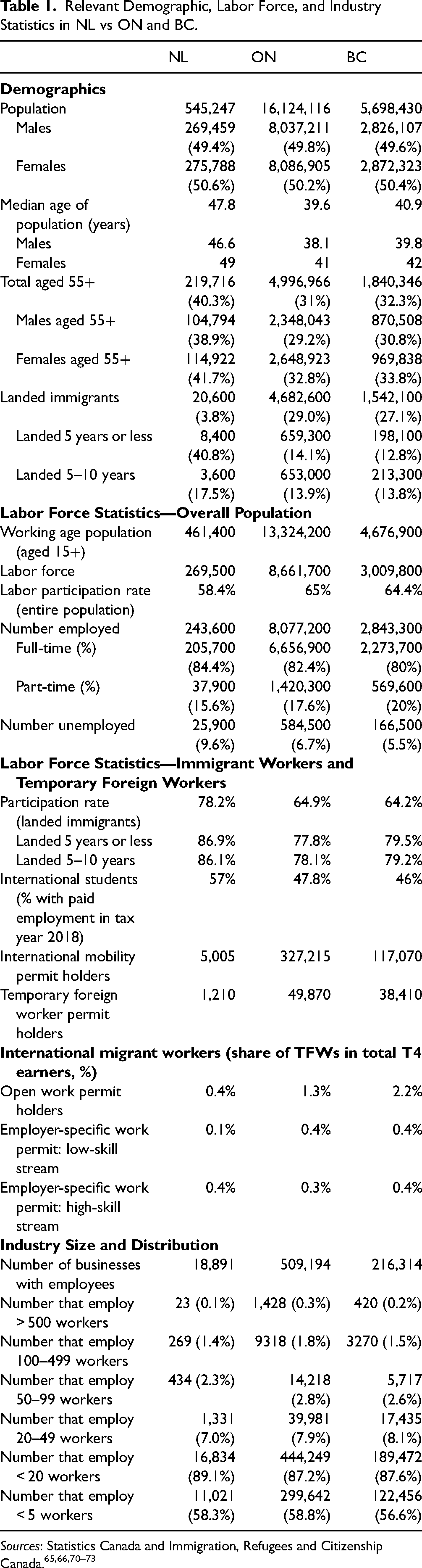
Although there is little RTW research in the province, RTW is likely complex and challenging for many workers in situations of vulnerability in NL. As indicated in Table 1, NL has an older population than is found in other Canadian provinces like Ontario and BC. Small and medium-sized enterprises are common: of the 18,891 NL businesses with employees in June 2024, 89.1% employed fewer than 20 workers, and 58.3% employed fewer than five workers. 60 Like other provinces in Atlantic Canada, NL has historically exported labor, including interjurisdictional employees (i.e., temporary labor migrants who are resident in the province but working elsewhere). The labor force share of interjurisdictional employees in NL has varied over time and across regions but, at peak times and in some regions, has been as high as 20.61,62 The number of recent landed immigrants in NL is increasing; these landed immigrants generally have high labor force participation rates. In addition, there are large numbers of international students with work permits and the numbers of temporary international migrants recruited through the Temporary Foreign Worker and International Mobility Programs have increased in recent years with their share of workers with T4s e beginning to approximate those in Ontario and BC.63–66 The number of International Mobility Permit holders in NL increased from 1,680 in 2017 to 5,005 in 2023. 66 Although the number of Temporary Foreign Worker Permit holders in NL has fluctuated over the last decade, there has also been an overall increase in permit holders from 705 in 2015 to 1,210 in 2023. 65 Employers in some key sectors traditionally dominated by NL-born workers are now relying on these workers to fill labor shortages.63,67 For instance, in 2022, the highest number of TFW Program work permits in NL were held by fish and seafood plant workers and laborers in fish and seafood processing.68,69 Seafood processing work is generally highly seasonal and precarious and is located largely in rural and remote areas with limited alternative employment options. As indicated above, research has shown that there are important RTW challenges across each of these groups.
Relevant Demographic, Labor Force, and Industry Statistics in NL vs ON and BC.
Other challenges include a lack of systematic and publicly available surveillance of RTW outcomes in NL that might inform policy development and limited organizational support for injured workers in NL who encounter RTW challenges. In contrast to some other provinces, organizational support for injured workers in NL is largely limited to whatever is available through WorkplaceNL, the supports provided by a small number of worker advisors housed at the NL Federation of Labour with funding from WorkplaceNL, access to the NL Human Rights Commission if they wish to file a discrimination complaint, and potential union support for those that are unionized.
A key contribution of the Dialogue was an environmental scan comparing RTW legislation and policy across key jurisdictions which formed the basis for discussions with key stakeholders. The sections below summarize the results of that policy scan, as well as some stakeholder insights related to how RTW actually operates in NL's policy and practice environment. We also provide a summary description of the recommendations arising from the Dialogue and discuss strengths and weaknesses of this kind of change initiative.
Interjurisdictional Law and Policy Comparison
The objective of the environmental scan was to identify the legislation and policy-related factors that might influence RTW and its outcomes for diverse groups of injured workers, to compare those factors across jurisdictions, and to present these findings to NL stakeholders for discussion. While all workers’ compensation authorities in Canada incorporate an RTW and/or vocational rehabilitation model into their legal framework to minimize the impacts of work-related injury or disease, not all enshrine the concept of “early RTW before full recovery” or “early and safe RTW” into their legislation and policies. Because the concept of “early and safe” is one of the core principles that underpin the legal framework for RTW in NL, the scan compared what is done in NL with Ontario (ON) and British Columbia (BC), the only two other provinces scanned in the project that had requirements for “early and safe” RTW. At the time of the scan, ON had the most established suite of policies; NL had relatively recently introduced a new suite of policies; BC was in the process of developing policy language to support and interpret legislative amendments that were to become effective January 1, 2024.
Relevant legislation and regulations were first examined in detail to identify any provisions related to RTW. Downstream policy and administrative practice documents were then reviewed to determine how the five systems have operationalized RTW under their statutory duty to serve injured workers and their employers. Information was then summarized in a series of tables that compared specific aspects of the RTW process. f The scan did not include a comparison of the type of compensation paid (e.g., wage loss, functional impairment, etc.), the types of benefits payable (e.g., lump sum payments, disability awards, etc.), or other procedural issues (e.g., early acceptance, waiting periods, the measurement of earnings’ loss, the establishment of compensation rates, treatment approaches, etc.). At the time of the scan, NL had the greatest number of policies interpreting the legislative provisions on RTW (n = 19) and administrative documents explaining the procedures for RTW (n = 14). Since the completion of the Dialogue, these have been reduced to 14 policies and 12 procedures.
Results of the scan were presented in the third session of the Dialogue after the presentation and discussion of research insights from elsewhere on what works in RTW and on RTW challenges associated with particular situations and groups associated with greater vulnerabilities. The presentation was framed around five key questions:
How is early and safe RTW defined in legislation and policy? What are the roles of the various parties in the RTW process? What are their obligations? To whom do the legislation and policy apply? To whom do they not apply? What are the penalties if the workplace parties do not comply with their obligations? What happens if there is a dispute between the workplace parties?
Prior to the session, key stakeholders who had been asked to launch the discussion were provided with a backgrounder that synthesized relevant findings from the environmental scan.
Definition of Early and Safe RTW
None of the jurisdictions provided a formal definition in legislation or in downstream policy instruments of what is meant by “early and safe” in the context of RTW. NL was the only jurisdiction with a policy that articulated that the goal of ESRTW is to “safely return the worker to employment or employability that is comparable to the pre-injury level as soon as possible” and provided examples of what ESRTW could involve (e.g., modified work, ease back to regular work, transfer to an alternate job or trial work to assess the worker's capability).74,75
Roles and Obligations of the Parties in the RTW Process
The roles of the various workplace parties in the RTW process (i.e., the worker, the employer, the workers’ compensation authority, and the health care provider) were addressed in either legislation and/or policy. No jurisdiction explicitly addressed the role of the supervisor in the ESRTW process or in RTW more generally.
The legislation in all three jurisdictions imposes a duty on both the worker and the employer to co-operate in ESRTW, an obligation on the employer to re-employ an injured worker, and a duty on the employer to accommodate the work or the workplace for the injured worker. In addition, it authorizes the workers’ compensation authority to resolve disputes and to levy penalties. NL was the only province that set out in policy the role of the health care provider in the ESRTW process. The other two have supplemental resources on their websites that describe the healthcare provider's specific roles in the RTW process. Under the NL policy, the health care provider is responsible for providing the workplace parties and WorkplaceNL with functional abilities information, providing the worker and WorkplaceNL with medical information, identifying the most appropriate method of treatment for the injury, ensuring the worker receives timely treatment, and ensuring RTW is discussed throughout recovery. 76
The statutory duties and obligations imposed on the workplace parties are similar across the jurisdictions; however, as shown in Table 2, there are subtle differences in how the specific provisions are worded and in how the legislation is interpreted by policy.
RTW Duties and Obligations Imposed on the Workplace Parties in NL vs ON and BC.
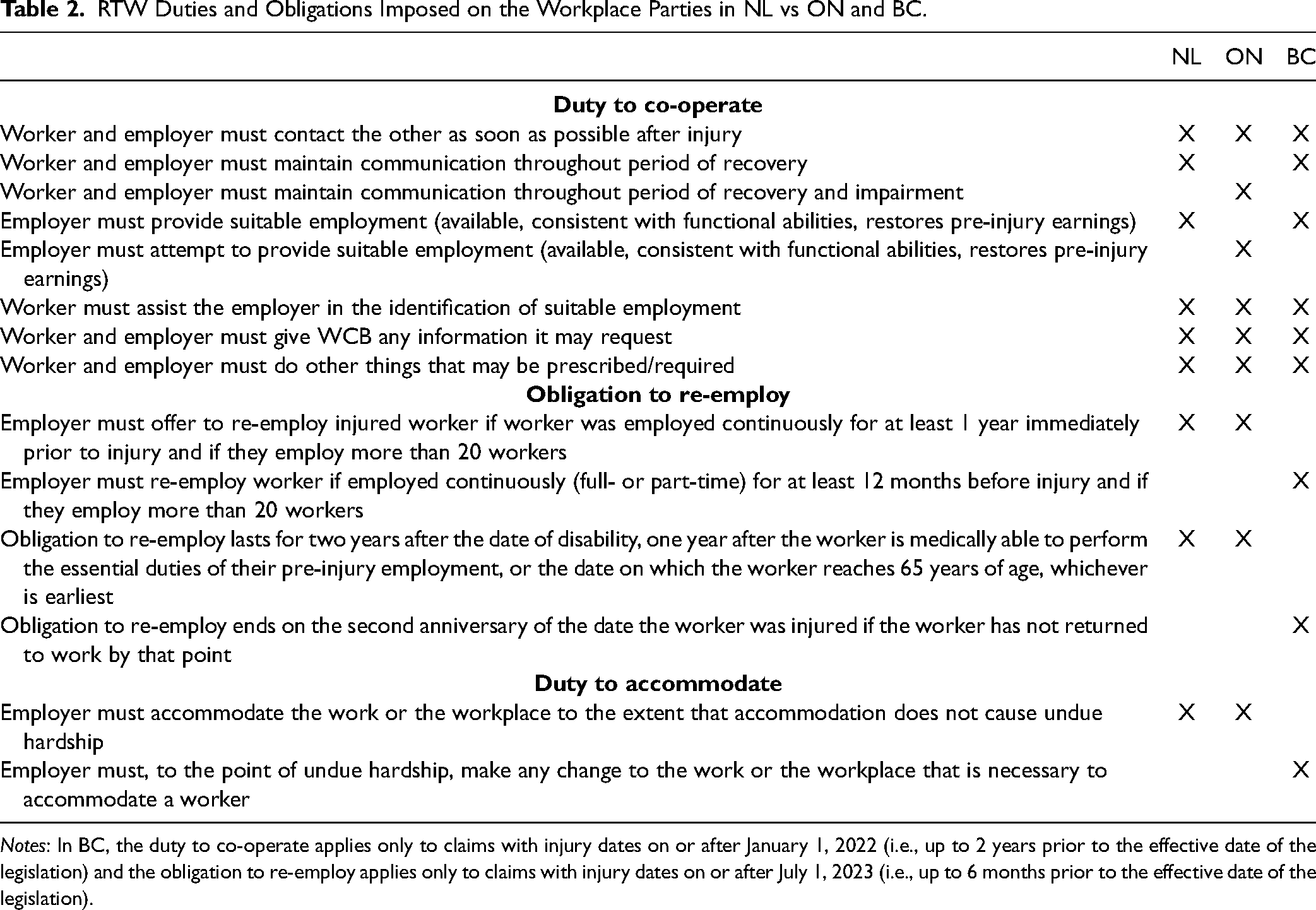
Notes: In BC, the duty to co-operate applies only to claims with injury dates on or after January 1, 2022 (i.e., up to 2 years prior to the effective date of the legislation) and the obligation to re-employ applies only to claims with injury dates on or after July 1, 2023 (i.e., up to 6 months prior to the effective date of the legislation).
Duty to Co-Operate
All three provinces impose a duty on both the worker and employer to contact each other as soon as possible after the injury, to give the workers compensation authority any information it may request and to do other things that may be prescribed or required under the legislation. In addition, all three impose a duty on the worker to assist the employer in the identification of suitable employment. In all three jurisdictions, suitable employment is that which is available, consistent with functional abilities, and restores pre-injury earnings. NL was the only jurisdiction to define the meaning of “co-operation” in both policy and procedure.
Obligation to Re-Employ and Duty to Accommodate
All three provinces impose a duty on employers who employ more than 20 workers to re-employ injured workers. However, as shown in Table 2, there are subtle differences in how the provinces operationalize this obligation and how long the obligation to re-employ lasts. All three provinces impose a duty on employers to accommodate injured workers but allow an exemption in cases where the accommodation would create ‘undue hardship’. All three provide definitions of accommodation in policy, make reference to their respective human rights statutes and/or the Canadian Human Rights Act, and provide guidance on how to determine what constitutes undue hardship. g All place the onus of proof onto the employer for demonstrating that undue hardship exists, but ON is the only province that requires the employer to provide supporting evidence, such as a cost-benefit analysis that includes the long-term financial impact if the claimed undue hardship is financial.
Parties to Whom the Legislation and Policies Apply
In all three provinces, the statutory obligation to co-operate applies to all workers and all employers, but BC is the only province with a statutory provision that the duty to co-operate does not apply if contact between the worker and the employer is likely to imperil or delay the worker's recovery—a situation that is perhaps more likely for workers in vulnerable situations. In all three provinces, the obligation to re-employ does not apply to all employers. Employers who regularly employ fewer than 20 workers, where many workers in vulnerable situations would work, are excluded from the obligation to re-employ, as are certain classes of employers or industries excluded by regulation. The one sectoral exception to this requirement in both NL and ON is the construction sector.
Injured workers are eligible to be re-employed if they were employed continuously for at least a year before the date of their injury. Of the three provinces, BC was the only one that explicitly stated that the injured worker must have been continuously employed on a full- or part-time basis, raising questions about whether part-time workers in other provinces are similarly eligible. The policies in all three jurisdictions clarified the meaning of continuously employed and the conditions by which seasonal workers, casual workers, and contract workers would be considered to be continuously employed. ON's policies also clarified how the obligation to re-employ is applied in other special cases such as emergency workers, temporary employment agencies, and successor employers.
In ON, the workers’ compensation authority, the Workplace Safety and Insurance Board (WSIB), has issued a policy that says that TFWs participating in the “Commonwealth Caribbean/Mexican Seasonal Agricultural Workers Program’ have WSIB coverage, which begins as soon as they reach the agreed-upon point of departure in their homeland and remains in place until they return home. This means that temporary foreign agricultural workers would be entitled to ESRTW provided other requirements of the RTW policy suite are met. There is nothing in either workers’ compensation legislation or policy that explicitly addresses the health and safety (and RTW) of TFWs in NL or BC.
Penalties for Non-Compliance
In all three provinces, financial penalties are levied on employers for failure to co-operate with the statutory provisions for RTW and for failure to re-employ an injured worker. However, as shown in Table 3, there are some differences in how the penalties are levied, the length of time that the parties are given to demonstrate compliance after they’ve received written notice, how the amount of the penalty is determined, and whether an employer is penalized for concurrent failure to comply with both the duty to co-operate and the duty to re-employ.
Penalties for Non-Compliance With RTW Duties and Obligations in NL vs ON and BC.
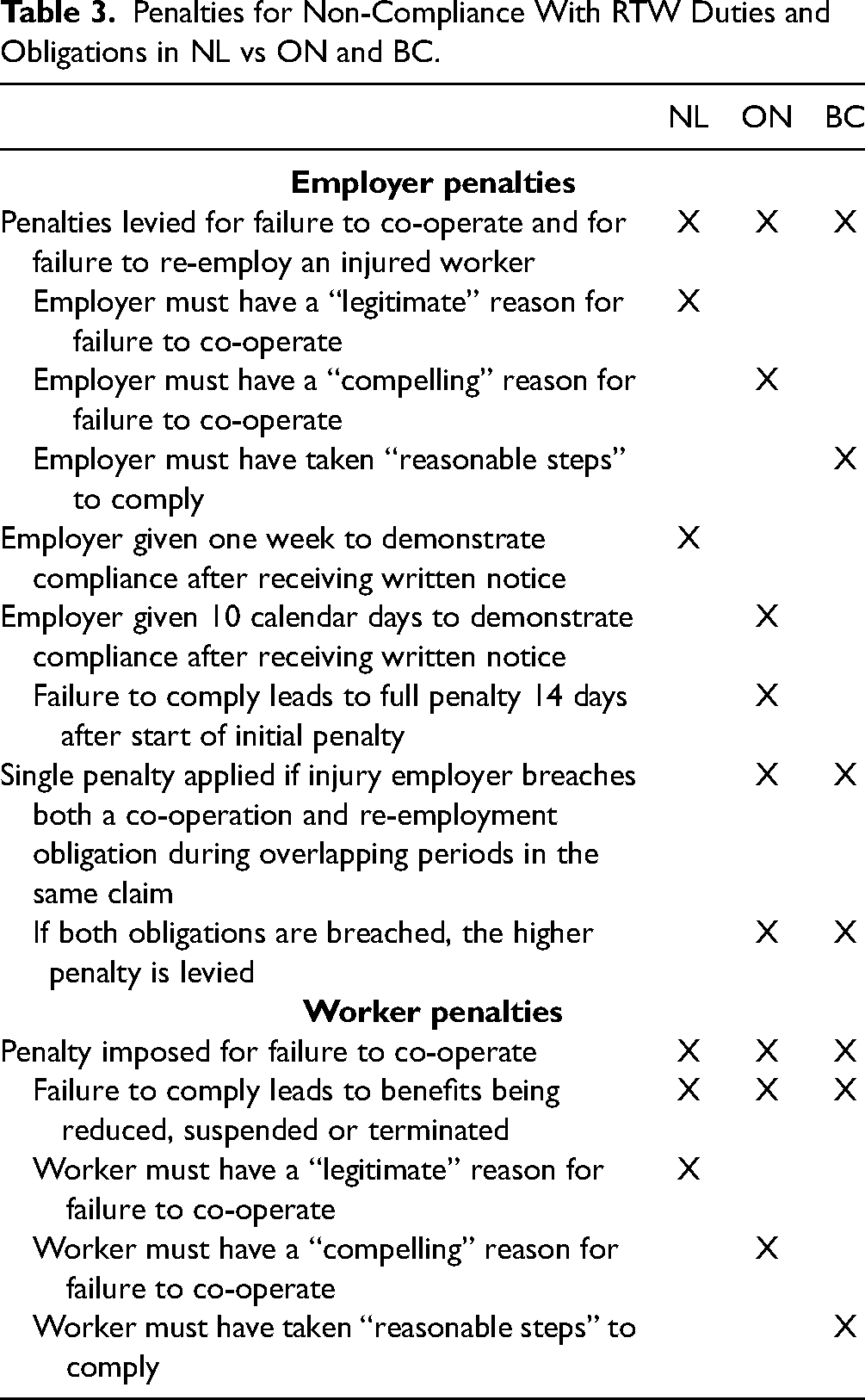
Penalties may also be imposed on workers for non-compliance. In NL, penalties will be levied against a worker or employer for not cooperating when it is determined they do not have a “legitimate” reason. Neither the policy nor the procedure provides examples of “legitimate” reasons. In ON, workers and employers may be penalized for not cooperating if it is determined that they do not have a “compelling” reason. Compelling reasons for employer non-compliance include: summer or holiday shutdown, general layoff, strike or lockout, and/or corporate reorganization; and in the case of small employers, a death in the family or an unexpected illness or accident. Examples of compelling reasons for worker non-compliance include: post-accident non-work-related changes in circumstances such as an unexpected illness or injury, death in the family, or jury duty. The policy notes that for both worker and employer non-compliance, these circumstances are typically of short duration. In BC, workers and employers may be penalized if it is determined they have not taken reasonable steps to comply. This entails consideration of “what a reasonable person would have done in the circumstances.”
What Happens If There is a Dispute?
All three provinces have similar provisions under their legislation for resolving disputes and disagreements in the ESRTW process between the workplace parties. These disputes and disagreements may be regarding the duty to co-operate or the obligation to re-employ. Regardless of the type of dispute, the legislation requires (a) the worker or employer to notify the workers’ compensation authority, (b) the workers’ compensation authority to first attempt to resolve the dispute through mediation, and (c) the matter to be decided within 60 days of receiving notice or within a longer period, as decided by the workers’ compensation authority. At the time of the scan, ON was the only jurisdiction with a policy that clarified that (a) disputes over the suitability of a job offered are not considered acts of non-co-operation and (b) non-co-operation is not meant to apply to workers who raise a health and safety concern under the provincial OHS Act or the federal Canada Labour Code.
Key Issues Highlighted by the Stakeholders
Throughout the Dialogue, participants shared their experiences and perceptions of how ESRTW in NL worked in practice at the time of the Dialogue. Panelists included representatives of WorkplaceNL, organized labor, employers/management, a safety sector council, as well as an NL human rights expert. All highlighted, with examples from their frontline experience, the complexities of the process and the challenges they encounter in getting injured workers safely—and sustainably—back to work. h Many of the issues they identified, particularly in non-standard workplaces (like construction), align with the challenges identified by the researchers who presented in other sessions of the Dialogue and in the related research synthesized in the final Dialogue report. Others reflect the labor and healthcare context of NL.
Two panelists who worked at WorkplaceNL indicated the success of ESRTW is determined largely by how the framework is applied on the ground. The policies are designed to support a model based on self-reliance within which workers and employers are expected to communicate and participate. However, at present, they think there is too much reliance on WorkplaceNL and on healthcare providers who are required to submit information and/or documentation and may be the sole people determining RTW. In their experience, when workers and employers are educated about RTW before the injury happens, things work better and there is more trust.
Labor representatives on the Panel indicated varied experiences with ESRTW but described a range of challenges that included not only accessing physicians but also situations where physicians may identify a suite of duties they think an injured worker can do in ESRTW, but the employer looks at the suite of duties, picks one and expects the injured worker to do that task all day. Workers with challenges accessing a physician are inclined to work through an injury rather than filing a compensation claim. Workers returning to work while still injured or sick may not have the ability to do a single task for an unlimited period of time and this needs to be appreciated by employers and case managers at WorkplaceNL to avoid situations where workers who come back end up worse off. A third issue identified by labor panelists was with employers using consultants who apply undue pressure on attending physicians and on workers to RTW. Worker advisors, whose job it is to help workers deal with workers’ compensation, indicated it was particularly hard to get injured workers employed with small employers (< 20 employees) successfully back to work—a pattern that researchers have documented elsewhere. They pointed to loopholes in the ESRTW program, including non-co-operation with employer obligations with little evidence of employer penalties.
The employer/management panelist (who was a health and safety manager in a large firm in Atlantic Canada) noted that while there is a framework for ESRTW in NL, there is no clear definition for ESRTW and the parameters are currently quite large, opening up the possibility for things to be unclear or missed. They indicated this needs to be addressed, and they also noted that there is nothing in the regulations and policies about the role of the supervisor, although supervisors are referenced a fair bit in NL's OHS legislation. The representative emphasized the importance of joint union-management ESRTW committees hearing from employees, doing an audit, and meeting regularly to review what is working and what is not after the worker returns. They also highlighted problems with healthcare providers not providing full information on functional abilities to employers as a key problem.
The safety sector association panelist noted that NL was the first province in Canada to have legislated RTW in construction in 2001, suggesting that when the provisions were first introduced, there were likely a lot of concerns in the sector because the nature of construction work presents limited opportunities for light work and construction also sometimes entails remote work which can create major challenges for RTW. They also noted that 90% of employers in the construction sector have 20 or less employees and that small employers often look at an injured worker and say, “Well, I can’t give him John's job or Jim's job” and fail to look at the issue from the perspective that there may be things Jim and John are doing the injured worker could do. While the safety sector association educates large employers on ESRTW, they are only now looking at adding this training for small employers.
The human rights expert noted that the failure to accommodate employees at work is consistently the number one issue they see at human rights commissions in NL and nationally. They also noted that the most challenging cases are among the precariously employed, foreign and racialized workers, and those with mental health issues. Overall, they see that issues arise when there is a breakdown in the relationship between employers and workers. If there is an unhealthy work relationship and the RTW process starts off badly when the workplace injury happens, often the first thing you will hear from the employer is that this is a fraudulent claim. Employers may hire consultants to manage RTW and the process often becomes more adversarial. In the view of this panelist, what this symbolizes is that the workplace was not healthy to begin with. They also pointed to the neglect of the role of the supervisor, including how important that person is to the success of ESRTW. In this panelist's view, there was a need to shift the whole conversation around the duty to accommodate away from reliance on a heavy medical, bureaucratic, medicalization model to focus more on how to provide more support to people to do a good job and how to support them in their communities. When people RTW, there is often no focus on how to fix what happened and no thought directed towards how to repair the employment relationship.
Cross-Cutting Perspectives on Healthcare and RTW in NL
Across the Dialogue panelists, issues related to access to healthcare and healthcare providers and the assessment of functional abilities were common themes. WorkplaceNL highlighted that the healthcare system is busy and almost non-existent for many rural people, that individual physicians are busy and have no time to complete reports required by policy, that primary care physicians lack training in assessing functionality, that physicians are reliant on patient's subjective reporting, and that physicians have discomfort with being in a gate-keeper position. As a result, they tend to report on the worker's ability to return to pre-injury work without considering that, while the injured worker may not be able to do the same work, there might be alternative work they could do. Labor representatives flagged that these barriers to healthcare access create disincentives to filing a claim and getting a functional assessment. Management representatives brought up the importance of physicians being made aware that companies have implemented ESRTW programs and that they need to provide full information on functional abilities. The Human Rights representative observed that human rights complaints often get bogged down in the need for medical information. They see this as an indication of a problem with the breakdown in the relationship between the worker and the workplace if they feel they need to have all the relevant medical documentation in place to act. This can unnecessarily complicate things.
Key Takeaways From the Dialogue
The Dialogue sought to transfer existing research knowledge and insights related to RTW with a focus on workers in situations of vulnerability and to present findings from a comparative policy scan to key stakeholders in NL. It provided an opportunity to compare NL policy to that of other provinces with ESRTW programs; to discuss the complexities of the RTW process generally, and the challenges identified by the stakeholder communities in NL specifically; and to identify priorities for future research.
Key takeaways that emerged from the overall project include:
The research on RTW shows that several work and non-work factors can either facilitate or impede early and safe RTW. Facilitators include: positive conditions, strong commitment to OHS, multidisciplinary and collaborative approaches, accommodation of injured/ill workers, individualized RTW plan that supports the returning worker but does not disadvantage co-workers and supervisors, trained and educated supervisors and managers, early and considerate contact by immediate supervisor based on the individual/specific situation, RTW coordinator with dedicated responsibility for coordinating RTW, communication between the employer and healthcare provider as needed and with worker's consent, and, engaged healthcare providers who understand what the worker does and the workplace's capacity to accommodate the injured worker.51,77–86 Some, but not all, of these factors are reflected in RTW policies and practices across Canada. Barriers include: organizational factors (e.g., an RTW plan that disadvantages co-workers and supervisors, supervisors excluded from RTW planning process), RTW plans that are not individualized to the worker's specific circumstances, awkward fit between the worker and the modified work environment, inappropriate contact between workplace parties that is not responsive to individual needs, lack of or inappropriate communication between employer and healthcare provider, and, a lack of access to health care and other services. One particularly relevant barrier for NL is the labor shortage and turnover in healthcare. Although the WorkplaceNL policy framework for ESRTW addresses and incorporates some of the key facilitators, the lack of access to healthcare and other services is a critical barrier to successful RTW in the province. Research done elsewhere has shown that RTW is complex and challenging, particularly in situations of precarious employment and other types of vulnerabilities. Our demographic and labor force profile comparing NL to other key provinces has highlighted the large proportion of small businesses, older workers, interjurisdictional employees, an increasing number of recent immigrants, growing numbers of temporary international migrants with work permits, and issues with seasonality and precarious employment in some sectors—all sources of vulnerability for workers. This points to the relevance of research from elsewhere for NL and the need for both research and action related to strengthening policy and practices around RTW in these contexts. The legislative and policy context in Canada for RTW generally—and for ESRTW specifically–is complex. The concept of “early and safe” underpins the legal framework for RTW in multiple jurisdictions, yet none has defined (in legislation or policy) what is meant by “early and safe” RTW. Furthermore, the environmental scan and NL stakeholder contributions indicate that the legislative, policy, and practice provisions for RTW in Canada, including NL, do not appear to have been informed by research evidence about what works best to sustainably return an injured or ill worker to work. Rather, they appear to have been developed for standard workplaces, standard work relationships, and physical injuries or illnesses. The only exception in some jurisdictions is the construction sector. The common exclusion of workers in small and medium-sized enterprises is puzzling given that workers’ compensation legislation imposes an obligation on employers to re-employ injured workers but then exempts nearly 90% of them from having to comply because they regularly employ fewer than 20 workers. This seems to defy the provincially legislated mandate to facilitate recovery and RTW of injured workers. Stakeholder participants in the Dialogue agreed that it is essential to know what works in RTW and for whom—and how NL compares to other jurisdictions. The lack of research on how RTW works in the NL context was identified as a critical gap. Globally, there are still gaps in our understanding of what works in RTW, for whom it works, and why it works. However, the evidence indicates that what works best to sustainably return an injured or ill worker to work are multidisciplinary, well-coordinated and individualized approaches tailored to the individual worker.
51
Key questions include how to achieve these approaches across diverse work environments (such as interjurisdictional employment) and for workers with varying rights, resources, and options (such as TFWs and the precariously employed). Because the policy suite on ESRTW is still relatively new in NL, there is an opportunity to evaluate how well the policies are working in comparison to other jurisdictions, as well as how effective they are at sustainably returning injured workers to work. Policy-focused research could answer such questions as: What do we know about how effective our policies and practices are in facilitating RTW across these diverse contexts and groups in NL and other under-resourced provinces? Are the policies and practices conducive to an individualized and comprehensive approach to RTW across diverse situations and groups? Are our policies and practices appropriate for the changing labor force and changing nature of work here and elsewhere? Of the provinces scanned, only ON (which had the longest standing ESRTW program) had policy language in place to accommodate issues related to small employers, temporary agencies, temporary foreign workers, and seasonal employment. Despite having the largest policy and administrative practice suite for RTW, NL does not address RTW for TFWs, for the precariously employed, or for small businesses other than construction. Provincial differences may reflect, in part, the history of research and advocacy in ON relative to other Canadian provinces pointing to the need to enhance opportunities and resources available for these in NL. The lack of linked administrative data (that allows for linkage and analysis of health care utilization, workers’ compensation, and other data and is currently only available to researchers in BC and ON) was identified as a critical gap for effectively analyzing ESRTW in NL and other small jurisdictions. The development of one or more occupational health clinics in NL like those in ON and Manitoba and the inclusion in those clinics of free legal advice and support for injured workers (as is currently available in ON) might also help improve the effectiveness of ESRTW policies and programs and improve surveillance potential around assessing what works and what doesn’t in different contexts.
Conclusion
Workers compensation boards vary significantly in terms of their resources, access to research, and engagement with diverse segments of the labor force. Smaller boards often borrow and adapt policies and practices from other boards. In this context, limited access to ongoing research on the effectiveness of these policies and practices, coupled with unmonitored variations and changes in labor force composition and employment relationships, can result in significant and potentially growing problems with RTW policy effectiveness.
The Dialogue was a cost-effective mechanism for relatively rapid knowledge synthesis and transfer of research and policy insights from better-resourced Canadian jurisdictions to a jurisdiction that lacks research capacity, ongoing and independent surveillance of RTW processes and outcomes, and with limited civil society resources available to injured workers to identify RTW issues and lobby for change. It also enabled a conversation among NL stakeholders about NL's diverse and changing labor force, RTW policies relative to other jurisdictions, research and policy gaps in the province, and some ways to begin to address these gaps. However, sustained engagement with the Dialogue varied across stakeholder groups and was particularly limited on the part of employers. Furthermore, as indicated elsewhere in this special issue, many injured workers confront RTW challenges even in better-resourced jurisdictions. Meaningful and sustained change is unlikely to occur in a context where there are sustained power imbalances between employers and injured workers, including growing numbers of workers in vulnerable situations, and in the absence of a strong, effective injured workers movement with access to civil society resources.
Access to organizational and other resources to address the problem of jurisdictional inequities in policy effectiveness around RTW for all Canadian workers might be improved through the development of a strong, national agency for OHS research, policy development, outreach and support and a national RTW strategy like that adopted in Australia in 2020. Like Canada, Australia has a federal style of government with a central government at the national level and regional governments at the state and territorial level. National laws and policy for OHS and workers’ compensation are developed by Safe Work Australia, and are implemented and enforced by state and territorial governments at the regional level. 87 Safe Work Australia has developed a 10-year national strategy for RTW that complements the national OHS strategy, identifies opportunities to improve regional workers’ compensation systems, and promotes national consistency where appropriate.88–90 The Australian strategy was informed by national and global research on workers’ compensation claims and RTW outcomes, national claims data and a national survey on RTW, expert advice, and stakeholder input. A Measurement Framework has also been developed and implemented to evaluate the strategy's success at achieving its three core strategic objectives: “increase in workers staying in or returning to good work following a work-related injury or illness, increase in positive RTW experiences for workers with a work-related injury or illness, and an increase in employers preparing for, effectively responding to and managing work-related injury and illness in the workplace”. 91
Footnotes
Acknowledgments
The authors wish to thank the worker, employer, and WorkplaceNL representatives who participated in the Dialogue and shared their experiences of return to work in Newfoundland and Labrador, as well as the individuals who presented their research and expertise in Sessions 1 and 2 of the Dialogue.
Data Availability

Declaration of Conflicting Interests
The authors declared no potential conflicts of interest with respect to the research, authorship, and/or publication of this article.
Ethical Approval
The research and Dialogue did not involve human subjects’ research and, as a result, they did not require ethics approval.
Funding
The authors disclosed receipt of the following financial support for the research, authorship, and/or publication of this article: The Dialogue is part of the work of the Policy and Practice in Return to Work After a Work Injury: Challenging Circumstances and Innovative Solutions research team, a research partnership funded by the Social Sciences and Humanities Research Council of Canada (895-2018-4009), the Canadian Institutes of Health Research (159064), the University of Ottawa's Office of the Vice-President—Research and Innovation, multiple universities and partners.
Informed Consent
This article reflects on the results from a knowledge synthesis and exchange initiative. The only related research was an environmental scan that relied on publicly available materials.