




Abstract
Background
Simulation in nursing education is widely used to develop technical competence, yet its theoretical framing often neglects deeper ontological dimensions of learning.
Purpose
This article reconceptualizes simulation as an ontological pedagogy that fosters professional identity formation beyond procedural skill.
Methods
Drawing on phenomenology, transformative learning, and threshold concepts, this paper introduce the Simulation as Ontological Nexus of Transformation (SIM-ONT) Framework, supported by an integrative review of literature and conceptual analysis.
Findings
SIM-ONT comprises five interrelated dimensions, liminality, embodiment, relationality, moral activation, and professional becoming, that position simulation as a transformative space where learners negotiate uncertainty, ethical complexity, and identity shifts. Conceptual vignettes illustrate how simulation activates moral agency and presence, moving beyond performance metrics to cultivate reflective, ethically grounded practitioners.
Conclusions
Reframing simulation through an ontological lens expands its pedagogical purpose from technical rehearsal to holistic formation. SIM-ONT offers educators practical strategies for scenario design, debriefing, and curriculum integration that prioritize identity development and moral resilience. This theoretical contribution invites future research to explore ontological phenomena in simulation and operationalize identity-focused outcomes in nursing education.
Introduction
Simulation has become an indispensable pedagogical tool in nursing education, valued for recreating clinical scenarios that foster skill acquisition, critical thinking, and decision-making under pressure. Despite its widespread use and technological sophistication, its theoretical framing often remains confined to instrumentalist and behaviorist paradigms that prioritize technical competence, performance metrics, and fidelity of task execution, assessing what students do rather than who they are becoming (INACSL Standards Committee, Xavier, et al., 2025; Jeffries et al., 2015). While checklists and algorithmic competencies enhance safety and standardization, they risk eclipsing deeper pedagogical potential by marginalizing affective, ethical, and ontological dimensions essential to nursing, a profession rooted in human connection and moral action (Al-Hassan et al., 2026; Castellano, 2025; Potgieter et al., 2025).
This article reframes simulation as an ontological pedagogy: a liminal space where students undergo transformative processes of becoming. Grounded in ontological education, this perspective shifts pedagogy from knowledge acquisition (epistemology) to formation of being (ontology), cultivating openness, care, and courage (Edwards et al., 2025; Liljedahl et al., 2022). Simulation can function as a disorienting dilemma, unsettling assumptions and activating ethical judgment (Mezirow, 1994). High-fidelity scenarios evoke emotional weight and moral complexity, while debriefing offers opportunities for collective meaning-making and identity negotiation (Lesā et al., 2021).
SIM-ONT, Simulation as Ontological Nexus of Transformation, conceptualizes simulation as a pedagogical space for professional becoming, ethical judgment, and embodied presence rather than technical performance alone. This article introduces SIM-ONT as a theoretically grounded framework comprising five interrelated dimensions, liminality, embodiment, relationality, moral activation, and professional becoming. The name SIM-ONT was chosen deliberately to signal a shift from simulation as technique toward simulation as a site of identity formation, moral agency, and professional presence. Drawing on phenomenology, transformative learning, and threshold concepts, this framework expands simulation beyond procedural mimicry to an ontological encounter essential for cultivating ethical, relational, and existential competencies in nursing practice (Rushton, 2023).
Theoretical Foundations
Understanding simulation as a space of ontological transformation requires revisiting its theoretical underpinnings. While simulation pedagogy has traditionally relied on competency-based and performance frameworks (Sellberg & Solberg, 2024), a richer interpretation emerges through six influential perspectives: experiential learning, transformative learning, threshold concepts, cognitive load, phenomenology, and emotional labor.
Kolb’s experiential learning cycle and Dewey’s emphasis on reflection remain foundational (Dewey, 1938; Kolb, 1984). However, in nursing simulation, reflection extends beyond procedural accuracy to questions of empathy, accountability, and composure under pressure (Walsh & Sethares, 2022). Simulation fosters thinking in action, where learners navigate uncertainty through adaptive judgment (Tseng & Hill, 2020).
Mezirow’s theory positions simulation as a disorienting dilemma that challenges assumptions and activates critical reflection (Mezirow, 1994). High-stakes scenarios, such as communication breakdowns or ethical dilemmas, provoke identity shifts and moral reasoning (Briese et al., 2020; Sedgwick et al., 2020).
Simulation offers gateways to troublesome yet transformative concepts like clinical judgment and moral agency (Meek et al., 2023; Meyer & Land, 2005). Crossing these thresholds reconfigures learners’ professional self-concept, enabling deeper engagement with ambiguity and complexity.
While cognitive load theory informs design (Sweller et al., 2011), simulation learning is inherently embodied and relational. Situated cognition emphasizes context-rich, socially mediated learning, reminding educators that simulation is more than data processing, it is lived practice (Roth & Jornet, 2013; Sawyer et al., 2016).
From Heidegger’s being-in-the-world to van Manen’s pedagogical tact, simulation becomes an ontological rehearsal where learners inhabit roles and reflect on moral presence (Heidegger, 1962; Van Manen, 2014, 2016). Simulation evokes emotional labor and ethical tension, rehearsing moral agency in scenarios that mirror real-world complexity (Delgado et al., 2017; Gaba, 2007). These encounters shape not only competence but character. Together, these perspectives position simulation as a threshold pedagogy, an embodied, relational, and ethically charged space where doing and being converge.
Integrating SIM-ONT With Existing Simulation Frameworks
The SIM-ONT model complements and extends existing simulation theories by introducing an ontological lens. For instance, the National League for Nursing (NLN) Jeffries Simulation Theory (Jeffries et al., 2015) provides a robust foundation for understanding design elements, learner characteristics, and expected outcomes. SIM-ONT builds on this structure but shifts the focus from what learners do to who learners become. It suggests that simulation is not only a cognitive activity but also a transformative encounter where identity, ethics, and presence are rehearsed and reshaped.
Similarly, the Healthcare Simulation Standards of Best Practice® (INACSL Standards Committee, Persico, et al., 2025) emphasize psychological safety, prebriefing, and outcome-focused debriefing. SIM-ONT complements these standards by embedding moral, emotional, and existential layers into simulation design and facilitation. For example, debriefing becomes not just a reflective practice but an ontological rite of passage, where learners integrate clinical experience with emerging professional identity.
This reconceptualization aligns with Dieckmann’s view of simulation as social practice (Dieckmann, 2020; Dieckmann et al., 2009) and with Rudolph et al. (2006) and Fey et al.’s (2022) Debriefing with Good Judgment approach, which emphasizes relational integrity and psychological safety. SIM-ONT contributes an added dimension by theorizing simulation as a liminal space, where students are invited not only to reflect on actions, but also to encounter themselves as future nurses.
Proposed Framework: SIM-ONT (Simulation as Ontological Nexus of Transformation)
Simulation in nursing education has long been celebrated for its effectiveness in skill development, critical thinking, and error-safe environments (INACSL Standards Committee, Xavier, et al., 2025; Jeffries et al., 2015). When attention moves beyond procedural and instrumental functions, simulation emerges as a transformative ontological space, a rehearsal of identity as well as action. This theoretical section proposes the SIM-ONT model, a novel conceptual framework that reconceptualizes simulation as a multi-dimensional nexus where students encounter themselves in the becoming of the nurse.
Rather than a linear instructional technique, SIM-ONT is envisioned as a web of overlapping, interdependent dimensions, each acting as a catalyst for ontological transformation. It rests on five foundational pillars: Liminality, Embodiment, Relationality, Moral Activation, and Professional Becoming. Together, they reframe simulation from a competence-based event into a lived encounter with being, situated within the socio-emotional and ethical ecology of nursing practice. This theoretical structure is illustrated in the SIM-ONT framework diagram (see Figure 1), which visualizes the interplay between simulation’s core ontological dimensions. Although developed in nursing education, the SIM-ONT framework is applicable to simulation-based learning across health professions where identity formation and ethical practice are central. The SIM-ONT framework: Simulation as ontological nexus of transformation.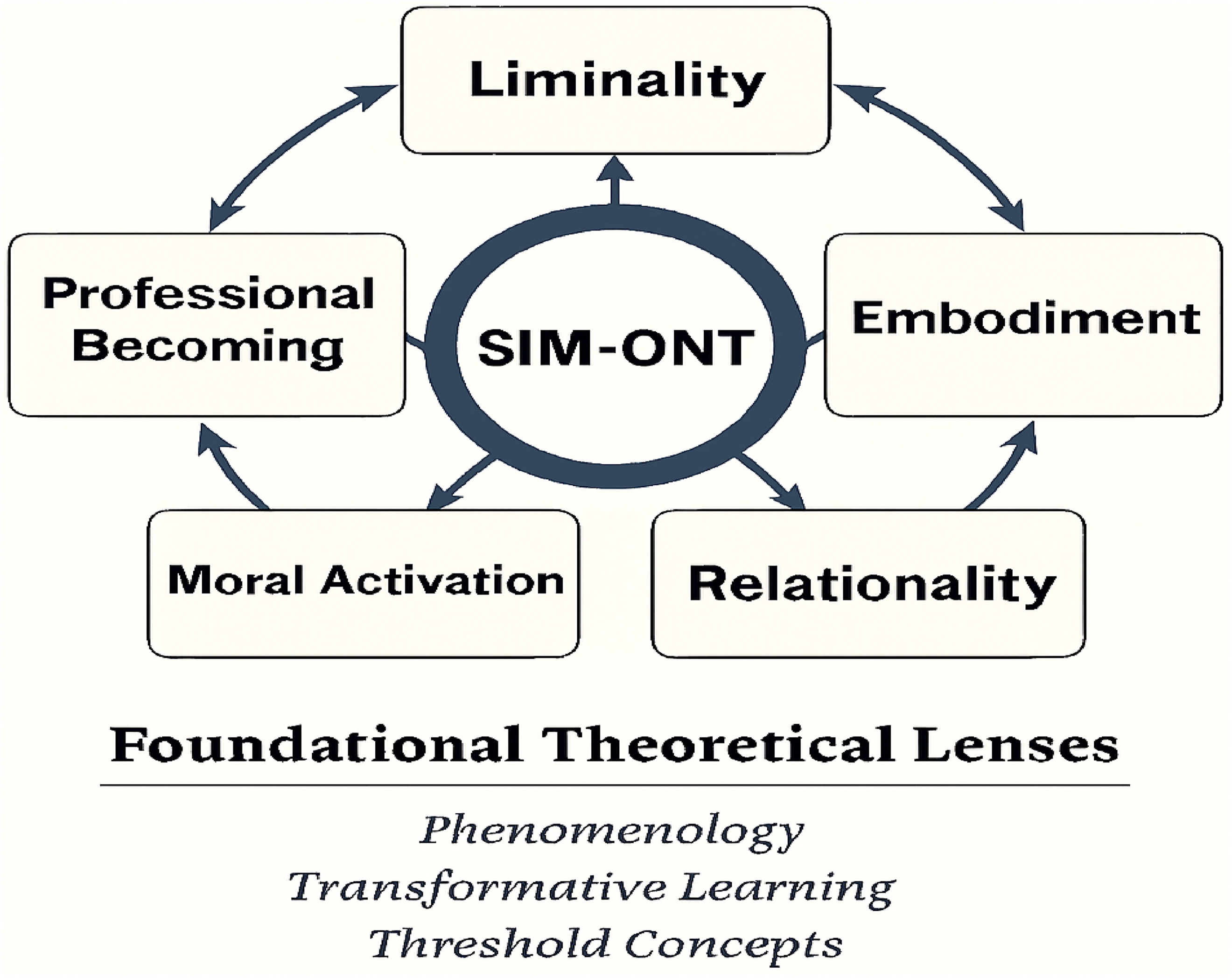
The SIM-ONT framework was developed through an iterative process of conceptual synthesis drawing on three sources: integrative engagement with simulation and nursing education literature, phenomenological theory related to professional formation, and reflective analysis of recurring patterns observed in simulation design and debriefing practices. Foundational theories, including phenomenology, transformative learning, and threshold concepts, informed the identification of dimensions that consistently surfaced at moments of meaningful learning, ethical tension, and identity shift (Crane & Abbott, 2021; Meyer & Land, 2005; Mezirow, 1994). The five pillars were determined based on their conceptual recurrence across these bodies of work and their capacity to collectively account for the embodied, relational, moral, and developmental aspects of simulation-based learning. Together, they represent interdependent dimensions rather than discrete stages, capturing simulation as a dynamic space of professional becoming. The following sections detail each of these five pillars, beginning with the foundational concept of liminality.
Pillar 1: Liminality: Threshold Experiences and Identity Disruption
Liminality, borrowed from anthropological and educational theory, refers to the in-between state, the space of ambiguity and disorientation that precedes transformation (Crane & Abbott, 2021; Meyer & Land, 2005). In simulation, nursing students enter a liminal zone where old identities are suspended and new possibilities emerge. They are neither laypersons nor professionals but apprentices of becoming, engaging in clinical roles with the safety to fail, reflect, and reimagine.
This process mirrors what Van Gennep (1960) described as a rite of passage: separation, transition, and incorporation. In simulation, students are temporarily separated from the clinical “real world,” immersed in a world that is both real and not real, a hyperreal context imbued with emotional authenticity. During the debriefing phase, they incorporate new understandings not just about clinical processes, but about themselves as potential caregivers, decision-makers, and moral agents (Lesā et al., 2021). Thus, liminality in SIM-ONT is not incidental, it is foundational. It is the portal through which simulation participants undergo ontological shifts, questioning their prior assumptions, roles, and capacities.
Pillar 2: Embodiment: Knowing Through Doing, Feeling, and Sensing
Traditional cognitive models tend to decouple knowledge from the body, favoring abstract reasoning over experiential feeling. Yet, nursing is an inherently embodied profession, it involves touch, presence, spatial awareness, and non-verbal attunement (Van Manen, 2014, 2016, 2017). SIM-ONT positions simulation as a site of embodied learning, where knowledge is not only acquired but enacted and inscribed through bodily performance.
Embodiment in simulation involves the visceral reactions of attending to a deteriorating manikin, the tension in one’s hands during a high-pressure code, or the tremble in the voice when delivering bad news. These sensorial experiences are not distractions from learning; they are the learning. They forge neural and emotional pathways that memory alone cannot reach (Finseth et al., 2025).
More importantly, embodiment anchors simulation in the felt reality of practice, enabling learners to integrate cognitive, psychomotor, and affective domains into a unified mode of knowing (Jeong et al., 2025; Van Manen,2014, 2016, 2017). In this way, simulation offers not just learning by doing but knowing through being.
Pillar 3: Relationality: Dialogic Encounters and Interpersonal Presence
At the heart of nursing lies relational practice, the ability to engage meaningfully with others in moments of vulnerability, uncertainty, and emotional need (Zou, 2016). SIM-ONT treats simulation not as an individualistic performance, but as a relational space, where the self emerges in dialogue with others.
Whether students are collaborating in interprofessional teams, negotiating conflict in patient handovers, or comforting distressed family members, simulation demands relational attunement. These encounters are more than role-play; they are microcosms of real-world ethical interaction, shaped by power dynamics, empathy, communication patterns, and cultural understandings.
Simulation thus becomes a dialogic rehearsal, a place to explore not just what to say, but how to be with others. It mirrors Durgahee’s (2002) concept of dialogism, where meaning arises not in isolation but in the interplay of voices. By foregrounding relationality, SIM-ONT acknowledges that becoming a nurse is not a solitary achievement but a co-constructed identity, formed in human connection.
Pillar 4: Moral Activation: Simulation as Ethical Tension Space
Simulation, by design, often places students in ethically complex scenarios: a do-not-resuscitate
In the SIM-ONT framework, these moments are viewed as moral activators. They present students with ethical tensions, not reducible to right/wrong answers but situated, context-laden decisions requiring judgment. Such scenarios function as crucibles of conscience, where learners must contend with uncertainty, prioritize conflicting values, and confront their own boundaries of action.
Through structured debriefing and reflective dialogue, students not only analyze what they did but explore why they did it, how it felt, and what it reveals about their ethical compass. This aligns with notion of narrative identity, wherein one’s moral self is constantly constructed and reconstructed through stories of action and reflection (Halverson et al., 2024). Thus, SIM-ONT frames simulation not as procedural ethics training but as a moral encounter, a space where students rehearse not just tasks, but who they are as moral beings.
Pillar 5: Professional Becoming: The Simulation of Self in Practice
The culmination of the SIM-ONT model is the concept of professional becoming. Simulation does not simply teach students how to nurse, it offers a structured, reflective, emotionally rich environment in which they try on the nurse self, embodying it, failing within it, and slowly growing into it.
This process is not linear; it is recursive, messy, and deeply personal. Professional education is not merely about competence, but about formation, a way of being that includes knowledge but transcends it (Fellenz, 2015). Professional becoming entails integrating knowledge, action, values, presence, and identity.
Simulation allows students to inhabit roles they have not yet earned, giving them a provisional authority to act as if they were already clinicians. This “as-if” space is powerful (Vaihinger, 2021). It invites reflection-in-action and authentic projection, a way for learners to visualize themselves not only in the role, but of the role.
Importantly, the professional self developed in simulation is not neutral. It is shaped by the institutional, cultural, and ethical narratives embedded in the scenario and facilitated by educators. SIM-ONT recognizes this and positions simulation educators as identity co-architects, who help students integrate experiences into evolving professional identities.
Together, the five pillars of SIM-ONT form a web of transformation, a space where simulation is not reducible to metrics but is expanded into a deep pedagogical experience. The interplay of liminality (disruption), embodiment (felt knowing), relationality (dialogue), and moral activation (conscience) converge to support professional becoming. The SIM-ONT model (see Figure 1) depicts simulation as an ontological space where four interrelated dimensions, Liminality, Embodiment, Relationality, and Moral Activation, recursively feed into the core of Professional Becoming. Bi-directional arrows in this framework reflect the dynamic interplay between each element, representing the non-linear, transformative nature of nursing simulation.
Implications of SIM-ONT
By introducing SIM-ONT, this article positions simulation as more than a pedagogical strategy, framing it as an ontological approach that supports the formation of professional identity alongside clinical action. This reconceptualization invites educators, curriculum designers, and researchers to: • Design scenarios that disrupt identity, not just test knowledge. • Embrace emotional labor and ethical tension as learning opportunities. • Facilitate debriefing as a space of narrative integration and meaning making. • Move beyond metrics to explore the textures of professional presence. • Re-center humanity in an increasingly digital simulation landscape.
Conceptual Vignettes: Enacting the Ontological Power of Simulation
To illuminate the SIM-ONT framework, this section presents four conceptual vignettes, hypothetical, literature-grounded scenarios that animate how simulation catalyzes transformation through liminality, embodiment, relationality, moral activation, and professional becoming. Each vignette reflects not just the acquisition of clinical skills, but the encounter with the self, the patient, and the ethical core of nursing. These are not just simulations; they are ontological rehearsals, revealing the profound pedagogical possibilities beyond traditional competency metrics.
Vignette 1: Code Blue as Existential Crisis
Theme: Liminality · Moral Activation · Embodiment
It is 10:08 a.m. in the simulation lab. A manikin representing a 68-year-old post-op patient goes into sudden cardiac arrest. Alarms blare. Students leap into action: compressions, airway, epinephrine. But amid the procedural fluency, one student hesitates, just a second too long, to call the code. The delay is subtle, but it’s there. After the scenario ends, she whispers to the instructor, “It felt too real, I didn’t want to lose him.”
This moment exemplifies what Gaba (2007) calls emotional fidelity, a simulation experience that evokes existential weight alongside cognitive demand. The student’s hesitation reflects
Rather than penalizing hesitation as a performance gap, the debrief reframes it as an ontological threshold. The student reflects on her actions and on her emerging responsibility within the fragile space between life and death. In this sense, the code blue functions as an existential crisis in which moral agency and anticipatory grief converge, initiating early professional identity formation. Simulation here becomes a rehearsal of conscience as well as clinical response.
Vignette 2: Breaking Bad News Simulation
Theme: Relationality · Moral Activation · Professional Becoming
In this scenario, students must inform a standardized patient (SP), playing the role of a mother, that her son has suffered a traumatic brain injury with minimal chance of recovery. The student, reading from the chart, tries to maintain neutrality. The SP interrupts with disbelief, then tears. The student stammers, reaches for platitudes, and ultimately goes silent.
This encounter foregrounds
After the simulation, during debriefing, the student admits, “I didn’t know what to say. I felt like a stranger trying to hurt someone.” The instructor guides a reflective dialogue using narrative debriefing (Lesā et al., 2021), shifting the focus from wording and technique to moral courage, empathy under pressure, and accountability to the patient and family. Through this reflection,
Breaking bad news functions here as an ethical apprenticeship rather than a discrete communication skill (Slade et al., 2016). Simulation supports ethical intentionality by allowing students to internalize the human consequences of information delivery and to rehearse what it means to remain present in another person’s moment of profound vulnerability. In this sense, the learning outcome extends beyond protocol adherence toward the formation of moral presence.
Vignette 3: Silent Simulation in Palliative Care
Theme: Embodiment · Relationality · Liminality
In this simulation, students enter a room where a high-fidelity manikin lies unconscious, moaning softly. The scenario centers on a patient in the final stage of palliative care who is alone. The constraint is deliberate. No words may be spoken.
At first, students fidget, accustomed to action, instruction, and verbal exchange. Gradually, attention shifts to the body and to presence. Students touch the patient’s hand, adjust blankets, clean lips, and sit quietly at the bedside. One student begins to cry. Another lights a flameless candle without prompting. These actions make
The shared silence also foregrounds
Following the simulation, a student reflects, “That was the first time I felt like I was with a patient, not just doing something for them.” This reflection marks
By removing speech, the simulation reorients learners to affective and spiritual dimensions of nursing that receive limited emphasis in procedural curricula. The scenario becomes a liminal encounter with human vulnerability, teaching learners to hold space when no intervention alters the outcome. Silence functions here as an intentional pedagogical tool that cultivates presence through embodied and relational care.
Vignette 4: Simulation Debrief as Reflective Baptism
Theme: Professional Becoming · Liminality · Moral Activation
Debriefing is often treated as a concluding activity following simulation (Sawyer et al., 2016). Within the SIM-ONT framework, debriefing functions as an integrative space where experience is examined, interpreted, and woven into professional meaning. In this scenario, following a pediatric asthma simulation in which a student froze mid-scenario, the group enters debriefing with visible tension. The instructor begins with an open prompt focused on self-reflection rather than correction: “What surprised you about yourself?”
This opening creates
These reflections signal
Across this process,
Simulation as Ontological Drama
These conceptual vignettes illuminate simulation not as technical performance, but as ontological drama, a space where being is at stake. Each encounter operates on multiple levels: • A liminal passage into the discomfort of new roles. • A site of embodied learning that cannot be replicated by textbooks. • A relational mirror that reflects the emotional labor of care. • A moment of moral choice, however subtle. • A stage of professional rehearsal, where students test-drive their future selves.
Simulation, in this light, becomes ritual pedagogy, a transformative choreography of practice, presence, and becoming.
Implications for Practice and Research
The SIM-ONT framework repositions simulation in nursing education not merely as a training tool but as an ontological crucible, a site where learners become nurses by inhabiting the moral, emotional, and existential dimensions of practice. This reorientation has profound implications for simulation design, educator roles, curriculum development, and research trajectories. It calls for a shift away from performance-centric metrics toward a pedagogy of presence, reflection, and transformation.
Reframing Simulation Design: From Checklists to Ethical Immersion
Traditional simulation design in nursing education has often emphasized fidelity, procedural accuracy, and measurable outcomes, driven by the language of competencies, checklists, and standardized performance (INACSL Standards Committee, Persico, et al., 2025). While this approach ensures clinical safety and consistency, it risks flattening simulation into a technocratic exercise, sidelining its relational and ethical richness.
The SIM-ONT framework encourages ethically immersive design, where simulation is not just an arena for rehearsing correct action but a theater of moral imagination and ontological awakening. Scenario designers are invited to: • Include ethical dilemmas without easy answers (e.g., conflicting DNR orders, resource triage). • Create emotionally charged encounters (e.g., grief, conflict, silence, hope). • Introduce affective complexity, allowing discomfort, ambiguity, and uncertainty to remain unresolved, fostering deep reflection.
This does not mean abandoning fidelity or structure but balancing technical design with ontological intentionality. Educators must ask not only, What do we want them to do? but Who do we want them to become?
Simulation Faculty as Ontological Coaches
In a SIM-ONT paradigm, the role of simulation faculty transforms from technical facilitator or debriefer to ontological coach, one who midwifes identity, guides reflection, and holds space for professional becoming. This requires a pedagogical shift from: • Corrective feedback → to narrative co-construction. • Evaluation of performance → to exploration of presence. • Skill remediation → to existential integration.
Faculty development must therefore include training in: • Ethical reflection facilitation. • Narrative medicine approaches to meaning making. • Embodied coaching practices. • Trauma-informed teaching to hold space for emotional vulnerability, especially post-pandemic.
This redefined educator role echoes Dewey’s (1938) notion of the teacher as an architect of experience, not merely a transmitter of knowledge.
Curriculum Reform: Integrating Ontological Threads
The SIM-ONT framework has broader implications beyond simulation labs. It can infuse entire curricula with ontological orientation by weaving transformation, identity, and ethics throughout the learning arc. Suggestions include: • Designing curriculum-wide simulation sequences where scenarios build on a learner’s ethical and emotional development, not just technical skill. • Integrating threshold concept mapping to track transformative points across courses (Meyer & Land, 2005). • Embedding phenomenological reflections post-simulation into assignments, not as “add-ons,” but as core assessments of professional formation (Van Manen, 2017).
In essence, SIM-ONT helps nursing programs move from training for technical proficiency to cultivating ontological fluency, the capacity to respond to human need with ethical discernment, relational grace, and embodied presence.
Preceptor Integration: Bridging Classroom and Clinical Worlds
A persistent challenge in nursing education is the fragmentation between simulation and clinical practice, which disrupts the continuity of learning and weakens the translation of simulated insights into authentic professional becoming (Watson et al., 2025). SIM-ONT opens pathways for meaningful integration by positioning preceptors not as evaluators of readiness but as co-mentors of becoming.
Simulation faculty and preceptors can: • Align on shared ontological language (e.g., presence, moral activation, identity shift). • Use post-clinical journaling prompts linked to simulation scenarios to bridge internal and external transformation. • Invite preceptors into simulation debriefs, creating a relational loop between what is practiced in simulation and what is embodied in the clinical world.
Such integration fosters continuity of reflection, ensuring simulation’s ontological impact does not end at the lab door but permeates bedside encounters (Watson et al., 2025).
Resilience and Moral Recovery: Simulation as a Space for Renewal
Contemporary nursing practice is marked by moral distress, emotional fatigue, and systemic strain. As learners enter or progress through their clinical education, they often carry vulnerability alongside a strong sense of responsibility and urgency (Rushton, 2023). SIM-ONT positions simulation as a space of moral and emotional recovery, where resilience is not taught as stoicism but cultivated through: • Collective reflection on loss, fear, and uncertainty. • Silent simulations that allow grief, awe, and care to surface (as in palliative or end-of-life vignettes). • Narrative-based debriefings where emotional labor is named and integrated.
Rather than “resilience training” as performance under pressure, SIM-ONT fosters resilience as reflective re-alignment, the reweaving of meaning, purpose, and identity after disruption.
Reflective Journaling Integration
Through the SIM-ONT lens, reflective journaling becomes an ontological echo, carrying forward the transformation begun in simulation into the learner’s ongoing becoming (Horton et al., 2020). Key strategies include: • Embedding SIM-ONT-guided prompts into journal entries (e.g., “What part of yourself showed up today in the simulation? What did you learn about your moral compass?”). • Using threshold journals where students document moments that felt like identity ruptures or ethical awakenings. • Encouraging embodied journaling, describing where emotions, hesitation, or confidence were felt physically during simulation.
These practices help move journaling from reflective compliance to ontological integration, where learners track their own evolution across time.
Future Research: Exploring Ontological Phenomena in Simulation
The SIM-ONT framework opens numerous avenues for empirical inquiry that move beyond skill acquisition and error rates: 1. Liminality in simulation: How do students narrate and navigate disorientation, ambiguity, or identity rupture? How does this relate to long-term transformation? 2. Affective presence: What emotional states are most generative for ontological learning in simulation? How can emotional fidelity be measured qualitatively? 3. Identity shifts: How do learners describe changes in their professional self-concept after simulation? What are the narrative markers of professional becoming? 4. Ontological debriefing: What facilitator behaviors or dialogic patterns best support identity integration in debriefing?
These questions may be explored using phenomenology, narrative inquiry, participatory design, and longitudinal reflective analysis, providing a robust research agenda that centers meaning and becoming in health professions education.
While the vignettes in this article are conceptual in nature, they are grounded in patterns commonly observed in simulation debriefings, reflective writing, and educator observations (Fey et al., 2022; Horton et al., 2020). In end-of-life care simulations, learners often describe heightened awareness of silence, presence, and emotional attunement, noting a shift from performing tasks toward simply being with the patient (Potgieter et al., 2025; Rushton, 2023). Such reflections illustrate the identity formation, moral activation, and embodied awareness that the SIM-ONT framework seeks to theorize (Fellenz, 2015; Jantzen et al., 2023).
As a next step, a multi-phase empirical research agenda is proposed to test and refine SIM-ONT in practice. Potential methods include: • Phenomenological interviews with nursing students’ post-simulation to capture experiences of liminality and professional becoming. • Longitudinal reflective journaling analyzed for narrative markers of ontological shifts. • Qualitative analysis of debriefing sessions, coded for themes like moral tension, embodiment, and relational presence.
These future studies would help establish the validity, transferability, and pedagogical impact of SIM-ONT across diverse nursing programs. They also align with calls in simulation literature to explore deeper learning beyond procedural performance (Lesā et al., 2021).
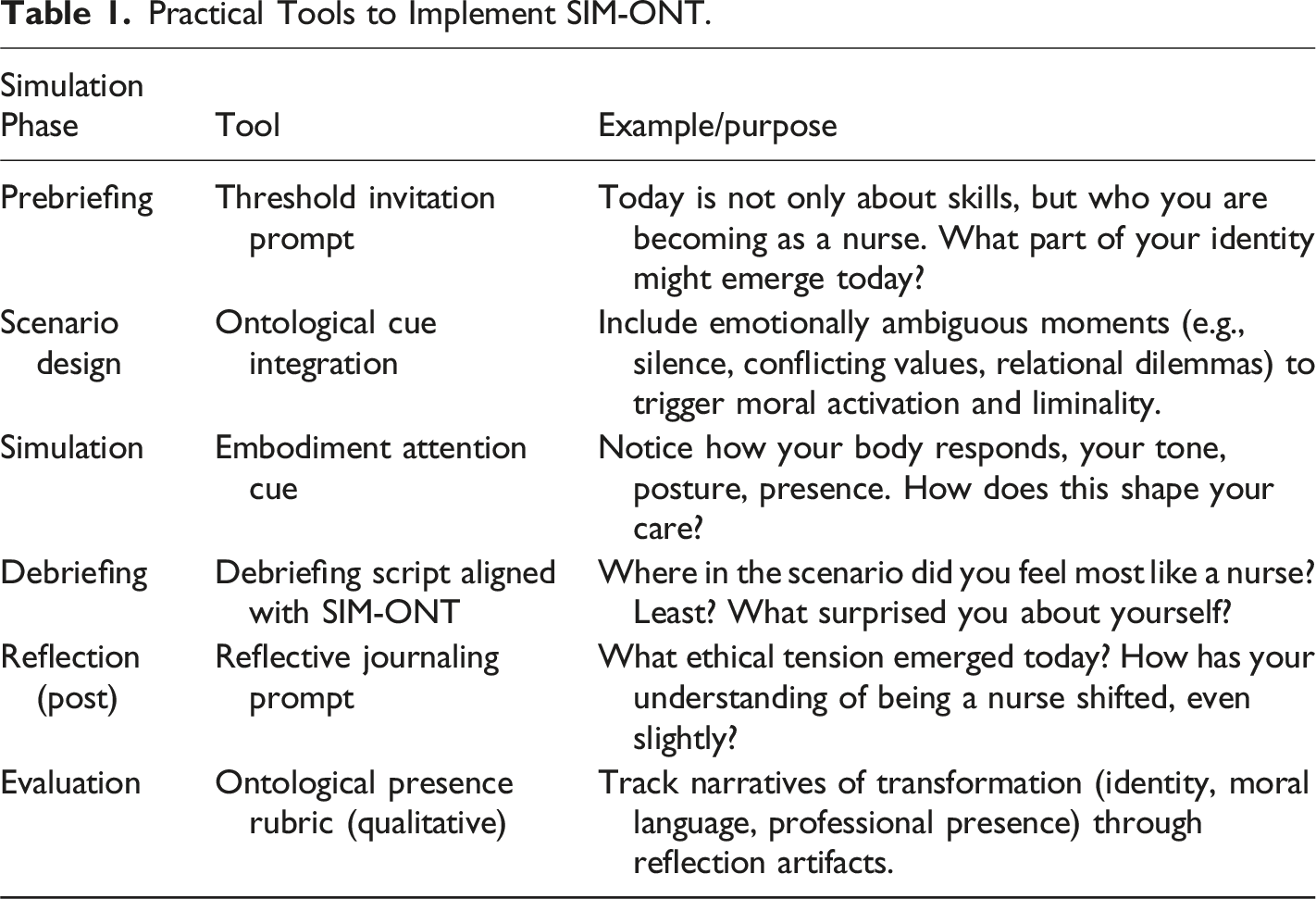
Operationalizing SIM-ONT in Practice
Practical Tools to Implement SIM-ONT.
Toward a More Human Simulation Pedagogy
Simulation in nursing education is at a threshold. As the field matures technologically, there is a parallel need to mature pedagogically and philosophically. SIM-ONT offers a theoretical structure to reimagine simulation not as a discrete event for skills testing, but as an ontological curriculum of care, where presence, ethics, and identity are rehearsed and reimagined.
The future of simulation lies in fidelity to the human condition, including the emotional, ethical, and relational complexities of nursing practice. Teaching nursing involves cultivating professional becoming alongside clinical action. When intentionally designed and facilitated, simulation functions as a powerful pedagogical stage for this work.
Conclusion
Simulation in nursing education has often been framed as a pedagogical technique, a replicable tool to cultivate competence, reduce error, and accelerate performance (Gaba, 2007; Jeffries et al., 2015). While these objectives remain vital, they do not encompass the full power of what simulation can offer. At its deepest level, simulation is a philosophical act, a structured encounter with uncertainty, emotion, ethics, and identity (Dieckmann, 2020). It is not only about what students do, but about who they are becoming (Fellenz, 2015; Halverson et al., 2024).
The SIM-ONT framework repositions simulation from a mechanistic rehearsal space to a site of ontological formation (Heidegger, 1962). Rooted in five interrelated dimensions, liminality, embodiment, relationality, moral activation, and professional becoming, SIM-ONT invites educators, designers, and researchers to reimagine simulation as a living curriculum (Dewey, 1938). Here, learners are not only acquiring skills, but also shedding, testing, and reconstructing their evolving nurse selves (Crane & Abbott, 2021).
In a profession where care, vulnerability, and decision-making intersect in real time, often under conditions of uncertainty, simulation must evolve from competency checklists to crafting consciousness (Castellano, 2025). It must become a pedagogical ritual that allows students to practice not just interventions, but presence, courage, empathy, and integrity (INACSL Standards Committee, Xavier, et al., 2025). SIM-ONT does not reject performance metrics, it expands them to include ethical resonance, emotional literacy, and identity integration.
To actualize this vision, simulation design must prioritize human complexity over procedural linearity. Faculty must be empowered not only as debriefers of action, but as coaches of becoming. Reflection must be treated not as an addendum, but as a transformative event. And research must move beyond counting actions to mapping inner shifts, the moments when learners cross thresholds into new understandings of care, self, and the human condition (Liljedahl et al., 2022; Meyer & Land, 2005).
The SIM-ONT framework affirms simulation as practice in becoming rather than preparation alone. Contemporary nursing education is shaped by moral fatigue, workforce precarity, and shifting patient needs, creating an urgent need for learning spaces that restore meaning alongside knowledge. The future of nursing requires practitioners who are reflective, ethically grounded, and attentive to human complexity. When approached as ontology, simulation serves as a powerful means to cultivate this form of professional formation.
Footnotes
Authors’ Contributions
(M.A) conceptualized the study, conducted the literature review, developed the SIM-ONT framework, and wrote the manuscript. (E.A and I.S) done the revision and review the final manuscript.
Declaration of conflicting interests
The author declares no conflicts of interest.
Funding
The authors received no financial support for the research, authorship, and/or publication of this article.
Informed Consent
This article is a theoretical work and does not involve human participants, patient data, or clinical trials.
