




Abstract
Background
Long queues at polling stations reduce voter satisfaction and raise the cost of running elections. In Australian federal elections, unpredictable arrival patterns and early-voting behaviour make traditional staffing estimates unreliable, often resulting in either under-utilised staff or wait times that exceed an hour.
Objectives
(1) Build a framework that couples an agent-based simulation of a polling station with a multi objective optimisation engine to reveal trade-offs between operational resources and voter wait times. (2) Generate Pareto-optimal solutions that balance the number of ballot issuing officers with queue waiting duration. (3) Identify which evolutionary multi-objective algorithm provides the best performance for this problem.
Methods
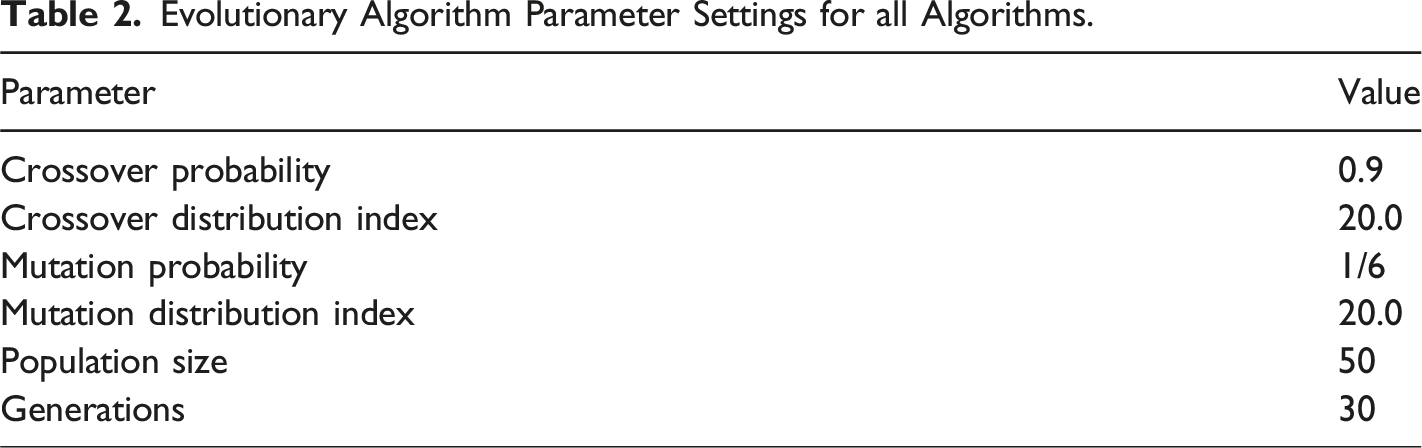
An agent-based model of a polling station was created in AnyLogic using arrival profiles and processing times collected from the 2017 Bennelong by-election. Six integer decision variables describe the numbers of ordinary and declaration issuing points, screens and lookup methods. The model was linked to the jMetal library and evaluated with three evolutionary algorithms: NSGA II, SPEA2 and IBEA. Experiments covered voter turnouts from 600 to 2000 in steps of 100, using a population of 50 and 30 generations per run. Solutions were assessed with the hypervolume indicator and a hard constraint that average waiting time must not exceed 25 minutes.
Results and Conclusion
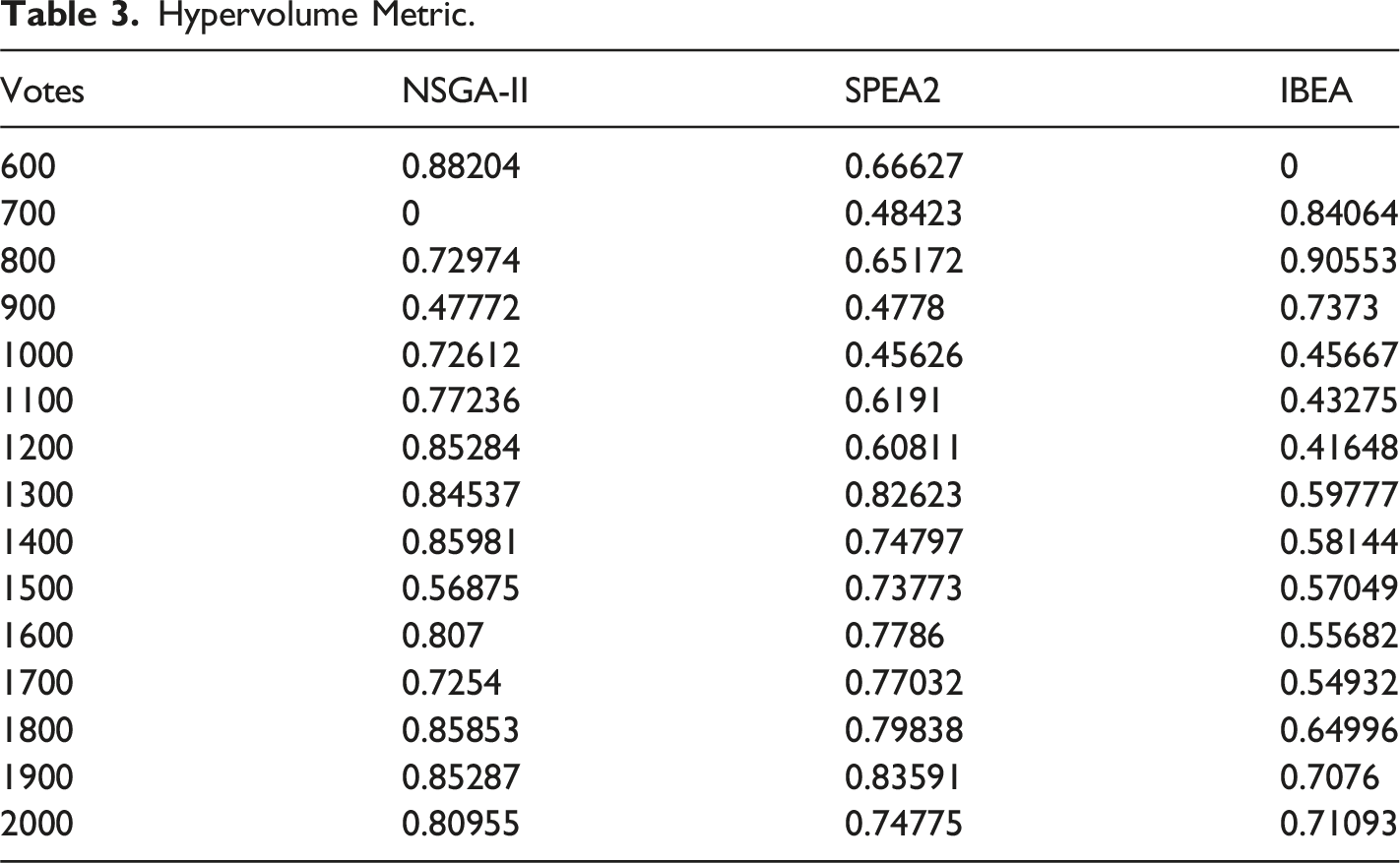
The optimisation produced sets of trade-off solutions for each turnout level. NSGA II and SPEA2 consistently achieved higher hypervolume values than IBEA, indicating better convergence and diversity. The Pareto-fronts show that adding issuing points shortens peak-time queues but increases staffing costs, while fewer points lengthen waits. The proposed framework delivers scalable, evidence-based staffing recommendations that improve voter experience and control election costs.
Introduction
Efficient polling station management is crucial for ensuring fair and accessible elections. Long queues resulting from inefficient resource allocation can lead to voter dissatisfaction. Typically, each polling station has an estimate of voter turnout on election day using historical data. However, with recent changes in voter behaviour, such as avoiding the queues on polling day by choosing early voting, these estimates have become less reliable. This uncertainty in voter turnout significantly affects staffing and resource planning. Moreover, polling stations often experience sudden surges in arrivals, leading to long queues, while at other times there are no queues at all.
Adding more issuing officers to manage queues during peak arrival times can address the queuing problem, but it also comes with significant costs. For most of the day, the extra resources remain unused or underutilised. The additional issuing officer adds staff and resources costs. Furthermore, the polling station must be spacious enough to accommodate multiple issuing points, each with its own voting screens and associated infrastructure. Conversely, too few issuing points can result in large queue times with some cases wait times of over an hour have been reported (Australian Electoral, 2025; Guardian, 2025).
Traditionally, Australian Electoral Commission (AEC) determines the number of issuing points at a polling station by first setting a target capacity for each issuing point, that is, the number of voters it can reasonably handle over the course of the day. The total predicted voter turnout is then divided by this capacity to estimate how many issuing points are required. While this provides a practical planning framework, it does not account for the variability in voter arrival patterns throughout the day, making it difficult to reliably estimate queue lengths or waiting times.
Literature Review
Several studies have attempted to address these challenges using simulation-based approaches. Herron and Smith (Herron & Smith, 2016) developed a Discrete-Event Simulation (DES) model using empirical data from the 2014 general election in Hanover, USA, to analyse how queues form and evolve, identify bottlenecks, and evaluate the impact of resource adjustments, such as changing the number of voter authentication stations and voting booths. In a related approach, Cheuk Hang Au et al. (Au et al., 2017) used FexSim to create a three-stage simulation model that integrated layout constraints to iteratively determine the most efficient spatial flow and reduce voter wait times. In addition, (Bernardo et al., 2020) analysed a large vote centre in Los Angeles County using a DES model developed in Simio to evaluate how alternative layouts and routing configurations, such as separating provisional voters and adjusting entry and exit flows, affected voter throughput. Their findings showed that layout modifications alone, without increasing resources, could reduce average and maximum times in the system by up to 36 per cent, highlighting the crucial role of spatial design in polling station efficiency. More recently, Barenji et al. (Barenji et al., 2023) introduced an agent-based simulation model using NetLogo to capture voter interactions, resource allocation, and polling station operations. While their model offered insights into improving voter flow, it was limited in scalability and lacked real-world data and advanced optimisation techniques.
Further extending the simulation-based body of work, (Zhang et al., 2025) proposed a dynamic resource allocation framework within a secure election network, focusing on efficient and fair distribution of resources across polling locations under varying demand conditions. Although their approach did not explicitly employ evolutionary algorithms, it demonstrated the relevance of optimisation methods in election resources. Similarly, (Gannouni & Ellaia, 2024) provided an overview of simulation-based multi-objective evolutionary algorithms (SMOEAs), outlining how simulation and Multi-Objective Evolutionary Algorithm (MOEA) frameworks can be integrated to handle stochastic and complex optimisation problems, suggesting a strong methodological basis for applying these approaches to polling station design. Moreover, a recent review on election logistics (Apiri & Lim, 2025) pointed to the limited use of advanced optimisation techniques in electoral management and highlighted the potential for combining simulation with multi-objective models. These studies collectively indicate a growing interest in applying optimisation frameworks to improve election operations, though direct applications to polling station design remain non-existent.
Although using DES models in combination with evolutionary algorithms for optimisation has been explored in various domains e.g., (Rashid et al., 2021), to the best of the authors’ knowledge, this study is the first to apply MOEA to optimise both the number of voting booths and ballot issuing points in a polling station simulation. The aim is to minimise voter waiting times and election resources.
This study integrates a simulation model developed in AnyLogic with an optimisation algorithm library, namely jMetal (Durillo & Nebro, 2011), to optimise polling station operations. The polling station model is specifically developed for the AEC, with throughput rates in the model derived from a data collection and analysis project in collaboration with the AEC during federal elections, by-elections, and referendums. This study was approved by the Deakin University Human Research Ethics Office (Ref. STEC-35-2017-JOHNSTONE) and carried out in accordance with the Deakin University Code of Ethics. The three contributions of this work are listed as follows. • Integration of an existing agent-based polling station simulation model for the Australian Federal electoral system with a multi-objective optimisation framework to analyse trade-offs between operational resources and voter wait times. • Identification of Pareto-optimal solutions balancing the number of ballot-issuing officers and queue waiting duration, enabling informed decision-making to improve election efficiency and voter experience. • A comparative study of state-of-the-art MOEAs applied to this context, highlighting the best-performing algorithm for managing polling station operations.
Methodology
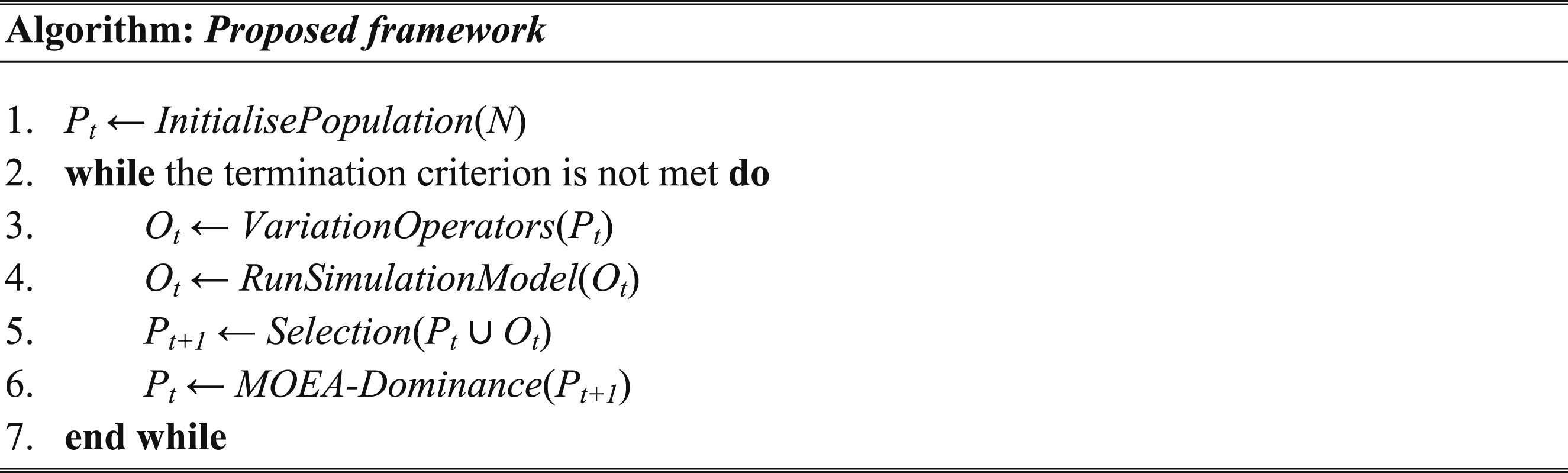
This study makes use of a simulation model to identify and mitigate bottlenecks at polling stations by searching optimal resources. Specifically, for a given number of estimated votes, the optimisation algorithm determines the optimal allocation of resources required to ensure smooth voter flow during peak periods. To identify the best solutions, a comparative study of multiple state of the art MOEAs, namely Non-dominated Sorting Genetic Algorithm II (NSGA II) (Deb et al., 2002), Indicator Based Evolutionary Algorithm (IBEA) (Zitzler & Künzli, 2004), and Strength Pareto Evolutionary Algorithm 2 (SPEA2) (Zitzler et al., 2001), is conducted.
The optimisation workflow begins with initialising a population of candidate solutions, as shown in Figure 1. Each solution is evaluated by interacting with the DES model, which returns objective values such as average waiting time and maximum queue length. The algorithm iteratively selects and evolves the population until termination conditions are met. Proposed framework.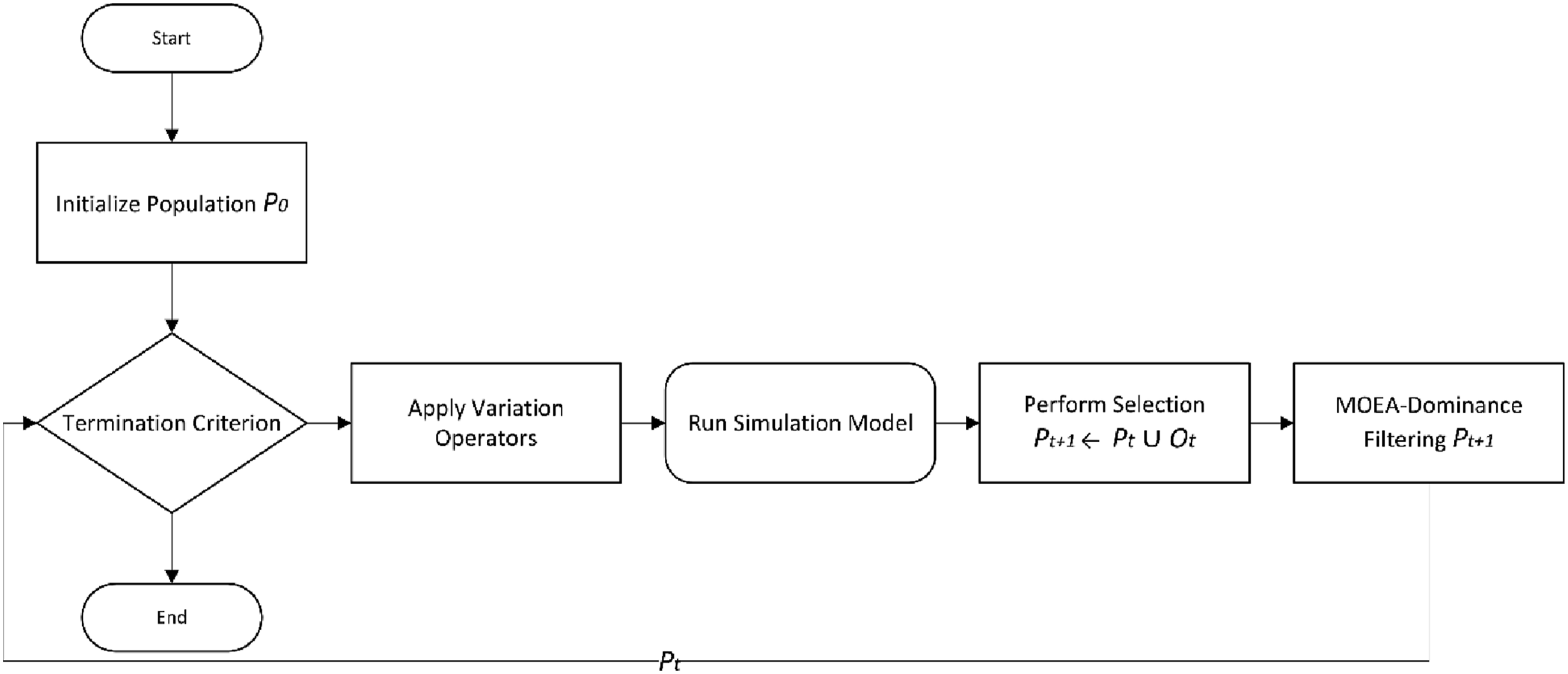
This optimisation process is repeated for a range of estimated voter turnouts, starting from 600 and increasing in increments of 100, up to a maximum of 2000 voters. As a result, the study produces a set of optimal solutions for polling stations of varying sizes. For each turnout level, the best performing Pareto-front, selected from among the three MOEAs, is used to inform optimal resource configurations. This approach ensures that the recommendations are scalable and adaptable to polling stations of different capacities.
Agent-Based Polling Station Model
This study employs an agent-based simulation model of a polling station, developed in AnyLogic, as illustrated in Figure 2. The model enables the configuration of key operational parameters, including the voter arrival profile, the number of ordinary and declaration votes, and the allocation of resources such as ordinary vote issuing points, declaration vote issuing points, and voting screens. The physical layout of the premises and agent walking speeds are also modelled to reflect real-world conditions. Polling station model.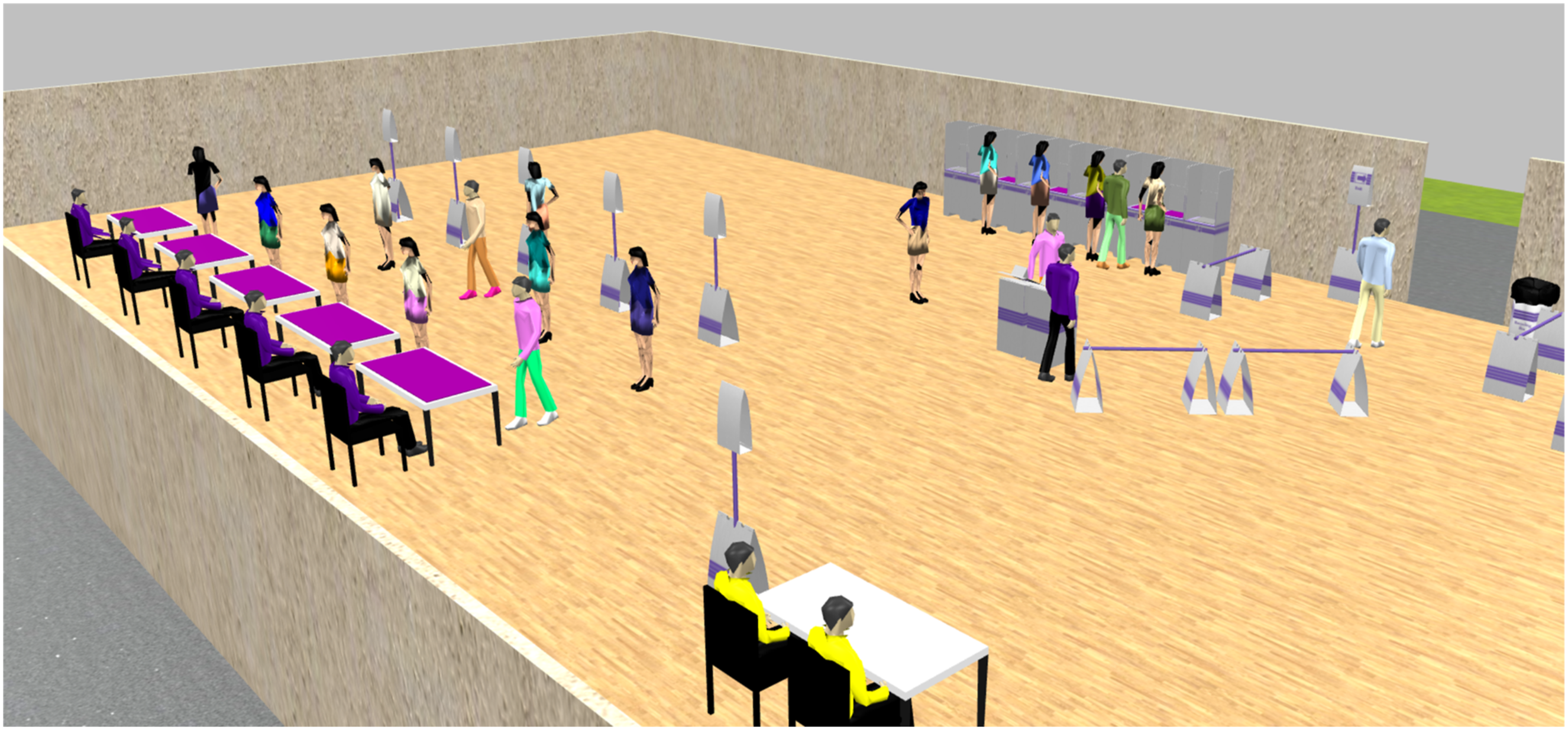
Voter arrival patterns were derived from empirical data collected during the 2017 Bennelong by-election. These data indicate significant peaks in voter turnout, particularly during the morning and around midday. In addition to arrival patterns, detailed time profiles were collected for several key tasks in the voting process, including the time required to look up a voter on the certified or electronic certified list, the time taken by issuing officers to issue ballots and explain the voting procedure, and the time needed for voters to complete their ballots at voting screens. These time distributions were incorporated into the model to more accurately represent process durations and variability.
Voters are represented as individual agents, each assigned specific attributes such as arrival time and vote type. In accordance with Australian federal election procedures, votes may be classified as either ordinary or declaration. Declaration votes are submitted in envelopes, while ordinary votes are placed directly into ballot boxes. It is assumed in this study that 10 percent of voters cast declaration votes, while the remaining 90 percent cast ordinary votes.
This simulation framework is utilised to evaluate various polling station configurations under differing workload and staffing scenarios. Performance metrics such as average waiting time, maximum queue length, and total system throughput are assessed to inform evidence-based recommendations for operational improvements and enhanced voter experience.
Problem Description
The problem addressed in this study involves optimising the configuration of a polling station using a multi-objective approach. Multi-Objective Optimisation (MOO) refers to scenarios in which two or more conflicting objectives must be simultaneously minimised or maximised. Unlike single-objective optimisation, which results in a single best solution, MOO produces a set of trade-off solutions known as the Pareto-front, as given in Eq. (1) for m number of objectives.

These solutions are non-dominated, meaning that improving one objective would worsen at least one other, as per Eq. (2). 1. Minimise the maximum voter queue waiting time, and 2. Minimise resource usage, specifically the number of ordinary ballots issuing points and declaration ballots issuing points.

These objectives can be broadly interpreted as a trade-off between cost and time: reducing voter waiting time generally requires more staffing and infrastructure, thereby increasing operational costs. Conversely, minimising resources may lead to longer waiting times.
To ensure the practicality of the solutions, a hard constraint is applied: the average queue waiting time must not exceed 25 minutes. Solutions that violate this constraint are considered infeasible and are penalised.

Decision Variables.
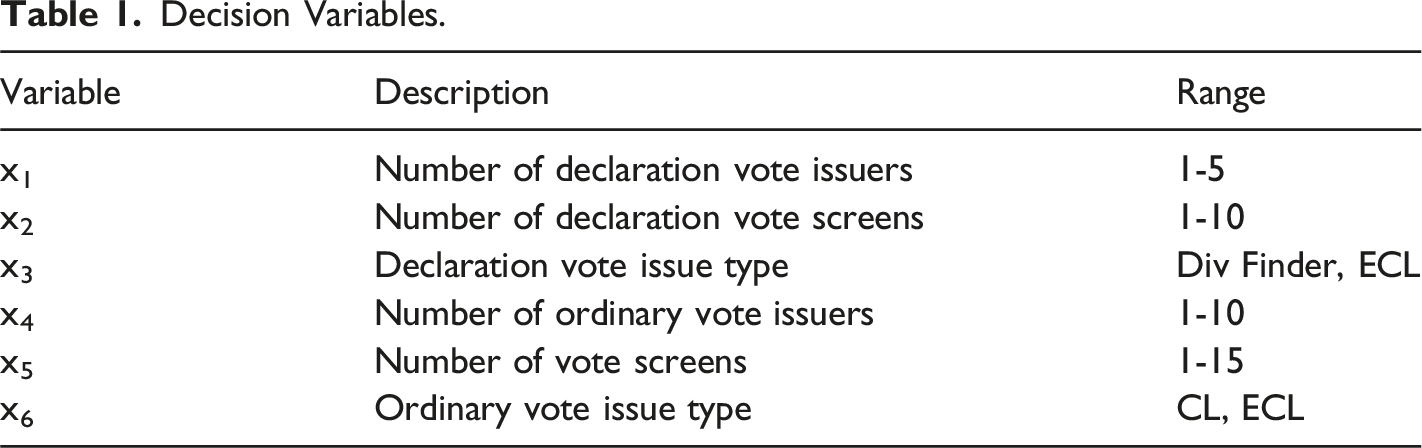
The decision variables include the number of issuing points for both ordinary and declaration votes, as well as the number of voting screens. Two additional variables define the method used to look up voter details at the ordinary and declaration issuing points. The type of issuing point is a critical factor, as the time required to retrieve voter information varies significantly depending on the method used.
Multi-Objective Evolutionary Algorithms
Three state-of-the-art multi-objective algorithms are used to find the best performing algorithm for this problem and best solution.
NSGA-II
NSGA-II (Deb et al., 2002) uses Simulated Binary Crossover (SBX) and Polynomial Mutation operators to generate offspring solutions. The SBX operator creates new solutions close to the parent solutions while maintaining population diversity. Similarly, the Polynomial Mutation operator perturbs variables based on a non-uniform polynomial probability distribution, enabling local search in the vicinity of the parent solution. In each generation, the offspring population is combined with the parent population and ranked into non-dominated fronts using a non-dominated sorting method. A solution a is said to dominate solution b if and only if a is no worse than b in all objectives and strictly better in at least one. Selection for the next generation is based on both the non-domination rank and a crowding distance measure, which helps maintain solution diversity across the Pareto-front.
SPEA2
SPEA-2 (Zitzler et al., 2001) employs a fitness assignment scheme that calculates the strength of each individual based on the number of solutions it dominates. To maintain diversity, the fitness function also includes a density estimation term, which penalises individuals in crowded regions using the distance to their kth nearest neighbour in the objective space. SPEA2 incorporates elitism through an external archive that preserves the best-performing solutions across generations, replacing them only when superior solutions are found. Similar to NSGA-II, this study utilises the same variation operators for SPEA2 to generate new offspring solutions.
IBEA
As the name suggests, IBEA (Zitzler & Künzli, 2004) assigns fitness to solutions based on a quality indicator that measures each solution’s contribution to the overall population quality. Instead of explicitly ranking solutions into Pareto-fronts, IBEA iteratively removes the least contributing solutions, prioritising those that maximise the improvement of the population’s quality indicator. Commonly used indicators include the hypervolume indicator and the ε-indicator. To generate new offspring solutions, IBEA typically employs SBX and Polynomial Mutation operators, similar to NSGA-II and SPEA2, enabling effective exploration and exploitation of the solution space.
Experimental Settings
Evolutionary Algorithm Parameter Settings for all Algorithms.
Normalisation of Objectives
It is necessary to normalise objectives to a common scale because they often have different ranges. Without normalisation, this disparity can introduce bias in the calculation of performance indicators such as hypervolume. By mapping all objective values to a standardised range, normalisation ensures that each objective contributes fairly to the evaluation process. This involves identifying the minimum and maximum values for each objective and computing the normalised values using Eq (4). These minimum and maximum values are updated regularly as the solutions converge toward the optimal front.
Hypervolume Indicator
The Hypervolume (HV) indicator measures the volume of the portion of the objective space dominated by the obtained solutions and bounded by a reference point z
nadir
, as given in Eq. (5). In the implementation, the reference point is set at 110% of the worst observed objective values to ensure it lies beyond the Pareto front. In this study, the hypervolume is computed using the PISA Hypervolume (Bleuler et al., 2003) method. A larger hypervolume value indicates better convergence to the true Pareto-front as well as a more diverse and well-spread set of solutions.
Results & Discussion
The experiment was conducted for polling stations with an expected number of votes ranging from 600 to 2000, in increments of 100. For each voting scenario, optimal resource configurations were obtained using three different MOEAs. The set of trade-off solutions produced by each algorithm was evaluated using the hypervolume quality metric.
Hypervolume Metric.
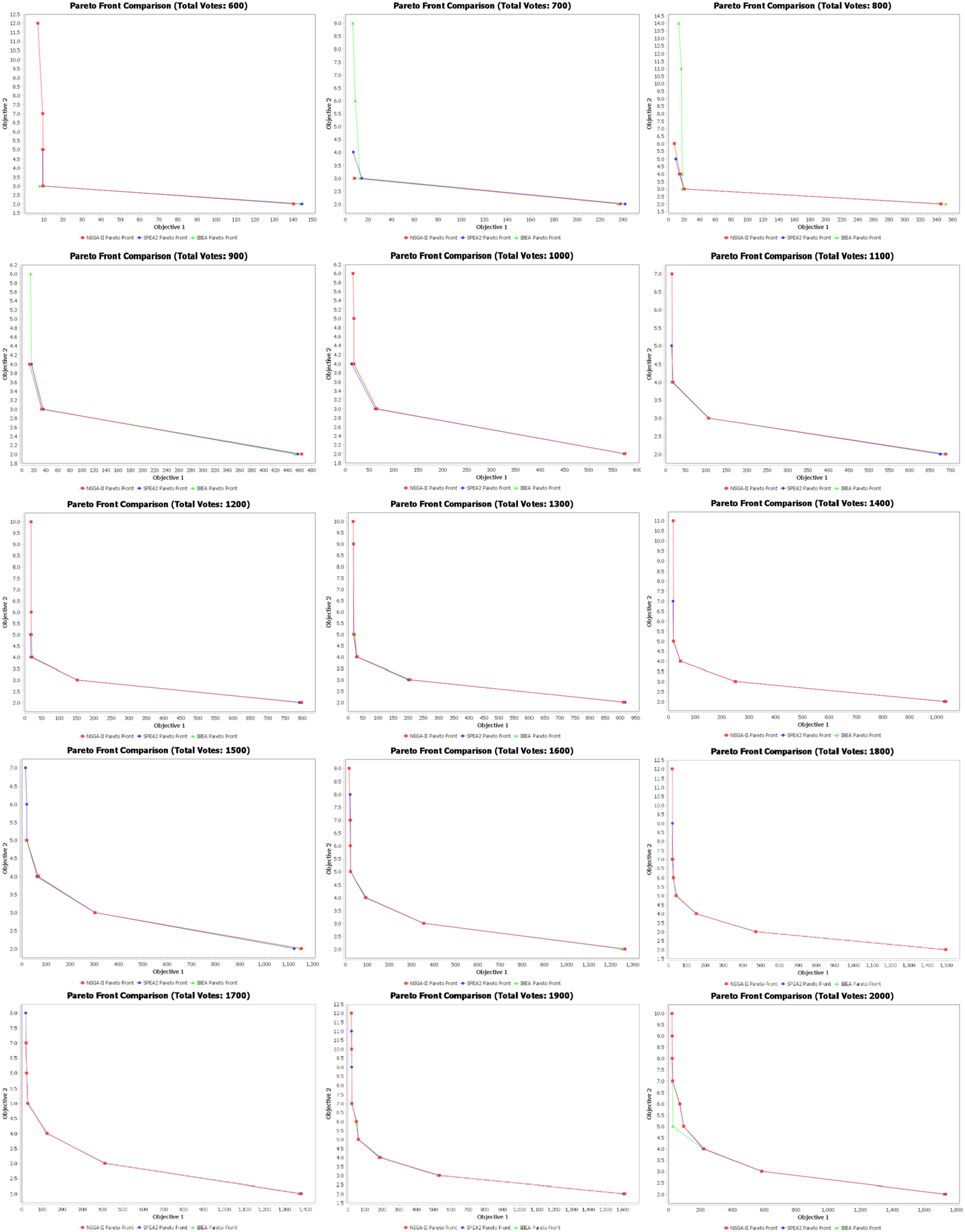
Pareto-fronts comparisons for the polling station voter count 600 - 2000. Here, Objective 1 is maximum queue waiting duration in minutes and Objective 2 is total number of ordinary and declaration ballot issuing points.
The trade-off solutions also highlight the marginal impact of adding or removing a single ballot issuing point, especially during peak hours. Since long queues mostly occur during these peak times, while during off-peak hours staff are often underutilised, these results can guide decisions not only about optimal staffing levels but also about scheduling staff breaks. Understanding the timing and intensity of voter arrival and service demand is essential for effective and informed planning of polling station operations.
Conclusion
Voter queuing at polling stations is a well-known challenge worldwide, and numerous studies have addressed it by modelling and simulating voting operations to identify bottlenecks. In this study, we advanced the state of the art by applying a multi-objective optimisation algorithm to determine the optimal allocation of resources aimed at minimising the maximum voter waiting time. Our approach produced a set of trade-off solutions for a range of polling station sizes, from 600 to 2000 voters. We also compared the performance of different MOEAs in terms of convergence and solution diversity. The results showed that both NSGA-II and SPEA2 performed similarly in identifying high-quality Pareto-optimal solutions.
As part of future work, we plan to enhance the model by incorporating different voter task profiles, such as time spent at the mark-off point and voting screens based on the type of election and number of candidates. Additionally, we aim to explore the effectiveness of many-objective optimisation algorithms (Khan et al., 2016, 2017, 2019a, 2019b) in tackling the resource allocation problem at a larger scale.
Footnotes
Declaration of Conflicting Interests
The authors declared no potential conflicts of interest with respect to the research, authorship, and/or publication of this article.
Funding
The data and simulation models used in this study were developed as part of an AEC-funded project at Deakin University. The optimisation analysis and manuscript preparation reported in this article were conducted without additional external funding.
Informed Consent
This research was approved by the Deakin University Human Research Ethics Office (Reference: STEC-35-2017-JOHNSTONE) and conducted in accordance with the Deakin University Human Research Ethics Code of Conduct.
