




Abstract
Background
City simulation games provide players a gaming experience by simulating different aspects of the real city. While there is an increasing scholarly interest in games for social learning and education, little research has been conducted to understand citizen perceptions and understanding of urban planning issues in city simulation games.
Aim
This study aims to understand the affective perception and cognitive learning of citizens regarding urban planning elements in the online communities of Cities: Skylines.
Research Methods
We develop a new methodological approach based on social media data analytics. Large datasets were scraped from Reddit, the most popular social media platform for video game players. The collected data were subjected to content analysis and sentiment analysis that identify different types of topics and emotions to understand citizens’ cognitive and affective perspectives.
Key Findings and Conclusion
The findings show that positive emotions were often about the game design, while negative emotions conveyed real-world planning problems such as transportation concerns. The cognitive dimension uncovered citizens’ urban recognition tied to personal experiences in various geographical contexts. This study has practical implications for game design for urban planning.
Keywords
Introduction
Interest is growing in games for social learning, education, training, and participation (Haahtela et al., 2015; Ampatzidou et al., 2018; Aguilar et al., 2021). Urban gaming simulations appeared in the early 1960s. They became tools for simulating the effects of decisions made by people allowing an understanding of the realm of complexity, the interconnections between the different parts, and the characteristics of the emerging social system (Cecchini and Rizzi, 2001). They are urban training tools for planners and administrators, learning tools for students, and research tools for scientists (Cecchini and Rizzi, 2001). However, the urban gaming simulation is a broader concept than the city simulation game, which focuses on urban planning and policies relevant to citizens’ daily lives. Several studies have highlighted the features of city simulation games. City simulation games provide an opportunity to extensively engage diverse social groups in various social and geographical settings and understand their different opinions, emotions, and experiences of planning problems (Tanes & Cemalcilar, 2010; Terzano & Morckel, 2017). They can provide players with a gaming experience by simulating different aspects of the real city. Players can act as urban planners or city authorities to plan the city to meet citizens’ needs. Duke & Geurts (2004) highlight that city simulation games can have a policy exercise that aids policymakers with a specific issue of strategic management. Duke (2011) further indicates that city simulation games can become instruments that improve communication in complex policy decision environments and help a group of actors achieve consensus through the multilogue mode of communication. Bhardwaj et al. (2020) envisage the gamified experience as a tool for creating collective dreaming blueprints, allowing communities to better articulate and facilitate communication in urban planning. City simulation games are also within the larger category of video games that invite players to explore, consume, and experience virtual universes (Shaw & Warf, 2009). Despite the growing scholarly interest in city simulation games, a unified definition has yet to be established. Drawing on the mentioned studies, we define a city simulation game as “a game that supports the management, governance, and development of a city, and facilitates participation, communication, and collaboration in planning and design processes”.
City simulation games can be divided into two types based on their intended use: serious city simulation games and commercial city simulation games. The existing study on city simulation games often refers to serious games, which are designed and used for a primary purpose other than pure entertainment (Robinson et al., 2021). Serious games sit at the intersection of educational content, games designed with a serious purpose in mind, and game techniques (Robinson et al., 2021). They can be designed and used to support visual expression of information, learning processes, playful public participation, communication between the public and professionals, collaboration mechanisms, and interactivity in planning processes (Poplin, 2012). However, little research focuses on the educational potential of commercial city simulation games such as SimCity and Cities: Skylines, which are primarily created for entertainment purposes. It is worth exploring the extent to which these commercial city simulation games educate players to understand city and planning problems. The existing studies on commercial city simulation games have also mainly examined the role of games in persons in formal education, such as adolescents (Tanes & Cemalcilar, 2010) and urban planning master's students (Khan & Zhao, 2021). Little research has been conducted to understand the influence of games on citizen perceptions and understanding of urban planning issues (Tóth, 2015). Furthermore, most studies have used traditional methods such as interviews or questionnaires to survey a small group of people (Tanes & Cemalcilar, 2010; Khan & Zhao, 2021). There is also a lack of understanding of the interactions and communication between game players, which are essential parts of games.
To explore the impact of games on player perceptions it is essential to understand the interaction among the players in the game world. Chou (2019) argues that one drive for playing games is social influence: the drive to interact with, help, learn from, and compete with others. When a game is developed, its designers come up with some core gameplay mechanics. While players are playing games, however, they tend to use their strategies and ideas. Bowen (2015) indicates that games could be used as a medium of expression to create players' own stories and new cultural artifacts. Models of collective behavior, social knowledge, and community outcomes emerge based on players' decisions (Aguilar et al., 2021). As part of the physical feedback loop, social learning and emotional contagion emerge in such game communities (Bernhaupt, 2010). In recent years, social media platforms have become increasingly important for interactions between numerous players (Shakeri et al.,2015). Yet few studies have used social media data as a source to understand the impact of games on players’ perceptions (Shakeri et al.,2015).
This study aims to understand the affective perception and cognitive learning of citizens regarding urban planning elements in the online communities of Cities: Skylines - a commercial city simulation game that receives significant public attention and is played by a wide range of players from many countries. It bridges the gaps between city simulation game studies, planning literature, and social media data analytics. Furthermore, this research develops a new methodological approach that collects large datasets from a social media platform and combines content analysis with sentiment analysis to understand citizen perceptions of urban planning. Additionally, this study has practical implications for game design and urban planning.
The paper has five sections. Section 2 reviews existing studies on city simulation games, urban planning elements, affective perception, and cognitive domain. Section 3 presents the methodological steps: data collection, data cleaning, and data analysis. Section 4 explains the results, emphasizing the topics of posts and the discussions in the comments. Section 5 discusses the study's key findings and their practical implications.
Theoretical Background
City simulation games and urban planning
In simulation games, players can travel through history and experience different professional identities and even a new life in a virtual world. City simulation games provide an opportunity to extensively engage various social groups in diverse settings and understand their opinions, emotions, and experiences of planning problems (Tanes & Cemalcilar, 2010; Terzano & Morckel, 2017). City simulation games are a type of simulation game in which players act as urban planners or public authorities to meet the needs and desires of citizens by planning a city, building infrastructure, making policies, and so on. One of the first city simulation games was SimCity; it was created in 1989 and simulates the interaction of private and public land values and uses with the public budget in the city (Gaber, 2007). Nowadays, the most popular city simulation game is Cities: Skylines. It is more complex and has more options for players to experience the city.
The existing studies on city simulation games focus mainly on three main areas: game behavior, game design and development, and games' external influences and applications (Ash & Gallachel, 2011; Shaw & Warf, 2009; Droll & Söbke, 2021). Initially, the behavior of gamers was seen as a cultural, geographic practice (Ash & Gallachel, 2011). Scholars have discussed various aspects of representation and politics, production and consumption, technocultural practices, and emotions from a geographical perspective (Shaw & Warf, 2009). A large body of research also focuses on the structural optimization of city simulation games (Harteveld, 2011; Poplin, 2012). The design of the game elements is crucial in shaping user experiences of certain planning issues such as transportation. Harteveld (2011) indicates that any game is designed with a certain kind of purpose in mind. He refers to “designed” to highlight that the initiators have consciously considered how to develop, modify, or use a game within a certain setting to achieve a specific purpose that extends beyond the game itself. Furthermore, playfulness can potentially address the issue of rational ignorance by attracting more people to participate in games and learn about urban planning issues (Poplin, 2012). Playful activities in games are structured: they have clear rules that guide participants in what happens through the activity, enabling designers to direct the experience toward something meaningful (Harteveld,2011). Moreover, a crucial factor for examining game design is the degree of consistency between the simulation models used in games and the real-world systems that they represent (Droll & Söbke, 2021). For instance, Olszewski et al. (2020) focus on the coding and analysis of social and ecological issues in game design, which has important implications for social education, urban planning, and shaping visions of urban development.
A growing body of literature has highlighted that city simulation games can be used as decision-making tools to support communicative and participatory processes in urban design and planning. Public participation has become increasingly important to obtain information from citizens, increase public awareness of planning issues, and address complex problems in planning practices. Digital technologies have the potential to fulfill different participation needs, such as informing, consulting, involving, communicating, collaborating, and empowering citizens to influence decision-making (Pflughoeft & Schneider, 2020). For instance, Jutraz & Zupancic (2015) indicate that city simulation games can help citizens better understand planning proposals and express their opinions, and improve their communication with professionals in the urban design process. The book of Kaneda et al. (2016) presents several examples of city simulation games that are used to support communication, collaborative practices, and decision-making processes. Tan (2017) sheds light on the applications and outcomes of city gaming in diverse planning practices in cities such as Shenzhen, Cape Town, Amsterdam, and Istanbul. City simulation games can encourage public participation in urban planning and improve public understanding of the planning process (Poplin, 2012; Aguilar et al., 2021). In city simulation games like Metropolis, cities can be adapted to citizens’ needs, and gaming can be used as a mechanism for democratic urban decision-making (Aguilar et al., 2021). In recent years, such games have become a new way to engage citizens in digital placemaking practices. Virtual collaboration and social participation in city simulation games are communication bridges that promote equal public participation in urban planning (Jutraz & Zupancic, 2015). They are crucial to creating resident-friendly environments (Olszewski et al., 2020). City simulation games provide new ways to engage and educate citizens in the planning process and raise their awareness of planning issues (Tóth, 2015). They can be used for policy simulation and to improve communication among various actors to achieve consensus in complex decision-making processes (Duke, 2011).
In recent years, the application of commercial city simulation games has received much attention. Although they were designed only for entertainment, researchers still found their educational function which serious games usually have. As a pedagogical tool (Bereitschaft, 2021), such games can improve students’ abilities in systems thinking, problem-solving, creativity, and regional understanding in the planning classroom (Terzano & Morckel, 2017). They can also influence students’ interest in planning and their perceptions of the subject. For master’s students in geography, it is essential to bridge the gap between the knowledge and skills acquired in the game and the real-life environment (Khan & Zhao. 2021). Tanes & Cemalcilar (2010) studied Turkish adolescents who play SimCity and found the game could change their expectations of an ideal city and their perceptions of urban issues.
Urban Planning Elements
In city simulation games such as SimCity and Cities: Skylines, players can build housing, infrastructure, public facilities, and many other components of built environments (Gaber, 2007; Bereitschaft, 2021). These components are related to urban planning. As a general classification, Jurkovič (2014) divides the elements of urban planning into two aspects: physical environment and social environment. Safee et al. (2015) compare several traditional planning theories and summarize several elements of good city planning: community life, sense and identity of place, livability, sidewalks, the built environment, density, and environment. The built environment includes the characteristics of neighborhoods, different types of buildings, and public spaces. The environment includes many environmental factors affecting the relationship between natural and human systems, such as pollution and natural disasters. Demographic changes and economic activities are also crucial to urban planning. Besides, Neuman & Smith (2010) emphasize the relations between urban planning and different types of infrastructure such as transportation, drainage channels, and communication systems. Infrastructure deals with the basic facilities and systems that serve the cities and their citizens. Several recent studies have analyzed users' perceptions of different means of transportation such as cycling (Aziz et al.,2018), walking, and driving (Knupfer et al.,2018).
Few studies have examined how commercial city simulation games, such as City Skylines and SimCity, can help students develop spatial reasoning and creativity (Bereitschaft, 2021). Although these games are usually used for entertainment and commercial purposes (Kaneda et al., 2016), they have the potential to influence players' perceptions of urban planning, especially when the game design implicitly incorporates a selection of planning concepts and elements. For example, SimCity encourages the separation of residential, industrial, and commercial areas, reflecting typical rational planning principles (Bereitschaft, 2021). This approach to planning is based on rational, logical, and scientifically factual decisions with little or no emphasis on values and participation. Cities: Skylines is empowered by complex agent-based models capable of simulating the movement and activities of thousands of individuals, who use different methods of transportation and travel between living places, working places, and daily activities (Haahtela et al., 2015). It has the potential to create transit-oriented development (TOD), a planning approach that integrates transportation infrastructure with residential, commercial, and recreational spaces (Calthorpe, 1993). TOD emphasizes walkable, vibrant, and mixed-use communities that encourage people to live near public transit services and to decrease their dependence on driving, thereby promoting sustainable development. TOD is also related to New Urbanism which promotes walkable neighborhoods, mixed-use development, public transportation, and sustainable urban planning practices (Grant, 2009). However, urban planning in the real world is usually more complicated. Minnery & Searle (2014) indicate that the simplification of reality (through abstracting, quantifying, and simulating the complex dynamics of city development) in city simulation games may mislead players in their understanding of how a city works and so might be planned. This calls for more research to examine players' perceptions and understanding of urban planning through playing games.
Cognitive and Affective Dimensions
Based on the experiential learning model, Khan & Zhao (2021) evaluate the effectiveness of the simulation game Cities: Skylines for teaching urban planning disciplines from the perspective of students, emphasizing cognitive, behavioral, and affective learning outcomes. They indicate that experiential learning exists when an individual cognitively, affectively, and behaviorally processes knowledge, skills, and attitudes in a learning situation. They argue that experiential learning can bring out better conceptual understanding, critical thinking and problem-solving skills, a higher level of self-confidence, and learning enhancement. In this study, we focus on cognitive and affective dimensions, which are crucial to examining players’ understanding or perceptions of urban planning as expressed in online communities. • Cognitive dimension
The cognitive dimension refers to players’ conceptual understanding and knowledge of urban planning. Khan & Zhao (2021) point out that the cognitive dimension relates to the mental process involved in knowing, learning, and understanding things. They indicate that Cities: Skylines can enhance students' conceptual knowledge of sustainable development since the game helps them understand its effects through visualization and monitoring. Other studies have also explored the cognitive dimensions of sensitivity to different urban issues, community and government thinking, and people’s expectations of the ideal city (Tanes & Cemalcilar, 2010). In addition, gaming-affected awareness can also be seen as an aspect of the cognitive dimension. Bagley & Shaffer (2009) analyze the promotion of civic thinking through epistemic gameplay. They find that the participants begin to see the city as a complex system and to understand how planners make changes. City simulation games can help players develop civic awareness and participation awareness (Tanes & Cemalcilar, 2010; Haahtela, et al. 2015). Based on existing studies, this research considers the cognitive dimension in terms of sensitivity to various urban issues, knowledge of urban planning, and expectations of the ideal city. These aspects may be different due to individuals’ locations and life experiences. We measure these differences by analyzing discussions and self-descriptions in the text of comments. • Affective dimension
An affective dimension can include different types of emotions, attitudes, and senses (Haahtela, 2015; Bernhaupt, 2010). Playing urban planning games can change feelings of safety and anomie (Tanes & Cemalcilar, 2010). Khan & Zhao (2021) find that urban planning games improve students’ interest and motivation and their sense of happiness and satisfaction relating to real-life urban planning. Intrinsic and extrinsic motivation are two branches of affective expression extensively studied in various contexts. Haahtela et al. (2015) emphasize that in the realm of educational gamification, student motivation tends to be predominantly extrinsic, focusing on task completion. Ideally, however, motivation should be intrinsic, arising from the inherent pleasure or satisfaction derived from completing a task. While intrinsic and extrinsic motivation are typically analyzed through qualitative research such as interviews, our research employs social media data analysis to examine affective expression. To adapt our methodology to this context, we consider the affective dimension through three emotional aspects: positive, neutral, and negative, which are measurable via text analysis. Given that players interact on social media, we also account for emotional contagion within online game communities, examining how players’ discussions influence the overall affective atmosphere.
Methodology
Case Selection--- Cities: Skylines
Most studies of city simulation games have investigated SimCity (Eilers, 2014; Terzano & Morckel, 2017), but this study uses one of the most popular contemporary city simulation games: Cities: Skylines—a single-player open-ended city-building game. One reason for choosing this game is its popularity: its broad audience and communities on many social media platforms make it easy to collect large social media datasets about player interactions. Another reason is that as the latest generation of urban planning games, its planning operations and city simulations are very professional. The game's core objective is to simulate a city of one million people. The game is good at simulating the traffic and transportation system of a city, making it possible to simulate accessibility efficiently (Haahtela et al., 2015). Players also have to balance other basic aspects of a city such as education, water, electricity, police and fire services, and sanitation (Garbizu, 2021). They can engage in urban planning by controlling zoning, public transportation, taxation, and public services. They can also act as the mayor and manage various elements of the city, such as the budget, health, employment, and pollution.
Data Collection and Analysis
The methodological approach developed for this study involved collecting data from a social media platform, discarding unrelated or duplicate data, and then analyzing data content and sentiment. Among the three popular social media platforms for video game players, the discussions on Steam are mostly about technical problems of games, while Discord contains more voice data in the form of a chatting room. Reddit, which is a platform where players choose to discuss specific topics, due to its open sharing, posting, and commenting, was chosen for data collection. Using MiniRPA software we harvested numerous posts from Reddit related to Cities: Skylines (https://www.reddit.com/r/CitiesSkylines/). The data collected per post comprised the title, type, user nicknames, number of comments, number of reads, and the content of comments. To take advantage of the high number of players and posts around New Year, data collection began November 15, 2022, and ended February 15, 2023. MiniRPA ran every 24 hours to collect renewed data every day. In total, we collected 7879 posts and around 100,000 comments on them. We then cleaned the data, deleting some official accounts, retweets, and repeat posts. We finally selected 2598 posts and around 50,000 comments for topic classification. To protect online users’ privacy, their user nicknames were replaced with number codes.
The collected data were subjected to content analysis and sentiment analysis. We classified and extracted meaningful information from unstructured text using GooSeeker software and NVivo for analysis. The analysis had two steps. In the first step, we focused on the titles of each post, doing keyword analysis and topic classification to explore the main urban planning elements that players discussed in the online gaming community. First, the content of the 2598 posts was imported into GooSeeker for keyword extraction and analysis, filtering 1882 nouns among the keywords. We then input the Excel generated by Gooseeker into weiciyun.com to create the word cloud. We found the most frequent keywords used in the post titles. We used these keywords to identify key topics referring to the urban planning elements. Each topic consisted of several key terms. In the second step, we selected the post about the most mentioned topic with the most comments, exploring players' understanding of planning issues in different regions We analyzed the comments under this post through sentiment analysis to understand players' affective perceptions. We used GooSeeker to analyze the sentiment value of the comments. In each sentence, the sentiment(s) expressed were classified as neutral (sentiment value=0), positive (sentiment value>0), and negative (sentiment value<0). Additionally, we used Nvivo to analyze these comments to ascertain players' cognitive perspectives.
Results
Urban Planning Elements in an Online Gaming Community
Keywords About Urban Planning
As mentioned above, a total of 2598 posts and around 50,000 comments under these posts were used for content analysis. GooSeeker yielded 4612 keywords, of which 3641 remained after filtering out the numbers and URLs. Since this study mainly focused on the urban planning elements that players were concerned about, we primed GooSeeker to filter 1882 nouns among these keywords. Figure 1 shows the word cloud containing the top 150 noun keywords. The top 150 keywords in the 2598 posts.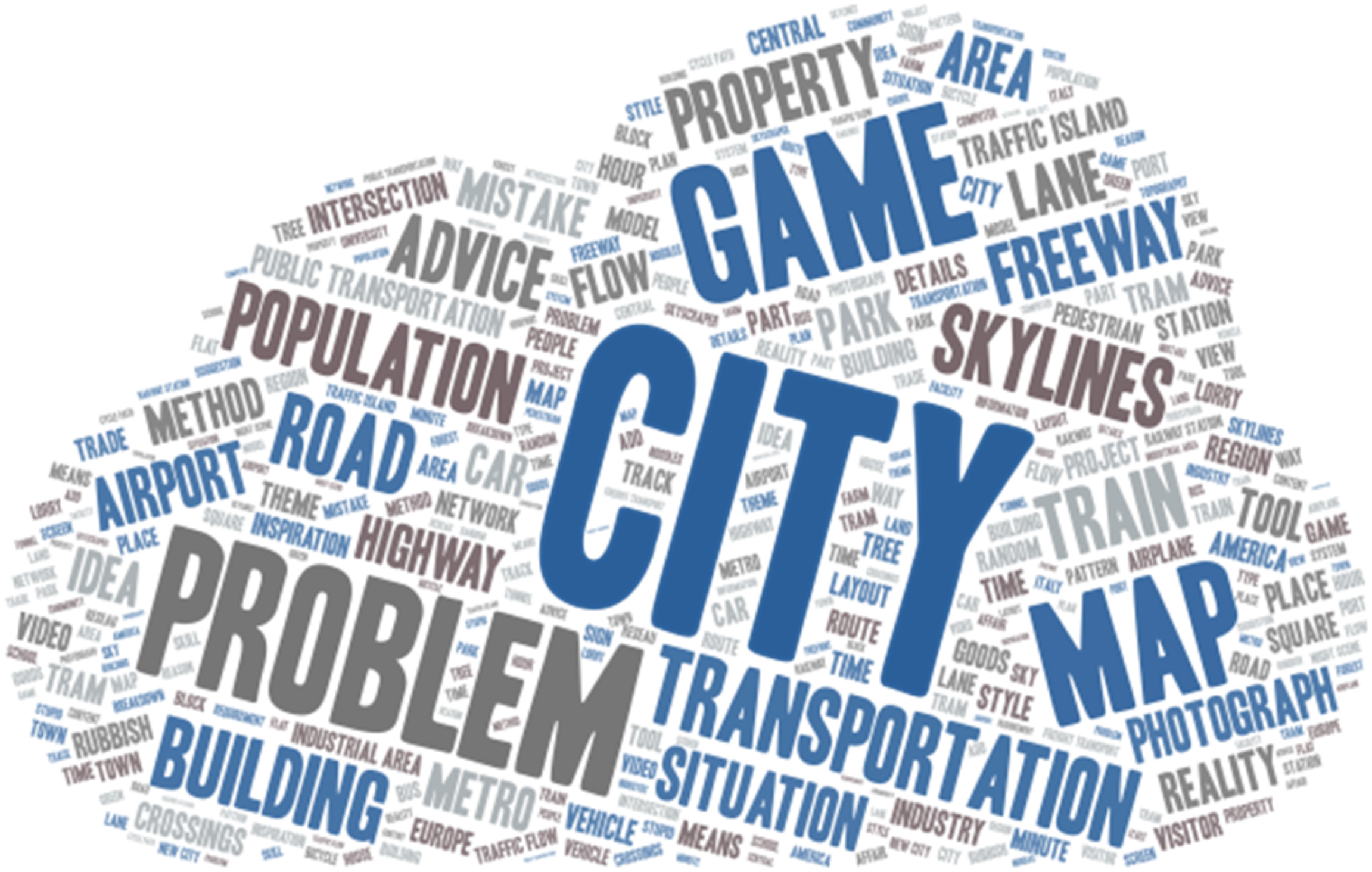
The word cloud shows much content about urban planning. Some players shared the “city” they built and expressed their feelings, e.g., “pedestrian streets are the best streets” (player 1), and “having a lot of fun making this city” (player 2). The high frequency of the keywords “problem” and “advice” shows many players asked for advice and solutions to address problems they faced in the game. They stated: “I'm detailing a British-style village and have an empty spot. What should go here? Ideas welcome” (player 3), and “Is this too car-centric” (player 4). Furthermore, many country or region names were keywords, among them (in decreasing order of frequency) “America”, “Europe”, “Italy”, “Korea”, “France”, “Japan”, “UK”, “Germany”, “Netherlands”, and “Arabia”. Players also mentioned some real cities, such as “Chicago” and “Miami”. It can be assumed that the city simulation game encourages players to speculate on real urban issues relevant to their cities or countries to some extent. This perspective is further explored in the cognitive analysis below, based on the texts of selected comments.
Two tendencies in designing cities were inferred from the posts referring to real cities: the reproduction of real cities, such as a post that said, “Throwback to port Miami, Miami 1:1 project” (player 5), and the creation of ideal cities, as when player 6 “started a new city inspired by the proposed megaproject, ‘The Line'—an eco-friendly linear city of the future in the Arabian desert”. Players expressed their imagination and creative thinking about city design in the form of a game. They had lively discussions about the various elements of urban planning.
The Most Mentioned Element: Infrastructure Construction
Topics about urban planning elements.
* The total percentages are not 100% because one post can include more than one topic or no topics.
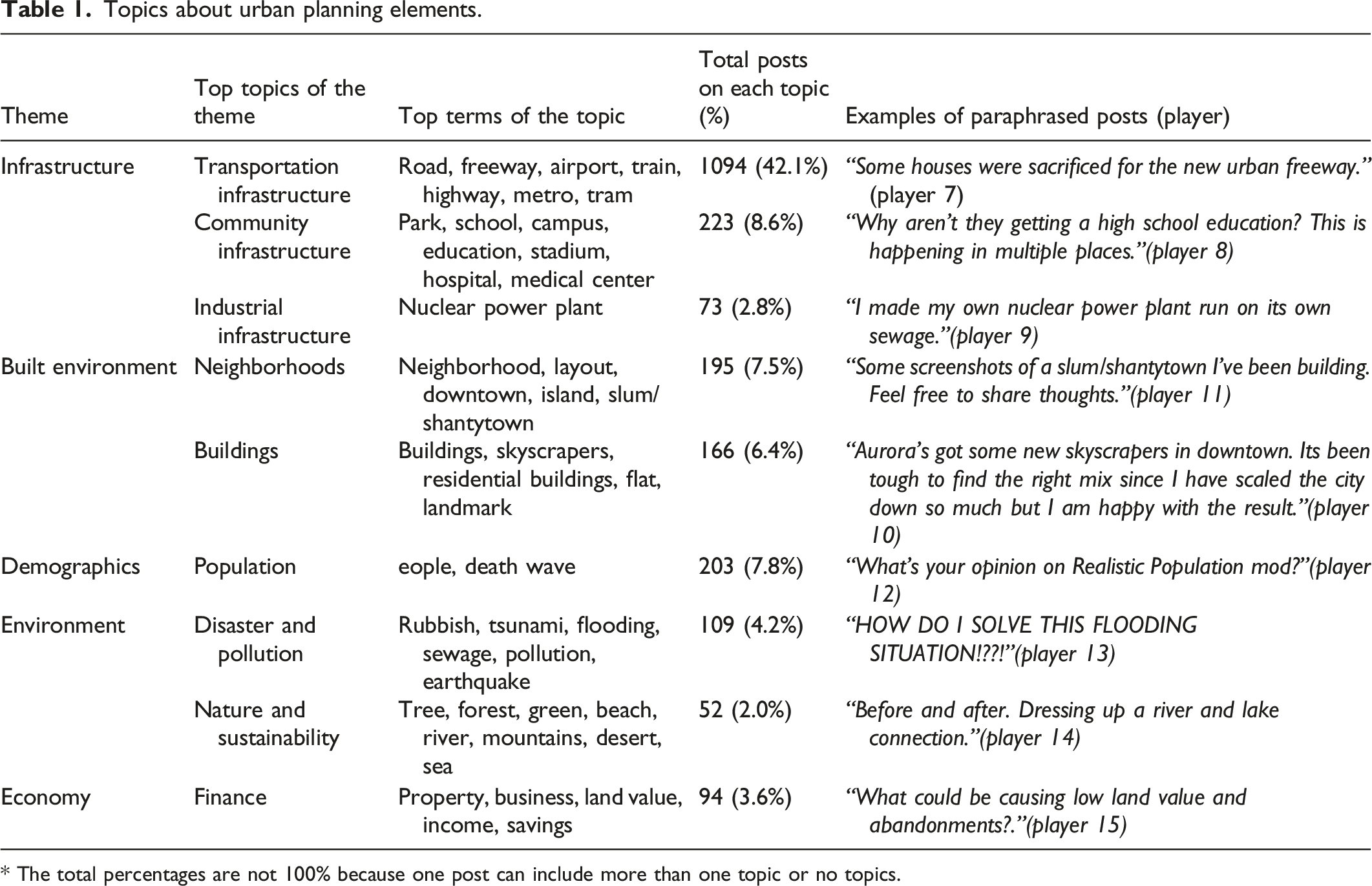
Among all the urban planning elements in Table 1, the element most mentioned by the Cities: Skylines players was infrastructure, especially transportation infrastructure (mentioned in almost half the posts). The main reason for concern about transportation is that the game design and content of Cities: Skylines emphasizes transportation efficiency and provides a comprehensive and varied set of transportation facilities. For players, transportation problems were more likely to appear in the simulation process, such as “no one uses public transportation” and “severe traffic jams”. As a result, more players sought help on transportation issues, such as “what is a good way of bringing people into my downtown off the highway without causing traffic jams? (Building a city of 100k+)” (player 16). Also, some players showed an interest in transportation planning: “Does anyone else spend 5–10mins not building anything just admiring your traffic flow?” (player 17)
The theme of the built environment was divided into two topics: buildings and neighborhoods. Players paid the most attention to the topics of neighborhoods: most mentions were made of different actual cities with different types and styles. Some players also showed their creativity in this topic, like “European city meets American skyscrapers”(player 18). The environmental theme mainly concerned the relation between natural and human systems. Regarding the natural environment, more players talked about the negative aspects of disaster and pollution than about the positive aspects of nature and sustainability. Pollution was a key concern of many players when building their cities, especially rubbish and water pollution, as in this post: “Pollution is backing up the river upstream, I’m new, what can I do and how to avoid this?” (player 19). Cities: Skylines made pollution and natural disasters visible, making players aware of changes to the weather and disasters and their impacts on the natural conditions, especially the water system. Most posts focused on the issues related to the game, even though some posts departed from the game and asked fellow players about their views on different urban planning elements. For example, one player asked about others' “thoughts on Urban Freeways” (player 20), and one post said: “During the morning rush hour, would you rather take High Speed Rail or the highway into the city?” (player 21)
Player Perceptions of Urban Planning Elements
To analyze player perceptions about key urban planning elements in depth it was crucial to analyze the comments of important posts. Having found that transportation infrastructure was the most mentioned urban planning element, we selected the transportation-related post attracting the most comments and attention: “What are your thoughts on Urban Freeways?” (player 21). In this post, the player shared the graphics of the freeways in the city he built in Cities: Skylines (Figure 2). This post triggered a lively debate about transportation infrastructure among players from many different places. We collected and analyzed a total of 353 comments under this post to understand player perceptions of transportation infrastructure in terms of affective and cognitive dimensions. The graphics player 21 shared in the post “What are your thoughts on Urban Freeways?”. Source:reddit.com/r/CitiesSkylines/comments/z1z36e/what_are_your_thoughts_on_urban_freeways/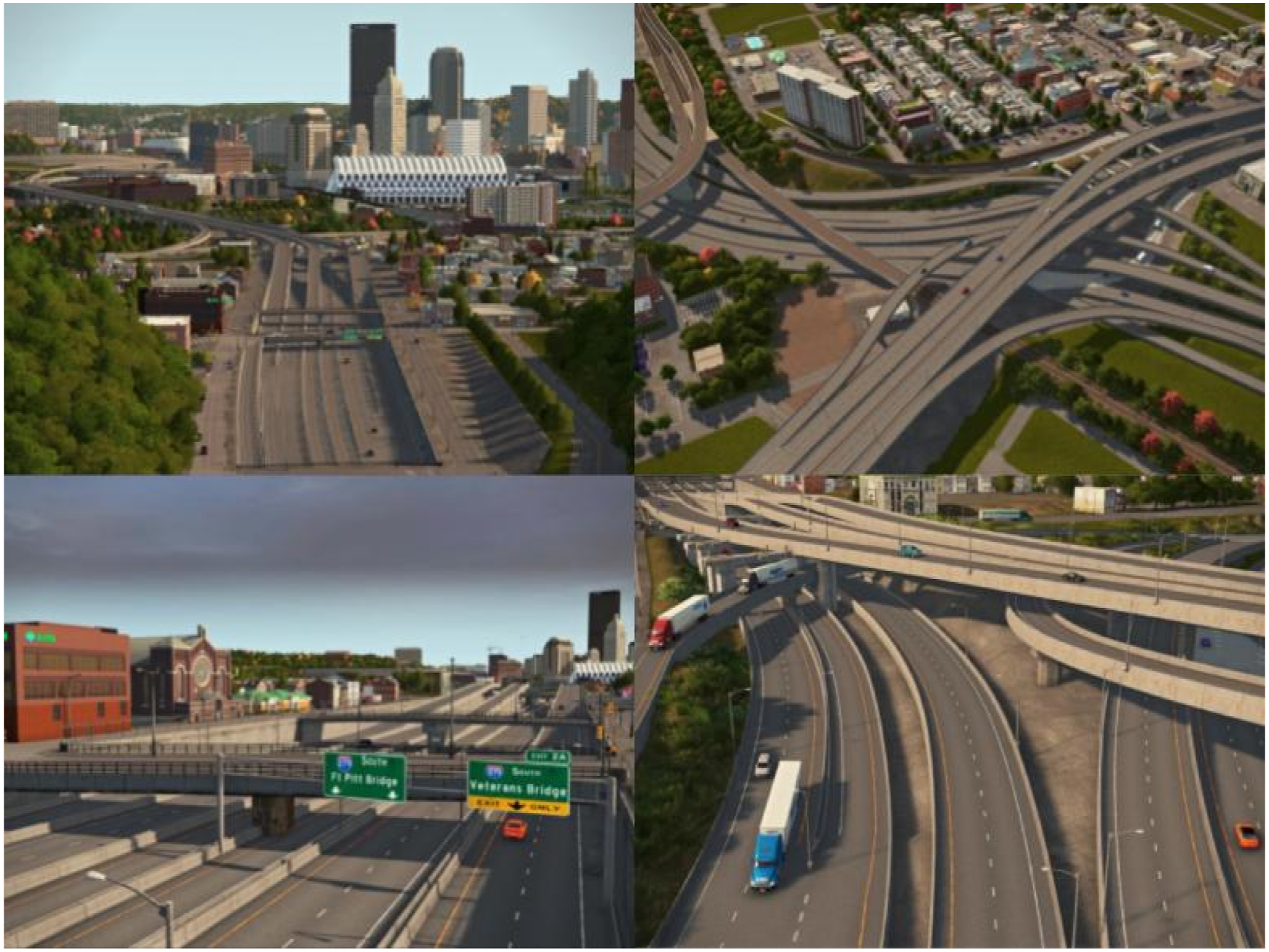
Affective Dimension
From the affective dimension, these 353 comments were analyzed for sentiment value in GooSeeker. The most frequent sentiment was neutral sentiment (sentiment value=0), occurring in 147 posts (41.64%), with key terms such as common and familiar. The positive sentiment (sentiment value>0) came second (132 posts, 37.39%), with key terms such as awesome, glad, interesting, useful, lucky, safe, and efficient. The negative sentiment (sentiment value<0) came last (74 posts, 20.96%), with key terms such as annoying, complain, bad, dangerous, and crazy.
Many players expressed positive feelings about transportation infrastructure. However, it was interesting to observe that most of the positive language did not relate to urban freeways but instead complimented fellow players’ game design, including admiring fellow players’ design creativity, consummate gaming skills, and players’ patience, such as “playing Cities has really given me an appreciation for well-built roads” (player 25) and “this is like a work of art” (player 26). The positive comments included expressions of satisfaction with government initiatives. For instance, a player complimented the government in his country for its great job in focusing more on human beings:
“Yeah, luckily I live in a country where authorities do consider mobility as something more than ‘go vroom’. In many places plans to build monstrosities like those urban highways were canceled in the 60s and 70s, when the population demanded that the cities should be a place to live, not a dead asphalt surface where no living being can survive unless it’s in a car.” (player 27)
The neutral sentiment comments comprised the largest percentage (41.64%) of the 353 comments. They showed that players tended to have different attitudes toward the game’s artwork and real-life urban freeways. Players who expressed both praise for the virtual cities in the game and dislike of real urban freeways in the same comment were judged to be neutral, resulting in a sentiment value of 0. For example, one player said: “Beautiful screenshots. In reality, urban highways are among the worst errors in city planning ever made.” (player 28)
The negative comments focused on real urban transportation problems. Players discussed a wide range of transportation issues beyond urban freeways. For example, some players complained about “car-based infrastructure” and “annoying travel time”. Some players also had negative attitudes toward urban planners and their ideas for urban renewal: “We have one main system that runs through KCMO which all the major highways run through. It's a goddamn mess. I think urban freeways can be good but they’re almost never designed in a way that’s safe, efficient, and not a complete disgusting eye sore on the whole city” (player 29). In these comments, players use words like “dystopian”, “unsafe”, “horror”, “racial motivation”, “splitting or destroying black/Latino neighborhoods” to describe negative perceptions of urban freeways. It was also found that negative emotions were more likely to generate emotional contagion. For instance when one player said “One more lane and it’ be perfect” when one player said ironically “One more lane and it’ be perfect” in the context of increasing the capacity of urban freeways, many players replied with the same sentences to support.
Cognitive Dimension
From the cognitive dimension, we found that players constantly associated real cities with their own life experiences and expressed their views on actual city planning while playing this game. Many players said that the graphics in a particular post evoked memories or reminded them of their hometowns. One player said: “I think these are common in all of America tbh...I only relate it to LA because I lived there for the first 25 years of my life” (player 30), while another player was reminded “so much of the turnpike by New Brunswick”(player 31) and an Australian player added: “Australian too, this looks like the M1–Pacific Highway interchange in Sydney” (player 32).
This urban recognition based on players' life experiences also led to differences in players' views on urban planning issues in different regions. Taking the urban freeways mentioned in this post for example, it is easy to see the contrast between European and American players in their thinking on car-centric design in real city planning. Players from Europe expressed their hatred of urban freeways, pointing out the unsuitable land use and the damage to the city. A European player described urban freeways as “nightmarish, a real scar on the landscape of a city” (player 33). Another player said that urban freeways “will never effectively ease traffic flow because all those cars have to get off at some point and within a city it will bottleneck, not to mention how expensive they are” (player 34). By contrast, most American players saw highways as crucial in urban life, as they thought they were fast and convenient. One player said that urban freeways were “a great way” for him to “get from A to B a few seconds faster, no matter the cost”(player 35). Meanwhile, some held the view that driving in America was safer than using public transport and walking:
“Have you ever taken the LA metro? I have… I do.. I also bike. The west coast isn’t the east coast. The homeless are aggressive and actually dangerous here. You need to be on guard when walking or taking transit, especially if you’re female. Consider yourself lucky if you can just drive everywhere… while the aesthetics of LA are beautiful, the average person on the street makes walking a hazard” (player 37).
Players learned about some key planning concepts, such as “the city center”, “zoning concept”, “cost of infrastructure”, “government funding”, “unlivable land” and “daily commute”. As many typical cities around the world appeared in the discussion on the same topic, players could obtain a global perspective on urban planning and acquire planning knowledge. Players unconsciously reflected their non-professional perspectives on planning concepts through their comments, drawing from their personal experiences. Many of them expressed a tendency to reject urban highways, car-centric infrastructure, and unlivable cities. This indicates a disfavor toward the rational planning model, which emphasizes separated land use, large infrastructure projects, and economic outcomes while often overlooking human and environmental needs. Instead, they appear to support TOD and New Urbanism, as may appreciate walkable, safe, and public transit-oriented cities. Some players also explored and shared their city's history or urban planning projects, which improved players' understanding of planning situations in different places.
“Living in Los Angeles, I have a love/hate relationship with freeways. In the 1970s, 80s, and 90s, freeways were incredibly fast and convenient most of the time. But given the huge population increase, freeways have become a clogged nightmare...” (player 40)
“Utrecht (the Netherlands) is where they torn [sic] down the inner-city highway. In Amsterdam and the Hague, there was the infamous Jonkinen plan that would turn the center of both city centers (including the Amsterdam canals) in [sic] large roads. They completed a fraction of that in the Hague, torn [sic] down large pieces of neighborhoods as well. After the uproar that was caused by that, they didn't even start in Amsterdam. The Hague is still looking for ways to get rid of that highway without causing too much disruptions.” (player 41)
“Since your city is Pittsburgh, people should read up on the Hill District. The lower hill was an epicenter for black culture in Pittsburgh and a major center for jazz music in the country. The area was razed in the name of progress to build these very highways, and it never recovered.” (player 42)
Discussion and Conclusion
Despite an increase in academic interest in city simulation games, most studies have focused on the learning experiences of students and professionals (Tanes & Cemalcilar, 2010; Khan & Zhao, 2021). This study is an attempt to fill in the knowledge gap by exploring citizen perception and understanding of urban planning in the city simulation game Cities: Skylines. We develop a novel methodology to collect and analyze large social media datasets to understand the affective perception and cognitive learning of citizens. Regarding the affective dimension, positive comments are often about the game design, while negative comments convey real-world transportation concerns and display emotional contagion. Regarding the cognitive dimension, players unconsciously reflected their non-professional perspectives on some planning concepts and approaches. The discussion in the online community enables players to share their own life experiences. However, the perception and understanding of certain planning issues are influenced by the player's personal experience, which is often rooted in specific local contexts. This has led to differences in players' views on urban planning issues across different regions.
Overall, our findings suggest that the city simulation game Cities: Skylines can serve as a platform to engage many players worldwide in sharing their playing experiences and discussing planning, allowing them to understand and learn various planning approaches and urban issues. Cities: Skylines reflects aspects of the rational planning model, but also incorporates elements that allow for more diverse planning approaches. The discussion in the online communication reflects that many citizens attempt to dislike the rational planning model emphasizing zoning and land use separation, infrastructure development, and economic efficiency, with little attention to social and environmental needs. They favor more livable and safe cities with environmentally friendly and public-transit-oriented development, which are related to the approaches of TOD (Calthorpe, 1993) and New Urbanism (Grant, 2009). Despite the game is not purposely designed for planning education, it helps citizens to understand planning issues and show their favors or disfavors for certain planning approaches and practices. City simulation games can become a new platform to broadly reveal how non-urban planners perceive urban issues and understand planning approaches.
This study has practical implications for game design for urban planning. Use experiences are substantially influenced by the design of the game. Any game is designed with a certain kind of purpose in mind (Harteveld, 2011). Despite being originally designed as a commercial/entertainment city simulation game, Cities: Skylines also demonstrates the functions of serious games, such as education. Its popularity among non-professional players is largely due to its intuitive, user-friendly interface, and playful elements. Furthermore, the discussions in the online gaming community show that players mainly focus on infrastructure development and management. This is largely due to the design of Cities:Skylines: it simulates the transportation system well by agent-based simulation of citizens in the city, i.e., citizens travel from home to work and to recreation and shopping and use different methods of transportation (Haahtela et al., 2015). This feature of the game also means that accessibility can be measured and transportation problems can be apparent. Through playing the game, citizens can learn and understand the impact of highways and public transit on the city as well as transportation issues. In this regard, the game reflects features of serious games, which are designed and used for a primary purpose other than pure entertainment (Robinson et al., 2021). In urban planning, particular games can be designed to meet a specific planning purpose such as illustrating complex urban issues (e.g., transportation, greening, and/or housing), evoking social learning, or making participation more accessible (Ampatzidou et al., 2018). They can be used to support communication, collaborative practices, and decision-making processes (Kaneda et al., 2016). Despite growing interest in the practical applications of serious games in urban planning, existing research suggests that only a small number of programs have adopted serious games in practice to support citizen participation (Aguilar et al., 2021). The design and use of serious games and other digital technologies in planning practice face several general challenges. These include addressing inexperienced planners, resource constraints, poor accessibility, and low usability (Ampatzidou et al., 2018; Geertman and Stillwell, 2020). The latter is often caused by issues such as poor user interfaces, a lack of playfulness, and other related factors. We acknowledge that serious games may struggle to match the interface and platform sophistication of commercial simulation games due to constrained resources and financial support. However, understanding user needs and integrating feedback from a wider range of users - not only experts and professionals - during the design stage can enhance the appeal of serious games. This inclusive approach can attract more participants and better support participatory planning processes.
The city simulation game Cities: Skylines provides an opportunity to extensively engage citizens, who could be specific social groups in a targeted region or anybody from worldwide, in planning processes. It can help planning professionals learn about citizen perceptions of urban planning issues such as infrastructure development and environmental management. The various perceptions and understandings of planning issues of players from different regions also reflect the socially and culturally constructed nature of planning practices in particular geographical settings. As Jenkins (2010) argues, planning should be based on socially constructed perceptions rather than on positivism. Urban planners need to work closely with residents and stakeholders to understand their interests, concerns, and experiences. Layperson knowledge can help to reveal planning problems and develop alternative solutions. With the development of smart cities and the digitalization of society, an increasing number of city simulation games, especially serious games, have been developed to support participatory processes in various planning domains (Kaneda et al., 2016; Tan, 2017; Aguilar et al., 2021). Acknowledging the implementation gap in digital technologies, recent research emphasizes the significance of involving citizens and stakeholders in the co-design process to ensure digital technologies effectively meet user needs (Geertman and Stillwell, 2020). The design of new city simulation games can incorporate a co-design process where citizens and stakeholders participate actively. This involvement in the game design process can better reach the objectives of serious games for specific planning tasks. Future research is needed to understand how the co-design of city simulation games and their application affect planning practices.
This research has some limitations. The first relates to the potential user bias. Although Reddit is a global social platform, users tend to be concentrated in certain regions. For example, the players were primarily in Europe and America; fewer were in Asian or African countries. Since players have diverse living experiences, their perceptions and understandings of certain planning elements are different. For instance, players from more car-dependent regions might be more comfortable seeing a highway-dominant transportation system than players from other regions that are less dependent on cars. Second, insufficient players' information on social media platforms limited our further analysis based on demographic attributes, such as gender, age, education, and origin. These demographic backgrounds may influence player perceptions, but we could not verify this point of view. Third, some players include both texts and images/snapshots of their game scenarios, but due to the difficulty of selecting large amounts of image information in Reddit, this study mainly analyzed text in posts and comments. Future studies could conduct in-depth interviews with players to ascertain their demographic attributes like their occupations and living places, to link with their game-based city planning perceptions. It is meaningful to link the region of the game account to the content of the posts to identify potential spatial patterns. Finally, future research could also use the pictures posted in online game communities, which contain a wealth of information reflecting urban planning issues.
Footnotes
Declaration of Conflicting Interests
The author(s) declared no potential conflicts of interest with respect to the research, authorship, and/or publication of this article.
Funding
This work has been funded by the European Research Council (ERC) under the European Union’s Horizon 2020 research and innovation program (grant agreement No 947879).
