




Abstract
Background
Serious games and game-based learning are widely used in education. Gaming in logistics education relies on serious gaming with no or less consideration on enjoyment.
Intervention
This study examines in a first step whether and if so, how (serious) games are used as part of logistics majors’ curricula at German universities. Based on the findings, an entertainment game about warehousing is developed and validated.
Methods
Warehousing is an application-based discipline in which the operation of different picking techniques has an impact on the order picking. To help students understand the impact of such techniques, the 2D game WareMover was developed. The open-access game combines education and entertainment with different gamification objects and can be played in singleplayer or multiplayer mode. In this competitive 2D game, the objective is to pick orders by navigating around the warehouse towards the right shelf and to click on the correct storage compartment. The player has to achieve the highest score, which is determined by the fastest and least erroneous delivery. Four different picking techniques can be used in two game modes.
Results
The results of a 14-player game session are presented. All players played both game variants with all picking techniques and completed a questionnaire. The players rated the game as user-friendly, entertaining, didactically useful, suitable for teaching and education, and engaging. In addition, the majority of players would play the game again and recommend it to others.
Conclusion
The open-source game WareMover can contribute to studies in the field of warehousing by teaching students about picking techniques and the differences between these techniques. The novel game approach of interpreting a serious game as an entertainment game can increase the enjoyment and motivation of the players.
Background
Serious games are used in educational institutions as a way of learning. They can be found in elementary schools (Baek and Whitton 2013; De Gloria, Bellotti, and Berta 2014), secondary schools (Watson, Mong, and Harris 2011), universities (Barr 2019; Ma et al. 2013), and apprenticeships (Hugger and Walber 2010). To expand the use of serious games, there are calls for video games to be included at appropriate points in higher education curricula and for universities to give video games the same status as, for example, sports (Barr 2019). In the relationship of serious games to traditional learning methods, predominantly positive effects can be observed. These include the promotion of a holistic understanding of scientific concepts, the preservation/improvement of cognitive skills, the possibility of flexible learning, mood improvements, or the improvement of learning outcomes. However, negative effects may also occur, such as a negative impact on the relationship between workload and learning effectiveness (Lamb et al. 2018; Ullah et al. 2022; Zhonggen 2019). Primary research suggests that the potential of learning with serious games should be considered as a function of learners' age, gender, and personal characteristics (Annetta et al. 2009; Riemer and Schrader 2015; Stege et al. 2011).
Entertainment Games and Serious Games in Logistics
Logistical principles have found their way into entertainment games long ago. Games in which logistical planning is an aspect of the game’s success can include simulation games and construction games, in which the construction of a game world optimized for transport logistics is the focus of the game experience. Other important elements are resource handling and automation. In logistics education, games can have a positive effect in self-directed learning competence, knowledge and motivation (Pacheco and Palma-Mendoza 2021). Thereby, a lot of playable games already exist. A study identifies 39 serious games for business and industry, of which 19 games teach competencies in supply chain management (SCM) and logistics (Riedel and Hauge 2011). Another paper examines the complexity of 40 games used in SCM (Deghedi 2023).
The objective of the study is to develop a novel, entertaining, open source game for university teaching in the field of warehousing that teaches order picking techniques, where players should unconsciously understand the picking techniques without explanation and be able to playfully reflect on the advantages and disadvantages of the techniques themselves through the game design. Research has shown that no German university with more than 10,000 students currently offers a warehouse-related game for teaching purposes (see Intervention).
In Germany, logistics students often only learn picking techniques in a lecture. It is not possible for universities to create a realistic warehouse environment where order picking is applied. Therefore, it is very difficult to teach these practical areas in a lecture. In such cases, game-based learning can help (Pivec and Kearney 2007). The WareMover approach is intended to close the gap between paper-based learning and reality to a certain extent.
Intervention
Serious games related to logistics at German universities with more than 10,000 enrolled students.
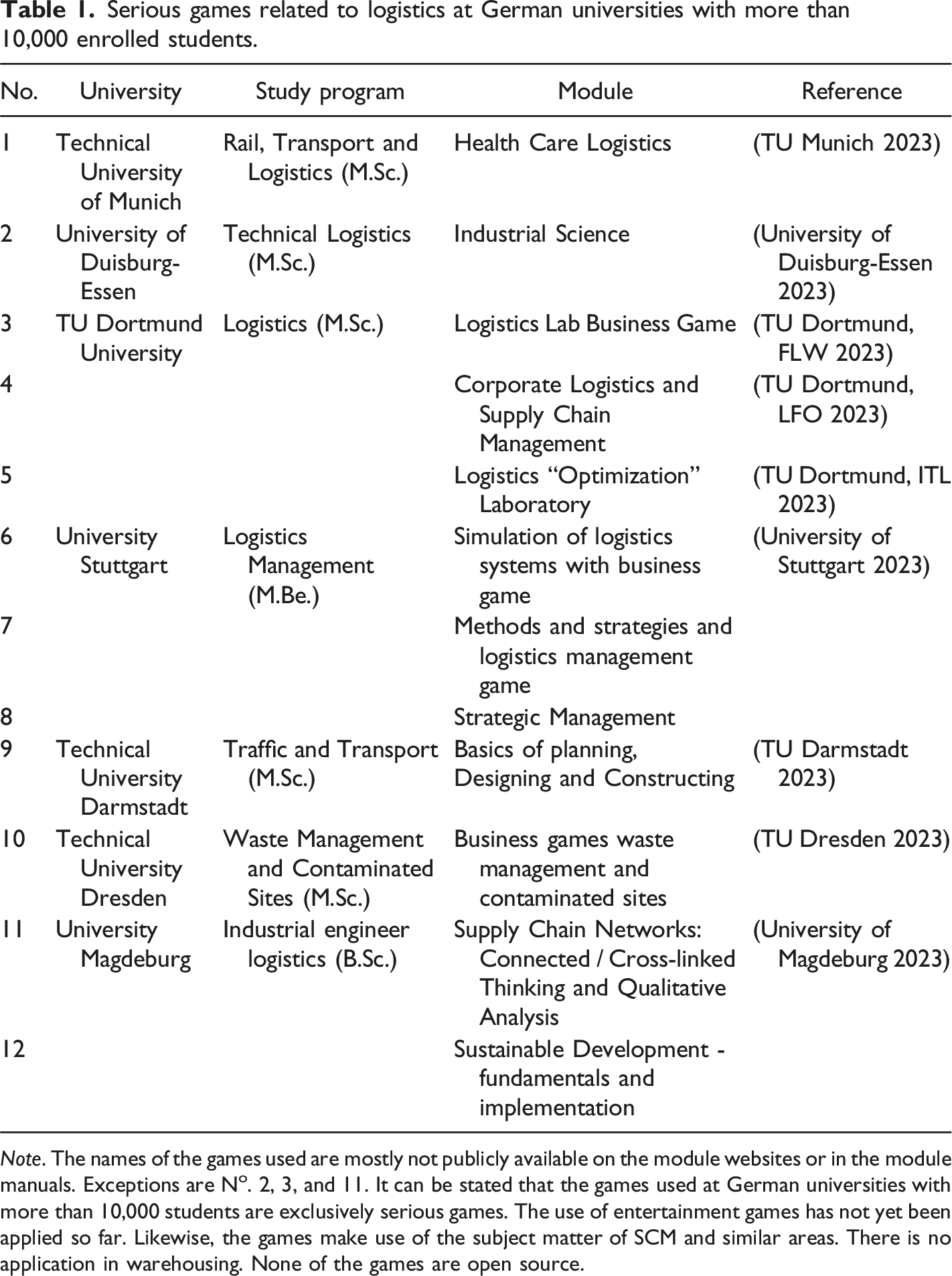
Note. The names of the games used are mostly not publicly available on the module websites or in the module manuals. Exceptions are No. 2, 3, and 11. It can be stated that the games used at German universities with more than 10,000 students are exclusively serious games. The use of entertainment games has not yet been applied so far. Likewise, the games make use of the subject matter of SCM and similar areas. There is no application in warehousing. None of the games are open source.
Method
Based on the findings, an entertainment game about warehousing is developed and validated on a group of 14 subjects. The 2D open-access singleplayer and multiplayer game WareMover deals with the picking technologies of order picking. The game is available in English and German. Multiplayer games are created via a lobby with a host. It is intended to be used in a lecture in which the corresponding content is taught or students can play it alone in advance to build up motivation for the topic. The goal is to complete orders using the different technologies in the least amount of time. Players can choose between pick-by-list, pick-by-voice, pick-by-light, and pick-by-vision. The technologies are described in (Gleissner and Femerling 2013; Reif and Günthner 2009). The players are supposed to learn how the technologies differ in handling and efficiency. Although a game description guide is available in the main menu, players should be able to get by without it and start the game straight away. The game design and the game environment were designed to be so simple that players should intuitively understand the game mechanics and the task at hand.
The game was developed using the GAMED methodology from (Aslan and Balci 2015). GDevelop (GDevelop 2023) was used as a game builder because it is a free and easy way to create a game with little programming effort. The game is publicly available at https://anonymous.4open.science/r/WareMover/. It can be installed on Windows, Linux and macOS using the installer file. It is also possible to create a link for the game via GDevelop, so that the game can be played online as a browser application.
Gameplay and Rules
The objective is to pick one or more orders by navigating to the correct shelf and clicking on the correct compartment for the correct amount of times. The player's goal is to achieve the highest score possible, by performing the aforementioned actions as correctly and quickly as possible. The player moves with the WASD or arrow keys and all actions are performed with the E key. As soon as a player approaches an interaction object, a pop-up with the E button symbol appears so that an action is immediately understandable. There are two variations of the game:
Pick an order as quickly as possible,
Pick as many orders as possible within 90 seconds. There are four different missions to choose from. Each mission represents a pick-by system. The systems in the game differ in the way the player receives mission information, either visually or acoustically. Before starting the game, all information about the gameplay, the score calculation, and the selected mode is explained. One order consists of 20 items, which are distributed over eight positions. The player starts in a 2D top-down view (Figure 1). First, the player has to move towards the in-game computer and get the order. Then, the player has to go to the shelves to pick the order. In the shelf view, the player clicks on the appropriate compartment with the left mouse button (to take out goods) and with the right mouse button (to put goods back on the shelf). When all articles are picked, the player has to submit the order and the game ends. A score is then calculated and displayed in a high score list. Fulfilling the order is the only goal of the game. Wrongfully articles are scored negatively, not picked articles not at all.
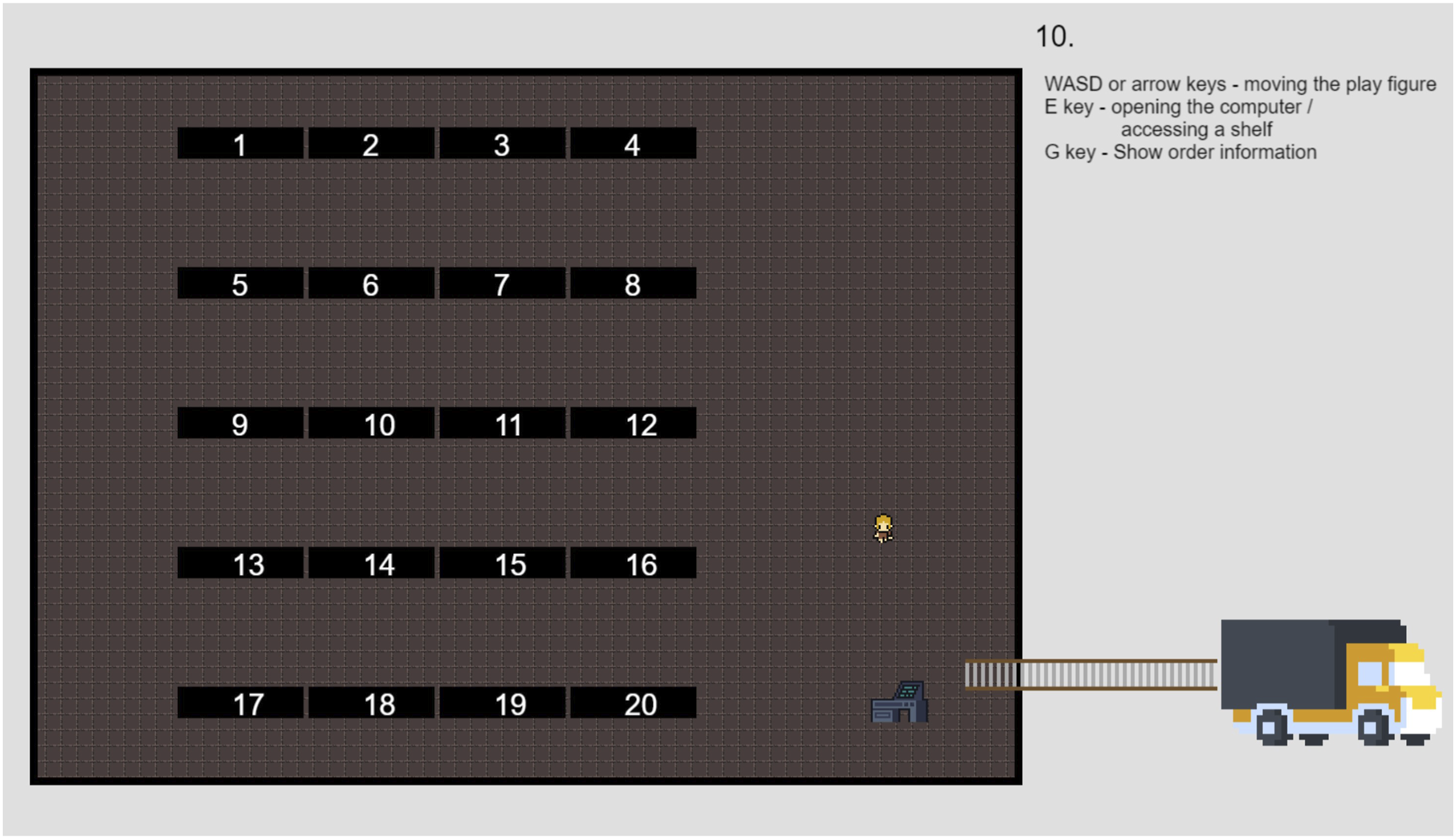
Top-down warehouse view in the main game scene.
Sample, Validation and Analysis
Results of the survey with 14 participants.
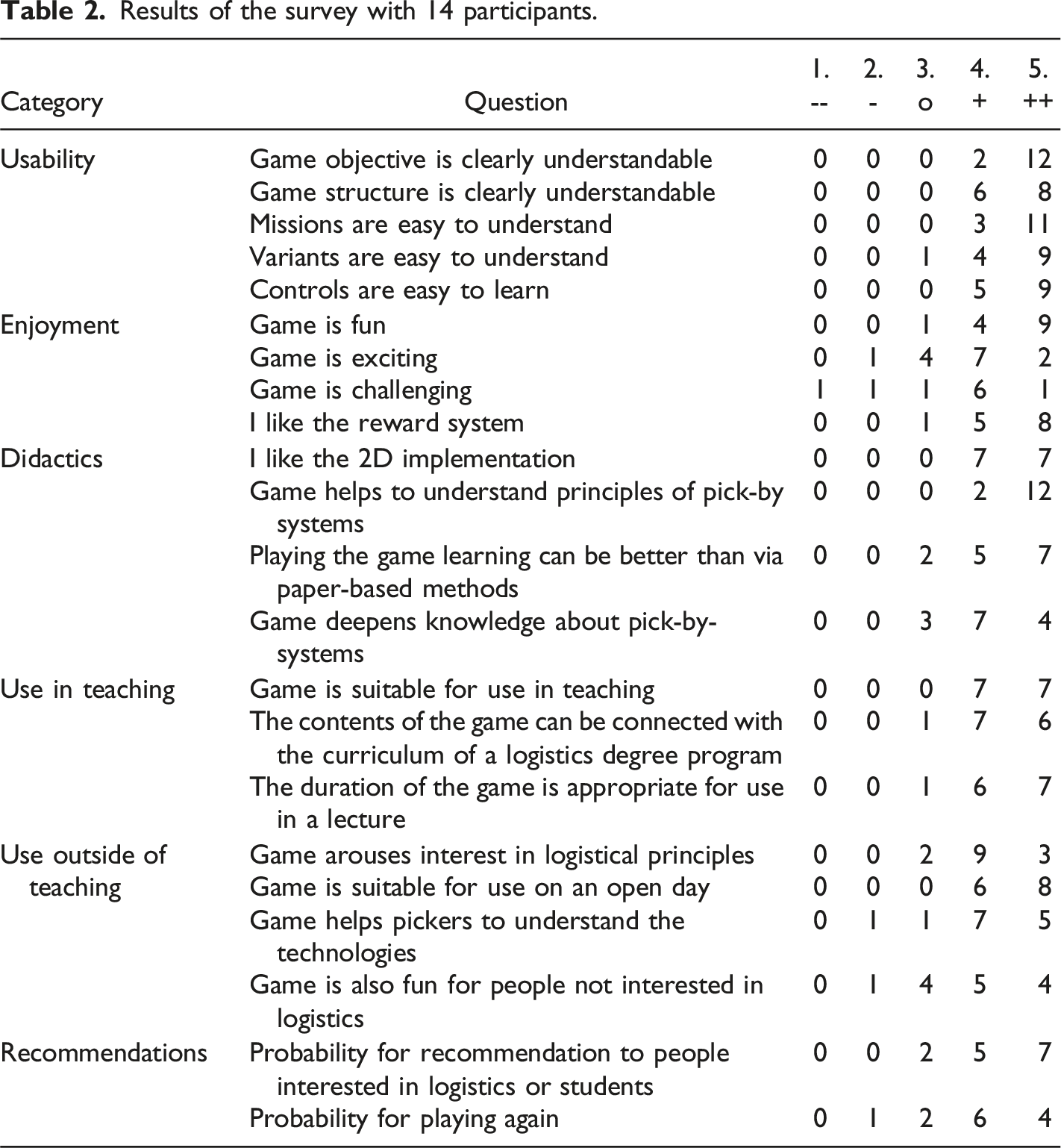
The response format used for the closed-ended statements is a 5-point Likert ordinal scale from 1 (strongly disagree) to 5 (strongly agree). For the open-ended questions, text boxes are used as response options. The participants were interviewed in order to obtain different perspectives. Personal data was not collected. The age range of the experimental group was 20 to 39. Twelve participants in the group had prior knowledge of the technologies presented and two did not. Half of the group played computer games regularly at some point in their lives (more than 5 hours per week for a duration of at least 12 months).
Results
All participants played the game in singleplayer and multiplayer mode without interruption. The questionnaire was filled out immediately afterwards. The results are shown in the table below.
Most participants answered the free text questions. They were asked how the previously answered questions were justified. This included advantages, disadvantages, suggestions for improvement, and use in teaching.
Discussion
The information about gaming experiences provided by the test group is consistent with the German population. 91% of 16-29-year olds and 74% of 30-49-year olds play video games from time to time (Statista 2023). In the 12-19 age group, 76% of respondents say they play video games daily or several times a week (Statista 2022). The younger target group is therefore counted among the addressees, as the game is aimed at students.
From the quantitative responses of the questionnaire, it appears that the game can be classified as user-friendly. In the enjoyment category, it is stated that the game is enjoyable. The challenge aspect has no clear result. This may be due to the fact that half of the group played computer games regularly and the other half did not. The participants also like the 2D implementation. In addition, the understanding of the pick-by-systems is increased. In how far the game is better than paper-based learning remains to be studied. It should be noted that serious gaming cannot be used across the board for every application. Nevertheless, it has been shown that educational games can be successfully used to transfer knowledge to areas outside the world of computer games. Game-based learning concepts have a high learning value, especially for interdisciplinary topics. The topics covered can often not be applied in real-life contexts if they are learned in isolation (Pivec and Kearney 2007).
Most of the players answer that they consider the game suited for teaching. The question of whether the game helps pickers and whether people interested in logistics would enjoy the game is answered ambiguously, which may be due to the heterogeneous group. The majority would recommend the game and play it again.
From the total of 13 free text questions, the 59 answers can be grouped into the following positive features: competitive elements, simple game structure, simple graphics, implementation of picking principles in 2D, web-based, and the possibility of game-based learning. The negative aspects can be summarized as follows: lack of information about real systems, unclear order information, insufficient game instructions, no arrow key control, and lack of other logistical principles. The comments on the order information, instructions and arrow key control could already be improved. The information about the real systems was not provided at the time of testing. It is planned to show this to the students in the lecture in combination with the game, which still has to be tested in the upcoming lecturing period. Further logistical principles will be implemented in the next game.
The feedback does not provide direct evidence that the game is enjoyable for all players, contributes to learning, or is easy to understand. However, the test provides indications of success in terms of enjoyment, motivation, a better understanding of the topic, and usability in teaching.
Limitations and Suggestions for Further Future Research
The game does not provide a high level of realism and the game experience is rather short. The environment of the warehouse is presented in a very simplified way and many elements are missing. Due to the simple concept, experienced players may not feel sufficiently challenged. In addition, it is necessary to contextualize the game with the right educational content in order to understand what the game scenario represents. A test with additional target groups, such as subjects not involved in the field of logistics or professional pickers may be useful. The learning effect or the motivation for the subjects should also be reviewed.
For future research, the game will be tested during a teaching period and enhanced based on feedback. The long-term goal is to create an open-source game platform covering all aspects of warehousing to teach lecture content interactively. The games should be engaging, fun and open source, so that others can implement their own ideas based on the concept. Further research into incorporating reinforcement learning with an emphasis on imitation learning could offer a transformative approach for the game's decision-making dynamics. This methodology would amplify the game's complexity for players and create a symbiotic, knowledge-sharing environment, enhancing gameplay and educational value.
Conclusion
The here presented game WareMover is the first of its kind. German universities do not have a game in the field of warehousing. It has the character of a standard video game and is not intended to be a classic serious game. It contributes to make a part of warehousing, order picking, more accessible, enjoyable and understandable to students. The simplicity of the game explains a practical application in a digital framework that can be used in a lecture. The game is not intended to replace a lecture, but is intended to support the learning process taking place during a lecture on picking. The questionaire shows that the game can be motivating and useful for teaching as a supplement, which will be evaluated in the coming teaching period. The open-source development is intended to stimulate discussion and independent development in the field, so that new ideas can be implemented into the existing concept. Further development of WareMover and other novel games related to warehousing are planned for the future.
Footnotes
Declaration of Conflicting Interests
The author(s) declared no potential conflicts of interest with respect to the research, authorship, and/or publication of this article.
Funding
The author(s) received no financial support for the research, authorship, and/or publication of this article.
