



Abstract
Background
Student teachers commonly struggle to
Aim
We aimed to assess whether repeatedly engaging with simulated teaching and theory-based feedback would improve student teachers’
Method
N = 86 student teachers learned twice with either a digital simulation game depicting decision-making in the classroom (
Results
Against our hypothesis, there were no changes in both conditions regarding student teachers’
Conclusion
Our results point towards the
Keywords
Background
Teachers tend to consider what they have learned in university as being separate from their everyday teaching practice, which is known as the theory-practice gap (for an overview, see Korthagen, 2010). Up to now, there has been little quantitative-empirical research about whether and how digital simulation games for teaching as approximation of practice (for a discussion, see Grossman et al., 2009; McGarr, 2021) may affect student teachers’ perceived usefulness and use of theory for teaching practice. The present study seeks to close this gap by investigating the effect of playing a digital simulation game on student teachers’ conceptions and use of theory.
Theory and Practice: Mind the Gap
In Germany, as well as other countries, teacher education consists of two phases: university courses that focus on learning theoretical knowledge and school phases that focus on observing and participating in teaching practice. Student teachers often struggle to connect the lessons learned in both phases. One reason for this is a lack of communication between university-based and school-based instructors. Mentor-teachers may either not know which theoretical knowledge student teachers have learned (Velija et al., 2008), or their priorities for teaching are inconsistent with knowledge learned in university (Moore, 2003). Both factors can be detrimental for effectively instructing student teachers to apply theoretical knowledge to real teaching. The resulting fragmentation of student teachers’ professional knowledge is known as the theory-practice gap (for an overview, see Korthagen, 2010). The influence of this gap can be seen in their perception of theory and practice as well as their ability to integrate theoretical knowledge into teaching (see e.g. Allen, 2009; Cramer, 2013).
Student teachers often do not perceive theory and practice as equally important for teaching (Bråten & Ferguson, 2015). They tend to struggle seeing the use of theories for their pedagogical practice, as they seem disconnected from real teaching (Velija et al., 2008). This attitude seems to persist over their studies, shown by the perceived importance and usefulness of their theoretical knowledge decreasing over time (Cramer, 2013). Consequently, student teachers primarily base their teaching on knowledge gained from prior practice (Bråten & Ferguson, 2015). Their emphasis on the importance of practice-derived knowledge crosses into teaching practice, especially in the early phase of teachers’ careers (Allen, 2009; Conway, 2012). This perceived gap further affects the integration of theoretical knowledge into teaching practice. When entering the workplace, novice teachers commonly experience difficulties integrating theoretical knowledge into their teaching (Allen, 2009; Cochran-Smith et al., 2015; Cramer, 2013). Theoretical knowledge then loses relevance compared to routines of experienced colleagues. This lack of transfer of theoretical knowledge into teaching practice, however, may lead to the preservation of inefficient teaching strategies in the long run.
Closing the Gap
Despite the reported struggles, knowing about theories of teaching has been shown to positively influence teachers’ professional development (Kulgemeyer et al., 2020) as well as the quality of their teaching (Blömeke et al., 2014; König et al., 2014). Although it is therefore desirable to integrate theoretical knowledge with practice, it remains unclear how best to close the theory-practice gap.
Different approaches focus on strengthening the role of student teachers as reflective practitioners (e.g., Schön, 1983). Reflective practice includes bringing together theory and practice by making conscious decisions in practice (reflecting in action) as well as reflecting on passed practice (reflecting on action). Further, Grossman et al. (2009) suggest the frequent integration of manageable portions of practice in teacher education before teachers enter real classrooms. Their framework comprises different perspectives that can be used to access practice in teaching: representations of practice, decompositions of practice and approximations of practice.
Representations of practice illustrate real teaching situations in form of e.g., videos or case studies. They allow novices to focus on specific aspects of practice. Decomposing practice requires instructors to break up teaching-sequences into the single units of skills and processes that compose them. After understanding them in isolation, they can then integrate them into more complex sequences of teaching. Approximations of practice allow closer interaction with authentic teaching by providing scenarios derived from practice with reduced complexity (e.g., role-play, simulations). Student teachers can apply their theoretical knowledge in these scenarios and experience the consequences of their actions. Depending on their use-case, authenticity can be adapted on different dimensions (e.g. linearity of time in the simulation Howell & Mikeska, 2021). Approximating practice has two advantages. First, student teachers can apply new knowledge in a safe setting, because failure is not sanctioned. Second, after receiving feedback, they can apply the lessons learned by reengaging with the same situation.
Serious games and simulations as approximations of practice allow student teachers to participate in authentic (teaching) situations mimicking the pacing of a classroom and experiment using their theoretical knowledge. Studies focusing on their effects show their potential for building up long-term skills and knowledge (Lamb et al., 2018; Raupach et al., 2021; Riopel et al., 2019; Wouters et al., 2013). Specifically the use of teaching-simulations showed significant increases in classroom management skills (Theelen et al., 2019), perceived preparedness for practice (Theelen et al., 2020), and use of reflective practice (Yeh, 2004). In sum, digital simulation games may be a promising method for bridging the theory-practice gap.
To fully use their potential, they have to be embedded effectively. Their general design should be based on theory, depict authentic situations and offer feedback as well as opportunities to reflect (De Coninck et al., 2019). Aligning with cyclical coaching approaches for (simulation) trainings (e.g., Darling et al., 2005), repeated use combined with feedback can be argued as a key factor, and thus a boundary condition for effective learning with simulation games (De Coninck et al., 2019; Dieker et al., 2014).
Research Questions
The current study aims to observe short-term effects of digital simulation games on self-efficacy and behavioural intentions as well as perception and transfer of theoretical knowledge. We compared participants learning twice with either (1) a simulation game (simulation condition) or (2) with a sequence of screenshots from the same game (control condition).
We investigated the following hypotheses: 1. H
1
(Replay hypothesis): Participants learning with the simulation game should feel more motivated to engage with the materials, due to actively taking part in the depicted events (see Deci & Ryan, 2000). Thus, they should report higher intentions to reuse the learning materials compared to participants in the control condition. 2. H
2
(Usefulness hypothesis): Participants learning with the simulation game can better apply their theoretical knowledge to authentic teaching situations for which they receive theory-based feedback. We expect higher gains in perceived usefulness of theoretical knowledge for participants in the simulation condition compared to the control condition. 3. H
3
(Self-efficacy hypothesis): Participants learning with the simulation game can make own decisions and experience their consequences. This agency should lead to significantly higher gains in teaching self-efficacy in the simulation condition compared to the control condition. 4. H
4
(Transfer hypothesis): By applying their theoretical knowledge in authentic situations and actively engaging with the provided feedback, we expect participants in the simulation condition to increase their use of theory-guided reasoning. We expect a significantly weaker increase of theoretical arguments in the control condition.
Methods
Participants and Design
N = 86 student teachers (71 women, 13 men, 1 other, Mage = 23.35, SD = 3.03) completed the experiment simultaneously during one session of the lecture Basics of teaching and learning with media at a German University. Because the experiment was didactically embedded in the session on “learning with computer simulations”, participants did not receive extra compensation, for which they provided informed consent. The study was approved by the local ethics board (LEK FB06 2022-0013).
Participants were randomly assigned to either the simulation condition (n = 37) or the control condition (n = 49). In both conditions, participants learned twice with either a simulation game depicting common teaching situations (simulation condition) or a screenshot-sequence of the games’ content (control condition).
Material and Experimental Manipulation
In the simulation condition, participants learned with a scenario from the simulation game ICH ALS LEHRKRAFT (ME AS A TEACHER), developed by Darya Frantskevich as part of the project Serious Games in Teacher Education. The visual style of the game resembles comic-styled illustrations of teachers and students in front of photographs of real classrooms (see Figure 1). The simulation game requires participants to make decisions in common, sometimes critical, teaching situations. For this, participants can choose from different options. Their decisions then influence the further course of the simulated lesson. At the end, they received feedback for their decisions. A more detailed description of the simulation game can be accessed via the Files of the following OSF-project: https://osf.io/e4vh6/?view_only=97415efb53234d23962d50d0e597a766. Translated example-screenshots from the simulation game that was used as learning material in the simulation condition (upper part) and the comic used in the control condition (lower part).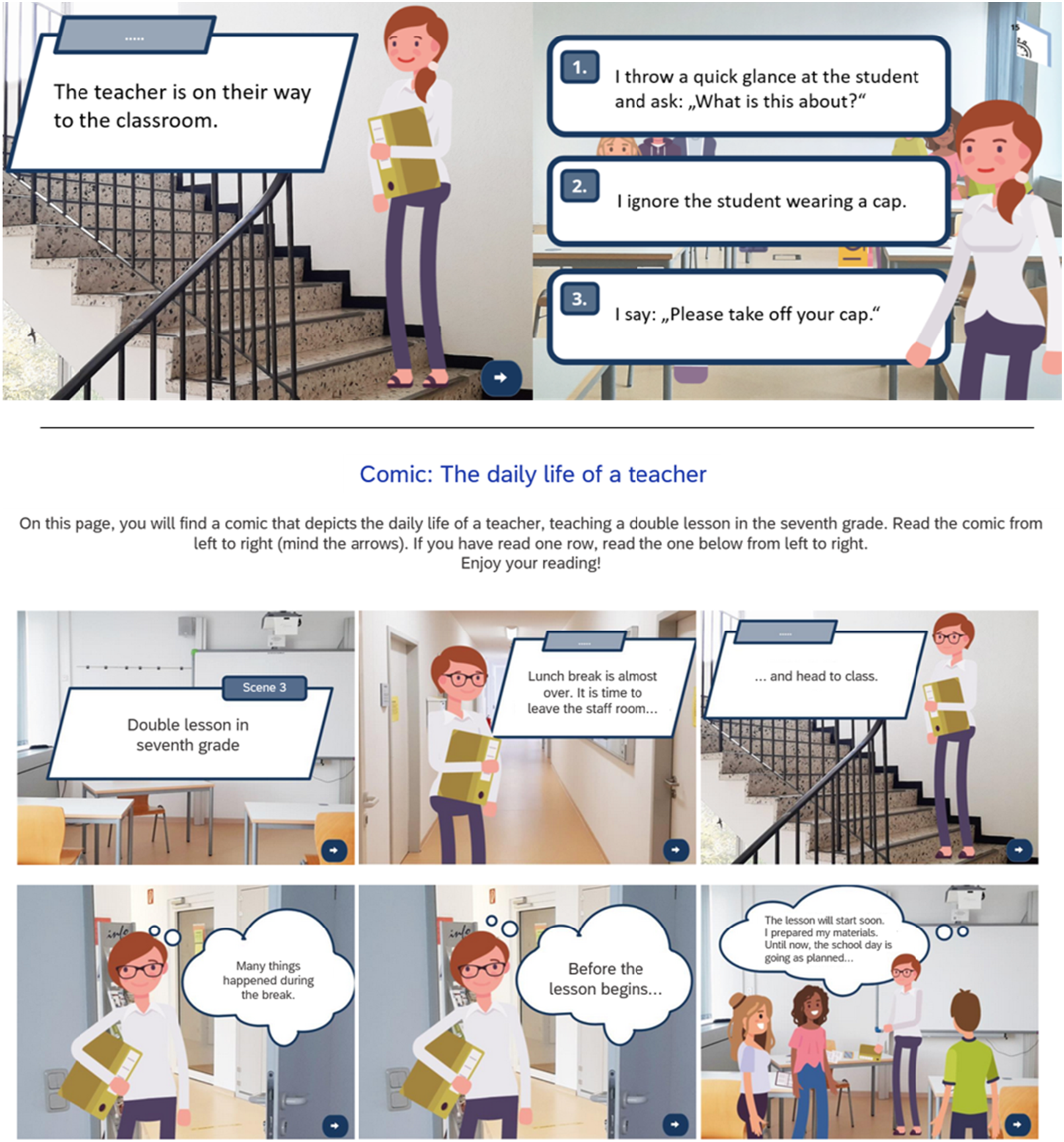
Participants in the control condition learned using a sequence of screenshots from the same game-scenario. Because of the games’ adaptive nature, we based the comics’ content on the average in-game decisions of five advanced student teachers. The comic contained no depictions of the in-game decision-screens. Instead, it showed the direct consequences of the teachers’ decisions. On a separate page, participants received feedback regarding the comic-teacher’s actions. Participants received the same comic in both learning-phases.
Measures
Prior Knowledge
We assessed participants’ prior knowledge via one open question (Which theoretical concepts do you spontaneously recall on the following topics? Classroom management, lesson planning, coping strategies (stress), forming work groups, time management, dealing with classroom disturbance). Answers were scored based on four categories: theoretical concepts from educational psychology, methods, subject-didactic concepts and experience-based answers. Participants received one point in the corresponding category for stating or describing a correct concept. If participants did not state any concept or exclusively stated them incorrectly, they did receive zero points in the corresponding category. A second rater scored all statements, achieving sufficient interrater-reliability (Cohen’s κ = .75).
Transfer
We assessed participants’ ability to apply their theoretical knowledge from educational psychology to teaching-situations with a decision-task. For this, participants received a description of a teaching scenario and were asked to choose one of three options, as well as to explain the reasons for their choice in an open format. Their reasoning was rated by two independent raters for the number of arguments based on theoretical knowledge (category one), using teaching methods without further reasoning (category two) or experiences from being a teacher or student (category three). For each argument, they received one point in the respective category. Participants received two decision-tasks at three times (pre, intermediate, post). One decision-task remained constant in all phases while the other varied, describing different types of teaching situations. A second rater scored all answers, reaching a sufficient inter-rater reliability (Cohen’s κ = .68).
Self-Efficacy
We measured participants’ trait self-efficacy using the general self-efficacy short scale (Cronbach’s α = .74) by Beierlein et al. (2014). The scale comprises four items (e.g., I am able to solve most problems on my own.) answered on a 5-point Likert-scale (from 1 Does not apply at all to 5 Applies fully).
To assess participants’ teaching self-efficacy, we used the subscales instructional strategies (Cronbach’s α = .69) and classroom management (Cronbach’s α = .86) from the short form of the Ohio State Teacher Efficacy Scale (Tschannen-Moran & Hoy, 2001). Both subscales comprised four items (e.g., To what extent can you use a variety of assessment strategies?, subscale: instructional strategies; How much can you do to get children to follow classroom rules?, subscale: classroom management), answered on a 9-point Likert-scale (from 1 Not at all convinced to 9 Fully convinced).
Perceived Usefulness of Theoretical Knowledge
We assessed participants’ perceived usefulness of theoretical knowledge with a self-constructed questionnaire focusing on perceived use of theories for practical teaching (e.g., Theory and practice are difficult to unite in everyday teaching.). The scale included six self-constructed items (Cronbach’s α = .77), answered on a 5-point Likert-scale (from 1 Does not apply to 5 Does apply) (see Appendix A.1).
Intention to Replay the Learning Material
To measure participants’ intention to reuse the learning materials, we used a scale of five self-constructed items (Cronbach’s α = .85), answered on a 4-point Likert-scale (from 1 Does not apply at all to 4 Does apply fully). Items in both conditions were worded similarly, with items in the simulation condition referencing the game and items in the control condition referencing the screenshot-sequence (e.g., I would like to replay the game vs. I would like to reread the comic). Additionally, two items were used to assess the reasons for participants to reuse the learning material (e.g., I would like to replay the game because I enjoyed it and I would like to replay the game to reinforce my knowledge).
Procedure
After providing informed consent, participants first answered demographic questions, as well as questions regarding prior teaching experience. Then they answered the open recall task on prior knowledge, questions concerning self-efficacy, and perceived usefulness as well as the transfer-tasks for theoretical knowledge. Then, they learned using either the simulation game or the screenshot-sequence. Thereafter, they again answered the questions regarding self-efficacy, perceived usefulness and transfer-tasks for theoretical knowledge as well as their intention to reuse the presented learning material. In the second learning-phase, they learned with the same material they received in the first learning-phase. They were instructed to integrate the feedback they just received into their learning. After learning, they answered questions on self-efficacy, perceived usefulness and transfer-tasks for theoretical knowledge for a third time and indicated their intention to reuse the learning material for a second time. Lastly, they answered control questions for faithful participation. Participants completed this procedure within a time-limit of 45 minutes.
Results
Means (and standard deviations) of main variables across both experimental conditions,
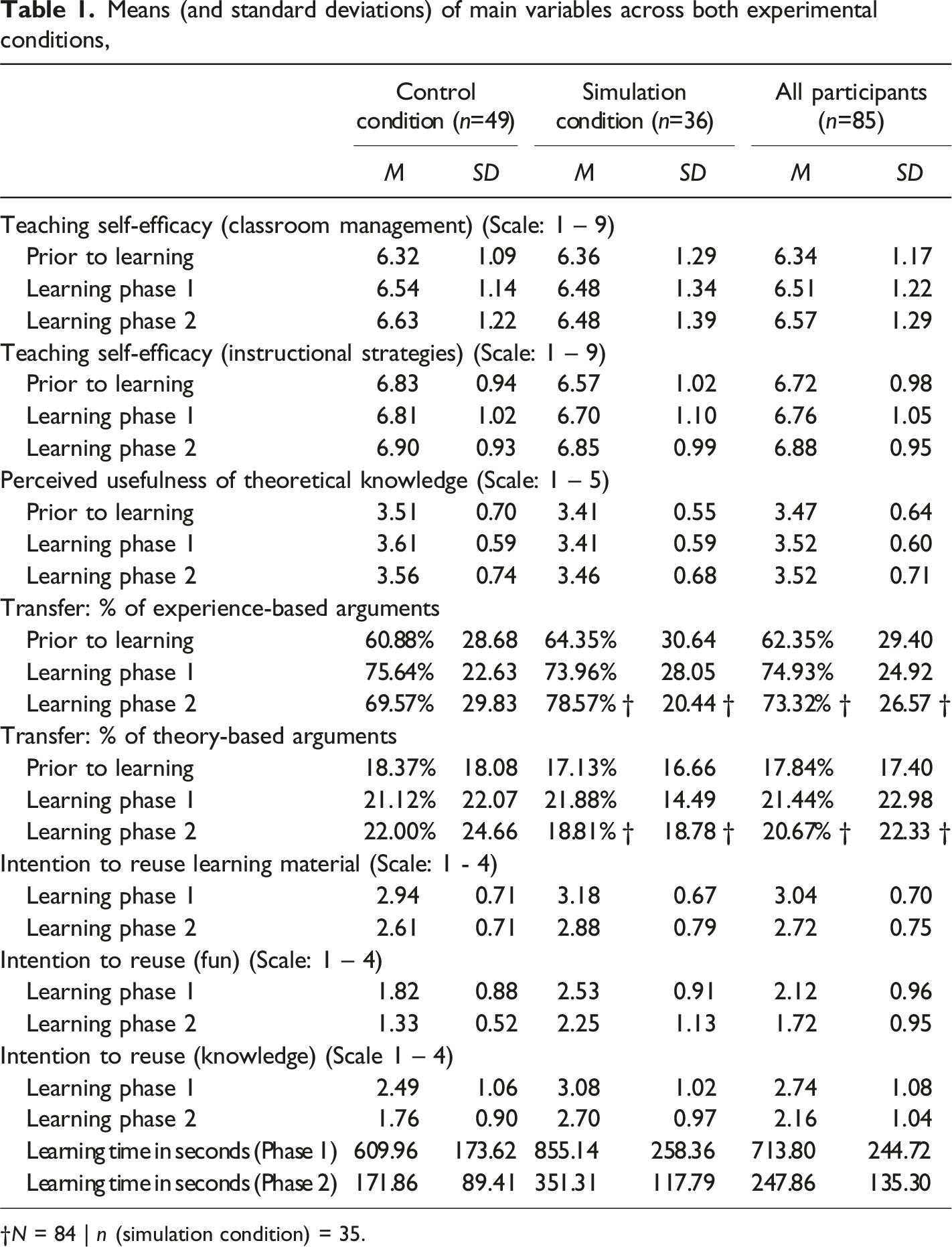
†N = 84 | n (simulation condition) = 35.
Replay Hypothesis
We entered intention to reuse the learning material as dependent variable in a 2x2 mixed ANOVA with learning-phase (1 vs. 2) as within-subject factor and experimental condition (control vs. simulation) as between-subject factor. There was no significant interaction between learning-phase and condition, F < 1. We observed a significant main effect of learning-phase, F(1, 83) = 28.54, p < .001, η p 2 = .26. The main effect of condition missed significance, F(1, 83) = 3.14, p = .080, η p 2 = .04. Contrary to our hypothesis, intention to reuse decreased to a similar degree in both conditions.
Additionally, we analysed two single items assessing why participants intended to reuse the material. Regarding wanting to reuse the material because it was fun, we observed no significant interaction for learning-phase and condition, F(1, 83) = 1.50, p = .223, η
p
2
= .02. Main effects for learning-phase, F(1, 83) = 19.72, p < .001, η
p
2
= .19, and condition, F(1, 83) = 23.46, p < .001, η
p
2
= .22 were significant. Partially supporting our hypothesis, participants in the simulation condition reported higher reuse-intention because of fun than participants in the control condition. In both conditions, we observed a similar decrease in reuse-intention because of fun over time. With respect to wanting to reuse the material to learn, the interaction between learning-phase and condition missed significance, F(1, 83) = 3.77, p = .056, η
p
2
= .04. Main effects of learning-phase, F(1, 83) = 32.39, p < .001, η
p
2
= .28, and condition, F(1, 83) = 15.97, p < .001, η
p
2
= .16, reached significance. Participants learning with the simulation game reported higher intention to replay to learn compared to participants in the control group (see Figure 2). This motivation also decreased over time. Yet, the results partially support our hypothesis. Results for participants’ intention to relearn (means) with the learning material across both experimental conditions and over time (Scale: 1 – 4). Error bars represent standard errors of mean.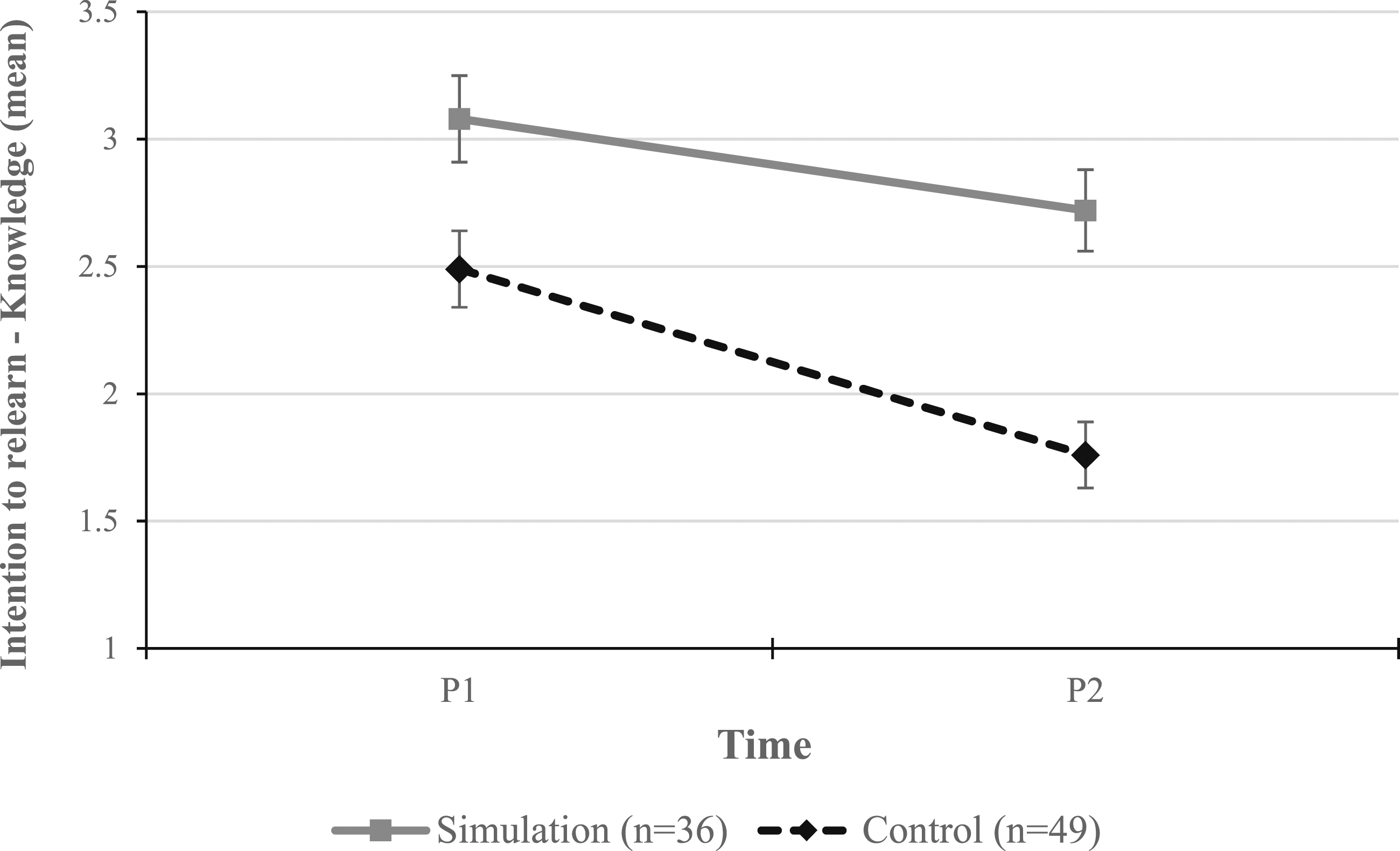
We further observed changes in learning times across both learning-phases. Between both conditions, we compared learning times in the second learning-phase as the percentage of decrease in learning time compared to the first learning-phase. In line with our hypothesis, an independent samples t-test revealed that participants in the simulation condition (M = 56.13%, SD = 18.42) reduced learning time to a smaller degree than participants in the control condition (M = 71.39%, SD = 13.94), t(83) = 4.35, p < .001.
Usefulness Hypothesis
We entered perceived usefulness of theoretical knowledge as dependent variable, and experimental condition (simulation vs. control; between-subjects factor) as well as the time of measurement (pre, intermediate, post; within-subjects factor) into a mixed 2x3 analysis of covariance (ANCOVA). Participants’ trait self-efficacy and prior knowledge on teaching methods were entered as covariates. Against our hypothesis, analyses revealed no significant interaction between time of measurement and condition, F < 1. There were also no main effects for either time of measurement, F(1.79, 145.25) = 2.16, p = .124, η p 2 = 0.03, or experimental condition, F < 1.
Self-Efficacy Hypothesis
We entered the two types of teaching self-efficacy (concerning instructional strategies, and classroom management) as dependent variables, and experimental condition (simulation vs. control; between-subjects factor) as well as time of measurement (pre, intermediate, post; within-subjects factor) within two separate 2x3 mixed ANOVAs. Trait self-efficacy was entered as a covariate. For self-efficacy concerning instructional strategies, we observed no significant interaction between time and condition, F(2, 164) = 1.51, p = .224, η p 2 = 0.02. The main effects of time, F(2,164) = 1.98, p = 0.142, η p 2 = 0.02, and condition, F < 1, did not reach significance. Results regarding self-efficacy in classroom management were similar, showing no significant interaction of time and condition, F < 1, as well as no main effect of time, F(1.56, 128.05) = 1.28, p = .277, η p 2 = 0.02 or condition, F < 1.
Transfer Hypothesis
To assess the effects of time of measurement (pre, intermediate, post; within-subjects factor) and experimental condition (simulation vs. control; between-subjects factor) on participants’ theory-based reasoning in our transfer-tasks, we entered both factors into a 2x3 mixed ANOVA. Participants’ theory-based reasoning prior to learning was entered as a covariate. There was no significant interaction of time and condition, F < 1, speaking against our transfer hypothesis. We did also not observe significant main effects of either time or condition, both F < 1. Our findings on transfer show that neither condition nor time influenced participants’ theory-based reasoning in decision tasks. The trend in our data suggests that theory-based reasoning decreases over time in the simulation condition and increases in the control condition.
Exploratory Analyses
To assess the influence of using the teaching simulation game on student teachers’ experience-based reasoning, we entered time (within-subjects factor) and experimental condition (between-subjects factor) with participants’ experience-based reasoning prior to learning as a covariate into a 2x3 mixed ANOVA. Our analysis revealed a trend towards an interaction between experimental condition and time, F(1, 81) = 2.92, p = .091, η
p
2
= 0.04. There were no main effects of time, F(1, 81) = 1.79, p = .195, η
p
2
= 0.02, and condition, F < 1. The trend suggests that over time, experience-based reasoning tended to increase in the simulation condition and to decrease in the control condition (see Figure 3). Results for the amount of participants’ arguments on the transfer task based in experience (means) across both experimental conditions and over time. Range of possible scores: 0% - 100%. Error bars represent standard errors of mean.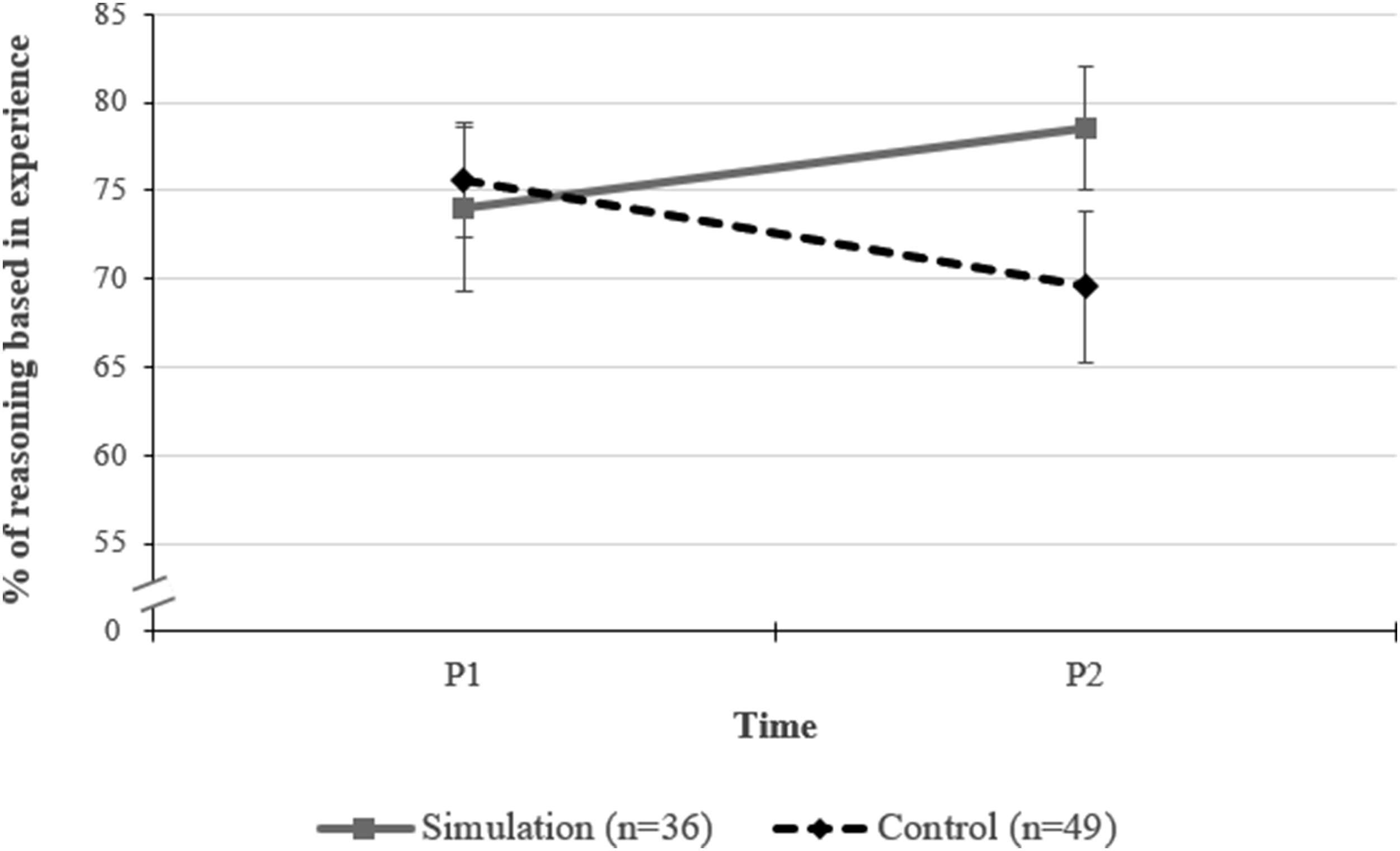
Discussion
We investigated the effects of a teaching simulation game on student teachers’ perceived usefulness of theories, self-efficacy and knowledge transfer, as possibility to close the theory-practice gap. Even though our results showed no beneficial effects on their perception and integration of theoretical knowledge into practice or their teaching self-efficacy, they did indicate benefits nonetheless.
Student Teachers are Motivated to Play and Learn
In accordance with the replay hypothesis (H1), our results partially show higher intention to relearn for participants in the simulation condition. More specifically, these participants indicated that they want to reuse the simulation game not only because it is fun, but also because they want to learn with it. This is in line with prior studies showing enjoyment as a predictor for motivation to use simulations (Baptista & Oliveira, 2019). This motivation to relearn could potentially support repeated learning, which has been stated as a boundary condition for effective learning with simulation games (Dieker et al., 2014; Matsuda, 2008; Wouters et al., 2013). Additionally, participants in the simulation condition learned significantly longer compared to the control condition, and their learning times decreased less between learning-phases.
In sum, our results suggest that simulation games motivate student teachers not only to play, but also to learn. Further research is needed to investigate whether student teachers put their intention for reuse to action with the same persistence when learning more self-directed.
Simulated Teaching did not Influence Theory-Based Reasoning
Contrary to our usefulness hypothesis (H2), there were no meaningful changes in participants’ perceived usefulness of theoretical knowledge. Moreover, in contrast to our transfer hypothesis (H3), there were also no significant change in student teachers’ integration of theories into their practical reasoning after playing the simulation game. The non-significant trend in our data even showed increasing experience-based reasoning over time in the simulation-condition. Although these findings speak against the meta-finding of serious games and simulations being effective for sustainably teaching diverse skills (e.g., Gegenfurtner et al., 2014; Wouters et al., 2013), they are in line with previous findings that they are generally less effective when used in higher education (Lamb et al., 2018).
Means (and standard deviations) of participants’ entry variables across both experimental conditions.
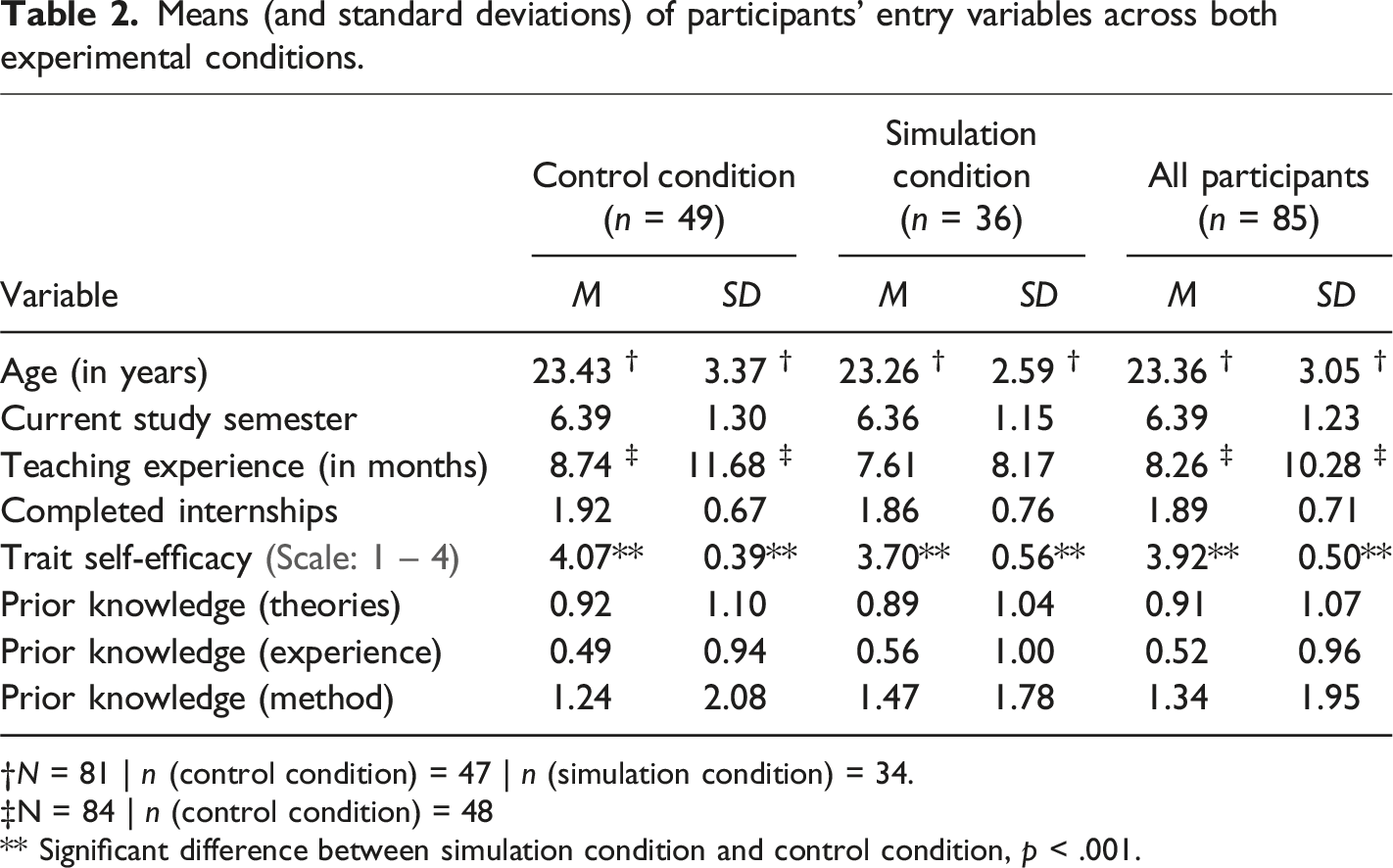
†N = 81 | n (control condition) = 47 | n (simulation condition) = 34.
‡N = 84 | n (control condition) = 48 ** Significant difference between simulation condition and control condition, p < .001.
Simulated Teaching did not Influence Teaching Self-Efficacy
Based on previous research (Bandura, 1996; Gegenfurtner et al., 2014; Song et al., 2022; Theelen et al., 2019), we expected that experiencing competence in the simulation should act as a form of enactive attainment, and thus foster teaching self-efficacy. Against our hypothesis (H4), we observed no meaningful changes in teaching self-efficacy. This finding might be explained by the fact that in our sample teaching self-efficacy was, on average, already high (Mclassroom management = 6.34, Minstructional strategies = 6.72, Scale: 1 – 9). Our participants were advanced student teachers with prior experience in teaching through internships and work in school (see Table 2). Their teaching self-efficacy was likely shaped by these experiences, and may have been too fixed to be changed through a one-time intervention. Concerning potential effects on teaching self-efficacy, the situations and consequences depicted in the simulation may have been too easy for advanced student teachers to act as meaningful enactive attainment. Adding (adaptive) difficulty options to the game could support the selection of adequately challenging scenarios. Future studies focusing on beginning student teachers learning with simulation games are necessary to investigate their potential for fostering teaching self-efficacy.
Limitations and Further Research
Some limitations arise from our setting of data collection. We collected data for all participants simultaneously in one session. There was limited time for learning and participants had to learn in two phases despite their actual intentions to reuse the learning material. This constraint in autonomy could have impaired their motivation for learning, aligning with self-determination theory (Deci & Ryan, 2000). Our results seem to support this reasoning, because intentions to relearn decreased between the learning-phases in both conditions. Nonetheless, we observed clear motivational benefits in favour of the simulation condition. To make effective use of the setting of playing the game in a group, future studies could feature playing and later discussing individual game experiences in dyads to potentially facilitate reflection.
We cannot rule out that low mental availability of theoretical concepts influenced the transfer of these concepts to teaching decisions. Future studies should focus on how the didactic context of playing may influence their effects as a tool for learning. For example, embedding game playing into the concept of a seminar or combining the use of simulation games with a prior learning-session (re-)teaching core theoretical concepts could have greater effects on student teachers’ perceptions and integration of theory. Using longer game sessions or games with longer playtimes could also enhance the learning effects of playing a simulation game, as learners can train knowledge-application for a longer time (e.g. Wouters et al., 2013). Especially more experienced learners, as present in our sample, may benefit from enhancing the authenticity and complexity of the material (e.g. by using Virtual Reality Games). Future research should especially focus on how feedback processing in such games may affect theory-practice integration.
Conclusions
The current study adds to the literature on simulation games in teacher education by obtaining quantitative data about the effects of a simulation game within a typical lecture setting for student teachers. Against our expectations, the simulation game in our setting did neither make student teachers perceive theories as more relevant nor make them integrate theories more frequently into their decision-making. Overall, the practical benefits of playing the simulation game appeared to be small when applied within a single lecture session. Yet, our results indicate that simulation games can motivate student teachers to learn about teaching, pointing towards the benefits of simulation games for timely teacher education.
Footnotes
Declaration of Conflicting Interests
The author(s) declared no potential conflicts of interest with respect to the research, authorship, and/or publication of this article.
Funding
The author(s) received no financial support for the research, authorship, and/or publication of this article.

Appendix
Full list of items for the scale Perceived usefulness of theoretical knowledge. Note. Items are answered on a 5-point Likert-scale (from 1 Does not apply to 5 Does apply). Items marked with an † are inverted.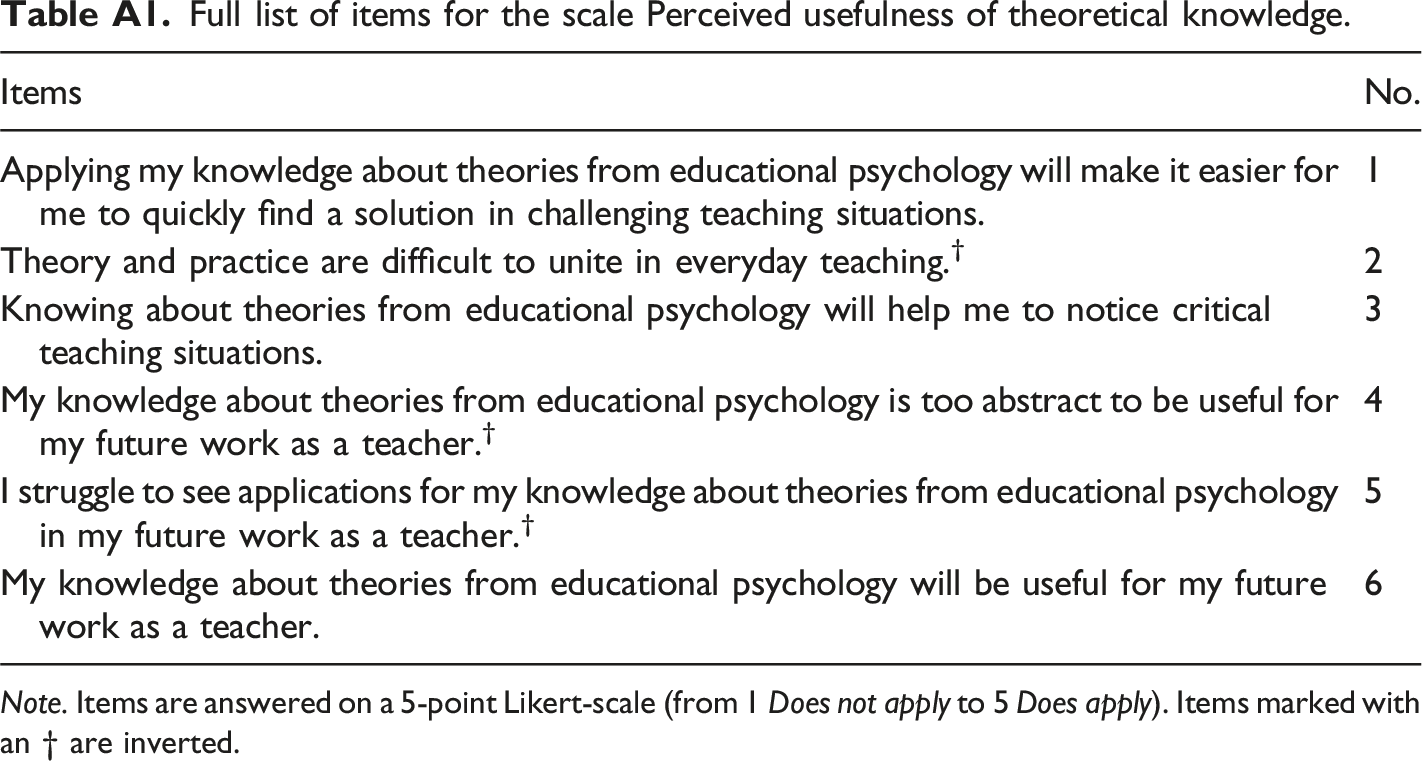
Items
No.
Applying my knowledge about theories from educational psychology will make it easier for me to quickly find a solution in challenging teaching situations.
1
Theory and practice are difficult to unite in everyday teaching.†
2
Knowing about theories from educational psychology will help me to notice critical teaching situations.
3
My knowledge about theories from educational psychology is too abstract to be useful for my future work as a teacher.†
4
I struggle to see applications for my knowledge about theories from educational psychology in my future work as a teacher.†
5
My knowledge about theories from educational psychology will be useful for my future work as a teacher.
6