




Abstract
Background
Society has an increasing demand for nurses, but the availability of clinical placements for nursing students does not keep pace with this need. As a result, the use of simulation as a supplement or replacement for clinical practice is being discussed. Simulation can be a resource-intensive learning method, making it important to consider how simulation can be organized and implemented as efficiently as possible without compromising learning outcomes.
Objective
To explore students' experiences with different ways of organizing simulation. Method: Qualitative design inspired by action research. A purposive sample of 24 students was selected, and data was collected through eight focus group interviews. Inductive content analysis was used for data analysis.
Results
Three main categories emerged: the importance of a conducive level of stress for learning, feelings of responsibility and autonomy, and constructive feedback and reflection.
Conclusion
The findings suggest that the presence of a facilitator in all stages of simulation may not necessarily be the most effective approach for learning. It appears that the facilitator could focus more on organizing the simulation so that all participants can actively engage, while utilizing their time to plan scenarios, establish a safe learning environment, and participate in a summary session to clarify unresolved academic questions and nursing practices
Background
In Norway, the number of nursing students is being increased to meet society's demand for nurses. However, the availability of practical training placements does not keep pace with the growing need. Practice-based studies play a vital role in socializing nursing students into the profession and equipping them with the necessary skills to tackle specific tasks and challenges (NOU 2023: 4, 2023).
However, student satisfaction surveys reveal that while students are generally content with the reception and guidance provided by practice sites, they are less satisfied with the preparations made by educational institutions (Reppen & Dolonen, 2022). The use of student-centered learning approaches, particularly activities that resemble real-world tasks, and digital technology is recommended as a key tool for enhancing student engagement and relevance to the workplace (NOU 2023: 4, 2023). In our institute, nursing students attend two days on campus during each clinical placement, called reflection sessions (R), which include reflection time with the teacher and a half day of simulation.
The value of simulations lies not only in practical experience but also in the opportunity for students to reflect on their learning experiences while assuming different roles within the simulation (Haddeland et al., 2021). Through simulations, students learn to communicate effectively, be open about adverse events, support one another, provide positive feedback, and share responsibility (Jeffries, 2022). Simulation-based learning contributes significantly to active learning, collaborative learning, student-centered learning, and interprofessional education in higher education (Glavin, 2009). The strength of simulation lies in its capacity for experimentation, where errors and deficiencies do not have the same consequences as in clinical settings (Dieckmann, 2009). However, students often experience stress during simulations, feeling vulnerable and at high risk of making mistakes or appearing inadequate (Roh & Jang, 2017; Tosterud, Hall-Lord, Petzäll, & Hedelin, 2014). Students feel outside their comfort zone and are unable to perform at their best (Jensen, Eldridge, Hu, & Tuten, 2009). Addressing this issue is crucial for effective learning, and debriefing plays a central role in this regard.
The debriefing process is accomplished using multiple techniques and must be based on theoretical frameworks and/or evidence-based concepts. The goal of the debriefing process is to assist in the development of insights, improve future performance, and promote the transfer and integration of learning to practice. Debriefing provides opportunities for giving and receiving feedback, expressing emotions, and learning from successes or failures (Decker et al., 2021). According to Steen Utheim (2017) the prerequisite for feedback to have a learning effect is that it is conducted as a dialogue.
Feedback supports self-regulated learning by enhancing participants' awareness of their competence, increasing their ability to make progress, challenging them to set improvement goals, and helping them develop strategies to achieve those goals (Lefroy, Watling, Teunissen, & Brand, 2015).
It is crucial for students to address their emotional and relational reactions and have the opportunity to express themselves during debriefing sessions (Steen-Utheim & Wittek, 2017). The Critical Response Process (CRP) model (Lerman & Borstel, 2003) is presented as a method for promoting such reactions in the learning process (Tosterud, Kjølberg, Kongshaug, & Haugom, 2020), and has been employed for several years at our institution.
Simulations are typically planned and organized by a facilitator in collaboration with the operator (of the simulator) or standardized patients. The facilitator's plans and priorities influence the amount of time allocated for debriefing and the level of student participation (Decker et al., 2021; Persico, Belle, DiGregorio, Wilson-Keates, & Shelton, 2021). Students rarely take control or initiative during the debriefing phase. The facilitator's feedback style, communication skills, and facilitation abilities have a decisive impact on the learning climate (Husebø, Dieckmann, Rystedt, Søreide, & Friberg, 2013; Keitel et al., 2011). Thus, practicing techniques that stimulate participant involvement and reflection can be beneficial (Husebø et al., 2013; Spanager, Dieckmann, Beier-Holgersen, Rosenberg, & Oestergaard, 2015).
Simulation is a resource-intensive learning method in terms of facilities, personnel, and time. The facilitator follows the students closely through all the steps in the simulation (Persico et al., 2021). At our institution, simulation is considered a complement to practical training, and efforts are made to involve as many students as possible as both actors and providers of constructive feedback to one another.
During the reflection sessions, half of the day consists of simulation, which means that student groups consisting of 12-15 students, rarely get time for more than two simulations. Thus, four students act as participants while the others serve as observers sitting in an adjacent classroom watching live-stream. To increase student involvement, it is necessary to explore new ways of organizing simulation activities. This is the setting of this study.
Purpose and Research Questions
The purpose of this study was to explore nursing students' experiences with two different approaches to organizing reflection sessions with simulation on campus.
The research questions for both reflection sessions were as follows:
How do students perceive the simulation?
How do students experience giving feedback?
How do students experience receiving feedback?
Do students feel that something is missing before, during, or after the simulation?
Method
The study has a qualitative research design and is inspired by action research, in which the researcher poses questions associated with a desire for improvement, renewal, and change (Tiller, 2004). In this study, the change involves conducting a traditional simulation initially, followed by experimenting with an alternative approach to implementation. Although comparisons are typically associated with quantitative research, they can also be utilized within qualitative studies by seeking generalizations in the qualitative descriptions (Roald & Køppe, 2008).
Intervention Planning and Execution of the Study
Recruitment of participants was done by purposive selection, which is a non-random way of ensuring that particular categories of cases within a sampling universe are represented in the final sample of a project (Robinson, 2014). The researcher identify and select individuals or groups of individuals that are especially knowledgeable about or experienced with a phenomenon of interest.
Two experienced supervising teachers (T and E) organized the two reflection sessions (R1 and R2) with two student groups each. Since attendance on these days is mandatory, it was appropriate to (recruit these students as participants in the study. Participants were recruited with the consent of the supervising teachers. Two weeks prior to the commencement, we provided both oral and written information about the study. All students who attended the information session agreed to participate in the focus group interviews after the reflection sessions. An email request was sent to students who did not attend the information session, and they also chose to participate as informants.
The sample (n=24) represented two student groups with 12 students in each group, who were assigned to the same hospital but different departments for their clinical practice. They were in their first clinical practice period (3rd semester) at the hospital and had minimal prior experience with simulation.
Intervention Execution of the Study
Schedule for the sessions.
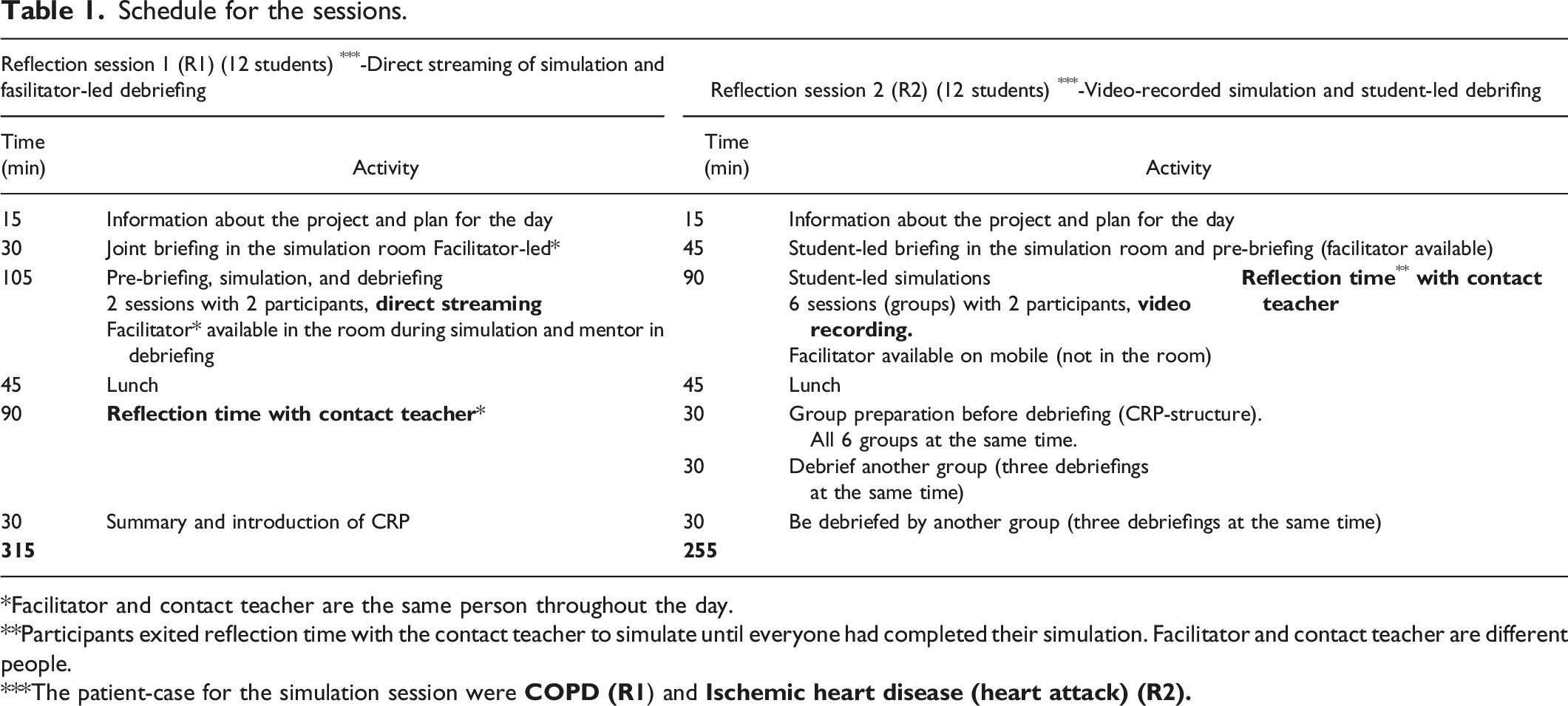
Facilitator and contact teacher are the same person throughout the day.
Participants exited reflection time with the contact teacher to simulate until everyone had completed their simulation. Facilitator and contact teacher are different people.
The patient-case for the simulation session were
Organization of the Simulation
R1 was conducted in the traditional manner were two students simulated while the rest of the group acted as observers watching live stream. The simulation was repeated twice, consequently, four students were active in simulation this day while the rest was observers.
After the focus group interviews in R1, the students were introduced to the debriefing structure CRP (Lerman & Borstel, 2003). A pocket card (Figure 1) based on the phases of CRP was developed as a tool for the students to use during R2 when they would debrief without a facilitator present. Critical Response Process (CRP).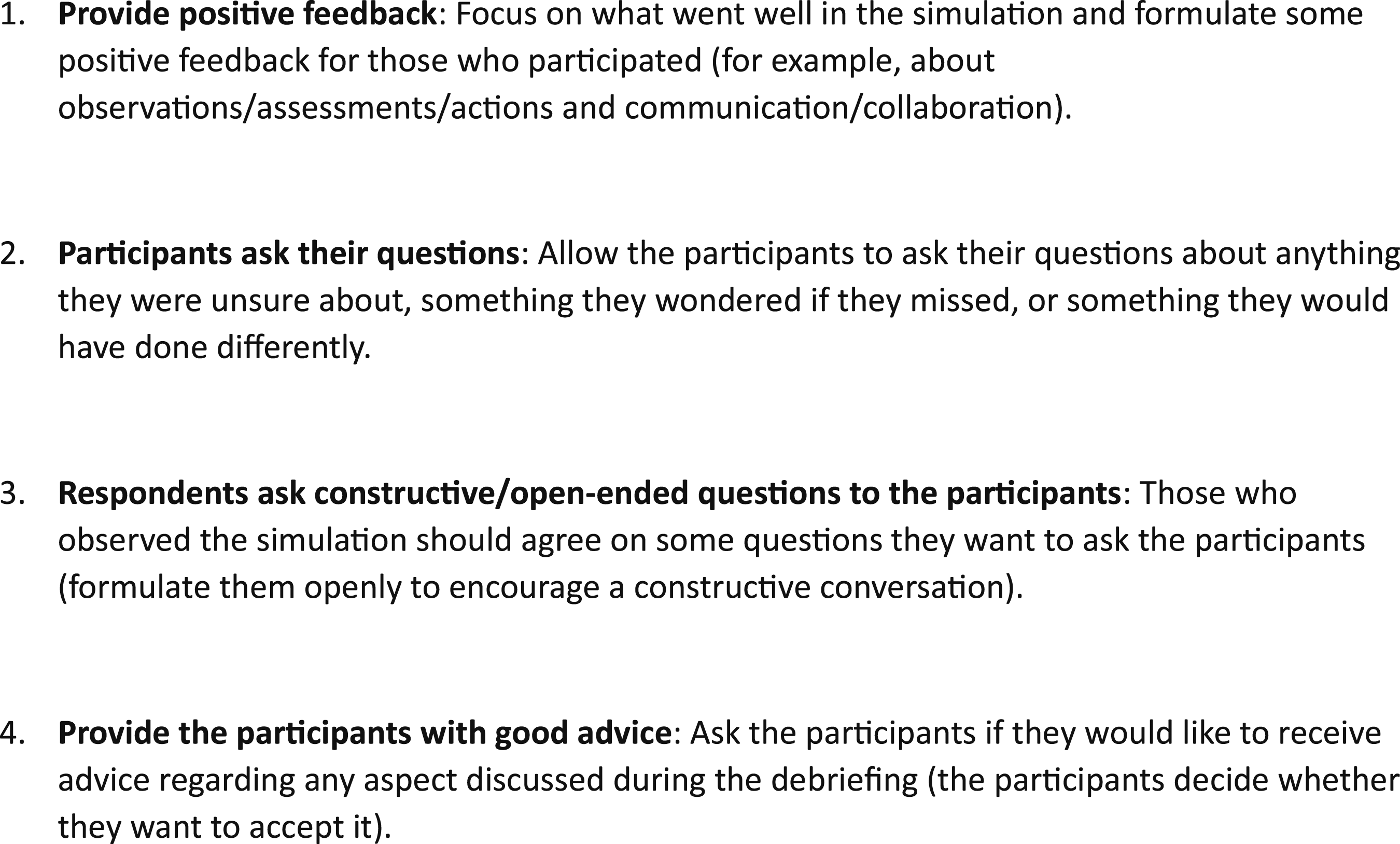
R2 took place four weeks after R1. Each student group (n=12) was divided into groups of three for the simulation, resulting that all students participated in the simulation. Audio and video recordings were made during the simulation. Each group of three then watched the recording of another group, which they would debrief later in the day.
Data Collection
Focus group interviews were selected as the data collection method. Kitzinger (1995) argues that the group processes in this method can assist participants in exploring and clarifying their perspectives in ways that would not be as fruitful in a one-on-one interview. Focus group interviews involve a one-to-one, qualitative and in-depth discussion where the researcher adopts the role of an ˝investigator˝. The researcher asks questions, controls the dynamics of the discussion, or engages in dialogue with a specific individual at a time. (O. Nyumba, Wilson, Derrick, & Mukherjee, 2018). It is important to consider that group dynamics and norms can influence freedom of expression (Graneheim & Lundman, 2004). According to Kvale et al (2015) a spontaneous interview procedure can elicit lively and unexpected responses, but when the interview situation is more structured, it may be easier to organize and analyze the results afterward. We consider the focus group interviews in this study to be semi-structured. An interview guide consisting of four open-ended questions derived from the research questions was developed. Figure 2 Interview guide.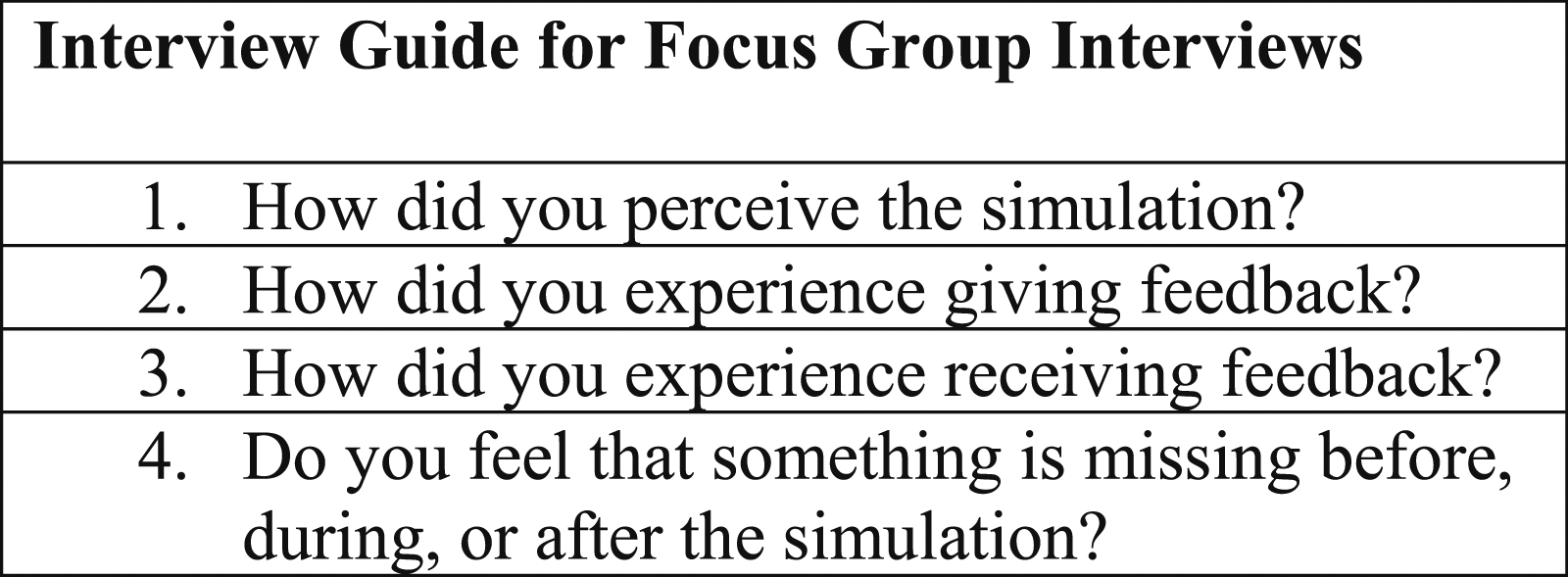
The interviews took place in a classroom in proximity of the simulation laboratory. All focus group interviews were conducted by the first author and audio recorded. The interviews' duration ranged from 22 to 29 minutes. The co-author participated as an observer and took jotted notes in the interview guide to ensure that the main areas outlined in the interview guide were discussed. The notes were read aloud to the participants at the end of the interview for confirmation, changes, and additional comments.
Data Analysis
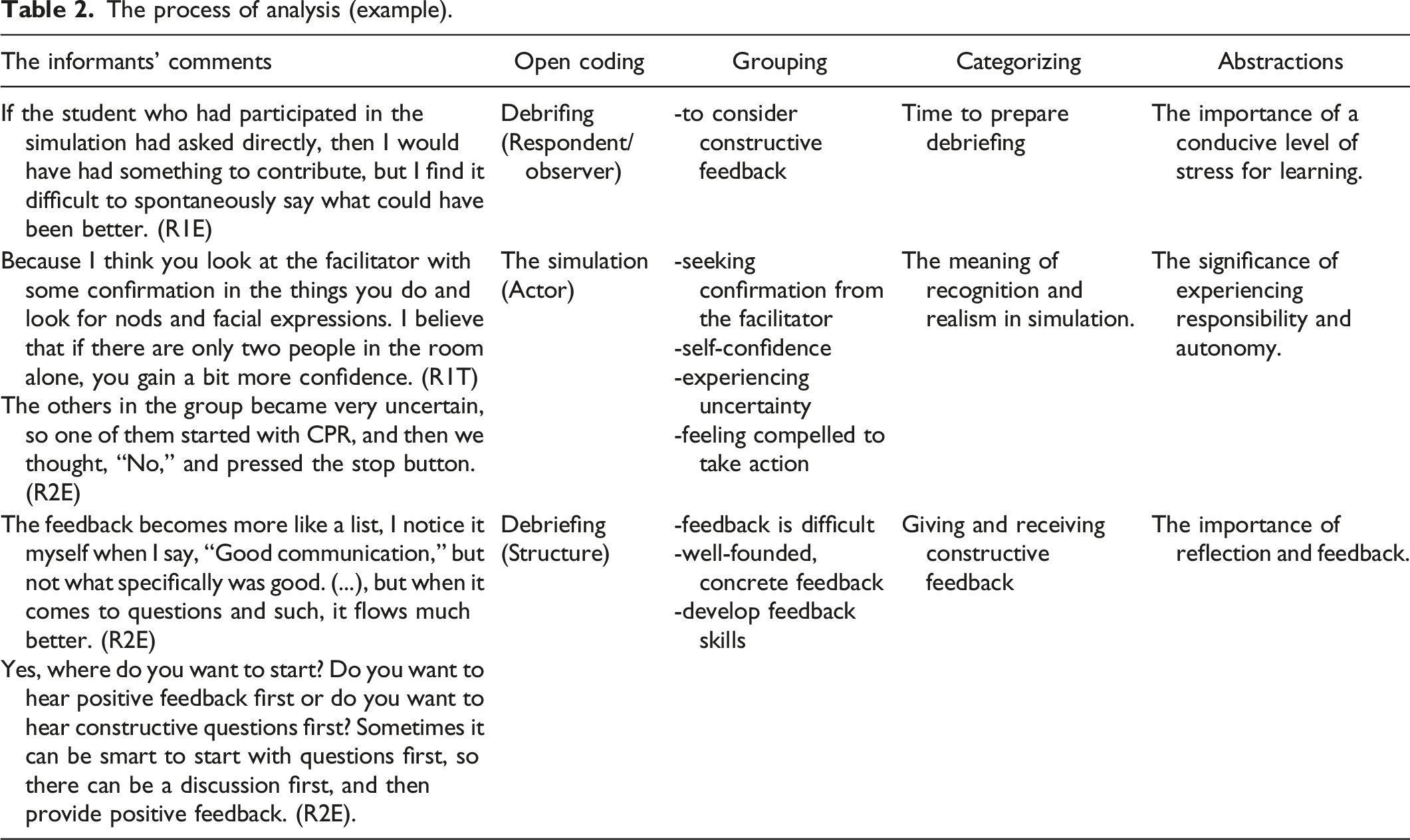
The process of analysis (example).
Research Ethics Considerations
At the start of the study, all students signed the study plan, consenting to the recording and live streaming of simulations in education. However, separate consent was obtained for participation in the focus group interviews. The study was approved by the Norwegian Centre for Research Data (NSD) on September 14, 2022 (reference number 8042440). Audio recordings were deleted after transcription, and the transcribed materials were stored in an encrypted area on the university's server. Consent forms are kept in a locked cabinet. All transcribed material has been cleansed of any direct and indirect personally identifiable information.
Findings
Findings.
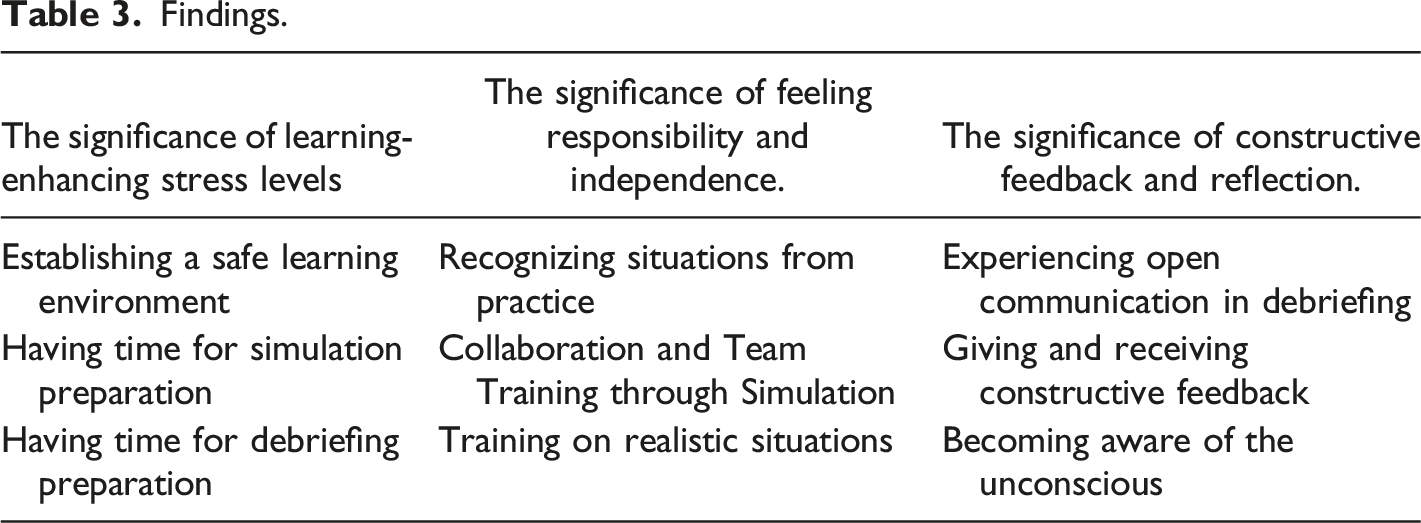
The significance of learning-enhancing stress levels
Participants' experiences of stress in relation to simulation included having a safe learning environment and sufficient time for simulation preparation and debriefing.
Establishing a Safe Learning Environment
Participants mentioned that their communication with each other during simulations differed from when they were on campus with teachers present. They described it as a “more comfortable environment” where they felt relaxed (R2T). This was seen as beneficial for reflection and feedback. They also mentioned that the feeling of stress diminished when the facilitator emphasized that learning could occur even when things are not perfect.
Participants perceived the group size during the first reflection session as a stress factor, describing it as “a little scary to be observed, with others watching, feeling pressured” (R1E). Following an observation structure of vital signs; known as ABCDE (Airways, Breathing, Circulation, Disability, Exposure); was also a stress factor for the actors, as they feared observers’ comments on something they might have forgotten.
During R1, they described uncertainty regarding the facilitator's role, perceiving that they needed to “clarify” with the facilitator what they were considering doing during the simulation. In R2, they felt that the stress was associated with the sense of responsibility and independence, as the facilitator was not perceived as equally accessible. “When we had to administer medication, you had to start calculating, and at the same time, we had to take care of the patient, and that caused some stress” (R2T).
Overall, participants described a lower level of stress during R2 because everyone was acting as actors (R2T). Additionally, they found video recordings of the simulation less stressful than live streaming because there were fewer people watching and providing feedback.
Having time for Simulation Preparation
Participants felt they had enough time during both reflection sessions to prepare for the case and briefing of the simulator and equipment. The structured review during the briefing in R1 was seen as beneficial by the participants. They became familiar with the equipment in the simulation room, received demonstrations, and had the opportunity to test the simulator. This created a sense of security before the simulation, “[...] in case it becomes critical, so we don't waste time searching and figuring things out” (R1E).
It was fine to conduct the briefing independently without the facilitator present in the room (R2), and participants perceived it as important for the actors to have time together before starting the simulation to clarify responsibilities and tasks and “discuss things we might encounter behind the door” (R2E).
Having Time for Debriefing Preparation
Participants mentioned that preparation for the debriefing was important for the observers. At the same time, it was crucial for the actors to have time to discuss among themselves after the simulation and “agree on what could be done better and what was done well” (R2E). In R1, they claimed that too little time was allocated for the actors and observers to prepare before the debriefing.
Observers who followed the simulation via live streaming said it created engagement to watch and they discussed and commented on what they saw. “You're sitting there, seeing things you would do differently, but they're not done, so you sit there thinking, Just do it! (R1E)
On R2, the actors experienced having ample time to talk amongst themselves after the simulation. “That's how we came up with even more things that we should have done” (R2T). The observers found the video recording useful in preparing for the debriefing. They could watch the recording multiple times, have academic discussions, and take notes on what they wanted to ask the actors. “The feedback becomes better when it's discussed before it's given” (R2E).
The Significance of Feeling Responsibility and Independence
This category relates to the experience of how campus simulations can prepare students for handling challenging real-life situations. The recognizability and perceived realism of the simulations in relation to the cases encountered in practice are significant factors.
Recognizing Situations from Practice
The case scenarios in the simulations were perceived as relevant, and the participants understood the purpose of simulating them. “It's positive that we get to practice; it's a very relevant case, and we will encounter the same type of patient in the hospital” (R1T). They also recognized the importance of practicing structured observations (ABCDE), even though it represented a stress factor. The simulations were perceived as relevant in terms of communication with the patient.
The participants particularly highlighted the usefulness of practicing medication administration, which they had limited opportunities to do during their practical placements.
Overdosing on morphine, it was interesting to try that out. We didn't know what was happening; we thought it was a side effect of morphine. Then when the doctor came in, we realized it wasn't 5ml; it was actually 5mg. So, it was a bit scary because I didn't know what to do (R2E).
Collaboration and Team Training through Simulation
Collaboration and team training through the simulation were perceived as “useful” and “relevant.” They had the opportunity to practice task allocation and agree on how to collaborate. “I've started doing that in real-life situations too, so that's good” (R2E).
Training on Realistic Situations
Although the simulator can speak, it was perceived as more challenging to communicate with it compared to a live marker, such as a fellow student. The actors did not get a sense of facial expressions, body temperature, and mobility from the simulator. According to the participants, in real practice settings, they need to seek permission from the contact nurse before taking action, even in situations where they know what needs to be done. In the simulation, they took greater responsibility for the patient. “You're alone, not with a nurse, so we have to make the decisions and figure out how to do it” (R2E).
The Significance of Constructive Feedback and Reflection
This category focuses on the participants' perceptions of what is important for learning through feedback and reflection.
Experiencing Open Communication in Debriefing
The communication in the debriefing was described as more natural without the facilitator present. “Many people feel more comfortable speaking up when the teacher isn't there. So, it becomes more like a regular conversation” (R2E). The participants mentioned that when they had debriefing sessions alone, it could involve laughter and joking, making it challenging to maintain structure. On R1, the participants reported that the facilitator contributed the most and guided the debriefing. “Actually, the facilitator spoke the most, and then we went around where everyone made a comment” (R1E).
The participants perceived that they were able to provide good feedback and engage in discussions without the facilitator present during the debriefing on R2. They also felt safer asking questions to the actors on behalf of the group rather than as individuals.
Giving and Receiving Constructive Feedback
After R1, the observers described being unsure of how confrontational they could be, and the feedback to the actors consisted solely of positive comments. “We go around the table and say something good, it becomes so vague, it's difficult to get any depth” (R1E). It was consistently challenging to be specific enough in the feedback. “It's easy to say that the communication was good, but what was actually good about what was said?” (R1E).
It was easier to receive feedback than to give it, and positive affirmation was perceived as important. “Personally, I am very self-critical of what I do, so receiving confirmation from other students who have been in similar situations in practice, getting feedback from them that what you're doing is what should be done” (R1T).
Having a debriefing structure (CRP) to follow was helpful (R2). However, the participants perceived that the positive feedback was characterized by listing without much nuance. They described it as difficult to create open and challenging questions, and that time for preparation was therefore important.
“We share perspectives and such before giving feedback to the group it concerns. The feedback becomes better when it's discussed before it's given” (R2E). “We wrote questions about what we had discussed so that they could reflect on things that we had noticed” (R2T).
The CRP structure was commented upon, and some suggested that the actors could decide where in the structure they wanted to start. “What I perhaps missed was first hearing what the group thought, what they thought they could have done differently, then maybe we could have been even more direct” (R2T).
Becoming Aware of the Unconscious
The participants expressed that they learn a lot from watching others simulate, but it is during the debriefing that they are confronted with their own performance. Watching the video recordings led to increased self-awareness. "When you watch other people's videos, you get a bit like “ […] yeah, they were good at that and that, things that you have forgotten yourself” (R2E).
Some of the participants also watched recordings of their own simulation when they were uncertain if the reality matched their perception. “Even though it's uncomfortable, but you see […] okay, this was actually quite good, while in your head during the situation, you might think now I'm doing everything very slowly, but in reality, it actually goes very smoothly” (R2E).
In preparation for the debriefing, the participants mentioned discussing clinical issues. “I still don't know why he did it [administered O2] when the saturation was 96, but yeah, that sparked some discussion” (R2T). They described that these discussions continued during the debriefing.
Discussion
The main findings of the study summarize nursing students' experiences with simulation. Regardless of the specific method of simulation employed, participants highlighted the importance of their own stress levels in the learning situation, the significance of experiencing responsibility and independence, and the value of constructive feedback and reflection. The discussion will be structured according to these three main categories.
Regulating Stress Levels in Relation to Simulation
As actors, students experienced stress from being observed and evaluated by observers and facilitators. Studies show that actors during simulation feel vulnerable and are fearful of making mistakes or presenting themselves in a negative light (Roh & Jang, 2017; Tosterud et al., 2020). Therefore, it is important to create a safe atmosphere before and during simulation. Simulation as a learning method is based on the premise that learning and human development occur through participation in social practice. According to Vygotsky (in:Thurmann-Moe, Dale, Øzerk, & Bråten, 1996), experiences or “learner activity” create the best foundation for integrated knowledge and deep learning.
In simulation, students learn about themselves by experiencing how they behave and handle situations with stress and communication challenges. The students described needing time to discuss among themselves before engaging with the “patient,” and they experienced gradual reduction in stress as they started the simulation. However, a certain level of discomfort can sharpen focus and contribute to increased learning outcomes (Jensen et al., 2009). The sense of realism and the gravity of the situation cause students to concentrate on their tasks (Akselbo & Aune, 2022). In our study, the students described feeling that the simulation time was shorter than it actually was, which may indicate that they worked with focus within an acceptable stress level.
The feeling of safety may be related to the degree of predictability and preparedness. To reduce stress levels in relation to simulation, it may be important for the facilitator to prioritize content and time for pre-briefing and briefing. This should be based on the students' prior knowledge and experiences. The facilitator can reduce stress levels through well-planned briefings, where students become familiar with the simulation room, the capabilities of the simulator, and the expectations for the facilitator's role during the simulation. A good briefing can prevent misunderstandings during the simulation (McDermott, Ludlow, Horsley, & Meakim, 2021).
According to Dieckman et al (2012), success in simulation-based learning depends on both organization, familiarity with the equipment used, and effective interaction among participants.
Degn et al. (2022) argues that the process in simulation is more important than the outcome. How the facilitator communicates expectations to the actors seems to influence the students' experience of stress (Persico et al., 2021). In our study, the actors were reassured when the facilitator stated that there is valuable learning in imperfection.
The briefing in R2 was conducted without a facilitator in the simulation room. We observed that the students spoke more freely and were more “hands-on” with the simulator and equipment, and together they remembered most of what was covered in the briefing in R1.
Observers described it as easy to identify deficiencies and ask questions when watching the simulation and having low stress levels. To increase observers' sense of responsibility and move them out of their comfort zone, it may be advisable to challenge each individual to provide justified feedback and formulate constructive question to achieve a dialog (Steen-Utheim & Wittek, 2017).
R2 was consistently described as less stressful than R1. The students claimed that the most significant reasons were that everyone participated as actors in R2 and that no one followed the simulation through live streaming. They mentioned that some of the stress associated with live streaming was due to thinking about what was being communicated among those who were observing.
What Promotes Students' Sense of Responsibility and Independence?
The students expressed that the relevance and realism of the simulation influence their engagement, immersion, and reflection regarding patient situations. Through pre-briefing, participants are immersed in a patient story that is relevant to practice. In addition, the level of realism achieved depends on framework factors such as time, available equipment, and teaching staff with relevant expertise. What participants gain through simulation compared with a clinical situation, is the possibility of time-out and debriefing, and the fact that failure is not life-threatening for a patient (Dieckmann, 2009).
One approach to increase relevance could be to create patient situations based on students' experiences in practice, where present scenarios based on real-life encounters that offer multiple alternative solutions to dilemmas that arise after discussions (Rønsen & Tosterud, 2022). This can enhance students' ownership and learning in simulation.
On R1, the students felt they had to look at the facilitator to clarify something related to medication errors. On R2, students experienced a greater sense of responsibility and independence compared to what they experienced in practical situations. They had no one to ask and had to learn together and from each other. According to Degn et al. (2022), peer-to-peer simulation without a facilitator can lead to better learning outcomes and increased levels of independence and confidence for students.
The students' descriptions suggest that the more independently the actors act, the smoother the simulation flows, thus enhancing the sense of mastery. However, at times, hints or tips from the facilitator can be helpful if the actors are stuck, allowing them to complete the simulation with a sense of accomplishment. It may seem like the facilitator can benefit from being sensitive to the actors' experiences and readiness to act in the situation before challenging or refraining from assistance (Persico et al., 2021).
What Promotes Learning Through Constructive Feedback and Reflection?
The students expressed concern about being too confrontational and “stepping on someone's toes” when they were observers. However, as actors, they did not take feedback from fellow students personally. Communication was perceived as more relaxed without a facilitator present (R2). This can be interpreted as the facilitator being regarded as an authority figure. Tosterud et al (2020) found that students unconsciously included the facilitator to varying degrees during debriefing based on their perception of the facilitator's role.
When using the debriefing model CRP, both actors and observers have an equal responsibility to maintain the dialogue. Training in providing feedback that prevents the recipient from becoming defensive is crucial. If the recipients become defensive, the learning process is hindered (Lerman & Borstel, 2003). Based on the statements in this study, it seems that students need practice in giving feedback.
Observers described engagement characterized by critical assessments, empathy, and discussions about observations and actions while watching the live stream (R1). On R2, both actors and observers felt that video recordings provided a different opportunity to evaluate and discuss before the debriefing. Discussing within the group before the debriefing can contribute to a shared understanding of what happened and how they solved the tasks. Each participant holds a piece of a large puzzle, and it is important for the overall picture that everyone contributes their insights. In the debriefing, the perspectives of the actors and observers are merged (Steinwachs, 1992). Through reflection after learning activities, students can become more aware of their tacit knowledge, knowledge that is difficult to describe or express (Lauvås & Handal, 2000). The students desired direct and constructive feedback, but this was not emphasized significantly during the debriefing. It was challenging to be specific and appropriately confrontational and to challenge each other with open questions. For feedback to have a learning effect, it must be conducted as a dialogue (Steen-Utheim & Wittek, 2017). The students valued the constructive aspect of positive comments but felt that learning did not occur unless they also included an explanation.
When the facilitator takes on the role of a moderator or leader during the debriefing, it is important for them to practice techniques that stimulate involvement and reflection among participants (Eppich & Cheng, 2015; Husebø et al., 2013; Spanager et al., 2015). The facilitator can encourage observers to elaborate on their feedback and help students rephrase comments into questions to provoke and create discussion. It requires competence and experience as a facilitator to formulate good questions that enable students to discover solutions they were not aware of. A facilitator who is sensitive and reflective about their own role in planning, briefing, implementation, and debriefing, and who allows students to learn from and with each other, will likely contribute to enhancing students' experience of learning through simulation.
Limitations and suggestions for further future research
Limitations of this study are assessed according to the criteria described by Guba and Lincoln, which are trustworthiness (credibility, transferability, dependability and neutrality) and authenticity (in: Schwandt, Lincoln, & Guba, 2007).
The execution of the study was conducted as per the plan. A study design influenced by action research, as opposed to controlled experiments, encompasses numerous and unpredictable elements that may diminish the dependability of the study. In retrospect, we recognize that a weakness in the study is that the two methods of organizing reflection sessions contains variations due to different facilitators and varying time allocations throughout the simulation process. It is possible that some of the students' experiences and perceptions of the facilitator's role and function may have been influenced by these differences.
A possible limitation could also be that the interviewer was inexperienced, but co-researcher participated during the interviews for support. The interviews had a relaxed atmosphere, and all informants expressed themselves freely and extensively in the discussions.
The research questions appeared to elicit responses in line with the study's purpose. The informants were perceived as active, with the opportunity to comment on and supplement their responses at the end. We believe that saturation was achieved in all interviews.
We have strived to describe the process as comprehensively and openly as possible within the specified word limitations to ensure transferability and dependability. The authenticity criterion was maintained through descriptions of the context and framework for implementation, presentation of direct quotations, and a description of the analysis process.
Elo and Kyngäs' (2008) analysis process was followed conscientiously, and this is presented through examples.
Recruitment of informants and data collection, processing, and storage were conducted following guidelines for privacy and research ethics.
Further future studies should focus on exploring the facilitator’s role in simulation, and especially when it comes to quality control of student’s learning outcomes.
In this study the students’ preparations for debriefing was recorded. The transcripts are prepared for analysis, and these data provide a basis for further studies to explore the students’ reflections and discussions before and under peer debriefing.
Conclusion
The purpose of the study was to explore nursing students' experiences with two different approaches to organizing reflection sessions with simulation on campus.
The findings suggest that the facilitator's presence during the simulation is not necessarily most conducive to learning. Perhaps the facilitator should prioritize establishing a safe learning environment, ensuring that everyone gets to be actors and, if necessary, participate as an academic authority in summarizing the day to clarify unresolved academic questions.
Footnotes
Declaration of Conflicting Interests
The author(s) declared no potential conflicts of interest with respect to the research, authorship, and/or publication of this article.
Funding
The author(s) received no financial support for the research, authorship, and/or publication of this article.
