




Abstract
Background
Over the past few years, there has been extensive discussion and research on
Aim
This qualitative study aimed to investigate the
Methods
The study utilized theoretical qualitative
Findings
The analysis revealed promising
Conclusion
This study highlights the potential for
Keywords
Introduction
In recent years, there have been growing debates, especially in the United States, over the role social-emotional learning (SEL) plays in educational processes (Shriver & Weissberg, 2020; Zhao, 2020). SEL is usually understood as the process by which individuals of all ages attain and utilize “the knowledge, skills, and attitudes to develop healthy identities, manage emotions and achieve personal and collective goals, feel and show empathy for others, establish and maintain supportive relationships, and make responsible and caring decisions” (CASEL, 2020, para. 1). On an institutional level, it involves educational “programs that attempt to enhance EI [emotional intelligence] and emotional literacy and/or the development of what are perceived to be fundamental social and emotional skills and competencies” (Hoffman, 2009, p. 535). Multiple meta-analyses of SEL programs demonstrate such programs have durable positive effects on individuals’ ability to manage their emotions and social interactions as well as on their academic performance on standardized assessments in math and reading (e.g., Durlak et al., 2011; Mahoney et al., 2018).
While current discussions focus on SEL interventions in formal education directed to children (e.g., McClelland et al., 2017; Jones et al., 2017) and adolescents (e.g., Yeager, 2017; Hurd and Deutsch, 2017), it also occurs in all kinds of informal learning contexts—in the wild, so to speak—and throughout the lifespan. Certainly, according to developmental psychology, the foundations of emotional and social skills are established during childhood and adolescence (Denham, 2018). However, it is important to recognize that SEL is a lifelong process (e.g., Akcaalan, 2016; Arslan & Demirtas, 2016), which takes place in diverse settings and contexts, including informal education (e.g., Chen, 2009; Luke et al., 2022). Consequently, we understand that scholarship in this area should increasingly consider informal learning sites, in both physical and virtual spaces, that are relevant not only for childhood and adolescence but also for adult learners, where they can acquire, strengthen, and practice social-emotional competencies. Such sites include challenging video games that may require and thus promote social-emotional competencies such as emotion management, stamina, and cooperation, making games a possible valuable tool for developing these skills. After all, playing difficult video games “involves working through challenging affects” (Jagoda 2018, p. 230): their mastery requires players to deal with the experiences of “anger, boredom, curiosity, complicity, pleasure, and uncertainty” (Jagoda 2018, p. 201).
The relationship between play and SEL begins in early childhood, where play is recognized as the primary driver of informal SEL for children (Ljubetic et al., 2020). However, this relationship does not stop there. The potential for video games to facilitate social-emotional learning across age groups has been recognized by the SEL community (e.g., Farber, 2021) and investigated by the field of game-based learning (e.g., Hromek & Roffey, 2009). It has been, for instance, demonstrated that video games can promote emotion regulation (Villani et al., 2018; Carissoli & Villani, 2019), self-directed learning (Toh & Kirschner, 2020), and prosocial behaviors (Saleme et al., 2020). Several studies applied the overall SEL standard by the Collaborative for Academic, Social, and Emotional Learning (CASEL)—including five categories: self-awareness, self-management, social awareness, relationship skills, and responsible decision-making (Weissberg & Cascarino, 2013)—and concentrated on single-player games (e.g., Toh & Kirschner, 2023), online games (e.g. Nikolayev et al., 2016), or serious games (e.g., Lim-Fei et al., 2016). In comparison, the sites around video games, such as online discussion boards and social networks, have received less scholarly attention. Investigating such spaces is worthy of scholarly attention as it has been shown that learning in relation to video games not only occurs during gameplay, but also in the (online) sites around video games, which Gee (2005) described as affinity spaces, through which players acquire video game literacy skills and collaborate in knowledge creation and dissemination (Hayes & Duncan, 2012). In this sense, we argue that the understanding of game-based SEL requires a consideration of metagaming practices, or “the game beyond the game” (Salen & Zimmerman, 2004, p. 481), via analysis of the online talk (Paulus & Friend Wise, 2019) beyond the games.
A study on after-school esport clubs lends credence to examining the value of communication surrounding gaming. Applying a quantified analysis of qualitative data, Reitman et al. (2020) found striking SEL gains of participating teens in the areas of self-awareness, self-management, social-awareness, and relationships skills, which were even higher than measurable increases in the academic domains of science, math, and English language arts. In qualitative interviews, both students and staff reported that the high school league improved players’ ability to regulate what many of them called “tilt,” which is a gaming term for strong emotional responses during gameplay, such as frustration and rage, that impairs decision-making and team work (Reitman et al., 2020).
Against this backdrop, our own investigation began with the assumption that the challenges of difficult video games offer opportunities for informal SEL—in the wild—that are enabled and can be observed when players visit affinity spaces such as discussion boards and social networks to help each other navigate difficulties encountered in a game. The present study therefore examined the performance of social-emotional competencies in a Reddit discussion board focused on the relentlessly difficult video game Elden Ring (r/Eldenring), where players support each other to overcome the mechanical, affective, and interpretative difficulties of the game (Jagoda, 2018). In doing so, we examined whether playing and mastering a challenging game—not only in the game as such, but also in interconnected affinity spaces (while metagaming)—requires social-emotional competencies and thus may encourage social-emotional learning.
Methods
To examine players’ demonstration of social-emotional competencies in a Reddit discussion board focused on Elden Ring (r/Eldenring), we conducted a qualitative thematic analysis (Braun and Clarke, 2006) of a focal thread in this subreddit. According to Braun and Clarke, “qualitative thematic analysis is a method for identifying, analyzing and reporting patterns (themes) within data” (p. 79), which enables researchers to interpret these patterns in relation to a given research question. While we initially developed a set of inductive codes from an analysis of our data as part of a broader research project, we later subsumed these codes under preconceived themes based on the theoretical CASEL framework (Weissberg & Cascarino, 2013; CASEL, 2020). Our approach to data analysis can thus be classified as a priori thematic analysis, i.e., a deductive or theoretical form of qualitative thematic analysis (Braun & Clarke, 2006, p. 83-84).
Reddit is one of the world’s largest social media platforms. The platform is structured by subreddits, which are interest-based communities where users, known as Redditors, share content (e.g., questions, news articles, videos, etc.) around the subreddit’s topic (e.g., Elden Ring). While several studies have examined gaming discourses on subreddits (e.g., Jorgensen & Bogers, 2020; Bergstrom & Poor, 2021), the platform has received less attention from educational researchers focused on gaming affinity spaces and/or SEL. Elden Ring is a critically-acclaimed action role-playing video game published in 2022 that has won multiple Game of the Year awards (Gerblick, 2023). We selected this game because of its extremely challenging mechanical, affective, and interpretive difficulty (Jagoda, 2018), typical for Soulsborne games, which we hypothesized would make it an excellent facilitator for SEL. On the interest-driven Reddit platform, players can find the necessary means of communication and a critical mass of fellow players to help each other navigate the game’s intense difficulty and high stakes.
Following prior qualitative studies of Reddit (Caplan & Purser, 2019; Maxwell et al., 2020), we began our search for a focal thread for analysis. Since our primary goal was to investigate whether community members demonstrate social-emotional competencies, we aimed to find a thread that showcased players’—individual and collective—coping with the game’s difficulty and management of their emotions within the affinity space of the subreddit.
Having identified and discussed several potential focal threads, the research team eventually selected one titled, “I’ve never played a FromSoftware game, this is my first, and I nearly quit.” The original post highlighted the user’s experience with the extreme difficulty of Elden Ring and described their early punishing and discouraging experience with the game as a novice player. After four hours in the game, the user explained, they were “about to quit because [they] just don’t see the point”, when they finally overcame the challenges of an area, which had been the cause of their frustration, and stumbled upon an encouraging in-game message left by another player, “Well done,” it said. “I’ve never felt more validated in my life by a person playing the same game as me,” the user wrote. “I think I get why y’all do this now.” This initial post inspired a lively discussion amongst r/Eldenring community members, who shared their experiences, feelings, perspectives, and strategies in relation to playing Elden Ring in particular and Soulsborne games in general, resulting in a trending thread highlighted on Reddit’s homepage. The thread had been upvoted over 18,000 times, included 2,363 comments encompassing 116,911 words, and had 997,765 readers when we extracted it for data analysis.
We followed the approach of Maxwell et al. (2020) and Caplan and Purser (2019) by exporting the focal thread as a PDF file and importing it into MAXQDA, a qualitative data analysis tool. After conducting a pilot analysis of 10% of the file using a set of 10 preliminary codes, the team met to share our coding results. Through discussion, debate, negotiation, and consensus-building, we identified fifteen final codes for the full analysis: philosophize, debate, cite, explain, narrate, evaluate, vent, joke/meme, strategize, speculate, celebrate, empathize, encourage, question, and answer. Subsequently, we applied 6,972 total codes to the data, distributed as follows: 742 for philosophizing, 139 for debating, 955 for citing, 400 for explaining, 404 for narrating, 308 for evaluating, 197 for venting, 377 for joking/memeing, 976 for strategizing, 33 for speculating, 357 for celebrating, 567 for empathizing, 919 for encouraging, 298 for questioning, and 275 for answering. This process enabled us to investigate patterns of comments and interactions across multiple research questions related to users’ interactions on r/Eldenring. However, the present study focuses on a single research question: To what extent do relentlessly difficult games and the affinity spaces around them require players to perform social-emotional competencies and thus encourage social-emotional learning?
Guided by this research question, we applied the conceptual framework of the Collaborative for Academic, Social, and Emotional Learning (CASEL) to our material. We used several of our study’s fifteen codes to align with the five cognitive, affective, and behavioral competencies (Weissberg & Cascarino, 2013) demonstrated by players in the focal thread. According to CASEL (2020), the five competencies can be characterized as follows:
The abilities to understand one’s own emotions, thoughts, and values and how they influence behavior across contexts. This includes capacities to recognize one’s strengths and limitations with a well-grounded sense of confidence and purpose. (CASEL, 2020, para. 3)
The abilities to manage one’s emotions, thoughts, and behaviors effectively in different situations and to achieve goals and aspirations. This includes the capacities to delay gratification, manage stress, and feel motivation & agency to accomplish personal/collective goals. (CASEL, 2020, para. 4)
The abilities to understand the perspectives of and empathize with others, including those from diverse backgrounds, cultures, & contexts. This includes the capacities to feel compassion for others, understand broader historical and social norms for behavior in different settings, and recognize family, school, and community resources and supports. (CASEL, 2020, para. 5)
The abilities to establish and maintain healthy and supportive relationships and to effectively navigate settings with diverse individuals and groups. This includes the capacities to communicate clearly, listen actively, cooperate, work collaboratively to problem solve and negotiate conflict constructively, navigate settings with differing social and cultural demands and opportunities, provide leadership, and seek or offer help when needed. (CASEL, 2020, para. 6)
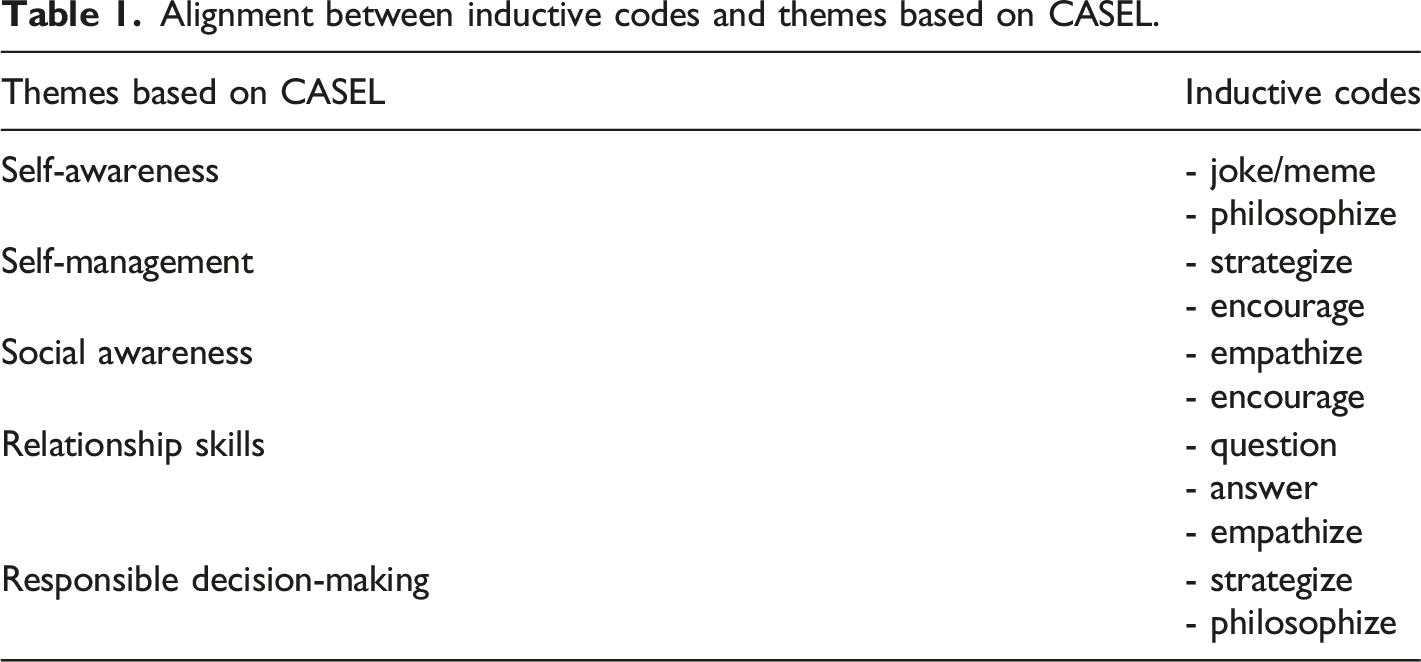
The abilities to make caring and constructive choices about personal behavior and social interactions across diverse situations. This includes the capacities to consider ethical standards and safety concerns, and to evaluate the benefits and consequences of various actions for personal, social, and collective well-being. (CASEL, 2020, para. 7) Table 1 illustrates the alignment between our inductive codes and the preconceived themes based on the CASEL framework.
Alignment between inductive codes and themes based on CASEL.
Findings
Our qualitative thematic analysis of the demonstration of social-emotional skills in our focal thread was guided by the CASEL framework. We present below qualitative evidence on the occurrence and character of the five cognitive, affective, and behavioral competencies at r/Eldenring: self-awareness, self-management, social awareness, relationship skills, and responsible decision-making.
Self-Awareness
In the focal thread, community members demonstrated their self-awareness, as defined by the CASEL framework, by exhibiting the key ability of understanding their emotions, thoughts, and values. Redditors frequently expressed a wide range of emotions, including frustration, anger, joy, and triumph. Their statements not only revealed their ability to discuss their feelings but also their capacity to step back and reflect. In other words, they exhibited a significant degree of self-awareness, which was evident, for instance, in their use of jokes, memes, and philosophical discussions to verbalize and contemplate their emotions.
During our analysis, it became clear that humor was a prevalent means for participants to express their emotions. Many of them would joke about their own struggles and failures. For example, one experienced player wrote: “Wait, it’s supposed to be easier? I’m getting wrecked still, been playing these games since 2009 haha.” The use of humor in this way often implied a certain level of wit, as exemplified in this quote: “This game showed me that , no im not a sadist but a hardcore masochist.” In many cases, players coupled their joking with a form of memeing, where they would reproduce inside jokes of the community. An example of this is the “git gud” meme, which encourages other players to improve their skills. Redditors frequently utilized the “git gud” phrase, which they weaved into their comments, demonstrating their familiarity with and affection for Soulsborne culture. One player stated, “As soon as I git gud I’m going back to gut that bastard,” showcasing the humorous use of the meme to express their determination to succeed.
Another means by which players verbalized and reflected on their emotions was through a category we identified as philosophizing. During our analysis, we observed that commenters engaged in philosophical discussions about why players willingly undertake the effort required to master such a difficult game. In doing so, players connected their emotions with thoughts and values that they often shared with the community.
Most frequently, players made sense of the frustration they experienced by emphasizing the intense satisfaction they felt as a reward when overcoming difficulties. This sentiment was evident in many of their posts, such as this example: “There is a point you break through the frustration and have a unique sense of accomplishment.” Repeatedly, contributors described the community’s narrative of mastery, emphasizing the themes of overcoming challenges and persistence to ultimately experience a highly satisfying feeling of accomplishment. As one player put it, “the point of a Souls game” is to “rinse and repeat, improving every try until I win.” Another contributor argued that “It feels better when you earn it.” All of these perspectives align with the philosophy behind the “git gud” meme mentioned earlier.
In addition to astute introspection (“And here I am, the stubborn masochistic fool,” as one commenter phrased it), some players also make generalizations and use psychological concepts to rationalize why they subject themselves to such challenging and difficult tasks: There’s something about facing an obstacle that someone puts in front of you, failing repeatedly and suffering for it, then smashing it to bits through persistence and will that no other experience can give you. Challenging yourself and using difficulty sliders simply doesn’t provide the same sense of accomplishment and satisfaction. Then the validation from others who’ve done the same thing is that much more gratifying because you know that they’ve gone through the same suffering you had. That’s what people who’ve never pushed through to complete these types of games and who keep asking for easy modes just don’t quite understand. It’s simply not the same.
Such statements go beyond mere identification of emotions and involve a profound (self-) reflection on a personal as well as a general, abstract level. They explore why it sometimes makes sense to endure negative emotions, such as the frustration and difficulty encountered while playing such games as a leisure activity. Some players even draw lessons that can be applied in real life. In response to the initial post in the thread, a commenter explained that they value these games “because they teach you patience and focus.” Others emphasized the humility that can be gained from playing these games. One poster wrote, “I love how these games just humble you,” while another described “a lesson [they have] never been taught in a game before”: “to swallow that pride” and “to push forward in the humblest of ways.”
As players participate in the community, they integrate their personal player identity with the social identity of the community, adopting shared values that help them to express, contemplate, and regulate their emotions. This process also allows players to experience self-efficacy, develop a growth mindset, recognize strengths and limitations, and cultivate a sense of confidence and purpose—all of which are crucial elements of the self-awareness category in the CASEL framework.
Self-Management
Redditors in the focal thread demonstrated their self-management skills and shared strategies with their peers, particularly as relates to CASEL skills of stress management and self-discipline. Playing Elden Ring is a stressful experience that requires patience and persistence to overcome challenging enemies and obstacles. Many participants focused on runes, an in-game currency that players can utilize to improve their character’s stats. Yet, players frequently lose runes through death. If a player dies, they drop all their runes in the location of their death. The player then has a single chance to retrieve those runes by returning to that location, which is often difficult and requires defeating challenging enemies. If a player dies again before retrieving the dropped runes, those runes are lost forever, and many Elden Ring players can confirm, losing a substantial amount of runes can be a demoralizing experience as it feels that substantial progress has been lost.
Participants, thus, strategized on this mechanic and a corresponding approach for stress management. One Redditor wrote: “DO NOT STRESS ABOUT RUNES. In any souls game the enemies rapidly increase the amount they drop as they progress. 2k [runes] will be nothing soon, and 2 lvls rarely makes or breaks anything.” Another counseled: This is the number one advice. As soon as you stop stressing about dropped souls/runes a lot of the difficulty of the game disappears. They are not as precious as you initially think. One level here and there will not make a difference and usually when you beat the boss you get more back.
These comments help community members, particularly newcomers to Soulsborne games, that becoming stressed over runes is simply not worth it.
Losing runes and progress and being repeatedly beaten down by the game’s crushing enemies, though, can be a stressful experience that requires stress management, including self-discipline. Community members also encouraged their peers to proactively deal with anxiety that accompanies playing Elden Ring. One Redditor wrote: “Make sure to take breaks if you ever find yourself getting really frustrated.” Another commented: Don’t be afraid to take a break. I’ll go play something easier and mind numbing if I start feeling like I want to quit. Sometimes walking away from the controller is the best choice. And when I come back I’ve even crushed the thing that I couldn’t do and realized I just needed a break
Other affinity space members not only encouraged peers to take breaks as needed, but also to persist in the game and overcome difficulties. One participant wrote “Remember that there’s no shame in taking breaks or looking around the world for other things to do if things get difficult. Just don’t give up!” Another community member offered to chat and shared their own experience, writing: the gameplay “will click. We can chat about it if you want. I’ve played from 9 last night to 6 am, quick break and then back at it. I had to take another break because tired eyes, but my dood, you can get it.”
Social Awareness
Community members in this affinity space demonstrated their social awareness through the CASEL skills of empathy, appreciating diversity, and respecting others. Empathizing was a crucial aspect of this discussion board, which served as a space in which players could share their ideas, including their difficulties and frustrations with the game and find a receptive and empathetic audience who validated those perspectives. In response to Redditors who commented on how their experience with Elden Ring thus far had been extremely difficult and frustrating with many in-game deaths, their peers replied with empathetic posts. This empathetic support often came from Elden Ring novices. One community member Redditor wrote: “i feel you bro...i started elden ring last night and im about 2 hours into the game, im dying like hell, but i really want to learn how to play.” Another poster noted: “Like you, this is my first [FromSoftware] game…As frustrating as it is, I can't stop playing it.” Other times, empathetic statements came from Soulsborne veterans. One Redditor wrote: “Dark souls veteran here and I definitely understand what you’re saying.” Another reflected: I’m a veteran in Elden Ring, but [Dark Souls 3] was my first game in the series and I felt the same way you did. You just got to deal with it, and learn how to git gud. Once you do that, bam you have one of the most satisfying experiences ever in a video game.
While empathy was often expressed directly in the form of statements such as “we’ve all been there,” participants’ empathizing was often accompanied by encouragement as well, as noted in the quote above. One member of the community noted, “I remember the same feeling when I played my first souls game, good job and good luck.” Another Redditor explained further: “This is what all of the Soulsborne games feel like in the beginning, even if you’ve played them before. They’re punishing and each have their own rhythm and dance. Keep going though, very soon it will click. We all go through that process.”
The discussion board also revealed appreciation for diversity via participants encouraging others to play the game however they want using their preferred playstyle, of which there are many (e.g., close-quartered melee combat, magic spells, ranged attacks, stealthy, aggressive, etc. that can unfold in various combinations due to highly customizable weapons and character upgrade systems). One participant wrote: “dont listen to people telling you what to play, or that ‘cheesing’ bosses with magic or glitches makes you a bad player.” Similarly, another Redditor stated: “Don’t worry about what kind of play style you have, find whatever works for you and most importantly have fun!”
Encouraging diverse strategies for progressing in the game extended into advice about using online resources about the game that can help players understand myriad issues such as mechanics, locations, items, techniques, and more. One participant encouraged readers, noting: “You shouldn’t be afraid to seek help, be it an online guide, this subreddit or whatever. Doesn’t mean you HAVE to but if you feel like it would make your experience more enjoyable then go for it.” Another participant wrote about this issue at length: A lot of vets will say they wanna go in blind to not get spoiled and discover everything by themselves. But as a first timer, get all the help you can get. Look up the wiki, look at beginner guides, look at maps to spot good items faster, etc. Imho, you’ll ruin the experience more by not looking it up than by doing so. Don’t give up, skeleton!
Collectively, the examples above illustrate how affinity space participants engaged in empathy and appreciated diversity in how people play and learn about the game. This demonstrates the respect these Redditors had for their fellow community members through empathy in their peers’ struggles and an appreciation of how others decided to play the game and partake in the Elden Ring experience.
Relationship Skills
Though it may seem counterintuitive to examine relationship skills on an anonymous social media platform—the CASEL framework, after all, seems to assume some degree of familiarity with those to whom a person relates (e.g., classmates)—our analysis suggests that Reddit’s anonymity can lend itself to the practice of a unique form of prosocial skill development. The salient features of CASEL’s construction of relationship skills emphasizes the ability to cultivate supportive relationships, interact with diverse people, communicate clearly and listen actively, solve problems and settle conflicts collaboratively, display leadership, and ask for and lend help when it is needed. Not only were these traits fully on display in the focal thread, we argue that the thread provided an important context for the practice of these skills, perhaps in part due its anonymous nature.
One way participants in the thread enacted relationship skills as an SEL practice was by seeking and offering help with Elden Ring, a fun problem to address. Indeed, the overall effect of the thread was to create a social context where people could engage with each other in response to the game’s brutal difficulty, often by empathizing and asking/answering questions. “Dumb question,” one user asked, “How do you level? By killing things?” Though perhaps not a dumb question, it certainly addresses one of the game’s most basic, and perhaps most obvious, mechanics: like many games, a player levels up by killing enemies. Rather than being met with snark—or worse, being ignored altogether—the user’s question was answered patiently and clearly: “Yes, u kill things and get runes, which u can convert to levels at sites of grace. U can also use any golden runes u have in your inventory to get some too. Don’t worry, its not a dumb question, everyone’s new at some point.” “Ah thanks!,” the initial user replied, to which their guide responded, “Glad it helped!” There is a prevailing stereotype, perhaps an earned one, that video gamers can be impatient with new players, hence the prevalence of the word “noob” in gamer discourse. (A “noob” is a newbie or novice game player.) What the above interaction illustrates, and this was consistent throughout the focal thread, is that the intersection of affinity space dynamics and metagaming practices created a context where anonymous strangers could relate to one another in constructive, uplifting ways.
Worth noting, too, is the role the Reddit platform itself played in structuring users’ interactions in ways that, in the focal thread at least, seemed to encourage more positive, supportive, relationship-building talk. What sets Reddit apart from most other social media platforms is the upvote/downvote feature, which allows users to display their approval of threads and comments by clicking on the upward-facing arrow (i.e., upvoting), their disapproval by clicking on the downward arrow (i.e., downvoting). The focal thread itself garnered 18,349 upvotes, with a 94% rate of upvotes overall, meaning only 6% of the total votes were downvotes. Not only did this high level of approval temporarily push the focal thread to the top of the subreddit, it also underscored a sort of community affirmation for the thread’s original poster. Within the thread, the upvote/downvote feature did similar work, with the most upvoted comment being elevated by the community: “Proud of you for getting good. Keep it up!” the user exclaimed, earning 2,947 upvotes for the contribution. At the other end of the spectrum, users diminished toxic comments that undermined their emergent relationships by downvoting into oblivion comments like, “You lost me at ‘y’all.’ Way to ruin your diction at the end =\.” In this way, the affordances of Reddit allowed users to build their relationship skills in a social media context by elevating content that encouraged members with upvotes, minimizing content harmful with downvotes.
Taken together, users’ willingness to seek and lend support and Reddit’s specific approach to structuring user interactions can facilitate the practice and development of prosocial skills like relationship building, underscoring the capacity for anonymous online interactions in affinity spaces to contribute to the cultivation of SEL skills in the wild, that is outside the institutional boundaries of formal schooling.
Responsible Decision-Making
The concept of responsible decision-making in this study aligns with the CASEL skills of analyzing situations, solving problems, and reflecting, as relates to playing and advancing in the game. In Elden Ring, players’ goals often relate to progressing in the game and overcoming adversity, and participants in the discussion board identified ways to effectively make decisions about how to accomplish these goals by strategizing. One community member who indicated they were new to Soulsborne games shared their strategy for progressing in the game: “[my] first time too. Here what i learn. Focus on long range till its easy for player like us. In dungeon use the summon finger and complete it with other people. Find an easy dungeon and use the finger and gain runes.” Similarly, another player wrote: “Long range [attacks are] your friend if you’re new to Souls games. I also skip the parts where I get too frustrated and go back to them later.” These Redditors analyzed situations and presented solutions for progressing in the game by sharing their perspectives and strategies. First, both noted the value of long-range attacks, which are useful because they allow a player to inflict damage on the enemy from a distance, inhibiting the enemy’s ability to damage the player. Second, one recommended finding an easy dungeon and summoning another player to help beat dungeon enemies and collect runes (i.e., currency). A third strategy was simply skipping difficult areas and coming back later, likely after the player has boosted their character’s stats. These strategies represent effective decisions that allow players, particularly Soulsborne newcomers, to achieve their goals of progressing in the game and overcoming difficult enemies and locations.
According to CASEL, reflecting is another important aspect of responsible decision-making, as personal reflection allows people to understand why they make the decisions they do and if necessary, adjust their behavior accordingly. A primary way the Redditors reflected was via philosophizing on how they make sense of the game and their gameplay experiences. Participants consciously reflected on and explained why they play Elden Ring, which generally involves subjecting oneself to high levels of stress and frustration. One participant reflected: “We endure it because we feel rewarded in the end and that’s why I enjoy these games. Keep going, you’ll eventually get how things work.” Another explained at length the appeal of Elden Ring and Soulsborne games more broadly, writing: The frustration, the challenge, the pain, the straight up soul crushing despair and hopelessness..it is all nothing compared to the high of beating that boss that stomped you out 20 times beforehand. The feeling of finding a new weapon in some hard to reach, hidden area. Learning an enemies weakness and turning an area from a deathtrap to a playground. It’s all amazing. Don’t give up.
These community members reflected upon and demonstrated their rationale for playing Soulsborne games and how persistence through adversity leads to an immensely rewarding and satisfying experience. These players’ goals not only included progressing in the game, but experiencing triumph over tribulation as a human being. As one participant philosophized: “Soulsborne games are not about leveling your character. they’re about leveling yourself. enjoy the ride.” Notably, as illustrated above, the participants’ writing not only explained their rationale, but also encouraged others to persist and experience the journey themselves: “keep going;” “don’t give up;” “enjoy the ride.”
Discussion
The purpose of this study was to investigate players’ demonstration of social-emotional competencies in a Reddit discussion board focused on the video game Elden Ring, known for its challenging gameplay. Applying a form of theoretical qualitative thematic analysis (Braun & Clarke, 2006) on a focal thread at r/Eldenring, we identified and subsumed a set of inductive codes under preconceived themes based on the theoretical CASEL framework, which consists of five components: self-awareness, self-management, social awareness, relationship skills, and responsible decision-making (Weissberg & Cascarino, 2013; CASEL, 2020). Through this analysis, we identified a range of promising social-emotional competencies exhibited by players across all five components of the CASEL framework.
Specifically, we found that players demonstrated self-awareness by verbalizing and contemplating their emotions and behaviors, and self-management by regulating their frustration and persevering through challenges. Players also exhibited social awareness by showing empathy and encouragement towards others who shared their struggles during the discussion, relationship skills by offering support and advice to fellow players while engaging with the platform’s affordances, and responsible decision-making by analyzing situations, solving problems, and reflecting on their gameplay experiences.
Additionally, as demonstrated in the findings, the same inductive codes were at times applied to multiple CASEL themes. This illustrates that various processes, such as strategizing and philosophizing, are applicable to multiple SEL competencies. Strategizing, for example, allows players to engage in self-management of their behavior and experiences by playing in ways that can reduce stress and frustration, but strategizing also contributes to responsible decision-making in that it can lead to efficient use of one’s time in the game. Similarly, community members encouraged one another in ways that promote self-management and demonstrate social awareness. On one hand, Redditors encouraged other discussion board participants to engage in self-management and proactively deal with stress that stems from playing this challenging game by taking breaks to relax. On the other hand, community members demonstrated social awareness of the feelings and preferences of others by encouraging peers to utilize their preferred playstyle and not feel compelled to succumb to pressure about the best or most appropriate way to play. Collectively, the use of the same code across multiple CASEL competencies illuminates how common ways of interacting in this affinity space, such as strategizing and encouraging, align with multiple valuable SEL aptitudes.
Our qualitative findings indicate that difficult games and related affinity spaces can encourage players to employ social-emotional competencies, promoting social-emotional learning. This study expands on existing research on games and learning by providing evidence on the demonstration of SEL skills in gaming affinity spaces (Gee, 2005; Hayes & Duncan, 2012). Moreover, it contributes to the field of SEL by shifting focus from formal contexts to informal learning environments: to SEL in the wild. While a limited number of studies have explored informal SEL using the CASEL framework, such as Luke et al.’s (2022) investigation of preschoolers’ SEL in children’s museums and community playgrounds, few have explicitly applied the concept of SEL to a type of gaming affinity space. An exception is Reitman et al.’s (2020) study on academic and social-emotional learning in high school esports. However, their study had a different focus than ours since it did not examine virtual spaces and the context was not entirely informal.
By shifting its focus to online interactions instead of face-to-face ones, this study highlights the significance of exploring virtual learning environments, which have not been extensively studied in the context of social-emotional learning except for a few recent studies primarily conducted in response to the COVID-19 pandemic (e.g., Kamei & Harriott, 2021; Raschdorf et al., 2021). In contrast to our study, most of these studies concentrate on formal education settings and primarily investigate oral communication rather than written communication. Consequently, the examination of how SEL can be facilitated through written online interactions in formal and informal contexts remains an area that warrants further exploration and research.
While the previous discussion of SEL emphasizes scholarship showing how it can support the development of positive mental and behavioral skills and dispositions, we want to acknowledge emerging critical perspectives on SEL, as they are gaining influence in educational policy, practice, and discourse. First, political actors in the United States have claimed that SEL reflects the influence of progressive political ideologies on education, functioning as sort of backdoor for what some conservative commentators denounce as “wokeness,” or the basic idea that the U.S. continues to struggle with systemic forms of oppression around such identity markers as race, sexuality, and gender (Cineas, 2023). Existing research, however, illustrates how SEL positively influences students’ academic performance in both math and reading (see Mahoney et al., 2018). Such politically motivated critiques are gaining traction in U.S. political discourse, potentially undermining the possible benefits of SEL on educational processes and outcomes.
Another strain of critique, this one derived from a very different set of ideological commitments, is suspicious of SEL due to its associations with career readiness in a competitive global economy. Williamson (2017) for example, explained that global economic policy bodies like the World Economic Forum and the Organization of Economic and Cooperative Development have latched on to SEL, situating the character attributes it builds within an economic grid of intelligibility. From this perspective, SEL has become a sort of branding exercise at the intersection of contemporary psychological trends, global economic policy, and educational technologies (e.g., ClassDojo), which come together to discipline the bodies and minds of children. Similarly, Richerme (2022) argued that CASEL’s framework for SEL is itself laden with neoliberal assumptions that risk eliding the structural pressures that produce economic inequality by focusing on the bootstrapping individual, who must cultivate and martial their social-emotional selves in order to flourish in the global economy. In other words, an individual’s success or failure is more a product of their individual “grit,” to borrow a fashionable term in SEL discourse (see Duckworth et al., 2007), than it is the consequence of powerful social and economic forces that transcend individual agency. Like Williamson (2017), Richerme (2022) also argued that cultivating SEL demands increasingly powerful regimes of surveillance, often instantiated through various digital technologies deployed in schools. Unlike the critiques coming from the U.S. conservative movement, however, progressive skepticism of SEL is generally centered on supporting the marginalized communities whom such curricula are ostensibly designed to serve.
While we acknowledge the growing contestation around SEL, we have nevertheless found CASEL’s framework to be a useful heuristic for investigating how reckoning with challenging video games in an online affinity space may function as a generative SEL practice in the wild. Indeed, in contrast to SEL in schools, we consider SEL in the wild as being more dynamic, open, and rich with potential, detached as it is from schools, global economic organizations, and invasive forms of technological surveillance. Approaching SEL as a leisure activity and considering learning outcomes that are “caught” rather than “taught” provides a fresh perspective on SEL. By doing so, we emphasize informal learning processes that have been mostly overlooked in SEL discourse but may offer intriguing opportunities for learners and insights for educators. One reason for this is that the experience of autonomy and personal agency can be advantageous for learning in general (Guay et al., 2008; Salmi & Thuneberg, 2019). In gaming affinity spaces like r/Eldenring, SEL can also benefit from some of the well-researched advantages of online sites, including low barriers to entry, a focus on a common goal (while disregarding variables such as race, class, gender, or disability), a wide range of participation options, and reciprocal mentorships (Gee, 2005).
Though Reddit, like other social media platforms, has hosted problematic content and interactions, including those of a sexist and racist nature (e.g., Ferrer et al., 2021), this study demonstrates how the platform can nevertheless shape user interactions towards more positive ends. Based on our analysis, the platform’s approach to community-based, self-moderation in the form of upvotes and downvotes had the effect of promoting positive, prosocial interactions in response to Elden Ring’s fierce difficulty, which can lodge players in states of anger, frustration, and confusion. Reckoning with such affective struggles in an affinity space, one where novice and expert players anonymously interact on a platform that offers tools for shaping community discourse, seemed to offer players a safe refuge from the game’s challenges. Of course, there is nothing inevitable about Reddit’s capacity to encourage prosocial behaviors; however, in our study, the platform’s affordances and the players’ affective needs seemed to combine to support a promising form of SEL in the wild.
Limitations and Future Directions
By applying the CASEL conceptual framework to our material, we gained insight into how r/Eldenring serves as a facilitator of SEL. However, we must emphasize five limitations of our research design. First, since the research question of this study on social-emotional learning was developed based on inductive codes, initially unrelated to the later identified thematic groupings, it should be noted that these codes do not represent a complete operationalization of the CASEL framework. Second, while naturally occurring data on the internet (including gaming affinity spaces) offers researchers the advantage of immediate and uninfluenced access to human practice (see Steinkuehler, 2006 for online games and gaming affinity spaces), it comes with the downside that we do not know the demographics of our study participants (Paulus & Wise, 2019, p. 106). Therefore, our data only speak in favor of informal SEL in general, not in relation to a particular age group, although we presume that the subreddit is a place for young people and adults of various ages. Third, our study depends on the theoretical assumption that the performance of social-emotional competencies within an affinity space centered around a challenging game is indicative of the promotion of social-emotional learning within such a space, as it necessitates the utilization of these competencies. Consequently, we assert that the investigated affinity space acts as a facilitator for the acquisition of social-emotional competencies. Nonetheless, from a methodological standpoint, it is crucial to emphasize that, similar to Luke et al. (2022), our measurement focused on observing the demonstration of social-emotional competencies rather than directly assessing the learning processes or outcomes. Fourth, the research design we employed, specifically the a priori thematic analysis, was not appropriate for investigating the temporal development of comments, which would necessitate a different approach such as sequential analysis. Finally, we selected the target thread based on its popularity, specifically in response to its temporary status as a trending thread on the Reddit homepage and having over 18,000 upvotes. We did not, however, systematically examine upvotes and downvotes as part of our analysis for two reasons: 1) we decided to focus more on the content of posts than on each post’s popularity, and 2) focusing on upvotes and downvotes has not been central to previous qualitative examinations of Reddit threads (Maxwell et al., 2020).
In light of the limitations of this study, future qualitative and quantitative studies that apply the CASEL framework to games and their affinity spaces should aim to systematically operationalize all five categories. Additionally, demographic factors such as age, gender, and educational background should be taken into consideration. Moreover, future research should closely examine the learning processes that contribute to the acquisition of social-emotional competencies in informal learning environments, similar to those observed in this study. Further studies should also conduct systematic comparisons of SEL in the wilderness of anonymous social media platforms versus SEL in other informal and formal settings, both in physical and virtual spaces. Lastly, it is crucial to pay special attention to the temporal dynamics of social media threads as well as the unique features of online platforms and their influence on users’ interactions and SEL. Future research on Reddit affinity spaces would benefit, for instance, from examining how upvoting and downvoting impact thread structure and interactions, although such research may encounter methodological challenges given the opacity of social networks like Reddit.
Conclusion
Our study suggests that engaging in challenging video games, such as Elden Ring, and participating in related metagame practices within gaming affinity spaces can—despite its digital and anonymous nature—foster the development of social-emotional competencies, which may have positive implications for players’ well-being and success in other areas of their lives.
Footnotes
Declaration of Conflicting Interests
The author(s) declared no potential conflicts of interest with respect to the research, authorship, and/or publication of this article.
Funding
The author(s) received no financial support for the research, authorship, and/or publication of this article.
