



Abstract
Background
Discussion-based communication scenarios are present in many aspects of life. These can range from conversations with friends in a social setting to formal consultation processes and focus groups used by industry and government. However, reliance on speech does not easily permit the fair and equitable involvement of people who face communication-based accessibility challenges.
Aim
This work aimed to understand the communication challenges present within social board games, how these challenges arise, and participants’ perceptions of the difficulties these challenges may cause.
Method
We conducted four social gameplay sessions to understand what parts of discussion may cause communication challenges and what techniques are commonplace in overcoming these.
Results
Our results highlight how group facilitation and conversation pacing are essential in promoting accessibility within discussion-type situations. Our analysis identified four themes that focused on speech and delivery, access strategies, viewing and position, balance of power, and awareness of others.
Conclusions
Communication within board game scenarios is a complex area that creates several intersectional accessibility challenges. These challenges can impact how group communication is facilitated, how pacing and delivery relate to overall group understanding, and how an awareness of accessibility is critical in developing inclusive environments.
Introduction
Hearing loss can impact how people communicate, form relationships, and participate in work-related opportunities. It can affect how people engage with society and how society engages with people (Chia et al., 2007, Dalton et al., 2003, Gopinath et al., 2012). Hearing loss can profoundly affect individuals' ability to play an active role within society (Tsakiropoulou et al., 2007) and puts people at an increased risk of social isolation (Shield, 2006). This risk is amplified during consultation events run by public services that allow members of the public to have their say on matters such as health, social care, education and transport. Understanding challenges experienced by those with hearing loss when participating in discussions is paramount for determining the actions and adjustments that will ensure those with hearing loss can contribute equally in debate and meeting type situations.
Participation in discussion and debate is core within society and political structures worldwide (Arter, 2004). Communication is essential within complex medical environments (Kopone et al, 2014), when engaging in commerce (Koponen and Julkunen, 2015), and within education (Jones, 1998). Table discussions and meetings require people to communicate in a highly interactive manner, where sometimes the overall accessibility of the methods used to elicit discussion is not considered. This lack of accessibility can be for environmental, behavioural, or attitudinal reasons (Demorest and Erdman, 1987). Understanding communication challenges that occur in these situations is vital in developing tools and techniques that can be used to increase inclusion levels. Previous work has explored the tactics that users employ with and without a hearing impairment to participate in conversation (Gorman, 2016, Hallam and Corney, 2014). These tactics are supplemented by guidance in communication practice that people can use at a broader societal level (UK Government, 2018). In group-based discussion, environmental and facilitation practices are crucial to ensuring inclusive communication (Balch and Mertens, 1999). Care needs to be paid towards the discussion setting, the number of participants and moderation techniques used (Kroll et al., 2007).
This work investigates participants' challenges when participating in discussion-based communication scenarios. We use board games to examine concepts, including bluffing, teamwork, and time-limited activities to simulate the same type of discussions that would occur within meeting-type situations (Allen et al., 2014). We conducted a qualitative analysis based on the participants' journaled experience (Banks, 2018) of participating in this work. We use this to discuss common communication challenges and hypothesize areas where technology could play a role in creating more significant levels of participation and inclusion.
Background
Active participation in society requires face-to-face communication, and the role of non-verbal communication in negotiations, focus groups, and meetings is a reasonably well-explored area (Bargiela and Harris, 1997, Conway et al., 2007, Peleckis and Peleckiene˙, 2015). The importance of posture, facial expressions, gaze and incidental gestures is generally well understood, but these analyses often exclude disability from the problem domain.
Traditionally, group meetings have focused on table discussions, where multiple participants are physically co-located to maximize the information load of presence. Meetings can be combative (Vine, 2017), they may be explicitly designed to be confrontational (Baxter, 2017, Farrell, 2001), and if not properly managed, can result in a few powerful personalities dominating proceedings (Collinson et al., 1989). Discussions may interleave or overlap without deference to hard-of-hearing colleagues (Coates and Sutton-Spence, 2001, Mather, 1987), and real-time transcription often fails to keep up with the pace of conversation (McGregor and Tang, 2017, Yoshioka et al., 2019).
While physical accessibility challenges can be accommodated through the design of meeting spaces, those with disabilities that impact conversational cues are disadvantaged (Garcia et al., 2002, Luft, 2000). People that face accessibility challenges relating to communication may find it challenging to make a point heard (David, 1991) or may struggle to argue a position (Perkins-Dock et al., 2015). In addition, people with learning difficulties may not catch all the nuances of a discussion (Grove et al., 1999), and those with hearing difficulties may be unable to differentiate between simultaneously conducted sub-conversations (Gatehouse and Noble, 2004).
Accessibility of Communication
Society should not use technology within discussion contexts to mark out people with different communication requirements (Lupton and Seymour, 2000) but instead be prepared to create improved experiences for all (Gregor et al., 2005). Previous work has focused on developing communication techniques to support working with those with aphasia (Kagan, 1998, Parr et al., 2008) and on considerations needed to create accessible conference-style events (Shaw, 2018).
We must consider the complexities of working with people of varying abilities. One method to accomplish this is to focus on user-centred design methods that promote empathizing with others rather than empathizing like others (Bennett and Rosner, 2019). Simulation tools are heavily used to promote empathy in the visual (Goodman-Deane et al., 2013, Takagi et al., 2004) and physical (Goodman-Deane et al., 2016) domains. However, recent work has rightly urged caution in their usage due to the disconnect between designers and end users (Tigwell, 2021).
One popular method used to assist in improving accessibility for communication focuses on the live captioning of content. Live captioning is an area that is growing in popularity, with this being showcased at conference (Kushalnagar, 2014), device (Google, 2019), and application (Microsoft, 2018) levels. Whilst readers can keep up with fast captioning levels (Szarkowska and Gerber-Morón, 2018), this can lead to a reduced understanding of contextual information. The potential exists in developing digital tools that can assist in monitoring the overall pace of content 2 Communication Challenges in Social Board Games delivery within discussion contexts. Possibilities in this area include automated, real-time speech monitoring (Khouri et al., 2011), personalized monitoring (teleStream, 2015) or carefully selected activities (Johansson-Sköldberg et al., 2013).
Although work has examined communication challenges for individuals, very little in comparison has focused on the additional challenges that appear in a group context. This can include challenges relating to multiple speakers within confined spaces, interacting with objects, and contributing to several sub-conversations simultaneously. Drawing on inspiration from the field of universal design (Steinfeld and Maisel, 2012), we aim to investigate the challenges that may appear in table-based discussion. Whilst no one-size-fits-all solution exists in this area (Manzoor and Vimarlund, 2018), an adaption from alternative domains may be possible (Cawthon, 2001). Adaptive accessibility is well understood within the digital domain (Abascal et al., 2011, Miñón and Abascal, 2012, Nicolau and Montague, 2019, Peissner and Edlin-White, 2013, Sloan et al., 2010), and it may be possible to use similar techniques to create adaptive group facilitation aids.
Board Games as a Proxy Tool
Exploring communication issues in context is complex. Investigating accessibility issues in group discussions first requires a motive for discussion, i.e. a subject for discussion content. This content may be a confounding factor when exploring alternate methods that interfere with the core deliverable of the meeting itself. Artificial reasons to gather will not generate the same dynamics. Any topic sufficiently engaging to develop discussion outside of a specified productive context will likely be so controversial to introduce irreducible complexity into the analysis.
A convincing proxy for productive physical gathering exists in tabletop gaming – specifically in a family of board games drawn from the traditions of social deduction, bluffing (Reiley et al., 2008) and escape-room (Menzies, 2019) puzzles. These neatly solve the issues of exploring accessibility in meeting discussions by giving all participants a reason to gather and have a productive conversation in an environment where the self-contained nature of the activity does not impinge on broader organizational needs. Introducing games into a topic like this runs the risk of exacerbating accessibility problems (Heron et al., 2018b). Still, we have focused on games where the accessibility challenges are well-understood (Heron et al., 2018a) and where we can compensate without interfering with core study goals.
Games offer a reconfigurability of use-case that can be highly granular. Conversational games may be confrontational, where players work at cross-purposes to frustrate each other through bluffing, misdirection and logical decomposition. They may be collaborative, where players work together to accomplish some shared goal. They are motivating by their very nature, which ensures a buy-in that is an appropriate proxy for consequential productive meetings. Board games have previously been shown to encourage discussion of topics whilst also providing a method to simulate team activities (Petranek, 1994). They can be used to explore complex areas such as environmental issues (Fjaellingsdal and Klockner, 2020). They are low-cost to organize and permit a discretization of conclusions through the specific mapping of game-design patterns (Bjork and Holopainen, 2005) to desired behaviour.
Communication in Board Games
Board games can create enjoyable social interactions (da Rocha Tomé Filho et al., 2019) between individuals. These interactions can involve complex relationships, including artificial conflict and negotiation between players (Rogerson et al., 2018). For example, games such as One Night Ultimate Werewolf rely on players' understanding of verbal and non-verbal communication to detect deception and suspicious behaviour (Chittaranjan and Hung, 2010). Games can be used to understand group trust dynamics and how these dynamics can alter individuals' behaviour (Violi et al., 2011).
Games can provide a structured environment for play that encourages levelling between traditional group hierarchy (Rogerson et al., 2019) and adaptations to game experiences to promote inclusion can create feelings of a level playing field (Johnson and Kane, 2020). To encourage inclusion, games use artefacts (e.g. dice, tiles, and meeples) to direct players' attention toward elements of importance at given points in time (Xu et al., 2011). The social engagement provided by games is not to be underestimated and can also be beneficial within a therapeutic context to assist in rehabilitating people with brain injuries (Duckworth et al., 2014).
A lack of focus on understanding how game creators can design game-based social interactions to cater for mixed abilities can create isolated communities (Gonçalves et al., 2020). These feelings of isolation are echoed outside of a game environment, as social interactions that are used within games, such as understanding deception, are seen as valuable skills by society (e.g. jury within a trial (Pérez-Rosas et al., 2015)) and failure to understand these interactions can lead to feelings of social isolation. Within a game setting, these feelings of social isolation can increase hostility and tension among players (Birk et al., 2016).
We position this work within HCI games research's Operative Paradigm (Carter et al., 2014). In doing this, we attempt to leverage knowledge from the study of games to understand real-world situations and frame our research where we ask RQ: What are the communication challenges faced by individuals when participating in board game related table discussions?
Methodology
In this work, we use board games as a method to observe the communication behaviour of groups. We use this medium to gather information on challenges people face with hearing loss or deafness during table discussions without manufacturing a meeting scenario where participants may be less interested in the topics being discussed. We carried out user studies with 14 participants in 4 sessions, and each participant participated in a single session to understand the communication issues present within table discussions.
Participants
Participants were recruited by approaching local groups with a description of the study. In total, 14 participants took part in this work. Participants had different hearing profiles, ranging from mild hearing loss to total deafness, and consequently had varying communication requirements. 6 reported having mild hearing loss; 6 reported using hearing aids; 1 reported having total deafness, relying on lip reading and English/BSL Interpreter; 1 report as having total deafness and relied on lip reading, and live captioning (when available).
Board Games
Five board games were selected to give a combination of competitive and collaborative games, with an emphasis on games involving large amounts of discussion. Games were play-tested by the research team before being included to ensure that the communication challenges that may have been present within games would not lead to participant stress. The games selected are introduced below: 1. Sheriff of Nottingham (Sérgio Halaban, 2014): A social deduction and bluffing board game where players work separately to try and sneak contraband goods into Nottingham past the eyes of the sheriff. This game focuses heavily on player negotiation and subtlety. 2. One Night Ultimate Werewolf (Alspach and Okui, 2014): A deduction and bluffing game where players must determine who has been assigned werewolf whilst keeping their role hidden. This game focuses heavily on auditory cues, subtle communication of strategy, and multiple discussions happening simultaneously. 3. Exit: The Mysterious Museum (Inka Brand, 2018): A deductive puzzle game where players must work together to solve puzzles. Players must work together and communicate a common goal. This game focuses heavily on high-speed discussion and fast negotiation, as the game score is based on temporal factors. 4. Exit: The Polar Station (Inka Brand, 2017a): A deductive puzzle game where players must work together to solve puzzles. Game mechanics are similar to 3) Exit: Mysterious Museum, with the main difference being complexity and theme. 5. Exit: The Sunken Treasure (Inka Brand, 2017b): A deductive puzzle game where players must work together to solve puzzles. Game mechanics are similar to 3) Exit: Mysterious Museum, with the main difference being complexity and theme.
In choosing our games, we emphasized picking titles that participants would be unfamiliar with to reduce performance bias and focus on core communication elements. The three "Exit" games are all variations on a theme and feature the same game mechanics (cooperative) and categories (deduction, puzzle, real-time). One Night Ultimate Werewolf and Sheriff of Nottingham share the two main types (bluffing) and differ slightly in mechanisms (both share role-playing, ONUW also contains hidden roles, and asymmetric information, SoN includes bribery). Board games were selected to combine competitive and collaborative games with an emphasis on games involving discussion.
Lab Setup
Experiment sessions took place in two separate locations to assist participant travel convenience. Two sessions were within a local community centre, and two were within a university HCI lab. Rooms were set up with a large central table with participants seated around this. The table used within sessions 1 and 2 was square and measured roughly 3m by 5m, and the table in sessions 3 and 4 was circular with a diameter of 1.5m. The researcher was seated next to, but not between, participants in each session. Participants were asked if they required any accessibility accommodations as part of signing up for study sessions. We employed a live captioner (Session 1) and BSL interpreter (Session 2) for participants that requested these options. The professionals providing these services were positioned in accordance with where best-suited participants' needs. The facilitator provided no communication guidance to the group at the beginning of study sessions. However, round table introductions and name plaques were used to assist in developing familiarity with everyone present.
Reflective Journal
A reflective diary was created and given to each participant at the end of the study. Reflective journals can reduce researcher influence compared to an interview or focus group-type environment (Ortlipp, 2008) and allows participants to articulate their thoughts and feelings whilst reflecting on the activity as a whole (Rapley, 2018). Participants were asked to fill these in and return them to the research team for a £10 Amazon voucher. The diary was created so that participants could comment on each game played and reflect on the challenges faced when playing individual games. Journals asked the following questions for each game that was played: • Were there any challenges that you faced that made communication difficult? If so, what were these? • Were there any challenges that the group faced that made communication difficult? If so, what were these? • Think about the communication challenges that were faced when playing this game. How were these overcome? • Were there any challenges that were not overcome? What strategies could be used in the future to assist with these? • What other strategies do you think may have worked to overcome similar challenges to these in the future?
Participants were also given extra pages within the journal for any additional notes or comments they would like to provide to the research team.
Experimental Procedure
Participants were welcomed to the session and asked to take a seat around the gaming table and to make themselves comfortable. Participants were then explained the study's purpose and asked to fill in consent forms in line with IRB approval. Two games were played in each session, with each game lasting between 45-60 minutes. Games were selected to combine solo (i.e. competitive) and group (i.e. collaborative) gameplay mechanics used in each session. Ten minutes were taken to explain the concept behind each game with a focus on game theme, structure, actions, rules, exceptions, victory, and an overall summary (guidance for this taken from (Davis, 2013)). At the end of the game session, participants took part in a small discussion regarding the overall experience of taking part in the work and were given a £20 Amazon gift voucher.
During the study sessions, the role of the researcher was to introduce the games and to answer any clarifications that players had, communicating through speech. They did not participate in the game sessions and were positioned as casual observers. An additional reason for picking the selected games was for their fast "pick up and play" nature (based on BoardGameGeek "Game Weight" ranking", meaning that researcher involvement was minimal when describing game rules. Our focus was on creating situations for participant communication to be prominent.
Results
We conducted a qualitative analysis based on the participants' journaled experience (Banks, 2018) of participating in this work. Whilst every attempt was made to remain impartial throughout the analysis, a potential bias may exist as the authors were present and active within all game sessions. However, using a reflective diary reduces bias as participants completed this independently. Eight reflective diaries were returned (from a total of 14 handed out). All reflective diaries were transcribed and analyzed by the lead author. Codes were identified within the data and then sorted into initial themes. Themes were reviewed and condensed into five main themes and ten sub-themes. The authors then conducted an online discussion to agree on all coded data. Themes and sub-themes were refined by discussing disagreement. The outcome of our analysis is a broad understanding of the communication challenges faced when participating in social gameplay situations and not codes themselves. As such, inter-rater reliability is not recommended (McDonald et al., 2019). The final themes are summarised in Fig. 1 and reported below. Thematic Map Showing Identified Themes.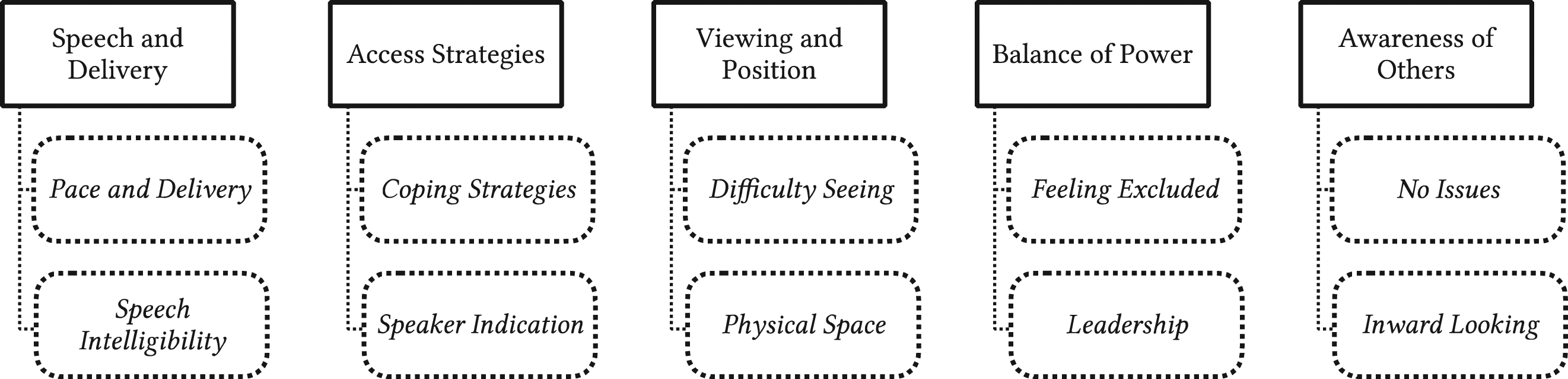
Speech and Delivery
The
Participants discussed several opportunities for assisting with challenges relating to this theme, with the majority focusing on "slowing the whole process down" (P4). They discussed the importance of "waiting for an interpreter to finish" (P2) and in speaking "slowly and clearly" (P10). In addition, participants discussed the importance of find taking turns to speak, "letting lip readers know who was speaking" (P4) whilst also allowing for focused discussion "before allowing other suggestions" (P2).
Access Strategies
Viewing and Position
Balance of Power
Awareness of Others
This final theme lies in contrast to those presented previously. We highlight these to illustrate potential challenges in developing an awareness of inclusive communication methods for all people participating in meetings and focus group situations.
Discussion
Communication within group situations is a complex activity that involves processing large amounts of information from various stimuli. In our work, critical challenges exist in the overall conversation pace within meetings. We also found difficulties in how participants determine what actions within their immediate environment require focus and which should be ignored. Allowing people time to listen, formulate, and express ideas are essential (Pound and Hewitt, 2004). Challenges also exist in the adaption of space to create a suitable meeting environment: although terms such as universal design are becoming more common within the vocabulary of building/space design, the techniques required to carry this out, and crucially, for how to achieve the necessary hearing access, are not (Demirkan, 2007).
Communication Facilitation Challenges
Our participants described their coping strategies that can be employed to improve communication. Coping strategies included tactics such as stopping the discussion from receiving clarification, using mirroring techniques to reinforce good practice in others and relying on a combination of visual and communication cues to receive additional context to specific conversation areas. These strategies are not new and have previously been reported on within literature (Andersson and Hägnebo, 2003, Andersson et al., 1996, Hallberg and Barrenas, 1995, Hallberg and Carlsson, 1991, Hallberg and Barrenäs, 1993, Pang et al., 2019). However, these do not always succeed and can lead to individuals being excluded from the discussion. Our work adds to previous research in this area by demonstrating the need and role of discussion facilitators. Our participants described how discussion facilitators could assist in balancing power and maintaining an inclusive communication environment.
Facilitation of sessions was an area that our participants commented on heavily. However, a careful balance must occur between encouraging healthy discussion and considering the communication needs of all present. Participants described several coping strategies and speaker indication techniques that would lend themselves well to digital facilitation tools. Methods such as physically indicating towards speakers and relying on key individuals within the group can be augmented using digital techniques.
Previous work has focused on developing communication techniques to support working with those with aphasia (Kagan, 1998, Parr et al., 2008) and on considerations needed to create accessible conference-style events (Shaw, 2018). While it would be possible to use tools similar to this to aid facilitation, developing digital facilitation aids may help personalize facilitation techniques to consider content, context, and clientele.
Communication Pacing Challenges
Achieving a suitable pace for the delivery of information within discussions is essential. Our participants described that finding ways to slow the conversion process down to translate certain aspects of speech to alternative formats (e.g. sarcasm and idioms) is critical in ensuring a shared understanding of what is happening. Participants noted specific challenges when multiple people were talking at once and when conversations became excited. Efforts must be made to slow the pace down so individuals can absorb information whilst also allowing for deep and stimulating discussion to continue.
In one of our sessions, we employed a live captioner to provide alternative access for participants, with this being a technique that is growing in popularity at conference (Kushalnagar, 2014), devices (Google, 2019), and applications (Microsoft, 2018) levels. Previous work has shown that readers can keep up with fast captioning levels (Szarkowska and Gerber-Morón, 2018), but this can lead to a reduced understanding of contextual information. Our participants echoed this sentiment and commented on the importance of waiting for interpreters to finish before moving on to new topics of conversation.
The potential exists in developing digital tools that promote universal design (Steinfeld and Maisel, 2012) and assist in monitoring the overall pace of content delivery within discussion contexts. Possibilities exist surrounding automated real-time speech monitoring (similar to (Khouri et al., 2011)), personalized monitoring (through v-pedal usage (teleStream, 2015)) or through selected discussion activities. Automated text-to-speech systems are regularly used to provide alternative access, but developers could alter these services to provide additional metadata, such as individual speaker pacing suggestions.
Communication Accessibility Challenges
One of the most challenging issues we found in our work was the lack of awareness and adaptation towards communication issues within groups. Existing research and comments from our participants suggest that this lack of understanding is not occurring for malicious reasons but is due to two separate but interlinking sets of actions. Firstly, it is crucial to develop an awareness of the accessibility needs of those around you. Secondly, it is essential to expose those around you to accessibility requirements and how these will enable you to participate.
Many methods compensate for a reduction in understanding within communication-based situations. It has been suggested that disengagement and pretending to understand the flow of conversation are typical for people with good hearing and those with hearing loss or who are deaf (Hallam and Corney, 2014). Participants that struggled to understand specific conversations within our play sessions may have followed this tactic. As our participants were unfamiliar with each other, this could be misinterpreted as disengagement/agreement with the task rather than a reduction in overall understanding (Ling and Koran).
Our participants discussed how being more aware of the needs of others would assist in creating more accessible experiences. It could be argued that people without hearing loss experience might present the most significant barriers to inclusive group communication. Future work focused on developing awareness in others is critical. Simulation tools are heavily used to promote empathy in the visual (Goodman-Deane et al., 2013, Takagi et al., 2004) 10 Communication Challenges in Social Board Games and physical (Goodman-Deane et al., 2016) domains. Accessible communication tools in this area would be beneficial. Still, consideration must be taken to find methods to empathize with others and not to empathize like others. Like Bennet and Rosner (2019), we believe that it is vital to understand the complexities of working with people of varying abilities and employing user-centred design methods to accomplish this.
Limitations and Future Work
Our evaluation of the communication strategies participants used during board game sessions was based on their first impressions of the game and those they were playing with. Participants had no experience playing board games in any of the areas we chose, and some of our findings may be related to the learning effect. However, the games selected for inclusion in this study have a low complexity rating and are designed to allow group communication to occur quickly.
Only 8 out of 14 participants in this work returned their journals after participating in the study's central section. We followed Dee and Hanson's (2016) suggestions when working with representative users throughout our work. Our response rate is similar to that they achieved when working with larger groups of engaged participants. We were unaware of any distress or fatigue in participants but acknowledge that this may have occurred without our noticing and could also be related to communication accessibility coping strategies. We suggest that further work in this area should adopt additional good communication practices (e.g. (Shaw, 2018)) as these may assist in creating environments more conducive to communication inclusion.
One possible method that may be suitable for future investigation in this area is using digital tools to assist in making communication more inclusive. However, society should not use technology within discussion contexts to mark out people with different communication requirements (Lupton and Seymour, 2000) but instead use it to create improved experiences for all (Gregor et al., 2005). We believe accessible technology can remap input methods, augment abilities, and positively adjust the perception of situations. These three areas all have rich potential within communication and game-based research.
Conclusion
Communicating within group-based situations is a complex area that creates several intersectional accessibility challenges. In this work, we conducted research sessions where participants played several board games, allowing us to gain insight into the communication challenges faced in discussion-based communication scenarios. We analyzed the journaled experience of participants and uncovered themes based on Speech and Delivery, Access Strategies, Balance of Power, and the Awareness of Others.
Participants discussed several factors that impacted how they took part in our study sessions. This included challenges related to how group communication can be facilitated, the impact that pacing and delivery have on overall group understanding, and how an awareness of accessibility is critical in developing inclusive environments. Technology may not be the answer to solve these issues, but future work should examine the role that it can play in creating inclusive experiences for all.
Footnotes
Declaration of Conflicting Interests
The author(s) declared no potential conflicts of interest with respect to the research, authorship, and/or publication of this article.
Funding
The author(s) received no financial support for the research, authorship, and/or publication of this article.
