



Abstract
Background
Videogames can be useful tools for teaching and learning. To
Theory and Method
Based on
Aims
We develop a
Results
We present a
Discussion and Conclusion
We offer illustrating
Introduction
In this article, we develop a template for planning and evaluation of videogame-use in teaching humanities and social science subjects in upper-secondary classrooms. To structure our endeavor, we operationalize the game ontological model by Aarseth and Calleja (2015) to identify four salient areas for critical assessment and intervention – sign system and representation, rules and mechanics, materiality, as well as players. We enrich the evolving template with insights from Pötzsch and Šisler (2019), Bogost (2006), and McCall (2011, 2016) regarding media specific aspects of game-use in education and otherwise. Finally, we offer brief analyses of the commercial title Assassin´s Creed: Valhalla (Ubisoft Montreal, 2020) and the free browser game Survive the Century (Beckbessinger et al., 2021) to illustrate the applicability of the template. We summarize key categories in a table and discuss potentials for further implementation.
Background
Games, including videogames, are well-suited to explore both contentious and difficult issues in a reflective manner (Apperley, 2010; Flanagan & Nissenbaum, 2014; Jørgensen & Karlsen, 2018; Sicart, 2009). This makes them potentially useful tools for teaching and learning (Apperley, 2010; McCall, 2011, 2016; Pötzsch, Holt Hansen and Hammar, 2022), yet also poses the question of how to adequately evaluate the efficacy of specific titles for given educational purposes.
In this article, we draw upon Aarseth and Calleja’s (2015) cybermedia model, Pötzsch and Šisler’s (2019) representation and simulation model, Ian Bogost’s (2006) concept of procedural rhetoric, and Jeremiah McCall’s (2011, 2016) idea of games as interactive problem spaces to develop a template that can facilitate the planning of game-use in humanities and social science subjects in upper-secondary classrooms. After introducing the template, we demonstrate its applicability through brief analyses of the commercial title Assassin´s Creed: Valhalla (Ubisoft Montreal, 2020) and the free browser game Survive the Century (Beckbessinger et al., 2021). Finally, we summarize key categories in a table to facilitate critical assessments and evaluation of other games and suggest steps for further implementation.
In this article, we distinguish between three main approaches to the games-education nexus: 1) Teaching with games, 2) teaching through games, and 3) teaching about games (Pötzsch, Holt Hansen & Hammar, 2022). The first type – teaching with games – uses specifically designed educational titles to facilitate learning in certain subjects. The second type – teaching through games – focuses on off-the-shelf commercial titles as potential conveyors of knowledge about certain subjects. Thirdly, teaching about games makes both commercial and educational games objects of critical scrutiny in classrooms. We argue that, given their massive use and current economic, societal, and even political valence (Kerr, 2017), games also need to be taught about in schools, i.e. they need to be treated not only as means but also as objects of teaching and learning. It is our contention that the aspect of teaching about games, so far, has received too little attention in discourses about games and education.
Our article draws upon earlier attempts to develop frameworks for the evaluation of educational potentials and applicability of videogames. Previous studies have highlighting specific issues ranging from game literacies and competences among teachers and students (Marklund, Rouse, and Holloway-Attaway 2020) to design challenges (Linderoth, 2010; Marklund and Romin, 2020), classroom practices (Westera, 2015; Marklund, 2015; Marklund and Taylor, 2016), and player identities (Klevjer 2021). Other approaches tried to combine singular elements into overarching frameworks for evaluation. Becker and Gopin (2016), for instance, have brought together a series of factors across the dimensions of game, teacher support, educational content, and general attitudes to assess the applicability of specific titles in educational settings. In Norway, the publicly funded advisory institution Kulturtanken (2021, 8) has issued a list of criteria to guide game selection for school use. While these frameworks have great merits and practical use-value, they lack a distinct game-theoretical foundation that could align them to conceptual developments in the field. As a consequence, they retain blind spots regarding some important aspects that are made palpable by game ontological models (e.g. political economy and sustainability of game use and production or the importance of laws and regulations for media use in schools). Our approach attempts to offer such a theoretically founded comprehensive approach for the evaluation of commercial and educational videogames as both tools and objects of educational practices.
Theory and Method
Operationalizing models from game ontology and game studies, we identify salient aspects of games that need to be scrutinized prior to using specific titles in educational settings. We develop categories and structure our template in correspondence with the introduced models and demonstrate its applicability by way of concrete examples.
Game Ontology: What Are Games and Why Does It Matter?
A comprehensive understanding of what games are, how they operate, and how they implicate players in diegetic worlds and transmedial contexts, is key to developing viable practices for using these technologies in teaching and learning. While previous research has advanced a variety of different game definitions (Juul, 2005; Fernández-Vara, 2014; Sicart, 2013; Salen & Zimmerman, 2004), we focus here on the game ontological approach by Aarseth and Calleja (2015).
Aarseth and Calleja’s model, distinguishes the phenomenon game into four distinct but closely interrelated aspects (figure 1); 1) rules and mechanics, 2) sign system or representational layer, 3) materiality, i.e. the matter needed to play and the material context of development, distribution, and use; as well as 4) players constantly interpreting and potentially reconfiguring the three aspects outlined above. The first three dimensions of the model constitute the game as a static cybermedia object, while the fourth – players – adds a processual dimension. Through their interactions with cybermedia objects players continuously create new and unprecedented configurations of the first three components and thus give rise to constantly evolving cybermedia processes. All four dimensions are important lenses that each enable unique perspectives on how games can (or cannot) be used as facilitators for or objects of teaching and learning. Studying these aspects and their contingent configurations requires specific methods that will be described below.
1
The four dimensions of the cybermedia model (from Aarseth & Calleja, 2015, n.p.).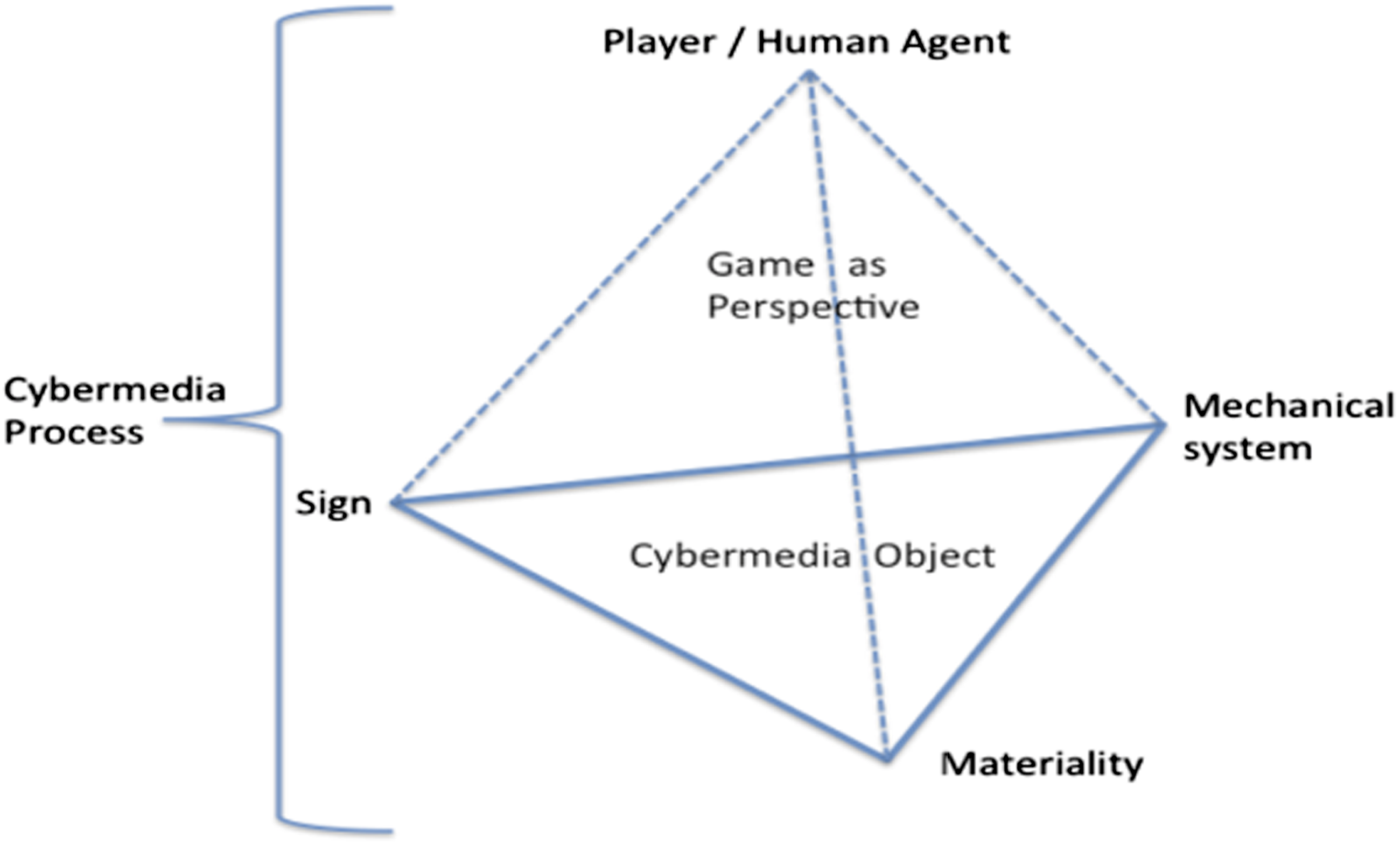
The component of sign constitutes the representational dimension of games as static cybermedia objects. At this level, game worlds, characters, and stories become conceivable to players through audial, visual, and haptic signals that are processed through their perceptual apparatuses and decoded based on acquired habits and game literacies. To enable meaning-making, the representational sign-layer issues cues to players allowing them to create and test hypotheses as to what is going on, who is who, and what norms or ethical obligations might be at stake in the diegetic universes presented to them to then decide if and how they want to engage with the presented world as players. As such, this dimension can be studied with methods drawn from literary and film analysis – first and foremost narratology, formal analysis, rhetorical analysis, and semiotics (Fernández-Vara, 2014). Naturally, also the political messages and ideological contents of specific game titles can be addressed at this level that therefore becomes important for teaching about games, but also emerges as salient for the planning and implementation of teaching with and through games.
The second aspect of the cybermedia model, the mechanical system, contains the rules and procedures that pre-structure how players can act in and interact with game worlds and their characters. While the sign-level presents the world and sets the stage, the mechanical layer regulates what actions and performances are possible in a game and which are ruled out. Analyzing the mechanical layer as such requires different methods that are often taken from cybernetics or game design (Salen & Zimmerman, 2004). A specific strain of formal game analysis focuses on the analysis of rule systems (Eskelinen, 2001).
As Ian Bogost (2006) has shown, the politics of games are not only reproduced at a representational layer (sign system), but also at the level of rules and procedures. He coined the term ‘procedural rhetoric’ to conceptualize how game mechanics can reproduce ideological positions by enabling certain player actions and performances in game worlds while hampering others. Also, the selection of variables to be included as relevant for specific simulations, and the way these variables are processed by the system, can have both intentional and unintentional ideological effects that can be captured by Bogost’s term. Procedural rhetoric has become a key concept for critical game analysis and emerges as an important area of focus for the planning and implementation of game-based teaching and learning (see also Apperley, 2010).
There are cases when the components sign/narrative and mechanical system are in apparent disconnect since the potentials for meaning and practice invited by each seemingly contradict one another. Such cases have been termed ludo-narrative dissonance (Hocking, 2007) and it has long been an accepted truth in game design that, for the sake of consistency, such cases should be avoided. However, recently scholars have pointed to the artistic potentials of tensions between narrative and rules that can have estranging and therefore engaging implications for players and audiences of gameplay (Murphy, 2016; Backe, 2018; Grabarczyk & Walther, 2022). Such possible tensions can be an important area of inquiry when preparing game-based teaching sessions.
The third component of the triangle forming Aarseth and Calleja’s (2015) static cybermedia object is materiality. This dimension contains the socio-economic, physical, technological, and environmental infrastructures required to produce and play games. Using materiality as a lens enables attention to technical components such as game consoles, digital networks and controllers, and the issues of availability, affordability, and accessibility these factors imply (Apperley & Jayemane, 2012). All these aspects have repercussions on how and with what implications games can (and should) be used as devices for teaching and learning.
Drawing on Stuart Hall’s (1977) understanding of materiality in cultural communication, we argue that the dimension of materiality in Aarseth and Calleja’s (2015) model needs to be expanded to also include wider contexts of political economy, business models, labour conditions in the games industry in relation to both software development, use, and hardware production (Kline et al., 2003; Kerr, 2017; Sotamaa & Švelch, 2021; Tulloch & Johnson, 2022; Hammar & Pötzsch, 2022). In such an extended understanding of materiality, issues such as working conditions for developers and manufacturers, data security for users and players, energy and resources required for production and play, e-waste disposal, pace of obsolescence, as well as the growing environmental footprints of server centers and streaming services move center stage. They are also crucial for attempts to adequately evaluate the suitability of specific games for formal educational settings.
The component of materiality requires specific methods to gain the insights necessary for a conscientious planning and implementation of game-based teaching and learning. Analyses of technological affordances and conditions can give indications about the advantages and disadvantages of certain types of consoles, computers, and controllers for specific constituencies of players (disabilities and neurodiversities, possible differences between genders, cultural sensitivities, purchasing costs, hardware requirements, monetization techniques, tacit data gathering and profiling, and more). Methods from political economy and critical sociology can assess business models and production cycles to avoid using and buying unethical, ecologically harmful, or too expensive products and to identify potentials for tacit advertising and clandestine data collection and monetization often enabled in commercial games (Light et al., 2018; Mosco, 2009). At this level, school regulations restricting access to specific content (e.g. violence) and technological limitations (e.g. quality of Internet connections) can be addressed, and the benefits and drawbacks of videogames compared to other available teaching tools such as books can be critically interrogated.
Having described the static components of games as cybermedia objects above (sign systems, mechanics, and materiality), we will now turn to players and their activities thereby drawing attention to the processual ontology of games as cybermedia processes that form constantly evolving contingent configurations of their constitutive elements. Games must be played to exist and without players they remain empty shells void of meaning (Aarseth, 2001). Play practices always happen in context and correspondingly offer situated experiences. To account for such aspects of sociality and diversity in game play, we refer to Aarseth and Calleja’s (2015) player component in the plural as players.
To assess how players engage with games in contexts and understand what they draw from these processes, various methods from the social sciences become relevant. Interviews, surveys, participant observations, and play diaries offer empirical insights into how players temporarily arrest cybermedia processes in contingent meaning-producing configurations. In this perspective, players can become co-researchers (Jørgensen, 2012, 2020) who offer new and often unexpected perspectives to scholars. Alternatively, the processual dimension can be explored by studying the play practices of others available in the form of Let’s Plays, walkthroughs, and other genres of recorded game play. By using this method, the different possibilities for action offered by the game space can be assessed and compared thus bringing forth the tacit limitations game mechanics put on possible player performances (de Smale, 2019a, 2019b). This last method can be productively used by teachers when preparing game-based sessions to gain an overview over variations in play practices and possible forms of counter-play.
As we have shown above, disentangling the complex phenomenon of digital game with help of the cybermedia model makes visible a series of contingencies and potential pitfalls that need to be taken seriously when planning to use games in teaching and learning. The model also highlights the importance of teaching about digital games to make students critically reflect about their production, content, use, and the ideological positions they offer. Different players play games differently and in doing so activate various possibilities for meaning and meaningful action. The scale of such play practices ranges from careful exploration of narratives and fictional worlds and characters to purely instrumental goal-oriented forms of engagement (gamer mode; see for instance Frank, 2012).
This inherent contingency of play practices needs to be considered by teachers who cannot simply rely upon their own play experiences when planning and implementing teaching with, through and about games. As many scholars have pointed out earlier, to make sense, game-use in educational settings needs to be carefully planned and tightly integrated in other classroom practices and curricular activities by game literate teachers (Linderoth, 2010; Westera, 2015; Becker & Gopin, 2016; Marklund et al., 2020; Marklund & Romin, 2020; Marklund & Taylor, 2016; Klevjer, 2021). Such requirements regarding teacher competences and overall integration need to be critically assessed prior to commencing with game-focused teaching sessions.
We will now develop a template for the critical evaluation of games as tools and objects for teaching and learning within humanities and social science subjects. Initially, however, we need to further disentangle some of the media specific affordances of games in comparison with other merely representational media such as films or novels.
Seeing and Doing: Games as Representations and Simulations
As Aarseth and Calleja’s (2015) model shows, games operate as both representations and simulations. Consequently, one can study games with an eye on the cinematic means they employ to visualize and narrativize certain topics or one can explore how they allow players to maneuver through and interact with represented diegetic worlds and their characters. As we have argued above, the first focus area is mostly concerned with the sign level of cybermedia objects, while the second predominantly focuses on mechanical systems. Both these dimensions combined configure what McCall (2011, 2016) has termed an interactive problem space which players can engage with for educational or other purposes (see also Apperley, 2010).
Different games leave different degrees of freedom to players. Some have static pre-structured narratives that are driven forward by means of pre-scripted cutscenes and locked dialogue sequences. Others leave considerable freedom to players and allow them to autonomously develop characters and configure the narrative through their own choices. In relation to games with historical themes, this tension is encapsulated in Chapman’s (2016) distinction between realist and ludic simulation styles.
All games, however, demand player input. 2 The closed variant is well-suited to convey static knowledge about a certain topic and make them experienceable to players, while the open narrative structure facilitates free exploration and testing of a variety of available options for action and the consequences of these. For teaching and learning history, Uricchio (2011) and Chapman (2016) refer to the latter as affording players the opportunity to play with history and explore if and how things could have turned out differently – a strategy that invites critical reflection and includes counterfactual play. The interplay of representational and simulation aspects – including potential dissonances between them – is an important area of focus when determining if and how a certain title can be used for teaching and learning. Pötzsch and Šisler (2019) have developed a model that allows for a disentangling of the complexities of cultural communication of historical events in and through games.
To become intelligible and communicable, past events need to be articulated (White, 1980). Such articulations, again, with necessity imply mediation and a selection of what are perceived as the most salient features of a given subject highlighting some aspects while veiling others. This systematic reduction of complexity always happens in a certain context that inevitably colors the resulting cultural expression (Bogost, 2006; Uricchio, 2011). Attention to the choices of which variables to include into a certain representation or simulation and which to exclude is key to educational engagements with representations and simulations. All forms of realism are inherently selective and this selectivity is the core of their specific political bent and ideological valence (Pötzsch, 2017, 2022) that become important areas of critical interrogation also when planning the use of games for educational purposes.
In their model, Pötzsch and Šisler (2019) distinguish between representations and simulations of the past (see also Frasca, 2003). In representations, historical events are configured into a narrative that is then actively interpreted by situated audiences leading to a variety of different understandings framed by the formal properties of the work and the varying contexts of its reception. The resulting understandings feed back into historical discourse and memory politics that then influence later production and subsequent readings of these (figure 2). Historical representation (from Pötzsch & Šisler, 2019, p. 6).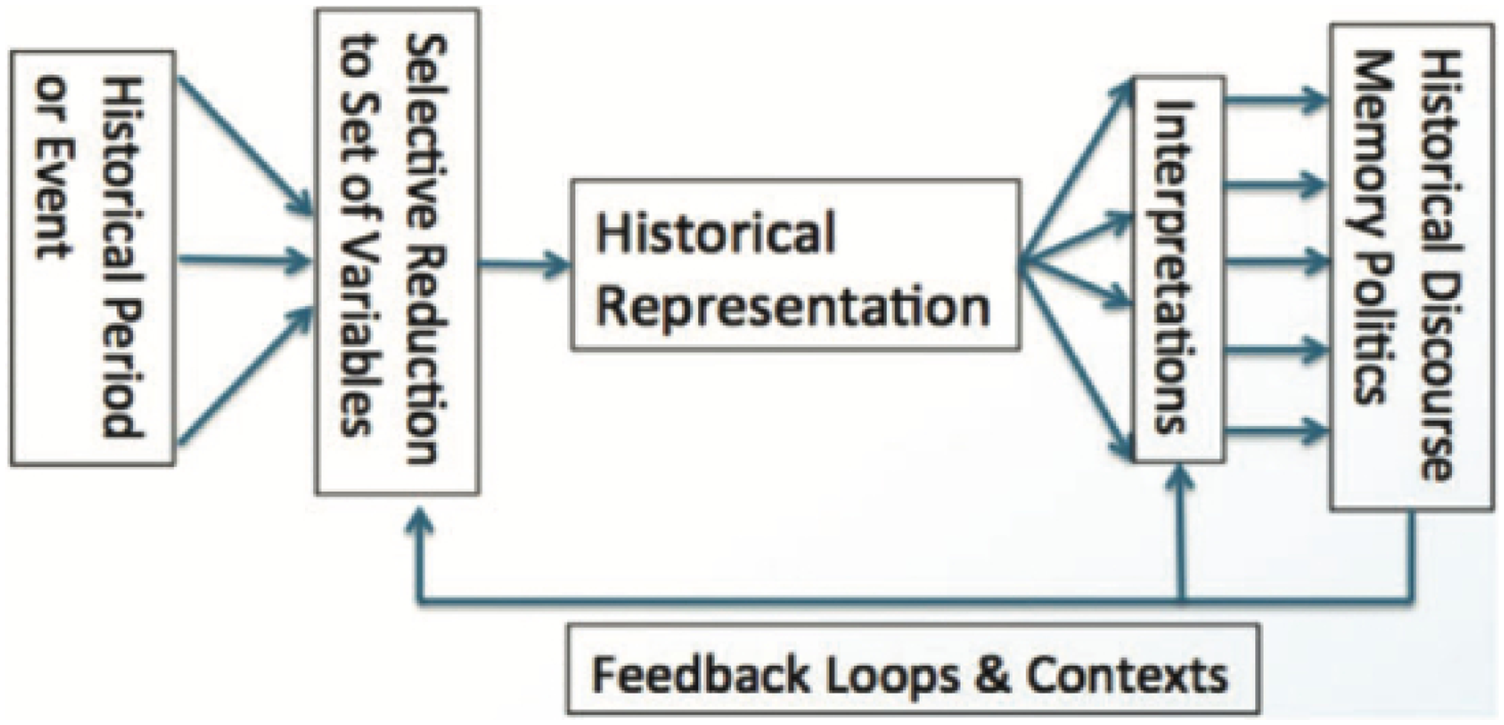
In contrast to this, simulations introduce the additional segment of play between the components historical representation and interpretation thereby adding another layer of contingency – game mechanics and their pre-structuring of player input and performances. Regardless of how neatly configured a particular game is, player choices will always have a certain impact on how the story is told, unfolds, and can be witnessed by others, including struggles against an “implied player” (Aarseth, 2007) and transgressive attempts to cheat or break the game (Jørgensen & Karlsen, 2018). This fact is the very condition for McCall’s (2011, 2016) understanding of games as interactive problem spaces. It also constitutes the core of Pötzsch and Šisler’s (2019) model visualizing how constrained player actions lead to the emergence of different representations that are then interpreted to produce meanings that, ultimately, feed back into later acts of configuring, reconfiguring, and interpreting narratives (figure 3). In Chapman’s (2016) terms, this contingency upon player input enables historical games to function as arenas for metahistorical exploration and reflection. Historical simulation (from Pötzsch & Šisler, 2019, p. 7).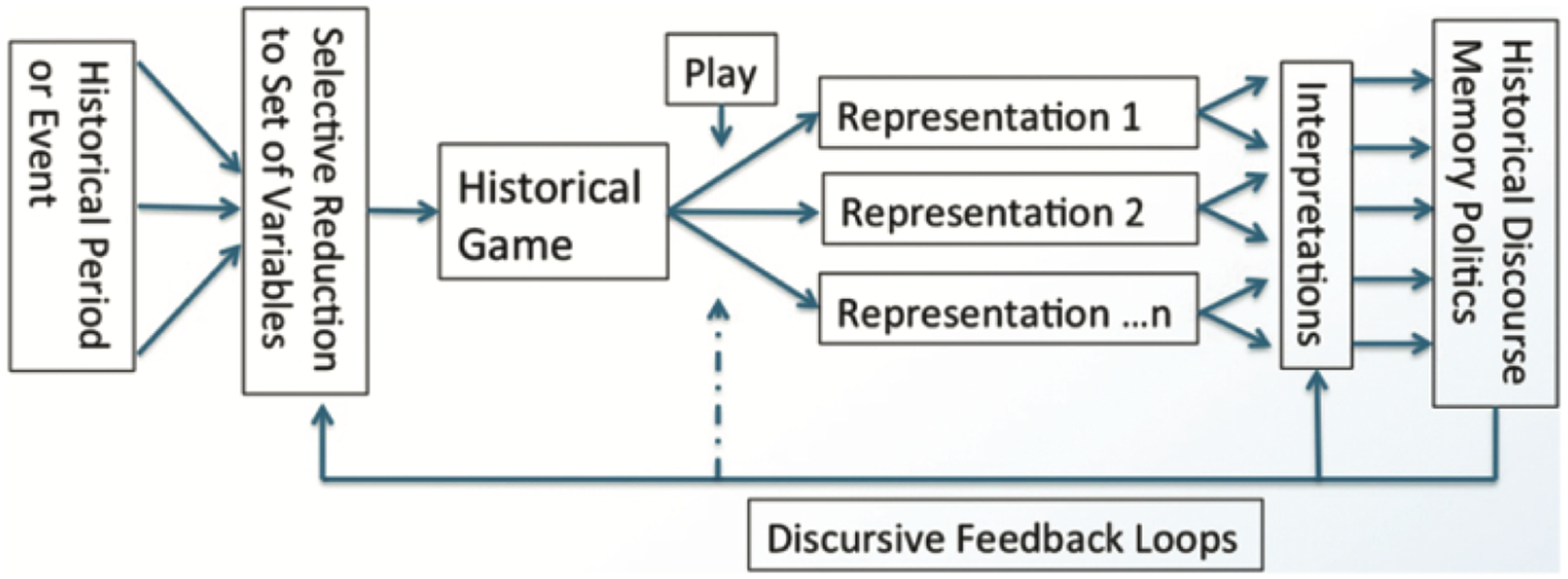
The models by Pötzsch and Šisler can be used when preparing game-based teaching sessions to raise awareness for media specific aspects of games and to alert to the various layers of contingency involved in representations and simulations. As such, the model can help to structure and focus educational endeavors and allows teachers to adequately balance own interventions and free student-driven exploration. It also allows for assessments of the interplay, tensions and possible contradictions between game mechanics and narrative (including ludo-narrative dissonances), and evaluations of how these might impact teaching and learning.
In the following section, we will show how insights drawn from the models we have introduced so far can be used to evaluate the suitability of specific game titles as both tools for and objects of teaching and learning.
Results: A Practice-Focused Template for the Evaluation of Games as Tools for and Objects of Teaching and Learning
We will now apply our theoretical framework to assess the applicability of two games for teaching and learning in humanities and social science subjects. Our inquiry will orient itself toward the four dimensions of the cybermedia model introduced above and will cover aspects of both representation and simulation. Finally, we will summarize key elements of the template in a table. We offer an overview over important aspects of games that teachers and learners need to assess and evaluate before using specific titles in educational contexts.
Key Aspects for The Planning of Teaching With, Through, and About Games.
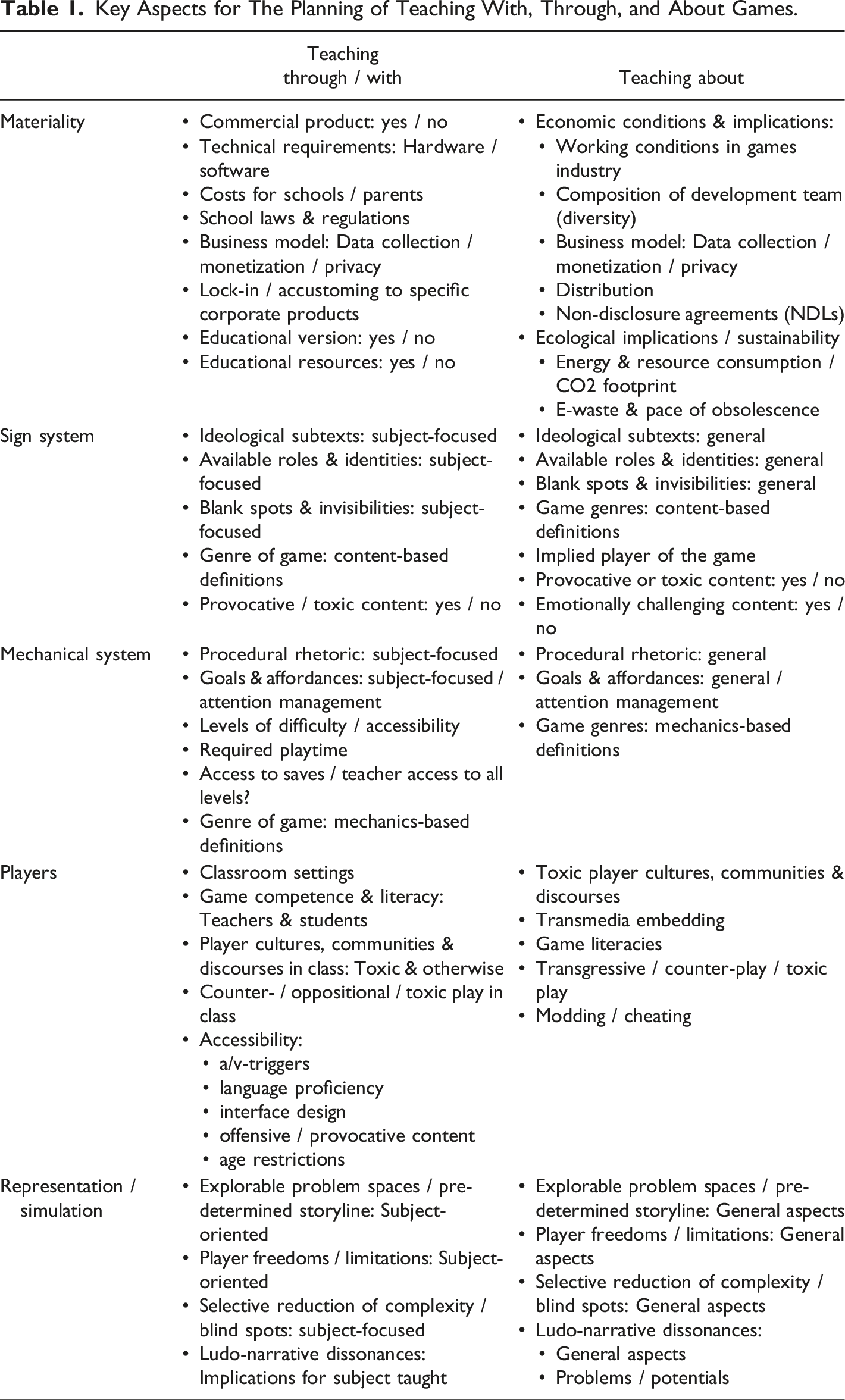
We will now demonstrate how such aspects can be reflected upon when planning to use specific games in educational contexts. We use both a relatively expensive commercial entertainment title – Assassin’s Creed: Valhalla – and a free-to-play publicly funded serious game – Survive the Century – to show the wide applicability of the analytical template. Note that even though many aspects at the levels of materiality, sign system, mechanics, and/or players should indicate a non-suitability of a particular title for teaching with or through games, the identified weaknesses might still be important to highlight when teaching about the title in question.
Assassin’s Creed: Valhalla (ACV)
ACV is a third-person action-adventure game developed by Ubisoft Montreal and released by Ubisoft Entertainment in November 2020. The title is set in the Viking age and inspired by historical events and characters. We will use the case of ACV to show how our template can be levied to evaluate how a commercial historical digital game can be used for educational purposes. In this endeavor we follow the logic introduced above and move along the four axes of materiality, sign, mechanical system and players, and flesh out both representational and simulation aspects.
Considering the level of materiality important aspects of ACV are the physical devices required to play the game. ACV is expensive and can only be played on costly and power-hungry state-of-the-art hardware. Three things are important to note for teachers and school administrators:
1. Are the necessary funds and administrative procedures in place to acquire both the game and the equipment needed to play it? Given the costs and technical requirements of ACV, it will be difficult to use it for anything other than play demonstrations on a screen during class. Asking all students to play it at home or hoping to acquire a class-size set of games to be played collectively during teaching sessions does not appear viable given the game’s violent content, its age restrictions (18+), and the significant amount of time required to play it through (20+ hours). Note also that no educational version is available that for instance would offer teachers access to all areas and features of the game.
2. ACV is a commercial product developed based on clear return-of-investment considerations. Using it in teaching requires the allocation of public-school budgets to the acquisition of an expensive commercial product. Using ACV also implies installing this commercial product on school hardware with all costs and potential problems regarding data capture, advertisements, and accustoming students to the game and the specific platform(s) it is played on (lock-in). The game requires expensive state-of-the-art hardware to play, but once installed functions without an Internet connection.
3. At the level of players it needs to be considered that not all students will be equally used to playing such action-focused and violent games that even at the lowest level of difficulty entail significant senso-motorial challenges. It is important to make sure that also the segment of class not interested in videogames or not used to playing these types of games are sufficiently included and that the teaching session takes heed of diversity amongst students. In addition, ACV is very violent and playing the game regularly requires killing other characters, a feature that might be experienced as unpleasant or provocative by some students, and that is prohibited by school regulations and law in most countries. Therefore, use of ACV in schools is limited to showing cut scenes or the collective exploring of areas of the game world that do not allow for violent actions.
Despite such limitations, ACV can offer interesting insights when taught about (rather than with). When teaching about the production context of the game, potential focus can be directed at the business models of global commercial game development, working conditions in the industry including issues such as global inequalities, crunch-time, the use of non-disclosure agreements, or the regular exclusion of women and non-cis identities. In this sense, the game is a useful example illustrating the production context of contemporary blockbuster games.
At the levels of sign and mechanics, issues of cultural representation and ideological subtexts can be critically addressed when teaching about the game. Here, it is important to show that analyses of game form merely offer insights into the aesthetic structures that predispose player action and understanding in a particular direction. This level of analysis does not deal with actual player responses and experiences in specific contexts. Teachers must make this distinction very clear to avoid conflicts with students playing with a different mind-set.
In ACV, players control a character navigating a three-dimensional world inspired by the historical Viking age. Besides the main storyline, ACV contains a series of quests designed to keep players engaged over long time periods through a simple effort-reward loop offering new or enhancing old abilities that make it easier to overcome the mostly violent challenges of the main quest forming the storyline. By such means, the game captures and holds the attention of players for long time periods.
The story of ACV is set in 9th century Norway and England as a popcultural rendition of the so-called ‘Viking’ era following similar conventions as recent television series set in the same historical period. Players take control of protagonist and hero Eivor Varinsdottir who is tasked to lead the Vikings’ invasion of England. Interestingly, the game lets players decide upon the gender of Eivor who can be played as either male or a female. Non-binary alternatives, however, are not available. This invites contemplations about game characters and their appearances in commercial triple-A productions.
In ACV, players encounter characters inspired by historical figures such as Alfred the Great and Ragnar Lothbrok and partake in a series of events that are based on actual historical incidents. The main features of the historical simulation are set imposing what Shaw (2015) has termed a “tyranny of realism” that presents one hegemonic version of a past reality and suppresses contingencies and ambivalences. ACV approaches history as the linear story of great men focusing on well-known historical figures rather than on persons or groups located at the margins. The game offers a hegemonic power fantasy to players where individual heroes overcome all odds through violent means (Hammar, 2020). The game enforces violent play and de-emphasizes alternative ways of resolving conflicts and interacting with others. Here, teachers have an opportunity to explain how both narrative and game mechanics can issue violent and bellicose ideological messages by predisposing player perceptions and actions and connect these insights to a critique of received genre conventions and their possible political implications.
Finally, the analytical level of player allows teachers to focus on actual play practices in context and how these either follow an intended dominant storyline and interaction pattern that is systematically invited by the game’s sign system and mechanics or negotiate and even oppose these in deliberate attempts to tweak the message or break the game. Taking heed of an active audience and dominant, negotiated, as well as oppositional play styles (Shaw, 2017) is important when teaching with and about ACV. Educators can focus on the contingencies inherent in the decoding of cultural representations and investigate the selective activation of game features by players in interactive simulation spaces. Games work on and predispose player actions and understandings by various means but also always open for struggles against the “implied player” of the game (Aarseth, 2007) through for instance transgressive play styles (Pötzsch, 2019).
The idiosyncratic nature of gameplay is important to consider also in a different manner when planning to teach with or through ACV. When playing the game either collectively or individually, students might not follow the path intended by the teacher or the game, thereby potentially undermining the previously planned outcome and results. This contingency of play is one of the main differences between teaching with, through and about videogames as opposed to other audio-visual media such as film, streamed series, or television. In addition, it is important to critically evaluate the suitability of the game for different groups of students in terms of age restrictions, inclusiveness, and accessibility. When using titles such as ACV, significant differences between players used to engaging with such titles and those with little to no interest in them will probably be significant and might also include aspects of toxic gamer culture in transmedia environments beyond the limits of the game. This problem can be alleviated by teaching about the game with an eye on reflective critique to offer students critical insights about the game, the genre it belongs to, and the transmedia contexts it is embedded in.
Survive the Century (STC)
Survive the Century is a choice-based branching narrative game about climate change developed as a free educational resource with the support of the National Socio-Environmental Synthesis Center at the University of Maryland and the UK-based Global Challenges Research Fund. Players are put into the position of a senior editor of “the world’s most popular and most trusted news organization” with the “enviable power to set the news agenda and thereby shift the zeitgeist” (STC website). Exposed to different ways of covering key global issues such as the Covid-19 pandemic, a green shift in the economy, or global inequalities players can decide upon the future course of the world and witness the consequences of their decisions in short pieces of creative writing presented to them before being exposed to new challenges. The game has been hailed for its upbeat take on the issue of climate change policies and its ability to engage players through its witty style.
STC easily lends itself to teaching sessions at an upper-secondary level that focus on challenges posed by climate change, growing inequalities and pandemics, and connected to this about tensions between populist positions and responsible political action. Due to this thematic frame, the game is particularly well-suited for use in social science subjects. Furthermore, its creative style and at times elaborate writing also makes it suitable for teaching English. When using STC, teachers can either project the game on a screen and engage in discussions about each choice-alternative and its potential consequences with the entire class or, if the necessary equipment is available, invite group or individual play and exchange experiences in subsequent de-briefing sessions. As the remainders of this section will show, however, using STC does not only enable a teaching with, but also requires a teaching about the game, its specific frames, ideology, and inherent blind-spots. To address this, we will again follow the template we developed from the models by Aarseth and Calleja (2015) as well as Pötzsch and Šisler (2019) to structure our evaluation of STC as a potential teaching tool.
At the level of materiality, STC appears very suitable for classroom-use. The game was publicly funded, and development therefore remained free from return-of-investment considerations that might lead to clandestine data collection, profiling, and tacit advertisement directed at players. STC is free to play and distribute and does not require allocations of school funds or payments by parents. The game only needs minor computational capacities and is playable on almost any screen-based device that can connect to the Internet making it widely accessible to students. It requires only minimal network capacities and is therefore quite resilient against Internet bottlenecks. Since STC is browser-based it does not require installation but can be accessed through programs already installed on school hardware. However, the title might be blocked by school fire walls sensitive towards online games.
In terms of sign and mechanics STC appears problematic in that it builds its argument on a series of implicit premises that need to be problematized in sessions of teaching about the game prior to or after teaching about climate change with the game. Firstly, STC is based on a problematic notion of media effect that assumes that senior editors are free of constraints in the decisions they make, that their decisions will have immediate effect on the content produced, and that this content will effectuate a shift in audiences, and therefore policy. By these means the game from the outset suppresses attention to problems connected to the political economy of commercial news production and dissemination (see for instance Hall, 1977; Herman & Chomsky 2002).
Secondly, STC reduces complex and contingent challenges with multiple and dynamic global effects to a series of unambiguous choices to be made by editors alleging the availability of simple solutions with straightforward and easily identifiable effects. The game too clearly marks certain choices as bad and thereby creates a caricatured version of climate change politics that can be entertaining but ultimately do a disservice to attempts to understand its actual intricacies and real complexities offering a perspective on the world that can rightfully be criticized as naive. However, if such issues are treated with care and brought to the awareness of students, the game can still solicit heightened awareness and even practical involvement through the content offered on the game website including links to additional information, local climate pressure groups, and more. These features, however, will require continued updates to retain their usefulness.
Thirdly, STC’s game mechanics base available choices on pre-selected alternatives that are by necessity exclusive. Consequently, the implicit ideology of the game also emerges at the level of what is not shown to be existing alternatives for action. This becomes palpable already in the first option presented in the game that focuses on responses to the Covid-19 crisis in terms of vaccines. An implicit neoliberal capitalist bias here reveals itself through the fact that the only alternatives available to players to solve the vaccine shortages in the Global South are donations by either states or billionaires. Initiatives to remove patents from vaccines to make these affordable to poor nations are not even mentioned. At the same time, the very problem description preceding the choice alternative reveals a colonial bias. The game states: But poor countries, who haven’t been able to afford vaccines, are seeing wave after wave of the virus. Experts are worried that it’s continuing to mutate and to become more aggressive. They say our best chance is to get the whole world vaccinated.
The most aggravating problem, it seems, is a possible mutation of the virus potentially endangering affluent parts of the world rather than millions of dead people in the nations ravaged by a preventable disease because vaccines are unaffordable. These two examples show the problematic aspects of a selective reduction of complexity (Bogost, 2006; Uricchio, 2011; Pötzsch, 2017) implied by simulations of real-world processes and points to the fact that STC has been made by affluent citizens for affluent citizens of the world selectively disregarding the fates and immediate interests of the vast majority of humans populating this planet.
Even given such problematic aspects of the game at the level of sign and mechanics and their interplay, STC can still be used productively in teaching. This, however, implies the necessity to teach not only with but also about the game in a critical manner thus alerting students to the problems identified above and enabling them to critically assess not only STC but also other representations and simulations that make arguments about the world. Teaching about the game might carry the additional challenge that the theme of Covid-19 and vaccination can be a divisive and polarizing issue in class. We perceive this challenge also as an opportunity to discuss important aspects of contemporary politics and society including issues such as fake news and the nature of trust in democratic societies.
At the level of players not much can be said about STC. Gameplay is keyboard-based and accessible to most. However, playing the game requires advanced reading skills and a high proficiency in English. The game offers players the ability to make decisions that are clearly framed as wrong thereby attempting to include efforts of counter-play into its pre-designed choices making it easier for teachers to predict possible alternative forms of play. It would be an interesting endeavor to trace the actual responses by students including transgressive attempts to exceed the borders of accepted discourse in contentious issues such as Covid or climate change thus connecting students’ resistance to an implied player (Aarseth, 2007) with trans-medial realms and wider socio-political contexts.
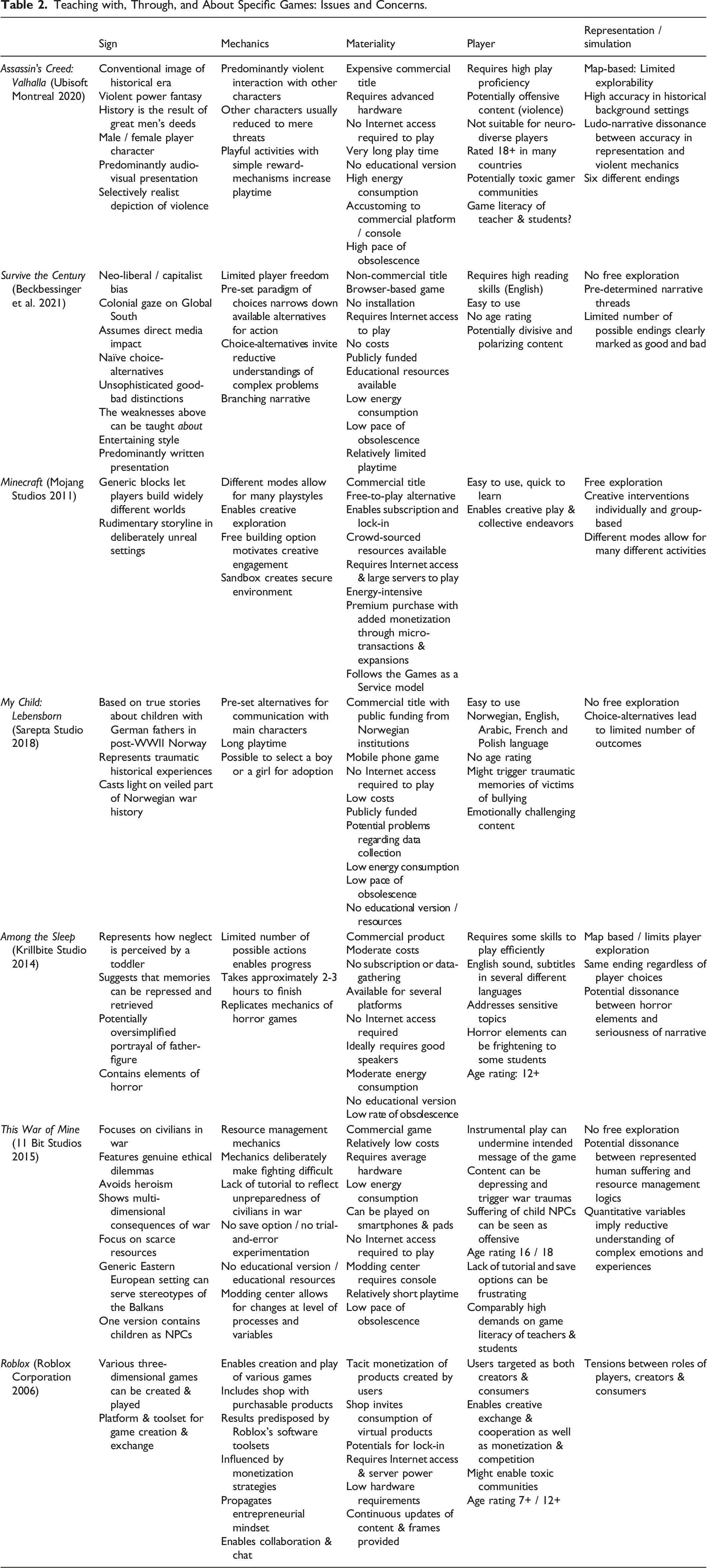
Having exemplified our approach with reference to ACV and STC, we will now move on to summarize our template for the evaluation of games for teaching and learning in form of a table. Here, we will offer schematic assessments of additional games to show how the template can be operationalized by teachers and other educators helping them to identify suitable titles for educational purposes in a critical and reflective manner.
Evaluating the suitability of computer games for teaching and learning is a difficult endeavor that needs to be taken seriously. The purpose of the template presented in the following is to make it easier for teachers and other educators to identify salient issues and critically assess how specific games can best be utilized for classroom use. Different questions raised under each component of the cybermedia model can reveal different issues relevant for different games and for different ways of teaching with, through, and about them. It is not our intention that identified problems and challenges should lead teachers to discard specific titles and not use them for teaching purposes, but to help teachers evaluate which games are suitable for precisely what types of teaching and learning.
Teaching with, Through, and About Specific Games: Issues and Concerns.
Discussion and Conclusion
We live in a “ludic century” (Zimmerman, 2013, n.p.). Today, games, and in particular digital games, can be found almost everywhere. They are a dominant cultural form used both for entertainment and many other more serious purposes by a rapidly growing number of people across the globe. Also education has become an important arena for the use of games. Such developments pose important questions to teachers, school administrators, and parents: Which games should be used in teaching and for which purposes? What are potential pitfalls and unintended consequences of bringing commercial and/or educational titles into the classroom? Once we start to use games in class, what types of activities are we diverting time and resources away from to make room for this new cultural form?
In the present article, we attempted to respond to such questions by developing a template for the critical evaluation of games as potential tools and objects of teaching and learning. Drawing upon Aarseth and Calleja’s (2015) cybermedia model as well as Pötzsch and Šisler’s (2019) distinction between representational and simulational aspects of digital games, we have proposed a framework enabling teachers and other educators to identify potentials and problematic aspects of specific commercial or educational titles. We argued for the necessity to critically reflect upon contingencies of game-use across a variety of dimensions including ideological biases, blank spots, business models, exploitative practices, privacy settings, accessibility, toxic play, sustainability, and more. We argued that besides directing attention to teaching with and through games also teaching about them rapidly develops into a key aspect of contemporary education situated in a world dominated by ludic forms.
We hope the template can serve as an orienting guiding light helping educators, administrators, parents, and others to maneuver through the shifting terrains of game-use in educational contexts in a reflective manner. We believe in the practical applicability of our framework, yet do not assume its completeness. The template contains many different categories and will, in and through its practical implementation, be changed, amended, and gradually improved and adapted to new contexts. It is vital that this happens in continued close cooperation between researchers and practitioners using the presented tools.
As a first step toward further improvement, we will present the model to groups of teachers and school administrators during in-depth focus and planning days in upper-secondary schools. During these events, we initially explain our framework and offer an empty table only containing the dimensions of the cybermedia model. We then add specific game titles and evaluation criteria in cooperation with the attendant professionals. Through this iterative process, we can solicit experiences and insights from practitioners while at the same time conveying elements of our template that the groups might not be aware of thus improving practice and adding new content to our framework. As a second step, we will work with colleagues from teacher education to develop the template further and, finally, publish it online as a freely available teaching tool including a commentary section inviting for new suggestions and further elaboration. By these means, we hope to enable a lasting impact of our findings and a continuing development and improvement of our ideas and concepts in close alignment with practitioners and other researchers.
Footnotes
Declaration of Conflicting Interests
The author(s) declared no potential conflicts of interest with respect to the research, authorship, and/or publication of this article.
Funding
The author(s) received no financial support for the research, authorship, and/or publication of this article.
