



Abstract
Background
This remembrance of Richard “Dick” Duke, one of the founding members of the International Simulation and Gaming Association (ISAGA), and dedicated promoter of game science, contains Duke’s contribution to the field of simulation and gaming, as a retrospective into the past, and as inspiration for the present and the future of this discipline. Duke has been a highly respected colleague, and a beloved friend for many in the scientific community. He will be remembered for his academic contributions, but more so for his commitment to support young talent, and for his aim to address societal problems in all of his doing.
Purpose
The goal of this article is to reflect on the work of Richard D. Duke and the influence he had and still has on the simulation and gaming research and practice community. The overview of his work illustrates his specific approach towards simulation and gaming, while the personal words of colleagues he worked with over the years combine professional and personal perspectives on the work and life of Richard D. Duke.
Research Design
The article presents a brief literature review along with a collection of contributions from researchers and practitioners in the field of simulation and gaming.
Data Collection
This obituary dos not represent a scientific article as such. However, a careful review of the articles and books of Richard D. Duke has been carried out for this article, and colleagues have contributed with their thoughts and memories.
Results
The overview of Richard D. Duke’s work shows how he approached simulation and gaming as a powerful form of human communication, especially suited to analyse and design complex problems. All simulation game design is driven by the purpose to represent and explore alternative solutions and future states of a given situation. Duke’s careful and detailed conceptualisation of simulation gaming as interactive language represents a wealth of information for current and future researchers and practitioners in the field of simulation and gaming.
Conclusion
After more than 50 years of his first publication in the field of simulation and gaming, Duke’s contributions are still highly relevant to the science and practice in this area. His ideas inspire a large number of researchers and practitioners, and his foundational work had and has a large impact on how the science of simulation and gaming has developed and still advances.
“The primary purpose of any game is to convey gestalt; to be successful it must convey an overall perspective of the problem at hand.” (Duke, 2014: 62)
Gaming: A Future Language
In a small town in the eastern part of the Netherlands, it is the year 1977 when a handful of researchers gather to discuss methods of interactive simulation at the science/policy interface. Richard “Dick” Duke, who had written his book Gaming: The Future’s Language in 1974, was invited to present a technique that he called gaming/simulation. The games Duke introduced at the conference did not use computers, but rather, cardboard, LEGO® blocks and dice - frivolous and alarmingly low-tech, as Jac Geurts put it. Yet Jan Klabbers, organizer of the meeting, had the insight and courage to put modelers and gamers in one hotel and make them explore each other’s work. With an impressive effect, as from the demonstrated power of games resulted a life-long research partnership and friendship, and the book “Policy Gaming for Strategic Management” by Jac Geurts and Richard Duke (Duke & Geurts, 2004). Duke himself called his journey as a gamer ‘design by chance’ – the positive feedback of the City Council of Lansing, Michigan, in 1964, to his first game design, made him “become a gamer ever after” (Duke, 2011: 344).
In the 1960s and especially the 1970s years, Duke was an important driver of the foundation of game science, and the International Simulation and Gaming Association (ISAGA), with its American sister, the North American Simulation and Games Association (NASAGA). Informal meetings in the western part of Germany led to the first ISAGA conference in 1971, and Duke’s collaborative work with colleagues resulted in first publications on the use of simulation games in policy making, especially together with Cathy Greenblat (Greenblat & Duke, 1975; 1979; 1981). Duke joined at least 9 ISAGA conferences, from Bad Godesberg (Germany, 1970), to Toulon (France, 1986), Nijmegen (the Netherlands, 2007), to a conference specially dedicated to his work in Dornbirn (Austria, 2014), with two related publications (Duke, 2014; Duke & Kriz, 2014). Duke was always a strong promoter of the Simulation & Gaming journal as ascientific means of communication devoted to theory, practice and research. He supported the ISAGA conferences, as well as ISAGA summer schools, and the association’s affiliations with professional organisations all over the world: “ISAGA must continue to encourage these linkages because the next generation of professionals will spring from these organizations.” (Duke, 2011: 353).
In his work, Duke was driven by the aim to understand and help others to understand the complexity of modern society. Not only conceptualized he gaming as ‘the future language’, but he always engaged wholeheartedly in scholarly exchange with his colleagues and students. In academic terms, modern technology failed in Duke’s eyes to convey the complex gestalt of modern society and its multi-layered, complicated systems (Duke, 2014). Duke strongly believed that games could provide a language, having the power of providing a holistic picture of society’s dichotomic and intertwined systems, and enable translation and communication between individuals and systems. Driven by the need to ‘improve the quality of decision-making’ in modern organisations, Duke and Geurts (2004) present games as ‘safe environments’ where people can bring their knowledge and skills to the forefront of the strategic debate. They provide an opportunity for ‘as real as possible’ experiential learning to mobilize core competencies and test the skills that may be needed in the future (Duke & Geurts, 2004). As a number of actors are involved in complex decision-making processes, communication is key to this process.
Games provide a language that works with analogies, and based on these, enables humankind to glance into possible futures, to take action, make decisions, and observe the outcomes – they are able to explain alternative situations that could otherwise not be managed (Duke, 2014). For Duke, gaming and simulation were on the extreme end of the continuum of human communication – the most integrated form of a future language (Duke, 2014). Simulation gaming in Duke’s words represents a multilogue interaction, that allows multiple, simultaneous dialogue amongst individuals who are both sender and receiver in the interaction, and react on an impulse (Duke, 2014). The game that facilitates such interaction, us the result of the work of a group of people – a team leader, colleagues who can critique the development, someone who hosts or runs tests, and in the end, the participants (Duke, 2011).
Compared to a lecture, the process of using gaming as a communication means follows the same process of perceiving, abstracting, and organising the complexity of reality. Yet, while a lecture then continues in a sequential dialogue, where receivers must first wait until the sender is finished, in a gaming session, the participants enter a multilogue mode of interaction, in which the subject of discussion is governed by interactive pulses (Duke, 2014).
Following Duke, it is only in play that the ultimate success of the game, its ability to conceive the holistic complexity of the underlying problem, can be perceived. It is this underlying problem that represents the subject matter of a game. All games are problem-specific. As they are usually dealing with complex subject matter, games are somewhat complicated in their construction, too, yet also inherently spontaneous. Games that are well designed are transient in character, following Duke. They allow for some amount of restructuring and rethinking during play, related to those who are participating in game play (Duke, 2014). In all games, their orientation is driven by their purpose to explore alternative futures. Common to all games, so Duke, is a “pulsing thought of inquiry” (Duke, 2014: 64). All games require some sort of abstraction, in relation to the problem’s gestalt, and the provision of multiple perspectives on the problem. However, in their abstraction, gaming simulation allows to display the linkage of parts of the underlying problem or reference system.
Duke was always aware that the reality as underlying reference system for any gaming simulation is only perceived through barriers. These barriers are in place because of the complexity of the underlying issue. The filtered, perceived reality forms the basis for gaming simulation, through a process of abstraction. Duke acknowledges that some games are constructed with learning as main aim in mind. And here again, it is the complexity of the gaming simulation that first may put off a player, but later, when persistent, allow for exploration of the complex problem, and the development of sophisticated understanding (Duke, 2014). This is particularly valuable, as simulation games lean themselves to explore so-called macro-problems, ill-structured problems with a high level of uncertainty, a large number of elements/actors, a high probability of unexpected consequences, requiring a heuristic approach (Duke & Geurts, 2004).
A conceptual map, an abstraction of reality, should guide the design of a simulation game, according to Duke (Duke, 2014). The purpose of the game should be made clear, as well as the group that is envisioned to use the game for communication – which can be expert to expert, professional to lay group, or laymen to laymen. When thinking about players, Duke was very considered about who and how to take over roles in a game – so did he suggest that three players should take over one role in a game, so the game play would allow for joint decision-making. The actions of the players (as well as its accounting system) are described by the games’ set of rules. At the end of a gaming simulation session, the phase of debriefing closes the session. This process, led by a facilitator, enables the ‘magic’ to happen – it allows players to reflect on what has happened, and to connect that experience back to reality (Duke, 2011).
A heuristic, balanced approach to game design is at the heart of Duke’s work. Balancing the elements of complexity, creativity, communication, consensus and commitment to action is key to successfully framing macro-problems with game design (Duke & Geurts, 2004).
Here, I tried to provide a brief overview of Duke’s approach towards gaming simulation and its design. I had to leave out many details, and many perspectives. However, fortunately Duke has left behind a large number of games, articles and books that one can use to read on. This way, Duke and his work will guide our discipline into the future, providing us with a multilogue language to get some grip on its complexity. To Duke, the practice of designing and using games in research and for policy-making was vital praxis for any game researcher and designer. His publications represent a wealth of practical knowledge beyond the scientific foundations of game science, and show that Duke lived what he taught. It is this knowledge that can help current and future game developers and scientists to remain successful, and deliver their full potential. To Duke, if gaming simulations are to fully deliver their potential, they must follow a clear design process. Teamwork between the design team and the client is the heart of this process. Duke’s concern for the future of simulation gaming, and an increase use of advanced technology, was that hi-tech simulation games could lose what is the essence of gaming - the power to improve communication between competing stakeholders (Duke, 2011). I hope many game researchers and designers will take his lessons to heart and focus on design and purpose of simulation games, and how to shed some light on the uncertainties and complexities of the modern world.
Words of Colleagues
David Crookall (France): Some fond reminiscences of Richard D Duke
Dick Duke started his gaming work in about or before 1958 (Duke, 1995), and published a book in 1960 (Duke, 1960). This was some ten years before the birth of ISAGA (International Simulation and Gaming Association) and the journal Simulation & Gaming. In 1969, with the help of Henk Becker, Dick created ISAGA, and in members’ minds, Dick has been associated with ISAGA ever since.
I clearly remember the 1986 Toulon conference as I organised it. My recollection of meeting Dick there is hazy, but in one of his autobiographical articles (Duke, 2011), he referred to it as a “magic conference”. He does not have a chapter in the proceedings book that I did for the conference (Crookall et al., 1987). However, a second book resulted indirectly from that conference, and Dick has a chapter in there – a brilliant one, in my view, titled ‘Gaming/simulation: A gestalt communication form’ (Duke, 1988).
Shortly after, I moved to the USA, in 1988, I believe. There, I had the pleasure of various stays in Ann Arbor, where I was privileged to get to know Dick’s wife, Marie, and colleagues, Al Feldt, Fred Goodman, Layman Allen, and Leonard Suransky. I have a hazy, but precious, recollection of warm welcomes by Marie and Dick, of fascinating gaming discussions with Dick, of seeing some brilliant games and of well-organized filing cabinets – it was a bit like being guided round a treasure trove.
In 1989, thanks to Cathy Greenblat, I became Editor of Simulation and Games (now Simulation & Gaming), with a clean slate for the Editorial Board. I found that Dick Duke had been one of the early members of the Editorial Board, and he graciously accepted to return. In addition to his books, including the well-known Gaming: The Future’s Language (Duke, 1974), republished in 2014 by Willy Kriz as a 40th anniversary celebration, Dick wrote several articles, including three that are auto-biographical (Duke, 1995; 2000; 2011). I invite everyone to read these – they are beautifully written. I have always admired Dick’s writing – it seems to flow with ease, even about complex topics.
I spent time again with Dick at the 1987 ISAGA Venice conference, run by Arnaldo Ceccini and Giorgio Panizzi. I recollect an exciting run of the HEX game, facilitated and debriefed by Dick, who seemed to be as enthused as the players. Dick, and sometimes Marie, attended many of the subsequent conferences. I was lucky to have been able to attend Dick’s own ISAGA conference, at Ann Arbor, in 1994, and for which I had the honour of editing the proceedings with my friend Kiyoshi (Crookall & Arai, 1995).
Fast forward to Willy Kriz’s wonderful Dornburn ISAGA conference in 2014. At age 84, Dick was a special guest, the central figure on a panel. I seem to remember that, despite some hesitation in speaking, his ideas were crystal clear and articulated with precision, the manner in which Dick had always expressed himself. That session was a wonderful moment. With that conference, Dick and Willy edited a marvellous volume of essays (Kriz & Duke, 2014) to honour Dick’s work and to “speculate on the future of gaming” (from Preface II). Other accounts of ISAGA’s development have been written (including Crookall, 2012; Klabbers, 2009c).
Dick Duke and my sister, Jean, died on the same day, 24 Sept 2022. That somehow gave me a strange sort of floating feeling, even months later. It also brings to mind a fascinating book, The Roots of Coincidence (Koestler, 1972), and with more than a superficial connection with gaming.
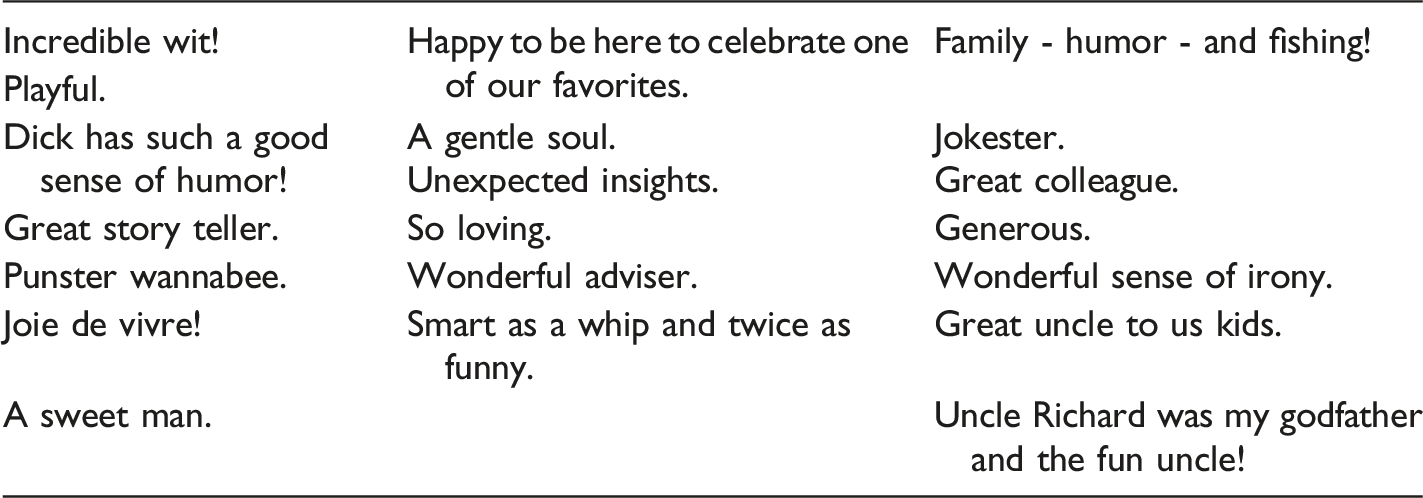
I remember that Dick knew how to engage people so effortlessly, especially during down times. It was from Dick, at an early ISAGA conference, that I learned Petals Around the Rose. He swore all players to secrecy about the rules; only those who could figure out the rules got to know them. They were enjoyable moments, engaging and calming.
My most enduring memory will probably be the witty, sparkling twinkle in his eyes, often when he teased. His genuine interest in people, their ideas and experience came across in all encounters with others. Finally, Dick’s composure and modesty were warmly obvious to all. I sometimes wonder if he ever realized what rich gifts he offered to others, including the gaming community. In any case, we all owe Dick immense gratitude and respect.
Marieke de Wijse-van Heeswijk (the Netherlands)
Before I went to my first ISAGA conference in 2004, Dr. Vincent Peters, my teacher at the university, said: “Well, you have to go there, you can even touch Dick Duke! He is just there and you can talk to him, he is very warm and inviting and knows so much on simulation gaming. This will be such a great opportunity.” I listened to Vincent and went to talk to Dick. He was as welcoming and friendly as promised, I was just a newbie, and he took all the time. He invited me to co-facilitate SLOGAN, which we facilitated together at the ISAGA summer school, which went smoothly. There was so much to learn and make fun as well. The other day he sent us out to shop for all kinds of funny things we might use in game design; clay and sticks seemed to become our favourites. With all of his knowledge he still made game science and design and all there was to it very doable, tangible. He really lowered the threshold and could explain all so well and gently, which worked as a confidence boost and big motivation for anyone at that summer school and conference.
Encouraged and helped by Dr. Vincent Peters, I started working with two of Dick’s games, SLOGAN and HEX. I found how multi-purpose they were and still are. How unique and usable they are today though developed in the sixties - we still use them at our university and in a few consultancy companies in the Netherlands. I remember I was fascinated by his elaborate systems models. In working with clients I noticed the modelling really helped in participatory development projects and later on I learned I used a lot of different types of models to validate my game models I started to form a sequence of models inspired by Dicks systems modelling approach. Instead of projecting all in one model I chose to decomplexify (which is often necessary when working with clients especially who have little time available to participate in the game design) by making multiple models (also triggered and inspired by the multi- layered way Sebastiaan Meijer started looking at simulation games). From the sequence of model building the game model emerges. Starting with a context model together with an internal systems model (if possible integrating scientific backgrounds), then a process flow model based on actors and decisions, followed by a further translation into the game feedback model. This way of working creates a red thread of connecting the games components to the games goals. This is what Dick favoured, a coherent approach, ticking all the boxes, in an iterative form. By using multiple models I succeed better in involving people in understanding the development process and making it coherent with the goals we want to achieve.
Richard was always open to questions and comments and if he knew you knew what you were doing he allowed changes to the game formats for further research and effect measurement. It was great to be able to talk to him and check how and why certain mechanics were in there and how these could be altered or modified to suit contextual needs. At high age he was still so flexible in thought and willing to think about solutions. His book “Gaming: The Future’s Language” is still so valuable to anyone ever wanting to work with simulation games. I also remember Marie, as his right hand. When he did not feel sharp, Marie could always step in, which he appreciated openly and valued the knowledge and contribution Marie had. For me, they were inseparable and ever inspiring.
Andrea I. Frank, former student & Associate Professor (Germany)
When studying for a postgraduate degree in urban and regional planning at the University of Michigan, I was fortunate to meet “Dick” Duke having enrolled in one of his introductory courses on gaming/simulation. It was a very different class compared to others as we were “playing” a different game or role-play every session. Coming from an architecture background I could easily relate to the use of paraphernalia, the idea of scenarios and options, however, Dick’s elaboration on communication theory and the creation of ‘multilogue’ for rapid learning was thoroughly eye-opening. I ended up taken a lot more relevant courses to obtain the Certificate in Gaming/Simulation studies and it is fair to say that Dick’s teaching and our subsequent friendship had a profound impact on both, my professional and personal development. In fact, when moving house recently I found a folder with syllabus of the above course; apparently in over 20 years, I never had the heart to throw them away and I still feel they contain material that has relevance today.
During my time at Michigan and thereafter, I have had the privilege to work with Dick in a range of capacities – assisting in research and doing illustrations for a book, building game kits, or developing a policy exercise for agreeing Research Priorities for the Great Lakes with different stakeholders from several Canadian provinces and US states. This involved learning about cutting edge ecological concepts and travelling to meet policy makers, scientists and first nation leaders. My learning was immense and to this day, I marvel at Dick’s patient leadership and calm demeaner in these often heated, politicized settings.
Dick cared deeply for his students and made sure to introduce us to friends and colleagues always aiming to create development opportunity. As such myself and a bunch of other students were offered to contribute to and help organize the 25th ISAGA conference which Dick hosted in Ann Arbor at the University of Michigan. It was a thrilling experience and thrusted me at least into the conference scene. While after graduating from Michigan, my professional interests never solely focused on gaming/simulation, it has remained a part of my toolkit and I have returned again and again in suitable circumstances to the topic be it for educational or research purposes. I also attended further ISAGA conferences, and these were wonderful occasions to reconnect with Dick and Marie, the pair who so admirably managed a fruitful partnership in life as well as work.
Aside from Dick’s intellectual generosity, his sense of humour and warmth as a human had few limits. Having lost my father early in life, Dick and Marie kindly treated me as part of their extended family during my time in Michigan and on subsequent visits. Amongst my fondest memories are when Dick and Marie invited to their home on the lake in Ann Arbor to play HEX – a natural resource/governance game he originally developed for Ghana, or when on a summers day my partner and I were asked to join the family for a ride on the ‘party-boat’ on the farm. And even in 2014, when Dick was increasingly suffering from illness – Dick insisted my husband and I come by on our Thanksgiving visit to Ann Arbor and meet with his sons, daughters and their partners and children. I am forever grateful for how Dick and Marie made me always feel welcome and at home.
Dick was a mentor, father figure and model for how I strive to define my own stance towards students, how to keep curious and a twinkle in the eyes. He often mentioned how blessed he felt working with students as this kept him and his mind feeling young by association. I am starting to see his point and am forever grateful for his long-time support and friendship.
Amparo Garcia-Carbonell (Spain)
In 1992, my colleague Frances Watts was returning excited from her brother Michael's wedding in Mobile, Alabama and after hearing a speaker, David Crookall, at a conference in Beloxi. She told me about an online simulation where teams from different parts of the world participated. From that moment on, my colleague and I got down to business and began to engage with our engineering students. In 1993, we attended our first ISAGA conference organized in Bucharest, Romania. That same year, Cathy Greenblat moved to Valencia for a while and contacted us, which was the beginning of a good friendship that has lasted decades. In 1994 we attended the ISAGA conference, organized by Dick Duke, in Ann Arbor, Michigan, and it is from that moment that a professional inspiration and friend was born for me.
Cathy recommended some books and I started with Gaming: The Future's Language. I did not understand anything, everything was new. Was it really a language from the future? I dared to write to Dick with many questions and, I must admit, I was surprised at how quickly and clearly he tried to clarify all my doubts. From that moment we established continuous communication and his principles were always a guide in the research that my colleague Fran and I carried out.
I remember personal moments where we enjoyed meals at his house by the lake in Michigan, walks with Marie and her daughter in the Malvarrosa beach and dinners at my house in Valencia with my family, where Dick always ended up playing with Lego games and explaining visually the language of the future.
Dick was a calm man, who approached learning with intelligence, patience, and designed his games with hope for the future. He was a very generous man with his knowledge and a person, along with Cathy Greenblat, intellectually ahead of his time.
He was always intellectually and personally by my side. He never separated these dimensions, which made him a holistic maestro of knowledge and affections.
Thank you for everything you discovered me and for your generous teaching of life. Dick, announced early on "...the high priests of technology speak only to the high priests of technology" and "God is dead and the citizen...can barely utter a word." Thank you very much for giving us all a common language that we will continue to use to deconstruct social complexity and work the future without risk.
Dick you will be with me always.
Jan Klabbers, ISAGA General Secretary, 1976-2004 (the Netherlands)
Dick Duke, with a background in urban planning, pioneered the design of games about urban planning in the 1960s and 1970s. Subsequently, he broadened his scope and designed games - as empirical models of varying referent systems.
The first meeting of ISAGA in June 1970, in Bad Godesberg, Germany, was a clear spin-off of such endeavors. As a result, during the 1970s the annual, international conferences of ISAGA, focussed mainly on game design methodology. That design focus set ISAGA apart from the fellow gaming associations, established during that time. By designing dedicated games about well-defined referent systems, Dick Duke invited the participants to develop a so-called Gestalt that enabled them to improve the functioning of those systems. That tradition, I consider Dick’s most important legacy.
Thank You Professor Duke, by Shigehisa Tsuchiya, an Honorary Member of ISAGA (Japan)
Professor Duke was kind enough to open the heavy door for me to enter the simulation and gaming world. My personal journey regarding simulation and gaming started about 30 years ago when I happened to realize how powerful computerized simulations could be for organizational change. The metaphors created by computerized simulation enabled me to transform a stagnant university into a high-performance organization. Through extensive surveys, I found that gaming/simulation could be most effective for organizational learning.
In 1997, Professor Duke gave me a rare opportunity to acquire the tacit knowledge about developing policy exercises. I spent 4 months at the University of Michigan as a visiting professor and created a policy exercise with his graduate students. This made it possible for me to start creating gaming/simulations for METI (the Ministry of Economy, Trade and Industry), Japanese companies, and local authorities.
I would like to say to Professor Duke, “Thank you very much and goodbye till we meet again ‘soon’.”
Memories by Markus Ulrich (Switzerland)
Edinburgh 1992
I was sitting in the audience. My first ISAGA conference. On the podium, Professor Richard Duke, amongst other gamers, including Cathy Greenblat. With their charisma, they sat there like gods. It was my first encounter with Richard Duke. I felt his natural authority, which I later realized was rooted in his dedication and deep understanding of simulation and gaming.
Ann Arbor 1996
University of Michigan, course UP664 - Game Design. We were at step 10 of game design, Definition of Gaming Elements. We students were working hard on this tedious description of every single game element. A task that can only be successfully completed with utmost focus. A task that requires meticulousness, patience and concentration. Our creativity surged forward. It was inevitable. We discussed the format of the game. Step 12. Dick came across and intervened sharply: Stop talking about the format of the game! Focus on the game elements. Forget all thoughts about a possible format. This will follow in a later step.
His intervention helped me understand a key element of his design method. The format of a game is not the result of rational elaboration. The format is emergent. It emerges out of the process.
This key element is simultaneously a crunch point. Clients ask me, what will the game look like. And my answer is: I don’t know yet. It will emerge. And I feel like the tailor in the fairy tale of The Emperor’s New Clothes.
Halloween 1996
Never miss an opportunity to party. Let’s celebrate Halloween and have pizza and some drinks. Dick appeared as a dairy cow with udders on his belly, laughing and joking.
My personal appreciation
His profoundly human personality. His game design method. He thus gave me a critical foundation for my professional work in the field of simulation and gaming, in the company I founded 25 years ago. Developing and facilitating simulation games for sustainable development, climate protection and more. His support, for many, including me. For example, when we translated his simulation games SLOGAN, HEX, SURVIVAL into German.
Walensee, Switzerland 2014
My last personal encounter with Richard and Mary Duke. We were driving along the shores of Lake Walen back to Zurich Airport. We stopped. Enjoyed the beautiful view from the highway rest area of the lake and the mountains beyond.
Ivo Wenzler (the Netherlands)
In summer of 1984 I moved from Croatia to US to get my master’s degree in architecture and urban planning at the University of Michigan. At that time, I had no idea how much my own perception of what I want to learn and what I want to do as an architect and urban planner will change. Just out of curiosity I took an elective course (taught by Dick Duke) about simulations and gaming for urban planning. The change was almost immediate. From that moment on I was almost addicted to the phenomena of using games for a serious purpose. I did get my master’s degree, but my focus completely shifted from architecture and urban planning to simulations and games in the context of policy development. Dick encouraged me to continue my study, and although my PhD degree is officially in architecture, the content was purely about gaming. While I was still doing research Dick invited me to become part of the small simulation and gaming company he initiated, named Multilogue. More than 30 years later, and I am still using the term ‘multilogue’ when I talk about gaming with my students or my clients. If one word would have to be used to sum all the impact serious gaming has, that would be it. One of the most important things I learned from Dick Duke is the structured approach to design, especially the importance of problem definition and the model of reality (in his words the ‘schematic’) as the basis for the development of a serious gaming intervention. Another thing is his ‘rule of 10’, a prototyping approach to design, moving from the ‘talk-through’, through ‘crawl-through’ and ‘walk-through’, to the ‘run-through’ versions of the game being developed. Working with Dick Duke and the approach I learned from him were instrumental for my professional development and had an enormous influence not only on my professional life, but through that on everything else connected to it. My move from the US to the Netherlands in 1992 was a result of a couple of projects we as Multilogue did in the Netherlands, where I met people who invited me to lead a small policy advice group at the Radboud University. Although Dick was disappointed that I was leaving the US, I know that he was also proud that I was continuing the path he not only initiated but also enabled though the work we did together. After a couple of years at the university I had a 25-year carrier in consulting, developing simulations and games for clients all over the world, and for the last four years I was holding a position of the professor serious gaming at the NHL Stenden University. In short, once I was an architect, but meeting Dick Duke change it all. He was not only a very good teacher and colleague, but a very good friend that will be missed.
A Closing Note
Whenever I talk to students about game design for the first time, I show them Duke’s Game Design Process ‘wheel’ - with all its numerous elements that Duke identified as common to all games (Duke, 1974). And I tell them how humbled I was to join a panel discussion between ‘younger and older’ experts in Simulation Gaming in Dornbirn in 2014, and having been able to feel what a curious and warm person he was. Many of my students read and study Duke’s articles and guidance into the design and use of gaming simulation for the understanding of our complex world. However, with all the complexity of the process itself, one clear message is also conveyed: That the first step in designing a simulation game is to clearly articulate its purpose (Duke, 2014), opening up glances into possible futures, using the wonderful tool of simulation gaming still, more than 50 years after Duke’s first publications and game designs. “Escaping from the game is not to be taken lightly.” (Duke, 2014: 122)
Footnotes
Acknowledgments
Special thanks to Toshiko Kikkawa and Marlies P. Schrijven for their encouragement and opportunity to publish this article, and to all who contributed with their wonderful memories of Dick Duke.
Declaration of Conflicting Interests
The author(s) declared no potential conflicts of interest with respect to the research, authorship, and/or publication of this article.
Funding
The author(s) received no financial support for the research, authorship, and/or publication of this article.