



Abstract
Background
In a world of ever-increasing complexity, organizations and people have an ever-increasing need for support systems that help them understand and shape the world around them. While simulation game design derived from the very idea to propose an instrument able to address complexity, seminal approaches dealt with a different level of complexity. In a networked, digitalized world, complexity has increased, and traditional approaches towards designing games show certain shortcomings that have to be overcome.
Aim
This article proposes a new process of game design for complex problems and complex systems that can both be used by game designers as well as the scientific community in the field. This process is represented within a framework, based on two parts. The so-called ‘Funnel of Game Design’ based on the IDEAS approach represents the process of problem derivation, while the ‘House of Game Design’ also covers possible steps towards the final game product and process, including de-briefing and evaluation.
Method
Based on hands-on experiences and related work, we developed several steps of a game design process (IDEAS approach). In face-to-face interviews, we discussed the first version of the framework with experts in the field of simulation game studies.
Results
This process led to the framework presented in this article, which shows the steps of problem derivation as well as challenges that can occur, and proposes adaptive methods to overcome these challenges. The framework includes elements that support the definition of complex problems, and their translation into game designs.
Recommendation
We recommend practitioners and scientists to apply the new framework presented here in their efforts to define the underlying problem that should be addressed by an envisioned simulation game, and in translating this into a valid, engaging and meaningful game experience.
Introduction
Today’s society is confronted with many challenges. Challenges that heavily influence so-called complex systems, such as our energy systems, food supply chains, or transport infrastructure. Complex systems are dynamic networks of interconnected elements whose behaviour arises from interactions, often characterized by emergent properties that cannot be fully understood by analysing individual components in isolation (Ridolfi et al., 2012). According to Ridolfi et al. (2012), complexity can be viewed from two different perspectives. One is the system itself and the other is the management of the system including the corresponding processes and involved stakeholders. “These two interrelated views of complexity, being bottom-up in the first case and top-down in the second, both converge to the system defined as an entity formed by a set of interdependent functions and elements that complete one or more functions defined by requirements and specifications” (Ridolfi et al., 2012, p. 39). De Bruijn and Herder (2009) confirm this assumption by emphasizing that complex systems are characterized by different stakeholders with diverse priorities, interactions, and interdependencies between subsystems, as well as a certain level of uncertainty. Complex systems can be described on three levels: on an agent or individual level, on a network level and on a system level (Bekebrede, 2010). Individuals and organizations involved in such complex systems are connected with each other and are interdependent (Mitleton-Kelly, 2003). For this reason, it is not surprising that the meaning and interest of complex systems is becoming more important. There is also an increasing number of societal and technological challenges (Dalpiaz et al., 2013; Davis et al., 2014), that needs to be considered within the framework of such systems. The increasing importance can be seen, among other things, in the award of the Nobel Prize in Physics in 2021 to Manabe, Hasselmann and Parisi for groundbreaking contributions to our understanding of complex physical system. 1
As early as 1974, Richard D. Duke put societal complexity in the foreground when defining the design and use of simulation games. He already stated that the need to address the issue of complexity has increased as the complexity of the problems has also increased (Duke, 1974). It can be assumed that the degree of complexity has changed in the last 50 years and has also shifted, since more and more parts of life are influenced by increasing digitalization, artificial intelligence, and automation, and in many jobs, additional related competences and skills are expected of employees (to give just one example). The analysis of such complex systems is difficult (Lukosch et al., 2018) because there are many uncertain influence factors and variables (Holland, 1995). In addition, complex systems […] are characterized by non-linear interactions […] (Bekebrede, 2010, p. 447). Especially simulation games offer a space to contribute to the design of complex systems, and to understand them better (Duke, 1974; Lukosch et al., 2018; Gurbuz & Celik, 2022). In Figure 1, we summarize the many simulation game design approaches that have been developed over time, and that inspired the present approach. Overview of different approaches towards the design and development of simulation games.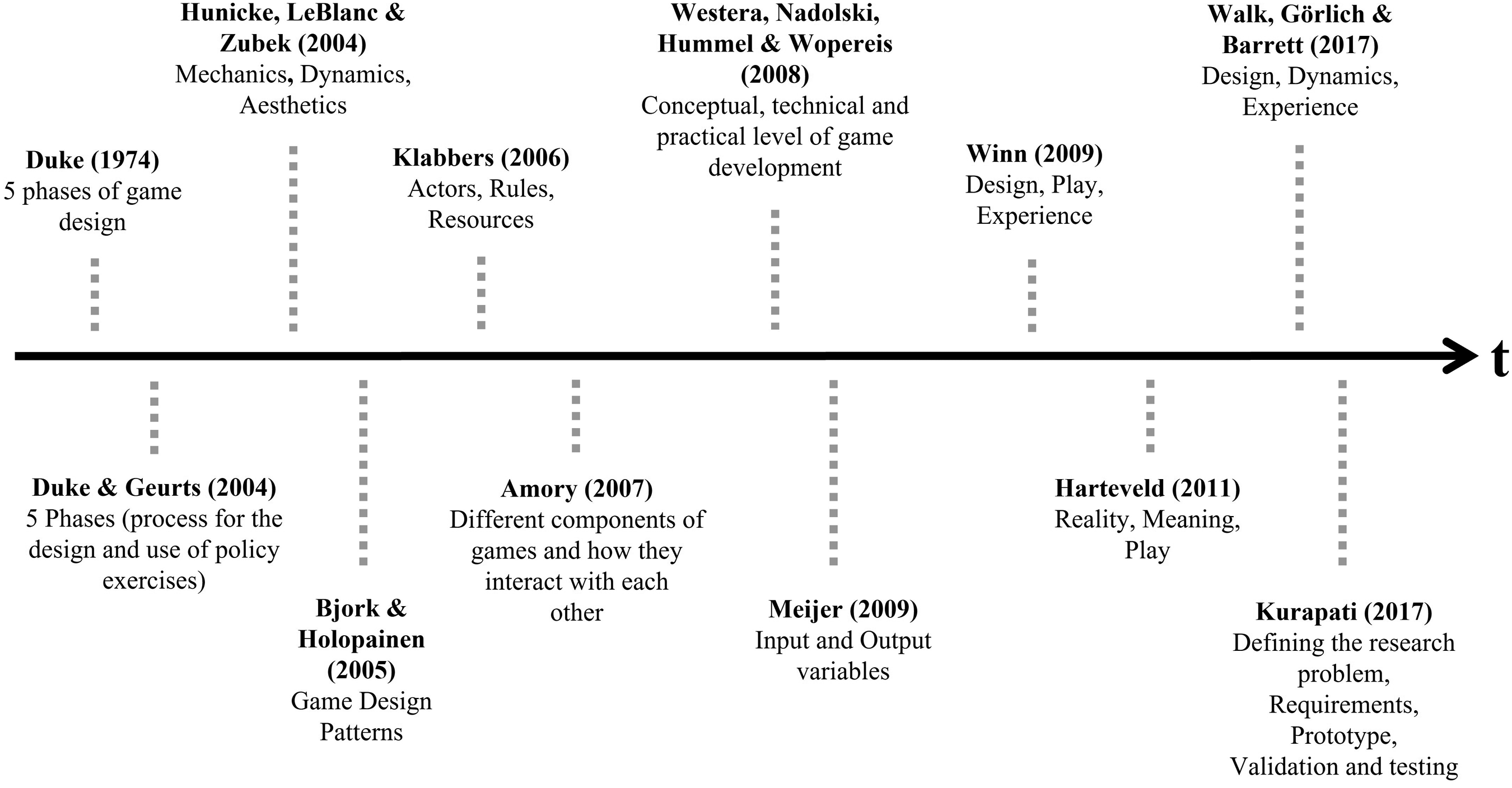
We discuss game design approaches that explicitly focus on simulation game design, or are somehow related to this field. This way, we exclude general game design approaches or such that center around a certain technology alone. However, we acknowledge that many of them served and still serve as valuable sources for simulation game design, and that many game elements and game mechanics are described in detail in the works of game designers and researchers like Salen Tekinbaş and Zimmerman (2003), Adams and Rollings (2006), Fullerton (2008), Sicart (2008), Koster (2013), or more recently Rusch (2017), to name only a few. Simulation game design has first been described in detail by Duke (1974) who provided an extensive framework of elements for designing simulation games. In his process, one starts from the complex reality, which is perceived in a certain way, and needs to be translated into a conceptual map as basis for the actual game design (Duke, 2014). However, while he acknowledges the complexity of the world, the purpose of the game seems to be more important as a starting point than understanding the complexity of the underlying problem. Duke’s simulation games design approach has been published in 1974, and inspired many design approaches to follow. Duke and Geurts published an updated version in 2004, addressing some current trends and developments since the first approach was published. In their book, they formulate the need for new tools for strategic management, and propose simulation game design to address this need. Complexity of the underlying problems is mentioned as main driver for the design and use of simulation games (Duke & Geurts, 2004). Klabbers (2006, 2009) conceptualizes simulations and games as processes of scientific enquiry and professional practice. They represent artifacts that consist of Rules, Roles, and Resources, with an explicit boundary to the 'real' world. Simulation game design in this approach is referred to as design-in-the small (that of the game itself), with the purpose to contribute to design-in-the-large processes (that of organisations, or social systems). Design and analytical science approaches are key to successful simulation games. Meijer’s (2009) approach is based on the idea of Klabbers (2006, 2009) and focuses on the use of games for the design of complex systems. In his concept, he takes into account so-called input and output variables of simulation gaming sessions. He defines six input variables (roles, rules, objectives, constraints, load, and situation), which characterize the environment of a gaming session. According to Meijer (2009), the outcome of a gaming session can be measured based on qualitative and quantitative data. Furthermore, he attributes an important role to the participants, whose behaviour is not predictable. In their publication, Hunicke et al. (2004) present an iterative game design approach that focuses on the interplay between Mechanics, Dynamics, and Aesthetics of games. Mechanics describe the components of a game, dynamics refer to the behaviour of the game over time, and the interactions of its components and relationship with the player. Aesthetics in this (MDA) framework refer to the emotional response of a player. Winn (2009) proposes a formal framework for the design of serious games, which adapts the MDA framework for its use for serious games in particular. Winn calls the new framework ‘Design, Play, and Experience’ (DPE), describing the relationship between designer, game, and player along a number of layers. Another ‘advancement’ of the MDA framework is proposed by Walk et al. (2017) with their framework of Design, Dynamics, and Experience (DDE). Bjork and Holopainen (2005) present patterns of game design with the goal of providing useful concepts for game designers. The aim of developing a pattern language of game design is described as providing a language that helps designers to formulate a design problem in a clear and consistent way. Amory (2007) proposes a game design approach specific to educational games, which is based on constructivist learning theory and on connecting between pedagogical concepts and game elements. In line with this, Westera et al. (2008) propose a framework for games in higher education, with the aim to ‘reduce design complexity’, and which is focused on scenario-based games addressing issues of complex problem solving. Harteveld’s Triadic Game Design (TGD) philosophy (2011) proposes to approach simulation game design along the three different worlds of Reality, Meaning, and Play that have to be balanced to achieve valid, meaningful and enjoyable game experiences. Kurapati (2017) has based her work on related game design approaches, and proposes a design process to create games for the analysis and design of complex systems.
According to the authors’ earlier work (Freese & Lukosch, 2021), existing simulation game design approaches have a different understanding of 1) what complexity is about, and 2) the relevance of formulating a problem statement as one of the very first steps when developing a simulation game. The latter is also precisely one of the challenges within complex systems, as Meadows confirmed in 2009 (p. 3) by saying that “Because of feedback delays within complex systems, by the time a problem becomes apparent it may be unnecessarily difficult to solve”. We have already established that the consideration of complexity is relevant for the design and development of simulation games. One possible explanation why all the simulation game design approaches we analysed have a different understanding of complexity might be a possible time effect in the sense that today’s interpretation of the meaning of complexity differs from the understanding of complexity 50 years ago due to new characteristics of our society as well as the advancements of technologies. In addition to this, defining a problem as a first step when designing a simulation game is relevant to guarantee the development of a valid simulation game, before one can go through a process of reduction, abstraction, and symbolization (Peters et al., 1998). One speaks of valid simulation games if they represent what they are supposed to represent, and meet the objective that was intended to be implemented (Pérez-Colado et al., 2019). Valid simulation games allow conclusions to be drawn that are relevant for the real system. Yet, this process is not always easy to realize due to the characteristics of complex systems having a large number of elements and relationships, and a high level of uncertainty for the actors involved. Considering these two main aspects, simulation game design approaches for a better understanding of complex systems need to reflect the current state of complexity of society. For this reason, this publication presents a new way of designing simulation games for complex systems that allows for a problem statement and translation of the problem into a meaningful game experience.
Purpose of this Article
Existing simulation game design approaches do not agree on a definition of complexity, or how to address it – or have one shared idea about what game elements or characteristics are key for the design process. Therefore, we address the following research question in this article:
How can one describe a design process for simulation game design for complex systems that allows for a problem statement and translation of the problem into a purposeful game experience?
To answer above-mentioned question, this publication is structured as follows. In a first step, the IDEAS approach is explained, which is based on previous research of Freese & Lukosch, (2021). In order to validate the IDEAS approach, the results of semi-structured interviews with international simulation gaming experts are described in a second step. Thirdly, according to the feedback of subject-matter experts, IDEAS has been adjusted in the so-called ‘Funnel of Game Design’. Fourthly, as this funnel represents only one pillar of the ‘House of Game Design’, we will conclude this publication with the description of the ‘House of Game Design’ and draw general conclusions about the experiences and contributions to game science.
Previous Research
The funnel-shaped IDEAS approach is shown in Figure 2. The idea of this funnel approach is to work successively towards the actual problem that the envisioned game is supposed to address under consideration of complex and uncertain challenges of today’s society, from general to very specific information. IDEAS consists of four steps that are based on related approaches, and our own game design work within research institutions. The process we propose looks as follows. In a first step, interviews with experts should be conducted. Especially when not a lot is known and complex and uncertain problems occur, semi-structured interviews can be useful to gain more insights (Wilson, 2014). In a second step, these interview results should be discussed, ideally with experts from a specific domain, with a focus on defining several problem statements to further refine the problem space. As it is not possible to integrate many different problem statements in one game because of complexity issues, the aim of the following step is to prioritize requirements. Therefore, the MoSCoW-analysis can be used (Clegg & Barker, 1994). One the basis of the MoSCoW-analysis, requirements and problem statements can be clustered in one of four categories: must haves, should haves, could haves and won’t haves (see Freese & Lukosch, 2021 for an example). As a last step, a gamestorm should be conducted. A gamestorm is a participatory brainstorm session with project partners to really understand the details of the problem the game should address that a game developer who was part of many of our projects has initially developed. For a game designer, it is of great importance to create a deep understanding of the underlying problem to develop a valid simulation game. Otherwise, a game may be developed that addresses a wrong problem and may not be helpful in achieving the envisioned goal. In this step, the TGD philosophy of Harteveld (2011) can be used with priority on the Reality and Meaning worlds as it is particularly relevant for both worlds to get input from subject-matter experts. Furthermore, feedback loops are considered in order to iteratively screen the procedure and compare results with previous steps. IDEAS approach (Freese & Lukosch, 2021).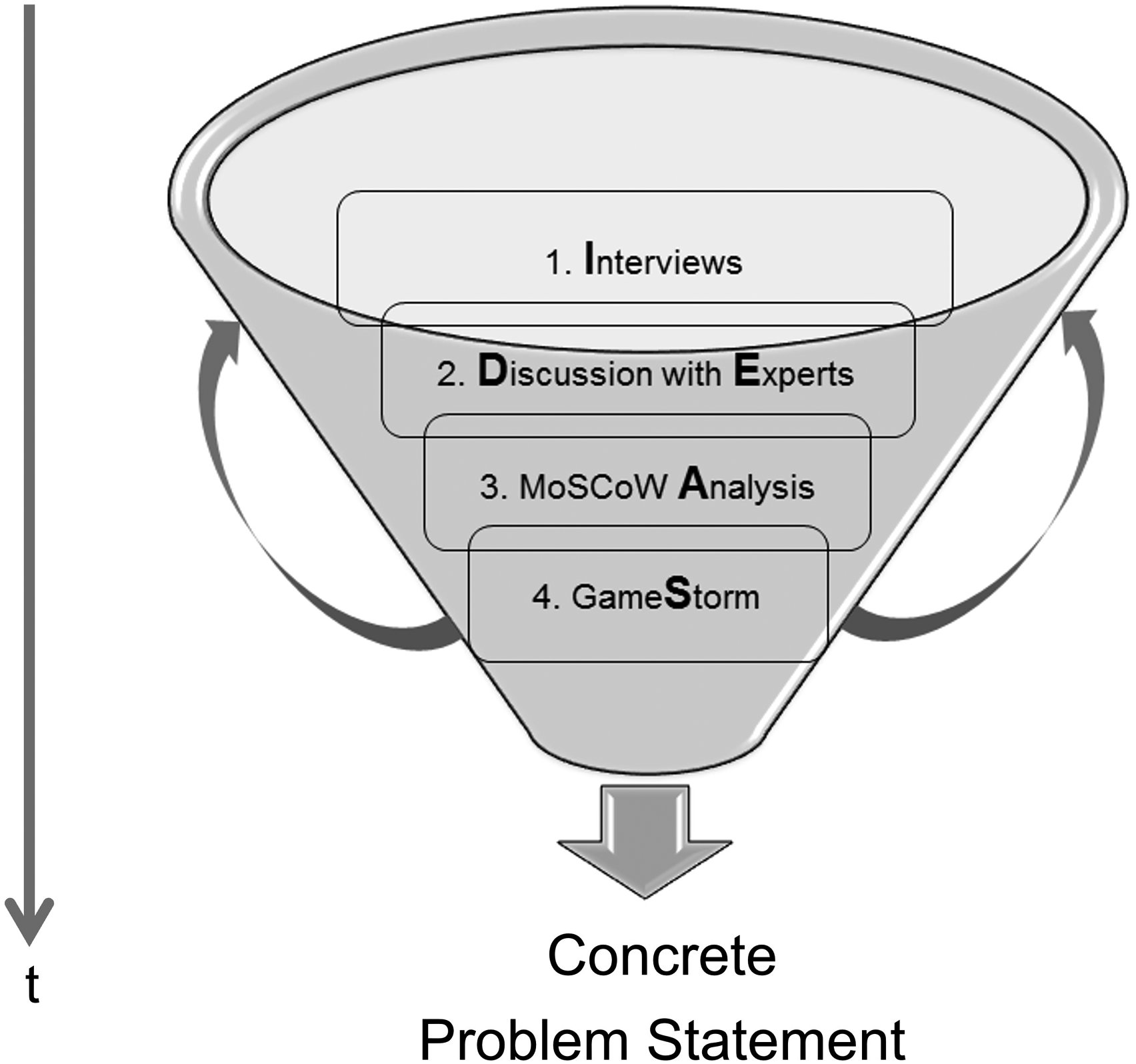
IDEAS has already been applied with the aim of specifying the problem that a game should address within the complex application domain of biotechnology. To validate the IDEAS approach, interviews with international simulation gaming experts were conducted.
Expert Validation of the IDEAS Approach
Sample description.

Talking about the Funnel of Game design, one subject-matter expert mentioned that we were able to identify good tools for the process of problem definition. This expert liked the iterative procedure, but mentioned that the sequence of these methods does not need to be the same for every case and that proposing such sequence was too strict. Further, this expert said that our approach was quite similar to the general approach of formulation research questions and that both very much depend on the specific aim and the target group. Especially the first step, the interviews, should be defined in a broader way. In particular, this expert would add methods based on empirical social research (e.g., literature analysis, observations, and questionnaires, group interventions versus individual ones). Moreover, this expert explained that their own approach usually was to 1) analyse the different stakeholders and their interests regarding a certain problem, 2) cluster their answers, and 3) analyse relevant system factors and elements. According to this expert’s feedback, our model should not focus on very specific methods, but leave the methods for each step more open.
Another subject-matter expert directly asked about the uniqueness of our systematic approach which we explained then (focus on complexity, problem statement). Furthermore, this expert mentioned that we should think about the wording issue. In particular, we should be more specific (e.g., answering where is the niche, what is our target group? Are we talking about games, serious games, games for business, IT, simulation games, games with a certain purpose etc.). Regarding the proposed methods, this expert asked why this was specific to serious games and said that there is nothing against the methods but we have to define or justify it in a more detailed way (e.g., design, scope, same level of aggregation). This expert also questioned whether a concrete problem statement was always necessary, which was, according to this expert, not always the case, especially in business games. Defining a problem statement is a very analytical, engineering approach, but in reality, it is very often very fluid. Another comment of this expert was related to the choice of Harteveld’s approach, which in the expert’s opinion only makes one aware of certain aspects of the envisioned game design. It does not propose certain steps for the development of a simulation game.
The third subject-matter expert we talked to said that this expert liked the IDEAS approach very much. Regarding its second step (discussion with experts), this interviewee mentioned that it is not always possible to get in contact with experts due to different reasons. With this expert, we discussed the idea of adding a literature review to be able to solve this challenge. This expert especially highlighted the third step in IDEAS (MoSCoW-analysis) and said that this was very helpful to analyse the main essentials, especially when you have experts with different opinions. This expert also recommended to add a power-interest grid (Bryson, 2004; Eden & Ackermann, 1998) to the MoSCoW analysis to be able to categorize different actors as one aspect that was still missing is the analysis of the target group.
The next subject-matter expert also mentioned that especially the first step, the conduction of interviews, can be challenging. Experts might experience the so-called ‘expert-trap’, meaning that they do not see problems anymore. In more sociological terms, this can be described as the blind spot of the system that is not able to observe itself (Luhmann, 1995). A method to propose here could be to use a simple warm-up exercise or game as an ice-breaker to enable problem owners to identify and speak about their problem. The first two steps (interview and expert discussions) are, according to this expert, the most difficult ones. The requirements analysis and gamestorm sessions were more technical-oriented, and can be addressed with different methods. The first two steps would refer to the social dimension of game design, while the third and fourth would rather refer to the technical dimension of the game design. It seems that our framework follows a design science approach, also discussing the big challenge to understand what someone really wants. This expert mentioned that the work on such framework was very important for the scientific field.
The next expert again discussed the second step of IDEAS in particular, the discussions with experts. The questions arose what our definition of experts was, how we selected those and how we structured the set-up (e.g., with expert panels, individual discussion with an expert, group discussion with experts, homogenies and heterogenic groups of experts). Between step one and two, this expert would add something like discussion of moderated groups and agreed that the participation of stakeholders was crucial. This expert also said that based on own hands-on experience, the problem statement very often correlated with the solution. It means that stakeholders already have an idea in mind (they call it solution) and define a problem statement based on their idea. This was something to be careful about, to not mix up the expert’s expected outcome with the problem. With regard to the third step of IDEAS, this interviewee said that it was important to focus on the different opinions stakeholders have while working on and with the MoSCoW-analysis.
Another subject-matter expert mentioned that IDEAS looked like a systematic approach with the aim to make an unconscious problem conscious. Based on this subject matter’s experience, it was important to not only focus on internal stakeholders (people that are not part of the system), but also external stakeholders (the problem environment in a broader sense as a separate layer).
The next subject-matter expert we interviewed said that the IDEAS approach was a great idea. This expert very much liked the different methods we explained and added that especially the fourth step (gamestorm sessions) was important because of the active participation of the stakeholders in the development process. Developing a game means at the same time the reduction of reality. This interviewee furthermore mentioned that we should add two layers: 1) researcher and 2) environment. Both should stand in interaction with our funnel.
One subject-matter expert asked why this approach was different from the other already existing approaches. After explaining the analysis, we had done, this expert said that this proposed process (from a generic to a specific problem) made totally sense, but it very much depended on the specific research question one had. We should not only consider an analytical approach, but also give space for creativity (what-if scenarios).
The last subject-matter expert added that the context of many simulation games was a wicked problem or a complex adaptive system. If this was the case, then there were many uncertainties about the system and the nature of its challenges/problems. As such, one cannot talk about the definition of a ‘concrete’ problem. This expert would propose to better talk about a “Jell-O problem”, meaning that the problem in general had a certain nature, but whoever actor the problem touches, it would move a little bit, and changed its overall form and boundaries slightly. This suggests that the statement would be a tentative not an absolute one, outlining of issues and context with which participants play within a defined/confined set of conditions.
Analysis of Experts’ Feedback
IDEAS supports a participatory approach of simulation game design. This was also emphasised by the experts at different levels. Based on their feedback, we discuss several key aspects mentioned by the experts with the aim of adapting and improving IDEAS from its original version.
Problem Statement
The authors’ aim is to develop a design approach that supports the development of simulation games for complex systems with a focus on understanding the underlying problem and make it explicit. The problems that such games address are often also complex and wicked ones, so that a specific formulation is usually not easy, since many variables have to be taken into account, are dependent on each other, and are emergent in a way that their development is uncertain. This goes hand in hand with the understanding of wicked problems stated by Rittel and Webber (1973). Wicked problems often are complex (and interdisciplinary) issues that have an indeterminate scope (Buchanan, 1992). They have multiple causes and a multitude of stakeholders with different needs, making them difficult to describe. What makes wicked problems especially pernicious is that even the problem formulation itself is contested (Rittel & Webber, 1973). When revisiting wicked problems as described in 1973, one can state that rational planning considering a wicked problem is not possible (Crowley & Head, 2017). For this reason, we have conceptualized the purpose of the game as the target variable of the funnel, which can contain a specifically formulated problem statement, but is more flexible in its application, allowing to consider the multiple facets of a problem.
Methods
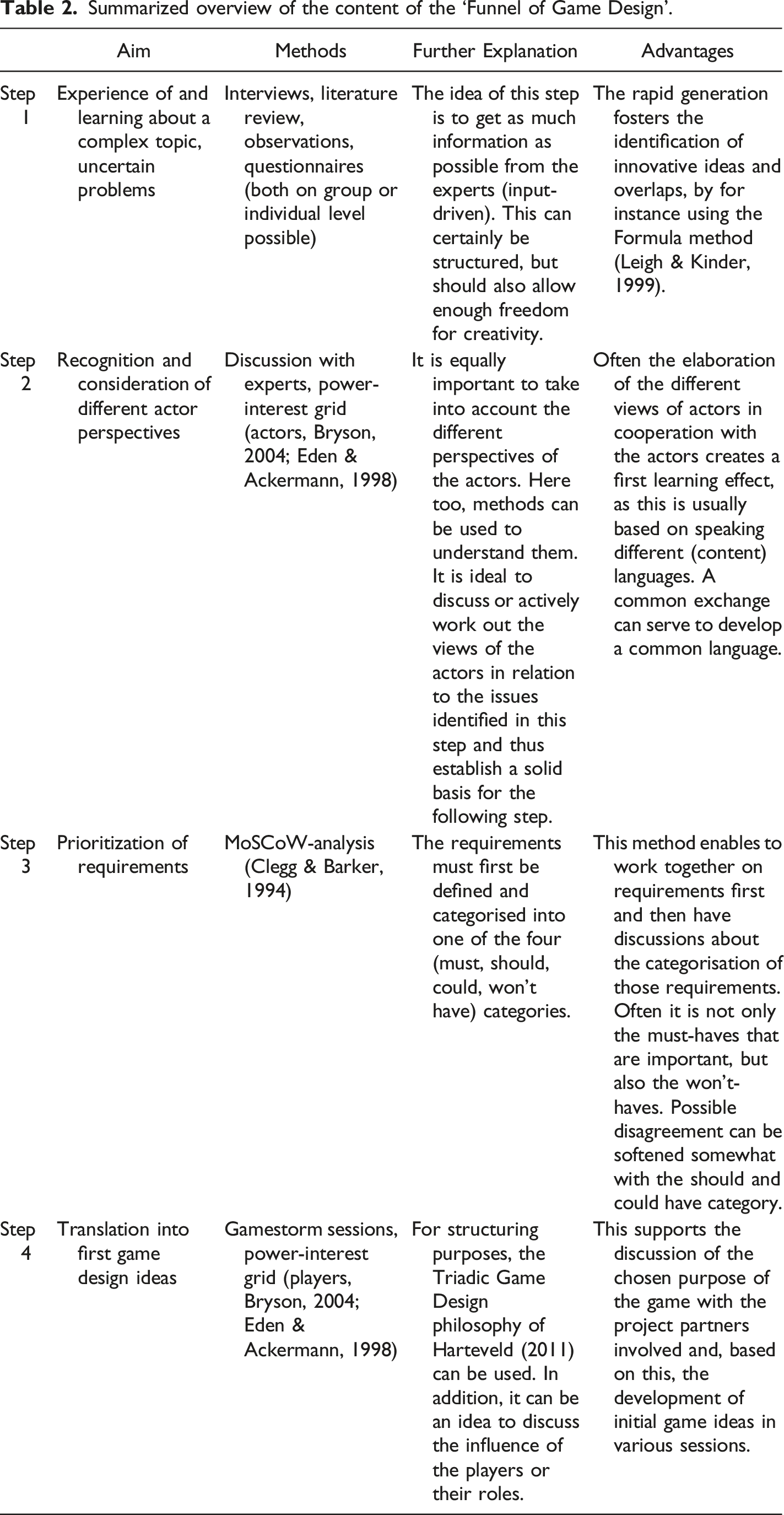
With regard to the methods that are included in IDEAS, it has become clear that the first two methods (interviews, discussion with experts) primarily pursue the goal of analysing aspects to identify the purpose of the game, whereas the last two steps (MoSCoW analysis, gamestorm) pursue the goal of better understanding the purpose of the game and thus, synthesising the collected information and the acquired knowledge. For this reason, we have added the two overarching phases of analysis and synthesis to the IDEAS approach and no longer work exclusively with the methods used, but rather with the aim that is pursued per corresponding level, which still follows a funnel principle: 1. Experience of and learning about a complex topic, and uncertain problems 2. Recognition of different actor perspectives 3. Prioritization of requirements 4. Translation into first game design ideas.
As suggested by the experts, other methods can of course be included. To make the funnel even more intuitive and to emphasise that it is an iterative process, a feedback loop was added to each stage to illustrate precisely this iterative procedure with fourth-and-back loops. In addition, overlaps between the individual steps must be taken into account.
Involvement of the Target Group
Linked to this point, the point of stakeholder analysis, involvement of experts and/or the actual target group came up several times. The authors' experience has shown that involving the actual target group as early as possible in the development process can significantly increase the acceptance of the developed tool. This topic is addressed centrally in the first two steps, because without contact to the actual target group, the development of a valid game is almost impossible. This approach relates IDEAS to the fields of participatory and co-design of games (e.g., Lukosch et al., 2012; Khaled & Vasalou, 2014; Ismail et al., 2019; Pereira et al., 2019).
Layered Funnel
The discussions with the experts also showed that different layers of game development should be taken into account. First of all, the time component, because the development of a valid simulation game takes time. Often, the development of a simulation game is carried out by game designers in cooperation with game researchers, although both functions are of course possible within one person. However, if resources allow, it is recommended that a team of designers and researchers work together through the appropriate steps, with different priorities per role per step. Also, the environment in which such a game is being developed should be taken into account, especially external factors such as available resources, and the context of the development to name just a few.
Finally, it must be mentioned that the ‘Funnel of Game Design’ has several objectives. On the one hand, it is about supporting the process of identifying and understanding the purpose of an envisioned game more precisely, which is the basis for the development of a valid simulation game. On the other hand, by taking the funnel into account, it is also possible to involve the actual target group in the development process as early as possible and thus at the same time increase the acceptance of the game to be developed and address challenges such as the solution is already known or the non-perception of problems.
The ideas described were taken into account in a new visualisation. An updated version of the ‘Funnel of Game Design’ can be found in Figure 3. ‘Funnel of Game Design’.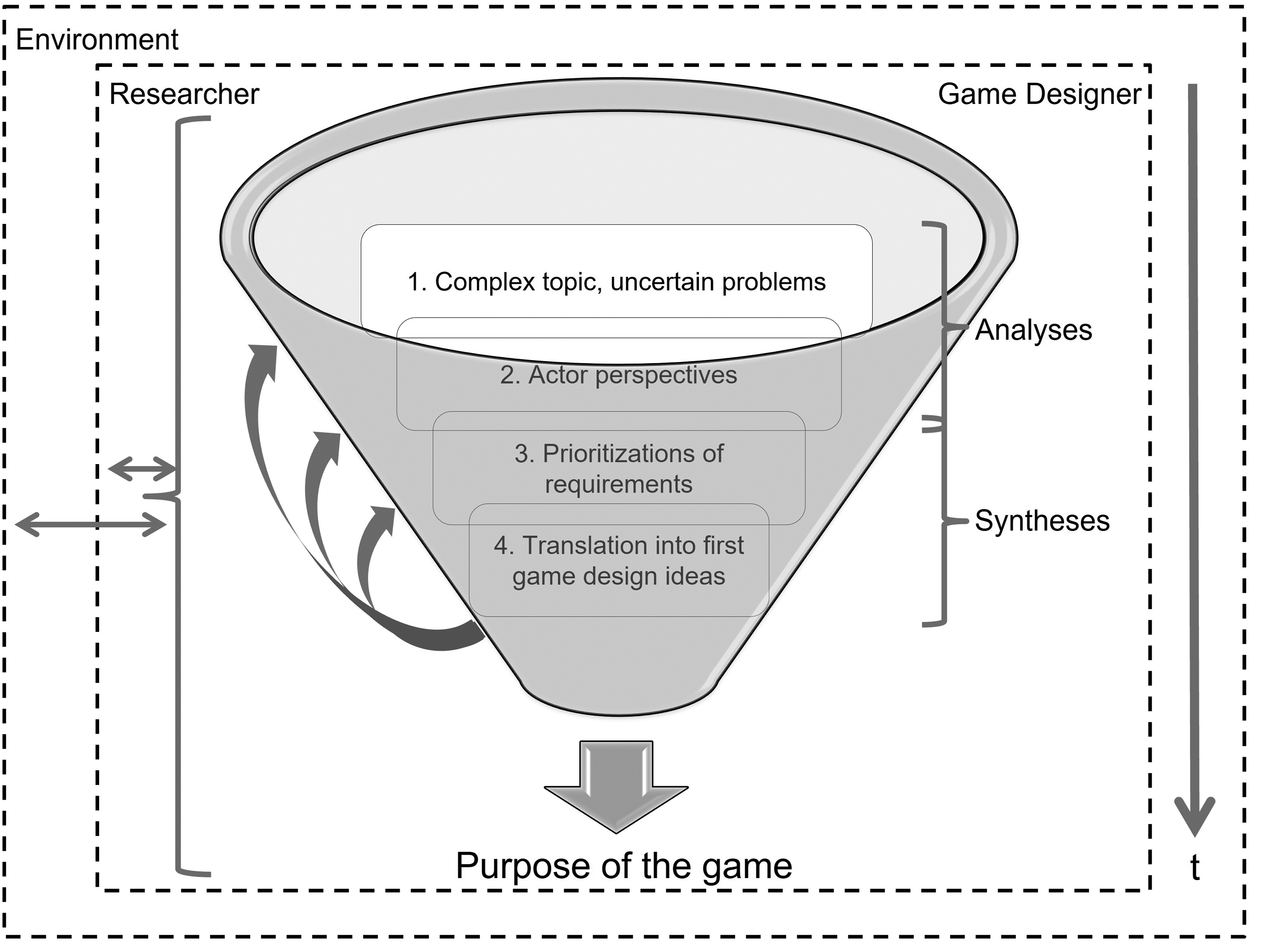
Summarized overview of the content of the ‘Funnel of Game Design’.
Discussion, Conclusions and Future Research
In this publication, we aimed at answering the question on how to describe a design process for simulation game design for complex systems that allows for a problem statement and translation of the problem into a purposeful game experience. According to Freese & Lukosch, (2021), approaches that focus on simulation game design have a different understanding of the meaning of complexity and the relevance of considering a problem statement as one of the first steps of a simulation game development. Yet, this is not only important in a world of ever-increasing complexity and its consequences, but also to guarantee the development of a valid simulation game. In previous research, we worked out the IDEAS approach; an approach that focuses on the derivation of a specific problem statement by going through four steps ranging from interviews, discussion rounds with experts, a MoSCoW-analysis to gamestorm sessions. The idea of the IDEAS approach was discussed with nine international gaming experts through semi-structured interviews. Their feedback was analysed and an adapted version of the ‘Funnel of Game Design’ was developed, which is one (‘Analysis of Content’) of the three main pillars embedded in the ‘House of Game Design’ (see Figure 4). ‘House of Game Design’.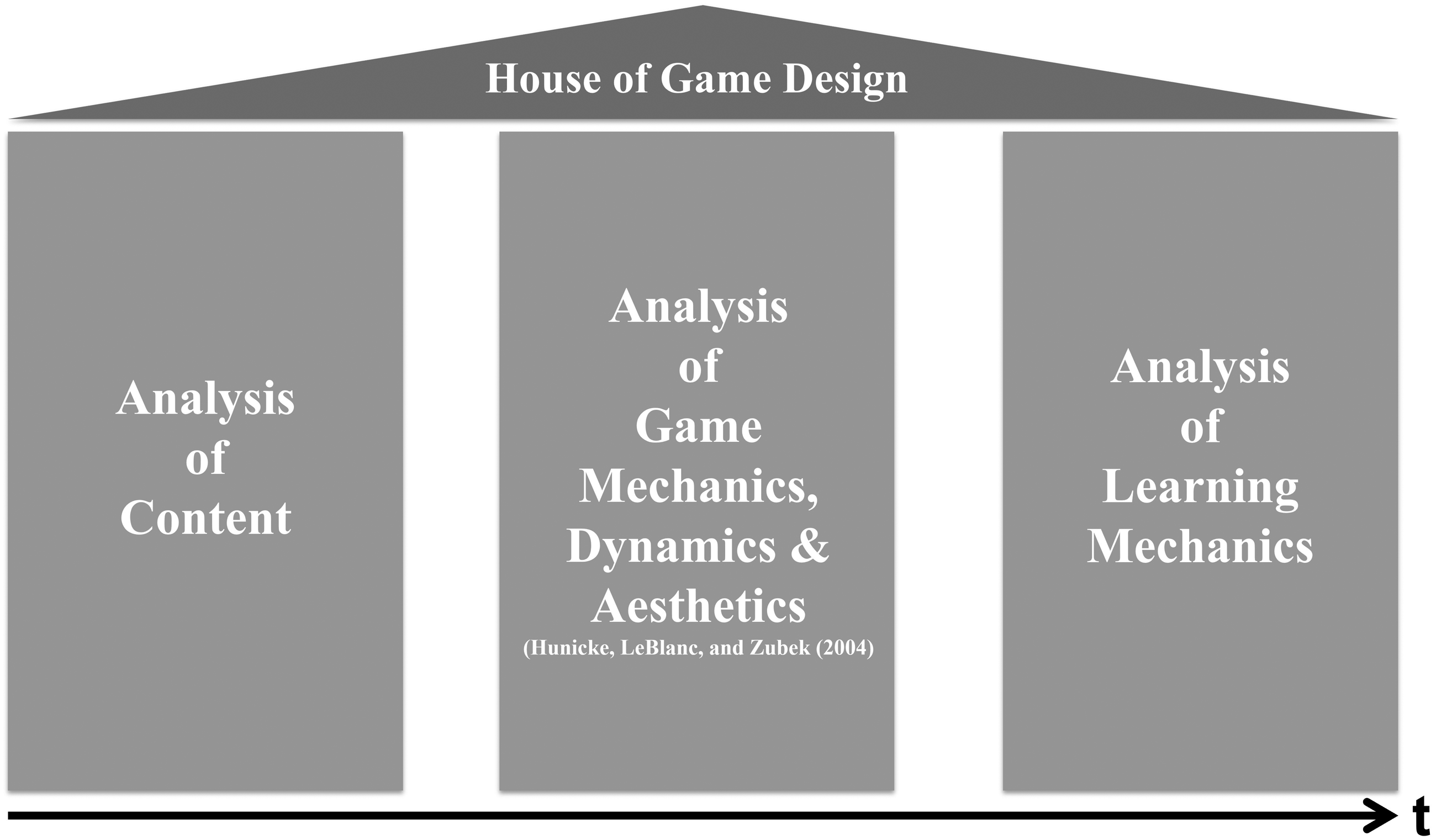
The other two pillars of the ‘House of Game Design’ are the analysis of Game Mechanics, Dynamics, and Aesthetics and the analysis of learning mechanics. Related to the first mentioned, the transition from the lessons learned from the analysis of the content to a first or adjusted game design takes place. To achieve this, the MDA approach (Hunicke et al., 2004) mentioned earlier can be used, which focuses on the analysis of game mechanics, dynamics, and aesthetics. The final step is to analyse and add learning mechanics to the game environment to ensure that the goal pursued with the game can actually be achieved. If the learning is primarily focused on cognitive levels, Bloom's (1956) taxonomy is often used here, because it is possible to assign certain game mechanisms to corresponding learning mechanisms (Arnab et al., 2015). Kirkpatrick’s (1959) model can also be used as an evaluation tool if the focus is on behavioural changes. In addition, a debriefing is important in order to facilitate an appropriate learning process during and after the game experience (Grund & Schelkle, 2020; Schwägele et al., 2021). A description of an application-oriented use can be found in Freese et al., (2020).
According to Dimitriadou et al. (2021), new simulation game design approaches are needed that meet the demands and challenges of today’s society. Through the development of the ‘Funnel of Game Design’, we tried to incorporate the characteristics of complex systems and emphasized the participatory idea, which includes the involvement of the target group as early as possible in the design process of a simulation game. Of course, the presented ideas are to be understood as dynamic ones and additions at different levels are possible. Furthermore, this is an approach that can also be applied to the development of other tools beyond simulation games.
Footnotes
Acknowledgements
The authors are grateful to all subject-matter experts for taking the time to validate the discussed ‘Funnel of Game Design’ and thus contribute to a new guideline for designing simulation games as instruments for complex problems and systems.
Declaration of Conflicting Interests
The author(s) declared no potential conflicts of interest with respect to the research, authorship, and/or publication of this article.
Funding
The author(s) disclosed receipt of the following financial support for the research, authorship, and/or publication of this article: This work was supported by the One of the authors has received partial funding from the Tertiary Education Commission (TEC) New Zealand, and the University of Canterbury through the Applied Immersive Gaming Initiative (AIGI).
