




Abstract
Background.
Games are designed to help participants think about, understand, sharpen their problem statement as well as the specific objectives to be achieved to escape the problem situation. When participants prepare for the game (briefing), interact in the simulated environment (gameplay), and self- or jointly reflect about the gameplay they faced in terms of intended and unintended learning experiences (debrief), they benefit or suffer from
Method.
To capture the
Results.
We analyzed the
Conclusion.
Background
Organizations face problems that increasingly pose challenges for which text-book or readily available solutions are not available. For some of these more complex and ill-structured problems games can be used by organizations as solutions. Policy games are explicitly created to assist policy makers with a specific complex and ill-structured issue of strategic management (Duke & Geurts, 2004). Such games are designed to help participants think about, understand, sharpen their problem statement as well as the specific objectives to be achieved to escape the problem situation. They produce important interim results as the participants are guided through a series of collective inquiries and communication activities (Duke, 2014; Geurts et al., 2007).
To prepare future leaders and managers of organizations, education programs in management and organization studies increasingly make use of games and simulations that mimic these policy games. The aspects that play a role in whether a game is successful are numerous as discussed in the literature elsewhere (Hofstede et al., 2010; Mayer et al., 2014). One of these aspects is guidance by the facilitator throughout the different phases of the game. Participants in policy games that come from real-world policy contexts bring their own experience and insights to work within the designed game. This allows them to explore terra incognita and try out novel solutions based on their competencies. Other participants bring theoretical and analogous knowledge to work with in the game, but they lack the frame of reference to explore terra incognita from a real-world basis. For this latter group, guidance and translation is even more important than for the first group, due to the newness of the situation and their relative unfamiliarity of how their theoretical and analogous knowledge feeds into the actions required in the simulated problem situation. This latter group of participants is included in this research, not the former. In this paper, we focus on role shift by the facilitator during the gameplay phase, as a way to address the heterogeneous needs of participants in games.
The extent to which the design of a game makes key characteristics and dynamics of the problem situation playable and tangible plays a major role in helping participants explore and resolve a situation. For the participants to learn, the design should capture the complexity, structure communication between the participants, stimulate creativity, encourage the building of consensus, and stimulate commitment to action through the problem situation as represented in the game (Duke & Geurts, 2004). For policy games, this demands quite some effort and skill on behalf of the game designers to translate the problem that is the subject of the game. Participants may subsequently benefit, or in turn suffer, from facilitation during a game. This can be in the briefing phase (preparation), gameplay phase (interaction in the simulated environment), and debriefing (self- or joint reflection on the gameplay they faced in terms of intended and unintended learning experiences). Little attention has been given in scholarly research to the quality of the facilitation during the gameplay phase as an effective ingredient for game success (Mayer et al., 2014), whereas facilitation during the gameplay is key to how participants can achieve the learning goals of the game.
The importance of the facilitator for games is recognized in the literature most prominently for the briefing and debriefing phases. The facilitator focuses on reflecting in order to harvest what has been learned and the extent to which goals are achieved for the latter, and on the guidance of the participants in setting the stage and expectations in the former (Van Kessel & Datema, 2008). The extent to which a facilitator is able to make participants perform more effectively by soliciting the skills and potential of all participants plays a major role in learning from the game. The participants in our study bring theoretical and analogous knowledge. For them, the facilitator’s influence is expected to be of more importance than for participants that bring their experience and insights based on the real-world policy context the problem situation is based on (Auvine et al., 2002). It is therefore important for education programs to pay attention to the facilitation to stimulate the transfer of learning during the game. This learning refers to those moments in which theoretical and analogous knowledge translates into experiences within the game and gain meaning for participants for the domain of the problem that is the subject of the game. This is comparable to what Schwägele (2014) calls mode 1 of learning when the transfer of learning occurs before the participation in games. In this mode, the game functions as the transfer context through which the participants learn. Mode 2 refers to the classical learning in which what one learns through a game becomes transferrable to another context. We pose that the within game learning is enhanced by how facilitators are able to engage participants during gameplay by adjusting their role to the way participants inject their theoretical and analogous knowledge in the gameplay. This complements factors known to be impactful, such as the temperament of the participants (reluctant or open-minded), the type of participant (organizational members or students), and level of affinity with the underlying problem situation (previous experiences or theoretical knowledge) and experience with other simulations (Geurts et al., 2000; Mayer et al., 2014; Salas et al., 2009; Schwarz, 2016). The importance of the facilitator during the gameplay phase is thus described in the literature, but mostly in terms of properties of the facilitator (facilitation style) or the gameplay (observing and overlooking the progress of the game) itself. However, it is important to include facilitation in the evaluation of the game as well (Mayer et al., 2014).
We advance the proposition that well-balanced interaction between participants and the facilitator is one of the most important aspects during the gameplay. Authors emphasize the need to sense what the needs of the group of participants are in order to make a game run into a success (Geurts et al., 2000). However, it is usually only limitedly unpacked what this entails beyond cognitive and socioemotional stimuli and process or content aspects (Hofstede et al., 2010; Stoppelenburg et al., 2012; Van Kessel & Datema, 2008). Such stimuli refer to the scenario and the events in the game, informational inputs available to participants, and interactions through the roles of and relations between participants. These stimuli and aspects become meaningful in the learning experience as soon as they become active or available to perform in the game. If missed or underutilized, the facilitator can bring these in or draw attention to them and make them part of the learning experience of individuals and groups. This requires judgment and contingent action on the part of the facilitator of what, how, why, who, where and when is something in need to be brought to the attention of participants. Facilitation during the gameplay phase aims to activate the essential ingredients that were placed but not (fully) used by participants or that emerge and need (re-)directing to make them effective for the success of the game. This puts an emphasis on the importance of the quality of a facilitator for the gameplay to be successful, as well as adaptation during the game, to connect the theoretical and analogous knowledge to the problem situation of the game insofar this does not happen by the participants themselves (Geurts et al., 2014; Hofstede et al., 2010).
To stimulate the participants to make the most of the designed and emergent elements in the game that contribute to fulfilling the learning aims, facilitators need to adapt to the participants. How do facilitators adapt their behavior to participants being more or less knowledgeable or considered knowledgeable to deal with the problem situation that underlies the game? Does the group consist of participants that have a well-established background knowledge and understanding of the main components of the problem or are they novices with little to no background and understanding? The difference is relevant to determine how to facilitate groups of participants, because if the latter will have little to no clue on how to respond to the situation, their solutions may mostly be driven by uninformed variation. The former may suffer from opting to go for familiar courses of action that worked or ought to work in their view. In other words, the learning goals of the game need to be achieved by the participants, for which the facilitator needs to anticipate how they can be helped with the designed and emergent elements on how to achieve these goals. The difference between students and organizational professionals is illustrative of this (Loon et al., 2015; Salas et al., 2009), as the former will at best be theoretically informed about the problem situation and the latter will at least have some analogous and perhaps even specific experience with the problem situation that is the subject of the game.
To support the participants to explore and resolve the problem situation to achieve learning goals, we propose that facilitators can make use of role shifts during gameplay. Such a role shift can be necessary during the gameplay phase because participants may require support, inspiration, or motivation to make the most of their learning experience or to be able to have the group of participants achieve that. Hence, a facilitator will need to monitor and insert stimuli and cater to aspects of process and content. Although facilitators do not exclusively need to do this in the gameplay phase, the literature on how a facilitator in interaction jogs the individual participant and the interaction between participants is rather limited. Table 1 shows an overview of the different roles facilitators can take during the game, what their typical role behaviors and foci are in the game phases.
Characteristics of game facilitator roles (adapted from De Ronde, 2015; De Ronde & Geurts, 2012; Kortmann & Peters, 2017)
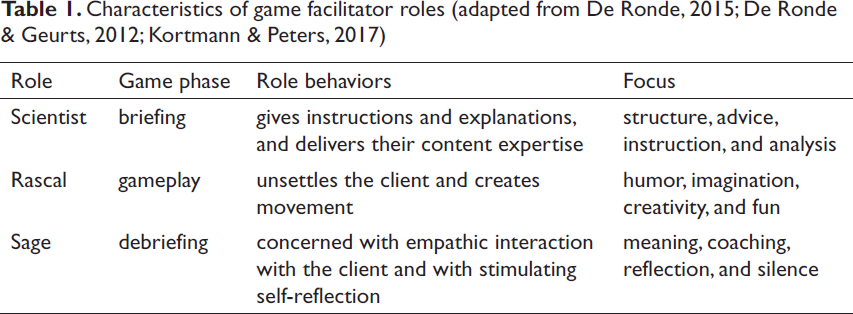
Initially, there seems to be a logical match of a role to a phase, which follows from the original empirical research of the authors and the interpretation thereof in relation to these phases (De Ronde, 2015; De Ronde & Geurts, 2012; Kortmann & Peters, 2017). Table 1 contains an ideal type set-up. Each role brings with it typical role behaviors and foci that can be regarded as the accentuation of what are the main behaviors necessary and foci to observe during that phase. They serve as the most important, but not necessarily the only point of view that the facilitator is expected to heed. If there is a single facilitator for a game this means that they should be able to fulfill the multiple roles across the stages, with the behaviors and foci. In that sense, every single facilitator should be ‘multiple’, referring to the ability to shift roles from phase to phase of the game. If they are not able to do that, then it makes sense to have an additional facilitator on site. During the game, facilitators can take different roles. However, our experience is that this is not always possible in educational settings (due to planning issues) or professional settings (due to resource issues). Moreover, the ideal-type set-up found in Table 1 does not eradicate other roles from being present or even becoming more important than the role you would expect. These role shifts during a phase in the game are a consequence of necessary adaptation. With a role shift, we refer to the change of behaviors and/or the focus of the facilitator into aspects that is typical for other roles in Table 1 in order to enable the utilization of the designed game elements or to (re-)direct emergent game elements. The focus of this paper is on the exploration of these role shifts in the gameplay phase. In doing so, we try to capture the multiplicity of the facilitation role during gameplay to further our understanding of how facilitation contributes to the success of a game beyond the briefing and debriefing stage, as is already established in the literature. The remainder of this paper presents the methods (including the description of the game), the results and the discussion and conclusion.
The Game: MicroTech
In order to capture the role shift in the gameplay phase we observed the game runs of the MicroTech game. This game was facilitated by the authors from 2014 to 2019 in a course on strategic management at a medium-sized university in the Netherlands. The participants in the MicroTech game have theoretical knowledge because they participate in the course and have limited analogous knowledge because they followed other courses in which experiential exercises are undertaken. By the time they participate in the game, they typically had followed five to six lectures from the course that focus on strategic decision-making. We held 30 game runs with this game and facilitated the game as a duo initially, later as individual facilitators. There were other instructors running game sessions. Each game run consisted of 20-26 students, with a total of 694 students that played the game. Students were allocated to teams and each game run consisted of five teams with 4-6 students per team. Each game run lasted between 6-8 hours and the total amount of game time was about 210 hours. The students who participated in the game were asked to play in two sessions (3-4 hours per session) and write a reflection report about the game. The reports were graded by the facilitators and were scored on average with a 6.9 (range: 5 – 8.3) on a scale of 1 to 10. The variety in grades shows that students learn in different ways from the game, yet they scored sufficient on average. We draw upon our observations in class, as the alignment between facilitators within and across game runs ensured sharing successful and failed activation of designed and emergent game elements. We noted the remarkable events, occurrences, expected and unexpected reactions in the game. Before we go to the observations, we describe the MicroTech game, a game inspired by the MicroTech negotiation exercise found in Carpenter’s Strategy Toolbox (Coff, 2014) and extended to the game you read about in the next paragraphs. This toolbox is a teaching tool website and is a repository for materials to help teach strategic management courses for all audiences. We adapted and extended the exercise into a policy game for the specific learning goals of the course. The didactical aim of the game is to submerge students in a decentralized strategic decision-making process in which the interests, information and power are dispersed differentially across the different units in the organization. This allows for the experience of procedural rational, intuitive and political perspectives on decision-making in context. These perspectives are key to understanding complex problem situations that require strategic decisions (Bettis, 2017; Elbanna et al., 2020; Van den Oever & Martin, 2019).
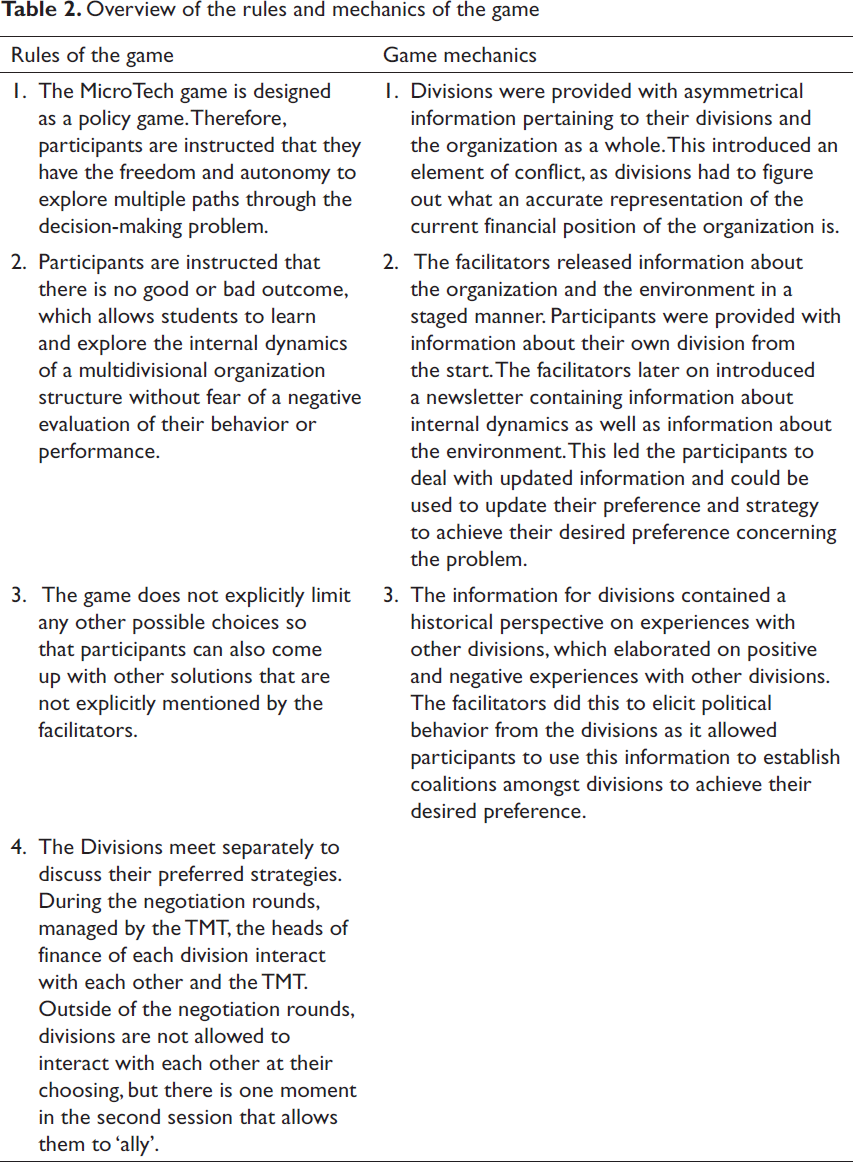
The MicroTech Game is a free-form policy game in which participants play the role of top management team or division managers in a multiunit organization. Participants in the game discuss and negotiate within and across four divisions under the supervision of the top management team. Given the considerable autonomy on what the managers in the divisions and top management team decide and how they go about pursuing their local decision and how they personalize their role, the MicroTech game allows for much variation in behaviors and focus points. Tying back to the facilitation of such a game it proved to be important to be alert to ensure that students were experiencing the strategic decision-making process, both in terms of what the design entails as well as the accommodation of the behaviors by the participants that were not expected. To ensure some guidance and elicitation of the theoretical mechanisms of strategic decision-making, we used a number of ground rules and explicitly designed game mechanics. We describe the rules of the game and the game mechanics in Table 2.
Overview of the rules and mechanics of the game
General Description of MicroTech and Game Dilemma
The dilemma facing MicroTech as a firm is as follows: One division (Household Appliances) developed Shadow RAM (a technological innovation) which has value if it is sold outside the firm, but the corporate charter forbids them from selling externally. Another division (Chips & Components) is the only division allowed to sell externally according to the charter. Therefore, the innovation should be transferred to Chips & Components if the corporate charter is not revised. A third division (Cloud Computing) is on the brink of developing an innovation in remotely reprogramming the ROM chip of appliances. However, Cloud Computing cannot sell this potential innovation externally due to the corporate charter. The decision revolves around the idea of sticking with internal transfer pricing (keep the charter as is) or to move to free selling (each division can sell to external parties on their own). Figure 1 provides the room set-up and the flows in the game.
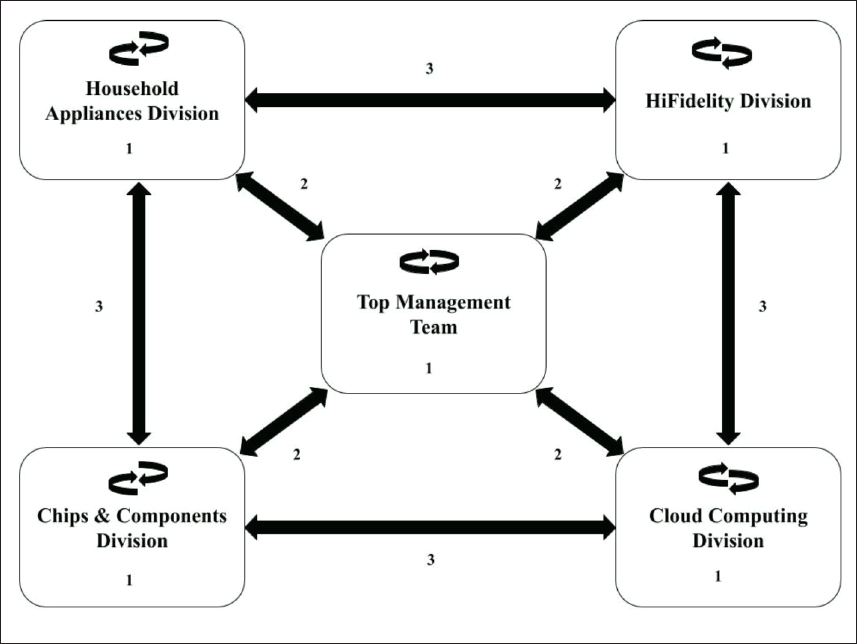
Legend: ‘1’ refers to interaction between participants within a division or the TMT; ‘2’ refers to interaction between division and TMT through delegates; ‘3’ refers to interaction between divisions other than through the TMT.
Running the MicroTech Game
The game is played in one physical room in which the divisions and the TMT are present, and consists of two sessions. There are two tasks that the divisions need to complete in the first session. First, there is an information exploration task to arrive at a local decision whether to support the current charter or propose a modification. Second, a representative of each division meets with the TMT simultaneously to negotiate their preferred decision and explore the other divisions’ preferences. At the end of the first, a decision on the charter is taken, minted by the TMT. After task completion the debriefing of the session starts. The session lasts a maximum of 3.5 hours. The second session is played one week later.
The second session starts with the reversal of the final decision by the TMT from the first session. The TMT takes a dominant position and reverses the decision. The session contains two main tasks for the divisions, while the divisional representatives aim to get a foothold with the TMT to safeguard their interests. The tasks revolve around preparing for the implementation of the decision from the management by drawing up a plan to guide the implementation process and around preparing the organization for the implementation by evaluating and redesigning the current organization structure. On top of that, there is the danger of ‘spin-out’, there are employees considering starting their own organization and commit a trust-breach. The divisions need to solve this. After these tasks and the emotional boiling point of the ‘betrayal’ are reached, the debrief part of the session starts. The session lasts a maximum of 3.5 hours.
Analysis of Experiences as Facilitators
Given that MicroTech is a free-form policy game, each game run is unique to some extent due to the composition of the group and the interaction between participants. We therefore decided to evaluate each game run through a process of shared sensemaking. As we ran the first game runs as a duo, we were able to develop a shared understanding of events during the game, which we used to improve the facilitation of the game and to improve our own game at facilitating. We always convened immediately after game runs that were facilitated by only one of us to share experiences to further develop a shared understanding of the game experiences.
We analyzed the role shifts we experienced as facilitators during a game run by elaborating on game events and how we/one of us could manage those events differently in future game runs if necessary, i.e., through a form of dialectic inquiry (Berniker & McNabb, 2006). After each run, we discussed how the game unfolded through the various planned events as well as the unique events for each game run. We used this structure (planned and unique events) to capture new experiences on role shifts while we also tried to search for recurring patterns. Subsequently, based on this initial capture, one facilitator would argue for coining the capture as a new or previously experienced deliberate role shift. The other facilitator would then put forward arguments and explanations why this deliberate role shift, as experienced by the first facilitator was not a role shift. The ensuing discussion between the facilitators was aimed at arriving at an agreement on whether or not this was a deliberate role shift that could be put in our arsenal for the subsequent game runs, or simply a random variation that bore no further meaning to achieve the learning goals (cf. Berniker & McNabb, 2006; Schweiger et al., 1989). The experiences we describe in the results section are the outcomes of the conversations and represent our shared understanding of the events that have unfolded.
Results
The role shifts that we elicited through this procedure are captured in Table 3. They are organized across the rows to indicate which ways are available to influence the course of the gameplay by bringing attention to something. We distinguish between planned and expected (‘designed’) influences and for those that are not planned and unexpected (‘emergent’). The description of the episode during the game that spurred the action by the facilitator is briefly described, and the active substance that prompted us to shift roles, i.e. what was necessary to help the participants keep on working towards the learning goals, is noted following that. The active substance key terms have been reported in italics and follow from the ideal types in Table 1. The one but final column depicts the role shift under the labels of the roles from Table 1. The final column indicates the occurrence of certain shifts, i.e. the approximate frequency of the shift in role behaviors for each designed and emergent role shift.
Overview of facilitator insertions during gameplay phase (based on and adapted from Stoppelenburg et al., 2012)
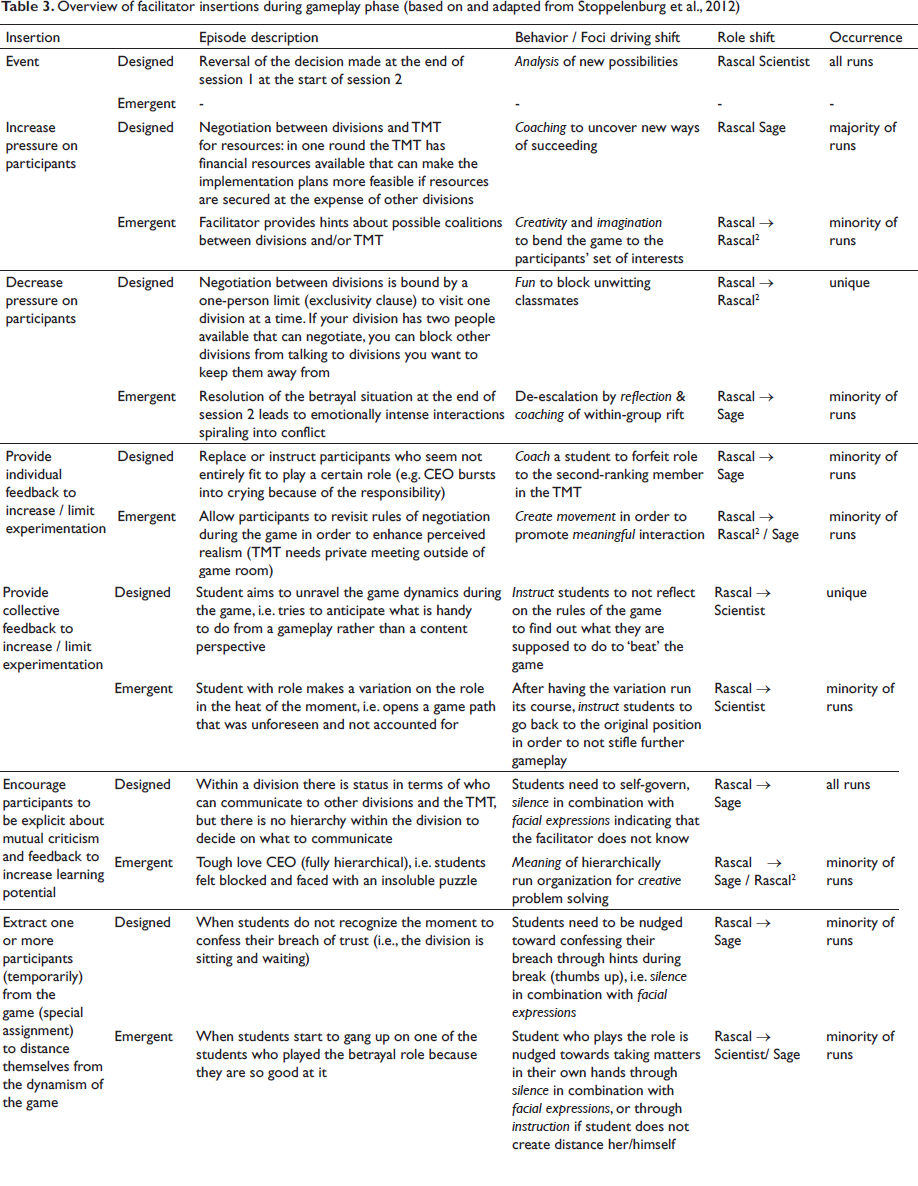
The results show that role shifts occur between ideal types in the gameplay phase and that most role shifts are far from one-off occurrences. Starting in the gameplay phase as a rascal, the facilitator’s role shifts to both other ideal types of the briefing (scientist) and debriefing (sage) stages. In some cases, the episode prompts a within role shift, i.e. becoming more intense within the rascal role which was indicated by rascal2 (rascal squared). We opted to indicate such role shifts from rascal to rascal2 when the situation captured required a further intensification of aspects that typically belonged to the rascal type and bordered on extreme ‘overdrive’. Lastly, some shifts embodied elements from more than one ideal type. For one insertion, we did not have an episode that embodied that, namely the emergent ‘event’ insertion. This is logical, as despite the openness of a free-form policy game, one cannot insert a major event on the spot and (re-)direct the entire gameplay. The results show that the role behaviors of the rascal are not sufficient in the case of participants that only bring theoretical and analogous knowledge to facilitate the gameplay phase. Providing instructions and stimulating self-reflection at times, or even challenging participants to become more creative, appeared to be necessary to keep the game going and to create learning opportunities.
The relatively low number of times a shift to the scientist role occurred (compared to the sage role) may come as a surprise, given that the MicroTech game was played with students. (Re-)Instructing them and structuring their actions to move them towards the learning goals of the game seems a logical step. Students are typically not in the possession of extensive work-related and real-world professional experience, and compared to professionals do not have such a wide repertoire of responses available during their interactions with other participants. Although this may be different if the game would have been played with organizational professionals (e.g., they may be too stubborn), we opted to work with insertions that would not create the impression that we were pulling the hierarchy or dependence card that course instructors as facilitators have. We aimed to promote a sense of safety to experiment and playfulness rather than to stimulate mimicking exact behaviors by instruction, and the rascal and sage roles embody more the interactive exchange and intra-personal processing of nudges, cues and information that enable participants to adjust their behavior of their own free will.
However, as Table 3 contains a selection of designed and emergent insertions that require role shifts, these changes of role behaviors during the gameplay phase should not be taken as ‘if…then’ type of shifts to make learning magically appear. The chain of events in the specific game run, the behavior of the participants, and the perceptiveness of the facilitator feed the potential to increase the learning possibilities for participants. This is why not all insertions occur across all game runs; some are unique one-off occurrences, whereas others occur more often, either in the minority or majority of game runs. This distribution in itself may change when facilitators gain more experience through more game runs. However, it also points to a very important consequence of running games multiple times: they help the facilitator not only build up experience in facilitating itself, but the facilitator builds up a repertoire of intervention possibilities for a specific game. Hence, repetition may enhance the learning potential for participants that bring in theoretical and analogous knowledge because of the familiarity with the game. In short, repeatedly facilitating a game may uncover a range of insertions (planned or spontaneously). Most role shifts will occur over time, which allows the facilitator to create a repertoire of experiences and interventions into a toolbox. This toolbox can then be used when the dynamics in the game seem to fall flat or, when necessary, allow the facilitator to provoke the motivation of participants. What such a toolbox may look like requires systematic research into this phenomenon and cannot be created based on experiences alone. Based on the current results, the advice is to fill your toolbox with skills to fulfill the different roles and sensitize yourself to identifying signals that may indicate a role shift is necessary during the gameplay phase and other phases. If the required multiplicity cannot be fulfilled by one person, either through limited competence or the comprehensiveness of the game, a solution can be to add more facilitators.
These results are a consequence of our selection of episodes and coding, or perhaps even our facilitation styles. They illustrate that the role shifts as a reaction to designed or emergent insertions play into role behaviors and those foci typically associated with roles from the other phases than the gameplay phase. These behaviors and foci were expected to be dominant in the brief and debrief phases rather than in the gameplay phase. Consequently, during gameplay, it is not only the role of the rascal or its more intense variant rascal2, but also scientist and sage aspects play a role. This points to the need for facilitators to be able to embody multiple roles. This means that next to being able to embody roles to be in fit with the different phases as seen in Table 1, facilitators also need to be able to shift within phases in order to maintain movement with participants and stimulate them to work towards the learning goals.
Conclusion and Discussion
The aim of this paper was to explore which role shifts facilitators undergo during the gameplay phase and what they looked like. Facilitators in the gameplay phase, departing from the role of the rascal, most often resorted to the role of the sage with its focus on meaning, coaching, reflection and empathic interaction. The behaviors associated with the scientist role seem to be less favored to draw from as a toolbox in order to encourage playfulness and to prevent provoking the traditional instructor-student dynamic. As one of the key aspects of gaming is having fun next to learning, our style may have emphasized this more than we would have in a professional setting.
There are two important implications of this study. First, this study shows that role shifts as a toolbox to engage and encourage participants in gaming should not necessarily be limited to between-game phase shifts from briefing to gameplay, to debriefing. This study shows the potential of a more fine-grained approach to mix the role behaviors of the ideal types to help participants learn during the game. The use of insertions by facilitators when necessary based on the designed and emerging elements serves the learning goals for participants and the goals of the game. The game then functions really as the transfer context through which participants, who bring theoretical and analogous knowledge, learn (Schwägele, 2014). In this sense, facilitator styles and profiles should not work from a simple matching perspective as exhibited by the between-game phase shifts, but as a configurational logic in which elements from the three roles combine. Although this study captures shifts during the gameplay phase, the other phases of briefing and debriefing may require elements from the other phases in order to promote preparation and going into, leaving behind and learning from the game.
Second, our analysis provides insight in how facilitators can consider policy games and their education program versions in relation to one another. The terra incognita for participants in a policy game oftentimes refers to aspects of the problem that is the subject of the game and how these expert participants active in that policy field should engage or could engage with it in the future. The terra incognita for participants that are not experts in a certain subject or policy field (who at best have theoretical and analogous knowledge) learn about the problem subject itself and the field itself (Duke & Geurts, 2004; Mayer, 2009). Whereas the latter group lacks a deep understanding of the specific aspects, the former may be too invested in these specific aspects. Hence, playing a game with experts may only lead to confirm à priori favored solutions and problem analyses. As a facilitator, presumably not an expert in the policy field, breaking the mold of standard thinking may not be easy. Although gaming is designed to create a multilogue, a discussion between many actors unfolding simultaneously (Duke, 2014; Geurts et al., 2007; Mayer, 2009) may not do the job of ending up with original and creative solutions. Therefore, playing with participants that are not the policy experts may feed a repertoire of insertions and adaptive role behaviors that are appropriate for the problem that is the subject of the game. Having played with other participants than the experts may improve the exploration of terra incognita under the guidance of such a facilitator.
Limitations
Our study provides multiple insights into the importance of role shift in policy games. Future research might address several limitations of our research design. First, while there are advantages to the authors facilitating the game as well as analyzing their experiences, it might introduce the potential for bias. We have tried to limit potential biases by constantly calibrating our observations and experiences after game runs. The game was also facilitated by other instructors throughout the years who have participated in the analysis of recurring and unique events during gameplay, which allowed us to calibrate our experiences through the perspectives of outsiders. Future research can make use of technology to track, record, and follow in real-time the behaviors and foci of facilitators during the gameplay phase for more systematic coding.
Second, the analysis in our study is based on a single game that was run at a medium-sized university in the Netherlands. Future research can extend our findings by applying the role shift framework in other games and contexts, which will lead to a more generalizable applicability of the role shift framework.
Third, the game was conducted with participants that are mostly informed through theoretical knowledge, as students played the game. The game was designed for them to gain analogous knowledge by mimicking approximate experiences in real organizations. In that sense, the role shifts identified through the runs cannot directly be transferred to all policy games. Future research should address game facilitation and role shifts for participants with substantial amounts of analogous and experience-based knowledge. This will lead to a more detailed insight in the configurational logic in which elements of the three roles combine in the gameplay phase to help achieve game success.
In conclusion, facilitators should explore what multiplicity is required of them to make the game a success as far as that can be established upfront. Although this may seem normal practice to well-prepared and professionally trained facilitators, this may be particularly important for novice facilitators to take on board. This paper shows that at least it is worthwhile considering the role behaviors as a toolbox for the brief-play-debrief phases more than a required set of behaviors in one phase.
Footnotes
Declaration of Conflicting Interests
Funding
The author(s) received no financial support for the research, authorship, and/or publication of this article.

Author Biographies
Contact:
Contact: