




Abstract
Introduction
Sustainable development and sustainability transformations have reached high urgency on national and international agendas and involve new knowledge and learning processes.
Intervention
We introduce the THEORY OF CHANGE GAME, which applies theory of change thinking to transdisciplinary projects aiming for sustainable development. A combination of
Method
We explain the iterative development rounds of the game through several game sessions in different settings and analyse whether and how the game supports
Results
The iterative development rounds took place first in academic settings and then in a non-academic event. Our observations during the game and the debriefing rounds after the game demonstrate that social learning takes place in the form of cognitive and relational learning. Verified findings on normative learning would need other assessment approaches.
Discussion and conclusion
Several development rounds supported the design of a game that is suitable to support
Keywords
Introduction and Background
Sustainable development (SD) and sustainability transformations are high on national and international political agendas (GSDR, 2019). Intergovernmental science–policy platforms stress the urgency to act and start transformative change on multiple levels to prevent catastrophic global change (IPBES, 2019; IPCC, 2018). However, planning and implementing sustainability transformations involve not only new scientific knowledge but also social learning among individuals and societies. Transdisciplinary co-production of knowledge as a research approach in combination with the methodological elaboration of theories of change have potential to support transformative learning processes. These approaches are both highly suitable for application in gaming, although this has to date rarely been done.
ToC are useful instruments because they help researchers and practitioners to thoroughly reflect on their own assumptions and understandings. ToC are especially suitable for planning research projects within specific problem fields, because they explicitly link research goals and the applied methods to expected outcomes and map envisioned pathways to impact (Belcher et al., 2019; Claus & Belcher, 2020; Ibrahim et al., 2017; Schneider et al., 2019). An important part of a ToC is the context of a research project with its underlying epistemological, normative, and cultural assumptions (Oberlack et al., 2019). Reflecting on their own ToC can be useful for organizations or research projects as a whole, to jointly learn about planning, monitoring, and evaluating developments and outcomes of their activities. Accordingly, ToC have been used regularly in development and implementation projects as planning and evaluation tools (e.g., Stewart, 2015; Valters, 2014) or as analytical frameworks for evaluating other research projects (Belcher et al., 2019).
The transformative potential of ToC is illustrated in various ways. Schneider et al. (2019) apply a mixed-methods, “informed and self-reflective transdisciplinary approach” for working out ToC in different research projects. In essence, they distinguish between three mechanisms for generating impact: knowledge promotion for informed and equitable decision-making, social learning for collective action, and enhancing competences for reflective leadership. Biggs et al. (2017) establish a community-based ToC to jointly combat illegal wildlife trade with several involved actors, using social learning processes to support desirable – and punish undesirable – behaviour. The ToC framework by Ibrahim et al. (2017) is based on social learning among city actors for planning smart and sustainable cities.
For quite some time TD has been seen as an effective way to address sustainability challenges because it systematically involves societal actors in the knowledge production process. Important factors for achieving societal impact include the motivation of societal actors as well as conducive institutional factors and political contexts (Hansson & Polk, 2018; Lux et al., 2019), as well as close interactions between scientific actors and their target groups (Hoffmann et al., 2019). Missed project targets however point to an inadequate understanding of the feasibility of certain approaches (Musch & von Streit, 2020). These results suggest the need for detailed reflection on how planned activities affect the involved actors in a given context; how this context might shape a process; how impact pathways might unfold; as well as the role of power, agency, and enabling conditions for research projects.
TD approaches in gaming are rare; one example is Agusdinata & Lukosch (2019), who used TD to design a role play game with societal actors. But the use of serious games for a professional audience is growing (Clapper, 2018), and the added value of serious games for social learning is being increasingly explored (Den Haan & Van der Voort, 2018). Such games include topics that rank high on sustainability agendas (Ahamer, 2006; Den Haan & Van der Voort, 2018; Katsaliaki & Mustafee, 2014; Taillandier & Adam, 2018; Torres & Macedo, 2000). While the majority of games are simulation-based (Katsaliaki & Mustafee, 2014), others rely on analogue approaches based on collaborative discussions (Ahamer, 2006; Torres & Macedo, 2000).
In this article, we present the design of a serious game that brings ToC thinking into TD research projects that promote SD. Players of the game are encouraged to reflect on their own approaches and assumptions. We also ask how the game can support social learning for SD, which we assess by drawing on a typology by Baird et al. (2014). They distinguish between three types of indicators for measuring learning effects: cognitive learning (acquiring new knowledge), normative learning (changes in norms, values, paradigms), and relational learning (better understanding others and building relationships).
The remainder of the article explains the methodology used in designing the game and assessing social learning; it presents the results, including the game itself and its learning outcomes; and it discusses the testing experiences and participants’ reactions.
Method of Game Development and Analysis
The game was developed through an iterative process of conceptualization, formalization, and verification through empirical testing. Insights from existing ToC research (James, 2011; Schuetz et al., 2014; Taplin & Rasic, 2012) provided our conceptual starting point. For defining the main fields of the board we referred to Claus & Belcher (2020) and for determining what questions to ask we drew on Schneider et al. (2019). Several rounds of discussions among the author team led to the first prototype of the game.
The prototype was tested, adapted, and refined in several test sessions. We started with a small group of interested people from various career levels at the interdisciplinary Centre for Development and Environment (CDE) at the University of Bern, Switzerland. The mixed group included ToC experts and people generally interested in games. The first test session led to major adaptations in the game.
Next, we played the game in workshops of several scientific conferences and in one event with societal actors. The conferences included the International Transdisciplinary Conference (ITD) 2019 in Gothenburg, Sweden; the Transformations Conference 2019 in Santiago de Chile; and the Earth System Governance Conference (ESG) 2019 in Oaxaca, Mexico. Although most participants were scientists, a few societal actors participated in the Transformations conference.
In early 2020, we organized a game workshop at the University of Bern, Switzerland, with societal actors, co-hosted with the Sustainable Development Solutions Network Switzerland (SDSN) and the Swiss Academy of Sciences (SCNAT). A total of 25 participants from 12 sustainability-oriented networks in Switzerland took part. The number of players across all test sessions totalled around 90 people.
We did not intervene much during the games, because we wanted to observe the developing dynamics. We asked each group to document their main discussion points while playing. To assess social learning, we observed relational learning by circulating among the groups during the games. To explore cognitive learning, we held debriefing rounds in plenary after each game session, where we asked the groups 1) what they liked/did not like about the game; 2) what was useful for their own work; 3) what they would change to improve it. We did not focus on normative learning. Debriefing rounds with self-reflective questions and observations during a game are among the most commonly used methods to assess social learning outcomes in serious games (Den Haan & Van der Voort, 2018).
Results
The first part of the results section presents the game itself as the outcome of the iterative process of test sessions. The second part assesses the social learning outcomes of the test sessions.
The Theory of Change Game
The THEORY OF CHANGE GAME aims to improve practices in TD projects that promote SD in a step-by-step process that prompts ToC thinking and encourages collaborative discussions. The game can either be used to design a particular ToC for planning a new (real or hypothetical) project, or for evaluating an existing project. Alternatively, game facilitators can provide the players with predefined starting scenarios, which might be the preferred choice in education for SD.
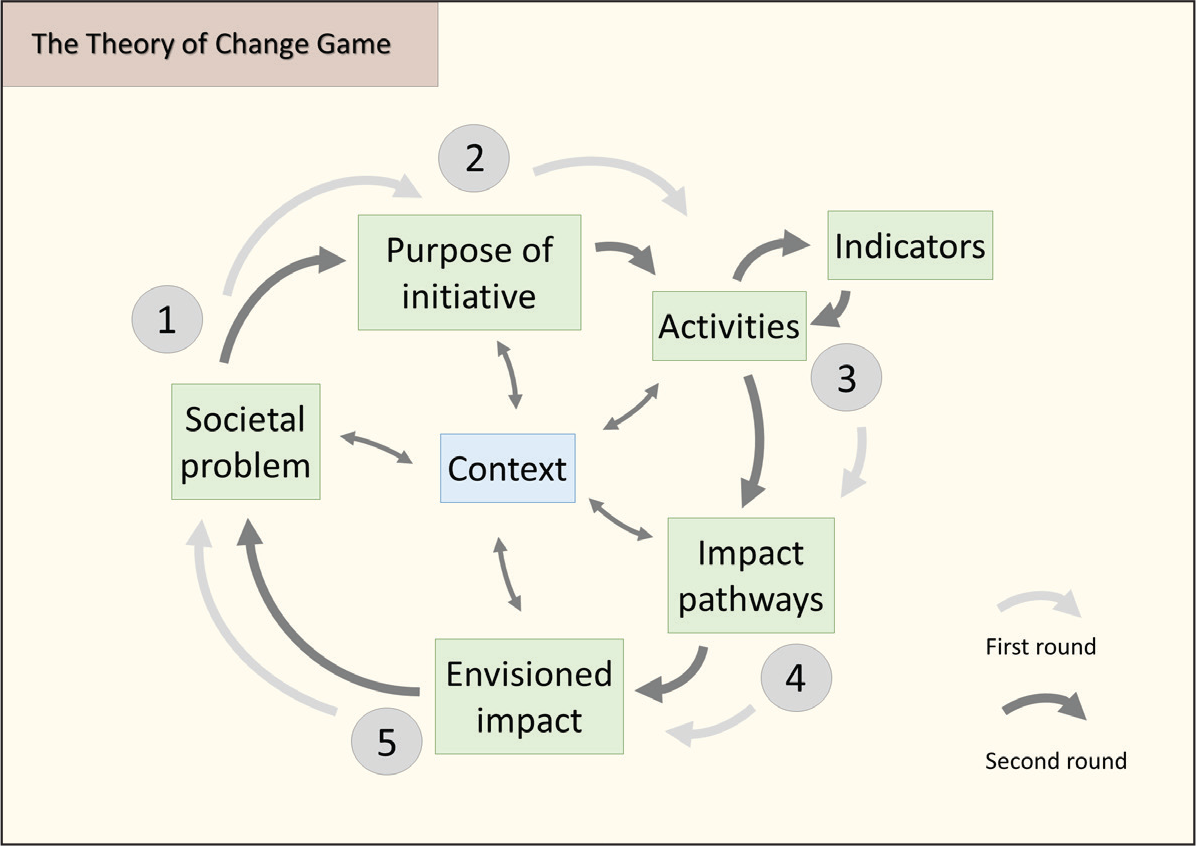
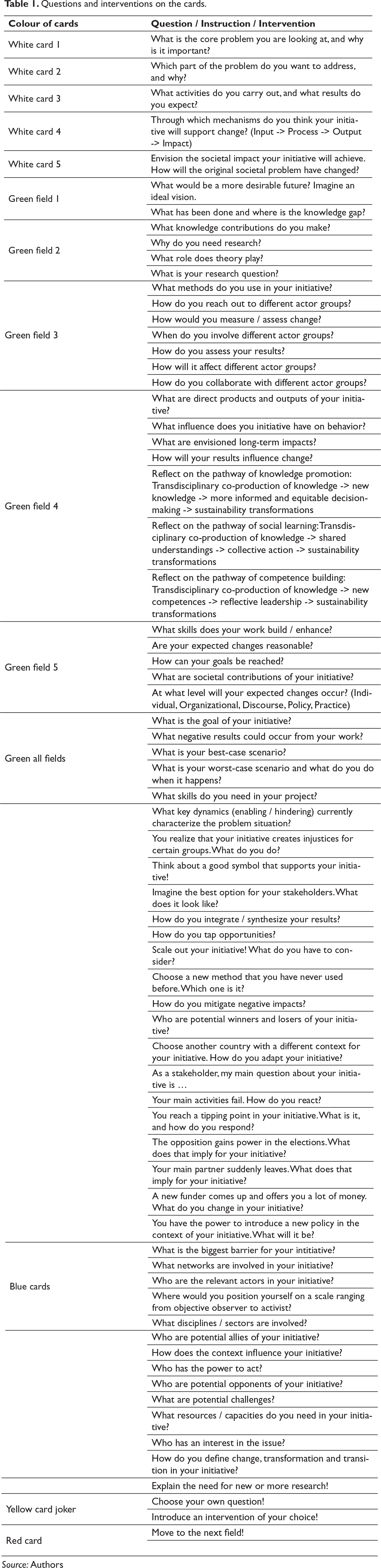
The game, for ideally 5-6 players, is a combination of board and card game. The board displays the model of a ToC with all its parts (Figure 1). Each field on the board is linked to a specific set of questions. In addition, different-coloured cards guide the players through the game with questions and instructions.
Source: Authors
The game has two rounds. The first round starts with introductory questions for each field on the board, which must be answered in 5 minutes each. At this stage, the discussion is still superficial and many questions will remain open, but this first round introduces the players to the topic and reveals the big questions. After the first round, the players will know which topics are covered sufficiently and where they need to dig deeper and be more specific about their assumptions. In the second round, each field is discussed in more detail using the probing question cards until one of the players decides the field is exhausted. This second round gives the opportunity to address open questions from the first round, shape the planning process, or evaluate an existing project.
The colours of the cards stand for different purposes. White cards are used only in the first round. They pose the main question for each field and are placed on the board. Coloured cards – green, blue, yellow, red – are used in the second round of the game as follows.
Questions and interventions on the cards.
Source: Authors
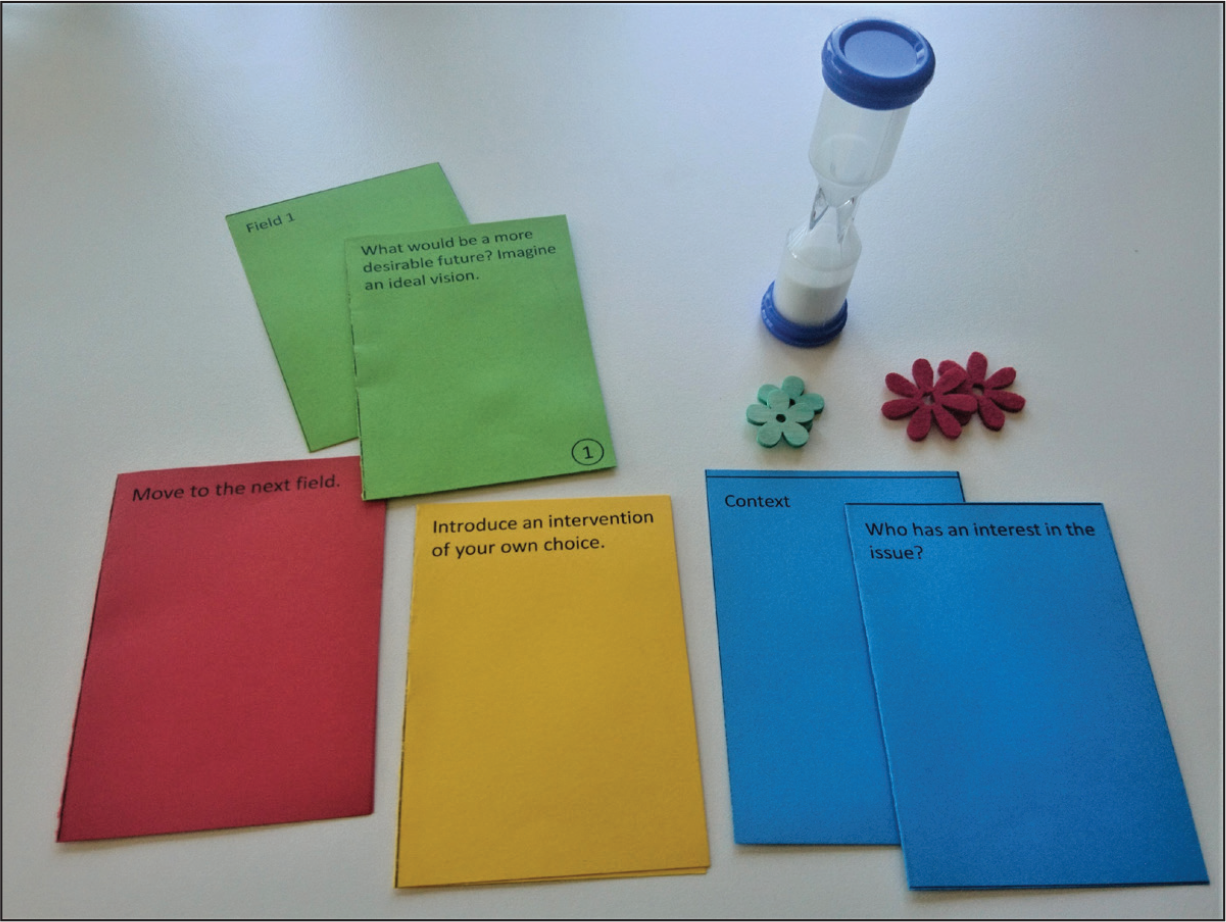
In addition to the coloured cards, each player receives five tokens. To move to the next field, a player must place a token on the board. A token can be placed when a player asks a question, sets an intervention, or contributes to the discussion. A two-minute hourglass is placed on the board to restrict talking time of each player to two minutes at a time and thus allows every player some space in the game. Figure 2 shows the different components of the game.
Source: Authors
Before starting the game, the players need a 15-minute introduction on ToC and how to play the game. The first round of the game takes 30 minutes while the second round takes around 1.5–2 hours or longer, if the players develop a ToC for a real project. Depending on the group of people and the purpose of playing, players might want to add a debriefing round after a game. They should therefore reserve at least 2.5–3 hours to complete an entire game cycle.
Assessment of Social Learning
The group of 7 people at CDE, University of Bern, discussed a ToC for a platform implementing SDGs in Switzerland. Due to the still rather unstructured discussion at this early stage of game development, the group did not manage to elaborate an entire ToC. It also took them much time to explain the activities of the platform, which was unknown to the majority of the group. However, they reported having learned a lot about ToC as a tool to support planning activities that actually link to the stated goals. Participants understood ToC thinking better and appreciated its potential as a project tool. Hence, cognitive learning in this first session occurred mainly around the concept itself. Relational learning occurred when participants realized that some were more dominant in the discussion and others could not actively participate. This made it clear to the author team that restrictions on talking time were necessary.
Many of the around 25 participants at the aforementioned ITD conference in Gothenburg are experienced TD researchers who have worked with societal actors for many years. Their discussed ToC covered various issues such as securing equitable urban water supply, addressing power imbalances, improving rural livelihoods, and promoting more sustainable mobility in urban areas and long-distance travel. While one group effectively made it through all parts of the ToC, the others ran out of time before that point. Participants reported that the game helped spark creative moments that gave rise to new ideas and helped them to find weak spots in their research questions and pathways to impact. These are clear indications for cognitive learning. The game board with space for notetaking distributed to the participants was appreciated because it helped the players to structure the discussion and keep track of the important points. They highlighted thorough reflections about how to include affected people in their ToC as an outcome of the game, which points to relational learning. Also appreciated were the concepts of “red cards” and time-keeping. Aspects that were criticized were a structure that was “too open” and a lack of the feeling of “winning” or “losing”.
The groups of around 15 people at the Transformations conference in Santiago discussed the contributions of microfinance to biodiversity conservation and how water security for small island communities can be improved through water storage. At the third conference, the ESG groups of around 18 people in Oaxaca tackled the issue of illegal waste dumps in wetlands of Mexico City and asked how scientific communication to societal actors could be improved. Some of the participants at the conferences had much experience in TD projects and were thus familiar with such questions, but some were new to this field and needed more reflection. At both conferences, the participants made it through a full cycle of the game.
The overall feedback from all three conferences was that questions were helpful to develop ToC and to reflect on one’s own assumptions and activities. This supports our assumption of the game’s cognitive learning potential. Especially participants with little TD experience said they had learnt a lot about the importance of involving societal actors in SD-related research questions and what to consider in this regard. Several participants asked whether they could use the questions in their student courses. Based on our observations, we felt however that shy players were still not equally engaged in the game.
After these academic conferences, we wanted to test the game with a mixed group of scientific and societal actors to see whether the questions also appealed to non-academic participants. We therefore appreciated the opportunity to co-host the aforementioned workshop in Bern with SDSN and SCNAT. Two of the three groups of around 25 people had fruitful and entertaining discussions on the following set topics: “What would networks need to better fulfil their functions?” and “What innovations (social and institutional) would help to make networks more effective?” The third group had more difficulties with the set task: “How can networks collaborate?” The problem with these set topics was partly that they did not refer to specific sustainability problems, which is the core idea of the game, but to a meta-level of network activities. Although all of these networks pursue a sustainability agenda and deal with sustainability problems regularly, not all of them were able to relate those agendas to the game questions. In the future, we need to think carefully about what predefined questions are useful for playing the game and which are not.
Cognitive and relational learning could be observed for the two groups that reported fruitful discussions. They gave positive feedback of having enjoyed the game and having discussed points that they considered important. The third group expressed difficulties with developing the ToC for their topic and seemed dissatisfied with the experience.
The test sessions helped us identify structural aspects in need of improvement and questions in need of adjustment. An effective game structure for ToC development needs to be clear enough to guide the participants but leave room for surprise and unexpected questions to spark reflection. The introductory question is crucial for setting in motion a creative and entertaining experience. Groups with a ToC topic that was clear and appealing to the participants reported moments of cognitive and relational learning. The few groups with difficult starts found the experience more tedious.
Two starting points are possible for the game: 1) the players decide what they want to discuss; 2) the players are given a topic by the organizers. The first option is useful for conference settings, for participants who want to evaluate their project’s ToC, or for participants who want to start a new project together. The second option can also be used in student courses where students should achieve a specific learning outcome or in groups that should work towards pre-defined goals.
Discussion and Conclusion
Through the different test sessions, we achieved our objective of designing a game that applies ToC thinking in TD research projects for SD. The test sessions offered a space for joining knowledge from different epistemological communities, which is deemed important for supporting SD (Lamine et al., 2019; Miller & Wyborn, 2018). In terms of learning for SD, we see different degrees of the three types of social learning (Baird et al., 2014), based on our observations during the game and on the participants’ feedback. First, cognitive learning took place when participants learned about ToC thinking and how it can help them to advance their own projects and ideas and allow them to find weak spots in their research questions. Furthermore, discussing the ToC allowed them to learn about other people's projects. Second, relational learning took place in discussions around how to include societal actors in their projects. This links to the importance of social interactions through conversation, mentioned by Katsaliaki & Mustafee (2014) for solving SD problems in simulations. Third, normative learning is more difficult to distil, but deep reflection on one’s own assumptions about contexts and how project activities link to goals and participants has the potential to challenge one’s own views and perceptions. To confirm this hypothesis, research would need to specifically address this question and set up an appropriate research design.
Overall, through its questions and interventions the game addresses important topics raised by previous research, namely the importance of considering institutional factors and political contexts (Hansson & Polk, 2018); close interactions between scientists and target groups (Hoffmann et al., 2019); or more realistic perceptions of conceptual ideas and their feasibility (Musch & von Streit, 2020). Some participants highlighted that repetitive playing of the game at several stages of a project would be useful for designing, monitoring, and evaluation purposes. This feedback is in line with previous research on the benefits of ToC approaches (Belcher et al., 2019; Oberlack et al., 2019; Schneider et al., 2019) and confirms the importance of debriefing sessions for consolidating learning experiences (Katsaliaki & Mustafee, 2014; Torres & Macedo, 2000).
Based on the different test sessions, we conclude that the game can be useful for educational purposes due to its learning potential about how to design SD projects. While we have not yet been able to run test sessions with students, several participants expressed an interest in playing the game with their students. The THEORY OF CHANGE GAME could help them to ask important questions for projects that support sustainability initiatives and nudge them to reflect on their own assumptions and approaches.
Although the game is based on collaborative discussions, it could benefit from more reflection on gamification elements. Such elements are likely to enhance the learning experience of participants as they add a motivational component to the game, e.g. through rewards for desirable behaviour such as good cooperation (Torres & Macedo, 2000). The cooperation component is at the core of the THEORY OF CHANGE GAME, as an effective ToC can only be developed if participants pull together.
Footnotes
Acknowledgment
We thank Tina Hirschbühl for her thorough editing work in this article and four anonymous reviewers for their helpful comments and suggestions.
Declaration of Conflicting Interests
Funding
The author(s) disclosed receipt of the following financial support for the research, authorship, and/or publication of this article: This research and the publication of it was funded by the Mercator Foundation Switzerland.

Supplemental material
Author Biographies
Contact:
Contact: