




Abstract
Background.
Simulation gaming sessions can be understood as a sequence of briefing, game play, and
Method & Results.
We analysed existing
Conclusions.
We provide a holistic understanding of
Background
Problem Description
When looking into the literature on the use and facilitation of simulation games, one inevitably comes across the topic of debriefing and the discussion on its relevance. The conduction of a debriefing is according to Taylor et al. (2012) one task of an instructor or game master. Debriefing is often understood as a separate phase within a simulation gaming session, particularly when games are used for learning and training. Following Bekebrede (2010) and Toyoda (2020), a gaming session consists of 1) a briefing, 2) game play, and 3) a debriefing - with some possible feedback loops and iterative steps in between. In addition to this, a debriefing can be described as a micro-macro-cycle model (Kern, 2003) in which a simulation game is understood as one intervention next to other possibilities. In the case of a simulation game, the learning cycle is not one-directional, processing from game to debriefing, with the main learning happening during debriefing. Kern’s model highlights that important actions happen already during the actual game play - participants reflect on events in the game, draw conclusions and try out new things. Kern calls this the micro-cycle of a simulation game, happening during game play. This micro-cycle is embedded in a macro-cycle of the overall event, including briefing and debriefing, and possible other activities that also foster the learning.
While it is difficult to find scientific literature on the facilitation of simulation gaming sessions, many authors have written about the meaning and role of a debriefing (e.g., Crookall, 2010; Grund & Schelkle, 2019; Hofstede et al., 2010; Kikkawa et al., 2019; Kriz, 2010; Lederman, 1992; Peters & Vissers, 2004; Stolp & Siemon, 2013; Van den Hoogen et al., 2016). It is described as “[…] crucial to maximise learning and to translate the lessons learnt to improve real […] performance, and thus to reduce […] error” (Runnacles et al., 2014, p. 1). Ravyse, Blignaut, Leendertz and Woolner (2017) highlighted the meaning of a debriefing by defining it as one of the success factors for simulation games to guarantee learning. Peters and Vissers (2004, p. 70) described debriefing as “[…] an important phase in using simulation games. Participants are invited to make a connection between experiences gained from playing the game and experiences in real-life situations. Thus, debriefing is the phase meant to encourage learning from the simulation game. Although design and practice of debriefing sessions should be aligned to this aim, it is necessary to distinguish different forms or modes of learning.” A debriefing in the sense of these scholars is understood as a reflection of what has happened and has been experienced during game play, as well as the decision to make corresponding changes or understand certain consequences. Debriefing in this meaning involves a follow-up discussion or an evaluation of the game experience after the game play. This is exactly the problem we want to address in our article, namely the lack of understanding of the role and process of facilitation, and the limited conceptualization of debriefing as a rather linear and final sequence of a simulation game session and its facilitation.
Objective and Structure
Related work approaches facilitation and especially debriefing as separate activities in comparison to game play. In most literature analysed debriefing is defined as the crucial phase where the real learning happens after game play. Contrary to this understanding, we aim to develop an integrated understanding of debriefing. This integrated understanding is needed to comprehend the ongoing inputs or impulses from the game play, and how these are connected to facilitation and debriefing. This will serve as a basis for the consolidation and further development of debriefing in practice as it will help in the facilitation of simulation games used for learning purposes. While the purpose of the simulation gaming method in general can vary greatly, the focus of this article is primarily on its use as a learning environment.
To clarify the role of debriefing as a vital activity of facilitation, we provide an overview of existing simulation gaming literature in terms of debriefing approaches, describe related concepts and discuss main elements of a debriefing. Based on our findings, we develop and explain the novel Impulse-Debriefing-Spiral. We conclude with a critical reflection on the new model, and with practical recommendations for game facilitators. In addition to this and in order to demonstrate the practical relevance of the Impulse-Debriefing-Spiral, two examples are explained in the appendix, structured by the main questions that relate to the Impulse-Debriefing-Spiral.
Debriefing in Literature & Practice
The aim of this chapter is to present the state of the art in terms of existing debriefing approaches as well as to identify gaps in related work (chapter 2.1) and to describe related concepts (chapter 2.2). To get a better understanding of relevant components of a debriefing, we analysed existing debriefing literature. We decided to concentrate our analysis on the Simulation & Gaming journal, as this is one of the gaming-related journals that guarantees a wide range of high-quality publications with no specific focus on an application domain, such as learning or education. The search for the term debriefing in this journal resulted in 631 articles 1 . For the further analysis, we focused on methodological articles with a clear description of (underlying) debriefing approaches (e.g., models, frameworks or theories, no specific case studies). We eliminated studies with only one application area, as well as articles without debriefing as the main focus. This resulted in 8 articles 2 that functioned as a basis for our analysis of existing debriefing approaches. The main ideas of those articles will be discussed in the following sub-chapter.
Existing Debriefing Approaches
From a theoretical perspective, debriefing can be described in terms of different phases ranging from the analysis of the game play experience to the connection with the real world. Debriefing comes “[…] after the completion of any experiential activity” (Thiagarajan, 1992, p. 161) and follows a step-wise approach (Kriz, 2010; Thiagarajan, 1992, 1993). Thiagarajan (1992) presented a seven-phase model for debriefing ranging from questions about feelings and experiences of the participants (1), events during game play (2), reality testing (3), to real-world relevance (4), strategies and learning (5), to insights (6) and finally a review of the experienced activity (7). Each of the phases is led by a special type of question. In 2010, Kriz postulated six different phases of a debriefing process. Again, this model starts with the feelings of the participants (1), discusses what has happened (2), and the connection between game and real world (3), the learning that took place (4), hypothetical scenarios (5), and finally the formulation of a concrete goal (6). Kriz proposed a set of questions and topics for each of the phases with the aim to let participants share their experiences, reflect on outcomes and discuss the meaning for the real world. Peters and Vissers (2004, p. 82) criticized that a debriefing very much depends on the purpose of the game and that it should not only be seen as a stepwise process as suggested by Thiagarajan (1992) and Kriz (2010), but as a “more cyclical, iterative procedure [that] may better suit the objectives of a debriefing session.” This notion brings us already closer to our understanding of the process of debriefing. Yet, Peters and Vissers (2004) still conceptualize debriefing as a closure of a simulation gaming session, and not as an ongoing phase throughout.
Lederman (1992) wrote an essay about a meta-analysis of existing debriefing processes and analysed their components and phases. Her three-phase model describes the process that is also recognizable in the approaches of Thiagarajan and Kriz, yet proposes three stages from systematic reflection to generalization and application. According to Peters and Vissers (2011), the approach defined by Lederman (1992) is limited as it does not address important topics, such as (learning) transfer.
Sawyer et al. (2016) worked on different debriefing approaches based on the different roles a facilitator has (facilitator-guided versus learner-guided) and the timing of a debriefing (intra-simulation versus post-simulation). They discussed that more research is needed to investigate the relation between context, participants and debriefing (methods). Roungas et al. (2018) presented and discussed some pitfalls for the debriefing of games and simulations. Their research provides valuable insights on debriefing. However, a validation of their results is needed as well as more research to understand the influence a facilitator has on the outcomes of a debriefing. In addition to this, Bilgin et al. (2015) developed different debriefing strategies and Der Sahakian et al. (2015) formulated key recommendations for a productive debriefing. All these approaches do not or just partially meet the needs we observe in our practice and are quite static. For example, while Thiagarajan (1992) as well as Kriz (2010) propose distinct questions for each of the phases in a debriefing, they do not propose any flexibility in how to adjust these phases and questions to the changing needs of the participants during the facilitation process. If facilitation would follow the steps proposed in a strict way, there would be no possibility to adjust the session in accordance to varying learning and support needs. While we acknowledge that good facilitation practice includes reading the participant(s) and acting accordingly, we identify a lack of this awareness in the related work, and aim at making implicit assumptions explicit through a new model. Sawyer et al. (2016) also discussed the limited evidence in this domain in terms of choosing the ‘right’ debriefing method. As a consequence, a facilitator has no real guidance on which of the methods he or she should use.
Related Concepts
Agreeing with the notion that “Debriefing provides purposeful direction to help improve thinking and clarify thought processes” (Mayville, 2011, p. 1), we aim at a holistic understanding of debriefing, meaning that debriefing should not only be seen as a separate phase after game play. This understanding should help facilitators in developing a debriefing that supports learning and learning transfer. For this matter, we provide brief definitions of the key concepts that are used in our conceptualization of debriefing for simulation game facilitation below:
In accordance to the shorter definition of Taylor et al. (2012),
Based on these definitions, we define several relationships between the elements of a simulation gaming session as follows:
between the between the between the
To conclude, different definitions about the understanding of a debriefing in relation to facilitation have been presented. Based on the identification of above discussed main elements and our own hands-on experience, we define debriefing as the stimulation of learning, reflection and transfer processes of the participants of a simulation gaming session. Debriefing is therefore an important part of facilitation. In order to stimulate these processes, a debriefable situation during the simulation gaming session is a central requirement and goal of the facilitation process, meaning that a debriefing should enable the participants to apply the acquired knowledge to a new context, should open up a new perspective and enable new ways of acting.
Towards the Impulse-Debriefing-Spiral
In the following sub-chapters, the central elements and general assumptions of the Impulse-Debriefing-Spiral will be explained.
Three Dimensions of Learning and Learning Transfer
In most cases, three central dimensions are mentioned when considering learning transfer (Baldwin & Ford, 1988; Gegenfurtner et al., 2009; Schüßler, 2007):
These three dimensions are strongly interdependent and interconnected. While the learning environment (didactic dimension) can be influenced by the facilitators of a simulation game, the other two central dimensions are usually out of their control. For our model, we would like to highlight three aspects:
Orientation Towards the Participants
We understand simulation gaming as a safe environment that enables participants to “act in a fictional, complex, realistic and dynamic environment. In the roles they take on and in interaction with other participants, strategic tasks and conflict or problem situations have to be dealt with. The goal of professional application is [in this perspective] to enable learning” (Schwägele, 2015, p. 55). In simulation gaming sessions, usually a collective learning goal is defined before a gaming session. This learning goal can be set by the organization using the game, by the facilitator, or even by the game used. Yet, games allow for individual learning successes in addition to a predefined, collective learning goal. The topics that become relevant during a simulation gaming session are not only dependent on the choice of the simulation game, the facilitator and the co-learners, but above all on the individual participant. Potential learning objectives therefore only become learning objectives if and when the participant turns them into such (Holzkamp, 1995). In this understanding, the aim of facilitators when using simulation games is to support the participants in the acquisition of knowledge, in independently thinking through and questioning what is given (Bender, 2004). The Experiential Learning Cycle (Kolb, 1984) is based on a very similar understanding of individual support of each participant. It is the task of the facilitator to accompany the learners to pass through all the four stages of this model, despite the possible individual focus of each learner.
Role of the Facilitator
The starting point for all considerations should always be the participants. A facilitator would like to find out what the participants are already able to do, what training they have received and what professional background or experience related to the simulation game to join they have. In this way, the facilitator can develop an idea of what the participants acutely need and what their individual needs and expectations are. However, as knowledge gaps may remain, a simulation gaming session should allow for enough flexibility to react on the dynamics of the participants’ group. The more a facilitator knows about the relationship and possible tensions between participant and situation or participants and reference system, the better he/she will succeed in defining a suitable target corridor for the learning situation to be designed. It is the facilitator's task to define development options and topic areas, so that the group of participants can develop a common goal perspective. It is particularly suitable here to define questions that are to be pursued within the learning environment.
Situational Context
Based on the preliminary considerations, we can remark that the first preparations to create a debriefable situation with the highest possible learning and transfer relevance for the participants should be made before the actual simulation gaming session. Therefore, information about the situational dimension is relevant: in what area do the participants want to develop skills or knowledge, where will they use the new knowledge and skills (reference system) and what demands does this pose on the participants. In this context, external factors such as time frame, number of participants, available infrastructure, etc. must be clarified.
Learning Environment and Transfer of Learning
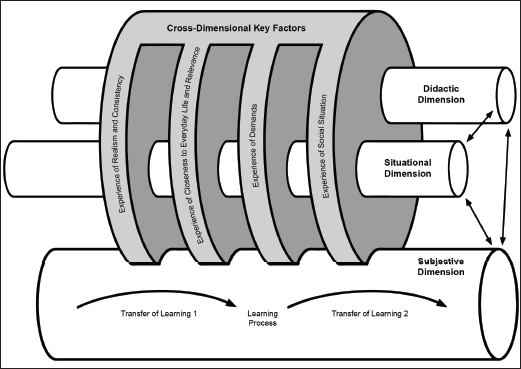
It is important to note that the learning process of participants involved in a simulation gaming session is not limited by the boundaries of the simulation game and the session itself. Rather, the aim of the whole session is to transfer what has been learned within the gaming session - knowledge, skills, behaviour, insights - to other contexts and to apply it there. This step is called learning transfer (Mandl et al., 1992). The main objective of the impulses of a simulation game and its debriefing in this understanding is the creation of the basis for a learning transfer and the preparation or promotion of such learning transfer. In relation to the notion of learning transfer, two understandings can be distinguished, which we refer to as learning transfer 1 and 2. Learning transfer 1 is the transfer of experiences, expectations and earlier adopted skills and knowledge of the participants into a simulation gaming session. Learning transfer 2 takes place by transferring learning out of the gaming session into the environment outside of the gaming session (e.g., everyday situations) (Schwägele, 2015). For learning and learning transfer to succeed, it is important to look at other factors as well, which Schwägele (2015) calls cross-dimensional key factors:
For a successful learning transfer, all these cross-dimensional key factors should be positively evaluated by the learner. The relationship between the four cross-dimensional key factors, the two types of learning transfer (1 and 2), as well as the didactic, situational, and subjective dimension of facilitation are illustrated in Figure 1.
Overview of cross-dimensional key factors, two types of learning transfer, and didactic, situational, and subjective dimension of facilitation. Source: Adapted from Schwägele (2015, p. 304).
Overview of cross-dimensional key factors, two types of learning transfer, and didactic, situational, and subjective dimension of facilitation. Source: Adapted from Schwägele (2015, p. 304).
It is important to note that the experience of a simulation gaming session is a subjective assessment of the participants. Rational arguments are only relevant if they are understood as such by the individual participant. Facilitation in connection with simulation gaming sessions should enable the participants via impulses to get closer to their respective goals. The facilitator makes offers to the participants, relates to what is actually learned, which goal is worked towards, yet is strongly dependent on the participants. Facilitation requires experience and a certain amount of activity in the background, which does not necessarily have to be noticed by the learners, but should help to lead them to the learning goal. A facilitator should be aware of both the group dynamics and the decisions of the participants (Kriz, 2010).
Following Schwägele (2015), distinct criteria define a debriefable situation. A debriefable situation allows for several possible decisions in the interaction between human and human or human and system. The situation does not pre-define what is right or wrong. The participants create a meaningful situation, because they are allowed to relate emotions to it. Aspects of the debriefable situation motivate to think about and reflect on them. From the participants’ point of view, the topics raised during the situation have relevance to everyday life and/or the future, and the participants have a personal interest in the topics. The debriefable situation creates a need for the participants to exchange views on what has happened.
Based on our analysis, it is vital to take all above-mentioned aspects into consideration when designing a debriefable situation. The criteria outlined here show that debriefing should be included throughout the whole gaming session. It should be designed as ongoing activity, not only seen as phases after sections of a game. Contrary to many traditional models that locate the debriefing phase at the very end of a simulation gaming session, we conceptualize debriefing as reflection moments during the whole playing time, where participants have the opportunity to reflect on their game play, activities, experiences, and learnings in the simulation game. During these moments, participants can address challenging situations of the game play, and make connections between the game play and the real environment. Effective debriefing (or at least its preparation) must therefore necessarily start much earlier.
Interplay of Participants, Target Corridor and Learning Environment
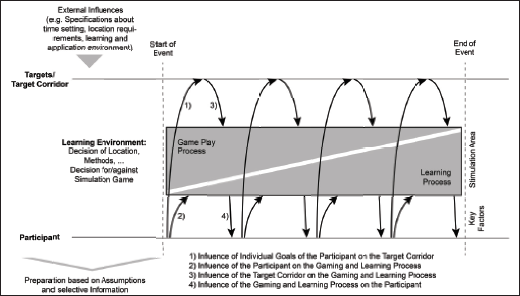
When it comes to the choice or design of the applicable simulation game, many aspects of the real system, the problem to address and the envisioned learning goal have to be taken into account. The role of and relationship to the debriefing is important to consider, too. At this point it is important to remember the following: the entire preparation, which is now finished, is based on assumptions and selective information despite the best possible preparatory work. As a facilitator, one can only find out at the day of the seminar itself which participants are actually coming, how they are doing, and which topics are of current interest to them. The moment the participants are confronted with the envisioned target corridor - that is the range of individual (learning) goals that can be reached with the session - and learning environment defined on the basis of the information obtained in advance, is a critical moment. This can lead to considerable changes to the pre-defined common learning goals. The more freedom the participant had in the decision to participate and the more transparent and comprehensible the target corridor was communicated in advance, the less these adjustments are needed. This also means that the more rudimentary the communication and coordination with the participants was in advance, the more extensive the adjustments of the target corridor and thus the learning environment on site can be. During the entire course of a simulation gaming session there is constant, mutual feedback, modification and adaptation needed (see Fig. 2), which explains why facilitation is such a demanding and challenging activity.
Interactions and influences between participants, target corridor and learning environment.
Interactions and influences between participants, target corridor and learning environment.
Figure 2 illustrates how target corridor, individual goals, participants, and learning environment are intertwined, and how external factors as well as key factors influence the whole situation. Compared to the existing and traditional concepts of debriefing, the new model takes into account the impulses that stem from the participants, and from the activity itself, and how the moments of debriefing can help to adjust the situation better to the needs of the learners. Most concepts we analysed in the related work propose debriefing as a singular event in a linear process of events, e.g., from introduction to game play, to debriefing. The new term ‘impulse’ introduced in our conceptualization addresses a more flexible and interwoven definition of debriefing. Impulses are events that are created by the learning environment in exchange with the participants, and describe the influence the individual goals of the participants, the participant itself, the target corridor, and the gaming and learning process have on each other (see numbers in Fig. 2). The impulses may change the initial design of a simulation gaming session.
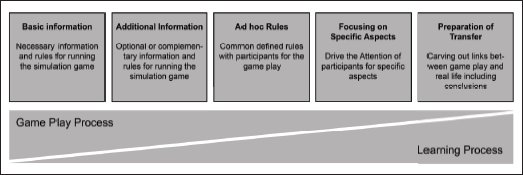
The learning environment must therefore be understood as a continuous stimulation environment that is influenced by the participant(s), the (continuously adapted) objective and guided by the facilitator. As described above, the debriefing focuses on the stimulation of learning, reflection and transfer processes of the participants. Debriefing is thus an accompanying and constant interplay between impulse(s) and evaluation and between target corridor and participant(s). The intervention model developed by Hitzler et al. (2011) provides an initial framework for the intervention options available for this interplay. In this model, game and learning processes inevitably belong together in a simulation game, but they must also fit and complement each other. The model takes into account that the focus of facilitation may shift throughout the gaming session. At the beginning, a facilitator focuses more on the game itself (e.g., explaining instructions, taking care of tutorial rounds and understanding the game). Over the course of the session, the focus of facilitation shifts towards the learning and the transfer process, moving away from the game itself to the experience of the player. The facilitator can foster the learning process and make the transfer to the real world easier for the participants, e.g., in formulating questions that help the participants reflect on what is happening during the game. While the focus is more on the game process at the beginning, the learning and transfer process becomes more and more important over the course of playing the game. Only the combination of the two processes enables experiential learning (Kolb, 1984), the process of learning through active engagement with an environment, such as a simulation gaming session. A number of intervention types are available to support the two processes (see Fig. 3). The stronger the focus of the game process, the further to the left the intervention of the management of the simulation can be classified. Accordingly, the other way around describes the relation to the learning process:
The
Source: Adapted from Hitzler et al. (2011, p. 74).
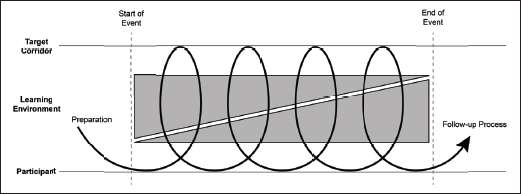
Looking at the notes above, the central process of a simulation game facilitation is therefore the inseparable interplay between impulses and debriefing. This Impulse-Debriefing-Spiral aims at coupling the participant and his/her objectives (see Fig. 4).
The necessary impulses are generated by the learning situation offered in combination with the participants. At the same time, it is the facilitator’s task to keep this situation in view, to give further impulses and to open up new fields of discussion and learning with specific impulses.
Impulse-Debriefing-Spiral.
Impulse-Debriefing-Spiral.
In this sense, considering debriefing as a separate or even final phase of the implementation of simulation games or interactive learning environments is not enough. Professional facilitation of simulation games is a continuous Impulse-Debriefing-Spiral, which ties playing and learning together. Debriefing must be understood as a continuous and accompanying process. Creating a debriefable situation to allow for learning and learning transfer is not possible without a well-planned conception of the learning environment in advance and a subject-oriented implementation in terms of the interplay of briefing and debriefing. The biggest challenge besides this unpredictable interplay between participant, objective and learning/stimulation environment is the fact that this interplay can be defined in different ways by different participants. Furthermore, it is important to notice that the process of learning and learning transfer of an individual does not stop at the end of a simulation game session. Nevertheless, in the follow-up process it is mostly beyond the facilitator’s control to provide impulses.
Conceptual Contribution
In this article, we propose a new conceptual model for debriefing in the facilitation of simulation gaming sessions. We conclude that the decision for the design of a learning environment, which might include a simulation game, can only be made after collecting and analysing all available information regarding participants and their objectives. As described in our examples in the appendix, leading questions related to the participants, the target corridor, the conclusions that can be drawn from the learning environment, and the changes that were necessary from the initial design to address specific learning goals, allow to create debriefable situations that foster learning and learning transfer and help to set a focus for both, facilitator and participants.
Debriefing, defined as a phase after the actual game play in our view is too limited to reveal its full potential as learning situation. Debriefing starts already in the conception and preparation phase of a learning session, because the foundations for the stimulation of reflection, learning and transfer processes are already laid here. Furthermore, debriefing is an ongoing process that is consistently oriented towards the participants and what is happening during a simulation gaming session. Debriefing as an integral part of a simulation gaming session must both be well prepared and flexible, and requires experience from the facilitator. We designed a new Impulse-Debriefing-Spiral that reflects on the need for flexible learning situations, allowing for debriefing moments throughout a gaming session, whenever learners need a moment of reflection, transfer, and thinking. This model accounts for adaptation of the whole learning environment, connects the learning and playing process, and addresses the need for a holistic conceptualization of debriefing within the process of facilitation.
Practical Recommendations
The design of a debriefing should consider the sometimes uncertain dynamics related to the diversity of participants during a gaming session. Different participants have different experiences, expectations, and changing needs. A debriefable situation should make it possible to directly reflect on the dynamics that can evolve from this. Furthermore, results of our initial literature review indicate that an integrative understanding of briefing, debriefing and facilitation is necessary. Following our new model, a facilitator helps and listens to the needs of the participants, and designs a learning environment that allows for debriefable situations. Just in the interplay of situation, participant, and individual and collective learning goals, and in reaction to distinct impulses that emerge during the session, debriefing can unfold its full potential in the process of learning and learning transfer.
Limitations and Future Work
We acknowledge the fact that our work is conceptual in nature. While we have been able to illustrate the new debriefing model based on one example using a physical game, and another using a digital game during a learning session, future work should lead to further empirical validation of the model, including its evaluation by experienced facilitators and researchers. As simulation games are not only applied to learning contexts, but also to situations of research or decision-making, one direction of future research could be to investigate the applicability of our model in contexts like research or decision-making.
It is certainly the case that our thoughts on and understanding of the debriefing process also have implications for game design. However, for the purpose of this article, we illustrated the novel Impulse-Debriefing-Spiral based on two existing games. It is beyond the scope of this article to focus on the design of games as well. This could be an interesting approach for a follow-up article.
Appendix - Use of the Impulse-Debriefing-Spiral in Practice
The questions that lead the analyses of the examples are related to the vital elements of the Impulse-Debriefing-Spiral.
Appendix A: Example 1 - General Management
This session was developed and carried out on request by a teacher in tertiary education and made for students in the 6th semester Bachelor at the Baden-Wuerttemberg Cooperative State University Stuttgart, in the subject area Business Administration - Industry. The first objective to address with the gaming session was formulated as: linking the previous contents of the course of studies to obtain an overall perspective on company processes, thus representing an integrative moment in the study program.
Who are the Participants? What is Probably on their Minds?
The participants of this session were students at the end of their studies, who have spent three years studying the theoretical contents of the functional areas of business administration. The individual participants within this study program usually are not interrelated, but taught in separate classes, tested at the end with an examination. Alternating with the theory lectures at the university, students work in industrial companies. During these internships, students generally only get to know individual facets and/or departments of an organisation. There is no targeted combination of what they have learned in theory and what they have experienced in practice, and this also makes it difficult to see the overall context of the company. After the end of their studies, most students are taken on by their employers; a not inconsiderable proportion will take further career steps in the short or medium term. Although there are still 6-8 weeks to go until the final exams, many of the participants already have the exams in mind.
What does the Target Corridor Look Like?
The theoretical knowledge of the various business administration areas offered in individual courses should be experienced in context in an integrative learning environment. Based on these experiences, theoretical content and practical experience should also be reflected upon and brought into connection with each other. The focus should not be on conveying details, but rather providing a systematic understanding of the different areas of a company and the market. In addition, the question of how such a complex situation can be designed should be addressed.
What Conclusions can be Drawn from this for the Learning Environment?
For these requirements, a general management business game is a good choice. Participants take over competing companies in small groups and are responsible for all functional areas. Over several periods of time, the teams make decisions and experience their effects. To ensure that the business management topics are systematically interlinked and to introduce systematic thinking, the topics are introduced one after the other, but the last level of complexity gives a good overall impression of the complexity of the overall matter. The evaluations of the decision-making rounds are strongly oriented towards the participants and their previous knowledge. The participants question the system with their own hypotheses and gradually analyse it. The speed of the process is adjusted to the progress of the participants. A thematic structure based on external factors (market perspective), a focus on internal processes (production and personnel) and financial aspects would be conceivable. In order to promote an overall assessment of one’s own company and the market, the final task could be to hand over the company taken over at the beginning of the seminar to the next board of directors.
How does the Target Corridor and the Learning Environment Change Through the Participants?
As the students were divided per hazard into teams in this session, we can draw conclusions on how participants altered the target corridor and learning environment when looking into their decisions and performance during game play.
The company of group 1 is insolvent after the third round of decisions. The participants mainly have problems in building up a strategic perspective and making consistent decisions. Together with this group, the topic of insolvency is dealt with and options for action are developed and implemented in comparison with reality. This topic also continues to occupy an important place in the group as a whole. In the final round there is intensive discussion among the participants as to whether the company would be viable after its restructuring. There is also discussion of which areas of the company would be interesting on the market, how a break-up would be conceivable and which company could benefit from which areas.
Group 2 consists of participants who have intensively studied the theoretical content of the course and each have career ambitions. In the small group, however, the participants do not only wrestle over decisions regarding content. The more advanced the seminar is, the more it is about personal positions and the question of how decisions are made and who is to blame for miscalculations and bad decisions. The actual topics of the seminar recede more and more into the background. Leadership topics, but also personality and cooperation in the team have to be worked through in this small group, accompanied by the facilitator.
In group 3, it emerges that the participants have not understood the central terms of business studies and therefore fundamental problems of understanding arise at a very early stage. Although not intended, it is necessary to discuss the basics of business administration again in a demand-oriented way and to give significantly more input.
In group 4, students take pleasure in penetrating and optimising their company by means of key performance indicators. The evaluations in the plenum are not deep enough for them. With the help of their scripts from the lectures they try to calculate and interpret key performance indicators and derive decisions from them. In some places, however, they need specific support, especially when it comes to the exact composition of individual data.
Each group, usually even each participant, has its (his/her) topics, and its (his/her) focus. The main task of the seminar facilitator is to deal with all of them in a flexible way.
Appendix B: Example 2 - Yard Crane Scheduler
Yard Crane Scheduler (YCS) is a short, digital game used in university teaching to explain the challenges and nature of planning in highly complex situations. The YCS game is a so-called microgame, a type of game that can be played in a short period of time and which usually makes it possible to experience a clearly defined aspect of a complex problem. Details of this game as well as detailed data analyses related to the gaming sessions and its effects are described by Kurapati et al. (2015), Lukosch, Kurapati et al. (2016) and Lukosch, Groen et al. (2016). The YCS game has been developed in the contexts of a research project, yet with the aim to increase awareness for the dimensions of interdependent planning within a container terminal as a hub in the global transportation chain of goods.
Who are the Participants? What is Probably on their Minds?
The participants of this game were professionals and graduate students in the transportation domain. In previous studies, 172 students majoring in supply chain management from the United States, Germany and the Netherlands were observed when playing the game in facilitated game sessions (Kurapati et al. [2015], Lukosch, Kurapati et al., [2016] and Lukosch, Groen et al., [2016]). 169 data points were analysed, leading to a gender distribution of 95 male and 74 female participants. The age range was between 20 and 30.
The predefined learning goal for these sessions was to raise awareness and increase understanding of the interconnectedness of certain actions and decisions within a container terminal. It has shown that container terminal operators often are not aware of the fact how many consequences their decisions might have on other parts of the terminal, and how an integrated approach would affect the overall performance of the container terminal. When participants enter the gaming session, they most probably have in mind to learn about the role of container terminals in a transportation system.
What does the Target Corridor Look Like?
The target corridor of learning sessions with YCS is defined as helping the participants to understand the interconnected nature of container terminal operations. A gaming session seemed to be applicable for this learning goal, because the game illustrates the dynamics and interrelations in a complex system in an engaging way, and provides immediate feedback on decisions of participants. In the 2-D game participants handle a simplified situation in a container terminal from a bird’s eye view. The task for the participants is to score as many points as possible by correctly loading and unloading arriving ships. To do this, different actions have to be performed simultaneously and cranes have to be moved. The game illustrates which actions are connected with each other and the consequences of decisions on the different areas in a container terminal. Along the target corridor, the session is designed along different stages, changing between game play and debriefing. First, a short introduction to the basic possibilities the game offers and the learning objective is provided. This is followed by a phase in which the participants can complete a few practice rounds in the game. Then a first debriefing takes place in which the problems the participants have and the basic strategies they have used are discussed. This debriefing focuses on technical questions, yet also refers to basic game play strategies. The aim of this phase is to enable all participants to reach a similar starting level and to understand the basic principles of the game. The facilitator determines how many rounds will be played or how long the actual playing phase will last prior to the gaming session. Questions about playing techniques may be asked at any time during the playing phase, but participants are encouraged to explore successful strategies themselves. Participants are asked to write down their scores so that they can be used for the final debriefing.
A second debriefing is carried out after some more rounds of play. The points will be queried and the participants with the highest and lowest points will be asked about their respective strategies. Afterwards, the game can be continued - as part of the course or voluntarily, e.g. at home (impulse). A third, final debriefing has two phases. Firstly, points and strategies are collected again. The question about points and strategies is to make clear that there are different strategies to play the game, which can also end in different success. The participants are asked to discuss their respective strategies to promote social learning. The second debriefing phase will focus on providing background knowledge, explaining the different processes in a real container terminal, their dependencies and challenges involved. Finally, all participants can then combine the knowledge gained through the game with background details and discuss how to apply what they have learned in their own reality.
What Conclusions can be Drawn from this for the Learning Environment?
While the debriefing phase at the end of the session with YCS has often been the longest of the debriefing phases, this was mainly due to the fact that it also included a clarification of the complexity of the reference system. The after-game debriefing started with a short video of a time-lapse of the activities within a container terminal, followed by a discussion. Yet, the debriefings between the game phases have been very valuable, too, as the feedback of the facilitator enabled the participants to constantly adapt (and improve) their strategies in the game. While participants were asked to explore strategies themselves, some did not follow this way of learning, but preferred more guidance from the facilitator. In both ways, participants were able to learn about successful strategies along the way with the debriefing phases between game phases, which can be seen as main learning from this example.
How does the Target Corridor and the Learning Environment Change Through the Participants?
With the need for more guidance uttered by some participants, the learning environment was changed. The session was initially developed as an experiential learning session, but it became clear that some participants needed more guidance and support. The need for feedback between game phases differed between participants; while some needed guidance on a lot of actions and decisions during game play, others took over a self-organized, exploratory approach as intended. Especially the need for guidance changed the learning environment, which was led by the idea of experiential learning, not instruction. Facilitators had to find careful responses to participants who asked for guidance, not only in how to play the game, but also how to master it.
Participants applied different strategies in the game, sometimes focusing on only one aspect of the game. As the whole session was meant to illustrate the interconnected nature of planning within a container terminal, the target corridor could not be reached by limiting this perspective to only one aspect. Additional explanation had to be provided on this aspect.
Footnotes
Declaration of Conflicting Interests
Funding
The author(s) received no financial support for the research, authorship, and/or publication of this article.
Notes

Author Biographies
Contact:
Contact:
Contact:
Contact: