




Abstract
Background. The significance of mutual-help in communities for disaster management is a fundamental important concept. However, the current societal state does not reflect this lesson.
Aim. This paper analyzes the current achievements of S&G in enhancing
Method. The paper clarifies the theoretical advantages of S&G in enhancing community resilience in coping and adaptive capacity plus proposes a conceptual contribution framework of S&G in improving community resilience. Based on this framework, the paper analyzes some major games that tackle community resilience against earthquakes in Japan.
Results. The paper demonstrates the achievements through the S&G spectrum that stresses the disastrous experience with specific resilience views on one side, while decision making for critical reflection from other players with more comprehensive resilience views on the other side.
Conclusion. The paper showcases the current S&G achievements in enhancing community resilience against large-scale earthquakes in Japan using the proposed framework, which can be utilized by other disaster-prone countries to develop and evaluate applications of S&G for increasing community resilience against earthquakes.
History repeats itself, as do natural disasters. 1 There has been no year, or even perhaps no month recently when news stories have not reported the occurrence of natural disasters. Figure 1 shows the number of reported earthquakes, total deaths, number of individuals affected, and damage caused by earthquakes from 1960 to 2018 on all continents recorded by EM-DAT (The Emergency Events Database [EM-DAT], 2019). 2 The trend is apparent: the number of reported earthquakes has been increasing.
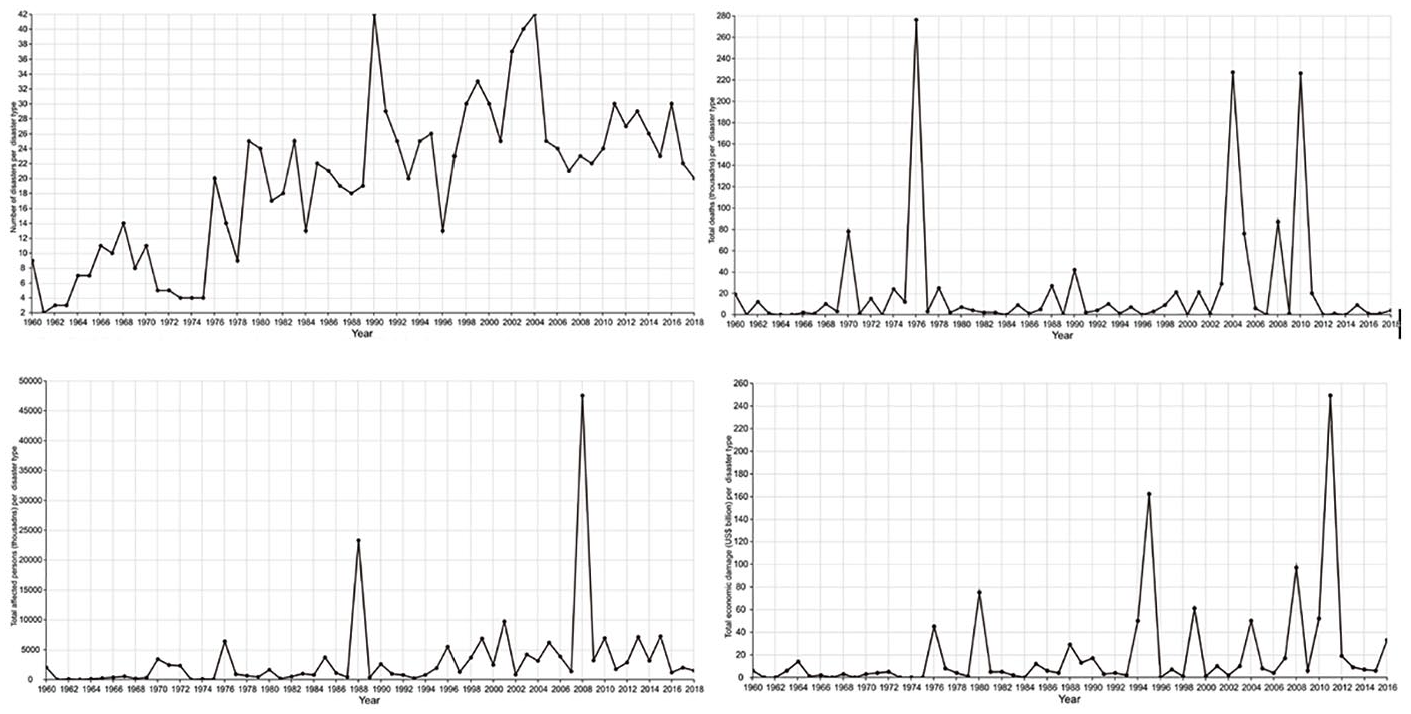
The number of reported earthquakes (upper left); total deaths (unit: thousand) (top right), persons affected (unit: thousand) (bottom left); and the damage (scaled to 2016 US dollars with unit: US$ billion) (bottom left) caused by the earthquakes recorded from 1960 to 2018 on all continents.
Moreover, every ten years there is a year or more with significant loss of life as well as affected persons and economic damages. However, these damages do not correspond with each other because some earthquakes kill more people than others (e.g., earthquakes that occur in developing countries), while others do affect the economy more than others (e.g., earthquakes that hit developed countries that are better prepared to reduce human loss) (World Bank, 2010). Although these numbers are subject to the occurrence of earthquakes, our societies have some influence due to expanding habitation areas exposed to the impact of natural hazards (exposure) and lack of preparation for them (vulnerability). These physical and human systems bring suffering to society.
Japan is a disaster-prone country that still suffers from the adverse effects of recent natural disasters. As an economically developed country, it has taken a variety of countermeasures against earthquakes, from hard (structural) to soft (non-structural) measures, and this has reduced some of the damage. However, natural hazards still cause many human deaths, and in Japan, earthquakes are the type of natural hazard that has killed the most people. From 2001 to 2017, earthquakes and earthquake-induced tsunamis killed about 22,500 people, accounting for more than 90% of all casualties of natural disasters in Japan (Cabinet Office of Government of Japan, 2019b). Even now, Japan is at risk for having a large-scale earthquake, such as a Great Nankai Trough Earthquake that could have the potential to kill more than 240,000 people (Cabinet Office of Government of Japan, 2019a).
Even if the country prepares for such earthquakes and tsunamis with hard measures, it must be acknowledged that natural hazards might overwhelm the best human efforts at curbing their effects, as exemplified in the case of the Great East Japan Earthquake that devastated East Japan in 2011. This indicates that we need to pay more attention to soft measures, which often require cooperation among residents. However, as Toyoda and Kanegae (2014) put it, Japan is faced with less social capital among residents.
Researchers, on the other hand, have been struggling to reduce the damage caused by natural disasters by applying the concept of resilience in the age of complexity. Several primary methods with a variety of minor revisions were invented to attain community resilience, e.g., participatory map making. Among these methods, Simulation & Gaming (S&G 3 ) is one of the effective ways of making a community 4 resilient. S&G is used to find solutions for societal problems that needs multi-stakeholders’ perspectives. However, according to Solińska-Nowak et al. (2018), most S&G address floods (27 games), followed by earthquake (10 games). S&G could contribute more to earthquake management to reduce large-scale damage, but the number and effect of games has not received adequate attention.
Against this backdrop, this paper reviews the current applications of S&G in Japan for enhancing community resilience against large-scale earthquakes. It begins by explaining the importance of the community in disaster management and community resilience and then clarifies the theoretical advantages of using S&G to increase community resilience. Next, the paper proposes a theoretical contribution framework of S&G for building community resilience against earthquakes. Finally, it analyzes some major S&G activities aimed at improving community resilience that have been introduced in Japan and evaluates their achievements based on the proposed framework. Although previous studies have dealt with the topic of applying S&G for enhancing disaster resilience, the significance of this paper is that it not only evaluates S&G practices in Japan but also provides a new framework for other disaster-prone countries to consider S&G applications for increasing community resilience against earthquakes.
Essential Roles of Community in Disaster Management for Earthquake in Japan
When natural disasters occur, societies can avoid having the same calamities repeat themselves by passing on lessons learned to other areas and future generations. One of the essential examples is mutual-help by communities in disaster management. For instance, since the Meiji Period (1868–1912) when Japan modernized, hard measures (construction) implemented by governments (public-help) succeeded in reducing the number of victims of natural hazards, leading to fewer residents’ awareness of natural hazards (Okada, 2003). However, the limitations of such hard measures gained recognition at the beginning of the 1980s, and attention then shifted to self-help (disaster management by oneself and family).
As Toyoda and Kanegae (2014) and many other researchers put it, the attention shifted to the community as one of the most important actors in disaster management, especially since 1995 when the Great Hanshin-Awaji Earthquake hit the central part of Japan. Izadkhah and Hosseini (2010) mentioned that the community is the first responder to disasters due to the delayed arrival of rescue and relief teams in disaster-stricken areas (disaster response). Kurata (1999) indicated that rescue activities in “intimate” living areas tended to be smoother than those in “less intimate” living areas because community-based disaster preparedness requires communities’ cooperation and coordination (disaster preparedness).
Community organizations are also key actors in the disaster recovery phase because they assist with information sharing and consensus building, as in the case of the Great East Japan Earthquake that devastated the Tohoku Region of Japan in 2011 (Kariya & Ubaura, 2013). They write about the significance of organizing community organizations before a disaster. Therefore, there is a need to promote community-based disaster management.
The basic system for responding to earthquakes in Japan is to evacuate to a safer place and stay at an evacuation shelter if going home is risky (Fujioka, 2007). Evacuation is a necessary action in reducing the devastating consequences of a disaster. Evacuation, as Chen et al. (2012) put it, can be an immediate coordinated response to a disaster, if residents are well-prepared before the event. During the evacuation, communities are supposed to secure their safety, rescue and aid others if needed, and help extinguish small fires on their own.
This process requires preparation and cooperation within the community before the disaster strikes. At an evacuation shelter, under the leadership of community organizations such as community-based disaster management groups, communities need to manage the shelter by themselves (Cabinet Office of Government of Japan, 2016).
After evacuees stay at the shelter, temporary houses are provided by the central government (for a maximum of 2 years and 3 months but longer in cases of large-scale disasters). Finally, the victims move to permanent houses (Cabinet Office of Government of Japan, 2015). Preparedness in managing earthquakes is crucial as it makes this process to be smooth and reduces the impact of damages as much as possible.
Communities should play a more critical role than ever in disaster management; however, the reality does not match this goal (Toyoda & Kanegae, 2014). Some of the challenges include; disaster training needs, improvement for the substantial enhancement of communities’ disaster management capacities, and the majority of residents, especially the young generation, tend not to participate in disaster management activities such as disaster training.
One of the standard attempts to overcome both challenges is to conduct game functions in activities. Adults can follow disaster scenarios in games, unlike in conventional training where everyone follows designated steps and succeeds in surviving by following the instructions. Also, school children can play fun games in disaster education to stimulate their interest and raise their awareness. Researchers and practitioners have developed games as products which have been introduced and promoted by Japanese government offices such as the Cabinet Office of Government of Japan (2017). Although Solińska-Nowak et al. (2018) showed a mapping of serious games for disaster management, they focused on the game formats, such as target groups, types of hazards, and aims, and did not discuss how games influence disaster management.
This study explores the first approach, by conducting S&G activities to make communities more functional in disaster management. Games in general are often used for disaster education, especially for school children, and many studies have identified specific game components that enhance community resilience (this concept is discussed later). However, although S&G is a sophisticated tool for education with its own advantages compared to other disaster training and education tools, its relation to community resilience has not been addressed directly and sufficiently in the existing literature. Moreover, concerning the progress of S&G in Japan related to disaster management or community resilience, researchers have tended to develop and carry out their own S&G activities; so far no studies, at least not in Japan, have evaluated how S&G enhances community resilience. Providing a framework based on applied S&G practices in Japan, which is a country rich in the application of S&G practices for disaster management, can provide a basis to further spread the use of S&Gs within the field of disaster management.
Enhancing Community Resilience Under the Paradigm of Complexity
The paradigms and concepts related to disaster management have changed in response to new knowledge in other fields. Complexity and locality is one aspect of it that is stressed as explained in the lessons about the significance of the community. Resilience is a common terminology in several academic disciplines, including disaster research. Besides, this paper emphasizes the importance of distinguishing three domains of knowledge for disaster management, i.e., scientific, experiential, and local.
Knowledge Integration Under the Society With Complexity
Smith (2013) demonstrates the evolution of (environmental) hazard paradigms toward the complexity phase. Following the extensive consideration of the engineering phase when preventing disasters, the behavioral stage was adopted when discussing exposure. The development phase followed when greater awareness developed with regards to human vulnerability to disasters.
The complexity phase began in 1990, characterized by an emphasis on complicated interactions between natural and human systems, leading to improvement in the long-term management of hazards according to local needs. This phase stresses complexity and uncertainties, the latter stemming from the complexity in and between systems, and recognizes the importance of the local level, as mentioned in the previous section.
Even though communities are the most important key actors for disaster management, the age of complexity makes it harder than ever for them to tackle natural hazards according to local needs. Three domains of knowledge must be integrated to take on the challenge. Scientific (academic) knowledge is scientifically induced knowledge (e.g., mechanisms in the causalities of concepts). Experiential knowledge means lessons learned from experiences or records of past disasters. Finally, local knowledge refers to the characteristics of local areas, which should be unique to each community, such as socio-demographic and physical characteristics (e.g., more elderly residents; more vulnerable houses made of wood and built close together, which could block evacuation routes). Integrating these domains of knowledge and making the best use of their integration is required in disaster management (National Research Institute for Earth Science and Disaster Resilience [NIED], 2010).
In summary, in a complex society, the community needs to play a critical role based on local knowledge combined with scientific and experiential knowledge to overcome earthquake disasters. However, based on what concept or toward what aims, should community-based risk management be promoted? Community resilience is an important concept in this direction.
Community Resilience for Disaster Management
The concept of resilience has prevailed in some disciplines, including disaster studies. Resilience in disaster studies and practice is generally referred to as; “the ability of a system, community, or society exposed to hazards to resist, absorb, accommodate and recover from the effects of a hazard in a timely and efficient manner, including through the preservation and restoration of its essential basic structures and functions” (United Nations International Strategy for Disaster Reduction [UNISDR], 2009, p. 24).
The term began to appear in official international documents as early as 1995, such as in “Hyogo Framework for Action 2005–2015: Building the Resilience of Nations and Communities to Disasters” (UNISDR, 2005). Although the definition above has widely been adopted in several disciplines, there is no consensus on the definition of resilience (Cai et al., 2018; Manyena, 2006).
In connection to earthquake disaster management and the complexity phase, this paper refers to community resilience as; “the capacity of a local community to keep its pivotal functions in evacuation by anticipating and reducing impacts; to recover communities’ lives in managing shelters quickly; and to adapt to the next normalcy, such as daily life after the shelters, under complexities and following uncertainties after the occurrence of an (earthquake) disaster.”
Community resilience has two strands to be addressed (Norris et al., 2008). One describes effective organizational behavior and disaster management (socio-ecological systems), and the other is relatively more concerned with preventing disaster-related health or mental health problems of communities (development psychology aspect and community development as its extension), while some studies tried to integrate both strands (such as Berkes & Ross, 2013). The relations between community resilience and S&G are discussed in the next section, where this study looks at both strands while focusing on the latter strands. S&G are considered as disaster education tools and provide players with opportunities to deliberate on their management, contributing directly to building a community capacity as a process (community development) and eventually making communities resilient as a result (socio-economic aspect).
Three Views of Community Resilience in Community Earthquake Management
By shifting the concept of community resilience down to the analytical level, resilience is divided into three significant views: stability (absorption), recovery (bouncing-back), and transformation (adaptability) (adapted from Maguire & Cartwright, 2008). These views relate to disaster management cycle as referred by a great deal of literature and useful reports as mitigation, preparation, response, and recovery. To attain these views, mitigation and preparation that come before a disaster strikes in the disaster management cycle are essential. It is mainly in the preparation phase that capacities for resilience are enhanced and tested in the response and recovery stage. Also, in the recovery phase, the adaptive capacity for resilience is increased along with the recovering process.
The stability view defines resilience as the ability to keep a pre-existing state. This view of resilience is measured as the amount of disturbance a system can tolerate (absorb) before it shifts to another state. This view corresponds to the response view in the disaster management cycle wherein the community resilience context; it can be said that a community can keep its pivotal functions by reducing loss through preparedness for smooth evacuation. This includes not only behaving flexibly in a disaster but also anticipating what might occur and preparing for such situations.
The recovery view relates to a community’s ability to “bounce back” from a change or stressor to return to its original state (rehabilitation). This covers the first half of recovery in the disaster management cycle. Following large-scale disasters that destroy buildings, it is not realistic to return precisely to the original state. This phase is the stage of recovery of life functions at evacuation shelters. Although staying at the shelters may be prolonged according to the magnitude of the disaster, evacuees can try to return to their regular lives while still living at the shelter, such as going to school or work.
The transformation view refers to the ability of a community to respond to a change adaptively. This means changing to a new state that is more sustainable in the current environment, rather than merely returning to a pre-existing state (reconstruction). This phase indicates the latter part of recovery in the disaster management cycle and is characterized by “bounce back better” (European Union & United Nations Office for Disaster Risk Reduction-Regional Office for Asia and Pacific, 2010). It includes starting discussions for new lives to make the community more resilient after the disaster. 5 Community resilience may be considered from these three views.
Functions of S&G for Risk Management: Implication from the Theoretical Perspective
Lukosch et al. (2018) saw S&G as a powerful approach to the understanding of highly integrated, large-scale systems where many players deal with deep uncertainties. Referring to Mayer (2009), they described S&G as experimental, rule-based, interactive environments in which players learn by taking actions and experiencing their effects through feedback mechanisms that are deliberately built into and around the S&G. S&G is one of the critical tools that deal with uncertainties in the complexity phase. Although it is not feasible to point out every function of S&G, this section describes how the vital tasks of S&G theoretically contribute to community resilience. The main focus experiences in virtual (game) worlds in a safe environment with role-play and knowledge domain integration. Both points would enhance community resilience.
Experience in Virtual Worlds With Role-Playing for Risk Management
S&G offers opportunities for people to have experiences of crises (Crookall, 2004) in a safe and risk-free environment (Kriz, 2003). Complex systems are difficult to understand and manage due to the number of players involved, use of technology, and interrelatedness of the system elements and their dynamics (Lukosch et al., 2018).
This reduces the effectiveness of learning because if learners think the task in an S&G is too tricky or complicated, they will be less likely to engage in the activities and feel less motivated to learn or reflect (Wardaszko, 2018). Although Wardaszko (2018) states that they will still learn or play the S&G, it can reduce the level of complexity while retaining the primary relations or dynamic mechanisms. This characteristic of making contents graspable for learners facilitates effective learning (Ambrose et al., 2010; Toyoda, 2016).
Moreover, the virtual (game) world provides opportunities for players to identify differences between their ways of thinking and the roles that they are playing (role-play) (Toyoda et al., 2014). S&G sets players into the decision context of other roles. Players will always think from their viewpoints, but role-play allows them to become familiar with the challenges of different designated roles.
Figure 2 shows the theoretical function of S&G in the process of disaster management (Gaillard and Mercer, 2013; Toyoda et al., 2014). In S&G, players can experience disastrous situations and learn from their success and failure. They reflect on their community based on the lessons and find the gaps between the present situation and better situations that they envision (risk assessment).
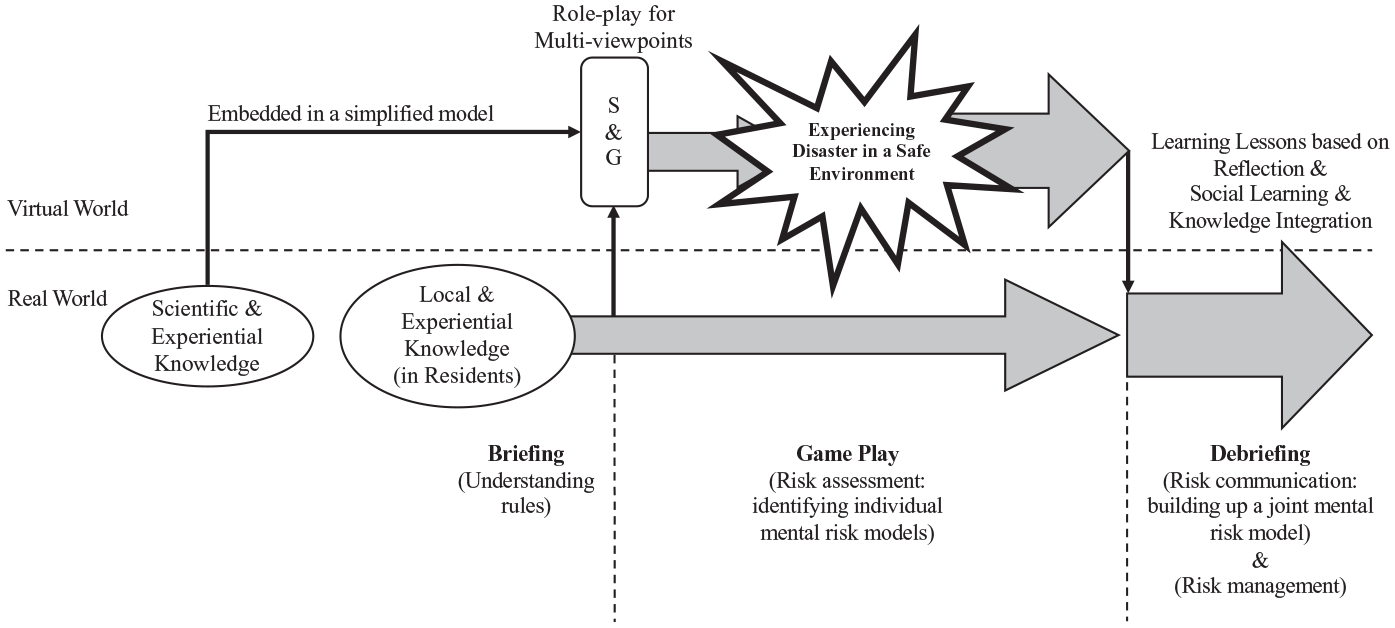
A theoretical functions of S&G for risk management.
Moreover, S&G is not a mere training by which players can develop their skills predetermined by specialists, but an opportunity for them to consider what to do in situations with uncertainties and to learn ways of thinking about problems. The players are encouraged to communicate with each other and build a joint mental risk model. After sharing information and deciding what to do (risk communication) in a debriefing session, they can carry out their decisions (risk management). 6 This allows the players to engage with the complexity of the systems embedded in S&G and trains them by promoting attitudes to cope with such complexity.
Experiencing Scientific and Experiential Knowledge for Knowledge Integration
S&G could be a tool for the transfer and integration of three domains of learning: scientific, experiential, and local within the game world, where components of the real world are simplified for players while focus points are retained where players can deliberate and make decisions based on different roles. S&G represent social systems and are interrelated to the social network around them (Klabbers, 2018). While the players’ background influences the gameplay, the process of acquiring knowledge and skills from the gameplay can be useful in a specific real context (Copier, 2007; Lukosch et al., 2018). S&G support knowledge transfer from the virtual to the real world and vice versa.
In S&G, particularly in community disaster resilience contexts, scientific knowledge and experiential knowledge as defined by NIED (2010) are embedded in the S&G, and these are often not easy to transfer by verbal media. At the same time, players play the S&G using their own experiential and local knowledge. Kriz (2010) explains debriefing as “the methods used to combine participants’ reflections on their experiences with assessment of mental (cognition, emotion, etc.), social (action, communication, etc.), and systems processes (change of resources, structures, etc.) to deduce applications for real situations beyond the gaming simulation experience (p, 669).”
As players acquire scientific knowledge (by experiencing its dynamic model) during the gameplay and debriefing session where they connect experiences in S&G and real situations, they integrate the scientific knowledge and experiential knowledge acquired in the S&G, local knowledge shared among participating community, and experiential knowledge possessed by individual players. By situational awareness, which refers to the understanding of others as a context for one’s activities (Lukosch et al., 2018), players connect their experience in the S&G and realities where they conduct activities such as preparations for a disaster. This process takes place not only in individual learning contexts but also in the form of social learning.
Therefore, S&G provides players with a standard arena for sharing knowledge to discuss issues presented in the exercise (Toyoda & Kanegae, 2014), leading to risk management based on the uniqueness of local communities. This process is included in Figure 2.
S&G Application Framework for Community Resilience
This section demonstrates how S&G could contribute to enhancing community resilience theoretically, based on the discussion above. The previous chapters discussed that resilience has three significant views: stability (absorption), recovery (bouncing-back), and transformation (adaptability), while for disaster management S&G can help players integrate three domains of knowledge through virtual gameplay with role-playing under a safe environment and following debriefing. This means that S&G influences directly player(s) through their learnings.
Stability and recovery do not require dramatic changes in the pre-existing systems, and they do keep or bounce back to the original state. Resilience can be divided into two conceptual indices of coping capacity and adaptive capacity (Parsons et al., 2016). These two phases can have the same connection with S&G. International Panel on Climate Change (2012) mentions that “while coping (capacity) aims to maintain the system and its functions in the face of adverse conditions, adaptation involves changes and requires reorganization processes (p.73).” Referring to Australian Natural Disaster Resilience Index (ANDRI), Parsons et al. (2016) see capacities as immediate reactions in response to a natural disaster or a result of social processes that develop the capacities required to anticipate and withstand unpredictable adverse conditions.
ANDRI is based on the latter view and this paper also focuses on the latter for discussing relations with S&G that is used mainly before disaster strikes. Although Parsons et al.’s (2016) intention was to evaluate resilience quantitatively and showed numerical indices, their theoretical dimension is more comprehensive than other studies and applicable to this paper focusing on the evaluation of community resilience.
Coping Capacity for Stability and Recovery
Coping capacities are defined as“the ability of people, organizations, and systems (in this study, community), using available skills and resources, to face and manage adverse conditions, emergencies, or disasters (UNISDR, 2009).” The importance here is to make the best use of existing or potential skills and resources. To discover and make use of the skills and resources that belong to local knowledge.
Parsons et al. (2016) noted that coping capacity consists of eight components that express the availability of resources and ability to prepare for, absorb and recover from a natural disaster: social character, economic capital, infrastructure and planning, emergency services, community capital, and information and engagement. S&G could change not attributions of communities such as social character, but directly related to capacities of the community as an educational tool.
Therefore S&G among these components directly could contribute to community capital and information engagement. Community capital relates to social network for recovery and social capital to enhance solutions to collective action problems. As social network and social capital are characterized as a social character, this paper pays attention to collective action. On the other hand, information and engagement can be represented by sharing information and knowledge, and community participation. Community participation is the premise to conduct S&G and information can be regarded as a part of knowledge; this study picks out the concept of sharing knowledge.
One of the advantages of S&G is that it allows players to experience disastrous situations in a safe and risk-free environment (Crookall, 2004; Kriz, 2003). Deguchi (2014) indicates that we can experience only some disasters among a range that are possible. By combining simulation elements, players can
In a virtual world composed of scientific and experiential knowledge, players input measures to keep their communities’ pivotal functions, reduce human loss, and return to the original state (to the extent possible) with their experience and local knowledge. This
Based on the discussion above, S&G could contribute to enhancing coping capacity by providing
Adaptive Capacity for Transformation
From the transformation view, Parsons et al. (2016) states that adaptive capacity consists of two components that express the processes enabling adjustment through learning, adaptation, and transformation: governance, policy and leadership, and social and community engagement. With community level, social and community engagement is related to S&G, representing the social enablers within communities for engagement, learning, and transformation by social capital, cooperation and trust, and behavioral change.
Moreover, Norris et al. (2008) also defines resilience with a focus on adaptive capacities, insisted that resilience rests on both the resources themselves and the dynamic attributes of those resources (robustness, redundancy, rapidity) and uses the term “adaptive capacities” to capture this combination. Reviewing the related literature, Norris et al. (2008) demonstrated a framework with identification of four primary sets of networked resources: Economic Development, Social Capital, Information and Communication, and Community Competence. At the adaptive capacities are levels of combination, varieties and the degree of each component are essential in enhancing capacity. Among these resources, S&G can directly affect Information and Communication, and Community Competence (paragraph hereafter explains Community Competence first).
They noted that Community Competence is related to Collective Action and Decision Making which may stem from Collective Efficacy and Empowerment, and that critical reflection and problem solving are fundamental capacities for community competence. As discussed in coping capacity, social characters are removed.
Lukosch et al. (2018) mentioned that an S&G could support players in changing existing systems as well as developing new ones. S&G allows for deep insights into existing systems, and they can make players to be aware of specific challenges and problems based on a reflection on what they experience in the game world with
Moreover,
Information and Communication are composed of Systems and Infrastructure for Informing the Public, and Communication and Narrative. The former could be bettered after residents play S&G and find solutions to do so, the latter could be dealt with by S&G. It is the presence of communal narratives that give the experience a shared meaning and purpose. Importance of shared understandings or stories of exposure to resilience is iterated (such as Alkon, 2004; Landau & Saul, 2004).
Especially transformation needs narratives to attain collective visions and purpose. In S&G, players share their experiences based on their partially composed scientific knowledge and lessons based on social learning, leading to
In disaster fields, the importance of a pre-disaster recovery plan (PDRP) is widely recognized. PDRP, according to International Recovery Platform & United Nations International Strategy for Disaster Reduction (2012), refers to “any planned attempt to strengthen disaster recovery plans, initiatives, and outcomes–before a disaster occurs” (p. 2) with the goal of building back better (European Union & United Nations Office for Disaster Risk Reduction-Regional Office for Asia and Pacific, 2010).
The concept of this plan is that we admit receiving some damage by natural hazards, and based on this presumption, we plan to reduce damage and recover better with effectiveness and efficiency. The latter part (recover) mainly includes transformation as it requires changing to a new state that is more sustainable in the environment after the disaster. These
From these discussions, it can be said that S&G could contribute directly to components and it is a powerful tool that enhances adaptive capacity by reflecting from a players
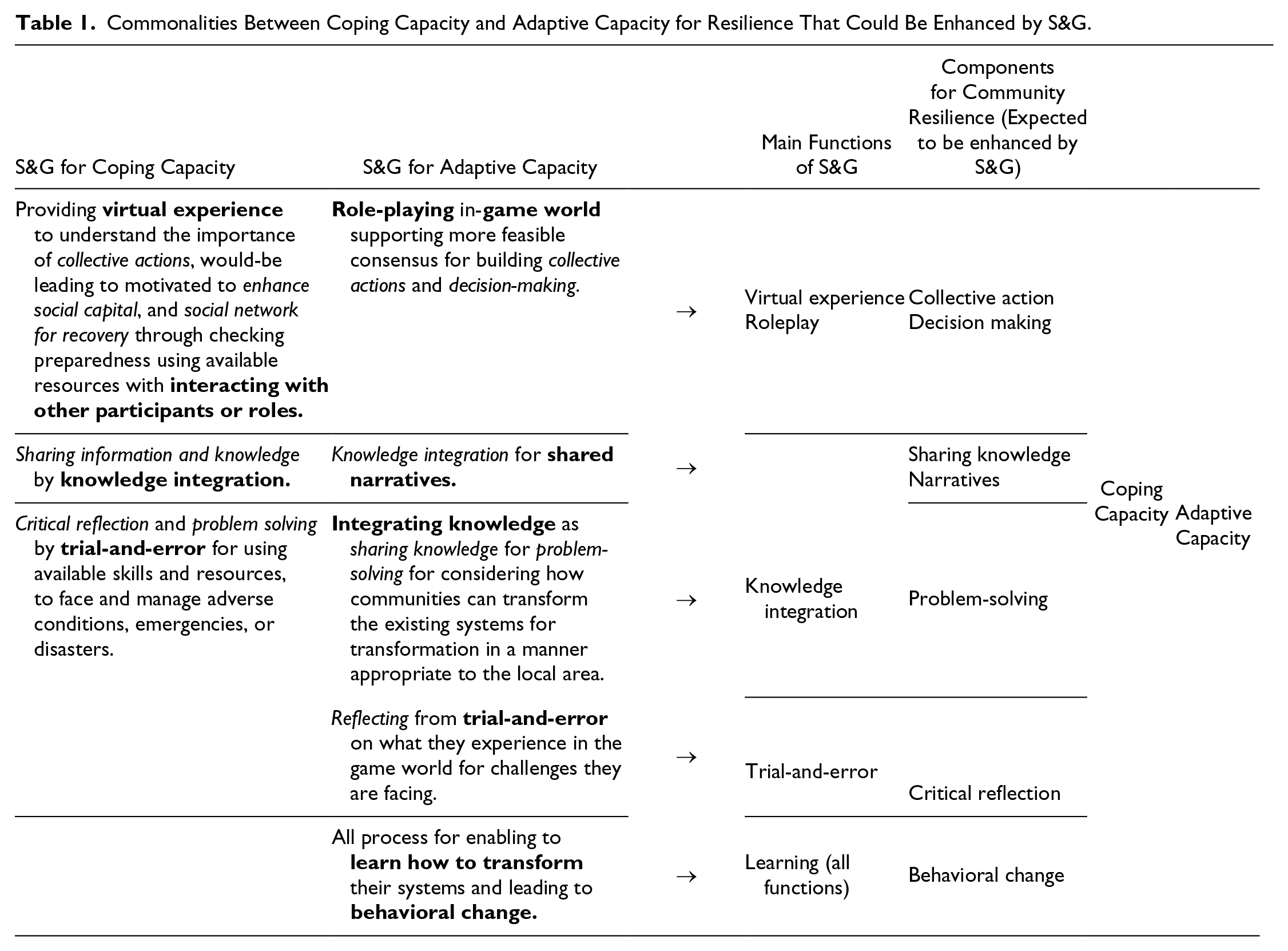
Moreover, it can be understood that as long as S&G directly contributes, most of the areas of coping and adaptive capacity will overlap as depicted in Table 1. Transformation requires systems to change, and behavioral change through learning is essential but not compulsory for stability and recovery. The right side of Table 1 summarizes the main functions of S&G and their expected contribution to components of community resilience based on the discussion above.
Commonalities Between Coping Capacity and Adaptive Capacity for Resilience That Could Be Enhanced by S&G.
Achievements of S&G for Community Resilience in the Context of Japan
This section reviews S&G introduced in academic journals in Japan for enhancing community resilience based on the framework discussed above. The term S&G is not popular, and product names often include “game” or “exercise” instead. Moreover, as a method, S&G includes different aspects; some contain many aspects mentioned above, while others contain only some of them. Some adopt more game aspects, while others contain both game and simulation aspects. It is not easy to differentiate between what is and is not S&G. Table 2 shows the number of papers (including proceedings, introductions to study groups, reports, etc.) found in one of the major academic paper search engines in Japan, CiNii, by searching for the keywords “Game,” “Gaming,” and “Disaster Management” but excluding “Game Theory” (in Japanese, these are Ge-mu, Ge-mingu, Bousai, and Ge-mu Seor-i or Ge-mu Ron, respectively). Table 2 shows that “games” for disaster management have gained popularity in academic domains since the 1990s when the Great Hanshin-Awaji Earthquake hit, while papers including “gaming” are limited and started to be published in the 2000s. On the other hand, papers including “game” or “gaming” in their titles are limited.
CiNii Search Results for Papers With Game (Gaming) and Disaster Management Excluding Game Theory.
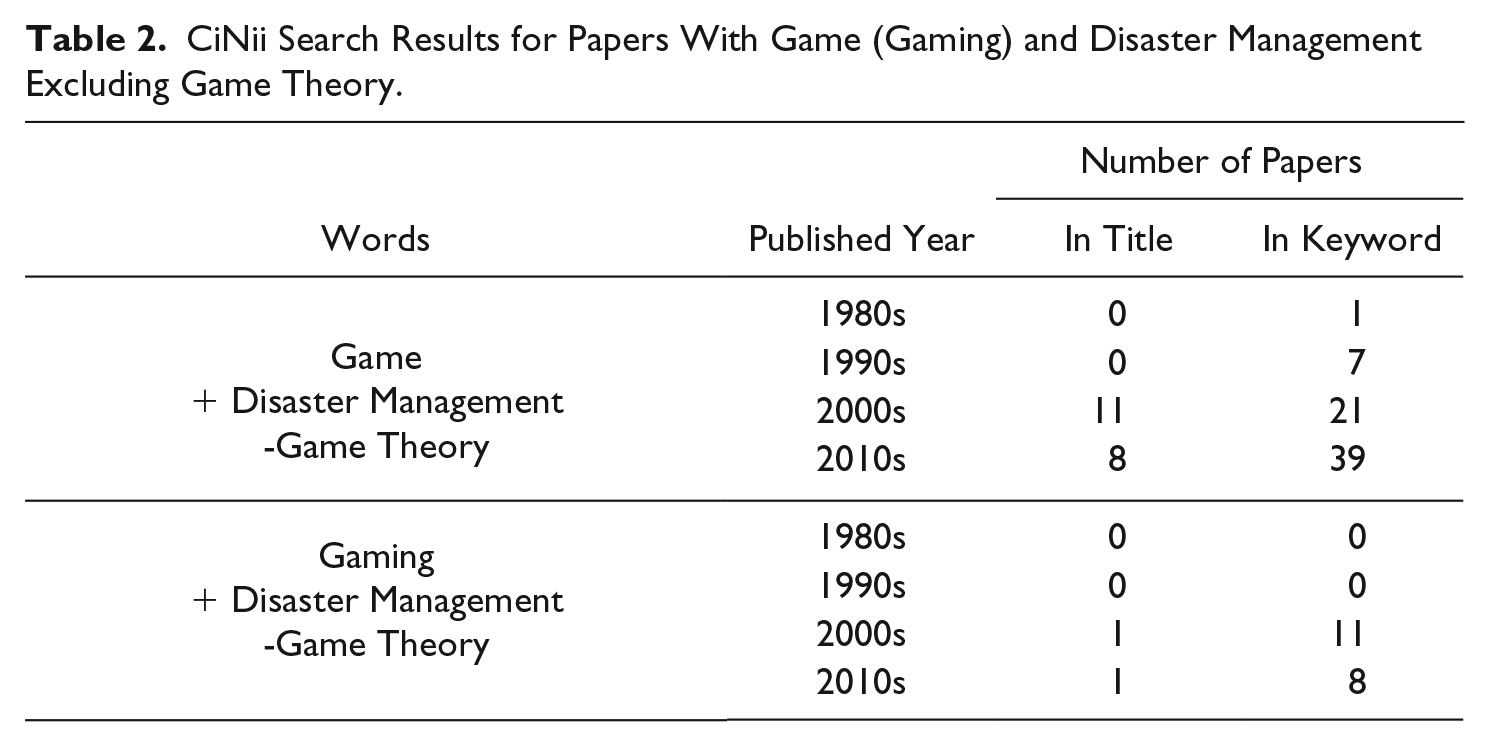
First, the S&G achievements related to community resilience were traced from the results in Table 2. The author focused only on journal papers whose contents are available through CiNii. Also reviewed were the journal and proceedings published by the Japan Association of Simulation And Gaming (JASAG) within the last 10 years, including papers by researchers based in Japan published in post-proceedings of ISAGA2015 (The 46th Annual Conference of ISAGA [International Simulation And Gaming Association]), held in Kyoto. After reviewing the papers and checking whether games were played in local communities (not by school children), and whether the papers were published only in proceedings, further studies were checked on the games and adopted if the games were published in journals, post-proceedings, or books to make sure the studies were completed to a certain extent. If not, the games were excluded.
Moreover, once a game was determined to be reviewed, related literature on the game, such as books and other proceeding papers, were also reviewed for further information if needed and available. This process revealed that some games were discussed in several papers by different authors. As the purpose of this paper is to review games, the explanation below is based on S&G as products and not on papers. 7 Five games were identified, all of which deal mainly with large-scale earthquake scenarios.
Description of S&G
There is no unified way of describing S&G, and each author introduces them to readers in different ways, including the works analyzed in this paper. Klabbers (2018) proposed that a comprehensive and coherent view on game science is needed that connects three levels of inquiry: philosophy of science, science, and practical (application). The philosophy of science level includes all inquiries concerning the source of knowledge of a scientific discipline. The science level focuses on methodologies and is responsible for the scientific aspects of a discipline. Then, the application level addresses practical problems in the real world.
To evaluate S&G for enhancing community resilience, the practical (application) level is the scope of this study as this paper focuses on S&G’s contribution to community resilience. Related to the components of S&G, Klabbers (2009) suggested three interconnected building blocks that S&G should include: actors (in this paper, referred to as “player”), rules, and resources.
Moreover, Klabbers (2018) required S&G designers to define social organization (the interactions and communications of the players), a substantive corpus of assertions (normative and descriptive rules that connect allowable actions and objects), and a range of media representing the S&G resources. As the substantive corpus of assertions is based on various types of rules about how to interpret and act on the world, combining these two categorizations, Klabbers (2018) showed a representation of the generic structure of S&G linked to faces of knowledge, shown in Table 3. The S&G explanation below follows his idea and explains S&G in Japan with this generic structure of S&Gs.
Representation of the Generic Structure of S&G Linked to Faces of Knowledge.
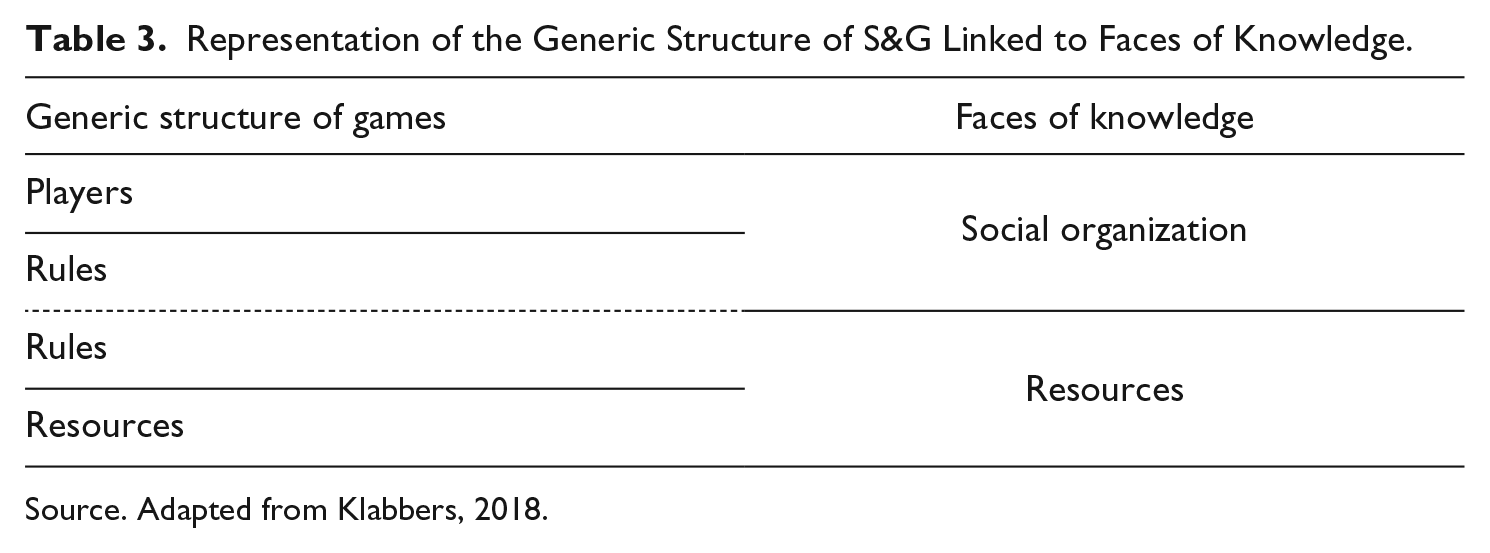
Source. Adapted from Klabbers, 2018.
Klabbers (2018) also raised a key question: “How do we ensure that professional games meet the purposes that the designer and user had in mind, and if so, under which conditions?” (p. 209) He continued that S&G are notoriously difficult to evaluate. Although this paper focuses on the practical (application) level, it must be admitted that “the designer’s and player’s intentions may not mesh with each other” (Klabbers, 2018, p. 215). Therefore, the analysis below is based on the premise that an evaluation of S&Gs would focus on the surface of S&G experience described in papers and would not be able to grasp the tacit knowledge of players.
CROSSROAD
The first game, CROSSROAD (Aziro et al., 2011; Kikkawa et al., 2009; Yamori et al., 2005), was designed based on the experience of Kobe City Officers when the Great Hanshin-Awaji Earthquake hit in 1995. Through interviews to collect experiences related to decision making, its designers found trade-offs between choices to be taken, e.g., whether or not to use a school field for setting up temporary houses even though doing so would not be preferable when considering the restart of the school. The objective of this game is to help players recognize that we might not have necessarily correct answers in disastrous situations and that decision making must take into account local conditions. The original game aimed at governmental officers, while other versions were developed for citizens. The target of this paper is the game meant for the community.
Players
The game starts with cards that show decision making statements. The cards clearly indicate players’ roles. Players form a group of 5 to 7, and one of them reads out the statements.
Rules
Each member judges YES or NO in each situation and shows the other members the appropriate card indicating YES or NO. Basically, if one’s opinion is the majority, he or she receives one point. In each situation, the group members discuss their thinking and reasons. Then, they show their decisions again to the other members (players can change their opinion after the discussion). This process continues with several cards, each presenting a different problem statement. Although the game assigns points, meaning that the players compete against each other, the purpose is for the players to share their opinions and recognize that they need to make preparations to avoid trade-off situations or reach a consensus about what to do based on local conditions.
Resources
The minimum required resources for playing the game are cards with problem statements, YES and NO cards, and a way to keep track of points (cushion cards in the game).
Contribution to Community Resilience
The game can be applied to a variety of fields in community resilience. It features group discussions of real-life situations. Its focus is on stability (preparation and evacuation) and recovery (shelter management).
In the game, players can trace trade-off situations and make individual decisions without fear of real consequences. The game provides difficult situations before and after disaster thus offering a disastrous
Contribution of CROSSROAD to Community Resilience.
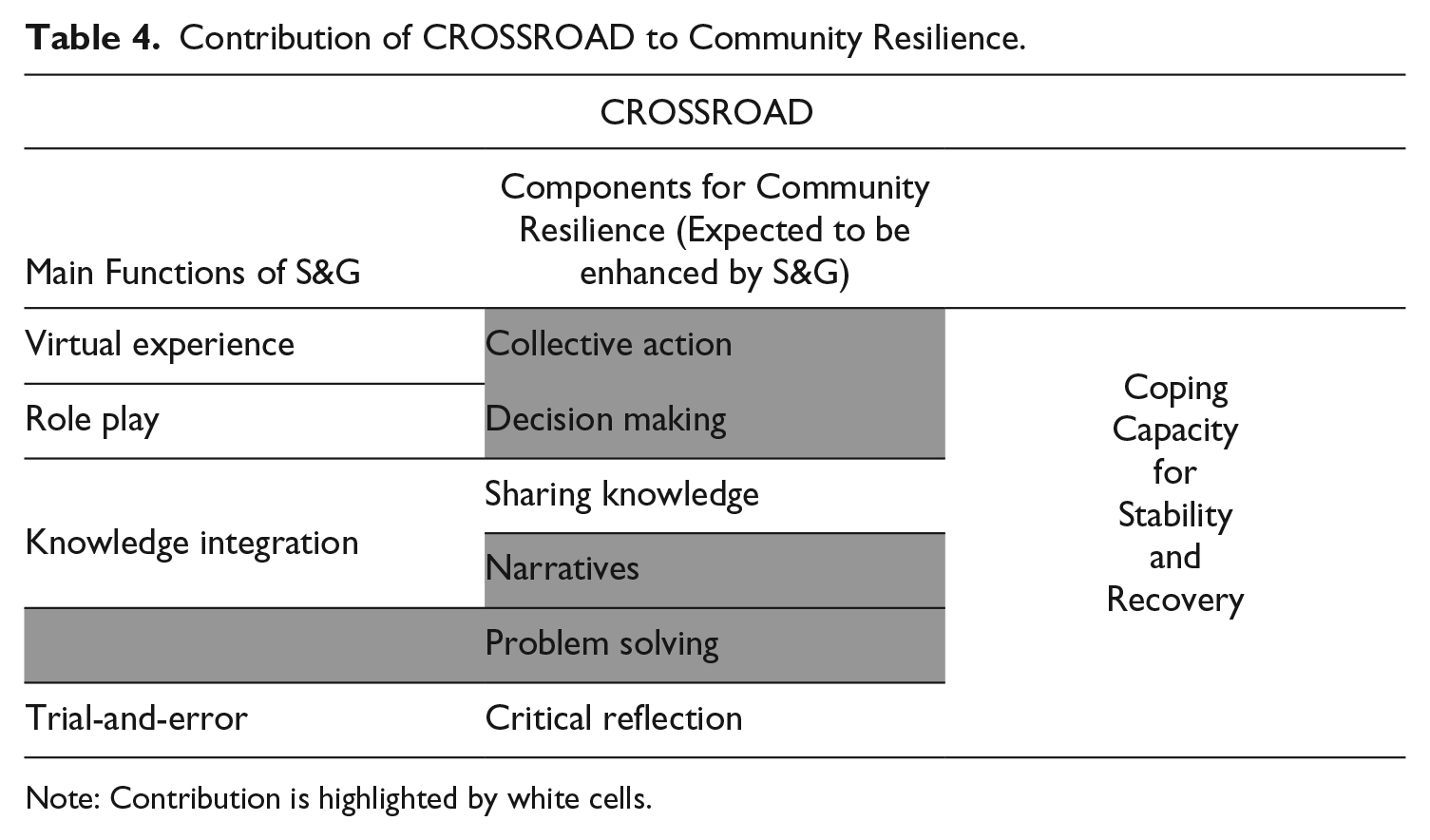
Note: Contribution is highlighted by white cells.
YONMENKAIGI SYSTEM (Four Sides Meeting System)
The YONMENKAIGI SYSTEM was originally developed with the aim of making plans for community activation in a mountainous and depopulated area (Na et al., 2015). The objective of the game is to overcome two challenges in disaster management contexts: people’s avoidance of thinking about disasters and of the creation of disaster management plans that will be never implemented. It prompts players to think from different viewpoints through role-play and debating the feasibility of ideas.
Players
Each player is located on one side of a square. The roles may be flexible, but typical examples are Management Group, Public Relations and Information (PR) Group, Human Resource Group, and Physical Resource Group.
Rules
Resources
A Yonmenkaigi chart and post-its are required for the game. Also, big pieces of paper are needed for the SWOT analysis.
Application to Community Resilience
The original theme of the game is preparing for disasters, meaning, and stability. However, the game is a method, and its topics to be discussed are based on local communities’ conditions.
Therefore, it was implemented in a community affected by a flood disaster in Korea as a method for community disaster recovery planning (Na, 2016; Na et al., 2015) and in the earthquake affected area of the Great East Japan Earthquake (Minami et al., 2014). Although the previous case study focused on disaster prevention camp at a disaster-affected area, the latter research discussed the transformation view of resilience by incorporating YONMENKAIGI SYSTEM as a part of activities.
The virtual experience is represented by the debate on the feasibility of activities suggested based on players’ assigned roles. Therefore, it is not based on the
Contribution of YONMENKAIGI SYSTEM to Community Resilience.
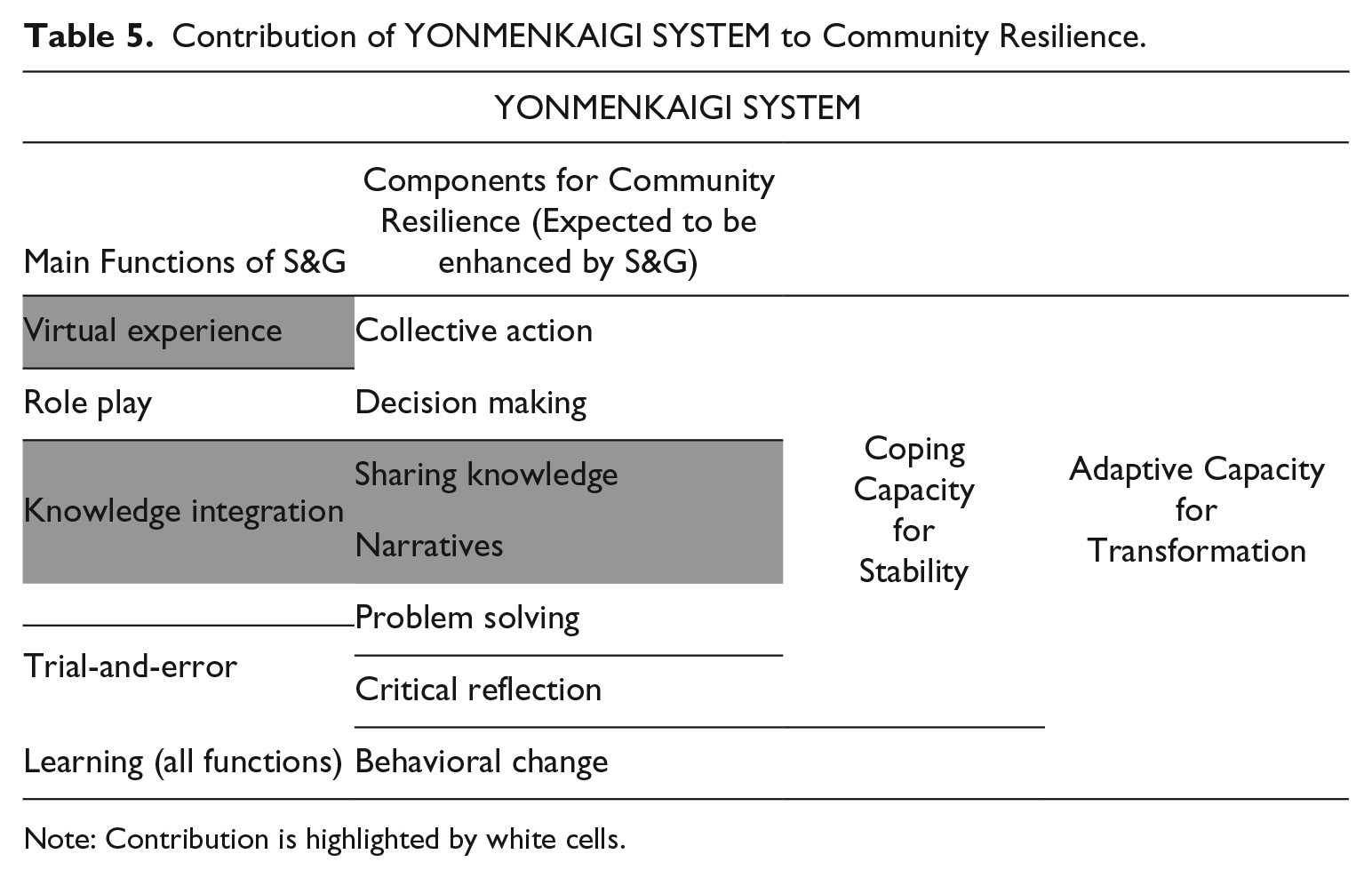
Note: Contribution is highlighted by white cells.
EVACUATION SIMULATION TRAINING (EST)
EVACUATION SIMULATION TRAINING (EST) was designed to reproduce community evacuation situations and implemented as a part of community-based disaster management activities (Toyoda & Kanegae, 2014). The objective of the game is to let participants experience a simulated earthquake evacuation that includes unexpected or unpredicted situations. The players are expected to identify problems and find feasible solutions. The game could be applied to school disaster education by making use of S&G aspects of a virtual world, meaning, setting a school building as the community area (Toyoda, 2018), the review here focuses only its application to a community.
Players
The original game assigned the roles of healthy residents, injured residents, residents buried alive under collapsed houses, and those who had received wrong information about temporary evacuation sites.
Rules
Players follow their assigned roles and evacuate from their own houses to an evacuation shelter via one of the temporary evacuation sites. During the evacuation, they draw cards and are assigned situations concerning a real community area. They proceed through these situations, which include roads blocked by collapsed houses, etc. Evacuating by oneself is important; however, helping other players (mutual-help) is also important, as learned from the Great Hanshin-Awaji Earthquake. This is not an evacuation training for individual players to learn where to evacuate, but for the whole community to understand what an evacuation of the whole community area would look like after a large-scale earthquake. Thus, even players who know the location of a temporary evacuation site need to go to a wrong site if instructed by the role cards, because some residents may not know the location of the site.
Resources
Role cards and situation cards are needed. The former are distributed to players, and the latter are also given as a booklet or attached to the game field.
Application to Community Resilience
This game simulates evacuation situations, categorized into stability, to cope with disturbances until the next state (living at an evacuation shelter).
With evacuation as
Contribution of EVACUATION SIMULATION TRAINING to Community Resilience.
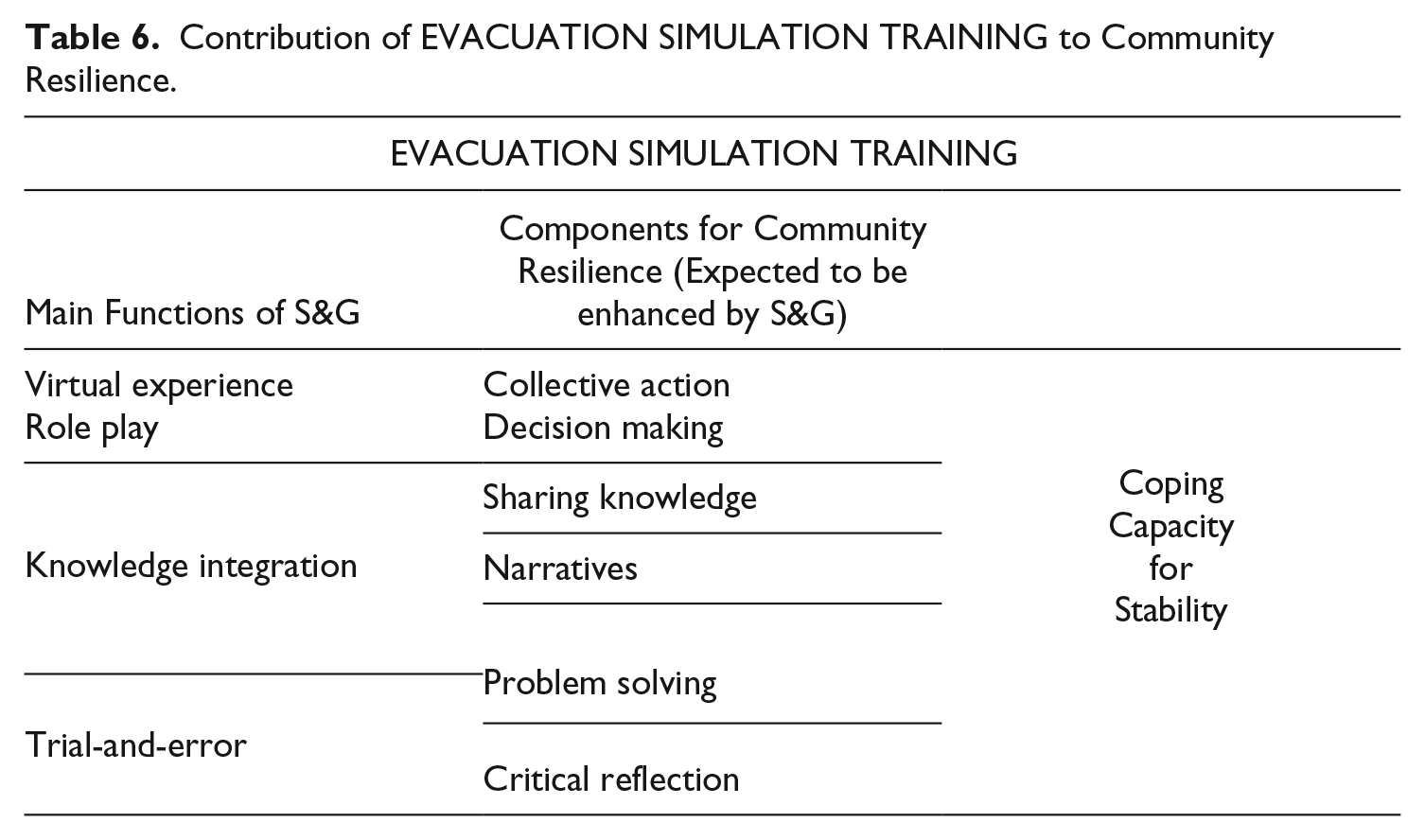
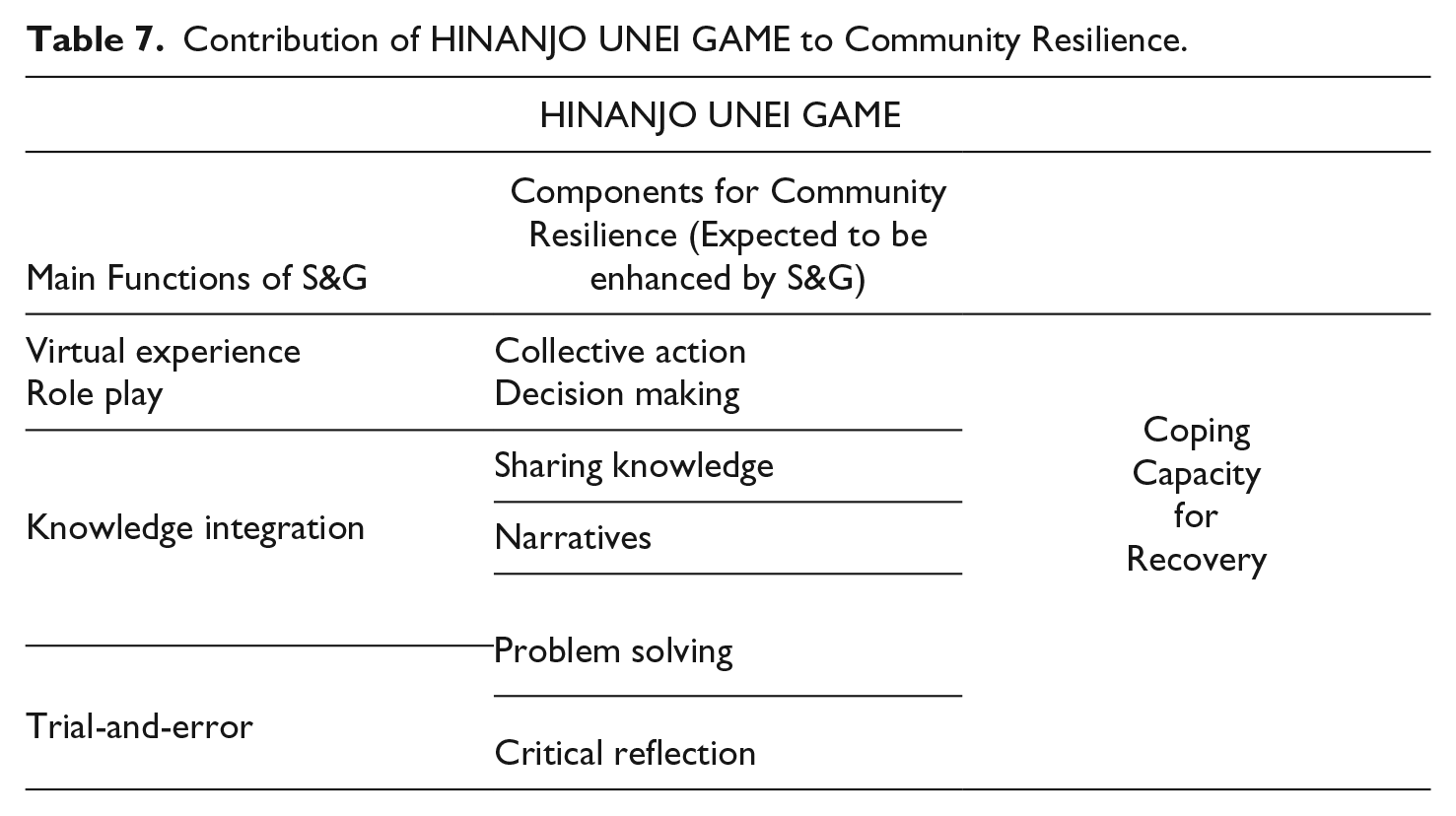
HINANJO UNEI GAME: HUG (EVACUATION SHELTER MANAGEMENT GAME)
HINANJO UNEI GAME (HUG) was developed for communities to prepare for evacuation management (Kurano, 2017). After a large-scale earthquake, as mentioned above, communities in Japan would be expected to manage evacuation shelters. However, the community leaders may not be safe or able to carry out such duties. Therefore, the objective of the game is to help community members other than leaders understand how to manage the shelters by simulating shelter management. The game targets the first day of earthquake.
Players
Evacuation shelters are primarily managed by community leaders (of neighborhood associations or community-based disaster management groups), and players in the group discuss to make decisions to cope with situations based on their roles as leaders.
Rules
One player in the group reads out situation cards, and all the players think over how to cope with the situations, such as deciding locations of stay and sleeping arrangements for a variety of residents and visitors coming to the shelter, plus solving problems at the shelter such as complaints about snoring. Players need to cope with over 200 situations (cards), and the players have a limited time to address them all. Basically, the time given to the players is too short, reflecting the chaos that might take place at shelters and the need to make quick decisions and to prepare to cope for such situations.
Resources
A map of schools and buildings are provided, and players locate evacuees or equipment such as temporary toilets on the map. There are over 200 situation cards to be placed on the map when the issue is handled (e.g., locating an evacuee in a place where he or she can stay, such as at the school).
Application to Community Resilience
This game is applied to many other situations such as aid stations that treat the injured, and is ideal for experts in this situation (Morimoto et al., 2017). Nonetheless, the phase of the game is fixed to the early stages of recovery with the aim of going back to the original state, and this paper focuses on the role of the community.
Players can
Contribution of HINANJO UNEI GAME to Community Resilience.
SASKE-NABLE
SASKE-NABLE was developed based on experiences related to a large evacuation shelter that opened after the Great East Japan Earthquake. The objectives are for players to become aware that (a) an evacuation shelter management should be considered based, not on controlling evacuees, but on facilitating their recovery with respect for human rights and the happiness of diverse evacuees and (b) given the unexpected conflicts/troubles that can occur at evacuation shelters, flexible responses are needed rather than reliance on preset instructions in a manual (Otsuki et al., 2016). The name comes from “sustainable” and sasuke-nae (“no problem” or “never mind” in the dialect of Fukushima area).
Players
Players are assigned roles that involved big evacuation shelter management, such as local government officers, social welfare council staff, NGO staff, and facility managers of evacuation shelters, community leaders, plus students.
Rules
In a case study (Otsuki et al., 2016), the game scenario took place three weeks after a large-scale earthquake. The game process is composed of four phases. The first phase is briefing followed by the practice phase that consists of grouped players discussing and making decisions for suitable solutions to conflicts or problems in an evacuation shelter, raised by a facilitator. Each group presents solutions and reasons, and each player votes for the best solution, excluding his or her own group’s solution. The team whose solution has the most votes earns points. After that, the facilitator gives the players five strategies of successful evacuation shelter management. The third phase is the game part. The same procedure as in the second phase continues for two or three problematic and dilemma issues, and the groups have a chance to rethink the solutions offered previously and identify alternatives. This phase is followed by debriefing as the fourth phase. The group with the most points wins the game.
Resources
The game can be played without any resources, although preparing equipment for promoting discussion and presentations is desirable.
Application to Community Resilience
The scope of this game is problems and dilemmas in evacuation shelter management, while HUG focuses on the beginning phase of shelter management, both categorized as recovery to the original state. In the game, players experience problems faced in evacuation shelters in a safe and risk-free environment and provide solutions to problems through evaluation by voting as a means of giving feedback for the better acceptability of solutions.
This process has commonality with CROSSROAD, although players
Contribution of SUSKE-NABLE to Community Resilience.
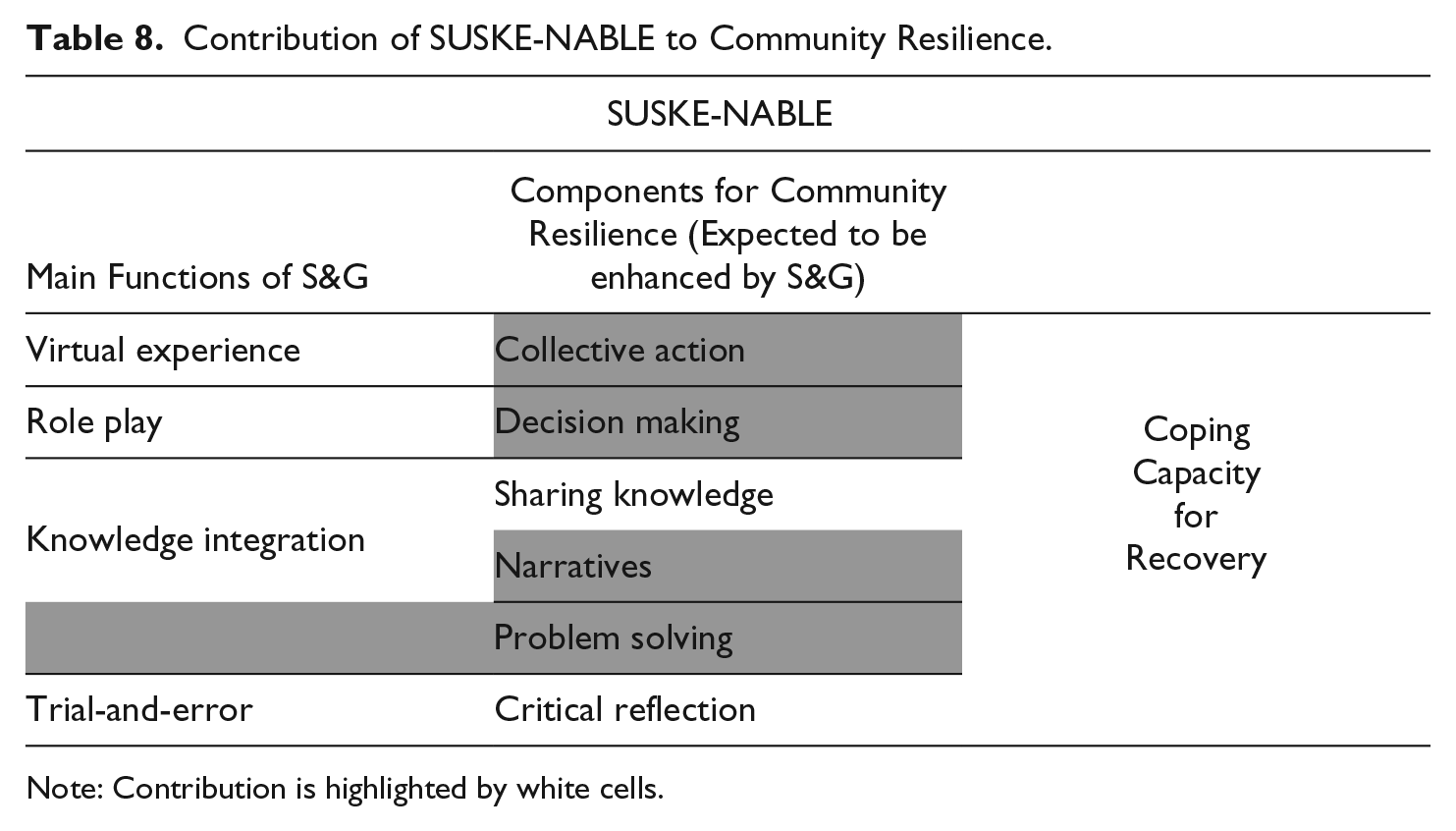
Note: Contribution is highlighted by white cells.
Achievements of S&G for Community Resilience
Five games were reviewed, and the results are summarized in Table 9 which changed the order of the games according to explanation hereafter. The review showed that CROSSROAD could target both stability and recovery; however (and therefore), it needs further steps to reach collective action, decision making, and problem solving. YONMENKAIGI SYSTEM also covers two views; however, it lacks some components.
Achievements of S&G for Community Resilience in Japan as of 2018.
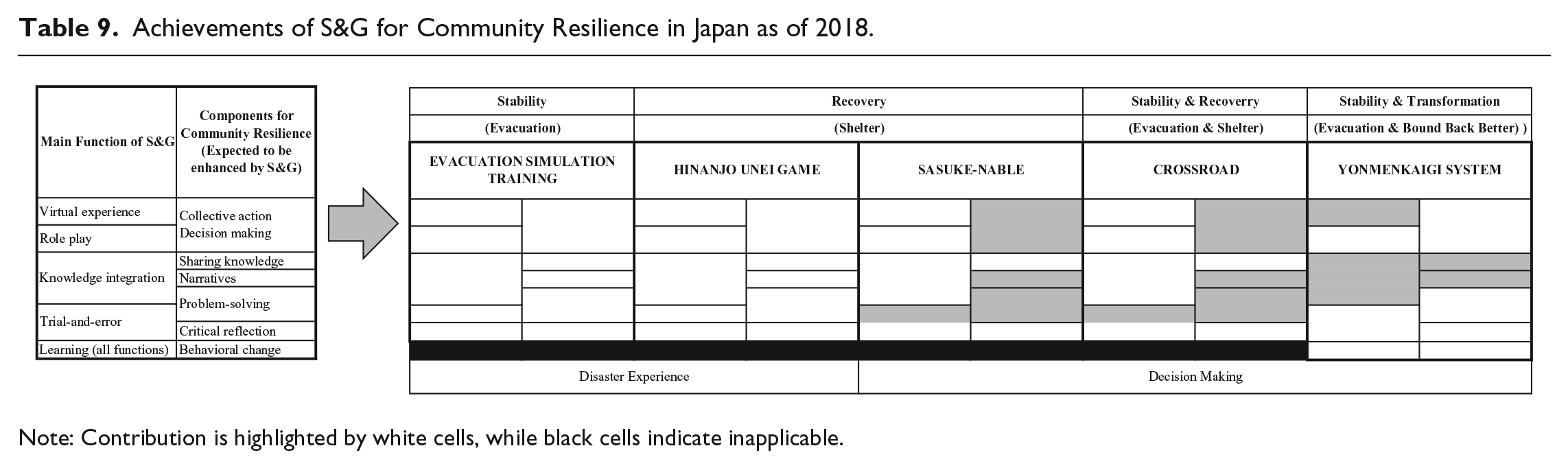
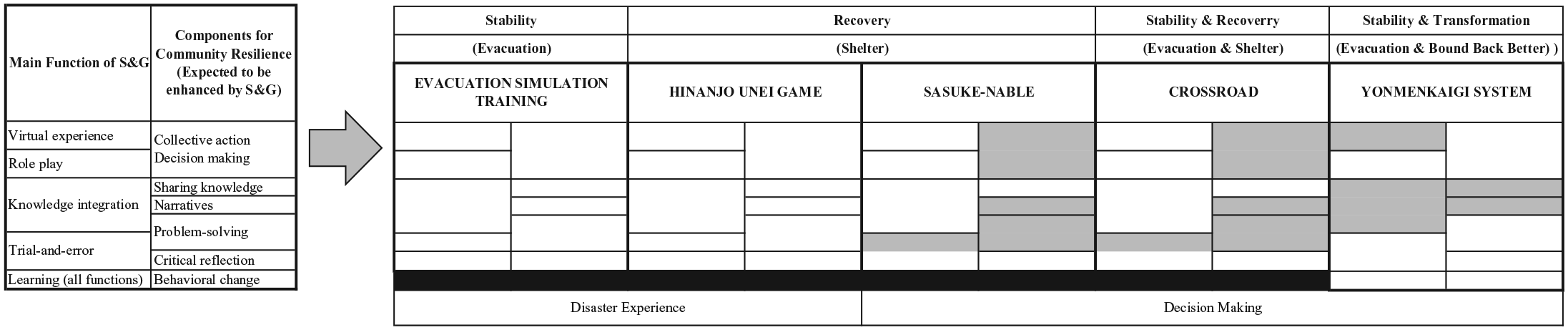
Note: Contribution is highlighted by white cells, while black cells indicate inapplicable.
These games do not treat some components directly, and therefore they can be utilized for other views. If a game focuses on the interaction among residents for decision making or communication as experience for difficult decision making, which is common to different views, then the game could be applied to several resilience views. This could be a hint for SASUKE-NABLE to expand its views. On the other hand, if a game is full of disastrous virtual experience, then the game is disaster-context specific and, its application is for one of the views.
Therefore, it could be summarized that games for community resilience in Japan focus on disastrous experience and decision making. From the discussion above, the achievements are demonstrated by the spectrum where in games that stress devastating experience with specific resilience views are at one side, while games that are focusing on decision making for critical reflection from other players with more extensive resilience views are at another side (Table 9).
Conclusion
This paper first explained the importance of the community in disaster management and community resilience. Then, it clarified the theoretical advantages of S&G for enhancing community resilience with coping and adaptive capacity. It proposes a conceptual contribution framework of S&G to strengthen community resilience against large-scale earthquakes. Finally, although the number of games reviewed is limited, it found that the S&G for community resilience against earthquake focused on experiencing disastrous situations or decision making, and the former can be applied for specific resilience view while the latter for several resilience views.
Although the practices described here are important for Japan, the findings of this paper can also contribute important knowledge to other countries that suffer from earthquakes. This includes economically developing nations that may lack sufficient budgets for disaster management, such as Indonesia and the Philippines. In such cases, financial conditions force the government to rely more on soft measures. After the strength or weakness of earthquake disaster management is evaluated in these countries, S&G activities can be introduced by matching the weak points and advantages of S&G with this study’s findings on resilience (enabling participants to simulate disastrous situations so they can learn how to manage various situations using trial-and-error or a decision making process for disaster management with a view from stability and recovery to transformation). For example, CROSSROD was applied in Thailand (Paksuchon, 2011), and the framework proposed in this paper would enable researchers to judge which S&Gs (including new ones developed in the future) would be more appropriate in given conditions. In this sense, this paper can serve as a basis for researchers and practitioners of earthquake disaster management to consider S&G applications in their own countries.
Moreover, future S&G in Japan could contribute to enhancing community resilience more in the area of transformation views with disastrous experience. In this transformation view, a variety of attempts were made after the Great East Japan Earthquake. One of the challenges possibly related to S&G is Geo-Design. Geo-Design makes use of Geographic Information System (GIS) and digital maps for community development and consensus building with cooperation among city planners, other relating specialists, and communities. As Hanaoka et al. (2016) pointed out, based on digital maps, stakeholders or players make land-use plans in a group by overlapping a variety of maps, such as hazard maps and evaluate plans proposed by other groups. Although they assigned roles only when the activity was conducted with students, general communities can also consider various roles to understand the viewpoints of different stakeholders, and this can be combined with simulation results of disasters for feedback on their decision making with trial-and-error in virtual world. Knowledge integration is also possible with the combination of simulation embedded with scientific and experiential knowledge and participating community’s experiential and local knowledge, potentially leading to behavioral change for transformation. The contribution of S&G to community resilience could expand if it is combined with other methods of enhancing community resilience.
Footnotes
Declaration of Conflicting Interests
The author declared no potential conflicts of interest with respect to the research, authorship, and/or publication of this article.
Funding
The author disclosed receipt of the following financial support for the research, authorship and/or publication of this article: Research Grant of the Foundation for the Fusion of Science and Technology; Grant-in-Aid for Early-Career Scientists (18K13972); OIC Research Institute: Program for major research institute, Research and Development Institute of Regional Information of Ritsumeikan University; and Kinugasa Research Institute: Program for major research institute, Institute of Disaster Mitigation for Urban Cultural Heritage of Ritsumeikan University.
Notes
Author Biography
Contact: