



Abstract
Background: Services have tangible and intangible aspects. Services are organized as a system of conceptual ideas (
Method: Game sessions were organized to support the
Results: Even as participants were designing services for the future, they realized the possibilities of space in their current services and made use of these soon after the game sessions.
Conclusions: Games in service design can be insightful as much as transformative.
Keywords
Services are generally considered intangible because they are not bound to an objective physical reality (Bebko, 2000). However, services are also believed to produce an artificial space that shapes the providers’ and the customers’ actions (Bitner, 1992). This contradiction between the tangibility and the intangibility of services has been a major challenge for designing services. It is not possible to design services as fixed spaces, but it is also not possible to design services as procedures detached from physical grounding.
To the best of our knowledge, the available literature related to services does not tackle this contradiction. Authors recommend stimulating value co-creation between customers and providers (Prahalad & Ramaswamy, 2004; Ramirez, 1999), changing the logic of doing business from delivering products to offering services (Vargo, Maglio, & Akaka, 2008), and systematically analyzing the constellation of resources that constitutes services as a complex system (Maglio, Vargo, Caswell, & Spohrer, 2009). They do not address the tangible aspects of services. The service design approach is perhaps an exception, taking into account both the tangible and the intangible aspects: people, infrastructure, communication, and artifacts (Mager, 2008; Polaine, Løvlie, & Reason, 2013; Stickdorn, Schneider, & Andrews, 2011).
To identify, plan, and organize these aspects, the service design literature recommends organizing co-design sessions with the project stakeholders (Steen, Manschot, & De Koning, 2011). Co-design here means these stakeholders take an active role in the design process, extending or criticizing the existing ideas but also proposing new ideas and creating shared objects (King, Conley, Latimer, & Ferrari, 1989; Sanders & Stappers, 2008). This is achieved by handing collaborative tools to the stakeholders, such as customer journey mapping (Nenonen & Rasila, 2008), storytelling (van Hulst, 2012), and bodystorming (Oulasvirta, Kurvinen, & Kankainen, 2003).
This study focused on one type of tool in particular: the design game. A design game is a tool that stimulates stakeholders to collectively conduct a design assignment in a playful manner. Design games employ well-known board games techniques such as role-playing, turn-taking, and make-believe “to deliberately trigger participants’ imagination as a source of design ideas” (Vaajakallio, 2012, p. 218). They are typically less structured than leisure games but draw elements from them to familiarize stakeholders with the design assignments (Sanoff, 1979). The main difference from leisure games is the aim to produce outcomes that may affect the stakeholders beyond the game.
Design games are used in service design to perform in three ways: as a tool, a mindset or a structure (Vaajakallio, 2012; Vaajakallio & Mattelmäki, 2014). For project managers, the design game is a tool to identify stakeholder expectations, whereas, for the game designer, the design game is a structure for the co-design session. These two ways are very different from the way the players experience a design game, for them the game is a mindset to imagine or transcend ordinary life. These three ways point to the emergent performance of design games.
So far, research in service design games has mainly drawn attention to the games’ potential to support the exploration of design options (Brandt, Messeter, & Binder, 2008, p. 54), leaving to a secondary place the potential to change the social relationships between the stakeholders. This can be attributed in part due to the intangible way services are represented in these games — logical diagrams, flowcharts, or rules — and in part due to the way the games are played, as uncommitted exercises of creativity with people who may not even have strong stakes in the service.
Such lack of commitment may be symptomatic of the split between play and work promoted by protestant ethics (Kane, 2005) and organizational functionalism (Sorensen & Spoelstra, 2011). In those perspectives, play is considered an activity that steps outside of the ordinary to establish its own stakes (Huizinga, 1955). The world can be imagined and enacted as completely different, but if a player brings in an outside stake, the magic circle that sustains play activity is broken and everybody gets back to his or her normal activities and roles. Play is meant to represent, not change the everyday life.
Contrary to these perspectives, the aim of this study was to highlight the transformative potential of games in service design by presenting theoretical and case evidence. The first part proposes a conceptual triad to understand games as space for action (Lefebvre, 1991, 2014) and play as a creative activity (Vygotsky, 1967, 2004). The triad is then applied to analyze three co-design projects wherein games help to design services: medical imaging diagnosis, hospital care, and environmental education/leisure. At the end, a cross-case analysis provides insight on the transformative potential of design games at work.
Space and Games in Service Design
In comparison to industrial design and interaction design, service design is considered to have a stronger spatial component (Holmlid, 2007). In spite of that difference, little is known about how to deal with this spatial component in design. A common approach to grasp space in service design is to map the spaces where the service interactions take place (Nenonen & Rasila, 2008), however, these spaces are not necessarily questioned through mapping. Mapping takes space for granted, as a given resource to which service must adapt. The implication is that space is hardly taken seriously as something to be designed together with other aspects that are typically associated with service design: touchpoints, frontstage/backstage, roles, and wayfinding.
One possible explanation for this neglect may be the dominant perspective on how space is understood in modern society: as a ready-made physical form that merely contains furniture and people (Lefebvre, 1991). Within this perspective, it makes sense to leave space outside of the scope of service design, since architects, interior designers, and business developers already have firm grounds on this object. From an alternative perspective, space can be considered a set of social relationships such as distance, demarcation, boundaries, enclosure, centrality, and segregation (Lefebvre, 1991). Architects, interior designers, and business developers often overlook these relationships because they cannot be easily set in stone. In fact, the people who actually enact the service in practice are constantly reshaping these relationships.
This perspective provides an explanation why service design often relies on co-design as a method for designing services. The people who provide or use the service — the stakeholders — are the ones who are going to produce the space of service design. Therefore, it makes a lot of sense to include these people in designing the means of production for such space. In spite of that, the discussions around space in co-design research are still limited to the space of problems, solutions, options, and alternatives, also known as design space (Botero, 2013). Co-design is believed to expand this space with the ideas and insights generated by stakeholders who have a different perspective from service designers, architects, interior designers, and business developers. This metaphorical design space is, nevertheless, very abstract and can easily become detached from the actual possibilities of implementing changes.
Design games are typically introduced in co-design sessions precisely to avoid the detachment between the abstract space of idea-generation and the concrete space of implementation (Vaajakallio, 2012, p. 79). The simple materials these games are based on — board, tokens, cards, and others — do more than representing the space of service design; they actually participate in design with their resistances, affordances, and associated meanings (Eriksen, 2012), acting as a pivot for stakeholders’ actions. Despite this emphasis on concreteness, the realistic depiction of space is believed to prevent the discovery of new possibilities due to fixed meanings (Kronqvist, Erving, & Leinonen, 2013). Hence space being represented in a metaphorical way. A case in point is LANDSCAPE (Halse, Brandt, Clark, & Binder, 2010), a game which represents office space as a series of concentric circles.
The design games included in the present study adopt the representations of space generated by architects as game boards. This was decided due to the stakeholder’s need to learn, evaluate, or change the architect’s design. In fact, the stakeholders were expected to take action about the meanings fixed by the architect during or after playing the game. A realistic representation was essential to achieve this, even as some less realistic representations were also employed.
Game Spatiality
From this initial scenario, we assume playing design games can have consequences beyond the scope of designing services, as part of the ongoing production of space in work. To sustain this assumption on theoretical grounds, we need an intermediate concept between the space of conceptual ideas and the space of physical experiences. This concept should allow grasping the materiality of design games as much as the interactive process of playing them. The existing concepts of play-ground (Huizinga, 1955), magic circle (Klabbers, 2009; Salen & Zimmerman, 2004), and playspaces (Walz, 2010) can already do that, but they focus more on the characteristics of space, different from the production of space, which is our focus here. In line with the production of space theory (Lefebvre, 1991), we expand further the concept of game spatiality proposed by Wood (2012).
The concept of game spatiality is derived from the production of space theory, which states a triad between the perceived, the conceived, and the lived spaces (Lefebvre, 1991). The conceived space is a mental arrangement of form, function, and structure that intervenes in the world by means of construction. It interacts with the perceived space — the social conventions to use space, where to go, how to move, ownership, etc. — and the lived space — space as experienced by its users, with all the meanings, emotions, and other symbolic relationships that users produce within this space. These spaces are not produced in a linear order, but all at the same time and nonstop.
With the purpose of bringing this theory closer to game studies and service design, we have reduced the scope of the triad: the conceived space corresponds to the space of possibilities, the lived space to the possibilities of space, and the perceived space to the game spatiality. The terminology inversion between space and possibilities is a recourse often used in the production of space theory to grasp the dialectics between two opposing elements that interpenetrate each other (Lefebvre, 1983).
Game spatiality is the sense of being in a social space produced while playing a particular game. It is gradually developed by the bodily actions of players trying to understand the game mechanics, position themselves in the game, and act meaningfully. These actions involve seeing and touching the physical parts of the game — tokens, boards, cards, etc., accelerating or slowing down the rhythm of play, listening and responding to other players’ talk, and eventually gesticulating, standing up, bending, and coming closer to another player.
Whereas the sense of being in physical space is given by the proprioceptive muscular-nerve system — which can be measured by kinesthesia tests (Swink, 2009; Walz, 2010), the sense of being in social space is much more complicated to pinpoint (Oksanen, 2013). This social space cannot be measured entirely by regular scales such as extension and volume, for the distances might be based on a different scale (e.g. a qualitative scale). When two players develop an antagonistic relationship with one another they do not need to demarcate physical distance to reflect social distance. Yet, the distance might become visible by an outburst triggered by a rule-breaking action.
Interesting enough, this social distance may be different in the game and outside of play, when the players might be really close friends. Play has this attractive feature of enacting social relationships different from what players are bound or accustomed to in other activities (Huizinga, 1955; Vygotsky, 1967). Distance is not the only relationship that can be modified in play; the possibilities of space encompass coexistence, encounter, imagination, demarcation, and attachment (Lefebvre, 1991), just to mention a few. Players develop these possibilities as they play, not necessarily in a conscious way, limiting and enabling their actions way beyond what game rules prescribe.
Due to the recursive nature of game rhythm, every action in a game changes the possibilities for the subsequent actions (Wood, 2012). Some possibilities may be discussed among the players, some may be considered in player’s thoughts, but the vast majority will remain unexplored. The possibilities considered by players and game designers constitute the space of possibilities and the actual possibilities for action constitute the possibilities of space (Figure 1).
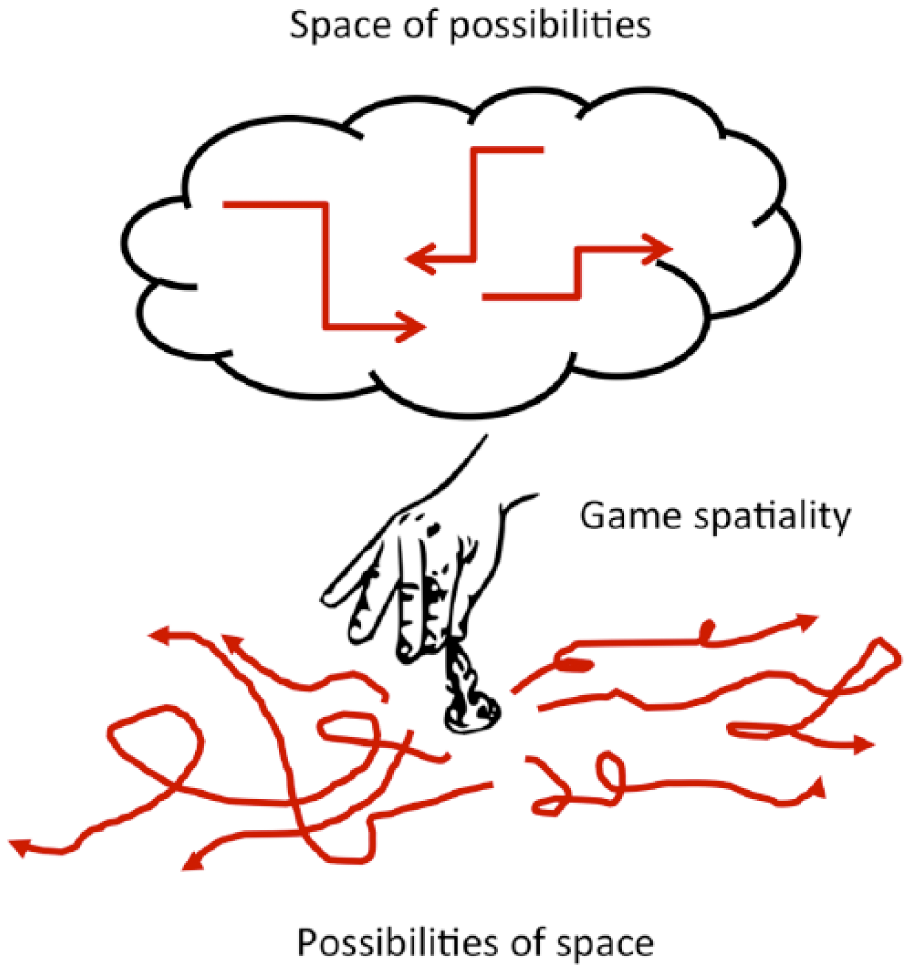
Game spatiality is produced by the player’s interaction with the possibilities of space offered by the game and the space of possibilities considered by the designers as well as by the players.
In this regard, Salen and Zimmerman (2004) stated that “playing a game is synonymous with exploring a game’s space of possibility” and that “defining this space is the collaborative work of the game design process” (p. 165). We developed the counter notion of possibilities of space to highlight that players produce space as much as designers do. The space of possibilities may be pre-defined and structured by the rules, quantifiable outcomes, and necessary choices, but the possibilities of space emerge from the transformations in the collective social history. Players can do more than use the space of possibilities predefined by the designer; they can create other possibilities. In comparison, the space of possibilities is not only smaller than the possibilities of space but also of a different quality: abstract, speculative and arbitrary.
Game spatiality lies in between those two poles, mediating their production. The more immersed players are in game spatiality, the more they might bring the possibilities of space to the space of possibilities, where they are anticipated, evaluated, and strategized. Game spatiality has, therefore, the potential to expand the space of possibilities when facing gameplay breakdowns and the potential to expand the possibilities of space by directly changing game conditions, such as purposefully rolling a dice out of the table to destabilize chance.
Play as Creative Activity
Design games are useful to realize the space of possibilities because they establish a difference between play and work so that new relationships can be experimented with. However, design games are also useful to keep participants focused on the work activity as an object to be designed. Through exploratory actions, players bring the work activity into play, reconstructing their activity in the imagination. Because they can leave out their customary roles and power relationships, they can also reach a sense of estrangement and detachment from the activity, enabling them to be more critical and willing to change.
Play is, on the one hand, an opportunity to step outside of the ordinary (Huizinga, 1955), and, on the other hand, an opportunity to change the ordinary. It is not the mere reproduction of an activity; it is the creation of a new activity through imagination (Vygotsky, 1967). This becomes explicit in a modality of play called transformative social play. “Players use the game context to transform social relationships. They actively engage with the rule system of a game, manipulating it in order to shift, extend, or subvert their relations with other players” (Salen & Zimmerman, 2004, p. 475). In this modality, players’ actions are targeted at the activity being played, not the play activity itself. For example: players raise commitment for the implementation of agreed upon possibilities (Botero, 2013), or they use the game to amplify their spatial agency — the capacity to alter spatial conditions (Awan, Schneider, & Till, 2011) — or even transgress the rules of the activity (Schick, 2008; Zaphiris & Wilson, 2010). These actions might trigger further changes in the activity after playing.
We propose a model for design games in which play becomes a microcosm for experimenting change in work (Figure 2). Work is brought to play by exploratory actions and play is brought to work by transformative actions. Exploratory actions are more concerned with the space of possibilities, whereas transformative actions are more concerned with the possibilities of space; however, they are not fixed only to that. Both actions produce certain spatial relationships. For example, an exploratory action may sort out options to make a decision, while the transformative action that follows it — the decision itself — may increase or decrease the power imbalance between the decision-makers and the other players.
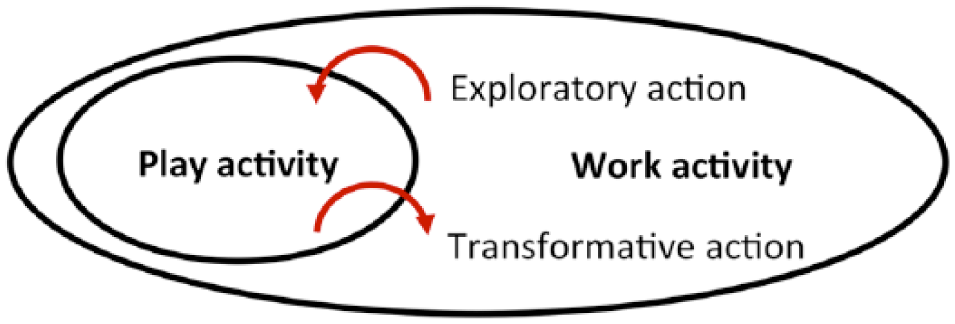
Through design games, play activity becomes a microcosm of work activity, connected to each other by exploratory and transformative actions.
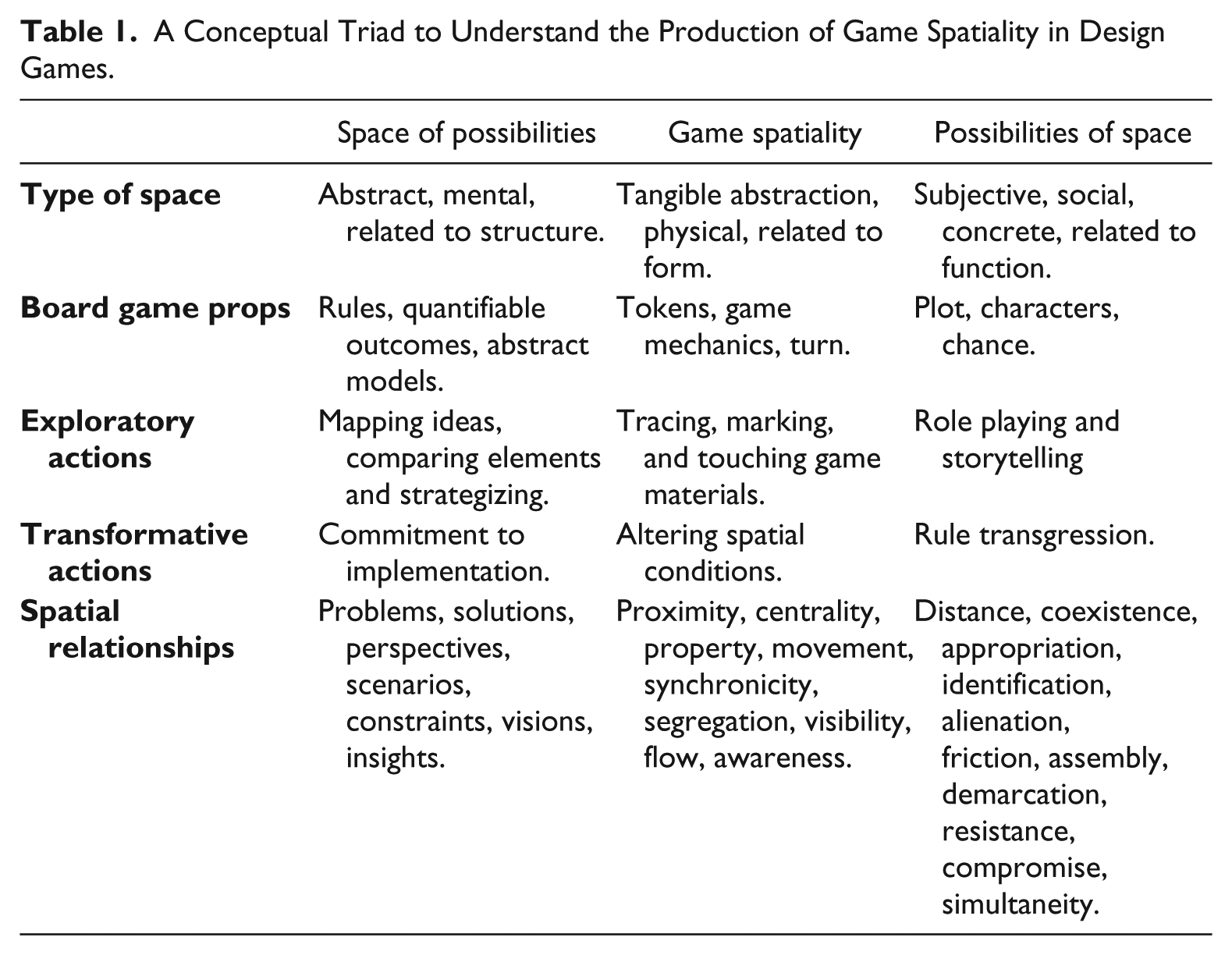
Exploratory and transformative actions constitute play as a creative activity. They may be triggered by game spatiality and be directed to the space of possibilities as well as the possibilities of space. Notwithstanding, these actions may also occur in the absence of a formal game. Co-design sessions, if they succeed in their intent to imagine and change other activities, can be considered play activities even if no design game is employed. For an overview of the conceptual triad and the associated actions, see Table 1.
A Conceptual Triad to Understand the Production of Game Spatiality in Design Games.
Research Method
To evaluate the conceptual triad’s power in explicating design games, we have selected three cases of service design projects in which we had a chance to design such games, observe the play activity, and debrief the play experience with the participants. Our involvement began by interviewing project managers and designers, followed by observations of stakeholder meetings. When appropriate, we suggested including more stakeholders through co-design sessions, in particular, customers and the people who deliver the services. Doing so, we argued services could be designed based on the needs, requirements and change processes expressed by the stakeholders (King et al., 1989; Sanders & Stappers, 2008; Steen et al., 2011). We designed custom-tailored games to represent premises in a way they could be modified and extended by players, yet the initial game state was based on our own interpretation of the issues raised during the interviews.
The number of co-design sessions varied per project, but they all had three moments: 1) introduce the current design and state the desired input from the participants; 2) play one or more design games with the participants; 3) debrief the differences between actions undertaken in play and in work activities, in particular, how some of the playful actions could be repeated as real work actions. In addition to step 3, we conducted debriefing interviews with the participants some weeks after the game sessions to check if any transformation in the design process or in the work activities happened. Debriefing was essential to trace back the transformative actions amongst the many observed. This was done through a close look at the video recordings of the sessions.
The analysis roughly followed the interaction analysis method (Jordan & Henderson, 1995). We selected a few minutes of recording from each project to watch together and discussed what we were seeing. These were specific moments when game spatiality was visibly being produced — mostly at the start of a game. The data interpretation is also based on the collected project documentation, the written notes taken during interviews and meetings, and still pictures.
The case studies that follow are based on our individual accounts, with some additional layer of interpretation provided by the shared discussion. Along the case descriptions, the conceptual triad will be used to punctuate the process and highlight the production of game spatiality. The specific spatial relationships will be mentioned in the text or highlighted in parenthesis. A comprehensive application of the triad can be found in the subsequent cross-case analysis.
Case 1 – Hospital Wards
The first case is about the development of nursing procedures for a new hospital building in the Netherlands. The development was triggered by a decision from the board of directors that in the new wards only single patient rooms will be available. This represents a major change in relation to the current situation with two-to-five patients’ rooms. Early in the design phase, architects used drawings to discuss with wards’ representatives; however, by looking at the maps, the representatives could not grasp the possibilities of space for the nurse work. Some staff members had concerns about the design, such as whether they would keep a good patient overview and whether patients would suffer from the solitude, but these concerns were not included in the space of possibilities. The development of nursing procedures came too late to alter the architectural design, but it opened up the possibility for implementing new technologies with the participation of their users.
In order to explore the space of possibilities set by the architects and to realize the possibilities of space for nursing procedures, a series of co-design sessions were organized in the hospital by the second author, in collaboration with a member from the board of directors. A design game has been developed for these sessions: HEAD, the Healthcare Environment & Activity Design Game. The game is a combination of free miniature roleplaying (Urnes, Weltzien, & Zanussi, 2002) and structured task analysis (Lafrenière, 1996; Muller, 2001). The miniature environment corresponds to a physical representation of the people, products, and spaces involved in the nursing work, whereas the task analysis corresponds to a series of cards with rich information about procedures (Figure 3).
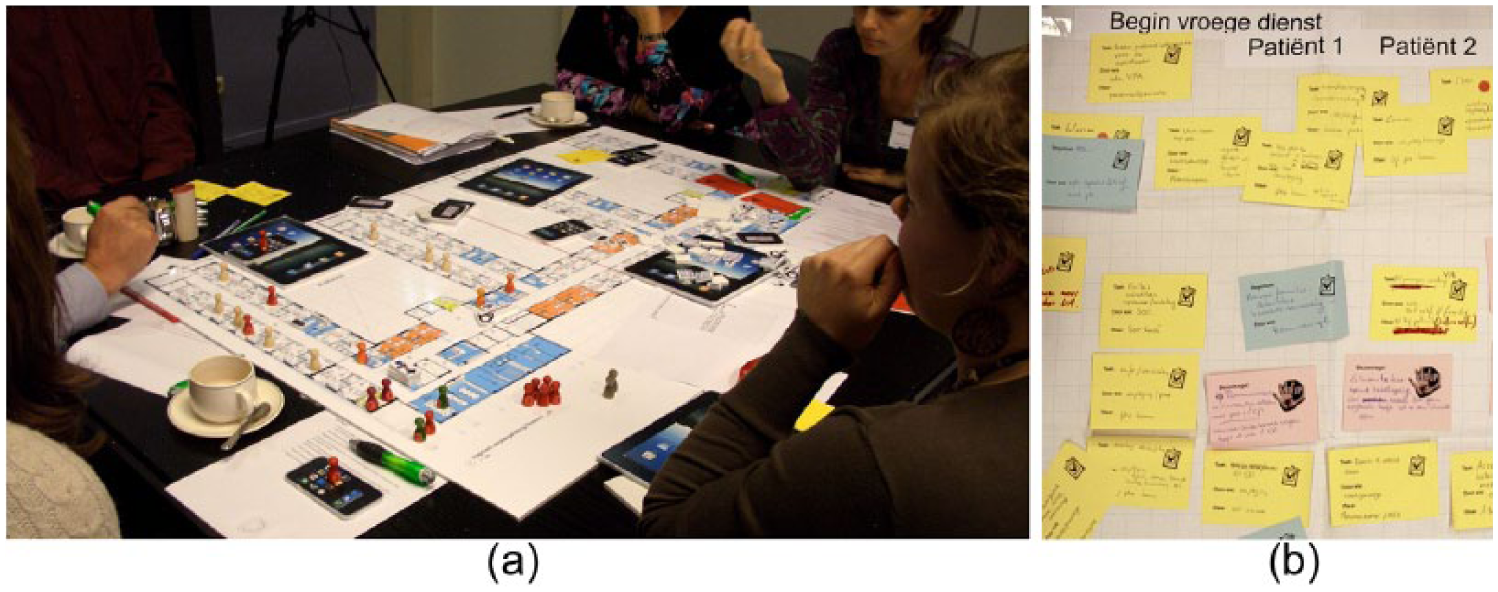
The HEAD game: Current and envisioned nursing activities are played by the participants with the tokens representing stakeholders as well as appliances (a). The card task flow complements the game with a structured representation of the work procedure (b).
The game aimed to enable stakeholders of various backgrounds — from nurse to IT worker — to bring in his or her knowledge and experience. Therefore, play activity was not organized around competition among players, but on collectively imagining the future of nursing activities. To emphasize collectivity, the players were encouraged to take different roles as the game unfolded.
The game board was a map of a nursing ward in the new building, based on the architect’s drawings. Participants moved tokens on the game board to role-play scenarios. The steps taken were made visible by the cards added to the task overview. On each card, participants could write down the responsible person, the location, the information needs and the duration of one task. Special event cards provided a surprise challenge (a problem in the space of possibilities), for example, “what to do in case of a reanimation emergency?” Players needed to discuss how to deal with the events and if they wanted to change the possibilities of space as a reaction.
At the beginning of the session, participants were encouraged to translate their current workflow by playing the current scenarios in the new building. This led to the discovery of problems such as a the sterile disposables being stored very far from where they were supposed to be used (proximity) and opportunities such as the small pantries that could be used for various tasks (simultaneity). The distance between storage and patient rooms led to the solution of a new material trolley for every nurse. Additionally, making the current workflow concrete led to the discovery that each ward had a different work perspective which must coexist (coexistence).
When considering the use of electronic tablets in care, a number of questions related to space were raised: “Where does the nurse enter patient data into the patient file? When? What kind of tools does he/she use?” The position of the tokens on the board triggered the exploration of the possibilities of space; for example, the emotional attachment difference between entering patient data in a quarantined patient room and entering patient data in the staff room.
The tablet concept generated during the sessions had a lasting impact in the project. The patients were supposed to have smart televisions with special functions such as ordering food, but playing out scenarios demonstrated this to be unpractical. Positioned at the wall, the televisions would not be at eyesight level for lying patients (visibility) and the remote controls would make the special functions difficult to access (segregation). The participants did not come up with a solution during the session, but some months later they had the idea of handing tablets to patients as well. The suggestion was accepted since patients could watch television, use medical applications, order food, and play games — all in the same device.
The animated scenario play helped participants to explore the space of possibilities. In a second step, the possibilities of the new technologies combined with the possibilities of space were used to develop a new nursing work activity. Game spatiality highlighted problems and generated insights for the nursing care in the new building. Participating in the co-design session raised the participants’ commitment to the relocation, engaged them in learning about the new technologies available, and stimulated a critical view towards the current work organization.
Case 2 – Medical Imaging Center
The second case is about a medical imaging service, provided by non-invasive scanning technologies that reveal body activity. One Dutch University partnered with a medical devices manufacturer to build on its own campus a medical imaging center for experimental technology such as the hybrid Positron Emission Tomography and Magnetic Resonance Imaging (PET-MRI). The challenge was to combine research, technology development, education, and care in the same center. To make that happen, the University and the manufacturer needed to sign with additional partners: the regional hospitals (including one mentioned in the previous case), which would provide the care services and receive benefit from the research.
After some months of designing with specialists, the managers decided to organize a co-design session with the healthcare professionals from the hospitals. Doing that, they expected to influence the hospitals’ directors in their decision to join the project. The session unfolded as follows. The project managers fixed a printed floor plan prepared by the architect on a wall, stood up beside it and explained the possibilities of space, pointing to the areas on the floor plan as long as they were mentioned. When the discussion got more intensive, the hospital professionals stood up and came closer to the floor plan fixed on the wall. They began to question the design by formulating problem scenarios. They were somewhat annoyed that they had not been involved in earlier stages of design, when the space of possibilities was being shaped. Participants represented their activities using verbal narrative while sliding their fingers over the printed document. Every time an activity was brought to the discussion, it had to be represented again since the floor plan was not being marked in any way. The session ended with many open issues.
The project managers asked help from the first author to organize the next session. The author suggested using a design game to keep participants focused on the relevant aspects of activity and avoid generating too many changes in the floor plan. The game consisted of pushpins and strings representing the patients’ and nurses’ paths when following a certain procedure. The participants were supposed to tie and untie the strings while discussing how to optimize the walking path. Drawing with the strings required more than two hands, emphasizing the representation’s collaborative nature. Another physical rule is that each step in the flow must depart from and arrive at pushpins otherwise it is loosely represented. This tool was named KNITTING GAME since the resulting image resembles a knitting textile (Figure 4).
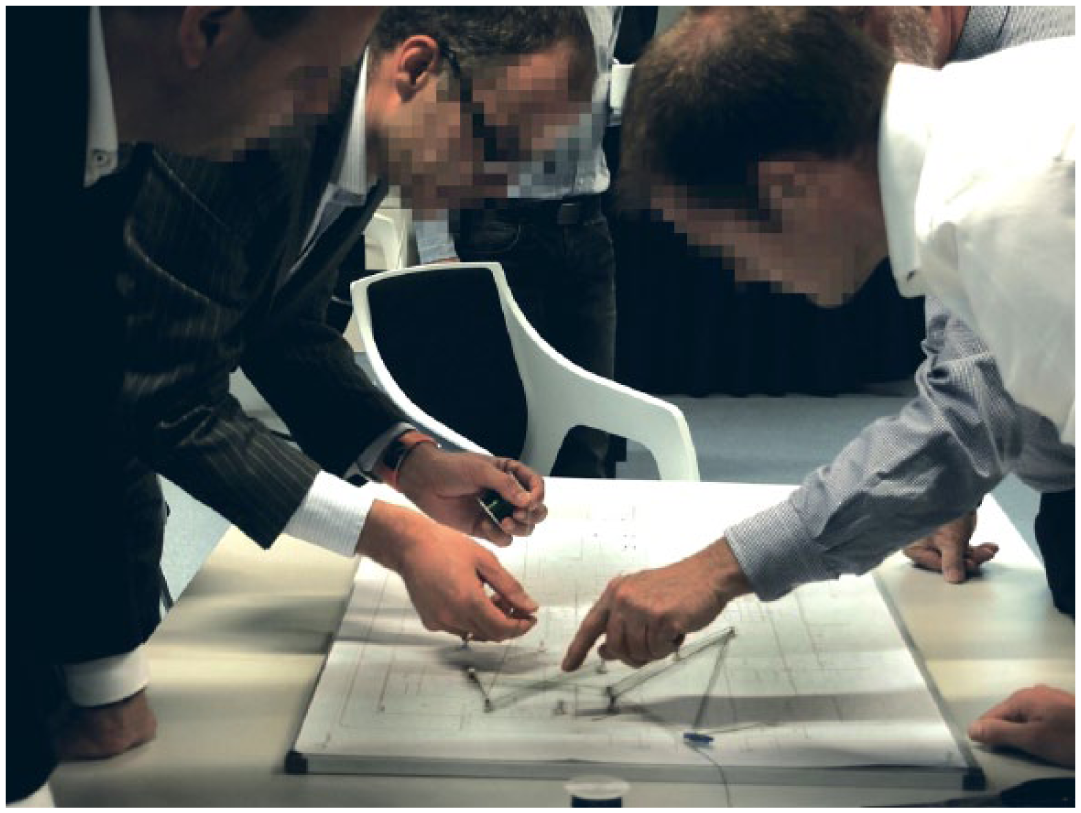
The KNITTING GAME: The blue lines are nurse paths and the green lines are patients. Playing the game revealed an unnecessary back-and-forth movement due to poor room connections.
Managers divided the participants into two groups, according to the activities under consideration: CT scan and MRI scan. Each group had to look at the space prescribed for each scan activity (demarcation). The CT scan group visualized the centrality of the dressing rooms in the process and realized the problem of nurse’s back-and-forth movement between the technical room and other rooms, but they didn’t question the floor plan. In contrast, the MRI scan group identified so many problems on the floor plan that they refused to play the game (resistance). They said it would only make sense playing the game after the space design was improved. The CT texture was brought to the MRI group and both groups discussed altogether from that point on. Later on, an MRI group member asked for a sheet of paper from the architect’s notebook and sketched an alternative floor plan for the area between the CT and MRI machines. Rethinking the floor plan was not what the project manager had in mind (vision), but they realized this was necessary to reach the consensus. They asked the design team to incorporate the sketch in the drawings so the participants could agree with the adjusted version (solution).
The KNITTING GAME was useful only to consider work activity. The floor plan was made inaccessible by the game because the managers did not want to let participants change the possibilities of space (constraints), only the space of possibilities — the walking paths. Since the MRI group could not do the movements they wanted (alienation), they rejected the game and argued for changing the possibilities of space. They managed to change the possibilities of space by sketching their own idea and convincing the manager to incorporate it into the official design (compromise). Game spatiality helped participants to make a point by refusing to play the next move, a common practice when players are feeling the game as unfair.
The co-design session, however, was not enough to convince the healthcare professionals to sign up for the project. Months after the session, the professionals confronted the possibilities of space in the center with the possibilities of space in the hospitals and came to the conclusion it would be unsafe to send patients to the center due to the lack of proper emergency facilities. The negotiation with the University and medical device providers led to the center being incorporated into one of the hospitals, where eventual emergencies could be properly handled (synchronicity).
Case 3 – Nature Center
The third case is about environmental education, nature-related leisure, and food services. Six different volunteer associations for environmental education and leisure joined forces to build a nature center in a public park in the central area of a medium-sized city in The Netherlands. This was done in response to the city hall announcement to close the official nature center, located in the outskirts of the city. The associations would not only take over the activities of this nature center, but also expand the services to become a city-center attraction at the new location.
Aiming for self-sustenance, the associations invited a restaurant to open a branch in the center and share the maintenance costs. The deal was that the associations organize activities for the general public and the restaurant would serve the customers who want to have a meal in between the activities (synchronicity). Both parties believed the synergy between the services would provide a more compelling case to receive permission from the city hall to use the public park (property).
An architect was hired to design the center, but the associations were having a hard time to evaluate his proposals. They could not tell if the space designed by the architect was going to fulfill their needs. When approached by the associations, the first author suggested organizing a co-design session with the aim of clarifying the center’s activities and their spatial requirements. So far, the associations did not have the opportunity to discuss how they would transfer their activities and, most importantly, how the activities of one association were supposed to interact with the activities of another (simultaneity).
The co-design session included one or two members from each association and happened at the existing nature center. The game played during the session had three phases. First, listing and ordering association’s activities according to three time scales — daytime, weekday and season — and, second, defining where in relation to the center these activities are supposed to happen (Figure 5). Keeping this broad scope helped the participants to identify the need for a garden sink and easily accessible toilets both for activities that begin or finish at the center — an assembly point for excursions. Overall, the process gradually moved from issues of time to issues of space, grounding the discussion onto the spatial conditions to perform activities, hence, the name of the game: GROUNDING ACTIVITIES.
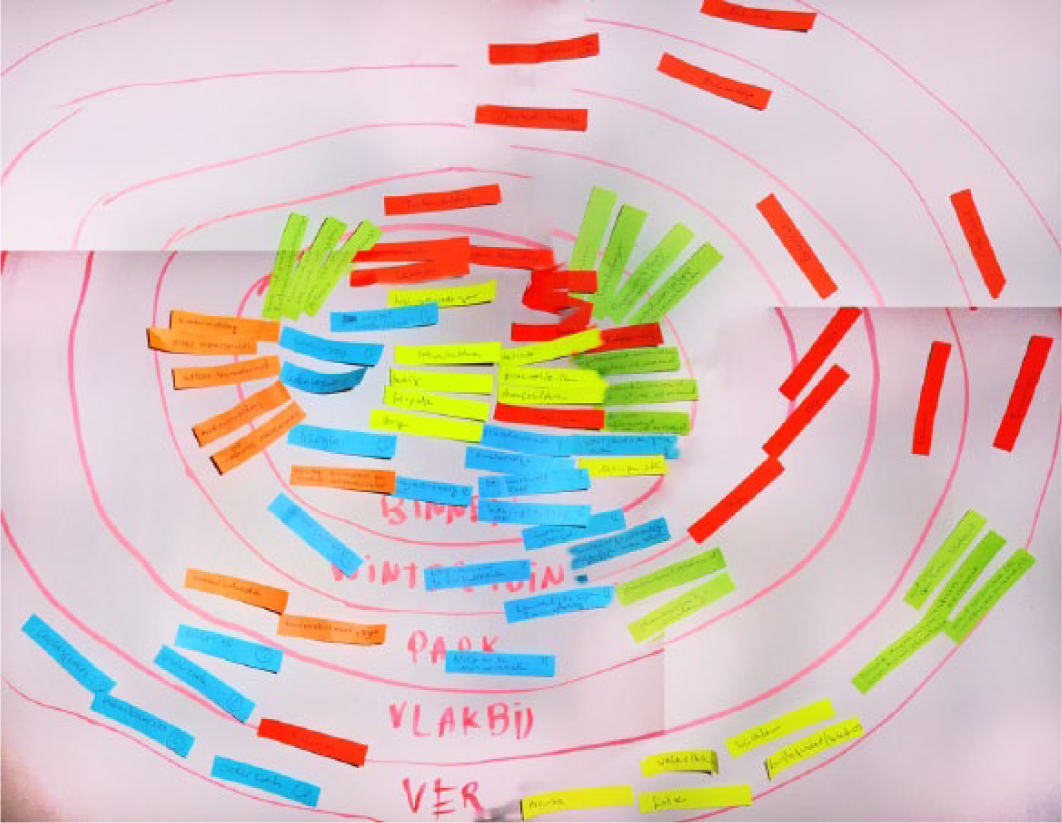
GROUNDING ACTIVITIES, phase two: Neighborhood plan for the nature center activities, represented as labels. The innermost circle gathers the activities to be held inside the center’s building, whereas the outer circles gather the activities to be held far away from the center.
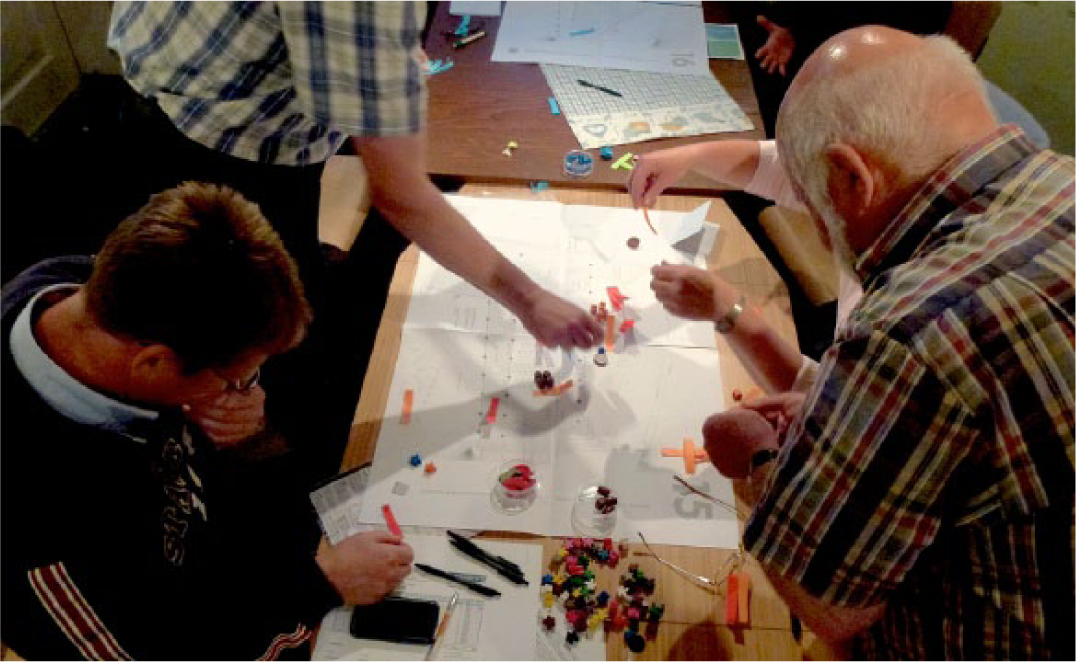
GROUNDING ACTIVITIES, phase three: Participants are encouraged to position their activities in the building and indicate their requirements with board game tokens.
Once all the activities were listed, the participants were ready for phase three: evaluating the architect’s design. The association member who worked closely with the architect introduced the design to the others. Some members did not engage in the discussion because they had difficulties to interpret the design based on the floor plan. After this brief discussion, the members were invited to stick their activities to a room and place additional board game tokens representing requirements and the appropriation of the space. A water drop represented access to water flow; a brown disc represented eventual dirt; a barrel represented the need for storage; a fox represented an exhibition display; and a people token represented a target-group involved with the activity — the elderly, school children or environmentalists.
The board game tokens were put on the plan all at the same time, in a silent move. After participants were done, the facilitator asked about the reason for each token’s placement. A member from the association that lends educational kits to schools surprised everyone by bringing forward a requirement for storage at the office. The storage facility located at the winter garden would not be practical for his activity, since he needed to handle the kits all the time (proximity). Another member asked how much storage space would be needed at the office, but he could not tell exactly. He could only say the office would not offer enough space for working with the educational kits. A heated discussion followed, with some participants positioning against bringing too much stuff to the center while others defended the educational kits’ relevance (friction). The discussion ended with the member promising to measure all educational kits — around 200 items. Soon after that, the session was over and the requirements were sent to the architect for adjusting the design.
In this co-design session, the board game pieces played an essential role in enabling the perception of space as designed by the architect and represented by the floor plan. Even if participants did not understand the plan very well, their task to physically interact with the plan helped them to understand it a little better. The collaborative nature of the task also gave participants the opportunity to quickly learn from each other by mimicking moves.
Beyond evaluation, game spatiality helped participants to discover new possibilities of space afforded by the building and the park. The space of possibilities became full of new ideas and the possibilities of space expanded to a new level of identification with the center, with more commitment to do volunteer work but with tension for the demarcation of space.
The discovery of functional needs was however not the main benefit of the session. One of the participants raised a question during the debriefing moment that was kept in discussion long after the session: “— We have considered very well all the activities of our individual associations, but which activities are we going to organize together?” This question brought the participants to think about what could be done before the center is built. As a response, they started organizing events involving one or more associations at the old center and the city hall decided to hand it over to the associations until the park unit is built. Game spatiality played a small but important role in strengthening the collaborative capacity of the associations group. Remarkably, the co-design session changed the possibilities of space by incorporating the old center into the space of possibilities.
Cross-Case Analysis
The three cases have employed very different game props in co-design sessions. The HEAD game is the most elaborate and broadest in its aim to discuss roles, tasks, responsibilities, technologies, and walking paths. The KNITTING GAME has a much narrower scope, focusing on walking paths in relation to roles and tasks. As we have seen through the case description, the discussion triggered did not follow the intended focus and ended up targeting the underlying floor plan. In the HEAD game, the floor plan was questioned but not changed, yet the participants changed many other aspects of space: furniture, room function, and people’s locations.
GROUNDING ACTIVITIES is much simpler than the other two games. It stands as an example that the game props do not need to be very elaborate to trigger the production of game spatiality. The participants reconstructed the space of possibilities and produced new possibilities of space through their actions. The tokens used to indicate requirements were manipulated for a short period, but they stood on the board until the end of the session, eventually being pointed at during the discussion. The game props worked as physical statements on the space of possibilities.
In HEAD, the roleplaying moves were captured in the task overview as a permanent resource. The task overview was supposed to make participants feel they were producing something tangible out of the co-design sessions, beyond the fuzzy social relationships considered. In healthcare, external and internal policies try to standardize procedures; however, the emergent nature of the work makes them difficult to be followed all the time. A standard procedure throughout the wards was indeed produced during the session, but the level of commitment achieved cannot guarantee the procedure is going to be followed in that same way.
In contrast, the procedures in the nature center were not standardized at all, and one participant even complained that defining requirements in exact numbers was too much structure for volunteer work. Creating the game for this session was difficult because it was not possible to generalize rules from the existing work arrangements. The game was simple and open in order to match the spontaneity of volunteer work. The discussion could have been held without the game props, but the level of participant engagement would not have been the same.
In the medical imaging case, two co-design sessions were observed: one with a design game, another without. Without the game, the discussion was much more fluid, but unfocused. The participants raised many issues that were not picked up by the designers because they could not remember them entirely after the session. The game assisted the managers in tracking the issues and keeping the session more focused; however, it also helped the hospital professionals in expressing their discontent with the floor plan by their refusal to play.
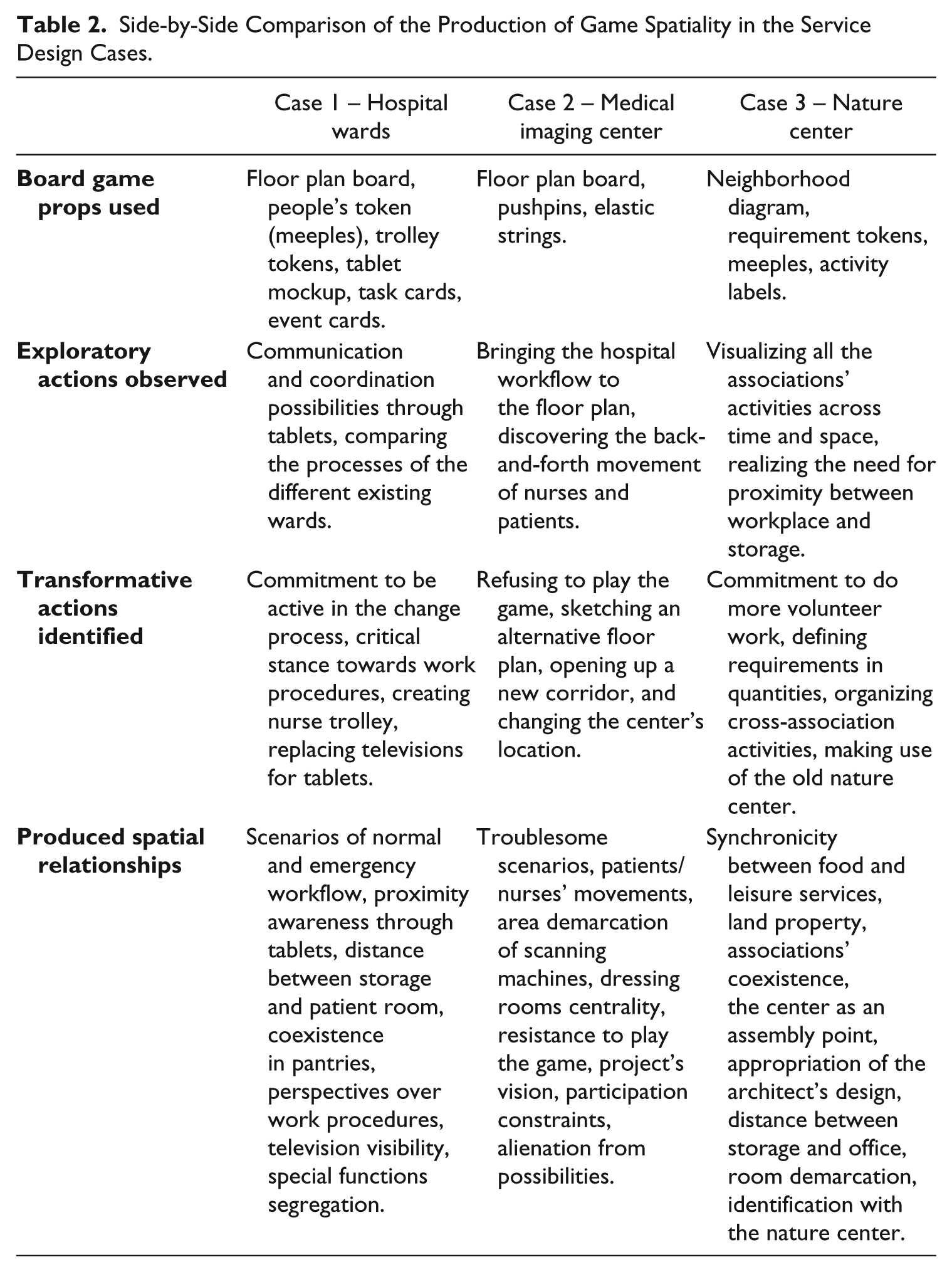
In the three cases, the participants have produced different spatial relationships: scenarios, centrality, distance, proximity, visibility, coexistence, and others. The play sessions were very creative and explored, as well as transformed, many aspects of the services to be offered. Table 2 provides an overview of the exploratory and transformative actions as well as the spatial relationships produced by them.
Side-by-Side Comparison of the Production of Game Spatiality in the Service Design Cases.
Discussion
The case studies present further evidence that design games help to expand the space of possibilities for a service with new ideas, options, problems, and solutions (Brandt & Messeter, 2004; Brandt et al., 2008; Vaajakallio, 2012). The contribution is finding a material counterpart to the space of possibilities, the actual possibilities of space in practice. With this counterpart, it is possible to distinguish actions that explore possibilities from actions that transform possibilities. These actions are very powerful since they can make the unthinkable thinkable and the impossible possible, but they should not be taken for granted. Design games can only facilitate — like GROUNDING ACTIVITIES, which gradually brings spatial relationships to the fore — or hinder game spatiality — like the KNITTING GAME, which keeps players away from changing space. Game spatiality is, ultimately, a players’ achievement and not a game’s feature.
From a technical perspective, the use of architectural drawings as game boards has worked quite well in grounding the discussion onto the space of possibilities. The work scenarios were developed together with the spatial relationships produced in practice, revealing restrictions and opportunities on both sides. In all the three cases, the dialectical development of activity and space has led to specific adjustments in the architectural drawings.
The commitment of design games with producing concrete outcomes can be overlooked if categorized under labels such as serious games or business simulations (Crookall, 2010; Mayer et al., 2014). While design games can also contribute to learning, they are not focused on that. Design games have the aim to create and transform products and services, including the work activities that produce them. This is why debriefing had a different purpose from what it normally has in serious games (Lederman, 1992); instead of reflecting on the space of possibilities produced while playing — ideas generated or lessons learned, debriefing raised commitment for changing the possibilities of space and later verified how and if this actually happened. The post-experience discussion would not be enough to trace the holistic changes implied in the possibilities of space (Harviainen, 2012, p. 518), hence the need for interviews some weeks later. The transformative actions identified in this way include replacing televisions for tablets in case 1, changing the center’s location in case 2, and making use of an existing building in case 3 (see summary in Table 2). These actions were not a direct result of the design games since the participants still had to negotiate them with other people who did not play the game. Yet, the participants credited the design games for showing the possibilities for such actions.
For this transformative aim, design games could better be classified under the label of operational gaming (Shubik, 2009), with the remark that they are not limited to exploration and testing. As this article has tried to show, design games — in particular game spatiality — can be used as pivot for transforming work activities. This intent is similar to the ORGANIZATIONAL ACTIVITY GAME held in the former Soviet Union (Rotkirch, 1996; Shchedrovitskii & Kotel’nikov, 1988) and the DESKTOP PUBLISHING GAME held in Sweden (Ehn, Mölleryd, & Sjögren, 1990), both played during the 1980’s.
Described as such, design games pose a theoretical challenge for game studies: are they playful games or are they just regular work? Discussing the answers is outside the scope of this article, however, we would like to point out that dichotomies such as true/false play (Huizinga, 1955) do not contribute to legitimate play in culture, but in fact to isolate play from other activities. If culture is produced by all the activities of a certain society (Williams, 2011) — and not just by specialized high-culture activities, then play can better be understood as “part of every human activity” (Lefebvre, 2014, p. 487). In design games, play is supposed to produce an alternative version of a certain activity, which can still be considered part of that same activity. The alternative is created just to be incorporated into the activity as soon as possible (Ehn et al., 1990).
Design games are severely limited for organizational change, nevertheless. People who do not join the co-design session may not understand the transformations and turn against them. This can be specially damaging if one these persons holds a powerful position in the organization. The design can be compromised if the co-design session is not followed up with smart political articulation inside the organization. In the cases presented in this article, the authors did not play this role; however, follow-up interviews revealed that at least one person inside the organizations performed this role, with different degrees of success. In the medical imaging case, the design was entirely rejected, whereas, in the hospital ward case, the design is being implemented at the time of this writing.
We have no data on service usage yet, but we can imagine usability problems not anticipated due to the service customers — patients in the first two cases and nature lovers in the last case — being left out of the co-design sessions. We suggested organizing specific sessions with users, but unfortunately we could not convince the involved organizations to think beyond the backstage actions performed by the service providers.
Conclusions
Games are employed in service design to expand the space of possibilities with new insights from service stakeholders; however, the actual possibilities of space are sometimes not recognized, experienced or realized through these service design games. The implication is the service stakeholders may be alienated from the possibilities of space; possibilities that could lead to innovations in service delivery. Space is neglected in service design, in part, due to the lack of a proper vocabulary to address its unfolding characteristics. To address this shortcoming, we propose a conceptual triad, which takes into account not only the space of possibilities — the design options to be implemented in the future — but also the possibilities of space — the current conditions for action.
The triad tries to capture the production of space by the actions of players engaged in a design game. Some actions may explore the space and its possibilities, whereas others may transform them, according to the level of player engagement. If players are engaged enough, they develop a shared sense of being in a space through game spatiality and become aware of the possibilities of space. From that point on, they may cut through the alienation imposed (on purpose or not) by the design game and alter the spatial conditions for the service themselves. Such movement should not be prevented in a co-design session even if the game rules are being transgressed, because this is the moment when the participants are gaining legitimacy in producing space. This can contribute to a more critical and pro-active attitude towards space during the actual service delivery.
The triad of game spatiality strengthens the argument for co-design, since it shares the aim to legitimate the participation of users in the production of space. Furthermore, it highlights the importance of participants’ interaction to enact spatial relationships. Last but not least, it emphasizes grounding change to spaces where transformative actions can take place. Play activity arises then as a microcosm for work activity, where new spatial relationships for work can be tried out in a playful manner. This synergy between play and work has been established here to study design games, but it may also be useful to other kinds of games and playful work interventions.
In service design, game spatiality reframes the contradiction between tangibility and intangibility (often used to justify service design itself) into another contradiction, between what is considered possible and what is actually possible. In this new contradiction, a design concept can be tangible as a wall, in its capacity to restrict or enable social action, and a corridor can be as intangible as a board, in its potential to misguide the sense of direction. The question that matters in this regard is not tangibility, but possibilities for action. Since action is grounded on space, the production of space seems to be much more interesting to justify the existence of service design among other approaches to services such as service-dominant logic (Maglio et al., 2009) and value co-creation (Prahalad & Ramaswamy, 2004; Ramirez, 1999; Vargo et al., 2008). This study offers an initial vocabulary to talk about space in the service design approach.
Design games do not produce game spatiality automatically. Players are the ones who produce game spatiality through their actions. In so doing, they can make use of the possibilities of space that were never conceptualized — for being outside of the space of possibilities. In the cases described in this article, even if players were designing services to be offered in the future, they already realized and made use of the possibilities of space in their current services. It is reasonable to say that transformative actions initiated in the co-design sessions went beyond play, provoking fundamental changes in the backstage work activities. From the observation of these outcomes, we can conclude that games in service design can be as much insightful as transformative.
Footnotes
Acknowledgements
The authors would like to thank the game players who willingly played the games and permitted the session recordings. Furthermore, they would like to thank the research supervisors Mascha van der Voort, Timo Hartmann and Geert P.M.R. Dewulf, who provided not only advice in research matters but also in game design.
Author Contributions
All authors contributed to this article, in content and in form. JG conducted the first case study, whereas FMCA conducted the last two case studies. The authors created together the framework to analyze the cases and FMCA was responsible for writing the manuscript. JG contributed to the manuscript by revising and editing.
Declaration of Conflicting Interests
The authors declared no potential conflicts of interest with respect to the research, authorship, and/or publication of this article.
Funding
The authors received no financial support for the research, authorship, and/or publication of this article.
Author Biographies

Contact: