




Abstract
Teams in organizations often ostracize (reject, exclude) members as a form of informal sanction against unethical behavior, a response that can carry complex consequences. Building on the theoretical infrastructure provided by autoregulatory feedback loops from biology, we synthesized findings from a diverse range of literatures—from management to ethology—to develop an organizing framework that explains how ostracism can either curb unethical behavior in teams or inadvertently sustain or intensify it. We use this framework to make propositions and identify future directions for research to advance the socially dynamic understanding of ostracism and unethical behavior within organizational teams.
Unethical workplace behavior—such as theft, fraud, dishonesty, bullying, or knowledge hiding—constitutes wrongdoing that is either illegal or violates moral norms (T. M. Jones, 1991; Veetikazhi et al., 2022). One common co-worker response to such norm violations is ostracism (P. A. Andersson et al., 2024; Curtis et al., 2021; Eriksson et al., 2021), the act of not engaging in inclusionary acts toward others when it would be socially appropriate to do so (Robinson et al., 2013). Across disciplines, ostracism is widely seen as a functional mechanism for maintaining group well-being, reinforcing cooperation, and deterring norm violations (Akpalu & Martinsson, 2012; Kurzban & Leary, 2001; Maier-Rigaud et al., 2010; Ouwerkerk et al., 2005; Robinson & Schabram, 2019; Söderberg & Fry, 2016). Organizational teams may thus be predisposed to use ostracism as a regulatory tool to enforce moral norms.
Yet, this instinctive response may backfire in organizational teams. Instead of curbing unethical behavior, ostracism may intensify it (Akhtar et al., 2020; Kouchaki & Wareham, 2015; Qi et al., 2020), potentially triggering a self-reinforcing cycle where both ostracism and unethical behavior escalate. While prior research has examined how wrongdoers get ostracized or how ostracism affects individuals, little is known about the dynamic relationship between the two. Thus, we ask: when and how does ostracism deter unethical behavior in organizational teams, and when does it escalate the very behavior it aims to prevent?
We address this question with a specific focus on teams in organizations while drawing insights from other types of groups. Despite the clear implications of ostracism and unethical behavior for team functioning, their dynamic relationship has received little theoretical or empirical attention. This gap limits our understanding of how this potentially dysfunctional process unfolds—and, crucially, how it can be interrupted. We argue that this oversight stems from the fragmented nature of existing research, which remains siloed across disciplines without a unifying theoretical framework. Different forms of ostracism (e.g., rejection and social exclusion) and unethical behaviors (e.g., bullying, dishonesty, knowledge hiding) have been studied in isolation in different disciplines (e.g., social psychology, management, anthropology, and evolutionary psychology), employing distinct methodological and theoretical frameworks at different levels of analysis. For instance, while social psychology frequently relies on controlled experiments (Blackhart et al., 2009), work from management and organizational behavior more often use self-reports and survey-based methods (Spector & Howard, 2021). Moreover, whereas evolutionary and anthropological work focuses more on understanding the functions of ostracism as an informal peer sanction (Kurzban & Leary, 2001; Söderberg & Fry, 2016), work from organizational behavior and management focuses more on understanding and mitigating the negative outcomes of ostracism (Mao et al., 2017; Sharma & Dhar, 2022). As a result, current scholarship captures the relationship between unethical behavior and ostracism in fragmented and discipline-specific slices, overlooking how these dynamics unfold and reinforce one another within organizational teams.
Given the fragmented nature of research on this topic, our first goal was to develop an organizing framework that explains how and why organizational unethical behaviors and ostracism dynamically unfold in teams over time. While prior reviews have examined ostracism (Bedi, 2021; Hartgerink et al., 2015; Hay et al., 2023; Sharma & Dhar, 2022) and (responses to) unethical behavior (Leib et al., 2021; Mishra et al., 2022; Van Kleef, 2024; Veetikazhi et al., 2022), these literatures remain largely siloed. One exception is Dash et al. (2023), who reviewed how ostracism fosters knowledge hoarding—yet no other model or framework has integrated a large body of work to understand the bidirectional and dynamic relationship between unethical behavior and ostracism. To address this gap, we draw on autoregulatory feedback loops, a concept extensively studied in biology (Brandman & Meyer, 2008; El-Samad, 2021; Ferrell, 2013; Suen & Navlakha, 2022). Using this framework, we illustrate how a team’s response to the wrongdoers with ostracism can either deter unethical behavior (functional feedback loop) or intensify it, fueling further unethical behavior and ostracism (dysfunctional feedback loop).
Our second goal was to integrate insights from diverse disciplines that examine the link between ostracism and unethical behaviors in organizations to enrich the understanding of the potential feedback loops between the two. Although we draw primarily from the organizational behavior, management, social psychology, and economics, to enrich the framework, we also incorporate research on broader norm violations (Carter-Sowell et al., 2008; Eriksson et al., 2021; Van Kleef et al., 2015), ethological studies on ostracism in nonhuman animals (Lancaster, 1986; Nishida et al., 1995; Slavík et al., 2015), and anthropological accounts of ostracism in small-scale societies (Mahdi, 1986; Söderberg & Fry, 2016). By synthesizing these diverse perspectives into a team-level framework, we seek to foster cross-fertilization across various disciplines, encouraging researchers to examine these processes through a broader and more integrative lens.
Third, we aimed to go beyond past work on the topic and discuss theoretical and methodological research implications of the present organizing framework. Drawing from the work on autoregulatory feedback loops, we develop several propositions and identify key gaps in our understanding to allow future researchers to explicitly test and extend the proposed framework. Finally, we highlight some methodological practices that can aid in testing the proposed framework empirically.
Scope and Definitions
In this review, we follow Jones’ purposefully “imprecise and relativistic” (T. M. Jones, 1991, p. 367) definition of unethical behavior as acts that are illegal or violate the moral norms of the broader community. We treat unethical behavior as a specific subset of norm violations and, accordingly, draw from the broader norm violation literature, while focusing on moral violations due to their particularly costly nature. That said, not all teams share the broader community’s moral standards. In unethical organizations—like corrupt teams (Ashforth & Anand, 2003; Stein & Pinto, 2011) or criminal groups (Dias & Salla, 2013; Lessing & Willis, 2019)—behaviors typically seen as unethical, like fraud or bribery, can become normalized, while behaviors typically seen as ethical, like honest reporting, can violate the group’s norms. Members who violate such local norms (despite conforming to the broader community’s norms), such as whistleblowers, may also face informal sanctions like ostracism (Bjørkelo et al., 2011; Curtis et al., 2021; Rehg et al., 2008; Van Kleef et al., 2023). These insights underscore two critical points: (a) sanctions are driven by deviations from local norms, even when those behaviors conform to broader community standards and (b) when the local norms of a group clash with those of the larger community, local norms take precedence. But while such nuances are theoretically important, empirical research has found a large degree of convergence in the moral norms across organizations (Kaptein, 2008; Martínez et al., 2021; Roy et al., 2024). Moreover, it is the unethical behavior relative to wider community norms that tends to be most studied, and most costly for organizations (Ellis, 2025; Treviño et al., 2006). Thus, T. M. Jones’ (1991) “imprecise” definition of unethical behavior in terms of violations of the norms of the wider community captures the organizational reality of unethical behaviors well for the purposes of this paper.
Given the detrimental effects of both ostracism and unethical behavior for organizations, our focus in this paper is on organizational contexts. Meta-analyses show that ostracized employees exhibit lower performance, heightened negative work attitudes, and reduced organizational citizenship behaviors, all of which undermine organizational functioning (Bedi, 2021; Howard et al., 2020). Similarly, unethical behaviors undermine organizations by increasing turnover and decreasing performance (Association of Certified Fraud Examiners, Inc., 2022; Mishra et al., 2022; Mo et al., 2023) and in the case of interpersonal unethical behaviors—such as bullying—they also inflict direct harm on other employees (Anand et al., 2021; Krishna et al., 2023; Vartia, 2001). Understanding how ostracism and unethical behavior reinforce each other is essential, as their interplay may not only intensify these negative outcomes but could also further destabilize the workplace.
While organizations increasingly rely on teams to accomplish tasks (Devine et al., 1999; Kozlowski & Bell, 2003), research on ostracism in organizations has primarily focused on dyadic interactions, examining why individuals are ostracized and how they respond (Howard et al., 2020; Mao et al., 2017; Sharma & Dhar, 2022). This body of work is undoubtedly very informative and has been crucial in understanding the negative effects of ostracism for individuals and organizations. Yet, studying what is theorized to be a group-level phenomenon by many (Hales, Ren, & Williams, 2016; Kurzban & Leary, 2001; Sasaki & Uchida, 2013; Wesselmann et al., 2012) through a primarily dyadic lens presents limitations. Groups and dyads differ in their dynamics, with groups affording distinct social processes such as coalition formation and subgroup development (Moreland, 2010). Organizational teams, in particular, operate within a complex social system—pursuing shared goals, interacting with other teams, and navigating shifting memberships, objectives, and norms (Humphrey & Aime, 2014; Kozlowski & Bell, 2003; Kozlowski & Ilgen, 2006). Thus, to fully understand the interplay between ostracism and unethical behavior in organizations, it is essential to adopt a team-level and temporally dynamic perspective. To maintain clarity, we use “team” to refer specifically to interdependent groups in organizations with shared goals, while “group” refers to groups in other contexts.
Groups are Predisposed to Use Ostracism as a Sanction Against Unethical Behavior
Ostracism as a sanctioning tool is a common feature of many social systems, observed in diverse human societies to varying degrees and in different forms (P. A. Andersson et al., 2024; Eriksson et al., 2021; Gruter & Masters, 1986; Zippelius, 1986), sometimes also as formalized institutions such as in ancient Athens (Ouwerkerk et al., 2005; Salamanca, 2023). Anthropological studies offer insights into how societies utilize ostracism to enforce and protect group norms. For instance, Söderberg and Fry (2016) studied several nomadic forager band societies and observed that they used ostracism as a peer sanction against norm-violations. Mahdi (1986) documented its role in Pukhtunwali, the honor-based code of the Pathan Hill tribes, where ostracism is utilized to evict norm violators and to protect group cohesion. Examining ostracism and other punitive measures among the Ju/’hoansi Bushmen, Wiessner (2005) found that ostracism was deployed to help reintegrate transgressors and entirely exclude them if norm violations persist. Hoebel (1936) described its use among Plains Indian military societies as part of a spectrum of sanctions, including public shaming and expulsion, to maintain order and support collective responsibilities, such as buffalo hunting. Furthermore, studying rural Japanese communities, scholars (Plath & Sugihara, 1968; Smith, 1961) described a severe form of ostracism, known as mura-hachibu, where most social and cooperative ties with a household are severed in response to unethical behaviors and other norm violations such as theft or refusing to partake in communal obligations. Despite cultural variation, these anthropological studies suggest that ostracism frequently serves a functional role in addressing norm violations—including unethical behaviors—and maintaining group norms.
The practice of ostracizing wrongdoers and norm violators is not unique to humans but is observed across a wide variety of nonhuman animal species. Norm violations are often met with sanctions in species ranging from fish to primates and insects (Andrews et al., 2024; de Waal, 2014; Nakai & O’Malley, 2015; Raihani et al., 2012; Ratnieks & Wenseleers, 2008). For example, coral-dwelling gobies—a type of coral-reef fish—maintain a size-based social queueing system where dominant members punish violators by evicting them from the community (Wong et al., 2007). In other fish species, group members ostracize individuals deviating from norms, such as albino fish maintaining physical distance (Slavík et al., 2015) or cooperatively breeding fish evicting non-helping members (Balshine-Earn et al., 1998). Similar behaviors have been documented in nonhuman primates (Goodall, 1986; Raleigh & McGuire, 1986). In one such example, researchers observed a rare within-group gang attack on an ill-mannered chimpanzee that led to his temporary ostracism (Nishida et al., 1995). This incident is particularly noteworthy as it involved a collective attack by multiple individuals, resulting in the target’s exclusion from the group for several weeks and highlighting the role of group dynamics in enforcing social norms. Insect communities also display similar behaviors (Ratnieks & Wenseleers, 2008). For instance, bees evict subordinate females that interact with foreign males outside the colony (Bull et al., 1998), and honeybee colonies expel lower-quality worker males, such as smaller individuals (Gilchrist et al., 2024). Researchers suggest that such social policing suppresses individual selfishness and protects group cohesion (Wenseleers et al., 2004), which resembles the use of social ostracism in humans. In summary, evidence from nonhuman animal studies reveals that groups utilizing ostracism as a response to norm violations is widespread across diverse species, including fish, primates, and insects, where strategies like eviction and distancing serve to protect the group’s interests, resembling similar mechanisms in human societies.
More direct evidence from modern human groups is aligned with the anthropological and ethological findings. Functional accounts of ostracism in human groups suggest that ostracism serves as a sanctioning tool to sustain group wellbeing by correcting unethical behavior or reinforcing norms (Hales, Ren, & Williams, 2016; Rudert et al., 2023). Evolutionary perspectives further propose that ostracism evolved to protect and regulate social groups by excluding norm violators or dysfunctional members (Kurzban & Leary, 2001; Sasaki & Uchida, 2013; Wesselmann et al., 2012). Experimental work corroborates these ideas. Social psychology research finds that groups ostracize members who underperform (Wesselmann et al., 2013; Wesselmann, Williams, & Wirth, 2014; Wesselmann & Wirth, 2014; Wirth et al., 2020) or violate group norms (Ditrich & Sassenberg, 2016; Rudert et al., 2023). Likewise, studies using economic games show that individuals ostracize non-cooperators (Feinberg et al., 2014; Maier-Rigaud et al., 2010; Masclet, 2003). Taken together, these findings reinforce the notion that ostracism functions as an informal sanctioning tool to maintain group well-being and functioning.
Turning to the workplace, conceptual work has similarly proposed that employees may ostracize coworkers as a means of preventing or punishing unethical behavior (Henle et al., 2023; Robinson & Schabram, 2019). Empirical research supports this idea and shows that employees (intend to) ostracize others who engage in unethical behaviors (Quade et al., 2017; D. Zhu et al., 2021), display dishonesty (Whitson et al., 2015), falsify expense reports (Curtis et al., 2021), engage in workplace cheating (Ye et al., 2024) or do not condemn others’ unethical behaviors (Dang et al., 2017). These findings align with insights from anthropology, ethology, and evolutionary theory, all of which suggest that ostracism serves as a form of informal social sanction to regulate norm violations, including unethical behavior.
How Similar are Organizational Teams to Bee Hives?
The work we reviewed thus far suggests that teams—just like many other human and nonhuman groups—are predisposed to rely on ostracism as an informal sanction to deter unethical behavior and norm violations. There is a caveat, however. The functionality of ostracism in nonhuman animals (Balshine-Earn et al., 1998; Gilchrist et al., 2024; Raleigh & McGuire, 1986) or some of the reviewed small-scale societies (Mahdi, 1986; Smith, 1961; Söderberg & Fry, 2016) is closely linked to the group’s ability to ensure that ostracism is costly for the wrongdoer. When evicted from a hive, a bee may lack crucial resources to survive (Gilchrist et al., 2024); being excluded from a highly interdependent community can jeopardize social and material support that a family depends on (Smith, 1961). Not being able to deliver a uniform response that is costly for the wrongdoer may call into question the functionality of ostracism in curtailing unethical behavior (Noblit & Henrich, 2023; Plath & Sugihara, 1968). We believe that organizational teams, in most cases, will not have that kind of power over their team members as, for instance, teams usually cannot formally evict a member (e.g., firing or moving to another group). As we discuss further in the research implications, this lack of severe consequences may undermine the intended deterrent effect of ostracism, increasing the likelihood that wrongdoers retaliate rather than correct their behavior.
A Note on the Functionality of Ostracism
Before further examining the (dys)functionality of ostracizing wrongdoers, it is important to clarify that this discussion is not an endorsement of ostracism as a preferred or recommended practice. Rather, our goal is to review research on how teams may naturally respond to unethical behavior, focusing specifically on the role ostracism can play in reducing such behavior. Here, we define functionality of ostracism narrowly as the extent to which it diminishes unethical behavior within a team, without addressing its broader consequences such as diminished psychological well-being and lower job satisfaction (Bilal et al., 2020; Howard et al., 2020; Li et al., 2021). Thus, our discussion is limited to the bidirectional relationship between ostracism and unethical behavior.
An Autoregulatory Feedback Framework of Ostracism and Unethical Behavior in Teams
Unethical Behaviors and Ostracism as an Autoregulatory Feedback Loop
Autoregulatory feedback loops are mechanisms by which a system regulates its own activity through feedback. In the simplest sense, “feedback loops are processes that connect output signals back to their inputs” (Brandman & Meyer, 2008, p. 390). Such loops are ubiquitous across multiple domains, including gene expression (Mullins et al., 2016), the cell cycle and signaling (Brandman & Meyer, 2008; Ferrell, 2013), the endocrine system (Peters et al., 2007), animal sensorimotor dynamics (Cowan et al., 2014), large-scale phenomena like climate regulation (Dufresne & Saint-Lu, 2016), or quorum sensing in bacteria, a process where bacterial populations regulate their collective behavior based on population density (Miller & Bassler, 2001; J. W. Williams et al., 2008). Importantly, it has also been applied to human populations to understand the dynamic relationship between vaccination patterns and disease propagation (Z. Wang et al., 2016).
Feedback loops exist in negative and positive variants. The core function of a negative feedback loop is to maintain homeostasis, or equilibrium, by responding to changes in the environment with compensatory outputs. A common illustrative example is the home thermostat: It detects deviations from the target temperature and adjusts the heat flow accordingly, illustrating a negative feedback loop that counteracts change and restores stability (El-Samad, 2021). In contrast, positive feedback loops amplify changes and drive the system away from equilibrium to achieve a specific outcome, such as oxytocin release and contractions mutually increasing until childbirth (Buckley et al., 2023; Kennett & McKee, 2012). Although positive feedback can be functionally advantageous for certain biological tasks, it also has the potential to produce “runaway” responses. Examples include unchecked cell division leading to tumorigenesis (Hanahan & Weinberg, 2011; Su et al., 2014) or when clearing of tropical savannas leads to further tree loss via drier and warmer climates increasing fire rates (Hoffmann et al., 2002). In these scenarios, the system diverges from its usual stable state and potentially spirals out of control—thus becoming dysfunctional in the sense that it no longer returns to equilibrium.
Much like other biological dynamic systems, a team is also a dynamic system with the capacity to regulate its own behavior (Dunphy & Bryant, 1996; Gorman et al., 2017; Kozlowski, 2015; Kozlowski et al., 2016; Magpili & Pazos, 2018; Sundstrom et al., 1990). Thus, applying feedback control to team dynamics offers a lens through which we can understand how ostracism and unethical behaviors interact over time in teams. To do so, we first need to define what we mean by equilibrium and perturbations in this context. As both unethical behavior and ostracism are seen as norm violations (T. M. Jones, 1991; O’Reilly et al., 2015), we define a team’s “equilibrium” as a state of minimal unethical behavior and minimal ostracism. Any emergence of unethical behavior—a perturbation—would disrupt this equilibrium, just as a temperature spike might disrupt a homeostatic thermostat. As a response, a team may ostracize the wrongdoer as a corrective measure to sanction the wrongdoer. If this sanction succeeds in curbing the unethical behavior, a negative feedback loop forms, restoring equilibrium. By contrast, if the perpetrator retaliates with further unethical acts and the team keeps responding with (increasing) ostracism, a positive feedback loop emerges that can spiral into more severe conflict or even affect broader organizational culture. Thus, in this framework, a negative feedback loop represents a functional outcome, while a positive feedback loop reflects a dysfunctional outcome. To prevent terminological confusion, we use the term ‘dysfunctional feedback loop’ to refer to the positive feedback loop (which leads to—escalating—negative outcomes) and “functional feedback loop” for the negative feedback loop (which restores equilibrium). Table 1 provides a simplified depiction of these loops, accompanied by illustrative graphs demonstrating how they may unfold over time.
A Simplified Visualization of the Proposed Feedback Loops.
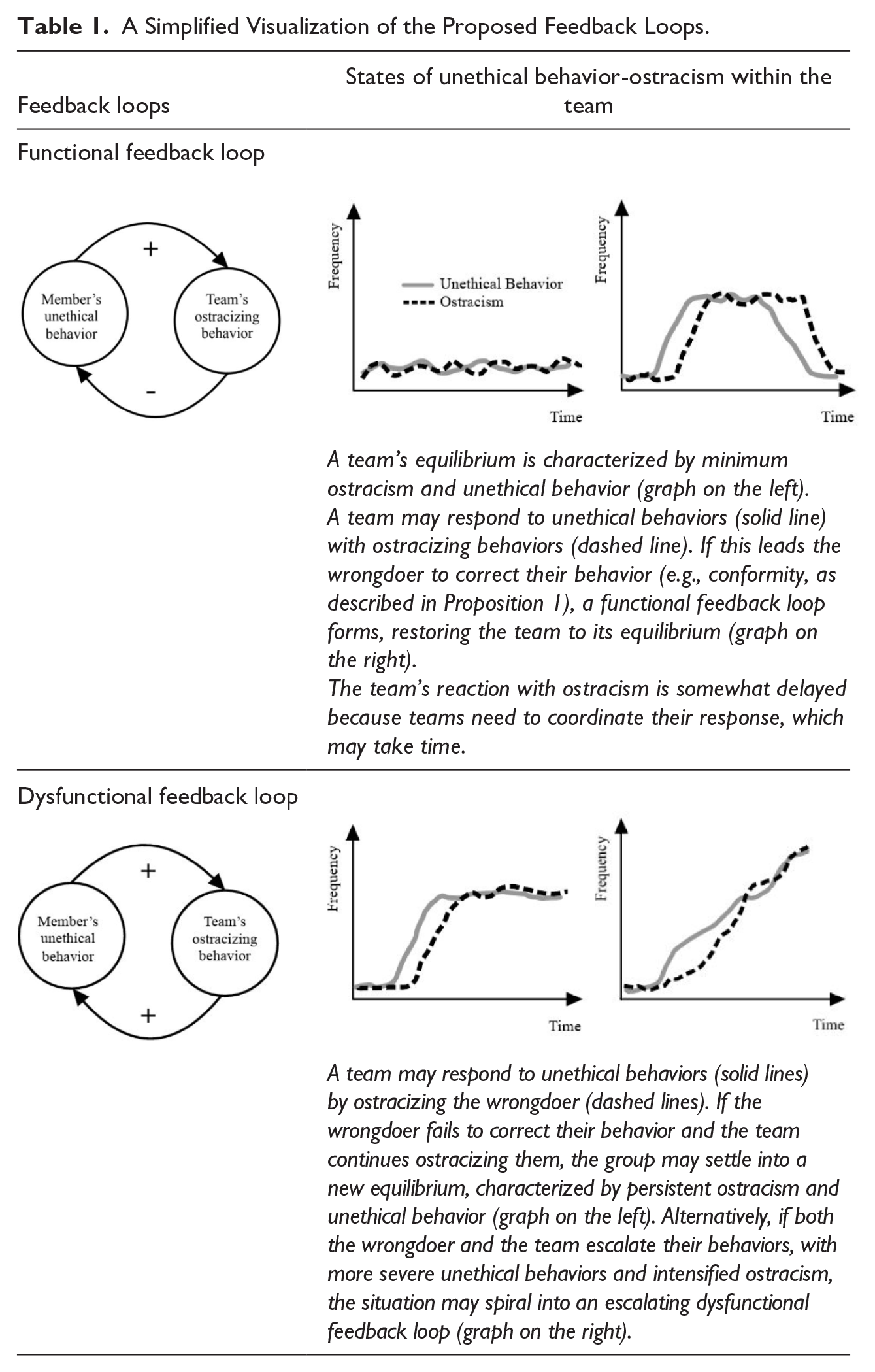
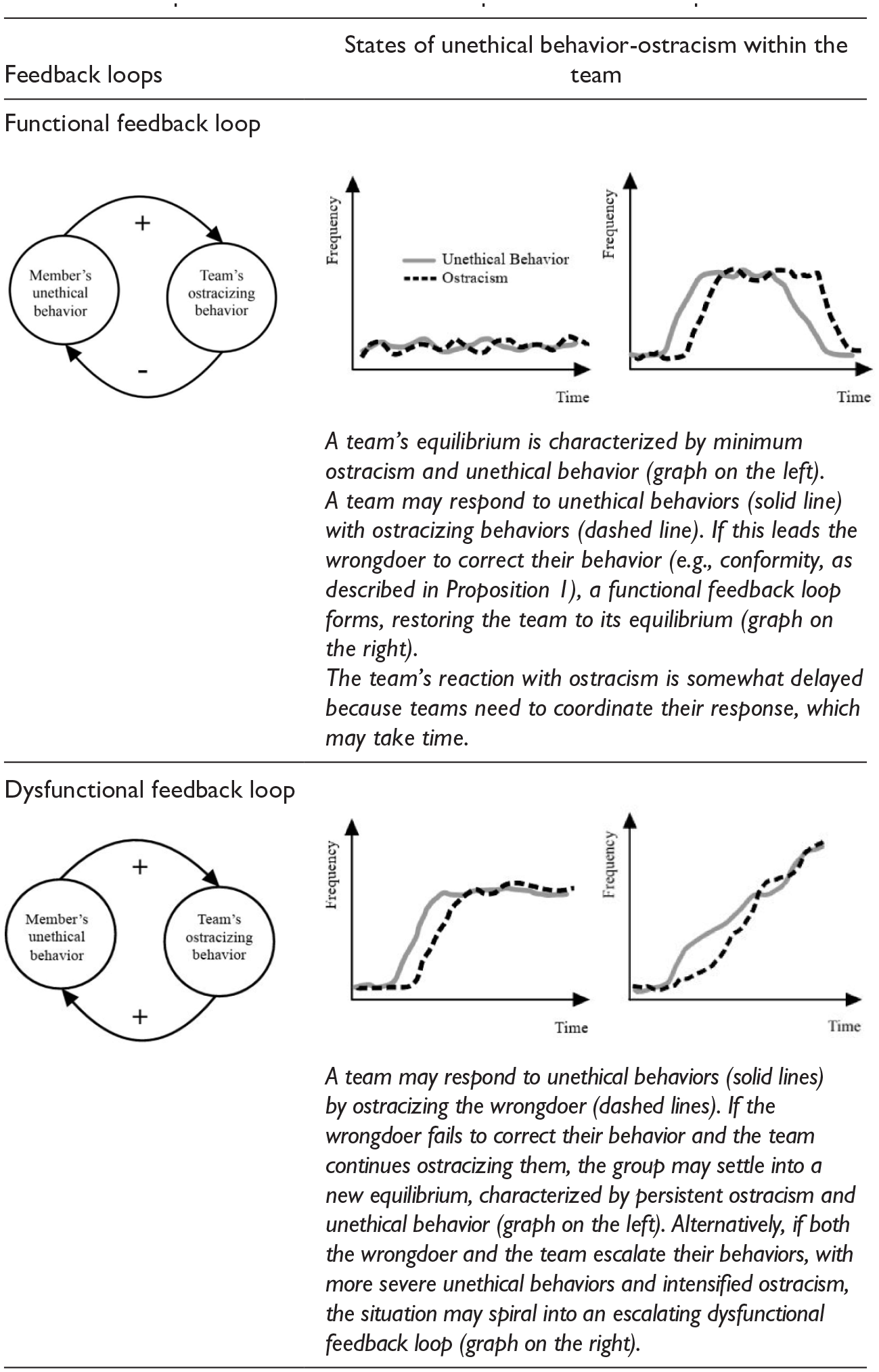
Application of feedback control mechanisms to organizational phenomena have long been suggested by scholars (Carver, 1982; Morgan, 1982) and researchers have used these principles to understand dynamic phenomena in various scales ranging from the individual level to financial markets (under various names such as control theory [Carver, 1982] or cybernetics [Wiener, 2019]). For instance, scholars used feedback control principles to investigate coping with organizational stress (Edwards, 1992), work motivation (H. J. Klein, 1989), innovation implementation (Repenning, 2002), organizational learning (Senge, 1994; Senge & Sterman, 1992), organizational intelligence (Schwaninger, 2000, 2001), and growth and valuation in platform markets (Karhu et al., 2024). Joining in this tradition, here we conceptualize the relationship between unethical behaviors and ostracism within organizational teams as one of feedback control. In the following sections, we synthesize relevant research from different literatures and highlight how feedback loops function to stabilize or destabilize teams.
Functional Feedback Loops
There are several ways in which ostracizing a wrongdoer may trigger functional feedback loops. First, an ostracized wrongdoer may stop engaging in unethical behavior. Addressing this notion, social psychological research shows that ostracism may increase the target’s social susceptibility to the team’s demands. More specifically, ostracized (vs. included) individuals have been found to be more obedient to direct commands (Riva et al., 2014), more compliant with donation requests (Carter-Sowell et al., 2008), and more likely to conform to their group members (Heerdink et al., 2013; Knapton et al., 2015; K. D. Williams et al., 2000). These findings suggest that ostracized individuals are more susceptible to group demands. Crucially, there is also direct evidence showing that ostracized wrongdoers may be tempted to correct their behavior. Experimental economics provides direct evidence supporting this idea, with studies examining behavior in multi-round economic games where participants were allowed to rejoin their teams after ostracism (as recommended by Hirshleifer & Rasmusen, 1989). For example, in an experiment involving resource theft, previously excluded participants stole significantly less upon rejoining the team (Baier et al., 2023). Similarly, participants who were voted to be excluded from a team contributed more to group tasks in subsequent rounds (Cinyabuguma et al., 2005), and ostracized individuals in a public goods game cooperated at levels comparable to other members upon reinclusion (Feinberg et al., 2014). In summary, research from social psychology and behavioral economics provides evidence that ostracism enhances the social susceptibility of targets, making them more obedient, compliant, and conforming. These findings suggest that ostracized individuals may correct past unethical behavior and align their behavior with group norms upon reinclusion—responses that, from the team’s perspective, function to reduce future unethical behavior.
A second way in which ostracizing a wrongdoer may trigger a functional feedback loop is if the wrongdoer chooses to leave the organization. In this context, a wrongdoer leaving the organization would diminish unethical behavior within the team. Research supports this idea, showing that being the target of workplace ostracism is positively associated with turnover intentions (Fiset et al., 2017; Garner & Iba, 2015; C. Liu et al., 2022; Singh et al., 2024; Vui-Yee & Yen-Hwa, 2020; Y. Zhu & Zhang, 2021). Importantly, several meta-analyses observed this link, demonstrating a robust relationship between ostracism and turnover intentions (Bedi, 2021; Howard et al., 2020; Vui-Yee & Yen-Hwa, 2020). Furthermore, a longitudinal field study found that ostracism was positively associated with actual turn-over rates over 3 years (O’Reilly et al., 2015). Collectively, these findings suggest that ostracizing a wrongdoer may fulfill a functional goal by prompting their turnover, thereby reducing the potential for future unethical behavior and preserving team norms.
The third way ostracism can function to reduce unethical behavior is by indirectly consolidating group norms. Ostracizing a wrongdoer can send a clear signal to others about acceptable behaviors and the consequences of norm violations, thereby reinforcing norms. Evidence for this effect largely stems from behavioral economics, particularly studies using economic games like public goods or prisoner’s dilemma scenarios. These studies suggest that just the threat of ostracism can promote cooperation and deter social loafing within groups. For instance, introducing ostracism as a potential sanction in an experiment with young fishers in Ghana reduced overfishing—the targeted unethical behavior—compared to conditions where ostracism was not an option (Akpalu & Martinsson, 2012). Similarly, public goods game experiments have shown higher contributions in settings where ostracism was allowed (Cinyabuguma et al., 2005; Dannenberg et al., 2020; Kerr et al., 2009; Maier-Rigaud et al., 2010). Beyond promoting individual compliance, the threat of ostracism can discourage collusion with wrongdoers, further strengthening group norms. For example, one study found that participants were less likely to collude with “bad apples” in their team when ostracism was a potential consequence (Kerr et al., 2009). These effects are amplified by individuals’ ability to readily detect ostracism, whether they are the targets or the observers of ostracism (Kerr & Levine, 2008; Rudert & Speckert, 2023; Spoor & Williams, 2007; Wesselmann et al., 2009). Where individuals do not experience or observe ostracism, gossip can play a powerful role in enforcing norms (Beersma & Van Kleef, 2011, 2012). In one study, participants were allowed to gossip, which in turn resulted in the ostracism of selfish players and increased the cooperation rates for groups (Feinberg et al., 2014). Together, this body of work underscores how the mere possibility of ostracism could indirectly reduce unethical behavior by consolidating group norms and deterring deviant behaviors.
Proposition 1: Ostracizing a wrongdoer may be functional for the team by stimulating the wrongdoer to correct their behavior, by making the wrongdoer leave the organization, and by consolidating group norms within the team (i.e., setting an example for other team members)—forming a functional feedback loop.
These functional outcomes of ostracism help a team maintain its equilibrium both directly—by correcting wrongdoing or prompting the wrongdoer to leave—and indirectly—by consolidating group norms. We view these outcomes as constituting a functional feedback loop between unethical behavior and ostracism in teams. Specifically, when a team responds to a disruption in its equilibrium (i.e., unethical behavior) with a social sanction such as ostracism, and when that sanction achieves its intended effect (e.g., the wrongdoer corrects their behavior), the team can return to equilibrium by also reducing ostracizing behaviors.
Dysfunctional Feedback Loops
Although ostracism may be functional for the group to the extent that it corrects or prevents unethical behavior, it also produces myriad outcomes that are potentially harmful to the group, such as negative influences on various work-related behaviors and attitudes (for meta-analytic reviews, see: Bedi, 2021; Howard et al., 2020; Li et al., 2021). More importantly, past work shows that ostracism is related to increased unethical behaviors using various methods like surveys (Akhtar et al., 2020; Qi et al., 2020; Sarwar et al., 2020) and experiments (Kouchaki & Wareham, 2015; Poon & Teng, 2017; Thau et al., 2015), suggesting that ostracizing a wrongdoer can also form dysfunctional feedback loops where unethical behavior and ostracism perpetuate one another.
More specifically, targets of ostracism are more likely to cheat (Kouchaki & Wareham, 2015); behave dishonestly (Poon et al., 2013); or engage in knowledge hiding (Zhao et al., 2016), unethical behaviors (Akhtar et al., 2020; Qi et al., 2020; Tunçel & Kavak, 2022), unethical pro-organizational behaviors (X. Liu et al., 2023; S. Zhang, 2019), and service sabotage (Sarwar et al., 2020) to name a few examples. Similarly, ostracism is also associated with increased aggressive and antisocial responses (DeWall et al., 2009; Poon & Teng, 2017; Rajchert & Winiewski, 2016). Lastly, ostracized targets also engage in other forms of norm-violating behaviors such as interpersonal deviance (Jahanzeb & Fatima, 2018) and counterproductive work behaviors (Ferris et al., 2016; Yang & Treadway, 2018). Together, this growing body of work suggests that ostracizing a wrongdoer may backfire by increasing (rather than decreasing) unethical (and other norm-violating) behaviors.
Proposition 2: Ostracizing a wrongdoer may be dysfunctional for the team by stimulating the wrongdoer to engage in more unethical behavior—forming a dysfunctional feedback loop.
In some cases, the reciprocal relationship between unethical behavior and ostracism may stabilize, with both the team and the wrongdoer settling into a new norm. Supporting this idea, a cross-lagged study over 12 weeks found that employees who experienced workplace mistreatment were more likely to engage in deviant behavior, and vice versa, with this cycle persisting over time (Y. Kim et al., 2023). This suggests that one form of a dysfunctional feedback loop between ostracism and unethical behavior may be characterized by a stable, self-reinforcing dynamic where neither party adjusts their behavior for extended periods of time. Such a relationship could reflect a bistable system (Brandman & Meyer, 2008; Ferrell, 2013; Peters et al., 2007), in which a team oscillates between states of high or low ostracism and unethical behavior—where the latter represents the equilibrium we previously defined.
An Escalating Dysfunctional Loop
A distinct possibility is a dysfunctional feedback loop spiraling out of control. Just as ostracism and unethical behavior can perpetuate one another in a stable manner (Y. Kim et al., 2023), we also think that individuals and teams can slowly increase the intensity of their responses as the cycle continues. Similar ideas around escalating negative interpersonal interactions have previously been proposed in the study of interpersonal conflict (Barki & Hartwick, 2004; Jehn et al., 2013; Kennedy & Pronin, 2008) or workplace mistreatment (Krishna et al., 2023; Robertson & O’Reilly, 2020). For example, in their seminal paper, L. M. Andersson and Pearson (1999) proposed that less severe forms of mistreatment such as incivility may gradually spiral into more aggressive behaviors as individuals respond to each other with uncivil acts gradually increasing in severity.
Let us examine what this may look like for the cyclical relationship we outline here. A team’s members may ostracize a wrongdoer by first only ignoring some of their emails or avoiding eye contact with them during meetings. The wrongdoer may pick up the cues even at this stage as individuals are good at picking up even very subtle cues of ostracism (Spoor & Williams, 2007). If ostracism does not fulfill its function to reduce unethical behavior, however, the team may increase the intensity of their sanction by ceasing most social interaction with the wrongdoer (Schachter, 1951; Wesselmann, Williams, Pryor, et al., 2014), which could also spread to work-related tasks by leaving them out of important work emails or not sharing work-related information with them (E. E. Jones & Kelly, 2010; E. E. Jones et al., 2021). A wrongdoer can also increase the intensity of their unethical behavior simply because of the so-called “slippery slope” of unethical behavior where smaller wrongdoings gradually give way to more serious unethical behaviors due to intrapersonal factors such as moral disengagement (Welsh et al., 2015) or other forms of motivated cognition (Garrett et al., 2016; Kouchaki & Gino, 2016). Additionally, a wrongdoer can increase the intensity of their acts also as a response to being ostracized. For instance, if a wrongdoer feels like they were ostracized unfairly, they may be more likely to respond with antisocial behaviors (Chow et al., 2008). Taken together, we argue that the reactions within the feedback loop may get more intense over time and that both the unethical behavior and ostracism may escalate into more severe forms.
Thus far, our discussion of dysfunctional feedback loops has focused on a single wrongdoer who either fails to correct their behavior (Proposition 2) or intensifies it. However, another pathway for an escalating feedback loop is the spread of unethical behavior to other team members. Research suggests that unethical behavior can diffuse within a team through, for instance, socialization of new members (S. Liu et al., 2015; X. Liu et al., 2022) or social learning (Kroher & Wolbring, 2015; Lian et al., 2022; Thiel et al., 2021), both of which depend on the type and strength of social relationships with the wrongdoer (Brass et al., 1998; Y. Zhang et al., 2018; Zuber, 2015). Additionally, interpersonal mistreatment—a form of unethical behavior—can provoke retaliatory unethical behavior, as studies on workplace mistreatment show that targets sometimes become perpetrators themselves (T. Kim & Shapiro, 2008; Lee & Brotheridge, 2006; Skarlicki & Folger, 1997). Together, these findings suggest that a single wrongdoer can prompt unethical behavior among other team members, increasing its overall frequency within the team. We argue that this spread—via social contagion or retaliation—could also trigger escalating dysfunctional feedback loops when the remaining team members respond with ostracism.
Proposition 3: Ostracizing a wrongdoer may trigger an escalating dysfunctional feedback loop if the wrongdoer and the team increases the intensity of their behavior or if more team members start engaging in unethical behavior.
Triggers of Functional (vs. Dysfunctional) Feedback Loops
In the following section, we examine factors that influence whether a functional (vs. dysfunctional) feedback loop emerges, focusing on moderators that influence how a wrongdoer and the team would react to one another. We argue that a negative feedback loop is more likely (a) if the wrongdoer is motivated to seek reinclusion and (b) if the team is motivated to reaccept the wrongdoer.
To organize moderators, we draw on the expectancy-value framework of motivation (Atkinson, 1957; Wigfield & Eccles, 2000), examining how different factors shape the perspectives of both the wrongdoer and the team. Specifically, we consider how moderators influence (a) expectancy—the anticipated likelihood of a certain outcome, (b) value—the importance placed on that outcome, and (c) motive—a disposition or tendency to pursue a particular goal. We argue that these dimensions are key in determining whether a functional or dysfunctional feedback loop will emerge.
The Wrongdoer’s Motivation for Reinclusion as a Predictor of Functional Feedback Loops
A wrongdoer’s motivation to seek reinclusion can thus be conceptualized as a function of key factors: (a) their expectancy that correcting their behavior will lead to reinclusion, (b) the value they place on being part of the team, and (c) dispositional tendencies that make them more or less prone to seeking (re-)inclusion. Smart Richman and Leary’s (2009) motivational model of responding to ostracism supports this framework, highlighting how expectancy (e.g., likelihood of relational repair) and value (e.g., perceived costs of rejection or benefits of inclusion) shape affiliative responses to exclusion. Building on this, we also consider the effect of motives—that is, dispositional characteristics toward inclusion such as a high need to belong (Baumeister & Leary, 1995).
We argue that a wrongdoer will correct their behavior or conform to the group norms to the extent that they see conformity as a means for regaining inclusion—expectancy. In a qualitative study of nursing trainees, participants reported seeing conformity and compliance as strategies to maintain inclusionary status (Levett-Jones & Lathlean, 2009). Heerdink et al. (2013, 2015) corroborated this notion empirically. In a series of experiments examining how feelings of rejection relate to conformity to group norms, the authors showed that rejected participants were more likely to conform if this would be instrumental in regaining acceptance. Similarly, in a study investigating conformity under different social pressures (Dittes & Kelley, 1956), the authors observed that some rejected participants were only conforming to the group norms publicly—likely because only when observed by other group members can conformity increase one’s chances of reinclusion. The distinction between temporary and permanent forms of social exclusion is also relevant for expectancy, as people may expect reinclusion more when exclusion is temporary (e.g., ostracism) rather than permanent (e.g., expulsion or long-term exclusion). Accordingly, wrongdoers may be more likely to attempt reintegration through conformity or prosocial behaviors when they perceive the exclusion as reversible (Dewald-Kaufmann et al., 2021; Thau et al., 2015).
The value placed on reinclusion further determines whether ostracized individuals attempt to reconnect. Evidence from behavioral economic games demonstrates that ostracized participants who incur tangible costs such as exclusion from group profits exhibit greater conformity and cooperation in response to (or the threat of) ostracism (Baier et al., 2023; Cinyabuguma et al., 2005; Feinberg et al., 2014). Supporting the idea that perceived value motivates reinclusion, Rusbult (1980) found that individuals were more likely to want to continue interpersonal relationships if they placed greater value in these relationships. In a similar vein, individuals who are strongly identified with a group are also more likely to conform to the group’s norms (Spears, 2021; Suhay, 2015). Looking at the other side of the coin, factors reducing the value placed on one’s team would also motivate the wrongdoer away from correcting their behavior. For instance, if the organization relies on a multi-team membership structure (O’Leary & Mortensen, 2011; Pluut et al., 2014), the wrongdoer may have alternative sources for fulfilling their belonging needs, thus reducing the costs associated with ostracism. In short, when reinclusion carries high personal stakes—high value—, individuals are more likely to engage in behaviors that facilitate acceptance, reinforcing a functional feedback loop.
Finally, if the wrongdoer is predisposed to seeking inclusion (i.e., exhibits stronger motive to be included), they will also be more likely to seek reinclusion after unethical behavior. Support for this idea comes from work investigating dispositional differences on the need to belong—a desire for interpersonal attachments (Baumeister & Leary, 1995; Leary et al., 2013), and rejection sensitivity—the tendency to “anxiously expect, readily perceive, and overreact to [social rejection]” (Downey & Feldman, 1996, p. 1327). High levels of these traits are linked to more functional responses, such as correcting behavior or conforming to group norms. For instance, individuals with a stronger need to belong are more motivated to gain group acceptance (Steinel et al., 2010), and those with high social approval needs are more likely to conform to group behavior (Strickland & Crowne, 1962). Further, a field-study revealed that employees with a high need to belong were less likely to respond to ostracism with knowledge hiding—a form of unethical behavior (Fatima et al., 2024). Experimental studies further show that brief silences can motivate individuals to realign themselves with group norms, especially among those high in belonging needs (Koudenburg et al., 2013), while rejection sensitivity motivates conformity when rejection is salient (Renström et al., 2018). Combined, these findings show that a heightened motive, conceptualized here as a disposition toward seeking inclusion, can drive wrongdoers to correct their behavior to align with group norms when facing ostracism.
Proposition 4: The likelihood of triggering a functional (vs. dysfunctional) feedback loop depends on the extent to which the ostracized wrongdoer is motivated to seek reinclusion from their team.
The Team’s Motivation to Reinclude as a Predictor of Functional Feedback Loops
Extending the expectancy-value framework of motivation (Atkinson, 1957; Wigfield & Eccles, 2000) to the team level, we propose that a team’s motivation to reinclude a wrongdoer depends on three factors: (a) their expectancy that reinclusion will help maintain conformity, (b) the value they place on the wrongdoer as a team member, and (c) their general tendency toward inclusivity and the strictness of their moral judgments. Teams are more likely to trigger a functional (vs. dysfunctional) feedback loop by reincluding a wrongdoer if they expect persistent conformity to the violated ethical norms, perceive the individual as a valuable member, and either foster an inclusive culture or exhibit leniency in judging moral violations.
A team’s willingness to reinclude a wrongdoer hinges on their expectation that continuous conformity is a likely outcome. Research on relationship repair and forgiveness provides valuable insights into how wrongdoer actions shape these expectations (Andiappan & Treviño, 2011; E. L. Frey, 2022; Gromet & Okimoto, 2014). Specifically, team members may be more likely to anticipate behavior correction if, for instance, the wrongdoer reaffirms the team values (Okimoto & Wenzel, 2009), makes strong amends (Gromet & Okimoto, 2014), self-punishes oneself to show remorse (de Vel-Palumbo et al., 2019), asks for forgiveness (E. L. Frey, 2022; Goodstein & Butterfield, 2010), or offers a sincere or costly apology (Ohtsubo & Watanabe, 2009; Schlenker et al., 2001; Takahashi & Mifune, 2022).
Besides the actions of the wrongdoer, the nature of the unethical behavior itself—such as type and severity—can also influence a team’s expectancy. T. M. Jones’ (1991) issue-contingent model of ethical decision making introduces the concept of moral intensity, emphasizing that some moral violations are perceived as more urgent or severe than others. Later research showed how moral intensity influences the recognition and judgment of immoral acts (Barnett, 2001; de Graaff et al., 2019; B. F. Frey, 2000; McMahon & Harvey, 2006), sensemaking around unethical behaviors (de Graaff et al., 2019), crucially, whistleblowing decisions (King & Hermodson, 2000; Valentine & Godkin, 2019). Additionally, past work has also shown that individuals are less likely to forgive intense transgressions (Gromet & Darley, 2009; Steiner et al., 2011). Thus, both the wrongdoer’s attempts at reconciliation and the characteristics of the unethical behavior shape a team’s expectancy that behavior correction will occur.
With regards to value, both Expectation States Theory (Berger & Wagner, 2007) and Social Exchange Theory (Cropanzano & Mitchell, 2005; Nieper et al., 2022) suggest that social interactions are shaped by (anticipated) relational value of an interaction partner. Building on this notion, Henle et al. (2023) suggested how employees may be less likely to ostracize others with punitive motives if they perceive the target to be a high quality social exchange partner. Supporting this, a survey of coworker dyads found that ostracism in response to incivility was more likely when the target was a low-value exchange partner (Scott et al., 2013). Similarly, high-performing employees who engage in unethical behavior are less likely to be ostracized by coworkers (Quade et al., 2017) or their supervisors (D. Zhu et al., 2021), likely because their performance makes them high quality exchange partners. Beyond performance, the wrongdoer’s social capital can also influence their value in the eye of the team. For instance, individuals seen as high on political skill (Wu et al., 2012; Zhao et al., 2013) or social skill (Wu et al., 2015) are less likely to experience ostracism. Thus, a wrongdoer’s perceived value as an exchange partner is central to a team’s motivation to grant reinclusion.
We conceptualize motive as a team-level characteristic that influences both the tendency to ostracize members and the severity of moral judgments. First, we argue that teams that generally ostracize less would be more likely to reintegrate a wrongdoer. The most evident predictor of this is an inclusive climate, where members engage in more inclusive behaviors and feel a stronger sense of belonging (Luo et al., 2022; Nelissen et al., 2017; Şahin et al., 2019). Other characteristics that reduce ostracism—such as high task interdependence (Chung, 2020; Robinson et al., 2013), strong social support (Ali et al., 2020; Howard et al., 2020), or a non-competitive environment (Löfstrand & Zakrisson, 2014; Ng, 2017)—likely increase the chances of reintegration.
Second, teams likely differ in how they judge and sanction unethical behaviors. We argue that cultural tightness-looseness would be a strong predictor, with tighter teams enforcing stricter norms and harsher sanctions (Gelfand et al., 2006). Originally conceptualized as a country level cultural construct, organizational scholars have studied tightness-looseness also at the team level (Di Santo et al., 2021; Gedik & Ozbek, 2020; Qin et al., 2021). A team with a tighter (vs. looser) culture would judge unethical behaviors more harshly—thus possibly decreasing the likelihood (or the ease with which) a wrongdoer could get back into the fold. Similarly, other factors that influence how quickly and harshly individuals make moral judgments such as disgust sensitivity (A. Jones & Fitness, 2008) and reliance on intuition (Ward & King, 2018) could also moderate a team’s response to wrongdoers to the extent they emerge as team-level properties.
Proposition 5: The likelihood of triggering a functional (vs. dysfunctional) feedback loop depends on the team’s motivation to reinclude the ostracized wrongdoer.
Research Implications
We reviewed empirical and theoretical work at the intersection of ostracism and unethical behavior to propose that ostracizing a wrongdoer can produce functional and dysfunctional feedback loops. We also reviewed potential moderators of this relationship from the perspective of the wrongdoer and the team, drawing from the expectancy-value framework of motivation (Atkinson, 1957; Wigfield & Eccles, 2000). In the following, we discuss what we believe to be key gaps or complexities in the study of unethical behavior and ostracism through the lens of the proposed organizing framework.
An Alternative Starting Point for the Feedback Loops
We would like to start with the starting point of the feedback loops. Up to this point, we have conceptualized unethical behavior as the initial perturbation that teams attempt to regulate through ostracism. However, the feedback loop can also begin from the opposite direction—when individuals ostracized for unrelated reasons respond with unethical behavior. In fact, much of the research linking ostracism to unethical behavior relies on measures that do not specify the reason for ostracism. For instance, the widely used Workplace Ostracism Scale (Ferris et al., 2008) captures the frequency of ostracism experiences (e.g., being ignored in meetings) but remains silent on why the ostracism occurs. This raises the possibility that some individuals found to engage in unethical behavior after ostracism (Qi et al., 2020; S. Zhang, 2019) were excluded for reasons unrelated to moral transgressions. Research suggests that ostracism can stem from personality traits such as being low on conscientiousness or agreeableness (Hales, Kassner, et al., 2016; Rudert et al., 2020), low performance (Howard et al., 2020; Quade et al., 2017; Wesselmann, Williams, & Wirth, 2014), demographic factors such as gender (Howard et al., 2020), or being a member of a minoritized group (Büttner, Rudert, et al., 2024; Janke et al., 2024). If these individuals, ostracized for reasons unrelated to unethical behaviors, react by engaging in unethical behavior, they too may enter the unethical behavior-ostracism feedback loop. Importantly, however, we do not intend to imply that groups who are ostracized more frequently (e.g., marginalized groups) are inherently more likely to engage in unethical behavior. Rather, our point is that even when ostracism is unrelated to unethical behavior, the resulting exclusion can still create the conditions for future misconduct, independent of the original reason for ostracism. Drawing from our discussion around moderators of the feedback loops, we argue that individuals ostracized for other reasons may enter dysfunctional feedback loops especially when teams are not motivated to reinclude them. Future research would benefit from measuring ostracism and wrongdoing from the early stages of team formation to learn more about the starting point of these feedback loops and the related downstream consequences (e.g., is a positive feedback loop more likely if the person was originally ostracized for an unrelated reason?).
The Curious Case of Unethical Prosocial Behaviors
Our framework primarily treats the outcomes of ostracizing a wrongdoer as either functional (reducing unethical behavior) or dysfunctional (escalating unethical behavior). This assumes that teams aim to curb unethical behavior due to its moral and practical harm. However, some unethical behaviors—particularly unethical prosocial behaviors (UPBs)—complicate this assumption. UPBs are “actions that are intended to promote the effective functioning of the organization or its members (e.g., leaders) and violate core societal values, mores, laws, or standards of proper conduct” (Umphress & Bingham, 2011, p. 622). Examples include misrepresenting information to improve the organization’s image or withholding information to protect it (Umphress et al., 2010). Despite their prosocial intent, UPBs are unethical (T. M. Jones, 1991).
UPBs are particularly relevant in the context of feedback loops because ostracized wrongdoers may use them as a strategy for reinclusion. Research suggests that excluded individuals engage in prosocial behaviors to regain acceptance (Smart Richman & Leary, 2009), and experimental evidence shows that individuals with a high need to belong are more likely to engage in UPBs when faced with the threat of exclusion (Thau et al., 2015). Similarly, ostracized individuals intensify their pro-group actions to signal loyalty (Gómez et al., 2011), and survey data confirms that ostracized employees are more likely to engage in UPBs (X. Liu et al., 2023; S. Zhang, 2019). Yet, because UPBs are unethical, teams may still respond with ostracism; indeed, engaging in UPBs for a supervisor has been linked to increased workplace ostracism (B. Zhang & Xu, 2024).
However, if a team instead responds to UPBs with inclusion, this can undermine norms against unethical behaviors. By reincluding an individual engaging in UPBs, the team implicitly communicates that prosocial norm violations are tolerated and possibly even rewarded. This dynamic shifts what initially appears to be a functional feedback loop (reduced ostracism) into a dysfunctional loop where inclusion and unethical behavior reinforce each other—potentially normalizing norm violations in the team. Thus, we believe that future research should investigate how teams navigate the paradoxical nature of UPBs from an expectancy-value framework to better understand the conditions under which they elicit informal sanctions like ostracism.
How Do Teams Coordinate Their Responses?
Currently, little is known about how teams coordinate their responses to ostracize a wrongdoer. Understanding this process is crucial, as “if one is the lone ostracizer in a population then one merely self-ostracizes” (Noblit & Henrich, 2023, p. 6). Most existing research does not explicitly examine how teams collectively decide to ostracize a member. Some studies using economic games incorporate voting systems, where team members explicitly share their views or decisions before democratically deciding on ostracism—akin to practices in ancient Athens (Salamanca, 2023). However, such formalized processes seem unlikely in modern organizations.
A more plausible coordination mechanism is gossip, which, alongside ostracism, helps maintain social order in groups (Feinberg et al., 2014; Nieper et al., 2022). In fact, Beersma and Van Kleef (2012) found that individuals use gossip to protect their group from norm violators, and such gossip is not socially disapproved. Reinforcing gossip’s role in team regulation, experimental work shows that groups with opportunities to share task-relevant information or gossip exhibit lower rates of free-riding and cheating (Nieper et al., 2025; Simpson et al., 2017). Additionally, research suggests ostracized individuals hesitate to disclose their exclusion due to anticipated negative evaluation (Meral et al., 2021, 2023), as doing so could also expose that they are a wrongdoer. Thus, within-team communication about unethical behaviors, for instance via gossip, seems like a promising starting point for future research. Incorporating a team sense-making perspective may further clarify how gossip helps teams navigate ambiguous situations like ostracism (Meral et al., 2023) or ethically gray areas (Bruhn, 2009; Kreps & Monin, 2011). Team sense-making is the process in which team members co-create knowledge by collecting and synthesizing data about ambiguous situations (G. Klein et al., 2010; Maitlis, 2005). Similarly, research has shown that one of the primary reasons why people engage in gossip is to validate their understanding of social situations (Beersma & Van Kleef, 2012). Thus, integrating work on gossip and sense-making could deepen our understanding of how teams coordinate moral judgments and decide when and how to sanction transgressions.
An important complication of team coordination is that team members seldom agree on every issue. Individuals can hold divergent moral values or personality traits and come from diverse demographic backgrounds—all of which could be consequential for how individuals may evaluate unethical behaviors or utilize ostracism (Cohen et al., 2014; Frazer et al., 2022; Graham et al., 2016; Gray & Pratt, 2025; Hobson et al., 2011; E. E. Jones et al., 2019). Disagreements resulting from these differences may sometimes be resolved swiftly (Pütz & Hassan, 2024), but they may also spark interpersonal conflicts especially if they involve contested or moralized issues (Jehn et al., 1997; Sands et al., 1990; Shah et al., 2021; Ziembowicz et al., 2023). These disagreements can reveal existing subgroups within the team or form new ones (Carton & Cummings, 2012; Lau & Murnighan, 1998). Such activated faultlines, or subgroups forming along different values or opinions, are usually harmful for a team’s functioning (Jehn & Bezrukova, 2010; Kerwin et al., 2017; Rico et al., 2007). These findings highlight how poor coordination within a team can result in potentially more destructive outcomes—showcasing the importance of understanding team coordination around the regulation of unethical behavior.
Testing and Extending the Proposed Framework: Methodological Implications
This proposed framework aimed to understand unethical behavior-ostracism feedback loops is inherently socially dynamic. Thus, it incorporates the perspectives of multiple people (the wrongdoer and the team—and its multiple members) and focuses on a relationship among these people that unfolds and fluctuates over time. Testing these dynamic processes in full requires a highly intensive methodological approach (Humphrey & Aime, 2014; Kozlowski, 2015) such that collecting data from multiple—if not all—team members is essential, and ideally such data should be collected across multiple time points. In practice such work is rare (Cronin et al., 2011; Krasikova & LeBreton, 2012; Meral & Moore, 2024) but not non-existent, and we have reviewed some examples in this article. For instance, focusing on shorter-term team interactions, work coming from behavioral economics relied on highly controlled lab environments to investigate how teams ostracized wrongdoers or how they responded to the threat of ostracism using economic games (Akpalu & Martinsson, 2012; Baier et al., 2023; Feinberg et al., 2014). Such designs would be ideal for investigating how the feedback loops form and potentially could be disrupted by manipulating various team or contextual characteristics during the course of a team interaction. Ideally, such findings would also be tested in organizations using longitudinal data (Y. Kim et al., 2023). This approach would not only test the external validity of lab-generated findings, it would also allow researchers to test the development of the feedback loops over longer periods of time (weeks to months). As we have not theorized about how long it would take for these propositions to form or cease, we suggest that future research test various time lags ranging from more episodic (e.g., a meeting) to more developmental perspectives—for example, over the course of weeks or months (for a discussion of various methods, see: Delice et al., 2019; Klonek et al., 2019). We recommend researchers to start with shorter time-lags (Griep et al., 2021). To do so, researchers can rely on experience sampling or daily-diary measures that are gaining popularity in studying both ostracism (Büttner, Ren, et al., 2024; Dong et al., 2024) and unethical behavior (Iqbal et al., 2024; Umphress et al., 2020) allowing researchers to track interactions with high fidelity (for recommendations, see: Arslan et al., 2020; Fritz et al., 2024; Gochmann et al., 2022).
Although required for testing temporal social dynamics, research collecting data from multiple persons over multiple periods is resource intensive—likely explaining why it is rarely adopted. An alternative solution could be to rely on archival data like some of the anthropological work that we reviewed which examined observational records of various societies (Söderberg & Fry, 2016). In terms of ostracism, individuals may investigate communication or interaction patterns by investigating email chains or meeting attendance records (in online agendas or meeting minutes showing who attended) to see who gets interacted less in relation to the rest of their team members. Similarly, social network analysis (Sahoo et al., 2024; D. Wang et al., 2017) may be ideal to examine some of the within and between team propositions in our framework. Such social interaction data would have to be combined with archival records of officially reported unethical behavior (Davis et al., 2021; Pierce & Snyder, 2008) to retroactively examine the existence and form of the proposed loops.
As a final note, we also would like to draw attention to the interdisciplinary nature of the evidence we reviewed thus far. We built our framework by bringing together insights from work on organizational behavior, social psychology, evolutionary theory, anthropology, economics, and ethology. Further, in organizing these findings we were guided by the feedback control principles found in many dynamic systems but largely informed by work in living organizations from biology (Brandman & Meyer, 2008; Cowan et al., 2014; El-Samad, 2021). Such an interdisciplinary approach allowed us to integrate the perspectives of the team and the wrongdoer across various levels of analysis. Thus, we believe that researchers testing these propositions or extending our framework would also benefit from extending out of their own discipline by reading and integrating evidence generated on the same topic but at a different level of analysis, using different theoretical frameworks, or relying on a different method.
Conclusion
In developing an organizing framework explaining how ostracism and unethical behavior interact in organizational teams through autoregulatory feedback loops, we synthesized a large body of diverse insights from multiple disciplines. While teams may be predisposed to use ostracism to deter unethical behavior, this can backfire—creating a self-reinforcing cycle where unethical behavior and ostracism sustain or escalate one another. By distinguishing between functional feedback loops (which restore equilibrium by curbing unethical behavior) and dysfunctional feedback loops (which could sustain or intensify conflict), our framework highlights the conditions under which ostracism stabilizes or destabilizes teams. We identify key moderators—the wrongdoer’s motivation for reinclusion and the team’s willingness to reaccept them—and draw on expectancy-value theory to explain how expectancy, value, and motive shape the behavior of the wrongdoer and the team. Beyond theory, we discuss methodological implications, advocating for longitudinal, multi-level, and interdisciplinary research to capture these temporal processes. By bridging fragmented literatures, our framework lays the groundwork for future investigations into how organizational teams regulate unethical behaviors, when ostracism is functional, and when it leads to further dysfunction.
Footnotes
Declaration of Conflicting Interests
The author(s) declared no potential conflicts of interest with respect to the research, authorship, and/or publication of this article.
Funding
The author(s) received no financial support for the research, authorship, and/or publication of this article.
