



Abstract
Knowledge-based teams that work on challenging tasks typically have members who are involved in multiple concurrent teams. These teams commonly use technologies to communicate, yet research largely studied multiple team membership (MTM) and team virtual exchanges independently whereas, in reality, they are coupled. Some scholars, however, have advised such teams to leverage technologies for asynchronous work to facilitate their members’ multiteaming. Using adaptive structuration theory as an overarching lens, we develop a model to address this advice and understand when and with which effect teams organize their work more asynchronously in response to their members’ multiteaming. Findings from 176 student teams show that when MTM teamwork demands are higher, MTM number is positively related to team asynchronous communication, which in turn is negatively associated with team creativity via information elaboration. Our research presents team asynchronicity as both a more common and more costly remedy for multiteaming.
Keywords
In many organizations, knowledge work is performed by teams, as diverse skills and expertise often are necessary to complete challenging, non-routine tasks (Cummings & Haas, 2012). Across a wide range of settings, from academia to consulting to product development, knowledge workers are members of multiple concurrent teams engaged in different complex tasks (Backmann et al., 2024; O’Leary et al., 2011). Given its prevalence across Europe, the United States, and China, multiple team membership (MTM) has become an undeniable reality for knowledge workers and their teams (van de Brake et al., 2023).
In fact, in a dynamic work environment characterized by flexible and remote work arrangements, this surge in MTM coincides with an uptick in technology use and asynchronous exchanges to facilitate collaboration (Maynard et al., 2012; Wageman et al., 2012). Whether teams work in collocated or geographically dispersed settings, virtual exchanges are central to team functioning (e.g., Gilson et al., 2015; Mesmer-Magnus et al., 2011) and largely determine the extent to which teams leverage the gains of their members’ multiteaming. MTM holds great promise for teams because members’ extended social networks and experiences on other teams can inform new perspectives and ideas that can fuel team creativity (Bertolotti et al., 2015). Yet, it ultimately depends on how the teamwork is organized in general and on how team communication ensues in the intricate MTM context in particular for teams to reap the benefits of multiteaming (e.g., Crawford et al., 2019; O’Leary et al., 2011; Rishani et al., 2024).
Somewhat surprisingly, prior research largely studied MTM and team virtual communication in isolation (Gilson et al., 2015; Margolis, 2020), overlooking that, in reality, they are commonly interrelated. Some scholars, however, have offered advice that links MTM to team virtual communication and suggested that such teams organize their work more asynchronously to manage some of the complexities arising from MTM (e.g., team coordination challenges) and facilitate their members’ multiteaming (Dixon & Panteli, 2010; Mortensen & Gardner, 2017; Mortensen et al., 2007). Though a more fine-grained understanding of when teams follow this advice and what the effect of doing so is remains lacking, this advice points to understanding nuances in team virtual communication by focusing on asynchronous work, and it presents team asynchronous exchanges as a process that changes in relation to members’ MTM. To examine this malleable view of team asynchronous communication, we direct attention to this advice and raise two key questions: (a) When does team MTM relate to the team’s use of asynchronous communication (i.e., asynchronicity)? and (b) In an MTM context, how does team asynchronicity relate to team outcomes like creativity?
We employ adaptive structuration theory (AST) as an overarching lens to examine the relationship between MTM and team asynchronicity—defined as the extent to which members of a single team use technologies to communicate about work activities at different times (Münzer & Holmer, 2009)—and in turn, the relationship between asynchronicity and team creativity. AST (DeSanctis & Poole, 1994; DeSanctis et al., 2000) is a useful framework for addressing our questions because its core tenets suggest that team technology use is a process that is influenced by several factors that are endogenous to teams, and it points to focusing on the underlying structures of technologies—including asynchronicity—to understand how members collaborate virtually (Bostrom et al., 2009). AST also prioritizes both social and technical dynamics, indicating that team outcomes are shaped by how teams use and interact with technologies. Such a perspective thus provides us with a foundation to study asynchronicity as enacted by team members in MTM contexts. As a high-level theory, AST guides us to develop a model that departs from the predominant study of virtuality as a stable feature of teams (Handke et al., 2020; Mathieu et al., 2017) and that focuses on team asynchronicity.
Team communication involves face-to-face, technology-mediated synchronous (e.g., video calls), and asynchronous interactions (e.g., via emails or shared documents) that complement each other. The simultaneity of team communication and whether it occurs synchronously in real time or asynchronously with a time lag offers varying support to multiteamers (Kirkman & Mathieu, 2005). Teams of multiteamers are likely to communicate more asynchronously to ease some of the coordination burdens arising from MTM and to provide greater flexibility for their members as they manage multiple teams (Dixon & Panteli, 2010; Mortensen et al., 2007). For example, by relying more on emails or online dashboards, multiteamers can keep their teammates updated without allocating costly live time to team meetings (Mortensen & Gardner, 2017). We specifically posit that team MTM number is positively related to asynchronicity in collocated teams. Team MTM number is derived from members’ individual number of concurrent teams, and is defined as the average number of teams that members within a single team work on simultaneously (Bertolotti et al., 2015). Our rationale is that teams whose members work in a higher number of teams favor asynchronicity because they face greater planning difficulties and disturbances, and their members have many competing priorities across teams.
Critically, research on team MTM number has shown that its effects on teams are mixed (Rishani et al., 2024). Insights from this line of work suggest that members’ experiences when multiteaming are important to determine the concrete influence of MTM number on teams (Mortensen & Haas, 2018). Particularly, members’ own experiences of how interdependently demanding their multiple teamwork is play a key role in determining the challenges MTM number introduces into the team and the extent to which the team adopts asynchronicity to support its MTM number. Integrating this knowledge from MTM research with AST, which indicates that team and contextual factors shape team virtual exchanges, we posit MTM teamwork demands—which refer to how much members of a team experience effortful team processes with their teammates of multiple teams (Bedwell et al., 2014; Pluut et al., 2014)—moderate the relationship between team MTM number and asynchronicity. We argue that when MTM teamwork demands are higher, a greater team MTM number is associated with more asynchronous team communication. Members overloaded with many interpersonal commitments, compared to those experiencing few effortless working relationships, likely find it more difficult to plan synchronous team meetings, given their temporal misalignments across teams (Margolis, 2020; O’Leary et al., 2011). They also find it more difficult to manage and compartmentalize their time across teams by dividing it into separate priorities or adhering to predictable schedules (e.g., via time-boxing), suggesting a strong preference for asynchronicity (Watson-Manheim & Bélanger, 2002).
Likewise, asynchronicity can be both conducive and disruptive to teamwork. The relief that asynchronicity provides in terms of team coordination challenges and multiteamers’ flexibility can be costly for outcomes like team creativity, which is key for knowledge work and a purported benefit of MTM. We hence posit that asynchronicity is negatively related to team creativity because it disconnects team information processes (Mesmer-Magnus et al., 2011), thereby limiting the extent to which teams share and integrate task-relevant information, known as team information elaboration (Kearney et al., 2009). AST supports that the extent of technology use emerges in team processes and outcomes, and adds that its effect largely depends on how teams bring these technologies into action. In that sense, the contingency of MTM teamwork demands that strengthens a team’s reliance on asynchronicity for its MTM number also determines how these asynchronous exchanges occur in the team and their subsequent influence on team creativity through information elaboration. We thus also posit that when MTM teamwork demands are higher, the negative relationship between asynchronicity and team creativity is amplified. Simply put, the team communication, which is already complicated by the challenges of asynchronicity, would be further degraded when the team and members’ resources are drained by high levels of teamwork demands from multiple teams (Handke et al., 2020).
In sum, we employ AST as an overarching lens and leverage other theoretical insights derived from MTM and asynchronicity research to develop a research model (Figure 1) that suggests team asynchronicity is a costly remedy for teams of multiteamers. Taken together, we propose that when MTM teamwork demands are higher, MTM number is positively related to asynchronicity, and the subsequent negative relationship between asynchronicity and team creativity is intensified.
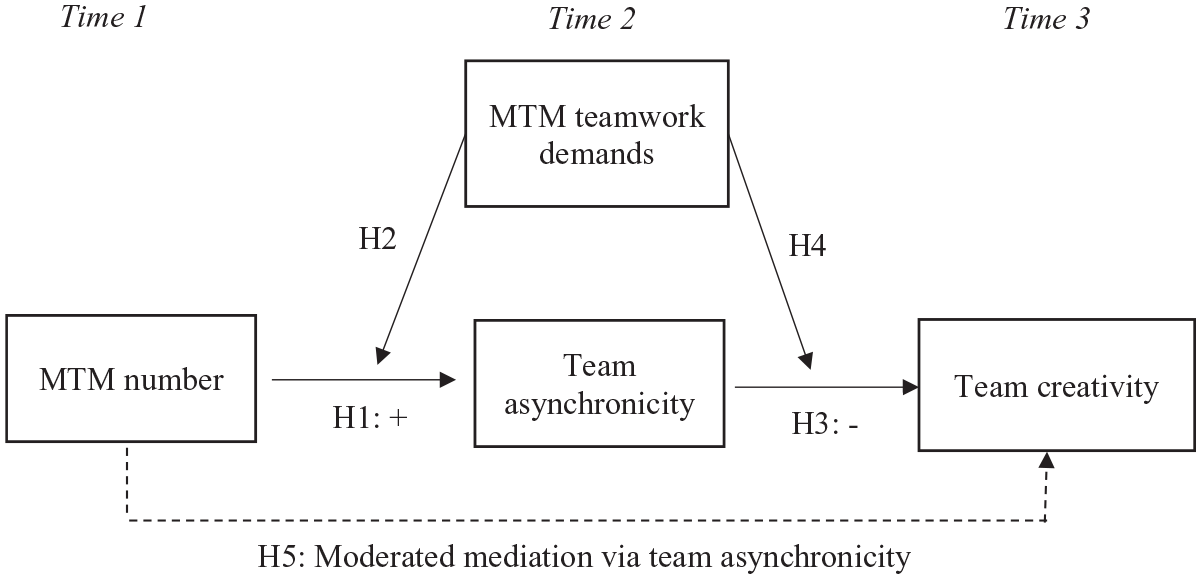
Research model.
Our research makes several important contributions. First, we draw attention to the interrelatedness of MTM and team virtual communication choices and the importance of studying them together. Prior research has focused primarily on how multiteamers develop social networks in online environments (Mo & Wellman, 2016; Reus et al., 2022); only a handful of studies have examined both MTM and virtuality in teams (Bertolotti et al., 2015; Maynard et al., 2012). As we direct research toward a malleable study of team virtuality and its consideration as a team process, we also provide insights about the application and soundness of prior advice for teams to communicate more asynchronously to support their MTM (Dixon & Panteli, 2010). Second, by integrating team MTM number with members’ experiences of their teamwork on multiple teams (MTM teamwork demands), we advance MTM theory to show why the number of teams can have mixed relationships with team processes and outcomes (MTM reviews: Margolis, 2020; Rishani et al., 2024). We identify the important role of MTM teamwork demands in exacerbating or mitigating the challenges of MTM number for teams, and move MTM research from a predominant focus on MTM number to consider contingencies related to members’ MTM experiences. Third, we contribute to the understanding of MTM’s influence on underlying team processes. Prior MTM research at the team level studied direct effects on performance without examining underlying team communication and information processes (Bertolotti et al., 2015; Cummings & Haas, 2012; Rishani et al., 2024).
Theoretical Background and Hypotheses
When Do Teams Communicate More Asynchronously to Support Their MTM?
Multiteaming can be especially favorable for teams because they can leverage their members’ talents while also importing best practices and insights for their teamwork from their members’ other teams. Although researchers typically have studied MTM at the individual level (Mistry et al., 2022), studying team-level multiteaming yields insights into how the combination of members’ MTM relates to the processes and outcomes of the focal team that they work in together (Bertolotti et al., 2015). Extant research at the team level has predominantly focused on team MTM number as the average number of members’ concurrent teams, and produced mixed findings about the relationship between team MTM number and team effectiveness (Rishani et al., 2024). As this line of work paints a complex picture of the team-level effects of MTM number, we note that one key to a better understanding of when and how teams flourish or languish from their multiteaming lies in exploring how teams organize their work in relation to their members’ MTM number.
A high team MTM number suggests that, on average, members of the focal team work on more teams and cooperate with a larger pool of teammates. When members are involved in many concurrent teams, teams face greater coordination challenges that elicit changes to how they typically structure their work (O’Leary et al., 2011). A greater number of teams suggests that members are regularly switching work practices, juggling higher workloads, and facing greater demands on their time and attention (Berger et al., 2022; Margolis, 2020). It thus becomes increasingly difficult for members to manage their competing team priorities and to coordinate their conflicting schedules across multiple teams. Traditional team meetings attended by all members simultaneously become more cumbersome to schedule (Bertolotti et al., 2015; Mortensen et al., 2007; O’Leary et al., 2011). Even when team meetings are successfully scheduled, they are likely to be disrupted, delayed, or rescheduled due to members’ work on many teams. For example, members are less likely to adhere to pre-set team meetings due to disturbances from their other teams (Zika-Viktorsson et al., 2006). Even if team meetings occur as planned, members are less likely to be fully focused on the focal team’s work because their attention is fragmented by switching among many different projects (Zika-Viktorsson et al., 2006).
To overcome these planning difficulties, disruptions, and members’ reduced focus, teams leverage available technologies to facilitate communication and members’ MTM (Dixon & Panteli, 2010). Importantly, AST indicates that virtual exchanges can have different underlying structures—where synchronous and asynchronous exchanges represent the core structures of virtuality (Kirkman & Mathieu, 2005), and that teams choose the extent to which they adopt these different types of communication based on team factors. We argue that team MTM is one such factor. Building on this notion that virtual communication is not a monolithic construct, we recognize that whether teams use technologies synchronously or asynchronously provides different levels of support for members’ MTM. By communicating synchronously (e.g., through video calls), teams relieve location constraints for members by eliminating the need to physically move between team meetings. Yet, team asynchronous communication is far preferable, because it also frees members’ time and grants them greater flexibility to manage their intricate MTM work schedules (Montoya et al., 2009). Following this reasoning, we posit that teams with higher MTM number tend to work more asynchronously, so their members can conveniently apportion their time and focus across the greater number of teams (Mortensen & Gardner, 2017; Mortensen et al., 2007). Given that their members are working in many teams, teams are also likely to prefer asynchronicity to limit the coordination burdens and interruptions that would typically accompany synchronous meetings. We propose:
H1: Team MTM number is positively related to team asynchronicity.
Importantly, however, team MTM number represents merely a structural aspect of multiteaming, whereas the nature of multiteaming and its influence also depends on how members experience their teamwork on multiple teams (Mortensen & Haas, 2018). Because teamwork can take different forms ranging from separate individual tasks to shared team tasks (Wageman et al., 2012), the extent to which the multiple teamwork is experienced as interdependently demanding is critical to determine how teams organize their work in relation to their MTM number. In other words, teams with higher MTM number can face either considerable coordination challenges and disruptions if their members’ MTM involves many taxing interactions or they can continue to work as usual if their members’ MTM entails only few and relatively effortless working relationships.
MTM teamwork demands thus reflect another aspect of MTM that captures how much members generally experience resource-intensive team processes with teammates to accomplish tasks across multiple teams (Pluut et al., 2014). At the team level, MTM teamwork demands refer to the aggregated MTM teamwork demands that members of the focal team experience across all their teams. Whereas leadership, supportive behavior, and flexibility have been identified as fundamental team processes (Salas et al., 2005), MTM teamwork demands arise from five core team processes: leadership, monitoring, control, communication, and coordination (Pluut et al., 2014). Higher MTM teamwork demands thus indicate that, on average, teams have members who experience many taxing working relationships across multiple teams as they constantly lead their teammates, monitor and correct their behavior, communicate with them, and coordinate their work. Conversely, lower MTM teamwork demands suggest that teams have members whose MTM interactions are relatively minimal and smooth. That is, members are not drained by frequent requests from their teammates across multiple teams to, for instance, supervise, correct, or explain work tasks.
Whether MTM teamwork demands are at higher or lower levels makes a fundamental difference in how teams experience their members’ MTM number and respond to it. Building on the notion in AST that teams’ use of virtual communication, including asynchronous exchanges, is co-determined by team composition and contextual factors (DeSanctis & Poole, 1994), and drawing on perspectives specific to MTM and asynchronicity research, we posit that MTM teamwork demands strengthen the positive relationship between MTM number and team asynchronicity. When MTM teamwork demands are higher, a larger MTM number suggests that, on average, members of the focal team work on more teams that require close, demanding interactions. The MTM reality is that teams have members who are overloaded by too many interdependent working relationships, and team time and attention are no longer secured, but are likely to be disrupted and strained.
When MTM teamwork demands are higher, a greater team MTM number suggests that members are juggling a greater number of taxing working relationships across all their teams. In such a challenging MTM context, team members find it more difficult to compartmentalize and manage their multiple teamwork and guard the focal team’s time (Watson-Manheim & Bélanger, 2002). Activities as simple as planning synchronous team meetings become more cumbersome, since temporal misalignments are more likely when members experience many interpersonal demands across a larger number of teams. Synchronous team meetings also carry higher risk of interruption and rescheduling, given that members are taxed by working closely on many teams (Mortensen & Gardner, 2017; Zika-Viktorsson et al., 2006). Considering the immense stress MTM places on members’ personal resources and the team’s shared resources, teams prefer to spend a greater percentage of their time working asynchronously. Asynchronicity appears to be the remedy that facilitates members’ team switching with less effort and that limits the coordination problems and interruptions typically associated with synchronous team meetings (Dixon & Panteli, 2010; Mortensen et al., 2007).
We argue that teams whose members are entangled in larger webs of demanding working relationships tend to communicate more asynchronously for several reasons. First, asynchronicity broadens the temporal scope of team interactions and overcomes the immediacy of feedback requirement associated with synchronous exchanges (Montoya-Weiss et al., 2001; Münzer & Holmer, 2009). Members who experience collaborative overload from working closely with a larger number of teammates across multiple teams (Cross et al., 2016; van de Brake et al., 2020) are thus given much-needed flexibility to freely apportion their time and attention. Second, the reprocessibility (i.e., the ability to process a message at a later point in time) and rehearsability (i.e., the ability to carefully revise a message before sending) characteristics of asynchronous exchanges become preferable when the team is embedded in such a challenging MTM context (Dennis et al., 2008; Münzer & Holmer, 2009). As members drained by the teamwork demands of their several teams have to regularly switch teams, alternate working relationships, and choose which team to prioritize (Foster et al., 2015), easily accessible communication logs from asynchronous exchanges offer members the opportunity to carefully consider and respond to their focal team when they give its work precedence (Dennis et al., 2008; Münzer & Holmer, 2009). Third, since synchronous team meetings are more costly in terms of planning, disruptions, and switching team contexts, teams are likely to favor asynchronous work that is uncomplicated and supportive of members’ tiring MTM.
On the other hand, when MTM teamwork demands are lower, a higher MTM number introduces fewer coordination challenges and disruptions to the team and places far less strain on the team and members’ time and attention. Although members are working in more teams and generally have higher workloads and switching of work spheres (Berger et al., 2022; Zika-Viktorsson et al., 2006), lower MTM teamwork demands suggest that MTM involves few effortless working relationships. In other words, a greater number of team memberships is not accompanied by many interpersonal commitments and demanding team switching to, for instance, supervise others and work with them on team tasks. In that sense, team members have much more control over their schedules and can better compartmentalize their multiple teamwork to minimize impacts on the focal team. For example, when members have competing priorities across their teams, it is much easier to attend to them without transferring shocks into the focal team, because members are not restricted by the demands of their teammates. Accordingly, when MTM teamwork demands are lower, a higher MTM number is much less disruptive to the team and less burdensome for its members. Teams do not have to considerably alter their communication to accommodate their members’ higher number of teams. Taken together, we hypothesize:
H2: MTM teamwork demands moderate the positive relationship between team MTM number and team asynchronicity, such that the relationship strengthens as MTM teamwork demands increase.
Team Asynchronicity—A Costly Remedy Linked to Lower Team Creativity
Drawing from AST, which suggests that the structure of team virtual exchanges emerges in team decision processes and outcomes (e.g., idea generation), and building on existing research on the characteristics of asynchronous exchanges and their suitability for complex tasks (Bell & Kozlowski, 2002; Münzer & Holmer, 2009), we propose that asynchronicity is a costly remedy for team multiteaming. The benefits that team asynchronicity provides for facilitating members’ MTM, easing team coordination, and limiting team disruptions also carry negative implications for team creativity, which is a cornerstone of knowledge work. We argue that asynchronicity increases physical and temporal disconnects in a team and limits emergent interactive team dynamics, which in turn is associated with lower team creativity.
By definition, team creativity refers to the generation of new and useful ideas and solutions by multiple actors working together interdependently (Hoever et al., 2018). Whether the task involves solving business problems, developing business strategies, or changing job processes, team creativity typically ensues when members work together on complex knowledge work that requires high task interdependence (Gilson & Shalley, 2004; Shalley & Gilson, 2004). For such complex conjunctive tasks, asynchronicity can be obstructive, because it limits the reciprocal interactions that facilitate collaborative problem-solving (Bell & Kozlowski, 2002; Handke et al., 2020; Kratzer et al., 2006). For instance, spontaneous, ad-hoc communication among team members, which plays a critical role in surfacing creative contributions (Hargadon & Bechky, 2006; Kratzer et al., 2006), is not possible asynchronously since members cannot naturally build on each other’s suggestions. We posit a negative relationship between team asynchronicity and team creativity because it limits team information elaboration, the process whereby different members’ inputs are shared, constructively discussed, and integrated (Hoever et al., 2012).
The more teams communicate asynchronously, the more likely they are to compromise information elaboration, which is imperative for team creativity (Hoever et al., 2018). Because asynchronous interactions require more time to convey the same amount of information, teams are likely to engage less in open information sharing (Maynard et al., 2018; Mesmer-Magnus et al., 2011). An increase in team asynchronicity, which by nature is time-delayed and conducive of multiple parallel conversations, also disconnects members’ discussions, leading to the decay of some ideas that are not pursued or processed further by team members (Dennis et al., 2008; Montoya-Weiss et al., 2001; Münzer & Holmer, 2009). Team asynchronicity is more likely to result in less coherent team discussions because joining disparate pieces of information into a meaningful shared understanding is cognitively challenging for members (Lewis, 2004; Münzer & Holmer, 2009). By allocating a greater percentage of their time to asynchronous communication, teams also face a greater risk of misinterpretation and misunderstanding. Asynchronous exchanges typically lack facial and vocal cues, and members cannot directly probe their teammates for clarification (Ensher et al., 2003; Münzer & Holmer, 2009; Straus, 1997). More importantly, asynchronicity limits opportunities for synergetic interactions that are at the heart of creative work, especially when it comes to synthesizing and combining members’ input (Hoever et al., 2012; Montoya-Weiss et al., 2001).
In short, team asynchronicity alters team information processing such that members’ information sharing is curtailed and complicated, shared team understandings are more difficult to develop, and the ability to integrate members’ contributions into a joint solution is compromised. For example, knowledge-based teams addressing HR problems, such as managing employee performance or hiring and retaining diverse talent, find it challenging to learn about their members’ ideas and to evaluate and bring their members’ suggestions together when communicating more asynchronously. Given that team creativity builds on the sharing and integration of members’ information into more novel and useful joint solutions (Hoever et al., 2012, 2018), we posit that asynchronicity is likely to be negatively related to creativity through compromised information elaboration.
H3: Team asynchronicity is negatively related to team creativity.
Although the proposed negative relationship between asynchronicity and creativity is discouraging for teams, AST indicates that the impact of technology use also depends on how teams use these technologies in their communication. Thus, the negative relationship between asynchronicity and team creativity can be weakened or strengthened according to the conditions of the work context the team is embedded in (Carter et al., 2018; Handke et al., 2020). Specifically, the contingency of MTM teamwork demands, which determines the extent of asynchronicity teams rely on to support their members’ MTM number, also shapes how these asynchronous interactions occur within the team and their subsequent influence. We posit that MTM teamwork demands moderate the relationship between asynchronicity and creativity, such that this negative relationship is mitigated when teamwork demands are lower, but intensified when they are higher.
As discussed, asynchronicity is likely to be negatively related to team creativity because of disconnected team interactions and limited information elaboration (Gibson & Gibbs, 2006). To overcome these challenges brought forth by asynchronicity, team members must invest additional effort as well as temporal and cognitive resources to improve the quality of team interactions and provide opportunities for creative work to emerge. When MTM teamwork demands are lower, members are not involved in taxing, disruptive, and resource-intensive interdependent teamwork across teams. Instead, members have only some effortless working relationships, suggesting that the focal team and members’ resources are relatively well protected from MTM related disruption (Cross et al., 2016). As such, members are able to carefully attend to their team’s asynchronous exchanges and work toward improving their quality. For instance, when MTM teamwork demands are lower, members can leverage the reprocessibility feature of asynchronicity and engage in compensatory effort to integrate the different messages of a team thread to improve their shared understanding of a particular matter (Münzer & Holmer, 2009). Another example would be members taking the time to provide elaborate responses to teammates’ questions in emails, thereby enhancing information exchange. Although team asynchronicity remains non-synergetic and delayed, members have resources available to carefully consider, attend to, and improve their team communication. We argue that in a team context where members experience lower MTM teamwork demands, the negative relationship between asynchronicity and creativity is weakened.
Conversely, when MTM teamwork demands are higher, teams are embedded in a stressful context where members’ demanding MTM interactions compete for their finite resources, and can even spill into the team’s resources. Members of the focal team are unable to expend additional effort to overcome the challenges of asynchronicity, and focus solely on completing work tasks, such that pursuing resource-intensive creative solutions becomes unlikely. As members are drained by working closely with their teammates of multiple teams (Cross et al., 2016), teams are likely to prioritize work accomplishment and not necessarily seek to leverage the reprocessibility and rehearsability features of asynchronicity to improve the quality of team communication. For example, members with demanding working relationships across teams are unlikely to dedicate time and attention to connect scattered chat messages to formulate a better understanding of an idea or to propose new integrative solutions. In such a context, teams find it more difficult to develop a shared understanding and face a greater risk of misinterpretation. We argue that, on average, a context with greater MTM teamwork demands is likely to overexert the team, such that the negative relationship between asynchronicity and team creativity is intensified. Our argument aligns with prior findings indicating that job demands amplify the negative relationship between virtuality and team performance (Baltes et al., 2002; Handke et al., 2020). We propose:
H4: MTM teamwork demands moderate the negative relationship between team asynchronicity and team creativity, such that the relationship strengthens as MTM teamwork demands increase.
Overall, we argue that when MTM teamwork demands are higher, a positive relationship exists between MTM number and team asynchronicity to support members with a greater number of taxing working relationships. The reprocessibility and rehearsability features of asynchronicity further support this communication choice, because members overloaded by taxing MTM interactions can streamline and redistribute their team’s work based on their schedules and priorities (Münzer & Holmer, 2009). Yet, we also posit that asynchronicity is a costly remedy for teams whose members work in more teams that involve frequent demanding interactions. Asynchronicity may be a sub-optimal communication choice because it is also associated with lower team creativity when MTM teamwork demands are higher. MTM teamwork demands, which may strengthen a team’s reliance on asynchronicity when the team MTM number is higher, also may shape how asynchronicity is practiced within the team, and its subsequent relationship with team creativity. When MTM teamwork demands are higher, asynchronicity likely has a negative relationship with team creativity, because the team and members’ finite resources are under immense strain. Under such conditions, team members focus solely on completing work tasks, such that expending additional effort to overcome the challenges introduced by asynchronicity and to develop integrative creative solutions becomes highly unlikely. Taken together, we propose:
H5: The negative indirect relationship between MTM number and team creativity via team asynchronicity strengthens as MTM teamwork demands increase.
Methods
Research Setting
To test our model, we gathered data from senior undergraduate business students at a Dutch university. The students took an HRM course that was offered simultaneously in a Dutch version and an international (English-language) version of the university’s business program. Course content, assignments, learning outcomes, and grading rubrics were identical in both versions. Students worked in teams of five or six on a project that accounted for 40% of their final grade. For this project, each team prepared a report that included problem analyses and actionable solutions related to assigned cases about HR-related challenges. All teams had the same complex knowledge task that required creativity to develop novel and useful solutions for the HR cases at hand.
The teams were collocated, and student members were required to attend in-person sessions together with their teammates. Given that students were regularly on campus to attend physical classes, teams determined the extent to which they engaged in face-to-face, asynchronous, and virtual synchronous communication for the project. MTM was common within our sample, since members joined different teams that had a professional focus. For example, members worked simultaneously on teams for research projects, job and internship tasks, and coursework.
Procedure
The study context allowed us to track the teams’ progress on a single complex task over several weeks. Team members were asked to complete online surveys on three occasions, each separated by 2 weeks. Students who completed all surveys received credit (5% of their final grade) and were informed that their responses had no effect on the course grades. We emphasized the anonymity of responses, and participants could opt out if they did not want their data used for research. We measured MTM number at time 1 (T1), and MTM teamwork demands and team asynchronicity at time 2 (T2). At time 3 (T3), after having worked together closely for 8 weeks, we asked respondents to rate their teammates’ creativity on the project. Building on a peer-rated assessment of each team member’s creativity, we then aggregated individual scores to produce team creativity scores. Using this approach, we were able to obtain information about each team’s creativity from members who were most knowledgeable about the nature of the teamwork, while limiting self-report biases that would have affected our data if we had directly asked members to rate their team’s creativity (Ng & Feldman, 2012; Taggar, 2002). We also asked students to complete a voluntary baseline survey to collect demographic information.
The sample comprised 201 teams with a total of 1,142 members. We received 974 individual survey responses at T1 (85% response rate), 958 responses at T2 (84%), and 958 responses at T3 (84%). For team data to be retained, at least half of a team’s members had to have responded at each time point. Our final sample consisted of 176 teams with a total of 1,008 members. The average within-team response rate was 87% (T1), 77% (T2), and 85% (T3). We included attention checks in the second and third surveys, which had multiple-item scales to ensure respondents answered carefully. Before calculating the within-team response rates, we excluded the data of those who failed an attention check in any respective survey.
Among respondents, the average age was 21 years (SD = 1.21, N = 740) and 54.8% were male (44.9% female, 0.2% preferred not to disclose their gender, N = 870). The sample included 61 nationalities; the majority of respondents were Dutch (68.3%), French (4.8%), and German (4.1%; N = 870). Most respondents (87.4%, N = 870) reported previous work experience ranging from 6 months to 12.5 years. Almost half of the respondents (49.1%, N = 870) were currently employed, working 14.28 hr per week, on average (SD = 8.93).
Measures
MTM Number
Consistent with prior MTM research (Bertolotti et al., 2015), we asked about the total number of teams respondents were working on concurrently. Respondents were instructed to list the names and the number of all teams that were directly linked to their professional development, including team memberships for coursework, internships, job tasks, and research projects. At the team level, we then computed the average number of concurrent teams for members of the focal team.
MTM Teamwork Demands
To assess the extent to which respondents experienced teamwork demands across all of their team memberships, we used a 10-item team process workload scale used in previous MTM research (Pluut et al., 2014). The scale evaluated the demands of five key team processes: leadership, monitoring, control, communication, and coordination. We measured each team process using two items: the first item determined the extent to which a team process was needed, and the second item assessed the extent to which this team process was demanding. The responses ranged from 1 to 7, with higher scores indicating that members had more interactions that are demanding with their teammates across multiple teams (i.e., higher MTM teamwork demands). Cronbach’s alpha was .81. Given that the choice of aggregation model should be theoretically informed (Chan, 1998), our operationalization at the team level consisted of averaging focal team members’ MTM teamwork demands without expecting agreement among them. This additive model fits our construct of MTM teamwork demands across all teams, as members have different MTM experiences that are not per se fully shared within the focal team (Chen et al., 2005).
Team Asynchronicity
Consistent with prior research (Maynard et al., 2012, 2018), we operationalized team asynchronicity by asking members to indicate the percentage of time they allocated to communicating asynchronously with their focal team when working on the group project. Specifically, respondents were asked to report the percentage of time (totaling 100%) spent across different communication modalities based on their simultaneity: face-to-face communication, virtual synchronous communication (i.e., real-time communication using virtual tools such as phone or video calls), and asynchronous communication (i.e., non-simultaneous communication using virtual tools such as messaging and emails). At the team level, we then aggregated team members’ asynchronous communication responses to obtain the team asynchronicity score. Whereas some asynchronous communication includes all team members, such as sending a team email or working on a shared document, asynchronous communication can also occur bilaterally (e.g., two members of the team emailing each other) or within a subgroup. Thus, the aggregation model is partly compositional, as focal team members may have communicated asynchronously with teammates to varying extents. The computed levels of within-group agreement (median rwg = .59, mean rwg = .52., SDrwg = .32) reflect this underlying hybrid nature of team asynchronicity and indicate a moderate level of consensus within the team. Reliability indicators (ICC(1) = .23, ICC(2) = .57, p < .001) support aggregation to the team level (Chen et al., 2005).
Team Creativity
Consistent with our definition (Hoever et al., 2018), we assessed each team member’s creativity in terms of novelty and usefulness. Respondents reflected on the time period following the survey at T2 and indicated how novel and useful each of their teammates’ contributions were to the team project using a seven-point scale (1 = not at all, 7 = very; α = .95). After confirming general agreement about each member’s creativity (median rWG(j) = .93, mean rwg(j) = .85, SDrwg(j) = .22, ICC(1) = .34, ICC(2) = .75, p < .001; Chen et al., 2005), we averaged the peer ratings to compute each member’s individual creativity score for the team project, and computed the team creativity score as the average of all team members’ individual creativity. Prior research supports the appropriateness of this aggregate measure of team creativity and shows that team creativity is largely explained by members’ individual creativity on the team (Pirola-Merlo & Mann, 2004; Taggar, 2002).
Control Variables
We included team size as a control. We also controlled for program to account for differences between the Dutch program and the international program, which had different enrollment and completion requirements even though the course content and team projects were the same (e.g., students in one program may have worked on more teams simultaneously than those in the other program). We controlled for team time allocation to ensure the proposed relationships with team asynchronicity were not driven by the amount of time members allocated to their focal team, but by the extent to which the team communicated asynchronously. To assess team time allocation, respondents reported the number of hours they dedicated to working on the team project per week (Maynard et al., 2012). Using additive aggregation, which does not require agreement among members (Chen et al., 2005), we then averaged focal team members’ responses to compute our team-level variable.
To show that the hypothesized relationships are shaped specifically by MTM teamwork demands and not general time pressure that can influence team communication and creativity (Khedhaouria et al., 2017), we controlled for the time pressure that could arise from MTM using a scale from Durham et al. (2000) (α = .81). We also controlled for information processing demands because members may experience varying levels of thinking demands across their multiple teams, and because information processing is central to creative work (Hoever et al., 2018). This variable was assessed using Morgeson and Humphrey’s (2006) scale (α = .87). Time pressure and information processing demands reflect summary index models since members have different experiences across their multiple teams. We thus computed team averages for each of these controls to obtain our team-level variables. Our study materials, data, analysis code, and additional results are available in a supplement at: https://osf.io/n4m2r/?view_only=c51331a82e17455a8ecca22aa101021c.
Measurement Model
Because we collected data for multiple measures from the same members, we conducted a confirmatory factor analysis using R’s LAVAAN Package (Rosseel, 2012) to evaluate the distinctiveness of the four multi-item measures (MTM teamwork demands, team creativity, time pressure, and information processing demands). This measurement model in which scale items loaded onto their respective factors showed a superior fit when compared to alternate models (Supplemental Table S1).
Results
Descriptive Statistics and Correlations
Table 1 presents descriptive statistics and correlations of the study variables. Team MTM number was not related to team asynchronicity (r = .06, p = .42) or to the level of teamwork demands experienced across multiple teams (r = −.03, p = .71). However, team asynchronicity was negatively related to team creativity (r = −.23, p = .003), which suggests that teams that communicated more asynchronously indicated lower creativity on their projects. Teams whose members experienced greater MTM teamwork demands reported increased time pressure (r = .15, p = .045) and information processing demands (r = .22, p = .003), and lower team creativity (r = −.33, p < .001). Moreover, greater information processing demands were associated with increased team creativity (r = .17, p = .02).
Descriptive Statistics and Correlations.
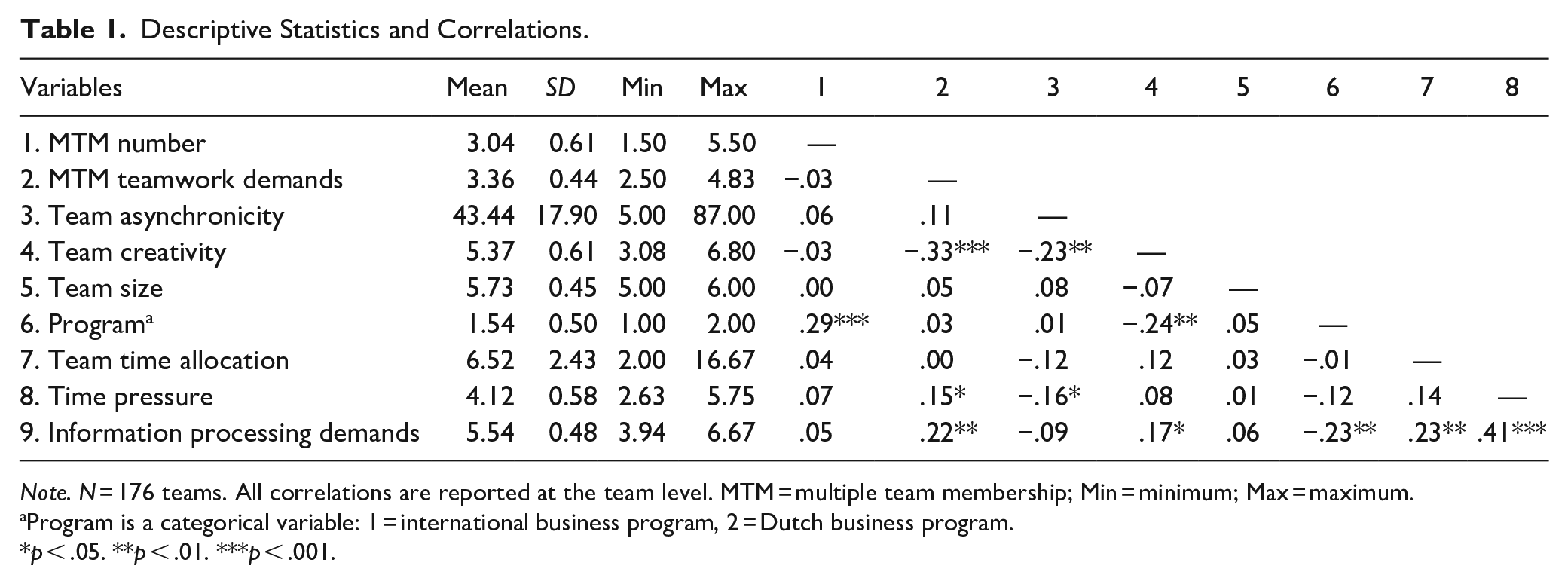
Note. N = 176 teams. All correlations are reported at the team level. MTM = multiple team membership; Min = minimum; Max = maximum.
Program is a categorical variable: 1 = international business program, 2 = Dutch business program.
p < .05. **p < .01. ***p < .001.
Test of Hypotheses
To test our hypotheses, we performed ordinary least squares regression analyses. Hypothesis 1 states that team MTM number is positively related to team asynchronicity. In the first step, we included our controls (team size, program, team time allocation, time pressure, information processing demands) before adding team MTM number in the second step. The results showed that MTM number on its own was not related to asynchronicity (β = .09, b = 2.60, SE = 2.34, t(169) = 1.11, p = .27). Thus, Hypothesis 1 was not supported.
To test Hypothesis 2, which posits that MTM teamwork demands moderate the relationship between team MTM number and team asynchronicity, we performed hierarchical regression analysis with mean-centered predictor variables (Dawson, 2014). We included our controls in step one, added MTM number and MTM teamwork demands in step two, and the interaction term of MTM number and MTM teamwork demands in step three. As shown in Table 2 (Model 1), the interaction was significant (β = .18, b = 11.58, SE = 4.92, t(167) = 2.36, p = .02), accounting for 2.99% of the variance in team asynchronicity. Simple slope analyses revealed that when MTM teamwork demands were higher, team MTM number was significantly and positively related to asynchronicity (b = 7.39, SE = 2.97, t(167) = 2.49, p = .01). In turn, when MTM teamwork demands were lower, MTM number was not related to team asynchronicity (b = −2.87, SE = 3.36, t(167) = −0.85, p = .39). Figure 2 shows this interaction at one standard deviation above and below the mean level of MTM teamwork demands. Following Preacher et al. (2006), we used the Johnson–Neyman technique to determine the region of significance for this interaction. The significant positive relationship between MTM number and team asynchronicity occurred at values of MTM teamwork demands greater than or equal to 3.58 (72nd percentile), as shown in Figure 3. Thus, Hypothesis 2 was supported.
Results of Regression Analyses on Team Asynchronicity (Hypothesis 2) and Team Creativity (Hypothesis 4).
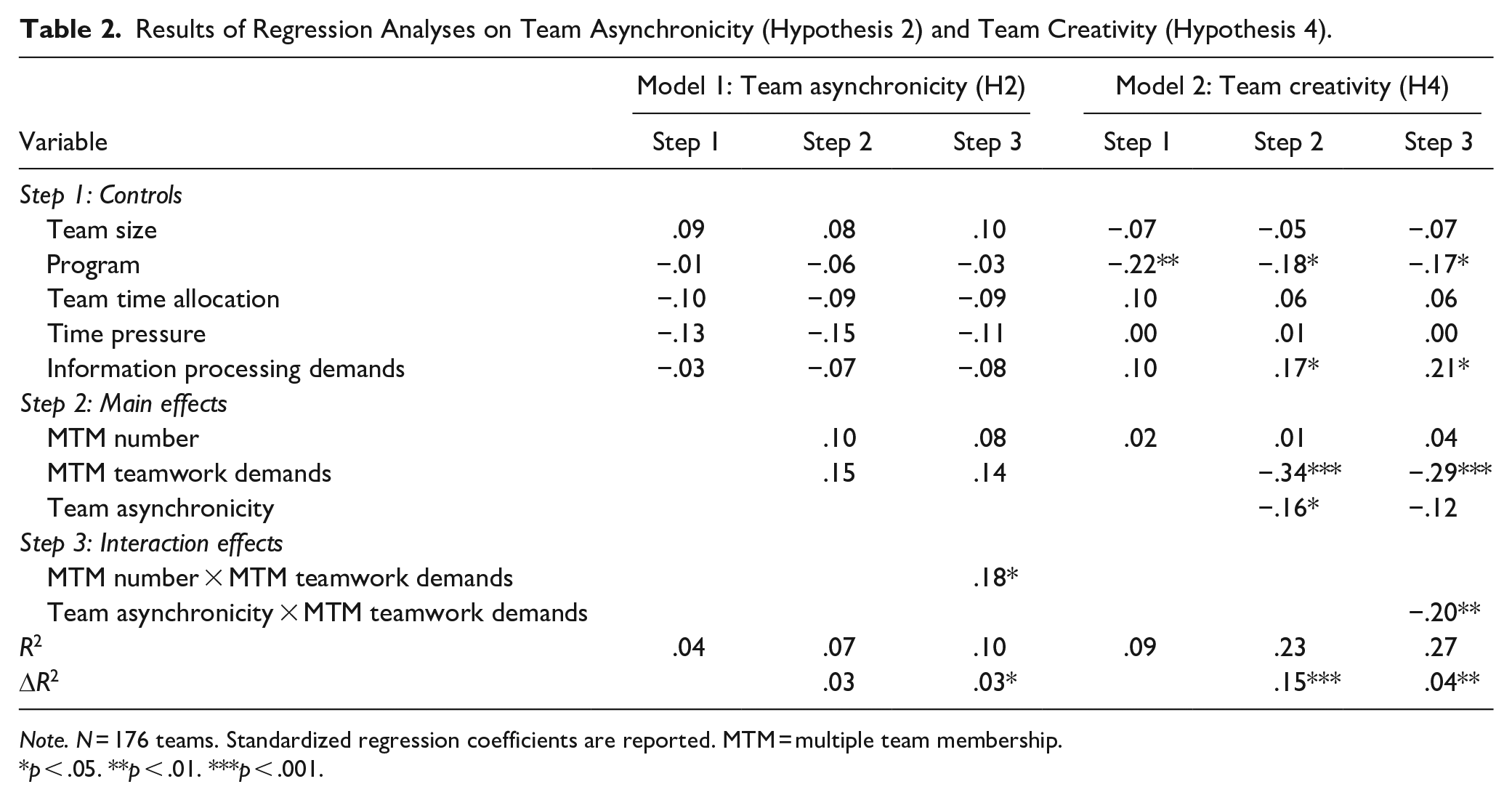
Note. N = 176 teams. Standardized regression coefficients are reported. MTM = multiple team membership.
p < .05. **p < .01. ***p < .001.
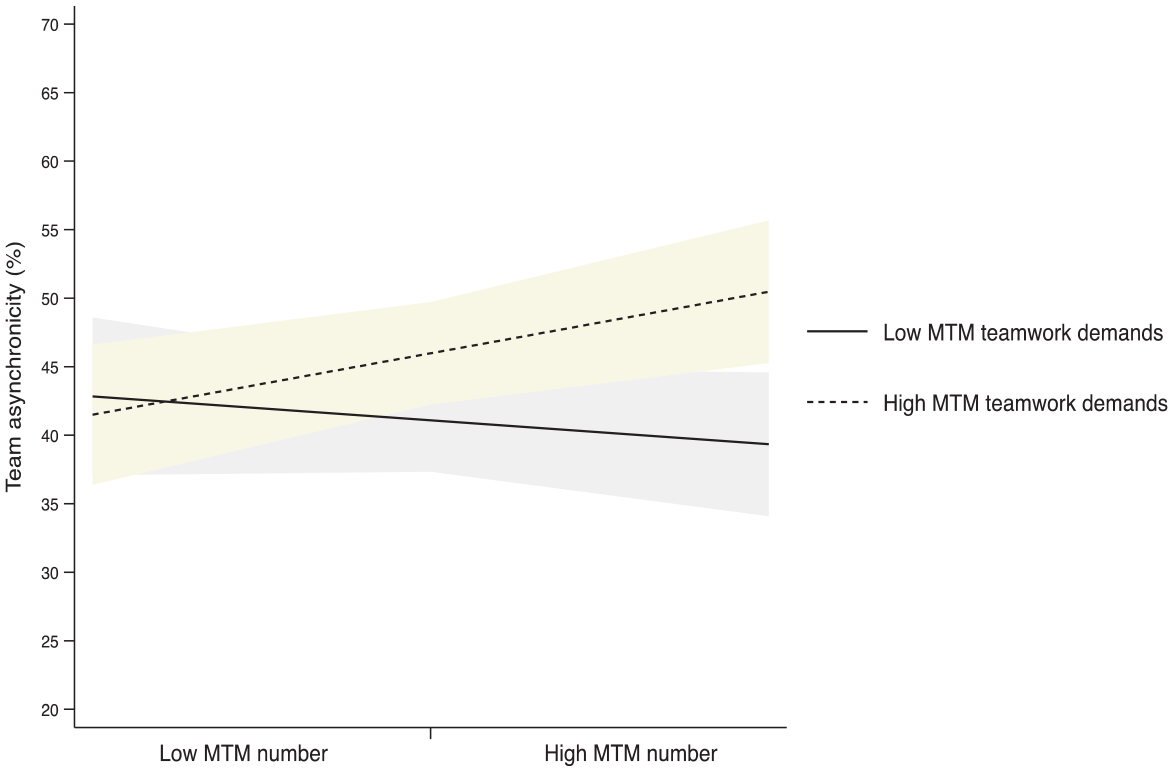
Interaction of MTM number and MTM teamwork demands on team asynchronicity.
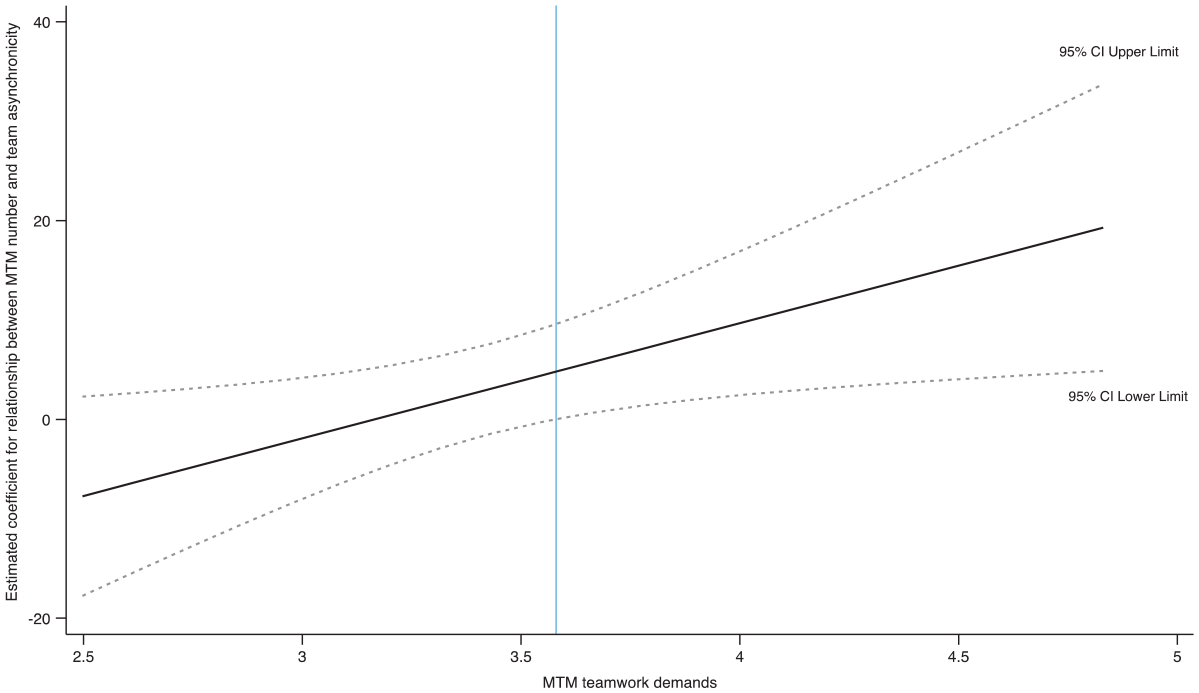
Marginal effects plot with estimates and 95% confidence intervals of the relationship between MTM number and team asynchronicity, contingent on MTM teamwork demands.
Hypothesis 3 predicts a negative relationship between team asynchronicity and creativity. After including our controls and MTM number in the first step, we added team asynchronicity in the second step. The results showed that higher team asynchronicity was linked to lower creativity (β = −.21, b = −0.007, SE = 0.003, t(168) = −2.78, p = .006), supporting Hypothesis 3.
As MTM teamwork demands can alter how members communicate asynchronously with each other in the team, we hypothesized that MTM teamwork demands moderate the relationship between the extent to which teams use asynchronous communication and team creativity. We entered our controls and team MTM number in the first step, team asynchronicity and MTM teamwork demands in the second step, and the interaction of asynchronicity and MTM teamwork demands in the third step. As shown in Table 2 (Model 2), the interaction was significant (β = −.20, b = −0.014, SE = 0.005, t(166) = −2.80, p = .006). Simple slope analyses revealed a negative relationship between team asynchronicity and team creativity when MTM teamwork demands were higher (b = −0.010, SE = 0.003, t(166) = −3.48, p < .001), but no significant relationship when MTM teamwork demands were lower (b = 0.002, SE = 0.004, t(166) = 0.55, p = .58). Using the Johnson-Neyman technique, we identified that the significant relationship between asynchronicity and creativity appeared at values of MTM teamwork demands greater than or equal to 3.40 (52nd percentile). The results depicted in Figures 4 and 5 support Hypothesis 4, such that the negative relationship between team asynchronicity and team creativity strengthens as MTM teamwork demands increase.
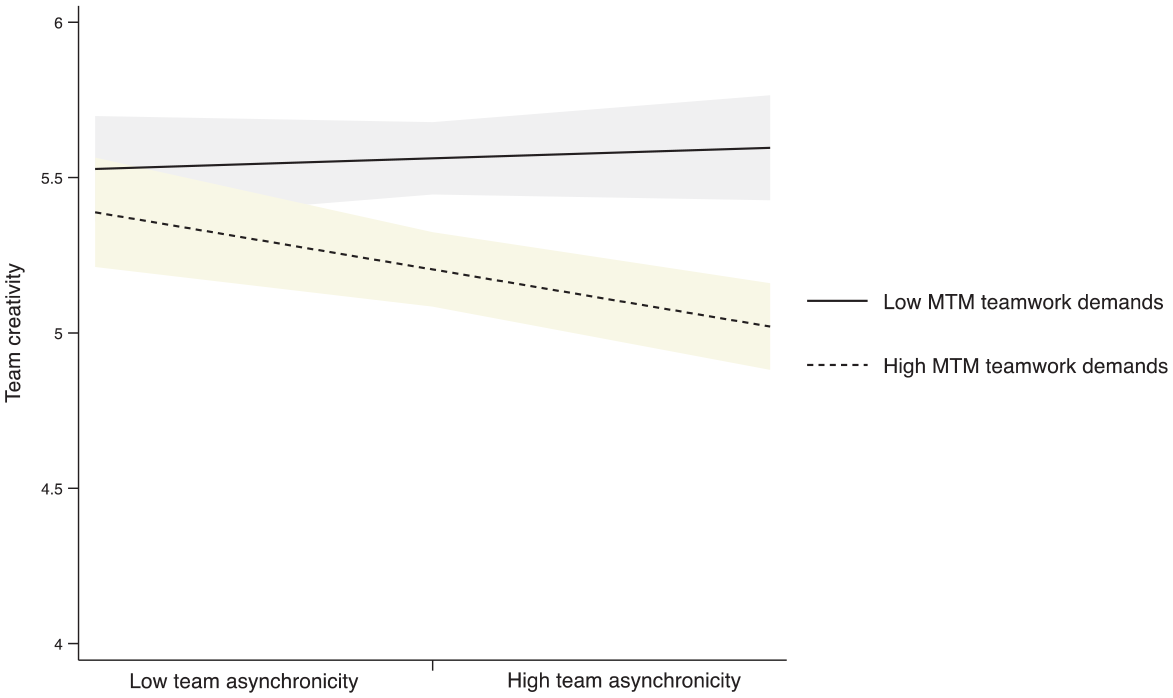
Interaction of team asynchronicity and MTM teamwork demands on team creativity.
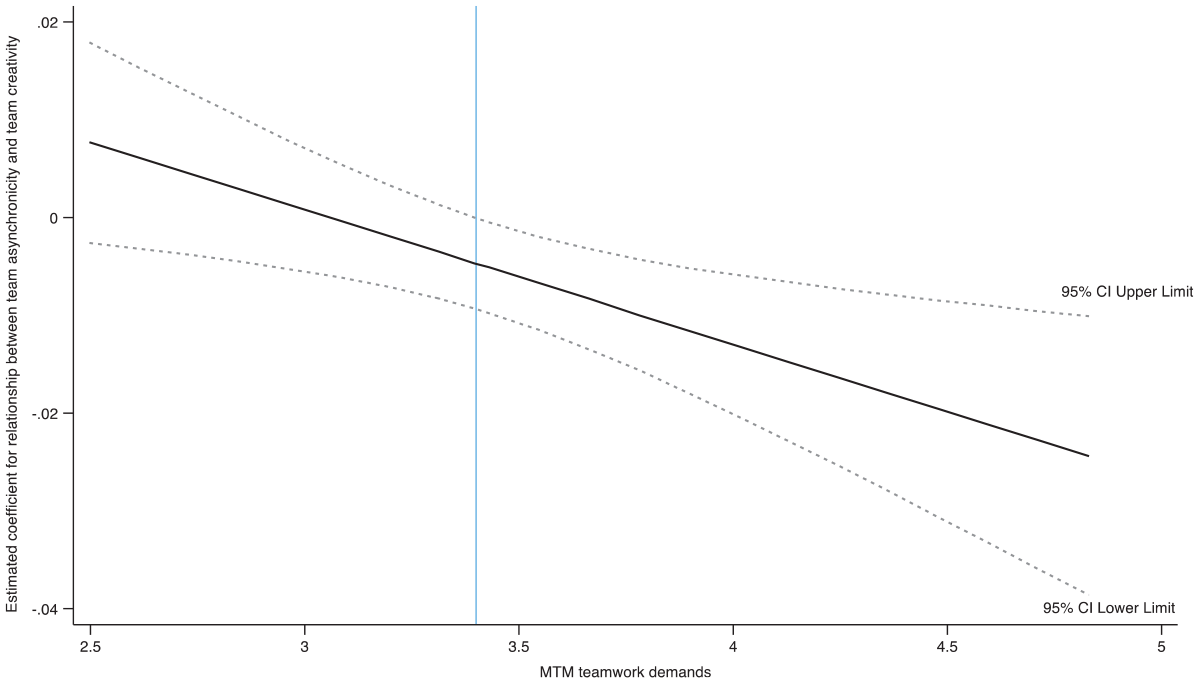
Marginal effects plot with estimates and 95% confidence intervals of the relationship between team asynchronicity and team creativity, contingent on MTM teamwork demands.
To evaluate our full model, we used the Hayes (2018) process macro, which allows for a test of the dual-moderated mediation (Model 58). Hypothesis 5 proposes that the negative indirect relationship between MTM number and team creativity via asynchronicity strengthens as MTM teamwork demands increase. Following Hayes’s (2018) procedure, we estimated the magnitude of the indirect effect using bias-corrected confidence intervals based on 5,000 bootstrapped samples derived from our original sample. The results showed a negative indirect effect of MTM number on team creativity via asynchronicity when MTM teamwork demands were higher (b = −0.08, Boot SE = 0.04, 95% CI [−0.15, −0.01]) but not when teamwork demands were lower (b = −0.01, Boot SE = 0.02, 95% CI [−0.06, 0.04]). Thus, Hypothesis 5 was supported.
To ensure robustness, we tested our hypotheses without controls; the results remained consistent (Supplemental Table S2). In addition, to confirm that our theorizing is specific to team asynchronicity solely and not to the use of synchronous virtual communication, we repeated our analyses with team virtual synchronicity as a mediator. Our hypotheses were then not supported, emphasizing the importance of specifying the distinct structures underlying team virtual exchanges. The unique temporal flexibility afforded by asynchronicity is a key driver for teams to rely on it more when their members work in a greater number of teams that involve demanding teamwork. Drawing on these results, we find support for our proposition that team asynchronicity is a costly remedy for multiteaming. That is, when the MTM context entails teamwork demands, teams communicate more asynchronously to support their members’ higher number of teams, yet asynchronicity is not a flawless solution because it also has a negative relationship with team creativity.
Additional Analyses
Our results support our research model, but also raise questions about the underlying team process through which team asynchronicity relates to team creativity. Consistent with our arguments that this relationship is likely to occur via information elaboration (Supplemental Figure S1), we collected additional data on information elaboration at T2 using Kearney et al.’s (2009) scale (α = .88, median rWG(j) = .97, ICC(1) = .22, ICC(2) = .55, p < .001) to test the validity of our reasoning. Supplemental Table S3 shows that team asynchronicity was negatively related to information elaboration (r = −.30, p < .001), and elaboration was positively linked to team creativity (r = .53, p < .001).
Results from regression analyses (Supplemental Table S4) showed that the negative relationship between team asynchronicity and team creativity (Hypothesis 3) occurs via information elaboration. Hayes’s (2018) procedure (Model 4) also supported the negative indirect effect of team asynchronicity on creativity via elaboration, as the confidence intervals excluded zero (b = −0.005, Boot SE = 0.002, 95% CI [−0.008, −0.002]).
We also re-tested Hypothesis 4, which suggests an interactive effect of MTM teamwork demands and asynchronicity on team creativity, using information elaboration as the dependent variable instead. Our reasoning was that at higher (rather than lower) levels of MTM teamwork demands, teams that communicate more asynchronously would have lower information elaboration, and thus lower team creativity. Supplemental Table S5 shows the significant interaction (β = −.21, b = −0.014, SE = 0.004, t(166) = −3.23, p = .002). Simple slope analyses showed a statistically significant negative relationship between team asynchronicity and elaboration at higher levels of MTM teamwork demands (b = −0.012, SE = 0.003, t(166) = −4.87, p < .001); however, this relationship was not significant when demands were lower (b = −0.0002, SE = 0.003, t(166) = −.08, p = .94). Johnson-Neyman results revealed that the region of significance appears at values of MTM teamwork demands greater than or equal to 3.22 (39th percentile; see Supplemental Figures S2a and S2b).
A complete test of dual-moderated serial mediation (Supplemental Figure S1) using Hayes’s (2018) procedure revealed a negative indirect effect of MTM number on creativity via asynchronicity and information elaboration when MTM teamwork demands were higher (b = −0.046, Boot SE = 0.023, 95% CI [−0.10, −0.01]) but not when demands were lower (b = 0.0003, Boot SE = 0.007, 95% CI [−0.01, 0.02]). All results of our additional analyses using OLS regressions were consistent without controls. Moreover, results of confirmatory factor analysis confirmed the distinctiveness of the five multi-item measures, including information elaboration (Supplemental Table S6).
Discussion
Despite the surge in research on multiteaming and technology use in teams, few studies examined the duality of MTM and virtual exchanges (Bertolotti et al., 2015; Maynard et al., 2012) that is inherently coupled in teams. Relying broadly on AST and scholars’ advice for teams of multiteamers to communicate more asynchronously to support their MTM, we developed and tested a model that emphasizes the interrelatedness between MTM and team virtual communication choices. Accounting for nuances in team virtual communication and examining asynchronous exchanges as a team process, we specified the relationship between team-level MTM and team asynchronicity, and subsequent links to team creativity, an outcome that is central to knowledge work.
Our findings showed that team MTM number on its own was not positively associated with asynchronous communication in collocated teams. This relationship was positive only when MTM teamwork demands were higher. In other words, teams tend to adopt more asynchronous work when their members’ MTM reality involves a greater number of teams with demanding interdependent teamwork. Critically, this reliance on asynchronicity proved to be a costly remedy for team MTM, because it was associated with lower information elaboration and team creativity, especially under those conditions that favored its adoption: when MTM teamwork demands were higher.
Theoretical Implications
First, we contribute to the literature by linking team MTM to team virtuality. Although both of these practices are inherently interrelated in teams, most researchers have studied them in isolation (Gilson et al., 2015; Margolis, 2020). The few studies that jointly investigated MTM and virtuality either treated virtuality as a given aspect of multiteaming (Incerti et al., 2020) or as a factor that is exogenous of teams in MTM settings (Bertolotti et al., 2015; Maynard et al., 2012). 1 Using AST and prior scholarly advice for teams to rely more on readily accessible technologies to facilitate their members’ MTM (e.g., Dixon & Panteli, 2010), we considered virtual communication patterns to be at least partly endogenous to teams. Our findings provide initial insights into when teams follow this advice and its implications for teamwork, underlining that virtuality can be endogenous to a team’s MTM reality and is shaped by structural (MTM number) and experiential (MTM teamwork demands) aspects of multiteaming. Our findings suggest that the relationship between team MTM number and team asynchronicity strengthens with increasing MTM teamwork demands, especially at higher levels of these demands. By communicating more asynchronously, these teams limit the coordination challenges emerging from members’ MTM and afford members the much-needed flexibility to engage in draining interactions across teams (Mortensen et al., 2007). Although scholars have recognized the importance of studying virtuality as flexible and remote work situations become increasingly common, they have mostly considered virtuality to be a stable feature of teams (Mathieu et al., 2017). Our research invites further consideration of virtuality as a malleable team process.
Relatedly, although AST highlights the importance of the underlying structures of virtual exchanges and proposes a variety of team factors that influence the extent of technology use and its impact, it only explains that such relationships occur without specifying their nature (Bostrom et al., 2009). As AST stresses the role of context in determining positive or negative relationships with technology use, scholars have used it to build context-specific models that explain why and how certain technologies are adopted in virtual teams and with which effects (Charlier et al., 2016; Tarofder et al., 2023). We add to this work by providing specificity for (a) the use of asynchronous exchanges across a diverse set of technologies (rather than solely focusing on a single technology) and (b) MTM contexts where we identify team MTM factors.
Interestingly, the results of our robustness analyses show that our model is specific to team asynchronicity and is not supported when virtual synchronous communication is tested as a mediator. Our research shows that scholars should not treat the extent of technology use as uniform; rather, they should study the underlying structures of asynchronous or synchronous virtual exchanges separately to account for their unique characteristics. We thus contribute to prior research that solely compared different types of virtual teams to face-to-face teams or studied team virtuality on a continuum (i.e., the extent of technology use) without disentangling its underlying synchronous and asynchronous structures (Gilson et al., 2015; Handke et al., 2020). We also direct future research to uncover the different conditions upon which teams communicate more asynchronously and synchronously via technologies, and to examine their distinct implications for teams. Scholars interested in the advice concerning leveraging technology for MTM can examine when teams use technologies more synchronously to support their members’ MTM. Since many technologies can be used both synchronously and asynchronously (e.g., instant messaging, discussion boards, document sharing), it is also important to clearly distinguish communication media from their (non)simultaneous use in future research.
Second, we advance our understanding of team multiteaming and its influence by integrating structural aspects of multiteaming (team MTM number) with members’ experiences of their teamwork on multiple teams (MTM teamwork demands). The extant MTM literature primarily focuses on MTM structures such as the number of concurrent teams, and reports inconsistent effects of the same structural reality of MTM on team outcomes (Margolis, 2020; Rishani et al., 2024). This work thus points to a complex relationship between team MTM number and team outcomes, and warrants a more fine-grained examination of when and how teams benefit from such MTM structures. Following Mortensen and Haas’s (2018) suggestion that mere membership in multiple teams differs from actual participation in these teams, we developed a model that emphasizes the critical role of members’ experiences of their actual multiteaming in determining how MTM structures affect teams. By showing that MTM teamwork demands experienced across teams can exacerbate or attenuate the challenges of MTM number on teams, we direct the scholarly discussion toward examining when members’ experiences of multiteaming yield detrimental or favorable team situations from MTM structures.
Our research shows that when MTM teamwork demands are higher, team MTM number is positively related to team asynchronicity, which in turn is linked to lower information elaboration and team creativity. Alternatively, when MTM teamwork demands are lower, team MTM number is not related to asynchronous communication, and the team’s information exchange and creativity remain unaltered. In future research, scholars can build on these insights by exploring how teams can limit their members’ MTM teamwork demands and identifying MTM conditions under which asynchronicity can benefit teams. Given the few studies on spillover effects across teams (Chen et al., 2019), it also may be fruitful to separate MTM teamwork demands based on where they originate (e.g., focal team vs. external teams) and study how they differentially relate to focal team communication.
Third, the MTM literature has primarily focused on team performance and largely overlooked underlying team processes and how teams organize their work for their members’ MTM (Bertolotti et al., 2015; Cummings & Haas, 2012; Rishani et al., 2024). By directing attention to the relationship between team MTM and underlying team communication and information processes, we provide initial empirical evidence for widely discussed knowledge integration mechanisms of MTM’s influence (Rishani et al., 2024). Extant research examining MTM’s effects on knowledge exchange often adopted a social network approach at the individual level (Brennecke & Rank, 2016; van de Brake et al., 2020), leaving much unknown about these core processes of teams. Focusing on these team processes, we show that team asynchronicity can be both beneficial (support for team MTM) and costly (lower elaboration and team creativity) for teams, and we underline that future research should provide a more nuanced understanding of its role.
Practical Implications
Our research informs teams that communicating more asynchronously can support their members who are busy in many concurrent teams and have close, demanding MTM interactions. When teams find their members entangled in extended webs of demanding working relationships across multiple teams, asynchronicity can ease team members’ restrictive commitments and facilitate their team switching with minimal effort (Dixon & Panteli, 2010). Nevertheless, teams and multiteamers should be cautioned that asynchronicity can compromise team information processing and team creativity when MTM teamwork demands are higher. Thus, teams that find it necessary to adopt asynchronous work practices in contexts involving MTM should seek to overcome the informational disconnects created by asynchronous exchanges. We advise teams to proactively reduce members’ MTM teamwork demands to prevent likely changes to team communication practices and potential negative effects on team creativity. For instance, managers can monitor MTM situations to ensure their workers do not have many demanding multiteaming interdependencies that create coordination burdens and disruptions for teams.
Limitations and Directions for Future Research
Although this study has yielded valuable insights, it does have some limitations. One limitation is the use of a student sample, which may differ from an employee sample. Nevertheless, it provided us with clear advantages in that we were able to collect data from a large number of teams, track comparable team projects from start to finish at three different time points, and obtain high within-team response rates to study team-level multiteaming relationships and processes. Such team data is difficult to obtain in work contexts because teams typically work on different projects spanning different time periods. For example, some knowledge teams are short-lived (e.g., 3 days) while others are long-lived (e.g., 10 weeks), making it extremely difficult to assess enough teams working within the same timeframe to determine how teams organize their work on a project as a result of their members’ MTM. To maximize the generalizability to knowledge work, we used a similar complex team task that requires creativity and for which members’ performance personally matters (i.e., a significant portion of the course grade). The teams in our sample also exhibited core characteristics of knowledge worker teams because: (a) they had autonomy over how they organized their teamwork; and (b) members were regularly multiteaming to complete different course work (e.g., information management, strategic management, cross-cultural management, entrepreneurship), thesis projects, internships, and other job responsibilities inside and outside the university. Consultant, academic, and ad hoc teams exemplify these knowledge worker teams that structure their own team processes, work on complex tasks, and whose members routinely work on multiple simultaneous teams inside and outside their organizations (e.g., researchers from other universities, client teams; Lewis, 2004; O’Leary et al., 2011). We encourage future research to further examine how MTM alters team virtual communication in knowledge teams while considering other settings where it is feasible (e.g., field experiments). Moreover, our sample of teams was embedded within a single course and had to complete the same task where creativity was expected. It is important to interpret our results within this study context, as other knowledge-based teams may have different ranges of creativity levels.
Second, although we assessed members’ team communication and team creativity at different points in time and our creativity measure specified the time period after asynchronicity, we cannot draw conclusions about the direction of this relationship. As one must consider the possibility of reverse causality, where less creative teams opted for more asynchronicity, we advise future research to employ longitudinal repeated measure surveys or experimental designs to clarify the direction of this relationship. Importantly, this study was conducted just before the coronavirus pandemic. Teams were entirely collocated, and members had the freedom to choose how they would communicate (face-to-face, synchronous, or asynchronous technology use). After the pandemic, the work context changed, with a greater reliance on fully remote or hybrid work. Future research can use insights from our work for alternative work contexts, for example, by studying when teams use technologies synchronously or asynchronously to support MTM in remote work settings.
Conclusion
Although MTM and technology use are inherently coupled in teams, researchers have often studied them in isolation. We study their interrelatedness to shed light on when teams follow scholars’ advice of leveraging technologies for asynchronous work to support their members’ multiteaming and to specify the implications of this advice on teams. Our research shows that the relationship between MTM number and team asynchronicity becomes more positive when members experience higher levels of taxing interdependent teamwork from multiple teams. Yet our findings show that team asynchronicity is a costly remedy for MTM, as it is negatively related to information elaboration and team creativity when MTM teamwork demands are higher. Our research discusses the contingent role of MTM teamwork demands that shape how teams organize their work for their MTM number and the extent to which team asynchronicity relates negatively to information elaboration and team creativity.
Supplemental Material
sj-docx-1-sgr-10.1177_10464964251325209 – Supplemental material for When Do Teams Communicate More Asynchronously to Support Their Members’ Multiteaming?
Supplemental material, sj-docx-1-sgr-10.1177_10464964251325209 for When Do Teams Communicate More Asynchronously to Support Their Members’ Multiteaming? by Mayssa Rishani, Inga J. Hoever and Dirk van Dierendonck in Small Group Research
Footnotes
Declaration of Conflicting Interests
The author(s) declared no potential conflicts of interest with respect to the research, authorship, and/or publication of this article.
Funding
The author(s) received no financial support for the research, authorship, and/or publication of this article.

Supplemental Material
Supplemental material for this article is available online.
Notes
Author Biographies
References
Supplementary Material
Please find the following supplemental material available below.
For Open Access articles published under a Creative Commons License, all supplemental material carries the same license as the article it is associated with.
For non-Open Access articles published, all supplemental material carries a non-exclusive license, and permission requests for re-use of supplemental material or any part of supplemental material shall be sent directly to the copyright owner as specified in the copyright notice associated with the article.
