




Abstract
We investigated how team composition, in terms of members’ emotions about the team tasks ahead, predicts performance on these team tasks. In 45 student teams, a higher average level of anxiety and happiness, but not anger, about the team assignments predicted higher team grades 6 weeks later. We explored potential mediating team processes. These findings contribute to the literature on team affect, which has so far struggled to identify benefits of negative affect in teams: task-related anxiety is linked to better performance of real-world teams. This highlights the importance of studying compositional effects of individual affective states in teams.
Among the many factors that influence the performance of small teams—groups composed of two or more individuals who interact socially, perform relevant tasks, and share common goals (Kozlowski & Bell, 2003)—the importance of affective processes is increasingly recognized (e.g., Barsade, 2002; Collins et al., 2013; George, 1990; Knight & Eisenkraft, 2015; Van Kleef et al., 2017; Walter & Bruch, 2008). A close look at this work reveals that the role of affective states in teams is almost exclusively (implicitly or explicitly) viewed through the lens of emergent, shared team properties (Klein & Kozlowski, 2000)—that is, focusing on the origins and consequences of the similarity in affective states that develop in teams. Reflecting this conceptualization, empirical research on affect in teams typically measures affective states during or after team interaction (e.g., Beersma et al., 2018; Delvaux et al., 2015), because team interaction allows emotional convergence to occur (Barsade, 2002; Hatfield et al., 1993; Klep et al., 2011).
However, team members do not enter teams from a vacuum. Instead, team members bring their idiosyncratic, pre-existing affective states into the team, and the combination (or composition) of these affective states is likely to have an impact on downstream team processes and performance. In theoretical work, affective composition is primarily considered as an input to the development of shared team affect (Barsade & Gibson, 1998, 2012; Kelly & Barsade, 2001), but other ways in which affective composition may impact team functioning and performance are not considered. Moreover, the actual consequences of affective composition remain to be empirically investigated. Previous work has highlighted the importance of team composition in terms of other team member variables (e.g., cognitive ability, personality, demographics; Bell, 2007; Bell et al., 2011; Devine & Philips, 2001; Peeters et al., 2006) for team functioning and performance. Given the importance of affective states and the unique input of individual characteristics in teams (Ilgen et al., 2005), it is striking that there is limited research on how affective states that members bring into the team relate to team outcomes. In this paper, we aim to provide insight into the importance of team affective composition by examining whether natural variation in the emotions about the assigned team tasks predict team functioning and team performance. Importantly, we expect more benefits of negative emotions than the team affect literature currently describes.
Affect and Team Performance
An exhaustive meta-analysis of the empirical research on the relation between (team) affective states and team outcomes concluded that “positive is usually good, negative is not always bad” (Knight & Eisenkraft, 2015, p. 1214). The first part of this conclusion follows straightforwardly from the findings: 23 of the 27 (85%) empirical correlations between positive team affect and team performance are in the positive direction, and no moderator was identified. Regarding negative affect, Knight and Eisenkraft (2015) found that the “badness” of negative affect depends on whether the negative affective states originate inside (endogenous) or outside (exogenous) of the team. Although endogenous negative affect is “bad,” exogenous negative affect is less “bad”—and in some cases, it may even be “good.”
But although this meta-analysis suggests that exogenous negative affective states might benefit teams, there is strikingly little direct evidence for such benefits. Of the 39 studies included in the meta-analysis, only four included a measure of exogenous negative affect (Knight & Eisenkraft, 2015, Table 1). Only two of these four studies, both unpublished, found positive correlations between exogenous negative affect and team performance (Erdheim, 2007; Iannone, 2011; see Knight & Eisenkraft, 2015, Appendix). One additional study found marginally better team performance following a negative mood induction compared to a positive mood induction, although the difference was not statistically significant (Jones & Kelly, 2009). A close inspection of these three studies reveals that they all operationalized team affect in a way that prevents the interactive affective convergence processes required for shared team affect to develop (Klep et al., 2011). Specifically, they measured (Erdheim, 2007) or manipulated (Iannone, 2011; Jones & Kelly, 2009) individual affective states prior to team interaction. As such, their findings may actually reflect compositional effects of individual negative affective states.
OLS Regression of Compositional Effects of Three Task-Related Emotions Prior to Team Formation on Team Performance.
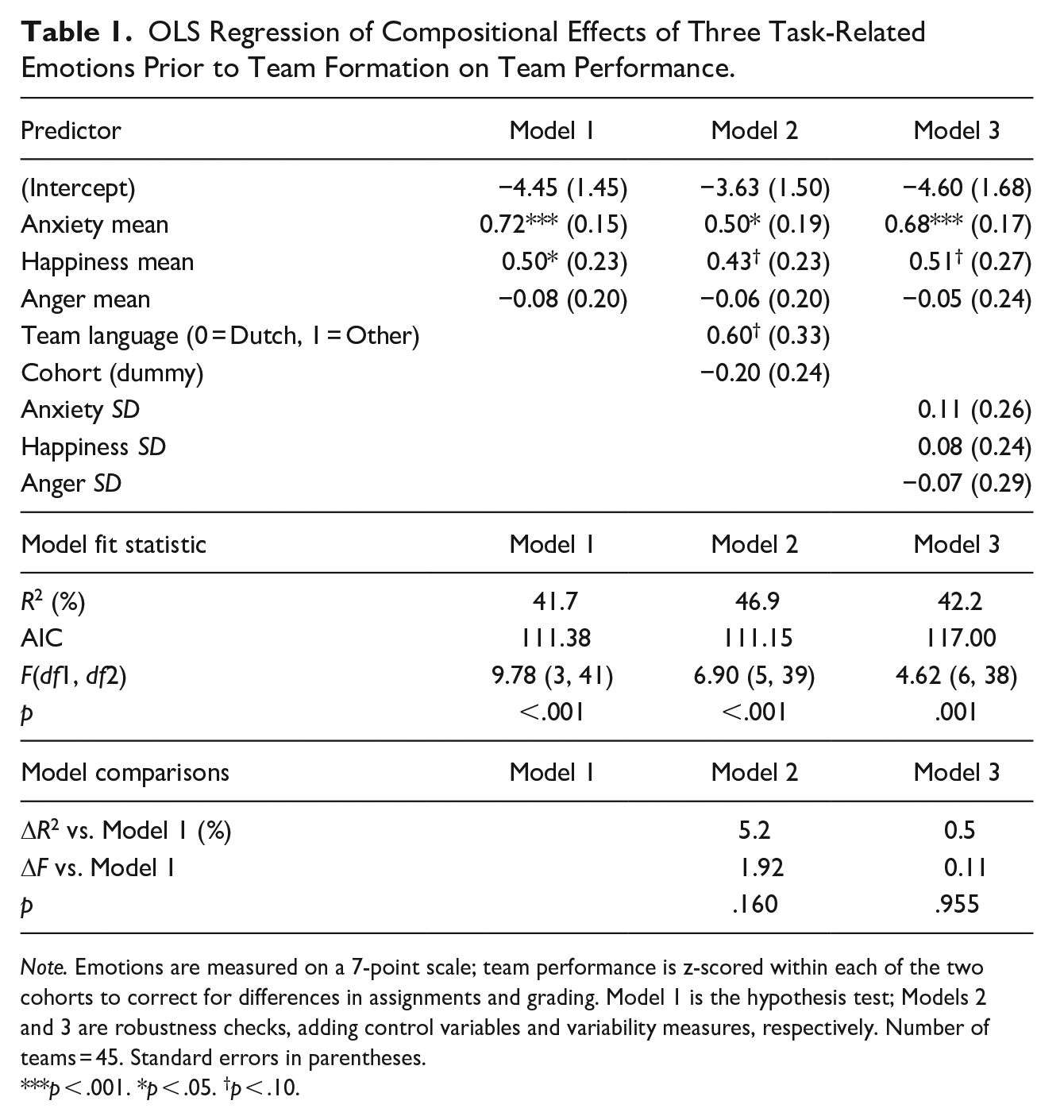
Note. Emotions are measured on a 7-point scale; team performance is z-scored within each of the two cohorts to correct for differences in assignments and grading. Model 1 is the hypothesis test; Models 2 and 3 are robustness checks, adding control variables and variability measures, respectively. Number of teams = 45. Standard errors in parentheses.
p < .001. *p < .05. †p < .10.
However, research with a more explicit focus on compositional effects is needed to validate and extend this interpretation. In doing so, we aim to resolve two further limitations of this prior work. First, the existing studies employed specific tasks on which negative moods may enhance individual-level performance. For instance, negative affective states in individuals can be conducive to persistence in creativity tasks (Nijstad et al., 2010). This makes it unclear whether benefits of negative team affect are specific to creativity tasks (Iannone, 2011; Jones & Kelly, 2009) and reducible to changes in individual-level performance, or whether they (also) reflect broader changes in team functioning. In the current project, we resolve this limitation by investigating the relation between team affective composition and team performance in real-world student teams working together on multiple team assignments tapping into a range of different skills over a 6-week period. A second, more practically relevant limitation is that both prior studies focused on the consequences of incidental moods (i.e., transient affect that is unrelated to the team, caused by unpredictable factors, such as the weather, or a mood induction by the experimenter) in one-shot lab groups. Especially in longer-term interacting groups, it will be nearly impossible to control team members’ moods prior to each team interaction. To resolve this limitation, we focus on team composition in terms of task-related emotions, instead of incidental moods.
Task-related emotions can be construed as short-lived affective states that are specific to the team tasks. Unlike moods, emotions are specific to an object or stimulus (Frijda, 1986, 2009; Gordon, 1974; Parrott, 2001). Although emotions are relatively short-lived, this object-specificity of emotions makes them less fleeting, and more stable over time compared to moods, at least while the underlying cognitive appraisals of the object (here, the task) remain stable (Lazarus, 1991). Instances of this relative stability include consistent emotional reactions to the same stimulus, as observed in conditions like spider phobia (Fredrikson et al., 1996) and the reliable anticipation of emotions in a (work) situation at a later timepoint (Kaplan et al., 2020; Smith et al., 2006). This object-specificity also differentiates task-related emotions from trait affect, which reflects a propensity to experience specific affective states across a wide range of situations (Lazarus, 1991; Watson & Clark, 1984), rather than to a specific task. Taking advantage of emotions’ relative predictability over time, we centered our investigation on students’ anticipated emotions concerning the upcoming team assignments (i.e., task-related emotions) rather than their transient moods as the key predictor of team performance. Examining specific emotions rather than moods also enabled us to develop more fine-grained predictions about which negative emotions might be particularly beneficial for team functioning.
Anger, Anxiety, and (Academic) Team Performance
Two different lines of theorizing on emotions suggest that negative high-arousal emotions, in particular, can benefit team performance. In the first line of relevant research, social-functional accounts of emotions propose that negative, high-arousal team emotions increase team-level effort expenditure. Reflecting the central premise that emotions evolved by providing survival benefits (e.g., Keltner & Haidt, 1999; Spoor & Kelly, 2004; Van Kleef & Fischer, 2016; Van Kleef et al., 2017), high-arousal negative affective states are theorized to have communicative and mobilizing functions, helping teams to efficiently coordinate efforts to deal with outside challenges (Spoor & Kelly, 2004). Although the challenges facing present day (student, work) teams are far removed from the survival challenges that enabled negative emotions to evolve, the functions of negative emotions—to coordinate efforts to cope with external challenges—should remain. This helps explain why exogenous (i.e., caused by external factors) negative affect may be more beneficial for team performance than endogenous negative affect (Knight & Eisenkraft, 2015). Further, consistent with the relatively greater benefits of negative high-arousal emotions over negative low-arousal emotions, Erdheim (2007) found that the team average level of negative activation prior to the task positively predicted later team performance, whereas the average level of negative deactivation did not.
A second relevant line of research concerns the role of achievement emotions in academic performance. Even though this literature focuses primarily on the individual level of analysis (for exceptions, see Linnenbrink-Garcia et al., 2011; Zschocke et al., 2016), it similarly proposes that the consequences of negative affective states depend on the associated arousal level. Low-arousal negative affective states such as boredom and hopelessness “uniformly reduce motivation and the effortful processing of information, implying negative effects on performance” (Pekrun et al., 2011, p. 38). High-arousal negative emotions, such as anger, anxiety, and shame, have a more complex relation with academic performance. On the one hand, they are found to generally undermine intrinsic motivation and achievement (e.g., Brosnan, 1998; Macher et al., 2012; Pekrun et al., 2002, 2011). Indeed, perhaps the most well-established finding in the educational emotions literature is a negative relation between test anxiety and GPA (Richardson et al., 2012), which can be explained by cognitive interference (Pekrun et al., 2002; Putwain et al., 2010). On the other hand, negative high-arousal emotions also have potentially beneficial consequences, such as increased effort and extrinsic motivation (e.g., increasing rehearsal; Pekrun et al., 2002). The increased effort on academic tasks driven by negative high-arousal emotions mirrors their capacity to enhance individuals’ persistence and performance on (important) creativity tasks (Baas et al., 2008; Nijstad et al., 2010).
Thus, both social-functional accounts of emotions and the literature on achievement emotions in academic settings converge in suggesting that high-arousal negative emotions (e.g., anger and anxiety) potentially benefit team performance more than low-arousal negative emotions (e.g., hopelessness and boredom). They differ, however, in their predictions about the overall consequences of these high-arousal negative emotions. Specifically, the achievement emotions literature suggests that, despite the motivational benefits, negative high-arousal emotions will decrease overall academic performance (e.g., Brosnan, 1998; Macher et al., 2012; Pekrun et al., 2002, 2011), whereas social-functional accounts (e.g., Spoor & Kelly, 2004) suggest that, at the team level, these same emotions might benefit team functioning and performance. We propose that teams provide circumstances where the team-level consequences of these emotions offset the individual-level drawbacks of two prevalent negative academic emotions, anger and anxiety, resulting in a net benefit for team performance.
Anxiety is produced by appraisals of threat, uncertainty, and low coping potential (Lazarus, 1991). Thus, task-related anxiety likely reflects uncertainty about one’s ability to achieve important goals (e.g., doing well academically). Teams who start with more task-related anxiety may perform better for several reasons. First, anxiety may lead teams to converge onto an (exogenous) negative affective state (Barsade, 2002; Barsade & Gibson, 1998; Kelly & Barsade, 2001). Such (exogenous) negative affect may benefit performance via improved social integration, which is a superordinate construct that comprises, for example, cohesion and identification (cf. Knight & Eisenkraft, 2015). Second, anxiety may elicit social support that helps individual team members cope with anxiety (e.g., Cottrell & Epley, 1977; Luminet et al., 2000; Yang & Kelly, 2016), thereby mitigating its individual-level drawbacks. Indeed, teams have been found to be more resilient to stress than individuals (Kerr & Tindale, 2004). At the same time, the provision of social support itself may promote social integration and, in turn, team performance (Beal et al., 2003; Boekaerts & Minnaert, 2006). Finally, task-related anxiety may motivate attempts to reduce uncertainty through the structuring of both the task and the team itself, for instance by assigning specific roles to team members. These attempts could manifest in process conflict (Jehn, 1995) and increased team efficacy (Bray & Brawley, 2002). The resulting diminished uncertainty and enhanced coping potential resulting may alleviate anxiety and its associated drawbacks. Thus, we hypothesized:
Hypothesis 1: Teams composed of students who feel more task-related anxiety will perform better.
Anger, on the other hand, reflects appraisals of a threatened goal, injustice, and assignment of blame to an external agent (Lazarus, 1991). Thus, task-related anger reflects a perceived obstruction of important goals (e.g., doing well academically) by others. There are multiple reasons why starting with greater task-related anger may benefit teams. First, similar to task-related anxiety, task-related anger may spread in teams, fostering a convergence onto an exogenous negative affective state that may enhance social integration and performance (Barsade, 2002; Knight & Eisenkraft, 2015). Second, anger about an external cause (such as tasks) provides a motivational basis for collective action (Thomas et al., 2009; Van Zomeren et al., 2004), which can trigger the effective and coordinated mobilization of (team) effort mentioned earlier. Moreover, perceiving that others, too, are angry about an external cause creates a sense of shared identity (Kessler & Hollbach, 2005; Livingstone et al., 2016), which is likely to enhance social integration and team performance. Finally, anger experiences may trigger team conflict (Barsade & Knight, 2015; Van Kleef & Côté, 2018). When anger prompts team members to “speak their mind” about the tasks, it can serve as a foundation for constructive forms of conflict, leading to the development of effective strategies for dealing with the task (i.e., task conflict Jehn, 1995). Thus, we hypothesized the following:
Hypothesis 2: Teams composed of students who feel more task-related anger will perform better.
The Present Research
We investigated the relation between team composition in terms of (negative) task-related emotions and team performance in the context of an academic course on group processes. We measured the emotions that students experienced about the team assignments proactively, specifically before engaging in the actual tasks, and, in our case, prior to team formation (for a similar approach, see Kaplan et al., 2020). We randomly assigned students to teams, which created natural variation in the affective composition of teams. We then examined how this affective composition related to the grades the group earned for their team assignments, completed over the course of 6 weeks, which counted toward the students’ final course grade. Research on team compositional effects suggests that task type is relevant when operationalizing a configural team property (e.g., Barrick et al., 1998; Bell, 2007). Although our team assignments encompassed different task types, we operated under the assumptions that more effort would generally lead to better grades and that students could offset each other’s lack of effort (i.e., a compensatory task). Based on Barrick et al. (1998), we therefore assumed that the team average of individual task-related emotions would predict team performance better than other distributional characteristics (Chan, 1998; Moynihan & Peterson, 2001).
Because several arguments and mechanisms can explain why teams composed of members who feel more anxious or angry about their tasks may perform better, and given the sample size constraints due to the academic context of this study, we refrained from formulating specific predictions about mediating mechanisms. Instead, we explored a broad array of possible mediators, including shared team affect, social integration-related concepts, and team conflict. This set-up enabled us to pinpoint which of these mechanisms is most important. Given our primary focus on negative emotions, we did not formulate hypotheses about the role of positive task-related emotions. Nevertheless, we also explored how happiness—a high-arousal positive emotion—is associated with team performance. We assumed that we would replicate the positive association found in prior research (e.g., Knight & Eisenkraft, 2015; Pekrun et al., 2002).
Method
We collected data in two consecutive cohorts of students in a course on team processes at a large university in the Netherlands. We present only the combined dataset to improve statistical power.
Participants and Design
Participants completed questionnaires at the beginning of the course, before forming teams (Week 1), and again at the end of the course (Week 6), after all teams had completed the graded team assignments, but before receiving their team grades and taking an individual exam. For practical course-related reasons, before forming teams, we divided the students in Dutch-speaking and non-Dutch-speaking subsamples (who had a wide variety of international backgrounds). Subsequently, teams were formed by randomly assigning students from the same subsample into three-member (40 teams) and four-member teams (five teams). There were 28 Dutch teams and 17 non-Dutch teams. 1 Participation was voluntary, and questionnaires were completed online at a self-chosen time and place (within the week in which the survey was accessible). In the first cohort, 82 out of 85 team members participated, with three non-participating students in different teams. In the second cohort, all 55 team members participated in the study. The sample totaled 40 men and 96 women (Mage = 21.74, SD = 1.77, range 19–29), plus one participant without demographic information. We used all available data in the analyses.
Measures and Procedure
Measures pertinent to the present study were embedded in a longer questionnaire. The Week 1 questionnaire consisted of individual difference measures (personality, conflict-related traits, and power motives) as well as the measures of task-related emotions. The Week 6 questionnaire tapped into team processes discussed in the course, aiming to illustrate and replicate important findings in team research for educational purposes, as well as to explore possible mediating mechanisms. Measures unrelated to the current study will not be discussed in this article (for a complete list of Week 6 measure, see Supplemental Material). In response to critiques of Cronbach’s α (McNeish, 2018; Peters, 2014), we report McDonald’s ωt (categorical omega), calculated using the MBESS package for R (version 4.8.0; Kelley, 2020), as the reliability statistic. This statistic is interpreted in a similar fashion as Cronbach’s α.
Measuring Task-Related Emotions
None of the existing measures of affect and emotions in educational contexts fit our purpose to measure discrete emotions about future course assignments (i.e., prospectively). We therefore combined items adapted from prior research (Goetz et al., 2010, 2012; Zschocke et al., 2016) with items developed by the authors to measure task-related emotions. We used the following items to measure task-related anxiety: “I feel nervous about the group assignments.” and “I am worried that we may not do the group assignments well.” (ωt = 0.75); task-related anger: “I feel angry about having to do group assignments.” and “I feel irritated because I believe that I can make more of my time alone than in a group.” (ωt = 0.77); task-related happiness: “I am happy to have group assignments.” “I look forward to working on the group assignments.” and “I think the group assignments are fun.” (ωt = 0.85). These seven items were scored on a 7-point Likert scale (1 = not at all, 7 = very much) and embedded in a 12-item measure that also assessed the low-arousal emotions hope (first cohort only), boredom, and hopelessness. Due to our theoretical emphasis on anxiety and anger, along with an exploratory interest in happiness, and constrained by our sample size, our analyses focus on these three emotions. Analyses involving the other emotions can be found in the Supplemental Material, and they yield converging conclusions.
To check the predictive validity of this task-related emotions measure, we also included the same measure in the Week 6 questionnaire, with the items rephrased in retrospective terms. The relations between task-related anger, anxiety, and happiness that students expected to experience during the tasks (measured in Week 1), and the corresponding task-related emotions reported in Week 6 were all positive and significant (βs from .38–.49, ps < .001), indicating that our Week 1 measure indeed captured the task-related emotions students later experienced (for details, see Supplemental Material).
Team Performance
We used official course grades as the measure of team performance. In the first cohort, it was calculated as the weighted average of scores on three team assignments: (1) A report on the team’s experience with a self-determined “getting to know each other” exercise, designed based on development literature such as the team stages model by Tuckman and Jensen (1977; weight 1/5). This assignment was graded on the adequate use of the theories discussed during the first two lectures of the course, which discussed group development, the Input-Process-Output model (e.g., Kozlowski & Ilgen, 2006), and social influence and motivation (as described in Nijstad, 2009). (2) A presentation about the creative process and coordination within the team during the development and preparation of a 3-course dinner with one recurring substantial (i.e., no salt, pepper, water) and creative ingredient in all three courses (weight 2/5). We graded this assignment on the overall creativity of the menu (feasibility and originality; Nijstad, 2009); the quality of the application of diversity and creativity theory to the group process (e.g., Van Knippenberg et al., 2004); and quality of communication (e.g., structure, clarity, grammar). (3) A reflection report, discussing two theories about team processes, one matching the team’s experiences, and one not. Additionally, teams described something that they would have done differently in their interaction given the knowledge they obtained throughout the course (e.g., many discussed that they would have used less computer-mediated communication; weight 2/5). The grade was based on the quality of the application of theory, critical evaluation of the team process, and quality of communication (e.g., structure, clarity, grammar). Team performance on all tasks was graded on a 10-point scale (1 = worst, 6 = pass, and 10 = perfect) by the course instructor (an expert on the link between diversity and team performance and creativity who was unaware of the responses to the questionnaires in Week 1. Thus, good team performance required not only creativity, but also analytical thinking, effort, and attention to detail. More details on the scoring rubric may be obtained from the authors.
In the second cohort, the first assignment was dropped for reasons unrelated to this study. Thus, team performance for the second cohort is the weighted average of the creative chef assignment grade (2/3) and the reflection paper grade (1/3). Additionally, we more explicitly separated the specific theories that groups had to include in their reasoning to prevent redundancy between the two assignments, and we provided specific references to the lectures that they should build on. For the reflection assignment, teams were also required to reflect on the development and overall functioning of their team using group-related literature. To account for variations in assignments and grading procedures between the two cohorts, we calculated per-study z-scores for team performance prior to combining scores from both cohorts.
Analytic Approach
Because our outcome (team performance) is a team-level variable, we analyzed our data at the team level. This necessitated aggregating the individual-level measurements.
Aggregation
To operationalize team composition, we calculated per-team average, minimum, maximum, and variability (SD and range) for the predictors of interest. We did not calculate intra-group agreement for these measures because team composition is a formative (or configural) team property. Because team-level variability is necessarily restricted when the team-level average lies closer to the extremes of the scale (i.e., restriction-of-range), we checked the robustness of any results involving average or variability by controlling for the other quantity (Harrison & Klein, 2007).
Before aggregating reflective (or shared) team properties, such as team process, we calculated intra-group agreement using the ICC(1, k) statistic (also referred to as ICC2; Bliese, 2000; LeBreton & Senter, 2008; Shrout & Fleiss, 1979), which reflects the proportion of variance in the average of team member scores that is explained at the team level. The ICC(1, k) value that justifies aggregation is subject to debate (e.g., Bliese, 2000) and depends on study goals (LeBreton & Senter, 2008). Given our exploratory purposes, we used a relatively liberal cut-off of ICC(1, k) ≥ .30, which reflects “weak agreement” or better (cf. LeBreton & Senter, 2008). In teams as small as ours (k ≈ 3), this value corresponds to around 13% of the variance in individual-level scores accounted for by team membership, which is close to the median of values typically observed in empirical research (12%, with a range from 5% to 20%, cf. Bliese, 2000). We evaluated variance components using Linear Mixed Models (LMMs), employing REML for estimation (Chen et al., 2018; McNeish & Stapleton, 2016). These models were fit using the lme4 package for R (Bates et al., 2015). For ICC(1, k) calculation, we utilized the insight package (Lüdecke et al., 2019) and the formula in Shieh (2016).
Control Variables and Robustness Checks
Because teams were either exclusively Dutch or non-Dutch, potential systematic differences between Dutch and non-Dutch students could impact our team-level findings. For instance, if international students feel more anxious about the assignments, non-Dutch teams will be, on average, more anxious than Dutch teams. If task-related anxiety then predicts performance, it could reflect a “true” association (i.e., differences in anxiety explaining the differences between Dutch and non-Dutch teams), or it might be an artefact of another, potentially unmeasured difference between the two types of teams. Thus, we also report results from analyses that included dummy variables for language and cohort, and address any inconsistencies.
Results
We analyzed the data using OLS regression and LMMs (Bates et al., 2015; R Core Team, 2020). No multicollinearity (VIFs ≤ 5) or heteroskedasticity was observed in any of the models, and the residuals met the normality assumption according to QQ-plots. G*power indicated that, in our sample of 45 teams, a regression analysis with five predictors could detect a large effect size of f² = .35 with 97% power, and a medium effect of f² = .15 with 72% power (two-tailed, α = .05; Cohen, 1988; Faul et al., 2009). Thus, our analyses could detect any medium-sized or larger relations with high probability.
Task-Related Emotions and Team Performance
Our main hypothesis was that teams that experienced more task-related anxiety and anger prior to the team assignments would perform better. We also explored the role of task-related happiness. As can be seen in Table 1 (Model 1), Hypothesis 1 was supported, but Hypotheses 2 was not. More anxious teams performed better, but anger was unrelated to team performance. Happier teams also performed better. Inclusion of the control variables (Models 2 and 3; see Table 1) showed that these findings were robust, even though the inclusion of team language (Model 2; see Table 1) slightly weakened the relations between anxiety/happiness and team performance, with the relation between happiness and team performance dropping to marginal significance. This suggest that the differences in performance between Dutch and non-Dutch teams might be partially attributed to differences in Week 1 anxiety and happiness or alternatively, that an unmeasured third variable partially accounts for the association between task-related emotions and team performance. Regardless, anxiety, and to a lesser extent happiness, remained important predictors of team performance in all models.
We also checked our reasoning that, because of task characteristics (Barrick et al., 1998), team-level task-related emotions would predict team performance better than other distributional characteristics. We fit four additional models, one for each quantity (minimum, maximum, and variability as SD and range). Results showed that the average of task-related emotions explained more variance in team performance than the other distributional characteristics (see Table 2). Altogether, these findings provide partial support for our hypotheses: teams composed of members who, on average, feel more anxious about the upcoming team tasks performed better.
Comparison Between Models Based on Different Distributional Characteristics of Task-Related Emotions for Team Performance.
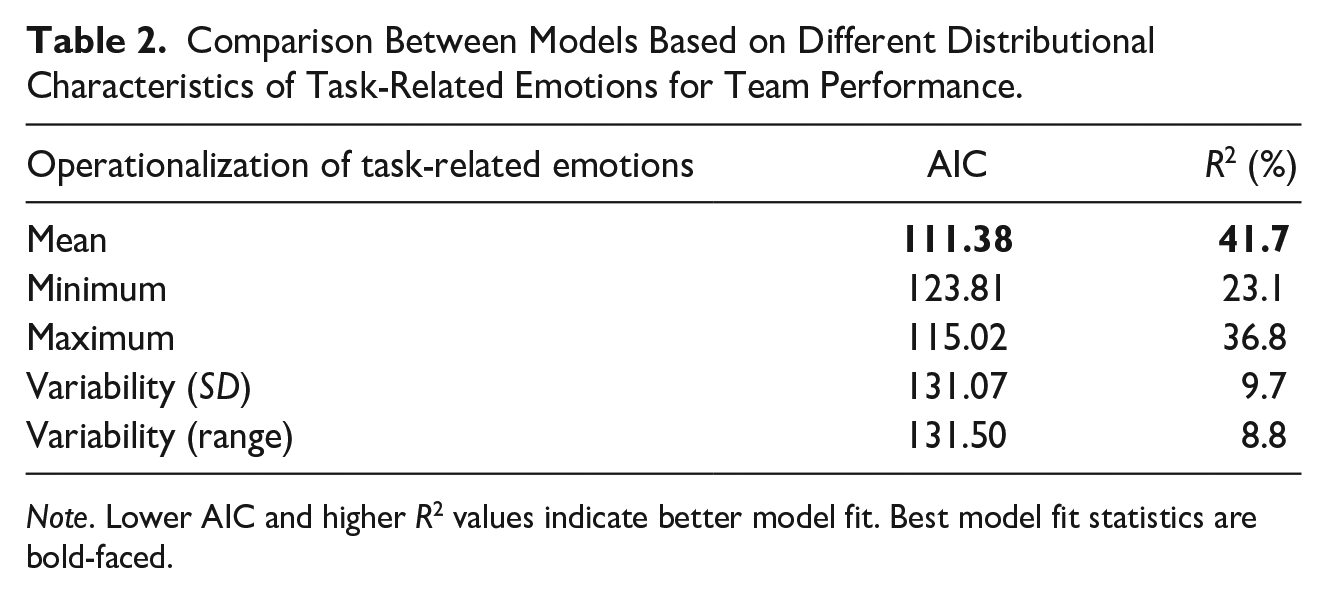
Note. Lower AIC and higher R2 values indicate better model fit. Best model fit statistics are bold-faced.
Task-Related Emotions and Individual Performance
We then investigated how task-related emotions relate to individual level performance, to gauge the extent to which the relations between task-related emotions and performance are unique to the team level. In this exploratory analysis, the dependent variable is the grade of the individual exam, which students took after all team tasks were completed and after the team grade was released. Five students had missing exam scores, due to reasons such as illness. An initial LMM that only included dummy variables for cohort and team language demonstrated a small amount of clustering in the exam grade, ICC1 = .038. In the second model, we added individual-level task-related anger, anxiety, and happiness as predictors, and found that the only predictor approaching statistical significance was (individual) task-related anxiety, B ± SE = 0.15 ± 0.08, p = .051 (other ps ≥ .269). As a third step, we added team-level averages of task-related emotions, and found that team-level anxiety predicted the individual exam grade as well, B ± SE = 0.37 ± 0.17, p = .037. However, with between-team differences in task anxiety controlled for and individual-level anxiety capturing within-team variance, the relationship between individual-level task-related anxiety and exam performance disappeared, B ± SE = 0.06 ± 0.09, p = .515 (other ps ≥ .180). This suggests that the relationship between task-related emotions and team performance is specific to the team level. Next, we investigate potential mediating team processes.
Exploring Mediating Processes
We explored additional measures from the Week 6 questionnaire to better understand why teams composed of more anxious members performed better. We considered two categories of potential mediators: team affect and team processes. Given the exploratory nature of these analyses and the limited sample size, we include marginally significant relations in our discussion, as they may provide tentative insights into the underlying process.
Team Affect as Mediator
As described earlier, the initial composition of task-related emotions may lead to the development of specific shared emotions about the team, which in turn caused changes in team performance (Barsade & Gibson, 1998; Barsade & Knight, 2015; Kelly & Barsade, 2001). To measure emotions toward the team, the Week 6 questionnaire included the question “When I think of my team, I feel:” followed by nine emotions rated on a 7-point scale (1 = not at all, 7 = very much). We created four scales: anxiety (“anxious,” “nervous,” ωt = 0.86); anger (“angry,” “irritated,” “frustrated,” ωt = 0.92); happiness (“happy,” “joyful,” “satisfied”), ωt = 0.87; and “boredom.” Within-team agreement existed for team-related happiness and anger, but not anxiety and boredom (Table 3); hence, our analyses focused only on the former two.
Intra-Class Correlations for Week 6 Team-Related Emotions.
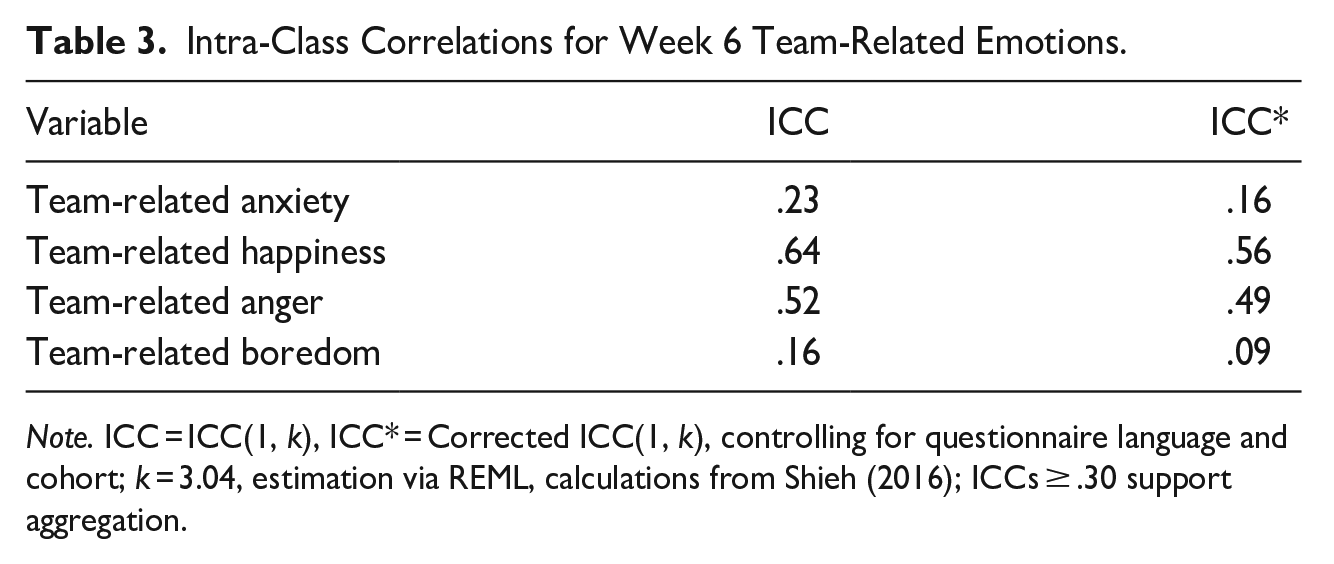
Note. ICC = ICC(1, k), ICC* = Corrected ICC(1, k), controlling for questionnaire language and cohort; k = 3.04, estimation via REML, calculations from Shieh (2016); ICCs ≥ .30 support aggregation.
We first regressed team-related anger and happiness on task-related emotions. Results showed that shared team-related emotions were largely unrelated to task-related emotions. However, the relation between greater task-related anxiety and team-related anger was marginally significant (B ± SE = 0.44 ± 0.22, p = .057), but only when the control variables were included. All other coefficients were non-significant (ps ≥ .287 for team-related anger, ps ≥ .185 for team-related happiness). Subsequent regression analysis showed that shared team-related anger and happiness were not associated with team performance, irrespective of the inclusion of control variables (coefficient ps ≥ .204). Thus, the association between a team’s affective composition in terms of task-related emotions and team performance cannot be explained through the development of specific team-level emotions.
Team Processes as Mediators
The Week 6 questionnaire included measures for 21 team processes, which could all be potential mediators. To avoid multicollinearity and overfitting, we first conducted a PCA at the team level to reduce the dimensionality of the 17 team-level process for which the ICC coefficients supported aggregation (i.e., ICC[1, k] ≥ .30). Results of a parallel analysis (Dinno, 2018) suggested two components, and we interpreted the Oblimin-rotated components as social integration and conflict (see Table 4; for more details, see Supplemental Material). We extracted the component scores, which are on the z scale, for analysis. The frequency of computer-mediated contact (CMC) did not load on either of these two components; thus, we considered it as a third potential mediator.
Team-Level Principal Component Analysis of Team Process Measures in the Combined Data Set.
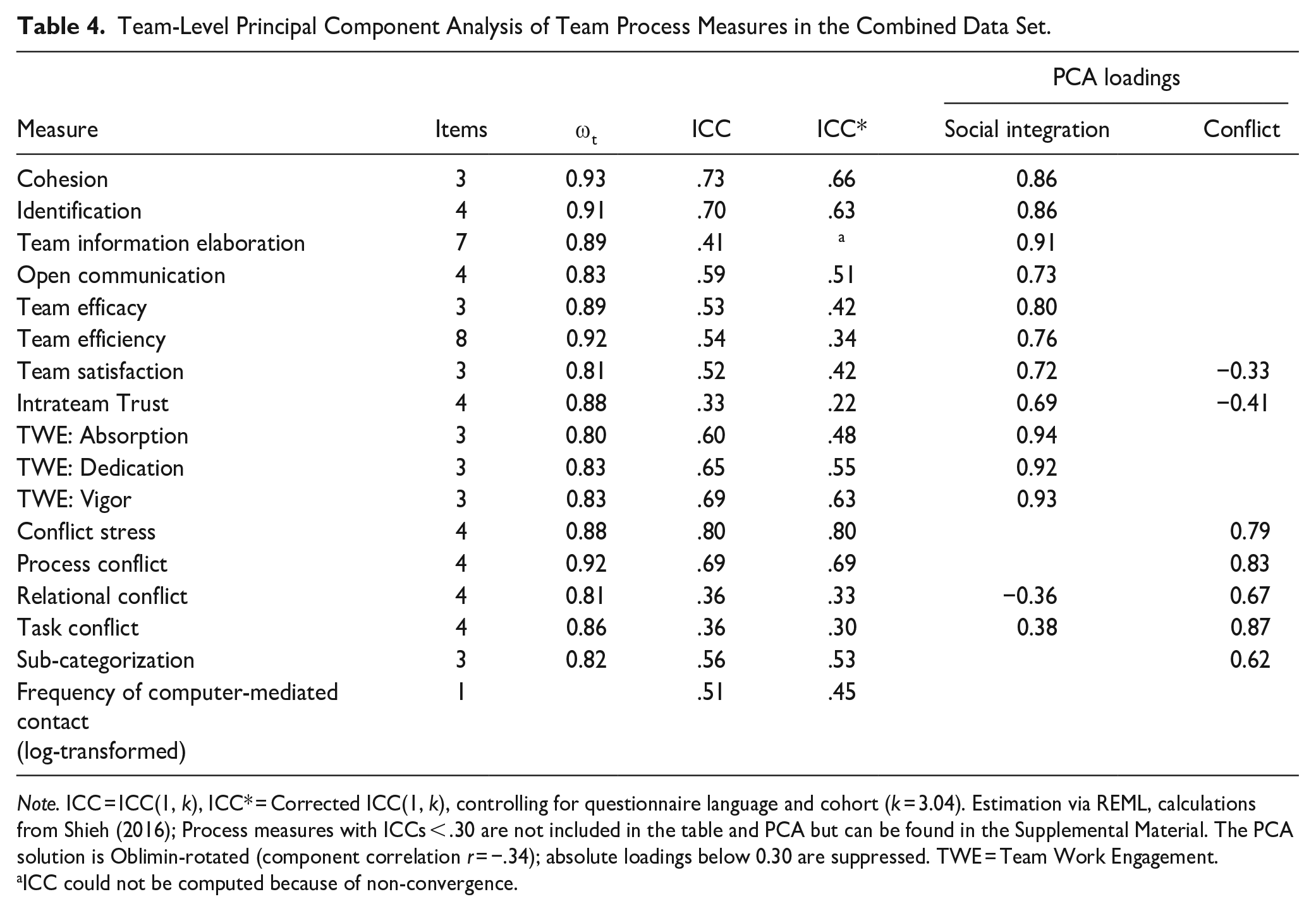
Note. ICC = ICC(1, k), ICC* = Corrected ICC(1, k), controlling for questionnaire language and cohort (k = 3.04). Estimation via REML, calculations from Shieh (2016); Process measures with ICCs < .30 are not included in the table and PCA but can be found in the Supplemental Material. The PCA solution is Oblimin-rotated (component correlation r = −.34); absolute loadings below 0.30 are suppressed. TWE = Team Work Engagement.
ICC could not be computed because of non-convergence.
Results of interest were obtained for conflict. Regressing team conflict on the team averages of task-related emotions (1–7 scale), we found that teams who started with greater task-related happiness later had more conflict, B ± SE = 0.62 ± 0.29, p = .038 (other ps ≥ .220 R2 = 13.8%, F[3, 41] = 2.19, p = .104). After adding the control variables team language and cohort, conflict was still predicted by task-related happiness (B = 0.75 ± 0.28, p = .010), and also by task-related anxiety (B = 0.59 ± 0.23, p = .015; overall R2 = 25.2%, F[5, 39] = 2.63, p = .039). One explanation for the difference between the two models is that non-Dutch teams had less conflict (B = −0.92 ± 0.39, p = .024). Given that international students were also more anxious about the team assignments, this may be understood as a suppressor effect, where an anxiety-induced increase in conflict in international teams was suppressed by a lower likelihood of conflict in international teams, overall.
Regressing frequency of CMC on the task-related emotions revealed no meaningful associations (all ps ≥ .148), regardless of whether control variables were included. The same applied to social integration (all ps ≥ .152), again regardless of the inclusion of control variables.
Regressing team performance on social integration, conflict, and frequency of CMC revealed no significant relations, whether or not team language was included (coefficient ps ≥ .200). However, when we calculated the zero-order and first-order correlations (controlling for team language) between these team processes and team performance, we found hints of a positive correlation between conflict and team performance (r0[45] = .174, p = .252; r1[43] = .253, p = .101). Neither social integration (r0[45] = .083, p = .589; r1[43] = −.183, p = .240) nor frequency of CMC (r0[45] = −.216, p = .153; r1[43] = −.022, p = .889) was related to team performance. Investigating the role of conflict further, we correlated the individual measures that loaded >.50 on the conflict component (Table 4) with team performance. One zero-order correlation emerged, showing teams with more task conflict performed better (r0[45] = .405, p = .006; other |r|s ≤ .082, ps ≥ .591). With control variables included, this correlation dropped to marginal significance (r1[43] = .299, p = .052). A marginally significant positive relation between the formation of subgroups (vs. a unified team) and team performance emerged as well (r1[43] = .271, p = .078; other |r|s ≤ .244, ps ≥ .111).
As a final analytic step, we conducted an exploratory multiple mediation analysis by bootstrapping the indirect effects (Preacher & Hayes, 2008) from task-related emotions (anger, anxiety, happiness) through task conflict and the formation of subgroups (vs. a unified team), identified as the most promising candidate mediators, to team performance (R = 25,000 resamples). We conducted these analyses with and without control variables included. None of the 12 estimated indirect effects (3 predictors × 2 mediators, with or without control variables) had 95% bias-corrected and accelerated (BCa) intervals excluding 0. Thus, no significant evidence for mediation was obtained. Closer inspection of the results indicated that, although the a paths from both (team) task-related anxiety (uncorrected B = 0.37, 95% BCa CI [0.14, 0.68]; corrected B = 0.41, CI [0.07, 0.87]) and (team) task-related happiness (uncorrected B = 0.52, CI [0.11, 0.88]; corrected B = .53, CI [0.11, 0.89]) to task conflict were consistently positive and significant, the b path from task conflict to team performance was not (uncorrected B = 0.08, CI [−0.49, 0.56]; corrected B = 0.05, CI [−0.54, 0.54]). Instead, the direct path from (team) task-related anxiety to team performance remained significant (uncorrected B = 0.69, CI [0.30, 1.13]; corrected B = 0.43, CI [0.01, 0.87]). None of the relations involving the formation of subgroups (vs. a unified team) was significant.
Taken together, teams composed of more anxious and happier team members were characterized by having more (task) conflict, and perhaps felt more anger toward each other. Although this suggests that teams with more task-related anxiety and happiness later became unpleasant, the lack of associations between task-related emotions and social integration suggests otherwise. The predictive link between the team’s affective composition and subsequent conflict seems to exist independently of social (dis)integration. We also found hints that (task) conflict and subdivision of the group into subgroups were related to better performance. However, despite evidence for a relation between increased (task) conflict and performance, we found no mediation. Hence, it is premature to conclude that more (task) conflict explains why happier and especially more anxious teams performed better, and we should remain open to other explanations as well.
Discussion
We investigated whether team composition in terms of negative emotions about team tasks predicts performance on these tasks. We expected that teams composed of individuals who, on average, feel more anxious and angrier about their assignments would perform better. Among students taking a course on group processes, team-level averages of three task-related emotions (anger, anxiety, and happiness) accounted for a substantial proportion of the variance in team performance. In line with Hypothesis 1, more anxious teams received higher grades 6 weeks later, but Hypothesis 2, that angrier teams would perform better, was not supported. We also found that teams who felt happier about the team tasks performed better. Further, task-related anxiety, anger, and happiness were generally unrelated to individual-level performance on the course exam, suggesting that the observed relations of task-related emotions with team performance are specific to the team level. Finally, regarding mediating processes, we found that the same emotions (anxiety, happiness) that predicted better team performance were associated with more team conflict, and particularly task conflict, even though team (task) conflict did not conclusively explain why these emotions are associated with better team performance.
While positive affect has often been found to benefit teams (e.g., Knight & Eisenkraft, 2015), the little evidence for beneficial consequences of negative affect in teams has, until now, stemmed from lab-based, one-shot teams working on very specific tasks and focusing on incidental moods (Erdheim, 2007; Iannone, 2011; Jones & Kelly, 2009). We extend these findings by showing that bringing a specific negative emotion—anxiety—about the task into a team may benefit team performance in teams working together over a prolonged period and on a series of assignments that required diverse skills. To better appreciate the role of negative affect in teams, we suggest that researchers shift their focus from “shared” team affect to compositional effects. The dominant focus on shared team affect is potentially obscuring important effects, because over the course of team interaction, individual-level affective experiences may increasingly reflect the quality of team interaction and perceived progress toward the team goals (De Dreu et al., 2001; Linnenbrink-Garcia et al., 2011; Watzek & Mulder, 2019). Thus, shared negative team affect likely reflects bad team experiences, which, given the literature’s emphasis on shared team affect, explains why negative team affect is generally considered “bad.” Shifting the focus to compositional effects instead of shared team affect seems crucial for elucidating the true benefits of negative affect for teams.
It is noteworthy that the benefits of (team-level) task-related anxiety were specific to the team level. Although we found some evidence that students in more anxious teams also did better on the individual exam, this relation was substantially weaker than the findings at the team level, and entirely due to between-team differences in task-related anxiety: Within teams, more anxious students did not do better (or worse) than less anxious students. Thus, our findings do not appear to be an artefact of unmeasured individual differences, such as the team member’s ability or motivation that co-vary with task-related emotions. Instead, our findings suggest that anxiety about (academic) work may simply be more beneficial at the team level than at the individual level—an insight that complements recent work on the potential benefits of individual-level workplace anxiety (Cheng & McCarthy, 2018) as well as prior findings on individual-level academic anxiety (Pekrun et al., 2002, 2011). This opens up novel questions about how emotions tied to other objects, such as leaders or the mode of communication, might impact team performance.
An important question remains regarding explanations for the relation between team anxiety and team performance. Our data do not show that more anxious (or angrier) teams converge on this affective state (Barsade & Gibson, 1998; Kelly & Barsade, 2001), nor provide support for the key role of social integration found in prior research (Erdheim, 2007; Knight & Eisenkraft, 2015), suggesting that anxious team members may not have helped each other cope by providing social support (Yang & Kelly, 2016). Instead, we found that teams that were more anxious (and happier) about the team tasks had more internal conflict, and specifically task conflict. These findings potentially align with the notion of “constructive conflict” (Jehn & Bendersky, 2003) as well as findings from Jordan et al. (2006), who found an indirect positive relation between negative team moods and team performance, mediated by task conflict. However, as noted earlier, we should not rule out other explanations, such as a more general relation between anxiety and increased effort. The fact that more anxious teams were characterized by more conflict might indeed be reflective of higher engagement with the tasks, greater motivation to do well, and greater scrutiny of input from team members. This raises interesting questions about contingencies with the type of task; perhaps the observed relation between task-related anxiety and team performance is specific to a performance-oriented context. If this is the case, an important further question is how teams offset the potential negative effects of individual-level anxiety (e.g., Brosnan, 1998; Richardson et al., 2012). Perhaps team members help each other to focus on the task at hand rather than getting distracted. Alternatively, expressed anxiety may have social informational effects (e.g., signaling task importance), exerting pressure on other team members to increase their efforts (cf. Van Kleef, 2016).
Contrary to our prediction, teams that, on average, experienced more anger about the task did not perform better. One explanation is that we inadequately considered the nuanced dynamics of anger’s other-blaming nature (Lazarus, 1991). Different consequences may ensue depending on whether the blame for the team tasks is appointed within the team (other students) or outside the team (the teacher; Spoor & Kelly, 2004; see also the distinction between exogenous and endogenous affect made by Knight & Eisenkraft, 2015). Moreover, when this anger is expressed, consequences can range from enhancing social integration (when attributed to external causes; Livingstone et al., 2016) to undermining it (when attributed to oneself, as a rejection signal; Heerdink et al., 2013), contingent on other team members’ attributions for this anger expression. The divergence between the findings regarding anxiety and anger may also stem from the uncertain nature of anxiety compared to the more certain nature of anger (Tiedens & Linton, 2001). This suggests that increasing effort might be a better coping strategy for anxiety than for anger. While these interpretations remain to be explored further, our findings underscore the value of distinguishing between specific (negative) team emotions, even when they are similar in valence and arousal. Even though we did not find the hypothesized benefits of anger, it is noteworthy that we did not observe any detriments associated with task-related anger. This contrasts with assumptions in both the academic emotions literature (Pekrun et al., 2011) and much of the shared team affect literature (e.g., Knight & Eisenkraft, 2015).
Three obvious limitations of this study are the relatively limited sample size, the heterogeneity of the sample in terms of national background, and the correlational design. Clearly, limited control over the sample is an inevitable consequence of the real-world setting in which we conducted this research. However, the positive relation between (average) task-related anxiety and team performance is evident even within the more homogenous subset of only Dutch teams (N = 28, B = 0.63 ± 0.28, p = .034). Although not statistically significant in non-Dutch teams (N = 17, B = 0.30 ± 0.33, p = .373), the coefficient is positive, and the lack of significance should be interpreted in relation to the small number of observations. Similarly, the relation is found in each of the two cohorts when analyzed separately (N = 28, B = 0.90 ± 0.19, p < .001 in the first cohort; N = 17, B = 0.73 ± 0.29, p = .027 in the second). While our study of real-world student teams may have compromised some internal validity in favor of external validity, preventing us from definitively excluding the influence of all third variables, we believe that the lack of a relation between task-related emotions and individual performance negates the most obvious possibility that more anxious students are inherently more conscientious or capable. Furthermore, the robustness checks, the consistency of the observed patterns, and the fact that the key measures were taken 5 weeks apart inspire confidence in our conclusions. Nevertheless, we believe these findings merit replication using both correlational and experimental designs for theoretical reasons. Despite the limitations, the observed associations are unusually strong in the social sciences, suggesting great promise for leveraging task-related emotions as an effective approach to compose better-performing teams in applied contexts.
In summary, we found a positive and surprisingly strong association between the composition of teams in terms of average task-related anxiety and team performance. This finding resonates with recent work calling for a renewed appreciation of the benefits of anxiety in the workplace (Cheng & McCarthy, 2018)—an appreciation with not only theoretical implications, but also with great applied implications. In this regard, we stress that our studies were conducted in a real-world university environment, with negligible self-selection biases (only three students refused to participate). The mixed nature of the team assignments (i.e., creativity activity, report writing) makes the results relevant to a range of team tasks performed both within and outside of academia. In light of prior findings (Erdheim, 2007), attending to the emotional composition of teams regarding their tasks holds promise for improving team performance—whether by directly boosting task-related anxiety or indirectly by guiding decisions about group composition.
Supplemental Material
sj-docx-1-sgr-10.1177_10464964241228547 – Supplemental material for Anxious to Perform: Compositional Effects of Negative Task-Related Emotions in Teams
Supplemental material, sj-docx-1-sgr-10.1177_10464964241228547 for Anxious to Perform: Compositional Effects of Negative Task-Related Emotions in Teams by Marc W. Heerdink and Astrid C. Homan in Small Group Research
Footnotes
Data Availability
Due to the sensitive and personal nature of academic performance, which constitutes the main dependent variable, the data cannot be made publicly available.
Declaration of Conflicting Interests
The author(s) declared no potential conflicts of interest with respect to the research, authorship, and/or publication of this article.
Funding
The author(s) received no financial support for the research, authorship, and/or publication of this article.
Ethical Approval
Approval was obtained from the University of Amsterdam Ethics board prior to data collection (file numbers 2015-WOP-4094 and 2016-WOP-6430).
Informed Consent
Informed consent was obtained from all participants as part of the data collection.

Supplemental Material
Supplemental material for this article is available online.
Notes
Author Biographies
References
Supplementary Material
Please find the following supplemental material available below.
For Open Access articles published under a Creative Commons License, all supplemental material carries the same license as the article it is associated with.
For non-Open Access articles published, all supplemental material carries a non-exclusive license, and permission requests for re-use of supplemental material or any part of supplemental material shall be sent directly to the copyright owner as specified in the copyright notice associated with the article.
