




Abstract
This paper reviews the literature on cognitive and neurodiversity in groups as they relate to group processes, emergent states, and outcomes. We build on a taxonomy of convergent and divergent process gains and losses in groups, put forward an integrative framework for the empirical research results, and distinguish between cognitive and neurodiversity as horizontal and vertical differentiation in groups. We argue that when conceptualized as vertical differentiation, cognitive and neurodiversity trigger convergent and divergent process losses, whereas when conceptualized as horizontal differentiation, they chiefly trigger convergent and divergent process gains. Building on this framework, we identify directions for future research on cognitive and neurodiversity in groups.
Diversity is the cornerstone of creative performance in complex tasks (Mathuki & Zhang, 2022; Qi et al., 2022), and a substantial amount of research has explored the relation of various group composition features with group outcomes. The “optimistic” outlook on group diversity emphasizes information elaboration (Van Knippenberg et al., 2004) as the key mechanism that explains its beneficial role in group dynamics and effectiveness. Studies that hypothesized positive outcomes of diversity in surface-level attributes such as gender or nationality suggested that, ultimately, diversity in cognition (i.e., differences in values, knowledge, norms, and attitudes) explains such benefits (Bear & Woolley, 2011; Curşeu et al., 2007). Therefore, cognitive diversity is the key diversity type that is expected to enrich the knowledge repertoire and information-processing capabilities of groups and foster synergy, innovation, decision comprehensiveness, and effectiveness.
Integrative approaches to date have focused mostly on surface-level diversity, with less attention devoted to deep-level diversity in groups (e.g., Bell et al., 2011; Stahl et al., 2010; J. Wang et al., 2019). In a systematic review of cognitive diversity literature, Mello and Rentsch (2015) used a time stability framework to distinguish between trait-like, developmental, acquired, and exposed forms of cognitive diversity with the aim of organizing the heterogeneous findings from the literature. Their integrative framework, however, yielded mixed results concerning the association between cognitive diversity and group outcomes for all four forms of cognitive diversity. A key conclusion of this systematic literature review was that cognitive diversity impacts various team criteria via team processes and emergent states. On the one hand, cognitive diversity stimulates synergetic processes such as team debates and information elaboration with the potential to enrich the cognitive repertoire of the team and boost team performance. On the other hand, cognitive diversity generates process losses (e.g., relationship conflict) and reduces cohesion and social harmony with detrimental effects on team outcomes (Mello & Rentsch, 2015). Our study builds on this previous work and provides an alternative, systemic perspective on cognitive diversity; it updates the literature search to include recent research and integrates neurodiversity studies in the review and analyses. By doing so, we depart from the taxonomic attempts to organize mixed results in diversity research (Bell et al., 2011; Harrison & Klein, 2007; Horwitz & Horwitz, 2007) and provide a novel systemic framework to interpret the rather idiosyncratic findings concerning the effects of cognitive differentiation in groups.
Our paper aims to extend the insights of the Mello and Rentsch (2015) review in several ways. First, we were able to include a larger number of studies, as the vast majority of studies on cognitive diversity in groups were published after 2015. Second, ours is among the first studies in the organizational literature on cognitive diversity and neurodiversity that build on the perspective put forward by Hunt and Jaeggi (2022) and Taylor and Vestergaard (2022) that these streams are not separable, and various neurological diagnoses are another evolved cognitive specialization essential for human adaptation. Further, we integrate the idea of optimal cognitive diversity by placing it within a framework of horizontal and vertical differentiation (Bunderson & Van der Vegt, 2018; Curşeu, 2022). We include both cognitive and neurodiversity as illustrations of horizontal and vertical differentiation, a distinction that allows us to better understand which forms of diversity contribute to group dynamics and outcomes and under what conditions. Third, our study presents an integrative, systemic model that explains the impact of cognitive and neurodiversity on workgroup outcomes through convergent and divergent group processes. In doing so, we contribute to recent process-focused views on diversity (Homan et al., 2020) that explain systemically how diversity impacts team outcomes. Fourth, building on our integrative framework, our study identifies future research directions that can expand our knowledge and understanding of cognitive and neurodiversity in groups.
Definitions and an Integrative Model of Cognitive Diversity
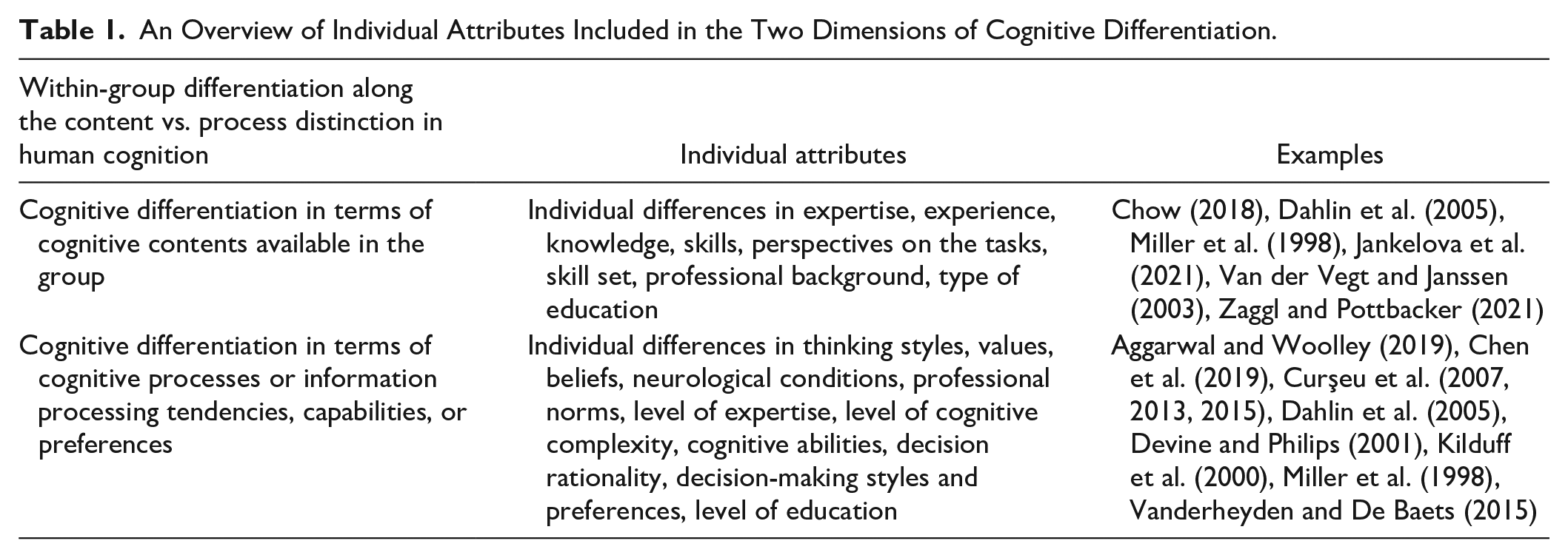
We explore the literature on cognitive and neurodiversity as important deep-level attributes expected to drive creative group performance. Both types of diversity studies focus on individual differences in information processing and test how such individual differences impact group functioning. Neurodiversity literature advocates treating neurological diagnoses such as ADHD, Dyslexia, and Autism as logical evolutionary outcomes, with advantages and disadvantages in social interactions (Doyle, 2020). Cognitive diversity literature primarily discusses patterns of thought rather than diagnoses, focusing on the variety of knowledge, skills, beliefs, and preferences (Schilpzand & Martins, 2010). For both cognitive and neurodiversity, we use the typical distinction between content and processes in human cognition (Wyer & Srull, 1986) as differentiation in the type of cognitive resources available in the group (e.g., specialized knowledge, type of expertise, professional backgrounds) and variability in information processing tendencies, competencies, and preferences of group members (e.g., cognitive styles, attitudes, values, level of expertise). Table 1 provides an overview of individual attributes included in each of the two dimensions of cognitive differentiation.
An Overview of Individual Attributes Included in the Two Dimensions of Cognitive Differentiation.
We thus start from a general definition of diversity as the degree of socio-cognitive differentiation in groups (Brah, 1991) and argue that cognitive and neurodiversity are deep-level attributes that reflect cognitive differentiation and impact group performance through systemic processes (Stahl et al., 2010). More specifically, in line with the distinction between variety and disparity presented by Harrison and Klein (2007) and the framework developed by Bunderson and Van der Vegt (2018), we argue that cognitive diversity can be mapped along two co-existing differentiation dimensions, namely horizontal (the dispersion of cognitive resources in the group) and vertical (the unequal concentration of cognitive resources in the group), and cognitive diversity impacts group effectiveness through convergent and divergent processes (Stahl et al., 2010). As an integrative framework for our literature review, we synthesize (1) the distinction between convergent and divergent group processes (Stahl et al., 2010) with (2) the concept of cognitive diversity that encompasses horizontal and vertical differentiation in groups (Bunderson & Van der Vegt, 2018). For clarity, in what follows, we provide illustrative examples of our integrative framework that presents four quadrants in which the co-existence of horizontal and vertical differentiation in terms of cognitive resources of groups is mapped with the convergent and divergent group processes. Imagine first a group composed of members with similar specializations with only one senior-level professional: this is a group with low horizontal differentiation and high vertical differentiation. In such a group, the status hierarchy is likely to be accepted, generating convergent process losses such as minority domination and premature consensus (likely driven by the most senior member). An example of a group with both high levels of vertical and horizontal cognitive differentiation is a group composed of members with various specialized knowledge but only one member is a senior-level professional. The configuration in this group would likely trigger divergent process losses (e.g., relationship conflict, social loafing), since novices with different specializations may revolt against the status differences. On the contrary, a group of equal-status members with diverse specializations will most likely experience divergent process gains as they challenge each other’s views, engage in dissent, and manage task conflict. Finally, a group composed of members with equal status and similar specialized knowledge will most likely experience convergent process gains as their shared identity facilitates information sharing and cohesion. Although not exhaustive, these examples illustrate the bi-dimensional framework for organizing cognitive and neurodiversity research in light of its systemic signature.
Method
This study uses a systematic review based on the PRISMA guidelines (Liberati et al., 2009; Page et al., 2021) to evaluate the existing literature on neurodiverse and cognitive diverse workgroup collaboration.
Literature Search
A query that searched titles, abstracts, and author keywords of articles on cognitive and neurodiversity in the work context was composed as follows:
(“cognitive diversity” OR “cognitive style diversity” OR “cognitively diverse” OR neurodiversity OR neurodiverse OR neurominorities OR neuromajorities OR neurodivergent OR neurodivergence)
AND
(team* OR group* OR organisation* OR organization* OR work OR collaboration OR performance OR creativity OR innovation)
The query was executed on September 1, 2023, in the most comprehensive social science databases, including Web of Science, ScienceDirect, and EBSCOhost (all journal databases selected: PsycArticles, PsycINFO, ERIC, GreenFILE, LISTA, MEDLINE, Psychology & Behavioral Sciences Collection, CINAHL, Business Source Complete, and Academic Search Premier). This query produced a total of 2,110 records. The records were filtered for peer-reviewed English journals and double results, yielding 1,167 records. Examination of titles and abstracts then revealed 1,115 irrelevant papers, such as studies that investigated neurological diagnoses (e.g., Bertrand et al., 2018), were conducted with children in the context of social work (e.g., Masataka, 2018), or focused on noise in theaters (e.g., Simpson, 2018). A full-text review of the remaining 52 papers excluded another 11 papers (for reasons, see Figure 1). The remaining 41 papers were included in our sample. We used the snowball method to expand our sample by screening the references in the 41 papers to find relevant articles. Papers found to be potentially relevant were reviewed through the same process, resulting in an additional 16 papers. During the search, we noticed that several studies in our sample used the cognitive diversity scales of Miller et al. (1998) and Van der Vegt and Janssen (2003). Therefore, we conducted a forward search on all citations received by these two papers, resulting in 10 additional papers included in our sample. Also, we examined the reference list of Mello and Rentsch (2015) and added four additional papers. Finally, we asked the AI research assistant Elicit.org (which is not limited to specific database fields) to search for relevant papers with search input “cognitive diversity in teams” and “neurodiversity in teams,” which yielded no additional relevant results. The final sample consisted of 71 papers.
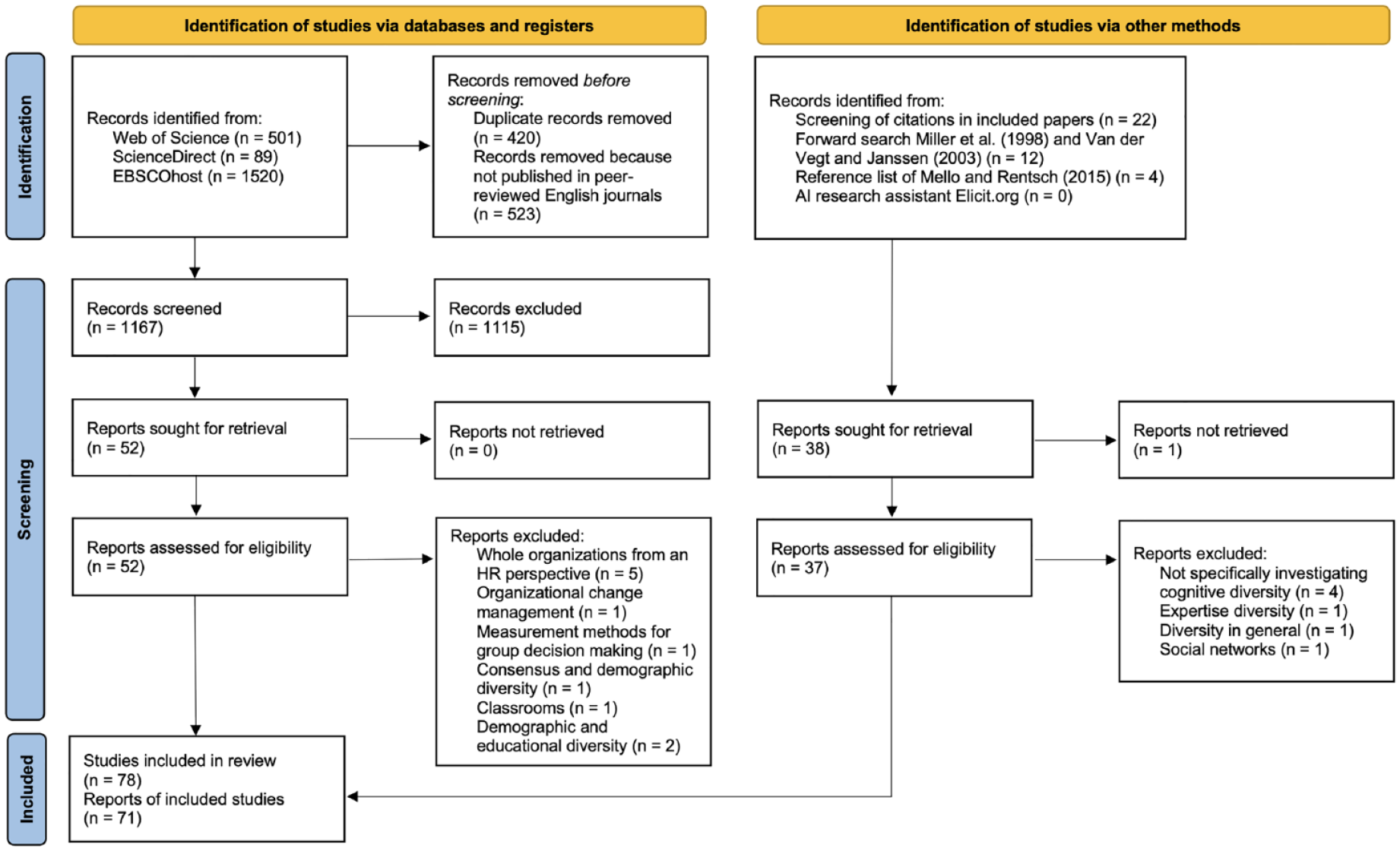
Flow diagram of the systematic search process.
Analytical Strategy
We extracted from all articles (1) definitions used for cognitive and neurodiversity, (2) research method (e.g., survey, experiment), (3) research context (e.g., organizations, universities), (4) research sample (e.g., executive teams), (5) conceptual model, and (6) research hypotheses and results. Given that diversity is typically conceptualized as an input variable in the theoretical models of group effectiveness (Ilgen et al., 2005), we aimed to explore its impact on group processes, emergent states, and outcomes. The papers were categorized according to the dependent variable under investigation.
Results
General Description of the Sample
The papers included in our literature review were published from 1995 to 2023, with 29 papers up to 2015 and 42 papers from 2015 to 2023 (see Table 2). The articles in our sample are published in 54 different journals, including eight in Small Group Research. Twenty-three articles were (at least partly) conducted in Asia, 18 in Europe, nine in the United States, and four articles did not include information on where data was collected. Nine articles were experimental studies and 51 employed surveys and questionnaires, of which 24 articles used the scale of Van der Vegt and Janssen (2003) for measuring cognitive diversity. Twenty-five papers included students as their study samples.
Overview of Included Articles and Their Characteristics.
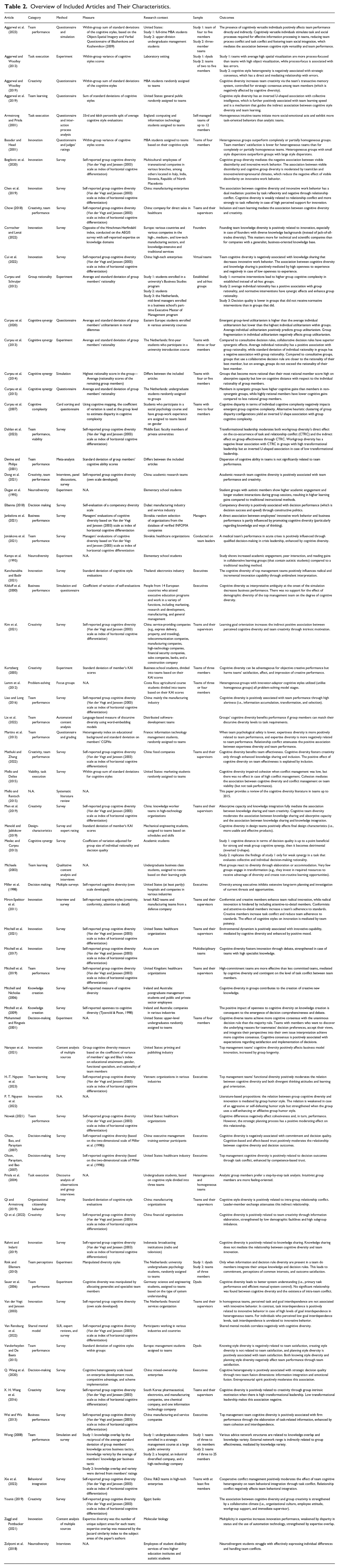
In the following sections, we first review the definitions and measurements of cognitive diversity, especially since the publication of the review by Mello and Rentsch (2015). Then, we discuss results of the studies in our sample, mainly grouped by team outcomes. Afterward, we discuss studies that tested a curvilinear relationship between cognitive diversity and group outcomes. Finally, we present our integrative model derived from the reviewed studies.
Recent Directions in Definitions and Operationalizations
Scholars have defined and measured cognitive diversity in many different ways. Mello and Rentsch (2015) showed in their literature review that this variety limits further theory development and complicates the comparison of empirical results. Since the publication of their paper, this conceptual variety has not decreased. Although the different definitions partially coincide, the range of the concept remains a point of debate. For instance, based on Dahlin et al. (2005) and Miller et al. (1998), Chow (2018, p. 372) conceptualizes cognitive diversity in groups as “the degree to which team members differ in terms of expertise, experience, knowledge, skills, thinking styles, value and beliefs.” Building on Horwitz and Horwitz (2007), P. T. Nguyen et al. (2022, p. 429) define cognitive diversity somewhat more restrictively: “the extent to which team members differ in terms of perspectives, values, beliefs, or skill sets.” Some of the most recent definitions build on Kilduff et al. (2000). For examples, Chen et al.’s (2019, p. 672) definition focuses on members’ similarity, which conceptualizes cognitive diversity as “an accurate reflection of how much the team shares a common set of attitudes, values and norms”; similarly, Jankelova et al. (2021, p. 4) define cognitive diversity as “differences in knowledge and perspective, which arise from professional diversity and account for its positive effects.”
In addition, among the studies included in our sample, operationalizations of cognitive diversity vary. Within our sample, 34 papers utilized self-reports for the assessment of cognitive diversity perceptions. These self-reports were completed by either group members or their managers. A significant portion of these studies employed the cognitive diversity scale introduced by Van der Vegt and Janssen (2003), while some also used the bi-dimensional scale, which includes preference and belief diversity dimensions (Miller et al., 1998). Nine of the papers explored diversity in terms of cognitive styles and relied on a within-group sum of standard deviations for one or multiple cognitive styles. Studies that assessed cognitive competencies directly (e.g., rationality, intelligence) or indirectly by cumulative grade point average (i.e., academic performance at university) used either the within-group standard deviation or the coefficient of variation as diversity indices. Finally, in some of the experimental studies, cognitive diversity was manipulated by creating homogeneous and heterogeneous groups with respect to the cognitive styles of their members (Priola et al., 2004) or based on the preliminary training that group members received (Sauer et al., 2006).
Topics
Next, we summarize the outcomes of cognitive diversity. Figure 2 shows the distribution of articles based on their expected group outcomes. Some articles were counted in multiple categories because they examined multiple group outcomes. The figure unveils that the majority of papers (n = 39) focused on three topics: team performance, creativity, and innovation.
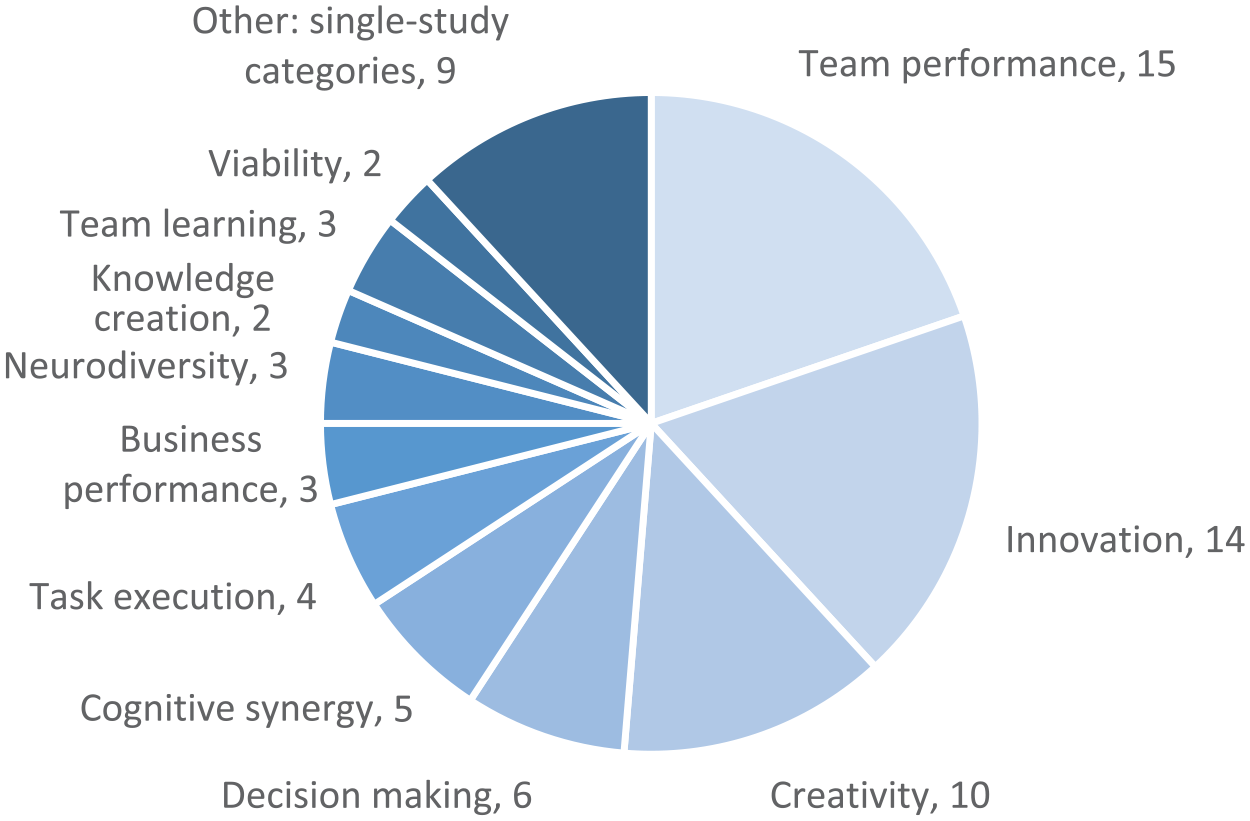
Distribution of articles in the sample.
Group and Business Performance
Eighteen papers focused on group or business performance. We first sum up studies that examined cognitive diversity as an independent variable; then, we discuss studies that examined cognitive diversity as a mediator; finally, we discuss studies that decompose cognitive diversity into multiple components based on the cognitive attributes considered.
In group performance studies that examined cognitive diversity as an independent variable, Dong et al. (2021) found that academic performance in research teams is fostered by cognitive diversity, while Liao and Long (2016) showed that group performance increases with high alertness (as a combination of information accumulation, transformation, and selection) arising from high cognitive diversity. Cognitive diversity positively affects group effectiveness through group learning, and an inclusive climate in terms of group discussion and decision processes (Chow, 2018; Mathuki & Zhang, 2022). Similarly, group cohesion mediates the effect of cognitive diversity and strategic planning on performance (Nowak, 2021). In groups with high transformational leadership, there is a negative linear relationship between cognitive diversity and co-occurrence of task and relationship conflict (that leads to group effectiveness in terms of performance and viability), whereas the relationship is inverted U-shaped in groups with low transformational leadership (Dahlan et al., 2023). Mello and Delise (2015) conducted related research and found that cognitive style diversity reduced cohesion when conflict management was low, but effective conflict management attenuated this negative association. Cohesion mediated the association between cognitive style diversity and conflict management, as well as groups’ viability. Devine and Philips (2001) and Mello and Delise (2015) reported no significant association between workgroup diversity regarding cognitive ability and group performance. In the context of cognitive diversity of top management teams (TMTs), Wei and Wu (2013) reported a positive association with firm performance, mediated by the elaboration of task-related information and strengthened by group cohesion and interdependence. Given that group cognition is dynamically produced in interactions, Lix et al. (2022) introduced the term discursive diversity as manifested cognitive diversity, reflecting the extent to which the meanings conveyed by members in a set of interactions differ from each other. Their findings showed that groups can dynamically align their level of discursive diversity with task requirements, suggesting that the performance trade-off of cognitive diversity in groups (i.e., diverse groups enhance performance but struggle with coordinated action) is not unavoidable. Cognitively versatile team members can enhance task and social processes required for effective information processing and reduce task and team process conflict. Further, these team members improve social integration that mediates the relationship between cognitive style versatility and team performance (Aggarwal et al., 2023).
Some other studies examined cognitive diversity as a mediator in a relationship between attitudinal variables and group or business performance (Jankelova et al., 2021; Joniakova et al., 2021; Kilduff et al., 2000; Mitchell et al., 2019). In a moderated mediation model, Mitchell et al. (2019) found a significant association between professional commitment and group effectiveness through cognitive diversity, contingent on task conflict. Medical group performance in acute crisis phase can be positively influenced by qualified decision-making in crisis leadership channeled through cognitive diversity of crisis leadership (Joniakova et al., 2021). Innovative work behavior rated by management is positively associated with business performance, partly mediated through cognitive diversity, especially regarding knowledge and varied ways of thinking (Jankelova et al., 2021).
Other studies decomposed cognitive diversity by considering different cognitive attributes to manipulate or assess group heterogeneity (Martins et al., 2013; Sauer et al., 2006; Vanderheyden & De Baets, 2015; Wong, 2008). Sauer et al. (2006) manipulated cognitive diversity by allocating group members into homogeneous versus heterogeneous groups based on procedure-oriented or system-oriented training. Within a technical work environment, they found that the benefits of more efficient manual system control and better primary task performance were triggered by heterogeneity in groups trained to understand the system as compared to groups trained to understand the procedure. No typical diversity problems, such as increased conflict, were found. Martins et al. (2013) decomposed cognitive diversity into expertise diversity (i.e., a group’s variation in the types of knowledge, capabilities, and skills; e.g., educational background diversity) and expertness diversity (i.e., the within-group standard deviation of group members’ cumulative grade point average reported prior to the group task). They found a negative association between expertise diversity and group performance in the case of low psychological safety, but not when psychological safety was high. The positive association between expertness diversity and group performance was stronger when group relationship conflict was low rather than high. Vanderheyden and De Baets (2015) examined the effects of diversity in knowing style, planning style, and creating style on group performance through group satisfaction. They found that knowing style diversity negatively affected only group satisfaction, whereas diversity in planning style was positively associated with satisfaction and performance. Diversity in creating style was negatively, yet not significantly related to satisfaction and performance, while the association between knowing and planning style diversity and group performance was mediated by group satisfaction. Finally, in a study that explored advice network structures (Wong, 2008), it was found that knowledge variety significantly increased group effectiveness, mediating the relationship between effectiveness and external network range.
Creativity
Ten articles examined the relationship between group cognitive (style) diversity and creativity. Dong et al. (2021) evaluated cognitive diversity in academic research teams and reported a positive association with team creativity. Kurtzberg (2005) found that cognitive diversity could benefit creative performance but reduce positive affect, satisfaction, and group members’ feelings about their creative endeavor. The positive association between cognitive diversity and group creativity was mediated by group learning (Chow, 2018), knowledge sharing (Mathuki & Zhang, 2022), and (task-relevant) information elaboration (Kim et al., 2021; Qi et al., 2022). Aggarwal and Woolley (2019) found that the impact of cognitive style diversity on creativity is explained by a transactive memory system (i.e., “a repository that emerges within a team to collectively encode, store, retrieve, and communicate information or knowledge in different domains,” p. 3). Further, X. H. Wang et al. (2016) and Kim et al. (2021) examined group intrinsic motivation as a mediator in the relationship between cognitive diversity and creativity, whereas Chow (2018) and Mathuki and Zhang (2022) examined the inclusion of workers in discussions and decision-making as a mediator.
Several studies explored moderators that influenced the positive indirect relationship between cognitive diversity and creativity. Qi et al. (2022) found that the indirect effect of cognitive diversity on creativity mediated through information elaboration is weaker when subgroup balance or strong faultlines exist. Higher cognitive group diversity enhanced the indirect effects of knowledge sharing on creativity through knowledge integration and absorptive capacity (Men et al., 2019). Younis (2019) found that a collaborative climate (comprising organizational culture, employee attitude, workgroup support, and immediate supervisor) strengthens the relationship between cognitive diversity and group creativity. X. H. Wang et al. (2016) found that cognitive diversity leads to more creativity via group intrinsic motivation only when team leaders exhibit transformational leadership. The indirect relationship between perceived cognitive diversity and creativity was stronger when group learning goal orientation was high rather than low (Kim et al., 2021).
Innovation and Knowledge Creation
The impact of cognitive diversity on innovation and knowledge creation was explored in 17 articles. Chen et al. (2019) found a positive relationship between cognitive diversity and innovation work behavior mediated through task reflectivity, and a negative relationship mediated through relationship conflict. Further, high perceived support for innovation strengthened the positive indirect relationship and weakened the negative indirect relationship. Basadur and Head (2001) found that there is a positive association between heterogeneous cognitive styles and innovation, and heterogeneous groups with smaller style differences outperform groups with large style differences. They also found group satisfaction was higher in homogeneous than in heterogeneous groups. Unlike group members with an attentive-to-detail cognitive style, group members with either a creative or conformist style enhanced radical innovation through group potency (Miron-Spektor et al., 2011). Whereas creative members encouraged task conflict and hindered adherence to standards, conformists reduced task conflict and, similar to attentive-to-detail members, reinforced adherence to standards. A study conducted based on the self-category theory showed that groups’ cognitive diversity is negatively associated with innovative work behavior through knowledge sharing, and this relationship is weakened by high openness to experience (Cui et al., 2022). However, in another study (Rahmi & Indarti, 2019), it was found that knowledge sharing does not mediate the association between cognitive diversity and group innovation, although cognitive diversity does have a positive influence on knowledge sharing, enhanced by high group climate and weakened by low group climate. Further, knowledge sharing positively relates to group innovation (Rahmi & Indarti, 2019). Finally, group cognitive disparity (evaluated using the coefficient of variation) had a negative association with group cognitive complexity (i.e., the complexity of knowledge generated by groups), while an alternative, heuristic way of conceptualizing cognitive disparity had an inverted U-shaped association with group cognitive complexity (Curşeu et al., 2007).
Mitchell et al. (2017) found that knowledge sharing mediates the positive association between cognitive diversity in multidisciplinary groups and innovation, and that trans-specialist knowledge accentuates this relationship. Cognitive diversity fosters knowledge creation in groups (Mitchell & Nicholas, 2006), while openness to cognitive diversity increases decision comprehensiveness, the quality of group debates and ultimately fosters knowledge creation (Mitchell et al., 2009). Kanchanabha and Badir (2021) found that cognitive diversity of the top management team reinforces ambivalent interpretation, fostering incremental and radical innovativeness. Narayan et al. (2021) found a positive influence of TMTs’ cognitive diversity on business model innovation (BMI) by expanding BMI attention scope and BMI intensity, strengthened by group longevity. Regarding founding teams, knowledge diversity positively relates to innovation in the case of founders with different knowledge backgrounds but not jack-of-all-trades diversity (Corrocher & Lenzi, 2022). This positive effect of different knowledge backgrounds matters more to companies whose knowledge base is focused on technical and scientific applications rather than those with a generalist, business-oriented knowledge base (Corrocher & Lenzi, 2022). In another study, it was found that expertise multiplicity increased innovation performance, enhanced by expertise overlap and weakened by status disparity and automation technology (Zaggl & Pottbacker, 2021). Unlike in homogeneous groups, in cognitively heterogeneous groups, task interdependence was positively associated with innovative behavior for members with high levels of goal interdependence and there was no association in the case of low goal interdependence (Van der Vegt & Janssen, 2003). Environmental dynamism increased innovative capability through cognitive diversity, enhanced by positive mood (Mitchell et al., 2021). Cognitive diversity mediated the influence of visible dissimilarity on innovative work behavior, and the effect was reduced by innovative/entrepreneurial and team/clan climates (Bogilovic et al., 2020). Finally, P. T. Nguyen et al. (2022) predicted a positive association between group cognitive diversity and group innovation mediated through group humor style, enhanced by emotional intelligence in the case of an affiliative or self-enhancing group humor style, and weakened by aggressive or self-defeating humor style. However, this conceptual model was not supported.
Task Execution
Our sample includes four studies that explored cognitive diversity in relation to task execution. Mello and Delise (2015) found no evidence for a relationship between cognitive style diversity and task performance mediated by cohesion. The other three studies explored more specific cognitive style dimensions. Priola et al. (2004) found that intuitivist group members are more feeling-oriented, while analytic members use a step-by-step task analysis. Aggarwal and Woolley (2013) found that heterogeneity in the object visualization style was negatively related to strategic consensus that was subsequently negatively associated with task execution errors. Armstrong and Priola (2001) expected more task-oriented acts by homogenous, self-managed, predominantly analytic groups relative to predominantly intuitive groups, but found no support for this. Further, social-emotional acts were more often initiated in predominantly intuitive groups than in predominantly analytic groups.
Decision-Making
Our sample includes 10 articles that discuss the association between cognitive diversity and group decision-making. Competency diversity was found to stimulate decision success and decision speed through constructive politics (Elbanna, 2018). Cognitive consensus and ultimately expectations concerning decision implementation and satisfaction are stimulated when group members inquire about the underlying reasons for others’ decision preferences, accept their views, and include others’ perspectives in their interpretations of issues (Mohammed & Ringseis, 2001). Executive diversity hinders comprehensive examinations of opportunities, threats, and extensive long-range planning (Miller et al., 1998). Research conducted in the U.S. found that there is a strong positive relationship between top-management cognitive diversity and decision outcomes, mediated through task conflict and strengthened by competence-based trust (Olson, Parayitam, & Bao, 2007). Similarly, research conducted in China found that cognitive diversity has a strong negative association with decision quality and commitment, attenuated by affect-based and cognition-based trust (Olson, Bao, & Parayitam, 2007). This research suggested that, unlike Western organizations, cognitive diversity is detrimental to decision outcomes in Chinese organizations. Further, the strategic decision quality of TMTs was found to be positively influenced by cognitive heterogeneity through information integration and emotional fusion, enhanced by an entrepreneurial spirit (Q. Wang et al., 2020). Several studies examined the emergence of group rationality as the collective competence of making choices aligned with a normative ideal. It was found that there is a negative correlation between group fragmentation concerning group members’ individual rationalities (as an index of cognitive diversity) and strong cognitive synergy (Curşeu & Schruijer, 2012; Curşeu et al., 2013, 2015). Moreover, Curşeu et al. (2020) found that emergent group-level utilitarianism is positively predicted by the average individual utilitarianism of the group members and negatively impacted by group-level fragmentation in utilitarianism. Group utilitarianism is lower than the highest individual utilitarianism but exceeds the average individual utilitarianism.
Individual Outcomes of Neurodiversity
Our sample includes three articles that examined neurodiversity in relation to group collaboration and performance. All three studies are based on student groups in an educational environment. Zolyomi et al. (2018) conducted qualitative research on the challenges of neurodiversity in student teams, focusing on the relational dynamics and cognitive enrichment that neurominorities bring to group debates. They found that neurodiverse students struggle with expressing individual differences and managing group conflicts. Kamps et al. (1995) found that, in collaborative learning groups that include students with autism, academic performance increases for all group members compared to a baseline, traditional teaching method. Similarly, Dugan et al. (1995) found that student groups that contain members with autism achieved significantly higher learning gains for all students involved when cooperative learning was implemented, compared to traditional instructional methods. Results of our analysis also showed that, in our sample, none of the cognitive (style) diversity articles mentioned neurodiversity-related words, such as neurodiversity, neurodiverse, neurominorities, neuromajorities, neurodivergent, or neurodivergence.
Less Studied Topics
In our sample, eight articles focused on other less studied topics regarding group cognitive diversity. For example, the positive association between cognitive style diversity and relationship conflict was found to be attenuated by the quality of leader-member exchanges (Qi & Armstrong, 2019). Michaela (2003) suggested that groups manage cognitive diversity in three ways: most groups manage it through either accommodation or elaboration, whereas others engage in transformation by investing the necessary resources to harness diversity and enable non-routine learning. TMTs’ functional diversity was explored by H.-T. Nguyen et al. (2023), who found that functional diversity enhanced the effect of TMTs’ cognitive diversity on both divergent thinking attitudes and learning goal orientation. Information diversity and decision rule diversity were investigated by Rink and Ellemers (2010), who found that both kinds of diversity are required to integrate members’ unique knowledge and decision rules, which can lead to perceptions of common interests, commitment, and outcome satisfaction. A qualitative study that examined innovator-adaptor cognitive styles found that, in contrast to homogenous groups, heterogeneous groups simultaneously utilize all stages of a problem-solving model (Lamm et al., 2012). Van Rensburg et al. (2022) found that shared mental models correlated negatively with cognitive diversity. In the study of Xie et al. (2022), behavioral integration in R&D teams was positively influenced by cognitive heterogeneity through task conflict (strengthened by cooperative conflict management) and negatively through relationship conflict. Moreover, avoidance conflict management attenuated the positive influence of cognitive heterogeneity on both task and relationship conflict while cooperative conflict management accentuated the association between cognitive heterogeneity and task conflict. Finally, Menold and Jablokow (2019) focused on design characteristics, finding that more diverse design teams can create more usable and effective products.
Curvilinear Modeling
A refined approach to differentiating between the mixed positive and negative outcomes of cognitive and neurodiversity is to draw on the concept of the “Too-Much-of-A-Good-Thing” (TMGT) effect (Grant & Schwartz, 2011; Pierce & Aguinis, 2013). This approach posits that excessive or insufficient cognitive diversity can be detrimental to group outcomes and emphasizes the notion of striving for optimal cognitive diversity. Our sample includes three articles that showed a curvilinear relationship between cognitive diversity and group outcomes. For example, Aggarwal et al. (2019) found an inverted U-shape association between cognitive style diversity and group implicit learning through collective intelligence. This finding is consistent with Meslec and Curşeu (2013), who reported an inverted U-shape relationship between cognitive distance in terms of cognitive accuracy (Study 1) and individual rationality (Study 2) on the one hand and cognitive synergy (i.e., when group performance exceeds the sum of individual performances) on the other hand. As dependent variables, their two studies distinguished between weak cognitive synergy (i.e., the average individual performance is lower than the collective performance) and strong cognitive synergy (i.e., the collective performance is better than the best-performing individual). Although their first study showed a curvilinear relationship for both weak and strong cognitive synergy in a generic problem solving task, their second study replicated only the findings for weak synergy in decision-making tasks. Curşeu et al. (2014) also found a non-linear association between cognitive distance and strong synergy by simulating all possible group configurations of cognitive distance in terms of individual rationality for groups of four and five members.
Integrative Model
In sum, results of our analysis showed mixed effects of cognitive and neurodiversity as on the one hand they foster divergence (e.g., conflict, dissent) and on the other hand they reduce convergence (e.g., consensus, agreement) in groups. Using the distinction between convergent and divergent process gains and losses described in Stahl et al. (2010) and Stahl and Maznevski (2021), we built a model to integrate the synergetic and relational dissolution consequences of cognitive and neurodiversity (see Figure 3). Building on the argument that diversity is a key antecedent for effective collaboration (Curșeu & Schruijer, 2017), we present two paths that explain the mixed effects of cognitive and neurodiversity on group outcomes and effectiveness, namely the relational dissolution path that includes convergent and divergent process losses, and the task synergetic path that includes convergent and divergent process gains.
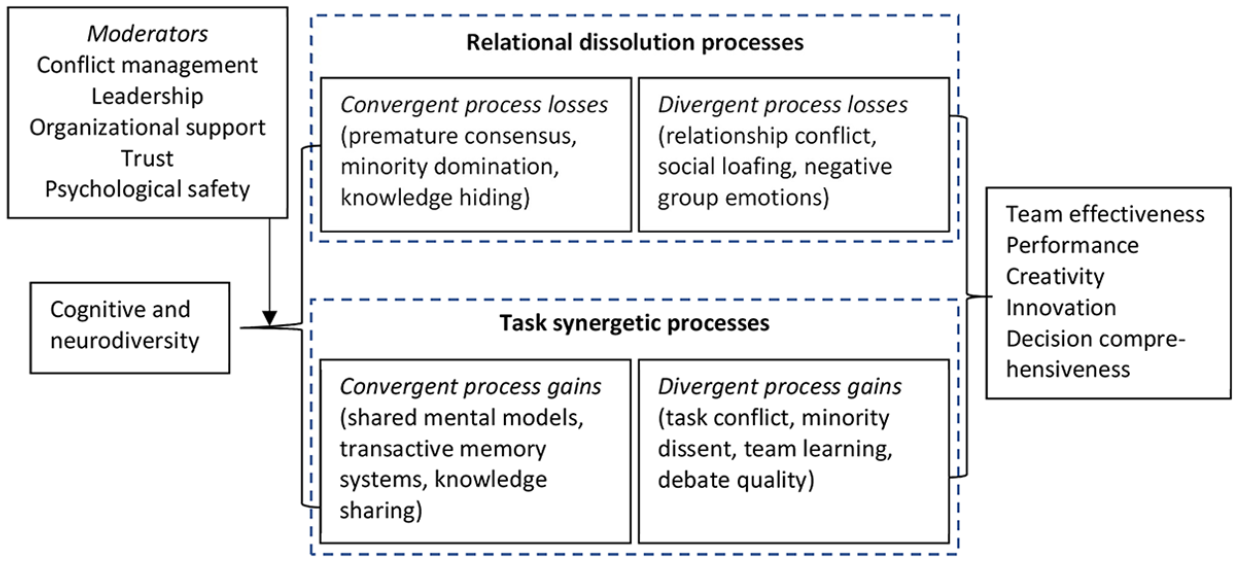
An integrative model of empirical cognitive diversity literature.
Discussion
We analyzed cognitive and neurodiversity as forms of differentiation in terms of cognitive resources (content) and information processing capabilities available in groups. Our results revealed mixed influences of cognitive and neurodiversity on group dynamics and outcomes. In order to provide an integrative framework, we first analyzed how cognitive diversity was operationalized in different studies, and second, we distinguished between two key cognitive differentiation dimensions that coexist in groups. One dimension is horizontal differentiation that refers to differentiation in the types of knowledge and expertise that is expected to increase the pool of relevant cognitive resources for task accomplishment. The other is vertical differentiation that refers to the hierarchical differentiation associated with the relative concentration of cognitive resources or information processing capabilities in particular subgroups or individual members (Bunderson & Van der Vegt, 2018; Curşeu, 2022; Harrison & Klein, 2007). Our analysis showed that studies assessing cognitive distance through self-reports, predominantly using the scale introduced by Van der Vegt and Janssen (2003), tend to gauge cognitive diversity as horizontal differentiation. These studies frequently report favorable effects of cognitive diversity on various team processes, emergent states, and outcomes. Horizontal cognitive diversity opens up the possibility of cognitive synergy by expanding the reservoir of task-relevant knowledge and expertise, thereby leading to positive effects on work-related outcomes and attitudes. Specifically, 24 of the 34 studies in which cognitive diversity was evaluated using indicators of horizontal differentiation revealed positive influences of cognitive diversity on information elaboration and knowledge creation (Mitchell & Nicholas, 2006), knowledge integration (Liao & Long, 2016), task conflict (Olson, Parayitam, & Bao, 2007), quality of debates and knowledge sharing (Mitchell et al., 2009; Rahmi & Indarti, 2019), group learning (Chow, 2018), group creativity (Kim et al., 2021), innovation (Jankelova et al., 2021), performance (Joniakova et al., 2021), and effectiveness (Mathuki & Zhang, 2022). Only four studies that evaluated cognitive diversity as horizontal differentiation reported negative associations: with cohesiveness (Nowak, 2021), decision comprehensiveness and extensiveness (Miller et al., 1998), shared mental models (Van Rensburg et al., 2022), and commitment (Olson, Bao, & Parayitam, 2007). In addition, one of these studies revealed mixed effects of cognitive diversity on innovation by showing that cognitive diversity generates relationship conflict and triggers task reflexivity. As such the vast majority of studies reveal a positive association between cognitive diversity as horizontal differentiation on synergetic cognitive processes conducive to effective information exchange and integration through effective collaboration, ultimately fostering creativity, innovation, decision quality, performance, and effectiveness. Because task conflict and constructive controversy are essential for effective collaboration (Curșeu & Schruijer, 2017), this finding adds to the synergetic effects of horizontal cognitive diversity.
Differentiation captured by unequal distribution of cognitive resources or information processing capabilities within groups indicates the co-existence of vertical and horizontal cognitive diversity. In particular, group faultlines reflect the overlapping and alignment of different forms of heterogeneity in groups, combining horizontal and vertical differentiation. Moreover, groups in which members differ in terms of their level of expertise, education, rationality, or cognitive competencies exhibit horizontal differentiation to some extent, while the unequal distribution of these cognitive resources within groups leads to vertical status differences and unequal allocation of idiosyncrasy credit within groups (Hollander, 1958). All studies in which cognitive diversity was assessed as the within-group standard deviation of individual rationality or cognitive competencies reveal negative associations of cognitive diversity with synergetic group performance in decision tasks (Curşeu et al., 2013, 2015, 2020) and performance (Kilduff et al., 2000). One exception is the study of Martins et al. (2013) that reported a positive association between expertness diversity (evaluated as within-group standard deviation of CGPA) and group performance in an IT project realized as part of a course task. Five of the 11 studies that used the summed score of the within-group standard deviation of cognitive styles reported disruptive effects of cognitive diversity on strategic consensus (Aggarwal & Woolley, 2013, 2019), cohesion and viability (Mello & Delise, 2015), positive emotional states (Armstrong & Priola, 2001), and relationships (Qi & Armstrong, 2019). Overall, these studies showed that horizontal and vertical cognitive diversity co-exist, and vertical cognitive diversity reduces social integration in groups, triggers process losses, and ultimately decreases effectiveness, performance, and creativity.
Further, if we conceptualize cognitive diversity as vertical differentiation with respect to the rationality of the members, cognitive distance has a non-linear association with synergetic work-related group outcomes (Meslec & Curşeu, 2013). An inverted U-shape association between cognitive diversity and collective intelligence in groups (Aggarwal et al., 2019) can be explained by an optimal balance between horizontal and vertical differentiation, which is when cognitive distance falls within an average range rather than being too low or too high. Drivers that increase vertical differentiation include a low group climate (encompassing groups’ collaborative attitudes, trust, and psychological safety), a lack of openness to experience (Cui et al., 2022; Jankelova et al., 2021; Martins et al., 2013; Mello & Delise, 2015; Mitchell & Nicholas, 2006; Olson, Parayitam, & Bao, 2007; Rahmi & Indarti, 2019; Younis, 2019), the existence of subgroup balance or strong faultlines (Qi et al., 2022), cognitive disparity (Curşeu et al., 2007), a lack of inclusive debate that engages different perspectives (Chow, 2018; Mathuki & Zhang, 2022; Mitchell et al., 2009, 2017), and relationship conflict compromising mutual trust (Chen et al., 2019; Martins et al., 2013; Qi & Armstrong, 2019).
Horizontal and vertical differentiation always coexist in small groups; yet their interplay generates different processes and outcomes (see Figure 4). A group with high horizontal and low vertical differentiation can be described as conducive to cognitive emergence and synergy, the ultimate breeding ground for positive group outcomes. The studies in our sample include various interventions aimed at reducing vertical differentiation that group members and their leaders can undertake to achieve relational synergy, such as conflict management that improves group cohesion (Mello & Delise, 2015), transformational leaders’ role model enactment (X. H. Wang et al., 2016), defining a group’s mission, goals, and strategic plans (Nowak, 2021), and supporting an innovation climate (Chen et al., 2019).
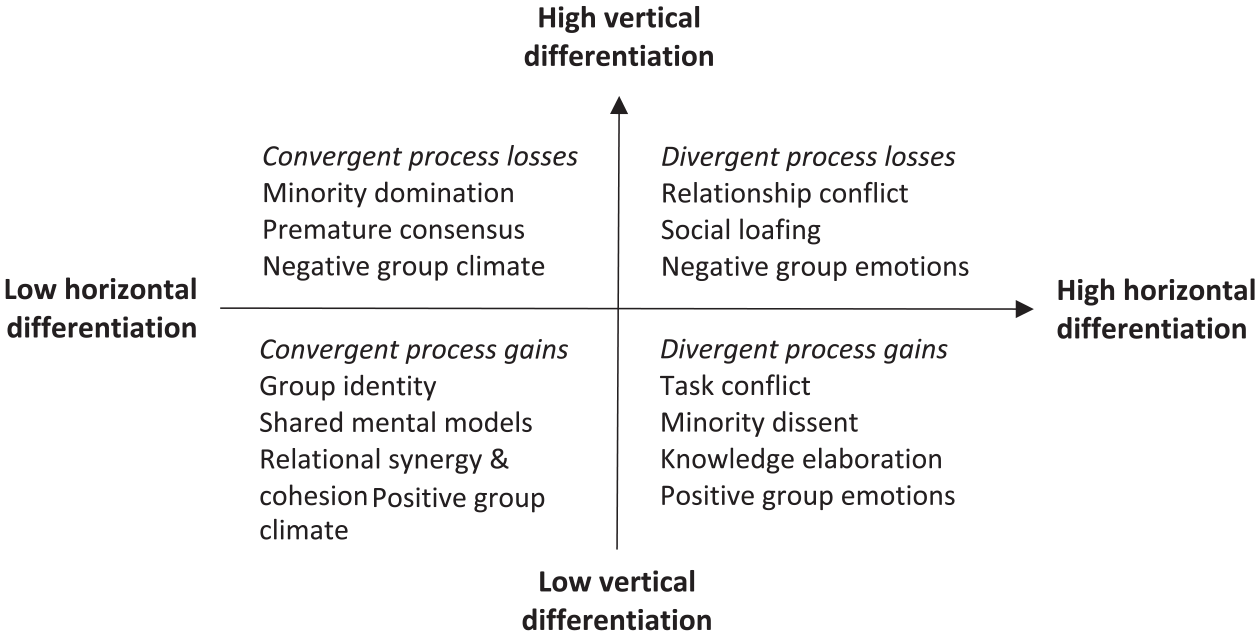
Framework of horizontal and vertical differentiation of cognitive group diversity and process gains and losses.
The studies in our sample collected data from different continents, including Asia, Europe, and the United States. Most studies do not explicitly address how cultural or national differences may impact the research findings on cognitive and neurodiversity. While we did not find a substantial intersection between culture and the conceptualization of horizontal and vertical differentiation in groups, it is not unfounded to suggest that cultural values influence the impact of cognitive diversity on group outcomes, particularly in the case of vertical differentiation. Vertical differentiation is more likely to be embraced in cultural contexts with high power distance than in groups that function within cultures characterized by low power distance (Gheorghe et al., 2023). As such, the negative influence of vertical differentiation on group dynamics and outcomes may exhibit variations across cultures, as individuals’ cultural and ethnic backgrounds provide a framework for interpreting social interactions (Abdel-Monem et al., 2010; Bender & Beller, 2016). Cultural variations exist in cognitive development, particularly in executive functions, memory, spatial cognition, and problem-solving (Gauvain & Perez, 2015). The drivers that increase or decrease horizontal and vertical differentiation are likely influenced by the cultural background of group members as well as by the organizational and national culture in which groups are embedded. For example, the negative effects of vertical differentiation lessen as the level of acceptance of formal or informal hierarchy increases within a specific organization or broader cultural context (Buttery & Leung, 1998; Zhang et al., 2015). Also, the experience of conflict stemming from cognitive differentiation is culture-sensitive, since, for example, harmony is preferred in collectivistic cultures rather than in individualistic ones (Leung et al., 2002). Thus, the same degree of vertical differentiation would likely lead to less relationship conflict in collectivistic rather than individualistic cultures, and in high rather than low power distance cultural contexts. Cultural background also significantly determines the degree to which group members are enabled to show cognitive growth (Grosser & Lombard, 2008) and openly express divergent ideas during group debates (Curşeu & ten Brink, 2016), directly affecting the degree of horizontal differentiation within groups.
Avenues for Future Research
Beyond Linearity
Group synergy can be achieved when a group operates at the “sweet spot” of cognitive differentiation. In prior studies, J. R. Austin (1997) alluded to the concept of optimal diversity, proposing a non-linear connection between diversity and group outcomes. More recently, Stahl and Maznevski (2021) have echoed the need for non-linear research on optimal diversity in groups. However, optimal (cognitive) diversity is still underexplored in contemporary cognitive diversity literature. Most studies in our review investigated the linear association between cognitive diversity and group outcomes, and only a few explored optimal cognitive diversity. Research on optimal cognitive diversity is based on the idea that an optimal cognitive distance is required for effective knowledge integration (Aggarwal et al., 2019; Meslec & Curşeu, 2013), showing that too little or too much cognitive disparity impairs group cognitive complexity (Curşeu et al., 2007). The TMGT principle (Grant & Schwartz, 2011; Pierce & Aguinis, 2013) states that too much or too little cognitive and neurodiversity is detrimental to group outcomes. By distinguishing between horizontal and vertical differentiation, our proposed framework offers a method for recognizing situations where diversity is too high or too low. Inadequate diversity implies a lack of cognitive differentiation within groups, whereas excessive diversity highlights situations where vertical differentiation overshadows the advantages of horizontal differentiation. Optimal cognitive diversity reflects a balance between horizontal and vertical cognitive differentiation that yields the maximum synergetic effects in groups. The inverted U-shape association between cognitive diversity and group outcomes can be decomposed into two primary non-monotonic relations reflecting the co-existence of vertical and horizontal differentiation. The first relation reflects a decreasing positive association between cognitive diversity and group outcomes, which occurs when (1) horizontal differentiation dominates over vertical differentiation, or (2) cognitive and neurodiversity is at low to moderate level, as indicated by heightened horizontal differentiation. The second relation describes the contexts in which cognitive diversity becomes detrimental to group outcomes, which occurs when (1) vertical cognitive differentiation dominates over horizontal differentiation or (2) cognitive and neurodiversity is at moderate to high level, as indicated by heightened vertical differentiation. To summarize, our integrative systemic model on cognitive and neurodiversity allows the theorization of non-linear associations between diversity and group outcomes.
Measurement of Cognitive Diversity
As shown in Table 2, the ways scholars assessed cognitive diversity can be categorized into horizontal or vertical differentiation, although their measurements does not necessarily align with this categorization. Many studies rely on self-assessment scales for group cognitive diversity (e.g., Van der Vegt & Janssen, 2003), effectively measuring one’s perceived cognitive diversity rather than using an objective index of cognitive group diversity. Such evaluations may primarily focus on horizontal differentiation, yet they could conflate vertical differentiation. Some other studies used generic attributes as proxies for cognitive diversity, such as demographic diversity variables (e.g., assuming gender subsumes cognitive differences) or functional diversity variables (e.g., assuming different functional roles reflect cognitive differences). The reliance on proxies for assessing cognitive diversity stems from the multitude of definitions within the literature, further complicating the aggregation of results from various cognitive diversity studies. This complexity has not diminished since the publication of Mello and Rentsch (2015). Aligned with our integrative model, we assert that if scholars explicitly specify the type of cognitive diversity they are assessing (horizontal or vertical differentiation), it will facilitate the grouping of empirical findings according to the distinct systemic characteristics of these differentiation forms. This approach will simplify the comparison and amalgamation of results, thereby advancing the research in this field.
Research on discursive cognitive diversity (Lix et al., 2022) and minority dissent (Curşeu & Schruijer, 2012; Miron-Spektor et al., 2011) opens venues for future research, as they capture the manifest cognitive diversity in groups. Group diversity, as measured by various personal attributes employed in the current literature, falls short in encapsulating the authentic manifestation of varied perspectives during group discussions, which are presumed to be essential for knowledge generation and integration. Therefore, we advocate for further research into the overt rather than hidden cognitive diversity within groups, with a specific emphasis on the explicit manifestations of cognitive diversity during group interactions.
Contextual Influences on Horizontal and Vertical Differentiation
We contend that horizontal and vertical differentiation always coexist in groups, and in line with Bunderson and Van der Vegt (2018), we acknowledge that the same cognitive attribute may trigger both forms of differentiation. However, the way in which horizontal and vertical differentiation impact divergent and convergent processes may vary as a result of contextual influences. We posited that the cultural context, as manifested in power distance and collectivism/individualism, influences the degree of acceptance of vertical differentiation and the visibility of horizontal differentiation in group discussions. Comparative cross-cultural studies on the effects of cognitive diversity are scarce. Our integrative review provides a fertile framework that can spur future cross-cultural comparisons. In particular, examining the experience of horizontal and vertical differentiation under conditions where objectively measurable cognitive capabilities are investigated could shed more light on the contextual influences of cognitive and neurodiversity in teams.
Another contextual influence relates to tasks. For complex tasks, the shifting task constraints may change the vertical differentiation in groups. For example, emergency management teams dealing with multifaceted tasks and rapidly changing environmental threats may perceive vertical differentiation as dynamic, with status hierarchies quickly adapting to meet the demands of the tasks. Future research could explore how team dynamics and outcomes are affected by the interaction between horizontal differentiation determined by role assignments and the fluid vertical differentiation that emerges due to changing task requirements that may require flexible management practices during the convergent and divergent processes.
Neurodiversity
While the interest in workplace neurodiversity has grown over recent decades, our sample comprises only three studies that investigated neurodiversity in the context of workgroup collaboration and group outcomes. These studies explored the effectiveness of collaborative learning in mixed student groups, including members with autism and they show substantial cognitive improvements for all participating students, highlighting the advantages of neurodiversity in enhancing collective learning. Neurodiversity studies in work environments focus mainly on HR practices and policies (e.g., Rao & Polepeddi, 2019; Szulc et al., 2021) or on the integration of neurominorities in a neuromajority-dominated organizational context (e.g., R. D. Austin & Pisano, 2017; Van den Bosch et al., 2019), with little attention given to how neurodiversity influences group dynamics and outcomes. To date, many scholars argue that neurodiversity in organizations could benefit innovative performance (e.g., R. D. Austin & Pisano, 2017; Houdek, 2022) and such claims warrant more empirical exploration. It is also noteworthy that none of the cognitive diversity studies in our sample mentioned neurodiversity or any related terms as dimensions of cognitive diversity. This shows that the research streams of neurodiversity and cognitive diversity are still disconnected despite recent observations that they cannot be treated as separate topics (Hunt & Jaeggi, 2022; Taylor & Vestergaard, 2022). Future research should integrate insights from both cognitive diversity and neurodiversity in order to gain a more comprehensive understanding of the benefits and detriments of diversity in collaborative efforts.
Practical Implications
The need for a better understanding of how cognitive and neurodiversity impact group dynamics is beneficial not only to researchers but also to practitioners. Our findings can guide managers in determining the optimal level of cognitive diversity in group composition. For example, they can select people who contribute to factors like subgroup balance, group learning, knowledge diversity, and debate to achieve optimal cognitive diversity. Managers should also understand the dynamics of cognitive diversity in workgroups and find avenues for managing the detrimental effects of vertical differentiation. For example, they can support and encourage teams to pursue the benefits of cognitive and neurodiversity by fostering psychological safety and stimulating constructive debates and relational synergy.
Limitations
Our literature review has several limitations. First, studies meeting the inclusion criteria may have been excluded because of missing keywords or titles that were less representative. Second, our sample comprises a limited number of studies related to neurodiversity. This is primarily due to the scarcity of research investigating the influence of neurodiversity on workplace group dynamics and outcomes. Third, the integrative model used to organize the literature on cognitive and neurodiversity in groups may not serve as a universally applicable framework for organizing group diversity research. We acknowledge that previous models with similar aspirations have struggled to offer a concise framework for consolidating group diversity studies and providing guidance for future research aimed at elucidating the distinct effects of diversity in groups. Our framework is specifically tailored for cases involving cognitive differentiation within groups and may not be universally applicable to other forms of diversity.
Conclusion
We reviewed studies that examined cognitive and neurodiversity as factors indicative of variations in cognitive content and information processing tendencies within groups. Empirical findings of 28 years of research on cognitive diversity and limited research on neurodiversity in groups are summarized and presented in an integrative model. We showed that the role of neurodiversity in workgroups has been largely overlooked, whereas cognitive diversity in workgroups mainly focuses on a few topics: innovation, team performance, and creativity. Mello and Rentsch’s (2015) mixed findings with respect to the outcomes of cognitive diversity still hold true today. The plethora of definitions and measurement approaches in cognitive diversity continues to obstruct the integration and comparison of study findings, obstructing the progress of the research field. We presented a framework in which cognitive and neurodiversity are defined as horizontal and vertical differentiation, each with distinctive effects on convergent and divergent process losses and gains. This framework encourages scholars to embrace the concept of optimal cognitive diversity and to employ curvilinear models, instead of linear ones, when studying the implications of cognitive and neurodiversity in workgroups.
Supplemental Material
sj-docx-1-sgr-10.1177_10464964231213564 – Supplemental material for Cognitive and Neurodiversity in Groups: A Systemic and Integrative Review
Supplemental material, sj-docx-1-sgr-10.1177_10464964231213564 for Cognitive and Neurodiversity in Groups: A Systemic and Integrative Review by Jan van Rijswijk, Petru Lucian Curșeu and Lise A. van Oortmerssen in Small Group Research
Footnotes
Declaration of Conflicting Interests
The author(s) declared no potential conflicts of interest with respect to the research, authorship, and/or publication of this article.
Funding
The author(s) received no financial support for the research, authorship, and/or publication of this article.

Supplemental Material
Supplemental material for this article is available online.
Author Biographies
References
Supplementary Material
Please find the following supplemental material available below.
For Open Access articles published under a Creative Commons License, all supplemental material carries the same license as the article it is associated with.
For non-Open Access articles published, all supplemental material carries a non-exclusive license, and permission requests for re-use of supplemental material or any part of supplemental material shall be sent directly to the copyright owner as specified in the copyright notice associated with the article.
