




Abstract
This conceptual integration addresses how positive and negative mood states influence information processing in groups. In addition to the impact of mood on attention and arousal, the review develops the notion of dominant cognitive processing strategies that mediate the influence of positive and negative moods on information processing in groups. Positive moods are proposed to reinforce dominant cognitive processing strategies while negative moods inhibit or revise such dominant cognitive processing strategies. Principles derived from several mood-cognition models are applied to group information processes related to attention, encoding, storage, retrieval, processing objectives, response, and feedback. The impacts of mood states are discussed in relation to group themes of convergence-divergence, commonality-uniqueness, and accentuation-attenuation of cognitive processes. The analysis leads to new implications for small group topics such as metacognition, group learning, motivated information processing in groups, communication, mood dynamics, and mood composition. The principles described can inspire numerous directions for future research.
Keywords
So, there we were—four of us on a road trip after the end of the term, driving an older hatchback down the interstate to visit national parks in the U.S. desert southwest. We were all in a good mood. Well, maybe everyone but me. We had just missed the exit for the turn off to go toward a national park. Now what do we do? Why did no one seem to see the sign for the exit? Do we admit we made a mistake, turn around, and go back to the exit? One group member appeared to remember that there is another turn off up the road about 10 miles. Do we go down the road and take that exit? Or, do we just enjoy the journey until someone comes up with an acceptable solution? This example illustrates some important elements of group interaction. In this case, it is an example of group processing of spatial and geographical information (Park & Hinsz, in press), which is a subtype of group processing of information. But the example also demonstrates a variety of cognitive tasks performed by groups (e.g., memory, judgment, information integration, decision making). Moreover, different aspects of information processing are involved, such as attention, encoding, retrieval, storage, processing objective, response, and feedback (Hinsz et al., 1997). Yet, it is also important to recognize that all of these events occur in an affective context. What role do the positive and negative moods of the group members play in the group’s interaction, action, and cognitions? This group road trip example highlights key questions that will be examined in our conceptual and integrative review, which focuses on how positive and negative moods influence information processing of groups.
This conceptual review integrates a diverse set of relevant conceptualizations. We will outline what is meant by positive and negative mood (or affect) states, drawing heavily on Watson’s (2000) conceptualization. Varieties of affect-as-information theory, as applied to mood states (Schwarz & Clore, 1988) and feelings (Schwarz, 2012), will provide a grounding for understanding how moods impact the cognitive strategies used to process information. We will particularly draw from an extension of these theories that contends that affective states provide feedback concerning cognitive strategies (Huntsinger et al., 2014), which provides a principled basis for considering how dominant cognitive processing strategies are influenced by positive and negative moods. To help define what the dominant cognitive processing strategies might be in a given context, we will draw from dual process theories (e.g., Chaiken & Trope, 1999) and the affect infusion model (Forgas, 2001). Information processing and cognitive strategies will then be considered at the group level, based on the groups as information processors framework (Hinsz et al., 1997). In addition, we will incorporate elements from other reviews of affective states in groups (e.g., Barsade & Gibson, 2012; Barsade & Knight, 2015; Kelly, 2007; Kelly & Barsade, 2001) while also integrating feedback theories of affect (Huntsinger et al., 2014) with the groups as information processors approach (Hinsz et al., 1997).
This review draws from multiple disciplines to demonstrate how related research contributes to the conceptual integration. These include affective science, cognitive science, motivation science, communication, management, organization science, social psychology, personality, and education. This paper provides a conceptual integration of how positive and negative moods influence information processing in groups rather than an exhaustive review of any particular literature, and several topics will not be examined. 1 We begin by examining theories of mood and cognitive processing, which will provide a basis for the extensions that follow. In the process of these integration efforts, the review will highlight many directions for future research.
Theories of Mood and Cognitive Processing
Information Processing and Cognitive Strategies
The cognitive revolution in psychology provided a basis for conceptualizing the cognitive processes that occur among interacting groups (cf., Hinsz et al., 1997). Although a variety of perspectives on cognition exist, dual process models have emerged as a general approach for information processing and cognitive strategies (e.g., Chaiken & Trope, 1999; Sherman et al., 2014), and we will draw from such models while recognizing criticisms of them (Evans & Stanovich, 2013; Kruglanski & Gigerenzer, 2011). Generally speaking, dual process models contrast processes that are automatic, intuitive, and heuristic with other processes that are controlled, effortful, deliberative, and/or systematic (Evans, 2008). Although dual processing approaches help explain much of information processing and cognitive strategies of individuals, one system might involve a number of processes (Petty & Briñol, 2014), and it is likely that humans do not limit themselves to the use of only two types of processes in their cognitive functions (Evans, 2008; Evans & Stanovich, 2013).
Individuals and groups performing cognitive tasks might adopt a number of cognitive processing strategies. Yet, a common result is that, for a specific task, one cognitive processing strategy (e.g., heuristic) is likely to dominate for a plurality of individuals. For other individuals, different cognitive processing strategies (e.g., systematic) might arise. Consequently, for any one task, there is likely to be a dominant processing strategy that characterizes most individuals. This strategy could also be considered a default processing strategy (Forgas, 2001; Isbell et al., 2016). Yet, other strategies are possible and a hierarchy of processing strategies could, in principle, be applied. This hierarchy of cognitive processing strategies can be conceptualized in terms of the response hierarchy concept from learning theory (Hull, 1934), which also influenced the drive theory of social facilitation (Zajonc, 1965). In this social facilitation conceptualization, it is proposed that individuals have a response hierarchy of the most to least likely response for that person in that situation as a function of their prior experiences (e.g., learning history). Similarly, we propose that individuals may have a cognitive processing strategy (response) hierarchy based on their experiences. When a person confronts a cognitive task, one dominant cognitive processing strategy could arise with an ordered set of sub-dominant strategies.
Several considerations follow from this conception of dominant and sub-dominant response strategies. First, different tasks will produce different hierarchies of response strategies. Thus, to make predictions, one must know about the strategies that are most likely to be dominant for any given task. Second, various factors (e.g., belief that a dominant processing strategy is not working) could discourage the dominant processing strategy and, in turn, encourage a sub-dominant response strategy. Third, affective states are likely to either encourage (e.g., positive mood states) or discourage (e.g., negative mood states) a dominant response strategy, resulting in predictable differences in the strategy by mood state. Therefore, if one knows (a) the dominant processing strategy for a given task, (b) the mood state of group members, and (c) how group interaction influences these processes, then it should be possible to make predictions concerning cognitive processing and performance on cognitive tasks.
Mood and Affective States
People are almost always in one sort of affective state or another (Russell, 2003; Watson, 2000), and such affective states can influence how a task is performed (Bless, 2001; Forgas, 1995; Larsen, 2000; Schwarz & Clore, 1996). When considering the potential impact of affective states, it is useful to distinguish among affect, mood, and emotion. Affect is an umbrella term for both mood and emotion, and this term is used when making the broadest generalizations (Watson, 2000). Mood states typically last longer than emotional states, and they arise and dissipate slowly (Watson, 2000). Also, because mood states are typically divorced from an obvious event or set of conditions that caused them, their influence tends to be diffuse and has been characterized as informational (Schwarz & Clore, 1996). In contrast, discrete emotions are often linked to events or conditions that prompt the emotional reaction (e.g., fear in response to highly threatening stimuli), which may result in an instantaneous response that ceases just as quickly. Moreover, emotional reactions often involve specific behavioral signatures (e.g., expulsion for disgust), rendering emotions more motivational in nature than mood states (Schwarz & Clore, 1996).
Both mood states and emotions are often experienced in social settings, and people consult their affective states when determining how to interact with others (Van Kleef, 2009; Van Kleef & Côté, 2022). In addition, it has been shown that both moods and emotions influence complex judgments in a variety of domains (e.g., Forgas, 2001; Lerner et al., 2015). Nonetheless, because the analysis of mood states and emotions might require different models (Berkowitz & Harmon-Jones, 2004; Gable & Harmon-Jones, 2010), and because mood states are ubiquitous (Schwarz & Clore, 1996), we will concentrate on mood states in the present review. We will emphasize both the valence of mood states (positive vs. negative: Watson, 2000) as well as their arousal level (Barrett & Russell, 1999). The valence and arousal components of mood appear to have separable influences (Storbeck & Clore, 2008), which should differentially influence the cognitive and social processes involved in information processing of groups.
Our focus on moods allows us to treat positive and negative moods as moderators of the processes that influence cognitive task performance. Hence, we emphasize that, for many tasks, mood states tend to influence task performance indirectly rather than directly, through their influence on informational, cognitive, and social processes (Huntsinger et al., 2014). 2 When performance on cognitive tasks is the focus, mood states can be considered part of the context surrounding the task (Hinsz et al., 2022) as well as part of the background that impacts social judgment (Fishbein & Ajzen, 2011). From this perspective, it will be important to outline ways in which positive and negative mood states interact with cognitive and social processes to impact group performance on cognitive tasks. To understand such influences, we turn to a series of mood-cognition models that have some relevance to the mood-cognition interface.
Mood, Information Processing, and Cognitive Strategies
Seminal work in the mood and cognitive processing literature was dominated by the idea that positive and negative mood states prime thoughts of a corresponding valence. From this perspective, positive (negative) moods might be expected to enhance the processing of events or information that also has a positive (negative) valence (Isen & Baron, 1991). Moreover, mood states could, through their instantiation as nodes within a semantic memory system, bias retrieval in a mood-congruent manner (Bower, 1981). Variations of this mood congruence hypothesis (Bower, 1981) continue to receive attention (Eich & Forgas, 2003), but inconsistencies in the literature led to other frameworks for understanding how and why mood states influence cognitive processing (Wyer et al., 1999).
In part as a replacement for mood congruence models, the affect as information perspective was developed (see Schwarz & Clore, 2003, for a review). Initially, the interest was in mood-congruent judgment, and research showed that participants judged their lives to be more positive on sunny than dismal days, unless attention was drawn to the weather, in which case mood-congruent judgments were not displayed (Schwarz & Clore, 1983). Thus, positive mood states signal to the individual that the environment is benevolent and that their processing and behavioral strategies are working appropriately, whereas negative mood states signal that the environment is troublesome, initial and habitual inclinations may not be trustworthy, and caution should be exercised (Schwarz & Clore, 2003). There is considerable support for this theory (Schwarz & Clore, 1988, 1996, 2003), which also aligns with cybernetic views of affect that treat affect as a feedback signal concerning the self’s cognitions or actions (Carver & Scheier, 1998).
The affect as information perspective was compelling in part because it aligned with dual process theorizing. Positive mood states would reasonably result in a greater reliance on heuristic (automatic, reflexive, etc.) processing. By contrast, negative mood states would lead individuals to engage in more systematic or effortful processing, in part because they doubt their natural inclinations, whether cognitive or behavioral (Bless & Burger, 2017). The heuristic-systematic framework for positive and negative mood has since been critiqued (e.g., Erber & Erber, 2000; Forgas, 2001). For example, Martin (2001) reviews data showing that people in positive moods will engage in effortful processing when they are enjoying an activity. Moreover, the pairing of positive moods with heuristic processing and negative moods with systematic processing have been found to be malleable depending on the task and other factors (Huntsinger et al., 2014).
The affect infusion model (Forgas, 1995, 2001) builds on the mood-as-information approach, but provides two additional elements that guide our conceptualization. First, task context is deemed an input for understanding what the default or dominant cognitive processing strategy is (also see Huntsinger et al., 2014). In many circumstances, the task context would direct attention to important information that does not necessarily follow the heuristic-systematic distinction. Second, Forgas describes four different processing strategies—heuristic, substantive, direct access, and motivated processing. The important point for us is not that there are four strategies, or that there are more than two strategies, but rather that the cognitive processing strategy that might be applied is a function of the context and the task. These cognitive processing strategies might stem from a dual processing conceptualization, but might also arise from other context and task representations pertinent to the situation.
Feelings-as-Information Theory
As research continued on the study of moods and their influences on information processing and cognitive strategies, a revised theory emerged: feelings-as-information theory (Schwarz, 2012). The feelings as information theory (FAIT) integrates prior notions that were not incorporated in the mood as information approach (e.g., the role of context). Schwarz (2012) describes this theory with four postulates (see Schwarz, 2012, Table 2). Postulate 1 of FAIT states that “people attend to their feelings as a source of information” and that “different types of feelings provide different types of information.” Postulate 1 is a generalized version of the moods-as-information approach which extends beyond mood states to incorporate other types of feelings (e.g., fluency, affective reactions to objects).
Postulate 2 of FAIT states that “The impact of a given feeling depends on its perceived informational value for the task at hand.” Mood states will influence task performance primarily when they are perceived to be relevant. People are thought to usually perceive their mood states to be relevant to whatever is the focus of attention, but mood states can sometimes be attributed to an incidental source, in which case the mood’s perceived relevance to the task is reduced or eliminated. 3 Postulate 2 also contends that changes in mood are perceived to be more diagnostic than stable mood states, and that contrastive mood states (e.g., a positive mood state in the context of a task involving negative information) often have greater impact.
The third postulate of feelings as information theory states that “When feelings are used as information, their use follows the same principles as any other type of information.” That is, all sources of information, including mood states, are more likely to be used when they seem relevant to a task or a judgment. In addition, all sources of information become less influential when there are alternative inputs, “which is a function of processing motivation and capacity.” The last point about processing motivation and capacity is important because groups impact processing motivation (De Dreu et al., 2008; Hinsz et al., 1997) and have greater processing capacity relative to individuals (Hinsz et al., 1988, 1997; Wallace & Hinsz, 2019).
Postulate 3b also emphasizes the importance of the context for inferring the implications of mood: “What people conclude from a given feeling depends on (i) the epistemic question on which they bring it to bear and (ii) the lay theory of experience applied.” This point suggests that the task and situation set a context for how mood will impact responding. For example, if the task is to estimate the number of deaths from a new flu variant, then a negative mood state might focus attention on death relative to mitigating factors, resulting in higher estimates. Moreover, Postulate 3b suggests that the impact of a mood also can vary as a function of the person’s lay theory of the experience. Importantly, if group members have differing lay theories concerning mood states (e.g., that negative moods convey a serious situation vs. that negative mood states are to be avoided because they are aversive), then a shared mood experience can still result in different kinds of responses from different group members (Hinsz & Bui, 2023).
Postulate 4 of FAIT largely reiterates standard dual-process theorizing, but with a twist: “feelings that signal a ‘problematic’ situation foster analytic, bottom-up processing style, whereas feelings that signal a ‘benign’ situation foster a more global, top-down processing style.” The twist is that the valence of a mood state, per se, is not critical. Rather, it is how the moods foster an interpretation of the situation as benign versus problematic that leads to the cognitive strategies that are then applied. Most of the time, positive mood states may signal that a situation is benign and negative mood states may signal that it is problematic, but such links are not inevitable (e.g., boredom, which is a negative mood state, could signal that a situation is benign, implicating the arousal dimension of mood experience).
Mood as Cognitive Feedback Approach
The mood as cognitive feedback approach (Huntsinger et al., 2014) built upon, and extended, the FAIT approach (Schwarz, 2012) with a key premise that the impact of mood states on cognitive processing is malleable rather than fixed, precisely because different tasks call for different default modes of processing. In conjunction with dual processing theories of information processing (Chaiken & Trope, 1999), information may be processed in a deliberative fashion (effortful, thoughtful, slow, reflective, System 2) or in a more heuristic fashion (quickly, efficient, intuitive, System 1). Depending on the context, individuals will favor either heuristic or deliberative processing as the default strategy for the task at hand (Bless & Burger, 2017). In addition, Huntsinger et al. (2014) suggest that the default processing strategy can be manipulated by the way the tasks are presented or by giving people social roles that lead them to adopt a more deliberative or heuristic strategy (Isbell et al., 2016). When the default strategy is deliberative, positive mood states should result in greater deliberation, whereas when the default strategy is heuristic, positive mood states should result in greater use of heuristic approaches (Bless, 2001). Thus, according to this cognitive feedback approach, positive mood states reinforce default processing strategies and negative mood states inhibit them, leading to the use of non-default processing strategies.
Integrating this cognitive feedback approach with the hierarchy of cognitive responses described earlier, we adapt the default cognitive processing strategy to focus on the dominant cognitive processing strategy. If there are two cognitive strategies that reflect the cognitive response hierarchy and dual process approaches, then there would be no differences between the two approaches, except that we will extend the model to information processing in groups. However, if a task evokes more than two cognitive response strategies, then a positive mood would enhance use of the dominant cognitive processing strategy. However, if the respondent experiences a negative mood, then they might revise the dominant cognitive strategy by shifting to a cognitive processing strategy lower on the hierarchy, or apply the dominant cognitive strategy with more determination indicating that the change needed pertains to the degree the cognitive processing strategy is applied (see Figure 1).
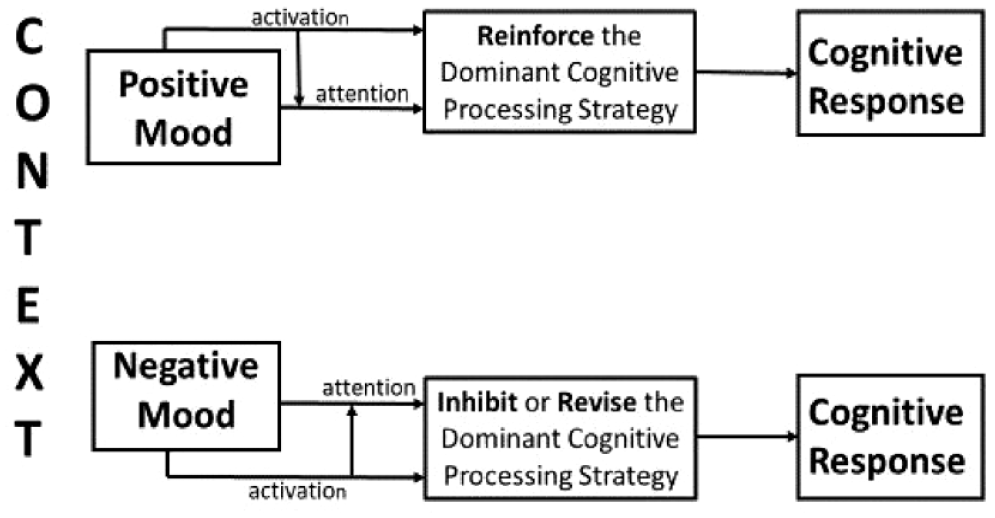
Positive and negative mood influences on dominant cognitive processing strategies.
The positive or negative dimension of moods influences which dominant or non-dominant cognitive processing strategy is accessible or attracts attention. If the mood is incidental to the task and no alternative attribution for the mood occurs, then this influence of moods will be direct (Schwarz, 2012) (see Note 3). However, if the mood is integral to the task and directs attention to specific mood consistent information, then experiencing a mood could modify which processing strategy attracts attention and therefore the hierarchy of the dominant cognitive processing strategies. That is, a positive or negative mood can direct attention to specific information to change the hierarchy of cognitive processing strategies such that particular mood consistent strategies become more dominant and cognitive processing strategies that are inconsistent with the mood state would be inhibited or revised.
This focus on dominant cognitive processing strategies and mood valence can help explain how positive and negative moods could result in more correct or more erroneous responses. If the dominant processing strategy is conducive to correct (or alternatively erroneous) responses, then positive moods would increase the likelihood that the individual would respond in a correct (or alternatively erroneous) fashion. However, if the dominant cognitive processing strategy is associated with more erroneous (or alternatively correct) responses, then if the individuals experience a negative mood state, they would produce less erroneous (or alternatively correct) responses subject to caveats discussed below. Thus, when the dominant cognitive processing strategy is beneficial, people in positive moods should reinforce those beneficial responses, while negative mood states will inhibit people in producing beneficial responses. These predictions are reminiscent of the patterns observed for social facilitation and inhibition (Zajonc, 1965).
It should be pointed out that neither feelings-as-information theory (Schwarz, 2012) nor the mood as cognitive feedback approach (Huntsinger et al., 2014) say much about the arousal component of mood states (Storbeck & Clore, 2008). To rectify this issue, we suggest that high arousal states should be expected to enhance the consequences suggested by these theories (Watson et al., 1999). That is, positive moods that are experienced with higher arousal will be more likely to activate dominant cognitive processing strategies (Figure 1). By contrast, high arousal negative mood states, relative to low arousal negative mood states, should be linked to greater tendencies toward the inhibition or revision of dominant cognitive strategies (Watson et al., 1999). If the experienced mood states are of a low arousal variety, then the effect of moods on cognitive processing may not be detectible (Magnan & Hinsz, 2005). Variability in arousal levels could thus help explain inconsistencies in the literature.
Independent of moods, groups can have arousing properties due to the mere presence of others (Zajonc, 1965). That is, groups can produce arousal among its members, which can be augmented by the moods they experience. Additionally, group interaction can enhance or diminish positive and negative moods (Bramesfeld & Gasper, 2008; Park & Hinsz, 2015). Therefore, in group contexts, changes in arousal can result from the mere presence of others, the experience of a mood, or group interaction via mutation of moods. These influences on arousal demonstrate additional levels of complexity for the effects of moods on groups. Therefore, a more complex and comprehensive framework for understanding the impact of moods on cognitive processing strategies in groups is needed.
Moods and Information Processing in Groups
As a consequence of the cognitive revolution in the behavioral sciences, notions of groups as cognitive or information processing systems emerged around the turn of the century (Cooke et al., 2013; DeChurch & Mesmer-Magnus, 2010; De Dreu et al., 2008; Grand et al., 2016; Hinsz et al., 1997; Larson & Christensen, 1993; Levine & Smith, 2013). In this integrative review, we draw heavily upon the groups-as-information processors framework (Hinsz et al., 1997), which focuses on how groups performing cognitive tasks process information. Other perspectives will be discussed, particularly when they focus on how mood should shape group-related information processing (e.g., Yoon et al., 2022).
Groups as Information Processors Framework
The review of groups as information processors (Hinsz et al., 1997) applied a generic information processing model to organize the literature concerned with information processing in groups (see Figure 2). Within this generic information processing model, the processes were categorized as involving processing objectives, attention, encoding, storage, retrieval, processing work space, response, and feedback. We will adopt these components or stages to consider how moods might influence information and cognitive processing in groups. In the process, we will also reflect on three themes of information processing in groups, namely: the commonality–uniqueness of information, convergence–divergence of ideas, and accentuation–attenuation of cognitive processes (Hinsz et al., 1997). We demonstrate how these themes hold relevance in terms of the impact of moods on group-related processes (e.g., the sharing of information; Hinsz & Bui, 2023; Hinsz et al., 1997; Mesmer-Magnus & DeChurch, 2009; Tindale & Kameda, 2000).
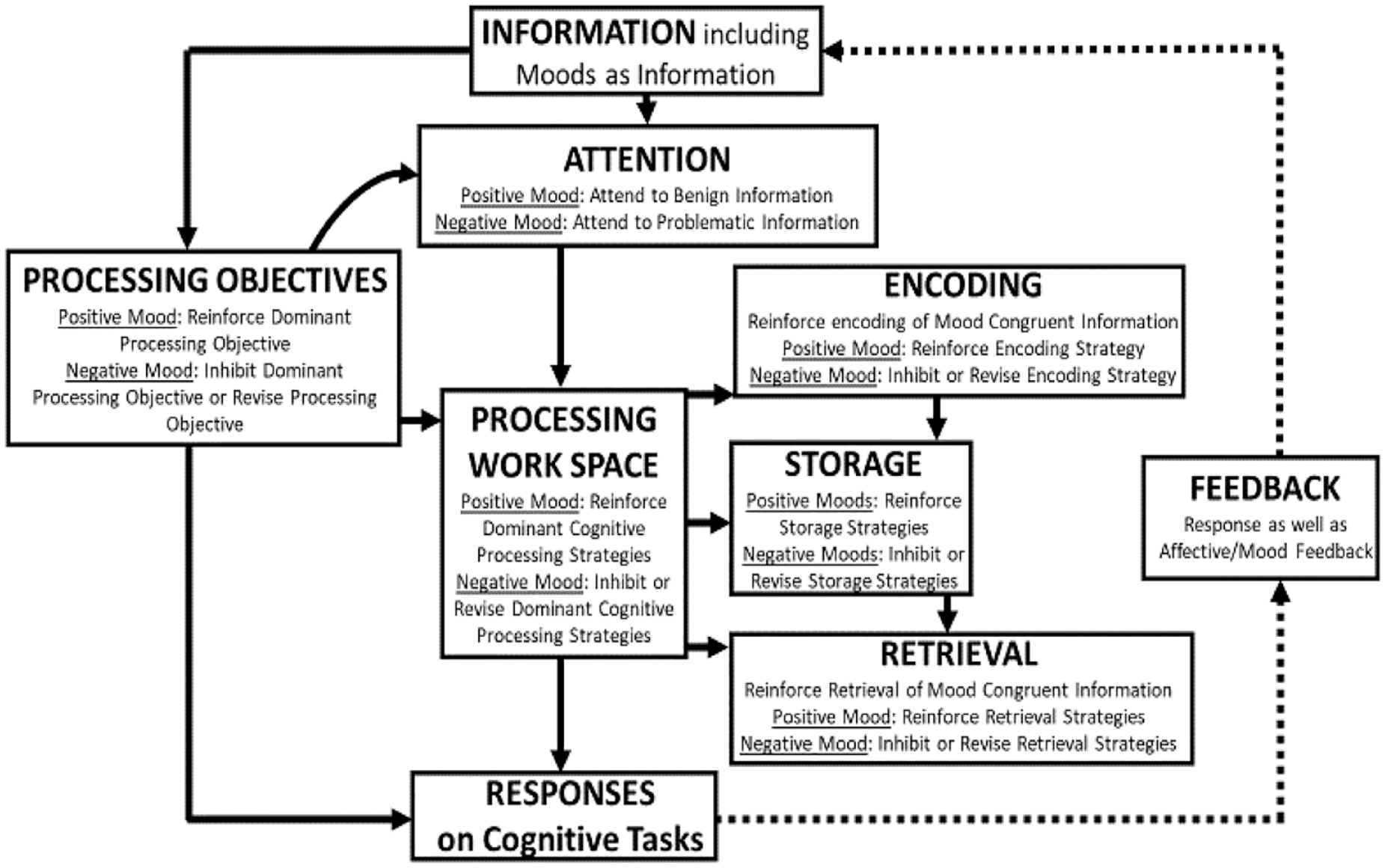
Mood influences in the generic information processing model for groups.
Processing Objectives
Groups establish objectives for information and cognitive processing, which can derive from instructions about tasks, the tasks themselves, group norms, prior commitments, the roles the individual or group play in larger social entities as well as those social structures (Hinsz et al., 1997). Importantly, individuals can have multiple objectives for information processing, and groups can have multiple processing objectives that can be shared or unshared (e.g., accuracy, error correction, effectiveness; Hinsz & Ladbury, 2012). The multiple objectives might follow a hierarchy of the processing objectives for the task situation.
Positive and negative moods can also impact information and cognitive processing objectives. Moods can direct more or less attention to specific objectives as well as impact the degree the processing objective is activated. If a group has a hierarchy of processing objectives for a cognitive task, then an incidental positive mood could result in the dominant processing objective being reinforced, while a negative mood could inhibit that dominant processing objective. If the mood is integral to the cognitive task, then positive or negative moods could make a mood-consistent processing objective more salient and dominant. Moreover, for integral moods, because specific processing objectives are reinforced, groups could be more likely to process mood-consistent information while inhibiting mood-inconsistent information. There is evidence that information that is consistent and inconsistent with preferences, which can be influenced by moods, has important influences on how information is processed in groups on tasks such as the hidden profile (Mojzisch et al., 2014).
Examples of how processing objectives influence the processing of information in groups are found with hidden profile tasks. Stasser et al. (1989) report that instructions about the procedures on a hidden profile task resulted in greater discussion of shared information to the detriment of unshared information, indicating that the instructions influenced information processing. This led Stasser and Stewart (1992) to suggest that members who were given a problem-solving set instruction (a processing objective) to solve a murder mystery as a problem would discuss the critical, but unshared, information more frequently relative to group members who received judge set instructions (processing objective) to make a judgment based on the information provided. Results confirmed this prediction. We predict that, if positive mood states were produced among group members, then this should direct more attention toward the processing objective introduced as well as reinforce the processing objective as the dominant cognitive processing strategy. The result for positive moods should be even greater exchange of unshared information in the problem set and greater exchange of shared information with the judge set. Putting group members in a negative mood, on the other hand, should inhibit the manipulated processing objective, direct attention to other aspects of information processing, and would likely result in greater discussion of shared and unshared information similar to the pattern of a no mood condition.
Similar results should be found when positive and negative mood states are applied to strategies introduced for processing information in group settings (e.g., priming a processing objective as a script or a norm; Hertel & Kerr, 2001; Levine et al., 2000). Consider group members being oriented toward a prevention or promotion focus for their processing of information in decision making (Florack & Hartmann, 2007). Because a promotion orientation focuses attention on positive outcomes and gain-relevant information, positive mood states should lead groups to reinforce the dominant cognitive processing strategy so that the group response is based even more on the positive and gain information, producing even more risky decisions than without positive mood (cf., Florack & Hartmann, 2007; Levine et al., 2000).
Attention
Given that positive and negative moods focus and guide attention (Schwarz, 2012), mood states would influence what information and cognitive processing strategies receive and maintain attention within the group. This attention could be directed to the task, the situation participants find themselves in, members of the group, or the self. Hence, important task information can attract the attention of group members or other information might distract attention away from critical aspects of the task. Moods would influence what information is the focus of attention in the group as well as the magnitude of that attention (see Figure 2).
Interestingly, the focus of attention by group members might also enhance the mood experienced by group members (Shteynberg et al., 2014). As mentioned, group interaction can sustain members’ positive moods and diminish negative moods in a relatively benign situation (Park & Hinsz, 2015). Further, Shteynberg et al. (2014) argue that if members of a group are sharing attention to specific affective stimuli (e.g., happy or sad), doing so can increase the intensity of the experienced affect relative to individuals attending to the same information by themselves. That is, Shteynberg et al. (2014) found that dominant affective experiences were intensified by the collaborative evaluation of affective stimuli. This finding is consistent with research having group members interact on a task such that they jointly pay attention to the task (e.g., Bramesfeld & Gasper, 2008; Hinsz et al., 2022; Park & Hinsz, 2015).
Members of groups might have a shared focus of attention or might distribute their attention to different aspects of the task and situation (Hinsz et al., 1997). If group members do not share attention to the same information, then even if the members were to share a positive or negative mood, they would not necessarily converge on the same accessible information. Alternatively, if group members share attention to the same information or cognitive processing strategy while accompanied by shared positive or negative moods, then this sharing of moods and attention could enhance the social validation of that information (Wittenbaum & Park, 2001). Similarly, positive and negative moods would enhance or diminish the shared processing of unshared and shared information (Hinsz & Bui, 2023). In this fashion, shared moods and shared information could impact the weight that the information or cognitive processing strategy would have for group performance on cognitive tasks.
The arousal component of mood is important because arousal is known to narrow attention (Easterbrook, 1959; Mano, 1990, 1992; Zajonc, 1980). By focusing attention, high arousal states could more strongly reinforce the cognitive processing strategy associated with that mood. Moreover, attention could be focused on critical task information if that information is initially salient, which should enhance cognitive task performance. Alternatively, if the information that is the focus of attention is unrelated to critical task features, then distracting information could interfere with effective task performance. Similarly, a narrowing of attentional focus could strengthen the dominant cognitive processing strategy, with more or less effective responding depending on whether the dominant cognitive processing strategy was appropriate or inappropriate. In these ways, the arousal component of positive and negative moods would introduce another dimension to how attention influences group responses on cognitive tasks.
Encoding
Individuals attempt to build representations of information that are meaningful. In this connection, it is important to consider how representations emerge in groups and among group members as well as how these representations are shared or unshared in groups (Tindale et al., 1996). If the development of a shared representation involves an established processing strategy, then a positive mood should facilitate groups achieving a shared representation. Alternatively, group members experiencing a negative mood should inhibit the established strategy for a shared representation and may experience difficulties in interpreting the information being processed. The development of representations should be influenced by the positive mood experienced by group members, the degree that the specific mood is shared by group members, and how shared the cognitive representation is among the group members.
Much of group interaction can be directed at, and result from, encoding processes. Shared social realities derive from shared experiences and understanding of groups confronting situations (Echterhoff et al., 2009), which often have affective connotations such that group experiences might generate positive or negative moods, or the shared realities might be tainted by the group members’ moods. If groups and group members share a positive mood as they develop a shared representation, then the dominant cognitive processing strategy (e.g., a loss avoidance frame of reference; equality norm) should be reinforced such that the group and its members hold a representation that is more defined (vs. diffuse) and that this representation is more widely shared by group members. However, if a negative mood is experienced in a similar situation, then the group and its members might inhibit the dominant cognitive processing strategy and adopt an alternative representation (e.g., gain frame of reference; equity norm). If group members have differing and unshared subdominant representations, they may be disorganized in processing information for the task. Importantly, if the members have an assortment of unshared negative and positive moods while constructing and utilizing those representations, then the group would not develop a shared representation, and group interaction in pursuit of achieving effective task outcomes would be unsatisfying.
The positive or negative affective interpretation or representation of the set of information being processed can also interact with positive and negative moods to influence how information is encoded in groups. If the information is positive in nature and group members are experiencing positive mood states, then mood congruence should reinforce the dominant cognitive processing strategy with members having a more shared representation of the information as well as perceiving the group interaction to be fine and appropriate. However, if there is an incongruity between the mood of group members and the affective connotation of the information, then the development of a shared representation might be more difficult to achieve. This could be beneficial, however, when the shared representation involves a flawed mental set.
If positive moods reinforce the dominant cognitive processing strategy associated with the development of the representation such that the group implicitly agrees on how the information is interpreted, then the group members would see responses that logically follow from that interpretation (e.g., response set) to be fine, safe, and appropriate. By contrast, negative mood states might lead group members to question shared representations and interpretation of information provided, particularly if there is a group norm for challenging frames of reference, representations, and interpretations of events (Postmes et al., 2001). Consequently, there might be a general trend for groups experiencing a negative mood to take longer and have more extended deliberation than groups in a positive mood.
Storage
Research indicates that groups can have greater information storage potential than individuals (Hill, 1982; Hinsz, 1990; Wallace & Hinsz, 2019). This greater group storage capacity can be augmented by strategies for storage such as a shared schema for the information (e.g., Betts & Hinsz, 2013). Such larger storage capacities of groups should be enhanced by positive mood states, which would reinforce effective strategies for storage. Negative mood states, by contrast, could result in less effective storage capacities in groups because efficient storage strategies are inhibited. Also, because members with negative mood states might favor differing (sub-dominant) storage strategies, the members may be uncoordinated in their attempts at information storage. Such considerations lead us to consider how positive and negative moods might impact transactive memory systems (e.g., Liang et al., 1995), also referred to as transactive knowledge systems (e.g., Brauner & Becker, 2006).
Transactive memory systems (Hollingshead, 2001; Lewis & Herndon, 2011; Moreland, 1999; Wegner, 1987) provide a means to influence the storage as well as the encoding and retrieval of information. A transactive knowledge system reflects the cognitive structure of group members to represent who knows or remembers what among them. For a transactive system to operate effectively, the distribution of specific pieces of relevant knowledge among group members needs to be known by the group members (e.g., knowledge of who knows what). In this fashion, the knowledge is stored in a distributed fashion that is known among group members.
Transactive knowledge systems are complex cognitive structures and processes created in groups that are unlikely to be well-rehearsed or applied without extensive interaction and experience. Thus, for many groups, the transactive knowledge system is not likely to involve a dominant processing strategy. So, positive moods are unlikely to reinforce newly established transactive knowledge systems that are not a shared dominant cognitive processing strategy. Negative moods may help initiate transactive knowledge systems if the members considered the systems reasonable and appropriate ways of dealing with complex cognitive task demands. Yet, some groups (e.g., families) have well-established transactive knowledge systems that are the dominant cognitive processing strategy for storing information (e.g., chief financial officer to chief operating officer asking about a specific corporate policy). In these cases, a positive mood should reinforce the transactive knowledge system as a cognitive processing strategy while groups experiencing a negative mood should inhibit such systems (also see Huang, 2009, for an alternative perspective of affective influences on transactive memory systems).
Retrieval
Retrieval refers to the processes by which stored knowledge and memories are brought forth out of storage to be accessible for task performance. Moods have long been related to retrieval processes in that mood dependent memory suggested that retrieval is more likely if the mood experienced during encoding is also the mood experienced during retrieval (e.g., Eich, 1995). However, these effects are not likely to be similar in group situations because moods and stored information may be unshared among group members during encoding and retrieval (Hinsz et al., 2022). However, if an established transactive memory system is available, then enhanced memory can result when positive moods (e.g., “Honey, where are the cookies?”) or negative moods (e.g., “What were the exact details of the mugging?”) match the valence of the information being retrieved.
A consistent finding is that groups tend to commit fewer retrieval errors than individuals (Hinsz, 1990), in part due to error correction processes (Betts & Hinsz, 2010). If error correction is a dominant processing strategy among groups, perhaps because such tendencies are reinforced with instructions to be accurate and complete, then positive moods could often enhance retrieval within a group setting. Alternatively, negative mood states could sensitize individuals to errors in retrieval, bolstering error correction processes, which could result in even more error correction if the processing objective is to provide an accurate rendering of the information. Such considerations lead us to suggest that both positive and negative moods could bolster retrieval accuracy within a group setting, perhaps relative to neutral or low arousal moods. Clearly, this is an area that would benefit from empirical study.
The retrieval of memories is also influenced by motivation (Betts & Hinsz, 2010). One way in which the retrieval of memories can occur is via stimulated cognition (e.g., Hill, 1982; Hinsz et al., 1997). That is, because of the processes that occur during memory performance in groups, one member can partially retrieve critical information, and that retrieval stimulates remembering by another group member (e.g., Hill, 1982). If negative moods convey to group members that the remembering is occurring in a problematic and inappropriate fashion, then the diligence and motivation that negative moods might inspire could lead to even more stimulated retrieval in groups. However, there is also substantial research suggesting that other group members tend to inhibit the retrieval of information in group settings (e.g., collaborative inhibition; Marion & Thorley, 2016; Weldon & Bellinger, 1997). Given that collaborative inhibition appears likely among freely-interacting groups, a positive mood would reinforce this dominant cognitive processing strategy, resulting in decrements in group remembering.
Processing Work Space
The processing component of the generic information processing model reflects what can be considered the cognitive work space where procedures, strategies, rules, integration, and information combination techniques are applied. This is the component where information and cognitive processing strategies would operate and function (cf., Huntsinger et al., 2014). Similarly, heuristics, biases, and rule-based procedures would be considered part of the processing work space. In the case of processing of information in the work space, the dominant and other cognitive processing strategies in the hierarchy may be well understood. Consequently, as a general principle, positive moods should reinforce the dominant processing strategies (procedures, rules, combination techniques, integration strategies, heuristics, biases) while negative moods should inhibit these cognitive processing strategies or lead to a revision of the strategy.
In research on affect as cognitive feedback (Huntsinger et al., 2014; Isbell et al., 2016; Yoon et al., 2022), tasks that aligned with heuristic and systematic processes were used to show that positive moods resulted in reinforcing heuristic processes and negative moods inhibited heuristic processes. Yoon et al. (2022) demonstrated a similar pattern for group responses. Similar results should be found for the influence of positive and negative moods for tasks involving judgmental biases such as framing for gain and loss (e.g., Paese et al., 1993), conjunctive errors (e.g., Tindale, 1993), escalation of commitment (e.g., Whyte, 1993), confirmatory bias (e.g., Augustinova, 2008), and base-rate neglect (Hinsz et al., 2008). For each of these cognitive tasks, groups are likely to accentuate the dominant cognitive processing strategy that results in the judgmental bias, with positive moods further reinforcing this processing of the dominant strategy, leading to even greater bias. In contrast, experiencing negative moods would inhibit that dominant cognitive processing strategy and diminish judgmental biases in groups.
The processing work space involves the more complex cognitive processes such as those associated with information integration. Many cognitive tasks requiring substantial information integration are effortful, novel, or complex, and dominant cognitive processing strategies may be absent. However, if the information integration does reliably follow some cognitive processing strategy (e.g., deliberation, structuring, focus on details), then a positive mood should reinforce the reliably performed strategy. For example, using a social judgment paradigm (e.g., Hammond et al., 1975), Wallace and Hinsz (2019) asked groups and individuals to integrate a set of seven cues to judge the likely success of a cinematic movie. Individuals rarely used more than four cues and groups used a slightly larger set of cues. We predict that, a positive mood should lead groups to use the larger set of cues more reliably because the processing of the cues is viewed as appropriate and fine. However, experiencing a negative mood may lead the group members to perceive that their approach to the task was problematic and perhaps inappropriate. In this case, group members are likely to inhibit deliberative processing of information and integrate the available information less completely and reliably. Similar effects of positive and negative moods might be observed for other complex tasks that require groups to employ effortful, systematic, analytical, and reflective approaches to the information (e.g., juries).
Response
The production of a group response reflects specific information and cognitive processing. Importantly, the format of the response required by the task defines as well as impacts the response provided. If the task defines the response scale utilized, then the process of reaching a response can involve mapping the information available onto the options or alternatives on the response scale. If the response and the information to be processed follow the same format (e.g., judgment of dollar amount to be awarded and evidence about damages suffered in dollars), then responding is likely to be easier (Slovic et al., 1990). The response facilitation from format correspondence should be reinforced by positive moods while negative moods would inhibit the effect of response format correspondence.
Group discussion can also define the response scale as well as the way information maps on to the options. For example, group discussion can change the meaning of different responses and thus how different arguments about stimuli might implicate different responses (e.g., Allen & Wilder, 1980). If group discussion changing the meaning of responses is a dominant response strategy, then it should be reinforced by positive moods. In contrast, negative moods might indicate that disagreement in the group is problematic, so group members might be more likely to define or redefine the response options (e.g., blue slides judged as green; Moscovici, 1980).
One defining feature of many judgment and decision-making tasks is the degree to which the response involves processes that are intellective or judgmental in nature (i.e., the intellective-judgmental task dimension; Laughlin, 1980, 2011). Intellective tasks can be considered ones that involve matters of fact whereas judgmental tasks involve matters of opinion. For intellective tasks, Laughlin and Ellis (1986) argued that the processes groups apply to come to a response are dependent upon how demonstrable the correct response is for the task, with a set of conditions defining demonstrability. To the degree that the task has a more demonstrable solution in that the conditions of demonstrability are met, then the correct or true response is more likely to be chosen. Therefore, positive moods experienced by group members should reinforce the conditions of demonstrability and groups would be more likely to select the correct response under such circumstances. By contrast, if group members experience a negative mood, then the processes associated with meeting the conditions of demonstrability would be seen as problematic and inappropriate. Consequently, a negative mood could lead groups to inhibit pursuit of the conditions of demonstrability, and groups would find the task less demonstrable, resulting in the group being less likely to arrive at the correct response.
Feedback
Feedback reflects the information that becomes available to the group and its members as a function of their interactions and actions in the situation. There have been different types of interpretations of feedback for information and cognitive processing in groups (e.g., performance, outcome, and process feedback; Hinsz et al., 1997; Tindale, 1989). Feedback also plays an important role in theories of affect that liken it to feedback concerning behavioral strategies and inclinations (e.g., Carver & Scheier, 1998). Moods can serve as feedback information and also change the information available as feedback through attention and activation processes. Because groups often use feedback better than individuals (Tindale, 1989), it is reasonable that moods may play an important role in such processes.
If groups use feedback information, such as moods-as-information, more effectively than individuals, then the impact of positive and negative moods on the processing of feedback information should be enhanced in group situations. For example, if groups use feedback information more effectively, then the cognitive processes underlying this effective use of feedback might be the dominant processing strategy for feedback information in groups. In those group situations, positive moods should result in even more effective use of feedback information. However, some feedback takes the form of correcting errors, which should be enhanced by negative mood states linked to error correction (Teper et al., 2013). Moreover, because error correction is a frequent cognitive process in groups (Hinsz, 1990), negative moods could lead to error correction becoming the dominant cognitive processing strategy, resulting in group members identifying errors and responding more effectively on such tasks. Additionally, experiencing negative moods may lead to more effective use of feedback information because the negative moods highlight congruent strategies associated with error correction that can arise in groups. Thus, depending on conditions or types of feedback, both positive and negative moods could result in the more effective utilization of feedback.
Feedback information directs attention to specific conditions in the group’s task environment. Importantly, this information can be about the task performed, the outcome for the group, or the group members and their interactions. If the feedback information focuses upon the conditions of the group, then the mood (as information) may dilute the information rich environment (e.g., Daft & Lengel, 1986), which would undermine the impact of the mood, as information (see feeling-as-information theory Postulate 2b). If positive and negative moods focus attention, then an important question is whether the feedback information is congruent with the information provided by the mood. This raises questions about the nature of the affective feedback. Does the feedback provide information about (a) the group’s affective state, (b) the means of regulating affect, or (c) the desired affective state? In these cases, positive or negative moods are likely to be congruent to the affective feedback information and may also augment or discount the affective feedback information. Moreover, other members of the group can be the source of this affective feedback, which could result in changing the intended target of feedback information to those who dispensed the affective feedback. In this way, moods can act as feedback, which can change the available information via attention and activation processes among the members of the group.
Summary
The groups as information processors framework provides a structure for considering how positive and negative moods influence the cognitive processing strategies that groups apply in task performance. A variety of effects are possible, depending on the information processing component under consideration. Indeed, a large number of research questions and predictions suggest themselves, though some of these were speculative. Often, these provisional conclusions emerge because they rely on the specification of the dominant strategies, which could vary by the nature of the task, situational context, and the information processing component involved (see Figure 2 for a summary). Nevertheless, there is much to be learned from research that investigates the potential insights garnered from considering the influence of positive and negative moods on the components of information processing in groups.
Themes of Mood Influences on Information Processing in Groups
Upon consideration, a few dimensions were described by Hinsz et al. (1997) that reflected general patterns of information processing in groups. These dimensions included the commonality–uniqueness of information, convergence–divergence of ideas, and accentuation–attenuation of cognitive processes. Along with these dimensions, it is worth highlighting social sharedness as a general theme for interacting groups (Hinsz et al., 1997; Tindale & Kameda, 2000). Social sharedness reflects how information, cognitive processes, and processing strategies are shared and are being shared within groups, and can also be considered for the social sharing of affect (Hinsz & Bui, 2023).
When cognitive processing strategies are unshared in a group, the group is unlikely to have a coherent dominant cognitive processing strategy. Consequently, positive moods with unshared cognitive strategies will imply that the groups will muddle on with uncoordinated efforts but see that situation as fine, appropriate, and benign. For groups experiencing negative moods with unshared cognitive strategies, the members might consider the group interaction as problematic, perhaps leading them to put forth effort to apply a systematic approach to the task situation, resulting in more time in group interaction, deliberation, and discussion – albeit without necessarily better group responses. Therefore, the impact of moods on information processing in groups depends upon the degree to which the cognitive processing strategies are shared among members of the group.
Commonality–Uniqueness
The commonality-uniqueness dimension relates to how many group members have access to a piece of information or apply a cognitive strategy. There are important tradeoffs for groups in terms of how common (shared) or unique (unshared) information is (Hinsz, 2015), for example with respect to hidden profile problems (e.g., Stasser & Titus, 2003) or transactive knowledge systems (e.g., Hollingshead, 2001). Research indicates that information that is held in common by group members is more likely to be utilized by the group and that groups process information better when it is shared (Tindale & Sheffey, 2002; Wallace & Hinsz, 2010). Information that is held uniquely by one individual tends to be perceived as less useful than information that is held by at least one other group member, perhaps because this sole-sourced information is not socially validated and can be considered an opinion rather than having some basis in fact. The commonality-uniqueness dimension is useful for thinking about how positive and negative moods would influence such processes.
The mood-as-information approach provides a relevant perspective on how mood influences common or unique information. When group members share the same mood, they would have common information from that mood, whereas when group members have unique moods, mood states would provide unique information. It will also be important to know how common a positive or negative mood has to be among members of a group such that a dominant cognitive processing strategy will be reinforced or inhibited. Partially shared moods might be sufficient, but completely shared moods might be more potent. Thus, the degree information, including moods, is socially shared widely or uniquely in groups can influence the likelihood a dominant cognitive processing strategy exists as well as which task and situation information receives attention, all of which have implications for the influences of mood on information processing in groups.
Convergence–Divergence
A consistent finding of research examining affect in groups is the convergence of affect (e.g., Barsade & Knight, 2015), which is also illustrated with emotional contagion (e.g., Barsade, 2002; Kelly, 2007; Spoor & Kelly, 2009). Convergence patterns may differ for positive and negative moods, with group interaction found to sustain positive moods but diminish negative moods (Park & Hinsz, 2015). Although this discussion focuses on convergence in moods in groups, notably there are many ways in which group interaction could also result in mood divergence in groups (Barsade & Knight, 2015).
Convergence also occurs with respect to cognitive representations among group members (e.g., shared mental models; Hinsz, 1995; shared task representations; Tindale et al., 1996). The strong forces for cognitive processing strategies to converge in groups is found for various aspects of information processing in groups (Hinsz et al., 1997), but cognitive strategies can also become divergent (e.g., depolarization; Vinokur & Burnstein, 1978) and stay divergent (e.g., minority influence; Nemeth, 1986). Nonetheless, because group performance generally aims to provide a single (convergent) response, it is often desirable to have a shared, coherent representation of the information available and to converge on a cognitive processing strategy for that information. Consequently, groups will have a norm (shared, convergent expectation) to arrive at agreed upon (shared, convergent) representations of the information, task, and processing objective as well as the cognitive processing strategies that result in a group response.
Given the general tendency toward convergence in moods and cognitive processing in groups, groups experiencing positive moods should be reinforced in using the dominant cognitive processing strategy. Group members may converge on the positive moods, which group interaction would sustain during interaction, and they may converge around the dominant cognitive processing strategy such that the group would be more likely to respond in ways consistent with that cognitive processing strategy. For example, if group members are inclined to share and follow the confirmatory bias, then a positive mood would inform them that the strategy is appropriate and fine for that task. Because group members share this bias, the group would be more likely to respond with a greater confirmatory bias (Augustinova, 2008). Moreover, if those group members experienced positive moods while completing a task involving confirmatory information, then the groups would be reinforced in their strategy and have even more confirmatory bias than similarly treated individuals. By contrast, the impact of negative moods could be to inform group members that divergent perspectives might be more appropriate. In the case of biases, groups in negative mood states may be less susceptible to them, in part because they should be more sensitive to errors and more willing to correct them. Thus, groups experiencing negative moods may, under certain conditions, come to less biased judgments that are more reasonable and defensible (Sniezek, 1992).
Accentuation–Attenuation
Research has frequently demonstrated that groups accentuate the cognitive processing tendencies of individual members (e.g., Hinsz et al., 2008; Wallace & Hinsz, 2019). Moreover, there is an accompanying attenuation pattern of a tendency to diminish the cognitive processes that are not widely utilized by group members. In this and related research, it is important to note that the cognitive processing strategies impact group responses such that there is an accentuation of the cognitive processing strategy as well as accentuation appearing in the pattern of group responses. For example, Hinsz et al. (2008) found that biases that were prevalent among individuals were accentuated in group responses, while Hinsz (1990) showed that errors that were not prevalent among individuals were attenuated in group recognition memory. Positive moods may moderate these accentuation and attenuation patterns because shared biases, strategies, and errors would be perceived as appropriate by group members, leading groups to enhance the dominant cognitive processing strategy (i.e., accentuation). Moreover, if lack of attention to other information is part of the cognitive processing strategy (i.e., attenuation), positive moods should also enhance the general group attenuation of cognitive processes that are not prevalent.
It is less clear how negative moods would impact the accentuation and attenuation of cognitive processes. If the dominant strategy accentuates biases, themes, and dimensions in cognitive processing (Hinsz et al., 1997), then negative moods might indicate that a revised strategy is called for. However, there may not be an alternative cognitive processing strategy to accentuation-attenuation for groups processing information other than perhaps processing information in a haphazard or unstructured fashion. Thus, we are uncertain as to how, or whether, negative mood states (perhaps relative to neutral mood states) would operate (e.g., inhibition) with respect to the accentuation-attenuation pattern.
The cognitive processes of accentuation and attenuation can be linked to dual process models (e.g., heuristic vs. systematic). On a variety of cognitive tasks, groups often follow a heuristic strategy, much like individuals, but groups accentuate this tendency as the dominant cognitive processing strategy (Hinsz et al., 1997). Positive mood states should further increase the use of heuristics as the group’s dominant processing strategy. Negative moods could inhibit group heuristic processing in favor of systematic processing, but there may be limitations to the strength of these influences if heuristic processing strategies are dominant. Nevertheless, using recognition memory tasks as an example (e.g., Betts & Hinsz, 2013; Hinsz, 1990), instructions might focus group attention on accuracy as the dominant processing strategy, and positive moods would facilitate accurate memory performance. Alternatively, negative moods might inhibit the focus on accuracy, provide feedback information that the remembering process is problematic, and lead groups to shift to an error correction processing strategy that is often observed in groups performing cognitive tasks.
Accentuation and attenuation are characteristic patterns of how positive and negative moods influence information processing in groups, as shown in Figure 2. This is also demonstrated by groups tending to accentuate the cognitive processing tendencies that are prevalent among group members and attenuate the cognitive processing tendencies that are not widely exhibited among group members (Hinsz et al., 1997). And, positive moods reinforce (i.e., accentuate) the dominant cognitive processing strategies that exist for group members while negative moods can inhibit (attenuate) the dominant cognitive processing strategies of group members. Consequently, there is a group accentuation and attenuation of cognitive processing tendencies as well as positive mood accentuation (reinforcing) and negative mood attenuation (inhibiting) of cognitive processing strategies that coexist in many affectively-laden group information processing situations.
Summary
The groups as information processors perspective draws attention to a set of dimensions that summarize patterns of responding when groups process information (Hinsz et al., 1997). The dimensions include commonality-uniqueness, convergence-divergence, and accentuation-attenuation, as well as broader factors related to shared versus unshared features of information processing. By linking such dynamics to the mood and cognitive processing literature, a number of hypotheses and general research questions were outlined, which, if addressed, would enhance our understanding of the influences of mood in groups as information processors (see Figure 2). Importantly, the accentuation and attenuation dimension appears as a consistent pattern in the interface of group information processing with positive and negative moods, indicating that complex direct and reciprocal relationships exist, which likely require numerous empirical investigations to untangle.
General Discussion
This conceptual review adopted an integrative, multidisciplinary approach to understand how moods influence the processing of information in groups. The review integrated ideas from a number of conceptual domains: (a) information processing and cognitive strategies, (b) positive and negative moods as affective states, (c) moods and feelings as information, and (d) groups as information processing units. Although this review has a foundation in mood influences on information and cognitive processes at the individual level, the conceptualization highlighted unique ways that mood states should influence the processing of information at the group level. Critically, this conceptualization proposed that the dominant cognitive processing strategy applied by a group mediates the relationship between positive and negative moods and information processing in groups. Specifically, it is proposed, positive mood states reinforce dominant cognitive processing strategies while negative mood states inhibit them or call for them to be revised (see Figure 1). This integrative conceptual review articulates a large number of novel and interesting predictions that can enhance our understanding of how positive and negative moods influence groups processing information.
Positive moods have specific influences in this conceptualization to focus attention, primarily on information that is congruent with the positive valence of the mood, and to reinforce the dominant cognitive processing strategies of group members. The influence of positive moods is relatively consistent for the different information processing components discussed and for different tasks considered (Figure 2). Consequently, the predictions are clearer and more direct for the influence of positive moods on information processing in groups, compared to negative moods. Nevertheless, consistent with the role of context highlighted in the previously discussed conceptual and theoretical approaches to moods, task and situational contexts will modify what information might receive attention, how activated the positive mood will be, and what cognitive processing strategy might dominate for the group response (Figure 1).
The implications of negative moods for information processing in groups are not always clear and can appear uneven (see Figures 1 and 2). Negative moods should focus attention on information that is consistent with the valence of the mood. Negative moods can provide feedback that the situation is problematic; however, in what way the situation is problematic may not be understood. A lack of consistency can also result from the vagueness of the predictions that negative moods will inhibit or revise the cognitive processing strategy. To what degree does the negative mood inhibit the dominant cognitive processing strategy, and in what way will negative moods revise the cognitive processing strategy applied? Because of possible irregularities in the influences of negative moods, negative moods will seemingly be strongly influenced by the contextual factors that exist in the task situation. Consequently, the conceptualization offered here articulates specific ways that negative moods focus attention (i.e., mood congruent information; problematic features of the situation) and influence cognitive processing (i.e., inhibiting and revising); however, the predictions derived from the conceptualization are not always clear and not always consistent across the different components of the generic information processing model.
This conceptual review highlights that negative moods can have positive influences on the outcomes of information processing in groups. As discussed, negative moods provide feedback about errors and direct attention to those errors. Consequently, consistent with the error correction processes observed in groups processing information (Hinsz, 1990; Hinsz et al., 1997), negative moods can foster enhanced cognitive task performance by identifying and focusing attention on errors while reinforcing error correction in groups. This was illustrated with retrieval, feedback, and the storage components of the generic information processing model, but also with regard to reducing judgmental biases. Although negative moods have a negative connotation, from a mood as information perspective, negative moods inform that the situation is problematic while also having the effect of directing attention toward the problem. Given that challenging problems are routinely assigned to groups, experiencing negative moods can serve positive functions for cognitive processing, leading to positive results for these groups.
This review emphasized the sharing and sharedness of moods and cognitive processing strategies among group members. However, members may often come to group situations with differing moods. An important issue is how the mood composition of a group influences the group’s processes, interactions, and outcomes (Kelly & Barsade, 2001). Specifically, what is the impact of different combinations of moods on (a) the information that is attended to, (b) which member dominant cognitive processing strategies are used, (c) how differences in dominant strategies are resolved, (d) how such processes change with group interaction, and (e) the way member moods change over time (e.g., divergence or convergence)? The answers to these questions will be complicated, in part because there can be an exponential number of compositions as group size increases. A different conceptual integration will be needed to understand the influences of mood and affect composition on group action and processes.
Another level of complexity arises when considering that group members can have reciprocal influences on other group members’ moods and cognitive processing (e.g., Park & Hinsz, 2015). As the moods of group members evolve during group interaction, the impact of positive and negative moods on the dominant cognitive processing strategy will develop as well. Additionally, discussion during group interaction can potentially change the hierarchy of cognitive processing strategies of the different group members. If there are different perspectives about the appropriateness of the different cognitive processing strategies, then group interaction can aid in resolving these differing perspectives. Although some research suggests that group members may be unaware of differences in perspectives, processing strategies, or moods (e.g., Paese et al., 1993; Tindale et al., 1993), the tendency to resolve potential differences and converge around a group response is normative in groups.
There are also important dynamic features of mood and cognitive processing changes that occur with groups processing information. The moods of group members change over time, and a variety of factors can influence these changes. Moreover, the cognitive processing strategies of group members are subject to change. How might the direction and rate of change among group members converge or diverge for moods and cognitive processes? Because positive and negative moods can influence cognitive processing strategies, reciprocal dynamics are likely, making these dynamics crucial to both contemplation and modeling (e.g., Grand et al., 2016).
Feelings-as-information theory (Schwarz, 2012) suggests that there can be motivational processes involved in relations between feelings and social judgments. Relatedly, De Dreu et al. (2008) provide a motivational perspective on information processing in groups, which proposes that social motivations (e.g., involving cooperation vs. an independence orientation) influence the content of information that group members process and that epistemic motivation (e.g., need for cognition) influences the magnitude of such tendencies. These two processes are similar to the valence and arousal dimensions of mood states in that valence governs the information that is attended to and arousal governs the magnitude of the resulting tendencies (Lang & Bradley, 2013). The De Dreu et al. (2008) model also highlights how individual differences (e.g., epistemic and social motivation) could moderate the influence of positive and negative mood states on information processing in groups. The conceptualization offered in this paper did not delve into these motivational and individual differences perspectives, leaving an avenue for future research.
Albeit limited, we provided guidance concerning the nature of context in modulating the influences of mood on information processing in groups. This is relevant because contextual factors are important in understanding mood effects (e.g., Schwarz, 2012), the hierarchy of cognitive processing strategies, how groups process information, and, ultimately, group responses on cognitive tasks (see Figure 1). Moreover, the effects of moods on information and cognitive processing can be seen as part of the context for groups performing cognitive tasks. Also, context features such as moods can make specific information or cognitive processing strategies more accessible and activated. An objective of our conceptual integration was to delineate how systematic changes in context (i.e., moods) result in systematic changes in cognitive processing strategies that impact groups processing information in that context.
Communication is part of the way information is processed in groups. Communication can be considered group cognition (e.g., Cooke et al., 2013), which can also include moods as group information. Although perhaps subtle, the communication of moods among members is how moods as information is processed in groups. Moreover, communication in groups often follows specific and sometimes entrenched patterns that could be considered dominant cognitive processing strategies. If groups perform a cognitive task with a well-established manner or style of communicating, then positive moods should reinforce that approach to communication and the information processing patterns that should result. However, if the group is in a problematic situation, then a negative mood may draw attention to negative features of the situation. The typical communication pattern could be inhibited, which might produce higher quality discussions and cognitive processing strategies as well as more effective group performance.
One consequence of information processing in groups is learning by the group members (e.g., Kozlowski & Bell, 2020). As groups acquire the knowledge associated with cognitive tasks, they have greater cognitive resources upon which to respond to task demands. Consequently, learning in groups allows groups and teams to be more adaptive to changes in the environment (e.g., Maynard et al., 2015). If the learning by groups involves the use of an effective dominant cognitive processing strategy (e.g., efficient encoding, storage, and retrieval), then a positive mood among the members could reinforce this effective and efficient learning. However, if the dominant cognitive processing strategy reflects an ineffective approach to the group learning, then a positive mood would lead the groups to continue the ineffective approach. In this case, a negative mood that informs group members that their implicit approach is problematic might lead individuals to adopt a more effective group learning strategy. Implications of this conceptualization for group learning interventions arise such as when students have a well-established and effective strategy for learning the material, then a positive mood might be introduced. If students lack an established and effective learning strategy, then a negative mood might be introduced along with an effective learning strategy that the students could adopt. The latter would challenge the idea that positive mood states can be recommended under all circumstances, as sometimes suggested by positive psychologists.
Mood influences are also found with respect to metacognitive processes (Schwarz, 2012). Metacognition in groups involves how groups think about how they perform cognitive tasks (e.g., Hinsz, 2004; Hinsz et al., 1997; Thompson & Cohen, 2012). How might positive and negative moods influence metacognition in groups? Much research illustrates how metacognition can be faulty (e.g., Serra & Metcalfe, 2009). Groups appear to have better metacognition than individuals (e.g., Hinsz, 1990, 2004), but groups can be wrong about what they think they know, such as misjudging how well groups perform cognitive tasks (e.g., illusion of productivity in brainstorming; Paulus et al., 1993). Consequently, if groups have a dominant metacognitive processing strategy characterized by overconfidence in their judgments about how they perform a cognitive task, then experiencing positive moods would enhance this metacognitive error. But if the same group experiences negative moods, then the group members might inhibit their overconfidence and seek out a potentially better cognitive processing strategy. However, if groups have better metacognitive strategies about how they can utilize the information they process and make accurate judgments (Hinsz, 1990), then a positive mood could reinforce such a dominant metacognitive processing strategy, leading to enhanced performance on cognitive tasks.
Conclusion
Much like the road trip described at the beginning of this paper, this has been an exciting journey discovering how positive and negative moods influence the ways cognitive processing strategies can be applied in groups processing information. Our hope is that this review inspires others to pursue a host of related and complementary research questions. We are pursuing some of these: discrete emotion in teams (Wang et al., 2023), socially shared affect in groups (Hinsz & Bui, 2023), and the impact of mood on group judgment and decision making (Hinsz & Robinson, 2023). Another contribution might explore how affect is regulated within groups, potentially from a dynamic systems perspective (cf., Hinsz et al., 2009). A fruitful conceptual review could also explore how moods and emotions influence information processing in groups from the perspectives of social identity theory, group identity, and social categorization. Although we could not explore all potential topics in one expedition, it is a large territory that will benefit from multiple visits and visitors.
Footnotes
Declaration of Conflicting Interests
The author(s) declared no potential conflicts of interest with respect to the research, authorship, and/or publication of this article.
Funding
The author(s) received no financial support for the research, authorship, and/or publication of this article.
