



Abstract
This paper addresses the need for theoretical advancements in understanding team processes and the impact of technology on teams. Specifically, it examines the use of digital collaboration technologies by organizational teams and their effect on team communication and collaboration. Using the concept of affordances as a theoretical lens, the paper explores the potential relationships between technology affordances and essential team processes. It also provides an agenda for future research on social technologies and teams as well as novel methodological approaches for better understanding the ways in which digital technologies are affecting team processes and performance in the workplace.
Digital communication technologies have revolutionized how teams work. From the selection of new members to information sharing and decision-making, digital technologies are re-shaping the dynamics of teams in all manner of workplaces. Digital communication technologies have evolved over the past several years to incorporate many social media capabilities. Popular digital tools like Slack, Microsoft Teams, Chatter, and Basecamp use social features that allow for greater geographic flexibility and remote work arrangements (Choudhury, 2022; Choudhury et al., 2021; Whillans et al., 2021), enabling many organizations, for example, to keep teams intact and working during the COVID-19 pandemic (Costa et al., 2021; Karl et al., 2022; Klonek et al., 2022; Leonardi, 2021; Wu et al., 2021). These tools have afforded unprecedented opportunities for teammates to communicate, interact, collaborate, and exchange information in various formats across multiple communities regardless of their location or schedule (Leonardi & Vaast, 2017; McFarland & Ployhart, 2015). Whereas external uses of social media cross multiple public platforms, most organizations use integrated digital platforms that incorporate social media features useful for internal communications (Leonardi & Vaast, 2017).
Despite widespread adoption of digital communication technologies that deploy social capabilities (what we’ll simply call enterprise social media, or ESM) within organizations, available knowledge about how teams can and should use ESM to engage and accomplish their work is limited. Although there has been growing consideration of how ESM use within the workplace alters organizations and the work of their employees (e.g., Ellison et al., 2015; Kane et al., 2014; Strong et al., 2014), most studies have been focused at the individual and organizational level, leaving the team level under-examined (Larson & DeChurch, 2020; Song et al., 2019; Van Osch & Steinfield, 2016). This disconnect is problematic, given anecdotal evidence suggests that ESM can have both positive and negative consequences on team interaction, collaboration, and performance. In this paper, we theorize from a synthesis of the literature on ESM use and team effectiveness to explore how team processes can be enhanced and constrained by ESM use. We adopt the Marks et al. (2001) taxonomy of team processes, augmented with the increasing prevalence of team formation processes, to focus on eight team processes integral to effective teamwork: enable diverse composition; manage external interdependence; identify and prioritize specific goals; scaffold information sharing; facilitate member coordination; generate member motivation; build cohesion and identity; and manage conflict.
On one hand, the capabilities offered by ESM create unprecedented opportunities for teamwork and collaboration. For instance, personal profile pages on a firm’s internal social networking site enable workers to learn about other employees’ backgrounds, skills, interests, and networks, strengthening many organizational processes including social capital (Leonardi, Huysman, & Steinfield, 2013), organizational identity and commitment (DiMicco et al., 2009), and career advancement (DiMicco et al., 2008). On the other hand, ESM use can generate tensions related to the pervasive visibility and persistence of content on these platforms that can discourage employees from using ESM to post and engage with others in their work and non-work interactions (Gibbs et al., 2013; Neeley & Leonardi, 2018), ultimately hindering knowledge sharing and the effectiveness of teamwork processes.
We approached our review by surveying the literature on ESM use and effective teamwork processes. First, to structure our review of team processes, we adopt Marks et al.’s (2001) influential and comprehensive taxonomy as a framework for understanding the processes that underlie effective teamwork (Handke et al., 2020; Marks et al., 2005; Rapp et al., 2021). We narrowed the vast literature on teamwork processes by focusing on studies published after establishment of the taxonomy, between 2001 and Q1 2023, in peer-reviewed management and group-oriented journals. They can be categorized into three main dimensions of the taxonomy: (a) transition processes; (b) action processes; and (c) interpersonal processes. 1 To these three dimensions we added a fourth process, namely, team formation processes, to account for the increasing ability of individuals to form their own teams (Guimerà et al., 2005; Lungeanu et al., 2014).
Second, we draw on prior work on ESM use in organizations conducted by scholars in the fields of management, information science, management information systems, and communication studies, which have primarily employed an affordance lens. 2 The term affordance refers to the potential for action that new technologies offer users. Although users have agency in determining how to utilize technology in their work, the material features of technology constrain and enable certain actions (Leonardi & Barley, 2010). When individuals perceive that certain actions are enabled, the technology is said to provide an “affordance.” Given our view that ESM use can both enable and constrain team processes, an affordance perspective is an appropriate angle for our review.
Because much of the prior work on technology affordances has been published in fields outside of management and teams research, we looked into the literature in adjacent fields of information systems, human-computer interaction, and communication, and expanded our search to include conference proceedings, in addition to peer-reviewed journals. From this set of key journals and proceedings we identified four ESM affordances that are likely to apply in a range of organizational contexts.
Third, we compared and contrasted findings from the team process studies with the empirical insights generated by studies of ESM affordances. This enabled us to integrate research from different domains and identify how ESM affordances could exert both positive and negative effects on each of the eight team processes. While we incorporated into our review any studies that provided empirical evidence of the effect of ESM use on the eight specific team processes, most studies have not examined team processes occurring within and around ESM use. Thus, our review is primarily founded on the conceptual integration of the diverse literatures, serving as the main basis for our analysis.
An Affordance Lens for Organizing the Literature on ESM and Teamwork
We use an affordance lens to develop theory around how teams use the material features of social media technologies to overcome challenges to teaming (Evans et al., 2017; Faraj & Azad, 2012; Treem & Leonardi, 2013). An affordance lens accounts for the relationship between materiality and social action. Specifically, people are motivated by their goals and their ability to achieve them through social action, and technologies have material properties or features that afford different possibilities for action, based on the social context in which the properties or features are perceived and used (Leonardi, 2011). All technologies are composed of material features that have properties that transcend their context of use, permitting certain actions and limiting others. When those features are perceived to allow individuals to perform certain actions, the technology can be said to provide an “affordance” (Treem & Leonardi, 2013). The notion of “affordance,” as the potential for action that new technologies provide users, is useful in explaining how human and material agencies become imbricated, that is, the mutual and dynamic interaction of people and technologies in which each influences and shapes the other over time (Leonardi, 2011).
Affordances are not exclusively properties of people or objects. Rather, they are constituted in the relationships between actors and the materiality of the things with which they come in contact (J. J. Gibson, 1986; Volkoff & Strong, 2013). An affordance lens, by focusing jointly on objects’ materiality and people’s perceptions of the objects, is useful for developing theories that help explain why, how, and when new technologies become enrolled in and affect organizational action (Faraj & Azad, 2012). This approach asks what combinations of material features enable people to do things they could not do before, or that were previously difficult to do without the technology. Also, as Leonardi (2011) suggests, people may perceive that an object offers no affordances for action and instead constrains their ability to pursue their goals. Thus, people’s goals guide and shape their interactions with a new technology, leading them to perceive a technology as offering distinct possibilities for or constraints on action (Leonardi et al., 2019). In short, objects can be used in myriad ways and have multiple effects on the organization of work (Fayard & Weeks, 2007; Zammuto et al., 2007).
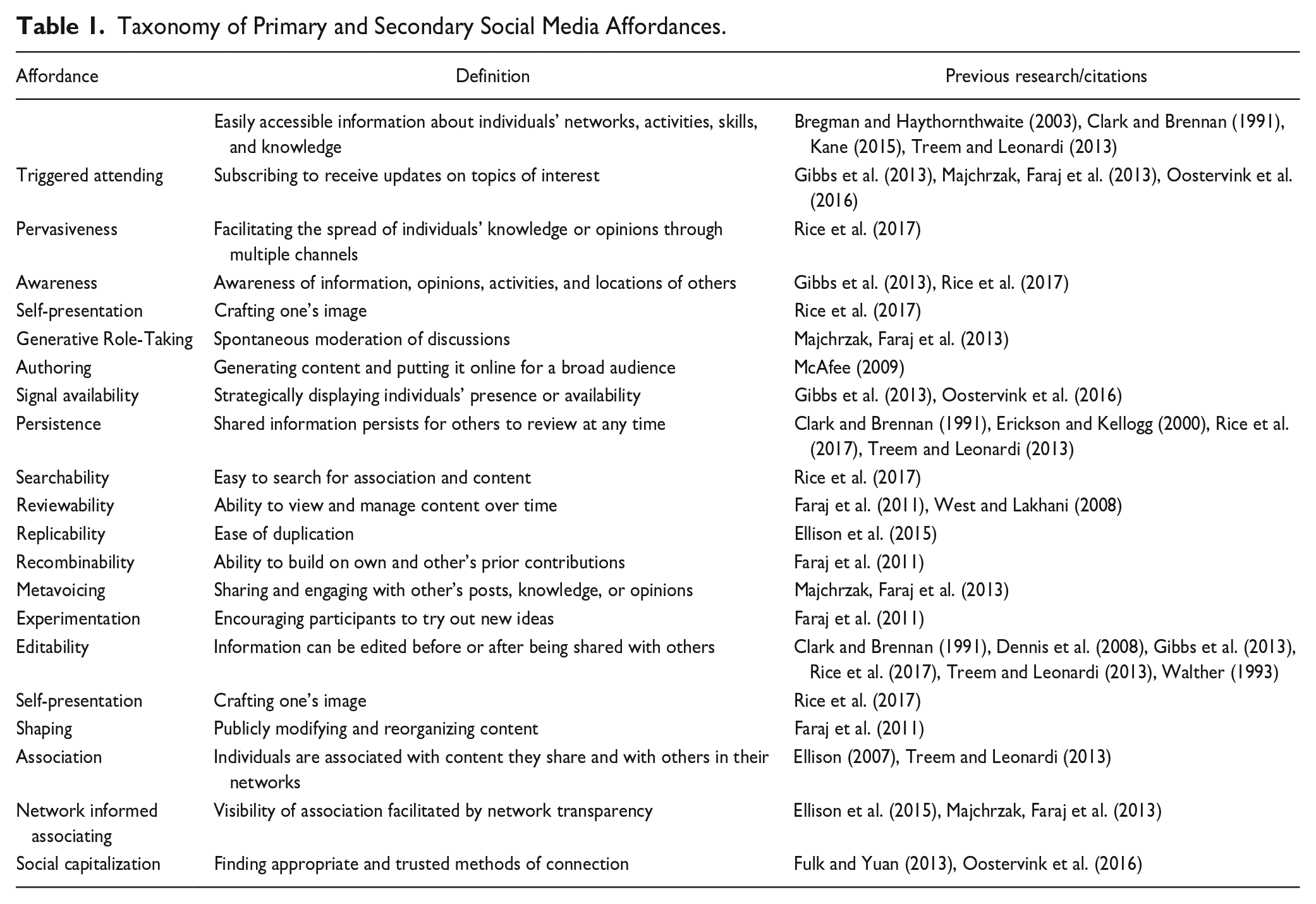
Although an affordance lens presents a compelling framework for understanding how ESM use might affect how teams carry out essential team processes, there have been few studies at the team level (for exceptions, see Leonardi, 2018; Song et al., 2019; Van Osch & Steinfield, 2016, 2018). Moreover, there is no overarching conceptual framework for understanding how affordances and constraints influence team processes, despite the identification of numerous ESM affordances across various organizational research contexts (e.g., Evans et al., 2017; Faraj et al., 2011; Fulk & Yuan, 2013; Gibbs et al., 2013; Majchrzak, Wagner, & Yates, 2013; Majchrzak, Faraj et al., 2013; Rice et al., 2017; Treem & Leonardi, 2013). To better understand the existing organizational affordances landscape, we first review the literature on social media use in organizations conducted by scholars in management, management information systems, information science, and communication studies. Table 1 synthesizes this review and presents a taxonomy of primary and secondary affordances. Four primary affordances—visibility, persistence, association, and editability—have been consistently identified across social media platforms, and each is associated with several secondary affordances that emerge either simultaneously with or are superseded by the primary affordance. This taxonomy suggests that the primary affordances accommodate a large degree of variability in user perceptions (Evans et al., 2017), whereas secondary affordances may be perceived in some contexts, but are less broadly recognized than their corresponding primary affordances. Given their broad applicability, we focus on how the four primary affordances may enhance team processes. Below, we define and elaborate on the four primary affordances, namely, visibility, persistence, editability, and association.
Taxonomy of Primary and Secondary Social Media Affordances.
Visibility
Social media afford users the ability to make visible to others their behaviors, knowledge, preferences, and communication network connections that were once invisible or difficult to see (Treem & Leonardi, 2013). Visibility is related to the amount of effort people need to expend to locate information: information that is difficult to locate or of which people are unaware is unlikely to be sought out (Brown & Duguid, 2001). Often, private communication acts between colleagues or subgroups are invisible to others and difficult to attend to (Leonardi, Huysman, & Steinfield, 2013). Social media offers a means to easily observe the work of others and become aware of emergent conversations about their work (Treem & Leonardi, 2013). In other words, visibility can lead to the development of more accurate organizational metaknowledge, which refers to knowledge about who knows what and who knows whom within an organization (Leonardi, 2014, 2015).
Persistence
A communicative act is persistent if it affords users the ability to access it in the same form as the original display at any time after the actor has finished their presentation (Bregman & Haythornthwaite, 2003). Social media enables communal conversations to persist past their initial point of presentation in a manner that does not expire or disappear (Treem & Leonardi, 2013). According to Erickson and Kellogg (2000), “persistence opens the door to a variety of new uses and practices: persistent conversations may be searched, browsed, replayed, annotated, visualized, restructured, and re-contextualized with what are likely to be profound impacts on personal, social and institutional practices” (p. 68). Thus, the ability to view past interactions and information affords individuals the ability to learn from the experiences of their predecessors, despite not being present to witness the actual interactions between the original communicators (Leonardi, Huysman, & Steinfield, 2013).
Editability
Editability refers to the ability of individuals to spend a great deal of time and effort crafting and re-crafting a communicative act before others view it (Treem & Leonardi, 2013; Walther, 1993). It is largely a function of two aspects of interaction: communication that is formed in isolation from others, and asynchronicity (Dennis et al., 2008). These features enable individuals to engage in more purposeful communication by focusing on the verbal content of the message they would like to convey rather than how nonverbal cues may be perceived by others (Treem & Leonardi, 2013). Thus, editability affords communicators the flexibility to take into consideration the context in which their messages will be viewed by others and adapt them accordingly. In addition, it enables individuals to modify or revise the content even after it has been initially communicated.
Association
Association refers to established connections between individuals, between individuals and content, or between content and content (Treem & Leonardi, 2013). Whereas traditional communication technologies make individuals’ personal connections visible, social media makes others’ communications public (within the organization) and provides users with the ability to see how people are connected to other people, how people are connected to content, and how content is connected to other content (Majchrzak, Faraj et al., 2013). Individuals can also stay updated on changes in their associations by subscribing to notifications that alert them, for instance, when a connection obtains a new role or adds a new tag to their public profile. In other words, social media enables users to articulate and make their social networks visible to others (Ellison, 2007).
Moreover, teams may enact multiple affordances at the same time (Volkoff & Strong, 2013). The ways in which the material features of ESM and the social context become imbricated (Leonardi, 2011) will determine how team members enact visibility, persistence, editability, and association, as well as the consequences for team processes. In the next section, we employ eight essential team processes as illustrative cases to explain how social media affordances can help or hinder teamwork.
Answering Questions About Effects of ESM Affordances on Teamwork
To investigate how teams enact ESM affordances, we draw upon theory and research on team effectiveness. Specifically, we use Marks et al.’s (2001) episodic framework of team processes to identify eight theoretically grounded team processes likely to increase the odds that a team is effective. We explain how affordances can both enhance and constrain these team processes by illustrating, for each process, the possible tensions that may arise when teams use ESM tools.
Marks et al. (2001, p. 357) describe team processes as “members’ interdependent acts that convert inputs to outcomes through cognitive, verbal, and behavioral activities directed toward organizing taskwork to achieve collective goals.” Team processes, like goal specification, coordination, and motivation play an integral role in promoting team effectiveness, because they are the vehicles that transform team inputs into outcomes (Hackman & Morris, 1975; Kozlowski & Bell, 2003; Kozlowski & Ilgen, 2006).
We account for increasing opportunities for individuals to form their own teams and manage team boundaries (e.g., Marks et al., 2005) by first considering two team formation processes: enabling diverse team composition and managing external interdependence. After a team has formed, drawing again on Marks et al.’s (2001) taxonomy of team processes, we consider the six processes that have received replicable support in the literature (Kozlowski & Bell, 2003; LePINE et al., 2008). Table 2 (Column 1) defines each of these eight team processes and their respective categorizations.
Team Processes and Tendencies.
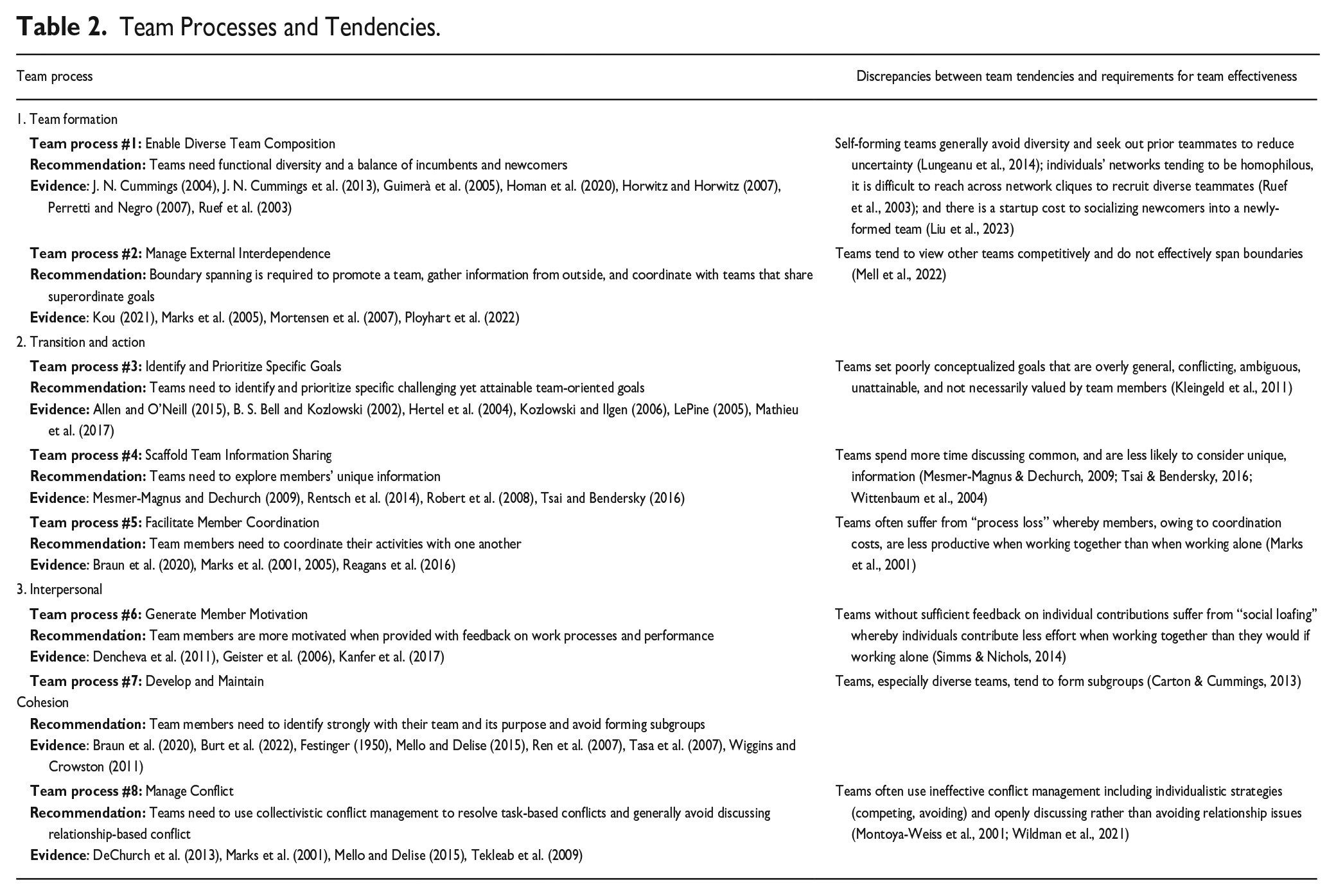
For each of the eight essential team processes, Table 2 identifies the tensions between what teams need and what tends to happen when left to their own devices. In other words, there are noticeable discrepancies between the normative recommendations (Table 2, Column 1) and natural team tendencies (Table 2, Column 2). In the remainder of this section, we draw on the literature on ESM affordances to examine potential positive and negative relationships between social media use and team processes. We propose that the direction of these relationships is likely to be contingent on team characteristics that serve as moderators of how affordances are enacted to either improve or constrain team functioning. We focus specifically on the moderating role of five structural characteristics of teams: task interdependence; temporal stability; authority differentiation; skill differentiation; and team virtuality (Hollenbeck et al., 2012; Wildman et al., 2012). We chose these moderators because they correspond to underlying constructs across many different team type taxonomies (Hollenbeck et al., 2012).
ESM Affordances and Team Formation Processes
Team formation processes are influenced by the antecedent factors of individual demographic and psychological characteristics, skills, ideas, resources, and external member relations that form the foundation of team assembly mechanisms (Contractor, 2013; Guimerà et al., 2005; Kozlowski & Bell, 2003). Team formation processes are increasingly relevant within organizational settings due to the increasingly fluid nature of team memberships. For instance, in some organizations, teams are increasingly being designed around project-based tasks that require changing skills and expertise over the duration of the project (Mortensen & Haas, 2018). Two important team formation processes that promote team effectiveness are enabling diverse team composition (Team Process #1) and managing external interdependence (Team Process #2).
Question #1: When Will Individuals Enact the Visibility and Association Affordances to Form More Diverse Teams?
Team composition, the configuration of team member attributes, includes factors like personality, abilities, demographics, and skills (S. T. Bell, 2007; Ruef et al., 2003). Teams tend to be more effective when their members are functionally diverse with respect to member training and development (S. T. Bell et al., 2011; J. N. Cummings et al., 2013; Homan et al., 2020; Horwitz & Horwitz, 2007), and when they balance incumbents with newcomers who bring new ideas to the team (Guimerà et al., 2005; Schuth et al., 2023). Despite normative recommendations to diversify, individuals generally seek out similar and prior teammates to reduce uncertainty. Research finds that teams tend to be homophilous (Hinds et al., 2000), often because members are simply unaware of who other people are and what they might know (Carlile, 2004). Moreover, newcomers present a potential challenge to existing social structures established within a team (e.g., norms, values), and therefore undermine the security most individuals feel when working with incumbents (Liu et al., 2023).
The affordances of visibility and association can facilitate more diverse team composition in three ways (see Table 3). First, ESM presents content communally so that individuals’ contributions are visible and can be easily located and viewed by others. Visibility has the potential to provide greater message transparency into the work behaviors of others and can improve communication visibility into the types of people in the organization and their potential areas of expertise (Leonardi, 2014, 2015). Second, features, such as rankings and recommendations, afford emergent forms of associations by suggesting ways for individuals to form new associations with people with diverse knowledge, skills, interests, and abilities (Brzozowski, 2009). Both these affordances may enable individuals to search for and identify more diverse team members, such as weak ties whom they did not know well or with whom they had worked previously but did not communicate on a regular basis (DiMicco et al., 2008). Third, visibility and association can aid the assimilation of newcomers into a team. Visibility enables incumbents to learn about the backgrounds, interests, and activities of newcomers, and for newcomers to learn about a team’s norms, role expectations, and other informal structures.
Effects of Social Media Affordances on Diverse Composition.
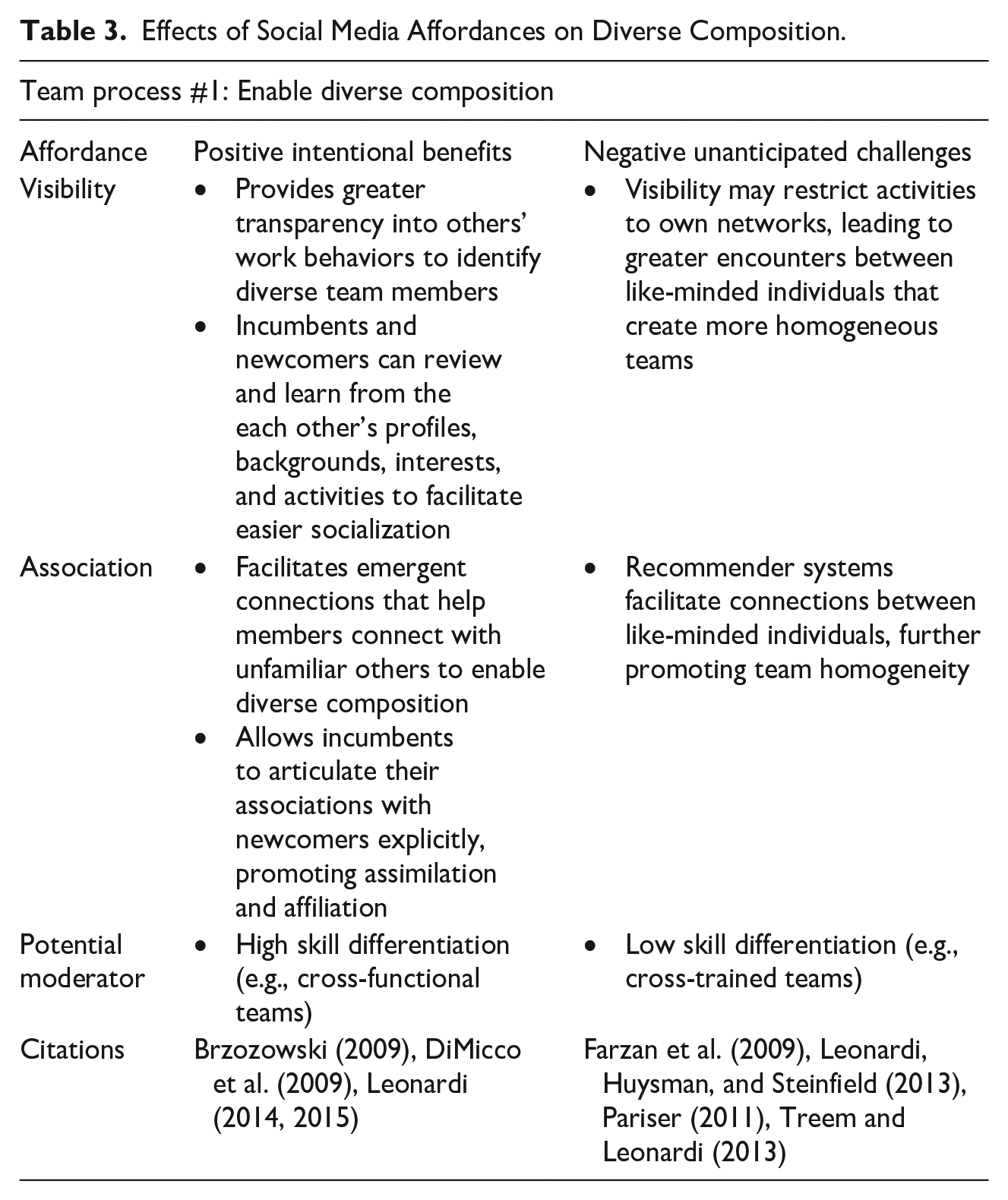
Although visibility enables people to encounter diverse content, the absence of explicit incentives may lead individuals to limit the accessibility of content to their own networks (Farzan et al., 2009; Stohl et al., 2016). The association affordance can augment these challenges by providing multiple avenues for connecting with like-minded individuals and repeating collaborations with past team members (Pariser, 2011). Thus, visibility and association may lead to less exposure to new people and ideas and further promote the formation of homogeneous teams by making it even easier to routinize existing biases in seeking out teammates.
Hence, when ESM affords visibility into and association with organizational workers’ interests, skills, backgrounds, and expertise, individuals can seek out new contacts that increase diverse team composition. However, given that individuals prefer homophily and familiarity in their collaborations (Guimerà et al., 2005; McPherson et al., 2001), an unintended consequence is that individuals enact the visibility and association affordances to form even more homogeneous teams.
We propose that teams requiring high skill differentiation (Hollenbeck et al., 2012), such as cross-functional teams (Denison et al., 1996; Pinto et al., 1993), may have greater need to incorporate members with differing expertise for non-routine tasks. Skill differentiation refers to the degree to which teams consist of members with specialized knowledge or skills that make them uniquely qualified and difficult to substitute (Hollenbeck et al., 2012). Accordingly, individuals looking to form teams with high skill differentiation may be more likely to enact visibility and association affordances to enable diverse team composition than individuals forming teams with members whose skills are more homogenous, such as cross-trained teams.
Question #2: Under What Conditions Will Teams Enact the Visibility and Association Affordances to Manage External Interdependence?
External interdependence involves gathering information from external contacts, representing a team to outsiders, coordinating work with others in the organization, and negotiating intergroup actions to expand a team’s network and connect with important external actors (Kou, 2021; Marrone, 2010; Ployhart et al., 2022). Often, however, teams view other groups competitively and do not always engage effectively in boundary spanning or external activities (Mell et al., 2022.
Social media features affording visibility and association can facilitate effective team boundary activities (see Table 4). First, visibility provides team members with insight into what people in other groups, departments, or locations are doing. The ability to see more communicative acts, interactions, and connections affords team members the opportunity to develop a common understanding with other groups. This can facilitate boundary-spanning activities, such as “talking up” to create favorable impressions with senior management (Van Osch & Steinfield, 2016), and facilitate coordination with and solicitation of feedback from other teams.
Effects of Social Media Affordances on External Interdependence.
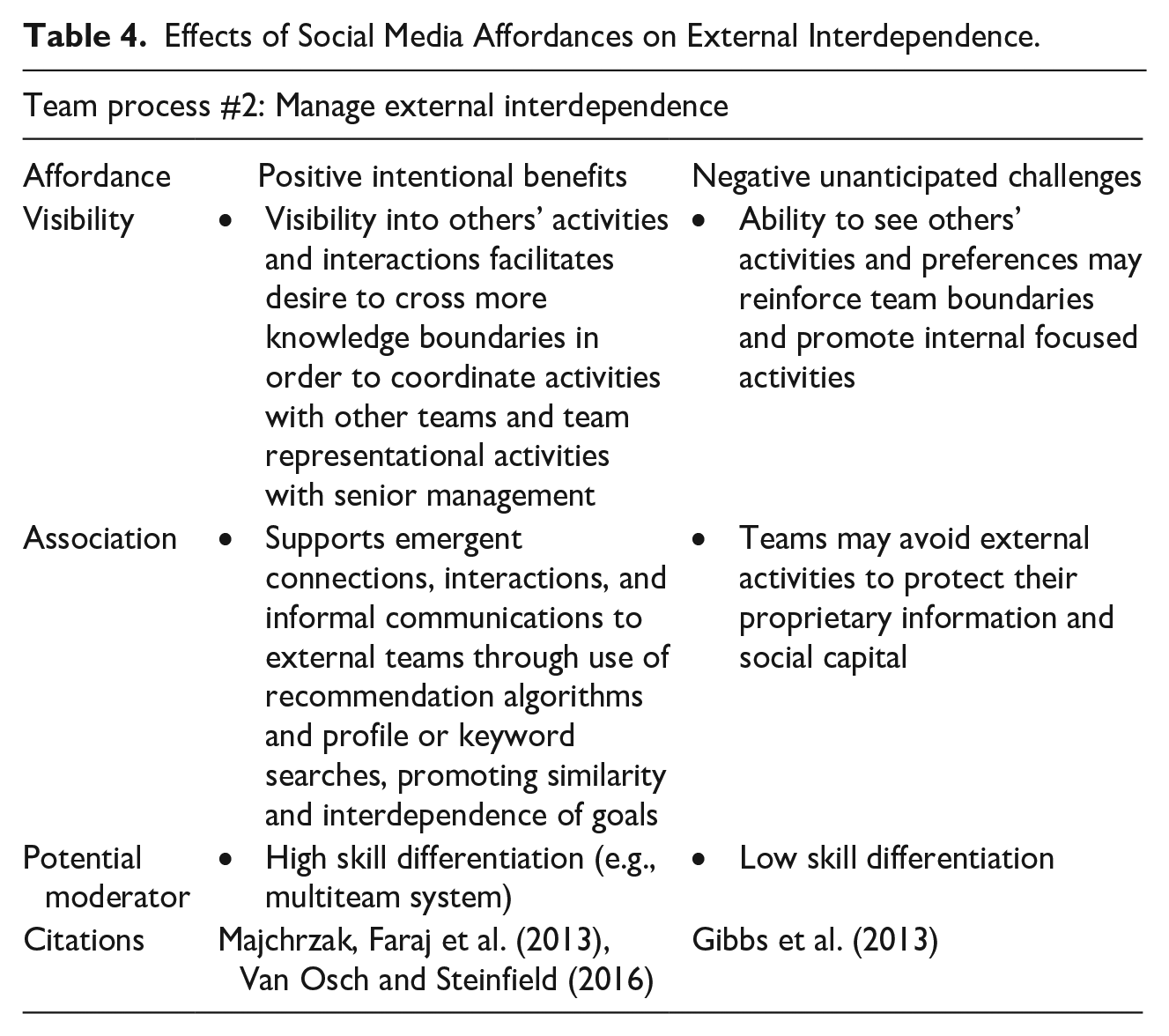
Second, social media supports connections across boundaries, including emergent connections with other individuals and groups that team members may otherwise know little about. For instance, teams can use recommender algorithms and profile information to evaluate the potential value of connecting with other teams with relevant resources or external stakeholders (Majchrzak, Faraj et al., 2013). At the same time, visibility and association may impose new constraints on teams’ external activities by highlighting differences and reinforcing team boundaries. Teams may, for example, avoid forming connections with other teams to protect their social capital and proprietary knowledge (Gibbs et al., 2013), thereby limiting their exposure to serendipitous content and information. In short, although team members may enact the visibility and association affordances to promote their team externally to others, some teams may perceive social media use to jeopardize their social capital, making them likely to focus even more on internal activities.
On balance, we suggest that multiteam systems—in which two or more teams interface directly to accomplish collective goals (Marks et al., 2005)—will be more likely to enact the visibility and association affordances to manage their external interdependence. These systems have a high degree of skill differentiation between component teams that are assigned specialized tasks, but low degrees of differentiation within component teams that perform the same task. As such, ESM affordances enable multiple component teams to update and monitor progress to achieve their common goals (Mathieu et al., 2017).
Social Media Affordances and Transition and Action Processes
Team formation processes are the foundation of a good team design that in turn supports the effectiveness of the transition and action team processes (Kozlowski & Ilgen, 2006) that describe the different types of interactions members use to accomplish the goals of the team that is formed. Teams generally cycle through two recurring phases of activity (Marks et al., 2001). The first, or transition, phase involves planning, analysis, goal setting, and reflecting on feedback and prior events. The second, or action, phase involves coordinating, sharing information, actively monitoring progress toward a goal, and backing up teammates. The transition process of goal specification (Team Process #3) and the action processes of scaffolding team information sharing (Team Process #4) and facilitating member coordination (Team Process #5) are three important processes directly related to accomplishing designated tasks.
Question #3: When Would Teams be More Likely to Enact the Visibility, Editability, and Persistence Affordances to Set Specific Goals?
Goal specification refers to the identification and prioritization of goals and subgoals for accomplishing tasks (Marks et al., 2001). During goal specification, teams develop, assign, and prioritize goals and subgoals that indicate what needs to be accomplished within a certain time frame and to what threshold standard of quality (Allen & O’Neill, 2015). Teams that set specific, challenging, yet attainable goals with collective-oriented strategies tend to be more effective than those that set more general goals (Kozlowski & Bell, 2003).
As illustrated in Table 5, visibility, editability, and persistence afford teams the ability to identify and prioritize specific goals for accomplishing tasks. First, visibility enables team members to monitor and hold each other accountable for accomplishing their goals and subgoals. For example, teammates can use notification features on social media to stay up-to-date on each other’s activities and track progress on task accomplishment (Clark & Brennan, 1991; Treem & Leonardi, 2013). Second, editability enables goals to be continuously updated as team members encounter unforeseen situational contingencies that force them to reevaluate their ability to attain their goals as previously set. Third, persistence creates a permanent record of the team’s goals able to be referenced at any time in the future (Clark & Brennan, 1991; Treem & Leonardi, 2013). This means team members can view past records to clarify content in order to develop a clear understanding of how to accomplish team goals. Visibility, editability, and persistence can also, however, inhibit goal specification. First, team members may be unwilling to set specific goals due to their visibility to others. Alternatively, they may set individual rather than team-oriented goals for strategic presentation purposes (Rice et al., 2017; Sun et al., 2021). Second, editability may encourage goal re-specification that masks inefficiencies and productivity loss. Lastly, persistence may lead to inefficiencies or difficulty monitoring progress toward goal accomplishment if team members do not periodically update the status of their goals.
Effects of Social Media Affordances on Goal Identification and Prioritization.
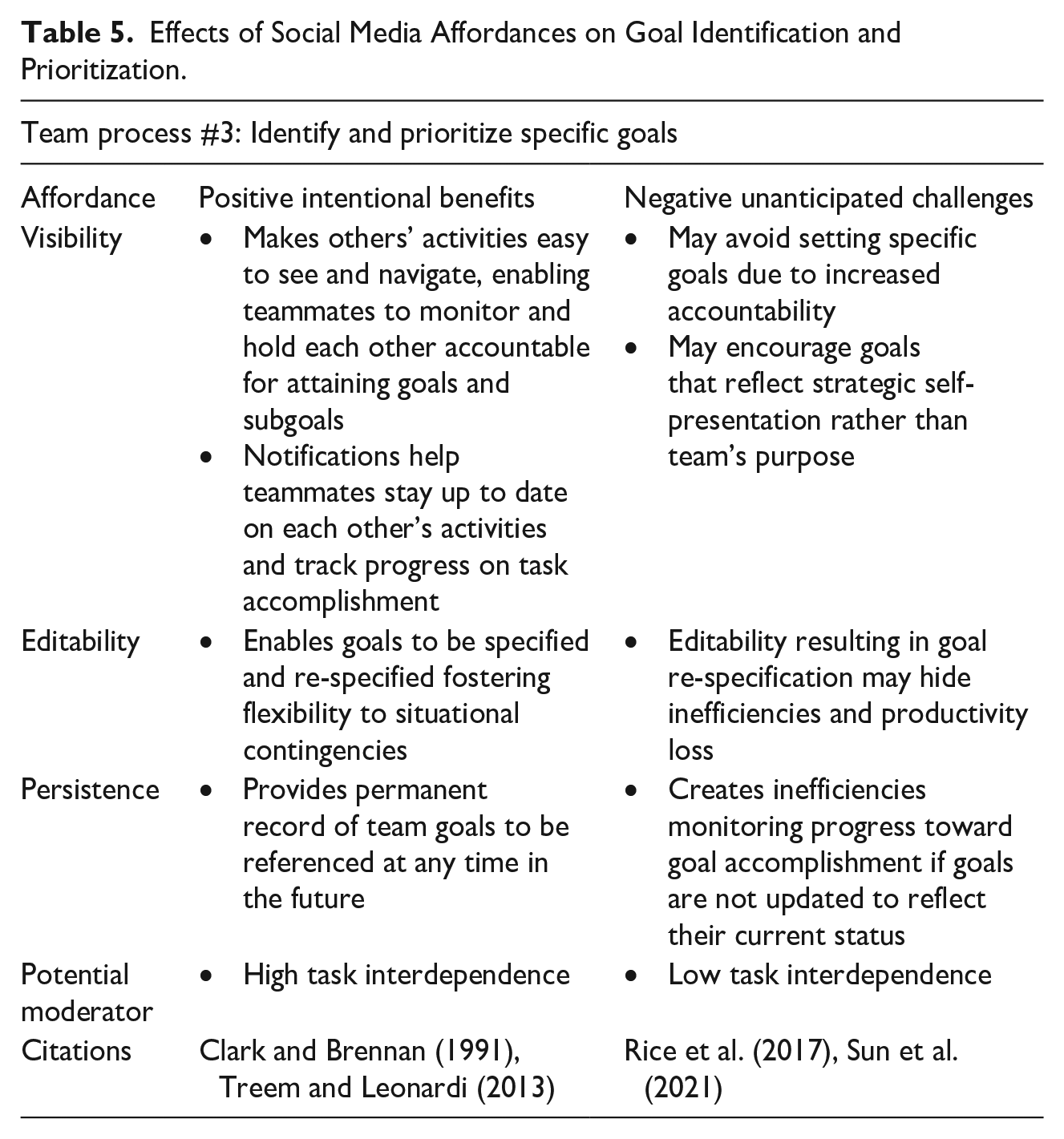
We suggest that the positive or negative consequences of ESM use on goal identification and prioritization depend on a team’s degree of task interdependence. When teams have greater task interdependence, team members need to rely on each other for inputs and resources to perform their tasks well (DeChurch & Mesmer-Magnus, 2010; Wageman, 1995). Because team members have a greater need for interaction and collaboration to accomplish their goals (Staples & Webster, 2008), the degree of task interdependence may affect the extent to which team members enact social media affordances to set and prioritize specific team goals.
Question #4: When Will the Association Affordance Enable Teams to Share and Discuss More Unique Information?
Sharing is the primary means through which team members utilize information resources to arrive at a decision or outcome. Teams need to leverage their information resources by exploring members’ unique information and discussing all available pertinent task information likely to improve performance (Mesmer-Magnus & Dechurch, 2009; Tsai & Bendersky, 2016) and yield higher quality solutions (Rentsch et al., 2014).
Table 6 indicates that the association affordance can help teams share more unique information and arrive at superior decision outcomes in two ways. First, team members can identify unique information by searching for keywords or tags on entries to find explicit connections among projects and their authors and verify their accuracy by examining the types of comments and direction of votes generated by the original communication. These features afford dialogic practices for information sharing (Duan et al., 2023). For example, Koroleva et al. (2011) found that Facebook users referenced the number of comments and likes on a post as information processing cues to identify the value and relevance of incoming information on their newsfeeds. Second, team members can react to each other’s posts and activities by commenting, voting, polling, or tagging each other’s content to promote supporting or alternative opinions.
Effects of Social Media Affordances on Information Sharing.
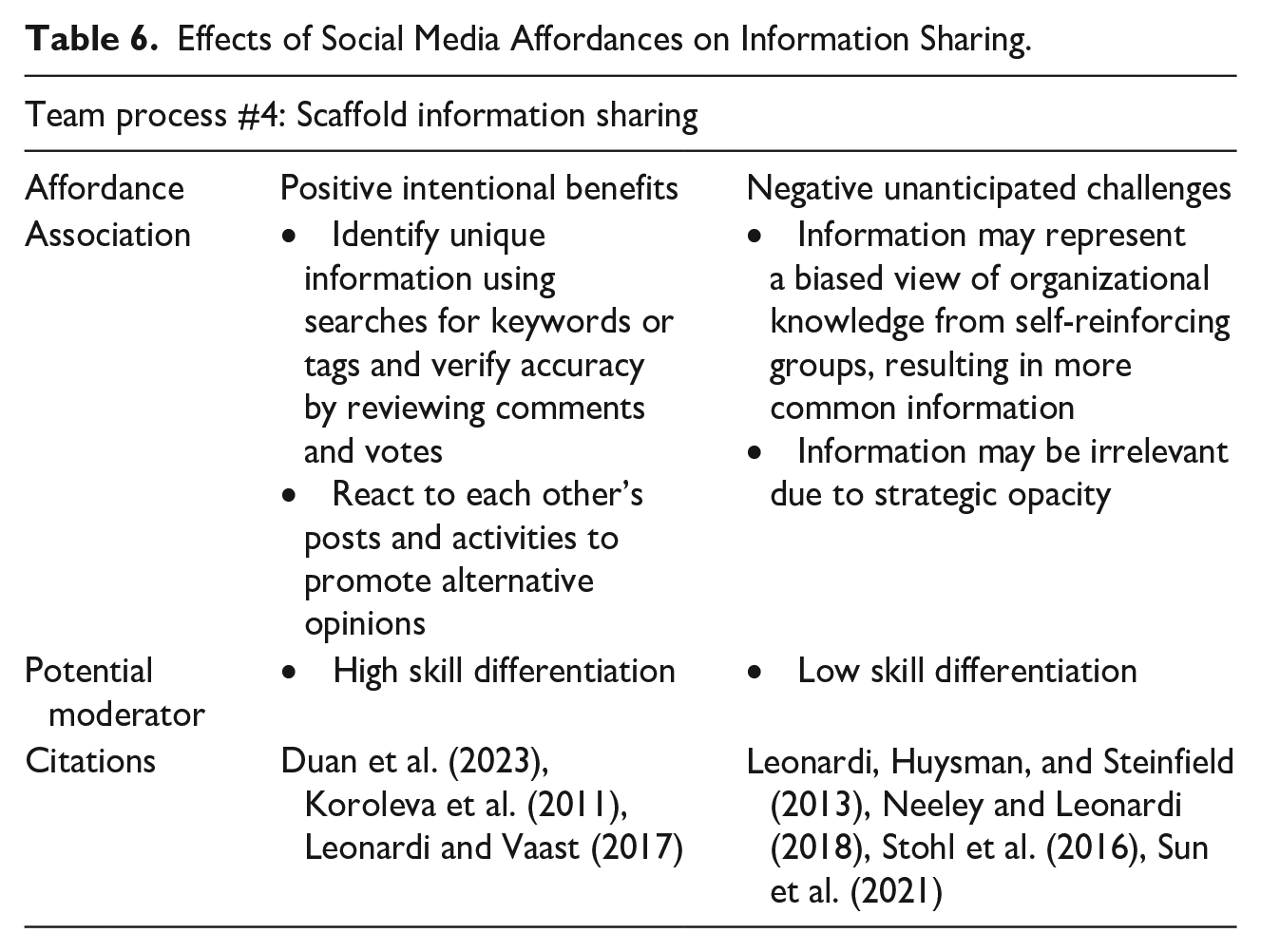
However, associations may unintentionally reinforce the sharing of common rather than unique information. For instance, team members may form associations with like-minded individuals who share similar information and promote self-reinforcing tendencies (Kane, 2017; Leonardi, Huysman, & Steinfield, 2013). Further, certain communicators may enact strategic opacity to increase the availability and accessibility of unimportant information to prevent others from accessing central information (Stohl et al., 2016) due to concerns about privacy invasion (Sun et al., 2021). Concerns about being associated or linked to their past contributions may lead team members to choose to engage strategically or disengage completely from their ESM team discussion (Neeley & Leonardi, 2018; Sun et al., 2021), undermining the potential for team information sharing and knowledge transfer.
To reconcile the two opposing consequences of the association affordance on team information sharing, we propose that teams with high skill differentiation (e.g., action or negotiation teams; Sundstrom et al., 1990) will be more likely to employ ESM to contribute unique and diverse information to team discussions. Such teams have a need to make use of and integrate divergent skills, interests, ideas, and opinions to arrive at superior agreements or outcomes (McGrath, 1984). The association affordance can enable team members to search for more pertinent and verifiable information that can help improve team performance.
Question #5: When Will Teams Enact the Persistence and Editability Affordances to Improve Team Coordination?
Coordination refers to the activities required to manage the interdependencies of team workflow, in which the correct and timely contribution of each member is often an important correlate of team effectiveness (Marks et al., 2001; Reagans et al., 2016). However, coordination is difficult to achieve due to the costs associated with integrating disparate actions and managing the temporal pacing of member contributions (Argote & McGrath, 1993).
Table 7 indicates that persistence and editability facilitate team coordination by enabling team members to retrieve, review, and edit each other’s content and contributions at any time and from any place, thereby promoting more efficient scheduling of workflows and activities (Duan et al., 2023). First, persistence enables team members to refer to previous communications in order to contextualize and clarify member roles and responsibilities as well as improve workflow processes. Because the entire history of a conversation is stored, ordered, and retrievable, team members can join the conversation at any time and become relevant contributors (Bregman & Haythornthwaite, 2003; Clark & Brennan, 1991; Leonardi, Huysman, & Steinfield, 2013; Treem & Leonardi, 2013). Persistence aids with grounding, a process based on building shared knowledge and a common set of goals to arrive at a common ground (Clark & Brennan, 1991). Gergle et al. (2004) found that chat collaborators who could see six turns of dialog history communicated more efficiently and had both faster and better task performance than collaborators with access to only one turn of dialog history. The authors found that the persistence afforded by the six turns of dialog history made grounding more efficient and subsequently enabled collaborators to better coordinate their activities (Gergle et al., 2004). Second, the change control feature reduces coordination effort by allowing members to edit each other’s content asynchronously while maintaining a history of revisions and the option of restoring prior versions (Arazy et al., 2009; Dennis et al., 2008; Rice et al., 2017). This affords team members the flexibility to modify or revise their own content as well as the content of others (Rice, 1987) depending on the coordination needs and activities of the team.
Effects of Social Media Affordances on Coordination.
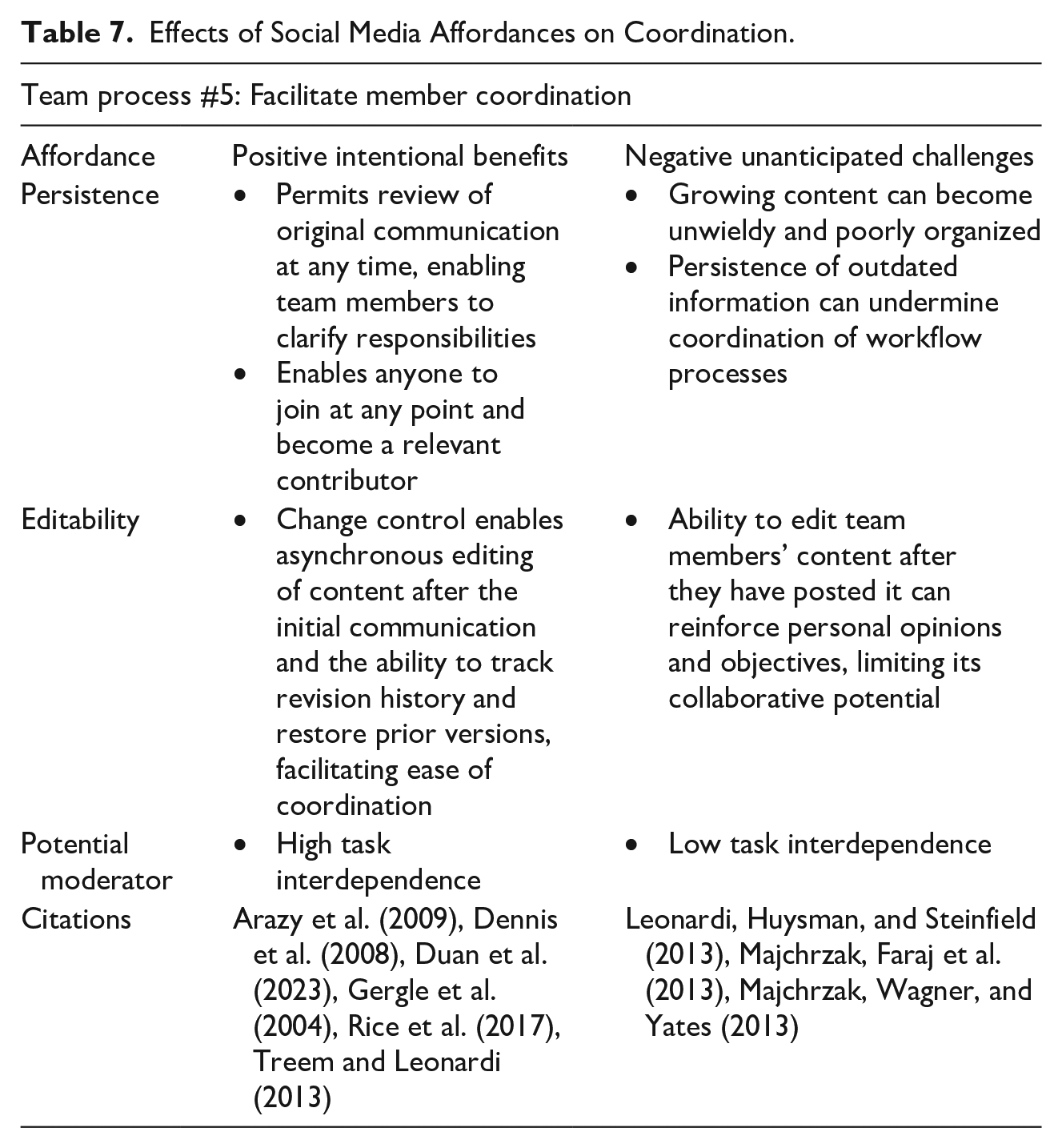
However, persistence and editability can also generate unexpected challenges. One potential negative consequence of persistence is that it creates a growing amount of content over time. Left unmanaged, this content can become unwieldy and poorly organized (Leonardi, Huysman, & Steinfield, 2013), with outdated information undermining team members’ abilities to coordinate workflow processes. This may unintentionally increase the amount of time team members spend searching and examining each other’s interactions to make sense of them. Because it is so easy to post content on social media, employees often post content to new conversation threads without checking if others have discussed the topic elsewhere (Majchrzak, Wagner, & Yates, 2013). This may undermine the ability of team members to interact directly with the content others have posted and build on it cumulatively (Majchrzak, Faraj et al., 2013). Another negative implication is that the same editability that affords team members the ability to craft and revise content asynchronously can be used to reinforce personal preferences and perspectives.
We propose that the degree of task interdependence within a team influences the likelihood that team members perceive the benefits of accessing, reviewing, and editing a team’s communication history as a means of improving team coordination. When tasks require greater interdependence, team members need to coordinate their activities, rely on each other, and work together “as a team” to accomplish their tasks effectively (Wageman, 1995). We thus expect that project teams, which typically have a variety of uncertain and complex group tasks, would be more likely to enact the persistence and editability affordances to coordinate their team activities compared to other types of teams, such as production or decision-making teams, the activities of which are more routine and generally less complex (De Dreu & Weingart, 2003).
Social Media Affordances and Interpersonal Processes
Interpersonal processes, used to regulate member emotions, confront conflict, and sustain motivation, can be employed in both transition and action processes (Marks et al., 2001). We describe three interpersonal processes that can increase the odds of having an effective team: generate member motivation (Team Process #6); build cohesion and identity (Team Process #7); and manage conflict (Team Process #8).
Question #6: Under Which Conditions Will a Team Enact the Visibility and Association Affordances to Generate Member Motivation?
Team motivation is the direction, intensity, and persistence of effort team members exert toward work processes and tasks. Teams that promote task competency and provide feedback to members on work processes are typically more effective (Dencheva et al., 2011; Geister et al., 2006; Kanfer et al., 2017). That said, teams often engage in behaviors that are demotivating, such as providing insufficient feedback on individual contributions and expending less effort than if team members were working alone (Simms & Nichols, 2014).
Table 8 shows how the visibility and association afforded by ESM can facilitate team motivation. First, the visibility affordance makes individual contributions easy to see, and the identifiability of member contributions improves team motivation because it becomes obvious who is and is not contributing (Ellison et al., 2015; Fulk & Yuan, 2013; Price et al., 2006). For instance, Rice et al. (2017), who surveyed more than 450 employees at a global Nordic media organization, found that access to the firm’s internal social media platform improved employee awareness of the activities, opinions, and locations of others and facilitated keeping up-to-date with projects. Improved awareness can be used to monitor behavior to ensure that all members are contributing to a team, and network transparency among team members may motivate contributions to ESM and facilitate norms of reciprocity to respond in kind to others (Beck et al., 2014; Ellison et al., 2015). Second, the association affordance makes it easier to solicit and provide feedback among members in a variety of formats. A team member can increase the odds of receiving feedback by pushing out content to teammates and other subscribers (Fulk & Yuan, 2013). In response, others can easily provide feedback with a vote, comment, “like,” or tag.
Effects of Social Media Affordances on Motivation.
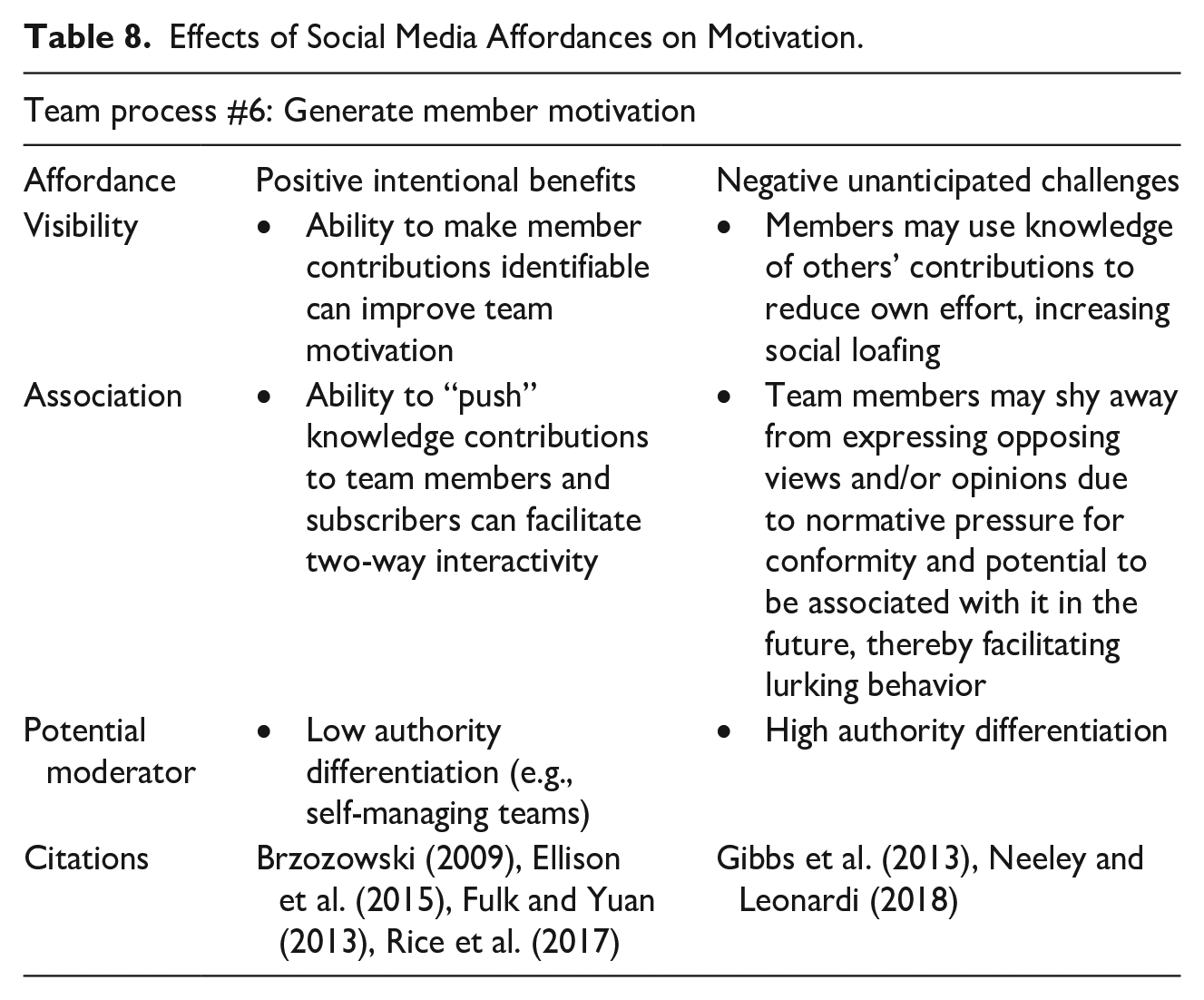
That said, the visibility affordance can undermine motivation if members use their knowledge of others’ contributions to reduce their effort and engage in social loafing behaviors (Simms & Nichols, 2014). Although explicit associations tend to elicit more varied feedback, they may unexpectedly encourage “lurking” activities (Gibbs et al., 2013) whereby team members enact association to simply keep up with ongoing activities instead of interacting directly with other teammates. Moreover, team members concerned with reputation management (Sun et al., 2021) may be careful about how the content they associate with affects their reputation, and the visibility of contributions on social media may deter team members from making task-related contributions (Neeley & Leonardi, 2018), which can reduce the amount of useful feedback team members provide and receive.
Teams with low authority differentiation, such as self-managing teams (Magpili & Pazos, 2018), may be more likely to perceive the visibility and association affordances to facilitate greater team motivation. Authority differentiation refers to how decision-making responsibility is distributed across a team (Hollenbeck et al., 2012). In authority-differentiated teams, a subset (one or a few) of members with high authority make the decisions for the team, whereas the members of low authority differentiation teams typically exert discretion over many types of decisions. Self-managing teams are an example of low authority differentiation teams. Often, members of self-managed work teams need to manage multiple relationships with other team members, which requires more intense and frequent interaction as well as greater feedback than is typical in traditional, authority-differentiated work groups (Elloy, 2005). Thus, teams with low authority differentiation would be more likely to enact the visibility and association affordances to generate and sustain member motivation.
Question #7: For Which Teams Will the Association Affordance be More Likely to be Perceived as Enhancing Team Cohesion?
Team cohesion is the result of all forces acting on members to remain in the group (Festinger, 1950). Cohesion has three main components: task, social, and group pride (Beal et al., 2003). Teams need to develop and maintain cohesion by encouraging members to identify strongly with them and their purposes (Braun et al., 2020; Burt et al., 2022; Wiggins & Crowston, 2011). However, teams tend to form identity-based subgroups with configurations that highlight ingroup-outgroup tensions (Carton & Cummings, 2013) and negatively affect group dynamics and performance (Lau & Murnighan, 1998).
Table 9 indicates that ESM tools that afford association can support team cohesion and identity by facilitating social connections that enable team members to articulate their associations with each other and with team content (Thom-Santelli et al., 2008). Social media enables friendship formation by making self-disclosure easier and speeding up the discovery of similarities and associations (Pillemer & Rothbard, 2018). For instance, individuals can signal their relationships with other members by “friending” them or joining a group page. Similarly, members can react to the profiles, preferences, content, and activities of other team members by “liking,” tagging, voting, or commenting. In addition, workers can learn about team members in different locations and functions by viewing their profile pages (J. Cummings & Dennis, 2018; DiMicco et al., 2009). Such information provides team members with background knowledge about what others do in both work and social contexts, creating more fodder for initiating conversation and developing a sense of belonging and shared identity. These associations support communication and bonding (Jackson et al., 2007), thereby generating and increasing both bridging and bonding social capital, as well as stronger network ties, particularly in distributed teams (Fulk & Yuan, 2013).
Effects of Social Media Affordances on Cohesion.
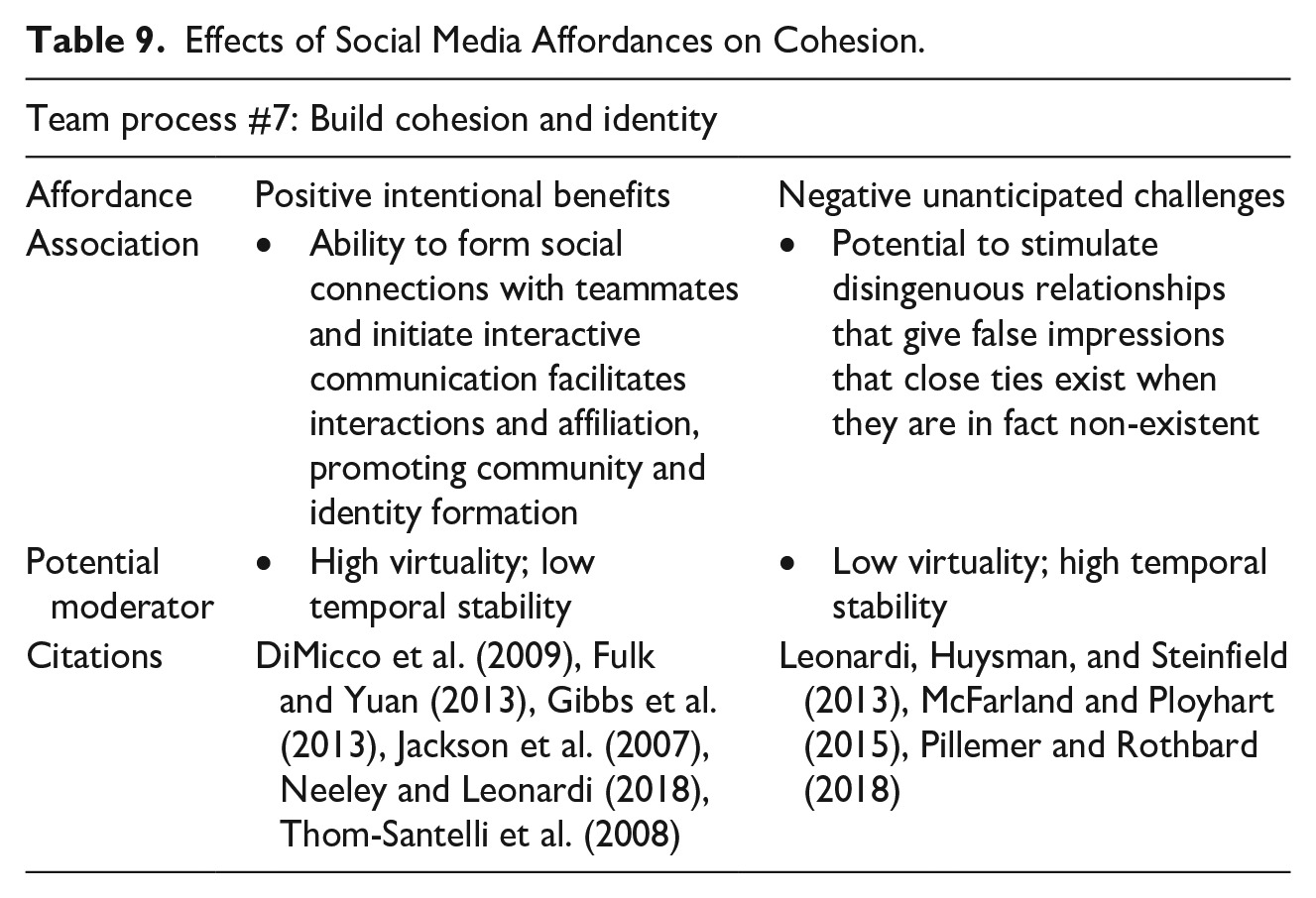
For instance, DiMicco et al. (2009) found that employees on Beehive, IBM’s internal social media platform, used the site to perform people sensemaking, a process by which individuals acquire a basic understanding of who someone is. The authors found that nearly one-half of Beehive users added at least one profile photo to the site and nearly one-half also supplied professional and personal information about themselves in the “about you” descriptions. Interviews with Beehive users showed that the ESM created a context for initiating social interaction and a public forum for learning about others that helped employees maintain existing relationships and deepen developing ones (DiMicco et al., 2009). Such capabilities are likely to be integral to building team cohesion, particularly in newly formed teams (Braun et al., 2020).
A potential constraint, however, is that social media associations may create disingenuous relationships that can give false impressions that close or strong ties exist when in fact they are non-existent (Leonardi, Huysman, & Steinfield, 2013). Social media facilitates “broadcasting” of personal information to a wide audience (McFarland & Ployhart, 2015). Although the ease of personal disclosure can facilitate the friendship formation process among team members, it does not replicate the process through which rich and authentic relationships are formed (Pillemer & Rothbard, 2018). Hence, reduced opportunities to develop socioemotional relationships among team members can negatively affect group cohesion.
Coming out of the COVID-19 pandemic, an increasing amount of work is being performed by virtual teams in dispersed (in space and time) locations that are connected by technology rather than face-to-face interaction (Karl et al., 2022; Klonek et al., 2022; Leonardi, 2021; Whillans et al., 2021). Compared to highly virtual teams, primarily face-to-face, co-located teams tend to share tighter structural linkages and greater cohesion. That said, ESM tools can enable virtual teams to develop relations, trust (Neeley & Leonardi, 2018), psychological safety (Edmondson, 1999), and smoother interactions (Ellison et al., 2015) that increase cohesion. Teams with a high degree of team virtuality may thus be more likely to enact the association affordance to develop team cohesion.
Similarly, the perception that the association affordance facilitates team cohesion may be influenced by the temporal stability of team membership, which refers to the extent to which team members have a history of working together in the past and an expectation of working together again in the future (Hollenbeck et al., 2012). In ongoing teams, members brought together to work on multiple tasks over an extended period develop a shared history and experiences (Bradley et al., 2003). Members of short-term teams (i.e., those with a finite life span) brought together to perform a specific task or mission, on the other hand, often have limited prior history (Joshi & Roh, 2009). Because the association affordance enables team members to form friendships and “weak ties” with each other, short-term teams may be more likely to enact the association affordance to develop team purpose and cohesion.
Question #8: Under What Conditions Will the Persistence and Editability Affordances be Enacted to Improve Team Conflict Management?
Team conflict refers to disagreement that naturally arises from team members’ attempts to cooperate and coordinate their efforts (Mello & Delise, 2015). Although conflict can promote different perspectives and contribute to team effectiveness, teams need to resolve task-based conflicts and generally avoid discussing relationship-based conflict (DeChurch et al., 2013; Tekleab et al., 2009). Teams can either establish preemptive conditions to prevent, control, or guide team conflict before it occurs or develop reactive strategies for effectively working through conflict and member disagreements (Marks et al., 2001). However, teams often use individualistic strategies and openly discuss relationship issues (Alper et al., 2000; Montoya-Weiss et al., 2001; Wildman et al., 2021).
As shown in Table 10, the affordances of persistence and editability can aid with team conflict management by regulating personal expressions and targeting content. First, the permanence of ESM content may deter team members from employing individualistic strategies or openly discussing relationship issues because others can retrieve, review, and report it at any time. Second, editability enables team members to spend an unlimited amount of time designing and re-crafting a communicative act before it is viewed by others (Walther, 1993), meaning that they can manipulate how and when information is shared (Barley et al., 2012). Barley et al. (2012) found that automotive engineers creating new vehicle designs frequently employed a strategy of ambiguity intended to promote compromises, as by simplifying objects to enable a multiplicity of interpretations, in order to advance progress on a vehicle’s design and avoid conflict. In another example, Birnholtz and Ibara (2012) found organizational members used ambiguity to maintain impressions and relationships with colleagues by choosing not to use the read/receipt feature of email. Social networking sites also enable the selective and purposeful disclosure of information. Additionally, members can reshape, modify, or delete their messages based on others’ responses, thereby facilitating collectivistic strategies.
Effects of Social Media Affordances on Conflict.
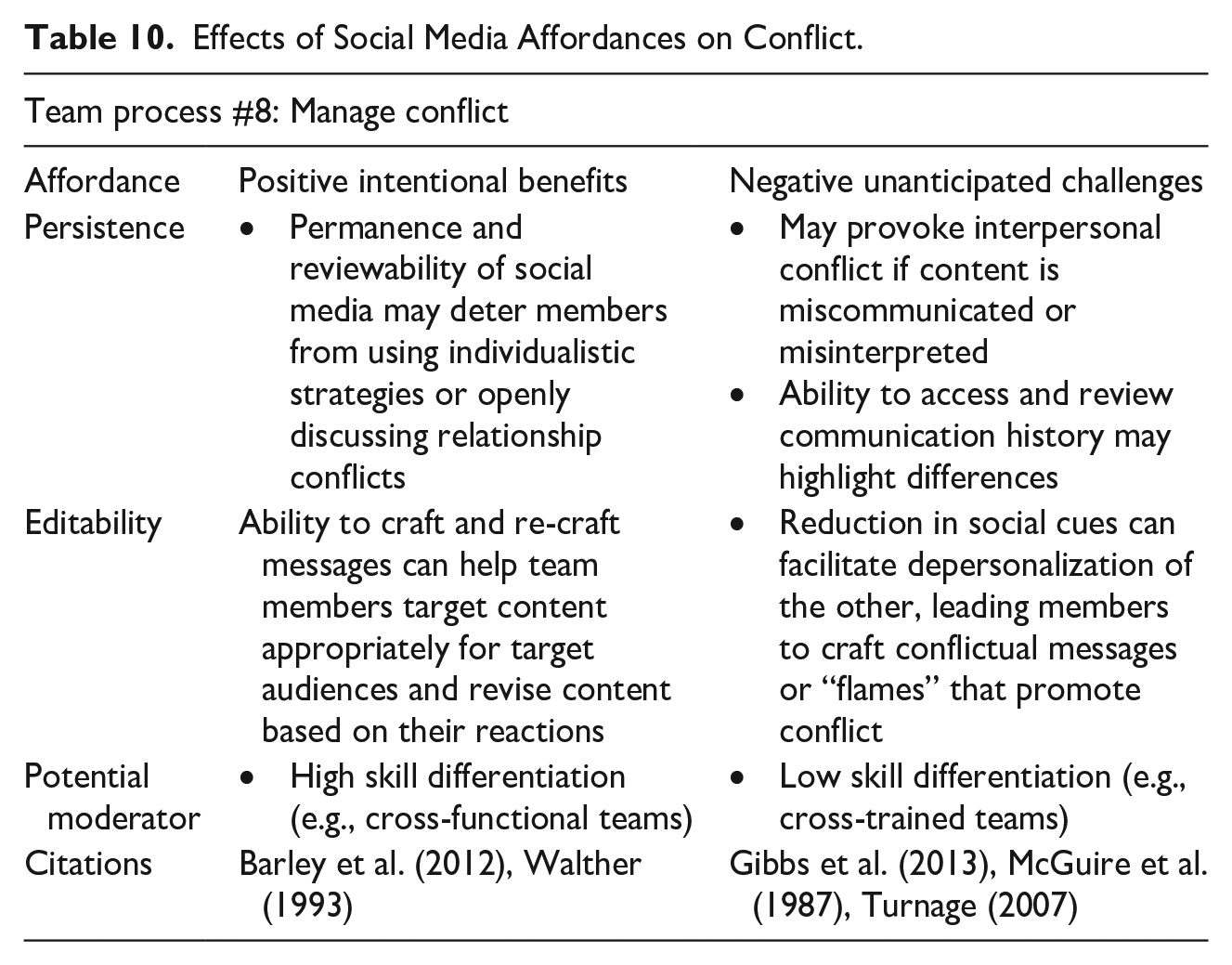
However, persistence and editability may heighten interpersonal conflict if team members miscommunicate or misinterpret content on social media. The permanence and reviewability of content may highlight differences between members, while the reduction in social cues in asynchronous text-based environments can facilitate depersonalization. This may provoke team members to craft conflictual messages or “flames” that unintentionally result in greater conflict (McGuire et al., 1987; Turnage, 2007).
Teams with a high degree of skill differentiation, such as cross-functional teams (Lovelace et al., 2001), may encounter greater communication difficulties and conflict due to differences in perspectives, preferences, language, and experiences among team members, compared to teams with broad, common sets of skills, such as cross-trained teams (Hollenbeck et al., 2012). To resolve differences in perspectives, cross-functional and other types of teams with a high degree of skill differentiation may be more likely to enact the persistence and editability affordances to manage team conflict.
To summarize, we have described potential links between ESM affordances and team processes and explained how team motivational orientations moderate how teams perceive ESM affordances. Notwithstanding the potential of social media affordances to shape processes that can enable teams to effectively accomplish their goals and objectives, there is also a possible dark side. Because team processes and team effectiveness are often dependent on social contexts, such as culture, and interaction with the external environment (C. B. Gibson et al., 2003), we propose that team characteristics may moderate how social media affordances will be enacted by team members, with either positive or negative consequences for team functioning. It is important to note, however, that teams evaluate their performance based on current team processes (Marks et al., 2001) and can either maintain recognizable patterns of interdependent actions or adjust them based on prior outcomes (Feldman & Pentland, 2003; Leonardi, 2011). Teams satisfied with their performance may not feel a need to change, but those that perceive a gap between their capabilities and goals can modify their routines or technologies, and such reconfigurations lead to new affordances and behaviors that better enable goal accomplishment over time. The following section proposes an agenda for future work on ESM affordances and effective teamwork.
An Agenda for Future Research on Social Media Affordances and Effective Teamwork
We build on the foregoing insights to develop themes and an agenda for future research on ESM affordances and team processes. For each of the proposed relationships, we have introduced eight corresponding research questions (see Tables 3–10) that form our agenda for future work on exploiting social media affordances to promote more effective teamwork.
We divide this agenda into two parts. The first discusses new opportunities for expanding the scope of research and leveraging new research methodologies to study the role of social media use in organizational teams. In the second part, we suggest research possibilities using student samples in the study of teams and technology. Specifically, this could involve investigating specific relationships between social media usage and the team processes outlined in this review.
Expanding the Scope and Methods of Inquiry
To date, our review of the literature on ESM use in organizations reveals a striking homogeneity in research approaches to studying the role social media technologies play in organizational processes. Most studies remain conceptual in nature or take a grounded approach to understanding social media phenomena in organizing. Although a few studies have used quantitative methods, such as survey instruments (e.g., Leonardi, 2015, 2018; Rice et al., 2017), there are many untapped opportunities to harness the rich server-side data on social media use collected within organizations.
The social media platforms being used by organizational teams for internal communication and collaboration host server-side data that can be extracted and used to make inferences about team members’ actual behaviors and provide information about both the content (e.g., documents, projects, and transactions) and structure of their actions, interactions, and communications with other individuals, both within and external to their teams. These data are unprecedentedly rich and can be used to observe the frequency, duration, and intensity of actual conversations and document exchanges between team members. They are also not subject to the potential biases (e.g., self-report, non-response, selection) of survey data (Eagle et al., 2009). These research methods can be used in combination to address different types of research questions related, for instance, to the types of affordances perceived to accrue to the use of ESM tools and features (through survey) or the actual behaviors and routines of team members using social media technologies (via examination of server-side data).
Team Processes and Technology Use
Most studies of organizational teams and technologies used for communication and collaboration involve digital media other than social media, such as email, discussion forums, and video conferencing (Handke et al., 2020; McFarland & Ployhart, 2015). The bulk of extant research also tends to focus on virtual teams, traditionally understood to involve team members distributed in space and time and reliant on digital tools to communicate and work together (Gilson et al., 2015; Kirkman et al., 2012). However, a growing presence of remote and hybrid work arrangements (Choudhury, 2022; Choudhury et al., 2021) means that team members of both co-located and virtual teams are working in locations away from their primary offices, such as their homes, client offices, or shared office spaces (Raghuram et al., 2019), or while they are on the go when using mobile technology (Hill et al., 2014). Coming out of the COVID-19 pandemic (Klonek et al., 2022; Leonardi, 2021), many organizations have implemented “flexible” work arrangements, and social media collaboration tools are frequently being used to augment interaction (Raghuram et al., 2019). Studies of remote and hybrid work arrangements suggest that team members’ communication strategies tend to differ from those of co-located teams (Whillans et al., 2021; Wu et al., 2021).
However, scholars have been slow to study the implications of how new technologies, such as social media, are both enabling these alternative teamwork arrangements and affecting theories of team processes and team effectiveness. For example, what are the implications of ESM on the ability of teams to attract diverse team members if newcomers are allowed to work remotely? How do the information sharing needs in a team change due to telecommuting, and how does social media enable or constrain team members’ ability to share their unique perspectives with one another? Because ESM use is associated with both opportunities for and challenges to efficient team functioning, an affordance perspective would help shift the focus away from the drawbacks of technology use and toward recognizing new opportunities for organizing and managing team processes that were not possible before the introduction or availability of these technologies.
Operationalizing Team Affordances, Team Processes, and Team Effectiveness
Being able to control for individuals’ positions within social networks has been immensely helpful in developing causal inferences surrounding collaborative learning in groups (Mason & Watts, 2012), the spread of behavior in a community (Centola, 2010), and peer influences in networks (Aral & Walker, 2012). A natural extension of these studies would be an attempt to explain team processes through the design and implementation of large-scale online quasi (e.g., interrupted time series, regression discontinuity, non-equivalent control groups) and natural (i.e., with random assignment and feature manipulation) field experiments. As ESM use has continued to progress, large-scale online experiments have superseded traditional laboratory experiments as a method for establishing causal explanations of group interactions within technology platforms. Experiments can now be designed and integrated into widely used web platforms with millions of users. These experiments employ, in some cases, millions of participants and account for interactions between people within their social networks as well as their interactions with the technology platform. Such experiments could be used to investigate the relationships linking social media features to social media affordances as well as team formation, transition, action, and interpersonal processes. For example, online experiments may help to uncover the effects of new technological features on team processes or provide clarity on how aspects of the social context (e.g., team characteristics) affect the way teams perceive social media affordances.
Operationalizing Team Affordance Characteristics
In conducting experiments that test the degree to which social media affordances affect team processes, an important first step is to assess the degree to which different affordances are potentially present on an ESM platform, with a focus on examining specific features of ESM platforms to determine whether they have the potential to afford visibility, persistence, editability, and association. The many different ESM platforms each offer slightly different sets of rapidly evolving features, while also continually introducing new capabilities (Kane et al., 2014). These include such varied tools as the team task list, announcement feature, chat interface, documents feature, profile pages, and newsfeed (Kaplan & Haenlein, 2010). The introduction of new features can be a critical way to measure the extent to which ESM affordances are perceived (Volkoff et al., 2007).
Consider, for instance, the team task list feature and its accompanying affordances of visibility and persistence. A team task list that provides a simple log of all tasks past and present may be seen as enabling visibility, but only minimally (visibility affordance = low or minimal). On the other hand, a team task list that provides every detail of every task, such as progress status and live updates of who is working on it and a detailed accounting of all discussions of each task, has the potential to maximally enable visibility (visibility affordance = high or maximal). Similarly, a team task list that includes every task performed by a team throughout its tenure could be seen as maximally persistent (persistence affordance = high or maximal), whereas a task list that tracks only current tasks and disappears after the team has ended would be perceived as minimal or possibly low persistence (persistence affordance = low or minimal). Ultimately, we suggest that surveys and observations of team members’ perceptions of affordances can aid in identifying the extent to which features of the team task list enable visibility and persistence, as well as the degree to which they enable or constrain effective team processes.
Operationalizing Team Processes
The impact of social media affordances on team processes requires a rich understanding of both the content and structure of team members’ interactions. Server-side data enables a comprehensive understanding of team members’ actions (e.g., editing a document), interactions (e.g., chat), and transactions (e.g., assigning a task to someone). Take, for example, the team process of information sharing. Teams need to share their unique information and reduce redundant communication (for empirical evidence, see Table 2). Server-side data can be used in two complementary ways to draw insights about the effectiveness of team information sharing. One metric can draw on the content of server-side data to assess the degree to which team members share redundant information with each other by examining what people say during team discussions. A high degree of similarity would indicate that team members are sharing more redundant information with one another. A second metric can draw on the structure of interactions from server-side data to determine the efficiency with which information is shared among team members. For instance, if we observe that individual A passes information to B and B passes that information to C, we would interpret A passing information to C directly in the future to be an indication that individual A has gained awareness that C has the most updated information and expertise about a particular task. These metrics, termed network “signatures,” constitute emergent patterns of team functioning (Leonardi & Contractor, 2018).
As a second example, consider team cohesion. Team members need to identify strongly with their team and its purpose and minimize subgroup formation (for empirical evidence, see Table 2). The content of server-side data can be used to examine the extent to which team members engage in socioemotional communication and support. Sentiment analysis (e.g., TextBlob) can detect the polarity of text and capture the stance of the sender toward the recipient, while smileys and emoticons can convey important cues about the extent to which team members develop socioemotional relations. The structure of a team’s communication patterns can also indicate the extent to which it is a strong, cohesive unit. For example, a high ratio of communication that takes place within versus across geographic or demographic bodies would indicate subgrouping within the team. Similarly, a lack of communication between two team members or reduction in communication over time is an indicator of avoidance behavior that may indicate low team cohesion (Rivera et al., 2010). The timestamps on server-side data constitute longitudinal data that allows for observations of team behavior over time.
Moderating Effects on Identified Relationships
In highlighting the relationships between ESM affordances and team processes, we have emphasized potential positive and negative consequences of ESM use on team functioning, and proposed that the direction of these relationships is likely to depend on features of the social context, such as specific team characteristics (e.g., scope of activities and extent of interdependence, extent of member autonomy, degree of skill differentiation). But there are likely to be other aspects of the social context, such as team culture, climate, level of trust (De Jong et al., 2016) or psychological safety (Edmondson, 1999), and degree of task interdependence.
Consider, for instance, the relationship between the social media affordances of persistence and editability and team conflict (Table 10). We propose that the degree of skill differentiation on a team can moderate this relationship, such that teams having greater skill differentiation (e.g., cross-functional teams) would be more likely than teams with more homogenous skills (e.g., cross-trained teams) to realize benefits from persistence and editability in improving team conflict management. Thus, future studies of ESM affordances and team processes should consider how moderators, such as a team’s degree of skill differentiation, affect the likelihood that affordances are enacted positively to improve team processes. Although server-side data can be an efficient way to capture these moderators, the use of surveys, interviews, and observations of social media use can also reveal the activities and behaviors that act as critical moderators of these relationships.
Conclusion
Management and information systems scholars have recognized the growing significance of social media use for organizing. A growing body of this scholarly work is employing the theoretical lens of affordances to investigate these implications. One goal of this paper is to address a gap in the literature by raising awareness of the fact that there have been relatively few investigations of social media use at the team and inter-team level. This observation highlights a disparity between the research pace regarding social media utilization within teams and the observed diffusion patterns of these technologies within organizations. In reviewing the extant literature on social media and team effectiveness, we identified limitations as well as prospects for enhancing effective teamwork by leveraging social media, depending on how its capabilities are perceived. In proposing an agenda for future research, we carve out directions that we hope and believe will yield novel approaches for management, teams, and information systems scholars to further theorize and make sense of how these new technologies are affecting team processes and the effectiveness of teams in the workplace.
Footnotes
Declaration of Conflicting Interests
The author(s) declared no potential conflicts of interest with respect to the research, authorship, and/or publication of this article.
Funding
The author(s) disclosed receipt of the following financial support for the research, authorship, and/or publication of this article: This article was supported by two grants to Paul Leonardi from the National Science Foundation: SES-1922266 and SES-2051896.
