




Abstract
While cohesive teams are essential to advancing interdisciplinary research, few frameworks exist to guide team development. In this article, eight academic women adopt a participatory process of inter-relational reflexivity to reflect upon our interdisciplinary research and propose a best-practice framework for sustained effectiveness of interdisciplinary collaboration.
Keywords
Interdisciplinary research has been described as a cooperative team effort motivated by “the need to address complex problems that cut across traditional disciplines, and the capacity of new technologies to both transform existing disciplines and generate new ones” (CohenMiller & Pate, 2019, p. 1211). Interdisciplinary research can be employed to advance or resolve problems and issues that span multiple knowledge domains (Choi & Pak, 2008; Hills & Richards, 2014). It requires more than the joining of researchers across disciplines to address a topic of research and depends on the recombination of knowledge in novel ways (Vestal & Mesmer-Magnus, 2020) to develop new ways of understanding (Fiore, 2008). Further, interdisciplinarity can foster creativity and practicality in addressing pressing social issues, enhancing knowledge mobilization, and providing a gateway for innovative practices (Vestal & Mesmer-Magnus, 2020).
Universities are increasingly seeking to hire faculty members with proven abilities to cross or extend across disciplinary frontiers (Graff, 2016), recognizing that the blurring of individual professional boundaries is essential to addressing complex issues at the intersection of multiple academic domains (Beck et al., 2017; Stokols et al., 2008). While researchers and practitioners increasingly seek to collaborate outside their disciplinary milieus, differences in professional cultures, value systems, and language may hamper effective communication (MacLeod, 2018; Tkachenko & Ardichvili, 2020; Trussell et al., 2017). As noted by Hesse-Biber (2016), “disciplinary comfort zones, a lack of attention to team dynamics and low level of reflexivity among interdisciplinary members” (p. 649) can inhibit the success of these collaborations.
Participation in interdisciplinary teams can enable academic faculty to more easily move beyond their disciplinary silos to explore research questions and methods that are expansive; within the broader community, these teams are better able to address pervasive and multifaceted societal concerns (Trussell et al., 2017) and generate innovations (Vestal & Mesmer-Magnus, 2020). While interdisciplinary research is a favored practice within many academic departments and institutions (Choi & Pak, 2008), there are few models or practical guides for interdisciplinary research teams in the health and social sciences (Hesse-Biber, 2016). Moreover, there is limited focus on benefits, challenges, and learnings that can result from interdisciplinary collaborations.
The objective of our reflective study was to identify effective practices that can be transferable to other collaborative, interdisciplinary initiatives in academia, with potential applicability to interprofessional teams functioning beyond these institutions. Eight academic women from the faculties of education, medicine, nursing, and social work engaged as research team members or “joint contributors and investigators” (Boylorn, 2008, p. 600). As researcher-participants, we employed a participatory reflective method (Bargal, 2008; Gilbert & Sliep, 2009) to explore the multiple intrinsic, relational, and environmental factors that impacted the cohesion and functionality of our interdisciplinary collaboration (Tebes & Thai, 2018) in the context of a project exploring peer mentorship opportunities for graduate students (Lorenzetti et al., 2020). We shared an interest and passion for interdisciplinary research and initiated this research project to intentionally document our collective learnings and capture useful insights derived through participation in interdisciplinary research collaborations. The overarching research question that directed the study was: What are guiding principles and practices that can advance effective collaboration in interdisciplinary team research?
Method
Theoretical Framework
We drew upon symbolic interactionism (Blumer, 1969; Rose, 2013; Serpe & Stryker, 2011) as a theoretical perspective to deepen our understanding of the various perspectives and points of view within our data. Three major tenets of symbolic interactionism include: (a) humans both create and act on their constructed ways of viewing the world; (b) these meanings are socially constructed through interactions with one another; and (c) these meanings are continually reinterpreted and modified in response to encounters with changing circumstances (Blumer, 1969; Rose, 2013). Meaning-making transforms with “the constant flux of social exchange and is thus embedded in. . . local cultural context[s]” (Turner, 2008, p. 503). Symbolic interactionism guided the implementation of our team’s reflective process in the context of our data collection (creation of questions to guide our self-reflections), and in developing a collaborative data analysis framework that resulted in a richer, more nuanced understanding of our findings.
Participants and Research Context
Based on the principles of inter-relational reflexivity (Gilbert & Sliep, 2009), our group of researcher-participants developed consensus on the study design and implementation through intentional dialog. Targeted recruitment by the first author (LL) occurred during a regular research team meeting, where the proposal and methodological approach for this study was discussed. The entire study team of eight members was recruited for this collaborative study, and all agreed to participate and remained engaged throughout the study process. We acknowledge that our personal and academic contexts affect our experiences (McDonald & Stockley, 2008), so we briefly outline them here. As participants from one mid-sized research-intensive university in western Canada, our representation varies from junior graduate students to early career faculty, and senior faculty members. Our team’s ages ranged from individuals in their early twenties to those in their mid-fifties. We identify as white settlers from Southern and Northern European backgrounds, living on traditional Blackfoot and Treaty 7 territory in Canada. As researcher-participants, we made a commitment to equity and to value all contributions; we collectively chose not to link direct quotes to specific individuals. Therefore, our reporting is focused on our collated reflections rather than the individual speaker contributions. This decision was made to protect the confidentiality of researcher-participants and encourage open sharing, including critiques of group processes. All researcher-participants were involved in all aspects of the research, from design to data collection and analysis, and writing.
Reflective Process
We drew upon participatory research principles (Bargal, 2008) and enacted a reflective practice process (Gilbert & Sliep, 2009) to formalize individual and group reflexivity related to our interdisciplinary collaboration experiences. The work of Gilbert and Sliep (2009) provided a guide for this approach; they introduce and define inter-relational reflexivity as a collective process where assumptions and intentions can be critically appraised by both individual and group members involved in a research or community initiative. We were informed by the tenets of symbolic interactionism in employing this reflexivity process as a means of moving beyond individual perspectives to collective, and co-created interpretations of our experiences.
We developed a five-step participatory process that included co-creating a reflective questionnaire designed to help us share our perspectives and experiences of participating in an interdisciplinary team (all researcher-participants); reflecting individually and recording responses to the questionnaire (all researcher-participants, individually); gathering, anonymizing, and collating responses (LL); sharing aggregated data and collaborating on the thematic analysis (all researcher-participants); and engaging in a focus group to discuss, validate and finalize key themes, and quotes (all researcher-participants).
Data Collection
The data collection tool (qualitative questionnaire) was developed collaboratively by all researcher-participants, based on an initial draft developed by the first author (Supplemental Appendix A). The nine-item questionnaire was designed to prompt team members to leverage their own experiences of participating in an interdisciplinary team, and to reflect on principles and practices that can advance collaboration in interdisciplinary team research and practice. Once questions were finalized, individuals were asked to complete and submit their questionnaires to the first author. All participants agreed that a process of strict data anonymity was not possible or required; however, we agreed that when presenting the data that all identifying information would be removed. This would also serve to increase the focus of the analysis on the reflections themselves, rather than the individuals who shared them. Further, data were collected and refined retrospectively at three time points through data analysis discussions (see below) and not in self-reflective diaries where reflections were documented throughout the study.
Collaborative Data Analysis
LL and GF were tasked with aggregating and anonymizing the submitted data. The aggregate and anonymized data was first reviewed by LL, MJ, and DL, and initial codes were identified and preliminary themes developed. More detailed and nuanced themes would emerge during the analysis meetings that followed. The removal of individual names from the data increased the focus of the analysis on the reflections.
All researcher-participants then met repeatedly to engage in a collaborative process of thematic analysis (Terry et al., 2017), led by LL. During these meetings of the full team, draft codes and themes were reviewed, discussed, and revised. We often spoke to our own written reflections during the collaborative analysis dialogs, thus enhancing the trustworthiness and understanding of these specific data and influencing thematic development. LL, MJ, and DL collaborated between meetings to update the thematic table based on the feedback provided from the entire researcher-participant team.
During this multi-step process, a shift occurred in the structure and content of the initial themes. These analysis sessions provided opportunities for critical questions to be raised, team members to revisit and regroup themes, and the emergence or refinement of perspectives shared in the initial written transcripts. These meetings also provided us with valuable opportunities to further reflect on both individual and shared experiences and identify those that were unique to individuals and/or context related. These discussions led us to more deeply contemplate and interweave individual and collective accounts, congruent with an inter-relational reflexivity process. Both collective learnings and recommendations emerged from this final phase. Negotiation of thematic concepts and language highlighted the unique disciplinary perspectives individuals brought to the analysis. Following the two analysis sessions, LL, MJ, and DL created a draft manuscript, which was discussed and approved during a final team analysis session.
Findings: Collective Discoveries
Our co-reflexive process identified several themes that captured the life cycle of our collaboration, beginning with intentions and motivations and ending with retrospective examination of how our engagement was both individually and collectively experienced. This reflective process evoked comments on roles, relationships, knowledge, and practice. As shown in Figure 1, five themes were identified from our reflexive conversations: (a) motivators; (b) leveraging individual strengths; (c) individual growth; (d) team growth; and (e) team challenges.
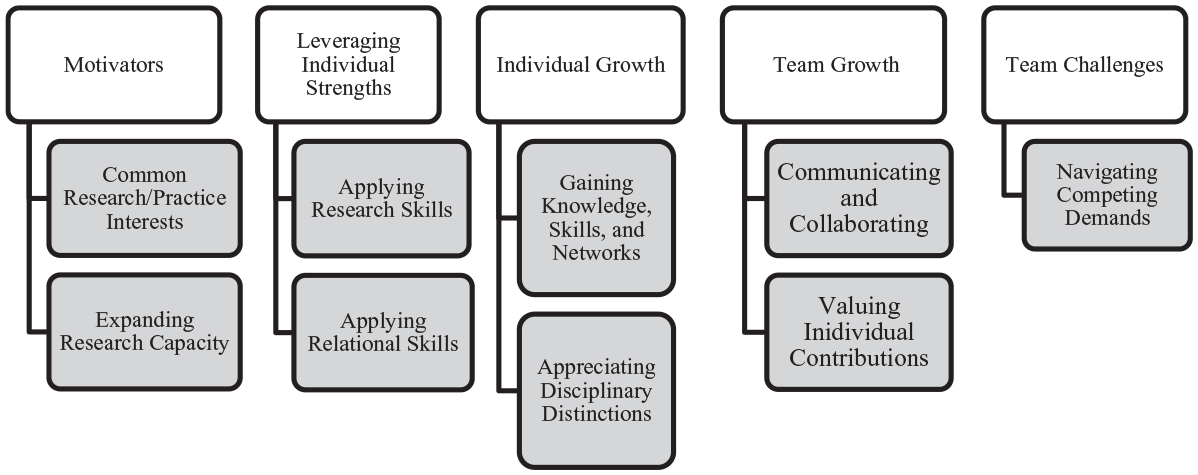
Collective discoveries: Themes and sub-themes.
Motivators
Each participant reflected on factors that catalyzed our interest in joining this interdisciplinary research team. Two sub-themes were identified and validated as representative of initial motivations to participate: common research/practice interests and expanding research capacity.
Common Practice/Research Interests
Many individuals had prior positive experiences with mentorship (the topic for our original research project), which served as a critical driver for becoming involved with this research team. These prior experiences inspired both philosophical beliefs of mentorship and willingness to engage in these relationships. Some of us had personally benefited from mentoring relationships or were motivated by prior experiences organizing and leading peer-mentorship programs for students. As one among us shared, “the relationships that I formed with peers and supervisors in those early days enabled me to develop the skills, knowledge, and language I needed to survive in an academic environment.” Another echoed this sentiment, “I became more conscious of the impact of my advice, of the behaviors I was modelling in these [mentoring] relationships, and curious about [their] impact on students and faculty.”
Less than ideal prior mentoring relationships were also an impetus for involvement. As one of us noted, “I have. . .seen the pitfalls associated with a lack of guidance, supervision, and mentorship, therefore understanding the art of mentorship was of interest.” Another shared, “I had very little mentorship during my graduate studies experience. . .so thought that this would be a great way to understand my experience. . .and then work towards learning how to better support others.”
As researcher-participants, we varied in our prior experience of formal peer mentorship programs, with some situated in faculties where formal programs were either of long-standing or being contemplated. Thus, we were curious to find out “where. . .different faculties [were] in establishing a mentoring program.” Faculty members in disciplines where formal student peer mentoring programs were not available hoped to gather evidence to inform the development of such programs: “I wanted to learn more about mentorship from an evidence-based perspective so I could better advise the implementation of a peer mentorship initiative in the program I was leading.” We were collectively interested in identifying key insights from the literature and from students themselves on how best to design effective peer mentorship programs that improve student experiences and success. Our interest in advancing peer mentorship research also motivated us to conduct this study. One researcher-participant noted, “I have been a mentor for social work students and social workers in the field for a number of years and was interested in the application of a research lens to this area of my practice.” Others shared that they wished to “learn about peer-mentoring initiatives, needs, outcomes, and best practices from other faculties on campus” and specifically to “engage with interdisciplinary colleagues. . . who had a shared interest in and passion for graduate student peer mentoring practice and research on same topic.”
Expanding Research Capacity
Some researcher-participants viewed participation in an interdisciplinary research project as an opportunity to enhance their cross-disciplinary knowledge more broadly. This notion was exemplified as follows: “I am looking to build myself a respectable niche as a qualitative researcher. . . In order to get there, I needed to build my experience working with teams. . .more familiar with qualitative research. . .to supercharge my learning.”
Through participating in this research, many also hoped to increase their knowledge and experience of interdisciplinary team collaborations and disciplinary research norms. A researcher-participant describe this sentiment: I anticipated this research project would be a valuable opportunity to build and extend upon my own research understandings, skills, and strengths. . .I wanted to share insights and findings from my own research, as well as develop. . .a broader understanding of research methodology and methods across disciplines.
Interestingly, one faculty member was motivated to participate through a desire to support the research interests of a more junior researcher on the team, “I am aware of how daunting it can be for a recent graduate to begin planning and building their research career. . .I wanted to offer a positive, encouraging, and productive space for my former student.”
As team members, we anticipated that this collaboration would enable us to expand professional networks and identify future interdisciplinary research initiatives. One individual indicated, “I welcomed the opportunity to work with colleagues from other disciplines and to expand my research network.” Another believed this experience would enable her to “develop friendships and partnerships that could result in future collaborations on related or different topics.” Students on the team also welcomed the opportunity to gain access to other research communities. As one student shared, “I am planning on pursuing my PhD and thought that it would be a great opportunity to learn from others. . .to be proactive in creating a positive experience for myself.”
Leveraging Individual Strengths
Researcher-participants reflected on the importance of research-based and relational skills developed throughout their careers in enabling them to be effective on this interdisciplinary research team. Individuals contended that they were able to apply their unique skills that were deemed valuable to the team, which in turn enhanced the interdisciplinary research experience. Two sub-themes were identified and validated as representative of team strengths: applying research skills and applying relational skills.
Applying Research Skills
We identified specific strengths developed throughout our studies or careers that enabled us to advance team goals, such as expertise in systematic reviews, project management, and peer review, “methodological skills in terms of experience with synthesis and qualitative research,” “expertise and diverse experience with educational research methodology,” and “writing and reporting research.” One individual expressed that she “enjoys the editing process” and is “always willing to provide detailed edits and go through each paper with a fine-tooth comb.” Another research strength leveraged by the team was intentionally engaging everyone in research processes and tasks, including supporting one another through mutual peer mentoring. For example, data analysis was done in mixed ability pairs, reviewed by all, and then revisited and iterated as needed. This enabled team members with less experience in qualitative methodologies to learn from more experienced researchers on the team.
Generally, we agreed that our skills and expertise were valued during the completion of this interdisciplinary research project. However, some shared they could have made further efforts to assume more extensive or diverse roles. A junior member admitted “feeling intimidated to approach experienced researchers [on the team, and] hesitant to overstep any boundaries in the research project.” Another individual noted, “I need[ed] to find a better way to communicate my enthusiasm for learning and growing without undermining my prior experience. . .that I do not want to devalue.” Still others recalled instances when research responsibilities appeared to be allocated to those with greater prior experience or seniority: “I’m not sure that my skills have been leveraged to their full extent in the partnership. I have an analytical mind and depth to my thinking, which may not have been as evident during this work.” Interestingly, experience did not always equate with seniority; there were repeated occasions when the team relied on the expertise of students and junior faculty to advance our research project. This theme of ensuring balanced participation was echoed by the research lead: “If I was ever to lead or participate in a multidisciplinary team again, it would be important to periodically touch base with every member of the team to ensure that everyone felt their skills and expertise were being incorporated.”
Applying Relational Skills
Both mentorship and leadership skills and experiences were viewed as essential contributions that enhanced our team’s functioning. While some of us had extensive prior “expertise and experience leading research teams,” others in administrative roles also possessed significant “leadership experience.” There were various opportunities for less experienced team members to benefit from the leadership and mentorship provided by more experienced members of the research team. As one researcher-participant reflected, “I think I bring my unconditional support of my colleagues, my humility in showcasing others instead of myself. . . and knowledge about the research process and dissemination.”
Importantly, relationships opened the door to insightful sharing about each person’s disciplinary lens on specific issues related not only to peer mentoring research but also to approaches to conducting collaborative work. As one team member commented, we were able to “develop and use common terms, because, in this project, we became more aware of each other’s disciplinary nuances.” Another reinforced this idea by stating, “we learned the nuances of navigating interdisciplinary work and how we could work as a team to leverage each members’ strengths.” From our co-reflective experience, we recognized that developing a skills inventory at the outset of the project might have enabled greater leveraging of expertise within the team and expanded early within-team discussions regarding mentorship opportunities. At the same time, we acknowledged that expertise be carefully balanced against capacity so as to not set unrealistic expectations of what individuals were able to accomplish.
Individual Growth
Researcher-participants reflected on professional and interpersonal benefits gained from participation in this interdisciplinary team. While research knowledge, skills, and an enhanced social and academic network were frequently cited, so was an appreciation of both disciplinary similarities and distinctions. Two sub-themes were identified and validated as representative of individual growth: gaining knowledge, skills, and networks, and appreciating disciplinary distinctions.
Gaining Knowledge, Skills, and Networks
As researcher-participants, we commented on the extent to which project participation expanded our knowledge of other disciplinary research traditions and approaches. This included conducting research using qualitative methods, analyzing interview data, writing, and providing mentorship and peer support opportunities for students. For one individual, in particular, this experience expanded her awareness of specific programs or initiatives in other faculties. A student member commented on an increase in knowledge regarding “the practical side of research,” noting that she had benefited from “being coaching and mentored by the research team and modelling their example.”
The researcher-participants acknowledged that this research opportunity enabled each to expand our research networks and opportunities across disciplines. This included co-presenting at various disciplinary conferences and “meeting colleagues from other disciplines who were working on similar issues, but from a different lens.” Opportunities “to publish in journals outside my discipline” were another benefit of interdisciplinary collaboration. Further, the group anticipated that the academic and social capital from this experience could lead to future research collaborations. As one of us noted, “I believe I now have a network of professional colleagues with a strong work ethic and expertise in diverse areas that I can rely on and call my friends.”
The benefits of this expanded network resulted in tangible outcomes, as recounted by one team member, “after the funding was over, there was a recognition of positive collaboration that made us want to keep working together, and we successfully applied for another grant.” Another noted that, as both mentorship and interdisciplinarity are university priorities, “our research group is recognized as leaders on campus.”
Appreciating Disciplinary Distinctions
Researcher-participants commented on the synergies found between the disciplines represented within the team. As one individual explained: I found that the different disciplines were more similar in their concerns and interests than may be obvious at first glance. While the language used and the interventions taken may be different, all four disciplines at their core are interested in people and want to do right by people.
As individuals, we “grew to appreciate both similarities in perspectives and the uniqueness of ideas that can be found when one reaches outside of a disciplinary silo.” One researcher-participant commented, “I appreciate the richness of each disciplinary lens and how this informed our overall growth. As a team we have remained open to embracing the nuanced differences that we bring while creating space for discovering our collective identity.”
Team Growth
Team members shared their stories, experiences, and views regarding team dynamics and effective team practices; these clustered within two sub-themes: communicating and collaborating, and valuing individual contributions.
Communicating and Collaborating
Ongoing communication was essential to effective team functioning. Researcher-participants remarked on the importance of open and frank discussions throughout our various research collaborations, particularly during process meetings, when we were developing research protocols, strategizing about recruitment across the four faculties, or determining how best to collect or analyze data. While multiple voices and differing opinions may have otherwise stalled the progress of our research, our ability to communicate with one another clearly and respectfully and a collective willingness to explore options increased team cohesiveness, trust, and mutual respect. As one individual asserted, “communication is critical to ensure that everyone has the opportunity to contribute.” Another noted: I learned the value of discussing rather than making assumptions; I learned that through conversations, we could negotiate steps forward by picking and choosing from all the experts’ tool bags. . .in the end this is what strengthened the quality of our work.
Communication became increasingly crucial as we began to disseminate knowledge from our studies through academic papers and conferences. Authorship order can often be a point of tension for scholars due to pressures to publish and be acknowledged as lead authors. One individual discussed how this issue was addressed within the team: Negotiating the tricky item of author order can be difficult for many teams. I recall it being a straightforward conversation among our team members about what author order meant, how we would be fair, and then deciding who wanted to take the lead on which works.
A student concurred with this assessment by making the connection between the “mentorship available in the project and the opportunities for students to both lead and co-lead the writing of academic articles.”
Our expressions and articulations of experiences within the project shifted over time from an individual/disciplinary-focus to a collective/interdisciplinary-focus. This shift was reflected in how we communicated about the project within the team and to external audiences. Several of us identified the positive, enjoyable, and collaborative nature of the research experience as an unexpected benefit of participating in this research study. One shared, “team meetings were comfortable affairs where expertise was shared. There were no arguments of any substance when it came to project decisions. The sharing of knowledge and expertise seemed to me to be highly reciprocal.” Another expanded on this, stating, “every interaction requires a positive energy and effort to ensure we are making a substantive contribution. In doing so, we recognize as individuals, we are reaping the benefits as scholars and academics as well.” Yet another contended that the group processes engendered collective reflection, which would not otherwise be present: “working on this team afforded us an opportunity to actively exercise and reflect upon competencies related to communication, professionalism, and collaboration skills we wouldn’t ordinarily take time to explore and reflect upon.”
Specifically commenting on growth within the team, one individual noted that team members progressively took on more significant roles within the group: I have been privileged to participate in and observe the growth of our team. Members who were previously more silent have stepped out into the light and taken on more leadership roles, and this has been the best evidence of our productivity.
Some also speculated that this positive experience might have been due, in part, to the makeup of the team– all women who possessed a strong work ethic and appeared to prioritize collaboration over competition for individual recognition or achievements. Our gender composition was acknowledged as a catalyst for positive collaborative practices. As an all-female team, we cooperated in a nurturing and supportive manner, inspiring openness, and transformational growth. As one individual noted: In general, there is a high level of collegiality and commitment to collaboration on this research team. I am not sure if this is more a characteristic of strong women, or of researchers in academia, or of the different disciplinary perspectives, which are all from professional faculties.
Although not captured in the individual reflections, gender roles and expectations emerged as an overarching social construct during challenging group discussions. We reflected on the role of gender on our ability to navigate the challenges we experienced and capacity to manage demands to stay connected and cohesive. As a group of women, we wondered, “are we being too positive about our challenges?” We heaved a collective sigh of relief when one person commented that she felt “guilt and shame around letting a team member that you care about down.” We mused aloud that all of us had this same shared experience and how this feeling of “not doing enough” appeared to be common among women. We further reflected that, at times, “we may have refrained from challenging or giving feedback in order to preserve our team relationships.”
Our reflexive process helped us identify multiple benefits and some challenges from our collaboration that were mutually experienced. This included personal and professional growth, an increase in content and methodological knowledge, and a sense that every member was a valued contributor.
Valuing Individual Contributions
Researcher-participants commented on the importance of acknowledging and respecting the contributions that each individual brought to the team. As one person noted, “this team of female researchers from Social Work, Nursing, Medicine, and Education is. . . committed to democratic participation, and acknowledging and valuing each person’s contributions on conference presentations and manuscripts.” Another confirmed, “every member of the team entered the room with a mutual respect for each other’s knowledge and experience. This created a comfortable, creative, collaborative environment that greatly enriched the project as a whole.” Our co-reflective process led us to progress, through time, from more individualist and disciplinary motivations to collective and inter-disciplinary accountability.
While we generally viewed our participation in a positive light, some of us were initially concerned that our voices might be undervalued. We wondered to what extent we would be able to work together with colleagues from other disciplines and to “share and integrate one another’s disciplinary knowledge and skills.” As one individual elaborated, “I wasn’t sure what to expect. . .. I knew everyone on the team was very accomplished, but I wasn’t sure if we would work well together.” Another commented, “being a new assistant professor, I wondered if all collaborators would be similarly valued despite our years of involvement in the academy.”
Initial concerns faded as we learned more about each other, and trust grew as we fulfilled our commitments and met internal timelines. We noticed that our ideas and experiences were welcomed and valued by students and other researchers on the team and that we were able to make meaningful contributions toward achieving project goals: “I felt that my voice and contributions were respected by everyone, and differences of opinion or approaches were managed with integrity and a collaborative spirit.” Another confirmed, “I truly believe every member has provided their expertise and substantially contributed to every meeting, presentation, and written product emerging from our team. This has been achieved with respect for others and the utmost professionalism.” Importantly, context-setting early in the project through leadership and role-modeling by the team lead facilitated trust-building and relational accountability among members.
Team Challenges
Our researcher-participant team identified many positive aspects of this interdisciplinary collaboration; however, various challenges were also acknowledged. These included leveraging skills, experience, and expertise, along with managing the many competing demands and timelines in academic work. With a climate of trust built through the collaborative process and intentional discussions on motivation and expectations, team meetings became a space to articulate and “embrace challenges through discussion.” One sub-theme that predominated our data relevant to team challenges was: navigating competing demands.
Navigating Competing Demands
During the research project, competing academic and career demands had the potential to impact our ability to achieve our research objectives. There were times when “personal and professional commitments conflicted with project timelines, and pieces of work had to be delayed or reassigned to others on the team.” Despite the time pressures and role demands, we collectively exhibited a clear commitment to shared goals. We demonstrated our accountability by identifying when timelines could not be met, asking for support or substitution for our commitments, and reaching out to other team members to ensure the ongoing progress of our work. As one team member emphasized, “the team had a diversity of positions, took the commitment seriously, and acted as leaders–mentors in vivo.” Another individual noted, “I learned how incredibly busy everyone is and how strong our commitment was to the team and to this project; we creatively juggled our schedules and ensured our meeting times and assigned tasks were always respected.” More senior team members were viewed as role models in how to engage in teamwork. As one junior researcher articulated: Through talking to and observing senior members of our team, I tried to adopt [their] perspectives to teamwork. Everyone is collectively responsible for seeing the project through to completion. It is essential to develop trust in the professionalism of the team and their commitment to shared goals.
Researcher-participants reflected on individual and “team accountability,” and “being honest about taking on commitments.” Transparency in terms of evolving capacity enabled the team to pivot as required to re-allocate responsibilities and meet project timelines. Individuals had trust in the strength of the relationships that we had developed and nurtured throughout this multi-year project. As one person stated, “when you develop those relationships, that becomes a currency that you can lean on – even when there are tensions – because we have already established that trust.” This currency of trust was of particular value during difficult conversations, such as authorship expectations and roles, as it helped ensure the team remained a cohesive whole throughout the project. We all acknowledged that many former collaborations did not engender this same level of trust or commitment.
Timelines and competing professional demands were also identified as barriers to participation in team projects and knowledge translation activities. The team acknowledged that there were occasions when these competing demands stalled progress on project goals. As one person noted, “time constraints prevented me from being more helpful in designing participatory presentations or workshops for our faculties.” Another also expressed feeling worried that her unavailability would “stop the ball from rolling,” and another, provoking laughter from the group, acknowledged that “we have all experienced feelings that we are the ‘slug’ in the group.”
Discussion
During our research project, our team of researcher-participants intentionally and authentically engaged with the emergence, co-creation, and negotiation of new interdisciplinary knowledge. Our reflective and co-reflexive research process yielded five themes and nine sub-themes that describe the personal, interpersonal, disciplinary, and interdisciplinary lenses that shaped our team’s experiences: (a) motivators; (b) leveraging individual strengths; (c) individual growth; (d) team growth; and (e) team challenges. While our study reflects prior research in highlighting motivation, commonality of purpose, leadership, and growth opportunities as drivers for successful team engagement and functioning (Tkachenko & Ardichvili, 2020), our reflective study also notes the positive role of gender in advancing collaborative efforts and ensuring that all team members can meaningfully contribute their individual expertise toward achieving collective goals.
Our reflections also informed the development of a related five-point framework for effective team functioning, outlined in Table 1. This framework underscores the transferability (Tkachenko & Ardichvili, 2020) of our collective discoveries into useful recommendations for researchers seeking greater intentionality, reflexivity, collaboration, and mutuality within their interdisciplinary teams. The framework elements include: (a) Become Intentionally Involved; (b) Leverage Individual Strengths; (c) Promote Individual Growth; (d) Grow and Benefit as a Team; and (e) Embrace Team Challenges.
Recommendations for intentional interdisciplinary collaborations.
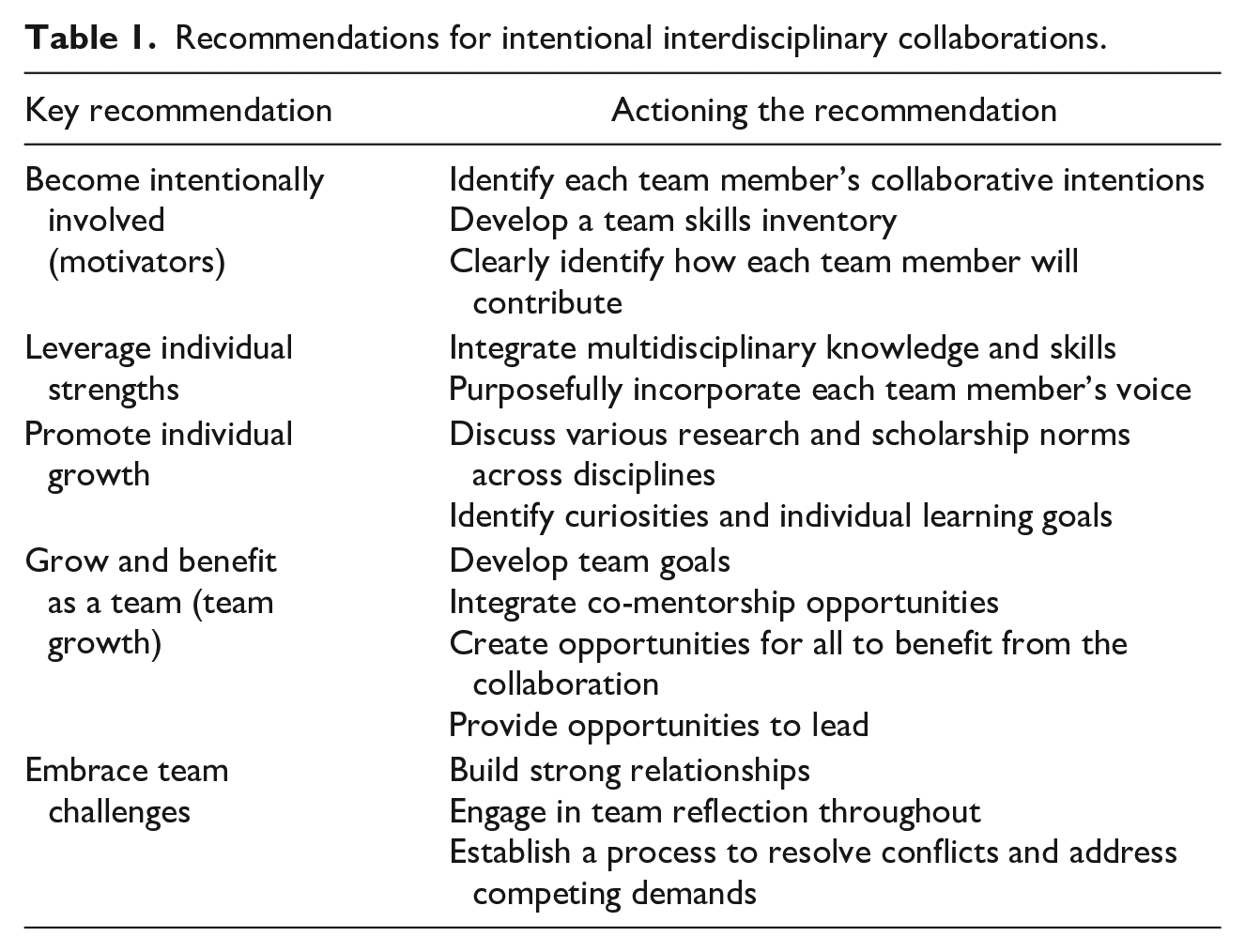
Become Intentionally Involved
A desire to understand the opportunities and tensions involved in producing new ways of knowing within interdisciplinary research (Miller et al., 2008) was one of the key motivators for our team to engage in this participatory reflection process. Providing time to focus on sharing team members’ diverse intentions, skillsets, and expectations of the collaboration at the outset can facilitate relationship-building and team cohesion (Beck et al., 2017).
Leverage Individual Strengths
Further, this intentionality with respect to accounting for team members’ expertise can amplify a team’s experiential and relational capacity to leverage and integrate each member’s unique knowledge, skills, and experience over time (Vestal & Mesmer-Magnus, 2020). Initial meetings between interdisciplinary collaborators can be bound by two key questions (Beck et al., 2017): (a) What is it that we need to know about each other’s disciplines? and (b) What do other researchers need to know about us as researchers? Our co-reflective experience highlighted the importance of generating a collective understanding of the team’s experiential and the relational capacity (Vestal & Mesmer-Magnus, 2020) to potentially mitigate some of the common challenges experienced by members of interdisciplinary research teams. This critical grounding could further enhance the contributions of each member and centralize experiential and relational accountabilities among members. The intentional documentation and regular review of a skills, expertise, and experiences inventory can provide each research team member the ability to explicitly highlight individual strengths, locate areas for leadership and contribution within the project, and identify opportunities for mentorship or co-mentorship.
Promote Individual Growth
Disciplinary culture can play a significant role in the lives of academic researchers and can have multiple types of impact on interdisciplinary research teams, including research and professional development opportunities in new domains (Bridle et al., 2013; Hesse-Biber, 2016; MacLeod, 2018). As documented in our study, opportunities can be fostered for individual members to identify learning goals and view the research collaboration as a growth opportunity. Team members can be invited to share a brief overview of past research during initial meetings to jump start conversations about similarities and differences in research interests, expertise, methodologies, prior collaborations, and motivations (Beck et al., 2017). The informal mentoring relationships that our team developed organically during our research collaboration could be intentionally formalized by matching individuals with specific learning goals to other team members who have the capacity and expertise to provide targeted mentorship specific to these goals. Prioritizing individual and group learning can create a cultural shift that values team process and relationships (Oddone-Paolucci et al., 2021), while still promoting the traditional valued outputs of academia, including journal article publications and conference presentations.
Grow and Benefit as a Team (Team Growth)
Democratic leadership styles, openness to interdisciplinary knowledge and skills, and an overall equity lens by the team lead can role model and guide team behavior (Fiore, 2008). This approach can support a safe climate for curiosity, co-learning, and the leveraging of individual members’ skills and strengths that transcends any potential barriers of power and rank. While previous researchers have highlighted the role of interdisciplinary collaborations in reducing disciplinary silos (Tkachenko & Ardichvili, 2020), our recommended framework incorporates purposeful inclusion of diverse disciplinary language, norms, experiences, and shared decision-making and leadership as explicit strategies for achieving this end.
Building relationships and trust occurs over time (Vestal & Mesmer-Magnus, 2020) and helps to reposition individual members from a primarily individual/disciplinary to an interdisciplinary/group mindset, including supporting and celebrating both individual and group contributions, areas of expertise, and successes. Establishing an intentional and collective plan to recognize and elevate each team member’s expertise, leadership, and technical skills at the onset of a study (MacLeod, 2018), with periodic check-ins to clarify viewpoints and expectations (Beck et al., 2017), may promote greater equity within interdisciplinary teams, increase mutual accountability, and proactively address status and power differences in experiential and relational resources (Vestal & Mesmer-Magnus, 2020).
Embrace Team Challenges
Team challenges and tensions are common, if not inevitable, in both disciplinary and interdisciplinary teams (Danermark, 2019; Graff, 2016; MacLeod, 2018). Domain specificity, the complex and specialized skills, and the understanding and experience required for research in a domain can often be inaccessible to non-specialists (MacLeod, 2018). Our interdisciplinary team developed interactive expertise (MacLeod, 2018) through focused and intentional communication that leveraged our commonly held and understood research methodologies, and intentional exploration of contrasts or differences in theories, methodologies, and methods to address complexity and seek correspondence across our four disciplines. Further, as highlighted through our co-reflections, our team’s ability to navigate challenges without disrupting team cohesion was due to established and prioritized practices of co-reflexivity throughout our research process (Fiore, 2008; Stokols et al., 2008). Moreover, we identified role-modeling, co-mentorship, respectful and collaborative conversations, and valuing each individual’s skillset as crucial factors in promoting cohesion and mutuality within our interdisciplinary team (Beck et al., 2017).
Research Implications and Limitations
As interdisciplinary research becomes increasingly common and necessary to addressing complex societal problems, issues, and challenges, frameworks to help guide effective research engagement in such collaborations will be required. In this paper, our team reports on one such effort to explore and articulate the benefits, pitfalls, and promising practices of interdisciplinary research partnerships in academia. We acknowledge that the implications of this research are limited to interdisciplinary teams in an academic context rather than teams in broader contexts. However, our reflective process and findings could apply to diverse team collaborations in multi-sectoral contexts. As researcher-participants, we also recognize that the transparency of our process, while generating deeper dialog and reciprocity, may have constrained individual critiques of the collaboration. Future research is needed to explore the transferability of our recommendations to other interdisciplinary teams and settings. We encourage other interdisciplinary teams to employ participatory research principles and co-reflective processes as outlined in our paper (Gilbert & Sliep, 2009) to intentionally document their learnings and disseminate useful insights and knowledge derived through their collaborations.
Supplemental Material
sj-docx-1-sgr-10.1177_10464964221089836 – Supplemental material for Fostering Learning and Reciprocity in Interdisciplinary Research
Supplemental material, sj-docx-1-sgr-10.1177_10464964221089836 for Fostering Learning and Reciprocity in Interdisciplinary Research by Liza Lorenzetti, Michele Jacobsen, Diane L. Lorenzetti, Lorelli Nowell, Helen Pethrick, Tracey Clancy, Georgina (Gina) Freeman and Elizabeth Oddone Paolucci in Small Group Research
Footnotes
Declaration of Conflicting Interests
The author(s) declared no potential conflicts of interest with respect to the research, authorship, and/or publication of this article.
Funding
The author(s) disclosed receipt of the following financial support for the research, authorship, and/or publication of this article: This research was funded in part by a Scholarship of Teaching and Learning (SoTL) Grant from the Taylor Institute, University of Calgary, and a Health Science and Medical Education Research and Innovation Grant from the University of Calgary’s Office of Health and Medical Education Scholarship (OHMES).

Supplementary Material
Supplemental material for this article is available online.
Author Biographies
References
Supplementary Material
Please find the following supplemental material available below.
For Open Access articles published under a Creative Commons License, all supplemental material carries the same license as the article it is associated with.
For non-Open Access articles published, all supplemental material carries a non-exclusive license, and permission requests for re-use of supplemental material or any part of supplemental material shall be sent directly to the copyright owner as specified in the copyright notice associated with the article.
