




Abstract
Despite their prevalence in daily teamwork, little is known about the influence of intrusions on teams. Therefore, the effect of intrusions on team interaction was investigated, focusing on relational communication. Three different theoretical perspectives regarding team interaction changes in response to a meeting intrusion are discussed. These perspectives were mapped onto fine-grained behavioral data from twelve teams (N = 4,627 sense units) by means of lag sequential analysis. Teams’ use of relational communication changed in several ways in response to the intrusion. While these changes fit best with one perspective (task-focused), several results also align with other perspectives.
A work interruption is defined as “an unexpected suspension of the behavioral performance or the attentional focus from an ongoing work task” (Puranik et al., 2020). Interruptions are common, frequent, and have both direct and indirect effects for employees. When co-workers interrupt ongoing work, they disrupt the task flow of employees directly (e.g., Wajcman & Rose, 2011). The most reported type of work interruptions are intrusions, which are interruptions from outside sources, such as a colleague disrupting a task by entering someone’s office or asking a question. Intrusions thus create unexpected non-routine situations that require attention in the present moment (Jett & George, 2003).
The influence of intrusions on individual performance is fairly well-understood. Intrusions tend to instigate time pressure and create obstacles for successful task completion (Perlow, 1999). Additionally, they often result in increased stress and strain (Baethge & Rigotti, 2013; Lin et al., 2013). Yet, these prior insights are limited to individual-level and task-specific outcomes. With organizations extensively relying on teams (Kozlowski & Bell, 2013), it is of vital importance to understand how intrusions operate in team contexts and can influence team processes.
However, the extant findings of the individual level effects of intrusions cannot be simply translated to the team level. Rather, teams consist of interdependent individuals that work together toward a goal (Cronin et al., 2011), which inherently implies that members of the team influence each other. Individual team member’s reactions to intrusions may influence other team members in such a way that the team level response does not represent a simple aggregation of single individual responses. To understand teams’ reaction toward intrusions, the authors argue that it is relevant to address team dynamics in terms of team interaction (Cronin et al., 2011; Kauffeld & Lehmann-Willenbrock, 2012), as this can best showcase the different responses of team members, and how these differentially responding team members influence each other. Team interaction is most easy to study in highly interactive and collaborative team settings (Bonito & Sanders, 2011), such as team meetings (Allen, Beck et al., 2014). Therefore, a focus on team interaction in team meetings provides a first step in understanding teams’ responses toward intrusions.
Intrusions are inherently emotional and relational in nature (Fletcher et al., 2018), as they occur between individuals and cause emotional responses. Therefore, relational communication will be primarily addressed. Relational communication is focused on the connection of a team member with the whole team or a specific team member. It is an integral part of task-related conversations, such that the relation between task and relational communication has to be considered in unison (Keyton & Beck, 2009). Nonetheless, most research on team dynamics has addressed task-related processes in a vacuum, frequently disregarding relational processes and how they intertwine with task-related processes (Barker et al., 2000). Therefore, relational communication and its relationship with task-related communication can be addressed by observing the patterns in interaction that occur.
Taken together, the contribution of this article is two-fold. First, theory is extended on interruptions, and in particular intrusions, by addressing team-level responses, rather than individual effects. Second, this research adds to theory on both team dynamics and intrusions by considering the relational aspects of communication. This is done by exploring how intrusions can alter team interaction patterns in a field study during naturally occurring team meetings in an organization, which is an approach that strengthens the internal and external validity of the findings. A fine-grained temporal framework will be employed, which constitutes identifying the behaviors of team members as well as the sequences of these behaviors in time. This allows for careful consideration of the intricate interaction patterns regarding relational communication that might occur, as well as the changes within these interaction patterns as a response to an intrusion.
Theoretical Background
Interruptions at Work
The term interruption has been used in the literature for several different phenomena: conversational interruptions, interruptions as adaptation triggers, and work interruptions. These phenomena are partly related, as they all involve suspension of someone’s activity for a specific amount of time. Yet the temporal scale of the effects of these phenomena is substantially different, from a few seconds for a conversational intrusion, to days or weeks for interruption as an adaptation trigger (Maynard et al., 2015; Sacks et al., 1974). The three types of interruptions will be discussed briefly below.
On the smallest temporal scale, interruptions refer to cutting somebody off in a conversation (Sacks et al., 1974). These conversational interruptions are an integral part of turn-taking in discussion (Sacks et al., 1974), yet have also been related to power structures and gender (Smith-Lovin & Brody, 1989). On the largest temporal scale, interruptions can refer to phenomena that cause the need for (team) adaptation processes (Zellmer-Bruhn, 2003), which refers to “the adjustments to relevant team processes in response to the disruption or trigger giving rise to the need for adaptation” (Maynard et al., 2015, p. 656). Team adaptation involves a substantial suspension of the team’s activities and a change in direction to meet the demands of the disruption or trigger (Maynard et al., 2015).
Work interruptions are somewhere in between in terms of both temporal scale and effort. They involve suspension of the work flow of individuals and teams because of an external disruption (Jett & George, 2003). The most common form of work interruptions are intrusions (Murray & Khan, 2014), and can be defined as “the unexpected encounter initiated by another person that interrupts the flow and continuity of an individual’s work and bring that work to a temporary halt” (Jett & George, 2003, p. 495). The focus of this paper is on this type of interruption in groups and teams.
To date, research on intrusions nearly exclusively focused on the effect of intrusions on individuals. Most of these studies identified only negative consequences of intrusions. For instance, intrusions can result in a loss in the train of thought and require rework which in turn increases the time individuals spent on a cognitive task (Altmann et al., 2014; Froehle & White, 2014). Other negative individual-level consequences of intrusions include a higher workload, more time pressure, higher strain and irritation levels, and less satisfaction with the working process and outcomes (Baethge & Rigotti, 2013; Lin et al., 2013; Perlow, 1999).
Even though there is insight in the role of intrusions for individuals, it is unclear how such intrusions affect teams. Individual level data on the effects of intrusions cannot be simply translated to the team level. Teams consist of interdependent individuals who can influence each other extensively (Cronin et al., 2011). Thus, the responses of team members toward an intrusion might thus not reflect the response of an individual team member. Instead, because of the dynamic nature of teams (Cronin et al., 2011), the processes that occur as a response toward the intrusion will determine the overall reaction of the team (Bonito & Sanders, 2011). This overall reaction of a team will be most visible through communication patterns. Therefore, the authors argue that intrusions will affect team communication structures.
Some evidence suggesting intrusions might influence team communication, comes from research showing that dyads, directly after an intrusion, show more politeness toward each other as well as display coordinating efforts to reinstate the conversation (Chevalley & Bangerter, 2010). Chevalley and Bangerter’s work suggests that within dyads, interruptions might stimulate relational communication (in the form of politeness), implying that in group-settings interruptions might prompt specific communication responses, which can be relational in nature (next to task-focused). Even though Chevalley and Bangerter (2010) provided initial insight in potential increases in relational communication directly after an intrusion, the current research will extend this work in two ways: first, by focusing on teams rather than dyads, and secondly by addressing relational communication in a broader context, rather than solely resolving the intrusion.
Relational Communication
Relational communication covers a vast range of specific behaviors and can either have negative or positive valence. Positive relational communication is for example humor, offering praise, encouraging participation, and agreeing, whereas negative relational communication can involve disagreeing, criticizing, and interrupting (Kauffeld & Lehmann-Willenbrock, 2012). All communication, including relational communication consist of the fine-grained interactions between team members visualized in units of communication. Relational communication has a macro-level equivalent captured in interpersonal processes (Marks et al., 2001). Interpersonal processes are team processes with the aim of managing interpersonal relations, and can be divided into conflict management, affect management, and motivational processes (Marks et al., 2001). These processes are important to maintain healthy working relationships, facilitate effective teamwork, and experience better performance (Killumets et al., 2015).
While relational communication is behaviorally distinct from task-oriented communication—communication which is inherently task-focused, both types of communication are intertwined in conversations and co-occur frequently (Kauffeld & Lehmann-Willenbrock, 2012). In fact, relational communication is an integral part of any interaction, including task-focused interaction. For example, communicating agreement can be very much used in function of the task, and as such not only serves the relationship among team members by signaling alliance, but also stimulates task progress (Keyton & Beck, 2009). This emphasizes the importance of considering relational communication in the context of other forms of communication. Moreover, Keyton and Beck (2009) argue that the specific meaning of relational talk can only be grasped by considering the interaction sequence in which it is used (i.e., meaning what patterns of task-focused and relational communication occur). Therefore, not only should relational communication be considered within the context of other forms of communication, researchers should also address how it is used in relation with task communication. This requires a look at the fine-grained behavioral dynamics surrounding a relational statement within the team interaction flow, by addressing the sequences of task and relational statements (Klonek et al., 2019).
Indeed, research shows the added value of considering relational-task communication patterns rather than single frequencies. For example, positive relational communication such as agreement or showing support has been linked to subsequent action planning statements and solution statements which in turn can be related to group mood and performance (Kauffeld & Meyers, 2009; Lehmann-Willenbrock et al., 2011). Additionally, negative relational statements have been found to produce more incorrect solutions and less creativity (Chiu, 2008).
Summarizing, only by considering the interaction between task and relational statements can a full picture of team interaction emerge (Keyton & Beck, 2009). Returning to the effect of intrusions on team interaction, this framework suggests that both the patterns of relational and task communication should be considered of intrusions of the team.
Intrusions and Team Communication Processes
How might intrusions influence relational and task orientated communication and patterns? Literature to date does not provide a clear answer to the question how teams respond toward intrusions. As this research is currently the first to examine teams’ responses to a meeting intrusion, and it is still unclear how teams change their interaction patterns in response to an intrusion, this paper refrains from forming hypotheses about the changes in interaction patterns teams might display. Rather the myriad possible changes teams make in their interaction patterns involving relational communication are explored. Therefore, the focal exploratory research question is:
RQ: How do teams change interaction patterns involving relational communication after the occurrence of a meeting intrusion?
Even though no formal hypotheses are provided, three perspectives could help to provide insights into the possible reaction of teams toward intrusions, are put forward. First, just like individuals, teams might experience more negative affect and frustration in response to an intrusion (Leroy et al., 2020; Puranik et al., 2020), which could result in more negative communication within the team. Indeed, there is evidence that when team members experience frustration they are likely to immediately express it verbally (Ayoko et al., 2012). This would suggest that when experiencing an intrusion, team members are more likely to express negative relational communication, and perhaps less positive relational communication.
Second, aside from expecting more frustration expressions in general, a shift in patterns could also be expected. Frustration from one person can spread to others, and may influence not only relational communication, but also its connection to task-focused communication. While no research seems to be available on the effect of frustration on communication patterns, some logical patterns could be expected. For example, problems and solutions could be met with more negative relational communication. Additionally, when team members complain, others might agree, which is positive relational communication, and thus create complaining cycles (Lehmann-Willenbrock et al., 2011), In summary, the first perspective, referred to as the frustration perspective, argues that more negative relational communication patterns will emerge after an intrusion.
A second perspective suggests that teams might become more task-focused and less relational in an attempt to cope with the loss of time when facing an intrusion. Intrusions can cause an exorbitant loss of time (Jett & George, 2003). When teams experience a loss of time this creates a necessity for a faster working pace and more direct task-focused behavior (Karau & Kelly, 1992). Teams under time pressure engage less in relational communication during the task (Karau & Kelly, 1992). Additionally, more indirect evidence for this perspective comes from a study showing that when leaders experience multiple intrusions during a day, they are also less likely to engage in relational behavior with their follower, and instead focus on task-related communication (Rosen et al., 2019).
Thus, on the basis of this perspective, a decrease in relational communication and an increase in task-focused communication should be visible after an intrusion. Additionally, relational communication should mostly occur independent from task-focused communication, and not be integrated with it, meaning that interaction sequences involving both task-focused and relational communication should be reduced after the interruption. This will be referred to as the task-focused perspective.
Finally, intrusions might function similar to midpoint transitions. These are naturally occurring transitions of a team in terms of work pace, due to the presence of a temporal marker (Okhuysen & Waller, 2002). These midpoint transitions concern the recognition of temporal markers, such as milestones or deadlines—particularly at the perceived midpoint of a task—that trigger one or multiple team members to reflect on their work and progress (Gersick, 1988). This reflection can result in alteration of the team’s processes, focus, and plans for goal completion. Specifically, Okhuysen and Waller (2002) argued that “a transition from one topic to another, itself, provides the opportunities for group members to “stop and think,” to evaluate their work and determine new direction” (p. 1057). Similarly, external temporal markers such as a change in deadline also result in teams engaging in a transition (Waller et al., 2002). Based on this perspective, intrusions could provide such a temporal marker, in the sense that the occurrence of an intrusion provides both a natural transition from one topic to another and a salient reference to time (Zellmer-Bruhn, 2003). This transition should result in an increased attention to goal progress and thus more functional interaction (Gersick, 1988). For relational communication, the expectation would be less negative relational communication, and more positive reinforcement from positive relational communication. Additionally, this would imply that less dysfunctional interaction patterns would be visible after the interruption (i.e., fewer complaining cycles), which can involve relational communication as a reinforcement of complaining (Lehmann-Willenbrock et al., 2011). Moreover, more functional interaction patterns should also occur, such as responding positively, for instance with support, to solutions (Kauffeld & Meyers, 2009). This will be referred to as the transition perspective.
Summarizing, the three perspectives suggest different patterns of relational communication within team interaction could emerge after an intrusion. The first perspective argues that task communication should be associated with more negative relational communication (frustration perspective), a second perspective that argues task conversation should involve less relational communication in general (task-focused perspective), and a third perspective that argues that intrusions should cause more functional conversation such that relational communication would be used to advance task-focused communication (transition perspective).
Method
Participants
The researchers had the opportunity to gather data at an organization in the Netherlands that was interested in the effects of intrusions on team functioning. This organization employs white-collar workers, who are part of project teams. In every team, team members have considerable work autonomy, but are supervised by a project leader. The teams in this organization come together around every 2 to 4 weeks to discuss progress, problems, and future plans. These scheduled meetings have been used as natural situations in which the intrusions occurred. Data were obtained from 12 meetings with different teams. In total 59 team members took part in the research, with a minimum of three members per team and a maximum of 10 (M = 4.91, SD = 2.02). Team members were between 24 and 59 years old (M = 39.20, SD = 8.78). In total 34 women and 25 men participated in the research. The employees were employed by the company between 4 months and 30 years (M = 10.38, SD = 6.90), and were working in their team from less than a year to 8 years (M = 1.29, SD = 1.56). They were told beforehand that the meeting would be videotaped, but were not informed about the purpose of the research, and thus did not anticipate an intrusion.
After data collection it was discovered that one or two individuals might have participated in multiple teams. As participation was anonymous, double participation was solely recognized by visual confirmation. This could be subject to mistakes as individuals’ communication was clearly distinguishable from the videos, their physical appearance was more difficult to code. Therefore, the choice was made to retain the whole sample for analyses. The authors do not believe this interfered substantially with the results, as those team members seem to be unaware about the purpose of the research during both meetings. Nonetheless, it remains a limitation of the study
Procedure
Project leaders of the participating teams were instructed to book a room in advance for a regularly scheduled team meeting. Prior to the meeting all team members signed an informed consent form. Team members were told they could sit at any spot with a letter on the table. These letters were used to combine survey data to the behavioral data without interfering with anonymity. The letters were placed in such a way that the camera, at the back of the room, could identify which team member was speaking. Everyone was instructed to ignore the camera, and to proceed with the meeting as usual. The research assistant left the room after providing these instructions, and did not return until the meeting was finished. Observation of some critical remarks regarding the organization indicated that most ignored the camera, as per instruction. Meetings took between 51 and 87 minutes (M = 66.33, SD = 13.25).
In order to create an intrusion during the meeting, at some point, at least 15 minutes after the meeting started, three confederates, who were other employees of the company, came in with the message that they had reserved the room, and asked if the team was almost finished with the meeting. Intrusions occurred between 17 minutes and 55 seconds, and 43 minutes and 42 seconds after the meeting started (M = 27:21, SD = 7:43). To add to the credibility of the situation, these employees carried laptops and coffee. Depending on the reactions of the team the intrusion took between 25.70 and 89.50 seconds (M = 40.80, SD = 17.30), after which the confederates left to sort-out the discrepancy in the schedule. Because the confederate left to sort-out the discrepancy, it remained uncertain whether the confederates would return, and interrupt the meeting again. This choice was made because it was the most natural way to end the intrusion. After the team decided the meeting was finished, a research assistant handed them a questionnaire with demographic questions.
Data Coding
For each of the 12 observed team meetings, one file was created for the team interaction before the intrusion, and one for after the intrusion, respectively. While the whole meeting was videotaped, only 10 minutes before and 10 minutes after the intrusion were coded. As intrusions occurred at different points during the meeting, some teams had a disproportionate share of the pre- or post-intrusion communication, which when included would have affected the results. The earliest intrusion in a team meeting occurred approximately 15 minutes after the meeting started To keep all observations between teams constant in terms of time coded, a timeframe of 10 minutes around the intrusion was chosen, in order to exclude the social talk and arrival dynamics that frequently took place in the initial minutes of a meeting. (cf. Allen, Beck et al., 2014). The intrusion was not part of the analysis, so only the conversation immediately before and after the intrusion was included.
To analyze the observed team meeting interactions, the act4teams coding scheme was employed (Kauffeld & Lehmann-Willenbrock, 2012). Using this coding scheme, the behavioral unit of analysis is a sense unit, which are units containing only one demarcated thought (see Bales, 1950). In other words, for each sense unit only one act4teams behavioral code can be assigned. A conversational turn by one speaker can contain several sense units (e.g., a problem statement followed by a question).
For the purpose of this study, each observed behavior was coded into one of nine relevant categories, namely: problem-focused statements, solution-focused statements, knowledge statements, action planning statements, action-inhibiting statements, positive process statements, negative process statements, and positive relational and negative relational statements (see Table 1). A tenth category, other, was coded for statements that did not fit into the other categories or when the coders were not able to hear or understand what was said. While the focus of the study was on positive and negative relational statements, it is necessary to define the other statement categories as they occur in relation to relational statements. Problem-focused statements address current or future problems for a team, whereas solution-focused statements are statements discuss or provide solutions that are possible. Knowledge statements provide knowledge about procedures, and important and general information. Action-planning include planning and expressing positivity about these plans. Action-inhibiting statements express negativity of the state of being and planning, and show demotivation. Positive process statements are statements intended to structure the meeting and different parts of it. Finally, negative process statements decrease the structure of the meeting and express team members going off topic (Kauffeld & Lehmann-Willenbrock, 2012).
Act4Teams Coding Scheme.
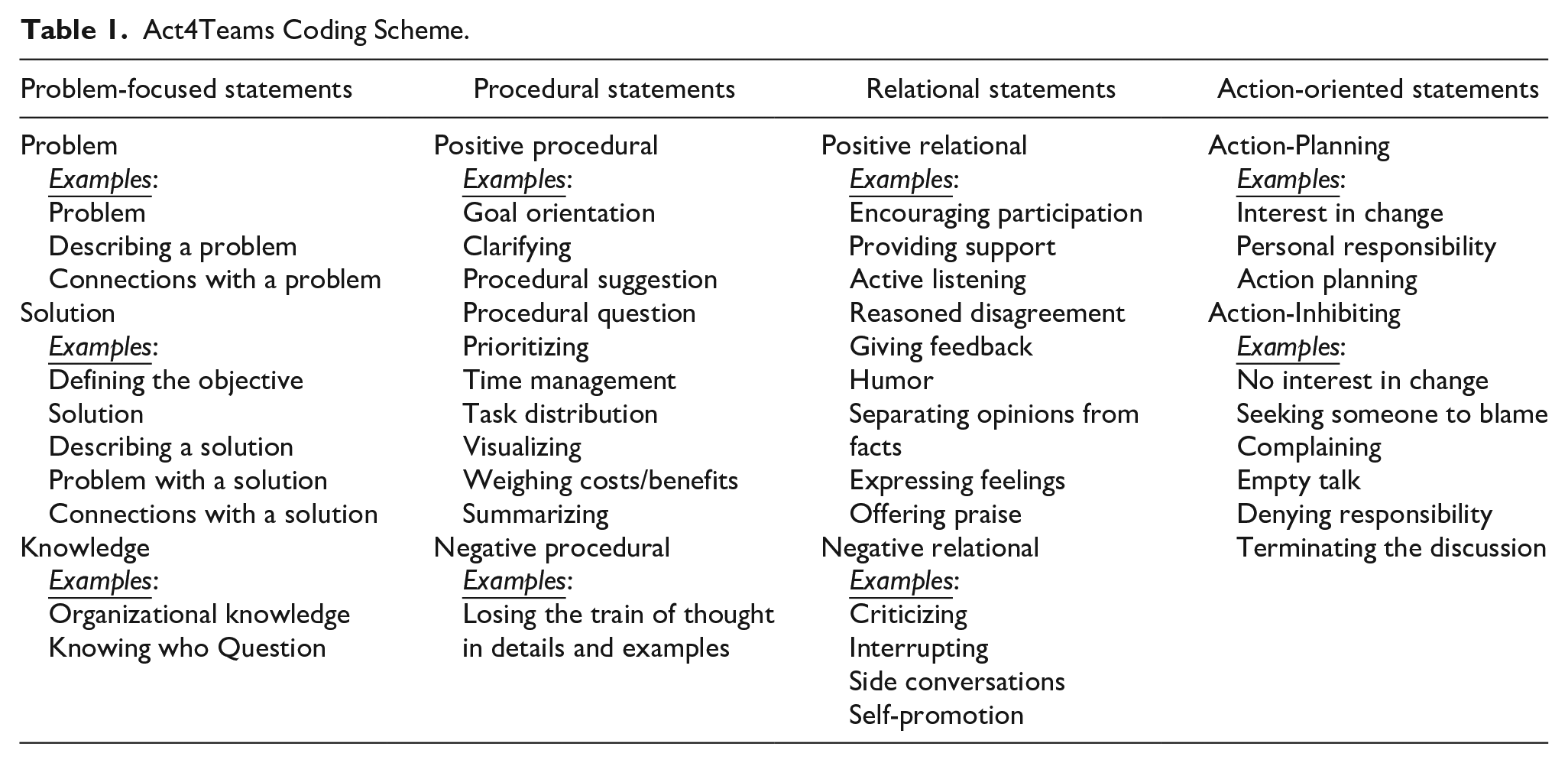
To ensure sufficient interrater reliability four videos were double coded and the achieved interrater reliability was κ = .80, thus suggesting satisfactory reliability. Disagreements were discussed between the coders. In total, 2019 sense units were coded for the pre-intrusion meetings, and 2,068 sense units for the post-intrusion meetings.
Data Analysis
The statistical program R (R Core Team, 2021) and the R-package LagSequential (Draper & O’Connor, 2019) were used to test whether the stochastic model of 10 categories was acceptable using a Tablewise Likelihood ratio chi-square test (Poole et al., 2000). Additionally, we tested whether the observed interaction of the 12 teams was characterized by sufficient homogeneity both before and after the intrusion. Moreover, stationary of the data before and after the intrusion was checked, before looking in depth into the pattern. Using INTERACT software (Mangold, 2020), lag sequential analysis was performed in order to analyze the interaction patterns in team meetings before and after the intrusion. Lag sequential analysis allows researchers to quantify the temporal sequences of interdependent behaviors. Based on the frequencies of each interaction sequence and derived transition probabilities, lag sequential analysis generates z-values to ascertain whether transition probabilities differ significantly from the unconditional probability for the event that follows. Any z-values larger than 1.96 or smaller than −1.96 indicate a statistically significant interaction pattern, where positive z-values indicate a facilitating effect of behavior A on subsequent behavior B, and negative z-values indicate an inhibitory effect of behavior A on subsequent behavior B (Bales, 1950).
Results
Models and Assumptions
The model of sequences before the intrusion had a good fit. The overall chi-square test suggests that the model is significant (χ2 = 231.46, df = 81, p < .001). Similarly, the model for after the intrusion had a good fit (χ2 = 328.05, df = 81, p < .001). Both models also had sufficient homogeneity between groups (respectively, χ2 = 995.31, df = 990, p = .447; χ2 = 856.08, df = 990, p = .999). Moreover, the data before the intrusion compared to after the intrusion were not stationary (χ2 = 106.1, df = 72, p = .006) indicating a significant change in the sequenced before and after the intrusion.
Primary Analysis
Interestingly, the team interaction did not significantly differ before and after the intrusion in terms of the frequencies (Table 2). However, several changes could be observed in the teams’ interaction patterns in response to the meeting intrusion. Tables 3 and 4 contain the results of the lag sequential analysis for both lag 1 transitions (from one to the first following behavior within the team interaction stream) and lag 2 transitions (from one behavior to the one but next behavior) before and after the intrusion, respectively. Below the most important results regarding the role of relational statements within the team interaction flow before and after the intrusion, will be discussed. For the purpose of clarity, subscript b (b) is used to refer to statistics regarding before the intrusion and the subscript a (a) for statistics regarding after the intrusion.
Means, Standard Deviations, and Statistical Difference in Frequency of Specific Codes Before and After an Intrusion.
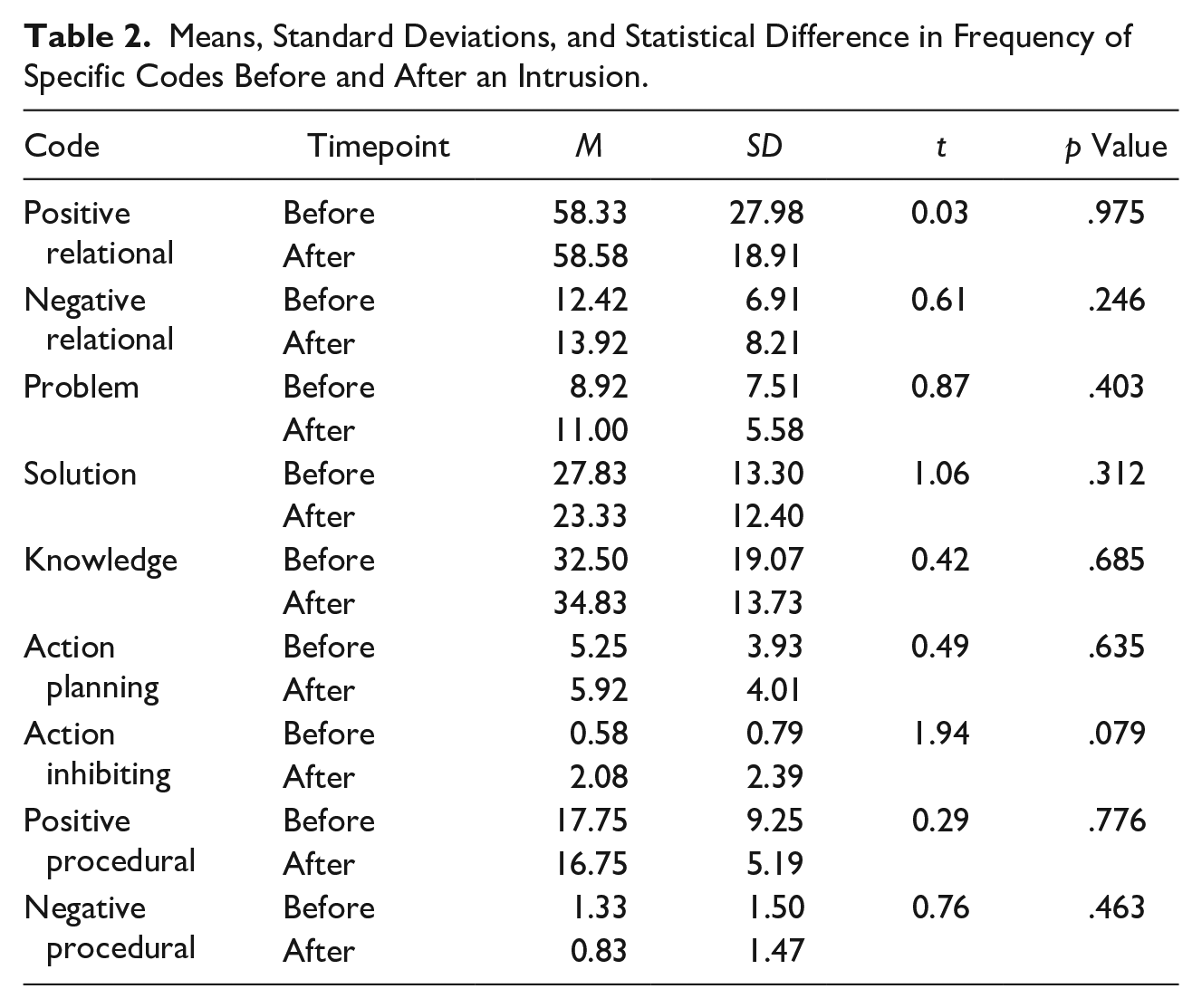
Lag1 Z-values Before and After the Intrusion, With Rows as First Behavior, and Columns as the Second Behavior.
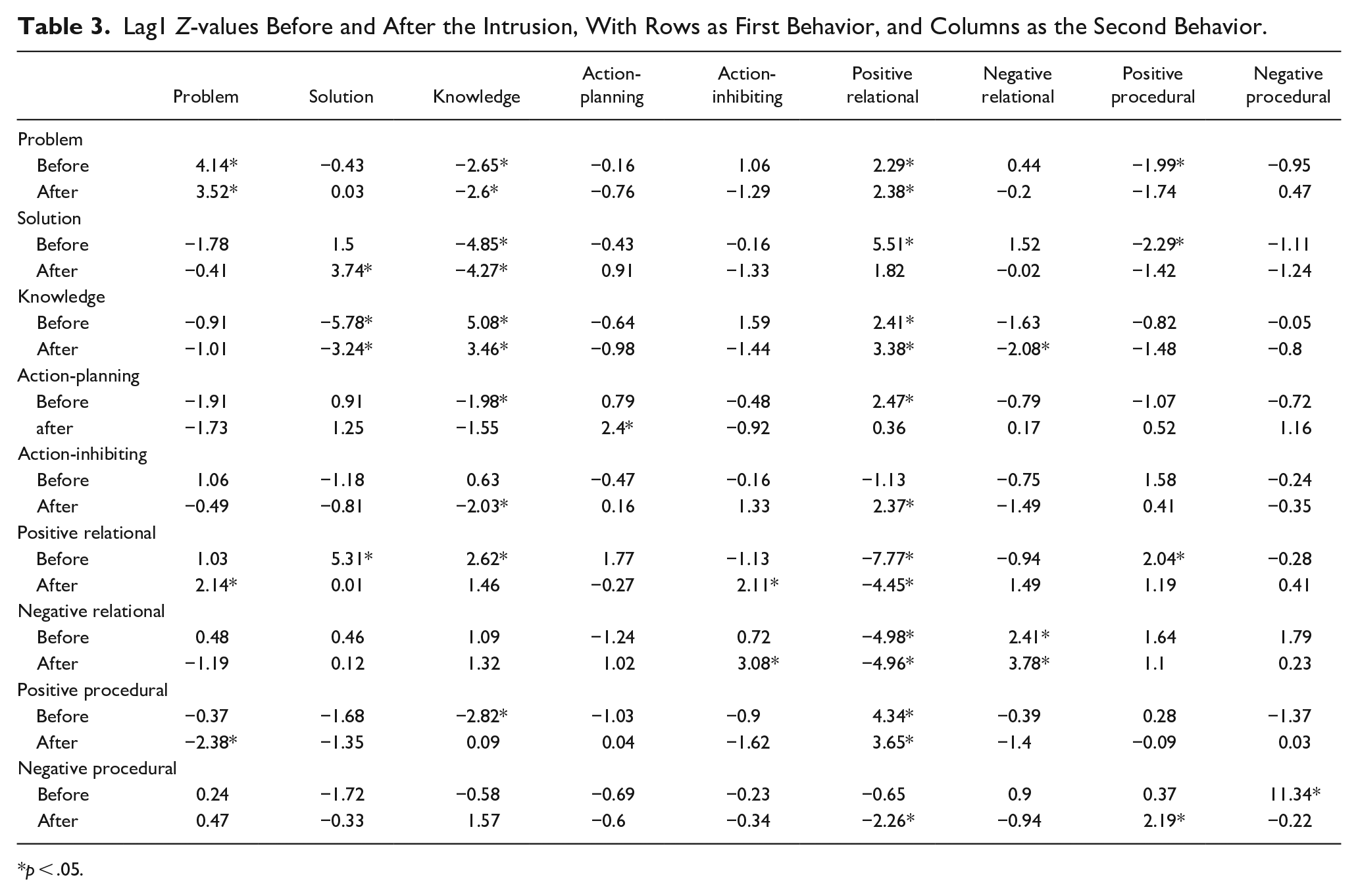
*p < .05.
Lag 2 Z-values Before and After the Intrusion, With Rows as First Behavior, and Columns as the Second Behavior.
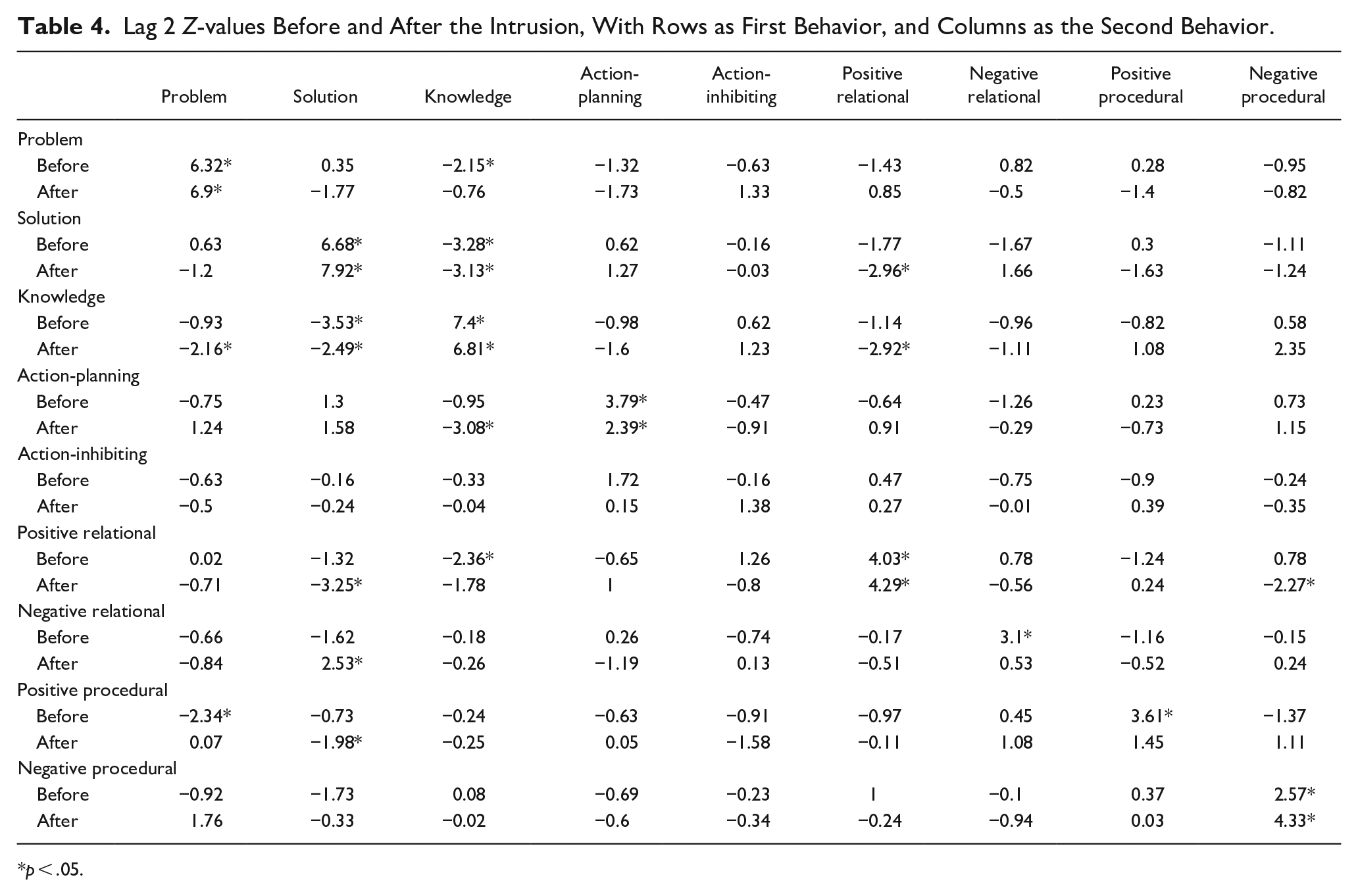
p < .05.
Positive relational statements
Overall, positive relational statements were used in more positive sequences before the intrusion, whereas after the intrusion positive relational statements were used more in response to negative sequences. Before the intrusion, solution and action-planning statements triggered positive relational statements (respectively, zb = 5.51; zb = 2.47), while this was not the case after the intrusion (respectively, za = 1.82; za = 0.36). Likewise, before the intrusion, relational statements triggered solution statements; this was not the case after the intrusion (respectively, zb = 5.32; za = 0.01). In fact, after the intrusion, positive relational statements resulted in a smaller change of solutions statements in the second subsequent statement (i.e., lag 2) while no such pattern was visible before the intrusion (za = −3.25; zb = −1.32).
The pattern for positive relational statements to action-planning statements was non-significant both before and after the intrusion, albeit approaching significance before the intrusion (respectively, zb = 1.77, za = −0.27). At lag 2 both before and after the intrusion, action-planning statements triggered more action-planning statements (respectively, zb = 3.79; za = 2.39), and solution statements triggered more solution statements (respectively, zb = 6.68; za = 7.92). Together these results suggest that before the intrusion a sequence of action-planning/positive relational statement/action planning occurs. However, after the intrusion a sequence of action-planning/action-planning/action-planning occurs. This suggests that relational communication does not play a role in action-planning after the intrusion, while it does before.
However, after the interruption, relational communication does play a role in action-inhibiting statements and negative procedural statements. Before the intrusion, action-inhibiting statements did not trigger positive relational statements, while this sequence did occur significantly after the intrusion (respectively, zb = −1.13; za = 2.37). Moreover, positive relational statements triggered subsequent action-inhibiting statements after the intrusion, but not before (respectively, za = 2.11; zb = −1.13). Additionally, before the intrusion, negative procedural statements were unrelated to subsequent positive relational statements, but after the intrusion negative procedural statements resulted in fewer subsequent relational statements (respectively, zb = −0.65, za = −2.26). However, this last finding should be interpreted with caution as fewer than five observations of this sequence were found in the overall data set, making the validity questionable (Van Der Heijden et al., 1990).
Negative relational statements
Negative relational statements seemed to primarily trigger the same type of statements before and after the intrusion. Both before and after the intrusion, negative relational statements decreased the likelihood of subsequent positive relational statements (respectively, zb = −4.98; za = −4.96), and increased the likelihood of subsequent negative relational statements (respectively, zb = 2.41; za = 3.78). However, there is one important difference: Negative relational statements seem to trigger more action-inhibiting statements after the intrusion (za = 3.08), but not before the intrusion (zb = 0.72). While at lag 1 negative relational statements were not related to solution statements both before and after the intrusion, at lag 2 negative relational statements triggered more solution statement after the intrusion, while not before (respectively, za = 2.53; zb = −1.62).
Discussion
This study addressed how team work interruptions, specifically intrusions during team meetings, affect relational communication within teams. The results highlight changes in the patterns of relational communication, whereas the overall frequency of relational communication did not change after the interruption. In particular, before the intrusion positive relational communication co-occurred above chance with task-focused communication, such as in response toward solutions and positive action planning. However, after the intrusion positive relational communication was substantially less visible in task-focused communication sequences. Instead, task-focused statements followed task-focused statements, and positive relational communication was more common in response to dysfunctional statements, such as statements that inhibit action and disrupt task-focused communication (in the act4teams coding scheme: action-inhibiting statements and negative procedural statements). After the intrusion, negative relational communication was also more frequently used in response to action-inhibiting statements as compared to before, although solutions were also more likely to occur in two statements after negative relational statements occurred.
Theoretical Implications
While the results do not perfectly align with any of the perspectives described in the introduction, they are mostly in line with the task-focused perspective, that suggested that after the intrusion the use of relational communication will be observed less, or at least less intertwined with task-focused interaction (e.g., Karau & Kelly, 1992; Rosen et al., 2019). While a decrease in relational communication following the intrusion did not occur during the team meeting, the use of relational communication in task-related interaction patterns did decrease. This means that task-focused communication seemed to occur more in a vacuum after the intrusion, whereas relational communication was more present as a response toward other relational communication or non-task focused communication. As such, relational communication seems to be more disconnected from task-focused communication after an intrusion. This perspective suggests that the cause for this change to more independent task-focused communication, not involving relational statements, is a need to adopt a higher work pace in order to recover from the effects of the intrusion (Karau & Kelly, 1992). However, because motives for changes in interaction such as time pressure have not been assessed, the authors can only speculate about the underlying mechanism. More in-depth research is required to test this idea.
Even though some converging evidence was found for the task-focused perspective, several findings do not align with this perspective. For example, relational communication did not decrease in total, but only seemed to be used in a different manner after the intrusion, as compared to before. One explanation for this discrepancy is, that the studies in alignment with this perspective, looked at the effect of multiple intrusions, rather than the effect of a single intrusion (Jett & George, 2003; Rosen et al., 2019), meaning that the effect of one intrusion might be more subtle and does not result (yet) in a total decrease of relational communication, but only in a separation from task-focused communication.
However, while the notion that only a single intrusion was studied, could explain that relational communication remained stable before and after the intrusion, it cannot explain that both positive and negative relational communication were used more frequently in response toward more dysfunctional types of statements after the intrusion. There are two possible explanations for this finding that can be aligned with the other perspectives. On one hand, after the interruption, teams might show support for dysfunctional behavior with positive relational statements, as well as display more dysfunctional behavior with negative relational statements. This would be in line with the frustration perspective, which argues that more negative communication sequences would be visible (Ayoko et al., 2012; Puranik et al., 2020). While it may seem counterintuitive for positive relational statements to enforce dysfunctional behavior, previous research has suggested that positive relational communication may indeed play a role in sustaining action-inhibiting behavior, such as in complaining patterns (Lehmann-Willenbrock et al., 2011).
On the other hand, teams might also use relational statements to try to diminish the negative effects of dysfunctional behavior, by providing support for team members who are frustrated (positive relational), as well as showing contempt for team members’ dysfunctional behavior (negative relational). This would be more in line with the transition perspective, which argues that as a response to intrusions teams become more aware, and make adjustments for dysfunctional team patterns (Okhuysen & Waller, 2002).
Unfortunately, within this study it is impossible to distinguish between the two explanations as neither the mental state of the participants nor the specific content of the interaction was considered. Therefore, future research should account for the causes of the changes in patterns involving relational communication after the discussion. Together, these findings emphasize that the effects of an intrusion on team communication do not fit perfectly with one of the three perspectives as described here, but lend the greatest preliminary support for the task-focused perspective.
Additionally, these findings have more general implications for meeting science, interruptions, and the use of relational communication in teams in general. While the exact reason of the observed changes in the use of relational communication remains elusive, these findings emphasize the necessity of considering relational communication in context (Keyton & Beck, 2009). They also highlight the complexity of considering team communication in any context, and especially changes within team communication. Changes do not have to be clear-cut such as significant changes in frequency, but can occur in the nuances of interaction, such as changes in communication patterns. Previous research has found that communication patterns in meetings are meaningfully linked to team outcomes (e.g., Allen, Lehmann-Willenbrock et al., 2014; Kauffeld & Lehmann-Willenbrock, 2012). This suggests that small changes within interaction patterns might already have profound effects on team outcomes. Even the smallest form of interruptions, namely conversational interruptions, may already influence future conversation (Sacks et al., 1974). On a larger scale, intrusions and work interruptions in general, being extremely common (Murray & Khan, 2014), team interaction patterns might constantly shift and alter a team’s course of action. Moreover, when more extreme interruptions occur, team adaptation might even be required (Zellmer-Bruhn, 2003).
This line of thought emphasizes that research needs to address interaction as dynamic and changing, instead of considering it as relatively stable (Klonek et al., 2019). It also underscores the need to consider team processes both on a micro-level and on a macro-level in a dynamic fashion that can be altered due to small or large environmental interruptions. Future research should employ methodologies that fit with such a dynamic perspective of team processes, and in particular team interaction (Klonek et al., 2019).
Practical Implications
These findings offer some practical implications for team managers and team members. The results showed that small external disturbances can have profound effects on team interaction. Managers should be aware of this influence that outside sources have on team meetings. While these changes might be subtle when observed within a meeting, they can have substantial effects on teams’ interaction patterns. As other research highlights that interaction patterns are related to team outcomes, taking notice of and possibly intervening in the team interaction, can provide benefit to coping with intrusions. For example, negative and positive relational communication can both enforce dysfunctional interaction cycles, involving action-inhibiting behaviors (e.g., Lehmann-Willenbrock et al., 2011), which in turn are related to negative team outcomes. As can be observed from the current data, these patterns also increase after an intrusion. This is something managers should be aware of and try to mitigate or solve.
Limitations and Future Research Directions
While this study shows the necessity of observing team interaction to changes in the work environment such as intrusions, there are also several limitations of this research that might be addressed in future research. First, the sample contained teams with similar tasks and demographics within one organization. Whereas this provided us with the opportunity to examine communication patterns in a relatively comparable and controlled setting, it limits the generalizability of these findings. Different organizational settings might alter team members’ responses to intrusions. For example, some organizations have high amounts of intrusions and other types of interruptions, resulting in high strain for employees (Perlow, 1999). Negative affect due to specific interruptions might be particularly high in those contexts, and dysfunctional team interaction patterns may ensue particularly in these types of organizations. This would suggest more pronounced effects of intrusions on team communication patterns, maybe also in terms of a total reduction of positive relational communication which was not present in the current sample.
Second, the current research explored the dynamics of team communication patterns before and after an intrusion, which provided us with the opportunity to speculate about the changes within relational and task-focused communication patterns. However, this pattern could not be linked to team outcomes. Doing so would have required a substantially larger sample at the team level, which was not feasible given the nature of the field study and in-depth analysis of the observed team meeting interaction in the present sample. As previous research addressed, individuals can differ in their responses toward intrusions (Puranik et al., 2020). Therefore team responses toward intrusions can also differ. Just like individuals, some teams might be more effective in coping with interruptions, or experience less stress from them. In turn, these team responses can result in different team outcomes, such as more effectively dealing with interruptions and stress, and perhaps also better quality of work. Therefore, future research should address team differences in their responses toward intrusions from both emotional and cognitive standpoints, as well as for team interaction and team outcomes.
Third, this study did not include a control group. Because teams tend to go through different phases in meetings, changes in interaction patterns could be due to a group simply starting a new phase rather than being influenced by the intrusion. While the authors do not believe this would explain the results, as the timepoint in which the intrusion occurred was not controlled across teams, future research should take into account the different phases of meetings and add a control group.
Fourth, the authors assumed, based on conversations with the organization, that the meeting groups observed in the sample would be unique, given the project teams investigated here. However, some individuals may have joined more than one meeting in the sample. No personal information was collected that would make it possible to clearly identify individuals. However, based on visual observation of the videos there might have been some overlap in one or two individual cases. This would be an issue particularly if these team members had become aware of the purpose of the study and thereby changed their behavior in the second meeting which they attended. Nonetheless, the authors believe that this has not interfered with the results overall. Because intrusions in meetings are very frequent for this organization, the intrusion of a videotaped meeting did not raise any suspicion that this might be the focus of this research. As an illustration, a team member, which we suspected had participated in another meeting, merely responded with a confirmation and a joke when a fellow team member noted that intrusions are frequent. The double participating team member did not refer to the other videotaped meeting. Therefore, it seems likely that the group members that might have been part of multiple groups were not aware of the purpose of the study, nor did they reveal anything regarding the occurrence of intrusions to the other team members. Therefore, the decision was made to let these two teams remain.
Finally, the findings presented here are exploratory. More empirical work is needed to substantiate these findings in larger samples, and future research can also apply more direct hypothesis testing based on the present findings. For example, the current research underscores a need for more research on the role of relational communication dynamics, and on team effects of intrusions. The current research shows that relational communication occurred frequently together with numerous types of task-focused communication. Therefore, in future research relational communication should not be considered independently, but in relation to task communication. Understanding how relational communication is part of teams’ interaction and can influence task-focused processes is of the utmost importance for understanding team functioning. While this research shows that relational and task-focused communication can be intertwined, more research is needed on how these connections can change through outside influences and how these changes might result in different team outcomes.
Additionally, more research should be directed to interruptions on a more integral level. While interruptions have independently been considered as conversational interruptions, work interruptions and adaptation triggers (Jett & George, 2003; Sacks et al., 1974; Zellmer-Bruhn, 2003), to date there is no overarching model of these distinct but overlapping constructs. All types of interruptions might influence team communication, the course of action, and perhaps team outcomes. The different types of interruptions might represent similar constructs on different temporal levels. Therefore, an integral model of interruption is something that future research should consider and apply. For example, an integral model could help show when work interruptions might result in a need for adaptation and thus become adaptation triggers.
Conclusion
The main finding of this study was that relational communication is used differently before and after an intrusion, emphasizing that small external events can cause changes within a team that can be quite small, but still noticeable. Future research should address how these changes are related to macro-level team constructs and outcomes, with specific attention to the role of relational communication.
Footnotes
Declaration of Conflicting Interests
The author(s) declared no potential conflicts of interest with respect to the research, authorship, and/or publication of this article.
Funding
The author(s) received no financial support for the research, authorship, and/or publication of this article.
