




Abstract
This study explores the leadership-health link from a social identity perspective. It focuses on leadership behaviors that seek to form a strong shared social identity (i.e., identity leadership) and the contextual influence of co-workers’ group identification. In a sample of 319 members in 77 workgroups, data supports the indirect link of identity leadership and reduced symptoms of burnout via perceived social support. However, contrary to our expectation, high levels of co-workers’ group identification weakened the relationship of identity leadership and perceived social support. The implications of this finding for the understanding of leadership as a group process are discussed.
Burnout—an indicator of persons’ work-related health—has become “a pervasive workplace hazard” (Schaufeli et al., 2009, p. 210). In 2019, the number of work hours lost due to mental illness (among these burnout) rose to over 830 million in Germany, 1 making it the number one reason for incapacities to work (Techniker Krankenkasse, 2020). This is an increase of over 101% since 2006, underscoring the need for researchers to explore ways to reduce symptoms of burnout in organizations.
Extensive research has investigated the role of individual characteristics of employees (Maslach et al., 2001; Schaufeli et al., 2009) and the dyadic relationship between leaders and employees (Harms et al., 2017; Montano et al., 2017) as drivers (or hindrances) of people’s health at work. However, such research often neglects that employees’ health is also impacted by their understanding of and relationship with the social groups they belong to (i.e., their social identities; Haslam et al., 2018; Haslam & Reicher, 2006; van Dick & Haslam, 2012)—in this case, their workgroup. This is unfortunate given the observation that “social identities are an important psychological resource” (Haslam et al., 2018, p. 26; emphasis as in original) that potentially buffer the negative effects of exhaustive work demands (Häusser et al., 2020). This raises the important questions, then, how can this resource be made accessible to organizational members and how this is affected by other members of a workgroup?
Emerging perspectives on health (Haslam et al., 2018; Häusser et al., 2020; Jetten et al., 2012) and leadership (e.g., Haslam et al., 2011; Hogg, 2001; Hogg et al., 2012) that draw on the theoretical and empirical insights of the social identity approach (Haslam, 2004; Hogg et al., 2004) offer a useful approach to address these questions. First, the social identity approach to leadership (SIA-L; identity leadership) underscores the importance for leaders to represent, advance, create, and embed a shared social identity within the workgroups they seek to lead (Haslam et al., 2011; Steffens, Haslam, Reicher, et al., 2014). Thus, identity leadership may contribute to reduced symptoms of burnout by making the social group a resource for the workgroup members (Steffens, Haslam, Kerschreiter, et al., 2014; Steffens et al., 2018). Identity leadership may also foster the extent to which workgroup members perceive their social context as supportive which could be an underlying process linking identity leadership with reduced symptoms of burnout (Avanzi et al., 2015; Frisch et al., 2014). Second, SIA-L assumes that the group forms the stage on which leadership interactions unfold (Hogg, 2001; van Knippenberg, 2011). This suggests that group members other than the formal leader may affect organizational members’ health at work (Haslam & Reicher, 2006; Häusser et al., 2020). In this way, co-workers are an important source of information on how to interpret leaders’ behaviors and may reinforce their effects by lending credibility to these through their actions, which are partly driven by their own identification with the group (Chrobot-Mason et al., 2016; Hogg, 2001).
In the present research, in a sample of employees working in dealerships and sales branches of an automobile manufacturer, we investigate (1) the role of identity leadership by a formal leader as means to protect employees from burnout, (2) workgroup members’ perceptions of social support as link between identity leadership and reduced burnout, and (3) co-workers’ group identification as potential supporting force of the link between identity leadership and perceived social support. A graphical model summarizing the conceptual model is presented in Figure 1.
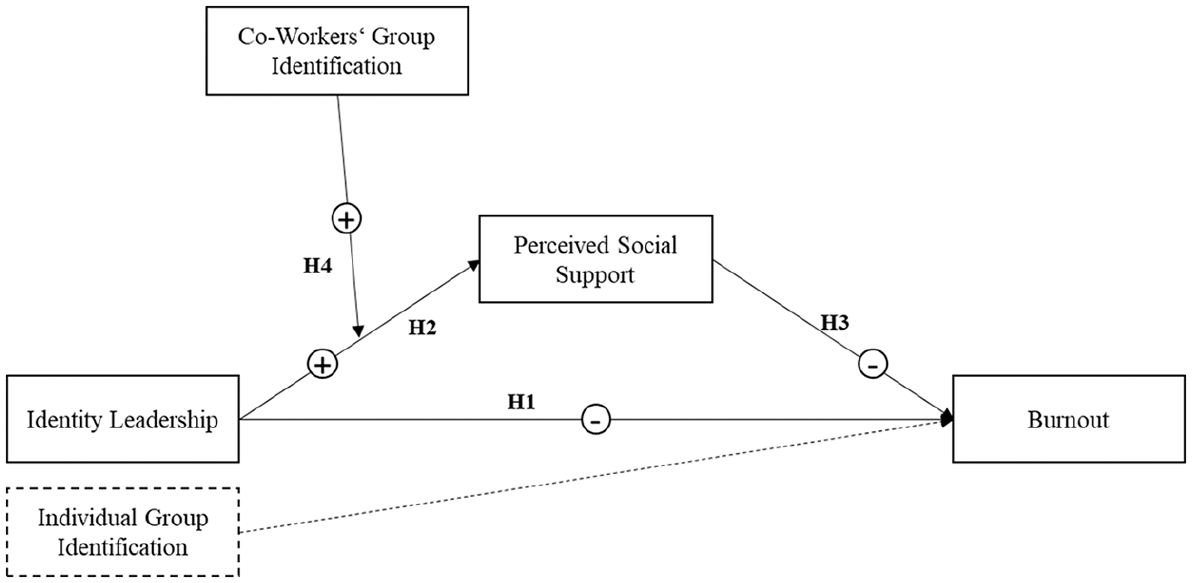
Conceptual model of present research.
This research contributes to the literature on leadership and health in organizations in at least three ways. First, previous work neglects the social context of leadership relationships and other group members. We go beyond previous research to understand the leadership-health link by examining the effect of leaders’ efforts to stimulate strong group identification among workgroup members on the experience of burnout. Second, by investigating perceived social support as an underlying process, the present research seeks to understand why identity leadership is related to reduced burnout. Third, following the call of Steffens et al. (2018), this research deepens our understanding by integrating properties of the group in the leadership-health equation. Complementing previous theorizing on the link between social identity (and identification) and well-being (Häusser et al., 2020), we explore the influence of co-workers’ group identification on the leadership-health link.
Theoretical Background and Hypotheses
Identity Leadership and Burnout
Generally, burnout describes “the exhaustion of employees’ capacity to maintain an intense involvement that has a meaningful impact at work” (Schaufeli et al., 2009, p. 205; see also: Maslach et al., 2001). Leadership behaviors are often seen as key to protect organizational members’ health from the adverse effects of exhaustive work demands. Accordingly, focus and investments have been put into researching the relationship of leadership and organizational members’ health at work (Harms et al., 2017; Montano et al., 2017). Because of these efforts, we do know that leadership matters when it comes to employee health, for better or worse. However, previous work predominantly focused on the dyadic relationships of leaders and employees neglecting the influence of co-workers and the social context within this relationship happens (Haslam & Reicher, 2006; Häusser et al., 2020; Steffens et al., 2018). The SIA-L is a perspective on leadership that acknowledges that leadership processes do not happen in a vacuum but are embedded in a social group (Haslam et al., 2011; Hogg, 2001; Hogg et al., 2012).
The idea of identity leadership (e.g., Haslam et al., 2011; Hogg, 2001; Hogg et al., 2012) is grounded in theoretical insights formulated in social identity theory (Tajfel & Turner, 1979) and self-categorization theory (Turner et al., 1987), which together are often referred to as social identity approach (Haslam, 2004; Hogg et al., 2004). One of the core tenets of the social identity approach is that individuals partly derive a sense of self from their membership in groups (Tajfel & Turner, 1979) and that self-categorization as a group member (e.g., a member of a workgroup) affects how people see the (social) world and interact with it (Hogg et al., 2004; Turner, 1991; Turner et al., 1987). In respect to exhaustive work demands, a person’s self-categorization as a member of a specific group is a relevant factor that influences (a) how stressors are perceived and experienced, and (b) which resources are available for coping (Haslam et al., 2018; Haslam & Reicher, 2006; McKimmie et al., 2020).
An important implication of the SIA-L is that social identities as a resource can be actively managed (e.g., Fladerer, Steffens, & Haslam, 2021; Haslam et al., 2011; Reicher & Hopkins, 2001). This point is underscored by a growing number of studies that point to the tangible benefits that flow from leaders’ rhetoric and actions, which help to develop and maintain a shared social identity among those they seek to lead (Fladerer, Haslam, et al., 2021; Fransen et al., 2015; Steffens & Haslam, 2013). For example, Slater et al. (2018) showcased in three experimental studies that a strong identification with a group leader facilitated followers’ mobilization for a group task and also followers’ psychophysiological adaption to stressors (measured as objective cardiovascular stress reactivity indicators) under pressure.
Identity leadership has been conceptualized as multi-dimensional construct with four facets labeled: (a) identity prototypicality, (b) identity advancement, (c) identity entrepreneurship, and (d) identity impresarioship (Haslam et al., 2011; Steffens, Haslam, Reicher, et al., 2014; van Dick et al., 2018). A recent global test of the factor structure of identity leadership showed that a correlated four-factor structure (as proposed by Steffens, Haslam, Reicher, et al., 2014), and a higher-order structure with a general identity leadership factor fit the data equally well (van Dick et al., 2018). Thus, all dimensions (although in different ways) share common ground in that they revolve around managing a shared social identity (Haslam et al., 2011). Identity prototypicality refers to the notion of being one of us (Haslam et al., 2011; Steffens, Haslam, Reicher, et al., 2014). Ample of evidence underscores the importance of leaders to be seen as one of us (rather than one of them) and representing what makes us special (Barreto & Hogg, 2017; Steffens et al., 2021; van Knippenberg, 2011). Identity advancement refers to the notion of doing it for us (Haslam et al., 2011; Steffens, Haslam, Reicher, et al., 2014). This dimension of the approach speaks to the importance for leaders to act in ways that promote the shared interests of the group they are leading (rather than those of an outgroup or their personal interests; e.g., Duck & Fielding, 2003). Identity entrepreneurship refers to the notion of crafting a sense of us (Haslam et al., 2011; Steffens, Haslam, Reicher, et al., 2014). As identity entrepreneurs, leaders need to actively engage in rhetoric and actions that create and maintain a shared sense of us among group members (Fladerer, Steffens, & Haslam, 2021; Reicher & Hopkins, 2001). Finally, identity impresarioship refers to the notion of making us matter (Haslam et al., 2011; Steffens, Haslam, Reicher, et al., 2014). This means inter alia that leaders develop structures, processes and events that allow group members to live out their shared social identity.
Two recent studies (Steffens, Haslam, Kerschreiter, et al., 2014; Steffens et al., 2018) highlighted the impact of leaders’ creation of a sense of group identity among workgroup members on burnout (and engagement). Steffens, Haslam, Kerschreiter, et al. (2014) found empirical support for the link of identity entrepreneurship and burnout. In a second study, Steffens et al. (2018) investigation in a time-lagged design strengthened findings that identity entrepreneurship reduces burnout and not the other way around. These initial insights lend credibility to the idea that identity leadership can reduce group members’ symptoms of burnout. However, both studies focused on one dimension of identity leadership, namely identity entrepreneurship, rather than all four dimensions jointly.
Above and beyond identity entrepreneurship, other dimensions reduce workgroup members’ burnout. For example, representing the norms and values of a group as a prototype makes potential followers more open for leader influence (van Knippenberg, 2011). At the same time, violations of group norms by workgroup leaders undermine the positive value of the shared social identity reducing group members’ identification (Ditrich et al., 2017). This hinders access to the resource social group. Furthermore, when leaders embed events and processes that help group members to experience the shared group identity with others this may foster their experience of connectedness and belonging (Haslam & Reicher, 2006). Moreover, these occasions provide the group members with opportunities to show supportive behavior (Haslam & Reicher, 2007). Thus, leadership behavior that fosters a shared sense of identity among group members and clarifies the purpose and goals of the group is likely to reduce the experience of burnout. More formally, we propose:
The Role of Perceived Social Support as a Mediator
Social support is one of the key resources for individuals to deal with challenges at work (Maslach et al., 2001). Social support can be defined as a general perception of the extent to which others in a group value one’s contributions and care about one’s well-being. The link of social support and burnout has been extensively studied showing generally a negative relationship (e.g., Kurtessis et al., 2017). However, in a recent analysis by Mathieu et al. (2019) buffering effects were almost as common as exacerbating effects of social support. One reason for this mixed pattern may be that the social context in terms of group membership (and identification) has not been taken into account in most previous studies. This is unfortunate because supportive behavior can be a threat to an individual’s integrity or a valued act of instrumental assistance depending on whether it comes from outside or inside the own group (Haslam et al., 2018; Jetten et al., 2012). For example, an experimental study by Frisch et al. (2014) demonstrated that social support buffered the cortisol response of participants in a social-evaluative stress situation only if shared identity between the participant and support givers was salient.
In this regard, recognizing another person as one of us and developing a shared sense of we-ness is the basis of social support in two ways: It influences the amount of social support behavior shown within a group and the interpretation of this behavior by other group members (Haslam et al., 2018; Häusser et al., 2020; Maslach et al., 2001). When individuals share a social identity, they will be more willing to give support to other group members (Levine et al., 2005) as well as perceive support they receive more positively (Haslam et al., 2012; Häusser et al., 2020) because this serves to advance the social identity they share (Haslam et al., 2018).
From the perspective of the receiver, we are all in the same boat is a necessary condition for perceiving the person providing support as having their best interests in mind (Haslam, 2004; Haslam et al., 2012; Häusser et al., 2020). This sense of shared identity has to be cultivated in the first place (Steffens, Haslam, Reicher, et al., 2014). Indeed, results by Steffens, Haslam, Reicher, et al. (2014) show that identity entrepreneurship as facet of identity leadership is positively related to perceived team support. Metaphorically speaking, leaders who engage in identity leadership facilitate group member’s perceptions of who belongs to the crew and, in consequence, how supportive behavior of others is to be interpreted. Thus, when a workgroup member perceives strong identity leadership, he or she is more likely to perceive behaviors by other group members as social support. This leads to our second hypothesis:
Perceived social support is likely negatively related to burnout because receiving support from other ingroup members has a buffering effect on stressors (Avanzi et al., 2015) and allows people to effectively cope with potential stressors (Haslam et al., 2005), thereby reducing stress and exhaustion (Thoits, 1986). Furthermore, within the social identity approach, it is argued that access to social support based on group membership changes the appraisal of stressors (Haslam et al., 2018) with events of personal distress turning into collective events of eustress (Haslam, 2004; Haslam & Reicher, 2006). Thus, instead of asking, “Can I cope with a customer’s complaint?” people that self-categorize as members of the workgroup will more likely ask, “Can we cope with the complaint?” resulting in lower stress and exhaustion or even eustress because of access to additional resources (Haslam et al., 2018; van Dick & Haslam, 2012). Haslam et al. (2005) showed in two studies that social support was strongly negative related to the experience of stress. More recently, Avanzi et al. (2015) found a significant and negative relationship of social support and indicators of burnout (i.e., emotional exhaustion, cynicism, reduced personal accomplishment). Building on this theoretical and empirical work, we suggest that social support negatively relates to symptoms of burnout and (partially) mediates the link of identity leadership and burnout. More formally, we hypothesize:
The Interaction of Identity Leadership and Co-Workers’ Group Identification
From a social identity perspective on leadership, leader-follower-interactions occur within the context of social groups, such as workgroups (e.g., Haslam et al., 2011; Hogg et al., 2004). And the social context will likely affect one’s perceptions and experiences at work (cf. Gill & Caza, 2018). In line with this idea, other group members become an important source of information on how to interpret leader behaviors (Chrobot-Mason et al., 2016; Häusser et al., 2020; Hogg, 2001). In this study, we look at co-workers’ group identification as source of behaviors that may reinforce (or subvert) leader’s efforts. Co-workers’ group identification is conceptualized as the average level of group identification of all other group members except the focal member (cf. additive composition model; Chan, 1998). Importantly, thereby, individual and contextual effects of group identification are separated. This bears several methodological advantages, but it is also of theoretical interest.
First, group identification may vary within a workgroup (Häusser et al., 2020; Steffens et al., 2017). While a uniformly strong group identification among workgroup members may characterize high performance teams (cf. Dietz et al., 2015), generally variations of identification will exist within a group, particularly in larger groups. In this way, the pattern of co-workers’ group identification creates a unique social context for each group member. This is because co-worker’s group identification will be expressed in their attitudes and behaviors as well as interpersonal behaviors. The cumulating observations of other group members’ behaviors will likely affect the focal members own experiences at work (Chan, 1998; see also: Gill & Caza, 2018). For example, when a group member observes that most members are offering and accepting support, she will likely interfere that she can also ask for help in this group, irrespective of her own identification. In a study by Haslam and Reicher (2006), results showed that low social support among group members and high group withdrawal prevailed when members were weakly identified. This led to a situation in which group members had to deal individually with (external) challenges and stressors. In contrast, in a comparison group where a strong identification developed, also acts of social support increased (see also, Levine et al., 2005).
Following this reasoning, if leader’s behaviors promote a shared sense of social identity, it is more likely to impact group members’ perceptions when it is validated by other group members (Chrobot-Mason et al., 2016; Hogg, 2001). That is, the words and actions of the leader are replicated in the social reality of a group member. For example, leaders do not only proclaim mutual support, but other group members actually provide it. Therefore, in groups where most members report high levels of social identification, workgroup interactions will be qualitatively different from those groups where most followers do not identify with the group. When there is a match between leader behavior promoting a shared social identity and other group members’ behavior of it, the impact of the leadership behavior will be amplified. This leads to our fourth hypothesis:
Method
Sample and Procedure
We collected data in dealerships and sales branches of a large automobile and motorcycle manufacturer in Germany. Our study focused on the dealerships and sales branches as workgroups. The director of each dealership or the branch manager was the formal leader of the workgroup. Employees of dealerships and sales branches were invited to participate in the online survey via the company’s mailing list. Participants were not compensated for their participation. Participants were informed that only aggregated results would be reported, and that it would not be possible to identify individual responses. It was optional for participants to provide demographic information, but they were encouraged to do so for data quality. Seven hundred fifty-six individuals successfully completed the survey. Individual responses were matched by a unique code for the dealership or sales branch. As a general rule, at least three members of a dealership or sales branch had to participate for the workgroup to be included in the sample. This was necessary condition to compute a score for co-workers’ group identification. After matching, the final sample was composed of 77 workgroups (with a least three individual responses) and a total of 319 participants (Mmembers = 4.16; range: 3–13).
Participants in the final sample were distributed over four broad groups of age: 26.6% were younger than 25 years, 29.4% of the participants were between 26 and 35 years old, 19.0% were between 36 and 45, and 25.0% older than 45 years. The proportion of men in the sample was 67.7%. About 90% of the participants worked in dealerships or sales branches with more than 30 employees (89.3%), and more than half worked at their dealership or sales branch for more than 4 years (58%). In terms of education, 44.5% of participants had an intermediate secondary school qualification, while 11.0% had no or a general secondary school qualification, and 44.5% at least a higher education entrance qualification. 2 About three quarters (74.7%) of participants reported interacting with the director of the dealership or the branch manager more than weekly.
We tested for differences between the demographics for individuals who were not included (n = 437) and were included (n = 319) in the final sample. Individuals were excluded when less than three members of their workgroup participated in the survey. Excluded individuals were on average older [F(1,749) = 10.01, p = .002, Mincl = 2.42, Mexcl = 2.69; Cohen’s d = .24)], less educated [F(1,731) = 9.80, p = .002, Mincl = 3.75, Mexcl = 3.47; Cohen’s d = .23)], and interacted more often with their director or manager [F(1,705) = 4.77, p = .029, Mincl = 2.63, Mexcl = 2.73; Cohen’s d = .16]. Testing for potential differences in the focal variables, analyses showed that individuals who were excluded more strongly identified with their workgroup than individuals included in the final sample, F(1,753) = 5.47, p = .020, Mincl = 3.79, Mexcl = 3.92, Cohen’s d = .17. All other differences were nonsignificant (p > .05). Means, standard deviations, and correlations between variables are presented in Table 1.
Means, Standard Deviations, and Correlations of Study Variables.

Note. N = 299 to 319. N varies in demographic variables, which were optional to answer. Variables 1 to 6 were categorical. Means and standard deviations are not displayed for categorical variables. Identity leadership and group identification were measured on a 5-point scale. Perceived social support was measured on a 7-point scale. Burnout was measured on a 4-point scale. Cronbach’s alpha estimates are displayed on the diagonal.
p < .05. **p < .01. ***p < .001.
Measures
Identity leadership
Identity leadership was assessed using the validated German version of the Identity Leadership Inventory (ILI; Steffens, Haslam, Reicher, et al., 2014; van Dick et al., 2018). 3 Sample items for the four dimensions of identity leadership include “The leader is a model member of [the group]” for identity prototypicality, “This leader acts as a champion for [the group]” for identity advancement, “This leader creates a sense of cohesion within [the group]” for identity entrepreneurship, and “This leader creates structures that are useful for [group members]” for identity impresarioship. The focal leader was the director of the dealership or the branch manager. The workgroup was defined as all members of the dealership or branch office. Participants rated the statements on a 5-point scale ranging from completely disagree (1) to completely agree (5). Cronbach’s α of the scale in our study was .97.
We conducted confirmatory factor analyses to assess the factor structure of the ILI. We compared four models: oblique four-factor model, higher-order factor model, single-factor model, and four orthogonal first-order factors model (Steffens, Haslam, Reicher, et al., 2014; van Dick et al., 2018). Table 2 shows that the oblique four-factor model and the higher-order factor model fit the data equally well, Δχ2(2) = 3.691, p = .158, and better than the other two models. In favor of a more parsimonious model, we tested whether our data supported the existence of a higher-order factor model (see Credé & Harms, 2015). Three sets of information indicated that the higher-order factor model (a) reproduces the observed covariation among lower-order factors (RMSEA-P = .05, Target Coefficient = .99, Relative Normed-Fit Index = .99), (b) explains variation in lower-order factors (Average Variance Extracted = .90), (c) and explains variation in manifest variables well (M = .69, range = .41–.85). In consequence, we used the higher-order factor model in subsequent analyses.
Test of Factor Structure of Identity Leadership.

Note. N = 302. The oblique first-order model is the baseline model against which the other models are tested. CFI = Comparative Fit Index; TLI = Tucker-Lewis Index; RMSEA = root mean square error of approximation; 90% CI = 90% confidence intervals; SRMR = standardized root mean square residual.
Burnout
Burnout was measured with the validated German version of the Oldenburg Burnout Inventory (OLBI; Demerouti et al., 2003). The OLBI was specifically designed to measure burnout at the workplace and can be applied to any occupational group (Demerouti et al., 2001). Burnout is measured on two broad dimensions: exhaustion and disengagement (Demerouti et al., 2001, 2003). Exhaustion is defined as, “a consequence of intensive physical, affective, and cognitive strain” (Demerouti et al., 2003, p. 14). Disengagement “refers to distancing oneself from one’s work and experiencing negative attitudes toward the work object, work content, or one’s work in general” (Demerouti et al., 2003, p. 14). Sample items are, “After my work, I usually feel worn out and weary” (exhaustion), and “Lately, I tend to think less at work and do my job almost mechanically” (disengagement). Participants rated the 16 items on a 4-point scale ranging from strongly disagree (1) to strongly agree (4). Cronbach’s α was .87.
Perceived social support
Perceived social support was measured using eight items from Eisenberger et al. (1986). A sample item is, “The [group] really cares about my well-being.” The referent of this scale was the workgroup of the participant (i.e., dealership or sales branch). Participants rated the statements on a 7-point scale ranging from completely disagree (1) to completely agree (7). Cronbach’s α was .90.
Individual group identification
Individual group identification was measured using six items from Mael and Ashforth (1992). Participants’ reference group was their dealership or sales branch when answering these questions. A sample item is, “When I talk about my workgroup, I usually say ‘we’ rather than ‘they’.” Participants rated the statements on a 5-point scale ranging from completely disagree (1) to completely agree (5). Cronbach’s α was .78. This variable was included as control variable in our model (cf. McKimmie et al., 2020 4 ).
Co-workers’ group identification
Participants reported which dealership or sales branch they worked for via a code and this was used to identify members of the same workgroup. Co-workers’ group identification score was calculated for each participant by averaging the group identification scores of all other members of his or her workgroup. This approach is consistent with the additive composition model (Chan, 1998). The meaning of the composite score “is a summation of the lower level units regardless of the variance among these units” (p. 236). Therefore, within-group agreement indices (e.g., ICC(1)) are not warranted as agreement among individuals is not required. The additive composition model explicitly allows for variance between group members, meaning all group members may identify at differing degrees. In this way, although being members of the same group, the score of one member is not necessarily a proxy for other group members’ identification. Yet, the composition of one’s social environment (e.g., co-workers’ group identification) will likely affect one’s attitudes and behaviors through interpersonal influences (rather than the emergence of a distinct group level phenomenon; Chan, 1998; see also: Gill & Caza, 2018).
We used an average, rather than a sum, to adjust for differences in participating workgroup members in our sample. Thus, the co-workers’ group identification score was calculated independently of the individual group identification score; a focal participant’s data had no influence on the co-workers’ group identification score associated with him or her. Thus, each participant had an individual-level score for the contextual effect. This procedure eliminates common method bias from this analysis as individual and contextual effects are distinct (Podsakoff et al., 2003).
Demographic variables
We assessed several demographic variables: age, gender, education, size of the workgroup, years in the workgroup, and frequency of interaction with leader. Of these, frequency of interaction with leader correlated significantly with the mediator and dependent variable. It was included in the analysis but did not meaningfully change the pattern of results and only reduced sample size due to missingness (nmis = 18). Therefore, frequency of interaction with leader was omitted from subsequent analyses (cf. Becker et al., 2016).
Analytical Approach
Because we proposed a model of relationships between identity leadership, perceived social support, co-workers’ group identification (i.e., an individual score), and individual burnout symptoms, an analytical approach was chosen to take into account the multilevel data structure. However, because the data structure was a by-product of data collection rather than of interest for our research question, we applied a population-averaged method (McNeish et al., 2017). More precisely, we used the cluster robust-standard error (CR-SE) method to account for the clustering in our data. This approach has several advantages, beyond its adequacy for our research question: (1) there are less assumptions than in hierarchical linear modeling, (2) the output contains OLS-equivalent R2 and effect sizes while accounting for clustering, and (3) it is less sensitive to small cluster sizes (i.e., small number of individuals per cluster). 5
We conducted confirmatory factor analysis for all items on the individual level using the lavaan package (Rosseel, 2012) in R (R Core Team, 2020). We used the MLR estimator with robust standard errors. We parceled the items for each latent variable combining the item-to-construct balance with the a priori questionnaire construction approach where appropriate (e.g., reverse coded items; for a review, see Williams & O’Boyle, 2008). We compared the proposed four-factor model (FFM; i.e., identity leadership, individual social identification, social support, and burnout) to a general factor model (GFM). Three fit indices were examined for each model: robust chi square (χ2), robust Comparative Fit Index (rCFI) and robust Root Mean Square of Approximation (rRMSEA). The GFM fit the data poorly, χ2(54) = 1,205.76; p < .001; rCFI = .543; rRMSEA = .285. In contrast, the FFM fit the data well, χ2(46) = 77.37; p = .003; rCFI = .988; rRMSEA = .049, and significantly better than the GFM (Δχ2(8) = 1,128.39, p < .001).
The moderated mediation analysis was performed using the statistical software Mplus (Muthén & Muthén, 1998–2017). The type COMPLEX was chosen for the analysis that takes the non-independence of observations into account and corrects the standard errors for clustering. The modeling was based on the conditional process analysis approach by Hayes (2018). Adapting the code provided by Stride et al. (2015) for performing conditional process analysis in Mplus (cf. PROCESS macro for SPSS), we specified and tested the proposed moderated mediation model (Model 7; see Figure 1). The number of bootstrapped estimates was 10,000.
Results
We conducted a moderated mediation analysis (Model 7, Hayes, 2018) with co-workers’ group identification as moderator of the relationship between identity leadership and perceived social support (i.e., first-stage moderator; Holland et al., 2017). To do so, two multiple regression models were generated. The mediator model specified perceived social support as dependent variable, while the dependent variable model specified burnout as dependent variable. Results are summarized in Table 3.
Results of Moderated Mediation Model.

In the mediator model (R2 = .123), perceived social support was positively and significantly related with identity leadership (b = 1.913, SE = .564, p = .001, 95% CI [0.767; 2.969]) and co-workers’ group identification (b = 1.338, SE = .518, p = .010, 95% CI [0.241; 2.280]). These are conditional main effects and should not be interpreted without taking the interaction term into consideration. Therefore, each main effect was estimated at the mean of the other interaction variable. At the mean of co-workers’ group identification, the relationship of identity leadership and perceived social support was positive and significant (b = .404, SE = .065, p < .001, 95% CI [0.277; 0.532]). At the mean of identity leadership, the relationship of co-workers’ group identification and perceived social support was negative although not significant (b = −.018, SE = .158, p = .908, 95% CI [−0.328; 0.291]).
In the mediator model, the interaction of identity leadership and co-workers’ group identification was significant and negative (b = −0.405, SE = .147, p = .006, 95% CI [−0.685; −0.111]). To determine the direction of the interaction, we plotted the interaction between identity leadership and co-workers’ group identification on perceived social support at low (−1 SD) and high (+1 SD) levels of co-workers’ group identification and as a function of identity leadership (from −1 SD to +1 SD). As can be seen in Figure 2, the interaction is in the opposite direction than predicted; that is, the relationship of identity leadership and social support is weaker when co-workers’ group identification is high (rather than low). This implies that the relationship of identity leadership and social support is the strongest at low levels of co-workers’ group identification. This relationship remains significantly positive but weakens as co-workers’ group identification gets stronger.
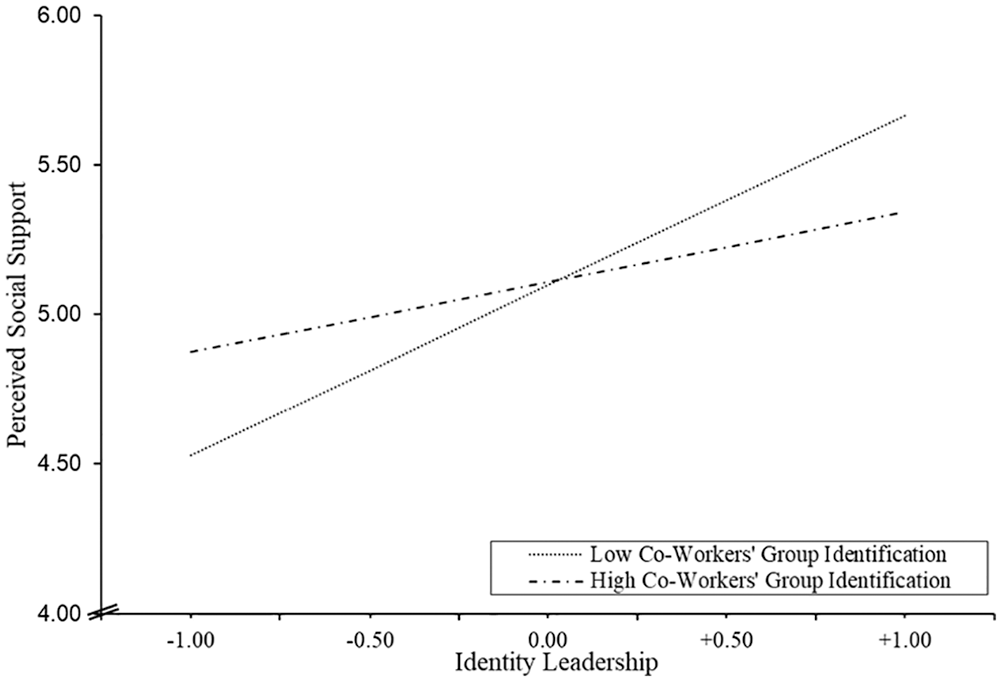
Interaction of identity leadership and co-workers’ group identification on perceived social support.
In the dependent variable model (R2 = .296), identity leadership (b = −.166, SE = .031, p < .001, 95% CI [−0.227; −0.106]), individual group identification (b = −.098, SE = .045, p = .029, 95% CI [−0.187; −0.011]), and perceived social support (b = −.117, SE = .028, p < .001, 95% CI [−0.173; −.062]) are negatively related to burnout. The index of moderated mediation was significant (b = .048, SE = .018, p = .009; 95% CI [.022; .082]). The conditional indirect effect was b = −0.063 (SE = .015, p < .001, 95% CI [−0.096; −0.036]), b = −0.044 (SE = .011, p < .001; 95% CI [−0.070; −0.024]), b = −0.025 (SE = .012, p = .030, 95% CI [−0.054; −0.007]) for values at −1 SD, the mean, and +1 SD of the moderator, respectively.
Discussion
At the heart of this study lies the question what organizations can do to reduce symptoms of burnout at work that ultimately result in substantial harm and costs for individuals, organizations, and societies (Hassard et al., 2018). Building on theory and previous research on the social identity approach to leadership (e.g., Haslam et al., 2011; Steffens, Haslam, Reicher, et al., 2014) and to health (e.g., Haslam et al., 2018; Häusser et al., 2020; Jetten et al., 2012), we investigated the role of identity leadership as means to strengthen workgroup members’ perception of social support and to reduce symptoms of burnout (i.e., exhaustion, disengagement; Demerouti et al., 2001). Moreover, we examined the role of the social environment of individual workgroup members (i.e., that is, the average level of co-workers’ group identification) in the relationship between identity leadership and perceptions of social support.
In a sample of 319 employees from 77 workgroups, identity leadership is related to higher levels of perceived social support and lower levels of burnout. An analysis of the indirect effect found perceived social support as intervening variable in the leadership-burnout relationship. Moreover, co-workers’ group identification significantly moderated the relationship of identity leadership and perceived social support but in the opposite direction than expected. Rather than strengthening the relationship of identity leadership and perceived social support, high levels of co-workers’ group identification weakened this relationship. Although, we did not anticipate this finding, it can be explained within the social identity approach. In workgroups where most members identify strongly, more members already have a strong feeling of oneness with the workgroup and its goals, norms and values (i.e., they care about the group; Haslam, 2004). Thus, more likely a strong consensus exists who we are and what we do (cf. Dietz et al., 2015). In this situation, efforts of the formal leader that are targeted at developing and clarifying these issues might have less impact on followers; although, the positive impact of identity leadership of the formal leader is still in effect.
This reasoning also resonates with another important aspect of the SIA-L. That is, social influence is not bound to formal organizational roles of power (Fladerer, Steffens, & Haslam, 2021; Haslam et al., 2011). When members identify with a group, they show behaviors that contribute to the group’s goal achievement and act in ways that reflect the norms, standards, and values of the group. They will also accept social influence by other group members (Chrobot-Mason et al., 2016; Hogg et al., 2004; Pescosolido, 2001). Thus, in groups where most members are identified, leadership becomes a group process (rather than something that one person has or possesses; Haslam et al., 2011). This is one reason why the influence of the formal leader may be less pronounced.
Does this mean that formal leadership in organizational settings becomes superfluous in groups where most members are strongly identified? We do not think so. If group identification can substitute for formal leadership, (1) how does group identification form and (2) how is it sustained over time? These are the cases in which formal leadership matters.
The first part of the question can be answered partly by our findings. These show that identity leadership was particularly relevant in situations where co-workers’ group identification was low. Moreover, there was no relationship between co-workers’ group identification and symptoms of burnout within this sample (see Table 1). Thus, by managing an identity, leaders can promote identification (Steffens, Haslam, Reicher, et al., 2014). This is also important in light of findings suggesting that the effects of social identification on reducing burnout are stronger when all members of a workgroup share the same degree of identification (Häusser et al., 2020; Steffens et al., 2017).
We explored this aspect of the dynamics of group member’s identification in our data. 6 In our sample, shared group membership did not explain variance in group identification and within-group variance of identification was low to medium in most groups—pointing to a certain degree of sharedness. However, in some groups the variance of social identification was large (i.e., some members identified strongly while others weakly). The reasons why or why not a person identifies with a specific reference group are manifold (e.g., experiences; other priorities). Particularly, in larger groups (90% of participants worked in dealerships or sales branches with 30+ employees) one may expect to find greater variance than in smaller groups (e.g., Riketta & van Dick, 2005). Yet, even when group identification is not shared, the additive effect of other group members’ behavior will shape the experience of individuals in the group (cf. Gill & Caza, 2018). In an exploratory analysis, we could not find evidence for a moderating role of the diversity of co-workers’ group identification (operationalized as SD) on the relationship of identity leadership, mean of co-workers’ group identification, and perceived social support. This result does not align with theory (Häusser et al., 2020) and recent findings (Steffens et al., 2017) regarding the beneficial effects of shared social identification within workgroups and organizations. Yet, to fully understand the effects of within-group variance it is important to take qualitative aspects and underlying assumptions into account (Harrison & Klein, 2007). For example, variance may be an expression of variety rather than separation and may broaden the cognitive and behavioral repertoire of a group (and thus, increase adaptability and flexibility). Moreover, the tolerance of within-group variance may differ as a function of group norms (e.g., individualistic vs. collectivistic; Hornsey et al., 2006). Investigating the interplay of strength and variability of social identification within social groups will be an important issue for future research to resolve.
The second part of the question—how identification can be sustained over time—cannot be answered with cross-sectional data but is an interesting field to explore in future research. Research shows that social identification (e.g., with a workgroup) varies over time and is affected by internal and external events (e.g., Haslam & Reicher, 2006). Moreover, future research should examine whether leader’s efforts to develop a strong shared social identity are effective over time and at what point they manifest in changes of attitudinal and behavioral patterns within workgroup members and a workgroup as a whole. In addition, understanding how changes in individual group members affect other group members, in the sense of acting as identity stewards, will also be relevant if we seek to capture the leadership process that unfolds within a group.
Limitations
This study had a cross-sectional design. In this case, all variables where measured at one point in time which limits our understanding of how these relationships unfold over time and their causality (Podsakoff et al., 2012). At the same time, a strength of this research is the incorporation of an independent measure (i.e., other-rating) for co-workers’ group identification which reduces method bias (Podsakoff et al., 2003, 2012) as well as adequately addressing the issue of data clustering (McNeish et al., 2017). Thus, longitudinal designs with multiple points of measurement could help to further investigate the processual relationship of identity leadership on employees’ health and well-being (e.g., Willis et al., 2019).
For each scale, we used its original scale anchors and number of response categories. All measured were assessed on agreement rating scales and poled identically (from completely disagree to completely agree). The number of response categories varied: Burnout was assessed on a 4-point, identity leadership and group identification on a 5-point, and perceived organizational support on a 7-point rating scale; but, all scales are within the recommended range for psychometric analyses (Lee & Paek, 2014; Lozano et al., 2008). The internal consistency of all scales was above .70. Together these observations led to the conclusion that using different numbers of response categories did not threaten the reliability or validity of our measures (Lozano et al., 2008).
Our research was conducted under the umbrella of one major automobile company. Although, the reference group was the immediate dealership or sales branch and its leader, participants’ identification with the overarching company could also affect this relationship (van Dick et al., 2008). Beyond hierarchically structured formal social categories (e.g., as work team, dealership, organization), cross-cutting identities, which can be either formal or informal (e.g., age, ethnicity), are available to and often important for organizational members (Ellemers & Rink, 2005). The relationship between and the management of these identities might also affect organizational members’ health and well-being at work.
Furthermore, the present research was conducted within the specific context of the automotive industry. The automotive industry is currently going through profound changes in technology (e.g., autonomous driving) and production (e.g., Industry 4.0) as well as business models (e.g., sharing economy). In times of organizational and industry changes, often coinciding with organizational members’ stress, the need for identity leadership might be more pronounced than in more stable contexts (Jimmieson et al., 2004). Another contextual variable of relevance could be the perceived external prestige of the company and/or industry (Smidts et al., 2001). The automotive industry and the examined company are both very well respected in Germany. In less prestigious industries and companies, the need to engage in identity leadership might be particularly pronounced (Crabtree et al., 2010). Thus further examination of industry and company prestige and identity leadership warrants future research.
Practical Implications
The present research underscores the potential for organizations to promote employees’ health through leadership and identity development. Particularly, leadership behaviors that aim at promoting and creating a shared sense of us seem to be fruitful. Thus, in accordance with the 5R Program (Haslam et al., 2017), in a first step (readying), organizations and their members can profit from familiarizing themselves with the importance of social identity processes for team and organizational functioning. Following this, on workgroup, department and organizational level the persons involved (or a delegation of them) can engage in activities to reflecting (i.e., understanding existing formal and informal identities; see also: Wimmer et al., 2019), representing (i.e., defining shared values and behaviors) and realizing (i.e., initiating structures and processes) their shared social identity. This could for example involve group activities to develop a shared set of group values and to bring them into life within the group.
Importantly, to sustain developments over time organizations and leaders cannot stop at this point. As discussed above, social identities are fluid constructions of social and organizational realities. These may be subject to change—even if at one point in time social identification with a group is high (and thus, positive effects on workgroup members unfold), there is no certainty that this will stay this way. Thus, leadership and in particular, identity leadership needs to be understood as process where leaders and followers continuously co-create social structures (Fladerer, Steffens, & Haslam, 2021; Haslam et al., 2011).
Burnout is a serious workplace hazard and rising numbers of employees are affected by this peril. Moreover, it is not only a threat to the health of individuals, but also comes with enormous economic and societal costs (Hassard et al., 2018). Researchers and practitioners alike turn to organizational leaders’ role as potential cure for this problem. In the present research, we broaden this perspective by including the “group” in the leadership-health link.
Footnotes
Declaration of Conflicting Interests
The author(s) declared no potential conflicts of interest with respect to the research, authorship, and/or publication of this article.
Funding
The author(s) received no financial support for the research, authorship, and/or publication of this article.
