




Abstract
Despite the fundamental relevance of team boundaries for team research, scholars have rarely explored their origins and characteristics. Instead, team research commonly assumes the existence of formally defined, stable team boundaries. We challenge this assumption by asserting that beyond formal assignment, team members’ individual perceptions of a team’s boundaries are driven by individual-level categorization processes and team-level task dynamism. Building on multiple team members’ mental representations of team boundaries, we propose that team boundaries are likely mutually inconsistent and vary in their degree of permeability. This permeability and inconsistency serve to clarify how membership change and overlap can induce cognitive and emotional spillovers across teams. The proposed conceptual model links the origins of boundary emergence with their characteristics by explaining how membership structure and dynamics drive the characteristics of team boundaries. This account offers a new perspective on how individual perceptions of work affiliations can shape a team’s boundaries.
Teams have commonly been defined as social systems with clear boundaries that work together for a common purpose (e.g., Hackman, 2012; Wageman, Gardner, & Mortensen, 2012). Boundaries help to demarcate teams from their intraorganizational environment; thus, they allow the identification of who is a team member and who is not (Alderfer & Smith, 1982). Despite being deeply rooted in the definition of teams, recent research notes that it remains unclear what constitutes team boundaries or why and how they emerge (Mortensen, 2014; Mortensen & Haas, 2018). Beyond that, the increasingly unpredictable business environment, enlarged variety of tasks, continuous debureaucratization, and greater geographical dispersion of teams increases the structural and relational complexity within the organization and introduces dynamism to team compositions (Hackman, 2012; Okhuysen et al., 2015). In such environments, team membership changes over time and individuals may be engaged in multiple teams, groups, or communities, threatening the stability and salience of team boundaries (Faraj & Yan, 2009; Hackman, 2012; Mortensen & Haas, 2018).
Among those addressing these developments, Mortensen and Haas (2018) have shown that the paradigm of clearly bounded teams is widely spread in team research. The researchers outline a range of mechanisms that render boundaries less stable, entailing a need to change how teams should be studied, both theoretically and empirically. Other scholars have explored how teams change from bounded, stable, and formally distinct organizational units to networks of fluid relationships (Dibble & Gibson, 2017; Humphrey & Aime, 2014; Wageman et al., 2012). Similarly, further studies highlight the adaptive and dynamic nature of teams and call on future team research to adopt a dynamic perspective (Cronin, Weingart, & Todorova, 2011; Ramos-Villagrasa, Marques-Quinteiro, Navarro, & Rico, 2017; Wageman et al., 2012). For example, Humphrey and Aime (2014) elaborate a dynamic, open-system perspective that focuses on the organizing aspects of teams, including boundary creation and maintenance.
In opening the debate about team boundaries and outlining the need for a theoretical conceptualization of team boundaries and their characteristics, these papers neither explicitly discuss what constitutes team boundaries nor what properties they show. Even literature streams focusing on the spanning and reinforcing activities of team boundaries (Ancona & Caldwell, 1992; Faraj & Yan, 2009) do not specifically define team boundaries and their characteristics. It remains unclear how specifically the team is demarcated from its environment. This is surprising as theory (e.g., social identity theory) has been built on the assumption that people can clearly identify such boundaries. Moreover, as cumulative constructs, such as team diversity, arise once a boundary is drawn around a collective of individuals (Cronin et al., 2011; Mortensen & Haas, 2018), we predict that team and individual outcomes may be distorted without a more detailed understanding of what team boundaries are, how they emerge, and what they imply. Therefore, our goal with this article is to provide a multilevel perspective on the emergence of team boundaries and characteristics.
Social identity theory predicts that individuals categorize their environment into in- and out-groups. The in-group is a collective that is identified as a team by its team members and by people outside the team (Ashforth, Schinoff, & Rogers, 2016). Identification with one’s team is an important antecedent for a range of desired organizational outcomes, such as organizational citizenship behavior, improved team processes, and job satisfaction (Ashforth, Harrison, & Corley, 2008). Then what would be the chosen out-group of an employee who is a member of several teams? Social identity theory claims that in the case of multiple social identities, one of them will be more salient than the others and that this salience shifts according to the situation (Ashforth & Johnson, 2001). However, this perspective fails to consider in detail the potentially disruptive effects of constant shifts in identity salience when employees may find themselves in several contexts simultaneously, for example, due to multiple team memberships. To understand how individuals cope with multiple identities, then, further insights are needed into the effects of multiple work domains and the permeability of boundaries between them.
The purpose of this article is to theoretically develop the fundamentals of team boundaries by answering the following research question:
To address this question, we develop a conceptual multilevel model of the emergence of team boundaries and their properties. In particular, we understand team boundaries as the multiplicity of all formal and informal demarcations of a team from its environment as enacted by individuals on the basis of their mental representations of the team. Drawing from social identity theory, this definition accommodates and emphasizes the inconsistency between formal and informal team boundaries that needs to be taken into account when studying teams. In addition, we advance a theoretical view of how and why team boundaries are inconsistent and permeable, noting the potential impacts of both boundary characteristics.
With this multilevel perspective on team membership, we enrich existing theories on team collaboration and contribute to the existing literature in two ways. First, by bridging a conceptual gap concerning team boundaries as current research reflects a silent consensus that team boundaries are determined by formally assigned team membership (Hackman, 2012). Challenging this assumption, we derive two categories of informal team boundaries—social categorization and mutual focus of attention—from social identity theory and theories on group dynamics that coexist with team-level boundaries defined by the organization. Arguing that the emergence of informal boundaries causes boundary inconsistency at the micro level, we extend previous research on boundary multiplicity and uncertainty (Mortensen, 2014; Mortensen & Haas, 2018). In addition, we contribute to closing the theoretical gap between research that builds on the assumption of clearly bounded teams (e.g., Hackman, 2012; Tannenbaum, Mathieu, Salas, & Cohen, 2012) and more open and ambiguous team boundaries (Humphrey & Aime, 2014; Metiu & Rothbard, 2013; Wageman et al., 2012). Neither of these research streams explicitly state what boundaries are, yet, such a definition is indispensable for further exploration of the impacts of team boundaries on teams and individuals. Thus, our classification of team boundaries, based on their origins and characteristics, represents the first step toward consolidating these two research streams.
Second, our analysis of the inconsistency and permeability of formal and informal boundaries contributes to current research analyzing the interplay between formal and informal intra- and interorganizational structures and the overall reduction of bureaucracy (e.g., Biancani, McFarland, & Dahlander, 2014; Gulati & Puranam, 2009; McEvily, Soda, & Tortoriello, 2014). This research has shed light on informal types of team memberships (Biancani et al., 2014; Mortensen, 2014) and on the performance benefits companies can reap from inconsistencies between the formal and the informal organization (Gulati & Puranam, 2009; Soda & Zaheer, 2012). McEvily et al. (2014) show that many questions remain open, such as explaining how, why, and when informal relationships emerge, what impacts they have on the effectiveness of formal relationships and membership ties, and how these relationships differ from formally defined structures. Following McEvily et al.’s (2014) call for an integration of research on formal and informal structure, we examine how structural variables at the team level affect team boundary characteristics.
Team Boundaries in Organizational Theory
Team boundaries are commonly understood as the clear distinction between members and nonmembers of a team (Ancona, Bresman, & Kaeufer, 2002; Ancona & Caldwell, 1992; Yan & Louis, 1999). This construct has been analyzed from a closed-systems perspective, with the main purpose being to protect the core activities of the team from undesired external disruptions and environmental uncertainty. This demarcational view on team boundaries was followed by a transactional view that understands boundaries as the interface among organizational units that enables resource exchanges, such as information, knowledge, and expertise (Cross, Yan, & Louis, 2000; Hoegl, Weinkauf, & Gemuenden, 2004; Somech & Khalaili, 2014; Yan & Louis, 1999). In this vein, researchers began to investigate when and why individuals and teams engage in boundary activities, particularly in bringing up, buffering, and spanning team boundaries. As a result, the extant research on team boundaries largely focuses on exploring how teams and individual team members seek to actively shape the organizational environment for their team by engaging in team-external activities, such as persuading outsiders to support a team’s decision (Joshi, Pandey, & Han, 2009; Marrone, Tesluk, & Carson, 2007; Yan & Louis, 1999). Team boundaries serve the purpose of filtering and managing the information flow and social interactions between the team and team-external entities (Choi, 2002). Ancona and colleagues (2002) were among the first to highlight the embeddedness of teams in organizational and interorganizational environments, paving the way for a series of studies on issues of boundary management, including boundary spanning (e.g., Harvey, Peterson, & Anand, 2014), reinforcement, and buffering (e.g., Drach-Zahavy & Somech, 2010; Faraj & Yan, 2009). Laying the ground for an analysis of the effects of boundaries on individuals and teams by showing how people behave at the team boundary and interact with the team-external environment, the research on team boundary spanning does not shed light on the origins and properties of team boundaries. Although there is a theoretical basis for the multiple sources of organizational boundary emergence (see Santos & Eisenhardt, 2005 for an overview) and despite calls for an elaborated open systems perspective on teams (Yan & Louis, 1999), theory on team boundary emergence remains sparse.
A second domain of research on team boundaries started to emerge in recent years that investigates the social constructedness of team boundaries (Dibble & Gibson, 2017; Wageman et al., 2012). Consequently, this allows for different degrees of team boundedness instead of drawing a clearly visible line between the inside and outside of a team. Humphrey and Aime (2014) argue that it is not formal assignment that delineates a team from its environment, but the nature of joint activities. If these are organizing activities, the collective that performs them can be viewed as bounded by their activities. Unfortunately, the authors do not define organizing activities and, therefore, do not provide a comprehensive concept of team boundaries. Metiu and Rothbard (2013) elaborate on that in more detail by analyzing how task bubbles—permeable barriers around groups of people who focus their mutual attention on one task—create temporary boundaries that shift depending on who is needed to accomplish the task. Their work is among the few that show how boundaries emerge and that they can be permeable and dynamic. Additional research shows that teams are less bounded than has previously been assumed, as membership is a matter of degree and as many teams are characterized by a core and a periphery (Biancani et al., 2014; Dahlander & Frederiksen, 2012; Dibble & Gibson, 2017; Edmondson & Harvey, 2018). Mortensen and Haas’s (2018) theory on team boundaries posits that formally assigned boundaries are perceived differently by individuals and change over time and thus result in permeable team boundaries. Their perspective on boundaries focuses on boundary blurring and the reasons for this development. We further argue that the diverging mental models of team boundaries create new categories of boundaries besides formal assignment. Although they have an informal nature, we argue that these types of team boundaries are equally important for cognitive, affective, and behavioral outcomes.
Concluding from this brief literature review, there is no consensus in research as to what team boundaries are, their emergence, and their properties. Therefore, the current aim is to analyze the idiosyncrasies of team boundaries in the following. Although the research on team boundaries has focused on the team-external environment and analyzed boundaries mostly from the macro and meso levels, we aim to add a micro-level view to provide a multilevel model of team boundaries. A summary of the proposed multilevel model is displayed in Figure 1.
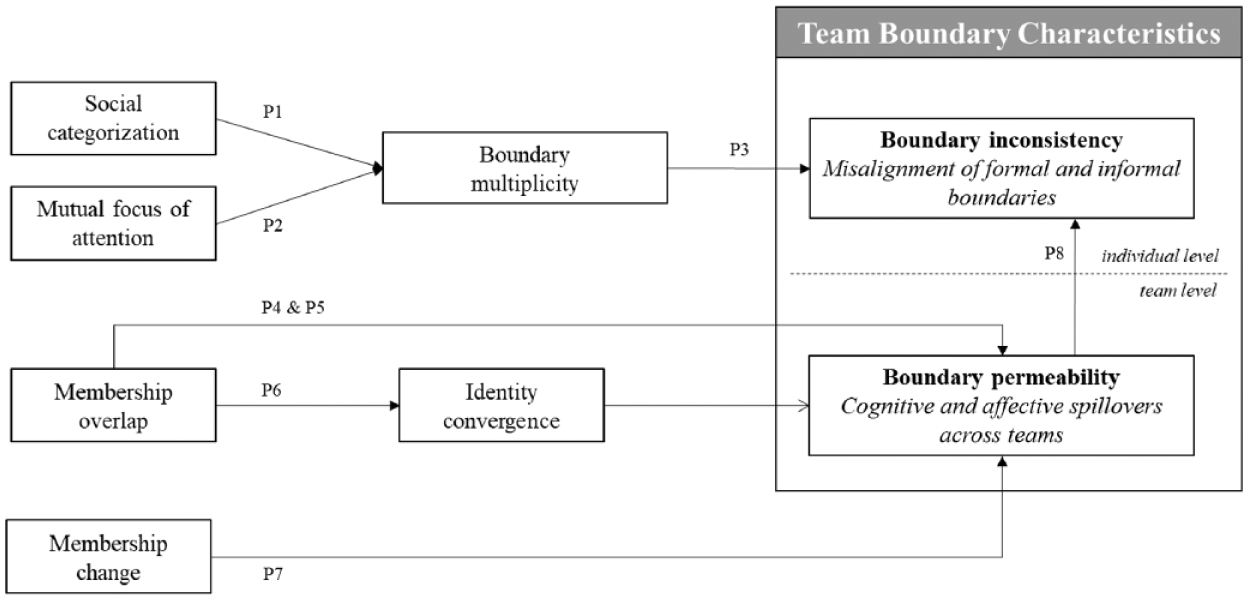
Team boundary permeability and inconsistency.
Conceptualizing Team Boundaries
Formal Boundaries
Team boundaries can be classified according to their degree of formality: Formal team boundaries arise when membership is assigned; informal boundaries arise when membership is identified or emergent (Mortensen, 2014). Most organizations have a formally described internal structure that determines basic principles of interaction and clarifies accountability (McEvily et al., 2014). Following Gulati and Puranam (2009), formality is defined as the organizational design of a formal network that bundles sets of predefined roles and prescribes the hierarchical relationships between these bundles as well as their purpose. Consequently, the boundaries of these sets of roles emerge and distinguish members from nonmembers across the organization and make them accountable for the team’s outcomes. Formal boundaries prescribe a pool of potential interaction partners for each individual, meaning that the ties between individuals are coordinated administratively (Biancani et al., 2014). Formalization focuses members’ attention on the inside of the pool and helps them have a consistent perception of where the boundaries of the team are located and to make sense of them (Mortensen & Hinds, 2002; Vlaar, Van den Bosch, & Volberda, 2006). Formal team boundaries, thus, serve as barriers to protect a team against competing demands from the outside (Faraj & Yan, 2009). As such, strong formal boundaries have been found to result in a variety of desirable outcomes, such as team psychological safety (Faraj & Yan, 2009), helping behaviors (Den Hartog, De Hoogh, & Keegan, 2007), and identification (Drori, Wrzesniewski, & Ellis, 2013).
Beyond that, the formalization of team boundaries increases team empowerment by reducing intraorganizational environmental uncertainty and clarifying areas of responsibilities (Hempel, Zhang, & Han, 2012). The idea of using boundaries to curtail uncertainty is rooted in Santos and Eisenhardt’s (2005) efficiency conception of organizational boundaries. Following their logic of minimizing transaction costs caused by uncertainty, formal team boundaries help reduce coordination costs arising from behavioral uncertainty by enabling monitoring and incentive alignment. Moreover, formal boundaries are used as a scaffold for resource allocation (Lomi, Lusher, Pattison, & Robins, 2014).
Thus, by assigning membership, organizations prescribe interaction ties, communicate to a collection of individuals, and specify who their closest collaborators should be. This facilitates a mutual focus of attention and shared mental representations of who is part of the team. The salience of formal team boundaries is an important attribute in terms of differentiating the team from other groups in the organization.
Informal Boundaries
Social categorization at the individual level
Less salient are informal team boundaries. Many researchers argue that what people call a team might embrace a different set of team members than is supposed by official rosters at the organizational level (e.g., Humphrey & Aime, 2014; Mortensen, 2014; Wageman et al., 2012). These scholars suggest distinguishing between formal (objective) and informal (subjective) boundaries. Informal boundaries refer to the subjective perception of who is part of a team (Mortensen, 2014; Mortensen & Hinds, 2002). They are socially constructed (Barley & Kunda, 2001), meaning that people have a subjective perception of where to draw the boundaries of a team that might differ from those suggested by formal assignment. This line of argument finds its roots in the concept of group entitativity (Lickel et al., 2000), which emphasizes the importance of the perception of a collective as coherent entities for a variety of team outcomes. In contrast to formal boundaries, informal boundaries are not codified. Rather, they are mental models that reflect which individuals are identified as team members by one’s self (i.e., micro-level perspective on team boundaries) or the team (i.e., meso-level perspective on team boundaries).
The questions of “who are we” and “who are they” directly refers to a team’s identity (Ashforth et al., 2008). Following social identity theory, individuals socially categorize their environment to define their in-group and out-group (Ashforth & Mael, 1989). Thus, they make a boundary decision, meaning that they draw boundaries around groups of people by attributing a certain identity to them (Bartel, 2001). They also categorize themselves into a group either by selecting a collective that fits best with their own values, goals, beliefs, traits, knowledge, and skills (Ashforth et al., 2016) or by internalizing their group membership into their self-concept. As Tajfel and Turner (1979) argue in their pioneering work on social identity, group membership is based on defining oneself and being defined by others as member of a group. The arising social foci serve as identification targets (Lomi et al., 2014) and help increase the feeling of oneness (Ashforth & Mael, 1989) in the group. This sense of belongingness is an important factor regarding the strength of team boundaries (Faraj & Yan, 2009). The higher the overlap between an individual’s self-perceived identity and the identity of the organizational unit, the stronger its feeling of belongingness (Ashforth et al., 2008; Lomi et al., 2014) and, thus, the more salient the team’s boundaries become for a particular team member (Hogg & Terry, 2000). These boundaries then include all individuals who share the identity of the team as it is perceived by a particular individual. Hence, membership refers to being part of a social category rather than of a formally assigned team (Tajfel & Turner, 1979). Concluding from the literature on social identification in organizations (Ashforth et al., 2008), the reason why individuals draw these boundaries might be the satisfaction of their need for belongingness, self-esteem, and self-continuity. As this process of boundary drawing is inherent in the individual, there is boundary multiplicity at the team level.
Mutual focus of attention inducing individual-level perceptions
Besides social categorization, boundaries emerge from a mutual focus of attention on a task. Humphrey and Aime (2014) argue that teams should no longer be viewed as closed entities determined by organizational structure, but as interdependent individuals with dynamic relations that interact on organizing activities. In consequence, they claim that teams are bounded by organizing activities. While they are not very specific on what these organizing activities are and how the process of boundary creation works, Metiu and Rothbard (2013) deliver a more specific picture on this. They show that individuals evaluate whether their engagement would be required to fulfill a certain task at hand. As a result, they self-select into an emergent collective, a task bubble as the authors call it, which arises from the mutual attention on that task and creates barriers to non-task-relevant outsiders. These barriers encircle a team and create boundaries. In their article, Metiu and Rothbard (2013) show that task-related expertise requirements determine in-group and out-group members. These boundaries are neither created by bureaucracy nor do they emerge from social categorization. They arise based on task interdependencies that entail the need for close cooperation and information exchange. Such boundaries help a set of individuals accomplish a task these individuals perceive to be within their role competence (Gittell & Douglass, 2012) and thus are temporally limited and dynamic by nature (Mortensen, 2015).
Despite their manifold sources, different types of boundaries (i.e., formal and informal) lead to similar results. They support shared mental models and help individuals to make sense of their organizational environment. They increase the attention of team members on the task at hand and on the other members of the team and serve as barriers to outsiders. They create a feeling of belongingness. Based on the preceding theoretical considerations, we suggest a micro-level view on team boundaries and define them as the multiplicity of all formal and informal demarcations of a team from its environment that individuals undertake on the basis of their mental representations of team membership.
The Inconsistency of Formal and Informal Boundaries at the Individual Level
As Soda and Zaheer (2012) show, formal and informal elements of networks overlap, but are not always identical. Despite awareness of the formally assigned team, individuals may differ in their perception of who belongs to a team. Mortensen’s (2014) meso-level model showed that the members of a team can hold multiple divergent membership models. The researcher also found a variety of antecedents relating to structural and relational issues. We argue that there are also cognitive processes that lead to differences in the subjective perception of boundaries at the individual level. An individual’s perception of the team might entail multiple boundaries as well, which are most likely inconsistent due to differing origins. Individuals know the formal boundary; however, as we have argued before on the basis of social identity theory, they have their own mental representations of the team’s boundaries due to social categorization processes or emerging tasks. Consequently, the perception of multiple boundaries results in boundary inconsistency at the individual level.
The reason why individuals hold models of team membership that are inconsistent with the formally assigned team can be found in social identity theory. Tajfel and Turner (1979) argue that social identity is an individual’s sense of self derived from membership in groups. Consequently, boundaries that arise from social categorization differ from formal boundaries when individuals do not derive their social identity from the team they are formally assigned to but perceive to belong to a different set of people than supposed by management. Individuals strive to achieve a positive social identity (Tajfel & Turner, 1979). Thus, when they are unsatisfied with their social identity, they change it by categorizing themselves as belonging to a set of people that is different from their formal team. Referring to theory on affective identification, a negative social identity gives rise to feelings of shame, sadness, disgust, and/or guilt. These feelings can trigger a process of sense-breaking in which people reconstruct their identities by questioning who they are and where they belong (Ashforth et al., 2008). Another source for the divergence of perceived from formal boundaries is cognitive identification. When an individual’s self-concept no longer contains the same attributes as the identity of the group, they will either try to adapt their self-concept or select another social identity as an identification target (Conroy & O’Leary-Kelly, 2014). This temporal identity discrepancy results in identity ambiguity (Corley & Gioia, 2004) and boundary inconsistency, which in turn might cause individuals to search for a new collective different from the one they are formally assigned to that can serve as an identification target. As group membership depends not only on identifying oneself as a member, but also on being identified as a member by others as well (Ashforth et al., 2016), the likelihood of boundary inconsistency increases with each additional individual under consideration. This results in a multiplicity of boundary perceptions at the individual level.
Beyond the divergence of the formal team and the team that people identify with, dynamics in organizational tasks can give rise to temporal boundary inconsistency. Research on a temporal view of team processes (Marks, Mathieu, & Zaccaro, 2001) acknowledges that team members work on multiple tasks and goals simultaneously within their teams. Organizations set up teams that have the expertise and capacity for a bundle of tasks or several projects and assign members or roles to that team. However, subtasks might require a different set of people, including experts from other divisions while excluding parts of the assigned teams, particularly when teams are low in functional heterogeneity (Somech & Khalaili, 2014). These experts might be temporary team members, not by intentional assignment but rather by emerging membership. They follow the same task-related goal. This goal interdependence among assigned team members and other individuals decreases formal boundaries (Hoegl et al., 2004; Somech & Khalaili, 2014). Simultaneously, goal interdependence allows new boundaries to emerge. The mutual focus of attention on a task of a set of individuals consisting of formal team members and temporary team members makes it circumscribable from other organizational subunits and serves as a team-level boundary creating a barrier to outsiders (Metiu & Rothbard, 2013). As these emerging groups are a temporally limited phenomenon dependent on the accomplishment of a task, management might not formalize them either because the bureaucratic costs from changing the formal organizational roster would be too high or because management does not even take notice of the grass roots structures. Nevertheless, these groups are bounded and directed toward a common goal and thus, need to be regarded as teams. In consequence, additional boundaries emerge through the mutual focus of attention by a set of individuals that do not correspond to any formally assigned team. As such, an individual again might have inconsistent perceptions of his or her team’s boundary.
The more informal boundaries diverge from formal boundaries, the stronger the inconsistency. This means the larger the overlap in terms of membership perception, the less incisive the consequences of boundary inconsistency are between different informal team boundaries or between formal and informal team boundaries.
The Permeability of Team Boundaries: A Team-Level Perspective
Although permeability has been declared to be an important pillar in the concept of boundaries (Dibble & Gibson, 2017), research falls short on specifying what permeability refers to. A group’s boundaries are permeable when individuals have the possibility to change their group affiliation (Alderfer & Smith, 1982; Ellemers, 1993). Mortensen and Haas (2018) and Dibble and Gibson (2017) follow a similar argument, stating that boundary permeability arises from membership change. Dahlander and Frederiksen (2012) posit, permeability is given when people are free to change membership or hold multiple memberships without being constrained to their formal affiliations. Although membership change is certainly one important aspect of team boundary permeability, research has not yet precisely revealed what else, beyond members, passes the boundaries of a team. We suppose that affect and cognition might also pass a team’s boundaries through membership change or multiple team membership. Individuals who are part of several teams can serve as a conveyor between the teams and therefore, their role can be similar to a boundary spanner (Pluut, Flestea, & Curşeu, 2014). Still, these individuals do not perform team-external activities, as boundary spanners do, but are active in multiple internal team activities, which makes their situation distinct from boundary spanners. Thus, to approach this complex embeddedness of individuals and to understand its impact on boundary permeability, we need to get a clearer picture on multiple team membership and membership change.
Multiple Team Membership
Multiple team membership implies that individuals split their working time between different groups and thus are active in different contexts and roles simultaneously (Hoegl et al., 2004; Katz, Lazer, Arrow, & Contractor, 2004; Mortensen, 2014; Pluut et al., 2014). As a result, teams become more connected and resources are used more efficiently and flexibly (O’Leary, Mortensen, & Woolley, 2011; Pluut et al., 2014). As is known from the research on boundary spanning, this increased interconnectivity leads to an in- and outflow of information (Faraj & Yan, 2009; Marrone et al., 2007), advice (Lomi et al., 2014), and knowledge (Tortoriello, Reagans, & McEvily, 2012; Zhao & Anand, 2013). Individuals serve as bridges for these resource exchanges. We argue that people with multiple team memberships constitute these bridges as they carry on team-internal knowledge and information from one team to another. In contrast to boundary spanners, multiteamers do not face the risk of losing information at the boundary of the team as they do not pass it on to teams they do not have access to, but to teams in which they themselves are a member. Therefore, multiteamers enhance the permeability of team boundaries.
Unfortunately, little is known on what is transferred from team to team via multiple team membership beyond knowledge, information, and processes. If cognition can be transferred, affect can spill over from team to team as well. In their analysis of the SUN Microsystems case, Välikangas, Hoegl, and Gibbert (2009) explain that individuals who have been part of a failed innovation project might experience a form of innovation trauma that hinders them from learning from their failure. Thus, the traumatic feelings of one project may spill over to the next one. Similarly, Ramarajan, Bezrukova, Jehn, and Euwema (2011) describe how boundary spanners experience spillovers of negative emotions from the external environment. Although there is not much evidence on emotional spillovers between different organizational contexts in the literature on interteam coordination, the research on work–life transitions provides strong support for this point. Butts, Becker, and Boswell (2015) and Ashforth, Kreiner, and Fugate (2000) show that increased interconnectivity leads to conflicts and emotion spillovers from one context to another. Following theories on emotional contagion, these emotions can spread to other team members and influence collective emotions in a team (Barsade, 2002). Therefore, we posit that individuals with multiteam engagement enhance the interconnectivity of teams by bridging the flow of emotions from one team to another.
Many scholars argue that individuals identify more strongly with lower order identities, such as teams, than with higher order identities such as the organization as a whole (Ashforth et al., 2008). Ashforth et al. (2008) argue that team identities are more salient, proximal, exclusive, and comparable than lower order identities. Alternatively, Bartel (2001) shows that individuals with high levels of team-external activities tend to identify more strongly with the organization than with subunits. Lomi et al. (2014) point out a reverse causality in arguing that individuals who identify more strongly with global foci, such as the organization as a whole, show more team external activities than people who rather identify with their team. Although Ashforth et al.’s (2008) finding might well be valid for teams with strong boundaries, we argue that it is less relevant for teams with permeable boundaries. Their identities will converge toward a comprehensive organizational identity so that the distinction of team and organizational identity becomes blurry. This is because individuals strive for identity coherence (Dutton, Roberts, & Bednar, 2010). Consequently, they will engage in identity work in cases where they face multiple social identities at one time. They try to shape the social identities of their teams in a way that produces greater overlaps of the social identities they are exposed to because they aim to integrate rather than exclude their identities (Sluss, Ployhart, Cobb, & Ashforth, 2012). In doing so, they spread the values, norms, and attitudes they hold to the other teams they are part of. Hence, social identities extend toward other teams via the shared member. As a result, team identities become increasingly similar to each other and converge toward the organizational identity. The strength of this effect depends on the degree of membership overlap between teams.
Converging identities can be understood as bridges for knowledge transfer. It has been shown that a shared social identity is an integral part of knowledge sharing (Kane, 2010). The reason is that a shared identity is related to shared mental models, which alleviate the process of interpreting knowledge and help to transfer knowledge directly without having to translate it (Bechky, 2003; Carlile, 2004). Moreover, as has been shown by Kane (2010), groups that share an identity more easily recognize the value of new knowledge due to a more detailed consideration of the knowledge. Hence, multiple team membership makes team boundaries permeable to knowledge transfers due to converging identities. Beyond that, shared identities make it easier for people to enter and exit groups as the strength of the informal boundaries around identification foci decreases when people perceive to be similar to each other.
Team-Level Membership Change
As boundaries are directly connected to membership, a change in the composition of a team induces a change in its boundaries, regardless of the scope (number of members that leave or enter the group) or frequency the membership change has (Mortensen, 2015). Thus, the change of a member makes team boundaries permeable (Tannenbaum et al., 2012). Team members leaving or entering the team take with them or bring along knowledge, attitudes, routines, and behaviors that influence team processes. Research has shown that regarding the outcome of membership change, it makes a difference which roles in the team are affected by the change (Summers, Humphrey, & Ferris, 2012). Based on this, we argue that the permeability of the team’s boundaries is higher when the change includes members with strategic core roles. In such case, the outflow of knowledge is higher, and the gap that is left is larger, creating a stronger pull for the replacement and inflow of knowledge.
Team Boundary Permeability Reinforces Individual-Level Inconsistency
As soon as team boundaries are permeable to cognitive and affective spillovers, they become increasingly less salient because individuals exhibit difficulties in distinguishing the inside and outside of a team. As a result, individuals have less guidance for their own perceptions of team boundaries. Based on research on formalization and sense-making (Vlaar et al., 2006), we argue that the lack of boundary salience causes a sense-making process within which individuals bring up their own mental representations of team boundaries. Consequently, these boundaries are less influenced by the official rosters than highly salient team boundaries. Thus, they most likely differ from formally defined boundaries. Therefore, we posit that boundary permeability at the team level causes individual-level boundary inconsistency.
A Conceptual Framework on Team Boundary Inconsistency and Permeability
Summarizing the preceding propositions, Figure 1 displays the relationship between the source of boundary emergence and its individual- and team-level properties. Informal team boundaries are a necessary condition for individual-level boundary inconsistency. As soon as boundaries arise from social categorization or the mutual focus of attention, the likelihood that individuals perceive boundaries that are different from the formal ones increases, as has been demonstrated by Soda and Zaheer (2012) in the context of networks. However, we cannot discount that the individual perception of a team’s boundary is completely overlapping with the formal team boundary defined by the official roster. Yet, the sufficient condition for inconsistency is membership model divergence. If people hold several mental models on where to draw the boundary of a team, inconsistency at the individual level is an unavoidable outcome of boundary manifestation.
Both informal and formal membership can be subject to change or overlaps. Both can be induced by assignment, but happen even more naturally to informal groups as their boundaries are dynamic and interlinked by definition. In any case, membership change and overlap give rise to cognitive and affective spillovers. Beyond that, we argue that identities also spill over. As soon as teams share members, a process of identity assimilation starts so that the social identities within the organization converge toward an organization identity. This is a self-reinforcing effect because a shared identity is an important antecedent of cognitive spillovers (Kane, 2010). Thus, we argue that converging identities make the effect of membership change and overlap on permeability even stronger.
Discussion
A team’s boundaries are supposed to demarcate unambiguously the inside and outside of a team and have long been equated with formally assigned team membership. However, social identity theory and recent empirical evidence (e.g., Metiu & Rothbard, 2013; Mortensen, 2014) indicate that people perceive such boundaries as different from those specified by the official team rosters. We have presented a framework that explains why diverging perceptions arise and how they lead to boundary inconsistency at the individual level and permeability at the team level. Team boundaries were defined as the multiplicity of all formal and informal demarcations of a team from its environment as perceived by individuals on the basis of their mental representations of team membership. Furthermore, we have outlined what team boundaries are permeable to and which factors influence their degree of permeability. Following recent calls for a more dynamic and multilevel view of teams (Humphrey & Aime, 2014; Mortensen & Haas, 2018; Wageman et al., 2012), this integrative microconcept of team boundaries deviates from the assumption that team boundaries are clear and stable, emphasizing instead the cognitive nature of team boundaries, which has been ignored in much of the previous research.
This shift is critical because informal boundaries feature permeability and dynamism, redefining the relationship between being inside and outside of the team and rendering the distinction between the team and its environment blurry and fluid. Most theories on teams adopt either an internal or external focus, describing on the one hand, the effects of team processes and emergent states and on the other hand, the effects of team-external activities on team outcomes (Ancona et al., 2002; Joshi et al., 2009; Marrone et al., 2007). The underlying assumption of such studies is that the inside and outside of a team is clearly identifiable and stable over time. In contrast, we outline the permeability and inconsistency of boundaries and show how differences in their perception arise.
Contributions to Research on Team Boundaries
At the team level, our conceptual model aligns closely with the types of team membership noted by Mortensen (2014). These are formal, identified, and emergent membership. Formal team memberships are based on official rosters, identified membership depends on self- or other perception, and emergent team membership relates to patterns of interaction. By applying social identity theory, we provide additional insight into the individual-level processes that lead toward diverging perceptions of team boundaries. By introducing boundary inconsistency as an outcome of boundary multiplicity, we add a microperspective on team boundaries to Mortensen’s meso-level concept of membership model divergence. Although the meso-level model emphasizes differences in membership perception across individuals, our model advances this discussion by theorizing that individuals themselves might have inconsistent perceptions of their team’s boundaries. Similarly, we emphasize the consequences of a mismatch between formal and informal structures with regard to the salience and strength of formal structural elements. In doing so, we advance preceding inquiries into the interplay of the formal and informal elements of an organization’s structure (e.g., Gulati & Puranam, 2009; McEvily et al., 2014; Soda & Zaheer, 2012) and pave the way for future research on the consequences of within-individual inconsistent mental representations of team boundaries.
Shedding light on the permeability of team boundaries, we contribute to the research on team boundary spanning. Scholars in this field have primarily focused on the behavior of boundary spanners and how they are affected by team-external influences or, respectively, on how the magnitude of the boundary-spanning activities of the team or certain individuals within a team affects team effectiveness (Druskat & Wheeler, 2003; Marrone et al., 2007; Ramarajan et al., 2011). In light of boundary permeability, a broader perspective needs to be taken. All team members who hold more than one team membership or experience changes in the composition of their teams are affected by external influences. With this conclusion, we want to shift the focus from analyzing behaviors at the boundary of the team of single team members to investigating what external influences each team member and the team as a whole enact or face. In addition, our conceptualization of team boundaries provides a theoretical foundation for empirical studies that scrutinizes teams with permeable boundaries (e.g., Metiu & Rothbard, 2013).
Linking Team Boundaries to Research on Organizational Boundaries
As the research on team boundaries remains sparse and incipient, our conceptual arguments relate to the research on organizational boundaries. Despite their distinct characteristics, team and organizational boundaries share some similarities. We contribute to the field of intra- and interorganizational boundaries by transferring the research on organizational boundaries to the team level. Santos and Eisenhardt (2005) offered a model of organizational boundaries to date, referring to organizational boundaries as “the demarcation between the organization and its environment” (p. 491). This demarcation embraces four conceptions (efficiency, power, competence, and identity) characterizing organizational boudaries.
Santos and Eisenhardt (2005) develop the efficiency conception as a legal view of boundaries that suggests setting formal boundaries at the point that minimizes the governance costs of transactions. Decisions about which transactions are to be carried out internally or externally (that is, through the hierarchy or the market) are governed by legally established boundaries around the bundle of transactions to be conducted internally. Applied at the team boundaries of efficiency are always formal, established by management to ease the coordination of individuals and to reduce the costs of behavioral uncertainty. Conceptually, Santos and Eisenhardt’s (2005) boundaries of efficiency exhibit a large overlap with the definition of formal team boundaries in this article. Boundaries of efficiency—on the organizational as well as on the team level—are formally prescribed interaction partners with whom transactions are to be carried out. In this article, we use this macro perspective on boundaries to reveal that there are inconsistencies among formal and informal boundaries that need to be taken into account when analyzing team-level constructs. Based on this view, we want to stimulate research on potential inconsistencies between different types of organizational boundaries as these can have tremendous implications for organizational outcomes, as has been shown by Grohsjean, Kober, and Zucchini (2016).
Within Santos and Eisenhardt’s power conception that draws on the work of Salancik and Pfeffer (1978), boundaries are set at the point where control is maximized. In this way, boundaries demarcate a sphere of influence that does not have to be congruent with an organization’s formal boundaries. This type of boundary does not relate to ownership mechanisms as it stretches beyond the organization as a legal entity and exercises power by means of networks, alliances, and other strategic relationships (Santos & Eisenhardt, 2005). In contrast, we argue that team boundaries refer to membership. This departs from Santos and Eisenhardt’s model because in our view boundaries distinguish between the perceived members and nonmembers of a team and, therefore, do not extend beyond membership. Thus, we take a relational perspective on boundaries that gives us the opportunity to explore the mental representations of team boundaries on the micro level. With regard to organizational boundaries of power, we hope to encourage further research on the impacts of an organization’s influence sphere on its boundaries as perceived by its stakeholders.
Santos and Eisenhardt’s third conception, boundaries of competence, originates from contingency theory (Chandler, 1962) and states that boundaries are set where the value of a firm’s resources is maximized. Thus, resources demarcate an organization from its environment and create dynamic boundaries. Part of these resources is human capital. Human capital is inherent in people, thus it is tied to membership. The present model defines boundaries as arising from membership attribution; hence, human capital resources do indeed demarcate the team from its environment. Therefore, Santos and Eisenhardt’s concept of boundaries of resources does apply to teams in this regard and thus is a valid basis for theory-building on boundaries at the team level. In particular, taking a resource-based perspective on team boundaries allows us to better understand the outflows of human capital upon membership change and the spillovers of these resources on other teams due to overlapping team memberships. Although Santos and Eisenhardt (2005) focus on the possession of resources as a boundary-defining element, we hope to encourage further research on how resources can pass boundaries without endangering their salience.
The final conception of boundaries describes how they used to establish coherence between an organization’s identity and its activities. Referring to Weick’s (1995) concept of collective sense-making, boundaries reflect organizations choice of who they are (Santos & Eisenhardt, 2005)—in short, they create a feeling of belongingness. This conception is equivalent to the team boundaries that emerge from social categorization in our model. Thus, Santos and Eisenhardt’s analysis of boundaries of identity supports our claim for the impact of this type of boundary on the functioning of the respective organizational unit and potential consequences from inconsistencies between the identity and the actual organizational activities. What we add to Santos and Eisenhardt’s identity conception of boundaries is that identification can in fact influence mental representations of membership. Combining our argument with Korschun (2015) theorizing on how boundary spanners attribute membership on external stakeholder, we aim to encourage a micro perspective on boundaries at the organizational level.
Overall, there are significant overlaps between what has been argued on organizational boundaries by Santos and Eisenhardt (2005) and our model on team boundaries. However, teams and organizations do have unique properties, and therefore, organizational theory cannot simply be transferred from the higher to the lower level. Teams are less distant, abstract, and global (Ashforth et al., 2008). Moreover, organizational boundaries are subject to legal regulation and are, therefore, less vulnerable to differences in perception. As a consequence, team boundaries are less salient and explicit, giving rise to diverging mental models of team membership. Therefore, the focal question in studying team boundaries is less about where boundaries should be set by management (as is the case for studying organizational boundaries) than where individuals actually set boundaries and how this differs from the “efficient” boundary. Unlike Santos and Eisenhardt (2005) who focus on where organizations should set their formal boundaries in light of their transactions, sphere of influence, resource needs, and identity, the present framework asks how team boundaries actually emerge. Santos and Eisenhardt (2005) do not explore how the different conceptions of boundaries interact. Although offering insights regarding the interdependencies between their four conceptions, they leave it open for future research to further disentangle the paradox of diverging boundaries. In our model on team boundaries, this question is addressed by restricting boundaries to membership attributions, shifting nonmembers to the outside of the team. In contrast, Santos and Eisenhardt (2005) allow nonownership mechanisms as boundary sources, but do not clarify the hierarchy of their four boundary conceptions beyond some hints concerning context specificities.
The present conceptual arguments also align with other theoretical considerations at the organizational level. For instance, Barley and Kunda (2001) define boundaries as social objects that result from legal aspects (corresponding to formal team boundaries), identification, and patterns of interactions (corresponding to informal identified and emergent boundaries). Moreover, Kogut (2000, p. 408) recognizes the informal nature of boundaries that we have investigated in more detail and sums it up as follows: “Boundaries to a firm represent more than the legal unit of accrual; they provide the cognitive representation of what constitutes the object of membership, that is, of identity.”
Implications for Future Research
First, the framework presented in this article provides a conceptual perspective and is purely based on theory and prior literature. This article is limited to this theorizing and does not provide empirical evidence on the proposed relationships. Although theorizing about the emergence of individual-level boundary inconsistency and team-level permeability advances our understanding about the dynamics of team boundaries, future empirical research is needed to test whether the proposed relationships hold in organizational reality. Organizational environments offering the opportunity to flexibly join interest groups and communities (e.g., consultancy work) or relying on temporary project work and virtual teamwork (e.g., new product development teams) would provide for an appropriate setting to study the inconsistency and permeability of team boundaries as the team structures and membership composition in these settings tend to be increasingly dynamic.
Second, despite the lack of empirical evidence, this article provided propositions that future research could build on. An important next step in testing these relationships in the field would be the development of operationalizations of individual-level boundary inconsistency and permeability. For instance, individual-level inconsistency could be measured by asking team members about their personal perception of the membership composition of the team (i.e., who is part of the team). This personal perception could be compared with the formal official roster of the team, and the percentage of disagreement between the personal perception and the official roster could be calculated. Similar to research on multitasking in teams, which states that teams rely on different processes over time (Marks et al., 2001), we believe that time also plays a vital role in the development of team boundaries. The change in perception of the team composition could be measured by asking individuals at several points in time about their views on who belongs to the team and who does not. This would capture the dynamic inconsistency of team boundaries each individual holds. A network measure collecting data about knowledge, information, and emotion flows between organizational members and across team boundaries could be one possible way to measure team boundary permeability. Alternatively, an item-based measurement scale could be developed in future research. To develop such a measure, a qualitative study capturing the cognitive and affective spillover between teams may be conducted to more clearly depict the concept of team permeability in organizational reality.
Third, we point to the importance of studying team boundaries under the lens of a network approach or experience sampling methodology. Future research on team boundaries should go beyond taking an internal or an external view of teams by focusing on the interconnectivity within the organization to examine how teams influence each other through shared memberships. To capture a strongly interwoven web of team memberships, we recommend a network approach as it is able to capture all types of team boundaries by analyzing the type of formal and informal ties between people in the organization. In doing so, researchers can disregard objectively identifiable team boundaries and investigate actual team ties no matter whether they are formally prescribed, emergent, or identified by the respective team and its members. As our model identifies membership change as an antecedent of boundary permeability and claims to consider the emergent and dynamic nature of boundaries, future empirical studies on team boundaries should moreover adopt a longitudinal approach, such as experience sampling studies. In particular with respect to the outcomes of team boundary inconsistency and permeability, experience-sampling methods that measure the inconsistency and permeability as well as their consequences at different points in time would help create a picture of the magnitude of the boundary dynamism individuals and teams experience.
Fourth, this article serves as a basic argument to rethink how we choose the observation object in empirical team studies. The assumption that formal team membership exclusively defines a team’s boundaries is often taken for granted. Many empirical researchers use formal team membership to delineate their sample. When team boundaries are permeable and team members hold inconsistent perceptions about their team boundary, research relying on formal team membership may come up with misleading conclusions or distorted results. For instance, if team members refer to different sets of team members when assessing team processes or team emergent states, such as team identity or the level of trust within the team, obtaining a rather low interrater agreement would not come as a surprise. So one reason why interrater agreements in some studies are rather low might not necessarily stem from a disagreement about the specific state or process but be caused by referring to diverging reference groups when assessing the team. Furthermore, in some research streams, such as team boundary spanning or boundary management, the boundary plays a central role, and activities of crossing or reinforcing team boundaries are discussed (e.g., Faraj & Yan, 2009) but without providing insights on how to define team boundaries and the demarcation of the team from its environment. Druskat and Wheeler (2003) point to the role of team-external managers in conducting boundary-spanning activities for the team—but do team members perceive these formally external managers to be outside of their team boundaries or would they see them as part of the team? Including versus excluding the manager would potentially make a significant difference when assessing the boundary activities of the team and, therefore, would affect the ratings of the team members. Therefore, this article aims to encouraging further research to deviate from the practice of identifying teams solely by official rosters and instead recognize the more complex nature of team boundaries, particularly, their permeability as well as the inconsistency between formal and informal memberships.
Fifth, future research should continue to develop this basic concept of team boundaries to further analyze the antecedents and identify the individual- and team-level consequences of team boundary permeability and inconsistency. In terms of antecedents, future research could more closely integrate the research on boundary spanning and the demarcation of team boundaries. As with all studies, our study was limited in scope by focusing on the individual-level antecedents and within-team antecedents of boundary characteristics. We did not consider the team boundary-spanning activities of team members (e.g., Ancona & Caldwell, 1992) as potential antecedents because this literature stream does not define the origins and properties of team boundaries, which we regard as an important initial step. Although not being the focus of this article, we would expect that boundary-spanning activities result in increased boundary permeability and inconsistency. Team members heavily engaging in outreach activities might bring outside parties—or at least their expertise and knowledge—into their own teams. In so doing, they may induce cognitive spillovers from other teams. Furthermore, outreach activities might lead to a mutual focus of attention with members outside the formal team boundaries. Thus, the team member engaging in outreach activities might perceive the formally unbounded party as part of the team for the time of their interaction, whereas the formal roster and the perception of other team members diverge from this perception. In addition to identifying potential sources of boundaries, a thorough investigation into what it means for teams to be bounded to some degree is needed. Soda and Zaheer (2012) point out that the inconsistency of an individual’s formal and informal networks affects individual performance. The permeability of team boundaries puts a great burden on individual team members by increasing competing demands and work overload (Faraj & Yan, 2009; Wageman et al., 2012). Nonetheless, boundary permeability offers opportunities for information exchange that allows teams to be creative and share knowledge, which is crucial for them to be innovative (Yaping, Tae-Yeol, Deog-Ro, & Jing, 2013). More research is needed on these opposing effects, identifying factors that help individuals and teams to deal with this trade-off and providing concepts on how to cope with weak boundaries. In this regard, a quantitative multilevel approach might be helpful in investigating what distinguishes successful loosely bound teams from less well-performing teams.
Conclusion
Our model of team boundaries emphasizes a broad concept of how to delineate a team from its environment. Complementing the macro view of boundaries as formal assignments of membership, we introduce a micro perspective that illuminates the impacts of how people perceive team boundaries on the properties of boundaries. We encourage additional conceptual and empirical work that helps scholars understand what drives people to draw boundaries within the organization and how these properties affect individuals and teams.
Footnotes
Declaration of Conflicting Interests
The author(s) declared no potential conflicts of interest with respect to the research, authorship, and/or publication of this article.
Funding
The author(s) received no financial support for the research, authorship, and/or publication of this article.
