




Abstract
Composites of lead zirconate titanate particles in an epoxy matrix are prepared in the form of 0–3 and quasi 1–3 with different ceramic volume contents from 10% to 50%. Two different processing routes are tested. Firstly a conventional dielectrophoretic structuring is used to induce a chain-like particle configuration, followed by curing the matrix and poling at a high temperature and under a high voltage. Secondly a simultaneous combination of dielectrophoresis and poling is applied at room temperature while the polymer is in the liquid state followed by subsequent curing. This new processing route is practiced in an uncured thermoset system while the polymer matrix still possess a relatively high electrical conductivity. Composites with different degrees of alignment are produced by altering the magnitude of the applied electric field. A significant improvement in piezoelectric properties of quasi 1–3 composites can be achieved by a combination of dielectrophoretic alignment of the ceramic particles and poling process. It has been observed that the degree of structuring as well as the functional properties of the in-situ structured and poled composites enhance significantly compared to those of the conventionally manufactured structured composites. Improving the alignment quality enhances the piezoelectric properties of the particulate composites.
Introduction
Piezoelectric particulate composites have attracted considerable research interest over the last few years as the inclusions of piezoelectric ceramics in a ductile polymer matrix leads to superior piezoelectric and mechanical properties. In such multiphase composites the volume fraction of the phases, their morphology, the pattern of connectivity as well as the dielectric and electrical properties of the two phases control the overall physical and electromechanical properties. Nine different types of connectivity were distinguished by Newhnam (Newhnam et al. 1978). The random particle distribution, 0–3 composites with unconnected particles in a fully self-connected matrix, and the fibrous distribution, 1–3 composites with ceramic rods fully aligned and connected in one dimension, present the lower and upper bounds as far as the final properties of the composites are concerned. Structuring equiaxed ceramic particles in a chain form configuration by means of dielectrophoresis (DEP) has been shown to improve the dielectric, piezoelectric and pyroelectric properties of these materials over those of random composites (Bowen et al., 1998; Van den Ende et al., 2010; Khanbareh et al., 2014; Wilson and Whatmore, 2005) When particle columns are formed, ideally the particles are aligned end-to-end, forming a column-like structure parallel to the applied electric field. Under ideal processing conditions, long particle chain configuration approaches the topology of perfect 1–3 composites. For a given filler concentration the alignment of the particles in the chain-like structure leads to a marked increase in piezoelectric properties while the high mechanical flexibility due to the polymer matrix is maintained (Bowen et al., 1998; Van den Ende et al., 2010; Tang et al., 2012, 2013). The quality of particle alignment is the key parameter in controlling the overall properties of the composites (Andrews et al., 2010; Patil et al., 2008; Tang et al., 2013, 2014).
The key parameters controlling the effective properties of the structured composites are the quality of the particle alignment as well as the poling efficiency. Improving the filler orientation while keeping the filler volume fraction low leads to a high electroactive sensitivity, while maintaining the optimum flexibility levels for the composites (Bowen et al., 1998; Van den Ende et al., 2010; Tang et al., 2012, 2013). Enhancing the alignment quality by means of decreasing the interparticle distance has been shown to significantly improve the dielectric, piezoelectric and pyroelectric properties of particulate composites (van den Ende, 2012; Khanbareh et al., 2014). In conventional biphase ferroelectric ceramic-polymer composites, the polymer phase normally have a lower permittivity and a low conductivity compared to the ceramic particles; thus a high AC field at elevated temperatures for a long period of time is required for efficient poling (Kwok et al., 2007; Lau et al., 2007). Thus the poling process as well as the resulting effective properties of the composites remain a challenge for the manufacturers. Recent investigations have shown that the electrical conductivity of the constituents has a significant effect on the dielectric, piezoelectric and pyroelectric properties of the granular composites (Khanbareh et al., 2015). It has been reported that an enhanced electrical conductivity of the matrix shortens the build-up time of the electric field acting on the ceramic particles. Therefore, for an electrically conductive matrix, efficient poling of the composites is possible at room temperature, with short poling times and relatively low electric fields. The electrical conductivity of thermoset polymer matrices as well as their permittivity decrease upon curing. Thus combining the DEP structurization and DC poling of the composites while the matrix is in the liquid state can improve the poling efficiency of the composites. Moreover the new proposed technique leads to cost effective single-step manufacturing of the composite sensors. In the present work the in-situ dielectrophoretic structuring and poling process of lead zirconate titanate-epoxy composites upon application of AC and DC electric fields is investigated. The effect of processing parameters on the structuring configuration as well as final properties of the composites are demonstrated.
Experimental procedure
Composite manufacturing
Lead zirconate titanate ceramic powder (PZT5A4), received from Morgan Electroceramics UK, was calcined at 1150°C for 1 h to develop a single phase material. The agglomerated powder was then dry-milled using 5 mm zirconium balls for 2 h using a single G90 jar mill. The particle size distribution of milled powder in an aqueous solution with 10% isopropyl alcohol measured by a Beckman Coulter LS230 laser diffraction analyzer is shown in Figure 1. The powder was stored in a drying oven at 120°C for 24 h prior to the experiment to avoid moisture adsorption. A two component epoxy system (Epotek 302-3M, Epoxy (diglycidyl ether of bisphenol-A (DGEBA)) resin and poly(oxypropyl)-diamine (POPD) multifunctional aliphatic amine curing agent) was used. Both components were degassed separately in a vacuum oven at RT for 3 h prior to the experiment to avoid air bubble formation. The PZT particles were dispersed in the polymer resin to the specific volume fractions of
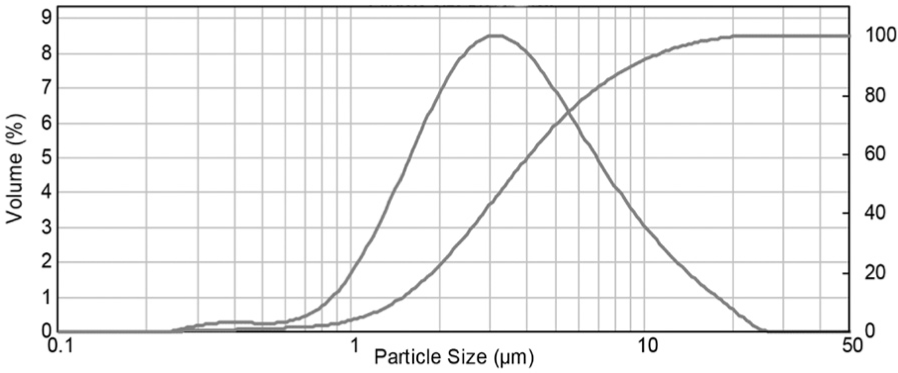
PZT particle size distribution.
Different combinations of AC and DC electric fields used for manufacturing of the composites. The AC field magnitudes are reported in peak–peak mode.
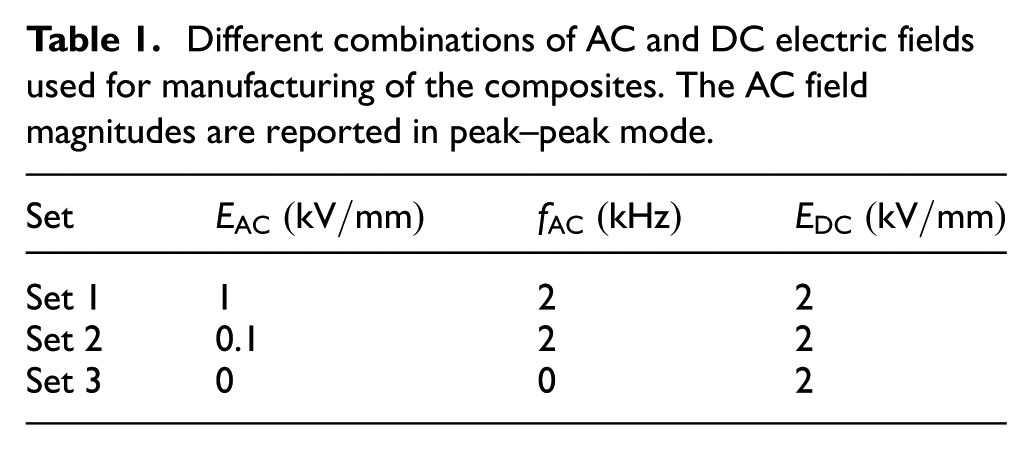
The first two sets result in quasi 1–3 composites with different degree of structuring, while set 3 is a 0–3 composite poled while curing. The properties of the obtained composites are compared with those of the reference samples reported by Van den Ende et al. (2010). Those composites were processed at a fixed applied field of
Measurement procedure
The dielectric constant of the composites were determined using the parallel plate capacitor method with an Agilent 4263B LCR meter (Japan) at 1 V and 1 kHz. The curing study of the epoxy polymer as a function of temperature was performed using a broadband spectrometer (Novocontrol) in conjunction with a Cryostat high temperature sample cell and an Agilent E4991A impedance analyzer at 1 V and 1 kHz. The piezoelectric coefficient,
Results and discussion
Microstructure of composites
Figure 2 shows scanning electron microscope images of 20% PZT-epoxy composites prepared by means of conventional method and in-situ structuring and poling as defined in Table 1.
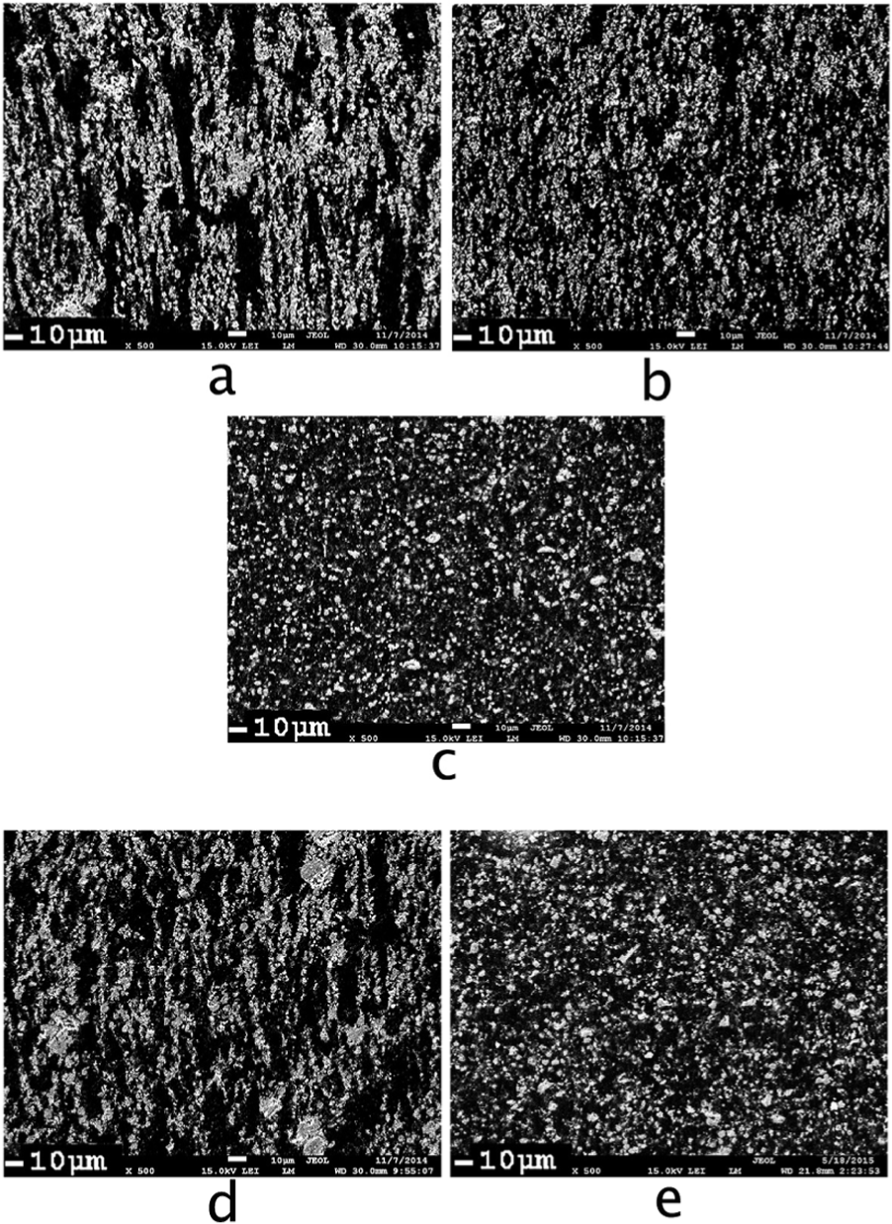
SEM micrographs of 20% PZT-epoxy composites prepared using conventional and in-situ techniques. (a) Set 1; (b) set 2; (c) set 3; (d) structured reference sample; (e) random reference sample.
In the random composites the PZT particles are homogeneously distributed in the epoxy matrix. The average particle size matches well with the result of particle size analysis. Chain-like structures along the direction of the electric field are formed during dielectrophoresis. The average orientation of the individual chains can be calculated in terms of
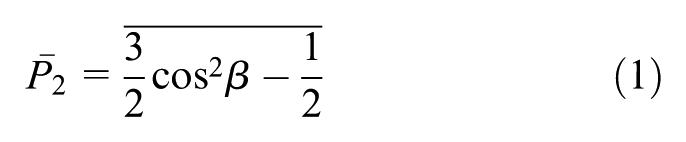
where
Electroactive properties
The dielectric properties of the composites are shown in Figure 3 for PZT volume fractions from 0% to 50%. The model proposed by Yamada et al. (1982) is used to describe the dielectric properties of the random composites.
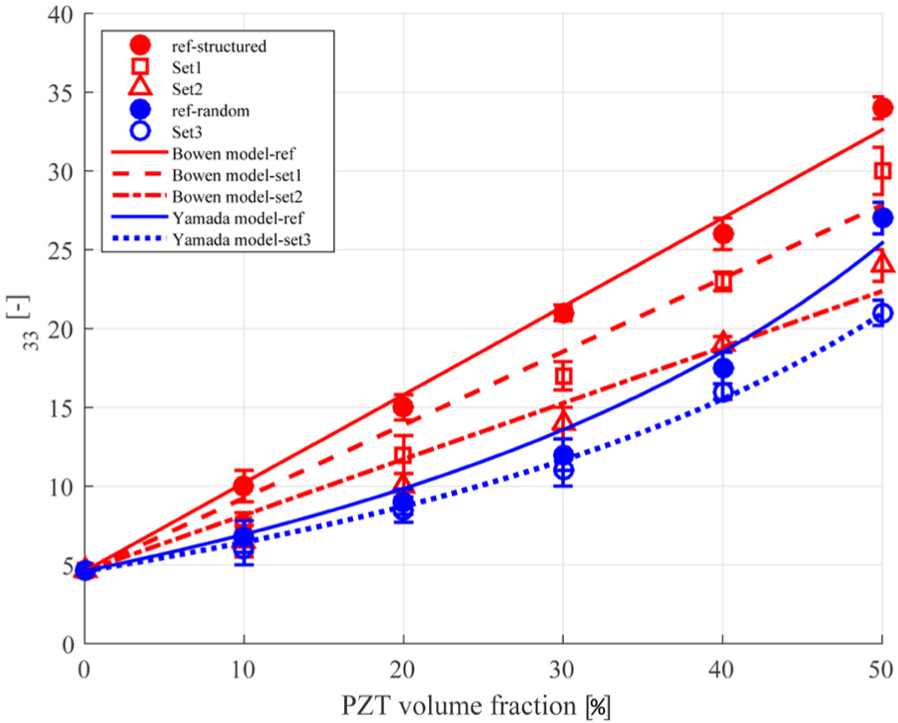
The dielectric constant data for PZT-epoxy composites with their associated models.
In this model the composite is assumed as a uniform distribution of ellipsoidal particles in an isotropic polymer matrix. The dielectric constant of the composite in the poling direction is given by

where ϵ is the dielectric constant, and

where
Properties of ceramic and polymer phases at 25°C.
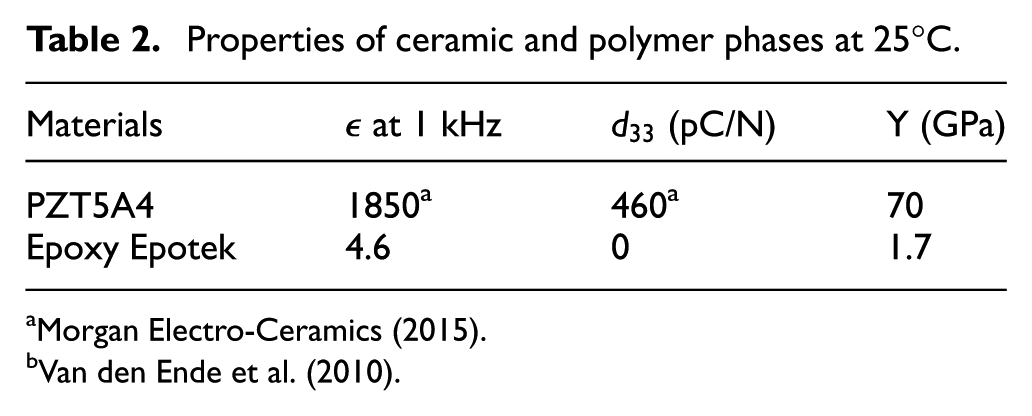
The best fit of the experimental data to Yamada’s model for both the reference random composite and the in-situ poled random composite was obtained for n is 4.4 which is an indication of particles having an aspect ratio of 1.3 that can be a close approximation to an equiaxed shape. The best fit of the experimental data to Bowens’s model for the structured composites of set 1, set 2 and the reference structured sample, was obtained for R values of 11.41, 8.9 and 13 respectively.
The piezoelectric charge coefficients,

where
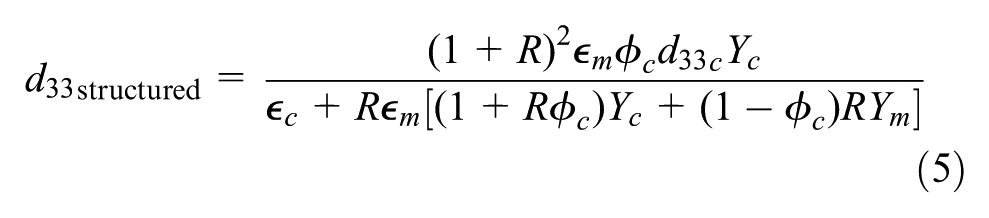
where
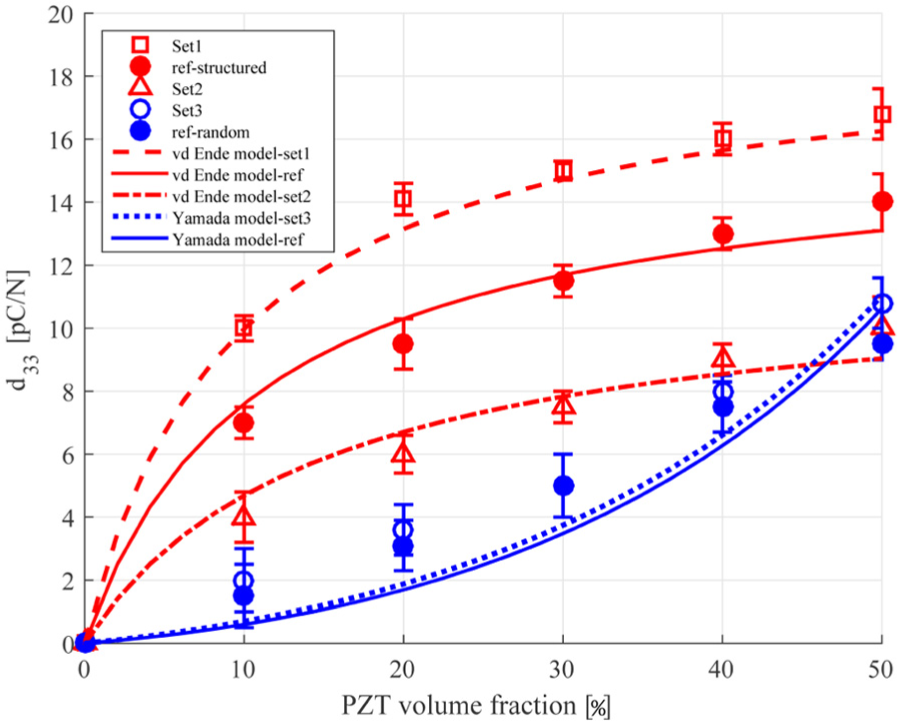
The
The best fit of the experimental
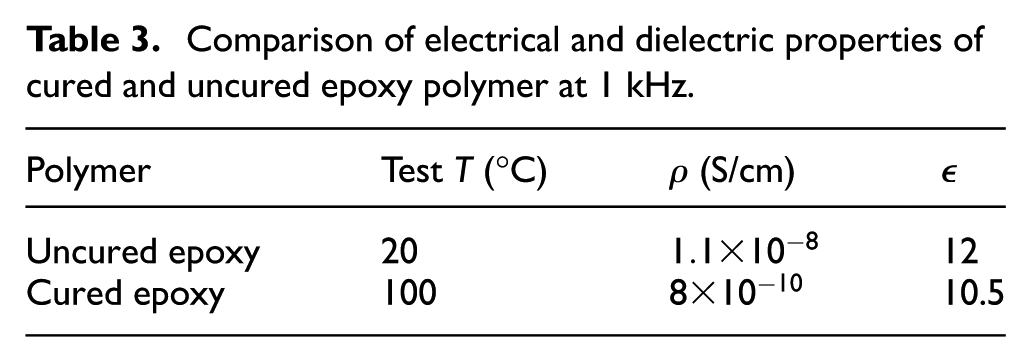
The electrical conductivity (
Comparison of electrical and dielectric properties of cured and uncured epoxy polymer at 1 kHz.
The best fit of the experimental data to Bowens’s model for the structured composites of set 1, set 2 and the reference structured sample, was obtained for R values of 15.5, 8.1 and 12 respectively. The interparticle distances calculated based on the obtained R values and the measured average particle size, are 0.19
The interparticle distance is an important parameter influencing the local electric field acting on the ceramic particles. The interparticle distances at each volume fraction have been estimated independently by fitting the model to the experimental data. The correlation between the
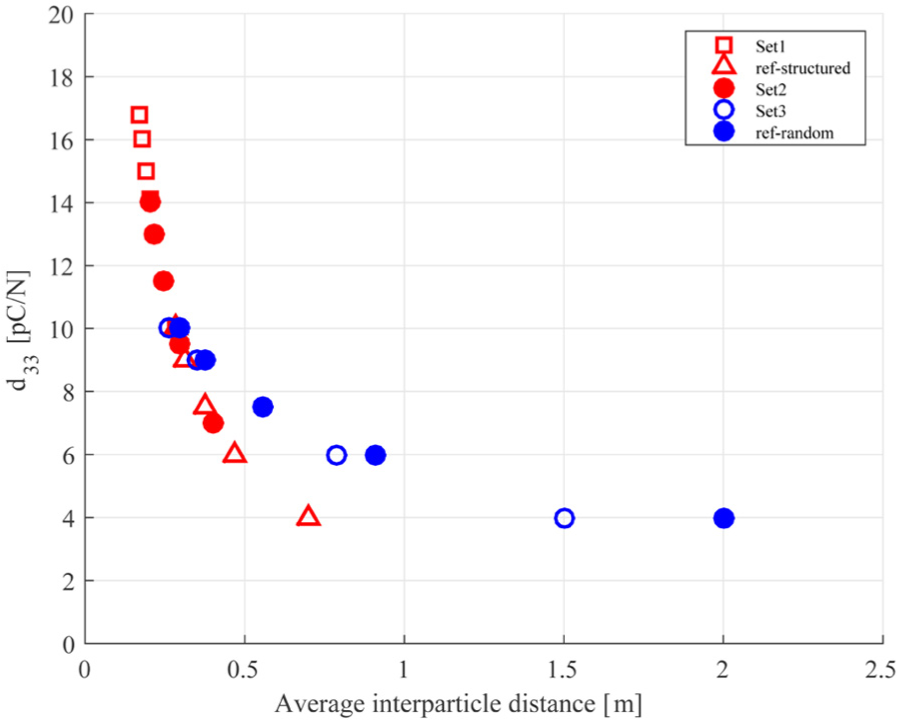
The
The piezoelectric voltage coefficient,
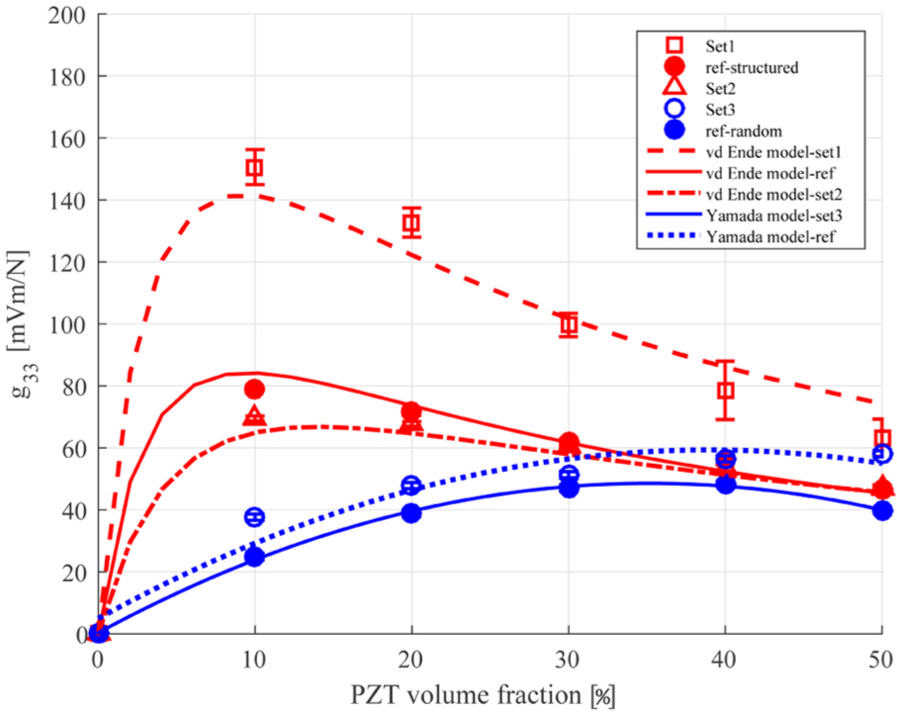
The
Conclusions
A significant improvement in piezoelectric properties of quasi 1–3 composites can be achieved via a combination of dielectrophoretic alignment of the ceramic particles and poling process simultaneously while the polymer matrix is still in the liquid state. This new processing route is practiced in a thermoset polymer system during curing while the polymer possesses relatively high permittivity as well as electrical conductivity as compared to a fully cured system. The proposed method offers new avenues in low cost manufacturing of composite pressure sensitive materials for demanding long-term sensor applications.
Footnotes
Declaration of conflicting interests
The author(s) declared no potential conflicts of interest with respect to the research, authorship, and/or publication of this article.
