




Abstract
The purpose of this systematic review is to critically evaluate experimental evidence on the usefulness of mobile- or computer-based foreign-language applications for adults aged fifty-five years and older who are free from cognitive impairment. A systematic search of Web of Science Core Collection and Scopus identified studies published without date or language restrictions. The findings from the detected studies indicate significant improvements in receptive vocabulary or composite language-proficiency scores (hedges g = 0.30–0.60). The only one randomized controlled trial found that sixteen weeks of Duolingo practice produced executive-function gains equivalent to a commercial brain-training program and superior to wait-list control. Smaller pilots documented modest enhancements in global cognition and attention. Qualitative feedback highlighted clear interfaces, adjustable font sizes, gamified progress cues, and social features as key engagement drivers, while onboarding complexity and low-contrast designs were recurrent barriers. Preliminary evidence shows that well-designed language-learning applications are highly beneficial for cognitively healthy older adults, support measurable language gains, and can yield short-term executive-function benefits when delivered at sufficient intensity.
Keywords
“The findings suggest that language apps may be suitable for older learners and may also support short-term cognitive improvement.”
Introduction
Population aging has made the maintenance of cognitive health a priority for public-health and education researchers alike (Khan et al., 2024; Sabayan et al., 2023). Long-term observational studies (Alladi et al., 2013; Bialystok, 2017; Bialystok, 2021; Gold et al., 2013; Liu & Wu, 2021; Van den Noort et al., 2019) show that lifelong bilinguals tend to experience a later onset of dementia than their monolingual peers, strengthening the idea that juggling two linguistic systems contributes to cognitive reserve. Inspired by these findings, scholars, for example, Ware et al. (2021) or Dey et al. (2024), have begun to ask whether acquiring a new language in later life, rather than over a lifetime, might deliver parallel benefits. However, as Hu (2024) points out, traditional classroom courses are often costly, require travel, and may rely on teaching methods that do not match older adults’ expectations or schedules.
Therefore, the use of smartphones and tablets offers a potential solution. In high-income countries the share of adults over sixty who own an internet-enabled mobile device now approaches, and in some regions exceeds, 70%, yet many still struggle with small fonts, complex navigation, and privacy concerns (Berenguer et al., 2017; Busch et al., 2021; Mohan et al., 2024; Portenhauser et al., 2021). Nevertheless, language-learning applications, such as Duolingo and Mondly, are marketed as convenient, self-paced tools that learners can use anytime and anywhere, an appealing proposition for older people who often combine travel aspirations with a desire to “keep the brain active” (Kazu & Kuvvetli, 2025; Nushi et al., 2024). In addition, research indicates both the promise and the limitations of these tools. For instance, survey study conducted by Sanda and Klimova (2021) among cognitively healthy Czech seniors aged fifty to sixty-nine found that more than one-third had already experimented with mobile apps for English study and strongly valued clarity, large print, and light gamification, while disliking cluttered interfaces and hard-to-read fonts. Furthermore, review articles (Klimova, 2020; Zhou et al., 2025; Zhu et al., 2025) conclude that app-based language practice can enhance older adults’ sense of autonomy, bolster confidence, and widen social networks even when formal proficiency gains remain modest. Nevertheless, findings from quality-assessment studies (Alghamdi, 2022; Portenhauser et al., 2021) of commercial app stores show that very few products have been designed with older users in mind and that accessibility shortcomings, such as insufficient contrast or the absence of adjustable text size, are common. To address these gaps, several design-thinking projects (Blake et al., 2025; Puebla et al., 2022; Sakaguchi-Tang et al., 2023) have involved older adults directly in developing and testing prototypes. For instance, a German study (Puebla et al., 2022) used semi-structured interviews, iterative brainstorming, and usability testing to produce a smartphone app that integrates language practice with hobby-based meet-ups; participants awarded high usability scores and praised the emphasis on social interaction. Such participatory work emphasizes that seniors are not merely passive consumers of technology but can articulate nuanced design requirements, including minimalist layouts, step-by-step onboarding, and opportunities for peer collaboration.
Overall, these descriptive, evaluative, and user-centered investigations indicate that mobile and computer applications hold genuine potential to make foreign-language learning more accessible in later life, yet they also reveal persistent usability barriers and a shortage of age-appropriate pedagogical content (Erdoğdu et al., 2024). Importantly, most published studies remain exploratory; rigorous experimental trials are only beginning to emerge, leaving a need to consolidate the pre-experimental evidence base that will guide future intervention research. Therefore, the present review seeks to critically evaluate what is currently known about the usefulness, encompassing perceived value, usability, engagement, and self-reported learning impact, of mobile- or computer-based foreign-language applications for cognitively unimpaired adults aged fifty-five years and above. To answer the aim of this review study, the following research questions were formed: (1) How do older learners appraise the usability, accessibility, and motivational appeal of existing language-learning applications? (2) What personal, social, and cognitive outcomes do older adults associate with app-based language study, and what obstacles hinder sustained use? (3) Which interface features, content types, and support strategies have been linked to more positive user experiences and greater persistence in this population?
Addressing these questions will clarify design principles and implementation challenges, thereby informing both developers who wish to serve the growing “silver learner” market and researchers planning the next generation of experimental studies.
Methodology
The search strategy followed the PRISMA (Preferred Reporting Items for Systematic Reviews and Meta-Analyses) guidelines to ensure a thorough and systematic approach in identifying and analyzing relevant research on the usefulness of educational applications for learning foreign languages by cognitively unimpaired older adults. To ensure broad disciplinary coverage, two multidisciplinary bibliographic databases were selected. The Web of Science Core Collection offers strong indexing of education, psychology, and medical informatics journals, whereas Scopus complements it with extensive conference proceedings and human-computer-interaction outlets. Both databases were investigated on 30 June 2025, thereby providing a single-day snapshot that can be replicated by future reviewers.
The population of interest comprised adults aged fifty-five years or older who were explicitly described as cognitively unimpaired. Operational definitions of preserved cognition included statements such as “healthy aging,” Mini-Mental State Examination scores of twenty-four or above, Montreal Cognitive Assessment scores of twenty-six or above, or equivalent descriptors. The intervention had to be delivered exclusively through a mobile phone, tablet, or desktop/web application; hardware-dependent platforms such as virtual-reality headsets or wearables were outside scope because their adoption among older adults remains limited. Finally, only experimental designs, that is, randomized, quasi-experimental, pilot, feasibility, or single-group pre-post studies, were considered eligible, observational surveys and narrative reports were deliberately excluded in order to concentrate on causal evidence.
After several rounds of pilot scoping, the definitive queries were formulated as three conceptual blocks joined by the Boolean operator AND. The first block targeted foreign-language learning terms; the second block captured older-adult descriptors using both American and British spelling variants; the third block homed in on experimental study terminology. For the Web of Science search, all three blocks were confined to the title field (TI = ) so as to minimize retrieval of papers in which language learning was merely incidental. The final Web of Science string therefore read:
In Scopus, the search had to be split across two TITLE clauses because of platform restrictions on wildcards within phrases. The technology terms were placed in the first clause and the gerontology and language stems in the second and third clauses:
No limits on date, language, or document type were applied to avoid excluding relevant pilot work or non-English studies. The searches yielded sixteen titles from Web of Science and five from Scopus.
De-duplication and Sequential Filtering
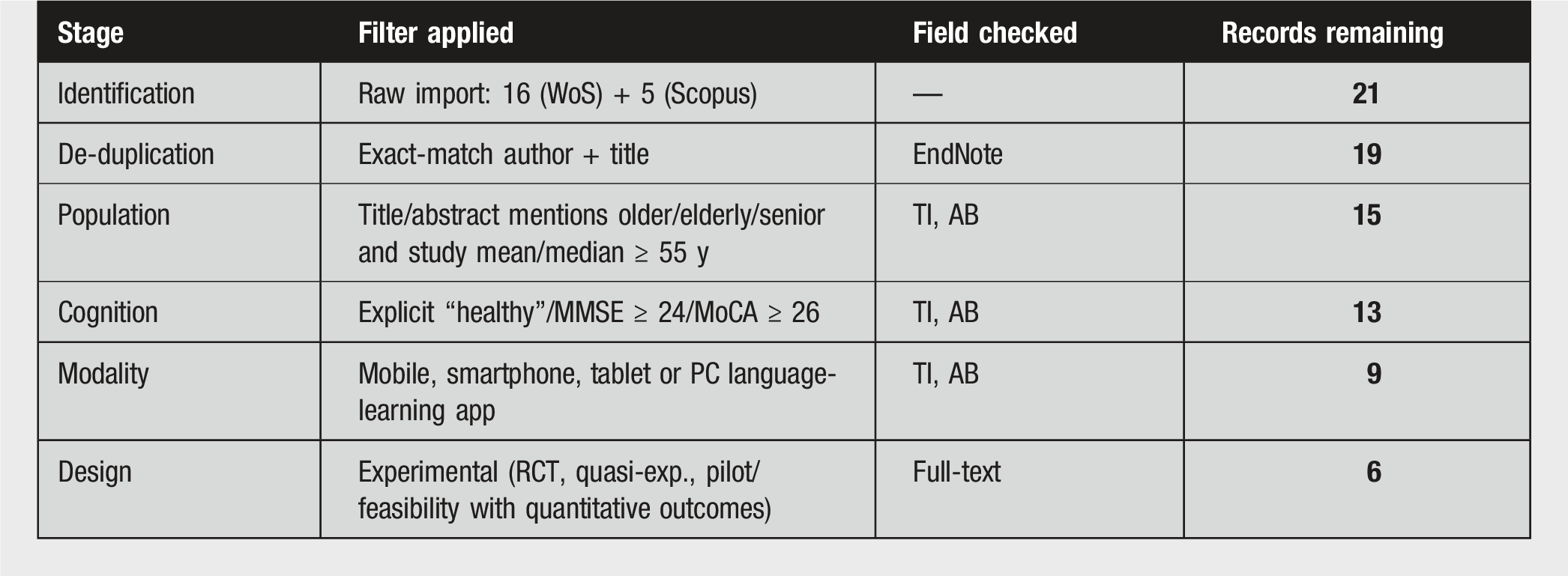
Six full-text articles therefore proceeded to detailed appraisal.
Eligibility Matrix
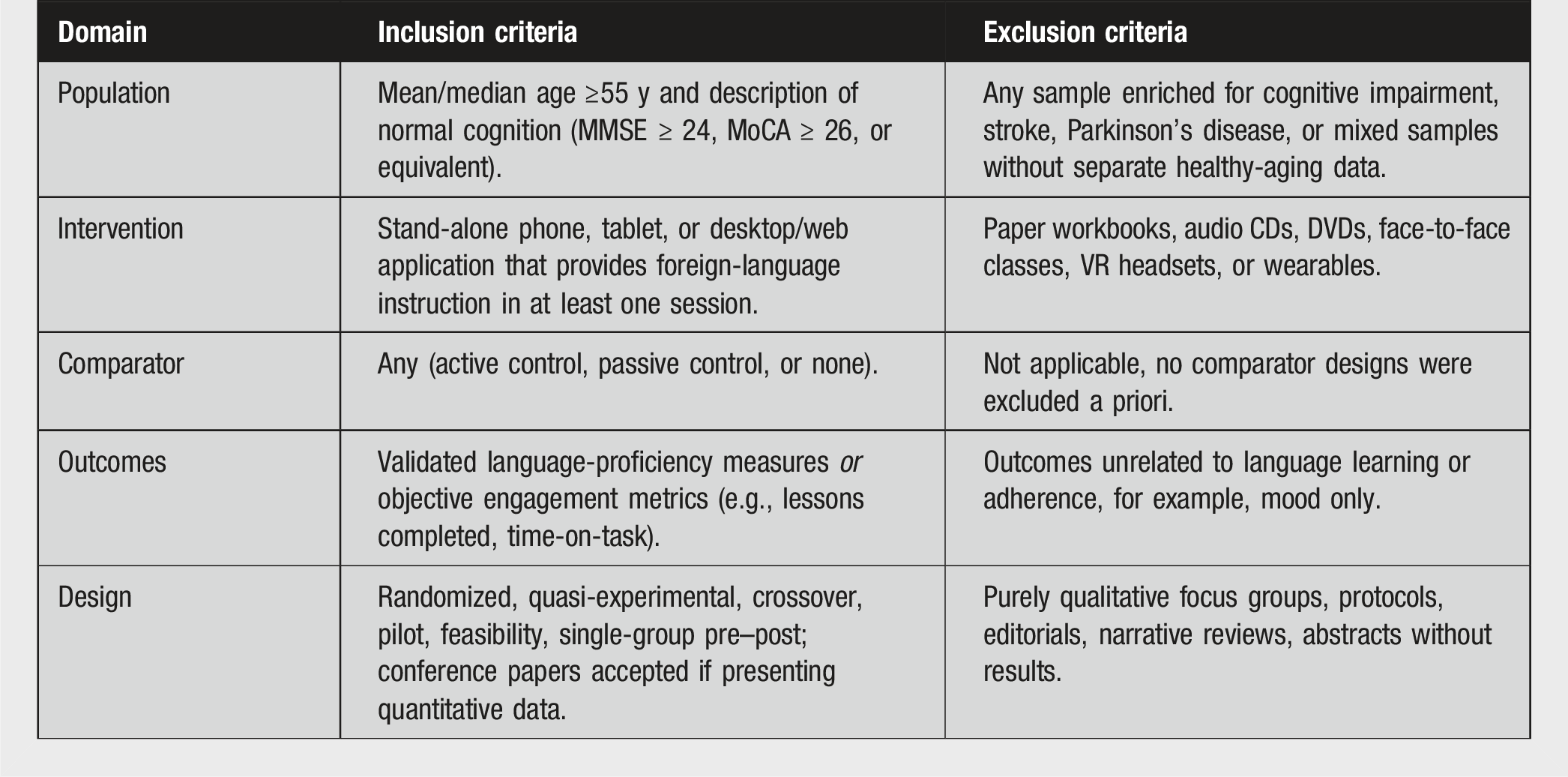
Throughout this manuscript, the umbrella term “older adults” denotes participants aged fifty-five years or more, and the phrase “cognitively unimpaired” is reserved for individuals who meet the objective or self-reported criteria outlined above. Commercial trademarks such as Duolingo® and Babbel® are reproduced verbatim when cited, whereas bespoke research software is described in generic terms.
Results
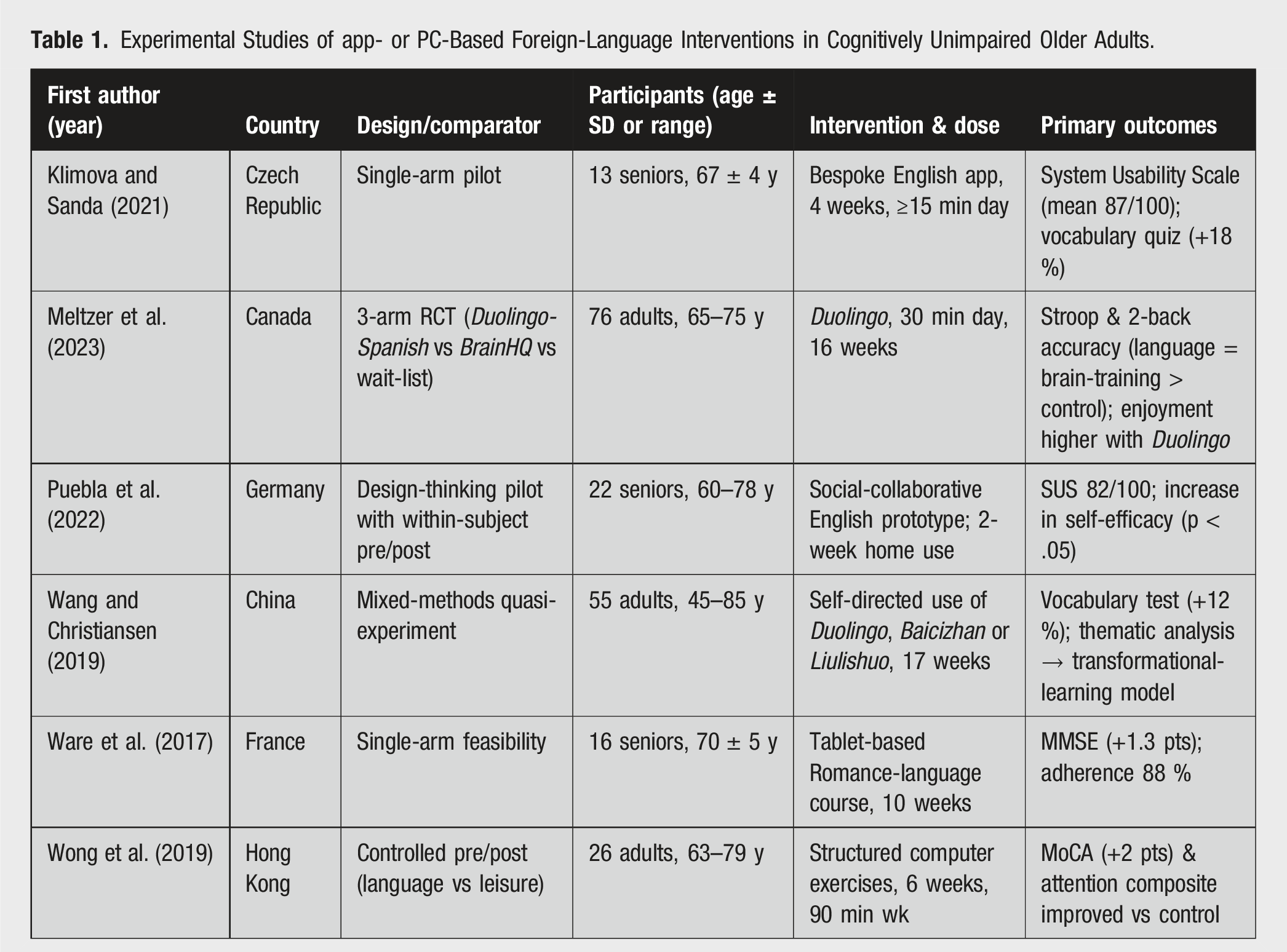
Experimental Studies of app- or PC-Based Foreign-Language Interventions in Cognitively Unimpaired Older Adults.
Language Outcomes
Across the six included experimental studies, language-related improvements were reported in four interventions. Gains were noted in receptive vocabulary and basic proficiency measures, including short programmes that produced measurable increases in vocabulary scores (Klimova & Sanda, 2021; Wang & Christiansen, 2019; Wong et al., 2019). Longer interventions, such as ten-week or seventeen-week programmes, supported broader improvements across listening, speaking, or composite proficiency indices (Wang & Christiansen, 2019; Ware et al., 2017). Variation in assessment tools prevented direct comparison across trials, yet the pattern indicated that older adults were able to achieve modest but consistent improvements when exposed to regular technology-based practice.
Cognitive Outcomes
Cognitive effects were examined in four studies. A randomized controlled trial showed that executive-function scores improved following a sixteen-week language-app intervention and that these improvements were comparable to those produced by a commercial cognitive-training programme (Meltzer et al., 2023). Additional studies reported small increases in global cognition or attention composites following short structured programmes (Ware et al., 2017; Wong et al., 2019). Follow-up periods were brief, and instruments varied across trials, which limited the ability to determine persistence of gains. The available evidence suggested that language-learning applications may provide short-term benefits in selected cognitive domains when delivered with adequate intensity.
Usability and Engagement
Usability and engagement indicators were monitored in five studies. System Usability Scale scores consistently fell within the good-to-excellent range, including evaluations of senior-oriented prototypes and commercial applications (Klimova & Sanda, 2021; Puebla et al., 2022). Participants reported that clear navigation, readable typography, and straightforward task structure supported continued engagement. Adherence rates were generally high, with most users completing the majority of prescribed sessions (Ware et al., 2017; Wong et al., 2019). Studies that incorporated social or collaborative components received especially positive evaluations, indicating that meaningful interaction and hobby-linked tasks may support motivation (Puebla et al., 2022; Wang & Christiansen, 2019).
Overall, across trials, outcomes reflected a consistent pattern of modest language gains, preliminary cognitive improvements, and strong usability evaluations. Substantial methodological heterogeneity remained, and most interventions were limited by small samples, short durations, and the use of bespoke measures. These constraints prevented aggregation of effect sizes but did not obscure the broadly positive indications regarding feasibility and user experience among cognitively unimpaired older adults.
Discussion
The results of this review reveal that across six experimental studies, app- or PC-based language learning by cognitively healthy adults aged 55+ was found to be usable, engaging, and associated with small-to-moderate gains in language outcomes, with preliminary transfer to executive functions when exposure was sufficiently intense. The only randomized controlled trial (Meltzer et al., 2023) that compared an app-based language condition directly to a purpose-built brain-training app reported equivalent improvements on two preregistered executive-function measures and higher enjoyment ratings for the language condition. The findings suggest that language apps may be suitable for older learners and may also support short-term cognitive improvement.
1. How do older learners appraise the usability, accessibility, and motivational appeal of existing language-learning applications?
Usability was consistently rated in the good-to-excellent range when basic age-friendly conventions were implemented. The Czech pilot study (Klimova & Sanda, 2021) of a senior-oriented English app reported a mean SUS score near the top quartile, and the German design-thinking pilot (Puebla et al., 2022) yielded similarly high usability scores. Qualitative comments across both studies emphasized clear navigation, readable typography, and low visual clutter. These findings match other research studies (e.g., Amouzadeh et al., 2025 or Chen, 2016) that identified frequent shortcomings in older-adult apps, including inconsistent accessibility options and unclear privacy controls, and that recommended large fonts, high contrast, and simple flows.
Motivation appeared strongest when apps offered brief lessons, clear progress indicators, and opportunities for meaningful social interaction. The RCT (Meltzer et al., 2023) reported higher enjoyment with Duolingo than with an active brain-training comparator. The design-thinking prototype that combined language tasks with hobby-based meet-ups was judged motivating, aligning with survey evidence that older adults prefer intuitive, socially connected, and bite-sized mobile experiences. This is in line with similar research studies on this topic, for example, Klimova (2023), Klimova (2018) or Perotti et al. (2025). Furthermore, Wilkinson and Cornish (2018) propose a Consideration Framework, which places the user at the center of the process and mirrors the aim to heighten product engagement by following the traditional principles of user-centered and participatory design.
2. What personal, social, and cognitive outcomes do older adults associate with app-based language study, and what obstacles hinder sustained use?
Language-specific benefits were observed for receptive vocabulary and composite proficiency in pilots and quasi-experimental designs. The Hong Kong study (Wong et al., 2019) used structured computer exercises reported improvements in global cognition and attention relative to an active leisure control over six months. The Canada-based RCT (Meltzer et al., 2023) reported executive-function gains after 16 weeks of daily app practice, comparable to a commercial cognitive-training program on two primary outcomes. These outcomes are consistent with laboratory and classroom studies outside the app domain in which short, intensive language courses improved attentional control across adulthood (Melo et al., 2025; Odii et al., 2025; Pasqualotto et al., 2021).
Reported obstacles included small or low-contrast text, complex onboarding, and privacy concerns. These barriers mirror recurring issues described in evaluations of apps aimed at seniors and in studies of smartphone adoption in older populations. Clear consent cues, visible privacy settings, and adjustable text were highlighted as practical mitigations also in other studies (Amouzadeh et al. 2025; Bertolazzi et al., 2024; Busch et al., 2021; Portenhauser et al., 2021;
3. Which interface features, content types, and support strategies have been linked to more positive user experiences and greater persistence in this population?
Three convergent design levers emerged. First, accessibility defaults mattered. Large fonts, sufficient contrast, and uncluttered screens were linked to higher SUS scores and better adherence (Klimova & Sanda, 2021; Puebla et al., 2022). Second, progress signaling and modest gamification supported day-to-day engagement when daily doses were kept short (Klimova & Sanda, 2021; Meltzer et al., 2023; Wong et al., 2019). Third, optional social layers that tied language tasks to meaningful activities supported motivation and self-efficacy (Wang & Christiansen, 2019; Ware et al., 2017). These levers align with recent age-friendly mobile-design reviews that recommend adjustable typography, simplified paths, error-tolerant inputs, and social scaffolding. For instance, Berenguer et al. (2017) report that social scaffolding, whether leaderboards, peer matchmaking or collaborative tasks, emerged as the most distinctive contributor to sustained engagement, echoing earlier reports that the wish to “belong” is a potent driver of technology adoption in late adulthood.
In summary, the detected studies showed that technology-based foreign-language instruction could produce modest yet reliable language gains, short-term improvements in selected cognitive domains, and generally high usability among cognitively unimpaired older adults. These outcomes suggest that older learners retain the capacity to acquire new linguistic knowledge when practice is structured and accessible, supporting earlier findings on vocabulary and proficiency gains in later adulthood (Klimova & Sanda, 2021; Wang & Christiansen, 2019; Ware et al., 2017; Wong et al., 2019). Cognitive improvements, although preliminary, aligned with theoretical accounts linking language learning to executive processes. Evidence from the longest intervention indicated benefits comparable to those produced by a commercial cognitive-training programme (Meltzer et al., 2023), while smaller studies reported gains in global cognition or attention (Ware et al., 2017; Wong et al., 2019). These findings suggest that language learning may introduce cognitively demanding activities that stimulate attentional control and memory. Moreover, the consistent usability ratings demonstrated that when interface design follows age-friendly principles, older adults can successfully engage with digital tools. Social or collaborative features further supported motivation and adherence, aligning with broader research showing that relevance and social meaning enhance engagement in later-life learning (Puebla et al., 2022; Wang & Christiansen, 2019).
Implications for Practice
Educational practitioners who work with older learners can integrate language-learning applications into their programmes by framing them as structured supplements rather than stand-alone tools. Practitioners may introduce apps during guided sessions that demonstrate key functions, provide reassurance about privacy settings, and allow participants to practise navigation with support. Clear weekly goals, such as completing a small set of lessons or vocabulary activities, can offer structure while accommodating varying levels of digital familiarity. Group-based formats can enhance persistence by fostering shared progress and discussion among learners, particularly when paired with short in-class reflection tasks or peer demonstrations.
App developers can build upon the findings by prioritizing accessibility defaults that remove early barriers to engagement. Large adjustable fonts, high-contrast color palettes, and uncluttered navigation paths should be embedded as standard rather than optional features. Stepwise onboarding that introduces essential functions gradually can support learners with limited digital experience. Short, manageable tasks with visible progress indicators may maintain day-to-day engagement, while optional social scaffolds, such as hobby-linked challenges or group tasks, can extend motivation without overwhelming learners who prefer individual study. Embedding brief, standardized measures of language progress may also help practitioners and researchers monitor outcomes more consistently.
The reviewed studies showed that technology-based foreign-language instruction can produce modest yet reliable language gains, short-term improvements in selected cognitive domains, and generally high usability among cognitively unimpaired older adults. These outcomes suggest that older learners retain the capacity to acquire new linguistic knowledge when practice is structured and accessible, supporting earlier findings on vocabulary and proficiency gains in later adulthood (Klimova & Sanda, 2021; Wang & Christiansen, 2019; Ware et al., 2017; Wong et al., 2019). Cognitive improvements, although preliminary, aligned with theoretical accounts linking language learning to executive processes. Evidence from the longest intervention indicated benefits comparable to those produced by a commercial cognitive-training programme (Meltzer et al., 2023), while smaller studies reported gains in global cognition or attention (Ware et al., 2017; Wong et al., 2019). These findings suggest that language learning may introduce cognitively demanding activities that stimulate attentional control and memory. Moreover, the consistent usability ratings demonstrated that when interface design follows age-friendly principles, older adults can successfully engage with digital tools. Social or collaborative features further supported motivation and adherence, aligning with broader research showing that relevance and social meaning enhance engagement in later-life learning (Puebla et al., 2022; Wang & Christiansen, 2019).
Furthermore, the findings of this review study demonstrate that when older adults are given accessible design, stepwise support, short tasks, and meaningful social engagement, they participate more fully, persist longer, and feel more confident using learning tools. These principles translate directly across subject areas, such as literacy, health education, digital skills, financial education, or arts programs.
Limitations
Despite these positive indications, several constraints affected the strength and generalizability of the evidence. With the exception of Meltzer et al. (2023), sample sizes were small, often convenience-based and dominated by well-educated, early-adopter seniors, raising the specter of selection bias. Follow-up periods rarely exceeded three months. Thus, the durability of both language and cognitive gains is unknown. Control conditions, where present, seldom matched the language intervention for social contact or novelty, potentially inflating effect sizes. Outcome heterogeneity, ranging from bespoke vocabulary quizzes to global cognition screens, means that effect magnitudes cannot readily be meta-analyzed.
Conclusion
Despite the shortcoming described above, the emerging picture is one of cautiously positive potential. The convergence of high usability, strong adherence, meaningful language gains and at least preliminary cognitive benefits suggests that foreign-language apps may occupy a unique niche in the healthy-aging toolkit: they demand complex, multi-modal processing yet sustain motivation through gamified structure and culturally relevant content. As such, they arguably combine the mental-challenge profile of classical cognitive training with the intrinsic interest and social-currency features of leisure activities, positioning them to meet the dual goals of enjoyment and cognitive resilience that public-health guidelines increasingly emphasize (Bialystok, 2017; Klimova, 2020). The task now is to move beyond feasibility toward multi-site, adequately powered randomized trials that embed common outcome batteries, ideally CEFR (Common European Framework of Reference for Languages)-aligned proficiency tests and consensus cognitive composites, and that track retention for at least six months post-intervention. Equally important is a commitment to equity: future studies must purposively sample seniors with lower education or limited prior digital exposure and provide scaffolded onboarding so that the field can speak to the diversity of the aging population.
Footnotes
Acknowledgments
The paper was written within the TAČR project (TQ23000281) run at the Faculty of Informatics and Management of the University of Hradec Kralove.

Authors’ Contribution
The author designed, drafted and revised the whole manuscript.
Funding
The authors received no financial support for the research, authorship, and/or publication of this article.
Declaration of Conflicting Interests
The authors declared no potential conflicts of interest with respect to the research, authorship, and/or publication of this article.
Declaration of Generative AI in Scientific Writing
During the preparation of this work the author(s) used ChatGPT in order to improve the readability and language of the manuscript. After using this tool/service, the author(s) reviewed and edited the content as needed and take(s) full responsibility for the content of the published article.