




Abstract
A late modern rationale for the education of older people has not yet been sufficiently explored. In this action research, I explore Giddens’s life politics as a framework for a late modern rationale for older adult education. Eleven older learners were recruited voluntarily to an online study group conducted via Zoom at a University for the Third Age. Over six sessions, learners attended mini lectures, completed self-reflexive assignments, and engaged in lively classroom discussions. I report and evaluate the study group, with special focus on outcomes such as personal growth and self- and social questioning. I conclude that life politics is a viable framework for the education of older people and state implications for theory and practice.
Upon retirement, older adults face new questions and identity-defining choices concerning roles within society and family, learning in later life, working beyond retirement, health, and lifestyle.”
A postmodern rationale for the education of older people has not been yet sufficiently explored (Findsen & Formosa, 2011). Pioneering work in that direction was characterized by Foucauldian undertones (see Withnall, 2010) and did not emphasize reflexivity—a necessary and central response to emerging changes (Edwards et al., 2002) that older people face in their third age (Bjursell, 2020).
Previous rationales for the education of older people include liberal-humanist (Percy, 1990) and change-oriented rationales—Freire and Mezirow (Formosa, 2011; Glendenning & Battersby, 1990; Manninen et al., 2019). Humanist education is seen as hegemonic and unable to empower older learners (Formosa, 2011); not that it aims to do so. Meanwhile, despite aiming for it, social empowerment is seldom reached despite following Freirean ideals (see Formosa & Galea, 2020; Nye, 1998) and transformative principles (see Moyer & Sinclair, 2020), which were redefined in terms of identity in lieu of cognitive frameworks alone (Illeris, 2014).
In addition, the humanist rationale assigns self-actualization or personal growth as a goal to learning, whereas empowerment and emancipation are the goals of Freirean older adult education, signaling a goal dichotomy (Hachem, 2020). One way to address this dichotomy is through a late modern rationale for the education of older people that can embrace concurrently personal growth and self- and social questioning. Responding to Formosa and Galea’s (2020) call “. . . to embed older adult learning in an agenda that is critical and sensitive to late modern sensibilities, whilst remaining responsive to the autonomous aspirations of individual learners” (p. 11), I propose the late modern concept of Life Politics (Giddens, 1991) as a framework for the education of older people, and there lies this study’s innovative promise.
In this action research, I test life politics in an educational practice setting. I implemented an online study group at a University for the Third Age (U3A) relying on reflexivity and identity work. I report and evaluate the outcomes of this study group, paying particular attention to signs of personal growth and self- and social questioning and to the ways in which identity and reflexivity contribute to these outcomes.
Life Politics and Older Adult Education
Identity construction is becoming a key part of the process of growing older (Higgs & Gilleard, 2006). Upon retirement, older adults face new questions and identity-defining choices (Illeris, 2014) concerning roles within society and family, learning in later life, working beyond retirement, health, and lifestyle. One way to tackle emerging questions and disjuncture is through reflexive learning (Bjursell, 2020; Edwards et al., 2002), and it is here that the educational promise of life politics emerges. Giddens (1991) defined life politics as a politics of -actualisation in a reflexively ordered environment, where that reflexivity links self and body to global scopes . . . Life politics concerns political issues which flow from processes of self-actualisation in post-traditional contexts, where globalising influences intrude deeply into the reflexive project of the self, and conversely where processes of self-realisation [or self-actualization] influence global strategies. (p. 214)
This conceptualization of life politics merges self-actualization and empowerment/emancipation and could solve long-standing learning goal-related dichotomies found within previous rationales for the education of older adults (see Hachem, 2020). Life politics offers two important insights. It allows for the discovery of the self in connection to societal and global scopes, and ultimately connecting the two. It transcends emancipation by orientating individuals “towards” rather than “away from” others (Giddens, 1991, p. 213), unlike emancipatory politics. Life politics speak to a heterogeneous cohort of older learners, not only the oppressed or the privileged. By acting on self-identities, life politics can engage learners from different life chances to learn together and exchange perspectives. Life politics also summons a dialectical relationship between the self and global issues, through which the individual journey of self-actualization becomes dependent on exploring global issues.
Through reflexivity, the proposed life politics framework for learning can help older learners manage the uncertainties and risks associated with older age, as well as global threats such as the COVID-19 pandemic (Bjursell, 2020). Edwards et al. (2002) explained that “reflexivity associated with contemporary change processes entails forms of learning that develop a capacity for questioning one’s self and the historical and social circumstances from which action to accomplish change may be envisioned and resourced” (p. 531). Via reflexively ordered narratives of self-identity, older adults can understand their own life span in the context of changing and emerging external circumstances, including other learners’ life spans, values, and perspectives. Life politics becomes a rationale for an elective change-oriented education that gratifies identity expression and self-actualization. Education à la life politics does not mandate individual or social change on learners. Rather, by constructing spaces for self- and social questioning, it forms an incubator for their materialization.
Planning the Study Group
My investigation follows an action research design (Glassman et al., 2013), through which I approach innovatively the learning goals dichotomy, self-actualization, or empowerment/emancipation. Inspired by the four core processes of action research, I opted for one cycle of planning, acting, observing, and reflecting (Kuhne & Quigley, 1997). In the planning phase, I deepened my understanding of the sociological concept of life politics. Then, considering previous rationales for older adult education, I designed life-politics-inspired educational activities where learners are the main contributors to their own learning processes in a small group dynamic. The success or failure of this rationale depended on whether learners, at the end of the study group, would exhibit signs of personal growth and self- and social questioning. The study group announcement promised to keep lecturing to a minimum and, through group discussions and dynamics, to tackle issues related to culture, norms, and older adults’ roles in their societies. In addition, the announcement promised a new take on learning in older age and indicated possible benefits such as fun, socialization (virtual), learning, and social impact. Initially, regarding the learning environment, it was expected that moving online would present technical challenges (Stephens & Coryell, 2020). I designed creative online educational activities to be accessible, effective, and fun (Rogers-Shaw et al., 2017) while remaining mindful of possible challenges to online teaching (Stephens & Coryell, 2020). Classroom activities were intended to invite older learners to reflect on their identities, past, present, and future. They were also designed to give space for a spontaneous digression from personal narratives to structural and societal concerns.
Study Group . . . Action
In the acting phase, the group took place via Zoom, as part of the first ever fully online educational term at this U3A. In October 2020, older learners were in a COVID-19-related lockdown. Participants were welcomed on a first-come-first-served basis. The study group recruited 11 students: nine females and two males. The youngest person in this cohort was 54 years old and the oldest was 74. Participants were given culturally blind aliases. The official language of the group was English. The group met six times, twice per week for three weeks, during October 2020. The planned duration of each session was an hour, but each session was extended by 15 to 30 min. At three intervals, I implemented mini lectures, self-reflexive assignments, and class discussions, which I detail in Figure 1. Key assignments encouraged reflection over self-identities by asking learners to
Write a short letter to yourself answering the question “Who am I”?
Write a short letter to your younger self; what would you say?
Write a short letter to your future self; what would you say?
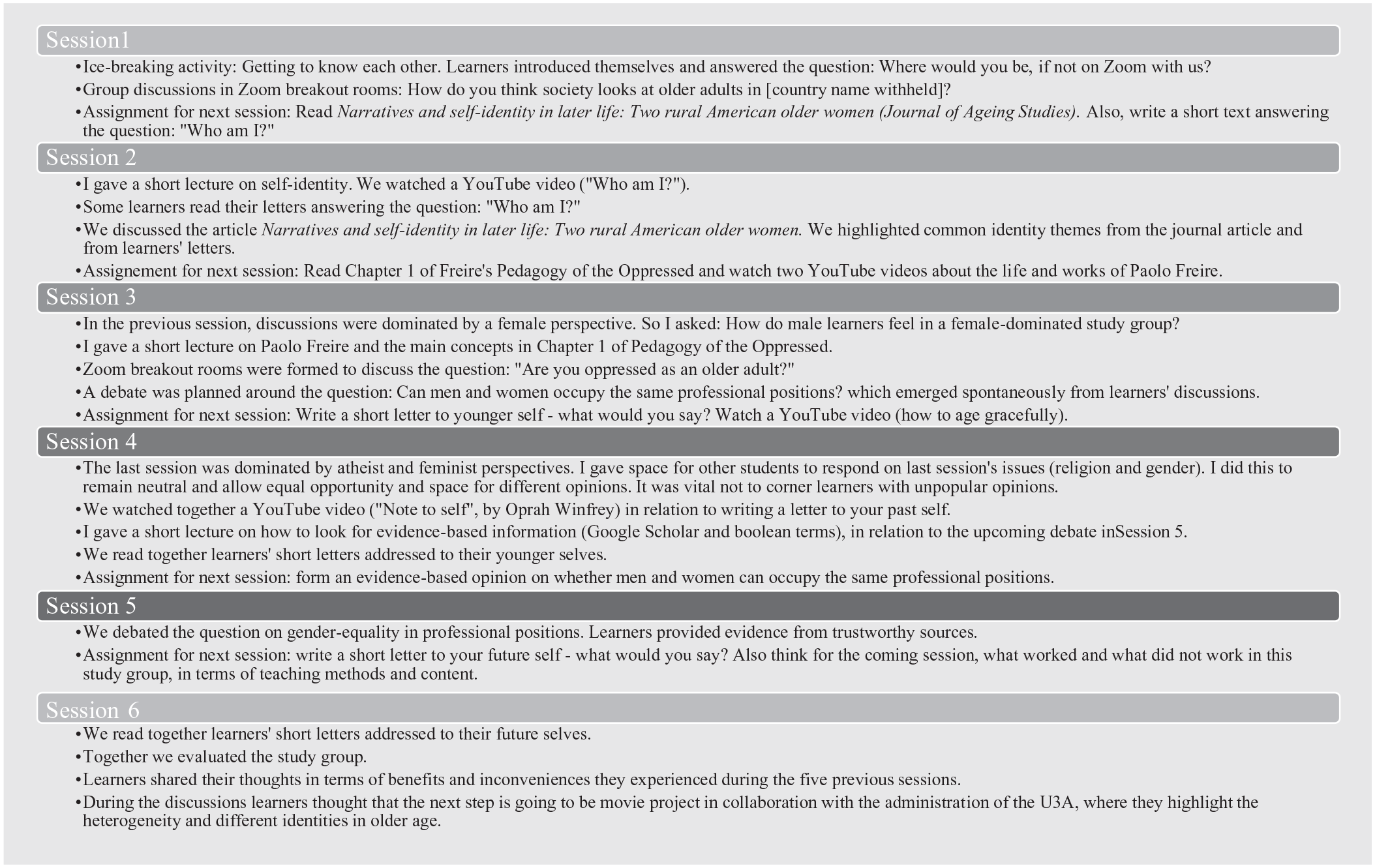
Study group sessions’ content.
Teachers’ positions following the humanist and change-oriented rationales mentioned earlier in this text are somewhat challenging. Following humanist ideals, teachers are mere knowledge facilitators (Percy, 1990), whose mission is not to empower nor expose oppressive structures. However, the teacher’s role as a leader for change seen from Freirean and transformative perspectives could easily place teachers in positions of deciding what can be known and what should be done (Ellsworth, 1989). For these reasons, I imagined and enacted a life-politics-inspired teaching role, which I call engaged facilitator of knowledge. I encouraged participation, posed questions, and introduced ideas that solicit reflexive discussions. I provoked learners to question their identities, beliefs, and values, but did not expect nor push them to change. I assumed a neutral position in debates and discussions and refrained from imposing my own political agenda. I kept topics, assignments, and participation strictly elective, believing that if learners are interested, they will engage. I kept in mind the well-being of learners and worked in the direction of their self-actualization and empowerment.
An important part of my role as a teacher was to establish a trusting virtual environment, and to nurture a collegial, warm, horizontal, and democratic atmosphere. Therefore, I underlined the elective nature of educational content, assignments, and classroom activities, which could be easily changed if learners wished it.
Observing: From Identities to Global Scopes
My identity or me: the daughter, the student, the wife, the mother, the fighter, the widow. What have I done with my life? What mark do I leave through which I will be remembered by those who knew me? (Jacqueline, 54-year-old female)
The three examples shown below are taken from classroom discussions and assignments. They illustrate evident connections between self-identities and global issues. Each example describes the transition from an identity theme (motherhood, religion, and gender) to questioning issues of global scopes (retirement, gendered social roles, and educational access).
From Motherhood to Retirement
The theme of motherhood surfaced as an identity account. It opened up discussions about retirement and led to the questioning of societal definitions of retirement. As part of the study group, the students wrote letters about their lives. Female older learners stressed their identity as mothers who are proud of their children and their accomplishments in both the educational and professional spheres. Antoinette, a 69-year-old female, proudly stated, “my son is a thoracic surgeon in a . . ., the other is an engineer and holder of an MBA, and my daughter has a master’s in science education. All the above to say, I could fulfil my dreams.” Although Antoinette mentioned caregiving and motherhood mostly in a romantic way, these were also seen in a rather problematic manner by Jacqueline, a 54-year-old female. Jacqueline gave up on her dreams of studying further so that she could be “the perfect mother.” As she worked for only 1 year in her life, Jacqueline started a discussion about whether she is considered a retired person or not. “Do mothers retire?” she asked. The discussion that followed included attempts to define retirement and to question who decides what retirement is and who benefits from different definitions.
From Religion to Gendered Social Roles
In the second example, identity themes in relation to religion sparked discussions on gendered social roles. Josephine, a 74-year-old female, had worked all her life and took pride in the number of years she had been engaged professionally. Retirement was not an easy ride for her. Despite her long career, Josephine, a religious woman, believed strongly in gendered social roles. “Motherhood and raising children are a women’s job, and mothers prepare women and men for their role in society,” she said. That same discussion became inflamed to such an extent that it had to be turned into a debate, which took place in Session 5. There, two main positions were formed: a group of females stressed that women could do any job as well as men. The other group, comprising Jacqueline and Jean (a 65-year-old man), insisted that some jobs are just not for women, citing construction work, truck driving, and jobs that require physical strength. Conversely, Helen, a 74-year-old “freedom fighter,” leftist, activist, and movie director, strongly condemned “patriarchy.” She believes in secular societies and that religion and women’s rights do not go well together. Along the same lines, Rose, a 72-year-old female, provided a long list of females who had entered and excelled in male-dominated work domains. The heated debate reached another instance of social questioning. It was concluded that if women cannot perform certain functions at work, it is not women’s abilities that should be doubted; it is the nature and circumstances of jobs that need adjustments.
From Gender to Educational Access
Gender was also discussed from the point of view of access to educational opportunities as learners questioned family traditions that favored educational access for males. Traditions meant that women did not receive proper education because the overall amount of money allocated for tuition within families is worth more when invested in male children. Recalling her childhood, Hope, a 62-year-old female, had to fight with her family, especially her uncle, because the uncle believed that she had received enough education. Family traditions also prevented Jacqueline and Rose from acquiring further education. When asked whether she felt oppressed, Hope responded, “we were raised in [country withheld] oppressed by our families, leaders, society, by everybody.” Hope added that the source of oppression is cultural practices. While traditions prevented female learners from learning more, Tony, a 55-year-old male learner, regretted not learning more, for reasons that are not related to traditions. Reflecting on Tony’s example, Hope affirmed that oppressive culture sustains differences between men and women, boys and girls, and that it is reproduced in homes and schools. Having missed some education in earlier times, many female learners consider learning in older age as a compensation.
Reflection: Teacher’s Perspective
I illustrated how educational activities engage learners in exploring and constructing their “selves” as part of reflexive processes that link together personal and social issues, a necessary step to identity-based change-oriented adult education. The proposed life politics framework for older adult education is not a form of self-glorification; rather, it is one that becomes “vitally implicated in a politics of representation (how people present and understand or are presented and understood) in the cultural processes that shape the meanings and understanding of experience and the formation of identity” (Usher, 2009, p. 179). In classroom deliberations, reflections on womanhood, as an identity, uncovered a male-oriented definition of retirement, and male favoritism in educational access. Tackling religious identity revealed beliefs in gendered roles in society and sparked questions about the ability of women to occupy certain job positions. Despite the elective nature of all educational activities across the six sessions, the discussions became increasingly fervent and intimate, and the number of responses to the assignments increased. Participants who did not write their assignments remained actively engaged in the discussions. On an outcome level, the previous examples form unmistakable signs of self- and social questioning coupled with personal growth, as older learners interacted with peers, shared intimate experiences, reflected on their identities, planned for future selves, and engaged in reminiscence about their past and in resolving unfinished business. Using life politics as a rationale for learning enables older adults to seek personal growth, as well as freedom from oppression—all while avoiding their portrayal as oppressed or powerless (Formosa, 2011; Glendenning & Battersby, 1990).
Reflection: Learners’ Perspective
I never liked to look back at my past life but now you gave me the courage to look for a while. (Antoinette, 69-year-old female)
Learners were invited to evaluate the study group regarding what had worked or what needed improvement. They reported that they most appreciated speaking their mind and that their opinions mattered. They also valued open discussions, their ability to impose changes in the content of the sessions, and that the assignments were not mandatory. Many stressed that the open format of the sessions and the interactions was much better than lectures, where they were allocated a short time to ask questions. Helen wrote, “I prefer the interactive sessions, because we get to know each other as well as our lecturer, more intimately, as living people with their ideas, thoughts, and experiences.” Rose concurred, saying, “I did enjoy [teacher’s] method of throwing ideas that motivated us to discuss them. Most participants were eager to share their opinions . . . we found ourselves actively involved in the learning process.” The older learners unanimously agreed that the online affordances of Zoom made the social interactions more open and honest. Some thought that if the discussions had been held face to face, they would have “opened up” less than they actually did. This finding is at odds with literature stating that sociability and openness are one of the challenges encountered in virtual learning environments (Githens, 2007; Stephens & Coryell, 2020).
Despite their appreciation of the study group, older learners felt that six sessions were not enough, as they were just getting warmed up and needed more sessions to interact and discuss issues further. They also were not satisfied with the duration of the sessions, which they felt should have been extended to two hours. They even demanded more time allocation for interactions, and that mini lectures could be recorded earlier and sent prior to the sessions, so that topical discussions could start immediately at the beginning of the sessions.
Implications for Practice
This study answers recent calls to embed older adult education in a late modern rationale by testing its feasibility in practice. I implemented an online study group using life politics as a framework for the education of older adults. Participants showed unmistakable signs of self-actualization and empowerment. This demonstrates that a late modern rationale based on life politics is viable in practice. I appeal to scholars and adult educators to further examine and replicate life-politics-inspired educational activities. Through this study, I partake in the debate on the rationales for learning in older age (Formosa, 2011; Hachem, 2020) and I invigorate it with a late modern rationale.
In relation to the COVID-19 pandemic and beyond, virtual learning with a focus on identity and reflexivity is beneficial to adult learners. Virtual study groups strengthen the online U3A phenomenon (see Swindell, 2002); they also enhance access to educational opportunities and interventions, designed for isolated adults. I call on administrators of adult education institutions to conceive of virtual learning as a permanent solution in pure or hybrid forms, in parallel to face-to-face activities. Engaging adult learners in identity work and reflexivity is not an easy task. Of key importance to adult educators is to keep their students motivated (Illeris, 2014) by partnering with them in shaping enjoyable educational activities and assignments that promote self-reflexivity.
Professional development for adult educators must include knowledge and skills to effectively use digital technology tools. Navigating the increasing numbers of affordances of digital technology is also an essential skill, which is crucial to establishing much needed intimacy and trust in online educational activities. Content knowledge and mastery of digital tools, although essential, may reveal insufficient to lead reflexive educational activities. Teachers must first engage in self- and social questioning, starting with their own teaching practices and choice of content knowledge. Teachers should also be fluent in dealing with concepts like agency, structures, and power relations, so they can more easily provoke discussions where learners reflect on their own lifestyle choices and their global significance. Today, adult learners question “Who am I? Who do I want to be? How can I fulfil my dreams?” (Illeris, 2014, p. 155). In an increasingly individualized experience of the third age, life politics become of essence in framing a late modern rationale for the education of older people.
Footnotes
Acknowledgements
I would like to thank Professor Johannes Westberg, my main supervisor, for his comments on previous versions of this article and for his continuous guidance and supervision. In addition, I want to express utmost gratitude to Professor Jyri Manninen for reading and commenting on a previous version of this article. However, I note that any mistake remains my sole responsibility. Finally, I would also like to extend gratitude to the anonymous administrative team of the U3A where the study group took place, as well as to the wonderful older learners who taught me about educational gerontology more than I taught them.
Conflict of Interest
The author(s) declared no potential conflicts of interest with respect to the authorship and/or publication of this article.
Funding
The author(s) disclosed receipt of the following financial support for the research, authorship, and/or publication of this article: This article has received funding from the European Union’s Horizon 2020 research and innovation program under the Marie Skłodowska-Curie (Grant Agreement No. 754285).
