




Abstract
Chosen Affirming Family Finding (CAFF) is a program developed and implemented by Cuyahoga County Department of Child and Family Services and Kinnect from 2019 to 2021. CAFF is a cultural adaptation of Family Finding, designed to work with LGBTQ+ (lesbian, gay, bisexual, transgender, queer, questioning, and other diverse sexual orientations and gender identities) young people involved with the child welfare system. This study outlines the evaluation of a 5-year design and implementation of the CAFF model using mixed-methods. At the start of services, nearly all youth were living in a foster home (67%) or residential setting (25%). At the end of CAFF services, the majority of youth who completed services were living at home (33%) or in kinship care (25%). Youth expressed that CAFF specialists reinforced their authority and role in making decisions about their lives, helped prepare them for disclosure, and increased family connections through meetings.
Keywords
Background
Data from multiple U.S. sites indicate that up to 34% of youth ages 12 to 21 in foster care identify as LGBTQ+ (Baams et al., 2019; Matarese et al., 2021; Sandfort, 2020; Wilson & Kastanis, 2015). Studies also show that this population reports poorer treatment in care, move around more frequently, are twice as likely to be placed in residential facilities, and age out of care without permanent connections more often than their straight and cisgender peers (Baams et al., 2019; Wilson & Kastanis, 2015). Research also shows that youth who age out of care without necessary support may become homeless (Robinson, 2018) and/or become victims of trafficking (Forge et al., 2018; Van Leeuwen et al., 2006). To decrease the risk to such disparities, special consideration needs to be given to providing family services to LGBTQ+ youth at risk to aging out of care without support networks.
Kinship caregivers can be a powerful permanency resource for LGBTQ+ youth. Current data show that more than 2 million children are being raised by kinship caregivers (Annie & Casey Foundation, 2022). Being placed with kin is beneficial for children and preserved family connections can help to maintain and improve children’s well-being (Epstein, 2017; Rubin et al., 2008; Winokur et al., 2014). Efforts to connect LGBTQ+ youth to potential kin caregivers can be challenging if the caregivers do not know about the youth’s LGBTQ+ identity or are unsupportive of the youth’s identity. The Chosen Affirming Family Finding (CAFF) model was inspired by the years of work around Family Finding, and its adaptations address unique challenge faced by LGBTQ+ young people. This is done by helping the young person identify people in their lives who can provide support, if and how the youth wants to disclose their identity to them, and then works with those connections and caregivers to help them understand the young person’s LGBTQ+ identity and the best approaches to affirm and support them.
CAFF was developed and implemented by Cuyahoga County Department of Child and Family Services (DCFS) and Kinnect (a non-profit agency in Ohio that works with child welfare agencies) from 2019 to 2021 as part of the National Quality Improvement Center on Tailored Services, Placement Stability, and Permanency for Lesbian, Gay, Bisexual, Transgender, Questioning, and Two-Spirit Children and Youth in Foster Care (QIC-LGBTQ2S). The goal of the model was to serve LGBTQ+ 1 youth to ensure they had the same opportunities as their straight and cisgender peers to build networks, leave foster care, and return to family and chosen family prior to aging out of child welfare.
CAFF was inspired by the Family Finding model. Kevin Campbell developed “Family Finding” strategies to address the loneliness of young people in foster care by finding and fostering lifelong supports for them (Todd, 2014). Family Finding has evolved greatly since its inception and was heavily influenced by legislation and policy guidance on connecting young people involved in child welfare to their families. The Fostering Connections to Success and Increasing Adoptions Act (2008) dictated that relatives needed to be notified by child welfare agencies when relative children entered foster care. The “reasonable efforts” clause of Title IV-E codified in 45 Code of Federal Regulation (CFR) § 1356.21 dictated that agencies receiving Title IV-E funds must make “reasonable efforts” to maintain children within their families of origin to prevent removal and entrance into foster care. This provided federal precedent to support the best practices of family preservation, family reunification, and alternatives to out-of-home foster care through relative placement (U.S. Department of Health and Human Services, 2021). The Children’s Bureau’s analysis of data from the Adoption and Foster Care Analysis and Reporting System (AFCARS) and from the Child and Family Services Reviews (CFSR) data from 2020 found that while 85% of young people who enter the foster care system are achieving permanency (either adoption, guardianship, or reunification within 4 or 5 years of entering care), young people are reunited with their families of origin in less than 50% of reunification efforts (U.S. Department of Health and Human Services, 2021). Therefore, despite the foundation of these laws, these data demonstrate that states need to make significant improvements in family preservation to improve permanency outcomes for young people involved in the child welfare system.
The Family Finding model was initially designed to serve older young people who had been in foster care for a number of years and who had lost contact with their families. The original stages of Family Finding served as a way to engage kin, with the goal that kin could be supported in providing legal and emotional permanency for their youth relatives. The original stages to the model were discovery, engagement, planning, decision-making, post-decision-making meeting, and child and family separation (Malm, 2016).
In 2014, the Family Finding model was revised by Campbell and Borgeson. Central to the revision was the inclusion of and emphasis on the alignment phase. The alignment phase was described as the creation of a shared understanding of the needs, concerns, purpose, and goals of the Family Finding work, and an authentic commitment to pursuing the same outcomes of the work from all parties involved. In the alignment phase, there is an agreement that the underlying purpose of Family Finding work is to assemble and support families to be the driving force in planning, decision-making, and evaluating permanency options for their young person.
The LGBTQ+ Adaptation
In 2017, the QIC-LGBTQ2S conducted a scoping review of the literature and evidence-based clearinghouses finding that there were only a few programs across the country developed for LGBTQ+ youth in care and none of them had a significant amount of evidence as to their effectiveness (Matarese et al., 2017). Five years later, in 2022, a search of the California Evidence-Based Clearinghouse (CBEC) rendered only 14 results when searching for “LGBTQ” programs, all of which are “not rated” due to a lack of evidence-base that meets CEBC criteria. Likewise, as of 2022, a search of the Families First Prevention Services Act approved programs renders none that are created specifically for LGBTQ+ youth. Despite the lack of evidence-based programs for the population, recent federal policy has acknowledged the importance of tailored programs, not only for LGBTQ+ youth, but also for their families. The Biden Administration's Executive Order on Advancing Equality for LGBTQI+ Individuals (Office of the Federal Register, National Archives and Records Administration, 2022) and the Administration for Children Youth and Families information memorandum on using Title E-IV and B-IV funding to support LGBTQ+ populations (IM-22-01), both urge child welfare leaders to provide specialized programming for these populations.
Tailored programming for LGBTQ+ youth and their families is extremely important. Young LGBTQ+ people face many unique stressors that could impact their mental wellness and life outcomes. The “coming out” process is one of them. The “coming out” process involves disclosing one’s LGBTQ+ identity to others and is a lifelong process as the LGBTQ+ person meets new people, lives in new places, goes to new schools, and so on. Even though it is a lifelong process, it typically remains a stressful event as the young person may anticipate or experience rejecting or even violent behaviors as a result of disclosing their identity. One study found that approximately 30% of LGBT (lesbian, gay, bisexual, and transgender) youth in foster care have experienced physical abuse by family members related to their sexual orientation or gender identity (Martin et al., 2016). Often, coming out to the important adults in their lives is one of the most challenging instances an LGBTQ+ person will experience. However, if the young person is met with affirmation and support, it can be lifesaving. Survey results from the Trevor Project (2019) found that even one supportive adult in an LGBTQ+ person’s life could decrease the likelihood of a suicide attempt by 40%. To address these situations for young people enrolled in CAFF, its adaptations addressed six primary areas:
Learning what LGBTQ+ affirmation looks like for the young person and what (if anything) they need from their network to feel affirmed.
Ensuring that there is a shared commitment among all professionals to following the young person’s direction on how, when, and with whom their SOGIE (sexual orientation, gender identity, and expression) is discussed in the work.
Identifying immediate safety issues around their SOGIE and assisting the young person in creating safety plans.
Including chosen family in the process, which comprised important non-kin adults who the young person identified as providing support and affirmation.
Providing opportunities and support to the young person to help plan around disclosing their SOGIE (“coming out”) to their family or chosen family. Providing opportunities for the young person to process and feel supported if they choose not to “come out” to family or connections.
Working with the adults supporting the LGBTQ+ young person to increase their knowledge and increase their supportive behaviors toward the youth.
Adaptations to the model were developed through consultation with stakeholders with lived experience in the LGBTQ+ community and through consultation from Family Builders, an organization that works with families of LGBTQ+ young people to prevent entry into care and increase reunification rates.
When LGBTQ+ young people were referred to the program, they would be assigned a CAFF specialist. The CAFF specialist would work with the young person to identify family and connections using the traditional methods (e.g., family tree, genogram, mobility mapping, and file mining) of family finding while integrating these adaptations. When family and chosen family were identified, they were invited to be part of the youth’s support network. Strengths, roles, and needs were identified among the network through network meetings. Network meetings were held until the young person felt supported enough to meet the goals in the permanency plan and, at that point, the young person and the network would move to transition meetings that prepared the network to sustain the positive changes on their own and outside of CAFF.
Because the purpose of the adapted model was to serve LGBTQ+ youth to ensure they had the same opportunities as their straight and cisgender peers to build networks, leave foster care, and return to family and chosen family prior to “aging out” of child welfare, the Quality Improvement Center (QIC)-LGBTQ2S’s goal was to evaluate the implementation of the model, placement outcomes, and participant feedback to determine CAFF’s impact.
Method
Research Question
Using a mixed-methods design, this study had three main goals. First, to describe the CAFF services that were implemented for an LGBTQ+ child welfare involved population. Second, to assess whether there were any lower level of care placement changes for the young people who completed CAFF. And finally, to understand the experiences of young people who participated in CAFF, interviews were conducted with 12 youth to gather more information on their experiences while in the program. Institutional Review Board’s approval was obtained for this study.
Measurement
CAFF Services: Throughout the course of the grant, the CAFF specialists were asked to complete a monthly Family Finding implementation tracker that included variables, such as referral status, enrollment status, the number of potential connections identified, the number of connections that were “engaged” in Family Finding activities, the number of connections that joined the young person’s network, and CAFF completion status. “Engaged connections” were defined as someone who was consistently active in the conversation with the CAFF specialist about identifying relatives, supports, and others who were important to the youth or the family. The tracker also recorded the number of potential connections that were identified specific activities like searching for potential connections through conversations with caregivers, relatives, or the young person as well as case record reviews, internet searches and searches in address and telephone databases. CAFF specialists were also asked to track the number of contacts made with the youth, identified caregivers or family members, child welfare staff, and other professionals. The research team had monthly data review meetings with the CAFF specialists to ensure the quality of the data and to provide clarity to any tracking and data entry, if the research team had questions.
Youth Demographics: The CAFF specialists recorded the young person’s demographics that included age at the start of CAFF services, race, ethnicity, sex assigned at birth, sexual orientation, and gender identity.
Permanency Outcomes: The young person’s placement was recorded at the start of CAFF services and then at the close of services (for the young people who completed CAFF). The evaluators then assessed if there was a change in placement. This was recorded as (a) no change, (b) a lower level of care change in placement, or (c) a negative change in placement. A lower level of care change in placement included a change to a less restrictive placement (e.g., a regular foster care placement to a kinship placement) and a negative placement was a change to a more restrictive placement (e.g., regular foster care to treatment foster care placement).
Eligibility, Referral, and Enrollment
Young people were eligible for CAFF if they were between the ages of 5 and 21, identified as LGBTQ+, were in the custody of Cuyahoga County child welfare services, and who did not have a permanency plan that involved reunification or placement in a home-setting. In addition, young people who did have a permanency plan that involved a family setting but could benefit from CAFF services due to abuse or neglect related to being LGBTQ+, had experienced an adoption disruption, or were engaging in high-risk behavior (i.e., substance use) were also referred. Between 2018 and 2021, a total of 32 young people who were involved with Cuyahoga County child welfare services were referred to CAFF. Of the 32 young people referred, 25 were eligible for CAFF services. The seven youth who were not eligible were either not available for services (e.g., incarcerated), opted for other child welfare related services, or had changes to their permanency plan while they were waiting for services. Of the 25 eligible young people, 19 (76%) started CAFF. Of the 19 young people who started, 12 (63.2%) successfully completed CAFF, four (21%) young people withdrew from the program and three (15.8%) young people were still enrolled in CAFF at the end of the grant time period. Administrative data findings include data on the 12 young people who successfully completed CAFF during the grant period.
Of the 19 youth who had started CAFF, a total of 15 youth were contacted and asked to participate in an interview. All 12 youth who successfully completed were asked to participate in an interview and the three youth who were still enrolled in CAFF at the end of the grant were also invited to participate. The four youth who withdrew from the program were unable to be contacted.
Procedures for Interviews
Twelve young people were available to participate in interviews. Of the 12 young people, nine (75%) had completed CAFF and three young people were still enrolled in CAFF at the time of the interviews. The young people were contacted by the CAFF specialist to explain the study and ascertain their interest in participation. All young people expressed interest. The outside interviewer then contacted the young people to explain the study, obtain consent, and then schedule the interview. All interviews were conducted via Zoom but did not include video cameras, only the audio featured was utilized. Interviews lasted between 19 and 35 minutes.
Semi-structured interviews were conducted over a 2-month period during the summer of 2021. Participants were asked questions, such as “Through the Family Finding work, did you become more connected to any of your family/ friends, “What were you wanting most from those connection, “What was your experience in these services like,” and “Did you have any concerns or fears about engaging in services?” An outside interviewer who did not participate in the QIC-LGBTQ2S grant but was familiar with Family Finding conducted the interviews. The interviewer had a background in qualitative interviews, divinity studies, working with families, working with LGBTQ+ populations, and identified as LGBTQ+.
Demographics of Study Participants
A total of 15 unique young people participated in the evaluation. This includes 12 young people who completed Family Finding and are included in the Family Finding administrative data analyses. In addition, 12 young people participated in interviews. Of these 12 young people, nine also were completers and are included in the administrative data analyses.
Family Finding Completers
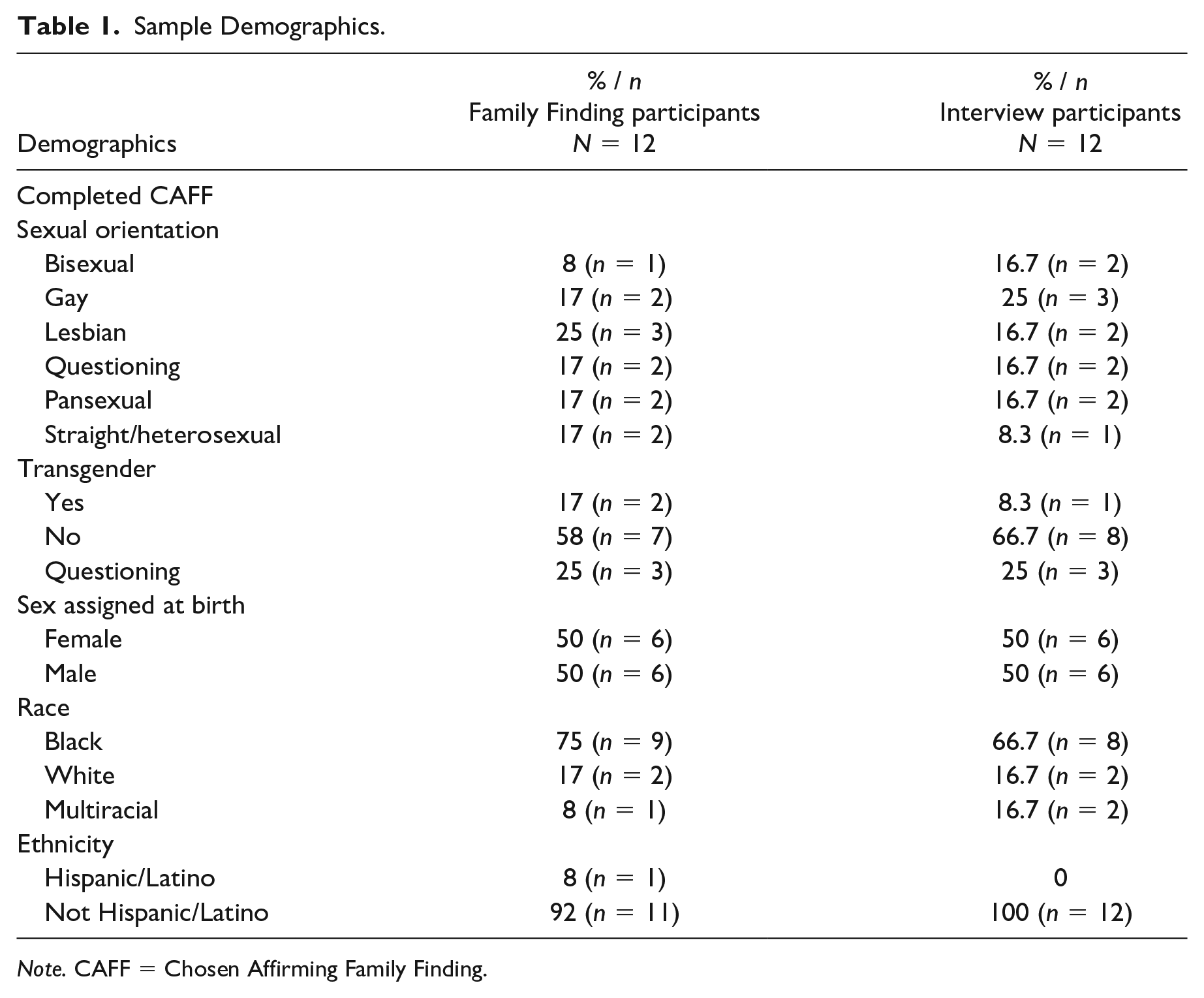
For the 12 young people who completed Family Finding, the average age of the young person at the start of CAFF services was 16.2 years (range: 13.7–18.7; SD = 1.5). Table 1 details participants’ sexual orientations, gender identities, sex assigned at birth, race, and ethnicity.
Sample Demographics.
Note. CAFF = Chosen Affirming Family Finding.
Interview Participants
A total of 12 young people participated in interviews. Of the 12 young people, nine were youth who had completed Family Finding and three youth were still enrolled in Family Finding at the end of the grant. The average age for the interviewees at the start of CAFF services was 16.3 years (range: 13.4–18.7; SD = 1.8). Table 1 details findings for young people who participated in the interviews.
Data Analysis
Descriptive statistics on the quantitative data, using SPSS v29, were examined to assess frequencies, averages, and changes in placement data. Due to the small sample size (N = 12), we were not able to complete any inferential or bivariate analyses. Please note, below, we report the type of individuals, either non-relative or relative, who were connected, engaged, and joined the youth’s chosen network. These data were only available for 11 of the 12 youth who completed CAFF.
A third-party evaluator conducted the analysis of the interviews. An outside evaluator was used to limit bias during coding because the internal evaluation team knew significant detail about the program, intended outcomes, and the results of the quantitative data. The analyst used a phenomenological approach to summarize the feedback provided by the youth, primarily because this approach focuses on the “lived experiences of individuals” (Creswell, 2014, p. 42; Patton, 2002) by centering their voices. Lived experiences are defined as time spent in foster care, enrollment in the CAFF program and being self-identified as lesbian, gay, bisexual, transgender, queer, questioning, intersex, two-spirit, or another diverse SOGIE. The goal of a phenomenological analysis is to lift up common experiences that arise for the group of interview participants and the analyst coded, or labeled, the data according to categories that emerged from the participants’ statements, to ensure that the common experiences were described in terms that were as close to the participants’ own words as possible.
To help to ensure that the findings promoted the perceptions of persons who received CAFF services, first the analyst reflected on how her role and background as straight cisgender woman who has supported programming for LGBTQ+ youth involved with child welfare systems might influence analytical decisions (Crawford, 2020; Creswell, 2014). The analyst briefly noted thematic feedback she’d heard to date during similar programs and mitigated the limitations in her lived experience and potential pre-conceived themes by an emergent approach to analysis, grounding herself in program-focused documents and engaging in peer debriefing about the analysis approach and codes developed, and coding application decisions, with two members of the QIC-LGBTQ2S team. Peer debriefing is useful for identifying potential biases in an analyst’s decision-making and preliminary conclusions (Crawford, 2020). Debriefing, in conjunction with other record keeping, helps to document decisions made during the analysis. The analyst utilized a codebook and NVivo, a qualitative data analysis software package, to allow others to view the coding applied to each interview transcript. Peer debriefing was also used to assess the accuracy and representativeness of summarized feedback, with debriefing taking place during a report-out of findings with members of the QIC-LGBTQ2S team.
Results
CAFF Services
On average, the 12 young people who completed CAFF had been enrolled in and receiving CAFF services for 624.6 days (approximately 1.7 years; range: 316–919 days; SD = 199.6). On average, as part of the CAFF investigative services, the CAFF specialist attempted 104 (SD = 50.4, range, 53–210) contacts; meaning, there were 104 occasions where they contacted or attempted to contact the youth, their family, child welfare staff, or other professionals. Contacts could include any contact via text, email, telephone call, or in-person. Of the 104 attempted contacts, 84 (80.8%; range: 36–168; SD = 39) were completed. CAFF specialists were asked to report how each contact occurred; there was a high degree of missing data with 18.5% (15.6 of 84) of contacts not having this information. Among contacts for which data were available, contacts largely occurred over phone (37.7 of 84, 44.9%, on average) or email/text (18.2 of 84, 21.6%, on average), as well as in-person meetings (12.5 of 84, 14.8%, on average). The large number of contacts via phone likely was due to the COVID-19 pandemic and in-person restrictions.
On average, per youth, the CAFF specialists spent 33 hours (range: 13–61; SD = 15.3) meeting or communicating with youth, families (including chosen families), child welfare staff, or other professionals. The 33 hours includes actual meeting or communication time, and not time spent on other CAFF services, such as internet searches for potential contacts or connections. Of the 84 contacts, youth were present for 44 contacts, caregivers or family members were present for 32 contacts, professionals were present for 45 contacts, and child welfare staff were present for 13 contacts. Please note, the categories are not mutually exclusive; meaning, youth and a caregiver or youth, and a child welfare staff member may have been present together for a contact, and both would have been recorded as being present for the contact. As part of the practice tracker, the CAFF specialists recorded all who were present.
Of the 84 contacts the CAFF specialists made, on average for the 12 young people, a total of 63 potential connections were identified (range: 11–125; SD = 29). This included 46 (73%) relatives and 17 (27%) non-relatives. Of the 63 connections identified, 10 (16%) were able to be successfully contacted by the CAFF specialists. Of the 10 average connections, six were relatives and four non-relatives. A total of eight (80%, eight of the 10) connections were able to be successfully engaged; of which five were relatives and three were non-relatives. Finally, on average, a total of five (63%, five of eight) connections joined the young person’s network as part of their chosen family, indicating the connection became a permanent support for the young person. Of these five connections, a total of four were relatives and one was a non-relative.
Permanency Experiences Before and After CAFF
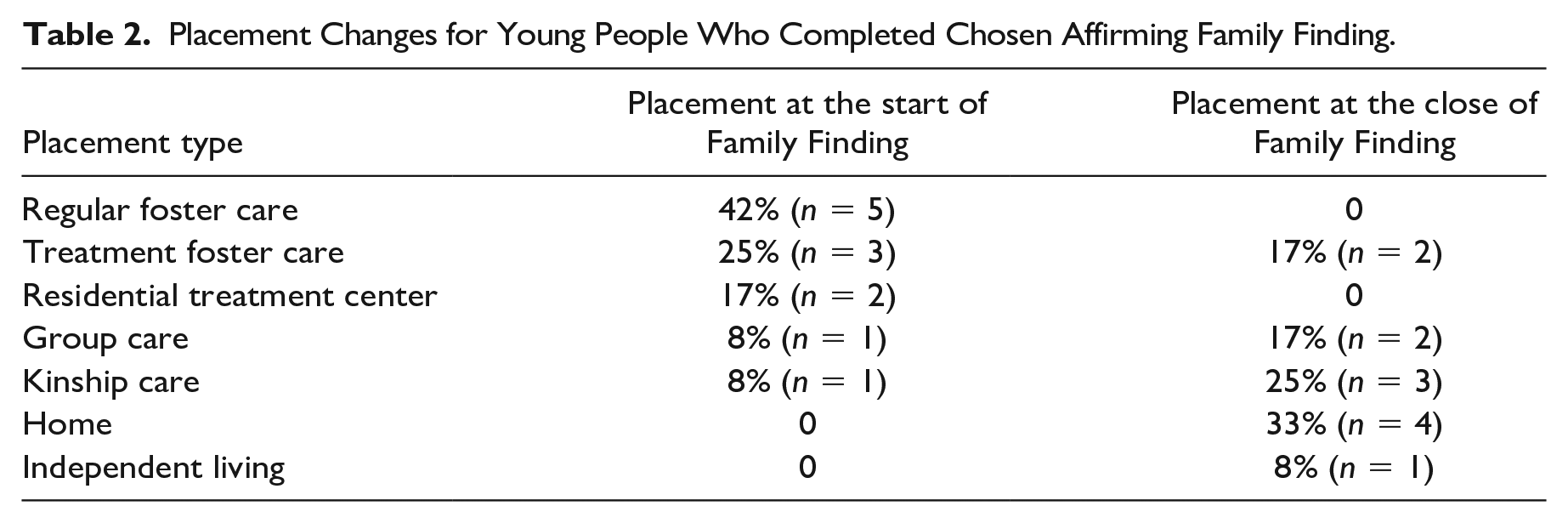
Table 2 details placement findings at the start and close of CAFF services. Of the 12 youth, three (25%) did not have a placement change from start to close of services, one young person (8%) had a higher level of care change (e.g., moved from regular to treatment foster care), and eight youth (67%) had a lower level of care change in their placement (e.g., moved from regular foster care to home or a kinship placement).
Placement Changes for Young People Who Completed Chosen Affirming Family Finding.
Twelve youth discussed their experiences with CAFF during interviews. For the purposes of this article, we (or the authors) are sharing youth’s feedback on Family Finding activities. Themes emerged around:
youth’s concerns about connecting with family, and
their experiences with Family Finding meetings, Family Finders (i.e., CAFF specialist), and connecting with family.
During the interviews, nine of the 11 youth who were enrolled in CAFF, and who wanted to connect with family expressed that they felt fear about making those connections. Their concerns included having their voices ignored in the planning process, disclosure of their identities, and family rejection. Eleven of the youth who participated in interviews expressed that the CAFF specialists helped the youth prepare for connecting with family by reinforcing the youth’s authority and role in making decisions about their lives, affirming, and protecting their identities, allowing them to guide disclosure, and helping prepare them for disclosure. For example, a youth remembered that their CAFF specialist said, You don’t have to talk to anyone that you don’t want to. If I bring someone up, and you don’t want to talk to them, you can just say that. I’m not gonna be mad about it. They’re not gonna know if you don’t want to talk to them. [CAFF Specialist] was like, I’m not gonna tell them anything that you don’t want me to tell them . . . [CAFF Specialist] was covering all of the bases right off the bat.
Another reflected on how their CAFF specialist helped them prepare for conversations with their family and options for discussing their identity, I had some concerns about some things and [CAFF Specialist] would address them in a way like . . . give scenarios on like my pronouns and things like that and they would have to answer the question to see if like they do good in certain areas. And we kinda gave them [family] certain areas that’d be helpful . . . if they didn't support or if they did where would it go from there and how would I react about it or try to at least get them to understand.
An area of diverging input centered on the role of CAFF in helping youth connect with family. One participating youth asserted that they were motivated, to participate in CAFF to get support with, “the LGBT stuff” going on in their life, “because that’s what I needed help on . . .” This youth already had desired connections with family and felt that they had decision-making power over whether to deepen the existing connections.
Eight of the interviewed youth who had family meetings during the program expressed that the meetings helped to increase family connections and communications, confirm plans, and amplify their voice and role in planning. For example, one youth noted, It was always uplifting . . . I always left the meeting with something as far as what to do next, as far as getting to the next step in my, my goals . . . those meetings they were honestly about the best moments I’ve, I could have . . . being able to express the fact that I, I am going through something in those meetings or that I, I need help with something and actually have someone to help me through it was like amazing. Because I never really had someone care so much to help me.
All the youth participants confirmed that they either found family members, including chosen family, or deepened connections with family during their time in the CAFF program. One participant noted, [It] did help relationships and understanding a lot more than what was going on before . . . it was helpful with getting certain family that I really didn’t talk to helping me with the fact that I could actually talk to them about emotions and stuff. And how I truly felt, and just opening up overall without the fact of having to think that I’m being judged . . . have stronger bonds with them over to- the period of time that I was in Kinnect.
Discussion and Implications
LGBTQ+ young people in child welfare require permanency efforts that meet the unique needs specific to their sexual orientation, gender identity and expression, and elevate the necessity of affirming relationships and strengthening networks of support. If Family Finding services are being offered to LGBTQ+ youth, the services would benefit from adaptations to account for the unique experiences of the LGBTQ+ youth, such as “coming out” to new connections and navigating LGBTQ+ rejection when and if it presents itself. Family Finding without these adaptations may leave the LGBTQ+ youth on their own to navigate these complex issues, which could result in loss of connections and long-term negative permanency outcomes.
Discussion
The Family Finding model is built on the foundational belief that all children have family members who can be identified with a persistent approach to finding them. Studies have found that children in out-of-home placements are more likely to experience isolation and negative consequences compared with young people who live with family who are more likely to experience positive outcomes (NIPFC, 2016). For LGBTQ+ youth, experiences in care can have even greater consequences directly related to their SOGIE. LGB (lesbian, gay, bisexual) youth have been found to be more likely to be removed by their foster families (Dettlaff et al., 2018) and have less stability while in care, often leading to placement in congregate care settings (Wilson & Kastanis, 2015). LGBTQ+ youth in this study were primarily living in foster homes prior to beginning CAFF (67%). After completing CAFF, the majority of youth (58%) transitioned to living with their family. Furthermore, the cultural adaptation of the Family Finding model allowed the youth to be supported in coming out to these family members about their SOGIE and provided these family members with psychoeducation and resources to better support their young person. This is particularly important for this population because LGBTQ+ who have high levels of demonstrated family acceptance of their SOGIE are more likely to report decreased mental health risks, including decreased suicide attempts, higher self-esteem, increased social supports and better overall well-being (Ryan et al., 2010).
In addition, the cornerstone of the model is a relentless persistence to search for connections. That search in most studies suggests a baseline of 20 to 40 connections (Greeno et al., 2019) as a minimum, so that, there are enough potential connections that would be able to move from an identified connection to a person who has joined the youth’s network. In this study, CAFF specialists made an average of 63 contacts, connections almost double the required baseline amount. Of those contacts, an average of five people joined the young person’s chosen family network, a similar finding in previous research (see Greeno et al., 2019). This is an important finding to consider that this adaptation may require additional contacts to identify committed connections in an LGBTQ+ young person’s life. However, once these connections are identified, they seem to join the young person’s network at rates similar to non-LGBTQ+ youth. This suggests the initial connection efforts are paramount to making changes to the youth’s chosen family. It is also noteworthy that of the five who joined, three were relatives. This suggests that young people were able to have meaningful connections with members of their biological family and a formal process of contacting their biological family, such as CAFF, is an effective way to grow additional support for the young person. Replicating this approach in other child welfare sites will help to determine whether there are similar patterns and findings in the number of contacts and of those who join the network.
Of the 84 contacts, youth were present for 44 contacts. In Greeno et al.’s (2019) study, Family Finders reported hesitation in involving youth in the process and that the determination to include them should be individualized to protect the youth from unmet expectations and negative reactions. Conversely, in this study, the site decided to engage youth at every stage of the process and centered their voice in decision-making as a core adaptation of the model. As a result, the youth believed the meetings helped to increase their family connections and amplify their voice in the process. CAFF specialists engaged youth at every stage of the process and prepared them for potential rejection. The young person could determine when and how they disclosed their SOGIE to any connection and stated that this reinforced their authority and role in decision-making and affirmed and protected their LGBTQ+ identities. Youth described initially feeling fearful about disclosure of the SOGIE and having their voices heard. After participating in the process, youth described feeling heard and that the meetings led to increased communication and deepened connections with family as well as strengthening their voice and role in planning for their future.
Implications
Youth voice and engagement in transition planning has been embedded in federal laws, including the most recent Family First Prevention Services Act (H.R. 253). Although there are numerous guidelines and policies on engaging youth in decision-making in child welfare, there is a lack of studies on the impact of youth participation in planning processes. Metze et al. (2015) found that youth who actively participate in their planning in child welfare feel empowered and resilient because they are directly involved in decision-making that impacts their lives. The child welfare workforce may have concerns about authentically involving young people in engaging with connections, it is important to note findings from this study suggest that LGBTQ+ youth benefit from inclusion when provided with supportive preparation for potential rejection and unconditional care throughout the CAFF process.
This model shows promise toward an effective adapted Family Finding model that helps LGBTQ+ young people find affirming family and chosen family support, as well as move to lower levels of care. More research is needed on the effectiveness of this model to ascertain whether the movements to lower levels of care were solely caused by the enrollment in CAFF. Continued evaluation might also explore the impact of the intervention, primarily the network meetings, on families and chosen families.
Limitations
Regarding placement changes, the placement change data are not definitively attributable to CAFF but gives an indication of the youth’s experience during the program. However, given the low sample size, causation for placement changes cannot be assumed, but does warrant further exploration. In addition, experiences and reflections shared in the interview data are applicable to the youth who were participating in that data collection effort and statements may not apply to all the CAFF participants. An additional limitation to consider is the impact a single session interview may have had on the content shared, because a single session interview may not have supplied sufficient time to build trust between interviewer and interviewee. Finally, implementation and this evaluation took place during the COVID-19 pandemic that impacted how the program was implemented, including a shift to virtual meetings, delays in processes, and challenges in engaging participants and connections. The qualitative data do, however, provide helpful context for the quantitative survey data and set the stage for future implementation of the CAFF model.
Conclusion
Studies have found that a cultural adaptation to evidence-based practices can increase efficacy and effectiveness than those developed for a general population (Hall et al., 2016; Hallingberg et al., 2019). All the youth participants confirmed that they either found family members, including chosen family, or deepened connections with family during their time in the CAFF program and 58% were living with their identified family at the completion of the program. Though these findings are considered preliminary due to the small sample, they begin to lay the foundation for future quasi-experimental evaluation of the CAFF model and provide a culturally adapted, manualized approach to helping LGBTQ+ youth in foster care achieve permanence.
Footnotes
Disposition editors: Angelique Day and Cristina Mogro-Wilson
Declaration of Conflicting Interests
The author(s) declared no potential conflicts of interest with respect to the research, authorship, and/or publication of this article.
Funding
The author(s) disclosed receipt of the following financial support for the research, authorship, and/or publication of this article: This study was funded by the National Quality Improvement Center on Tailored Services, Placement Stability, and Permanency for Lesbian, Gay, Bisexual, Transgender, Questioning, and Two-Spirit Children and Youth in Foster Care (QIC-LGBTQ2S). The QIC-LGBTQ2S is funded by the U.S. Department of Health and Human Services, Administration for Children, Youth and Families, Children’s Bureau under grant #90CW1145. The contents of this document do not necessarily reflect the views or policies of the funders; neither do mention of trade names, commercial products, or organizations imply endorsement by the U.S. Department of Health and Human Services.
