




Abstract
Many individuals with psychiatric disabilities employed by work integration social enterprises (WISEs) rely on disability financial supports to supplement their income. However, little research has investigated the interconnections between WISE, disability support, and psychiatric disability. We draw on data from a qualitative study of employees, supervisors and administrators from seven WISEs in Ontario, Canada, to determine: (a) how does receipt of disability support impact the work experiences and choices of WISE workers? and (b) how does workers’ receipt of disability support impact the business practices of WISEs? We find that the cap on employment income earned without triggering a reduction in benefits limits worker engagement and places WISEs in the difficult position of jeopardizing continuity of benefits while pursuing their mandate of encouraging participation in work. These findings illustrate how the structure and function of WISE are interconnected with the structure and function of disability support in ways that bring to light the tensions between their respective understandings of psychiatric disability.
Social enterprises are businesses that sell goods and/or services but prioritize using their business practices and revenue to achieve social goals (Defourny & Nyssens, 2017). Work integration social enterprises (WISEs) aim to generate jobs and/or employment training for those who experience barriers to traditional employment, including people with psychiatric disabilities 1 (Vidal, 2005). Many WISE employees with psychiatric disabilities rely on disability support benefits to supplement their WISE income (Morrow et al., 2009). However, little research has examined the impacts of disability support programs in the context of WISE employment for people with psychiatric disabilities. To address this research gap, this analysis draws from a qualitative study that examined the economic, social, and health impacts of WISE employment for people with psychiatric disabilities in Ontario, Canada.
The limited research available suggests that disability support benefits may influence the participation of individuals with psychiatric disabilities in WISE (Krupa et al., 2003; Morrow et al., 2009); however, the data come from studies carried out between one and two decades ago. Since that time, the WISE sector has expanded significantly, and disability welfare support has undergone reform. We therefore offer a more recent analysis focused on seven WISEs in Ontario, Canada, where disability welfare support is provided through the Ontario Disability Support Program (ODSP). Drawing on data collected from WISE workers, supervisors and administrators, we aim to address the following questions: (a) how does being in receipt of disability support payments affect the employment choices and experiences of WISE workers? and (b) how does employee receipt of disability support payments affect the business practices of the WISE? Through examining these questions, we aim to explore how publicly administered disability support programs can support or impede engagement in WISE for people with psychiatric disabilities. Understanding these relationships is important given the potential for disability welfare supports to influence worker motivations and socio-economic status, and given the ramifications for WISE business planning and growth.
In the section that follows, we provide an overview of the literature examining work and psychiatric disability, with a particular focus on the structural barriers to employment for this population. We then provide a brief review of the history and role of WISEs in the mental health sector, and the roles of disability support programs for people with psychiatric disabilities, particularly in relation to our own context of Ontario, Canada. Subsequently, we describe the methodology for the overarching study and present our findings on the impacts of the disability support program on both workers and employers. We conclude by reflecting on the implications of our findings for policy and for practice.
Background
Work and Psychiatric Disability
People with psychiatric disabilities frequently report a desire to engage in paid work, yet are often frustrated in efforts to obtain and hold jobs. Structural, institutional, interpersonal and individual-level barriers have all been identified as contributors to this issue (Cook, 2006). High among the barriers faced are stigma and discrimination, both during hiring (Bjornshagen, 2021; Hampson et al., 2020) and while in the work force (Appelbaum, 2022; Hampson et al., 2020; Lindsay et al., 2023). Stigma in employment settings can also become internalized (i.e., internalized ableism) such that people with psychiatric disabilities may lack confidence in their capacity to continue to work and/or become unmotivated to request employment supports or seek other employment (Brouwers, 2020; Hampson et al., 2020). Beyond interpersonal and internalized stigma and discrimination, people with psychiatric disabilities also encounter institutionalized discrimination in the form of inflexible workplaces that fail to provide accommodations for their individualized needs (Appelbaum, 2022). The lack of such accommodations (for example, lengthened breaks, peer mentorship, ongoing training, more detailed directions, or flexible scheduling) may prevent many people with psychiatric disabilities from engaging meaningfully with employment (Zafar et al., 2019). These institutional barriers are interconnected with structural barriers, including economic policies and associated labor market dynamics, ineffective employment discrimination legislation, and work disincentives that may be unintended consequences of related policies (including those related to social assistance) (Cook, 2006; McAlpine & Alang, 2021). Collectively, these barriers may exclude people with disabilities from both the “latent” and “manifest” benefits of work (Jahoda, 1981).
One feature of psychiatric disabilities that can pose a barrier to long-term employment is that they are often episodic: there can be periods of wellness where work is possible, followed by periods of illness during which it is not (Charette-Dussalt & Corbiere, 2019; Gewurtz et al., 2015). Psychiatric disability may also result in barriers to formal education (Breslau et al., 2008), creating gaps in skills and credentials that further restrict employment. Lastly, there are structural barriers to employment for many people with psychiatric disabilities. For example, those who live in poverty face significant barriers to obtaining and maintaining employment, for example, in leaving one unable to afford a cellphone and professional clothing, or to maintain sufficiently safe and stable housing to allow for regular hygiene (Cook, 2006).
WISE in the Mental Health Sector
Social enterprise models have a long history, emerging from European traditions of co-operatives and not-for-profit organizations (Borzaga & Galera, 2012). They have been applied for purposes of work integration with a broad range of groups facing barriers to traditional employment, including, but not limited to, people with physical disabilities, at-risk youth, immigrants, people who are homeless, and Indigenous peoples (Myles et al., 2024). WISE, as a mechanism to address employment barriers for people with psychiatric disabilities, originated in the 1970s (Borzaga & Galera, 2012) and in Ontario, Canada (the context of this study), received significant funding in the 1990s, allowing growth in number, magnitude and scope (Akingbola et al., 2015). Although it is difficult to establish the precise number of WISEs, one 2012 study identified 58 social enterprises in Canada operating a total of 100 companies with the mandate to employ individuals experiencing serious mental illness (Krupa et al., 2012). More local to the context of the current study, a 2015 investigation identified 24 Ontario-based organizations operating at least 38 different social enterprises providing paid employment primarily to people with psychiatric disabilities (Buhariwala et al., 2015). While we have been unable to identify more recent research quantifying the availability of WISE for people with psychiatric disabilities, WISEs in general continue to be a popular model for addressing employment barriers, as evidenced by a recent Canadian federal study demonstrating the impact of the WISE model on employment and economic outcomes (Myles et al., 2024).
The potential of WISE to facilitate employment for people with psychiatric disabilities is long established through research carried out in North America, Europe, and various other global regions. Specifically, research examining the impacts of WISE employment has found positive associations with mental health, job satisfaction, quality of life, self-reliance, social skills, destigmatization and social capital (Martinelli et al., 2022; Roy et al., 2014; Villotti et al., 2018). Furthermore, qualitative research has illustrated how WISE employment helps people with psychiatric disabilities to feel competent and valued as workers (Blonk et al., 2020; Svanberg et al., 2010), and is associated with feelings of purpose, belonging, success and individuality (Svanberg et al., 2010). Other qualitative research has identified features of WISE that have the potential to reduce the experience of stigma among people with psychiatric disabilities (Krupa et al., 2019).
Positive outcomes of WISEs have been attributed to their provision of supportive workplaces that accommodate the specific needs of each individual (Martinelli et al., 2022). WISEs may offer personalized job placement to match the skills, needs and preferences of employees, enabling them to work at their own level (Blonk et al., 2020; Martinelli et al., 2022). Other features may include shorter workdays, flexible hours or shifts, training and job support, tolerance for mistakes, and flexible pace of work (Blonk et al., 2020; Paluch et al., 2012; Villotti et al., 2017). Job security within many WISEs is also conducive to the episodic nature of mental illness, allowing people to work when they are well, take time off when they are not, and return to work again when they are able (Evans & Wilton, 2019; Svanberg et al., 2010). The flexible and supportive nature of WISEs thus enables workplace participation for individuals with psychiatric disabilities who might otherwise be unable to participate in employment, providing access to benefits of employment such as purpose, structure, community integration and self-esteem (Roy et al., 2014; Svanberg et al., 2010). There is also evidence that WISEs have broader societal benefits: participation in WISE is associated with reduced health care system costs for people with psychiatric disabilities (Sultan-Taïeb et al., 2019), and there is emerging evidence of impacts of WISEs on ‘upstream’ social determinants of health and health inequalities as well (Roy, Baker, & Kerr, 2017; Roy, Lysaght, & Krupa, 2017).
Disability Support Programs for Psychiatric Disability
Due to employment barriers, many individuals with psychiatric disabilities rely on government disability support for income. Indeed, a significant proportion of individuals who access disability support programs do so as a result of psychiatric disability. For example, in a Dutch population-based study of individuals receiving disability benefits, psychiatric disorders were the most frequent diagnoses and those with psychiatric disorders were the least likely to come off benefits during the 5-year study period (Louwerse et al., 2018). This is consistent with data from other OECD countries, where disability claims based on mental disorders are steadily increasing (OECD, 2022). Furthermore, there is evidence that young people diagnosed with particular psychiatric disorders (i.e., psychotic disorders) tend to be moved toward disability support payments very quickly, developing a pattern of income dependence before or during the prime years for entering the workforce (Krupa et al., 2012).
Across OECD countries, most state-administered disability support programs include some combination of income replacement (i.e., direct cash payments), coverage of other disability-related needs, such as adaptive equipment and prescription medication, and/or access to employment-related supports and/or incentives (MacDonald et al., 2020). In Canada, social assistance programs are legislated at the provincial/territorial level (Dean & Pinto Moriera, 2023). In Ontario (the context for our study), the ODSP is the public disability program for Ontarians with disabilities who are experiencing financial need. The Ontario Disability Support Program Act (1997) defines disability as (a) substantial physical/mental impairment that is continuous or recurrent and of expected duration 12+ months, (b) the direct and cumulative effect of the impairment substantially limits activities in the areas of personal care, community function, and/or workplace function, and (c) the impairment and its impacts having been verified by an approved licensed healthcare professional (Ontario Disability Support Program Act, 1997). Individuals who meet these criteria can receive a maximum benefit of approximately $1,300 CDN per month, alongside other supports such as coverage for prescription drugs and accessibility-related costs (e.g., assistive devices). At the time of the study, ODSP recipients could earn a maximum of $200 CDN in employment income per month without a reduction in benefits; income earned above $200 CDN was deducted from the ODSP payment at a rate of 50% (the ODSP income cap has subsequently changed, as further detailed in the “Discussion” section).
Research has examined the possibility that disability benefits could act as a disincentive to employment (Barr et al., 2010). In Canada, individuals receiving social assistance payments who choose to work will have 50-100% of their income earned above a set threshold deducted from their social assistance payment, commonly referred to as a “clawback” (Dean & Pinto Moriera, 2023). This diminishes the impact of employment on one’s socioeconomic status. Employment may also impact access to other income-geared supports such as subsidized housing; thus, there are significant disincentives to employment for individuals receiving social assistance (Dean & Pinto Moriera, 2023). Indeed, a meta-analysis of global studies examining the effectiveness of the individual placement and support model for adults with psychiatric disabilities found these programs to be more effective in contexts with weaker employment protection legislation and less comprehensive disability benefits (Metcalfe et al., 2018).
Additional research has highlighted the inconsistency between the definition of disability that informs government disability supports and the realities of psychiatric disabilities. Requirements to access disability support generally indicate that one’s condition must be continuous, severe, prolonged, and substantially affect one’s basic activities of daily living. This essentially constructs wellness and illness—and in turn, employability and unemployability—as a dichotomy. As a result, people receiving disability supports, and particularly those with psychiatric disabilities, often fear that participating in employment will result in loss of their income support and other benefits, as well as the inability to regain their benefits if they experience a future relapse that renders them unable to work (Gewurtz et al., 2018).
Disability Support Programs in the Context of WISE
Many workers in WISEs that target or are inclusive of individuals with psychiatric disabilities access disability supports in addition to WISE income (Chan et al., 2017; Krupa et al., 2003). However, little research has examined inter-relationships between WISE, psychiatric disability, and disability support. In our review, we could find only three published studies examining the WISE model in relation to psychiatric disability that reported any data regarding disability support programs (Evans & Wilton, 2019; Krupa et al., 2003; Morrow et al., 2009).
The first was an early mixed methods study examining the transition from a sheltered workshop to a WISE model in an Ontario-based social enterprise (Krupa et al., 2003). The study found WISE was successful in providing rewarding paid employment for workers; however, the disability support income cap was a constraining factor. In contrast to the sheltered work model, wherein all workers received full disability benefits unaffected by their earnings, 26% of WISE workers earned sufficient employment income to reduce disability benefits. Despite ODSP regulations allowing retention of a portion of disability benefits, the reduction in payments triggered by earnings above the income cap left overall income (WISE earnings + benefits) well below acceptable wage standards. Furthermore, jeopardizing eligibility for disability support was highly undesirable given recurrent periods of ill health. Workers identified scheduling flexibility to account for the income cap as an important accommodation (Krupa et al., 2003).
The second relevant study examined disability benefits and employment incentives in British Columbia, Canada, through interviews with individuals responsible for the administration of five social enterprises with mandates to employ/support individuals with psychiatric disabilities (in addition to data examining several other types of income and employment supports) (Morrow et al., 2009). Findings indicated that in all participating social enterprises, the majority of workers were receiving government disability benefits and limited the number of hours worked to avoid earning more than the income cap out of concern that a review of their eligibility for disability supports could be triggered. The participating social enterprises provided mainly seasonal employment to their workers, meaning that they were unable to provide permanent full-time employment that would eliminate the need for disability supports, even if this were desired or possible for their workers. Thus, social enterprises recognized the necessity of government disability supports, due to both the nature of psychiatric disability and the nature of the WISE employment available (Morrow et al., 2009).
Finally, the third study examined 48 Canadian social enterprises offering work to people with mental ill health (Evans & Wilton, 2019). Although not the explicit focus of the study, the authors note that the reduction of disability benefits that occurred when workers earned above the legislated threshold limited the material benefits of WISE employment.
Collectively, these three studies leave significant gaps in our understanding of the inter-relationships between WISE employment, disability support benefits, and psychiatric disability. Thus, this study aimed to address these research gaps.
Method
This analysis is based on qualitative data gathered as part of a 5-year longitudinal mixed-methods study. The parent study aimed to: (a) characterize the population of individuals employed by WISEs with a mandate to employ people with psychiatric disabilities; (b) examine any longitudinal changes in socioeconomic indicators for individuals employed by WISEs; and (c) identify characteristics of WISEs that are associated with improved social and economic outcomes in this population. Data were collected from seven WISE partner organizations across Ontario, which collectively operate over 15 social enterprises (Authors, 2024). All of the WISEs have demonstrated success as businesses operating in the open marketplace and comply with provincial employment regulations, including minimum wage requirements.
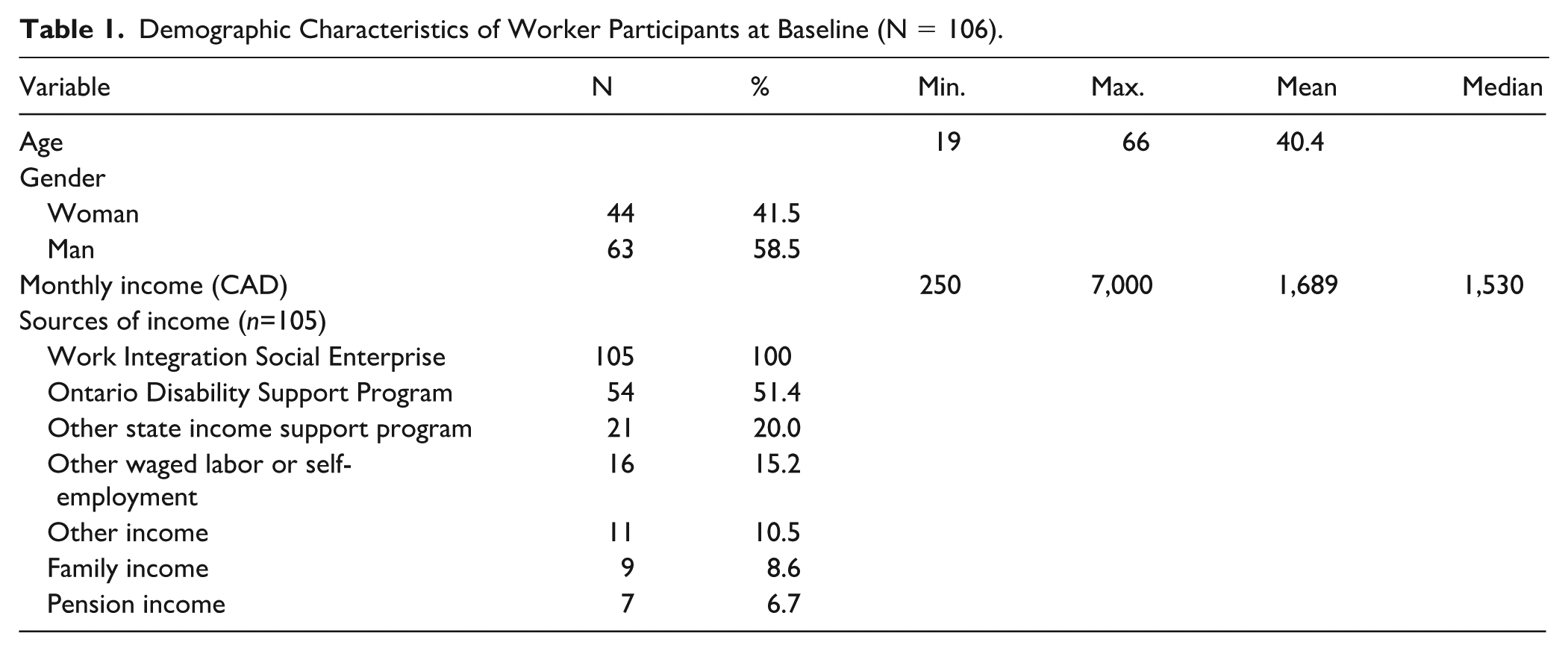
Recruitment and data collection have been described elsewhere (Authors, 2024). Briefly, participants were recruited via the WISE partners, referred to the study coordinator, and assigned to an interviewer. All participants provided informed consent to participate prior to each data collection session. The data collected included: structured qualitative interviews with WISE administrators at the beginning (n=12) and end (n=9) of the study (due to turnover during the study period, some, but not all, of the administrators participated at both time points); semi-structured qualitative interviews with 14 individuals working in roles that involved direct supervision of WISE employees; and a structured survey with both open and closed ended questions conducted with a total of 106 WISE workers at multiple timepoints (only the baseline data were included for this analysis). Administrator participants were identified by the WISE partners as the person best positioned to speak on behalf of the organization (typically, the Executive Director or equivalent). Supervisor participants were also identified by the WISE partners and were defined as any individual who had responsibility for overseeing the work of WISE employees (the specific job titles and responsibilities of these individuals varied substantially across the participating WISEs). Finally, worker participants were 106 employees of the WISE (i.e., those whose work integration was the mandate of the WISE). Of the worker participants, approximately 40% had been employed by the WISE for 2 years or more, while approximately 60% were recruited upon employment. Of the 106 worker participants, 22 were purposively sampled for participation in a semi-structured qualitative interview. Variables considered in the purposive sampling process included representation from the seven participating WISEs and current employment status (still at WISE, employed outside of WISE, unemployed). Demographic characteristics of worker participants are provided in Table 1.
Demographic Characteristics of Worker Participants at Baseline (N = 106).
With respect to the qualitative interviews, three distinct interview guides were developed for the administrator, supervisor, and worker interviews. The administrator interview guide was focused on understanding the WISE’s overall mission, structure, and business practices (e.g., “Are you currently at minimum wage, or market wage? What would it take, from your perspective, to be able to offer your workers a living wage?”). Initial administrator interviews were all over 1 hour in length, while the closing interviews were more variable in length (ranging from approximately 45 to 175 min). The supervisor interview guide was focused on understanding both the supervisor’s own role (e.g., “In what ways are you called upon to ensure that the business remains successful?”) as well as the supervisor’s perceptions of worker experiences, successes and challenges (e.g., “What, in your opinion, makes a great worker?”). Supervisor interviews ranged in length from approximately 45 min to over 100 min. Finally, the worker qualitative interview guide was focused on workers’ experiences and impacts of WISE employment (e.g., “What changes would you say have happened for you as a result of working in [WISE]?”). Worker interviews were of variable length, ranging from 18 min to over 1 hour, with a median length of approximately 43 min.
For this manuscript, the qualitative data sources were examined for material relevant to disability-related financial supports in general, and the ODSP in particular. We were primarily interested in the data collected from worker participants to address our first research question (about work experiences and choices of workers) and data collected from administrator and supervisor participants to address our second research question (about WISE business practices). However, through our process of analysis, we found that supervisor participants also offered insights into worker experiences (particularly since some of them had themselves previously been in other, non-management roles in the WISE).
Our analysis drew from a directed content analysis approach (Hsieh & Shannon, 2005). Content analysis is a family of flexible approaches to qualitative data analysis that are commonly applied in health-related research (Assarroudi et al., 2018). In a directed content analysis, existing theory or research guides the selection of pre-determined concepts or variables as initial coding categories (Hsieh & Shannon, 2005). In this study, a directed content analysis approach enabled us to efficiently identify passages of data relevant to our specific research question from within a large data set. Specifically, worker qualitative interview data, as well as data from open text fields in the baseline worker survey, were searched using the following keywords: ODSP, pension, social assistance, and disability. These search terms were identified on the basis of previous research regarding disability support programs, in discussion with the coauthors, and iteratively revised as the analysis approach progressed. The identified text was extracted into a Word document for analysis. A similar process was used for analysis of the supervisor interview data. Given that the supervisor interview guide included a probing question that was directly relevant (“Are there any issues related to WISE work and disability pensions?”), these interviews were a particularly rich data source for this analysis. Administrator interviews were initially examined using the same process; however, finding few instances of the selected keywords, the interview transcripts were reviewed in full to identify any important contextual information. All the extracted qualitative data sources were then analyzed through an iterative coding process, whereby data were read and re-read (with reference to full transcripts for context), while labeling relevant text. The labels used included some that were explicitly related to the initial search terms (e.g., “risk of losing ODSP”), as well as labels that were inductively identified in the process of analysis (e.g., “manager accommodations”). These labels were then collectively organized into broader themes (e.g., “impact of clawbacks”), which ultimately were developed into the qualitative findings presented below. Illustrative quotations are anonymized using a participant code, with “W” indicating a quote from a worker participant and “S” indicating a quote from a supervisor participant. NVivo version 12 was used for data management.
Results
In our analysis, we found that requirements and restrictions of the ODSP interfered with WISE workers’ employment goals and complicated the business practices of the WISEs. Two aspects of the ODSP were particularly notable in this regard: (a) the limitations on income that could be earned through paid work without a reduction in benefits, and (b) the lack of congruence between the structure of the ODSP and episodic disabilities. We explore the implications of each of these facets of the ODSP in turn, below.
Trapped in Precarity: Limitations on Income Earned
At the time data were collected, individuals receiving ODSP were allowed to earn a maximum of $200 per month in employment income without a reduction in the monthly benefit. At minimum wage (typical for WISE employees), $200 translates into approximately 15 hours of work per month. Both workers and supervisors noted that this income cap shaped worker choices about how much to work. Some workers were comfortable with the 50% clawback described above; for some, this was due to the mental health gains they experienced from meaningful employment (“It’s kind of the only thing that keeps me stable”—W4). This experience was shared by one of the supervisor participants, who had received ODSP in the past: At a time I was on ODSP and my philosophy was, if I can work I’m going to work and if they take half the money away from me or more I don’t care, because I know long-term having the experience and just being busy doing stuff is better for my mental health. And better for me potentially going back to work. (S2)
Given that ODSP alone leaves people at or below the poverty line (“It’s not easy living on $1000 a month”—W1), some workers needed the additional income to cover basic necessities and so described choosing to work beyond the income cap for that reason: After so much ODSP takes in half, but it’s still worth getting those extra hours, even though they cut the money in half. Because you’re still making a lot of money. You could work, I don’t know, maybe 40 hours a week, you’d still get that $500 [from ODSP]—even though [ODSP] would be cut in half, it’s worth getting. (W19)
Other workers did not want to exceed the $200 earning threshold, and so limited their paid working hours accordingly. For example, when asked why they chose to work fewer than 10 hours per week, one participant replied: Well, OK, so the thing with that is whenever I worked that much they would deduct money off my ODSP cheque . . . So, I wanted to work less so that they wouldn’t deduct any money off the ODSP cheque, because I just kind of that that was—to me, that didn’t seem—I didn’t like that. (W11)
For some participants, limiting their paid work in this manner opened up opportunities for non-paid opportunities that also had skill development or other personal benefits. As described by one of the supervisor participants: Some [WISE employees] say, like, “You know, after $200 in income, I’m going to get clawed back 50 cents on the dollar. So, I’m better to go and volunteer, or you know, do something in my own life.” (S12)
Keeping track of hours worked in relation to this threshold created labor for both workers and supervisors; many supervisors noted this as an important component of scheduling: We operate with a pretty set schedule these days just because it’s easier for me and for them [workers]. But a lot of people I work with are on ODSP so they have a certain amount of hours they can’t max, like they can only work, right? So that’s one thing that we take into consideration. (S14)
For workers, this flexibility was seen as a significant benefit of working at the WISE: [WISE] is really great because as long as they trust [you] and they see you’re a productive worker you can say “This is how many hours I need to make my thing work” [maximize income earned] and they’ll say “Great, we’ll try to make it work for you.” (W15)
In some cases, the WISEs attempted to introduce practices to reduce the labor of reporting to ODSP for their employees by taking on some of this work as part of the business’s administrative practice, as described by one of the supervisor participants: A big thing we do now which is really nice is anybody that works for us that’s on ODSP, we directly report their pay stubs right to their worker, just from saving them from having to do that. Yeah, so once a month. And then any follow up questions they have. (S9)
The restriction on earned income created stress for workers, in that clawbacks were not necessarily immediate; that is, extra income earned one month would influence the determination of a future month’s ODSP payment, and the timing of the deduction was not always predictable. Furthermore, given the episodic nature of our participants’ mental health issues, as described further below, it was common for their capacity to work to fluctuate from month to month, thus making the hours worked and, in turn, future clawbacks, even more unpredictable. Similarly, for those living in subsidized housing, changes to their income would influence their rent, again in unpredictable ways. One of the supervisor participants described how this left their workers in precarious financial situations: A lot of our folks, once they finally get subsidized housing . . . their whole rent is dependent on their earnings. So, say we had that landscaping business going, we had the carwash and they’re cranking out shifts in the summer and then their rent is going up and they’re having to pay for it later. It’s scary for them. [Interviewer: Yeah. Because it’s hard to plan.] Yeah, you can’t plan it. It’s “Oh, you know, you made a lot of money in March. So in May we got around to doing the paperwork and your rent’s going from, you know, 200 bucks to [uncertain amount].” (S12)
Fluctuating Capacity: Incongruence With Episodic Disabilities
As other scholars have previously noted (Gewurtz et al., 2015), the structure of the ODSP is based on assumptions about disability as being chronic and/or permanent, and as a result, is not well aligned with episodic disabilities. Many of our worker participants hesitated to increase their hours of work, even if they were capable of doing so at the time, for fear that this could flag them for review and ultimately be deemed ineligible for ODSP. Given their long-term experiences with their mental health, workers understood their current capacity for work to likely be temporary, and felt that they could not risk the potential loss of ODSP benefits to support them during future potential downturns in their well-being. As noted by supervisor participants:
A lot of people are terrified. If you work a little more than maybe your ODSP case worker thinks you should be able to work . . . they’re afraid that their supports are going to be pulled. That is a huge fear for people, you know, the ODSP [case]worker’s going to say, hey, you worked, like, 20 hours, and you know, we’re going to cut you off ODSP. A lot of people will not work full-time because they’re terrified of losing—like, what about if I’m well now but in 6 months or a year or 2 I’m not again, and now I have no housing, I have no medical benefits and I might not get on ODSP again . . . I’ll underwork, underperform because I’m terrified of not having that social safety net. (S2) There are so, so many ebbs and flows of illness . . . So right now, they’re doing really well, for the next six months. And they’re doing so well, they want to come work more often. But it’s like a door in their face, because they can’t, because then there’s too much at risk. Because then for six months to a year, maybe they’re not going to be able to work that much because they don’t feel well. It’s a terrible system. (S10)
The episodic nature of psychiatric disabilities is particularly relevant to the WISE context, wherein variable hours of work were necessary both to accommodate the daily realities of worker mental health (time off needed for appointments and “mental health days”) as well as the need for longer periods away when they were not well enough to work: If I needed some time off, that was no problem at all. And if I ever wanted to go back, all I had to do was call them and they would hire me right back. So that was good too because sometimes I needed to go on leaves and stuff like that. (W11) The number one major thing is that if you cancel your shift three hours before the shift starts you are going to keep your job. Because they understand that if you need a mental health day you’re going to have to take it. And so that isn’t dependent on you losing or keeping your job. So that was the first thing that they mentioned to me, and in practice I didn’t do it for a while, but then I realized yes, I can take those days and they have enough staff to cover in case someone does need to do that. (W8)
Both managers and administrators spoke to the understanding that such fluctuations—day to day and over longer periods—were a reality of psychiatric disability and would be accommodated: It was all kinds of things, like appointments, or it was just not doing well mentally and needing to take time for themselves. So, we really wanted to encourage that awareness and that ability to be supported and take the time they need so they can be successful long term . . . Yes, I would say [staff turnover] was slightly high, but that was part of our understanding, is that turnover would be an aspect of being supportive. (S6)
Despite this acknowledgment within WISE (and associated characteristics of the structure of the business, for example, having a large roster of potential employees knowing that not all will be available to work at any given time) the structure of ODSP did not align with the realities of how episodic disability presents in the workplace, creating additional labor for WISE supervisors, administrators, and workers to navigate a system that is not set up to reflect their realities: I think if ODSP . . . said no matter what you’ll have your basic housing, you’ll have your food, you’ll have medical benefits, you can come on and off as you please. The amount of people that would work and feel, oh, if I need the help again I’m good, I’m covered. So then I can take more chances . . . if I know my basics are covered if I fall apart. (S2) I’d like to take on the . . . disability system, because I think that is a barrier for a lot of people. I wouldn’t change anything about our [WISE], because I really like our [WISE]. But I would like to change parts that our [employees] have to deal with on a daily basis like ODSP, housing, and all of those things and make it easier to navigate and much more forgiving. So that if they want to achieve more, then they’re able to achieve more. (S10)
Discussion
In this paper, we examined how disability support programs can impact engagement in WISE employment for people with psychiatric disabilities. We aimed to explore how being on disability support affected the employment choices and experiences of WISE workers, and how disability support programs affected the business practices of WISEs. We find that the ODSP cap on employment income earned without triggering a reduction in benefits limits worker engagement: workers must strategically decide whether and/or how much to work beyond this threshold. This creates a paradox whereby the mandate of WISE is to be flexible and accommodating to worker needs, yet allowing major fluctuations in work hours and encouraging growth in work engagement serves to jeopardize the continuity of benefits and financial stability for employees. Furthermore, we find that these features of ODSP produce additional labor for WISE supervisors in their attempts to support workers by scheduling them in ways that maintain their eligibility for the maximum possible ODSP benefit while simultaneously ensuring the workforce necessary to carry out the business of WISE. Taken together, these findings illustrate how the structure and function of WISE are interconnected with the structure and function of ODSP in ways that bring to light the tensions between their respective understandings of psychiatric disability. Given that the structure of the ODSP is very comparable to disability support programs across many OECD countries, particularly in regard to implementing a cap on allowable income earned through employment (MacDonald et al., 2020), these interconnections are very likely also relevant to disability support programs in other jurisdictions.
Our findings align with other studies that have identified the limitations of the ODSP (Smith-Carrier et al., 2017), including those that pertain to episodic disabilities in particular (Gewurtz et al., 2018; Lahey et al., 2021). Unique to our study is our focus on the WISE context, wherein these systemic issues are problematic not only for disability support recipients but also for the organizations proactively designed to employ them. We show that earning restrictions create a burden for WISE supervisors in the time and effort required to track worker hours and prevent clawbacks for those who wish to avoid them, in the complexities of scheduling when a significant proportion of the staff is working only 15 hours per month, as well as in business practices that take on some of the labor in ODSP reporting. These findings have implications for WISE business practices, particularly in contexts like Ontario (as in most other OECD contexts) where WISEs operate within employment regulations that require payment of at least minimum wage (thereby triggering the reduction in benefits after a relatively small number of hours worked). In these contexts, this labor of responding to requirements of the ODSP might be considered a foundational element of WISE (Lysaght, Krupa, et al., 2018), requiring that it be built into WISE’s structure and funding, as well as considered in the training provided for WISE staff responsible for scheduling, payroll, and other administrative functions.
While our findings offer important insights into the inter-relationships between income, disability income supports, and WISE in the context of psychiatric disability, the limitations of this study should be considered. First, disability support programs were not the main focus of the primary study. Workers who participated in qualitative interviews were asked about the impact of WISE on their lives, including their financial situation, rather than about their experiences and perceptions of ODSP. However, supervisors were asked directly about ODSP, and many worker participants spontaneously spoke about their experiences of ODSP in the context of other interview questions. Second, the timing of our study in relation to the COVID-19 pandemic presents a limitation, given that the pandemic changed worker participants’ engagements with work (in some cases decreasing hours, and in some cases increasing, depending on the nature of their employment). In addition, COVID-19 opened up an alternative to ODSP in the form of the Canada Emergency Response Benefit (CERB). Further research is needed, both to understand the inter-relationships between ODSP and other forms of social assistance for individuals employed in WISEs, and to explore how these relationships might change over time and with changes to relevant policy.
Indeed, since this study was conducted, changes to the ODSP have been introduced: the maximum employment income earned before reduction of benefits was increased to $1,000 per month, while increasing the clawback to benefits to 75% of income earned above $1,000 (from 50% of income earned over $200/month in the previous scheme). While this change may benefit many individuals with disabilities who earn employment income, it also means that individuals become ineligible to receive any ODSP payment or most ODSP-related benefits at a lower total income level than prior to the change (i.e., an individual earning $2,637.33/month is now ineligible for ODSP, while under the previous scheme, they would still be eligible to receive ODSP-related benefits such as prescription drug coverage; Community Legal Education Ontario, 2023). Future research comparing experiences before and after this change to the income threshold could inform other jurisdictions as to the impact of higher earning limits on worker participation, as well as how such changes may impact WISE business practices.
Implications for Policy
The findings of this study suggest important implications for policy related to WISE, disability financial supports, and their intersection. As our data illustrate, the fundamental aims of WISE (to flexibly support work engagement for individuals with psychiatric disabilities) and disability supports (to provide financial support to those unable to work due to disability, explicitly defined as continuous impairment) are in opposition, and thus changes are needed to enable both to function effectively for individuals with psychiatric disabilities. Specifically, policy interventions are needed to revise eligibility criteria for disability supports in ways that address the episodic nature of psychiatric disability. Such interventions will be relevant not only in the context of WISE but also more broadly for individuals with psychiatric disabilities or other episodic disabilities (e.g., multiple sclerosis, HIV/AIDS, and long COVID, among many others) who wish to work but require disability supports to supplement employment income.
Given the inherent individual and social benefits of maintaining workforce participation for the large and growing segment of the population with episodic disabilities, there are sound reasons for ensuring the continuity and quality of the WISE sector. Our data point to policy interventions to maximize the potential of WISE in providing work opportunities for those unable to access or retain employment in traditional settings. For example, our findings revealed multiple administrative and financial burdens associated with WISE operation related to accommodating the support needs of their employees. Thus, policy should address strategies to achieve funding stability of WISE businesses, ranging from tax reductions to procurement guidelines and cost underwriting, as well as administrative supports to build strategic capacity in the sector.
Finally, we concur with longstanding calls from disability advocacy groups to increase the rates of disability financial supports to better align with the contemporary cost of living, including the added costs that living with disability can bring (e.g., Canadian Labour Congress, 2024; Income Security Advocacy Centre, 2025). In Ontario and elsewhere, disability financial supports are currently at rates that often leave recipients below the poverty line. As a result, even small fluctuations in income may produce stress and worsen financial precarity. Disability support policies that reduce benefits paid in response to employment income often lead individuals to self-limit work participation for this reason. Consequently, many miss out on experiencing the full range of health and other benefits of employment participation.
Across the global north, everyday political and economic life has come to be shaped by a narrow definition of work that promotes ideas of individual freedom and self-interest (Roy & Farmer, 2021). Indeed, the notion of work has become inextricably bound with what citizenship has come to mean and entail (Evans & Wilton, 2019). This makes interventions such as WISE that engage individuals who would otherwise face barriers to employment particularly necessary to promote their full citizenship and social participation. However, given the inter-relationships between WISE and disability support programs, reform of disability support programs must be a key priority as austerity measures result in further restrictions to these supports. These measures will inevitably have the most negative impact on those who face the most substantial barriers to traditional employment, including individuals with psychiatric disabilities. As such, both individuals with psychiatric disabilities and the WISEs that employ them will be important stakeholders in future disability support reform.
Footnotes
Author Note
The authors thank the seven WISE partners involved in this study for their support and commitment to this work. The authors also acknowledge Agnieszka Fecica, Kathy Brock, and Cai Mitchell for their contributions to this manuscript.
Declaration of Conflicting Interests
The authors declared no potential conflicts of interest with respect to the research, authorship, and/or publication of this article.
Funding
The authors disclosed receipt of the following financial support for the research, authorship, and/or publication of this article: This research was funded through a grant from Employment and Social Development Canada, Research Program on Effectiveness of Work Integration Social Enterprises, Project #1443818. We have no known conflict of interest to disclose.
Ethics Approval
Ethical clearance for this study was received from Queen’s University, Canada, Health Sciences Research Ethics Board, Reference number 6021530. Informed consent was received from all parties prior to their participation in this study.
