




Abstract
Conducting field research in resource-constrained settings presents unique challenges for new and experienced researchers. These challenges are amplified in the context of comparative research where adherence to standard protocol and procedures are required to obtain valid results. This paper draws on Ghana’s first participation in the fourth wave of the International Self-Report Delinquency Study (ISRD4) to examine such challenges in situ. We reflect critically on issues related to funding limitations, validity and reliability of measurement instrument, ethical approvals, bureaucratic delays, school access, technological constraints, and unforeseen disruptions that demanded adaptive and innovative responses. These experiences reveal the limitations of rigid methodological prescriptions and underscore the value of embracing uncertainty, improvisation, and reflexive research skills when working in complex environments. By integrating practical lessons with methodological reflection, this study contributes to the literature on field research in resource-constrained settings and offers recommendations for researchers, educators, and policymakers engaged in similar contexts.
Introduction
There is the general consensus in the literature that good research must be methodologically rigorous. Adhering to this mantra in standard textbooks, protocols and publications on research methods require some consistency and careful considerations in the design and implementation of the research project. This means research must be carried out by following diligently and persistently a prescribed protocol (Blaikie & Priest, 2019; Graziano & Raulin, 1993; Peirce, 1995). Adhering to this principle can be challenging and complex for both novice and seasoned researchers conducting field research. While new researchers might be confronted with challenges of research design and adaptability in the field, experienced researchers can also face unexpected events in the process of undertaking the research that they must address (Denzin & Lincoln, 2011; Yin, 2009). Unlike controlled laboratory-based research, field research requires collecting data in the real world or natural settings. Depending on the peculiar research environment, fieldwork usually comes with unique challenges (Clark et al., 2021; Creswell, 2014). During this process, researchers must negotiate many unforeseen factors that may unfold in the course of the research. They may need to modify their methods and approach to suit the particular research context for a successful fieldwork (Lune & Berg, 2017; Yin, 2009). In comparative research, where following established protocols and processes are necessary to get reliable results, these difficulties are exacerbated (Harkness et al., 2010). This paper reflects on the experience of participating in the fourth wave of the International Self-Report Delinquency Study (ISRD4) in Ghana.
Until now, Ghana and mainland Africa countries have not participated in the main ISRD study. Cape Verde remains the only Island in West Africa to participate in the ISRD study (Dias et al., 2014, 2017). Kenya conducted a pilot study but could not progress with the main ISRD4 study because of funding challenges. First, we reflect on the funding challenges. Second, we examine measurement and ethical issues the study had to address. Third, we address bureaucratic challenges in obtaining gatekeeper approval to conduct the study in the selected schools. Fourth, we discuss the practicalities of planning the fieldwork and how we dealt with challenges related to technology and the survey administration. And finally, we reflect on these issues and the general experience of conducting the ISRD study in Ghana. We hope that by sharing our fieldwork experience of participating in this international survey, we can suggest some practical steps and insights that may simplify the task for those who wish to engage in international collaborative research.
Navigating Funding Challenges
For both new and experienced researchers, a major challenge that all must contend with is securing funding for research projects. The research funding challenges have been exacerbated globally in recent times, and particularly for research focused on Africa and the global south (Flint et al., 2022; Schöpf Caroline, 2020). In Ghana and in many African countries, national funding bodies are either non-existent or, where they exist, are severely under-resourced (DFID, 2019). Researchers interested in conducting criminological research in Africa must either compete for funding from external bodies and international organizations or develop collaborative projects though by partnership with researchers in high-income countries. However, to be successful in these collaborative endeavors require that the research project aligns with the funding priorities of these high-income countries or external organizations (Flint et al., 2022). The priorities of these external funders sometimes do not reflect local needs or priorities. A search for funding for the ISRD4 project began in 2021. The impact of COVID-19 pandemic on funding, and research generally, was particularly pronounced in Ghana and in developing countries. Consequently, our planned collaborative funding bid with the Ministry of Education to support the ISDR4 project was abandoned. Similarly, our initial discussion with UNICEF Ghana was halted as the organization’s priorities shifted to child health care concerns in response to the global pandemic. We refocused attention on funding opportunities in the United Kingdom where the lead author is based. Application for funding was submitted to several UK funding bodies, including the British Academy/Leverhulme Small Research Grants scheme. None of the application was successful. Eventually, a decision was made to explore internal and self-funding options. The implication was that we had to review our initial plan to conduct the school survey in two cities to one city and to restrict the survey to the population of public schools in the Greater Accra region. This decision meant that the study design and sampling strategy also had to be reviewed to ensure that we are able to sample schools in the three categories of public schools. At the time, Ghana had a three-tier system where public high schools were categorized into A, B and C with A schools representing high achieving public schools, B denoting average performing public schools and C known to be below average performing schools (Baidoo-Anu et al., 2022). Another strategy adapted to minimize research cost was to engage graduate research assistants as volunteers in return for mentoring support and opportunities to access the ISRD data for their research projects. We also developed collaboration with some of the external universities where the graduate research assistants interested in using the ISRD data for their research were pursuing their doctoral studies, which allowed us to access funding support available in their universities.
Adaptation of the ISRD Study Instrument
Designing effective data collection instruments is one of the challenging aspects of research, particularly in cross-national comparative studies. Achieving conceptual and measurement equivalence is essential for valid comparisons across countries. Without such equivalence, it becomes difficult to identify similarities and differences in research findings. The ISRD study utilizes a standard protocol to minimize methodological difference across study sites. The instrument comprises standard items used in all participating countries, as well as national modules that allow countries to address context-specific areas of interest (Marshall et al., 2025). As is common in cross-national research, key challenges include the translation and adaptation of measurement instruments while ensuring the validity and reliability of the measures.
The source language for all ISRD items is English (Marshall et al., 2020). Translation is therefore required when the instrument is used in contexts where the primary language differs from English. This process typically involves both forward and back translation to ensure accuracy and validity (Eisner, 2023; Foley et al., 2021). However, translation in cross-national studies presents several challenges, including the challenge of maintaining conceptual equivalence and cultural relevance (Behr, 2016; Eisner & Parmar, 2007). In the Ghanaian context, the challenge of questionnaire translation was largely avoided, as English is the official language of instruction. Nevertheless, adaptation was necessary to ensure that the items were culturally relevant and comprehensible to the participants. Although English is widely used in schools, some questionnaire items required revision to enhance clarity and contextual appropriateness.
We assessed the face, content, and construct validity of both the standard instrument and the national module. As noted in the ISRD protocol (Marshall et al., 2020, p. 17), “The standard approach in ISRD has been to ask the same question in each country through direct translation.” In our assessment, the majority of items were comprehensible in the Ghanaian context and did not require modification. However, some items were reworded to improve clarity and cultural relevance. Table 1 shows examples of the revised items. In some cases, all that was required was to change a word or phrase rather than reword the entire question item. For example, the item “How well-off is your family/household?” was revised to “How rich is your family/household?” as the term “well-off” may not be widely understood as referring to financial sufficiency. Similarly, the word “shoved” in another item was replaced with “angrily pushed” to enhance clarity. The self-control scale, adapted from Grasmick et al. (1993), included the item “I act on the spur of the moment without stopping to think.” This item was part of the items intended to capture the impulsiveness dimension of self-control (Marshall et al., 2020). Recognizing that this idiom may not be universally understood, we revised the item to read “Sometimes I make decisions or take actions without thinking things through carefully.”
Cultural Adaptation of Items on the ISRD4 Instrument.
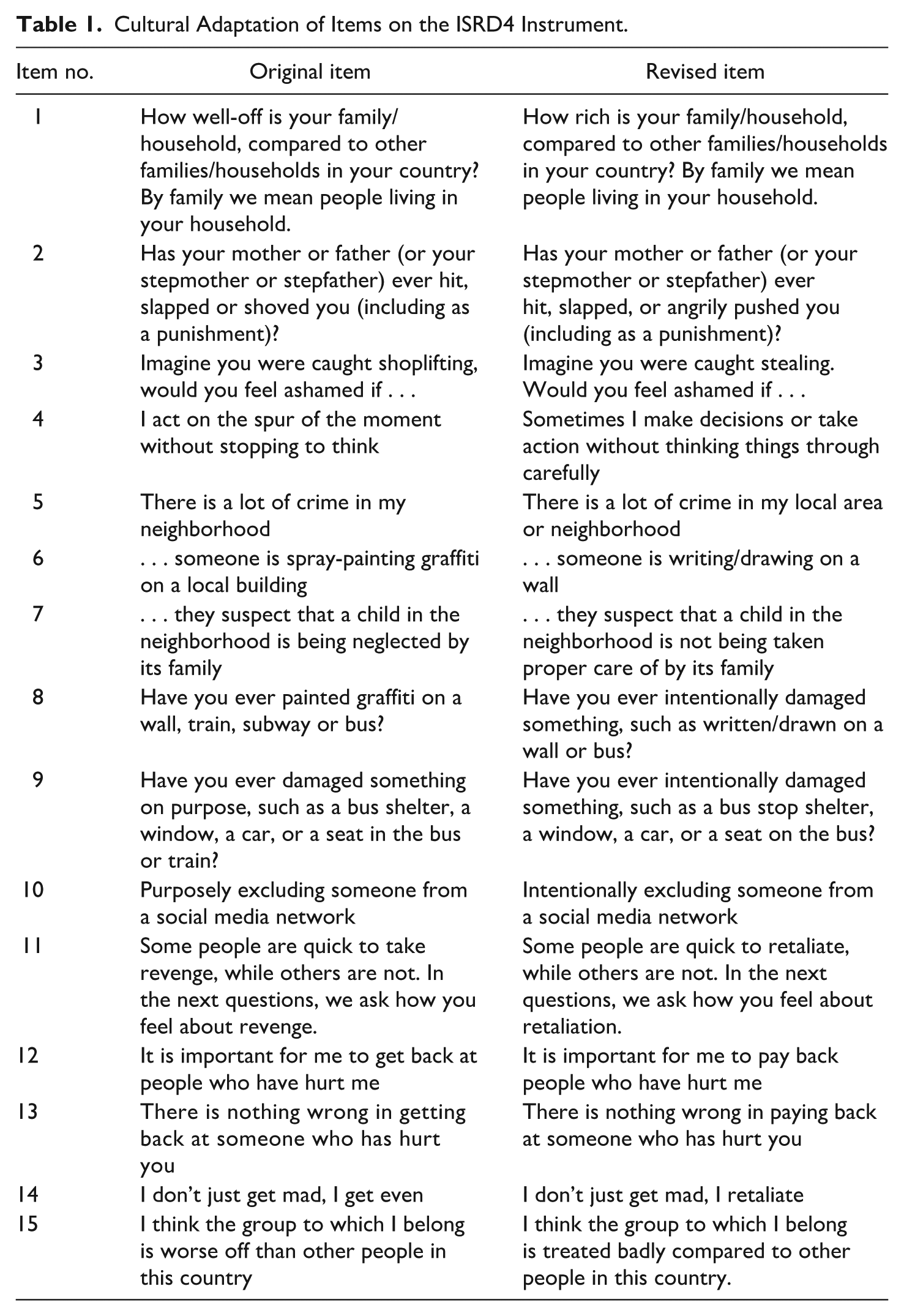
A factor analysis of the six items adapted from the original 24-item scale (Grasmick et al., 1993)—three measuring impulsiveness and three measuring sensation-seeking—did not yield the expected two-factor structure, highlighting the difficulty of assessing construct validity for theoretical constructs such as self-control and social bonding in the Ghanaian context (Foley et al., 2021). Criterion validity could not be assessed in the present study due to the lack of suitable alternative crime measurement tools. Unlike many Western countries, Ghana lacks comprehensive self-report studies or national surveys of youth offending, or reliable official crime statistics such as arrest or court conviction records (Boakye & Tankebe, 2020). Existing studies on self-reported offending in Ghana are based on relatively small, non-probability samples (Boakye, 2013, 2021).
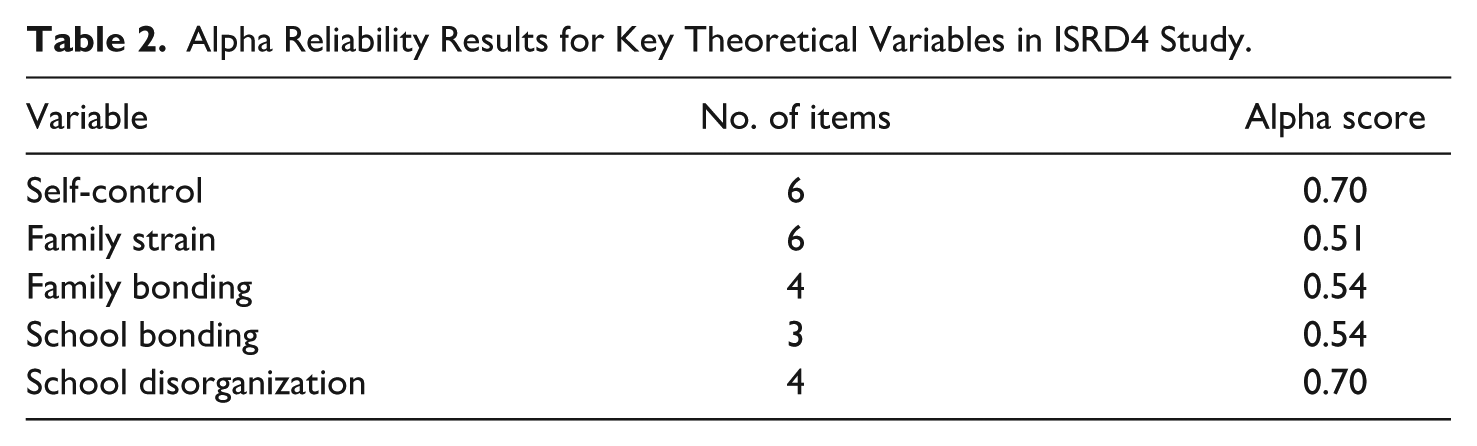
We also assessed the internal consistency of items measuring key theoretical constructs in the ISRD4 study. The results (see Table 2) underscore the difficulty of reliably measuring these constructs. The reliability of the items was generally low even after piloting and further revision of the items. While items assessing self-control and school disorganization demonstrated acceptable reliability, those measuring family constructs showed low internal consistency. This finding aligns with previous research in Ghana (Boakye, 2013, 2020). Developing suitable items to measure concepts such as parental warmth, family bonding, and parental supervision—and achieving measurement equivalence in comparative research—remains challenging, likely due to cultural differences in the conceptualization of these variables (Eisner & Parmar, 2007; Foley et al., 2021; Harkness et al., 2010; Karstedt, 2001).
Alpha Reliability Results for Key Theoretical Variables in ISRD4 Study.
The ISRD study also collects important sociodemographic information, including gender, age, country of birth, sexual orientation, and family socioeconomic status. In the ISRD4 study in Ghana, efforts were made to cover all relevant sociodemographic variables. However, certain sensitive items, such as those related to sexual orientation and gender identity, were excluded due to ongoing political debates and societal polarization surrounding LGBTQ+ rights. The period of data collection coincided with parliamentary debates on the “Promotion of Proper Human Sexual Rights and Ghanaian Family Values Bill,” which heightened ethical concerns and the risk of school access denial if question relating to these variables were included in the study (Amnesty International, 2024; Mensah, 2023). These modifications prioritized cultural sensitivity and ethical concern without compromising the core research objectives.
Ethics Approval Process
Ethics application and approval can be cumbersome, especially for criminological research which often involve reporting acts that infringe on the law or offend societal morals (Davis & Francis, 2018; Israel & Gelsthorpe, 2016). The process is further complicated for overseas researchers where dual ethics approval may be required. Added to ethics is the requirement to adhere to data protection laws and regulations of the European Union and the United Kingdom (Karagiannopoulos & Winstone, 2020; Pardar et al., 2024). Although in relation to this project, ethical approval from the lead author’s institution would have sufficed, a decision was made to also seek ethical approval from the Ethics Committee of Humanities at the University of Ghana, where the lead author was also affiliated. This dual approach was intended to address potential local concerns and facilitate gatekeeper approval. The ethics application process was fraught with bureaucratic delays. We obtained ethical approval in the end, which proved particularly useful in facilitating gatekeeper access and increasing confidence in the integrity of the project. Ethics approval from a local institution should be considered in cross-national comparative studies, even if this is not required. In many low-resource countries, it is possible that the research ethics culture may be weak. However, the weak ethics culture should not be misconstrued to mean the absence of ethical complexities that may be peculiar to the local context (Appiah, 2021). One useful approach is for overseas researchers to actively seek collaboration with researchers in local institutions and to obtain ethics approval from the institution of the local collaborator. Beyond seeking formal ethics approval, the process enhances understanding of local ethical concerns that would otherwise be overlooked as well as improve the rigor of the research.
Navigating Bureaucratic Hurdles and Gatekeeper Approval
Conducting empirical research within educational institutions can be a cumbersome process. It requires navigating bureaucratic systems to gain access to participants and field sites. In line with the procedural requirement of gaining access to public institutions, we first initiated access to schools through the Ghana Education Service (GES), the governing body under the Ministry of Education, responsible for pre-tertiary education in the country. When it comes to allowing researchers to gather data in public Senior High Schools (SHS), the GES is an essential gatekeeper. Our first step was to submit a formal letter, which details the purpose of the study, the study design, sampling and data collection procedure, addressed to the Director General of the Ghana Education Service in July 2021. This was to ensure adherence to proper procedure that aligns with national education goals and ethical norms (Clark et al., 2021). It illustrates our use of what Denzin and Lincoln (2011, p. 651) described as the “institutional negotiation phase” where researchers must match the ethical and administrative requirements of gatekeeping organizations with the objectives of their research.
To facilitate follow-ups, we obtained the direct contact details of the official who received our letter. Follow-up calls yielded no positive results. We made several visits to the GES office without prior appointment after waiting for a month, but these visits also did not yield any positive outcome beyond the repeated assurance that our request is being processed. Our experience with the GES as a gatekeeper reflects what Lipsky (2010) described as street-level bureaucracy. Frontline public officials, working within institutional systems, exercise discretionary powers. They have discretion over which issues are given attention and which ones are postponed, sometimes indefinitely. In our case, we did not get a call from GES until the end of August 2021, after almost 6 weeks of administrative limbo and several unsuccessful attempts to arrange a meeting.
Eventually, we received official notification from GES that access to schools was not possible due to COVID-19 restrictions. This information added another layer of complexity to the situation. While access restrictions were reasonable earlier in the COVID-19 pandemic, and common in many countries, schools had resumed and were working under health protocols by August 2021, when we received the notification. The response from GES, therefore, raised concerns about whether there may be reasons beyond COVID-19 for the refusal. We requested a formal response in writing to confirm the decision. Three reasons informed our decision to request for a formal response. First, official response will confirm the authenticity of the decision, clarify whether the denial was temporary or permanent, and ensure institutional accountability. Second, formal notice will provide evidence of timeline and source of delays to project collaborators should the need arise. And finally, given that educational activities had resumed, we found the reason for the refusal to be inconsistent with the public health situation at the time. We needed a formal written response to ascertain whether our denial was part of the generalized bureaucratic hurdles or obstructionism; or whether this was a legitimate institutional policy or directive at the time.
After repeated calls for several weeks with no encouraging response, we decided to pause contact temporarily. As Hammersley and Atkinson (2007) warn, researchers need to be aware of institutional politeness and to negotiate access in a way that do not extend persistence to overstepping boundaries. We eventually received a call after 3 months inviting the research team to a formal meeting with the Director at very short notice. Although this step opened an opportunity for direct engagement with GES, it reaffirmed the complex and cyclical process of getting permission from institutions. As Clark et al. (2021) suggest, studies within education systems are usually plagued with multilayers of formal and informal rules and regulations, discretionary gatekeeping, and enforcement policies. Our encounter mirrors these observations and further highlights the complex, and sometimes ambiguous, process of seeking access in the developing world.
This first meeting was pivotal because it gave us the opportunity to discuss our research goals and answer enquiries about our data management, sample strategies, and ethical procedure and safeguards in place. During the meeting, we briefed and answered further questions from the officials. The meeting concluded with the official requesting us to submit another letter detailing the specific schools in the regions to be included in the study, the estimated number of student participants, the location and protocol for storing and securing the data and a clear declaration of who would own the data to be collected and how it would be used. These further requirements for us were indications of wider data ethics concerns. We, therefore, submitted a revised letter and added evidence of ethics approval for the research and subsequently the survey questionnaire on request. After several weeks of waiting, we resorted to what Sowatey and Tankebe (2019, p. 540) call “strategic ambush access.” This strategy involved attempt to gain audience with gatekeepers or relevant officials without prior notice or official appointments. This approach failed to yield positive results and by December we resolved to explore alternative access route by shifting focus from the national office to the regional office. It is essential for researchers to prepare for different scenarios and develop contingency plans in a context of uncertainty, and where formal processes are opaque and unpredictable.
Negotiating Access: From National to Regional Approach
The shift from national office to regional level access also required a review of our approach from formal contact to activating our informal networks. The resort to an informal network within the institution proved productive. Our social networks acted as an important social capital (Bourdieu, 1986) and influenced a timely approval. Within a month of our engagement with the regional GES, we received formal approval allowing us entry in schools. The regional office also sent letters to the selected schools to inform them about the research and confirm permission to access students in the schools. Our experience with the regional GES suggests that local offices are often flexible and collaborative. They are also likely to readily recognize the value of the project.
School Dynamics and Access Negotiation
After a successful approval from the regional level GES, we started our engagement with schools. Although we received approval from the regional GES, the different schools had their own access protocols. We started school entry with initial calls to heads for in person briefing. We had obtained contact details of heads of schools from the regional GES, which facilitated the process. Although our first point was to contact heads directly, some responded to calls, others did not. When a head missed our call, we sent a text message with the approval received from GES. WhatsApp is the most common social media application used by teachers in Ghana (Kwaah, 2024). Where both approaches failed, we visited schools without prior appointments with copies of the approval letter. This process did not necessarily guarantee access. Schools had additional gatekeeping requirements that had to be satisfied to gain access. Heads of schools wield enormous authority in this regard, and they vary in the extent to which they exercise their gatekeeping mandate. The differences in response from heads of school reflect the multilayered process of field access. It shows that access from the top does not necessarily guarantee access at the school level. This is consistent with previous studies that suggest researchers may gain official permission from higher administrative levels but may still struggle to get the cooperation and collaboration of local gatekeepers (Buchanan & Bryman, 2007; Wanat, 2008). Sensitivity to the differences in the way heads of school exercise their gatekeeping mandate is critical to developing effective and tailored engagement strategy to gain access to schools. In this context, a one-size-fits-all strategy may not be effective.
We successfully gained access to all but two schools. A decision was made to replace the two schools after persistent visits yielded no positive outcome. Our experience with the schools underscores two important issues about access. First, it shows that access requires variable approaches even with similar-level bureaucracies like schools. As noted earlier, some schools were receptive, granted access, and facilitated data collection. For others, it was only after persistent follow-ups that access was granted. Yet there were schools that denied access despite our frequent and lengthy engagement. Second, our encounter reinforces the point that institutions are shaped by the individual gatekeepers and institutional politics. The undue delays, sidelining, and outright denial in some schools show that access from the top does not necessarily guarantee access at the local level, capturing the everyday micro politics of access within an institutional context. Reasons for access denial may vary from sensitivity of the research area to concerns about potential damage to the reputation of the school, availability and perception of the head of school, previous experience with researchers, and local school policy.
Data Collection, Local Challenges, and Improvisation
Next, we discuss the practicalities of planning the fieldwork and how we dealt with technology and survey administration. The ISRD study provides the option for an online or paper survey. We opted for the online survey after a careful review of the advantages and challenges associated with each option (Clark et al., 2021). Nevertheless, the online survey presents unique logistical and technological challenges in the Ghanaian context. For instance, an online survey required access to a portable device such as tablets or mobile phones, stable power, and internet connectivity. The schools were generally under-resourced. Several schools do not have computer labs or portable devices, and tend to experience interrupted power supply and unreliable or no internet access. Poor internet connectivity and unreliable power supply lead to frequent interruptions in the use of technology in Ghana (Soma et al., 2021). To conduct the online survey and reduce cost, we adapted a hybrid approach, which involved direct purchase of used tablets and bulk hiring to bring the total to 40 tablets. In addition, we purchased two Wi-Fi connectivity devices and data SIM cards to create hotspots to connect the tablet for use in the schools. For schools with large class sizes (50 or more), the survey was conducted in batches due to the limited number of tablets available for the project. The unreliable power supply was a more difficult challenge to overcome. Several scheduled school visits for data collection were delayed or canceled due to power outage. These challenges prolonged the period of data collection from August to December 2024 and increased the cost of completing the project. By the end of the data collection, we recorded 161 (7.1% of 2,264 participants) online surveys that could not progress to completion due to interrupted power supply or internet connectivity. We exceeded the ISRD4 minimum requirement of 900 valid responses for each city (Marshall et al., 2020). Our experience underscores the need for openness to adaptive strategies when conducting field research. These changes were not only necessary but crucial to the completion of data collection, which confirms the need for methodological flexibility for productive fieldwork in unpredictable situations.
Refusal, Social Desirability, and Self-Presentation Bias
Unlike Western educational systems, which often promote egalitarian relationships, Ghana’s educational environment is characterized by hierarchical structures. In such settings, students are expected to show deference to authority figures, including teachers and researchers. During data collection, teachers were sometimes present to introduce the research team and assist in settling students for the survey. The potential impact of this process on participants’ responses remains unclear. No refusals were recorded from students or parents across the participating schools. For parents, the use of passive consent and approval from school authorities may explain this outcome. However, among students, it is possible that the 161 non-completions and in-progress responses included individuals who were present but chose not to participate.
Despite our explicit emphasis on voluntary participation, cultural expectations to defer to authority may have indirectly influenced some students’ decisions to participate. Prior research on social desirability suggests that respondents from collectivist cultures are more likely to engage in impression management, driven by cultural norms that value conformity and social approval (He et al., 2015). Enzmann et al. (2017) further affirm that hierarchical structures can influence young people’s willingness to participate and may shape the content of their responses. These factors have important implications for cross-national comparisons. In Western contexts, students may feel freer to participate or decline, whereas in hierarchical settings, participation may be influenced by social expectations. Such differences must be considered when interpreting results. A separate, detailed analysis is needed to assess the extent to which self-presentation bias may have affected participants’ responses in the ISRD study in Ghana.
Discussion and Conclusion
Prior research emphasizes the importance of accounting for variations in cultural norms, institutional practices, and infrastructure when conducting research across multinational, multiregional, and multicultural settings (Harkness et al., 2010). While some of the challenges we encountered, such as funding constraints, bureaucratic gatekeeping, and disruptions related to COVID-19, are common in other contexts, the Ghanaian experience presents distinct features that merit critical reflection. Unlike Western countries participating in the ISRD, Ghana’s hierarchical educational environment, limited institutional capacity, and infrastructural deficits pose unique obstacles to conducting large-scale, school-based surveys. This paper sheds light on the complex realities of criminological field research in resource-constrained environments. It contributes to the literature on research methodology in such contexts and offers practical insights for future researchers. Our experience illustrates the interplay of logistical, interpersonal, and structural challenges that are often underreported in mainstream methodological discourse. By documenting our experience of participatiing in ISRD4 in Ghana, we provide an empirical perspective on methodological challenges rarely discussed in research from resource-limited settings. Notably, access to research funding remains a significant barrier, potentially explaining the limited participation of African countries in ISRD data sweeps (ISRD1–3) and other international collaborations. Ironically, these are the very contexts where criminological research is most needed to expand our understanding of crime, its causes, and effective prevention strategies.
As demonstrated, adapting standard instruments to measure key concepts across diverse cultural contexts is inherently challenging. Achieving conceptualization and measurement equivalence is crucial in cross-national comparative research, yet contextual differences can impact the validity and reliability of measurement instruments. This, in turn, affects the identification of similarities and differences across contexts. Addressing these challenges requires deep knowledge of the local research environment and the skills to navigate complex methodological issues.
Traditional research protocols often overlook the dynamic and unpredictable realities of fieldwork, including opaque bureaucratic processes, unexpected disruptions, and infrastructural limitations. For example, our analysis revealed significant difficulties with institutional access. Our prolonged and ultimately unsuccessful engagement with the Ghana Education Service exemplifies what Lipsky (2010) describes as “street-level bureaucracy,” where the discretionary power of frontline officials can facilitate or hinder research. Despite adhering to all bureaucratic requirements, access was often delayed or frustrated without explicit denial. Even at the school level, informal gatekeeping and internal processes sometimes impeded access, despite formal approval from regional authorities. These findings align with previous research suggesting that formal approval from higher administrative levels does not guarantee cooperation at lower levels (Bogdan & Biklen, 2007; Feldman et al., 2004). As others have noted, obtaining formal approval is rarely straightforward due to administrative bureaucracy and frequent changes in personnel (Azungah, 2019; Wanat, 2008), leading to delays in data collection. In our case, negotiations over access extended for more than 2 years, significantly delaying the ISRD4 project.
Our findings also underscore the importance of social capital in facilitating research within hierarchical organizations. Access was often contingent on personal networks and relational capital developed over time. Logistical and technological challenges further complicated data collection. The online survey format presented obstacles such as erratic power supply, limited internet penetration, and inadequate ICT infrastructure in public schools. Field-level improvisations, such as the use of portable Wi-Fi and mobile hotspots, were essential for overcoming these barriers. These adaptations were not only necessary but also critical to the successful completion of data collection, supporting the argument that methodological flexibility is vital for productive fieldwork in unpredictable environments (Clark et al., 2021).
Systemic bottlenecks and delays also impacted researcher motivation and project implementation. These challenges highlight the limitations of standard methodological prescriptions and demonstrate the need for researchers to embrace uncertainty, improvise, and develop reflexive skills when conducting fieldwork in resource-constrained settings. Our experiences further illustrate the importance of contextual dynamics and reflexivity in international and comparative criminological research. While operating within the broader framework of a global study, our local adaptations underscore the necessity of integrating methodological strategies that are sensitive to specific socio-cultural and institutional contexts. This aligns with calls for a contextualized, reflexive, and adaptive approach to fieldwork (Denzin & Lincoln, 2011; Hammersley & Atkinson, 2007; van Assche et al., 2023).
The lack of robust institutional infrastructure, such as reliable access to computers, electricity, and internet connectivity, cannot be overlooked, as it has significant implications for functional equivalence (Harkness et al., 2010). Achieving functional equivalence in multinational, multiregional, and multicultural surveys requires more than technical consistency; it demands adaptation to local conditions without compromising core methodological standards. In Ghana, our use of hybrid administration methods, including offline tablets and mobile hotspots, exemplifies the need for context-specific implementation. While innovative, such adaptations may introduce variability or inconsistencies in survey administration, potentially affecting cross-national comparability.
Unlike Western countries, access in Ghana involved a combination of formal and informal gatekeeping structures, contrasting with more standardized institutional procedures elsewhere. Our experience supports Karstedt’s (2001) assertion that comparative criminological research must contend with institutional variability across countries, which can shape access and sampling. These structural differences raise important questions about the validity and comparability of ISRD data across countries. For example, power outages and internet disruptions may have affected data quality in Ghana. These contextual specificities have significant implications for international collaborative research. Although standardized procedures are essential for comparability, our experience in Ghana highlights the tensions between methodological uniformity and local adaptation. Greater reflexivity is therefore required when interpreting and comparing Ghanaian data, necessitating recognition of the socio-cultural and infrastructural constraints that shaped both survey design and implementation.
In summary, conducting research in low-resource settings such as Ghana is not merely a logistical exercise but also a highly flexible and political endeavor. Challenges should be viewed as inherent elements of the research process, requiring imagination, perseverance, and adaptability rather than being seen as exceptions. By sharing our fieldwork experiences in this international survey, we hope to provide valuable insights for future researchers engaged in international collaborative research.
Footnotes
Acknowledgements
We are grateful to the Director and staff at the Greater Accra Regional Office of the Ghana Education and the Heads of participating schools for their support. We also thank the study participants for sharing their perspectives with us. Also, thanks to the anonymous reviewers for their insightful comments on the earlier draft of this article.
Declaration of Conflicting Interests
The authors declared no potential conflicts of interest with respect to the research, authorship, and/or publication of this article.
Funding
The authors received no financial support for the research, authorship, and/or publication of this article.
