




Abstract
In recent decades, sex work in Canada has faced legal changes with efforts to enhance the criminalization of buyers and court challenges to uphold sex workers’ human rights. What are the consequences of these legal changes and challenges on the streets of Toronto where sex work and its enforcement have also changed? Leveraging an intersectional framework with annual data on Toronto police–recorded sex work occurrences and census data from 1992 to 2020 (29 years, 579 tracts, n = 16,791), we spatially and longitudinally analyze neighborhood counts of sex work arrests and their relationship to sex work policies and neighborhood effects. Our results show that (a) the policing of sex work in Toronto has dropped by 99.6% in the past 30 years, (b) neighborhood socioeconomic disadvantage increases neighborhood arrests, (c) criminalizing policies that target buyers increase neighborhood arrests, and (d) the Supreme Court decision upholding sex workers’ human rights briefly decreased neighborhood arrests. Our study raises policy implications as to why laws do not do more to protect sex workers when it appears that arrests have become a low priority for police. Rather than criminalization, laws could prioritize harm reduction, especially for Toronto’s most marginalized sex workers and clients.
Keywords
Introduction
Historically, Canada has never technically criminalized the selling of sex, but laws targeting sex work and their enforcement have fluctuated in recent decades. Canada’s Criminal Code, passed in 1985, criminalizes activities related to selling sex, such as “disorderly houses,” “offering, providing or obtaining sexual services,” and “commodification of sexual activity” with language criminalizing “communication for the purposes of prostitution” (Backhouse, 1985; Hudson & van der Meulen, 2013; Minister of Justice, 2023).
Sex workers’ rights advocacy groups have legally challenged the Criminal Code as violating Canada’s Charter of Rights and Freedoms in courts, specifically sex workers’ rights to liberty and security of the person (Belak, 2018). The most successful court challenge was the Canada v. Bedford case filed in 2007, which resulted in the Supreme Court ruling on the side of sex workers’ rights in 2013 (Belak, 2018). The Court gave Parliament 1 year to revise the Criminal Code. In 2014, the last year when Prime Minister Stephen Harper and the Conservative Party had the majority in Parliament, they passed Bill C-36—the Protection of Communities and Exploited Persons Act (PCEPA)—which went into effect in December of that year (Belak, 2018; Canada Department of Justice, 2018). Bill C-36 formalized the Nordic model of sex work in Canada by criminalizing the purchase of sex but not its sale, and it also clarified the communication ban with revisions prohibiting the advertising of others’ sexual services (Canada Department of Justice, 2018). Sex worker advocates and organizations viewed this as a legal backlash to their brief Supreme Court victory (Porth, 2018). Winning the 2015 election, Prime Minister Justin Trudeau and the Liberal Party government committed to reviewing Canada’s prostitution laws (Ling, 2018), but there has been no movement on this front a decade later. In 2021, the Canadian Alliance for Sex Work Law Reform challenged the constitutionality of C-36 in the Ontario Superior Court, which included legal arguments on safety and the importance of negotiating with clients (Canadian Alliance for Sex Work Law Reform, 2022). The Court dismissed their case in 2023.
This brief legal history shows that the (de)criminalization of sex work in Canada has fueled political and judicial debates for decades, following the political direction of Australia and some European countries more so than the United States’ prohibition model. However, it is unclear if or how these political debates unfold on the ground. How does police enforcement of sex work vary across neighborhoods? How have local police departments enforced sex work amid these legal challenges and changes? The aim of this study is to analyze approximately 30 years of sex work arrests by neighborhood in Toronto, Canada’s largest city, to test whether policy changes, legal challenges, and/or neighborhood effects impacted the criminal legal control of sex work at the local level.
We find that sex work arrests in Toronto decreased by 99.6%—from thousands per year in the 1990s to about a dozen by 2020. Throughout this period, socioeconomically disadvantaged neighborhoods experienced higher counts of sex work arrests, even when arrests became increasingly rare. A fraction of this decrease resulted from the human rights court decision on behalf of sex workers, while policies targeting buying sex increased Toronto neighborhood arrests.
Intersectionality and Sex Work
Intersectionality provides a theoretical and analytical lens through which we attain a deeper understanding of sex work, especially at the intersection of gender, class, and race (Crenshaw, 1991). Research finds that most sex providers are cisgender and transgender women (Vanwesenbeeck, 2013), and community members assign labels of sex worker to women rather than men (Shdaimah et al., 2014). Benoit and colleagues (2015) consider sex work to be a “feminized” occupation, which confers lower status and greater stigma. Intersecting gender with class, economic necessity is arguably the primary motivation to engage in sex work (Oselin, 2014; Sanders, 2005). Yet, there is substantial stratification within the sex industry that reflects and contributes to intersectional inequalities. Poor women of color with lower educational attainment tend to be overrepresented in street-based sex work and less likely to work in higher-tier forms (e.g., escorts) (Lever & Dolnick, 2009; Maher, 1997; Sanders, 2005). The type of sex work one performs can affect many aspects of life. For example, operating at the street-level exposes one to lower pay and greater risks of criminalization, violence, and stigma compared to indoor forms (Brents et al., 2009; Weitzer, 2009).
Community members and police subject street-based sex workers to heightened levels of social control because they occupy visible public spaces. Community members express a myriad of complaints about outdoor sex work, including immorality, greater noise and trash, harassment by customers, and spread of disease (Shdaimah et al., 2014; Weitzer, 2005). Fueled by these concerns, community members mobilize police and report sex work at high rates (Harari et al., 2024). This community-policing dynamic often results in greater arrests of outdoor sex workers when compared to other forms (Cunningham & Kendall, 2011; Krüsi et al., 2016). Still, police enforcement of sex work—consisting of harassment, move along orders, or arrests—varies based on local and federal policies as well as policing priorities (Oselin et al., 2022; Rosentel et al., 2021).
Even though men perform sex work, most studies focus on their roles as customers or managers who possess more gender-based power (Brady et al., 2015; Monto, 2004). However, when policymakers enact measures that intentionally target men of the sex industry—such as “end demand” or anti-trafficking policies—men’s interactions with law enforcement, arrests, and subsequent involvement with the criminal legal system increase. Sex workers’ rights movements attempt to reconfigure these gender-based power dynamics, with efforts to affect policies that grant them legal protections, decriminalize their work, and enhance their work conditions (Belak, 2018).
An intersectionality framework focusing on neighborhood effects can additionally shed light on compounding disadvantages as they vary across sex workers. Research reveals that particular neighborhoods receive heightened levels of criminalization of outdoor sex work compared to others (Brock, 1998; Oselin et al., 2022). Although recent studies find police disproportionately target sex work in poorer, disadvantaged neighborhoods, resulting in more arrests in these locations (Harari et al., 2024; Oselin et al., 2022), others document heightened criminalization in affluent, gentrified neighborhoods (Ross, 2010). Scholars should be attentive to the urban contexts in which sex work occurs given they may produce different types and levels of risks for providers.
Sex Work Trends in Canada
Notably, the criminal legal control of sex work in Canada has closer gender parity compared to the United States. Canadian prostitution arrest statistics do not differentiate between buyers and sellers of sex; police arrest women in similar numbers as men for prostitution-related crimes though most Canadian sex workers are cisgender and transgender women (Benoit & Shumka, 2021). This occurs because the most straightforward prostitution-related offense for police to enforce is the communication ban, which prohibits “communication for the purposes of prostitution in a public space” between buyers and sellers and accounts for 90% of prostitution-related arrests in Canada (House of Commons, 2006). Historically, Canada’s Uniform Crime Reports (UCR) statistics for prostitution show that only about half of the country’s arrests are of women, and women’s proportion of arrests has been decreasing since 2009 (Rotenberg, 2016). In 2013, only 9% of Canada’s arrests for prostitution-related offenses were of women (Rotenberg, 2016, p. 8). 1 Data from Ontario Adult Criminal Courts on guilty prostitution charges show the trend of decreasing cases since the 1990s as well as the trend of women comprising about 56% of the guilty cases until the Bedford decision in 2013 (Statistics Canada, 2023). Post C-36, Ontario Courts have found only 10 women and 54 men guilty of prostitution offenses, with zero men and women found guilty since 2019 (Statistics Canada, 2023). 2
Estimates suggest that only about 20–25% of Canada’s sex industry is street-based sex work, although this fraction faces the most legal enforcement due to its higher visibility (Benoit & Shumka, 2021; House of Commons, 2006). More than 75% of Canada’s “prostitution-related incidents reported by police between 2009 and 2014” occurred in public spaces such as streets, sidewalks, parks, or public transit facilities (Rotenberg, 2016, p. 7). As prostitution arrests have decreased, a higher percentage of arrests occur in private property (22% in 2014) and commercial spaces (21% in 2014), but these percentages are based on small counts (Rotenberg, 2016, p. 7).
Sex Work in Toronto
Toronto is the largest city in Canada and the fourth largest city in North America, with a population of approximately 2.8 million people. Half of Toronto’s population is White, with East Asian, South Asian, and Black populations making up the largest racialized groups respectively. Approximately half of Torontonians are immigrants. Toronto is stratified socioeconomically, with low-income households clustering around the edges of the city (Hulchanski, 2007). Competing for some of the most expensive housing costs in North America, approximately 11% of Torontonians live in poverty, and 6% are visible minorities. Racial segregation in Toronto follows immigration patterns, especially the post-industrial 1980s immigrants arriving from non-European countries when affordable housing stock in Toronto was decreasing (Goel, 2023). Toronto’s visible minorities, especially Black and Arab immigrants, face economic marginalization in the labor market, and affordable housing constrains them to the periphery and suburbs of Toronto (Goel, 2023). Within Toronto, 55% of tracts were majority racialized persons according to the 2021 census.
In the early 1970s, Yonge Street in downtown Toronto earned a reputation as “Sin Strip” for its concentration of strip clubs, adult film and bookstores, and massage parlors (Brock, 1998, p. 31). Following the murder of a 12-year-old shoeshine boy outside of a Yonge Street massage parlor in 1977, municipal crackdowns, increased licensing fees, and police raids began targeting and closing Yonge Street’s indoor sex industry (Brock, 1998). This led to an increase in escort services and street-based sex work in and around Toronto’s downtown core (Brock, 1998). In fact, escort agencies peaked in Toronto in the 1980s (Oselin et al., 2025). By the 1990s, Toronto’s well-known strolls near Yonge Street moved toward more residential neighborhoods (Brock, 1998). Cisgender women worked in the Downtown Yonge East neighborhood, transgender women worked in the North Street Jamestown and Cabbagetown neighborhoods, and cisgender men worked in Church and Wellesley, the gay village, neighborhood (Brock, 1998; Hagan & McCarthy, 1998).
Police were familiar with these stroll locations. The policing tactic of “john sweeps” resulted in many men’s arrests for communication for the purposes of prostitution. Women undercover officers posed as sex workers to encourage men to engage in solicitation—entrapment tactics permitted by Canada’s Supreme Court (Khan, 2015; Wortley et al., 2002). Men officers also posed as clients to witness sex sellers’ solicitation and arrest women. These sweeps resulted in dozens to a hundred arrests per night of almost entirely street-based sex work (Brock, 1998; Wortley et al., 2002). Their sweeps largely targeted poorer residential neighborhoods, such as Parkdale on Toronto’s westside (Brock, 1998), or gentrifying neighborhoods with strong neighborhood associations, such as Cabbagetown (McKenna, 2022). Parkdale continued to be targeted by john sweeps for decades (Kelly, 2006). Toronto police announced a hold on john sweeps in 2012 following the Ontario Court decision on the Bedford human rights case (Davidson, 2012), and news outlets have not reported any high-profile sweeps in Toronto since.
Beginning in 1996, men arrested in the john sweeps could have their criminal charges dropped if they attended Toronto’s john school diversion program, which was not an option available to sex workers (House of Commons, 2006; Wortley et al., 2002). John schools aim to educate clients about the harms of sex work. One study showed that john school attendees were disproportionately working-class and immigrant men, and police were not targeting higher-tier indoor sex work (Wortley et al., 2002).
Sex Workers in Toronto
Although clear statistics on the racial, Indigenous, gender, and socioeconomic status of Canadian or Torontonian sex workers are not available, intersectionality is critical to understanding sex workers in any context given differential exposure to risk, arrests, and violence. In Canada, gruesome murders of vulnerable street-based sex workers have spotlighted the disproportionate number of Indigenous women involved in it (National Inquiry into Missing and Murdered Indigenous Women and Girls, 2019; Razack, 2000). Toronto advocacy organizations have highlighted the violence experienced by Asian and migrant sex workers (Lam & Santini, 2020), and the unsolved murders of transgender women of color sex workers (Transgender Pride Toronto, 2023).
Several empirical studies provide some insights into the demographics of Toronto sex workers. Research on 55 women enrolled in a Toronto sex work exit program included sample demographics of about half identifying as women of color, 58% having high school or less as highest level of education, and 66% earning less than $15,000 a year (Shareck et al., 2024). Hagan and McCarthy’s (1998) study of unhoused and street youth in Toronto found that youth, especially but not exclusively young women, engaged in survival sex work. A 2001–2004 government-funded study obtained a purposive sample of Toronto sex workers of whom 30 were cisgender women, 9 were transgender women, and 22 were cisgender men, but there was no mention of race or Indigeneity (Lewis et al., 2005). In this study, transgender women street-based sex workers were largely confined to particular strolls, whereas cisgender men and women could move between dancing, escorting, and street-based work as needed (Lewis et al., 2005).
One other source with insights on the demographics of Toronto sex workers comes from the Toronto Police Service’s (TPS’) Field Information Reports (FIRs), which it published as part of an open data initiative. These reports include the reasons for police contact and some details of the individuals involved, such as skin color and sex, but the FIRs do not measure Indigeneity or include categories for gender diversity. One category for the “nature of contact” is “sex trade related.” Females accounted for 70% of these police contacts between 2008 and 2013. Among these, Black and Brown females were underrepresented, making up only about 9% of all females involved in sex trade–related contacts (relative to their population in Toronto of approximately 11–12%). However, the percentage of Black and Brown females in these sex trade–related police-civilian contacts increased from 6% in 2008 to 12% in 2013 (closer to their proportion of Toronto’s population).
Although the intersection of gender and class is the best documented for Toronto sex workers, racism, colonialism, nationalism, and cisgenderism compound socioeconomic disadvantage in Toronto (and Canada). These intersecting systems of oppression result in Toronto’s most marginalized women selling sex under the most dangerous conditions. How these intersecting systems have played out in Toronto neighborhoods over time has yet to be examined.
Current Study
Our review above identifies several trends that are relevant to the present study. First, in recent decades, sex work regulation has shifted in Canada: the formalization in the 1985 Criminal Code, the human rights challenge in 2007 and Supreme Court victory in 2013, to the passage of the restrictive Bill C-36 in 2014. Second, the enforcement of sex work regulations on the ground is mostly through communication bans that impact men buyers and women sellers of sex, with the former accessing local john school diversion programs. Third, limited evidence shows that sex work arrests disproportionately occur in socioeconomically disadvantaged neighborhoods and target disadvantaged clients and workers in street-based markets.
This study’s aim is to examine the relationships between these trends by analyzing approximately 30 years of sex work arrests in Toronto to test whether policy changes, legal challenges, and/or neighborhood effects impacted the criminal legal control of sex work within Toronto’s neighborhoods. Our research questions ask: How does police enforcement of sex work vary across Toronto neighborhoods? How have Toronto police enforced sex work amid legal changes and challenges? Based on trends in the literature, we propose four hypotheses.
Data
Following our filing of a Freedom of Information request and a formal researcher application, we obtained the TPS data on all “occurrences” related to “prostitution” from 1992 to 2020. 3 TPS does not distinguish occurrences from arrests in the data it provided; however, other scholars have clarified that TPS occurrences “include all arrests and other enforcement actions” (Foster & Jacobs, 2022, p. 11). These occurrences are more than just casual stops, observances, or move along orders. As such, we refer to these police recorded occurrences as arrests throughout our study results. The majority (94%) of these occurrences were for “communication for the purposes of prostitution.” Although TPS did not provide any demographic information on the accused persons, each occurrence does include a census tract location and date.
We merged the TPS data to Canadian census data obtained through the cancensus R package (Von Bergmann et al., 2021). The Canadian census occurs every 5 years, and our analysis uses the 1996, 2001, 2006, 2011, 2016, and 2021 censuses. We cross-walked the census data by population weights to harmonize earlier tract boundaries to Toronto’s 2021 tract boundaries, following Allen and Taylor (2018). We used inter-census year linear interpolation with extrapolation on the earliest years to fill in our annual longitudinal merged dataset (Weden et al., 2015). 4 Our unit of analysis is 579 Toronto census tracts by year (1992–2020). Our final dataset is longitudinal with 29 observations for each tract (n = 16,791).
Measures
Sex Work Arrests
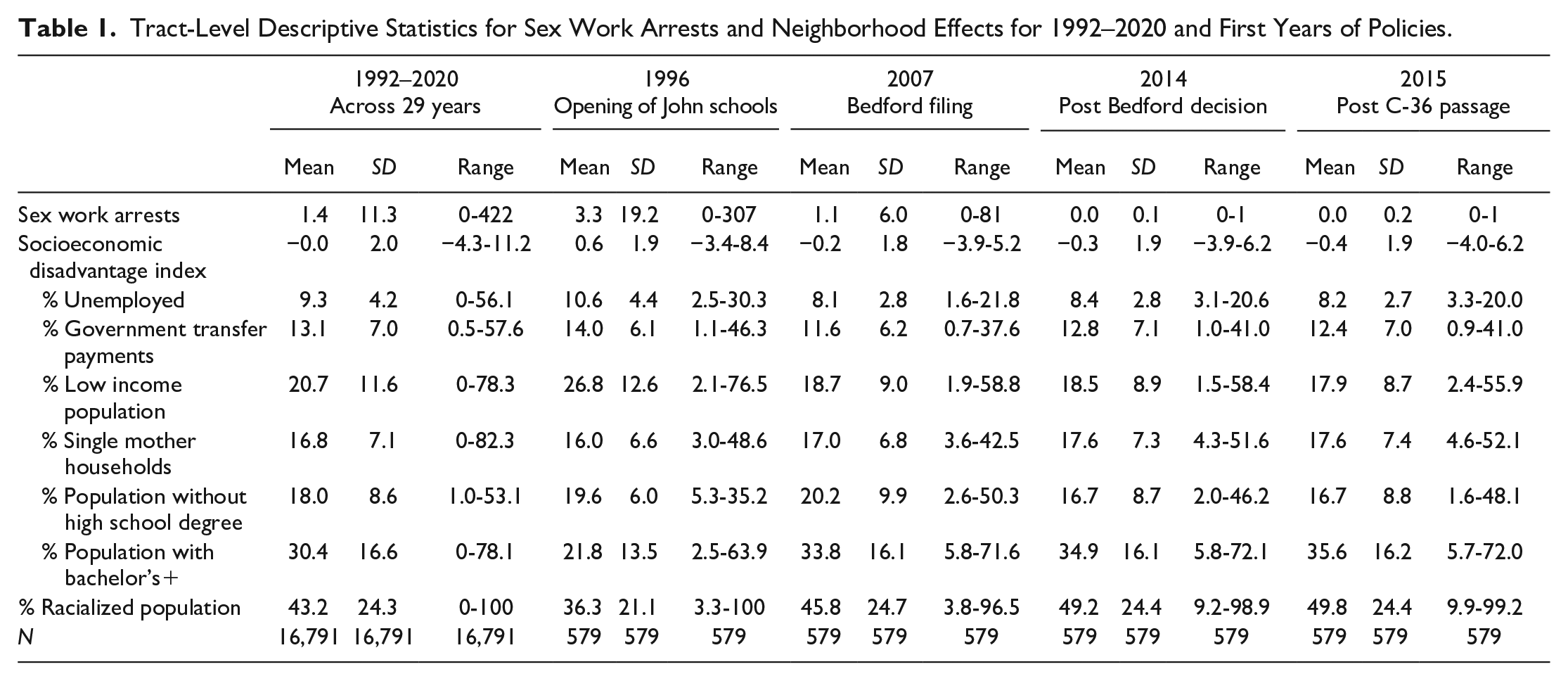
Our dependent variable is the tract-level count of the TPS recorded sex work arrests in a year. The range of this variable is 0 to 422, with a mean of 1.4. This variable is highly skewed with a standard deviation eight times higher than the mean, and 87% of observations have zero arrests. Table 1 presents the descriptive statistics for pooled observations and for the first year of four policy interventions.
Tract-Level Descriptive Statistics for Sex Work Arrests and Neighborhood Effects for 1992–2020 and First Years of Policies.
Socioeconomic Disadvantage
We build on Wodtke, Harding, and Elwert’s (2011) measure of neighborhood socioeconomic disadvantage and use principal component analysis on six census variables to derive an index: percentage of families below the low-income cutoff, percentage receiving government transfers, percentage of single female-headed households with children, percentage of the population ages 15 and over unemployed, percentage with no high school diploma, and inversed percentage with a bachelor’s degree or higher. Higher values indicate greater socioeconomic disadvantage. This index is mean centered, and the range is −4.3 to 11.2.
Racialized Population
The percent of the neighborhood’s racialized population comes from the census designation of visible minorities defined as “persons, other than Aboriginal peoples, who are non-Caucasian in race or non-White in colour” (Statistics Canada, 1998). We added the neighborhood count of people who identify as visible minorities to the count of Indigenous people, and we divided this sum by the neighborhood population to obtain the percentage of racialized population. The overall tract mean racialized population is 43.2% with a range from 0% to 100%. The correlation between socioeconomic disadvantage and racialized population is positive and strong at 0.63. The correlation between tract-level racialized population and immigrant population is 0.81, which is so strong for Toronto that we cannot measure these effects separately.
Policies
We created binary variables for four sex work policies covering the range of years when they were in effect. We measure the periods of two policies that criminalized sex buyers: Toronto’s john schools that opened in 1996 and continue today and Bill C-36’s passage in November 2014 that we lag to 2015. We also measure the periods of two policies focusing on sex workers’ rights: the Bedford case variable covers 2007–2013, from the initial court filing in March 2007 to the final Supreme Court ruling in December 2013, and the Bedford decision variable which was only in effect in 2014 while legislators debated C-36. These four policy variables equal one for the period during their intervention: john schools 1996–2020, Bedford case 2007–2013, Bedford decision 2014, Bill C-36 2015–2020, and zero otherwise.
Methods
Our analysis first visualizes trends in sex work arrests over time and across Toronto neighborhoods. We present a line graph displaying the aggregate counts of sex work arrests per year with emphasis on the first year of the four policy interventions. We present four maps illustrating the spatial variations in sex work arrests across census tracts during the four policies’ beginning years. Each map includes the spatial clustering statistic from Moran’s I tests that assess the global correlation between sex work arrests and its value among its contiguous neighbors (Weisburd et al., 2022).
Our multivariate analysis uses longitudinal negative binomial regression models to account for overdispersion in our count outcome variable and to test the impact of neighborhood effects and the policy periods on sex work arrests. These models are appropriate for analyzing overdispersed count data and common when modeling spatial crime data (Boessen & Hipp, 2018; Weisburd et al., 2022). Dispersion tests indicate substantial overdispersion in the data (dispersion = 34.97, p < .001). We nest the models by adding in policy intervention periods in chronological order. Our models include control variables for population size and year. Our standardized year variable centers the original year values around 2006 to account for the linear trend in sex work arrests across the data. The model specifies random intercepts and slopes for year nested within census tract to account for correlations within tracts over time, allowing for each tract to have its own intercept and slope.
Results
Toronto police activity around sex work has dramatically decreased in the past 30 years. Figure 1 presents a line graph of sex work arrests in Toronto from 1992 to 2020. Sex work arrests dropped by 99.6% from the peak of 2,784 arrests in 1992 to only 11 arrests in 2020. We found three waves of persistent decreases in sex work arrests within each decade of these data. Sex work arrests dropped by 45% in the 1990s, 39% in the 2000s, and 96% in the 2010s. In 1992, 97% of sex work arrests were for communication for the purposes of prostitution, whereas the last recorded arrest for this offense occurred in 2017. The lowest count of sex work arrests was six in 2014, which was the year following the Bedford decision when legislators were drafting C-36. These six arrests in 2014 did not directly target sex workers: one arrest was for keeping a bawdy house, two arrests were for living on the avails of prostitution under age 18, and three arrests were for aggravated assault in the context of avails of prostitution.
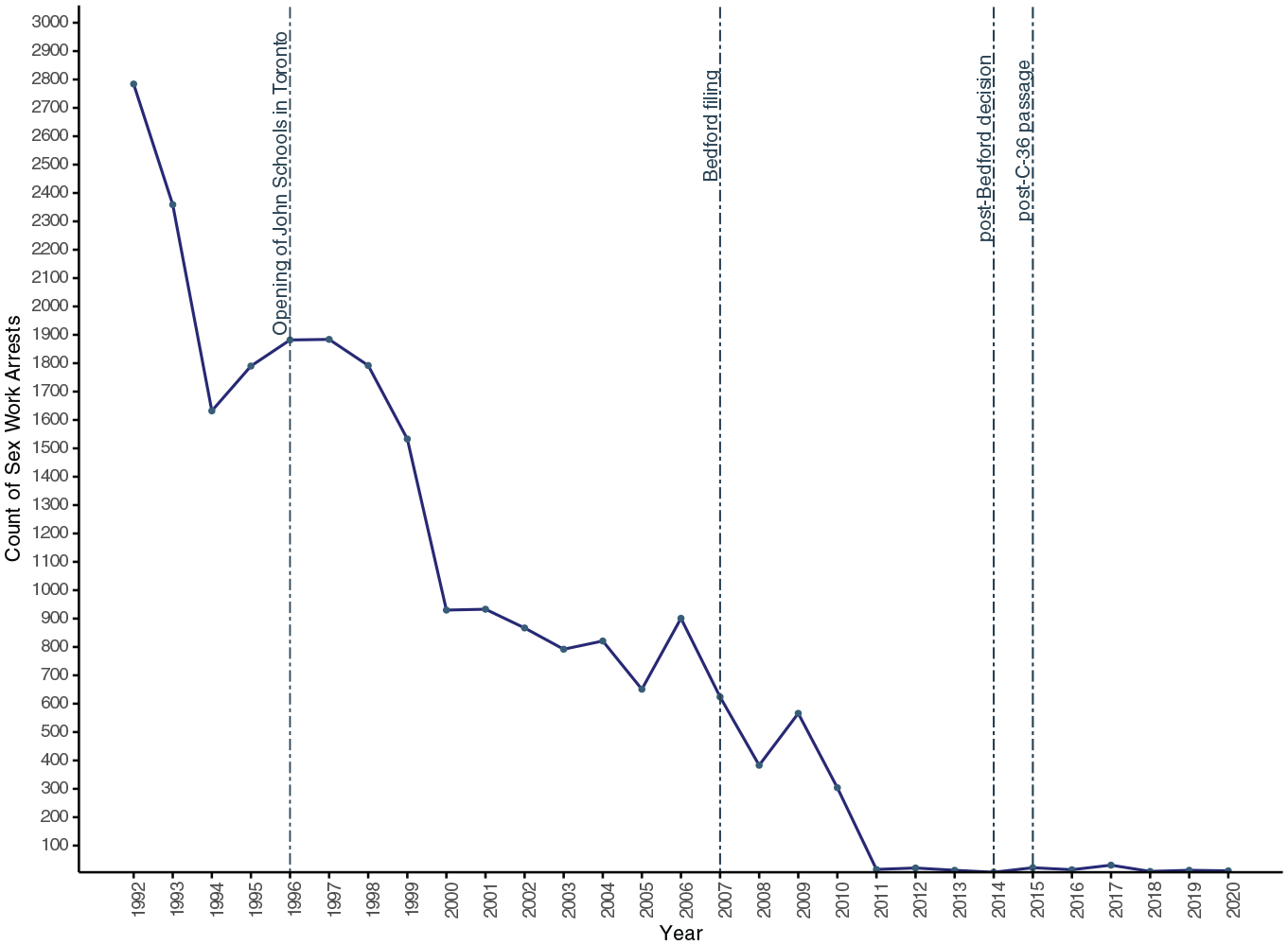
Line Graph of Toronto Sex Work Arrest Counts by Year, 1992–2020.
Figure 2 presents four maps of Toronto showing the spatial distribution of where TPS directed its efforts to control sex work during the beginning year of the four policies. The longitudinal decrease in arrests shown in Figure 1 is also visible across the Figure 2 panels. In 1996, sex work arrests largely concentrated in Moss Park near the downtown core, in Parkdale on the west side, and in the Scarborough Village/Cliffcrest neighborhoods in the southeast. The spatial arrangement of arrests in 2007 was similar but lower in frequency, and the rare arrests in 2014 and 2015 appear randomly distributed throughout Toronto. The Moran’s I statistics confirm these visual trends with low spatial clustering for sex work arrests in 1996 and 2007 (p < .001), and no spatial clustering in 2014 and 2015 (not statistically significant).
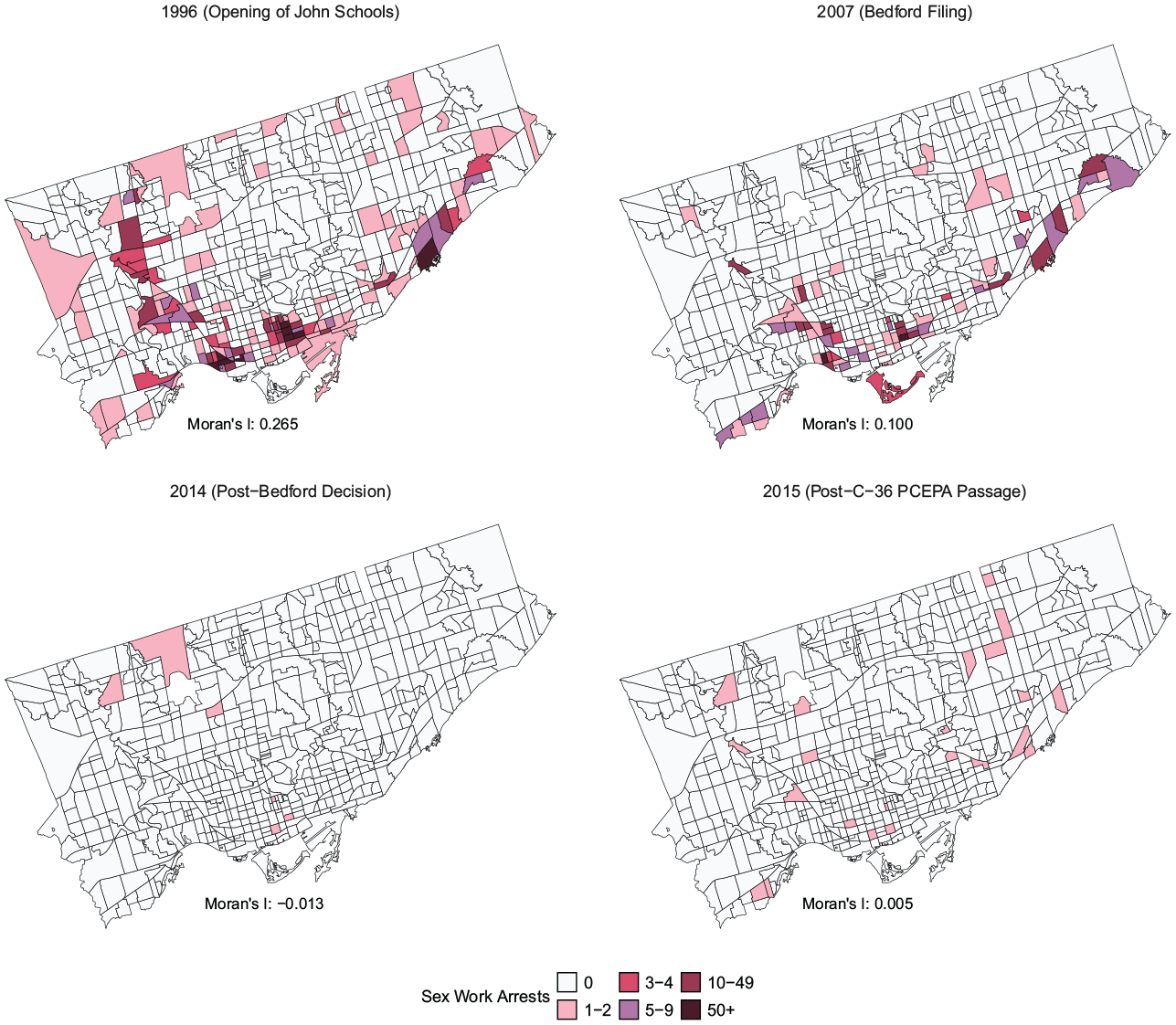
Maps of Toronto Sex Work Arrest Counts by Census Tract for First Years of Policies.
Zooming in on the overall mean neighborhood characteristics for tracts with the highest arrests, Moss Park is the poorest neighborhood near downtown with concentrated public housing and multiple homeless shelters, where on average 52% of the population was racialized and 43% fell below the low-income cutoff from 1992 to 2020. Parkdale is a residential, historically working-class neighborhood with a large Tibetan diaspora, and demographically, it had 42% racialized population and 30% below the low-income cutoff. One census tract had high arrests in Scarborough Village/Cliffcrest where a notorious strip of budget motels concentrates, but only 14% of the population was racialized, and 10% were below the low-income cutoff.
Table 1 shows that the mean in neighborhood sex work arrests decreased across the beginning years of the four policies as did the socioeconomic disadvantage index. The neighborhood mean for racialized population is 43% across the 29 years, and this average increased from 36% since 1992.
Table 2 presents the results from our longitudinal negative binomial regression models measuring the impact of neighborhood effects and policy interventions on sex work arrests at the tract-level, controlling for random effects of census tracts nested within years. All five models include neighborhood effects, and Models 2–5 add each policy period chronologically. Regarding neighborhood effects, we find a one standard deviation increase in the socioeconomic disadvantage index was associated with a 59% increase in sex work arrests (Model 5, p < .001), and a 1% increase in racialized population decreased sex work arrests by 2% (Model 5, p < .001). These findings provide statistical evidence that sex work arrests are highest in Toronto’s most socioeconomically disadvantaged neighborhoods, but not in neighborhoods with the largest racialized populations.
Longitudinal Negative Binomial Regression Predicting Toronto Tract-Level Counts of Sex Work Arrests, 1992–2020.
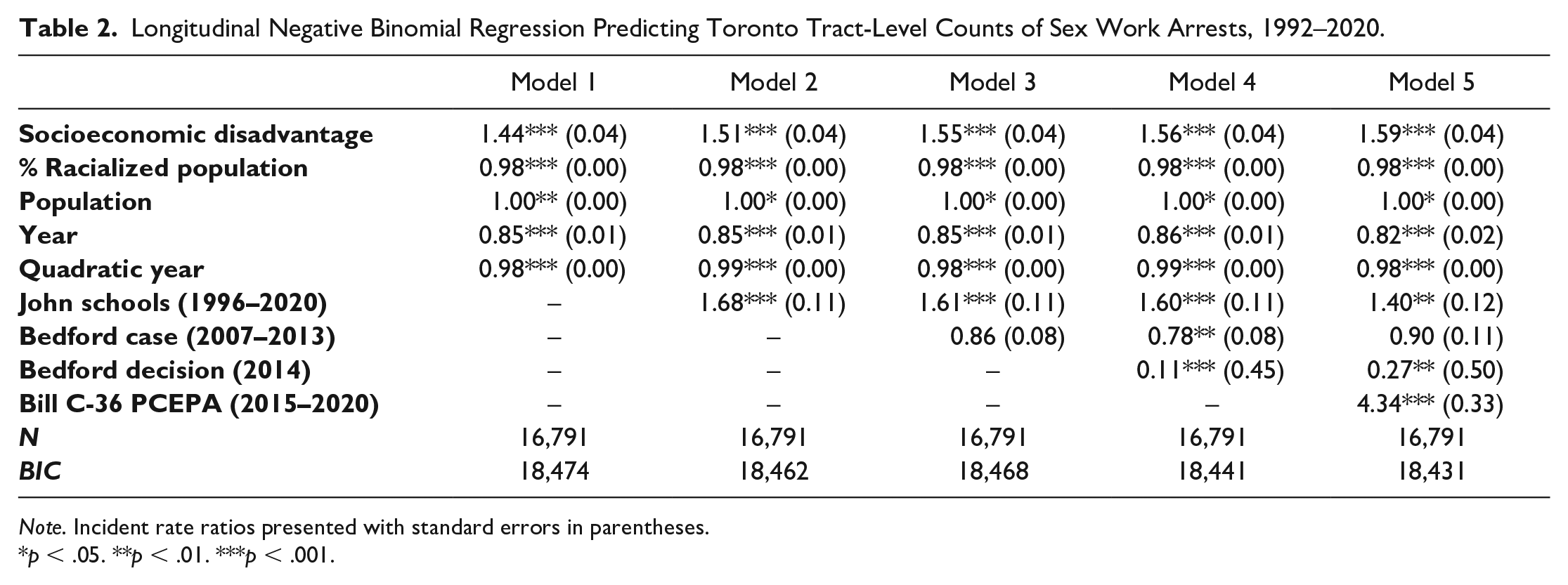
Note. Incident rate ratios presented with standard errors in parentheses.
p < .05. **p < .01. ***p < .001.
Model 2 in Table 2 shows that the period of Toronto’s john schools increased sex work arrests by 68% (p < .001), and this relationship holds with additional policies in the model. Model 5 shows that the passage and period of Bill C-36 increased Toronto neighborhood arrests by 4.3 times (p < .001). These two policies (one local and one national) that targeted buyers of sex increased sex work arrests at the neighborhood level, even in the later period when sex work arrests were rare.
Model 3 in Table 2 shows that the period covering the Bedford case from its filing in 2007 through its time in the courts did not significantly influence sex worker arrests in Toronto neighborhoods. However, Model 4 shows that the 1-year period following the Bedford decision significantly decreased sex work arrests by 89% (p < .001), and this model generates a significant period effect for the Bedford case showing a decrease of sex work arrests by 22% (p < .01). The significant 1-year period effect for the Bedford decision holds in Model 5, but not for the Bedford case. The long period of Bedford moving through the courts from 2007 to 2013 did not have a consistent significant decrease on local neighborhood arrests in Toronto, but the Supreme Court victory for sex workers’ human rights did decrease arrests for the interim year before Bill C-36.
Discussion
The aim of this study was to analyze approximately 30 years of sex work arrests by Toronto neighborhood to test whether policy changes, legal challenges, and/or neighborhood effects impacted the criminal legal control at the local level. Our research questions asked: How does police enforcement of sex work vary across Toronto neighborhoods? How have Toronto police enforced sex work amid legal changes and challenges?
Our first and second hypotheses focused on neighborhood effects, and they proposed that sex work arrests would be higher in economically disadvantaged neighborhoods and neighborhoods with high racialized populations. Results from our longitudinal models show strong support for the relationship between socioeconomic disadvantage and increased sex work arrests, but, contrary to hypothesis two, we find a small negative relationship between the percent racialized population and sex work arrests. While the data available do not permit us to make conclusions about who TPS arrested, these neighborhood effects help us situate our findings in a more intersectional framework—especially at the intersection of class and gender. Police targeted street-based sex workers and their clients in Toronto’s poorer neighborhoods, leaving Toronto’s higher-tier indoor sex industry largely untouched. Street-based sex workers in disadvantaged neighborhoods are likely to be marginalized, engaging in survival sex work, and working under higher risk conditions (Oselin, 2014; Sanders, 2005). Toronto’s racial composition is such that, since the 1990s, 38%–55% of Toronto neighborhoods are majority racialized. Within Toronto, there is certainly overlap between the socioeconomic and racial compositions of neighborhoods. However, our models show that, when controlling for socioeconomic status, the racialized population (strongly correlated at .81 with immigration and driven predominantly by East and South Asian immigrants) actually has a small negative effect on neighborhood sex work arrests. Zooming in on the neighborhoods with the highest sex work arrests tap into some of the statistical variation: Moss Park is majority racialized with high socioeconomic disadvantage, Parkdale has a large racialized population and low-income population but less than Moss Park, and Scarborough Village/Cliffcrest is majority White and not low-income but includes a tract where a notorious strip of motels resides. These profiles showcase variation in the location of high sex work arrests and provide insights as to why the racial composition of Toronto neighborhoods did not fit our hypothesis. Racism, colonialism, nationalism, and cisgenderism certainly compound socioeconomic disadvantage and sex work in Toronto and across Canada, and establishing how these systems stratify the sex industry is an important direction for future research.
Our third hypothesis proposed that legal changes targeting sex buyers would increase arrests, which we confirm. We examined the local policy of Toronto opening its john school diversion programs in 1996 and its continuation through 2020. We find that the period effect of this policy increased Toronto neighborhood sex work arrests, net of controls and neighborhood effects. The john school result is not surprising as TPS targeted many men and women in neighborhood sweeps for communicating about prostitution, making their sweeps a major policing activity in the 1990s and 2000s until TPS announced a hold on john sweeps in 2012. Substantively, john schools provide an alternative path to criminalization for men’s arrests, which is not a path available to sex workers.
We examined the national policy change of Bill C-36 formalizing the Nordic model of sex work that criminalized the purchasing of sex but not its sale. The period effect of this policy also increased Toronto neighborhood sex work arrests. Bill C-36 introduced the new category of “offences in relation to sexual services” that, compared to the criminal code on prostitution, included some new offenses (purchasing) and included similar offenses (communication). The C-36 effect likely captures a crackdown following the Bedford decision that nearly halted sex work arrests in Toronto. Post C-36, sex work arrests remained low, especially compared to the 1990s and 2000s, and many of the arrests do not appear to be directly targeting sex workers themselves. Since C-36, only 2% of Toronto sex work arrests were for communication, and the remainder were for procuring prostitution, solicitation, living on the avails of prostitution, and keeping a bawdy house—39% of which pertained to juvenile prostitution solicitation and procurement.
Our fourth hypothesis proposed that legal challenges around sex workers’ rights would decrease Toronto sex work arrests, for which we find mixed support. Here we examined the Bedford court case during the period of the initial filing up to the Supreme Court decision (2007–2013), and we examined the 1-year period following the Supreme Court Bedford decision in 2014. The period covering the Bedford case did not have a consistent statistically significant impact on sex work arrests in Toronto neighborhoods across our models. This period captures much fluctuation in annual counts including one of the largest annual decreases in the data (95%) from 304 arrests in 2010 to 16 arrests in 2011. (The Ontario Supreme Court ruled in favor of Bedford in September 2010.) Toronto’s annual counts of sex work arrests looked very different at the end of the Bedford case compared to its beginning. Moreover, the counts dropped to their lowest in the Toronto data following the Supreme Court decision in 2014, and this 1-year policy effect significantly decreased neighborhood sex work arrests. Elsewhere, we found that the period of the Bedford case increased the number of escort agencies advertising in Toronto (Oselin et al., 2025), which suggests that some dimensions of Toronto’s sex market grew during the Bedford period even when arrests decreased.
Limitations
The police data we obtained limit our analysis and interpretations. We have to assume the data are a complete and accurate account of arrests. We compared the TPS data to Canadian UCR data submitted for Toronto, and we are confident in the longitudinal trends. Ideally, we would know more about the individuals implicated in these arrests and how their race, class, and gender relate to the neighborhood demographics where they were buying or selling sex. Additional variables would allow us to have a more complete understanding of the intersectional dynamics and the urban policing of sex work over time.
Another limitation is that some of the largest decreases in Toronto sex work arrests occurred in the 1990s, but our analysis does not explain these. Our supplementary models show that this period effect was significant within the longitudinal trends, but these decreases appear unrelated to documented policy changes that we identify and measure. Likely, local policing policies were shifting during this time, perhaps moving away from or deprioritizing the aggressive policing of sex work. Also, our analysis does not account for the changes in technology that occurred during this period. Starting in the 1980s, sex work was one of the earliest industries to adopt internet technology with websites connecting sex workers and clients (Cunningham & Kendall, 2010). Moving communication and coordination of selling sex out of public spaces and to private online spaces certainly would have an impact on Toronto’s communication arrests. 5
Conclusion and Policy Implications
Ours is among the first studies to examine the longitudinal and spatial trends of the policing of sex work in Toronto. While these findings are unlikely to surprise workers who have been in these fields for decades, this documentation is important to understand when and where changes have occurred in Toronto. The policing of sex work in Toronto has changed dramatically since the 1990s, dropping by 99.6% from the peak of 2,784 arrests in 1992 to only 11 arrests in 2020. During this time, sex work arrests have disproportionately occurred in Toronto’s socioeconomically disadvantaged neighborhoods.
Our study raises policy implications and questions as to why the legal codes do not do more to protect sex workers when arresting them appears to be a low priority for the police. Since Bedford and C-36, Toronto police appear in practice to have adopted an enforcement model that more closely resembles the United Kingdom, where buying and selling sex under consensual private conditions is legal, and police direct resources against crimes of trafficking, violence, and juveniles (City of London Police, 2024). Bill C-36, even on the books, threatens the safety of sex workers by criminalizing their clients, even if the Toronto police have little motivation to enforce this tricky law. Prime Minister Trudeau and the Liberal Party government promised to review C-36 in 2015. Nearly a decade later, the government has provided no resolution, and the Ontario Supreme Court recently dismissed the 2021 sex workers’ rights challenge. Canadian or municipal laws could improve to match the reality of sex work in Toronto in ways that support workers’ safety and autonomy. Toronto can also serve as an example of harm reduction to other locations, such as the United States, where prohibition models still exist. Legalizing or decriminalizing sex work would have the most benefit for workers and clients who are especially marginalized by the existing legal prohibitions and the most targeted in Toronto’s socioeconomically disadvantaged neighborhoods.
Footnotes
Acknowledgements
We thank Emily Hammond and Lexi Harari for research assistance. We thank Noli Brazil, Prentiss Dantzler, Rosemary Gartner, Akwasi Owusu-Bempah, and Dan Silver for feedback on data and measurement. We thank David Nichols for feedback on the statistical modeling. We thank Karen Heimer and Stacy De Coster for the invitation to contribute to this special issue and an anonymous reviewer for feedback on earlier versions of this work. We thank the Toronto Police Service for the researcher agreement and providing some of the data presented here. This work represents the opinions of the authors and in no way reflects the views of the providing agencies or the City of Toronto.
Declaration of Conflicting Interests
The author(s) declared no potential conflicts of interest with respect to the research, authorship, and/or publication of this article.
Funding
The author(s) disclosed receipt of the following financial support for the research, authorship, and/or publication of this article: This research is supported in part by funding from the Social Sciences and Humanities Research Council (430-2021-00071), the Office of the Vice-Principal Research at the University of Toronto Mississauga, and the Department of Sociology at the University of Toronto Mississauga.