




Abstract
In a context in which many calls are made for the reform of youth justice services, little is known about aspects of practice that youth justice staff regard as critical to effective service delivery in community settings. This study reports an analysis of seven focus groups involving 40 Youth Justice staff members from an Australian jurisdiction. Participants identified the ability to engage and build rapport with justice-involved young people as critical to effective practice, while also identifying a number of barriers to meaningful engagement. These findings are discussed as they relate to ongoing efforts to reform and strengthen current services.
In recent years, a number of reviews and inquiries have examined the provision of Youth Justice services, both in Australia (Clancey et al., 2020) and other Western countries (Taylor, 2016). These have generally noted a lack of progress toward the two key goals of any youth justice system: reducing re-offending and improving the health and wellbeing outcomes of justice-involved children and young people. In Australia, for example, while recent years have seen a reduction in the overall number of children and young people under supervision (Ball et al., 2023), almost one in three children (aged 10 to 16 years who were sentenced to community-based supervision) will return to sentenced supervision within 12 months, with three in four of those who are released from sentenced detention returning within 12 months (Australian Institute of Health and Welfare, 2023). Furthermore, as in all settler-colonial countries, there continues to be substantial and persistent over-representation of First Nations children and young people under Youth Justice supervision in Australia (even though they account for less than 5% of the general community, they make up approximately half of the population of young people under supervision; Australian Institute of Health and Welfare, 2023b). Such statistics, when set alongside growing evidence of increasingly complex and intersecting needs among those who come into contact with youth justice services (Baidawi & Piquero, 2021), have fueled calls to develop new—and more effective—ways of working. It is here that the expertise and knowledge of youth justice practitioners and case managers can contribute, even though there have been few previous attempts to document what is sometimes referred to as practice-based wisdom (Samson, 2015). Understanding the views and experiences of youth justice practitioners and case managers is central to the success of any effort to improve outcomes for children and young people. It has been well documented, for example, that service delivery workers (or “street-level bureaucrats”) might modify their practice, interpreting policy and regulations in ways that exert their autonomy or to minimize stress on the job (Lipsky, 1980). In this study, we sought to understand, from a practitioner perspective, key factors that enable and/or constrain the effective case management of justice-involved children and young people.
The Context for Service Delivery
The most common court disposition for justice-involved children and young people is community-based supervision (sometimes referred to as probation in the United States and Europe). For these young people, case management is the primary method of providing support, typically involving a sequential phase of activities beginning with an assessment of client needs and goals, and the development and implementation of a case plan. This is supported by monitoring and evaluation processes to re-assess the extent to which case management is impacting client outcomes. The term “casework” is often used to describe the mechanism through which case management techniques are applied (Vanderplasschen et al., 2007), with casework viewed as central to effective service delivery. Numerous scholars have pointed to the supervision skills employed by those responsible for day-to-day supervision of both children and adults serving community supervision orders and how key these are to reducing rates of recidivism (Bonta, 2023; Raynor & Vanstone, 2018). However, the lack of clarity about the very purpose and goals of community-based dispositions (The Annie. E. Casey Foundation, 2018), the absence of a clearly articulated theory of change (Esthappan et al., 2020), and policies that legitimate and endorse a wide range of different services and programs (Day & Malvaso, 2024) have resulted in considerable variation in the day-to-day practice (casework) approaches of individual case managers and practitioners (Viglione & Labrecque, 2021). This is despite recognition that punitive and surveillance-oriented approaches to supervision are often ineffective in reducing recidivism, with evidence suggesting that services underpinned by a more therapeutic philosophy hold the most promise in reducing re-offending (Lipsey, 2009). While the number of children and young people who come into contact with the justice system continues to decline (Tuttle, 2024), an increasing proportion of children with intersecting needs across health, disability, education, welfare, and child protection have been identified (Malvaso, 2024; Taylor, 2016). And in relation to the increasing pressure placed on youth justice services to better respond to the complex health and social needs of children and young people (Clancey et al., 2020), genuine questions have been asked about what casework with justice-involved children and young people should look like (Haines & Case, 2015).
In Australia, the responsibility for youth justice services is devolved to the eight States and Territories and, while the processes by which children and young people are charged, and the types of legal orders available to the courts, are broadly similar across jurisdictions, there is some variation in the philosophical approach adopted (e.g., different minimum ages of criminal responsibility and administrative positioning of youth justice agencies across justice and human services departments; Malvaso, Day, McLachlan et al., 2024). The most recent national statistics indicate that, on an average day in 2022–2023, 4,542 children aged 10 and over were under youth justice supervision, the majority of whom (four in five) were supervised in the community (one in five was detention; Australian Institute of Health and Welfare, 2024). While the majority of children supervised in the community were on sentenced orders, four in five of those in detention were unsentenced. Children under youth justice supervision are more likely to identify as First Nations, to be male, and to come from the lowest socioeconomic areas and/or very remote areas. Almost two in three children under supervision were also known to child protection services in the previous 10 years, with approximately half being the subject of a substantiated notification for abuse or neglect (Australian Institute of Health and Welfare, 2022). While these national data provide a snapshot of the characteristics of children under supervision each year, research documenting the experiences of different birth cohorts of children followed to age 18 in one jurisdiction (South Australia) indicates that more than three in four (86%) children under supervision have had contact with child protection and one in three has experienced at least one placement in out-of-home care (Malvaso et al., 2020). Patterns of social and economic disadvantage measured as birth are also far more pronounced among those under youth justice supervision, and they are more likely to experience mental health-related challenges, relative to children in the general population (Malvaso et al., 2023). The prevalence of adverse childhood experiences is also high, with almost 90% of children reporting exposure to maltreatment and indicators of household and community disadvantage (Malvaso et al., 2022), with the prevalence of each type of adversity measured up to four times higher than estimates reported in the international literature (Malvaso et al., 2021). Not only is the prevalence of adversity high, but so too are trauma symptoms, with 88% of children scoring in the symptomatic ranges for at least one of the following: depression, anxiety, posttraumatic stress, dissociation, anger, and sexual concerns (Malvaso et al., 2022). Studies in other Australian jurisdictions confirm the high prevalence of exposure to adverse and potentially traumatic events (Baidawi et al., 2024; McGrath et al., 2020). Along with independent reviews and inquiries of youth justice services, this body of research is the foundation for calls for youth justice agencies to make a paradigm shift away from punitive, risk, and deficit-based models of service delivery to one that is underpinned by trauma-informed and developmentally calibrated responses (Day et al., 2023).
Accordingly, it becomes important to the success of any continuous improvement efforts to understand the views and experiences of frontline practitioners about strategies and practice approaches that they view as central to effective service delivery. Therefore, the aim of this study was to obtain, firsthand, information through a series of focus groups conducted with youth justice practitioners in an Australian jurisdiction to address the following key question: what factors enable, or constrain, the effective case management of justice-involved children and young people?
Methodological Approach
The strategy for recruitment to this study was purposive, meaning that participants were invited based on their current professional roles in working, either directly or from a supervisory or managerial perspective, with children and young people under Youth Justice supervision. While supervision can occur both in custodial and community settings, particular attention was paid in this study to strategies for engaging children under community supervision. After ethical approval was obtained from the University of Adelaide School of Psychology Human Research Ethics Subcommittee (#HREC-2024-24/05), the General Manager of Community Youth Justice contacted eligible staff via email to provide details of the study and to invite them to participate. A total of seven focus groups were conducted, involving 40 Youth Justice staff members (23 case managers, 8 case coordinators, and 9 staff in supervisory, managerial, or executive roles) all of whom had direct practice experience (from a few months to over 25 years) working with children and young people under community supervision. Each focus group was facilitated by two independent researchers and adopted a semi-structured format, with all sessions beginning with a consistent preamble to provide background information on the project. All focus groups were audio-recorded and automatically transcribed using Microsoft Teams, with an average duration of 77 minutes (min. 53 minutes—max. 85 minutes).
Each of the groups took place in-person and onsite at the central Youth Justice office in Adelaide, except for the focus group conducted with the regional practitioners, which took place virtually using Microsoft Teams. An additional focus group was conducted with staff working in the case coordination team at the State’s youth custodial facility due to the role these staff play in coordinating care and supervision of young people between custody and community. All eligible participants were provided with an information sheet about the study and were asked to sign a consent form that included consent to the interviews being audio-recorded for transcription and analysis.
An interview protocol was used to guide discussion about key enablers and constraints of effective practice, pertaining to the core activities of case management (i.e., assessment, case planning, referrals and intervention, and monitoring and evaluation). Participants were asked specifically about their views and understanding of the current risk management approach (i.e., matching level of service to assessed risk of re-offending and targeting criminogenic needs in planned intervention efforts), as well as their views on possible alternative approaches that might be better suited to the contemporary needs of children and young people under community supervision.
Analytical Strategy
Reflexive thematic analysis using an inductive approach was used as the guiding framework for analysis (Braun & Clarke, 2006) to identify and generate patterns or themes within data, while centering the researchers as active participants in the interpretation of these themes. In other words, an inductive approach to identify themes was taken, but, where applicable, the researchers used a deductive approach to organize the data according to key components of case management—assessment, case planning, referral, intervention, and monitoring and evaluation—with themes interpreted as they related to the components of the organizing framework. Researcher characteristics and reflexivity were considered throughout the process, given the potential for the roles of researchers to influence the way the data are interpreted and organized. Both researchers were recognized as having extensive experience in research relating to young people under Youth Justice supervision and with staff who work with these young people across multiple jurisdictions. Author 1 had existing professional relationships with some of the participants in this study, which was unavoidable in a relatively small jurisdiction. This may have influenced the power dynamics present during the focus groups in both positive and negative ways and was taken into consideration in the delivery of the focus groups (e.g., encouraging new or less experienced staff to offer their views) and during data analysis (e.g., being mindful of not privileging or negating the views of participants with whom the researcher had a professional relationship). This is consistent with reflexive thematic analysis, which recognizes the subjectivity of the researcher in providing both advantages and disadvantages, not as a bias that needs to be “removed.”
The analysis began with the first researcher becoming familiar with the data after listening to the recordings and reading the transcripts numerous times. Key quotes were then organized according to the key components of case management or ideas that cut across multiple components. Initial codes were developed and color-coded to represent patterns of shared meaning to generate themes. Both researchers were then involved in the process of refining themes, discussing the thematic generation, and determining the appropriate classification of themes. This was an iterative and reflexive process that involved going back and forth between interpreting the data and developing themes and subthemes.
Thematic Findings
The analysis identified the ability to engage and build rapport with justice-involved young people as the core practice skill that participants viewed as defining effective service delivery. Several barriers—conceptualized in this analysis as subthemes—to meaningful engagement were then identified, including (a) balancing efforts to address children’s needs while also keeping the community safe; (b) role confusion and a lack of training; (c) the burden of administrative tasks; and (d) engaging young people with child protection involvement. These themes and subthemes are discussed in detail in the following section.
Overarching Theme: Engagement and Rapport Building as a Defining Practice Skill
Building a strong relational rapport with young people, and their families and support networks, was consistently identified as the most important way to facilitate engagement, with many participants commenting that it was this aspect of their role that they enjoyed the most. This is reflected in the following quotes: The best is when kids come up and you have time to spend with young people, have a conversation, it’s brilliant. I always feel refreshed after that. When you support a young person to get a task done, something as simple as that, and they achieve something, it feels like magic.
Worker qualities that assisted engagement were identified, most notably flexibility and consistency. Flexibility was discussed in terms of the ability of staff to deal with issues and crises as they arise as well as the need to use creative approaches to engage young people (e.g., through indirect methods such as conversing while playing cards, sports, or driving). Others emphasized the importance of remaining consistent and “showing up” for young people, and as an important way of modeling good behavior: I think like if we could add some structure to their lives a little bit because often they live in chaos. If you can have a regular time, I know that’s not always possible, but if you can and you go OK, so we’ll deal with that crisis first. All right, move on to the normal structured stuff.
Rapport building was considered central to efficacy in specific areas of case management. In terms of assessment and case planning, participants suggested that the ability to build a strong relationship with young people was key to conducting valid assessments and developing appropriate case plans. Participants believed that the development of a trusting relationship with young people promoted greater participation. This, in turn, was described as supporting young people to build confidence in articulating their needs and to increase empowerment to achieve the goals set down in the case plans. Participants thought that this would also better position them to advocate more effectively for appropriate supports. The adverse consequences of an inability to engage meaningfully with young people were also described, with some participants raising concerns about the lack of integrity and validity of assessment data and case plans developed in the absence of authentic consultation. Participants suggested that an inability to engage leads to gaps in case planning goals (at best) and the development of inappropriate or unachievable goals (at worst). As one participant commented, “you’re either saying no because you don’t know or you’re saying yes because you might be guessing.” This statement was made in reference to the current needs assessment instrument employed by the agency, with the short 6-week timeframe in which assessment completion is required leading to a “tick and flick” approach that cannot be properly translated into case plans.
Engagement was also identified as key to the successful implementation of case plans, particularly in relation to the successful referral to—and participation in—interventions and programs. It was in this context that some of the focus groups acknowledged that while assertive outreach could be both intensive and time-consuming, it was also likely to facilitate the level of engagement required for young people to actively participate in more intensive interventions and programs. Given the adversity and trauma experienced by many justice-involved young people, some participants suggested that the location that this relationship-building takes place matters; with some observing that government buildings were “sterile” and not conducive to the delivery of therapeutic supports. One participant, for example, spoke about how attending supervision in a government office could be confronting for some young people, stating “you’ve got children with trauma histories and you’re expecting them to come into a sterile environment that’s akin to DCP [Department for Child Protection].” Most of the focus group participants agreed that it was “unrealistic” to expect young people to travel into the city for supervision, for example: I feel like the expectation for them to come into the city for supervision sometimes is such a big struggle for the young person because they’ve got so much going on in their family home . . . .
Others discussed how the success of referrals to external agencies and services relied on the engagement philosophy of that service and its staff. That is, if the service operated as “by appointment-only” and was office-based, it would be unlikely that many justice-involved young people would connect with the requisite service. As one participant described, “if you refer them to an NGO [non-government organisation] and they don’t show [up], that NGO is not going to chase those kids.”
The importance of engaging young people’s family members and those in their broader support networks was identified as critical to facilitating engagement and to “wrap” supports around young people in their own home and school environments. Family- and community-based engagement was raised as particularly important when working with First Nations young people, as exemplified in the following quote: We need to be working more closely with the family, the community, the significant others, and bring those around the table, which is really difficult, and I don’t say physically, but to keep them on board, to work with them to, to get gain insight from what they need from us instead of we driving everything ourselves.
Engagement was also identified as important to ensure that young people’s views of progress and change are adequately captured in monitoring and evaluation activities. In the early stages of supervision, participants suggested that it was important to document “small wins” in relation to engagement with services and, in the latter stages to assess young people’s perception of personal change and the extent to which they have benefited from the supports provided through a supervised mandate. Participants spoke about how these small wins can accumulate over time and act as a conduit to working on more sensitive issues including talking about their offending behavior.
Constraints to Meaningful Engagement
Subtheme 1. Challenges in Attempting to Balance Efforts That Address Children’s Needs While Also Keeping the Community Safe
Several challenges were described in efforts to balance work that aimed to reduce the risk of re-offending and strengthen community safety. While most participants agreed that ensuring community safety is a key service goal, others expressed confusion about the very purpose of youth justice agencies and the outcomes that they are expected to influence. This was reflected in comments made about the agency’s “identity problem” which was discussed as stemming from the movement of the agency from a child-focused department (education and child development) to a larger department focusing on human services more broadly, as reflected in the following quote: “since we broke away from Families SA [Department of Families] 16 years ago we’ve just been floundering really and treading water to be honest with you with no real direction, no real decent brand.” In fact, there was extensive discussion about whether the focus of service delivery should be on reducing recidivism or on addressing young people’s health and welfare needs. Participants also, however, spoke about these approaches “going hand-in-hand” in that addressing the health and welfare needs of young people was necessary for reducing recidivism and, as a result, would increase community safety. As one participant stated, “if they’re gonna be in the community and we don’t want them to be a risk then we need to address personal concerns,” and from another, “. . . what’s good for the young person is good for the community.” Others spoke about the need for a more individualized approach in which the focus of work is broader than increasing compliance with court mandates. However, there were some participants who expressed the view that a primary focus on the welfare needs of young people is too narrow, for example: I don’t think we place enough weight on the risk to the community that these young people pose. I think there’s an imbalance, I believe. Yeah, it’s easy to get caught up in the fluffy stuff of, you know, helping this young person. And it’s become more and more and more a welfare response again from us.
Difficulties in addressing children’s needs and enhancing community safety were also raised in relation to specific case management activities, including assessment and case planning. Participants talked about how the focus of the current risk-needs assessment was too narrow and thus inadequate for informing case planning activities that could achieve the dual aims of meeting the needs of young people and, at the same time, reducing risk. It was suggested that while the risk-needs tool assessment domains provide a “good guide” for assessing criminogenic need, there are gaps in terms of assessing immediate health, welfare, and social needs. These included factors relating to mental health and wellbeing, trauma, and the transition to adulthood. Others spoke about the deficit-focus of the current assessments and the need to better capture strengths and resilience factors to support more positive engagement, particularly when working with First Nations young people and those from culturally and linguistically diverse backgrounds. Participants further expressed the view that there were limited opportunities to include young people’s views in assessment and case planning activities, which inhibited authentic engagement.
Most participants agreed that meeting a child’s basic health and welfare needs is necessary to facilitate initial engagement that could then support progression to more intensive engagement in therapeutic interventions to address the underlying causes of offending behavior. However, numerous barriers to the provision of such services were identified, including the “incredibly limited” availability of referral options to meet the complex needs of justice-involved children (especially due to strict eligibility criteria that often exclude those who are justice-involved); that a suite of supportive programs and interventions simply does not currently exist within the service; the long waitlists for specialist services that are often not available over the course of the supervision mandate (resulting in young people not receiving the support they need); and a lack of transparency in waitlist processes operated by both internal specialist and external services (which were believed to be influenced by the personal agency of specialist practitioners in “cherry-picking” who they work with).
Subtheme 2. Role Confusion and a Lack of Training
Overlapping with discussions about the very purpose of youth justice agencies, participants expressed confusion about their roles and a lack of clarity around the activities and services they ought to be providing. This was exemplified by one participant who stated, “some people think you do this and some people think you do that.” A lack of role clarity was almost always coupled with expressions about the absence of training; when training opportunities did arise, these were almost always one-off or ad hoc sessions and further added to the sense of role confusion. Those who had joined the agency more recently also spoke about the deficiencies in onboarding and orientation at the commencement of their roles, with one participant explaining how this contributed to their sense of role confusion, stating: I haven’t been given like a procedure. I talked to my supervisor and he gave me some advice on how we are doing things here. And then I also talked to my colleagues as to how things are done so that I can learn from them. But I guess there’s no official guidelines or procedures that I can follow and that sometimes is a bit confusing to me.
Participants spoke about how they felt that a lack of investment in training and professional development had led to changes in their roles over time. Some described a broadening in the scope of roles and the idea that they are now “expected to do everything” which impacted their ability to engage authentically with young people. Others indicated that their roles were impacted by diminishing resources across the broader service system, with practitioners expected to fill the gaps left by other agencies. One participant explained, “We’re doing advocacy, referral, brokerage, but we’re doing a bit of everything . . . and maybe that’s not part of our role but it falls to us, it falls to us because there’s nowhere, no one else doing it.” Some participants felt that in trying to do too many things the quality of the service offered was impacted, as explained in this quote, “Every time we get a new client we have to think about how well, you know, in the limited time we have, what can be best achieved.” More experienced staff members spoke about how their roles had changed and evolved over time, sometimes in response to the changing nature of the justice population (e.g., an increase in children with complex needs) but at other times in response to changes in leadership (e.g., those who encouraged outreach versus those who directed that supervision should take place in local offices). This idea is clearly articulated in the following quote: What I’ve found during my years in the Department is that things come in and out of flavour. So one minute it was be on the road. Get out, see young people in the community. Then the next year that’s frowned upon and it’s all office based. And then it just goes around in this circle.
Role confusion also emerged in relation to specific case management activities. Participants expressed being unclear about the purpose of current assessments and how they should use the information gathered to inform case plans. They spoke specifically about the mismatch between the level of service recommendation indicated in the assessment and what can realistically be achieved in practice. For example, one participant stated, “I’ve had a couple of scores as intensive [level of supervision required]. I think it’s meant to be that we see them twice weekly when most of those kids you can barely see them monthly.” Others commented on trying to maintain regular contact with all of their clients regardless of the level of service indicated in the assessment. This lack of clarity was often attributed to the dearth of training provided in how to complete assessments. This resulted in assessment outcomes often being poorly translated into case plans.
Several participants suggested that if they were able to access a “toolkit” or “tool pack” of screening and assessment options that they had specific training to use, then this would enable them to be more responsive to the individual needs of young people, which, in turn, would enhance engagement and case planning. Participants also spoke about the confusion that arises in the absence of clear delineation of tasks across different teams within the agency, especially in relation to the provision of court updates and reporting. This lack of clarity was also raised in relation to the responsibilities of other agencies, with many participants describing taking on roles that they felt were not their “business,” particularly tasks viewed as the responsibility of the jurisdiction’s child protection agency. Others were more explicit in their refusal to take on roles that they viewed as the responsibility of other agencies, although this was often accompanied by an acknowledgment that it was the young people who suffered the consequences.
Other participants raised the need for further reflective practice opportunities with supervisors and colleagues to assist them in their case planning activities. Some discussed how the quality of reflective practice could assist in strengthening collective practice, and also assist in problem-solving, as one participant stated: think it’s also very dependent on who your supervisor is as to the quality of those conversations rather than it just being a tick box of, like, yeah, monthly. Like, we’ve gone through this and you talking at someone being like, this is what I’ve done or I’ve moved on to your next client as opposed to this is what I’ve done, this is what I’ve tried, I’m stuck here or I’m not sure where to go and getting some input and advice of like maybe try this or exploring different options. So it is really dependent on who you’ve got to talk to.
In terms of case plan implementation, participants discussed how limited referral options and an inability to connect young people with appropriate support services often left participants trying to fill in the gaps themselves. This could have consequences for subsequent interactions with different agencies. For example, one participant explained: . . . I think a lot of the stuff that workers here do, like, go above and beyond because I want to address the immediate needs and like genuinely care. But yeah, it leads to that role confusion where other agencies are like, oh, well youth justice can do it . . . that’s actually not our role.
This theme overlapped strongly with the first theme in terms of uncertainty about the types of interventions participants should be provided, with some advocating for a greater focus on interventions designed to address the welfare needs and others on those designed to reduce the risk of re-offending through a focus on criminogenic needs. Participants again identified a lack of training and professional development opportunities as contributing to the confusion about the purposes of, and approaches to, intervention. This was particularly the case in the delivery of criminogenic programs, with many new staff members identifying that they had received little to no training in this area. One participant explained how this made them question whether it would be appropriate to attempt to deliver a program in the absence of training, stating: Like I haven’t even had training in [criminogenic program], no training, and I feel a bit like I just think I don’t I don’t even know that therapeutically if I should be working in that space when I haven’t had training yet.
Generally, there was disappointment in the lack of formal training received, and that most of their training had been informal and “on-the-job,” leading to significant discretion in the types of activities or interventions that are offered: It really comes down to individual personality. You can have some case managers be quite punitive and quite direct and quite blunt. Then you can have those that are really focused on welfare issues and that, not necessarily criminogenic, and more comfortable with getting a bank account, a birth certificate and all that sort of stuff and that’s their supervision.
In terms of measuring, monitoring, and evaluating outcomes, participants spoke about how administrative outcomes relating to the statutory responsibilities of their roles (e.g., order compliance) were often prioritized over more child-focused outcomes. As one participant explained, Statutory responsibilities have to take precedence, you know, if a worker gets ordered to do two or three reports and, suddenly, they have to cancel all their contact with young people for a couple of weeks . . . that’s the dilemma, isn’t it?
Others felt that it would be beneficial if the compliance function of the role could be separated out from the intervention component, with one participant pointing out that the requirement to provide support and care and to also breach young people was not “trauma-informed or child-focused.” They explained how his can be confusing for the child or young person “If you go, I think you’d benefit from this. They say no thanks. And you’re like, I’m going to breach your obligation if you don’t go, like it’s just there’s a complete disconnect.”
In every focus group, there was discussion about what constitutes a “good” outcome and confusion in defining and measuring “success.” Some participants raised that administratively focused outcomes, such as mandate completion or recidivism, were not always the best indicators of success. As one participant explained, That’s a grey area because it could have been any a period of time while they’ve been subject to a mandate when it’s been really rocky and high risk and they haven’t actually engaged well or with services or have a whole gamut of things going on, received warnings, whatever but they still completed it.
Others suggested that a successful indicator might not be simply whether or not a young person returned to Youth Justice supervision but the length of time before return: It might be that our intervention means that they’re not coming back quicker . . . So it’s not that I think we’re failing. I do see the benefit of what we do. It’s very difficult to measure when you’re only looking at re-offending.
Subtheme 3. The Burden of Administrative Tasks
In every focus group, participants spoke about being “over-burdened” and “bogged down” in administrative tasks, such as writing court reports and updates and case noting on the electronic record management system, which was viewed as detrimental to engagement and child-centered practice. As stated by one case manager, “I didn’t realise that, yeah, I’d spend so much time on . . . case noting, and I’m doing that more than time with young people . . . some days I don’t feel like I’m really here for the young person.” Participants generally felt that the administrative burden resulted in fewer opportunities for “meaningful” interactions with young people and could be damaging to rapport building. As explained by one participant, I can also say that our interactions with young people, we don’t always have time for them to be meaningful. So, the young person sees us and sees we are time poor, and we can’t sink in and spend time doing that stuff, so the young person knows that sometimes we’re there to tick a box too.
In terms of assessment and case planning, time was consistently identified as a major constraint, with the completion of assessments required within 6 weeks of the order start date. Participants expressed that there was seldom enough time to build the rapport required to facilitate the level of engagement needed to complete assessments with confidence, which resulted in relying on information gathered from other agencies, or from contactable family members, to meet administrative deadlines.
Many of the focus groups identified the need for greater streamlining across different mandates and areas of the business to reduce repetition. Participants felt there was a lot of duplication of work, particularly across teams working with young people on unsentenced and sentenced mandates and when young people cycle between custodial and community settings. Some felt that this also led to young people being asked similar questions repeatedly and required them to re-tell their stories (which often include details of traumatic experiences). The need for streamlining was also raised in relation to the way participants interact with practitioners from other services who might also be working with young people under Youth Justice supervision. One barrier to greater streamlining of assessments and case plans that was raised was the “inflexible” electronic record management system that participants currently work with. The difficulties experienced navigating this system were described as follows: New workers don’t necessarily understand the purpose [of assessments] and how they relate the documents. Because that is very overwhelming when you start here, there’s a lot of information, there’s a lot of processes, there’s a lot of policies and procedures. They’re really hard to find . . . you have to go to five different places.
In reference to case plan implementation, the lack of any coordinated approach to identifying referral pathways to connect young people to appropriate support services was noted. Participants explained how this often relied on connections between individual practitioners across agencies and suggested that the development of a “live” referral directory with the capacity to record information about waitlists would be helpful, particularly for new staff who are still learning how to navigate the complex service system landscape.
Most of the participants spoke about how administrative tasks associated with their roles constrained their ability to focus on providing interventions, for example: I don’t feel that in our role at the moment that we are able to work on that [criminogenic needs] because obviously we’re focusing on a lot of the crisis management things that are going on and connecting services, doing referrals. It’s very hard to actually get that time.
Some expressed that a reduction in administrative tasks would allow them to invest more time in casework and the delivery of child-focused, therapeutic interventions. However, other participants also acknowledged that even if administrative loads were reduced, there would still be barriers to the provision of meaningful interventions in this area. These included the nature of mandates (i.e., short orders limited participation in intensive treatment programs), challenges in engagement (e.g., symptoms of trauma acting as a barrier to participation), and an increase in the prevalence of complex needs requiring more holistic and specialist approaches to treatment. Some participants suggested that briefer interventions may be more feasible to implement in the context of short mandates, or those that are modularized so that they can be picked up across different periods of supervision. Some also emphasized the importance of brief interventions that focused on non-criminogenic needs, such as improving independent living skills and enhancing self-esteem, as important intervention options in the context of time constraints.
Ways to reduce administrative burden and enhance capacity to deliver interventions were also discussed. Some suggested forming a specialist team that is dedicated to the delivery of interventions. One participant expressed that they felt this would be more economical, stating “I think we are going to get more out of that than all of us trying to make time.” Others suggested that the intervention component could be outsourced to external agencies that were better equipped to deliver “a greater breadth of services” and therapeutic interventions. Non-government agencies were viewed by some as in a better position to deliver services, with participants describing them as “friendlier” and “less confrontational” than government agencies. However, there was disagreement in the focus groups about the utility of this approach, with some participants in favor of reducing the administrative burden on staff as a way to increase capacity to deliver services instead of outsourcing this component of the role. It was also acknowledged that the decisions about service provision should be made with young people’s and the community’s best interests in mind, exemplified by the following quote: If it results in a better, more effective service then we should not resist that development—the best, long-term interests of our young people and community safety should always take precedence over job security.
Finally, participants raised numerous of their own suggestions for ways to reduce the administrative burden so that they could invest more time and energy in case work. These included identifying opportunities to streamline assessments and avoid duplication of work; the development of an information management system that supports case management; administrative support for non-specialist tasks (e.g., applying for birth certificates); a toolkit of screening assessments that can be used when relevant, with support structures in place to undertake comprehensive assessment and case formulation for young people on sentenced mandates; a live referral directory that can be updated with information about acceptance rates and waitlists to support appropriate and efficient referrals; a toolkit of brief interventions that can be delivered in the context of short mandates and complex needs; and a specialist intervention team that can deliver more intensive services to young people who need specific supports.
Subtheme 4. Challenges in Engaging Young People With Child Protection Involvement
The extensive adversity and trauma experienced by many justice-involved young people and the need to develop specialist responses for this cohort of children were raised across all focus groups. Participants spoke about the need for a specialist service response for those young people who crossed over between the child protection and youth justice systems. One participant explained the predicaments often faced by these young people and how the system appears to be reinforcing cycles of disadvantage: They’re stuck in custody because they’ve breached all [of their orders], you know, not necessarily doing crime. It’s because they’re getting criminalised for the situation they’re in. And then it’s like, just punishing disadvantage and punishing trauma.
This view was considered relevant across multiple areas of case management practice, from the need for assessments to be sensitive to the trauma histories of most justice-involved young people, to the need for specialist interventions to keep these children out of the justice system. For example, current assessments were not viewed as accommodating the developmental and trauma-related needs of young people, which then made it difficult to plan appropriate supports. Others identified difficulties associated with referral pathways and obtaining appropriate supports in response to notifications made to child protection; some participants raised that the notifications they made about the ongoing child protection support needs did not often trigger a response. Participants also raised difficulties in their ability to engage young people in therapeutic interventions, and that currently available interventions were not appropriate for use with this cohort. As explained by one participant: “Like they’re not in the frame of mind to even engage. With all the trauma and everything going on in their lives, there is no way that they are gonna sit down and go through [the program].” One participant even suggested that the entire approach to responding to young people under statutory care of child protection needed re-thinking and raised the possibility of reform in this area, starting with the judicial response. For example, it was suggested . . . .could the judiciary, you know, the justice system look at treating or approaching them very differently because these DCP [Department for Child Protection] kids are missing, in and out, and they’re getting breached constantly for situations that’s just not their fault . . . I wonder if there’s some sort of way we can treat them a little bit differently.
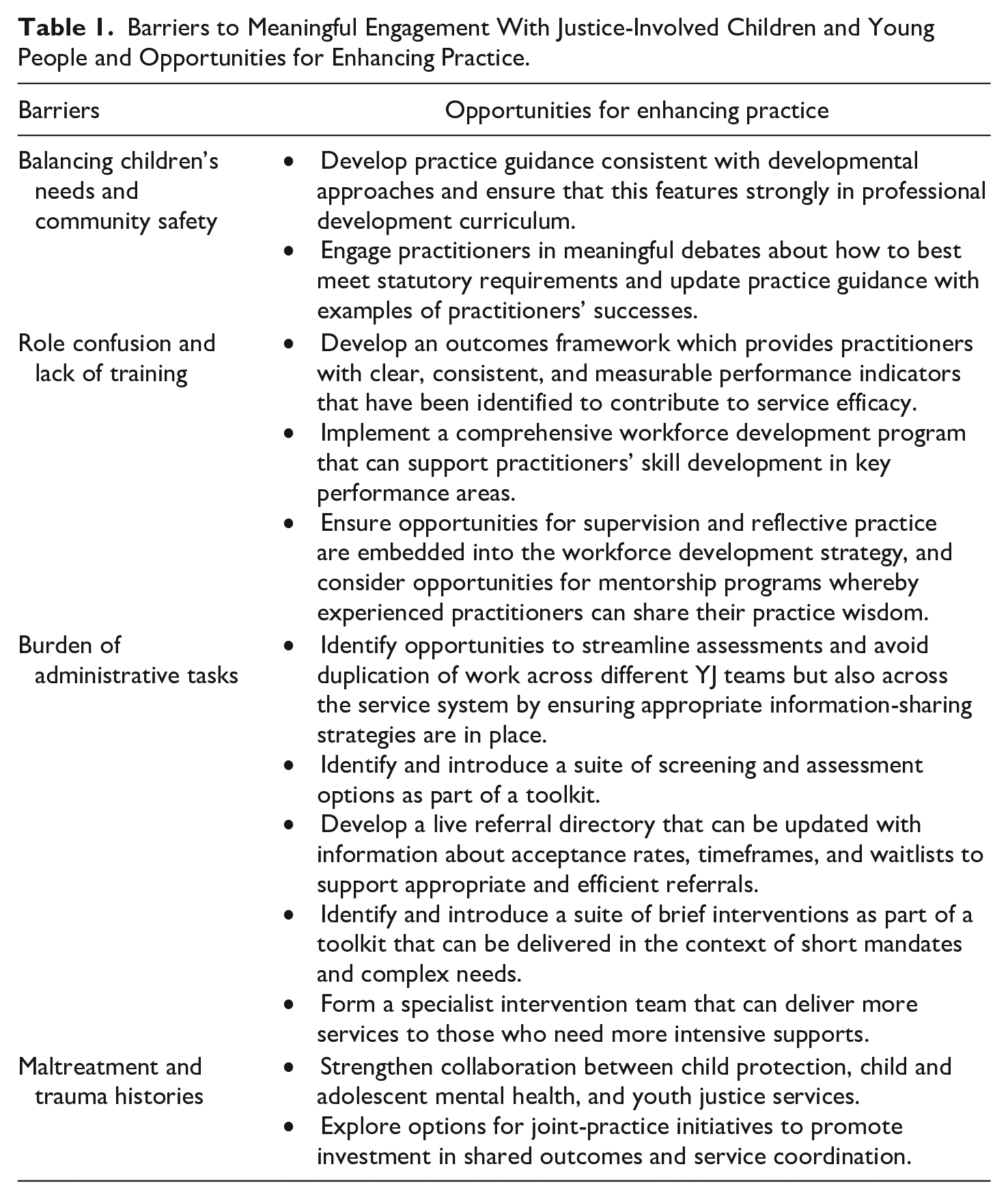
Despite the attention on the numerous barriers to meaningful engagement, it is important to also note that focus group participants provided many examples of ways to overcome these challenges, which we have summarized in Table 1.
Barriers to Meaningful Engagement With Justice-Involved Children and Young People and Opportunities for Enhancing Practice.
Discussion
Through a series of focus groups conducted with youth justice practitioners and case managers, the importance of engagement and rapport building was identified as the defining practice skill central to effective service delivery when working with justice-involved children and young people. This raises an important, broader question about what constitutes meaningful engagement and the extent to which this is necessary or sufficient in achieving the goals of a youth justice agency. But, as highlighted by the first thematic barrier identified through participants’ responses, the very purpose of youth justice is often contested (Malvaso, Day, McLachlan, et al., 2024; Monahan et al., 2015; Muncie, 2008). Smith and Gray (2019), in their examination of 34 strategic youth justice plans and documents across Youth Justice agencies in England, found that a number of practice models were operating in parallel, with evidence of limited consistency and of increasing diversity in the underpinning principles of practice. They concluded that, “practice is only realised on the basis of what practitioners believe to be legitimate, credible, achievable, effective and right in any given context” (p. 566).
One way to understand what the key theme of meaningful and effective engagement between youth justice practitioners and children and young people means in practice is with reference to the broad set of values that are set out in a trauma-informed approach (Malvaso, Day, & Boyd, 2024). These prioritize safety, trust, choice, collaboration, and empowerment, all of which can reasonably be expected to result in better levels of engagement. For example, engagement might result from building trust by being consistent and reliable, offering choice and flexibility in when and where supervision takes place, promoting collaboration in case plan development, and empowering children and young people to achieve their set goals. This approach to practice should help each child to feel safer in their interactions with government agencies, both physically and psychologically. But, working in a context of mandatory engagement and where there are adverse consequences for non-compliance presents several challenges. As highlighted by Hampson et al. (2024), an imbalance of power in the practitioner–child relationship can serve to stymie the development of genuine collaboration, resulting in limited opportunities for children to meaningfully exert influence over issues that are important to them. For Hampson and colleagues, collaboration encompasses a range of activities at different levels, from engagement, to participation, co-production and, finally, co-creation, with truly collaborative services incorporating activities from each level. This recognizes that some young people may not want to participate in a service, while others may desire a more active role. Furthermore, a trauma-informed approach to engagement emphasizes the need to be sensitive to the historical, cultural, and gender-related factors that impact children’s developmental pathways, which has been identified as critical to meaningful engagement when working with justice-involved children and young people (Cavanagh, 2022; Sullivan, 2019). This includes the need to engage and respond in ways that better recognize the specific personal and cultural impacts of trauma, including the personal, familial, and community-based cultural trauma, which is viewed as a key driver of First Nations over-representation in the justice system (Day et al., 2023).
A range of enablers of effective engagement have now been identified, including autonomy, choice, control, information and resource provision, support, voice, trust, and positivity (Smithson, Lang & Gray, 2022). Other work has focused on the inherent qualities of practitioners who work with hard-to-reach populations, including positivity, respect, empathy, responsiveness, persistence, flexibility, consistency, and being future-oriented (Blakemore et al., 2019; Gursansky et al., 2012; Klassman et al., 2024; Malvaso et al., 2016; Marfleet et al., 2013). From the perspective of the child or young person, the professional’s ability to listen to feedback has been identified as key to the development of trust and therapeutic alliance (De Boer et al., 2022). It has been proposed that one way for youth justice practitioners to contribute to improved outcomes for children and young people is by re-focusing their casework practice on listening to children, helping them to feel safe and to avoid re-traumatization, and working in ways that promote positive childhood experiences (Day & Malvaso, 2024).
Another key question that arises from this study is exactly what it is that we are asking children and young people to engage in or with. This study has highlighted the challenges faced by youth justice practitioners in terms of the provision of, or referral to, intervention options that can meet the complex health and social needs of justice-involved children and young people, particularly within the context of short court orders. There is also only limited evidence to guide decisions about the intensity or timing of criminogenic treatments required at different stages of court orders (Day et al., 2019), with some studies involving adults suggesting that an excess of 200 or more hours of treatment is required to expect substantial reductions in recidivism (Sperber et al., 2013). Given the significant challenges that practitioners described in their efforts to facilitate engagement (some suggested they had difficulty seeing their clients even once every month), it is difficult to imagine how it could be possible to provide the level of intervention intensity required. From the perspective of facilitating meaningful engagement, focusing less on surveillance and compliance—which perpetuate relationships that are brief, transactional, and impersonal—and more on addressing needs has the potential to positively impact the practitioner–child relationship. This may also lead to greater inter-agency collaboration, which, in turn, has been shown to lead to better decision-making through increased information sharing, a reduction in the duplication of services, and a strengthening of interprofessional relationships and trust (De Boer et al., 2022; Klassman et al., 2024; Malvaso et al., 2018; Woldgabreal et al., 2014; Zuchowski et al., 2020).
It is important to note that simply bringing services together does not automatically translate into investment in shared outcomes for children and young people or to authentic engagement. In addition, the existence of coordinated service responses does not necessarily promote the inclusion of the views of children. Therefore, investing in co-production and participatory approaches is likely to be fundamental to ensuring that the views and aspirations of children and young people being “managed” are embedded into service delivery priorities (Day et al., 2023). Further to this, utilizing qualitative indicators informed by children’s perspectives to measure service performance can not only help to guide practitioners in their day-to-day practice but also to support an understanding of the impact of engagement on broader service-level outcomes. And while frontline staff are key to any continuous improvement initiatives, it is widely recognized that there are likely to be a number of obstacles to the implementation of change in practice (Sullivan, 2019) that ultimately hinge on questions of feasibility, cost, and effectiveness (Welsh et al., 2013).
Focus group research is vulnerable to limitations such as hesitancy to share honestly in a group setting or peer pressure; however, this was mitigated to some extent by the large number of participants and by the way in which the researchers attempted to promote discussion in the sessions (e.g., by inviting all participants at the conclusion of the interviews to offer one suggestion to improve case management in the future). A specific limitation of this study was the lack of capacity to identify those themes that are more or less salient for different cohorts of youth justice case managers and practitioners, such as those of different ages, genders, and experience with the system.
In conclusion, this study highlights the importance of engaging with, and listening to, the perceptions and views of frontline youth justice practitioners in understanding the current and future directions of youth justice practice. It helps to demonstrate the value of eliciting firsthand, practice-based evidence that can contribute to the development of strategies to promote and overcome barriers to meaningful engagement, as well as ways to enhance practice. While most of the barriers identified in this study are far from new (see Trotter, 1999), they point to the ongoing need to think differently about identifying new and effective ways of engaging with justice-involved children and young people. While a strong focus on increasing training opportunities was noted by participants in this study, the effective implementation of staff development through training alone is not guaranteed; workforce culture, staff perceptions, values, and professional focus as well as leadership style have all been identified as factors that act as either barriers or facilitators to successful implementation (Viglione & Labrecque, 2021).
Footnotes
Acknowledgements
The authors acknowledge the generosity and willingness of youth justice practitioners in sharing their views and experiences with the research team. The views presented do not necessarily reflect those of the government agency.
Declaration of Conflicting Interests
The author(s) declared no potential conflicts of interest with respect to the research, authorship, and/or publication of this article.
Funding
The author(s) disclosed receipt of the following financial support for the research, authorship, and/or publication of this article: This study was supported by funding from Youth Justice and Exceptional Needs, Department of Human Services, South Australia, Australia.