




Abstract
Firearms are used in around 25% of homicides in Europe. More so than other weapons commonly used in violent encounters, firearms have the ability to inflict lethal injuries. Yet, theoretical approaches to understanding the impact of firearms on the prevalence, lethality, and nature of violent encounters are scarce and have been developed almost exclusively within and for the context of the United States, where the levels of firearm violence and firearm availability are much higher than in Europe, limiting their applicability to the European context. To address this issue, European empirical data are reviewed in this paper to critically assess the few existing theoretical approaches focusing on the use of firearms in lethal and non-lethal violence. Based on the obtained findings, future directions for empirical research, as well as suggestions for new conceptualizations of firearm violence in Europe are presented.
Firearm Homicide in Europe
Compared with other global regions, the firearm homicide rate in Europe is low. According to the available crime statistics, the European firearm homicide rate has been declining steadily in recent years and is estimated at 0.3 per 100,000 inhabitants, whereas the global average is 3.1 (see Figure 1, United Nations Office on Drugs and Crime [UNODC], 2023). Moreover, in Europe, only 20% of homicides involve a firearm, while more than 50% of all homicides globally are committed with a firearm. Regardless of these relatively low statistics, around 1,000 lives are taken by firearms annually in Europe, and the European Commission (2020) highlights the significant role of firearms in (violent) crimes, including “domestic violence that may escalate into homicide . . . terrorism, illicit drugs trafficking, trafficking of human beings, smuggling of migrants, maritime piracy, counterfeiting, environmental crime, or organized property crime” (p. 14).
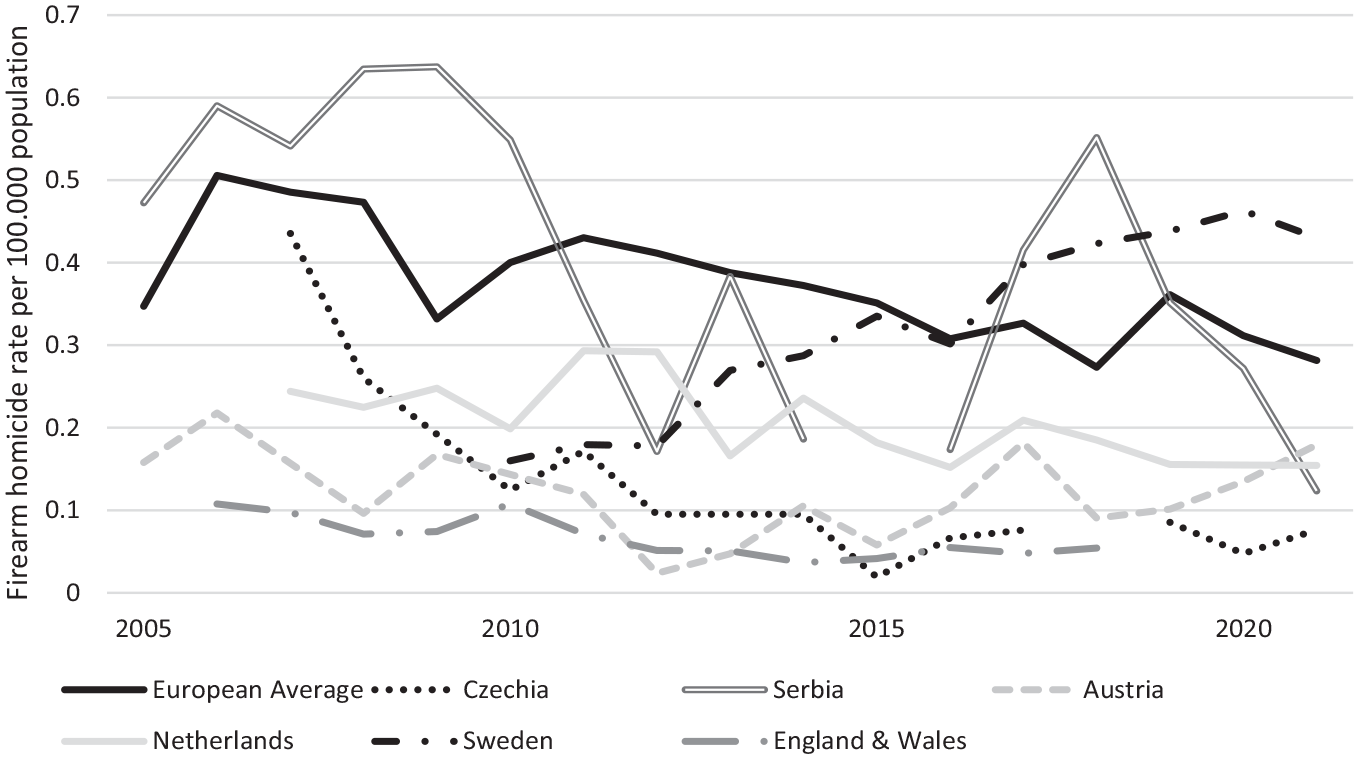
Firearm homicide rate 2005 to 2021 in selected European countries and the European average (UNODC, 2023).
What makes firearms stand out compared with other weapons commonly used in homicides, such as knives, is their lethality as well as their ability to inflict injury from a distance. Already in 1967, Zimring established that firearm assaults in Chicago were five times as lethal as knife assaults. His study was seminal in the criminological field and, since then, both criminological and medical studies have yielded support for its findings in the United States as well as other regions across the globe such as Europe (Braga et al., 2021; Khoshnood et al., 2017).
The high lethality of firearms, their prevalence in European homicides, and their role in (violent) crimes overall warrant a closer look at the impact of firearms on the prevalence and nature of (lethal) violence. However, the use of weapons in homicide in general and firearms specifically is largely understudied in the European context. In particular, theoretical and conceptual approaches to the understanding of firearm use in homicides are rarely directly assessed using European empirical data, with most studies on firearm homicides remaining descriptive in nature. Furthermore, the few approaches originating from the United States—a context with significantly higher levels of homicide as well as firearm availability (Karp, 2018)—are not tested for their applicability to the European context. Thus, both empirical and theoretical gaps exist, prompting this study.
To address the current theoretical gaps in knowledge, in this work, two sets of relevant theoretical approaches originating from the United States are critically reviewed using European empirical data. Namely, the Weapon Lethality Hypothesis and the Weapon Facilitation Hypothesis are employed to address the impact of the use of firearms on the prevalence of homicide, whereas the Adversary Effects Hypothesis and the Physical Strength Hypothesis focus on the nature of homicide. In examining their relevance in the European context, the aim is to elucidate what is known and what needs to be known about firearm homicides to guide future research.
The Impact of Firearms on the Prevalence of Homicide
The first set of theoretical approaches addresses the impact of firearms on the prevalence of violence and, in particular, homicide rates. Specifically, the two aforementioned hypotheses argue that an increase in the availability of firearms leads to an increase in levels of lethal violence, albeit from two different argumentative standpoints. The Weapon Lethality Hypothesis posits an increase in homicide rate due to the firearm’s lethality, whereby greater availability of firearms may lead to an increase in their use in assaults and the resulting fatalities, both intended and unintended (Zimring, 1967). On the contrary, Altheimer and Boswell’s (2012) interpretation of the Weapon Facilitation Hypothesis purports that the firearm’s lethality and power it provides may encourage a perpetrator to commit a violent (lethal) crime they would otherwise not have committed, for example, to avoid a physical encounter with the victim. As a result, the authors argue that the number of potential perpetrators increases, which in return should lead to an increase in firearm homicides and homicides overall.
In contrast, the Deterrence Hypothesis (Kleck, 1988) postulates that widespread availability of firearms may lead to a decrease in (lethal) violence, as perpetrators would refrain from using violence when confronted with a victim who may also carry a firearm. In a similar vein, according to the Weapon Substitution Hypothesis, the lethal intent of a motivated offender—rather than the availability of a particular weapon—determines the outcome for the victim (Wolfgang, 1958). Thus, the non-availability of a firearm would not change the lethal outcome of a violent assault, as the perpetrator would choose another weapon or modus operandi. The association between firearm availability and homicide rate has been extensively studied in the U.S. context, and the findings largely indicate that higher availability of firearms is associated with higher homicide rates, on the national, regional, and local levels (for an overview of these studies, see Hepburn & Hemenway, 2004).
The empirical evidence for a positive correlation between firearm availability and homicide rate in Europe is not as straightforward and is at times contradicting. First, there are only a few studies as a part of which the relation between firearm availability and homicide rates was empirically tested, as indicated by a recent systematic review (Krüsselmann et al., 2021b). Some international comparative studies have also included European countries. The overall results show weak support for a higher availability of firearms leading to an increase in the overall homicide rate, as correlations remained statistically non-significant once outliers, such as the United States, were removed (Hemenway & Miller, 2000; Hemenway et al., 2002; Killias, 1993).
Only a few studies so far have focused exclusively on Europe, and their findings are inconsistent. For example, according to a 2015 report issued by the Flemish Peace Institute, the correlation between firearm ownership and the overall homicide rate is not supported by the available evidence (Duquet & van Alstein, 2015). In contrast, findings published by the UNODC (2019) indicate that higher estimated levels of civilian-held firearms are associated with higher levels of firearm homicides and overall levels of homicides. These differing results are contradicted even further by an earlier study conducted by Altheimer and Boswell (2012) that focused exclusively on Eastern European countries 1 , where greater firearm availability was associated with lower firearm homicide and overall homicide rates. Some of the differences in these findings may be explained by the use of data from varying sources and years, yet an examination of the most recent available information on homicide rates from the UNODC and estimations of civilian firearm ownership (Karp, 2018) do not show a clear association either (see Figure 2). Thus, there seems to be no consensus regarding the direct association between firearm availability and homicide rates.
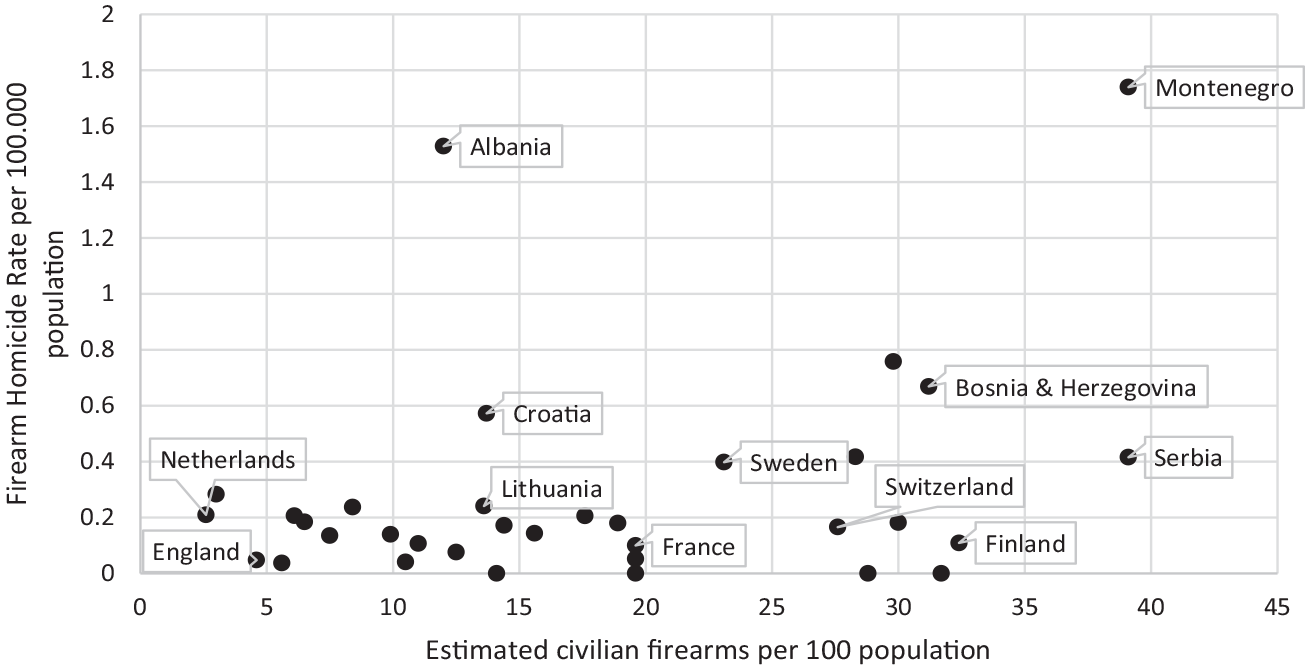
Scatterplot of most recent available firearm homicide rates per 100,000 population (UNODC, 2023) and the estimated number of civilian-owned firearms per 100 individuals (Karp, 2018).
Another approach that can be used to test whether firearm availability impacts the prevalence of violence involves assessing the impact of policy or other regulations that limit availability. The few available studies from the European context in which this strategy was adopted show a slightly different picture in that restrictive policies were followed by a decrease in firearm violence. For example, in Austria, the implementation of the EU Firearm Directive in 1997 resulted in more restrictive legislation for the legal ownership of long guns in particular. Analyses of the firearm homicide trends in the subsequent period revealed a decrease, which was later stalled and reversed by the economic crisis in 2008 (Kapusta et al., 2007; König et al., 2018). More recently, Hurka and Knill (2020) developed an index of firearm policy restrictiveness, which is an aggregate measure based on three factors: a country’s general paradigms toward firearm policies (prohibition vs. privilege vs. permission), individual requirements for gun owners (such as health checks), and general safe storage requirements. Sixteen European countries 2 were assigned a rank on this index and time series cross-sectional analyses across these countries revealed an association between high firearm policy restrictiveness and lower levels of firearm homicide.
In sum, the few empirical studies on the association between firearm availability and homicide in Europe do not support the Weapon Lethality Hypothesis or Altheimer and Boswell’s interpretation of the Weapon Facilitation Hypothesis. At the same time, due to the contradicting findings, there is equally little support for the Deterrence Hypothesis, as no association between higher firearm availability and lower homicide rates was found in any of the relevant European studies.
The Impact of Firearms on the Nature of Homicide
A second set of theoretical approaches addresses the impact that firearms—or weapons more generally—have on the nature of homicide and violent encounters. The pertinent hypotheses are concerned with determining who uses firearms for what reason, in what context, and against whom. They further explore to what extent that differs from violence by other means. Overall, these hypotheses argue that, due to their high lethality, firearms are used by specific types of perpetrators, against specific types of victims, and in specific contexts.
With regard to the types of firearm homicide perpetrators, the Physical Strength Hypothesis (Heide, 1993; Wolfgang, 1958) argues that a firearm equalizes or overturns power imbalances between the perpetrator and the victim that may exist due to their physical strength. Thus, in violent encounters with a physically stronger opponent, the perpetrator may resort to a firearm for its ability to inflict potentially lethal harm without necessitating physical contact with the victim. Due to the lack of detailed data on the physical differences between perpetrators and victims, the Physical Strength Hypothesis is often operationalized with somewhat arbitrary categories of age and gender differences and has been mainly tested in research on parricides, the killing of parents. Based on homicide data from the United States, Heide (1993) found that male (step)parents were more likely to be killed with a firearm compared with female (step)parents and that juvenile perpetrators were more likely to use a firearm than adult perpetrators. The importance of gender, as well as age difference between perpetrators and victims in relation to weapon use, was also supported in later research on female-perpetrated homicides (Chan & Frei, 2013) and sexual homicides (Chan et al., 2019; Chan & Heide, 2008). However, whether the firearm has explicitly been chosen to overcome physical differences and thus mitigate the perceived power imbalance has not been directly empirically tested.
The Adversary Effects Hypothesis suggests that certain victim and situational characteristics motivate the offender to use a firearm instead of a less lethal weapon, such as a knife, or no weapon at all (Felson & Hullenaar, 2021). Specifically, the firearm’s lethality ensures that the perpetrator can either prevent or fend off a counterattack or retaliation by the victim, either at the moment of the violent encounter or at a later point in time. Thus, according to this hypothesis, more lethal weapons are used in violent encounters in which the victim’s characteristics are threatening to the perpetrator. This may include the physical power of the victim, but also other aspects, such as the victim’s violent history. From this perspective, several “adverse” factors associated with firearm use in homicides have been identified in the U.S. literature, including the victim being male (Fox & Allen, 2014), a young adult (Libby, 2009), or a person known to have a violent or criminal history (Pelletier & Pizarro, 2019). In addition to the victim characteristics, a number of situational circumstances at the time of the violent encounter may appear equally detrimental to the perpetrator, such as the type of location or intoxication (Libby, 2009).
The context of weapon use is also addressed in the Weapon Facilitation Hypothesis developed by Felson and Messner (1996). These authors argue that the more lethal weapons should be found in violent encounters in which the perpetrator has the intention to harm the victim, as opposed to the death being a byproduct of an altercation. They found support for this idea in their own data, which shows that the use of firearms (and knives) in lethal assaults committed in the United States is associated more strongly with “pure assaults” when compared with robberies, in which the perpetrator’s main goal may not be to inflict harm but to enforce victim cooperation.
The Nature of Firearm Homicides in Europe—Victims
Thus far, the applicability of these theoretical approaches has rarely been tested in the European context (Krüsselmann, Aarten, & Liem, 2023; Liettu et al., 2012). Nonetheless, information on the victims, perpetrators, and contexts of firearm homicides derived from descriptive studies may allow for cautionary conclusions.
Based on the Physical Strength Hypothesis and the Adversary Effects Hypothesis and the findings obtained in the U.S. studies, one would expect firearm homicide victims to be mainly physically stronger than the victim, mainly male, of a young age, possibly with a criminal history or criminal group membership, or having other characteristics that may seem threatening to the perpetrator. To an extent, these expectations are met in the European context, as most victims of firearm homicides are male, disproportionally so when compared with the victims of homicides committed by other means. Mortality and crime data suggest that on average about 80% of all firearm homicide victims in Europe are men, with the majority of European countries falling within or above this average (Duquet & vanden Auweele, 2021; Krüsselmann, Aarten, Granath, et al., 2023; South Eastern and Eastern Europe Clearinghouse for the Control of Small Arms and Light Weapons [SEESAC], 2023). In addition, several studies and reports describe firearm violence—often measured as firearm homicide—victims as young men below the age of 40 (Copic & Dokmanovic, 2021; De Labbey et al., 2021; Sturup et al., 2019). One may expect victims at this age to be physically stronger than those of more senior age, thus confirming the Physical Strength Hypothesis.
However, not all available information on firearm homicide victims aligns with the expectations. In some countries—such as Austria, Belgium, Slovenia, and Switzerland—the proportion of female firearm homicide victims is significantly higher than the European average (Krüsselmann, Aarten, Granath, et al., 2023). Similarly, in some countries, firearm homicide victims are not particularly young or even younger than victims of homicides committed by other means (Duquet & vanden Auweele, 2021; Krüsselmann, Aarten, Granath, et al., 2023). In addition, the findings reported by Krüsselmann, Aarten, & Liem (2023) who conducted their study in the Netherlands aiming to test the Adversary Effects Hypothesis suggest no significant effect of the victim’s criminal history on the use of a lethal firearm in homicide compared with other weapons.
The Nature of Firearm Homicides in Europe—Perpetrators
While victim characteristics may influence which weapon is used during a lethal violent encounter, this choice is ultimately made by the perpetrators. Based on the Physical Strength Hypothesis, one would expect firearm homicide perpetrators to be physically equal or inferior to their victims. With physical inferiority being difficult to assess in empirical studies, age and gender have been used as proxies with the assumption that female perpetrators and perpetrators who are either relatively young or relatively old may be physically weaker than an adult male. Thus, firearm homicides should involve more female and relatively young and old perpetrators compared with homicides committed by other means.
However, European data do not fully support these assumptions. The Physical Strength Hypothesis has thus far been tested in only two studies, whereby Liettu et al. (2012) found support for the notion that younger perpetrators of parricides are more likely to use a firearm, whereas Sahin et al. (2016) noted no significant difference with regard to the perpetrator’s gender. Other descriptive studies do not align with the expectations either. With respect to the perpetrator’s gender, the disproportionate involvement of male perpetrators in firearm homicides is frequently noted (Copic & Dokmanovic, 2021; Khoshnood et al., 2020). For example, in Finland, the Netherlands, Sweden, and Switzerland, more than 95% of firearm homicides involve male perpetrators compared with 86% to 90% of non-firearm homicides (Krüsselmann, Aarten, Granath, et al., 2023). These findings counter the assumption that female perpetrators should give precedence to lethal firearms over less lethal weapons during a violent altercation. In addition, even though the age of firearm homicide perpetrators differs across national reports and studies, the involvement of young (but not elderly) male perpetrators is commonly noted, yielding limited support for this hypothesis (Hradilova-Selin et al., 2024; Krüsselmann, Aarten, Granath, et al., 2023; Sturup et al., 2019). Thus, overall, the Physical Strength Hypothesis is not fully supported by European data.
The Nature of Firearm Homicides in Europe—Context
Finally, firearms may be used in very specific contexts. To reiterate, according to Felson and Messner’s (1996) Weapon Facilitation Hypothesis, firearm use should be registered more commonly in homicides in which the perpetrator’s intention was to harm the victim instead of forcing compliance, as is common in robberies and sexual homicides.
Very few European empirical studies include detailed information about the context of firearm homicides and the reported findings do not show a homogeneous picture. In some countries, such as Finland or Switzerland, firearm use tends to be more common in domestic homicides, whereas, in other countries, such as Sweden, firearms are most common in criminal milieu activities, for example, organized crime conflicts or drug-related activities (Krüsselmann, Aarten, Granath, et al., 2023; Sturup et al., 2018). However, a commonality across various European countries is the low percentage of firearm homicides in the context of robberies or sexual crimes (Chlebowicz et al., 2021; Hermoso et al., 2019; Krüsselmann, Aarten, Granath, et al., 2023). Homicides committed in the context of robberies only account for about 1% to 9% of firearm homicides across European countries, and the use of firearms in the context of sexual homicides is even rarer, with many countries recoding no such instances, including Denmark, Switzerland, and Spain (Chlebowicz et al., 2021; Hermoso et al., 2019; Krüsselmann, Aarten, Granath, et al., 2023). At the same time, categories of firearm homicide contexts that may reflect “pure assaults” show higher percentages, with 32.5% of all firearm homicides in Spain being categorized as related to motives of revenge, and around 50% of firearm homicides in the Netherlands and Sweden are connected to the criminal milieu activities, such as targeted assassinations or rip deals (Krüsselmann, Aarten, Granath, et al., 2023).
Overall, these findings support Felson and Messner’s notion that firearms make it easier for a motivated perpetrator to kill their victim, thus making the use of firearms more prevalent in contexts in which the perpetrator may have intended to commit murder. Yet, it must be noted that the perpetrator’s intent has not been measured in any of the studies discussed above.
Firearm Homicides in Europe: Where Do We Stand? What Do We Know?
In the previous paragraphs, several theoretical approaches to the study of firearm use in homicides were reviewed and their applicability to the European empirical data was assessed. The findings suggest that none of the existing theoretical approaches can adequately explain the impact of firearms on the prevalence and nature of lethal violence in Europe. The link between firearm availability and prevalence of (firearm) homicide is not as straightforward as suggested by the Weapon Lethality Hypothesis and Altheimer and Boswell’s interpretation of the Weapon Facilitation Hypothesis. Furthermore, the Physical Strength Hypothesis, Weapon Facilitation Hypothesis, and Adversary Effects Hypothesis postulate that firearms are more likely to be used by perpetrators who require the most lethal type of weapon in order to overcome their physical inferiority to the victim or other factors preventing successful attack. Yet, firearm homicides in Europe do not share specific characteristics across countries that would all meet these expectations. What may explain the limited applicability of these theoretical approaches to the European context?
This conclusion may be driven by the fallacy of the assumption of weapon availability underlying the previously discussed hypotheses (see also Krüsselmann, Aarten, & Liem, 2023). Firearms in Europe are not generally available to civilians due to strict legislation. For comparison, the Small Arms Survey estimates 1.2 legal and illegal firearms per capita in the United States (Karp, 2018). For European countries, this estimate ranges between 39 firearms per 100 individuals in Montenegro and Serbia to 2.5 in Poland, Romania, and the Netherlands. Killias and colleagues (2001) suggested that the limited firearm availability and thus relatively low number of firearm homicides and fractions of homicides committed with firearms in Europe may even be so low that the overall homicide rate in most European countries is not significantly impacted by changes in the firearm homicide rate. A recent study from Sweden seems to support this notion, with a rise in firearm homicides leading to the number of homicides committed with firearms surpassing that of homicides committed by other means, thus impacting the overall homicide rate (Hradilova-Selin et al., 2024). Hence, while the Physical Strength Hypothesis, Weapon Facilitation Hypothesis, and Adversary Effects Hypothesis are based on the premise that firearms are readily available, in Europe, this assumption cannot be made. Thus, although perpetrators may have the intent to harm their victim and are being confronted with a physically strong victim and other adverse situational circumstances, their choice of the most lethal weapon is bound by availability.
Another reason for the failure of the presented hypotheses to explain the firearm homicide prevalence and nature in Europe may lie in the heterogeneity of the phenomenon in this region. As the few comparative studies have shown, firearm homicides take on various forms and involve different types of victims and perpetrators, as well as different types of firearms (Duquet & vanden Auweele, 2021; Krüsselmann, Aarten, Granath, et al., 2023). This heterogeneity may again be explained by the varying degrees of firearm availability, but also differences in the traditions and attitudes toward firearm ownership and use. A survey of EU citizens revealed variations in the level of legal firearm ownership, as well as variations in the reasons for owning a firearm, indicating the prevalence of a hunting culture in some countries as opposed to mostly professional use or collection of firearms in others (Eurobarometer, 2013). Yet, the effect of these diverse stances toward firearms on the illegal use of firearms in violent encounters has seldom been considered or empirically tested in the criminological studies on firearms in Europe. Consequently, already established theoretical approaches may be able to explain the prevalence and nature of firearm homicides in some cultural contexts and countries, but not others.
Considering these factors, existing theoretical approaches should not be disregarded altogether, but their applicability to the European context as a whole or to firearm homicides on a national scale cannot be assumed. The question remains whether it is time for new conceptualizations and theoretical approaches to the research on firearm violence that are inclusive of a broader range of socio-political contexts beyond the United States. Although the evidence presented in this paper suggests that the existing approaches have proven mostly inadequate, it also prompts us to consider whether it is possible to establish conceptualizations that would appropriately address such a complex, heterogeneous phenomenon. Despite the growing number of European studies on firearm homicides and related subjects, such as the trafficking of firearms, current gaps in knowledge are too extensive for building a theoretical foundation. In other words, the research agenda on firearm violence in Europe is still in its infancy. To move toward a potentially new and improved theoretical approach to the investigation of firearm violence, further research is needed to build on the existing initiatives and advance them further.
Next Steps: How to Move Firearm Research in Europe Forward?
Much is left to be uncovered to fully understand the role of firearms—and weapons more generally—in violent encounters and to advance both empirical and theoretical approaches used in research on armed violence. Specifically, future investigations on this topic should (a) focus on establishing reliable data sources on firearm violence, (b) broaden the research scope to include non-lethal firearm violence, and (c) approach firearm violence from an interdisciplinary or multidisciplinary angle.
First, it is necessary to establish reliable, detailed, and comparative data sources that include relevant information on firearms and weapons more generally. Current data sources are too limited and are thus inadequate as a foundation for furthering firearm homicide research. Mortality statistics and crime statistics that include information on weapons, such as the WHO’s Mortality Database or UNODC’s data on intentional homicide, are often highly aggregated, outdated, incomplete, or focus on either victims or perpetrators, but rarely both (Duquet & vanden Auweele, 2021). The European Homicide Monitor allows for such cross-national comparisons and includes detailed information on victims, perpetrators, and modi operandi, but the ballistic information on the firearms used is scarce and is currently recorded in a limited number of countries (Liem et al., in press). Other databases, such as SEESAC’s Armed Violence Monitoring Platform or the Flemish Peace Institute’s Gun Violence Monitor, focus specifically on lethal and non-lethal firearm incidents but rely mainly on newspaper articles which may be deemed less reliable than non-public law enforcement or forensic data. To further our understanding of firearm violence on a European level in the future, the gathering of reliable and comparative data on violence that includes detailed information on weapons, including firearms, is necessary. One such data collection initiative is the Dutch Firearm Violence Monitor (Krüsselmann et al., 2021a), which is relatively recent and has not been adopted by other countries yet.
Second, although homicide is widely regarded as the most reliable violent crime indicator, authors of future investigations on this phenomenon should broaden the research scope and include non-lethal firearm violence in their analyses. At present, firearm homicides are used as a measure for firearm violence overall, yet whether lethal and non-lethal shootings share similar characteristics is underexplored both on the global scale and in the European context specifically. The few existing studies point to significant differences between lethal and non-lethal firearm violence (Duquet & vanden Auweele, 2021; Krüsselmann et al., 2024), which need to be accounted for in future investigations. In addition, as firearm homicides in Europe are rare, such low frequency may prevent proper analytical assessments (Killias et al., 2001). Thus, the inclusion of non-lethal firearm violence may open up new possibilities for the assessment of the existing hypotheses or the development of new theoretical conceptualizations of firearm violence.
Third, research on firearm violence requires a multi- or interdisciplinary approach. In the United States, researchers from diverse disciplines including criminology (Pelletier & Pizarro, 2019), sociology (Obert et al., 2018), anthropology (Springwood, 2007), and public health (Grommon & Rydberg, 2015) have contributed both empirically and conceptually to the better understanding of firearm violence. Combining these insights displays the variety of situational, medical, and forensic factors that impact the outcome and characteristics of shootings (Grommon & Rydberg, 2015). Similar multi-faceted approaches from a European point of view do not yet exist, although the insights gained from their adoption could be valuable. For example, qualitative approaches to understanding firearm ownership and use could add to the discussion on the extent to which a firearm’s lethality impacts the outcome of a shooting independent of the perpetrator’s intent (Phillips & Maume, 2007). Furthermore, qualitative studies could shed more light on the attitudes toward and practices on legal firearm use across Europe, explaining their impact on the illegal use of firearms in violent encounters. Hopefully, the recent increase in studies on firearm violence will continue and the research methodology will broaden to include various disciplinary methods, as well as approaches to and insights on firearm violence. Such a broad interdisciplinary strategy is also required when working toward advances in theoretical approaches to the study on firearm violence.
In sum, improved data availability and approaches from various disciplinary points of view should not just enhance our understanding of the prevalence and nature of firearm homicides but will also further the theoretical conceptualizations of this phenomenon. This improvement is needed, given that most of the currently utilized theoretical approaches focus on the causes and outcomes of violent encounters, aiming to ascertain how situational or social and structural determinants impact violent crimes. However, as Obert and colleagues (2018) eloquently asked: “But what of the guns themselves? What if guns are not merely the carriers of action, but also actors themselves? How might this affect our theories of the causes and consequences of violence?” (p. 33). At present, these questions cannot be answered due to the limited understanding of the modes of violence production. Thus, to move firearm homicide research in Europe forward, we need to take firearms seriously and explicitly focus on their use in violent encounters in future research efforts.
Footnotes
Acknowledgements
The author thanks Pauline Aarten and Mathijs Sanders Smello for their thoughtful feedback on earlier versions of this paper.
Declaration of Conflicting Interests
The author(s) declared no potential conflicts of interest with respect to the research, authorship, and/or publication of this article.
Funding
The author(s) received no financial support for the research, authorship, and/or publication of this article.