




Abstract
Over the past two decades, the study of terrorism has been increasingly integrated into mainstream criminology. Like other types of criminal behavior, terrorism can be divided into etiology (an emphasis on “breaking laws”) and criminal justice (an emphasis on “making laws” and “reacting toward the breaking of laws”). Moreover, like the study of crime, the study of terrorism is inherently multidisciplinary. Nevertheless, terrorism differs from more common forms of crime in fundamental ways: Terrorist perpetrators, unlike common criminals, rarely see themselves as criminal, often seek rather than eschew publicity, and often have broader political goals. Despite similarities and differences, we could identify little prior research that has directly compared the determinants of terrorism and more ordinary types of crime. In this article, we create large cross-national datasets on homicides and terrorist attacks and then compare the effects of a set of common economic, political, and social variables on each. We find a good deal of similarity in the determinants of the two types of violence. Both homicide and terrorism are more common in countries with high GDP, high percent urban, high ethnic fractionalization, and in countries moving toward democratization. Both homicide and terrorism are low in countries experiencing high globalization. Although homicides are more common in countries experiencing high levels of inequality and poverty, neither of these two variables is significantly associated with terrorist attacks. We discuss the implications of the findings for theory, policy, and future research.
Although research on political extremism and terrorism from criminology scholars began to appear in the late 1970s (Hamm, 1998; Kittrie, 1978; Smith, 1994; Turk, 1982), before the coordinated attacks of September 11, 2001, there was relatively little interest in these topics among criminologists. However, this situation began to change dramatically in the early 2000s. In fact, in a review of the major developments in criminology during the first two decades of the 20th century, a growing interest in research on terrorism and responses to terrorism qualifies as a major development (Chermak & Gruenewald, 2015; LaFree & Freilich, 2019; Lum & Kennedy, 2012). In the space of just 20 years, the study of terrorism and political extremism went from a relatively uncommon niche in criminology to a widely recognized criminological specialization.
As the study of terrorism and political extremism has become more common as a research topic in criminology, there have been a growing number of studies that compare the characteristics of terrorism to more ordinary types of crime (for a review, see LaFree, 2023). Rosenfeld (2004, p. 29) argues that “criminology offers distinctive insights into the nature of terrorist violence. . ..” However, he also points out that terrorism, unlike more ordinary crime, is not explained by common variables like economic deprivation. Black (2004, p. 9) applies his influential “self-help” theory of crime to argue that like other types of crime, terrorism relies on a form of self-help. He also notes that unlike other types of crime, terrorism “is unilateral self-help by organized civilians who covertly inflict mass violence on other civilians.” LaFree and Dugan (2004) conclude that terrorism resembles other types of crime in some ways (e.g., both disproportionately connected with young men; both depend on interdisciplinary approaches) but is also fundamentally different in other respects (e.g., terrorist perpetrators often see themselves as altruists and frequently seek public attention rather than avoid it). The authors also note areas where terrorism resembles some but not all types of crime. For example, terrorist attacks, like organized crime and crime committed by gangs, are often part of a sustained program of illegal violence and are frequently associated with an ongoing organizational structure.
Despite the growing interest in ways in which terrorism is similar to, or different from, other crimes, very little research has directly compared the determinants of terrorism to more common crimes like homicide. In fact, the only published research we could identify that directly examines both cross-national rates of terrorism and homicide is a recent study by Kamprad and Liem (2021). Based on an analysis of homicide and terrorism-related fatalities for 165 countries over a 24-year period, the authors find strong correlations between a set of common covariates and homicides but relatively weak correlations between the covariates and terrorism-related fatalities. However, the Kamprad and Liem article focuses not on differences in the determinants of homicide and terrorism but rather on whether terrorism-related fatalities are a significant predictor of cross-national homicide rates. Their empirical comparison of homicide and terrorism-related fatalities is limited to bivariate correlations and is excluded from their multivariate analysis.
The purpose of this article is to provide what we believe to be the first direct empirical comparison of the cross-national determinants of homicides and terrorist attacks for a large sample of countries. To develop a robust set of covariates, we rely on past research from both the homicide and the terrorism research literature. Our article proceeds in four sections. First, we develop a set of hypotheses for determinants of homicides and terrorist attacks. Second, we describe the data, variables, and methods we used to compare homicides and terrorist attacks. Third, we present the results of our analyses. Finally, we conclude with the implications of the article for theory, future research, and social policy.
Prior Research and Hypotheses
To derive a set of theoretically informed hypotheses about the worldwide determinants of crime and terrorism, we begin with a review of the cross-national literature on both topics. We relied especially on reviews of prior research on cross-national crime (Baumer & Wolff, 2014; Koeppel et al., 2015; LaFree, 1999; Nivette, 2011; Pridemore & Trent, 2010; Stamatel, 2006) and cross-national terrorist attacks (LaFree & Ackerman, 2009; LaFree & Schwarzenbach, 2021; Wolfowicz et al., 2020). Based on the assumption that compared with other crimes, homicides are more likely to be reported to police, police are more likely to record them, and criminal justice systems devote more resources to solving them (Aebi, 2010; Eisner, 2008; LaFree & Jiang, 2022), we use homicides as our crime measure. Following LaFree et al. (2014, p. 13), we define terrorist attacks as “the threatened or actual use of illegal force and violence by non-state actors to attain a political, economic, religious, or social goal through fear, coercion or intimidation.” We group our hypotheses about the determinants of homicide and terrorist attacks into four theoretical categories, described below.
Modernization/Social Disorganization
Modernization/social disorganization perspectives are likely the earliest and consequently most common theoretical avenue explored in cross-national literature on homicide (Koeppel et al., 2015; LaFree, 1999; Nivette, 2011) and are also a common theoretical justification for the study of terrorist attacks (Freytag et al., 2011; Morris & LaFree, 2016; Sandler, 2014). These perspectives encompass a wide range of distinct, yet related concepts, including social disorganization (Davies, 1962; Smelser, 2011), anomie (Messner et al., 2013; Messner & Rosenfeld, 2012; Savolainen, 2000), breakdown (Tilly et al., 1975; Useem, 1985), and strain (Agnew et al., 2002; Broidy, 2001). Modernization/social disorganization perspectives can be traced back to Durkheim’s (1893) assessment of the transition to a modern industrial society, which predicts that as traditional social patterns are disrupted, methods of social control become less effective and are accompanied by increases in criminal behavior, including homicide and terrorism. Modernization theorists (Austin & Kim, 1999; Howard & Smith, 2003) argue that the shift from agricultural to industrial labor, advances in technology and communication, increases in access to education, and a breakdown in traditional community social structures are evidence of modernization. To examine the differential impact of this broad theoretical perspective on homicides and terrorist attacks, we look at the effects of four variables: economic development, urbanization, ethnic fractionalization, and percent young.
Economic Development
Economic development, usually operationalized as GDP or GNP, has been a common measure in both studies of homicide (Messner et al., 2010; Pridemore, 2008) and terrorism (Fahey et al., 2012; Meierrieks & Gries, 2012), and for both, results have been inconsistent. Nivette’s (2011, p. 117) review of connections between GDP and homicide acknowledges that it “has been a long-standing interest in cross-national research” but characterizes it as “a weak predictor at best. . ..” Findings from several studies show that countries with high economic growth and strong welfare measures experience fewer terrorist attacks (Choi, 2015; Krieger & Meierrieks, 2019). However, several studies (Bennett, 1991; Ortega et al., 1992) find that homicide rates increase along with GNP or GDP. Moreover, in a study of 12 West European countries (1994–2007), Caruso and Schneider (2011) find that expected future economic growth is associated with an increase in current terrorist activity. Although the results are not entirely consistent, we follow the modernization/social disorganization perspective and hypothesize that:
Urbanization
A classic criminology study by Burgess (2015) argues that inner-city urban areas continuously expand and consequently produce “zones in transition” that are characterized by high rates of poverty, rapid population growth, transiency, and population heterogeneity. Shaw and McKay (1942) argue that these zones are socially disorganized, lacking the ability to develop and maintain effective neighborhood-level crime control. Similarly, terrorism researchers (Mousseau, 2011; Savitch & Ardashev, 2001) point out that urban areas are prime targets for terrorist attacks because they provide perpetrators with valuable or high-profile targets.
Examinations of the relationship between homicide and urbanism, usually measured by population size or density, have yielded mixed results (Koeppel et al., 2015; LaFree, 1999). For example, McCall and Nieuwbeerta (2007) report a significant positive relationship between urbanism and homicide rates in European cities. By contrast, Alshuwaikhat and Garba (1997) find no significant effects of urbanism on homicide. Pridemore and Trent’s (2010) review of cross-national homicide studies concludes that of 20 studies that examine the impact of population size on homicide, 2 resulted in a positive association, 6 resulted in a negative association, and 12 found that the relationship was insignificant. However, there is somewhat stronger evidence for a connection between urbanism and terrorist attacks. Several studies reveal a significant relationship between a high percentage of urban residents and the number of terrorist attacks (Fahey & LaFree, 2015; Freytag et al., 2011; Gassebner & Luechinger, 2011). Again, following the modernization perspective, we hypothesize that:
Ethnic Fractionalization
Proponents of modernization/social disorganization perspectives argue that high ethnic diversity reduces a community’s ability to organize itself and create the social controls necessary to deter crime. Likewise, these perspectives maintain that fractionalization leads to more terrorist attacks by increasing ethnic or cultural conflict. Support for the impact of fractionalization on homicide and terrorism is mixed yet leans toward a positive relationship (LaFree & Schwarzenbach, 2021; Trent & Pridemore, 2012). For example, Cole and Gramajo (2009) found a significant positive relationship between a nation’s ethno-linguistic fractionalization and homicide rates. Likewise, Python et al. (2017) conclude that areas with high levels of ethnic polarization experience more terrorist attacks. Considering these results and the modernization perspective, we offer the following hypothesis:
Youth Population
Hirschi and Gottfredson (1983) introduce the concept of the age-crime curve to argue that individuals are most delinquent in late adolescence and early adulthood. This argument has generally been supported in criminology literature (Farrington, 2003; Marvell & Moody, 1991; Sweeten et al., 2013). In addition, there is strong evidence that youth are more susceptible than others to recruitment into terrorist groups (Klausen et al., 2016; Pyrooz et al., 2017). For example, Pape (2006) found that the average age of offenders in his study of suicide terrorists ranged from a low of 21.1 years for the Lebanese Hezbollah to 29.8 years for Chechens. We thus hypothesize that:
Economic Stress
Closely related to modernization perspectives is the argument that crime and political violence result from the stress caused by economic hardship. These arguments have been made both by researchers studying homicide (Pridemore, 2011; Williams, 1984) and terrorism (Choi, 2015; Krieger & Meierrieks, 2019). For both groups, economic stress perspectives can be divided into those based on either absolute or relative deprivation.
Absolute Deprivation
A link between poverty and homicide is a consistent finding in most criminological research (Pratt & Cullen, 2005; Pridemore, 2002, 2008) stemming from the idea that resource deprivation causes frustration, which ultimately leads to aggression (Hsieh & Pugh, 1993). The relationship between poverty and homicide is generally supported by the literature (Koeppel et al., 2015; LaFree, 1999, p. 199). For example, McCall and Nieuwbeerta’s (2007) cross-national comparison of European cities reveals that the cities’ deprivation, measured by the percentage of single-parent families, households on social security, households below the national mean income, and median household income, is a strong predictor of homicide rates. By contrast, prior research reveals little support for the effect of poverty on terrorism (Jager, 2018). For example, Abadie (2006) examines the relationship between country-level terrorist risk and economic variables and finds that terrorist attacks are not significantly related to the country’s poverty level. Sageman (2004)’s study of al-Qaida supporters reveals that the majority of them come from financially stable backgrounds. LaFree and Bersani (2014) find that terrorist attacks are less common in U.S. counties with high levels of concentrated economic disadvantage. We thus offer the following hypothesis:
Relative Deprivation
In Merton’s (1938) classic formulation, relative deprivation stems from blocked opportunities to achieve prescribed cultural goals which cause individual frustration and aggression and leads to criminal and deviant behavior including homicide (Chamlin & Cochran, 2006; Nivette, 2011). This societal imbalance is most often conceptualized by disparities in the distribution of wealth. According to this reasoning, when individuals become frustrated with perceived inequality, they are more likely to participate in protests and violence. Economic inequality is thus commonly used to explain rates of violent acts like homicide and terrorism. The relationship between economic inequality and homicides has “emerged with remarkable consistency” (Messner & Rosenfeld, 1997, p. 1394). However, support for the impact of income inequality is not as consistent in the terrorism literature. Gries et al. (2011) assess the link between domestic terrorism and economic growth in West European countries and find that economic success significantly reduces terrorist violence in only three out of the seven countries included in the sample. Piazza (2006) finds no support for a relationship between economic inequality and terrorism. Based on the relatively strong evidence for the effect of inequality on homicide and the more inconsistent evidence for the effect of inequality on terrorism, we pose the following hypothesis:
Strength of Democracy
The strength of democracy is used frequently to predict country-level terrorist attacks but is relatively uncommon as an independent variable in the homicide literature. An exception is LaFree and Tseloni (2006) who analyze homicide trends in 43 nations and find that during the second half of the 20th-century homicide rates gradually increased for countries transitioning to full democracies. A good deal of research has investigated the extent to which regime type and level of democratization of a country correlate with terrorist attacks (Gaibulloev et al., 2017; Wilson & Piazza, 2013). These studies operationalize country-level democracy in different ways but generally account for some or all of the following elements: electoral processes, civil and political freedoms, levels of political participation, and competition. Despite the fact that the connection between democracy and terrorism has been analyzed frequently, the true effect of democracy on terrorist attacks remains uncertain. Research has suggested both positive (Bell, 2017; Wilson & Piazza, 2013) and negative relationships (Masters & Hoen, 2012; Simpson, 2014) between measures of democracy and terrorism, with some studies finding no link between the two (Piazza, 2008). Although the results are not entirely consistent, we propose the following hypothesis as a way of exploring these issues:
Globalization
As with the transition to democracy, globalization has more commonly been linked to terrorist attacks than homicide rates. However, Levchak (2015) finds partial support for some forms of globalization on homicide, and LaFree and Jiang (2022) find strong support for the conclusion that as worldwide globalization increases (measured as trade openness), homicide declines. Bryan and Farrel (1996) claim that globalization reduces terrorism by increasing prosperity and the flow of technology and capital from developed to developing countries. Friedman (2006) argues that by connecting world knowledge into a single global network, globalization reduces terrorist threats. Bove and Böhmelt (2016) and others (Brockhoff et al., 2016; Blomberg & Hess, 2006) assess the effects of globalization on terrorist attacks through increased migration flows, international cooperation, and advances in educational attainment. Several studies (Forrester et al., 2019; McAlexander, 2020) have analyzed the relationship between immigration and political violence, finding mixed results. Bove and Böhmelt (2016) find that migrant inflows generally reduce the number of terrorist attacks. However, Choi and Salehyan (2013) show that countries with many refugees are more likely to experience terrorist attacks. Drawing on bilateral migration data for 170 countries from 1990 to 2015, Forrester et al. (2019) find no evidence in support of the thesis that immigrants import terrorism. Although prior research is not entirely consistent, we hypothesize that:
Data and Method
We had full information for a total of 2,736 homicides in 99 countries from 1970 to 2016 and 6,525 terrorist attacks in 156 countries from 1970 to 2019. For a list of country-years and the first and last country-years included in the analysis see Supplementary Appendix A.
Dependent Variables—Homicides and Terrorist Attacks
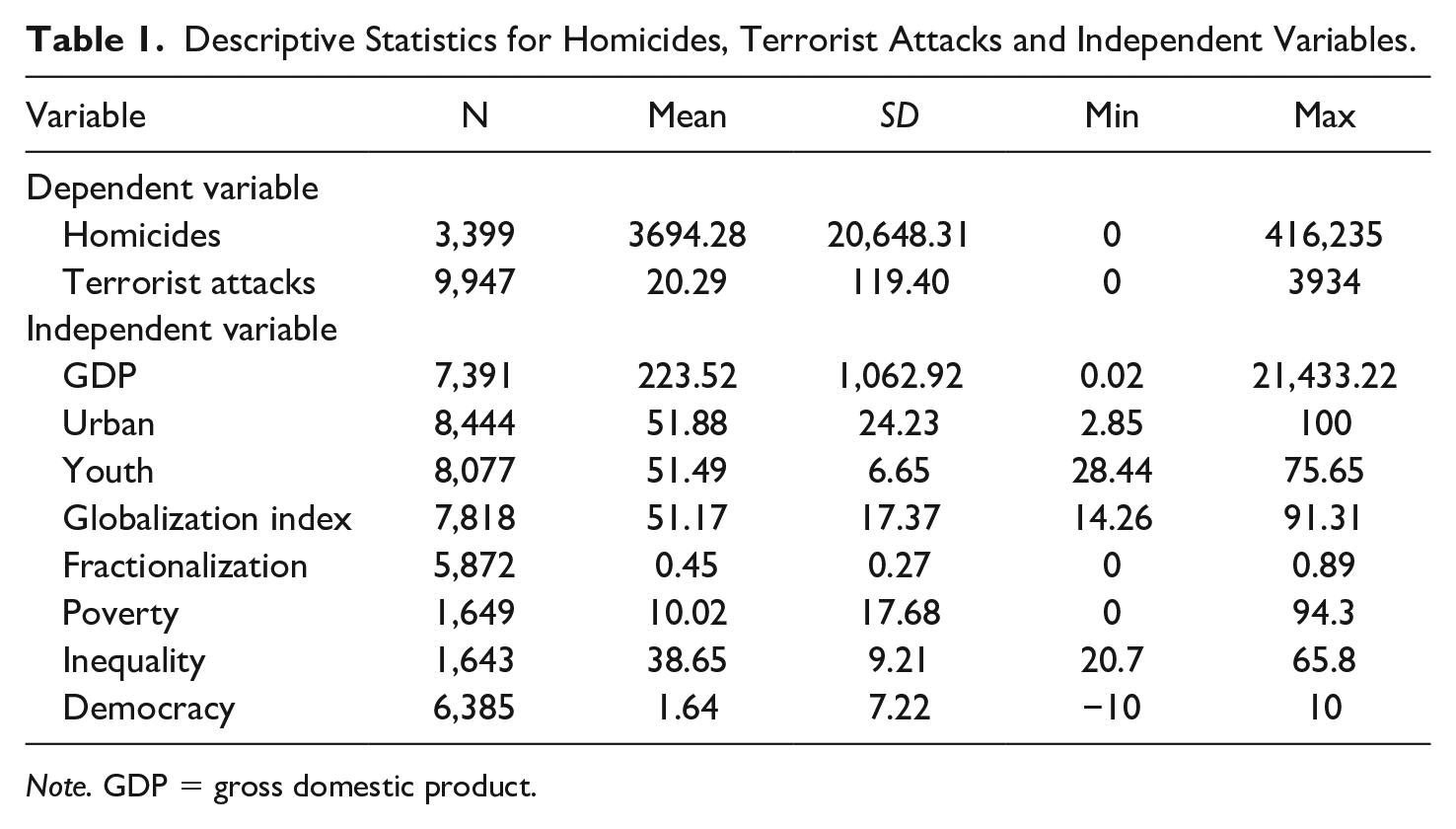
In Table 1, we provide descriptive statistics for all variables included in the analysis. Our measure of homicide counts is drawn from the World Health Organization Mortality Database (World Health Organization, 2014), which defines homicide as “the killing of a person by another with intent to cause death or serious injury.” We compiled the World Health Organization (WHO) data by using the 7th to the 10th revision of the International Classification of Diseases to classify the cause of death for both sexes and all ages. WHO homicide data have long been regarded as the “gold standard” for cross-national homicide comparisons (Aebi, 2010; Andersson & Kazemian, 2018; LaFree, 2005; Rogers & Pridemore, 2023). As shown in Table 1, homicide counts range from zero to more than 400,000, with a mean of 3,694 homicides per country-year. Although national classification rules vary, because socio-politically motivated terrorist attacks that result in death are counted as homicides in some countries, we remove deaths resulting from terrorist attacks from the homicide data.
Descriptive Statistics for Homicides, Terrorist Attacks and Independent Variables.
Note. GDP = gross domestic product.
We draw counts of terrorist attacks from the Global Terrorism Database (GTD; https://www.start.umd.edu/gtd/). Terrorist attacks in the GTD are defined as “the threatened or actual use of illegal force and violence by non-state actors to attain a political, economic, religious, or social goal through fear, coercion, or intimidation” (LaFree, Dugan, & Miller, 2014, p. 13). To qualify as a terrorist attack in the GTD, incidents must entail violence or the threat of violence (including violence against property), they must be intentional and they must be perpetuated by non-state actors. According to Table 1, annual terrorist attacks ranged from zero to nearly 10,000, with a mean of 20 per country-year. Note that because worldwide homicide data are less complete than worldwide terrorism data, our sample of terrorist attacks is nearly three times larger than our sample of homicides.
Independent Variables
To test our hypotheses, we include eight independent variables. As with our two dependent variables, there is great variation across the independent variables in terms of missing data. For example, the total number of cases for the variable with the least missing data (percent urban) is more than five times greater than the variable with the most missing data (inequality). In addition to percent urban, the three other variables with the most available data are youth, globalization and GDP. In addition to inequality, the three variables with the most missing data are poverty, ethnic fractionalization and strength of democracy.
Modernization/Social Disorganization Measures
As described earlier, we include four modernization/social disorganization measures in the analysis: economic development, urbanization, percent youth, and ethnic fractionalization. Our measure of economic development is GDP recorded from the Penn World Table 9.1 (Feenstra & Inklaar, 2019). Our urbanization measure captures the proportion of the population in a given country that resides in urban areas relative to the total resident population (World Bank Open Data, 2020). Our percent youth measure is from the United Nations World Population Prospects (2015) and measures the proportion of the population between 15 and 29 years old relative to the total resident population for all age ranges in a given country-year. We construct our ethnic fractionalization measure by combining data provided by Alesina et al. (2003) and Drazanova (2019). Both sources define ethnic fractionalization as the likelihood that two randomly selected individuals drawn from the population belong to two different ethnic groups.
Economic Stress
We include two measures of economic stress in the analysis. Our absolute measure of economic stress is poverty, which we measure by using the percentage of the population living below national poverty lines based on population-weighted subgroup estimates from household surveys (World Bank Open Data, 2020). Our relative measure of economic stress is inequality, which we draw from the GINI Index reported in the Standardized World Income Inequality Database (Solt, 2016).
Strength of Democracy and Globalization
We operationalize democracy by using the POLITY IV score ranging from −10 (hereditary monarchy) to 10 (consolidated democracy) drawn from the World Bank (World Bank Open Data, 2020). Our measure of globalization is from the KOF Globalization Index (Gygli et al., 2019) and integrates information on the political, social, and economic aspects of globalization.
Method
Given the considerable amount of missing data for several of our theoretical variables, we begin with a base model that includes the four covariates with the smallest proportion of missing data (GDP, percent urban, percent young, globalization) and then add, one at a time, the other four theoretical variables. Following past research on terrorist attacks, we begin by modeling total event counts for both homicide and terrorist attacks.
Prior research suggests that both homicides (Neapolitan, 1994; United Nations Office on Drugs and Crime [UNODC], 2014) and terrorist attacks (LaFree & Dugan, 2009; LaFree et al., 2010) are heavily concentrated in particular regions of the world. Because countries nested within a particular region are likely to be more similar to each other than they are to countries in other regions, we use a multilevel analysis with countries nested in 12 regions (Australia/Oceania, Central America/Caribbean, Central Asia, East Asia, East Europe, Middle East and North Africa, North America, South America, South Asia, Southeast Asia, Sub-Saharan Africa, Western Europe).
In addition to the fact that our analysis takes place on two levels, both our homicide and terrorist attack data are highly skewed to the right with large numbers of zero cells. Multilevel mixed effects negative binomial regression analysis has been shown to be appropriate for handling the over-dispersion of count data (Allison & Waterman, 2002; Hilbe, 2011; Yirga et al., 2020; Zhang et al., 2017) and can incorporate various correlation structures among country-years within the same region as well as include different types of random and fixed effects. Assuming that counts of homicide and terrorist attacks (yij) follow a negative binomial distribution yij ~ NB(µij,θ), where θ is the over-dispersion parameter and µij are the means, we estimate a multilevel negative binomial model that is conditional on both country and time effects, respectively:

where µij are the means which are related to the independent variables specified in the base model and Models 2 to 5. The log-link function can be specified as:

where ln Tij is the depths of coverage; Xij are the independent variables included in the analysis; β is the intercept β0 and the vector of fixed effects; Zij = (1,tij) and bi represents the intercept b0i and the random effects which are assumed to follow a multivariate normal distribution with bi ~ N(0,)ψ where ψ is the variance-covariance matrix (Zeger & Karim, 1991).
Determinants of Cross-National Homicides and Terrorist Attacks
In Figure 1, we show trends for homicides and terrorist attacks. Both trends generally move in the same direction for the first two decades of the time series—although increases and decreases are steeper for homicides than terrorist attacks. Both homicide and terrorist attacks increased from 1970 to the early-1990s, before dropping sharply until the late-1990s. Homicide counts reached a peak in 1994 with 607,273 cases and terrorist attacks reached a peak of 5,070 in 1992. Both trends generally move in opposite directions from the late 1990s until the end of the homicide series in 2015, with homicides declining and terrorist attacks increasing. Homicides declined by about 50% from 1994 to 2000, were relatively flat from 2001 until 2011, and then decreased another 42% from 2012 to 2015. Terrorist attacks dropped substantially from 1992 to reaching a low point of 1,164 attacks in 2004. From 2005 to 2014 terrorist attacks increased rapidly, reaching a series peak of 16,959 in 2014. Following 2014, terrorist attacks declined considerably during the last 4 years of the terrorism series.
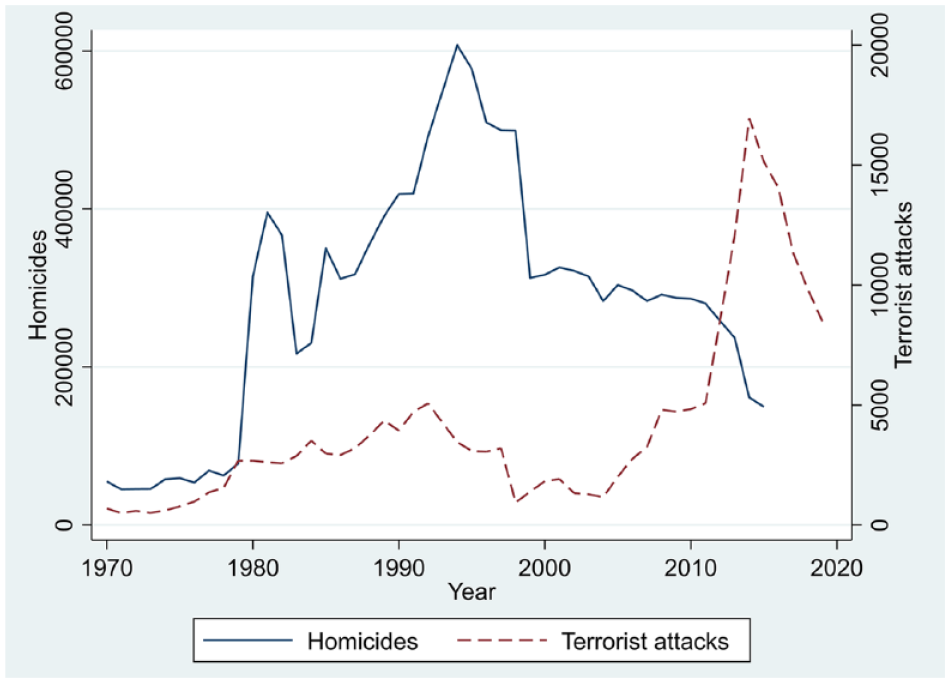
Time Series Homicides (1970–2015) and Terrorist Attacks (1970–2019).
Bivariate Correlations
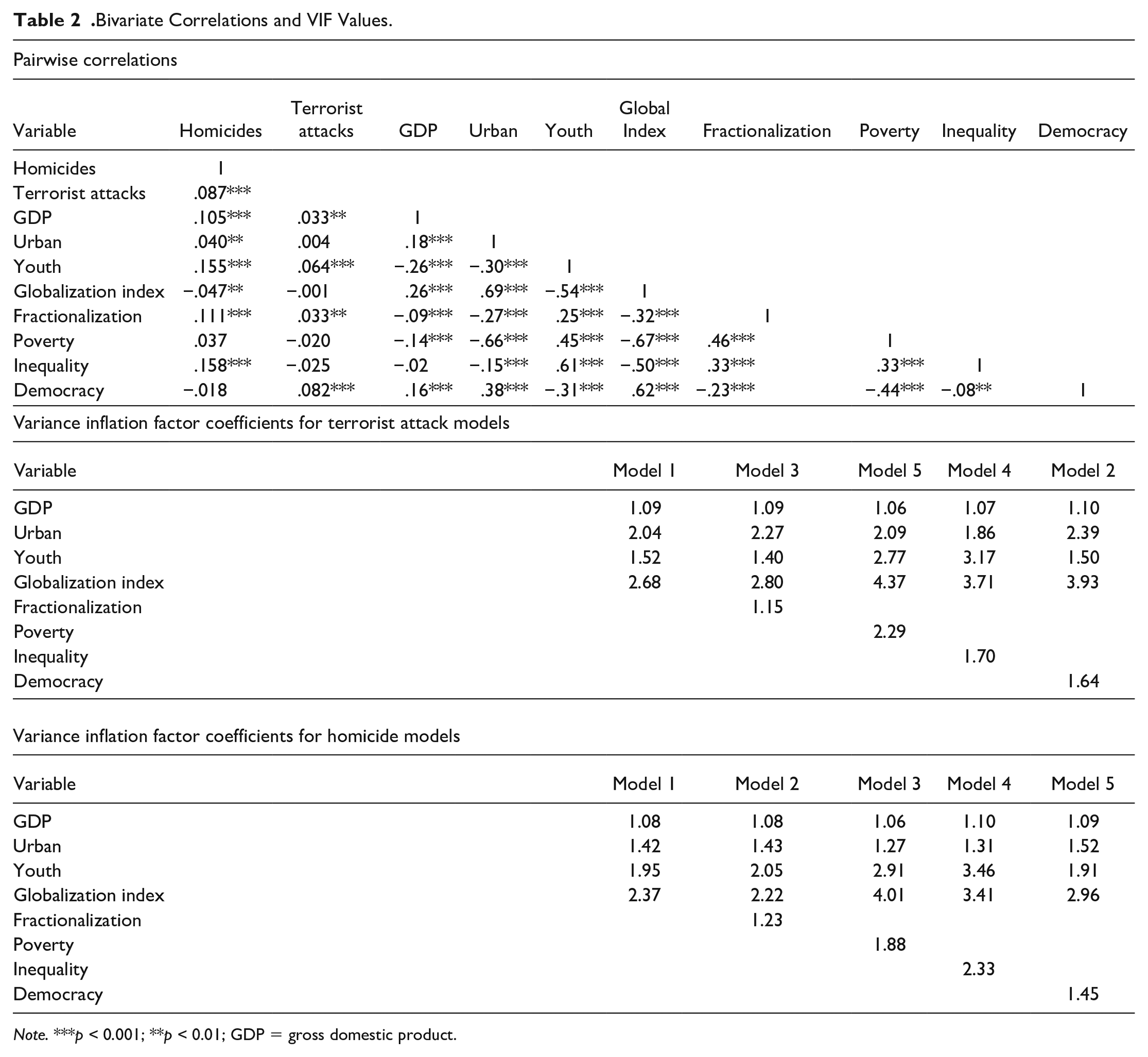
In Table 2, we present bivariate correlations and Variance Inflation Factor (VIF) coefficients. 1 Consistent with the trends shown in Figure 1, homicide and terrorist attack counts are significantly correlated (ρ = 0.087, p < .001). GDP, ethnic fractionalization, and percent youth are significantly and positively correlated with both homicides and terrorist attacks. Urbanization and inequality are positively associated with homicides but not significantly related to terrorist attacks. The strength of democracy is positively associated with terrorist attacks but not significantly related to homicides. Poverty is not significantly associated with either homicide or terrorist attacks.
Bivariate Correlations and VIF Values.
Note. ***p < 0.001; **p < 0.01; GDP = gross domestic product.
According to Table 2, all pairwise correlation coefficients are below 0.75 (the largest correlation is 0.69 between percent urban and globalization), increasing our confidence that multicollinearity is not a major issue. Furthermore, according to panels B and C, the VIF for variables included in Model 1 are all below three. The only situation where the VIF exceeds four is in Model 5, Panel C for the globalization index when poverty is added to the model. As we can see in the correlation matrix this is likely a result of the relatively high negative correlation (ρ = −0.67, p < .001) between globalization and poverty. Given that the VIF value is still close to four, we do not see major threats from multicollinearity (O’Brien, 2007).
Multivariate Results
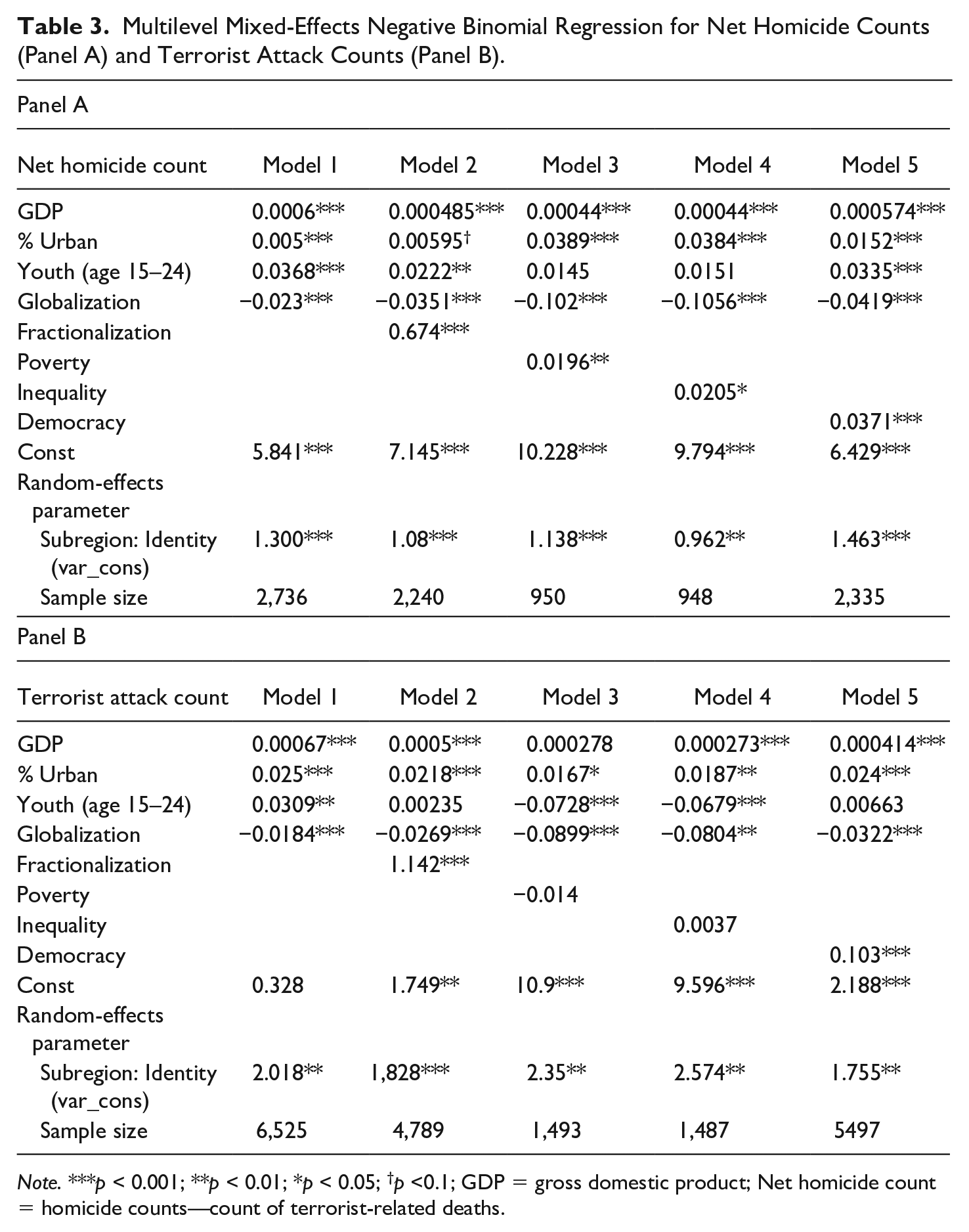
Our main objective in this research is to compare the determinants of homicide and terrorist attacks. To do so, we include four theoretical arguments with eight covariates that are grounded in prior theory and research on cross-national homicide and terrorism research. In Table 3, we present the results of our multilevel mixed effects negative binomial models. We included four measures of the modernization/social disorganization argument. In support of Hypothesis 1a, our results show nearly complete support for the conclusion that homicides and terrorist attacks are associated with rising levels of economic development. The one exception is that GDP is no longer significant in the analysis of terrorist attacks when we add poverty to Model 5.
Multilevel Mixed-Effects Negative Binomial Regression for Net Homicide Counts (Panel A) and Terrorist Attack Counts (Panel B).
Note. ***p < 0.001; **p < 0.01; *p < 0.05; †p <0.1; GDP = gross domestic product; Net homicide count = homicide counts—count of terrorist-related deaths.
In support of Hypothesis 1b, our results show that both homicide and terrorist attack counts are significantly higher in countries with a high urban percent. The single exception to this pattern is for homicide Model 2. When we add fractionalization to the model, urbanization falls below the conventional level of statistical significance (although it is significant at p < .10). In support of Hypothesis 1c, our results show that countries with high levels of ethnic fractionalization have consistently high levels of both homicide and terrorist attacks.
In Hypothesis 1d, we argue that countries with a high proportion of young people will have high levels of homicide and terrorist attacks. The results are partially supportive for homicides where we find significant positive effects for Models 1, 2, and 5, but positive and insignificant effects when we add poverty (Model 3) and inequality (Model 4). Results for the impact of percent youth on terrorist attacks are extremely variable with Model 1 showing a significant positive effect, Models 3 and 4 showing significant negative effects, and Models 2 and 5 showing no significant effects.
Taken together, the results show consistent support for three of the modernization/social disorganization variables: as hypothesized, both homicides and terrorist attacks are more common in country years with high levels of GDP, percent urban and ethnic fractionalization. By contrast, the effects of the youth population are inconsistent, especially for terrorist attacks.
We include two common measures of economic stress in our models: poverty and inequality. In support of Hypotheses 2a and 2b, both are significant and positive for homicide and neither are significant for terrorist attacks.
In support of Hypothesis 3, countries transitioning toward full democracy are associated with high levels of both homicide and terrorist attacks. In support of Hypothesis 4, high levels of globalization are associated with low levels of both homicide and terrorist attacks.
We note in passing that the variation in intercepts of the included predictors at the region level, denoted by µ0j, are all statistically significant for both homicide and terrorist attack counts. This suggests that there are significant clustering effects within regions and supports our decision to do the analysis using multilevel negative binomial models.
Discussion and Conclusion
In our multivariate analysis, we evaluated 24 coefficients (eight variables across five models) for both homicides and terrorist attacks. For the 24 tests of our homicide hypotheses, 21 were supportive and three were not (of the three none were significant in the opposite direction). For the 24 tests of our terrorist attack hypotheses, 19 were supportive and five were not (of the five, two were significant in the opposite direction of the hypothesis). Four of the five contrary results for the terrorism analysis were from the percent youth variable—the fifth was from Model 5 for GDP.
Of the four variables we used to examine the modernization/social disorganization perspective, three produced mostly consistent results for both homicides and terrorist attacks: both increased along with increases in GDP, percent urban, and ethnic fractionalization. Results for homicides and terrorist attacks differed the most for percent youth. Although percent youth is positively associated with homicide in all five models and significant in three, percent youth is positively but insignificantly associated with terrorist attacks in three models but negative and significant in two models. The differing results for the effects of percent youth on homicide and terrorist attacks may be related to the fact that in general, those who commit terrorist attacks are older than those who commit more ordinary forms of crime (Klausen et al., 2016; Pyrooz et al., 2017).
Our results show that both our absolute (poverty) and relative (inequality) measures of economic stress were significantly associated with high levels of homicide but neither had a significant effect on terrorist attacks. These results are consistent with a growing body of literature suggesting that economic deprivation is generally not a root cause of terrorism (Caruso & Schneider, 2011; LaFree & Bersani, 2014).
The results show that the strength of democracy is significantly associated with both high levels of homicide and terrorist attacks. The homicide results are consistent with LaFree and Tseloni (2006), who find that during the second half of the twentieth-century homicide rates increased for countries transitioning to full democracies. The results for a positive effect of democratic strength on terrorist attacks are also consistent with Wilson and Piazza (2013) and Bell (2017).
Our measure of globalization had significant negative effects on both homicide and terrorist attack counts. The strong association between globalization and homicide is supported by recent research (LaFree & Jiang, 2022; Levchak, 2015). The results are also in line with Friedman’s (2006) contention that globalization reduces terrorism by increasing prosperity and the flow of technology and capital from developed to developing countries.
Taken together, the results suggest a good deal of similarity in cross-national predictors of homicide and terrorist attacks. Both are increased by GDP, percent urban, ethnic fractionalization, and democratization. Both are decreased by globalization. Percent youth is generally associated with high levels of homicide but results for terrorist attacks are inconsistent. Economic stress measures are significantly associated with homicide but not terrorist attacks.
We recognize two important limitations of our study. First, although we assembled a long time series for a large number of countries, we acknowledge that more inclusive data would be an improvement. Cases included in cross-national homicide data are skewed toward Europe (44.7%), the Americas (28.2%), and Asia (23.8%). Coverage is much weaker for Africa and the Middle East.
Second, while we were able to examine a robust set of independent variables, including measures like poverty and inequality greatly increases the amount of missing data. For example, available sample sizes drop by 77.1% when we include poverty in our analysis (Table 3, Model 3) and 77.2% when we add inequality to our analysis (Table 3, Model 4). Moreover, for other potential covariates like the decommodification index, which has been used in previous cross-national homicide studies (Messner et al., 2002; Messner & Rosenfeld, 1997; Trent & Pridemore, 2012), missing data issues posed such a serious limitation that we decided to exclude them from our analysis.
Although we can agree with Clarke and Newman (2006, p. i) who argue that “terrorism is a form of crime in all essential respects,” there are clearly important differences between terrorist attacks and more common forms of crime. In this regard, terrorism’s connection to mainstream criminology resembles the relationship between mainstream criminology and more specialized areas like organized crime or criminal gangs. In other words, although the fit between terrorism and more common crimes is relevant, it is imperfect. Of the four theoretical perspectives we examined here, effects for modernization/social disorganization, democracy, and globalization were similar for homicide and terrorism. However, although our two measures of economic strain were significant predictors of homicide, they were unrelated to terrorism. This outcome is consistent with much recent research suggesting that compared to more typical criminal offenders: terrorist perpetrators are less motivated by material concerns (Abadie, 2006; Becker et al., 2022; Jager, 2018).
One potential advantage of broadening the field of criminology to include terrorism is to provide theoretical and policy insights that might otherwise escape notice. Our analysis included two variables—globalization and transition to democracy—which are rarely included in etiological studies of homicide. Both variables were shown to be significant predictors of not only terrorist attacks but homicides. Indeed, both variables are associated with societal developments that might be expected to impact homicides. The argument that as the world becomes more interconnected through commerce and trade, criminal behavior becomes costlier and less rational can be traced back to antiquity but is especially associated with the scholars of the Enlightenment (Pomeranz & Topik, 2017). Montesquieu, Voltaire, Smith, and Hume were all supporters of the “doux commerce” (i.e., gentle commerce) thesis, that globalization through the spread of trade and commerce decreases all types of violence, including homicide and other violent crime (Dickey, 2001; Movsesian, 2017). In his description of the “civilizing process,” Elias (1939) argues that as Europeans gradually freed themselves from the feudal system, trade and commerce increased and individuals had fewer incentives to engage in violent behavior. Elias (p. 185) also argues that globalization consolidates the political power of the state, giving it an increasingly effective monopoly over the legal system and reducing the tendency for individuals to take the law into their own hands. This is likely to reduce the kind of criminal behavior that Black (1983) refers to as “self-help”—where individuals seek their own justice rather than relying on the state.
The results for the impact of democratic transition on homicide are consistent with worldwide research (LaFree & Tseloni, 2006; Neuman & Berger, 1988) showing that compared with autocratic regimes, cross-national homicide rates in transitional democratic regimes are significantly higher. The results are also in keeping with research on the impact of the transition to democracy on crime in various world regions. For example, this connection has been commonly observed in studies of the newly emerging democratic countries of Eastern Europe following the disintegration of the Soviet Union (Bäckman, 1998; Barak, 2000; Karstedt, 2003). Researchers have also pointed out that the growing crime problems in Latin American countries frequently coincide with democratization in this region (Fajnzylber et al., 1998; Méndez et al., 1999; Rivera, 2016). Finally, Daniel et al. (2005) make similar arguments for rising crime rates in South Africa. If these results are replicated in future research, they suggest that some variables more commonly examined in the terrorism literature may also have relevance for criminology. The results for globalization and democratic transition also have potential policy relevance, suggesting that increasing globalization and supporting countries as they transition from partial to full democracy may be viable options for lowering the threat of both homicide and terrorist violence.
As terrorism research has been increasingly embraced by criminologists, there is growing interest in the extent to which terrorism differs from other types of illegal behavior. Terrorism clearly resembles other types of crime in some ways, but also exhibits fundamental differences. Somewhat surprisingly, despite the growing interest in ways in which terrorism is similar to, or different from, other crime, very little prior research has directly compared the determinants of terrorism and more common crime. In what we believe is the first direct empirical comparison of the cross-national determinants of homicides and terrorist attacks, we find similarities and differences. Both homicide and terrorist attacks are positively associated with several common measures of modernization/social disorganization perspectives. Both are positively associated with democratization and negatively associated with globalization. Although common measures of economic stress are significantly related to homicides, they had no impact on terrorist attacks. In comparing the cross-national determinants of homicide and terrorist attacks, we find an imperfect fit: substantial similarities punctuated with a few important differences.
Supplemental Material
sj-docx-1-ccj-10.1177_10439862231190213 – Supplemental material for Comparing the Determinants of Worldwide Homicide and Terrorism
Supplemental material, sj-docx-1-ccj-10.1177_10439862231190213 for Comparing the Determinants of Worldwide Homicide and Terrorism by Gary LaFree, Bo Jiang and Yesenia Yanez in Journal of Contemporary Criminal Justice
Footnotes
Acknowledgements
The authors would like to thank Marieke Liem for helpful comments on an earlier version of this paper.
Declaration of Conflicting Interests
The author(s) declared no potential conflicts of interest with respect to the research, authorship, and/or publication of this article.
Funding
The author(s) received no financial support for the research, authorship, and/or publication of this article.
Supplemental Material
Supplemental material for this article is available online.
Notes
Author Biographies
References
Supplementary Material
Please find the following supplemental material available below.
For Open Access articles published under a Creative Commons License, all supplemental material carries the same license as the article it is associated with.
For non-Open Access articles published, all supplemental material carries a non-exclusive license, and permission requests for re-use of supplemental material or any part of supplemental material shall be sent directly to the copyright owner as specified in the copyright notice associated with the article.
