




Abstract
Efforts to divert people with mental illnesses from the criminal legal system are widespread among mental health and criminal justice authorities. Most diversion efforts focus on directing individuals with mental illnesses to treatment; however, these treatment-focused interventions are an insufficient approach to diverting people with mental illnesses from the criminal legal system and fail to adequately address organizational and system-level factors that impact criminal legal system involvement. This study uses a social ecological approach to identify multilevel supervision challenges that probation officers face in diverting people with mental illnesses from future criminal legal system involvement. Twenty-six probation agency representatives from across the United States were interviewed as part of a larger study about supervising people with mental illnesses on probation. Salient themes indicate diversion targets related to (1) probation officer and agency capacity, (2) interorganizational relationships and roles, and (3) resources and systems in the local community. A comprehensive framework for diversion must include a both-and approach that maintains focus on individual-level supports and predictors of recidivism and violations, while also targeting the macro- or system-level factors that create the conditions for recidivism at the individual level.
Introduction
People with mental illnesses are disproportionately represented within the criminal legal system. Mental illnesses occur at higher rates among people within the criminal legal system when compared to the general population, with 56% of those in state prisons (Maruschak et al., 2021), 41% in jails (Bronson & Berzofsky, 2017), and 16%–27% in community supervision (Crilly et al., 2009; Ditton, 1999) having one or more mental illnesses. Although these disproportionate rates are evident across the legal system, at 3.7 million people (Carson & Kluckow, 2023), community supervision constitutes the largest segment of the corrections population and, consequently, the largest volume of people with mental illnesses in the criminal legal system.
Justice-involved people with mental illnesses are also at higher risk of probation revocation and violations (Prins & Draper, 2009) and re-arrest (Baillargeon et al., 2009) than people without mental illnesses. Furthermore, evidence suggests that criminal legal system involvement is associated with increased mental health symptoms (Porter & DeMarco, 2019; Sugie & Turney, 2017), risk of infectious disease (Massoglia, 2008; Massoglia & Pridemore, 2015), hypertension (Binswanger et al., 2009; Howell et al., 2016), some types of cancer (Puglisi et al., 2020), opioid overdose (Mital et al., 2020), drug-related mortality (Merrall et al., 2010), and overall mortality (Bovell-Ammon et al., 2021; Patterson, 2013; Pridemore, 2014; Witteveen, 2022). Given these elevated risks, comprehensive and coordinated approaches are needed to divert people with mental illnesses from the criminal legal system.
Frameworks such as the sequential intercept model (SIM; Munetz & Griffin, 2006) have emerged to help communities, policymakers, and researchers (a) understand the ways that people with mental illnesses interface with the criminal legal system and (b) identify diversion interventions and opportunities along the criminal legal system continuum. The SIM is an organizing framework for mapping an individual’s movement through the criminal legal system and corresponding opportunities to connect them with behavioral health treatment and divert them from further criminal legal system involvement (Munetz & Griffin, 2006; Policy Research Associates, n.d.; Substance Abuse and Mental Health Services Administration [SAMHSA], 2022a). The SIM consists of six points or “intercepts” where communities can focus resources to intervene and divert a person from arrest or further criminal legal system involvement. The original SIM consisted of five intercepts: (1) community-based interventions, (2) law enforcement interventions, (3) initial detention and court proceedings, (4) jail and court proceedings, and (5) reentry and community corrections (SAMSHA, 2022a). In 2017, the SIM was expanded to include Intercept 0 (Community Services) to capture the role of early intervention points as a means for diversion prior to initial criminal legal system contact (Abreu et al., 2017). The SIM framework has been used within communities to map the existing service landscape and identify effective strategies and policies for diversion from the criminal legal system (Bonfine & Nadler, 2019; Comartin et al., 2021).
Many of the interventions along the SIM focus on service linkage and treatment engagement as the primary pathway for diversion. For example, SAMHSA suggests that specialized mental health probation (SMHP) caseloads can be used for diverting people with mental illnesses away from the criminal legal system at Intercept 5 (Reentry and Community Corrections; SAMHSA, 2022b). Mental health probation caseloads and other types of “first-generation” interventions, such as mental health courts, assume that treatment linkage will decrease criminal legal system involvement among people with mental illnesses (Epperson et al., 2014). Although addressing mental health is an essential part of supporting people with mental illnesses on probation and may facilitate diversion in some cases, evidence indicates that treatment alone does not reliably improve criminal legal system outcomes, including diversion (Epperson et al., 2014; Manchak et al., 2014; Skeem & Eno Louden, 2006; Skeem et al., 2017; Van Deinse et al., 2022a; Watson et al., 2008; Wolff et al., 2014). Treatment-focused approaches are necessary but insufficient for diverting people with mental illnesses from the criminal legal system and fail to adequately address organizational- and system-level factors that impact criminal legal system involvement. The field needs to expand its recidivism reduction framework beyond a unidimensional model that prioritizes individual-level factors and mental health treatment as the sole strategy for diversion (Eno Louden et al., 2015).
This study uses a social ecological approach to identify multilevel supervision challenges beyond the individual level that probation officers face in diverting people with mental illnesses from future criminal legal system involvement. The social ecological framework (Bronfenbrenner, 1979; McLeroy et al., 1988) is a widely used model for understanding the person within the context of complex social systems and examining factors at multiple levels, including individual, interpersonal, organizational, community, and societal. Despite its broad application and acceptance in human services fields, the social ecological framework has been sparsely applied to community corrections within the peer-reviewed literature, with two notable exceptions (Bunting et al., 2018; Dong et al., 2022). These studies use the social ecological framework to describe barriers to treatment engagement and health literacy of people supervised by community corrections; however, neither study focuses on criminal legal outcomes among people with mental illnesses on probation. By using the social ecological framework to examine multilevel supervision challenges that probation officers face in diverting people with mental illnesses from the criminal legal system, this study aims to pivot the field toward a framework that moves beyond individual-level intervention targets (e.g., treatment only) to improve criminal legal and mental health outcomes.
Methods
Design
This article reports on findings from qualitative interviews conducted as part of a larger, nationwide study of the perspectives of probation officers regarding their probation supervision approaches for individuals with mental illnesses. For the larger study, participants completed a web-based survey about probation practices for people with mental illnesses. At the end of the survey, respondents were asked whether they were willing to participate in a follow-up interview with a member of the research team. The purpose of these interviews was to better understand challenges related to supervising people with mental illnesses and obtain information about how specialized supervision approaches are implemented. All study activities were reviewed and approved by the university’s Institutional Review Board.
Sample
As part of the larger study, 315 counties were randomly selected from the 3,142 counties across the country. Probation administrators and supervisors from the 315 selected counties were invited to complete a web-based survey about mental illness and probation supervision. Of the selected counties, representatives from 179 counties completed the survey (57% response rate) and 47% (n = 85) of those expressed interest in a follow-up interview with the research team. The research team then contacted these 85 individuals to invite them to be interviewed. A total of 26 (31% response rate) interviews were completed. Interviews lasted between 20 and 52 minutes (average length 35 minutes), and the majority were conducted via Zoom or telephone between April 21, 2021, and June 17, 2021, with one interview completed on April 26, 2022.
In the sample of people interviewed, the average age was 46 years (M = 9.83), 58% (n = 15) were female, 42%, (n = 11) were male, 88% (n = 23) were White, and 12% were Black or African American (n = 3). Nearly all had at least a 4-year degree (96%, n = 25), more than half of whom had a degree in criminal justice (58%, n = 15). On average, participants had worked in their current position for 7 years (SD = 5.43), at their agency for 16 years (SD = 9.18), and in community supervision for 18 years (SD = 9.36). There were no statistically significant differences between the participants interviewed and those who responded to the survey but did not participate in the interview (Table 1).
Respondent and County Characteristics.
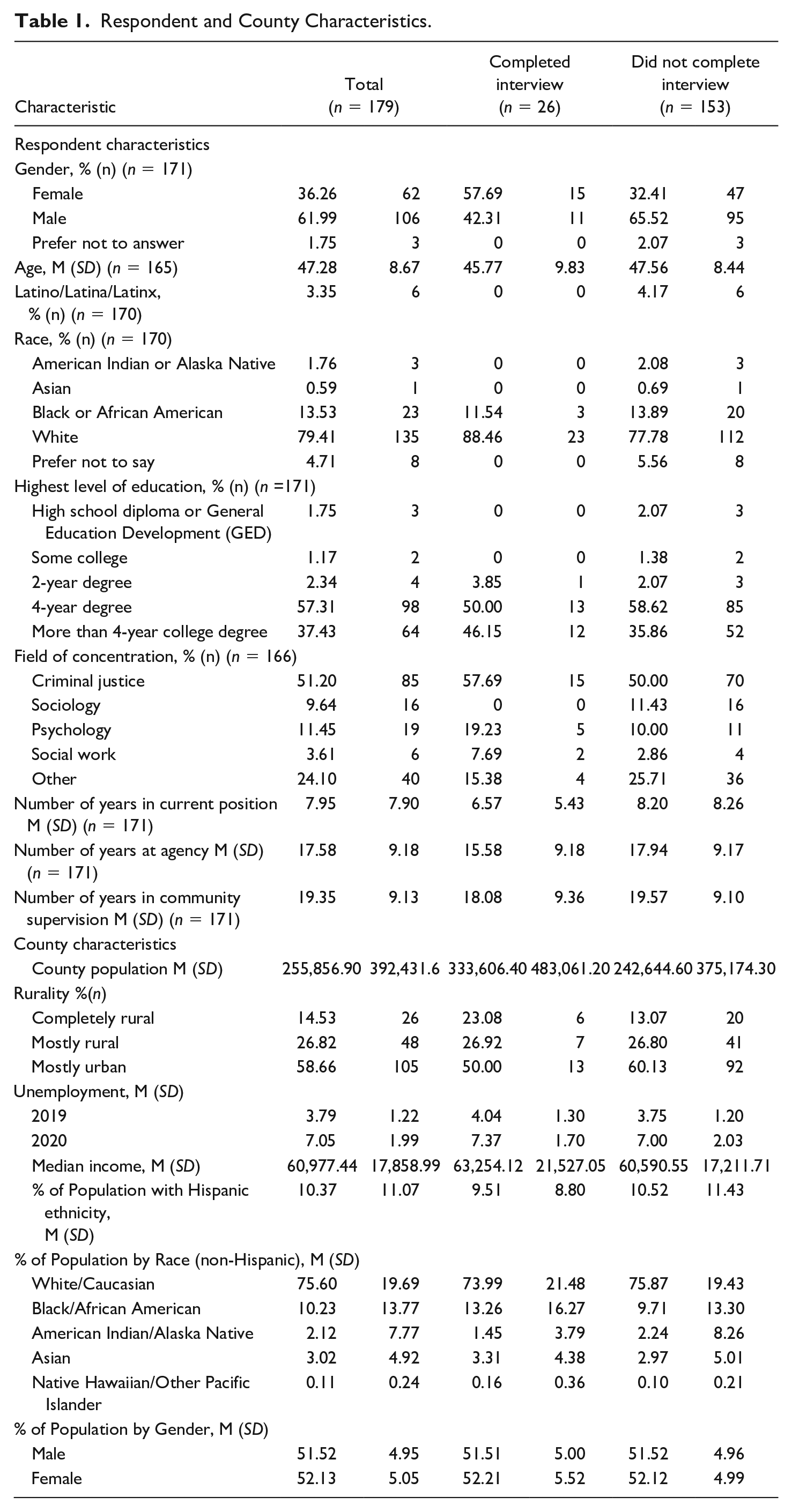
Of the counties represented in the interviews, the average county population was 336,606 (SD = 483,061.20) and 50% (n = 13) were mostly urban, 27% (n = 7) were mostly rural, and 23% (n = 6) were completely rural, according to the U.S. Census Bureau (2020). The average unemployment rate was 4% in 2019 and 7% in 2020. There were no statistically significant differences between the counties represented in the interviews and counties represented in the survey but not in the interviews (Table 1).
Measures
A broad and inclusive definition of mental illness was used in both the survey and the interviews to account for agency variation in protocol and infrastructure to screen and assess for mental illnesses. For the purposes of this study, mental illness was defined as: follows
A mental illness, such as schizophrenia, bipolar disorder, depression, generalized anxiety disorder, and/or post-traumatic stress disorder (PTSD), which has been diagnosed by a medical or mental health provider.
Individual self-report of a diagnosis from a medical or mental health provider.
A potentially undiagnosed mental illness that has been flagged using screening or assessment instruments that may be part of a probation department’s documentation or intake process.
The research team developed a 9-item semistructured interview guide comprised of three sections: (1) challenges supervising people with mental illnesses, (2) core components of mental health probation approaches, and (3) COVID-19 challenges and program adaptations. This study focuses on section 1 of the interview guide, in which participants were asked the following: Compared to the general population, there are higher rates of mental illness among people on probation, which can sometimes create challenges for probation officers. What do you see as the top three challenges of supervising people with mental illnesses?
In addition, the research team analyzed survey data pertaining to respondent and county characteristics to examine differences between survey respondents who completed the interview and those who did not. Survey items pertained to respondents’ gender, age, ethnicity, race, education level, years in their current position, and years working within community supervision. Furthermore, the research team analyzed Census Data (U.S. Census Bureau, 2020) pertaining to county-level characteristics including population, rurality, unemployment rate, mean income, race, ethnicity, and gender. Characteristics of counties represented in the interview sample were compared with survey respondents who did not complete the interview.
Data Analysis
The research team used a general inductive coding approach (Thomas, 2006) to analyze interview responses. First, four research team members reviewed a sample of four transcripts and developed an initial codebook. Next, the coding team compared and revised their codebooks until final agreement about codes and themes was reached. The remaining interviews were divided between two teams of two coders. After each team member independently coded their assigned interviews, the coding pairs met to compare results and discuss discrepancies. Any codes unable to be adjudicated by the pair were resolved in a discussion with all four coders.
At the end of the coding process, the research team grouped results based on their social ecological level (Bronfenbrenner, 1979; McLeroy et al., 1988)—specifically, factors related to the individual on probation, probation officer, probation agency, interorganizational relationships, and community. After codes were grouped by social ecological level, the team summarized findings within each of these levels into a salient theme. Although supervision challenges related to the individual on probation were identified during analysis, this article focuses on factors external to the individual on probation. Analyses were conducted by Dedoose (2021).
Data analyses pertaining to county-level and respondent characteristics were conducted using Stata 17 (StataCorp, 2021). Basic descriptive statistics were used to describe the sample. Percentages of the county population reported by race, ethnicity, and gender was calculated by dividing the number of people in each demographic category and dividing by the population in the county. Chi-square tests and Fisher’s Exact tests were used to examine associations between two categorical variables (e.g., interview completion and respondent gender). Wilcoxon rank sum and independent samples t-tests were used to examine differences in mean scores of continuous variables between those who completed the interview and those who did not (e.g., age of respondents who completed the interview compared to those who did not).
Results
Qualitative results pertaining to the challenges supervising people with mental illnesses are grouped by social ecological level: (1) probation officer and agency capacity, (2) interorganizational relationships and roles, and (3) resources and systems in the local community.
Probation Officer and Agency Capacity
Participants suggested several factors related to probation officers and probation agencies that impact supervision of people with mental illnesses, including the need to balance roles and expectations, officer capacity to work with people with mental illnesses, difficulty building rapport with the person on probation, insufficient mental health training and screening protocols, and limitations of the probation agency role.
Need to Balance Roles and Expectations
One of the most frequently mentioned supervision challenges was probation officers needing to balance the multiple roles they are expected to fulfill, especially when supervising people with mental illnesses. In addition to enforcing conditions of probation, officers are often called upon to provide services as diverse as crisis counseling, service coordination, and transportation to people with mental illnesses on probation, especially given the limited informal supports and myriad needs of this population. Not only must probation officers accomplish the many tasks associated with their roles, but their efforts to support individuals on probation sometimes conflict with expectations to act in the interest of public safety: How we respond is also difficult, because we have to balance the public safety risk with the ability for our clients to get the services they need, recognizing that their mental health may be actually triggering some of their behavior. But then again, the public demands that they’re safe, and rightfully so. So, how do we balance that without just filling our jails up with individuals that struggle with mental health? We want them to get the help they need without being incarcerated, but at the same time, there’s times that incarceration is needed, so just balancing that.
Officer Capacity to Work With People With Mental Illnesses
Another frequently cited supervision challenge was the limited number of probation agency staff with the experience and knowledge necessary to supervise people with mental illnesses. Probation officers need to understand mental health symptoms and how to communicate with people experiencing them to effectively supervise people with mental illnesses; however, participants noted that a limited number of probation officers possess this knowledge or skill set. One interview participant describes this lack of understanding as follows: I think it’s easy to confuse mental illness with just bad behavior. And so, part of it is officers [. . .] outside of the mental health unit, often won’t recognize this as a mental impairment, or if they do, they don’t understand mental illness. And so, their approach would be just suck it up and do what we tell you to do, or you’re using it as a crutch thing. It’s a stigma. [. . .] It’s a lack of education, a lack of understanding.
Another participant described instances in which standard probation officers assume a person has a mental illness, based on difficulties they encounter with a person, rather than on symptoms: People will come to me and say, “I’ve got this case I need you to look at them. They got mental health issues.” A lot of times they really are just talking about someone they either can’t communicate with or that [is] difficult, so they automatically assume it’s a mental health issue. But there’s a lot of confusion as to what mental health is. We have officers that say, “He’s got to have a mental health problem because he uses drugs.” Well, no, not necessarily. Not saying he doesn’t, but it’s just a lack of understanding [of] mental health.
This limited understanding among standard officers was corroborated by other participants who reported that their colleagues sometimes felt uncomfortable, fearful, or underprepared to supervise people with mental illnesses on probation. Participants stated that some probation officers feel they lack the knowledge, experience, or skills necessary to work with people who have mental health and/or substance use disorder diagnoses; this includes probation officers being unaware of resources in the community to serve individuals with behavioral health disorders. Gaps in probation officers’ knowledge of mental illness and resources in the community presented supervision challenges: The lack of knowledge and understanding of mental health by the probation officer themselves would be one of the biggest challenges because I don’t know that they recognize certain things that might throw up a red flag or if they do recognize, they don’t know what to do with it because of their lack of [. . .] understanding about mental health. Probably secondly, would be the availability of ready resources in the community, the ability to make those quick connections for or with the offender so that the offender can utilize this access to services quickly when a crisis is noticed or when a lot of times, if they’re ready to do something about their situation, it’s not readily available. I don’t think officers necessarily know exactly what’s available to them.
Difficulty Building Rapport With Person on Probation
Participants conveyed that the quality of their relationships and rapport with people on probation affected supervision and that strong relationships are difficult to build. For example, one participant described the importance and challenge of building trust and creating an alliance: It takes almost the entire year for that offender to start breaking down those walls sometimes and trusting that officer. [. . .] That’s a long time because if they’re only given a year of probation [. . .] When you’re switching cases around constantly, they’re constantly in that defense mode and they’re not letting those barriers down and there’s not a professional relationship or alliance built between the two parties.
In addition, a participant explained how a probation officer’s lack of understanding of the person on probation can impact the supervision relationship: I think just from experience, the offenders get frustrated when the officers don’t understand what they’re going through, whether it’s lack of services, difficulty of services, just in general, a lack of understanding, if you will, of their side, of what’s going on their side where the offender also has a lack of understanding of the officers and what their role is. Because we’re so often just seen as law enforcement, [they think] if I don’t do this, then this person can put me in jail or put me before the judge who can put me in jail.
The quotes above suggest multiple types of obstacles to rapport-building, such as negative perceptions of probation officers, frequent changes in probation case assignments, and officers’ limited understanding of people with mental illnesses on probation.
Insufficient Mental Health Training and Screening Protocols
Some probation agencies do not provide their staff with training on how to supervise people with mental illnesses on probation. Even when trainings are available, they may not be adequate, as one probation agency representative explains in the quote below: If there is a mental health training, it’s going to be like an eight-hour, one-day training. It’s not going to be something that’s ongoing, or it’s a week at a time, or a week required every year, or anything like that. It’s all going to be self-taught, or what you learn from experience talking to coworkers who have more experience with mental health.
Participants also described challenges related to identification of people with mental illnesses on probation. Agencies that do not have an adequate process or instrument to screen for mental illnesses among people on probation are less able to identify and serve these individuals early in their probation term, as described below: By the time we’ve identified [people with mental illnesses on probation] and moved them to the specialized officer, the time frame that’s passed, sometimes you’re looking at an offender who technically may already be in violation. [. . .] I feel like that’s a challenge because if some of our mental health stuff were done up front by the officers, maybe if it were automated, so like if an individual had a mental health flag, certain things would pop up to flag the officer to ask the individual. I find ourselves playing a back and forth game with the officer, “Well, what is their diagnosis?” “You know, oh, I don’t know, I’m going to have to ask them.” “You mentioned they’re on medications, what medications?” “I don’t know, I’m going to have to ask them.”
Limitations of Probation Agency Role
Several participants stated that they were unable to carry out the tasks that judges assign them, particularly related to ensuring individuals on probation receive mental health treatment. Some judges expect probation agencies to guarantee that people with mental illnesses on probation take their prescribed psychiatric medications or engage with mental health treatment providers. Although probation officers can assist individuals with accessing treatment, they cannot force them to engage in it. Participants described variability in judges’ understanding of probation agencies’ capabilities, as in the quote below: Judges sometimes think that we can control the medication with these offenders. So, they will want us to make sure they’re medicated, but we can’t control that. [. . .] We do our best [by] asking, “Have you taken your medication? Have you been in mental health?” And we can only take what the answer they give us at that point. [. . .] We have some judges that will say, “You have a point. There’s no way that probation can make sure they’re taking their medication.” And we had one judge that just really thought probation [officers] were babysitters that were going to stay with these people at night to make sure they took their medication. And it doesn’t work like that.
One participant recounted their efforts to convey the limitations of their agency’s role to judges, as well as the reasons why probation officers are not able to enforce treatment conditions: I know when I go to court, I try to let the judge know that we can’t make sure these offenders take their medication. [. . .Judges will] be like, “Probation is going to make sure they take their medication,” and I say, “Judge, we cannot make sure that they take their medications. That’s just something we can’t do.” So, I try to speak out to let the judges know there are just certain things that we’re not capable of doing when we supervise these mental health offenders. We can make referrals to mental health and try to get in contact with mental health to make sure that they are going to their appointments. But other than that, that’s about all we can do. So, you have judges that will listen to that. And there are some of those judges that are going home just thinking that what they say goes. And we just have to kind of deal with it.
Interorganizational Relationships and Roles
People with mental illnesses on probation often rely on myriad community services, including but not limited to mental health treatment. To support and supervise people with mental illnesses on probation, the various stakeholders (e.g., courts, treatment providers, probation) often need to communicate and collaborate, which can present challenges. There were two themes or factors associated with relationships between organizations or agencies (i.e., interorganizational factors): communication, coordination, and collaboration barriers; and disconnect between partner expectations, priorities, and roles.
Communication, Coordination, and Collaboration Barriers
Participants described communication barriers and misunderstandings between the probation agency and other stakeholders—especially treatment providers—that made supervising people with mental illnesses more difficult. For instance, probation officers often contact mental health treatment providers for updates on an individual’s treatment engagement and mental health status, and sometimes the response is delayed or nonexistent; this makes it difficult for the probation officer to know whether a person has met any treatment-related probation conditions (e.g., attending therapy or taking psychiatric medications). Sometimes, the barrier to communication is that the person on probation has not signed a release of information allowing interagency communication. Other times, the barrier is perceived as reticence on the part of the treatment provider to share information with probation, for fear that it may harm the client: We have consent forms where we get the offenders to sign. And we ask them, “Do they give us consent to get their mental health records or for mental health to talk to us?” And they say, “Yeah,” they sign it. Well, even with these consents, when we call mental health, they still feel the need to not share with us what’s going on with our offenders. We can’t properly do our job if you’re not going to communicate with us if this person is actually coming to his meetings, if he or she is taking their medication, what medications are they on [. . .] We just get minimum communication from certain mental health facilities. It’s like they’re scared to talk to us even though the offender has given consent.
Probation agency officials also described insufficient collaboration across organizations, such that organizations interact with people on probation in isolation from one another: [One challenge] is having all the agencies on the same page meaning the court system, the clerks, the judges, the attorneys understanding the person’s capacity and what their situation is with their mental health and how it applies or affects their probation and probation supervision. Then you’ve got the officer that also has to work with that individual and then you’ve got the third component of the actual provider if they have a provider and just everybody working on the same page at the same time for that individual. That’s a huge challenge because everybody’s doing their own individual thing.
Even with common goals, failure to coordinate between multiple agencies involved in supporting and supervising an individual can lead to confusion and misunderstanding.
Disconnect Between Partner Expectations, Priorities, and Roles
Participants noted that the stakeholders involved in supervision and support of people with mental illnesses on probation do not always have common goals. Competing priorities of various stakeholders in the probation and supervision process (e.g., probation agency representatives, judges, attorneys, treatment providers) pose a challenge to supervision. For instance, a District Attorney’s office or a particular judge might be focused on charging offenses and holding an individual accountable for their alleged actions, while the probation agency is focused on rehabilitation or preventing re-offense, as illustrated in the following excerpt: You got prosecutors that are still in the draconian old ages, and they feel like people that commit crimes [. . .] need to be punished. [. . .] Yeah, so it’s really kind of a sleight of hand with the prosecutors. [. . .] If the prosecutors knew how we supervise the mentally ill, they would probably have a problem with it. [. . .] Because we don’t look at violations, technical violations, the way they want us to look at technical violations, which I don’t really care because we don’t work for them. But if they knew that our job was to get them clinically stabilized and off probation, they would intervene, they would.
Probation agency representatives also find it difficult to carry out court orders that are inflexible or untenable for the person on probation. The following quote describes how court orders that do not match a person’s capacity can lead to a cycle of incarceration and re-arrest: The court system [. . .] they just want to do something with him. So, they just gave him probation, but he doesn’t understand. [. . .] So, he should have been committed. The judge could have committed him if his public defender would have just did what he was supposed to do, but he put him on probation. So now we have to deal with him. [. . .] In those cases, [. . .] we do a violation report, and get a warrant, and send it back to the prosecuting attorney, and then eventually they’ll end up in jail again, which all that’s doing is making it worse, because you got these four walls. [. . .] In those cases, it’s kind of a lose-lose situation.
Resources and Systems in the Local Community
Interventions and services for people with mental illnesses, including specialized probation approaches and diversion programs, depend on community resources (e.g., service providers) and characteristics (e.g., rurality). Interviews indicated that variation in characteristics and resources can contribute to supervision challenges and discrepancies in probation approaches and diversion programs for people with mental illnesses across communities. There were four themes or factors associated with the community that caused supervision challenges, including factors related to: the criminal legal system, the mental health and substance use service system, community resources, and county size and rurality.
Criminal Legal System
Participants described how supervision of people with mental illnesses on probation and recidivism reduction are both made more difficult by a lack of diversion programming in the local community. The presence of programs such as mental health court, Crisis Intervention Team training, and rehabilitation facilities were named as effective strategies to divert people with mental illnesses from the criminal legal system and reduce the number of technical violations they incur. The absence of such strategies is, in contrast, a challenge. For example, one participant described the need for mental health court in their area as follows: [One challenge] would be that we do not have any specific mental health court here, so [people with mental illnesses] are thrown into the full population of everyone on probation. We do have a drug court here, but we do not have a mental health court, which I feel like we could definitely use, because we probably have the numbers that we could have people placed in mental health court.
Mental Health and Substance Use Service System
Limited capacity and accessibility of mental health and substance use treatment services in the community was a prevalent theme in discussion of supervision challenges. Participants described challenges related to treatment provider agencies’ limited staff, limited hours, lack of accommodations for people on probation, and being generally overwhelmed by the demand for behavioral health services. Many treatment provider agencies have had high staff turnover or closed, especially since the onset of the COVID-19 pandemic, which has exacerbated existing staffing and continuity of care issues. Participants cited scarce supply and variable quality of community mental health services as among the most significant challenges they faced when supervising people with mental illnesses on probation, as summarized below: As far as inpatient beds, they’re almost non-existent, and for those that need inpatient . . . they’re in and out in two or three days. They’re handed some pills. I can’t really say whether they’re given follow-up for outpatient, hopefully they are, but the majority of these offenders don’t ever follow up with the follow-up, and so they don’t engage in any type of outpatient counseling or therapy to address their mental health issues. [. . .] There’s just a real lack of resources and quality mental health care. There’s just not enough mental health treatment available for the need. There’s a bigger need than there is providers.
Community Resources
Probation agency representatives described shortages of important social services and infrastructure in the community, which posed challenges to supervision of people with mental illnesses on probation. Notably, transportation and housing were mentioned as areas of great need in the community, as in the following quote: Overall, I would say access to resources in the community for them, supportive services. That would be one. Within those, housing is a huge issue and transportation. Those seem to be the biggest challenges for managing those cases and helping them to succeed on probation.
Transportation is a supervision challenge, especially in areas without reliable public transportation infrastructure. In these areas, unless a person with mental illness on probation has a car, it is difficult for them to access resources and attend necessary appointments, including with treatment providers and probation agencies, as described by an interview participant below: People that struggle with mental health issues, they struggle with some transportation issues, being able to get to the appointments that they have. Again, being a rural county, transportation is not readily available. Having bus service to and from different appointments, not available, unless you meet certain criteria, and you’re going to a certain destination, then they can transport you. But the vast majority of our clients just struggle with transportation. They struggle with getting the services that they need the most.
Lack of reliable transportation in the community impedes individuals’ abilities to perform necessary tasks such as picking up medication, attending work, and keeping appointments (e.g., court hearings and probation check-ins). As one participant stated: Realistically, if you have an individual who suffers from schizophrenia, they may or may not have access to a vehicle to get their medication. If they’re not medicated, then you have the potential that they could reoffend because the paranoia is so deep that it causes them, unfortunately, to have instability in their lives.
Participants also described deleterious impacts of limited housing supply, especially affordable rental housing and shelters. Lack of housing infrastructure leads to housing instability, which contributes to destabilization of individuals’ mental health and greater difficulty meeting conditions of probation. A probation officer described the combined effects of transportation and housing resource shortages in the excerpt below: If they don’t have stable housing, they’re bounced around in emergency housing, which is problematic because the Department of Social Service will place them into overnight housing that they would go into after 4:30 PM and then they have to be out like by 8:00 AM and there’s nowhere for them to go during the day. [. . .] That’s not a great environment. And then the transportation is an issue. Unless they can secure transportation to a treatment center, that reduces their likelihood of success. If you’ve got somebody, even if they’re in stable housing but they can’t get reliable transportation to a treatment agency, then that becomes a challenge. There is transportation for people who have mental illness. They have their Medicaid transportation but those are like not always reliable and sometimes if they are trying to do buses, they could be on several different buses, they could miss one.
Participants further described housing instability as a supervision challenge because probation officers and treatment providers do not know where to find people to check on their well-being or compliance with the terms of probation, as illustrated below: If they have housing, they have a stable place to be, and I know where they are all the time. They have a place to live. That means they’re there. They’re able to get mail at their home, they’re able to go to [a service provider] and they can help them find a job, like apply for food stamps or Medicaid or whatever it is that they need, and they have one central place where they can be there. It makes it easier for probation because I know where they are.
Community-level factors such as strict housing program policies and limited options for informal housing outside the system make it difficult for individuals on probation with mental illnesses to obtain and maintain stable housing, as described below: Another issue we run into is housing these individuals. A lot of times, family, they have burned bridges, they have gotten kicked out of shelters, and they sometimes are not permitted to come back to those shelters or shelters have a 90-day policy that, if you are kicked out of their facility, they do not let you return for at least 90 days, so housing can definitely be an obstacle for individuals.
County Size and Rurality
Participants reported a scarcity of services and resources in small counties and rural areas. It is particularly difficult to find high-quality treatment services in rural areas, and these areas tend to have greater variability of services within them. Participants also described greater challenges to accessing existing services in rural areas because services are located far apart and there is rarely the kind of public transportation found in urban centers: It’s a big county, and [. . .] it’s a long county. From the western border to the eastern border is [. . .] almost 60, 70 miles or something, so it’s pretty big. There’s not great public transportation. So, it’s almost like our services are broken up into Eastern [County Name] and Western [County Name] and it’s [. . .] almost like different systems. So, depending upon where the probationers live, the services are going to be a little bit different. We do have county-wide services, but they vary geographically within the county.
Discussion
The purpose of this study was to examine multilevel challenges associated with probation supervision of people with mental illnesses to expand the field’s default diversion approach beyond linkage to treatment resources. Using a social ecological approach, this study examined organizational-, interorganizational-, and community-level challenges that impact the supervision process and, consequently, further criminal legal system involvement. Participants described limited officer and agency capacity for supervising people with mental illnesses on probation, including insufficient officer training and expertise, as well as challenges related to interorganizational relationships and communication. For example, differences between stakeholders’ expectations, priorities, and roles, coupled with limited understanding of the impact of mental illness across the criminal legal system, often result in court-issued sanctions and conditions that disregard precipitators and case context related to mental health. In this way, punishment orientation in courts constitutes an obstacle to probation supervision and diversion for people with mental illnesses.
At the community level, resource availability and infrastructure vary widely and can create disparities in probation approaches and diversion opportunities. Specifically, community-level factors (e.g., affordable housing stock, transportation infrastructure, availability of behavioral health services and other community-based resources) create probation supervision challenges and can impact both diversion from the criminal legal system and barriers to probation compliance. For example, in communities that lack free or affordable transportation options, people on probation may have greater difficulty attending required probation meetings and mandated treatment appointments and maintaining employment, all of which can impact their ability to comply with supervision terms. Taken together, these multilevel factors create supervision challenges for probation officers and the system’s ability to divert people with mental illnesses from continued involvement in the criminal legal system.
Limitations
Although this study contributes to existing research on multilevel factors that impact continued involvement in the criminal legal system and corresponding targets for diversion efforts, there are a number of study limitations to consider. First, the governance and administration of probation varies widely across the United States, and the sample of interview participants is not representative of that variation. Although the goal of qualitative research is to provide deeper understanding of a phenomenon and not achieve generalizability, the lack of a representative sample means that results are not applicable to all probation jurisdictions, and some factors discussed here may vary in their relevance, depending on location. Likewise, some community-level factors will vary depending on how local behavioral health systems are administered. For example, some states may have county-level mental health agencies and others may use private mental health service providers. Consequently, relevance of factors related to mental health services may vary depending on services system structure.
A second limitation is the low response rate for the interviews. Although 85 people expressed interest in participating in a follow-up interview, only 26 interviews were completed. The remaining individuals did not respond to follow-up recruitment outreach. Many factors likely influenced probation administrators’ ability to respond and participate, including their responsibilities around responding to the COVID-19 crisis, given that interviews were conducted in 2021, with one exception. Although representation is a limitation worth mentioning, the analysis of respondent and nonrespondent data indicated that there were no statistically significant differences between survey respondents (and the counties they represented) who participated in the interview and those who did not.
Finally, results are based on perspectives of probation agency representatives. Participants described supervision challenges they experience and their perceptions of challenges that people with mental illnesses on probation face. Although probation agency representatives are uniquely positioned to identify factors within probation agencies that make diversion of people with mental illnesses difficult, they cannot provide firsthand accounts of individuals’ challenges. Although it was outside the scope of this study to examine supervision challenges from the perspectives of people on probation, it would be valuable to do so. People with mental illnesses on probation have critical insights about the impact of multilevel factors on probation compliance, relationships with probation officers, and the effects of supervision strategies.
Implications
Recognizing that criminal legal system involvement among people with mental illnesses is not just a product of the behavioral health, and criminal legal systems is an important step toward a social ecological systems approach for diversion. There are multilevel factors and multiple systems that create the conditions leading to high arrest and recidivism rates among people with mental illnesses. Consequently, undoing criminal legal system entanglement among people with mental illnesses requires diversion frameworks to move outside a sequential analysis of one system and incorporate multilevel factors from multiple intersecting systems. This study’s analysis focused on challenges related to probation supervision of people with mental illnesses, including factors at the agency, interorganizational, and community levels that impact or create individual-level conditions, which can increase the likelihood of subsequent probation violations.
Diversion Efforts Within Probation Agencies
To enhance probation officer workforce development and agency capacity, probation agencies should develop (1) protocols for screening and identification of people with mental illnesses, (2) a process for referral and connection to treatment, and (3) specialized approaches that help officers understand and respond to mental illnesses. Furthermore, probation agencies should focus on officer training that moves beyond a single course offered during basic training. Instead, probation agencies should implement rigorous training (e.g., skills-based training) in which probation officers can obtain a core foundation of knowledge about mental health and then continue to participate in booster sessions or more advanced trainings, depending on their caseload (e.g., specialty mental health caseload versus traditional caseload). Probation agency trainings can also target stigma, probation officers’ misconceptions surrounding mental illnesses, and relationship-building techniques. Evidence suggests that probation officers’ stigma about people with mental illnesses impacts their perception of the person on probation as higher risk and may result in more punitive sanctions (Eno Louden et al., 2018). Exploratory studies suggest that training initiatives for probation officers that focus on mental illness can positively impact mental health knowledge and decrease stigma (Tomar et al., 2017). Evidence also suggests that when a person on probation perceives their probation officer as caring (e.g., kind, respectful, and understanding), they are more likely to abide by the officer’s guidance and comply with probation conditions (Epperson et al., 2017; Kennealy et al., 2012). Consequently, training that targets probation officers’ relationship-building and interpersonal skills may also be beneficial. A focus on rapport building is consistent with efforts to reorient the role of the officer to a “coach,” as opposed to the more punitive and less development-focused “referee” (Lovins et al., 2018). Finally, training pertaining to the behavioral health service landscape (e.g., availability and type of services, procedures for accessing services) and other resources would be beneficial to both specialty mental health probation officers and standard officers (i.e., nonspecialty officers), given that probation officers facilitate an access point to services for people on probation.
Diversion at the Interorganizational Level
In addition to training officers about local resources, probation agencies should enhance their focus on creating and strengthening interorganizational relationships between probation officers and behavioral health service providers. For example, a key component of SMHP is interfacing with behavioral health service providers and other community resources (Van Deinse et al., 2021) and having enhanced organizational networks may aid in reciprocal communication and collaboration between probation officers and service providers (Van Deinse et al., 2022b) to augment individuals’ service engagement. Another interorganizational factor is courts implementing one-size-fits-all probation conditions, which fails to consider a person’s mental illness and how it may impact a person’s ability to comply with the terms of supervision, thus increasing the likelihood of supervision failure (e.g., violations and revocations). To the degree possible, courts should consider modified probation sentencing, such as adjusting the length of time a person is sentenced to probation and the sanctions for probation violations (e.g., eliminating or limiting “dips and dunks” or short-term jails stays that can result in a person’s decompensation). In addition, systems could limit the use of probation revocations for violations related to a person’s mental illness or co-occurring substance use disorder. One resource to address many interorganizational factors named here is the stepwise framework advanced by Lamberti (2016) that outlines the collaboration process between criminal legal system entities and mental health. This framework guides interorganizational interactions through six steps: engagement, assessment, planning and treatment, monitoring, problem-solving, and transition. Although ultimately focused on individual treatment outcomes, this framework targets interorganizational procedures, practices, and relationships.
Diversion at the Community Level
The best way to end the cycle of criminal legal system involvement among people with mental illnesses is to focus diversion on the front end of the system and ensure that individuals have the resources and services they need to remain stable in the community. Stabilizing factors at the front end include resources like housing and transportation—two salient factors that participants indicated at both the individual and community levels. Lack of housing or transportation can impact a person’s stability at the individual level, and both factors have been empirically associated with probation violations and/or recidivism. Specifically, a recent article (Breno et al., 2023) showed that among the general population of people on probation, housing, and transportation were both associated with a higher odds ratio of subsequent probation violations, including absconding, technical violations, and violations due to new crime. Access to these critical resources depends on the existence of affordable housing stock and low- or no-cost transportation options that are accessible to people with mental illnesses in the community. Finally, community resources that focus on alternative responses to police for mental health related calls are emerging as an evidence-informed approach to intervening at the point of initial contact (Marcus & Stergiopoulos, 2022). Such models are a viable option for disrupting contact with law enforcement, addressing mental health crises, and diverting people to community-based resources (Beck et al., 2020; Waters, 2021).
While this study alone cannot offer a comprehensive, empirically driven model of diversion across the criminal legal system, the findings discussed here interrogate traditional treatment-first or treatment-only models and call for the inclusion of macro-level factors that impact and, in some cases, predict ongoing involvement in the criminal legal system. Although ambitious, a comprehensive framework for diversion must include a both-and approach that maintains focus on individual-level supports (e.g., treatment) and predictors of recidivism and violations (e.g., housing and transportation; Breno et al., 2023), while also targeting the macro- or system-level factors that create conditions for recidivism at the individual level (e.g., lack of affordable housing stock in the local community, limited transportation access, few available jobs for people with mental illness and a criminal record, treatment service scarcity).
Conclusion
There are multilevel challenges that impact probation supervision of people with mental illnesses, some of which can lead to a person’s continued involvement in the criminal legal system via probation violations and arrests for new crimes. However, diversion approaches typically prioritize treatment approaches based on the assumption that improved mental health symptoms will also reduce involvement in the criminal legal system. Instead, frameworks that inform diversion (e.g., SIM) should consider a social ecological approach that accounts for multilevel factors across multiple systems that impact a person’s continued involvement in the criminal legal system.
Footnotes
Declaration of Conflicting Interests
The author(s) declared no potential conflicts of interest with respect to the research, authorship, and/or publication of this article.
Funding
The author(s) disclosed receipt of the following financial support for the research, authorship, and/or publication of this article: This study received funding from the Pew Charitable Trusts. Manuscript preparation was also supported by K01MH129619 (Van Deinse).
Authors’ Note
This manuscript was presented at the American Society of Criminology Annual Meeting in Atlanta, GA, USA, on November 16, 2022.