



Abstract
Introduction:
Providing education for graduate nursing students about implicit bias, covert/overt racism in the United States has become challenging due to state and federal policies. Yet, national accrediting bodies require these concepts in doctoral level nursing curricula. While these concepts may be viewed as divisive, faculty can facilitate meaningful discourse by fostering an authentic and safe learning environment.
Methods:
This article describes a curricular revision and our approach of integrating these concepts into a doctoral level ethics course using Mezirow’s Transformative Learning Theory and Kitchenham’s evolution of Mezirow’s theory with instrumental learning, dialogic/discourse learning, and self-reflection.
Results:
Students evaluations revealed their enhanced awareness of implicit bias and racism and its toll on minoritized populations.
Discussion:
With the ever-increasing diversity in the United States, our intentional approach for addressing implicit bias, covert/overt racism provided a platform for students to enhance their transcultural nursing skills by learning to appreciate differing worldviews and experiences.
Introduction
Understanding health disparities requires an informed and balanced understanding of historical and social issues. Teaching Doctor of Nursing Practice (DNP) and Doctor of Philosophy (PhD) graduate nursing students these concepts is challenging in educational settings where state and federal policy can affect what educators can teach (Ehrlich et al., 2023). Despite these policies, the American Association of Colleges of Nursing (AACN, 2021) DNP Essentials call for “employing ethical decision making to assess, intervene, and evaluate nursing care (1.2h)” and to “challenge biases and barriers that impact population health outcomes (3.2e).” Weaver et al. (2023) appeal that education for future nurse scientists include “determinants of health, health equity, and social justice (i.e., cultural humility, structural inequities in health, health disparities).” Therefore, it is crucial that PhD and DNP students receive education about covert/overt racism, and implicit bias. These concepts are not new in the United States, but health care clinicians’ lack of awareness of the negative impact of racism and implicit bias on health outcomes has prompted the call for dedicated teaching of these concepts. This targeted focus provides students an opportunity to enhance their transcultural nursing skills by understanding how their implicit biases may unintentionally affect their care for persons of differing worldviews.
Needs for Changed Curriculum
Most doctoral programs do not provide opportunities for students to obtain non-research skills to advance health equity in minoritized populations, such as the influence of power imbalances created by implicit bias, covert and overt racism (Pollack Porter et al., 2025). To address this, nursing faculty teaching in doctoral programs should develop curricula that allows students to engage directly with implicit bias, covert and overt racism through active learning approaches. In their second innovation, Giordano et al. (2021) “Novel Learning Opportunities and Curricula Content to Address Emerging Scientific Priority Areas” describes the importance of providing opportunities for doctoral students to engage in fully grasping the impact of bias and racism on health outcomes. However, students may not see the relevance of learning and identifying covert and overt racism, or implicit bias by adopting a narrow mindset, resisting learning, and refusing to engage with someone else’s personal experiences, thereby discounting the authenticity of the content (Anderson, 2021). In addition, students who may be more open minded about these concepts, the content may be distressing as a minoritized individuals experience may differ from their personal experience. Despite the potential discomfort felt from either perspective, it is vital that educators do not view or treat either stance as “bad”; rather, we must help guide students through these feelings and promote an open environment that will lead to an enhanced understanding of another’s worldview (Jackson et al., 2013).
This article describes a curricular revision of a doctoral level ethics course and our approach of integrating the concepts of implicit bias, covert and overt racism (in alignment with AACN’s (2021) Essentials and the Core Curricular Elements (CCEs) for PhD education; Weaver et al., 2023) while being cognizant of the state and federal policies. In this course, PhD and DNP students are blended into a single class and complete the course together with numerous active learning opportunities. By adopting active learning, the instructors were able to serve as a guide for students on their educational quest while introducing students to differing viewpoints and experiences from their own (Coffman et al., 2023; Crosby, 2012). The instructors facilitated reflective learning, allowed students to pause and consider how new viewpoints contrasted with their prior assumptions. This introspective process encouraged students on the journey of self-discovery, which enabled identifying solutions to described problems, and deepened critical thinking (Coffman et al., 2023; Crosby, 2012; Savin et al., 2023).
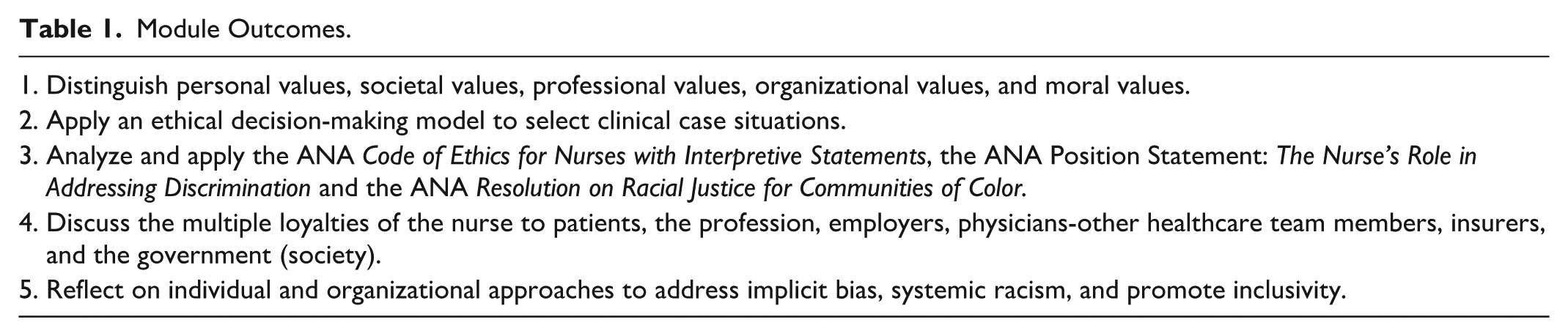
The described work fulfills sub-competencies within two domains of the AACN Essentials: Furthermore, our work fulfills the PhD Core Curricular Element Number 5 (Determinants of Health, Heath Equity, and Social Justice) described by Weaver et al. (2023). The overall module outcomes are provided in Table 1, and the alignment of the sub-competencies and core curricular elements with the module activities and assignments are provided in Table 2.
Module Outcomes.
Module Assignments/Activities and Outcome Alignment.
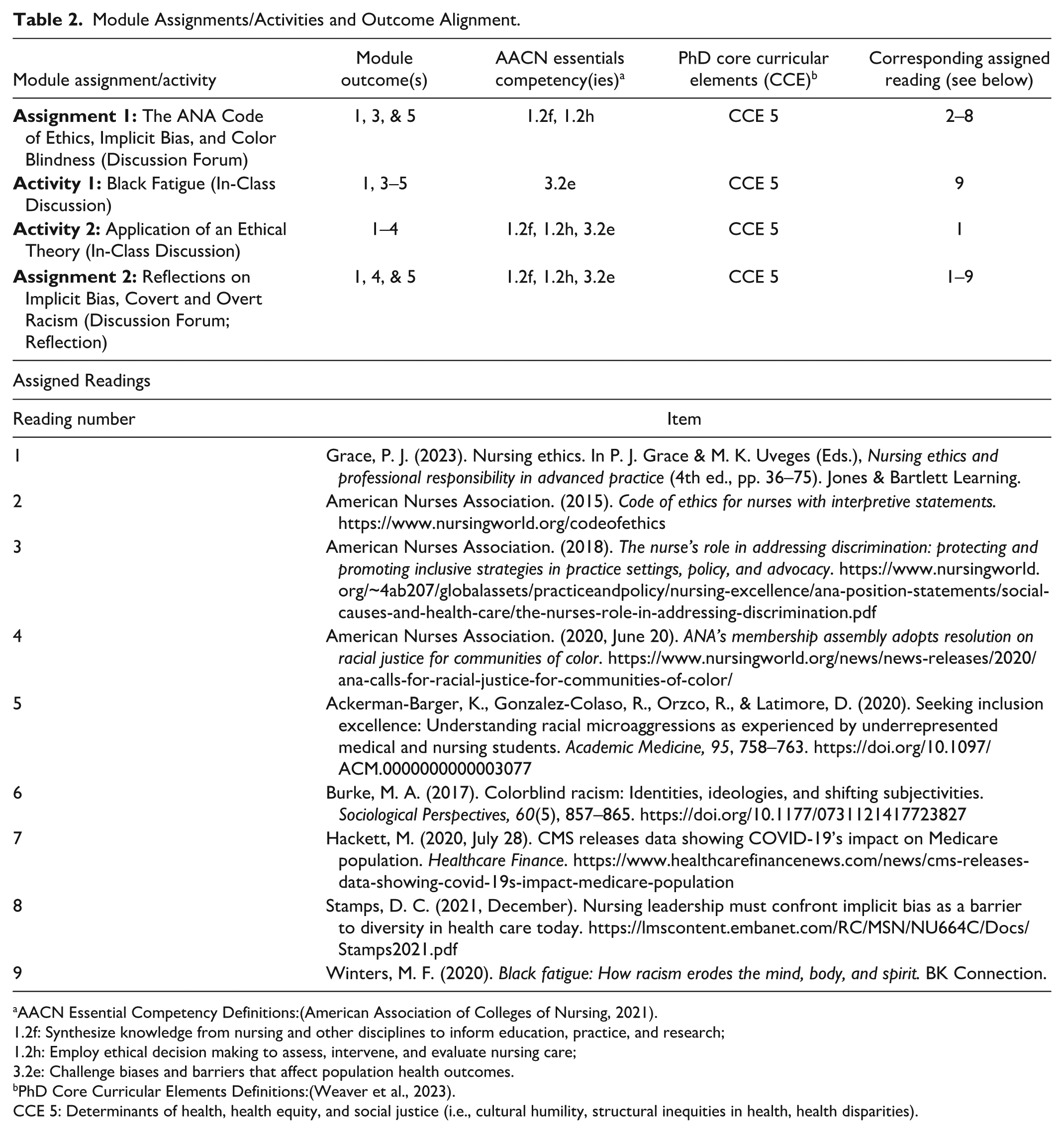
AACN Essential Competency Definitions:(American Association of Colleges of Nursing, 2021).
1.2f: Synthesize knowledge from nursing and other disciplines to inform education, practice, and research;
1.2h: Employ ethical decision making to assess, intervene, and evaluate nursing care;
3.2e: Challenge biases and barriers that affect population health outcomes.
PhD Core Curricular Elements Definitions:(Weaver et al., 2023).
CCE 5: Determinants of health, health equity, and social justice (i.e., cultural humility, structural inequities in health, health disparities).
Method
Conceptualization
Mezirow’s (1997) transformative learning theory guided the curricular revision of this module. Mezirow writes, “A defining condition of being human is that we have to understand the meaning of our experience” (Mezirow, 1997, p. 5). This understanding comes from our ability to interpret our own meanings, rather than what we are told by others. As educators in adult education, it is critical that we nurture students in autonomous thinking to affect change through frames of reference (Mezirow, 1997). Frames of reference are the lenses we use to identify with and define the world around us and are developed through cultural exchanges and familial influences. To effect change, we must work within these frames of reference, helping students grapple with the world they know and then to reconsider their view from a different perspective. Three teaching/learning strategies helpful to affecting change are: instrumental learning, dialogic or discourse, and self-reflection (Kitchenham, 2008) and are presented in Figure 1.
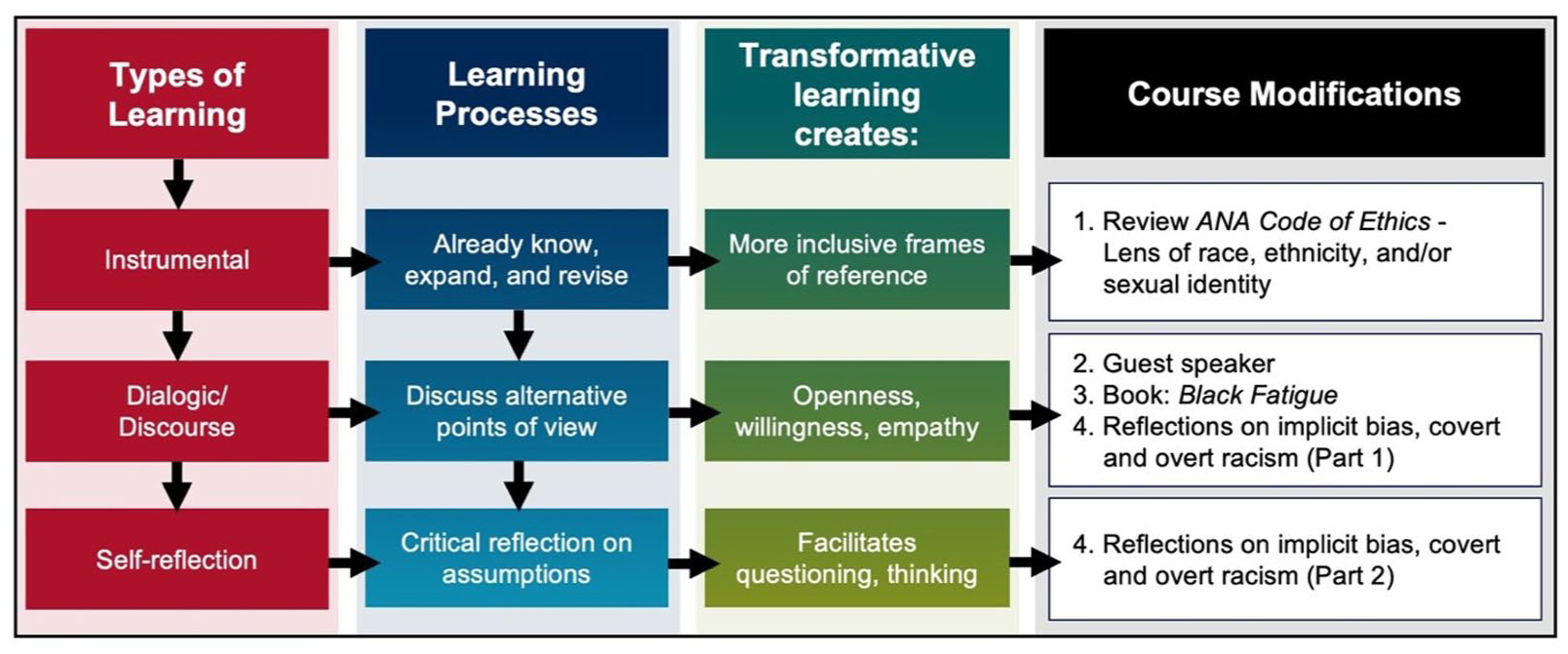
Theoretical Background—Transformative Learning.
Instrumental learning includes working with students from a foundation of what they already know, growing that foundation, and then re-tuning their ways of knowing (Kitchenham, 2008). Discourse or dialogue opens their thinking through conversation and discussion by having students re-examine the existing evidence alongside others’ perspectives (Mezirow, 1997). Together, students process and analyze these differing views to reach a new understanding or lens to consider their world (Kitchenham, 2008). Students then engage in self-reflection of what they previously knew, then compare and contrast it from their new lens of understanding. This critical self-reflection transforms students’ frames of reference by encouraging questions about their prior assumptions and reframing their ways of knowing (Kitchenham, 2008; Mezirow, 1997).
Process
In this curricular revision, we were attentive to the transformative learning tenets. To affect change in students’ frames of reference, we began with instrumental learning and had students review the American Nurses Association (ANA, 2025) Code of Ethics. However, we asked students to review their assigned provisions from the lens of race, ethnicity, and/or sexual identity. Our intent was to take “the Code” as something they knew and to expand and adjust their thinking to have more inclusive frames of reference. We followed this with discourse after students read Black Fatigue (Winters, 2020). Students shared responses to guided questions about the book during class which occurred synchronously (Zoom in-person class) and asynchronously via a discussion forum. A guest speaker, certified in diversity management, shared her knowledge of implicit bias and health outcomes during class and provided real world examples creating a safe space for students to be open and empathetic about others’ experiences with racism. After class, students shared images with their peers from their communities that represent implicit bias, covert, and overt racism in a discussion forum. Critical self-reflection continued, where students reviewed their responses to previous assignments, along with their earlier assumptions. In a 2-page final reflection paper, students shared their previous lens of knowledge with their current lens of understanding, acknowledging change or new insights they had not previously considered (Figure 1).
Implementation
Module Four: Values, Ethical Decision Making, Advocacy, and Racism
This is the fourth of six modules in the course. We have learned that as we begin each module that it is important set the stage; critical to this module is how we introduce the topics of implicit bias, covert and overt racism. Our learning management system provides a content introduction page where we upload and link all the assignments. In this course, all our module introduction pages include a module title, the time frame of the module, and an Elie Wiesel quote. For this module, we selected the following quote from his speech at the Freedom House in 1992: “No human race is superior, no religious faith is inferior. All collective judgments are wrong. Only racists make them” (Wiesel, 1992). Notice how this quote intersects with the content we will be covering. However, because of the students’ familiarity with Wiesel’s work and having his words presented every module, we have not been told by students that they find the use of the word “racist” offensive. We also provide an introduction video to the module, where we share our own implicit biases including our challenges reading the book Black Fatigue (Winters, 2020) and stress to the students that the book is written from the author’s perspective and lived experience.
Assignment 1: The ANA Code of Ethics, Implicit Bias, and Color Blindness
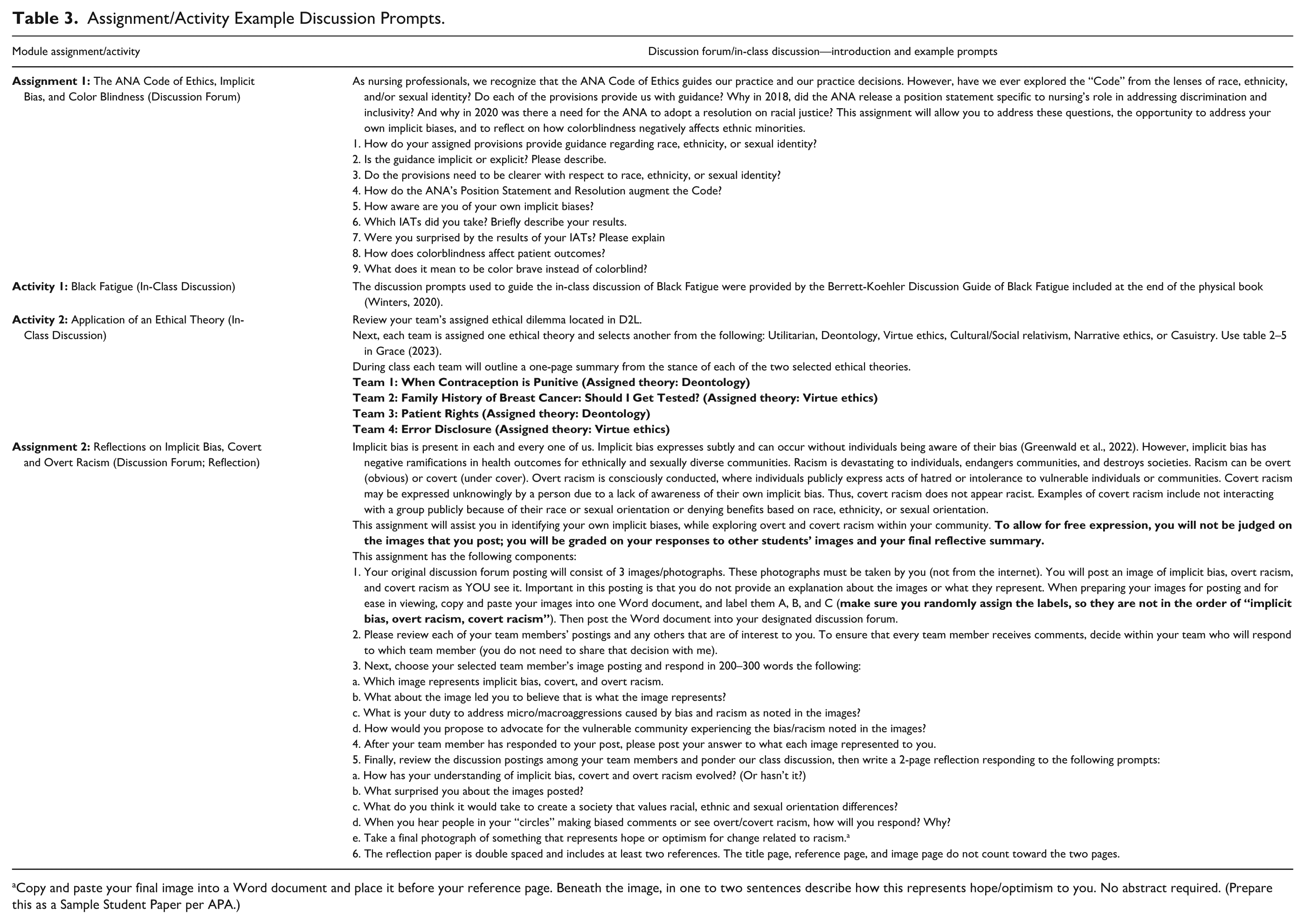
The first assignment focuses on instrumental learning, where students review assigned provisions within the ANA Code of Ethics (i.e., something they already should be familiar with) and provide them the opportunity to review it from a different frame of reference. To expand their perspectives, we added additional readings from the ANA specific to nursing’s role in addressing discrimination and ANA’s resolution on racial justice (Table 2). Our introduction to the module is presented in Table 3.
Assignment/Activity Example Discussion Prompts.
Copy and paste your final image into a Word document and place it before your reference page. Beneath the image, in one to two sentences describe how this represents hope/optimism to you. No abstract required. (Prepare this as a Sample Student Paper per APA.)
Before students analyze their assigned provisions and to introduce the concept of implicit bias, they are expected to review the assigned readings (Table 2), take three Implicit Association Tests (IATs), and watch Mellody Hobson’s Ted Talk, “Color blind or color brave” (Hobson, 2014). The purpose of the evidence-based IAT (Rezaei, 2011) is to provide students a sense of their associations between two concepts (e.g., American Indians, white), two attributes (e.g., good, bad), or two stereotypes (e.g., fat, thin; “Project Implicit,” n.d.) When completing an IAT, it is assumed that when two concepts are closely associated, it will be easier and faster for the person to connect the concepts (Rezaei, 2011); critical to this test is the ability to quickly sort and associate the concepts. After completing the IAT, the individual receives a score indicating bias, neutral, or no bias. More detailed information on the IAT is located on the Project Implicit website (Table 3) (Rezaei, 2011). Hobson’s Ted Talk (Hobson, 2014) provides real world examples of the meaning of being color brave versus color blind regarding race. When students complete the IATs and the Ted Talk, they transition to their assigned ANA provisions and respond to the guided questions within their team’s discussion forum (Table 3).
Activities 1 and 2: Black Fatigue and Application of an Ethical Theory
The next activity occurs during our 3-hr class (via Zoom) is centered in dialogic or discourse learning. Prior to class students have read Mary-Frances Winters book, Black Fatigue (Winters, 2020), responded to guided questions provided by the book publisher, and uploaded their responses to the questions into a dropbox within the course. As noted previously, we begin our class with a guest speaker, who is a diversity expert. She enters the teaching-learning space as a “neutral party”; she doesn’t know them, nor does she grade their responses. She simply engages the students in discourse by asking them to respond to her questions, using the Zoom’s chat function or through speaking. Her presentation is more of a conversation, where she openly shares her own personal biases and emphasizes that we all have bias, which is our personal lens. However, she stresses the need to be aware of our bias and how bias limits our perspectives. This hour-long discussion is rich in discourse, where students, the guest speaker, and faculty openly share their experiences with bias and its impact on others.
After the guest speaker, we begin the book discussion. We share with students our own experience of working with minoritized populations and recognizing how unaware we were of their experiences of bias and racism. We also express our own challenges of reading the book but stress the importance of honoring the author’s story and her perspectives. We are not prescriptive and go through each guided question but instead allow students to select the question that they wish to discuss. We conclude class with team-based learning, where students in their pre-assigned teams, review a different ethical issue with a cultural focus using an assigned ethical theory.
Assignment 2: Reflections on Implicit Bias, Covert and Overt Racism
After class, the focus is on reflection; applying what they knew previously to what they now know. This assignment combines a discussion forum and a 2-page reflection paper, and students have a period of roughly 10 days to complete the assignment (assignment overview provided in Table 3). We introduce the assignment by defining implicit bias, covert and overt racism and then share our expectations (Table 3; please note final sentence in bold).
Evaluation
Despite the challenges in providing a thorough education about implicit bias, covert and overt racism, the students were highly receptive to broadening their viewpoint considering the new information they garnered throughout the module. We obtained permission from students to share snippets of their work or reflections from the course to present in this paper.
Black Fatigue
The first time this book was taught in the course, we did receive feedback from one student that they did not agree with the perspectives presented by Francis-Winters even given their minority race/ethnicity. This was a great learning opportunity for the instructors to reframe how we introduce the assignment to students, affirming that the book is written by a single person from their perspective. We then changed our approach to remind students that they are never required to endorse a particular viewpoint. Rather, we ask that everyone be open to appreciating other people’s experiences as valid. One student expressed her view on the book:
I really did enjoy Black Fatigue. I think it is so important to step into the shoes of someone different from ourselves . . . I thought this book was powerful and important in expanding our understanding of racism in American today.
Another student shared how their perspective shifted as a result of the book and the guest lecturer’s presentation:
I felt [guest speaker’s] lecture was a great follow up after reading Black Fatigue. I find my implicit biases as something that initially comes to my head. She said that they are normal and that we all have them, but it doesn’t mean we shouldn’t challenge them as they occur. I enjoyed . . . the discussion of having a “lens.” We all see the world through a different lens and our lens can change based on our personal experiences. I found myself more aware of my own lens and biases and what experiences I have had that led to this.
Another student shared,
The impactful activity from the semester was reading and our in-class discussion of Black Fatigue. This book challenged my own thinking about my whiteness, my duty as a nurse, and as a global citizen. I enjoyed the lively discussion with my classmates, and I appreciated that the conversation was honest and thoughtful without blindly agreeing with others and yet still respectful and courteous of the content and each other. This reading has given me a passage to act on. I have shared it several times since our discussion but I’ll share it once again in this reflection: “Such care reframes the thinking of the caregiver from ‘what is wrong with this person?’ to ‘what has happened to this person?’” (Winters, 2020, p. 89). I believe that using my privilege to be an ally means reframing my thinking to be of service to others. How can I reframe my thoughts to consider the person, not the stereotype, and take into account what might have happened in their life to shape their behavior?
Reflections of Implicit Bias, Covert and Overt Racism
The student reflections of implicit bias, covert and overt racism were remarkably profound. One student’s final reflection included:
As a future [nurse] leader I want to model my professional and ethical responsibilities by exhibiting principle ethics to my colleagues and my patients. I acknowledge this is much harder than it sounds. I take my professional and ethical responsibilities seriously and want to recognize my own biases where they may be clouding my judgement . . . I want to be a leader . . . in helping patients feel heard and valued. I want to be known as someone who does not only know what is right, but as someone who can be counted on to do what is right, and who will speak up when something is not right.
Another student discussed their perspective of reviewing other students’ pictures and seeing implicit bias, covert and overt racism from their view:
When viewing the photographs of my team members, I noticed that common everyday items or images may represent racism or implicit bias, depending on how the viewer is perceiving the images. Two people define implicit bias or racism differently and view the same photograph differently. White Santa Claus or white Captain America are archetypes that may be viewed differently depending on your race, ethnicity, or gender.
Discussion
It is vital that graduate nursing education include concepts of implicit bias, covert and overt racism. We acknowledge there are challenges due to state and federal policies, but refuse to limit student learning experiences to only ones of comfort. We are not forcing students to endorse any particular viewpoint or change their personal beliefs. Rather, we are encouraging students to take a step out of their personal bubbles and see the world from another perspective in hopes that through seeing the world from another lens, our students can hear another individual’s experience and provide empathetic care.
While feedback from the students was overwhelmingly positive, some students did share discomfort and/or disagreement with the presented material. We anticipated this kind of response from students given each student’s differing worldview. However, we reiterated that our intention was always to provide exposure to other individual’s viewpoints and appreciate their experience, not to abandon personal belief in favor of another. To further emphasize this point, we reminded students that people of any race/ethnicity have personal experiences that shape their view of the world; no two person’s experience is the same. For white persons, the same is true. While no two people have the same experience or viewpoint, that does not discount the validity of another’s personal experience. To become empathetic clinicians and researchers skilled in transcultural caring principles, we need to be willing to hear every person’s story and appreciate their personal context.
Our teaching strategy embraced culturally congruent care, a core construct of the Culture Care Theory (McFarland & Wehbe-Alamah, 2019). This construct emphasizes the importance of understanding others cultural beliefs, values, and lifeways to effectively address health disparities. Furthermore, with our use of active learning strategies, our students experienced a form a culture care repatterning and restructuring. We created safe spaces that supported differing viewpoints, where our students became more aware of how their personal lens or biases can affect the health outcomes of others.
Conclusion
Regardless of state and federal policies, faculty should not fear teaching anti-racist concepts. To teach these potentially highly charged concepts, it is critical faculty create and foster an authentic, intentional, and safe learning environment that encourages students to openly engage in meaningful discourse. This environment should include a variety of large group, small group, and individual work, as well as synchronous and asynchronous activities which include discussion posts that invite questions, discussions, reflections, and responses. As educators, may we equip our students with the tools to engage in meaningful discourse and to appreciate another person’s perspective. In the words of a Lakota elder, “Race is a US census concept. What is important to remember is mitakuye oyasin, ‘we are all related.’ We are all two-legged, we are all human beings.”
Footnotes
Acknowledgements
The authors express sincere gratitude to the students who shared their sincere reflections of this module and graciously provided permission for the authors to use their work for this manuscript.
Data Availability
Raw data for this work is not available for public disclosure.
Declaration of Conflicting Interests
The authors declared no potential conflicts of interest with respect to the research, authorship, and/or publication of this article.
Ethics Approval and Informed Consent
No ethics approval was required for the preparation of this manuscript. All anonymized work from students that is featured in this article was used with their written consent.
Funding
The authors received no financial support for the research, authorship, and/or publication of this article.
