




Abstract
While social norms and metanorms supporting sanctions are essential for norm compliance, their emergence in temporary settings, where long-term repeated interactions and reputational incentives are absent, remains poorly understood. This study analyzes survey, social network (N = 421), and interview (N = 65) data collected from volunteers at three Hungarian music festivals to explore the relationship between sanctioning support and social networks in these transient organizations. The findings show that a clear sanctioning hierarchy can emerge even in such temporary settings. Support for sanctions was strongest for violations that caused immediate operational disruption or direct harm, but far weaker for violations consistent with the festival’s informal, permissive atmosphere. Informal peer regulation mitigated the need for formal sanctions, particularly for lateness, a frequent violation. Different measures of network centrality were associated with distinct sanctioning attitudes: individuals in bridging positions showed stronger support for sanctions, especially for violations that posed a threat to group cohesion, whereas well-connected volunteers showed no consistent support for sanctions. This suggests that in temporary settings, some socially active and central individuals may favor short-term social harmony over the group’s cooperative interests. These findings demonstrate that social control mechanisms are not confined to stable environments but can also emerge in transient settings.
Keywords
Introduction
The effectiveness of work organizations largely relies on members adhering to expected behavioral standards. Free riding and norm violations pose significant risks to the productivity and cohesion of work teams (Bennett et al., 2018). While formal sanctions such as dismissal or suspension exist and can address such behavior, their effective enforcement requires consistent monitoring and is often impractical for addressing all misconduct (Coleman, 1990; Hollinger and Clark, 1982). To complement or replace formal mechanisms, informal social control plays a vital role, operating through coworker behaviors such as disapproval, reputational damage, or exclusion (Axelrod, 1986; Hollinger and Clark, 1982; Horne, 2009; Wittek, 2003).
However, the effectiveness of informal social control and sanctioning behavior depends on shared metanorms, which are second-order norms that specify how individuals should respond to norm violations. Metanorms determine whether sanctioning behavior is perceived as legitimate and necessary, aligning group members and enabling coordinated responses to breaches (Axelrod, 1986; Horne, 2001). Without these shared expectations, individuals may hesitate to act, fearing social backlash or uncertainty about how their actions will be interpreted (Heckathorn, 1989, 1990; Horne, 2009; Oliver, 1980).
Information about norm violations and metanorms flows through social networks, enabling individuals to coordinate responses to norm breaches (Coleman, 1990; Takács et al., 2008) and to form shared expectations through the perception that others also comply (Bicchieri et al., 2022; Desmet and Engel, 2021). By facilitating communication and amplifying social expectations, networks reinforce the legitimacy of informal sanctions and help sustain cooperative behavior within the group (Axelrod, 1986; Takács et al., 2008). Individuals in central network positions have both the social capital and the motivation to enforce norms (Baldassarri, 2015; Coleman, 1988), and local interdependence secures social rewards for such sanctioning efforts through repeated interactions (Coleman, 1990; Horne, 2001, 2009).
Yet, previous research has paid limited attention to how attitudes and actions toward norm violations can support cooperation in settings without long-term repeated interactions. This gap is increasingly important as contemporary work often takes place in transient environments, where collaborations are short-lived and focus on specific objectives. Examples include crisis response teams, software development projects, performing arts productions, and many project teams in which individuals must collaborate with unfamiliar others within a short time period (Burke and Morley, 2016; Di Vincenzo and Mascia, 2012; Sydow and Windeler, 2020). In transient environments, reputation systems and repeated interactions that typically encourage cooperation are largely absent (Coleman, 1990; Kreps et al., 1982; Lundin and Söderholm, 1995; Nowak and Sigmund, 1998), meaning that sustaining collaborative behavior must rely on rapidly developing trust and a sense of community (Blomqvist and Cook, 2018; Livne-Tarandach and Jazaieri, 2021; Meyerson et al., 1996; Philips, 2005).
Accordingly, the present study addresses two main questions: (1) How does the type and severity of norm violations affect support for sanctions in transient organizational settings? (2) How do social ties shape individuals’ attitudes toward sanctioning norm violations in such contexts? To explore these questions, we examine social networks and support for sanctioning norm violations among short-term volunteers at the three largest music festivals in Hungary.
The study contributes to research on informal social control in three ways. First, it provides empirical evidence of the context-dependent nature of sanctioning attitudes and demonstrates that clear sanctioning hierarchies and informal adaptive systems emerge even in temporary groups. Second, the results extend understanding of how social network position shapes attitudes toward norm enforcement in transient contexts. Third, the study addresses the methodological challenges of studying transient groups by combining quantitative survey and social network data with qualitative interview data, providing a rich understanding of informal social control.
The paper is structured as follows: it begins by establishing a theoretical foundation for understanding support for sanctions within organizations and the role of social networks in this process, with a focus on transient groups. It then presents the hypotheses, introduces the collected data and the analytical strategy, and finally, presents and discusses the quantitative and qualitative results regarding the research questions and hypotheses.
Background
Factors shaping support for sanctioning misconduct in a work context
Social norms are expectations about behavior, enforced through rewards and sanctions (e.g., Coleman, 1990; Opp, 1982, 2002), and are central to social coordination and cooperation (Bicchieri, 2006, 2016). Yet, individuals must share not only expectations about acceptable behavior, but also an understanding of the consequences of norm violations. Metanorms are second-order norms that dictate responses to first-order norm violations and determine whether sanctioning behavior should be rewarded, tolerated, or condemned as relational aggression (Axelrod, 1986; Heckathorn, 1990; Horne, 2001, 2007, 2008; Macy and Flache, 1995). By establishing clear expectations that sanctioning is appropriate and necessary, metanorms make sanctioning socially acceptable, a condition essential to sustaining group cooperation (Horne, 2001, 2009; Ohtsuki and Iwasa, 2004, 2006; Podder et al., 2021). While everyone benefits when violators are sanctioned, each individual prefers that others bear the costs of enforcement, creating a second-order free-rider problem (Coleman, 1990; Flache, 1996; Heckathorn, 1989; Oliver, 1980). In social contexts where sanctioning is socially rewarded, individuals tend to participate in norm enforcement because social approval offsets personal costs (Axelrod, 1986; Horne, 2001, 2009). Conversely, in communities where sanctioning is discouraged, social control weakens because benefits do not compensate for the costs, such as retaliation or damaged relationships (Flache, 1996).
Support for sanctions also reflects perceptions of the behavior’s severity in its specific context (Dimant and Gesche, 2023; Eriksson et al., 2021; Horne, 2009). More severe norm violations warrant enforcement by increasing both the moral imperative and potential future costs of non-enforcement (Fehr and Gächter, 2002; Horne, 2009; Jasso, 2001), yethow different forms of deviance are evaluated and sanctioned varies with their specific social and cultural contexts (Eriksson et al., 2021; Gächter and Herrmann, 2009; Henrich et al., 2006; Herrmann et al., 2008). Consequently, understanding the perceived severity of norm violations requires consideration of their surrounding social and cultural environment.
Workplace deviance takes two primary forms, each with distinct targets and consequences. Organizational deviance threatens collective functioning through behaviors such as theft, misuse of company assets, free-riding, and production deviance, including working slowly, taking excessive breaks, or falsifying work hours. Meanwhile, interpersonal deviance directly targets individuals, for example, by obstructing colleagues’ tasks or damaging relationships. While organizational deviance poses immediate threats to productivity and goal achievement, interpersonal deviance disrupts work efficiency by eroding trust and weakening social cohesion (Bennett et al., 2018; Bennett and Robinson, 2000; Hollinger, 1986). Across both forms of deviance, violations that elicit strong emotional responses, undermine cooperation, inflict direct harm on group members, or directly threaten core group objectives elicit stronger support for enforcement than those affecting peripheral activities (Andersson et al., 2024; Gächter and Herrmann, 2009; Herrmann et al., 2008; Thulin and Bicchieri, 2016).
Transient working environments represent a particularly compelling context for examining to what extent various norm violations elicit support for sanctions. These settings bring together individuals from diverse backgrounds for short periods with specific goals, requiring collaboration with unfamiliar others (Burke and Morley, 2016; Di Vincenzo and Mascia, 2012; Sydow and Windeler, 2020). In transient environments, the absence of repeated, long-term interactions, shared expectations, and established reputational systems that typically underpin norm reinforcement (Bicchieri, 2006; Coleman, 1990; Elster, 1989; Matzat, 2004) heightens the risk of free-riding, making such settings more dependent on immediate sanctions, such as exclusion, to manage norm violations (Billiet et al., 2021; Quintane et al., 2013; Wang et al., 2023) and leaving them susceptible to dysfunctional group dynamics (Hällgren, 2010).
Nevertheless, if shared metanorms emerge successfully, they can foster norm enforcement and adherence, in which social cohesion can play a crucial role (Horne, 2009). This study examines whether metanorms develop in a transient setting and how the characteristics of norm violations shape sanctioning attitudes in such a setting. Furthermore, it explores how sanctioning support is embedded in social structures even when stability and shared long-term motivations are absent.
The relevance of social networks for sanctioning support
Norm enforcement cannot be explained solely by individual motives and incentives; social structure shapes both expectations and enforcement patterns (Horne, 2007, 2008), and social networks serve as channels for social control (Takács et al., 2008). The structure and dynamics of social networks, therefore, shape individuals’ attitudes toward social norms and the sanctioning of norm violations (Gelfand et al., 2024). This is a dynamic process: norms shape interactions, while interactions, in turn, influence how norms evolve (Hawkins et al., 2019). Dense networks facilitate coordinated responses to these violations by enabling successful collective action (Coleman, 1988, 1990), and strong interdependence supports norm enforcement through members’ mutual reliance and their interest in preserving relationships that serve their longer-term interests (Horne, 2007). This enables effective third-party sanctioning, in which group members actively punish transgressions to uphold their reputation (Molho and Wu, 2021; Piskorski and Gorbatâi, 2017).
How individuals are positioned within networks also shapes their motivations for norm enforcement. Well-integrated members actively enforce group norms because their social standing depends on network stability and their personal interests align with the group’s functioning (Baldassarri, 2015; Brass, 1984; Bruggeman, 2024; Horne, 2009; Ibarra and Andrews, 1993). Their investment in norm enforcement reflects reputation concerns, anticipation of reciprocal benefits, and a sense of social responsibility toward victims of violations (Blau, 1964; Cialdini and Trost, 1998; McNeely and Meglino, 1994; Moisuc et al., 2018; Pedersen et al., 2018). Beyond motivation, embeddedness also generates compliance through visibility: social relationships make behavior easily observable, creating pressure to conform even when individuals personally disagree with specific norms (Granovetter, 1985; Horne, 2008; Stets and Burke, 2000). This visibility further implies that a small number of well-connected individuals can disproportionately affect compliance, either reinforcing or undermining prevailing norms (Bicchieri and Funcke, 2018). Conversely, peripheral members face minimal monitoring pressure, which makes them more likely to participate in norm-violating acts (Gomila and Paluck, 2020; Takács et al., 2008).
Yet the same network processes that enable enforcement can also help conceal norm violations, particularly when close ties among peripheral members enable them to assist one other in evading group standards (Flache, 1996; Janky and Takács, 2005). In large groups, this concealment is facilitated by monitoring limitations: individuals monitor only their direct contacts, allowing violations to persist within subgroups that are out of central oversight (Harrell and Wolff, 2023). Norm enforcement mechanisms tend to weaken as groups grow larger and connections become sparser (Harrell and Wolff, 2023; Olson, 1965), partly because witnessed violations are more likely to be shared with others than elicit direct confrontation (Estévez and Takács, 2022; Feinberg et al., 2012; Takács, 2022). Violations that go unsanctioned can have broader consequences, as witnessing violations among peers tends to weaken compliance more than observing adherence strengthens it (Bicchieri et al., 2022).
The dynamics of social control and concealment become particularly complex in temporary, large-scale settings. In transient contexts, the absence of repeated interaction and future reputational stakes removes traditional incentives for social control (Baldassarri, 2015; Bicchieri, 2006; Coleman, 1988; Horne, 2001, 2009), and social cohesion may even shield deviant behavior: where group members prioritize preserving social ties over sanctioning violations, deviance goes unchallenged or is even normalized as in-group solidarity (Akkerman et al., 2020). Nevertheless, our understanding of how metanorms and norm enforcement operate in transient natural settings is considerably limited by observational difficulties. To address these limitations, this study examines whether established associations between social integration and norm enforcement are present among festival volunteers.
Festival volunteer work as a context for observing sanctioning support in transient settings
Transient organizational settings pose distinct challenges for informal social control (Kreps et al., 1982; Lundin and Söderholm, 1995). Coordination in such settings emerges through ‘swift trust’ based on demonstrated competence and clear role definitions (Bechky, 2006; Grabher, 2002), while informal networks provide flexible channels for information sharing and coordinating responses to workplace deviance (Grosser et al., 2012; Krackhardt and Hanson, 1993; Nicoll, 1994; Waldstrøm, 2001). Empirical examination of these dynamics remains limited due to methodological challenges in studying temporary groups (Hoffman and Chabot, 2023; Jarman, 2018; Nagy, 2023).
This study addresses this gap by examining attitudes towards norm violations and enforcement among music festival volunteers, where the project-based structure of the volunteer body is combined with a stable core of top management coordinating them (Sydow and Windeler, 2020). Such volunteer arrangements have become increasingly common as younger and more individualistic volunteers prefer well-defined, shorter-term commitments (Cnaan et al., 2022; Handy et al., 2006; Lockstone-Binney et al., 2010; Pozzi et al., 2019) that integrate seamlessly into their lifestyles (Cnaan and Handy, 2005; Handy et al., 2006). Large festivals utilize volunteers for a range of unskilled tasks (e.g., construction, information services, monitoring entrances), reducing operational costs for organizers while granting volunteers free event access, thereby creating a mutually beneficial arrangement.
The festival volunteers in our study sign a contract defining duties, rewards, and formal consequences for non-compliance, with expected behaviors and community standards communicated at a briefing session. These include specific requirements such as pre-shift check-ins and abstaining from working while intoxicated, with sanctions ranging from warnings to wristband removal. Yet formal monitoring is severely constrained: the coordinating organization faces typical principal-agent challenges arising from the number of volunteers, the geographical dispersion of the festival area, and the inherent difficulty of verifying actual performance (Cropanzano and Mitchell, 2005; Steele and Scherrer, 2018). A check-in at the base, for instance, does not confirm that work has commenced or that its quality meets expectations, leaving substantial room for information asymmetry and minimal personal consequences for poor performance. The setting thus combines formal rules with structurally weakened enforcement, where informal control mechanisms offer limited compensation for these gaps, constrained by their own structural limitations due to the transient nature of interactions. This raises the question of what shapes volunteers’ willingness to support norm enforcement under these conditions.
Research questions and hypotheses
Support for sanctioning norm violations among festival volunteers
The general premise is that support for sanctioning norm violations is strongly influenced by the perceived severity of those violations (Horne, 2009; Jasso, 2001). However, perceived severity is highly context-dependent (Gächter and Herrmann, 2009; Herrmann et al., 2008). Festival volunteer settings offer a unique dual context for examining sanctioning attitudes: volunteers must adhere to norms to avoid operational disruptions while also navigating their role as festival attendees in an environment that emphasizes personal freedom. We interpret the perceived severity of norm violations in this context through the lens of this duality, which may create tensions between organizational and leisure norms.
Our central argument is that in transient organizational settings focused on specific, short-term collective tasks, judging the severity of norm violations is heavily weighted towards factors that directly impact immediate operational goals. Violations that directly disrupt operations should be treated as highly severe because of their immediate threat to collective objectives and because they could worsen work conditions for others. For example, a volunteer showing up intoxicated for a shift may be unable to perform duties and create safety risks, and arriving late disrupts shift changes and burdens teammates. We propose that violations that pose a direct threat to operational efficiency or safety will elicit strong support for sanctions because of their clear impact on collective goals.
Beyond violations affecting collective operations, another critical category involves those that inflict direct personal harm through misappropriation of property. In transient settings where the formation of swift trust is crucial (Meyerson et al., 1996), stealing personal items from shared spaces not only violates personal boundaries but also fundamentally undermines the psychological safety and mutual reliance essential for effective collective functioning (Bennett et al., 2018; Bennett and Robinson, 2000; Hollinger, 1986), particularly as leisure and work heavily overlap in the case of festival volunteering. Moreover, some personal property violations may compromise a volunteer’s ability to fulfill work duties, such as when stolen food or gear prevents effective task performance. We therefore expect that violations involving personal property will also elicit strong support for sanctions.
Conversely, the festival’s leisure-oriented environment and emphasis on personal freedom should foster more lenient attitudes towards violations that are primarily leisure-related and lack immediate, tangible operational repercussions, such as excessive off-shift drinking at the volunteer base or bringing unauthorized friends into non-work areas, even when these acts are formally proscribed.
We thus expect a hierarchy in sanctioning support related to perceived severity in the context of festival volunteering (Gächter and Herrmann, 2009; Herrmann et al., 2008; Thulin and Bicchieri, 2016), prioritizing the smooth functioning of the temporary work system and minimizing direct personal harm over regulating leisure-related behaviors.
Volunteers will express significantly stronger support for sanctioning norm violations that directly threaten work-related operational efficiency and safety (e.g., arriving for a shift in an unfit state or being substantially late) than for sanctioning other norm violations related to leisure activities that occur outside of direct work tasks and do not pose an immediate, clear threat to operational functioning or collective safety.
Norm violations that inflict direct personal harm on other volunteers or involve the misappropriation of their personal property (e.g., stealing food or essential belongings from shared spaces, or unauthorized use of critical items such as chargers) will elicit stronger support for sanctioning than leisure-related violations that do not involve such direct personal harm (excessive drinking at the base, letting strangers into the volunteer base, littering at the base).
The role of social networks in support for sanctioning norm violations
In traditional organizations and long-term settings, it is well established that embedded individuals who have more to lose from disruptions to group functioning are more likely to support norm enforcement than their more isolated counterparts (e.g., Baldassarri, 2015; Coleman, 1990; Gomila and Paluck, 2020; Ibarra and Andrews, 1993). Our second research question concerns how volunteers’ level of integration within emergent social networks is associated with their attitudes toward sanctioning norm violations.
While conventional social control mechanisms, such as long-term repeated interactions, stable hierarchies, and established reputation systems, are largely absent in transient settings like festival volunteering (Baldassarri, 2015; Bicchieri, 2006; Coleman, 1988; Horne, 2001, 2009), these environments still offer structured and informal opportunities for connection. Through shared tasks, group activities, and shared spaces (Feld, 1981; Hachen et al., 2024; Rimé and Páez, 2023), these short-term interdependencies can foster ‘swift trust’ and meaningful social ties (Grabher, 2002; Meyerson et al., 1996). Although temporary settings may encourage the toleration of violations to preserve short-term harmony (Akkerman et al., 2020), we argue that the short-term social interdependencies among festival volunteers create real stakes in group functioning. Therefore, building on established findings from stable environments, we propose that as individuals become more socially integrated within the festival environment, their investment in collective well-being strengthens, thereby motivating greater support for sanctions (Baldassarri, 2015; Coleman, 1990).
We examine this through multiple measures of social integration. Beyond the sheer number of connections (Freeman, 1978) or complete isolation (Borgatti et al., 2018), we consider volunteers’ relative popularity (defined as the difference between received and initiated mentions) and their brokerage positions among other volunteers (captured by betweenness centrality). Those in brokerage positions connect otherwise separate groups and control information flow between them, and are thus motivated to maintain network cohesion (Burt, 2005). Volunteers in brokerage positions are those who spend their time across different social circles. Although the transient nature of the festival may limit volunteers’ conscious awareness of their network position, those in bridging roles still experience the practical reality of connecting different social circles (e.g., eating lunch with one group of volunteers and attending concerts with another). This lived experience of spanning diverse social segments can foster a broader perspective on the group’s overall functioning and heightened sensitivity to threats against its stability, thereby motivating stronger support for sanctions that uphold norms essential for maintaining overall cohesion.
We therefore expect a positive relationship between volunteers’ connectedness and embeddedness and support for sanctions, although the simultaneous measurement of networks and attitudes during the festivals limits causal claims (McPherson et al., 2001).
Volunteers with more connections within the volunteer social network (as indicated by forming more social ties with other volunteers during the festival) are more likely to express stronger support for sanctioning norm violations compared to less connected volunteers.
Volunteers occupying structural brokerage positions within the volunteer social network are more likely to express stronger support for sanctioning norm violations compared to those in less central brokerage positions.
Data and measures
Participants and data collection
Data were collected at Hungary’s three largest music festivals in 2023, which lasted 4, 5, and 6 days, respectively. The study targeted all volunteers coordinated by the same organization, which specializes in managing volunteers for mega-events in Hungary and provides festival volunteer services. 146, 86, and 651 volunteers were contracted across the three festivals. Volunteers served as temporary staff within the project firm (i.e., the volunteer organization), and their unskilled physical labor was compensated with free entry to the festival, a hot meal on working days, and dedicated volunteer spaces.
Our data collection combined quantitative surveys with qualitative interviews in Hungarian and English (Figure 1). Data collection took place at the volunteer base, which functioned as the administrative and social center of the temporary community. In the first survey stage, volunteers who received orientation at the volunteer base were asked to participate in our study. Participation was voluntary and compensated with small, guaranteed gifts and some prizes. Volunteers accessed the surveys via QR codes on their mobile phones through a custom web platform. While user accounts were required for the platform to prevent duplicate responses and distribute prizes, only an anonymous ID was recorded with the survey answers. Volunteers provided informed consent before completing short surveys on socio-demographic characteristics, pre-existing relationships (ego-networks), and motivations. The second survey round took place near the end of the festival and measured networks formed during the event and attitudes toward norms. The quantitative data collection achieved participation rates of 86%, 95%, and 70% across the three festivals. For our analysis, we used data from 421 volunteers (N1 = 57, N2 = 60, N3 = 304) who completed both rounds of surveys, including the norm and social network questionnaires. Data collection and fieldwork.
Between the two survey rounds, we conducted 65 semi-structured interviews. While interview participation was voluntary and anonymous, only volunteers who had completed the first survey round were eligible. Interviews lasted 25-30 minutes and included 28 questions designed to explore a range of topics related to norms and norm violations, including: volunteers’ understanding of formal rules (e.g., regulations for the volunteer base, job-specific duties) and informal social norms; their direct or indirect experiences with rule violations; the perceived consequences and attitudes towards such acts; and the social dynamics of the volunteer community, such as peer tolerance, conflict resolution, and social enforcement of formal and informal norms.
Measures
Dependent variables
We asked participants about a predefined list of norm violations, including those specified in the volunteer contract and explained upon arrival by the coordination team, as well as those not included in the contract but emphasized during the briefing: being late for shifts, bringing in outsiders, showing up for work in an unfit state, excessive alcohol consumption at the volunteer base, littering at the base, taking items from the common fridge without permission, and using others’ chargers without permission. The list of norm violations was defined through communication with the volunteer organization and a pilot study conducted at one of the sites in a previous year. Then, in the present study, volunteers rated their support for sanctioning another volunteer and, separately, a friend for each listed behavior on a 5-point scale (1 = strong disagreement, 5 = strong agreement), using the following item: “What is your opinion about someone/a friend of yours receiving a warning or punishment for any of the listed behaviors?”. This wording aligns with the core concept of metanorms, as it captures attitudes toward the sanctioning of norm violations rather than the violations themselves, and reflects the range of sanctioning practices present in the festival context.
For each norm violation, we constructed a composite measure by averaging responses to sanctioning ‘any volunteer’ and a ‘friend’ (Figure 2). Volunteers tended to be slightly more lenient toward friends. These moderate differences were significant for taking belongings from the fridge (4.36 vs. 4.14), showing up unfit for work (4.30 vs. 4.10), being late for one’s shift (3.69 vs. 3.52), and consuming alcohol excessively at the base (3.94 vs. 3.84). Nevertheless, Cronbach’s alpha values indicated consistent attitudes for any volunteer and friends for most violations, with somewhat lower consistency for taking items from the fridge (α = 0.72). The overall high reliability supported the use of these composite measures in further analysis. Mean attitudes toward sanctioning a friend, any volunteer, and overall. Stars are based on Wilcoxon p-values comparing attitudes toward any volunteer and friends, with p-values adjusted using the Benjamini-Yekutieli procedure for the number of pairwise tests performed (7 tests). ***p < 0.001, **p < 0.01, *p < 0.05. α = Cronbach alpha for the composite attitude measure (sanctioning any volunteer vs. a friend).
Independent variables
Our main independent variables captured characteristics of volunteers’ social network positions within the temporary organizational setting. We measured both pre-existing relationships and ties formed during the festival, normalized by the total number of possible direct ties at each festival. Beyond degrees, we calculated relative popularity (difference between received and sent nominations) and brokerage positions among volunteers (betweenness centrality). We also categorized volunteers’ integration patterns based on the presence of pre-existing ties and connections formed during the festival. All network measures and additional control variables are detailed in Supplemental Material Table I.
In addition to agreement with sanctioning different types of norm violations, we also assessed several other aspects of the predefined types of norm violations in the survey: whether the participant was bothered by/heard about/witnessed/committed a certain kind of norm violation.
Analytical strategy
Hypothesis 1a and 1b
We compared the overall means and variances across norm violations. The Pitman-Morgan test was used to evaluate whether the variances in attitudes toward sanctioning (measured as the mean of attitudes toward sanctioning any volunteer and a friend) differed. To address multiple comparisons and potential dependencies among test results, we applied Benjamini-Yekutieli-adjusted p-values (Chen et al., 2017). Furthermore, we compared the distributions of each pair of attitudes toward sanctioning using the Wilcoxon test for paired samples, applying the same adjustment for multiple comparisons.
Hypothesis 2a and 2b
We tested the effects of social networks on sanctioning support by applying ordinal regression models with a probit link to a 4-category dependent variable, after progressively ruling out other potential approaches. We tested models with festival fixed effects, but the Brant test indicated overparameterization, and random intercepts showed negligible variability across festivals (<0.001). The final models use clustered standard errors by festival without festival fixed or random effects.
Linear regression on the aggregated attitude measures resulted in poor model fit due to violations of model assumptions. Therefore, we applied ordinal regression models to 9-level variables derived by averaging the two 5-point scales (attitudes toward sanctioning volunteers and friends). Brant tests (Brant, 1990) revealed violations of the parallel lines assumption, suggesting that the relationship between the predictors and the outcome variable differs across levels of the dependent variable. This violation indicates that the model is not appropriate for these dependent variables, as it assumes that the effects of the predictors are consistent across all outcome categories. To address this issue, we systematically tested different coding of the dependent variables (3-, 4-, and 5-point scales). A 4-point scale was adequate to satisfy the criteria, with categories: 1, 1.5, and 2 labeled “low”; 2.5 and 3 labeled “medium”; 3.5 and 4 labeled “high”; and 4.5 to 5 labeled “very high.” A three-category approach would have oversimplified the response patterns, and a five-point scale still violated the assumption of parallel lines. The distribution for the dependent variables used in the ordinal models is presented in Supplemental Material Figure II.
Results
The difference in support for sanctioning norm violations
Our hypotheses predicted stronger and more uniform support for sanctioning work-related norm violations (H1a) and norm violations that directly harm other volunteers, beyond those related to work (H1b). Figure 3 visually describes these comparisons. The left panel shows pairwise differences in mean sanctioning support, while the right panel shows differences in response variances (indicating consensus), with darker shades indicating larger differences. Difference in means and variances of the overall attitudes. Notes. Left panel (Differences in Means): Cells show the mean sanctioning score for the norm violation in the row minus the mean sanctioning score for the norm violation in the column. Right panel (Differences in variances): Cells show the variances for the norm violation in the row minus the variance for the norm violation in the column. Blue shades indicate the row value is higher; red shades indicate the column value is higher (darker shades for larger differences). p-values are adjusted by the Benjamini-Yekutieli adjustment based on the number of pairwise tests performed (21 tests). Wilcoxon (left) and Pitman-Morgan (right) tests for paired samples. ***p < 0.001, **p < 0.01, *p < 0.05 sanc1 = Was late for their shift, sanc2 = Brought in an outsider, sanc3 = Showed up for work in an unfit state, sanc4 = Consumed alcohol excessively on the base, sanc5 = Littered on the base, sanc6 = Took others’ belongings from the fridge without permission, sanc7 = Used someone else’s charger without permission.
Descriptive results provide partial support for our hypotheses. While work-related violations were expected to elicit uniformly strong attitudes toward sanctioning, our findings revealed considerable variation. Supporting Hypothesis 1a, showing up for work in an unfit state, a violation threatening operational safety, received the second highest support for sanctioning (Moverall ≈ 4.17, SDoverall ≈ 0.97) with mean sanctioning attitudes significantly higher than nearly all other violations (Figure 3, all p < 0.001 except theft from fridge). However, contradicting expectations, being late for shifts, another work-related violation, elicited only moderate sanctioning support (Moverall ≈ 3.6, SDoverall = 1.03), comparable to attitudes toward littering. This suggests that being related to work alone does not determine whether stronger sanctioning support is elicited; rather, perceived operational impact appears to be the critical factor. Qualitative analysis provides further insight into why lateness may be viewed more leniently and less disruptive than other work-related violations (see the dedicated section).
The results largely support Hypothesis 1b. As predicted, attitudes toward sanctioning varied substantially depending on whether violations involved the misappropriation of personal property that inflicted direct personal harm, compared to leisure-related violations lacking such harm. Theft from the shared fridge, a clear case of personal property misappropriation, elicited the strongest sanctioning support overall (Moverall ≈ 4.22, SDoverall ≈ 0.98), with mean attitudes significantly exceeding those for all other leisure-related violations (Figure 3, all p < 0.001).
In contrast, leisure violations without direct personal harm received considerably lower sanctioning support: bringing in an outsider (Moverall ≈ 2.93), excessive alcohol consumption on base (Moverall ≈ 3.85), and littering (Moverall ≈ 3.72) were all viewed more leniently, consistent with their lack of direct harm to individual volunteers. Unauthorized charger use, despite involving personal property, was among the most leniently viewed violations (Moverall ≈ 3.26), with the second-highest variance (SDoverall ≈ 1.24). This high variance suggests that respondents evaluated charger use in a highly context-dependent manner. These findings support Hypothesis 1b while revealing important distinctions: food theft generated strong sanctioning support as predicted; leisure violations received low support as predicted; and charger use, though involving personal property, received similarly low support, suggesting that the nature and perceived severity of harm matter more than property involvement per se.
Social networks and support for sanctioning norm violations
Figure 4 displays the results from ordinal regression models for attitudes toward the seven predefined norm violations. We find partial support for the positive effect of social integration within the volunteer community on attitudes toward sanctioning norm violations. Consistent with Hypothesis 2b, volunteers in network brokerage positions (i.e., those with high betweenness centrality) showed stronger support for sanctioning across several violations, with significant positive coefficients observed for arriving late to work, working in an unfit state, excessive drinking, littering, and using someone’s charger. Conversely, socially isolated volunteers, defined as those without pre-festival ties who formed no new free-time connections during the festivals, showed less support for sanctioning lateness and the two most consensually recognized violations among volunteers (working in an unfit state and taking others’ food from the fridge), while showing greater support for sanctioning a less widely agreed-upon violation (taking someone’s charger). Ordinal Regression Results for Attitudes towards Sanctioning Various Norm-Violations. Notes. Late: Was late for their shift. Stranger: Brought in an outsider. Unfit: Showed up for work in an unfit state. Alc base: Consumed alcohol excessively on the base. Litter: Littered on the base. Fridge: Took others’ belongings from the fridge without permission. Charger: Used someone else’s charger without permission. Probit link function. Bottom three rows: Ordinal model cut points (thresholds) representing the boundaries between response categories on the latent attitude scale: Low|Medium, Medium|High, and High|Very High.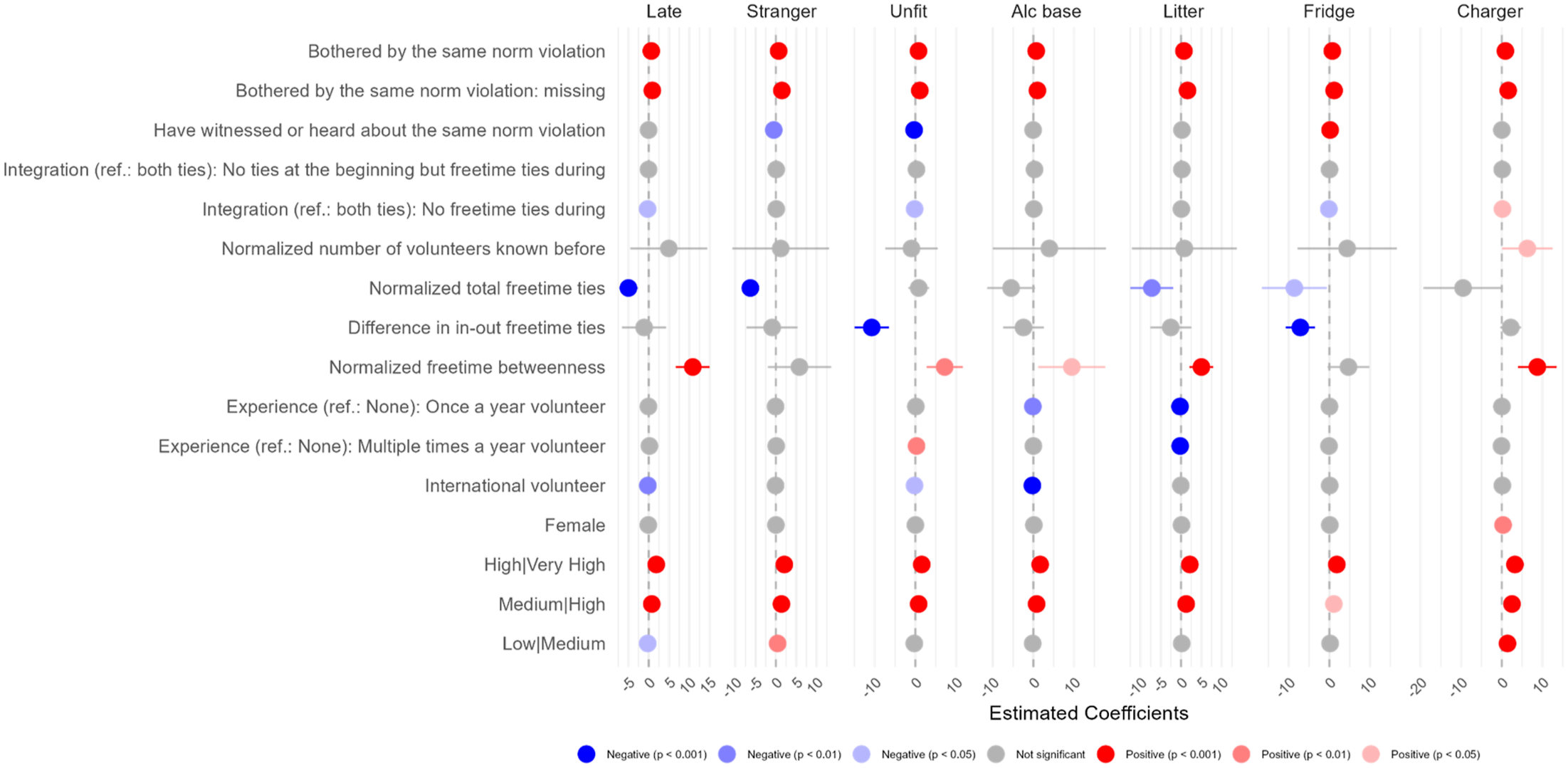
However, we found no support for Hypothesis 2a. Contrary to our prediction, well-connected or popular volunteers did not show stronger support for sanctioning norm violations. Instead, we found either no significant effects or the opposite pattern. Being more engaged with other volunteers was associated with significantly more lenient attitudes toward sanctioning arriving late for work, letting strangers into the volunteer base, littering at the base, or taking other volunteers’ belongings from the fridge (see the normalized free-time ties row for these columns). Additionally, popularity among volunteers (measured as the difference between incoming and outgoing free-time ties) was significantly negatively associated with support for sanctioning working in an unfit state or taking others’ belongings from the fridge, as indicated by the negative coefficients for the difference in incoming and outgoing free-time ties for these columns.
Volunteers who were personally bothered by a norm violation were more likely to support sanctioning it across all violation types (coefficients ranging from 0.64 to 0.88). Exposure through witnessing or hearing about a violation showed a more mixed pattern: those exposed to bringing in outsiders or working in an unfit state were less likely to support sanctioning these violations, whereas exposure to fridge theft was associated with a slight increase in support for sanctions. International volunteers showed less support for sanctioning certain norm violations than local volunteers, such as arriving late for work, arriving in an unfit state, or consuming excessive alcohol at the volunteer base.
As a robustness check, we examined each network variable separately as well (see Supplemental Material Figure III). While our core conclusions remained robust across specifications, the separate models revealed some nuances. The separate models show that the bridging role (high betweenness) is consistently associated with stronger sanctioning support across most violations. However, this association was not statistically significant for littering and unauthorized charger use when tested without the other network measures. Well-connected volunteers were not more likely to support sanctioning even in models without the betweenness measures. However, their more lenient attitudes towards letting in strangers and taking others’ belongings were not significant either. The most notable difference across models emerged regarding support for sanctioning lateness. While being well-connected was positively associated with supporting sanctions when examined without the other network measures, this effect flipped to a significantly negative association in our main, full model. The sign reversal for lateness likely reflects the correlation between the two centrality measures: in the full model, the degree coefficient reflects well-connectedness controlling for betweenness, indicating that volunteers who are well-connected but not bridging otherwise separate groups show greater tolerance for lateness.
Qualitative evidence and interpretative models from interviews
Qualitative interviews aimed to provide a deeper understanding of volunteers’ perceptions of norm violations and their willingness to sanction them. The interviews were organized around a fixed set of broad questions on norms and attitudes toward sanctions. We then conducted inductive thematic analysis on the transcripts, which generated data-driven sub-themes and highlighted the most salient norms, breaches, and attitudes on sanctions. The qualitative results revealed patterns that aligned with the hypotheses and complemented the quantitative findings.
The interviews revealed that volunteers differentiate between norm violations, distinguishing harmless rule-bending from genuinely disruptive behavior, reflecting their capacity to self-regulate within acceptable boundaries. Certain norm violations were largely framed as inconveniences rather than serious transgressions, eliciting lenient responses from fellow volunteers. For example, in the case of alcohol consumption at the volunteer base, participants expressed tolerance as long as others were not disturbed: “it became a tolerated thing, as long as there’s no major drunkenness” or “I’m not bothered by smoking or drinking, as long as they keep it moderate”.
In contrast, norm violations perceived as disruptive to the collective well-being or posing potential danger elicited stronger disapproval and a greater inclination to impose sanctions. Although theft from the shared fridge or alcohol consumption during shifts were infrequently observed, there was strong consensus on their unacceptability. One volunteer described food theft as creating “general distrust.” Alcohol consumption during shifts was particularly condemned: “if someone goes to work drunk, it damages the reputation of volunteers”, “It harms the volunteer work, and creates uncomfortable situations.” Another noted, “I won’t report anyone […] but let’s say the first aiders shouldn’t be drunk”. These infractions were generally regarded as clear norm violations warranting intervention, though only a few interviewees reported informing coordinators. Nevertheless, such transgressions caused tension, especially when individuals avoided consequences simply because their roles made detection difficult. One volunteer noted that some intoxicated colleagues were “just not in a position where it would be discovered,” expressing frustration at the perceived double standard: “It bothered me a bit why some can and others cannot”.
Concerns about the volunteer group’s reputation also shaped responses to norm violations. Several participants felt that rule-breaking could reinforce negative perceptions of volunteers among festival staff and guests. As one interviewee stated: “Breaking the rules would harm the volunteer community; if someone did not do their job well, it would reinforce staff stereotypes that volunteers aren’t important.” Another noted, “If there were a disagreement between a volunteer and a guest, it would reflect badly on the entire volunteer group.”
Lateness emerged as a particularly ambivalent issue. While it was the most frequently discussed norm violation, reactions varied considerably depending on the situation and relationships involved. Of the 65 interviewees, 26 explicitly stated that minor, communicated delays were not a serious problem. Volunteer viewed those cases with flexibility and leniency: “I can accept lateness if there’s a valid reason. If you oversleep it annoys me a bit, but it can be overlooked” and “few minutes of lateness don’t bother me […] five minutes of lateness is completely acceptable” or “lateness bothers me to a certain extent, let’s say after 15 minutes”, highlighting the role of communication in smoothing over these situations among volunteers: “everything else is okay, as long as they’re informed” or “I am lenient if I am informed in advance”. In contrast, nine interviewees identified lateness as problematic, especially when repeated. They noted that it disrupted workflow and undermined group cohesion. Despite such concerns, volunteers tended to avoid formal sanctions.
When discussing responses to norm violations more generally, interviewees consistently expressed reluctance to formally report transgressions, often citing a shared sense of mutual dependence or community. Some explicitly stated their refusal to report peers: “I’m not going to snitch on anyone”, while acknowledging mutual dependence: “We can only snitch on each other”. Volunteers frequently engaged in mutual covering behaviors, shielding one another from potential consequences. This was not necessarily seen as deception, but rather as an expression of solidarity. Examples ranged from minor accommodations to more significant interventions, such as: “there’s a kind of honorable camaraderie among volunteers”, or “There was one time when he showed up drunk, and I had to cover for them”, and “Sometimes it happens, but nothing very serious—like when they wanted to talk to their friend for half an hour, and I would say they were in the bathroom if someone asked”.
Beyond the abovementioned behavioral transgressions, a few interviewees mentioned harmful behaviors that were not formally regulated. Notably, concerns regarding racial, gender, and ethnic discrimination were raised, particularly among international volunteers. These were not described as isolated incidents but as broader threats to group cohesion.
Overall, interviews indicate that even in these temporary organizational settings, volunteers developed informal regulatory norms that extended beyond formal rules. These norms balanced group solidarity with the need to maintain functioning and co-existence.
Discussion
Our investigation of attitudes toward sanctioning in transient settings provides insights into how both network position and the contextual features of norm violations shape sanctioning support when traditional mechanisms of long-term repeated interactions are absent. The findings yield partial support for our hypotheses, and reveal that while social control mechanisms emerge in transient settings similarly to traditional contexts, notable differences also exist.
We found substantial differences in sanctioning attitudes across different types of norm violations, which were only partially consistent with our hypotheses (Hypothesis 1a and Hypothesis 1b). As predicted, volunteers strongly supported sanctions for norm violations that disrupted operational functioning (showing up for work in an unfit state) or caused direct harm to other volunteers (taking others’ belongings from the fridge), with both receiving significantly higher sanctioning support than other norm violations. This sanctioning preference for violations that disrupt operations or harm others reflects both self-interest and emerging group identification. From a self-interest perspective, volunteers supported sanctions for behaviors that might impede their work or threaten their belongings. Our qualitative analysis supplement this with group-level concerns, with volunteers expressing worry about collective reputation, noting that violations ‘would reflect badly on the entire volunteer group’.
However, we observed important exceptions to this general pattern of strong support for sanctions protecting operations and personal property. Unlike violations such as showing up unfit for work (an operational disruption) or taking food from the fridge (a personal property violation), volunteers showed much weaker support for sanctioning being late or using others’ chargers without permission. These exceptions suggest that even in transient groups, perceived severity emerges as adaptive and flexible, reflecting the social reality, and informal social control mechanisms develop accordingly.
Unauthorized charger use, for instance, was evaluated context-dependently (as indicated by the low overall consensus) rather than as a clear-cut transgression and was potentially viewed by some as an act of volunteer solidarity. This interpretation is supported by our findings on socially isolated volunteers who were more likely to support sanctioning of charger use, even while sometimes showing more leniency towards other, more universally condemned transgressions. Lacking dense social ties or shared understandings that might frame such borrowing as acceptable within an ingroup, isolated individuals may adhere more strictly to formal property boundaries or perceive these acts as more direct personal violations.
Moreover, despite being a common operational disruption, lateness elicited only moderate support for sanctions. Volunteers established informal protocols for managing this behavior among themselves, as revealed by our qualitative analysis. These informal practices included subjective thresholds for acceptable and unacceptable lateness and expectations for advance communication. The widespread occurrence of lateness likely contributed to its normalization, consistent with empirical evidence on the effect of peer behavior on norm compliance (Bicchieri et al., 2022; Desmet and Engel, 2021).
Turning to the associations between social network positions and support for sanctions for different types of norm violations, our findings support Hypothesis 2b, but fail to support Hypothesis 2a. We predicted that better-connected and embedded individuals would demonstrate stronger support for sanctioning norm violations. We found that, in many respects, integration into social networks in our transient context operated similarly to that in permanent settings. Individuals in bridging positions were more likely to support sanctions for most norm violations. This finding aligns with the broader social network literature, which suggests that individuals in bridging positions are deeply invested in maintaining group cohesion because their position depends on successfully integrating multiple parts of the group (Burt, 2005; Estévez and Takács, 2022). Isolated volunteers were less likely to support sanctioning several norm violations, probably because they had reduced motivation to maintain collective standards when informal relationships with other volunteers were unlikely (Gomila and Paluck, 2020). These results suggest that even in temporary settings, embeddedness in social networks is associated with engagement and support for norm enforcement.
However, being merely well-connected and popular in the volunteer social network did not produce the same patterns of support for sanctioning norm violations. Well-connected volunteers, in general, were not consistently invested in sanctioning and in some cases, well-connected and popular individuals even appeared more likely to be lenient toward norm violations. For instance, popular individuals (those whose incoming ties dominated their outgoing ties) demonstrated more lenient attitudes toward sanctioning showing up for work in an unfit state and taking other volunteers’ belongings from the fridge, which the broader group would typically sanction more harshly.
These findings suggest that the association between social integration and support for sanctions differs in some respects from that observed in permanent settings, where well-connected individuals often advocate for strict sanctioning to protect their social standing and ensure future cooperation (Baldassarri, 2015). This divergence in transient contexts, however, does not necessarily mean that established arguments about network integration promoting norm enforcement are incorrect, nor that such effects are outweighed here. Rather, our results suggest that different facets of integration into social networks can activate distinct responses to norm violations.
The lack of prospects for long-term relationships and reputational concerns (Coleman, 1990), make the consequences of norm violations more immediate but less enduring in transient settings. This may explain why well-connected and popular individuals prioritize the immediate benefits of maintaining harmony within their social circles (e.g., social enjoyment, reciprocal favors) over the collective benefits of norm enforcement for the broader volunteer community (Akkerman et al., 2020; Flache, 2002). This interpretation is consistent with our qualitative findings, which show that volunteers often expressed reluctance to formally report transgressions due to a sense of mutual dependence and an emphasis on having a good time and maintaining harmonious relationships.
A key limitation of our study is the concurrent measurement of network positions and sanctioning attitudes at the festival’s end. While the time-compressed nature of the setting necessitated this approach, it prevents us from making causal claims about whether network position shaped attitudes or vice versa (Steglich et al., 2010). Future research would benefit from collecting data about how attitudes towards norms and norm violations develop over time, though this presents significant challenges in temporary organizational settings.
While our findings derive from a specific volunteer context, they offer important insights into how temporary organizing shapes social control mechanisms. Our results reveal that many social mechanisms of norm enforcement operate in ways similar to those of permanent organizations. We observed the development of clear, context-specific sanctioning hierarchies within the festivals’ short timeframes. Even without long-term interaction, normative orders appear to crystallize quickly around immediate functional necessities and salient contextual cues, with strong support for sanctioning violations that cause operational disruption or direct harm, alongside greater tolerance for behaviors congruent with the leisure-oriented setting itself. This informs theories of norm and metanorm development by demonstrating how swiftly such priorities can be established. Additionally, we provide empirical evidence of how informal adaptive mechanisms emerge even in transient settings to manage common violations, such as lateness, illustrating how groups can efficiently address minor infractions through self-regulation .
Regarding the association between social network positions and sanctioning attitudes in these transient environments, the observation that individuals in bridging roles generally support sanctions conducive to group cohesion points to the relevance of such structural positions for maintaining order, even in short-lived groups. Nevertheless, an interesting nuance emerged: those who were merely popular or well-connected were not more supportive of sanctions and often exhibited greater leniency towards certain norm violations. This suggests that for these individuals, the preservation of immediate social harmony may be a more salient consideration than the broader well-being of the community. This indicates that the various aspects of social integration are associated with distinct sanctioning attitudes in temporary settings.
Our findings offer several practical implications for managing transient working groups, such as those in festival volunteering. Since violations that threaten operational integrity consistently receive strong support for sanctions, formal enforcement of these behaviors is likely to be perceived as legitimate rather than imposed. For violations such as lateness that induce lenience among peers and informal self-regulatory responses, coordinators should avoid rigid enforcement that might undermine the development of naturally emerging peer coordination. Instead, they can support emergent informal regulation by encouraging peer communication while establishing clear boundaries for when formal intervention becomes necessary. Finally, management can foster conditions for organic self-regulation by framing rules in terms of collective reputation and community well-being, which could also help address property violations such as theft. Creating opportunities for interaction among different subgroups can strengthen the overall social fabric and enable the natural emergence of cohesive and sanction-supporting dynamics related to bridging positions.
Supplemental material
Supplemental material - Social networks and the emergence of informal norms and metanorms in transient working groups
Supplemental material for Social networks and the emergence of informal norms and metanorms in transient working groups by Eszter Vit, Eliza Bodor-Eranus, Béla Janky, Zsuzsanna Szvetelszky, Beáta Lázár, Károly Takács in Rationality and Society.
Footnotes
Acknowledgments
The authors thank key partners who contributed to the success of the project by granting access to their venues or events or by providing incentives to encourage survey participation: Festival Volunteer Centre, Flumina Magna Kft, Balaton Sound Festival, Campus Festival, Sziget Festival, Typotex Publishing, Pannon Work Zrt, Károli Gáspár University of the Reformed Church in Hungary, Lidl, Metro. These organizations were not involved in the research process or the preparation of this manuscript. We would like to thank the app designer, Péter Bodó; Anna Mária Bartal for her scientific help and guidance on volunteer work and motivations ; and Ákos Bocskor for his help in the fieldwork and methodology. We are very grateful to the research assistants who helped with the data collection: Csenge Csernus, Tamás Balázs Hajós, Petra Halász, Héra Ildikó Horváth, Ágnes Kovács, Patrícia Morvay, Máté Pallér, and Barbara Szigedi.

Consent to participate
The data collection was approved by the Ethical Committee of ELTE Centre for Social Sciences, the approval number is: 1-FOIG/26-5/2023. Participants were involved with written consent, and personal data was anonymized during the analysis.
Funding
The authors disclosed receipt of the following financial support for the research, authorship, and/or publication of this article: This work was supported by the National Research, Development and Innovation Office (Reference: OTKA FK 143024).
Declaration of conflicting interests
The authors declared no potential conflicts of interest with respect to the research, authorship, and/or publication of this article.
Data Availability Statement
All data used in this study have been collected by the ELTE Centre for Social Sciences, Computational Social Science - Research Center for Educational and Network Studies (CSS-RECENS) research group, and data sets used are available by request from the authors.
Supplemental material
Supplemental material for this article is available online.
References
Supplementary Material
Please find the following supplemental material available below.
For Open Access articles published under a Creative Commons License, all supplemental material carries the same license as the article it is associated with.
For non-Open Access articles published, all supplemental material carries a non-exclusive license, and permission requests for re-use of supplemental material or any part of supplemental material shall be sent directly to the copyright owner as specified in the copyright notice associated with the article.
